Does a filter that says “lead-reducing” give you the same protection as a certified lead water filter? Not necessarily. The difference can sit in a small line of packaging, a model number, or a laboratory listing that most shoppers never check.
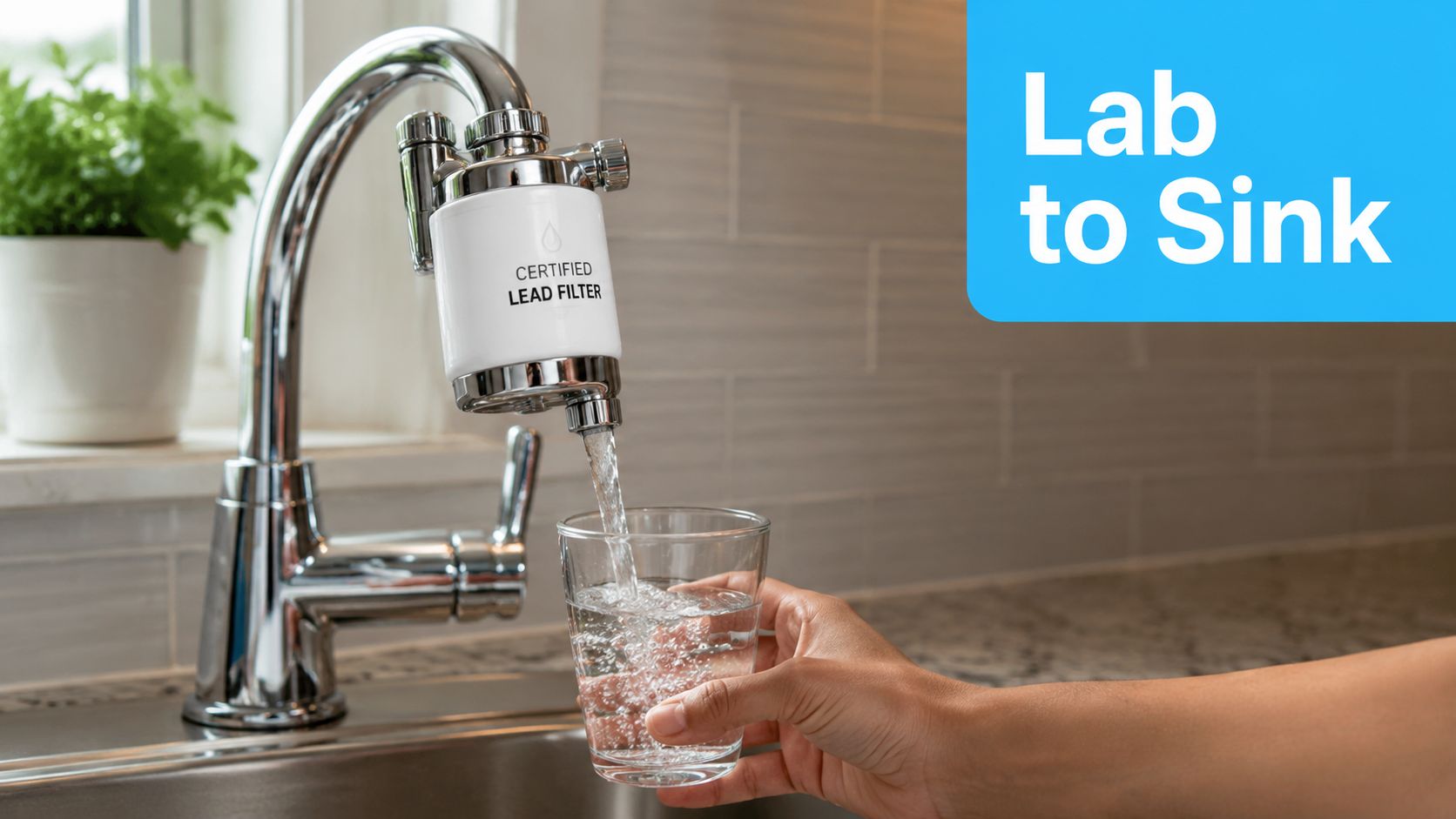
A practical buyer should treat certification as a specific, verifiable performance claim, not as a general badge of quality. The right filter must match the contaminant, the installation point, and the standard used to test it. A certified filter can reduce lead in the water that passes through it, but it isn't a substitute for solving every lead problem in a home's plumbing.
The Difference Between Lead-Reducing and Certified Lead Filters
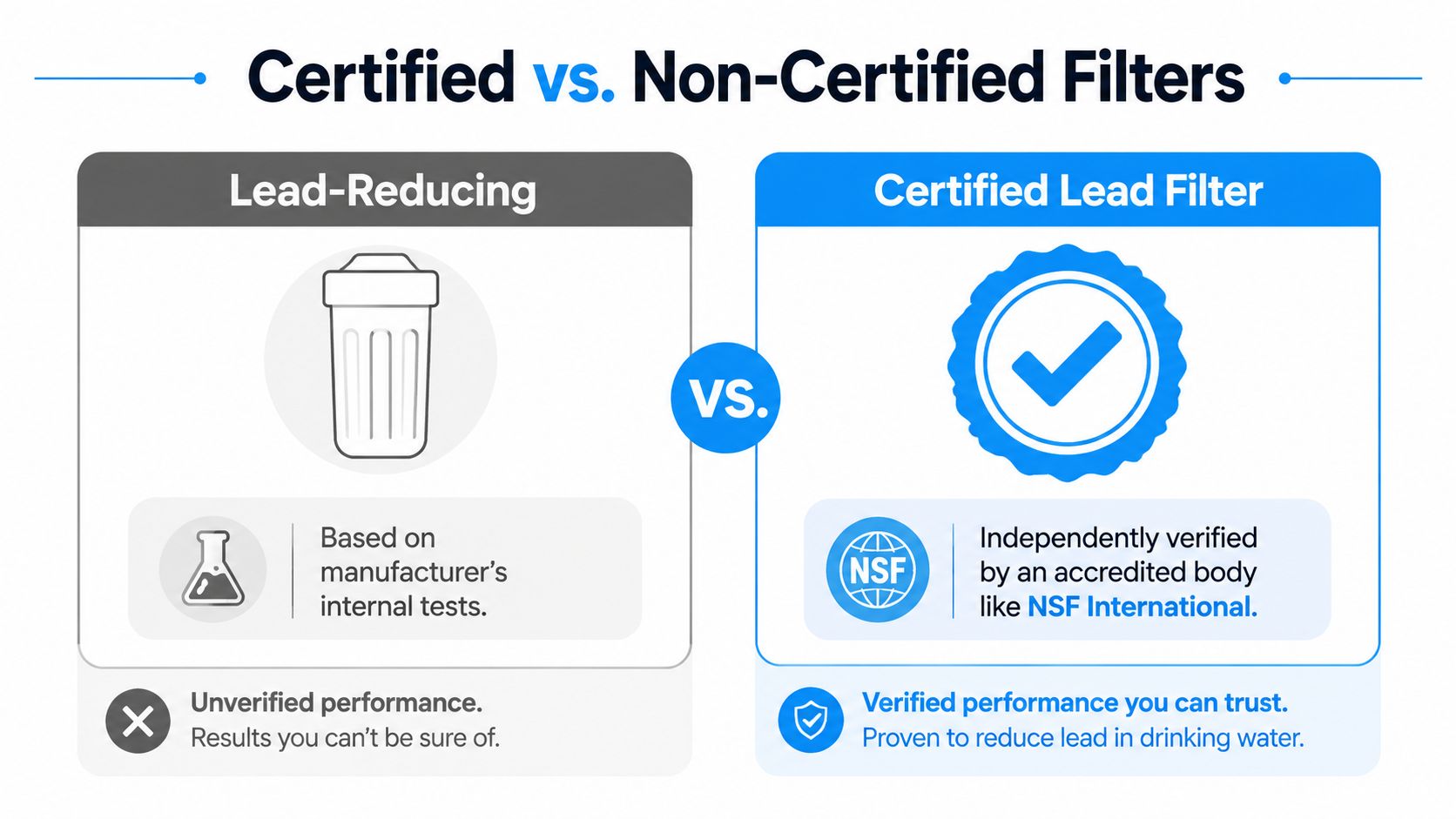
How can two faucet filters make similar claims while offering different evidence? One package may say “reduces lead.” Another may say “certified to NSF/ANSI 53 for lead reduction.” The wording points to different levels of verification.
“Lead-reducing” can refer to a manufacturer's internal test or a broad performance statement. By itself, it may not identify the laboratory, the tested model, the lead concentration used in testing, or whether the result applies to the complete filter rather than one cartridge or material.
Certification connects the claim to a defined standard and an independent evaluation. For household lead filtration, NSF/ANSI Standard 53 covers point-of-use systems for health contaminant reduction, while NSF/ANSI 58 covers reverse osmosis systems, as summarized by Virginia Commonwealth University's lead water management guidance.
What the label should tell you
A claim you can check should identify:
- The exact model: Certification belongs to a listed product. It does not automatically cover every filter from the same brand.
- The testing body: Look for an accredited third-party certifier, then confirm the entry independently.
- The applicable standard: NSF/ANSI 53 and NSF/ANSI 58 apply to different system types.
- The named contaminant: Certification for taste, odor, or chlorine does not establish lead reduction.
- The performance threshold: Current lead-reduction benchmarks focus on reducing lead to 5 parts per billion, or ppb, or less, as shown in the NSF product listings. Readers can use the NSF certified lead-reduction product listings to check a product's entry.
A filter may display an NSF mark for one claim without holding certification for lead. The logo alone therefore cannot answer whether the product addresses your concern.
Practical rule: Read the standard and contaminant claim together. “Certified” without “lead reduction” may not answer the question you're asking.
The U.S. Environmental Protection Agency's consumer tool directs shoppers toward point-of-use and pitcher filters evaluated by an accredited third party for lead reduction to 5 ppb or less. The exact certification record provides stronger evidence than a prominent badge on a retail page, and it gives you details to compare against the model in the box.
Understanding NSF/ANSI Standard 53 and 58
Which certification standard applies to the filter you are considering? NSF/ANSI 53 and NSF/ANSI 58 both address lead filtration, but they cover different types of equipment.
NSF/ANSI 53 generally covers point-of-use drinking-water systems that reduce health-related contaminants. Under-sink filters, faucet-mounted units, countertop systems, and pitchers can fall under this standard when the specific product has been tested and listed for lead reduction.
NSF/ANSI 58 covers reverse osmosis systems. An RO unit pushes water through a membrane and supporting treatment stages under pressure. Because the certification evaluates the complete RO product, check the exact model and confirm that its record includes a lead-reduction claim.
The standard number works like a label on a plumbing component. It identifies the type of system being evaluated, not every contaminant the system might remove. A conventional under-sink carbon-block filter may be evaluated under NSF/ANSI 53, while a reverse osmosis unit may be evaluated under NSF/ANSI 58. Neither standard allows you to assume that the product removes all contaminants.
Why the number on the standard matters
A product page may say “tested to NSF standards.” That wording does not carry the same weight as an independently verifiable certification listing. The NSF explanation of lead-filter testing describes certification testing with challenge water containing 150 ppb of lead, while the U.S. EPA action level is 15 ppb.
Newer lead-reduction requirements use a finished-water benchmark of 5 ppb or less. Certification therefore refers to a defined test protocol and measurable result, rather than serving as a general marketing symbol.
| What to inspect | What it answers |
|---|---|
| NSF/ANSI 53 | Is this point-of-use system evaluated for a health contaminant claim? |
| NSF/ANSI 58 | Is this reverse osmosis system evaluated under the RO standard? |
| Lead-reduction listing | Does the certification specifically cover lead? |
| Exact model number | Does the listing apply to the product you're buying? |
| Rated use | Is the system intended for the drinking-water fixture you need to protect? |
Certification isn't a universal removal promise
A certification supports only the claims shown in the record. A system certified for lead reduction may not address other contaminants. A system certified for chlorine, taste, odor, or another contaminant may not reduce lead.
The EPA Lead and Copper Rule information provides context for interpreting water reports. The rule uses a 15 ppb lead action level, measured at the 90th percentile of tap samples from a public water system. That level triggers utility action when the required sampling conditions are met, but it does not guarantee that an individual home's water contains no lead.
How to Verify Certification in the NSF Database
Could a certification logo cover something other than lead reduction? The product record answers that question. Begin with the filter's full model number, found on the housing, cartridge, manual, performance data sheet, or retailer listing. A product family name is not precise enough.
A practical verification process
- Record the exact model. Similar cartridges may have different certifications.
- Open the NSF certified-product search. Start with the lead-reduction listings and search by brand or model.
- Compare every character. A listing for another size, cartridge, or generation does not automatically cover the product in your hand.
- Read the standard entry. Confirm whether the record names NSF/ANSI 53 or NSF/ANSI 58.
- Check the contaminant claim. Look for lead reduction specifically, rather than chlorine, taste, odor, or particulate reduction.
- Review status and details. Read the product information and the claim the certification permits.
Use the NSF lead-reduction database as the record of reference, not a shortened retailer description. It connects the certification to a specific product. If the exact model is missing, pause the purchase and ask the manufacturer to explain why.
“Uses NSF-certified materials” describes components that contact water. It does not by itself prove that the complete filter has certified lead-reduction performance. Verify the whole treatment system and the stated lead claim, much as you would check both a replacement cartridge and the housing it fits.
The following video may help visual learners read certification information and filter claims:
Save a screenshot or copy of the listing when buying replacement cartridges. Model names, packaging, and configurations can change, so your record helps confirm that a replacement still matches the certified system.
What Laboratory Testing Measures
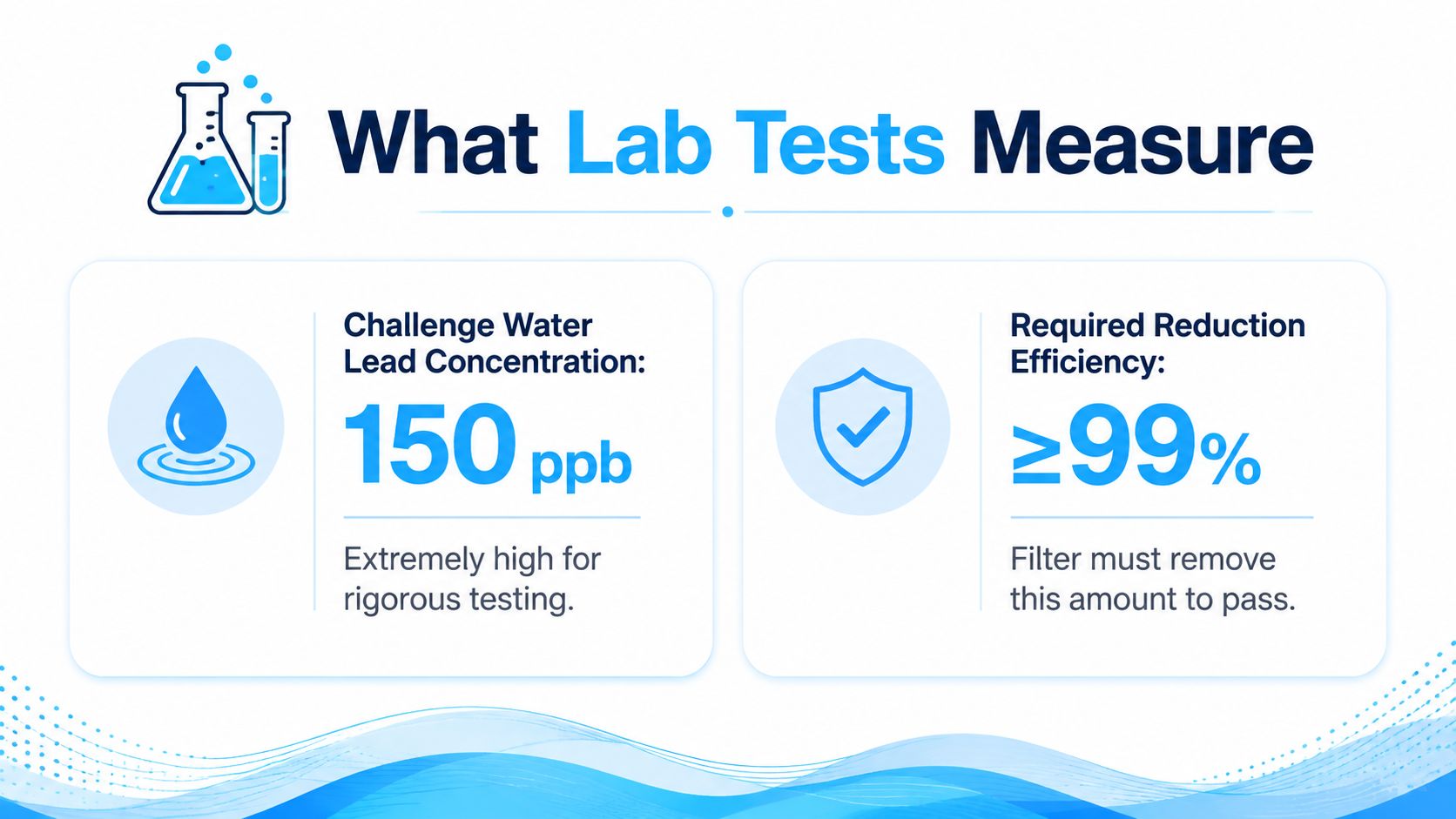
How can a laboratory show that a lead filter will keep working beyond one sample? Certification uses challenge water, prepared with a known contaminant concentration that places the filter under demanding conditions. For lead-reduction certification, that water contains 150 ppb of lead.
That concentration is 10 times the EPA action level of 15 ppb. The comparison matters because a controlled test provides a clear reference, while a casual demonstration may leave the water quality, flow rate, and test conditions unknown.
The test is about more than one sample
A credible evaluation checks whether the complete system can deliver its stated reduction under intended operating conditions. The protocol considers how water moves through the treatment media, how the system is used, and when lead may begin passing through.
Read the laboratory documents for answers to these questions:
- What entered the filter? Challenge water establishes a known lead concentration.
- What left the filter? The finished water is measured against the applicable benchmark.
- Can the system maintain performance? Testing may examine operation through the product's rated capacity, rather than relying on one early sample.
- Does flow affect treatment? The cartridge must work at its intended rate, not only when water moves unusually slowly.
- When does breakthrough occur? Media can lose effectiveness as its capacity is used, which explains why replacement instructions matter.
The laboratory challenge is a controlled stress test, not a prediction that every home receives water with the same lead concentration. A product that meets the required benchmark under those conditions gives stronger evidence than one supported only by a manufacturer's general “lead-reducing” wording.
Why a high-stress test helps at home
Household plumbing varies. Water can sit in pipes, fixtures can differ, and installation can change contact time and flow. Certification does not remove those variables, but it gives homeowners a documented performance reference before they install the filter.
The laboratory record is therefore more useful than a package claim alone. Check the contaminant, challenge conditions, operating rate, capacity, and endpoint in the actual report or certification documentation. Those details show what was tested and define the limits of the claim. A certified result supports confidence in the tested configuration, while correct installation and timely cartridge replacement still determine how the system performs in daily use.
Real-World Performance vs. Certification Claims
Can a certified lead water filter deliver the same protection in a kitchen that it showed during testing? Field performance depends on the connection, installation, water use, and cartridge replacement. Certification provides a tested reference, while daily operation determines whether water passes through that certified treatment.
A review of field performance found strong results across certified products. In a Denver Water challenge study, five NSF/ANSI 42 and 53 certified pitcher filters achieved more than 94% lead removal, and all distributed filters reduced lead below the EPA Action Level of 15 ppb except one sample. These findings add practical support to the certification record, but they do not turn a point-of-use device into whole-home protection.
Another finding cited in Virginia Tech work examined Flint homes with lead levels up to 4,080 µg/L. EPA testing found all point-of-use devices reduced lead to below 1 µg/L. Such results show why certification documents matter: they connect a product's claim to defined testing, rather than leaving “lead-reducing” as a vague package description.
Point of use is the key limitation
A pitcher, faucet filter, or under-sink system treats only the water that flows through it. Water from an unfiltered bathroom faucet, shower, laundry connection, or refrigerator line remains outside that device's certified claim.
| Choice | What it can address | What it doesn't establish |
|---|---|---|
| Certified point-of-use filter | Lead reduction at the treated fixture | Whole-home protection |
| Uncertified “lead-reducing” filter | A manufacturer's stated claim | Independent verification |
| Certified RO system | Lead reduction when the exact RO model carries the claim | Removal of every contaminant |
| Whole-house filter without lead certification | Other treatment goals, depending on its listing | Certified lead treatment |
Installation can also change the outcome. A cartridge installed backward, a poorly seated housing, a bypassed filter, or a replacement that is overdue can undermine the protection shown in certification records. Follow the manufacturer's instructions, confirm that the model matches the documented claim, and use filtered water for drinking and cooking at the connected fixture.
Certification tells you what the product demonstrated. Correct use determines whether your household receives that treatment.
Common Misconceptions About Lead Filtration
Myth one, a whole-house system automatically solves lead. It doesn't. NSF's water-filter FAQ states that no whole-house systems are currently NSF certified for lead treatment. Certified point-of-use systems may be installed at a main drinking-water source, but they still treat only the water that flows through that fixture.
Myth two, the EPA action level is a safe-home threshold. The EPA explains that the 15 ppb action level is a treatment-technique trigger for public water systems, not a health-based guarantee for an individual home, in its Lead and Copper Rule factsheet. A result below that level doesn't mean a household should ignore a lead concern.
Myth three, certification covers every contaminant. It doesn't. Check the exact standard, model, and contaminant claim. A certification for lead reduction doesn't automatically establish performance against other substances.
Read the fact sheet before installing
Look for the rated capacity, flow instructions, installation diagram, replacement guidance, and the specific lead-reduction statement. Keep the model number visible in your records, and replace the cartridge according to the manufacturer's schedule rather than waiting for taste or odor to change.
The federal Safe Drinking Water Act doesn't require consumers to use point-of-use filters or require every consumer filter to undergo certification, so third-party verification remains an important purchasing safeguard. A certified filter is one layer of risk reduction, not a replacement for lead service-line replacement or other plumbing strategies where they're available.
For practical guidance on selecting and maintaining home filtration equipment, consult Water Filter Advisor's filtration advice, then verify any shortlisted product in the certifier's database before purchase.
Water Filter Advisor offers consumer-focused guides, comparisons, and maintenance advice for home filtration systems, including certification details and replacement considerations. Visit Water Filter Advisor to compare filtration options and choose a certified lead water filter that matches the fixture you use for drinking and cooking.
- August 24, 2026
- Uncategorized
