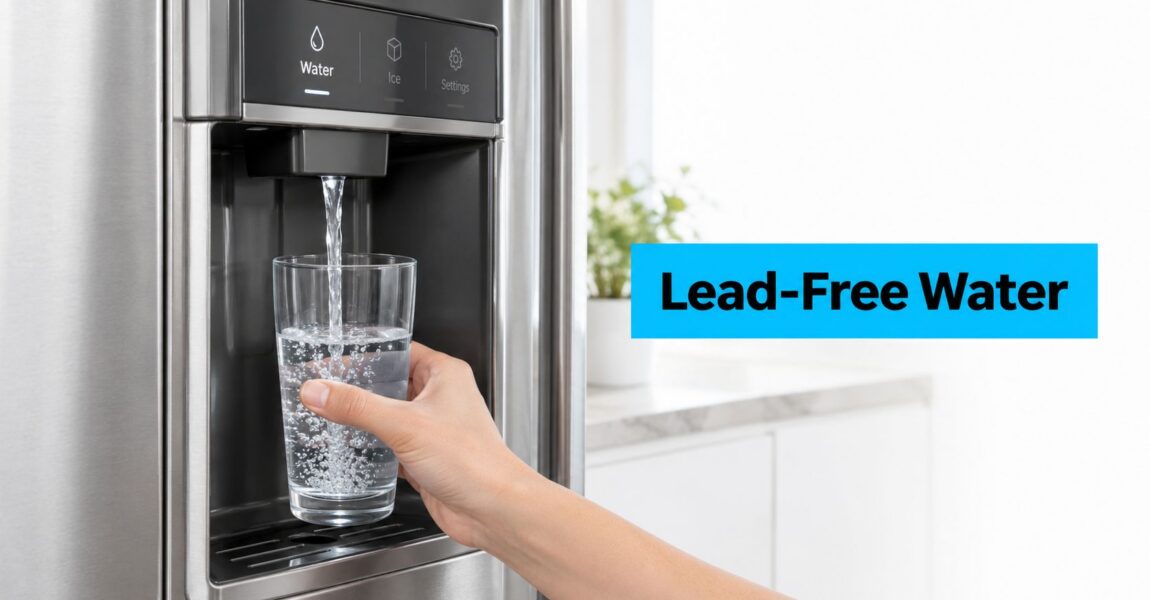
You've replaced the refrigerator cartridge, the water tastes better, and the dispenser works normally. Then a question appears that the packaging may not answer clearly: does the filter remove lead? The refrigerator label alone can't answer that. The exact cartridge, its certification, installation, and replacement status determine what protection you can reasonably expect.
A refrigerator filter can be a useful point-of-use barrier for drinking water and ice, but it isn't automatically a lead filter. NSF/ANSI 53 certification for lead reduction is the key verification, while NSF/ANSI 42 Class I can address particulate reduction. The difference between those claims matters far more than words such as “purifies,” “advanced,” or “heavy-metal filtration.”
Understanding How Refrigerator Filters Handle Lead
A homeowner notices a metallic taste in the kitchen tap and orders a replacement cartridge advertised as a “water purifier.” The new filter fits, the chlorine smell fades, and the water seems cleaner. That improvement can be real, but it still doesn't establish that the cartridge reduces lead.
Refrigerator filtration decisions often go wrong here. Activated carbon commonly improves taste and odor, and some carbon-based products can reduce certain heavy metals. Yet a generic carbon cartridge, a refrigerator-compatible label, or a claim about chlorine reduction doesn't independently verify lead performance. For practical ideas about improving a home's kitchen water setup, the same principle applies: match the treatment claim to the contaminant rather than assuming one device handles everything.
The label isn't the test
Manufacturers may describe a cartridge as reducing impurities, chemicals, or heavy metals. Those phrases are too broad to confirm dissolved-lead reduction. A filter certified only for taste, odor, chlorine, or general particulate reduction shouldn't be treated as a lead-control device.
The relevant question is narrower: does this exact model carry an NSF/ANSI 53 claim for lead reduction? NSF lists refrigerator, aftermarket refrigerator, and integrated refrigerator filters among the products that may be certified for this claim. Certification applies to the specific product and stated operating conditions, not to every cartridge made for the same refrigerator brand.
What a refrigerator filter can cover
A refrigerator cartridge generally treats water delivered through the refrigerator dispenser and ice maker. That makes it useful for the water you drink or freeze, but it doesn't treat the kitchen faucet, bathroom taps, shower, or water used elsewhere in the house.
Practical rule: Treat the refrigerator filter as a targeted drinking-water measure, not as proof that the home's plumbing is free of lead.
The accurate answer to “do refrigerator filters remove lead” is therefore conditional. A cartridge independently certified to NSF/ANSI 53 for lead reduction has verified capability under the certification test. An uncertified cartridge should not be assumed to remove dissolved lead.
What NSF/ANSI 53 Certification Actually Means
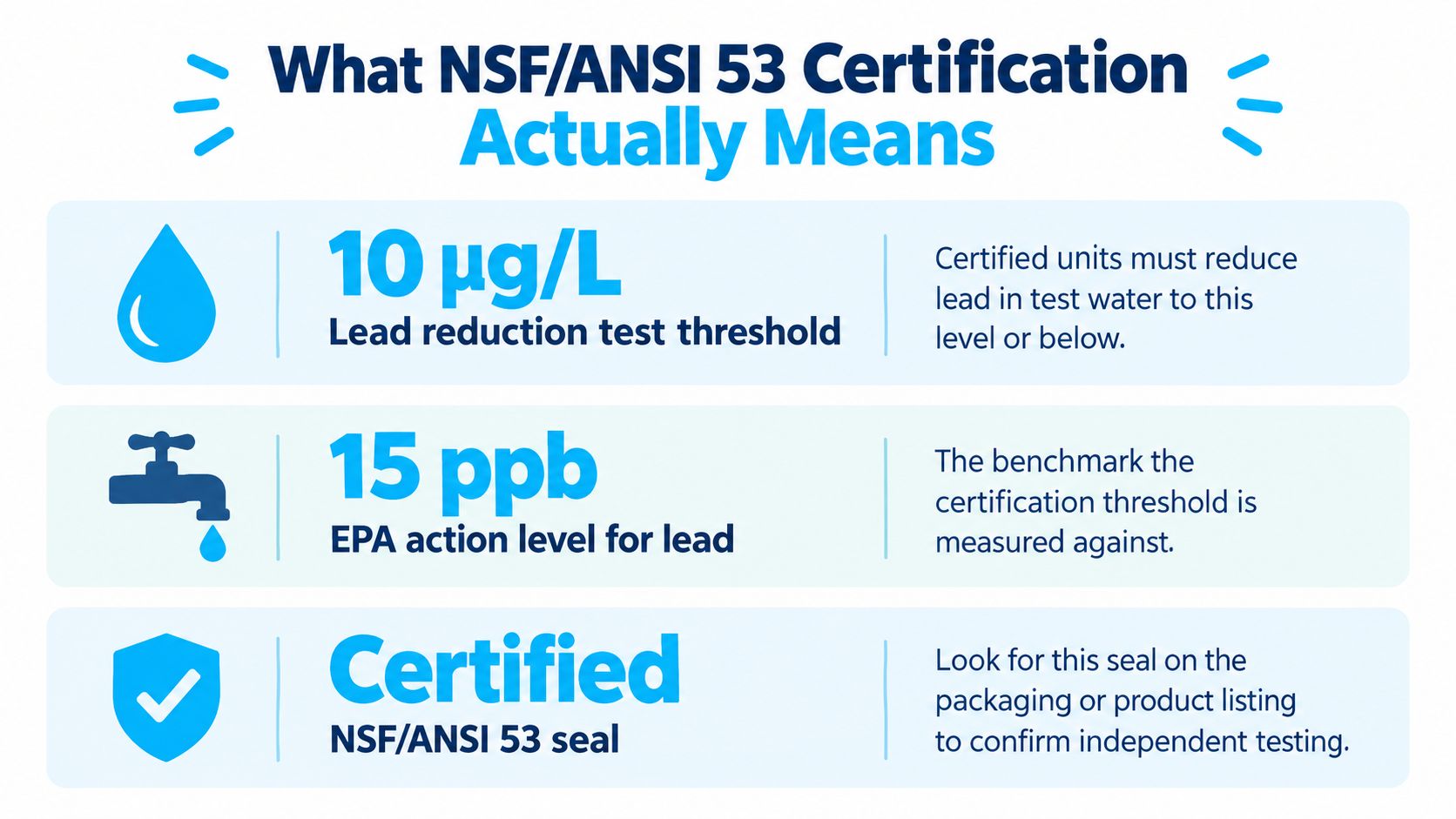
NSF/ANSI 53 gives homeowners a concrete performance benchmark instead of a vague marketing promise. NSF says a certified treatment unit is challenged with water containing 150 parts per billion of lead and must reduce the treated water to less than 5 parts per billion under the certification test. The test is performed over the device's stated performance life, so the claim relates to more than a fresh cartridge used briefly.
That challenge concentration is described by NSF as ten times the U.S. Environmental Protection Agency action level of 15 parts per billion. The comparison doesn't mean a certified filter makes every home's water risk-free. It means the product has been evaluated against a defined lead-reduction requirement rather than merely showing that water tastes better.
Why the contaminant-specific claim matters
A certification isn't a blanket approval for every contaminant. NSF/ANSI 53 for lead reduction supports a lead-specific performance claim. A separate NSF/ANSI 42 Class I claim addresses very small particles, which may contain lead, but it doesn't establish removal of dissolved lead by itself.
That distinction is useful when checking water for chemical risks because a laboratory result may not tell you whether lead is dissolved, particle-bound, or present in both forms. Your treatment choice should reflect the form of contamination and the exact claim attached to the cartridge.
What the benchmark doesn't promise
Certification describes tested reduction performance under stated conditions. It doesn't promise unlimited capacity, perfect performance with incorrect installation, or protection from lead introduced after the filter. Flow rate, water contact, cartridge condition, and rated service life still matter.
The Centers for Disease Control and Prevention states that no safe blood lead level has been identified for young children, and the EPA's maximum contaminant-level goal for lead in drinking water is zero. A certified refrigerator filter can reduce exposure at the dispenser and ice maker, but it should support broader investigation when lead is suspected.
How to Verify Your Refrigerator Filter Certification
Start with the cartridge in your refrigerator, not with a search for a replacement that merely looks similar. Remove the filter or photograph its label, then record the full model number, including letters, numbers, and suffixes. Compatible shapes can conceal different performance claims.
Use a focused verification process
Read the packaging and product data sheet. Look for an explicit NSF/ANSI 53 lead-reduction claim. “NSF tested,” “NSF certified,” or “reduces impurities” isn't specific enough unless the product identifies the relevant standard and contaminant.
Check the exact model in an independent certification directory. Certification applies to particular products, not to an entire brand family. A replacement cartridge may fit your refrigerator while carrying a different certification profile.
Look for NSF/ANSI 42 Class I when particulate protection matters. Standard 42 Class I addresses particulate reduction. It complements, but doesn't replace, the dissolved-lead claim under Standard 53.
Review the performance data sheet. Confirm the stated service life, flow-rate conditions, installation requirements, and contaminants covered. These details define how the certification applies in actual use.
Match the cartridge to the refrigerator. A filter that doesn't seat correctly can leak or allow bypass. Correct compatibility is part of correct treatment, not just a convenience issue.
A simple checklist can prevent an expensive assumption:
| What you find | What it tells you |
|---|---|
| NSF/ANSI 53 lead claim | The model has a specific certified lead-reduction claim |
| NSF/ANSI 42 Class I claim | The model addresses particulate reduction |
| Taste, odor, or chlorine claim only | Lead reduction hasn't been established by that claim |
| No identifiable model certification | Treat the lead performance as unverified |
Don't rely on a refrigerator manufacturer's label alone. The model-specific listing and performance documentation are more useful than a broad statement that the filter is “premium” or “advanced.”
Certified Lead-Reduction Filters vs Generic Carbon Units
The difference between the two products is not just the type of carbon inside. It is the evidence behind the claim.
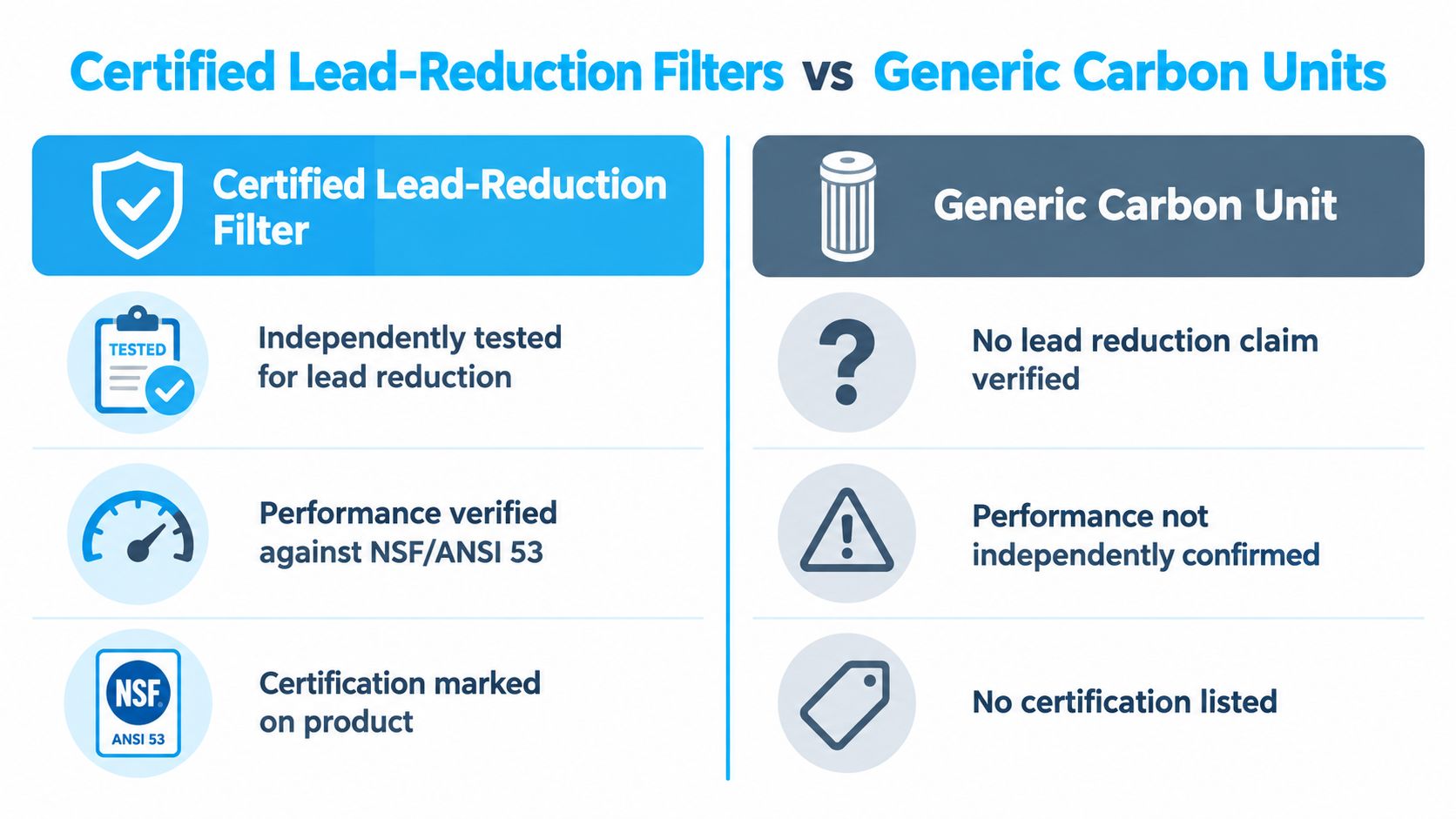
A certified lead-reduction filter has undergone independent evaluation for a defined lead-reduction performance claim. A generic carbon unit may improve chlorine taste, odor, and general water acceptability without having its lead performance independently confirmed. Both may make water taste better, but only one has the relevant certification evidence.
Compare the decision, not just the cartridge
| Certified lead-reduction filter | Generic carbon unit |
|---|---|
| Independently tested for a lead-reduction claim | May focus on taste, odor, chlorine, or sediment |
| Uses NSF/ANSI 53 as the relevant lead standard | May have no verified lead claim |
| Product documentation identifies the certified model | Packaging may use broad filtration language |
| Performance is tied to stated operating conditions | Lead performance remains uncertain without certification |
Carbon can be an important filtration medium, but carbon content isn't the same as a lead certification. A buyer who chooses solely by price, fit, or taste may end up with a cartridge that solves an aesthetic problem while leaving the lead question unanswered.
The practical trade-off is straightforward. A certified cartridge gives you stronger evidence for a specific contaminant, while a generic unit may be adequate when your only concern is taste and odor. If lead is part of the decision, don't substitute a general carbon claim for NSF/ANSI 53 verification.
For readers comparing carbon media and configurations, carbon block filters and their water-treatment role provide useful context. The media description still needs to be matched with a model-specific certification claim.
Addressing Dissolved Lead and Particulate Lead Risk
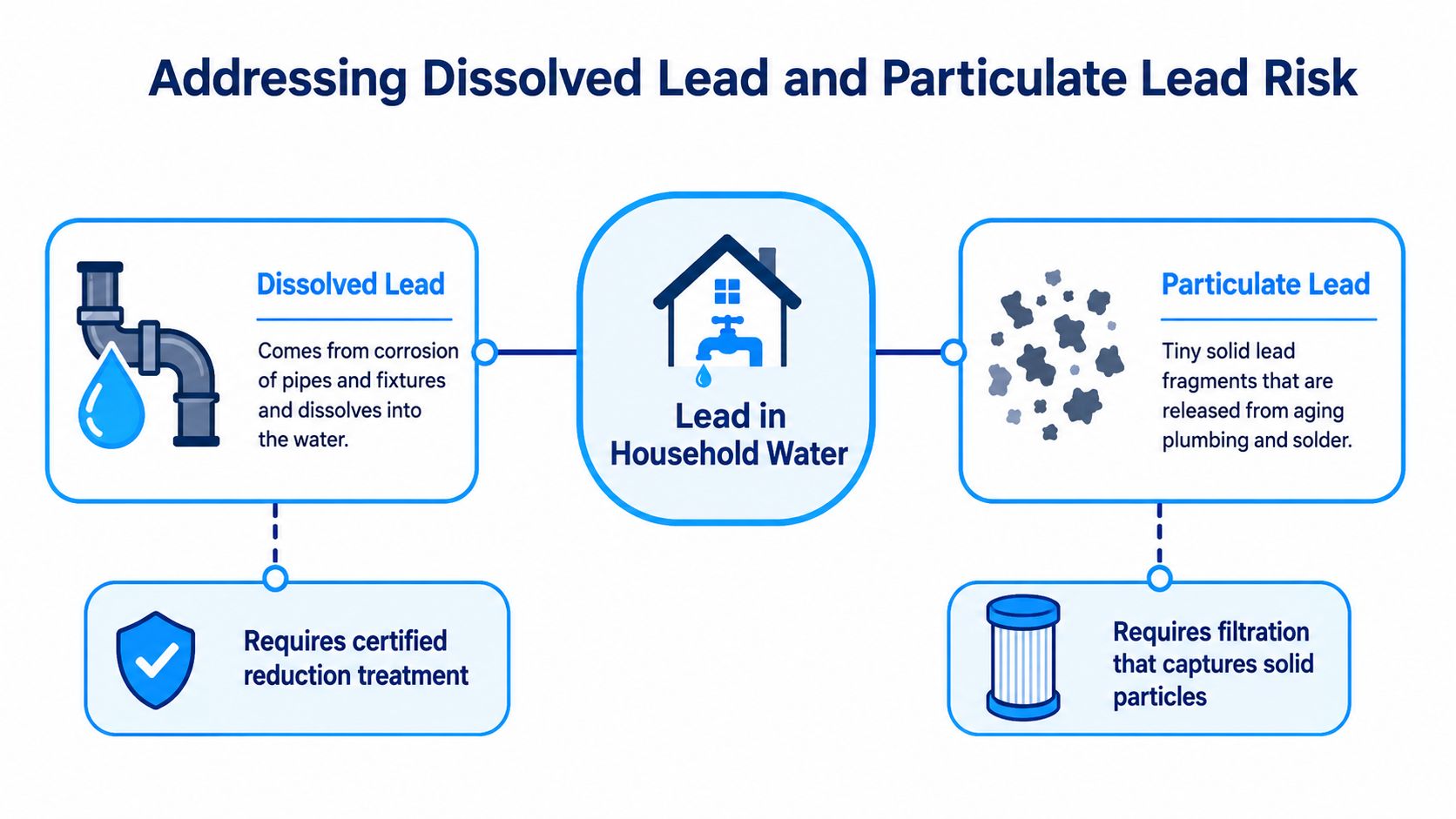
Lead in household water isn't always present in one physical form. Some lead is dissolved in the water, while some can be attached to or contained within tiny solid particles released from plumbing. A refrigerator cartridge selected for only one form may not address the whole concern.
NSF/ANSI 53 is the key certification for dissolved-lead reduction. NSF/ANSI 42 Class I addresses particulate reduction, which can provide additional protection when corrosion releases solid material. The two standards answer different treatment questions.
Dissolved lead
Dissolved lead has passed into the water itself through interactions between water and plumbing components. Because it isn't a visible flake that a basic sediment stage can catch, particulate-only filtration doesn't establish protection against this form.
Look for the exact NSF/ANSI 53 lead-reduction claim. That is the certification that addresses the health-related dissolved-lead question for the cartridge.
Particulate lead
Particulate lead consists of tiny solid fragments or particles that can enter water as plumbing materials corrode or are disturbed. NSF/ANSI 42 Class I is relevant because it covers very small particle reduction. It complements Standard 53 rather than replacing it.
A cartridge carrying both claims gives homeowners a more complete certification profile for the two forms. Still, certification doesn't identify the source in your house. If testing detects lead, investigate the service line, fixtures, solder, and household plumbing rather than treating the refrigerator cartridge as the diagnosis.
Maintaining Filter Performance and Knowing Limits
Certification only helps while the cartridge operates within its rated conditions. An old or incorrectly installed filter may no longer deliver the performance demonstrated during testing, even if the model number remains certified.
Control the operating details
- Follow the rated service life. Replace the cartridge according to the manufacturer's instructions and rated capacity. Don't extend use just because the water still tastes normal.
- Respect flow-rate limits. Water moving too quickly may not receive the intended contact time. Check the performance data sheet rather than guessing from dispenser speed.
- Install the cartridge completely. Confirm that it locks into place and that the housing or connection doesn't allow untreated water to bypass the media.
- Flush as directed. Follow the product's installation instructions before collecting drinking water or making ice.
- Watch for changes. Reduced flow, unusual taste, leaks, or a filter indicator alert can signal that inspection or replacement is due, although normal taste doesn't prove lead performance.
Maintenance matters: The rated replacement interval is an operational control, not a suggestion based only on taste.
A certified filter also isn't a permanent shield. Its test result applies to defined water conditions, contaminant levels, flow, and service life. Household water chemistry, incoming concentration, and installation quality can differ from those conditions.
If you suspect contamination, testing the water provides information that taste and odor cannot. Use the result to decide whether the refrigerator cartridge is an appropriate point-of-use measure or whether the plumbing requires a broader response.
When a Refrigerator Filter Is Not Enough
A refrigerator filter is appropriate for water that passes through the refrigerator dispenser and ice maker. It doesn't treat water from the kitchen faucet, bathroom sink, shower, or other fixtures, and it doesn't protect water used for cooking unless that water also passes through the filtered refrigerator dispenser.
That boundary creates a useful decision framework:
If your concern is limited to drinking water and ice, verify the exact cartridge's NSF/ANSI 53 lead claim and maintain it according to its rated service life. Add NSF/ANSI 42 Class I when particulate reduction is relevant.
If lead has been detected or the plumbing source is uncertain, test the water and investigate the service line, fixtures, and household plumbing. The CDC recommends using tap water that has passed through a point-of-use filter certified by an independent organization to NSF/ANSI 53 for lead removal and NSF/ANSI 42 for particulate removal.
If you need protection at multiple fixtures, a refrigerator cartridge won't provide whole-home treatment. Consider a treatment design suited to the affected points of use, with certification matched to the contaminant and intended application.
If water enters the system after filtration, the cartridge can't remove that later contamination. The plumbing path from the filter to the glass still matters.
The CDC lowered its blood-lead reference value in 2021, from 5.0 micrograms per deciliter to 3.5 micrograms per deciliter, as a population-based reference used to identify children with higher blood lead levels, not as a safe threshold. That context reinforces why families shouldn't interpret a refrigerator filter as permission to ignore a suspected source.
For a broader treatment framework, guidance on removing lead from household water can help you compare point-of-use and wider plumbing responses. The right choice depends on where lead is found, which fixtures need protection, and whether the source has been corrected.
A certified refrigerator filter can reduce exposure from drinking water and ice, but it isn't a substitute for testing or plumbing investigation. Check the model number today, verify NSF/ANSI 53 and, where relevant, NSF/ANSI 42 Class I, then replace any cartridge whose certification or service life you can't confirm.
Water Filter Advisor offers practical guides for comparing refrigerator, under-sink, faucet, and whole-house filtration, along with advice on certifications, replacement cartridges, and water testing. Visit Water Filter Advisor to evaluate your current cartridge and choose a treatment approach that matches the lead risk in your home.
- October 14, 2026
- Uncategorized
