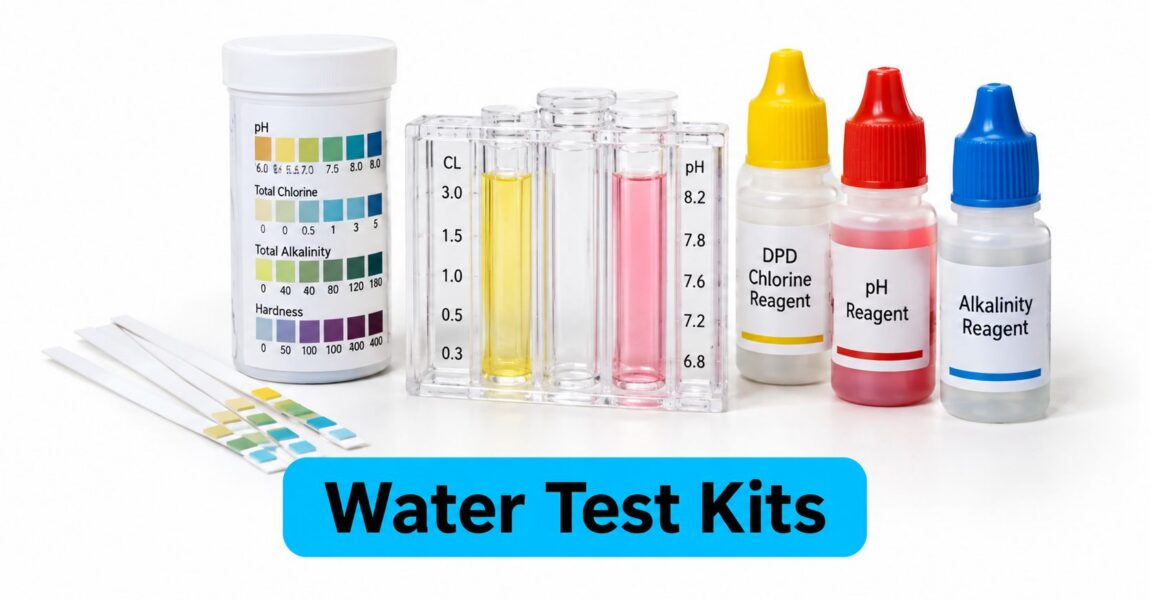
A metallic taste in the morning often sends homeowners straight to the nearest water-testing kit. The first strip may report pH, hardness, chlorine, or a few metals, but that quick screen can still miss the contaminant behind the taste. A consistent color change doesn't prove the result is accurate, especially in real tap or well water.
That's the central question in useful water testing kit reviews: does the kit match your water source, measure the concern you have, and detect it at a meaningful level? The options below are organized around those decisions rather than star ratings. You'll find guidance for municipal tap water, private wells, filtration problems, and suspected contaminants, along with a plain explanation of what each resource can't detect.
Before choosing a filter, identify the water problem. A carbon filter, iron-removal system, softener, or reverse-osmosis unit can only work as intended when the target contaminant is known. For broader context on household water risks, see this guide to preventing illness from recreational water, then use the comparisons below to choose a sensible testing path.
1. Where to Buy Water Testing Kits for Home
You're standing in a hardware aisle or comparing kits online because the water tastes off, leaves scale, stains fixtures, or raises a health concern. The first buying decision is not brand loyalty. It is choosing a test type that fits your water source and the decision you need to make. Water Filter Advisor's buying guide is useful for that first pass because it separates strip tests, reagent kits, and mail-in laboratory options instead of treating them as interchangeable.
That matters in practice. A strip can be enough for a quick municipal tap screen when the question is chlorine, hardness, or a broad change after filter replacement. A reagent or color-disc kit can give you more controlled readings for some common parameters. A mail-in lab test is the better choice when a result may affect a treatment purchase, a conversation with a landlord or utility, or a health-related decision. The guide points readers toward detection limits, certifications, purchase sources, and the specific contaminants each method is intended to measure.
It also supports the right kind of question.
If your water comes from a city supply, you may need a kit that helps sort out chlorine taste, hardness, lead sampling concerns, or disinfection byproducts. If you're on a private well, the useful question shifts toward bacteria, nitrate, metals, and whether a home kit can screen the issue at all. If you suspect one specific problem, such as iron staining or a softener problem, a narrower test can be more useful than a broad panel that reports a long list of parameters without enough sensitivity to guide treatment. Some buyers also end up on unrelated pages, such as this online purchase page. Check that any page you rely on for water-testing decisions actually points you to water-testing or filtration resources.
What it does well
- Format comparison: It separates dip strips, reagent or color-disc kits, and mail-in labs by use case.
- Contaminant matching: It helps you check whether a kit can detect the contaminant you care about at a level that matters for action.
- Buying practicality: It gives direct paths to retail or laboratory options without forcing every reader into the same kind of test.
- Treatment planning: It helps connect the result to the next decision, whether that is carbon filtration, softening, iron treatment, reverse osmosis, or a lab confirmation.
Practical rule: A bigger panel is only useful if the method can measure the target at a level that helps you decide what to do next.
The limitation is that this is still a commercial buying hub. Readers should verify current product claims and certifications before treating any home kit as proof of safety or proof that a filter solved the problem. Home kits also have clear limits. An independent review found that consumer kits could be repeatable yet still vary widely in accuracy across contaminants and water types, with no single brand performing well across every parameter. The 2025 assessment is a good reminder that consistent readings are not the same as correct readings.
Use the page to narrow the test format and the likely purchase path. Then check what the kit cannot detect before you buy. If you're purchasing a property, water testing should also sit alongside a broader sewer scope for homebuyers so you are not treating the water sample as the whole plumbing picture.
2. This Old House
This Old House's water-test-kit guide is built for homeowners who want a short path from concern to purchase. Its 2026-dated presentation separates do-it-yourself strips and drop tests from mail-in laboratory panels, then frames the choice around common household situations such as municipal water, well water, hardness, bacteria, nitrate, and lead.
That structure works for beginners because it starts with the decision rather than laboratory terminology. Someone trying to size a softener needs useful hardness information. Someone worried about an old faucet needs a lead method that explains sample collection. Someone on a private well needs more than a generic “water quality” score.
The filtration trade-off
The guide is helpful for deciding whether a low-cost screen is enough to investigate taste, scale, or chlorine. It's less useful as final authority for a health-related treatment purchase because it isn't a laboratory report and relies partly on vendor information and home-testing experience.
A home kit also cannot prove that a filter removes a contaminant just because the water tastes better afterward. NSF explains that residential treatment products do not have a single all-encompassing federal certification requirement. Certification is tied to a specific contaminant claim and standard, so a general certification mark is not proof of universal purification. NSF's overview of water-treatment standards is essential reading before matching a test result to a filter.
The guide's main weakness is limited methodological transparency. It doesn't provide the depth you'd want for comparing interference, false negatives, or laboratory reference methods. Use it to narrow the field, then check the kit's instructions for sample type, detection limit, expiration date, and whether confirmation is recommended.
For additional homeowner-oriented filtration explanations, Water Filter Advisor's practical water advice is a useful companion. Don't treat either shopping guide as proof that a particular cartridge is suitable until the contaminant and reduction claim line up.
3. Bob Vila
Bob Vila's water-test-kit roundup is most useful when you want category-based recommendations rather than one universal winner. It discusses strips, drop-based tests, mail-in panels, and common use cases such as bacteria screening, lead concerns, and private-well testing.
The plain-English testing impressions are its strongest feature. They help readers understand whether a kit feels manageable at the sink, whether the instructions are clear, and whether a result is easy to interpret. That matters because a technically capable test can still fail in practice when the user collects the wrong sample or reads a color chart under poor lighting.
Use the category, not the badge
A bacteria screen is not a metals panel. A lead test is not a test for iron, copper, nitrate, or volatile organic compounds. A hardness kit can guide softener planning, but it can't tell you whether a well has microbiological contamination or whether plumbing is contributing lead.
The review's product categories make that separation easier, but the original write-up is older. Models, packaging, availability, and claims may have changed, so confirm details on the manufacturer's current page before buying.
Detection limits also receive limited treatment in the summaries. That's a serious omission for lead. Independent research on 16 at-home lead-kit brands judged 12 unsuitable for drinking-water analysis because their stated or observed detection limits were approximately 5 to 20 milligrams per liter, far above drinking-water-relevant concentrations expressed in micrograms per liter. The lead-kit evaluation also found that binary strips performed differently for dissolved and particulate lead.
A lead result is only as useful as the sample method, contaminant form, and detection limit behind it.
Use Bob Vila for accessible product orientation. For filtration decisions, move to a certified laboratory when a result could determine whether you install a lead-reduction cartridge, replace plumbing, or treat a private well.
4. Popular Mechanics
Popular Mechanics' home water-quality guide takes an engineering-minded approach to the familiar split between fast DIY screening and mail-in analysis. Its staff-tested selections include budget and premium choices, with attention to how much information a homeowner receives for a particular situation.
That's valuable because “thorough” often means different things. A strip may cover many visible categories but offer broad color ranges. A reagent kit may provide better control for a narrow parameter. A laboratory panel can investigate a wider set of contaminants, but only if the selected panel matches the source and local risks.
Where it helps
The guide works well for a homeowner deciding whether a basic screen is enough to investigate chlorine taste, pH, or hardness before considering a filtration change. It also gives city-water and well-water owners a clearer sense of when a more involved test is justified.
Its limitation is depth. The 2025 publication date means availability and product details may have shifted, and it isn't a laboratory-methodology report. It doesn't replace checking detection limits, sample preservation requirements, or reference methods.
Private-well owners should be especially cautious about broad scores. CDC summaries report that about one in five sampled private wells contained at least one chemical contaminant at a concentration capable of affecting health. In one CDC-supported program, 26,427 well-water samples were collected, and 4,346, or about 16.4%, came from wells with contaminant levels described as high, affecting approximately 11,000 people. CDC's private-well public-health summary explains why chemical, microbiological, and radiological hazards need different methods and thresholds.
A quick kit can help decide whether to investigate. It can't establish that a well is safe across all those hazard categories or validate a treatment system by itself.
5. Good Housekeeping
Good Housekeeping's water-testing-kit roundup is designed for families who want a short, recognizable shortlist. It includes targeted lead tests, broader strip kits, and mail-in options, so readers can see the basic difference between checking one concern and sending a broader sample to a laboratory.
The format is approachable. If a household is noticing a metallic taste, white scale, or uncertainty about older plumbing, the roundup gives enough orientation to start asking better questions. It also avoids forcing every reader into the most extensive panel.
What it cannot tell you
The article is older, so current models and prices need verification. Its technical treatment of detection limits and interferences is also limited. That means it's a reasonable shopping entry point, not a final technical review.
The biggest filtration mistake is choosing a system from the number of contaminants printed on the box. A strip that covers chlorine and hardness won't confirm lead. A lead-only test won't identify nitrate or bacteria. A filter certified for chlorine taste and odor won't automatically reduce metals, and a shower filter's certification applies only to free available chlorine under the applicable standard, according to NSF.
Use the roundup to separate targeted kits from broad screens. Then read the exact reduction claim on the proposed filter. If your concern is hardness, you may need a softener or scale-control approach rather than activated carbon. If it's iron, look for iron-specific treatment. If it's lead, prioritize a method and filter certification designed for lead reduction.
The best family-friendly test is the one that answers the family's actual filtration question, not the one with the longest parameter list.
For a suspected health contaminant, send a sample to a certified drinking-water laboratory rather than relying on a color match alone.
6. Consumer Reports
Consumer Reports' tap-water testing guidance is less of a product ranking and more of a decision framework. That's its advantage. It explains when a homeowner should use a home kit, when a certified laboratory makes more sense, and how municipal and private-well situations differ.
Start with the water source. Municipal customers can review the utility's annual Consumer Confidence Report, then test at the tap if they're concerned that household plumbing changes the water after it leaves the treatment plant. A well owner has a different responsibility because private wells aren't regulated like public water systems and may not be routinely tested.
A sensible filtration workflow
Use a home kit for a preliminary question such as whether hardness, chlorine, or pH may be contributing to scale or taste. Use laboratory analysis when you're investigating lead, bacteria, nitrate, suspected industrial contamination, a regulatory exceedance, or the performance of a health-focused filter.
The guidance also helps prevent over-testing. Don't order a large panel just because it sounds safer if your concern is a narrow, known issue. At the same time, don't use a cheap strip to rule out contaminants the strip wasn't designed to detect.
EPA recommends that private-well households test at least annually for total coliform bacteria, nitrates, total dissolved solids, and pH. It also recommends additional testing after flooding, nearby land disturbance, new construction or industrial activity, well repairs, or a noticeable change in odor, color, taste, or appearance. EPA's private-well protection guidance says homeowners should use laboratories certified for drinking-water analysis when confirmation is needed.
Consumer Reports doesn't provide a product-by-product ranking, so shoppers seeking a specific box may need another source. That's a feature for careful buyers, not a flaw. The article keeps the focus on the decision a test must support, including whether a filtration purchase is justified.
7. TapWater.org
TapWater.org's water-test-kit comparison is more technical than many shopping roundups. Its 2026-dated guidance emphasizes analyte selection, detection limits, and the difference between city-water and well-water testing. It also discusses situations that may require laboratory analysis, including lead, arsenic, VOCs, and PFAS.
That orientation suits readers who are already thinking about filtration performance rather than just taste. A treatment system needs a defined target. If the test doesn't detect the contaminant at a useful level, the resulting filter choice may be poorly matched from the start.
Strong on limits, cautious on authority
The city-versus-well split is practical. Municipal customers can compare a tap sample with utility information, while well owners need to account for local geology, land use, and changes around the property. The site also makes a useful distinction between fast screening and laboratory panels.
It's a newer and less widely known resource, so verify third-party laboratory details, current availability, and the exact scope of any recommended panel. Links to outside laboratories can also make pricing and reporting formats vary.
Lead sampling deserves special attention. EPA specifies a 250-milliliter first-draw sample collected immediately after opening the faucet or valve, with no water allowed to run first. The purpose is to capture water that has been sitting against plumbing or fixtures. EPA's residential lead-sampling module explains why a first-draw sample and a flushed sample answer different questions.
A kit that doesn't explain container size, stagnation time, faucet choice, and laboratory shipping requirements produces a result that may be difficult to interpret. TapWater.org is useful for spotting those gaps, but it can't turn an unsuitable strip into a certified test.
7-Site Water Test Kit Review Comparison
| Source | 🔄 Implementation Complexity | ⚡ Resource Requirements | 📊 Expected Outcomes / ⭐ Quality | 💡 Ideal Use Cases | ⭐ Key Advantages |
|---|---|---|---|---|---|
| Where to Buy Water Testing Kits for Home (Water Filter Advisor) | Low → High, explains DIY vs lab workflows | Minimal for strips; moderate–high for certified labs (fees, shipping) | 📊 Practical accuracy guidance; ⭐⭐–⭐⭐⭐ depending on kit | Selecting/purchasing the right kit; comparing detection limits | Comprehensive comparisons, retailer links, detection-limit details |
| This Old House | Low → Moderate, beginner-friendly steps | Mostly DIY kits; some lab panel options | 📊 Good for basic screening; ⭐⭐ | Homeowners deciding municipal vs. well testing | Easy to scan; clear trade-offs and homeowner advice |
| Bob Vila | Low → Moderate, category rundowns and impressions | DIY strips to mail-in labs across budgets | 📊 Practical testing notes; ⭐⭐ | Readers wanting product mini-reviews and picks | Plain-English impressions; wide selection across budgets |
| Popular Mechanics | Low → Moderate, staff-tested selection process | DIY and premium lab options; varies by pick | 📊 Balanced recommendations; ⭐⭐–⭐⭐⭐ | Choosing testing depth (quick screen vs. lab) | Engineering-minded tests; clear DIY vs lab differentiation |
| Good Housekeeping | Low, curated shortlist approach | Primarily DIY & some mail-in recommendations | 📊 Family-friendly results; ⭐⭐ | Families/homeowners wanting a concise shortlist | Trusted consumer voice; simple shortlists for quick decisions |
| Consumer Reports | Low → Moderate, guidance-first framework | Emphasizes when to use labs; includes price context | 📊 Helps avoid over/under-testing; ⭐⭐⭐ (independent) | Independent decision-making; municipal vs. well guidance | Independent, consumer-advocacy recommendations |
| TapWater.org | Moderate → High, technical, analyte-focused | Higher: recommends analyte panels and accredited labs | 📊 Technical accuracy focus; ⭐⭐⭐ | Users needing detection-limit detail (PFAS, arsenic, VOCs) | Technical analyte checklists and detection-limit emphasis |
Match Your Test to Your Water Source Before You Buy
The most reliable buying path starts with the source, not the brand. Municipal tap water, private well water, and a suspected plumbing problem create different testing needs. A homeowner with city water may begin by reading the utility's annual water-quality report, then test the kitchen tap if an older building, faucet, or service line could be changing the water before it reaches the glass.
Private-well owners should treat home kits as screening tools, not complete safety programs. EPA recommends annual testing for total coliform bacteria, nitrates, total dissolved solids, and pH, with additional testing after flooding, nearby disturbance, repairs, construction, industrial activity, or a noticeable change in the water. A certified laboratory is the right follow-up when the result could affect health, a treatment purchase, or a regulatory decision.
A suspected specific problem calls for a targeted test. Metallic taste may justify checking iron, copper, or lead, but taste alone can't identify the cause. White scale points toward hardness, while chlorine odor may call for a chlorine test and a review of activated-carbon filtration. None of those tests automatically detects bacteria, nitrate, arsenic, VOCs, PFAS, or every other contaminant a household might face.
Use this decision path:
- Municipal water: Review the utility report, then test at the tap if plumbing or taste is the concern.
- Private well: Use periodic certified laboratory testing, with a home kit only for preliminary screening or trend checks.
- Single suspected contaminant: Choose a targeted method with a stated detection limit near the relevant health benchmark.
- Filter validation: Compare the test target with the filter's exact contaminant-reduction claim and certification.
- Unclear or concerning result: Stop treating the kit as definitive and arrange certified laboratory confirmation.
Choose the treatment only after you know what needs to be removed. Activated carbon can address selected taste-and-odor concerns, iron treatment requires an iron-specific approach, and reverse osmosis is not a universal answer for every well-water problem. A result near a health standard deserves confirmation before you install equipment or assume the water is safe.
The best next step is concrete. Order one certified laboratory panel suited to your source, or buy one targeted kit for the single concern you can clearly name. Keep the report, record the sample location and method, and use those findings to select filtration rather than choosing a system from marketing claims. For additional household pool-related guidance, see these Peoria pool testing tips, but keep pool chemistry tests separate from drinking-water decisions.
Water Filter Advisor helps households compare water-testing kits with whole-house, under-sink, faucet, shower, refrigerator, and portable filtration options, including guidance on contaminants, certifications, cartridges, and maintenance. Visit Water Filter Advisor to match your test result with a filtration system that addresses the specific problem in your home.
- October 10, 2026
- Uncategorized
