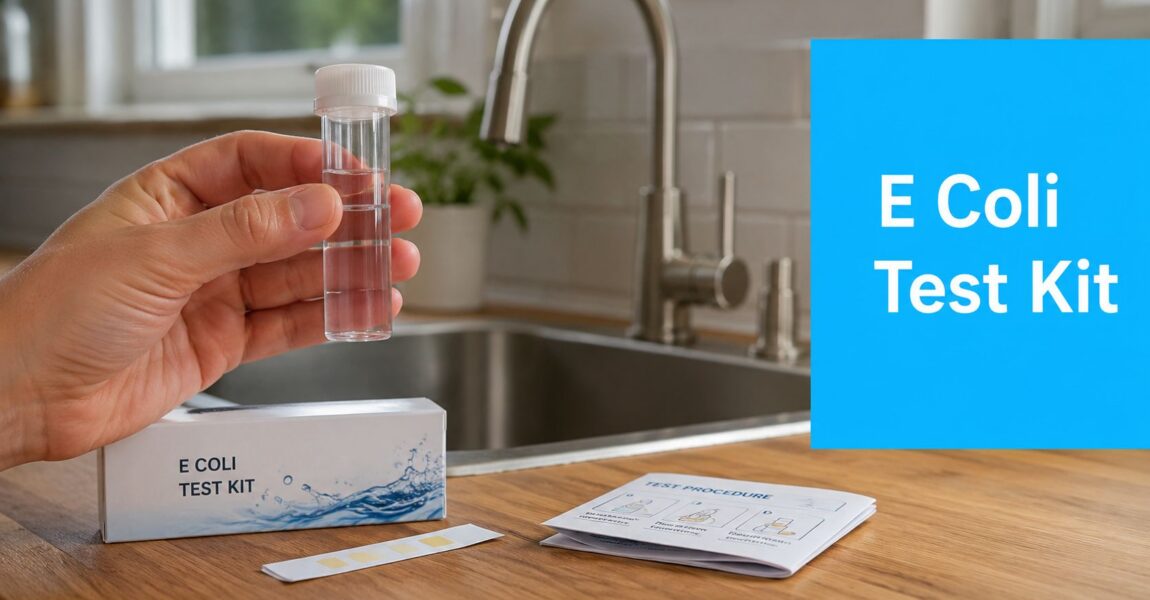
Choosing the Right Water Filters for Coliform Bacteria

So, you've got a microscopic party happening in your pipes, and coliform bacteria are the uninvited guests. What's the plan? You need a bouncer, a filtration system that either zaps these critters into oblivion with ultraviolet (UV) light or physically blocks them with a barrier so fine they can't sneak through, like reverse osmosis or ultrafiltration. The mission is simple: neutralize the bacteria or trap them so they never make it to your morning coffee.

Understanding Coliform Bacteria: Your Water's Unwanted Guests

Think of coliform bacteria as the smoke alarm for your water supply. Just finding them doesn’t mean your house is on fire, but it’s a blaring warning that your water's defense system has been breached. It’s a sign that a pathway exists for more dangerous germs to crash the party.

Before you can pick the right bouncer for your plumbing, you need to know who you're dealing with. These microscopic intruders can show up in city water from old, cracking pipes or in private wells thanks to a leaky septic tank or farm runoff.

The Coliform Family Tree

Not all coliforms wear the same villainous cape. The type found in your water test tells you if you're dealing with a petty thief or a master villain. Labs usually test for three categories, and each one paints a different picture of your water’s safety.

  • Total Coliforms: This is a huge, sprawling family of bacteria living all around us—in soil, on plants, and in rivers. Most are as harmless as a housefly. But if they're in your drinking water, it means the front door has been left wide open for nastier microbes to wander in.

  • Fecal Coliforms: This is a smaller, more concerning sub-group of total coliforms. They come from the gut and waste of warm-blooded animals (yep, including us). Finding these is a major red flag that your water was recently contaminated by sewage or animal manure. Time to pay attention.

  • E. coli (Escherichia coli): The most infamous member of the fecal coliform family, E. coli is the clearest sign of recent fecal contamination. While most types of E. coli are just harmless gut dwellers, some nasty strains can make you seriously sick with stomach-twisting gastrointestinal issues.

Finding any of these in your water means it's time to take action. A positive test for fecal coliforms or E. coli means you need to act fast to keep your family safe.

How These Party Crashers Get In

Contamination isn't just a problem for rustic farm wells—it can happen anywhere. If you live in a city, old pipes and water main breaks can create tiny cracks where dirt and bacteria sneak into the treated water supply long before it reaches your home.

Well owners have their own set of worries. The contamination trail often starts at sources like:

  • A failing septic system weeping into the groundwater.
  • Runoff from nearby farms carrying animal waste.
  • Cracks in the well casing or a poorly sealed wellhead letting surface water trickle in.

This is a massive global issue. In 2022, the World Health Organization estimated that at least 1.7 billion people around the world drink from water sources contaminated with feces. According to WHO guidelines, safe water should have zero detectable E. coli in a 100 mL sample. That incredibly strict standard is what drives the technology behind modern bacteria filters.

To really get a handle on preventing coliforms, you have to look at your entire water system. This even includes things like maintaining clean water tanks, where bacteria can set up a colony if they aren't cleaned out. A positive test result is your signal to find the source of the problem and put a reliable filter in place.

The Real Health Risks of Contaminated Water

When you find coliform bacteria in your water, it's not just a minor inconvenience—it's a massive red flag. Your water system is supposed to be a closed, protected pipeline. The presence of coliforms is like finding a crack in that pipe, a breach that allows all sorts of nasty things from the outside to get in.

That crack opens the door for genuinely dangerous pathogens like E. coli O157:H7, Salmonella, and Giardia. These aren't your average germs. They're capable of causing severe gastrointestinal illnesses, leading to debilitating cramps, vomiting, and diarrhea. Ignoring a positive coliform test is, frankly, a gamble you don't want to take with your family's health.

Protecting Your Home's VIPs

A healthy adult might fight off a low-level exposure and just feel a bit off for a day. But for others in your home, the stakes are significantly higher.

  • Children: Their immune systems are still under construction, making them far more susceptible to severe symptoms and the dangerous effects of dehydration.
  • The Elderly: As we age, our immune responses naturally weaken, which can turn a common waterborne bug into a serious health crisis.
  • Immunocompromised Individuals: For anyone dealing with a chronic illness or undergoing medical treatments, exposure to these pathogens can be life-threatening.

The point isn't to scare you; it's to give you a clear-eyed view of the urgency. A reliable water filter isn't a luxury; it's the last line of defense, a crucial barrier that protects everyone under your roof from these invisible threats.

The connection between contaminated water and disease on a global scale is staggering. Unsafe water contributes to an estimated 1.7 million deaths each year. In fact, a shocking 88% of diarrheal diseases worldwide are traced back to unsafe water, inadequate sanitation, and poor hygiene, highlighting just how critical effective filtration is for public health.

More Than Just Bacteria in Water

A compromised water supply is often a symptom of a larger environmental issue in your home. It’s a sign that the whole system may need a closer look. Beyond the immediate worry of waterborne bacteria, homeowners should also be understanding the health risks associated with common household mould, another contaminant that can thrive in damp environments and impact both air and water quality.

Ultimately, a positive coliform test means the natural or municipal safeguards for your water have failed. Taking swift, decisive action is the only responsible next step. Installing the right water filters for coliform bacteria is how you restore that protective barrier and ensure every tap in your home delivers clean, safe water.

How to Confidently Test Your Home Water Supply

You can't fight an enemy you can't see. Before you even think about buying a water filter for coliform bacteria, you have to know for sure if they're actually in your water. This isn't a time for guesswork—you need solid data.

The good news? Testing your water is pretty straightforward. You have two main options: send a sample to a professional lab or use a simple at-home test kit. Both are useful, but only one gives you the concrete proof needed to make big decisions about your water treatment.

Professional Lab Testing: The Gold Standard

For absolute certainty, nothing beats getting a professional water analysis from a state-certified laboratory. This is the only way to get a precise, legally defensible result, which is a must if you're on well water or need to know just how bad the contamination is.

Finding a certified lab is easier than you might think. Your local health department is a great place to start, or you can check the EPA's website for a list of accredited labs in your area. Once you get in touch, they'll send you a specialized collection kit with sterile bottles and very specific instructions.

Following their instructions to the letter is critical. If you don't, you could easily contaminate the sample yourself and get a false positive. Here’s the basic rundown:

  1. Pick the Right Faucet: Go for a cold-water tap you use often. One without an aerator screen, like a bathtub faucet, is ideal.
  2. Prep the Tap: Take off any aerators or filters. Wipe down the end of the faucet with an alcohol swab or a diluted bleach solution, then let the cold water run for a few minutes to flush the pipes.
  3. Collect the Sample: Fill the bottle to the line without letting the rim touch anything. Screw the cap on tight right away and stick the sample in the fridge until you can get it to the lab, usually within 24 hours.

The lab will take it from there, giving you a clear report that says whether total coliforms, fecal coliforms, or E. coli are present.

At-Home DIY Test Kits

If you just want a quick check, at-home test kits are convenient and fast. You can find them easily online or at hardware stores, and they'll give you a simple "present" or "absent" result for total coliforms, often in about 48 hours. They're perfect for an initial screening or for doing periodic spot-checks between professional tests.

Just be aware of their limits. These DIY kits aren't as sensitive as a lab analysis and are prone to user error during collection, which can mess with the results.

Contamination isn't just a problem for remote wells. A 2023 survey in one California valley found total coliforms in a shocking 50% of tap-water samples and 41% of school fountains. It’s a powerful reminder of how widespread these invisible threats can be. This is exactly why regular testing is so important for catching risks before they turn into health problems. You can discover more about these microbial survey findings and what they mean for public health.

Bottom line: if an at-home kit comes back positive, your very next step should be to confirm it with a professional lab test. Think of the home kit as the smoke alarm—it tells you there might be a problem. The lab test is the firefighter who comes in to confirm if there’s a real fire and where it’s coming from. Once you have that confirmation, you can confidently move forward and choose the right filtration solution for your home.

Comparing Filtration Technologies That Stop Bacteria

So, your water test came back positive for coliform bacteria. The next logical step is to pick the right shield to protect your home's water supply. This isn't a job for your standard pitcher filter; those are great for taste and odor, but they won't touch microscopic threats like bacteria. You need a system specifically built for the task.

Let's dive into the heavy hitters—the proven technologies that either physically block bacteria or neutralize them completely, making sure your tap water is safe to drink.

The Power of Inactivation: UV Disinfection

Think of a UV disinfection system as giving bacteria a lethal sunburn. Water flows through a chamber where it's blasted with a powerful UV lamp. This intense light zaps the DNA of bacteria, viruses, and other nasty microorganisms, turning them into harmless, sterile zombies.

It's important to understand that this process doesn't remove the bacteria; it just renders them sterile and harmless. They can't reproduce or make you sick. The biggest plus here is that UV is a chemical-free process, so it doesn't change the taste or smell of your water one bit.

  • Pros: Extremely effective, with a 99.99% kill rate against a huge range of pathogens. It adds no chemicals, requires low maintenance (just an annual bulb change), and doesn't waste any water.
  • Cons: It needs electricity to run and won't work well in cloudy or murky water, as sediment can literally shield bacteria from the UV light. It also doesn't remove other contaminants like chlorine or heavy metals.
  • Best For: Well water owners who need a reliable, whole-house defense against microbiological threats. It's almost always paired with a sediment pre-filter to ensure the UV light has a clear shot at the contaminants.

The Ultimate Sieve: Reverse Osmosis

Reverse Osmosis (RO) is less of a zapper and more of an impenetrable barrier. It works by using high pressure to force water through an incredibly fine membrane. The pores in this membrane are minuscule—around 0.0001 microns—which is so small that bacteria, viruses, lead, chlorine, and even dissolved salts are left behind and flushed away.

RO systems are the champions of purification, producing exceptionally clean water. The trade-off is that the process is slow, which is why they're usually installed as point-of-use systems under the kitchen sink, feeding a dedicated faucet for drinking and cooking water.

Key Takeaway: The difference between disinfection (UV) and filtration (RO) is critical. UV zaps bacteria, rendering them harmless but leaving them in the water. RO physically blocks and removes them, flushing them away with the wastewater.

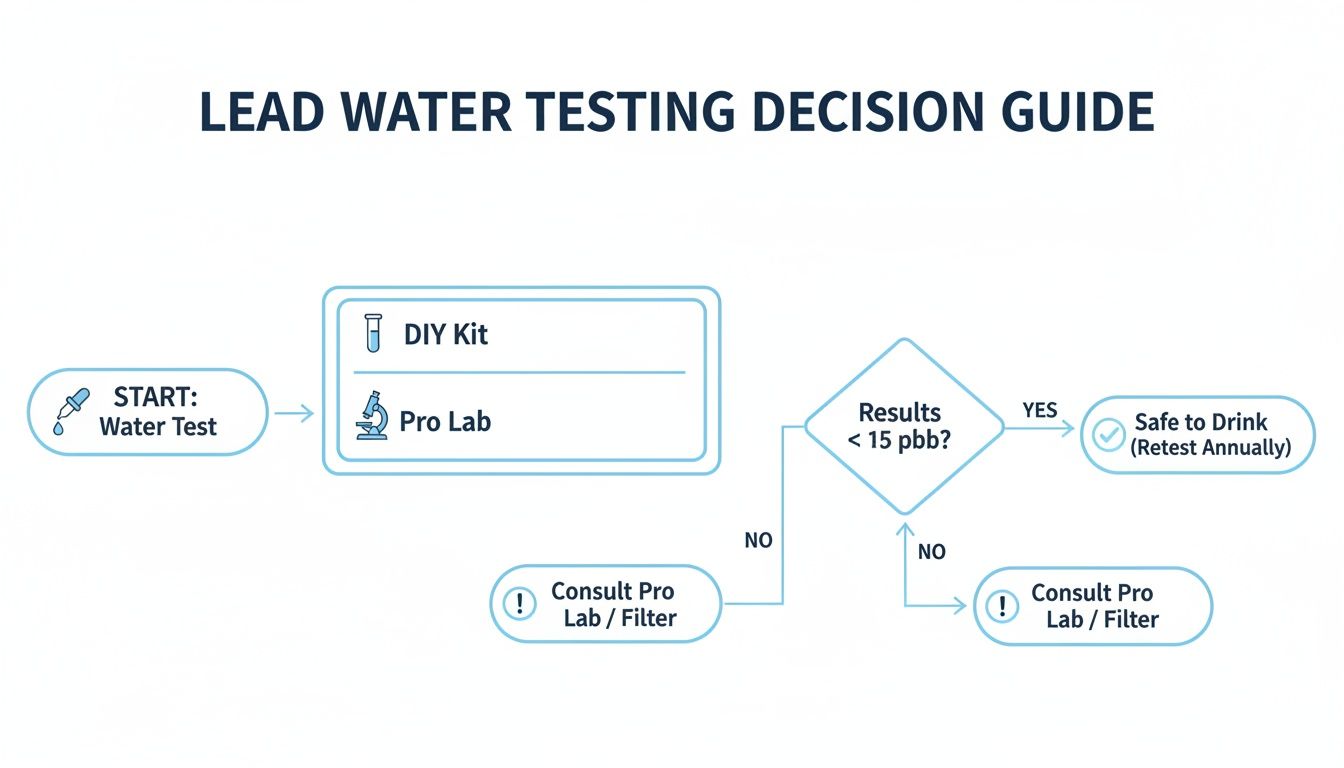
Before you choose a system, you need to be certain about what's in your water. The infographic below shows the two main ways to confirm contamination.

As you can see, a full lab test gives you the complete picture, while a home kit is great for a quick, preliminary check.

Comparing Water Filter Technologies for Coliform Removal

To make sense of all the options, it helps to see them side-by-side. This table breaks down the most effective methods for getting rid of coliform bacteria, comparing how they work, how well they perform, and what they'll cost you.

Technology How It Works Effectiveness on Coliforms Pros Cons Best For
UV Disinfection Scrambles microbial DNA with ultraviolet light, rendering them harmless. Very High (99.99% inactivation) No chemicals, no wastewater, low maintenance, keeps healthy minerals. Requires electricity, ineffective in cloudy water, doesn't remove other contaminants. Whole-house treatment for well water with known biological contamination.
Reverse Osmosis (RO) Forces water through a semipermeable membrane with tiny pores (0.0001 microns). Extremely High (Physical removal) Removes a vast range of contaminants including bacteria, viruses, metals, and salts. Wastes water, removes healthy minerals, slower flow rate, requires a storage tank. Point-of-use (e.g., under-sink) systems for the purest possible drinking water.
Ultrafiltration (UF) Pushes water through a hollow fiber membrane with pores of 0.01-0.1 microns. High (Physical removal) Blocks bacteria and viruses without wasting water or removing minerals. Doesn't remove dissolved contaminants like salts, chlorine, or lead. Point-of-use or whole-house systems where mineral retention is desired.
Ceramic Filters Uses the natural, complex pore structure of ceramic to physically trap bacteria. High (Physical removal) Inexpensive, no electricity needed, long-lasting and cleanable filter elements. Slow filtration rate, can be brittle, requires regular cleaning to prevent clogging. Gravity-fed countertop units, portable filters, and emergency preparedness.
Distillation Boils water to create steam, leaving contaminants behind, then condenses it back to liquid. Extremely High (Complete removal) Removes nearly all contaminants, including bacteria, minerals, and heavy metals. Very slow process, high energy consumption, removes healthy minerals. Creating small batches of highly purified water for specific uses (not practical for whole-house).

Each of these technologies offers a solid defense against coliforms, but the right one for your home depends on your specific water test results, your budget, and how you use your water every day.

Other Effective Technologies

While UV and RO get most of the attention, a few other technologies are excellent at stopping coliform bacteria in their tracks.

Ultrafiltration (UF)

You can think of Ultrafiltration as a slightly less extreme version of Reverse Osmosis. Its membrane has larger pores (around 0.01 to 0.1 microns), but that's still more than small enough to physically block bacteria, parasites, and even some viruses.

Unlike RO, UF systems don't need a storage tank and don't produce wastewater, which makes them much more efficient. The downside is that they won't remove dissolved minerals or salts, so the water's mineral content remains unchanged.

Ceramic Filters

These classic filters rely on the natural, maze-like pore structure of ceramic to trap contaminants. The pore size is small enough to physically block bacteria and larger protozoan cysts. You'll often find them in gravity-fed countertop systems or portable filters, making them a fantastic choice for renters or for your emergency prep kit.

Distillation

This method is a perfect imitation of the Earth's natural water cycle. Water is boiled, turning it into steam and leaving everything else—bacteria, minerals, you name it—behind. The steam is then cooled and condenses back into pure, clean water. While it’s incredibly effective, distillation is slow and uses a lot of energy, making it impractical for a whole-house solution but great for producing small amounts of purified water.

Your Homeowner's Selection Checklist

Feeling a bit buried under all the technical specs and different options? Let's cut through the noise. This checklist is designed to walk you through the process, turning what seems complicated into a series of clear, manageable steps.

Think of it as your roadmap. We’ll go step-by-step, making sure you’ve covered all the important bases before you decide on the right water filter for coliform bacteria for your home.

Step 1: Confirm the Contamination

Before you spend a dime on equipment, you need to know exactly what you’re dealing with. A positive lab test is your non-negotiable starting point.

  • Get a Lab Test: At-home kits are fine for a quick check, but a state-certified lab gives you the definitive answer. It provides precise, reliable results, telling you if you have total coliforms, fecal coliforms, or even E. coli.
  • Understand Your Results: What kind of bacteria shows up will determine how quickly you need to act. Any sign of E. coli means you need a serious solution, and you need it now.
  • Identify the Source: If you're on a well, a positive test is your cue to inspect the wellhead, casing, and any nearby septic systems for problems. If you're on city water, the issue could be somewhere in your home's own plumbing.

Step 2: Decide Your Scope of Protection

Now, think about where you need clean water. Are you just worried about drinking and cooking, or do you want every tap in the house to be safe? This is the point-of-use vs. point-of-entry decision.

Point-of-Use (POU) Systems: These systems treat water at a single spot, like your kitchen faucet.

  • Examples: An under-sink reverse osmosis unit or a countertop water distiller.
  • Best For: When you only need purified water for drinking and cooking. They're also a great option for renters who can't make major changes to the plumbing.

Point-of-Entry (POE) Systems: Often called whole-house systems, these are installed right where the main water line enters your home.

  • Examples: A whole-house UV disinfection system, usually installed with a sediment filter right before it.
  • Best For: When you want every single tap—from the kitchen and bathrooms to the shower and laundry—to be protected. This is the gold standard for anyone dealing with a contaminated well.

Step 3: Match the Filter to Your Water Source

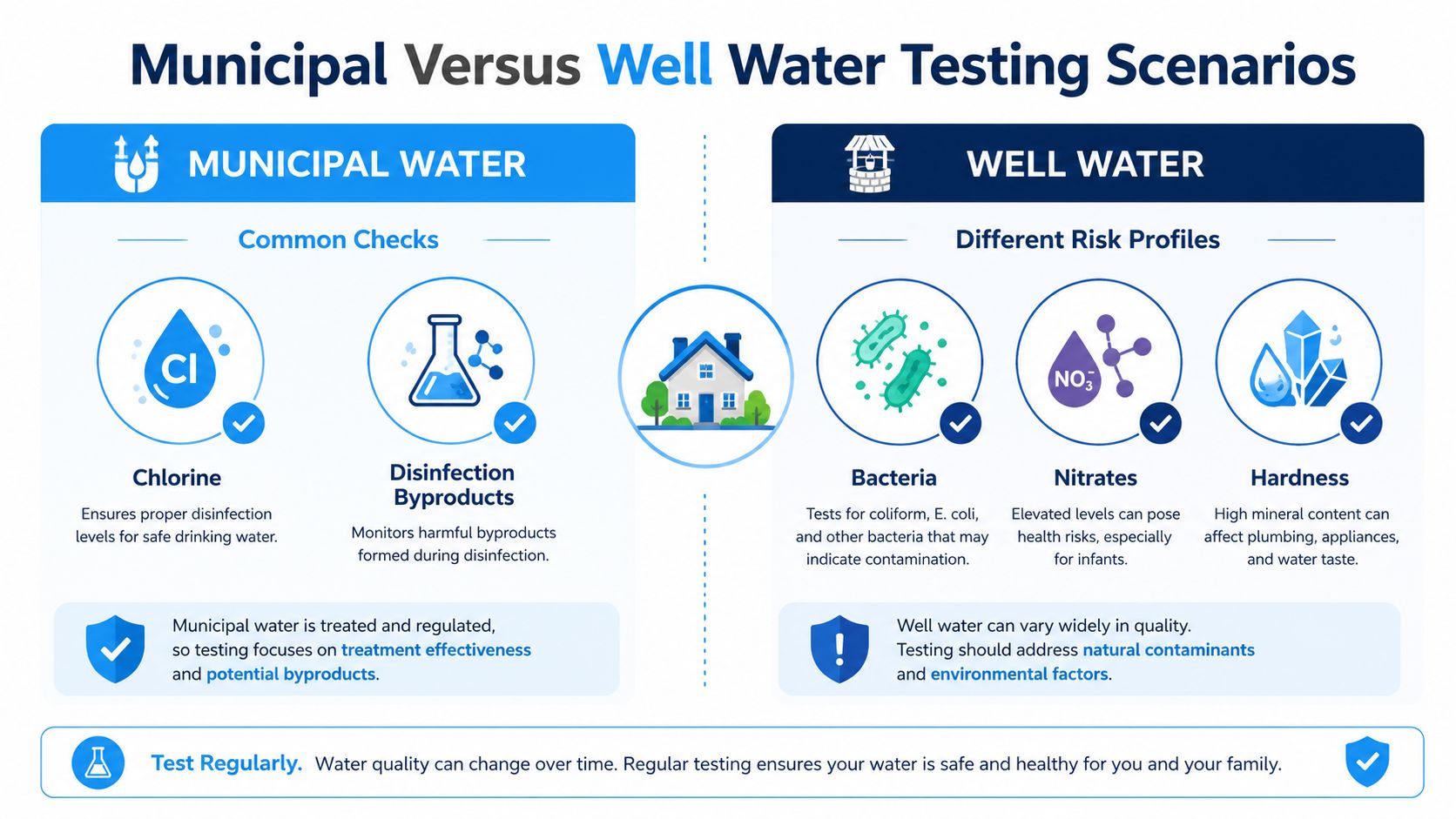
Where your water comes from makes a huge difference. Private wells and city water supplies have completely different challenges, so they need different solutions.

The EPA has a zero-tolerance policy for E. coli or fecal coliforms in public drinking water. A single positive sample is a violation. This standard underscores the importance of choosing a filter that guarantees complete removal or inactivation.

  • For Well Water: The biggest threat is almost always microbial. A whole-house UV disinfection system is the industry go-to, and you'll almost always need a sediment pre-filter to make sure the UV light can do its job without interference.
  • For City Water: While bacteria aren't as common, old pipes or water main breaks can cause problems. A point-of-use system, like a good reverse osmosis filter under the kitchen sink, is usually more than enough to handle this while also removing other city water contaminants like chlorine.

Step 4: Verify Certifications and Plan for Maintenance

Don't just take a manufacturer's word for it. You need proof from a third-party that the system actually performs as advertised.

  • Look for NSF/ANSI Certifications: These certifications are your best guarantee.
    • NSF/ANSI 53: Certifies that a filter can reduce specific health-related contaminants, including cysts like Giardia.
    • NSF/ANSI 55: This one is specifically for UV systems. You want Class A, which is certified for microbial disinfection. Class B systems are not.
    • NSF/ANSI 58: The standard for reverse osmosis systems, certifying their ability to reduce a long list of contaminants.
  • Consider Long-Term Costs: Get a clear picture of the maintenance schedule and costs. A UV system needs a new bulb every year (around $50-$150), while an RO system will need its filter cartridges replaced periodically (typically $100-$300 annually).

By walking through this checklist, you can confidently choose a system that delivers certified protection. For more detailed comparisons and recommendations, you can find a ton of expert water filter advice to help you find the perfect fit for your family.

Common Questions About Coliform Water Filters

Finding out you have coliform bacteria in your water can be a pretty stressful experience. Suddenly, you're faced with a whole host of questions you never thought you'd have to ask. Don't worry, you're not alone. We've compiled the most common questions we hear from homeowners to give you the clear, straightforward answers you need to handle this.

Can a Brita or Standard Pitcher Filter Remove Coliform Bacteria?

This is probably the most important question we get, and the answer is a hard no. Your standard Brita-style pitcher filter is designed to make your water taste and smell better. They use activated carbon, which is great for pulling out things like chlorine.

But when it comes to microscopic bacteria, they just don't cut it. The pores in those filters are way too big to physically stop something as small as a coliform bacterium. Thinking a pitcher filter will protect you is a dangerous mistake. You absolutely need a system that's specifically built and certified for microbiological purification, like UV, reverse osmosis, or a certified sub-micron filter.

Do I Need a Whole-House System for a Positive Coliform Test?

Not necessarily, but it’s usually the most surefire way to protect your entire home. It really boils down to where the contamination is getting in. Your first move should always be to try and figure out the source.

  • Localized Problem: If you find out the bacteria are only showing up at one faucet (like the kitchen sink), a point-of-use (POU) system could be all you need. An under-sink reverse osmosis or UV unit can treat the water right where you use it for drinking and cooking.
  • System-Wide Problem: On the other hand, if the bacteria are coming from your well itself or your main water line, then a point-of-entry (POE), or whole-house, system is the only way to go. This puts a barrier up for your entire home, protecting every tap, showerhead, and appliance from the contaminated water.

What Is the Difference Between Disinfection and Filtration?

This is a fantastic question because it gets right to the heart of how these systems work. People often use the terms interchangeably, but they describe two totally different ways of dealing with contaminants.

Filtration is a physical barrier. It’s like a bouncer at a club door. The filter membrane has microscopic pores that are small enough to physically block bacteria and other contaminants while letting clean water pass through. Reverse osmosis is a classic example of this.

Disinfection is more like a neutralization process. It doesn't remove the microbes, but it zaps them so they can't hurt you. A UV purifier is the perfect example—it uses ultraviolet light to scramble the DNA of bacteria and viruses, making it impossible for them to reproduce and cause illness. They're left in the water, but they're completely harmless.

Often, the best systems use a one-two punch of both. You might have a sediment filter to get rid of physical debris, which then flows into a UV chamber that disinfects whatever's left.

Expert Insight: The EPA has a zero-tolerance policy for E. coli or fecal coliforms in drinking water. A single positive sample is considered a violation of federal standards. This strict rule is why choosing a system that provides complete disinfection or removal is non-negotiable for your family's health.

How Often Should I Re-Test My Water After Installing a Filter?

Getting a new system installed is a huge relief, but you're not quite at the finish line. The only way to know for sure that your system is still doing its job is through regular testing.

Here’s a simple schedule to follow:

  1. Right After Installation: Test your water as soon as the system is up and running. This is a critical step to confirm the installation went smoothly and the unit is working as advertised.
  2. Annually for Well Owners: If you're on a private well, you're the one in charge of your water quality. We strongly recommend testing for coliforms at least once a year to keep an eye on your groundwater.
  3. After Major Events: You should always re-test if something happens that could affect your well or plumbing. This includes things like major plumbing repairs, nearby flooding, or if you ever notice a sudden change in how your water tastes, smells, or looks.

Consistent testing isn't just a suggestion; it’s a core part of keeping your home's water safe. It's how you ensure that investment in a water filter for coliform bacteria keeps paying off for years to come.


Ready to find the perfect filtration solution for your home? The experts at Water Filter Advisor have done the research for you, with in-depth reviews and easy-to-understand guides on everything from UV systems to reverse osmosis. Take the guesswork out of water safety and explore your options today at WaterFilterAdvisor.com.

What is a TDS Meter: Your Secret Weapon for Better Home Water

Ever poured a glass of tap water, held it up to the light, and wondered what’s really swimming around in there? It might look crystal clear, but your water is carrying a secret cargo of dissolved stuff—minerals, salts, metals, you name it.

Think of a TDS meter as your personal water quality detective. This simple handheld gadget gives you a near-instant reading of the Total Dissolved Solids (TDS) in your water. In just a few seconds, you get a snapshot of what’s going on with your water, giving you the power to know if your home water filter is actually doing its job.

Your Quick Guide to Water Purity Testing

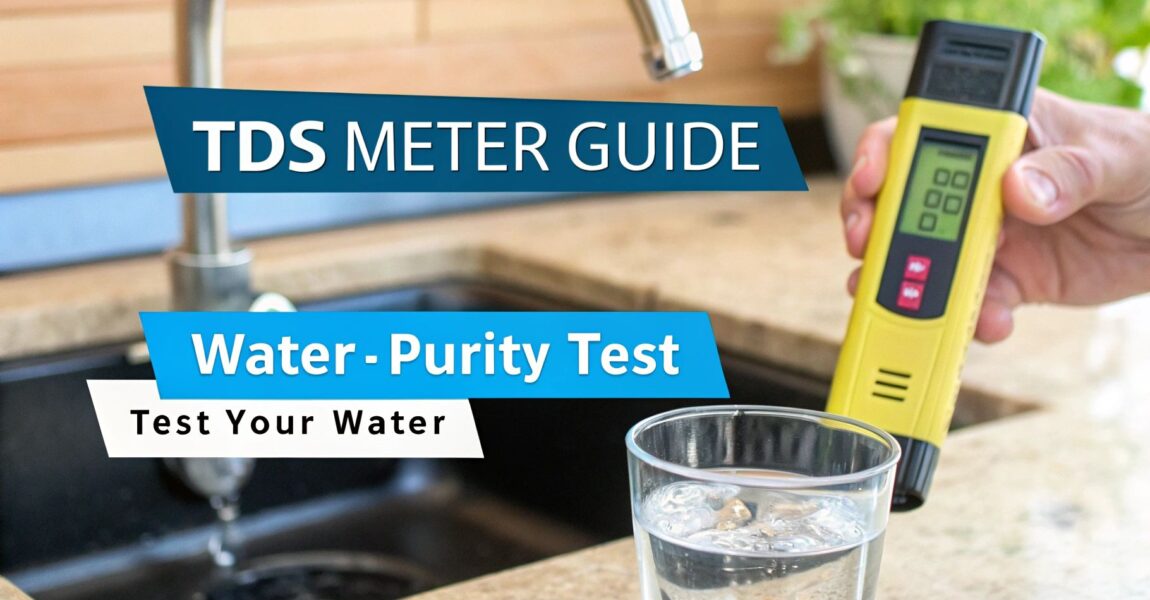
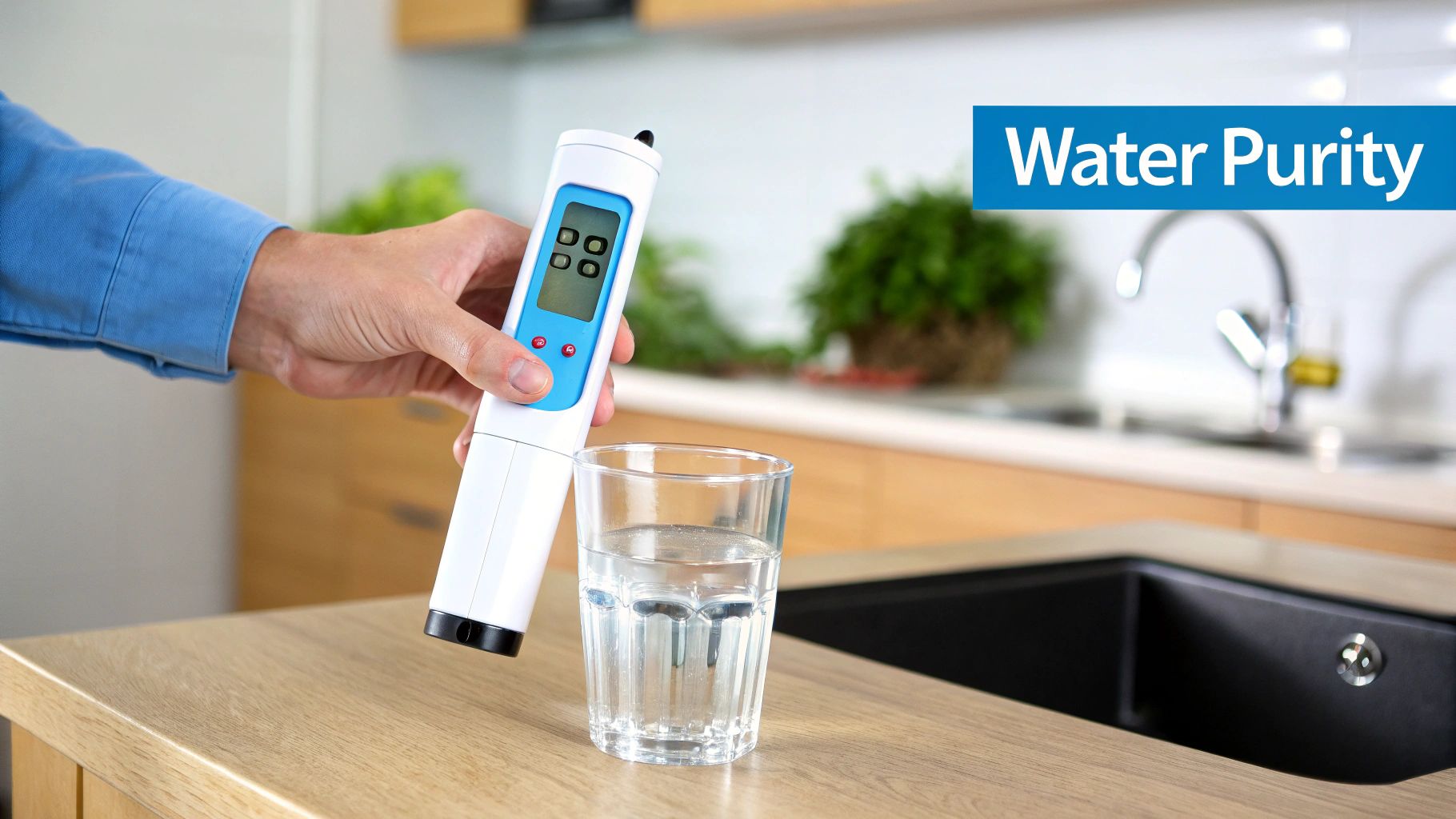
A person tests water purity in a glass with a TDS meter on a modern kitchen counter.

Just because water looks clean doesn't mean it is. It can be carrying all sorts of dissolved materials that make your coffee taste off, give your ice cubes a weird cloudy look, or even build up as crusty scale inside your pipes and appliances over time.

This is where understanding Total Dissolved Solids, or TDS, becomes a game-changer for any homeowner interested in better water.

A TDS meter doesn't magically identify every single substance. Instead, it measures the water's electrical conductivity. The more dissolved ionic solids like salts and minerals there are, the more easily electricity can pass through. The meter translates this conductivity reading into a number, usually in parts per million (ppm), which gives you a solid estimate of the total "stuff" dissolved in your water.

What Does Your First Reading Actually Mean?

Getting a number from the meter is the easy part. Making sense of it is where the fun begins. A high reading isn't automatically a red alert, as many of those dissolved solids are perfectly harmless minerals like calcium and magnesium that our bodies can use.

But what that number does give you is a crucial baseline.

A TDS reading is your first clue in an investigation. It tells you if there's a high concentration of dissolved "stuff," prompting you to ask the next important question: "What is that stuff, and is my filter removing it?"

This simple piece of information is incredibly valuable, especially if you have a water filter or are thinking about getting one. It’s the starting point for deciding if your tap water could taste better, be kinder to your home, and if your filtration system is truly earning its keep. For anyone who cares about the quality of the water in their home, a TDS meter is an essential tool.

So, How Does This Little Gadget Actually Work?

It might seem like some kind of high-tech magic, but the science behind a TDS meter is actually pretty straightforward. It's not "seeing" or identifying individual particles in your water. Instead, it’s measuring how well your water can conduct electricity.

Imagine your glass of water is a tiny highway. All those dissolved solids—the calcium, magnesium, sodium, and so on—are the cars on that road. Pure, distilled water is like a completely empty highway; electricity has a tough time getting from one side to the other. But once you add those mineral "cars," you create a perfect path for an electrical current to flow right through.

A TDS meter uses this exact principle. Its tip has two little metal probes (electrodes). When you dip it in water, the meter sends a tiny, harmless electrical charge from one probe to the other.

From Electricity to a Simple Number

The meter then measures how much of that electrical charge makes it to the second probe. The more dissolved solids you have, the more "cars" are on the highway, and the stronger the electrical signal will be. This measurement is called electrical conductivity (EC).

From there, a smart little chip inside the meter takes that EC reading and converts it into a number we can all understand: parts per million (ppm). It’s important to know that this is a very good estimate, not a precise chemical breakdown from a lab.

In short, a TDS meter isn't counting particles. It's really just checking the electrical traffic in your water and giving you a simple number that represents the total amount of dissolved stuff.

This is what makes a TDS meter such a fantastic tool for any homeowner. You get an instant snapshot of your water quality without having to send a sample off to a lab.

Why This Matters for Your Water Filter

Once you understand how it works, the readings become a powerful tool. For example, if you test the water coming from a reverse osmosis (RO) system, you want to see a very low number. RO systems are designed to strip out nearly all of those conductive minerals.

So, if you test your RO water and the reading is almost the same as your tap water, you know something’s up. The "highway" is still packed with cars, which means your filter isn't doing its job anymore. This simple electrical checkup gives you the feedback you need to keep your system running right and ensure your family is drinking pure, clean water.

Decoding the Numbers on Your TDS Meter

Getting a number to pop up on your TDS meter’s screen is the easy part. But what does it actually mean? That's where you turn a simple number into real, useful knowledge about your home's water quality.

The most important thing to remember is that different water sources have wildly different—and often perfectly normal—TDS levels. A reading of 250 ppm from your city tap water might be totally fine, but seeing that same number from your reverse osmosis system would definitely tell you something is wrong. It all comes down to the source and the filter.

What Is a Good TDS Reading for My Water?

Honestly, the "ideal" TDS level depends on your personal taste and your filtration goals. Well water, for example, naturally picks up beneficial minerals like calcium and magnesium as it filters through layers of rock. A higher reading here isn't a red flag; it just means you have mineral-rich water.

On the other hand, a good reverse osmosis (RO) system is designed to strip out pretty much everything, getting the water as pure as possible. In that case, a low reading, often below 50 ppm, is exactly what you want to see. It’s a clear sign your filter is doing its job right.

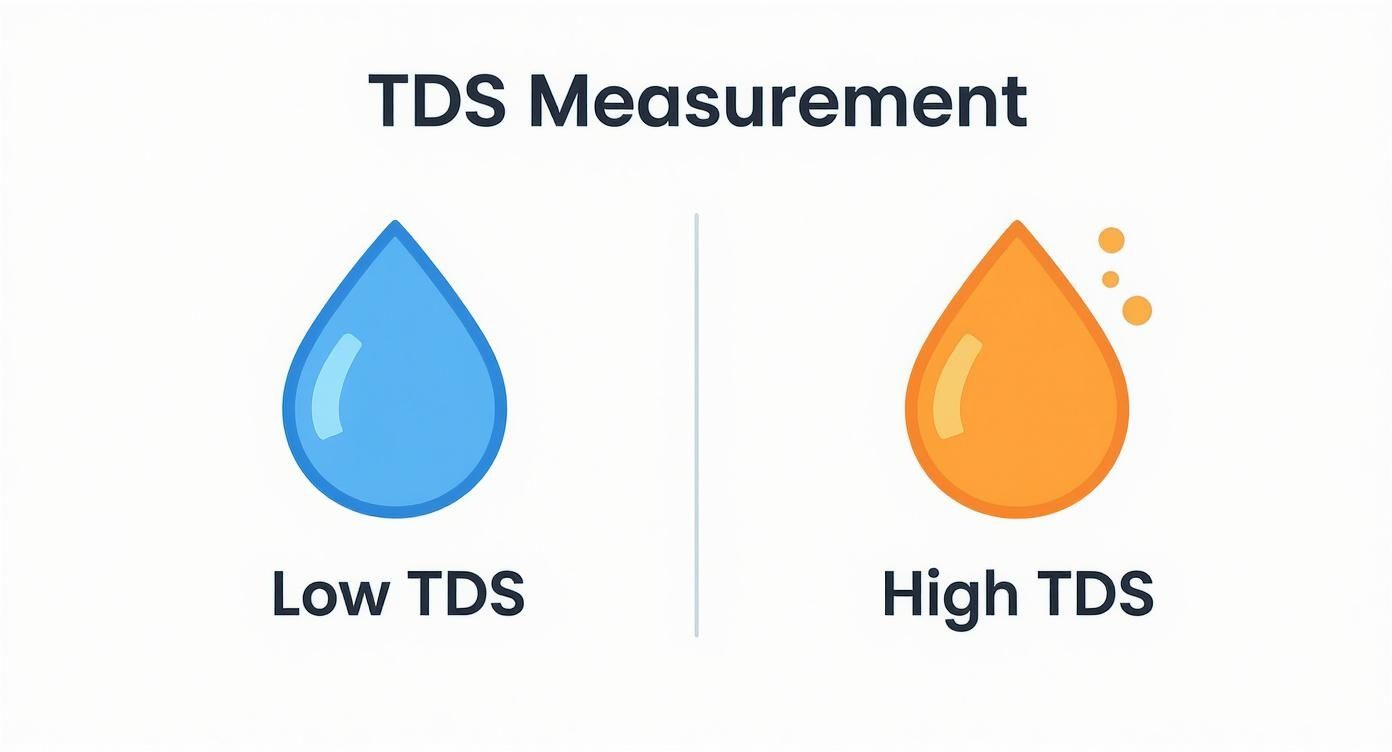
Illustration comparing a blue water drop labeled 'Low TDS' with an orange drop labeled 'High TDS' indicating water quality.

This just shows that a higher TDS simply means more "stuff" is dissolved in the water. That stuff could be anything from harmless minerals to contaminants you'd rather not drink. Your filter's job is to remove the unwanted stuff.

Comparing Common Household Water Sources

To make sense of your own results, it helps to see how they stack up against typical levels for other types of water you might find around the house. Bottled spring water is going to have a much different TDS profile than your tap water, and both will be different from the water coming out of your refrigerator's filter.

Each source has a unique story, and its TDS level is a big part of that.

Remember, a "high" TDS reading doesn't automatically mean "bad water." It's simply an indicator of a higher concentration of dissolved substances. The crucial next step is understanding what those substances might be and if your filter is removing them.

The table below gives you a quick reference for what to expect when you test different water sources. Think of it as a cheat sheet to help you benchmark your own results and figure out if your filter is performing as it should.

Typical TDS Levels in Common Household Water Sources

Here’s a quick comparison of average TDS readings you can expect from different types of water you might test at home.

Water Source Typical TDS Range (ppm) Primary Dissolved Solids
Reverse Osmosis Water 0 – 50 ppm Very few; highly purified. A low number confirms the filter is effective.
Bottled Spring Water 50 – 200 ppm Natural minerals like calcium and potassium that contribute to taste.
Typical Tap Water 150 – 400 ppm A mix of chlorine, salts, and minerals added during municipal treatment.
Well Water 200 – 500+ ppm Naturally occurring minerals like magnesium, calcium, and iron from the ground.

Seeing where your water falls on this chart can give you a much better sense of whether your numbers are normal or if it's time to investigate your filtration options further.

What a TDS Meter Cannot Tell You

While a TDS meter is a fantastic tool to have in your water filtration toolkit, it's really important to know what it doesn't do. Think of it this way: it's like stepping on a bathroom scale. The scale gives you one number—your total weight—but it can't tell you your body fat percentage, muscle mass, or bone density. It just sees the total.

A TDS meter is the same way with your water. It gives you a single number for the total quantity of dissolved stuff, but it has absolutely no idea what that stuff is. If you remember only one thing about its limitations, let it be that.

It only picks up on solids that can conduct electricity. That means a whole host of nasty contaminants can be floating around in your water, completely undetected by your meter.

What Your TDS Meter Won't Detect

Because the meter works by measuring electrical conductivity, it's totally blind to some of the most serious water contaminants people worry about. These substances don't carry an electrical charge, so as far as the meter is concerned, they simply don't exist.

A TDS meter will NOT detect:

  • Lead and Other Heavy Metals: Things like arsenic, mercury, and chromium won't show up.
  • Pesticides and Herbicides: Runoff from farms or your neighbor's lawn? Your meter won't see it.
  • Pharmaceuticals: Trace amounts of medications in the water supply are invisible to a TDS test.
  • Chlorine: The very disinfectant your city uses to treat the water doesn't register.
  • Bacteria and Viruses: Biological threats like E. coli are not measured at all.

This same principle applies in other areas, too. For instance, understanding pool water maintenance is all about using specific tests for chlorine and pH levels, not just a TDS meter, to keep the water safe and balanced.

A low TDS reading does not guarantee your water is safe. It only means there is a low amount of dissolved ionic solids like minerals and salts.

So, what's the takeaway? Use your TDS meter as a first-pass screening tool for your water filter's performance. A high number is a red flag telling you it's time to get a real lab test that can pinpoint exactly what’s in your water. Only then can you choose a filter that actually solves your problem.

Using a TDS Meter with Your Water Filter

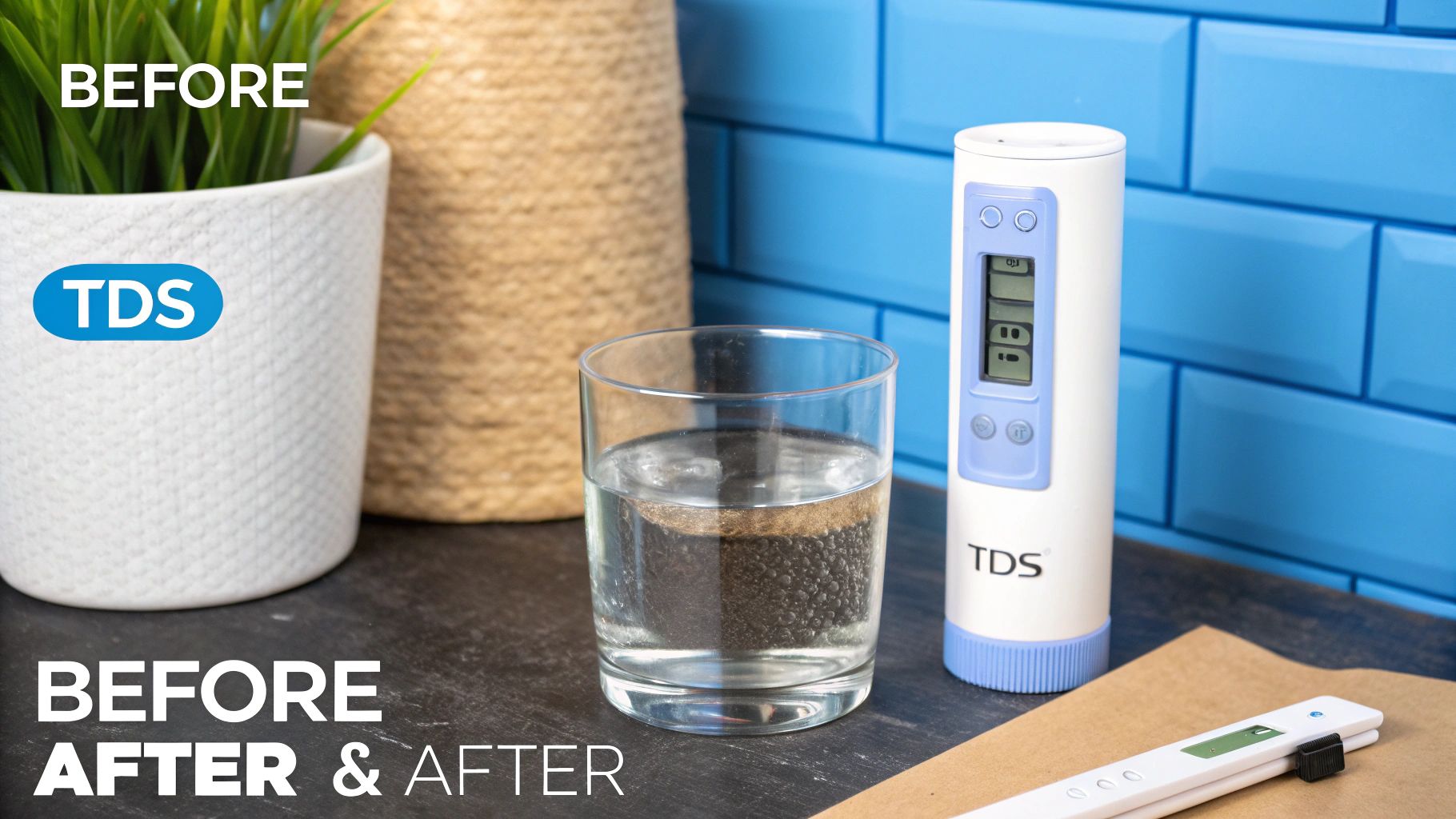
A TDS meter, glass of water, and plant, illustrating water quality before testing.

Okay, this is where a TDS meter really shines. It stops being just a neat gadget and becomes your go-to partner for home water filtration. Think of it as a report card for your filter, giving you clear, hard numbers on whether it’s actually doing its job.

The key is the simple "before and after" test. This is especially powerful if you have a system designed to strip out nearly everything, like a Reverse Osmosis (RO) unit. It’s the easiest way to know if your investment is paying off.

The Before and After Performance Check

It couldn’t be simpler. First, grab a sample of your regular tap water and jot down the TDS reading.

Then, run that same water through your filter system and test the filtered water. That's it. The gap between those two numbers tells you everything.

A good RO system should be knocking out over 90% of the total dissolved solids. So, if your tap water starts at 300 ppm, the water coming out of your RO faucet should be way down, ideally under 30 ppm. If those numbers are creeping closer together, it's a huge red flag that your filter membranes are shot and need to be replaced.

This quick check takes all the guesswork out of the equation. Forget just swapping filters when the calendar says so. Now you can change them based on actual performance, making sure you’re always getting the pure water you paid for.

Why Different Filters Affect TDS Differently

Here’s something important to remember: not all filters are made the same, and they definitely don't all tackle TDS. A meter helps you understand what your filter is supposed to do, so you don't have unrealistic expectations.

  • Carbon Filters (like in pitchers or on your faucet): These are great for making water taste and smell better by removing things like chlorine. They don't remove dissolved mineral salts, so you’ll see little to no drop in your TDS reading. That's normal!
  • Reverse Osmosis (RO) Systems: These are the champs of TDS reduction. An RO system forces water through a special membrane that strips out the vast majority of dissolved solids. With these, you expect to see a huge drop in the TDS number.
  • Water Softeners: This one trips people up. A softener works by swapping "hard" mineral ions (calcium, magnesium) for "soft" sodium ions. Since it's just trading one dissolved solid for another, a water softener will not lower your TDS. In fact, it might even make it go up slightly.

People are catching on to this. The global market for digital TDS meters hit about $2.5 billion in 2023 and is expected to grow to around $3.8 billion by 2028. This isn't just a niche hobby; it's a worldwide trend of people wanting to know exactly what’s in their water.

Once you know how your filter is meant to work, your TDS meter becomes a powerful tool. And if you're looking into different filtration options, our guides have some great advice on choosing the right water filter for your needs. At the end of the day, a TDS meter is the accountability partner that proves your filter is living up to its promises.

Your Simple Guide to Using a TDS Meter

https://www.youtube.com/embed/EtoCiUM9RwE

Ready to find out what's in your water? Good news: using a TDS meter is about as easy as it gets. You can get a reading in less than a minute.

Just pop the cap off, turn it on, and dip the end with the two metal probes into a glass of your water. You don't need to sink the whole thing—just the tip.

Give it a gentle swirl to knock off any tiny air bubbles that might be clinging to the probes. After a few seconds, the number on the display will lock in. That’s it! That number is your TDS reading in parts per million (ppm).

Tips for an Accurate Reading

To make sure your results are reliable every single time, a few little habits go a long way. This is especially important if you're trying to track how well a water filter is working over time.

  • Test at Room Temperature: The temperature of the water can actually change the reading. For the most consistent and accurate results, try to test your water when it's around 77°F (25°C).
  • Use a Clean Glass: Seems obvious, but any leftover soap or residue in a glass can easily throw off your numbers. Always grab a sparkling clean, well-rinsed glass for your sample.
  • Keep the Probes Clean: After you're done, give the meter’s probes a quick rinse with distilled water (if you have some) and gently wipe them dry. This stops minerals from building up and messing with your next test.

A Quick Word on Calibration

Most TDS meters are all set and calibrated right out of the box. But like any measuring tool, they can drift a bit over time and lose their pinpoint accuracy.

Calibration is just a fancy word for resetting your meter against a solution with a known TDS level, making sure its readings are trustworthy.

If you test your water a lot, it’s a smart move to check the calibration every few months. A quick tune-up with a calibration solution ensures you can always trust the numbers you're seeing, giving you real confidence in your water quality.

Common Questions About Using a TDS Meter

Even after getting the hang of it, you might still have a few questions floating around. That’s perfectly normal. Let's tackle some of the most common things people ask when using a TDS meter to figure out their water.

What Is the Ideal TDS Level for Drinking Water?

Honestly, there isn't a single "perfect" number because everyone's taste is a little different. For safety and aesthetics, the EPA recommends keeping TDS below 500 ppm.

Many people find that water with some natural minerals, usually in the 50-150 ppm range, tastes best. On the other hand, if you're using a high-quality reverse osmosis system, you'll see readings under 50 ppm, which gives you that exceptionally pure, crisp taste.

Does High TDS Mean I Have Hard Water?

It's a really strong hint, but it's not a definite "yes." Hard water is specifically caused by high concentrations of calcium and magnesium. Since those are dissolved solids, water that's truly hard will always give you a high TDS reading.

But, you can also get a high TDS reading from other things like sodium or potassium, which don't cause hardness. Just think of it this way: a TDS meter points toward potential hardness, but you'd need a specific hardness test to be sure.

A high TDS reading is a signal to investigate, not to panic. It’s your first step toward understanding your water, empowering you to ask the right questions and find the best filtration solution for your home.

My Tap Water Reading Is High. What Should I Do?

A high number is just your cue to do a little more digging. A great first step is to look up your local water utility’s annual quality report, which you can usually find online. This report breaks down exactly what's in your municipal water.

If you're on well water or just want more detail, the best next move is a comprehensive lab test. A professional analysis will pinpoint the specific substances pushing your TDS up, so you can choose a water filter that actually targets those contaminants.


Ready to take the next step toward purer, better-tasting water? The experts at Water Filter Advisor provide in-depth guides and unbiased reviews to help you find the perfect filtration system for your home. Explore your options at https://www.waterfilteradvisor.com.

Your Ultimate Guide to Testing for Heavy Metals and Choosing the Right Home Water Filter

You can’t always trust your eyes. That crystal-clear water flowing from your kitchen tap might be hiding some nasty secrets. The only real way to know what you’re drinking is to test water heavy metals—we’re talking about invisible villains like lead and arsenic that pose serious health risks. Getting proactive about testing is the single best way to make sure the water in your home is safe and to find the perfect filtration system for your family.

The Hidden Journey of Your Drinking Water

A glass of clear water being poured from a modern kitchen faucet, with sunlight glinting off the surface.

It’s easy to get a false sense of security, especially if your local water report comes back with a clean bill of health. But here’s the thing: those reports only tell part of the story. They test the water at the treatment plant, not at the end of its journey—your faucet. This is where a home filtration strategy becomes your best line of defense.

The real problem often crops up in the miles of pipes the water travels through to get to you. Much of this infrastructure is decades old, and that’s where heavy metal contamination can really take hold.

For instance, many older homes and communities still have plumbing made with lead or copper. Over time, these pipes corrode, and tiny, microscopic particles flake off into the water passing through. This means that water that was perfectly safe when it left the plant can pick up a load of contaminants just a few feet before it fills your glass—a problem only a point-of-use or whole-house filter can solve.

Sources Beyond Your Pipes

It isn’t just about the pipes leading to your house, either. The water source itself, whether it’s a city supply or a private well, is exposed to all sorts of environmental factors that can introduce heavy metals long before it ever gets treated.

A few common culprits include:

  • Industrial Runoff: Factories and manufacturing plants can dump wastewater loaded with harmful metals. This is a massive global problem. In India, for example, an estimated 260 million liters of industrial wastewater, thick with metals like chromium and lead, flow into the Ganga River every day. That's a staggering amount, and you can read the full research to see the true scale of the issue.
  • Agricultural Contamination: The pesticides and fertilizers used on farms often contain heavy metals like arsenic and cadmium. When it rains, these chemicals wash right out of the soil and into rivers, lakes, and the groundwater we rely on.
  • Natural Deposits: Sometimes, the problem is right under our feet. Certain heavy metals, like arsenic, occur naturally in the earth's crust and can dissolve into groundwater, especially in areas with certain geological makeups.

The unsettling truth is that even if your water looks, smells, and tastes perfectly fine, it could still have elevated levels of these harmful elements. Because they are colorless and odorless, the only way to be certain is to perform a test.

At the end of the day, your city’s report gives you a general snapshot, but a home test gives you the real picture of what your family is actually drinking. It’s the essential first step to choosing a water filtration system that truly protects your household.

DIY Kits vs. Lab Analysis: Which Water Test Is Right for You?

So, you're ready to find out what's really lurking in your tap water. Great! Your first mission, should you choose to accept it, is deciding how you're going to test it.

When you're looking to test water for heavy metals, you've got two main routes: the quick-and-easy DIY test kit or the comprehensive professional lab analysis. Think of it like this: a DIY kit is like taking your temperature at home, while a lab test is like getting a full diagnostic workup from a specialist. Both are useful, but they serve very different purposes in your quest for clean water.

DIY kits are all about instant gratification. They’re cheap, you can find them almost anywhere, and you get results in minutes. Most work by dipping a test strip into a water sample and matching the color it turns to a chart. It’s a fantastic way to get a quick, general overview and find out if you need to investigate further.

Just keep in mind that these kits are mostly qualitative. They’ll tell you if a contaminant is present, but usually not how much. You'll get a simple "yes" or "no," which might be all you need to decide it’s time to upgrade from a basic pitcher filter. For anyone who enjoys a hands-on approach, using a DIY kit fits right in with other DIY home upkeep strategies.

When Precision Is Paramount

On the flip side, you have professional lab analysis. This is the gold standard for accuracy, no contest. It costs more and you'll have to wait a bit—usually a week or two for the report. But the level of detail you get in return is your secret weapon for choosing the perfect home filtration system.

You'll receive a report with precise, quantitative data showing the exact concentration of various heavy metals, often measured down to the parts per billion (ppb).

This kind of detail is absolutely essential in a few common situations:

  • You Have Specific Health Concerns: If someone in your family has a compromised immune system, or if you have infants and young children, knowing the exact levels of contaminants like lead is non-negotiable.
  • You're Buying a Filtration System: Before you drop hundreds or even thousands on a whole-house filter, you need to know exactly what you’re trying to remove. A lab report is the blueprint for your filtration strategy.
  • You Have a Private Well: Well owners are 100% responsible for their water quality. Regular lab testing is the only real way to make sure your water source is safe from things like agricultural runoff or naturally occurring metals.

Choosing a method isn't just about cost; it's about confidence. A DIY kit gives you a clue, but a lab test gives you the definitive blueprint for building your home's water defense system.

To help you weigh your options, I've put together a simple table that breaks down the key differences between the two methods.

Comparing DIY Test Kits and Professional Lab Analysis

This side-by-side comparison should make it easier to decide which water testing method fits your needs, budget, and how much accuracy you're looking for.

Feature DIY Test Kits Professional Lab Analysis
Accuracy Good for presence/absence Highly accurate quantitative results
Cost Generally $20 – $50 Typically $100 – $300+
Speed Instant or within minutes 1-2 weeks for results
Scope Tests for a limited range of metals Can test for a wide array of contaminants
Best For Quick screenings, routine checks Health concerns, filtration planning, well water

So, what's the verdict? A DIY kit is a fantastic first step. If it flags anything concerning, follow up with a professional lab analysis. That hard data is exactly what you need to pick the perfect filtration solution and declare victory over contaminants.

Getting Your Water Sample Right: The Key to Accurate Results

When you set out to test your water for heavy metals, the accuracy of your results boils down to one simple thing: how well you collect the sample. It's a bit like a crime scene investigation—if you accidentally contaminate the evidence, the lab's findings are useless. A small mistake here can lead you to buy the wrong filter or, worse, miss a real problem entirely.

Luckily, getting a clean sample is easy once you know what to do. The whole process starts with a single question: what are you actually trying to measure? Are you checking the water coming from the city's main line, or are you trying to figure out if your own pipes are leaching lead? Each goal needs a slightly different approach.

First Draw vs. Flushed: The Two Types of Samples

You'll need to understand the difference between a "first draw" and a "flushed" sample. They each tell a unique story about your water and can help you pinpoint where to install a filter.

  • First Draw Sample: This is literally the first water out of your tap in the morning. You collect it before you run any faucets, showers, or flush any toilets. This water has been sitting still in your pipes all night, giving it plenty of time to pick up any contaminants like lead or copper. This is the most important test for sniffing out problems inside your own home's plumbing.

  • Flushed Sample: To get this sample, you'll let the cold water run for a solid 3-5 minutes before filling the bottle. This pushes all the stagnant water out of your home's pipes and pulls in fresh water from the main supply or your well. This sample tells you what the water quality is like before it even gets to your plumbing.

Taking both samples gives you the full picture. If your first-draw results show high lead but the flushed sample is clean, you’ve just pinpointed the problem to your home's pipes or fixtures. Now you know an under-sink filter might be a better solution than a whole-house system.

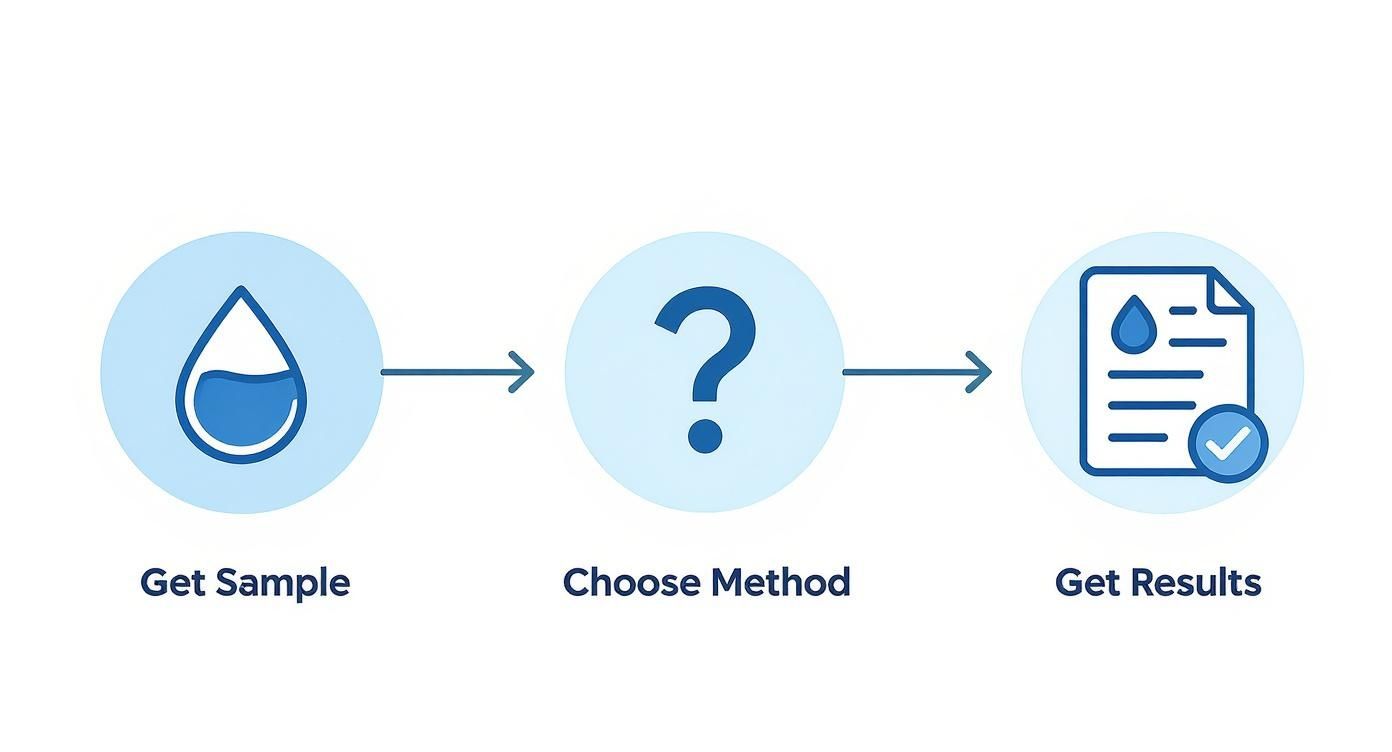
This simple three-step process—from grabbing a sample to understanding the results—is the foundation of taking control of your water quality.

Infographic showing the water testing process: Get Sample, Choose Method, Get Results.

As you can see, it all starts with that first step. A good sample leads to good data and, ultimately, the right filtration choice.

Pro Tips for a Perfect Sample

To make sure nothing skews your results, here are a few critical but easy-to-follow guidelines I always recommend.

  1. Stick to the Cold Water Tap: Never use hot water for a sample. Your hot water heater often has metal parts that can break down and leach into the water. Hot water also dissolves contaminants from pipes more easily. Using the cold tap gives you a true baseline.
  2. Take Off the Aerator: See that little screen on the end of your faucet? That's an aerator. It can trap tiny bits of sediment and metal particles, which might fall into your sample and give you a false positive. Just unscrew it before you start.
  3. Follow the Kit's Instructions to the Letter: Whether you're using a home test kit or a mail-in lab vial, read the directions first. Some labs have very specific rules for how to fill the bottle or require you to ship it back quickly to keep the sample stable.

Following these steps is the best way to ensure that when you test water for heavy metals, you’re getting a real-world snapshot of what’s coming out of your tap. From there, you can confidently find the right filter to fix it.

Decoding Your Water Test Results

Getting that lab report back can feel a little intimidating. It often looks like a foreign language—just a wall of numbers, chemical symbols, and acronyms that don't mean much at first glance.

But don’t sweat it. This report is your treasure map, and it's about to lead you straight to the perfect water filter. Once you get the hang of a few key terms, you’ll be able to read it like a pro.

You’ll probably notice measurements like mg/L (milligrams per liter) or ppb (parts per billion). To put that into perspective, one part per billion is like a single drop of water in an Olympic-sized swimming pool. It sounds microscopic, but for potent heavy metals like lead and arsenic, even those tiny amounts are a big deal.

Your report will list out the metals and their concentrations. Your job is to play detective and compare these numbers against the safety benchmarks set by the Environmental Protection Agency (EPA).

Making Sense of the Numbers

The EPA sets a Maximum Contaminant Level (MCL) for many substances found in public drinking water. This is the absolute highest level of a contaminant that’s legally allowed. For some of the most dangerous metals, though, the goal is much, much stricter.

Let's break down a few common heavy metals and what the EPA guidelines say:

  • Lead (Pb): The EPA has set the Maximum Contaminant Level Goal for lead in drinking water at zero. That’s because there is no known safe level of lead exposure, period. The official "Action Level" is 15 ppb—if your water tests above this, you need a filter certified for lead removal.
  • Arsenic (As): Arsenic occurs naturally in the environment, but it's highly toxic. The EPA's MCL for arsenic is 10 ppb. Anything higher than this is considered unsafe for long-term consumption and requires a specialized filter.
  • Copper (Cu): While less toxic than lead, copper can still cause problems like gastrointestinal distress. Its Action Level is 1.3 ppm (parts per million), which is the same as 1,300 ppb.

The big takeaway here is that just because a metal is detected doesn't automatically mean your water is dangerous. It's all about comparing the concentration found in your test to these established safety limits to determine your filtration needs.

A Real-World Scenario

Let’s say you get your results back and see 22 ppb of lead and 5 ppb of arsenic.

The arsenic level (5 ppb) is under the EPA’s 10 ppb limit, so that’s good news. But the lead level at 22 ppb is a different story—it's significantly over the 15 ppb Action Level. This result is a clear red flag that you have a lead contamination issue that needs to be addressed with a targeted filtration system.

And this isn't just an issue in old cities. Heavy metal contamination is a massive global problem. A 2025 global soil study revealed that up to 17% of the world’s arable land is contaminated with toxic heavy metals, which can seep into water sources. You can discover more about these heavy metal findings to get a sense of the scale of the problem.

Understanding your report is what moves you from just having data to taking decisive action. When you test water heavy metals and decode the results, you gain the clarity needed to choose the perfect filtration solution, ensuring every drop from your tap is safe.

Matching Your Results to the Right Water Filtration System

Okay, you’ve got your test results. The worrying part is over, and now you know exactly what you’re dealing with. This is the moment you can take real action and choose a defense for your home.

It’s all about connecting the dots—linking the data from your water report to a specific filtration technology that will actually solve the problem.

Let's be clear: a basic pitcher filter is great for making water taste better. But when you’re up against serious contaminants like lead or arsenic, you need to bring in the heavy artillery.

For Broad-Spectrum Metal Removal

If your report lit up like a Christmas tree showing several different heavy metals—even at low levels—a reverse osmosis (RO) system is usually your best bet. Think of an RO system as an elite bodyguard for your water supply. It forces water through an incredibly fine membrane with microscopic pores.

This membrane is so effective that it blocks a huge range of contaminants, typically knocking out over 95% of heavy metals like lead, arsenic, mercury, and copper. It’s a true workhorse for getting exceptionally pure drinking and cooking water right at your kitchen sink.

Consider an RO system if:

  • Your report shows a cocktail of different heavy metals.
  • You’ve got high levels of arsenic, which can be tough for other filters to handle.
  • You simply want the highest possible purity for your drinking water.

Investing in the right filter is a direct response to your water quality report. It’s not about guessing; it's about using your data to make a confident, targeted decision that protects your family’s health for years to come.

For Targeted Contaminant Issues

Sometimes your report might pinpoint just one or two specific culprits, like lead leaching from old pipes or unusually high copper levels. In a situation like that, a more specialized filter might be a smarter and more cost-effective choice than a full RO setup.

Kinetic Degradation Fluxion (KDF) filters are a perfect example. These systems use a high-purity copper-zinc alloy that starts an electrochemical reaction, essentially neutralizing contaminants like lead, mercury, and chlorine and turning them into harmless substances. You'll often find KDF media inside whole-house systems or high-end shower filters.

While industrial pollution is a significant source of heavy metals, it's worth noting that strong regulations work. In Europe, for example, industrial releases of metals like lead and mercury into waterways have plummeted over the last few decades. You can discover more about these environmental improvements to see how focused efforts can create cleaner water for everyone.

When you test water heavy metals, you’re creating a roadmap. Your results point you directly to the filtration technology that will turn your tap water from a source of concern into a source of pure, safe hydration.

Common Questions About Home Water Testing and Filtration

Once you’ve decided to test your water, you’re bound to have a few more questions. That’s totally normal. People often wonder about the costs involved, how often they really need to re-test, and whether their filters are actually doing the job they’re supposed to.

Let’s clear up some of that confusion so you can feel confident you're on the right track.

The first thing on everyone's mind is usually the cost. A DIY kit is your most budget-friendly option, typically running under $50. It’s a great starting point. If you go for a certified lab analysis, expect to spend between $100 and $300. I always tell people to think of it as an investment—that detailed lab report is your roadmap to a solid filtration strategy.

How Often Should I Test My Water?

This is a big one, and it really comes down to where your water comes from and what your first test results look like.

  • For city water: If your initial tests are clean and you’ve got a reliable whole-house filter, re-testing every 2-3 years is a pretty safe bet. This just confirms your system is still working well and alerts you to any new issues from the municipal supply.
  • For well water: You are the water manager, so an annual test should be your standard. Wells can be affected by everything from farm runoff to seasonal weather changes, so staying on top of it is key to catching problems early.

Here’s a pro tip: If you discover high levels of a specific heavy metal, you’ll want to re-test about 1-3 months after you install a new filter. This is the only way to be certain the system is working and has knocked those contaminant levels down to a safe range.

Will My Filter Get Rid Of Everything?

It's a common misconception that any filter will remove all contaminants. The truth is, a filter's effectiveness is all about its specific technology. That basic carbon pitcher filter does a fine job with chlorine, but it won’t touch things like lead or arsenic. This is exactly why you need to match your filter to your test results.

A reverse osmosis (RO) system, for instance, is a powerhouse against heavy metals and can remove over 95% of most contaminants. But even then, no single system gets rid of 100% of everything. When you test water heavy metals, you get the exact data you need to choose the right line of defense.

You can find more helpful information in our extensive library of water filtration advice to guide your decision-making process.


At Water Filter Advisor, we're committed to helping you find the perfect, most effective solution for your home's specific needs. Explore our reviews and guides to make a confident choice for your family's health and safety.

https://www.waterfilteradvisor.com

Learn How to Test for Chlorine in Water with This Easy Guide

So you want to know what's really in your tap water? Good call. Testing for chlorine is surprisingly simple. You can use test strips, grab a liquid kit, or get fancy with a digital meter. This quick check is your first step to exposing the secrets in your pipes, arming you with the intel needed to pick the right water filtration system. The goal? To finally get that pure, clean taste you've been missing.

Why Bother Testing Your Tap Water for Chlorine?

Let's be real—most of us turn on the tap without a second thought. But ever catch a whiff of that faint swimming pool smell? That’s your old friend, chlorine. It's the go-to disinfectant that stops our public water supply from becoming a bacterial free-for-all.

While it's a hero for public health, its job should be over long before that water hits your coffee maker. Knowing the specific chlorine levels in your home's water is the secret to choosing a filter that actually works. This isn't about guesswork; it's about getting hard numbers so you can make a smart move. Think about it—before modern water treatment, cities were constantly fighting off waterborne diseases. The introduction of chlorination was a game-changer, slashing illnesses like typhoid and cholera. But that doesn't mean you want it in your drinking glass.

Free Chlorine vs. Total Chlorine: The Showdown

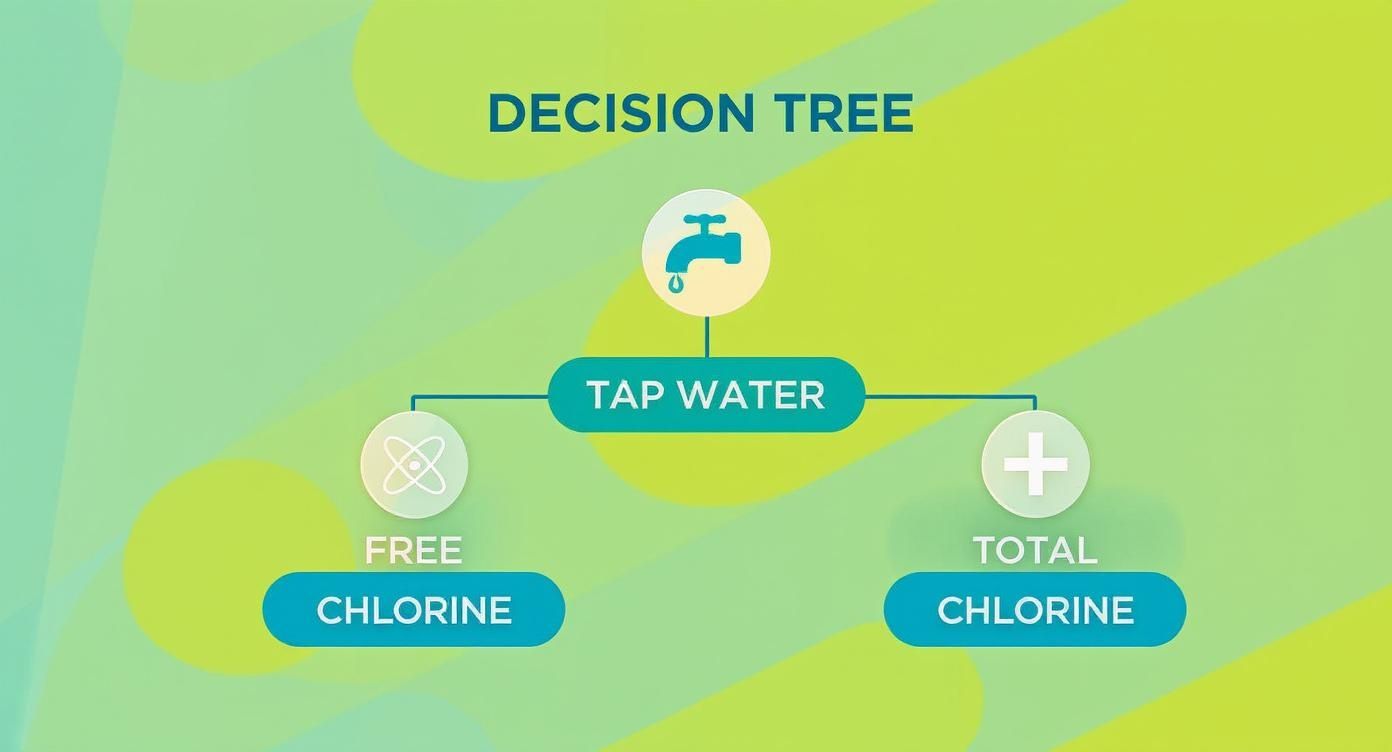
When you run a test, you're looking for two different villains. Nailing down the difference between them is the key to finding a filter that will actually get the job done.

  • Free Chlorine: This is the active, germ-killing stuff. It's the frontline soldier keeping your water safe as it travels from the treatment plant to your faucet.
  • Total Chlorine: This is the big number that includes both free chlorine and its sneaky sidekicks, chloramines. Chloramines are what you get when chlorine mixes with organic stuff in the water. They are more stubborn and are often the real culprit behind that "chemical" taste and smell you can't stand.

Knowing both figures helps you diagnose the problem. High free chlorine means a strong chemical taste. But high total chlorine points to those pesky chloramines, which many basic filters can't touch.

Testing takes all the guesswork out of buying a water filter. It gives you a clear, data-driven starting point so you can invest in a solution that targets what's actually in your water, instead of just grabbing a generic filter pitcher that might not be up to the task.

This proactive approach puts you in control. Just like you'd want to know what's in your water, it's smart to consider other parts of your home's environment, like the air you're breathing every day. You can learn more about creating a healthier living space with expert air quality tests for a safer home. Ultimately, testing for chlorine empowers you to take charge of your water quality, leading you straight to the perfect filtration strategy.

Finding the Right Chlorine Test Kit for Your Home

Choosing a chlorine test kit can feel a bit overwhelming. Walk into any hardware store and you'll see a wall of options—strips, droppers, and digital readers, all promising to reveal the truth about your water. The trick is to match the tool to your mission. Your home water filtration goals will point you to the right choice.

Think of it this way: if you just snapped a new filter into your pitcher and want a quick thumbs-up that it's working, simple test strips are perfect. They're cheap, fast, and give you a solid ballpark reading in seconds.

But if you're installing a whole-house filtration system or trying to figure out why your tap water tastes a little "off," you're going to need more precision. That’s where liquid reagent kits and digital meters enter the ring. They deliver the detailed data you need to make bigger, more informed decisions about your home's water quality.

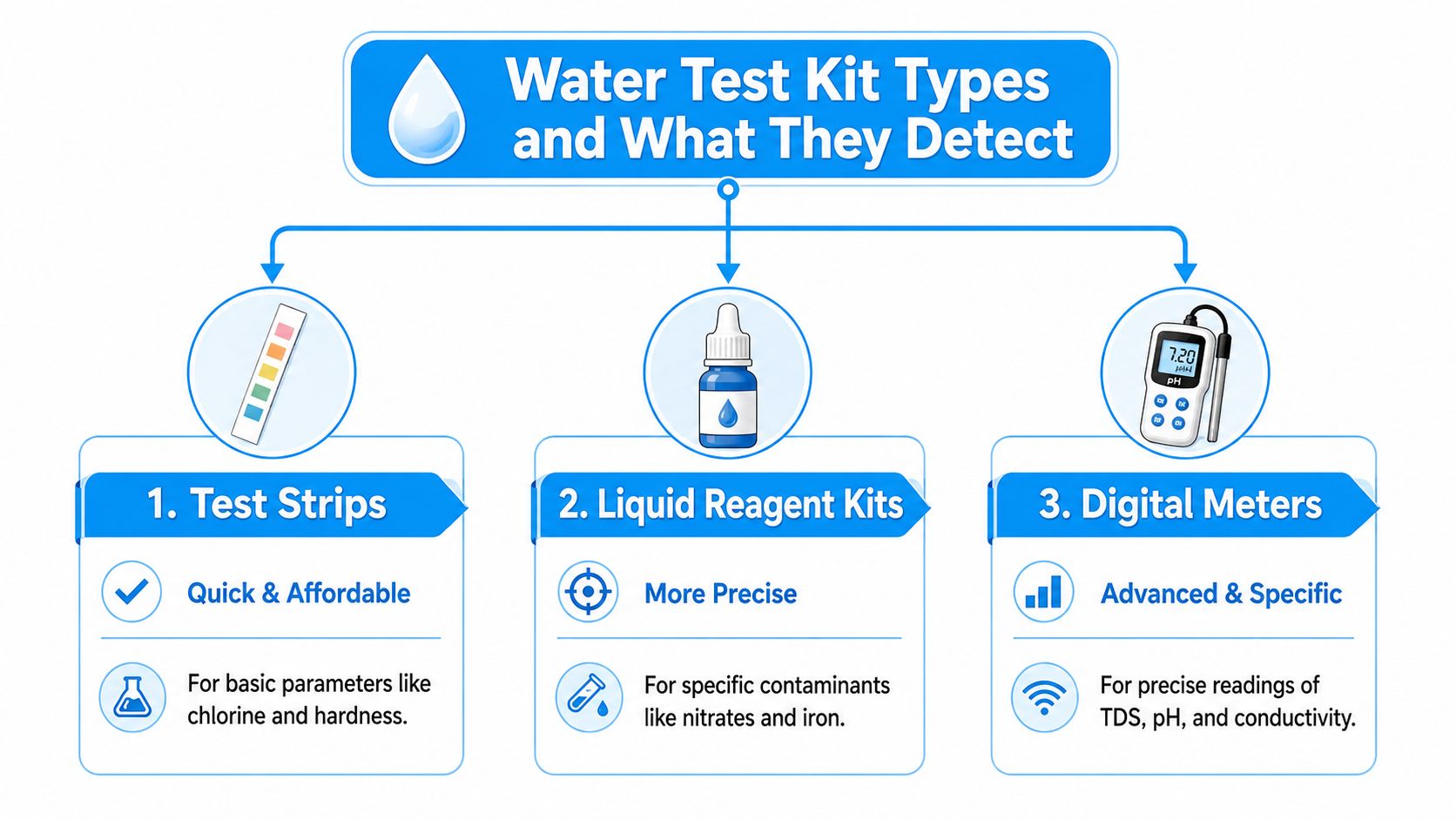
Comparing Your Testing Options

The world of home water testing really boils down to three main players. Each has its own strengths and weaknesses, so there's no single "best" option—it's all about what fits your budget, your patience, and your need for dead-on accuracy.

To make it easier, I've put together a quick comparison of the most common types of chlorine test kits you'll find. This should help you zero in on the best one for your situation.

Comparison of Home Chlorine Test Kits

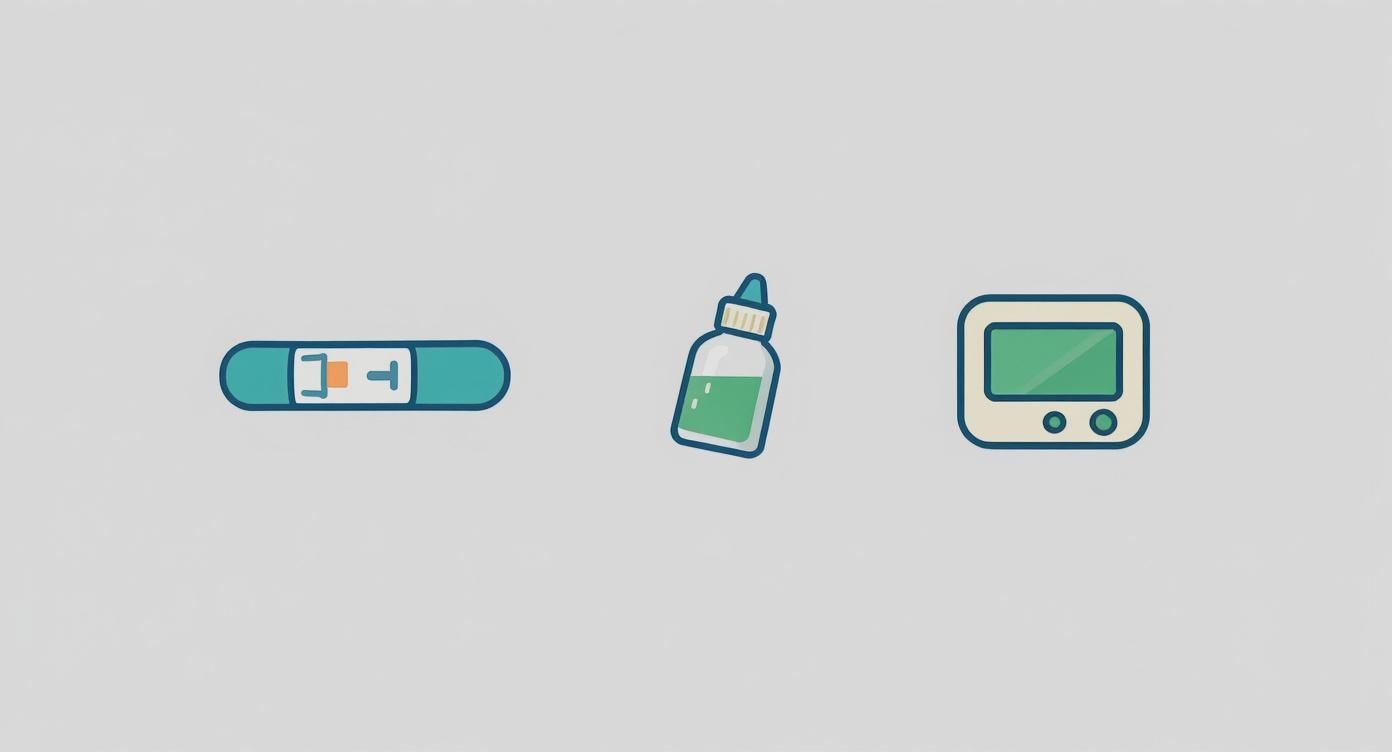
Test Kit Type Best For Accuracy Ease of Use Average Cost
Test Strips Quick spot-checks & confirming a filter is working Low to Moderate Very Easy $10 – $20
Liquid Reagent Kits Accurate home testing & troubleshooting Moderate to High Moderate $15 – $30
Digital Meters Precise, data-driven analysis & system optimization Very High Easy $50 – $150+

As you can see, you can get started for very little money, but investing a bit more can give you a much clearer picture of what's happening in your pipes—and which filter can fix it.

Let’s break these down a bit more:

  • Test Strips: The speed demons of water testing. You just dip a strip into your water, wait a few seconds, and match the color to a chart. They're fantastic for quick checks and getting that instant gratification that a new filter is doing its job.
  • Liquid Reagent Kits: The reliable workhorse. You add a few drops of a chemical reagent (like DPD) to a vial of water, and it changes color. Compare that hue to a color chart to find the chlorine level. This is a big step up in accuracy from strips without a huge jump in price.
  • Digital Meters (Colorimeters): For the data nerds and precision fanatics. It works like a liquid kit, but instead of you squinting at a color chart, a light sensor measures the color change electronically. This eliminates the guesswork and gives you a precise, numerical reading—perfect for optimizing a high-end filtration system.

This infographic breaks down the two key measurements you'll be taking when you test for chlorine.

Infographic about how to test for chlorine in water

Understanding both free chlorine and total chlorine is fundamental. These two numbers are the foundation for any smart home filtration strategy.

Matching the Kit to Your Goal

Before you buy anything, ask yourself why you're testing. Are you just curious, or are you on a mission to solve a problem like dry skin after a shower or foul-tasting coffee?

The goal isn't just to get a number; it's to get actionable intel for your filtration strategy. A quick, cheap test is great for confirming a filter works, while a more precise test is essential for choosing and optimizing a whole-house system.

If you're about to invest in a serious filtration setup, you absolutely need an accurate baseline measurement first. For more in-depth guidance on choosing the right filters, check out the expert advice on Water Filter Advisor. Getting good data from the start is the only way to be sure you’re picking a solution that will actually solve your specific chlorine issues.

A Practical Guide to Testing Your Water

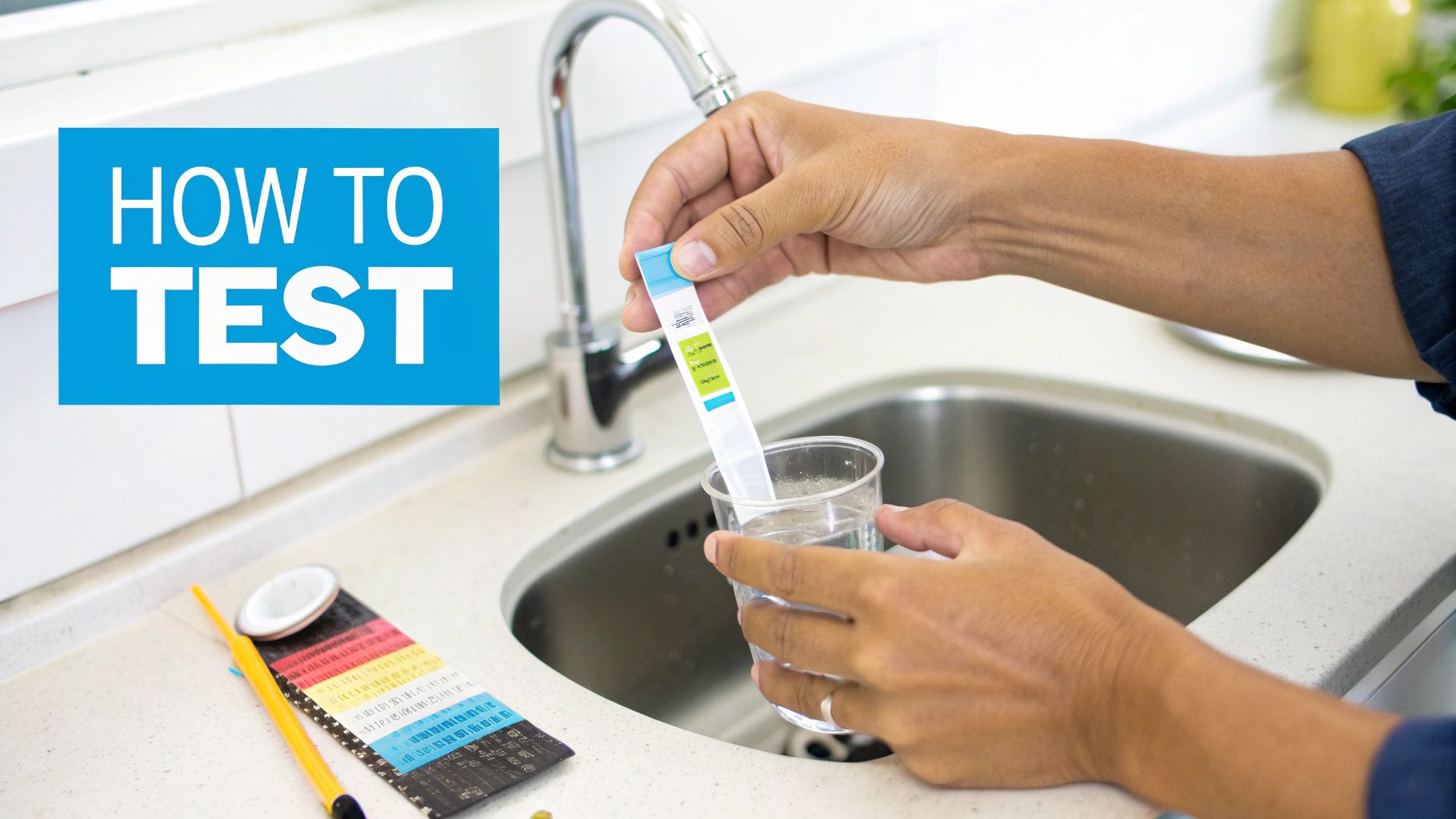
Person using a liquid reagent kit to test tap water for chlorine.

Alright, you've got your test kit. Now for the fun part. Forget the tiny, confusing print on the box for a minute—let's walk through how to actually do this right. Getting an accurate reading is the whole point, and a few simple tricks can make all the difference in choosing the right filter.

First things first: grab your water sample. Don’t just stick the vial under a trickling tap. Let the cold water run for at least 30 to 60 seconds. This flushes out any stagnant water sitting in your pipes, giving you a sample that truly represents what's flowing into your home from the main line.

Mastering Test Strips Without Mistakes

Test strips are the quickest way to get a reading, but their speed can be their downfall if you’re not careful. The most common mistake? Rushing the timing.

If you just dip the strip and immediately check the color, you'll get a faint, inaccurate reading. But if you leave it in too long, the reagents bleed out, also messing up the results. The sweet spot is a quick dip-and-remove, then waiting the recommended time—usually 15 to 30 seconds—before you match the color.

A few pointers to get it right every time:

  • Keep it level: After dipping, hold the strip perfectly horizontal. This stops the colors on the different pads from running into each other and muddying the results.
  • Find good light: Don't try to read the strip in a dim kitchen. Natural daylight is your best friend, as artificial lights can totally change how the colors look.
  • Hands off the pads: The oils on your fingers can contaminate the little reagent pads. Always hold the strip by the plastic end.

Nailing the Liquid Reagent Drop Test

Liquid reagent kits, often using a DPD indicator, give you a nice bump in accuracy. You add a few drops to your water sample and watch for a color change, usually some shade of pink or red. It sounds simple, but the details really matter.

When the instructions say to "mix," they mean a gentle swirl or turning the capped vial over a couple of times. They definitely don't mean a vigorous, bubble-making shake. Shaking too hard dissolves extra oxygen into the water, which can interfere with the chemical reaction and skew your results.

Your goal is an even, consistent color throughout the sample. A gentle swirl is all it takes to mix the reagent completely without adding other variables that could lead you to buy the wrong type of filter.

Here’s another pro tip: hold the vial against a plain white background when you compare it to the color chart. A busy countertop can trick your eyes into seeing a different shade. A simple white piece of paper works perfectly and ensures you’re making an accurate assessment.

This kind of color-based testing has been the backbone of water safety for a long time. Developing reliable methods to test chlorine was a cornerstone of public health for over a century. Early techniques were basic, but modern tech allows treatment plants to keep chlorine levels in that sweet spot—between 0.2 and 2.0 mg/L—to kill germs without ruining the taste. You can learn more about the history of water testing on the USGS website.

Making Sense of Your Chlorine Test Results

So you've done the test, and now you’re staring at a color or a number. What does it actually mean for your water filtration plan? The real trick is translating jargon—like "parts per million" (ppm) or "milligrams per liter" (mg/L)—into a clear course of action.

A test result isn't just data; it's a direct command from your water on which filter to buy. Most city water systems aim to keep chlorine between 0.2 and 2.0 ppm. The EPA sets the absolute maximum at 4.0 ppm, a level your water should never even approach.

Getting these numbers right is a delicate balancing act for water engineers. They need enough chlorine to kill pathogens but not so much that it creates an unpleasant taste or harmful byproducts. You can learn more about how global water safety standards are maintained on ketos.co.

What Your Chlorine Reading Tells You

Honestly, what you do next comes down to your personal goals. Your test result is your personal benchmark for deciding if you need a water filter—and if so, which kind.

Let's break it down with some real-world filtration scenarios:

  • Below 0.5 ppm: This is great news. Your water probably has very little chemical taste. A simple carbon-based pitcher or faucet filter is likely all you need to polish it to perfection.
  • Between 0.5 ppm and 1.5 ppm: This is typical for most city water. You can definitely smell and taste the chlorine here. It might even cause dry skin. This is where a more robust under-sink or countertop filter becomes a smart upgrade.
  • Above 1.5 ppm: At this level, the chlorine is impossible to ignore. Your iced tea tastes funky and your shower feels harsh. You should seriously consider a whole-house filtration system to get the chlorine out of every single tap.

A reading of 1.0 ppm might be perfectly safe according to public health guidelines, but if you're battling dry, itchy skin or can't stand the taste in your morning coffee, your personal standard is what truly matters when choosing a filter.

Free vs. Total Chlorine: What's the Goal for Filtration?

When it comes down to it, for the water you drink and shower in, you want both your free and total chlorine numbers to be as close to zero as possible. A good filtration system makes this happen.

Any reading above zero simply means there's a disinfectant in your water that has already done its job. Your test results give you the exact data you need to choose the right filtration system to get you there, turning a confusing number into a clear plan of action.

Choosing a Water Filter Based on Your Chlorine Levels

Person installing an under-sink water filter.

Alright, you've done the detective work. You have your test results. That's the diagnosis; now it's time for the cure. With your chlorine numbers in hand, you can stop guessing and finally pick a filter that solves your specific water problem.

When it comes to chlorine removal, there's one clear champion: activated carbon.

Think of it like a powerful chemical magnet. Through a process called adsorption, it grabs onto chlorine and chloramine molecules, pulling them right out of your water. So, the real question isn't if you need a carbon filter, but which type is the right fit for your home.

Matching the Filter to Your Test Results

Your test results are your personal roadmap to pure water. A high chlorine reading just at the kitchen sink points to a completely different solution than a house-wide issue that makes your skin feel tight and itchy after every shower.

  • Low to Moderate Chlorine (0.5 – 1.5 ppm): If you're mainly looking to improve the taste of your drinking water, a simple point-of-use filter is a great, wallet-friendly choice. This could be a pitcher filter, a faucet-mounted unit, or a countertop system. They're dead simple to install and focus on the water you consume.
  • High Chlorine (>1.5 ppm): When your tests come back high, you feel the effects everywhere. This is when it's time to upgrade to a more serious system. An under-sink filter is a fantastic option for a dedicated stream of purified water, while a whole-house system tackles the problem at the source.

If your tests show high chlorine levels all over the house, a whole-house system is hands-down the best investment. It doesn't just fix the taste of your drinking water—it deals with the chlorine you absorb in the shower and the stuff that’s fading your clothes in the laundry.

Point-of-Use vs. Whole-House Systems

An under-sink system strikes a great balance. It gives you high-performance filtration right where you need it most—the kitchen tap—without the expense and installation of a full whole-house unit. These systems typically use larger, more powerful carbon block filters than what you'd find in a basic pitcher.

But if you’re truly fed up with dry skin, brittle hair, and that swimming pool smell every time you turn on a faucet, only a whole-house carbon filtration system gets to the root of the problem. It's installed at your main water line, transforming every single tap in your home into a source of clean, chlorine-free water.

Your test results gave you the data. Now you can make an informed choice and invest in a solution that will directly fix your water quality issues.

Common Questions About Chlorine Water Testing

Once you start testing, a few common questions almost always pop up. Let's tackle some of the things people wonder about as they dive deeper into their home filtration journey.

How Often Should I Test My Water?

This all comes down to your filtration setup and your goals.

If you have a whole-house carbon filter, checking your water every three to six months is a smart move. This confirms the system is still working hard and gives you a heads-up when a filter change is on the horizon.

Using a simpler pitcher or faucet filter? A quick test right after you install a new cartridge is a great way to confirm it’s working. After that, testing once or twice a year—or anytime the water starts tasting "off"—is plenty.

Why Do Chlorine Levels Change Seasonally?

You're not imagining things if your water seems more chlorinated in the summer. It's a real phenomenon.

When it gets hot, the warmer water in pipes and reservoirs creates a breeding ground for bacteria. To fight this, municipal water suppliers often increase the amount of chlorine they add. This means your filtration system has to work harder in July than in January, which is why regular testing is so important.

Do I Need a Special Kit for Chloramine?

Yes, and this is a big one. It's a critical distinction many people miss.

Most standard chlorine test kits use a DPD reagent that only measures free chlorine. The problem is, they can't properly detect chloramines—a more stable compound of chlorine and ammonia. Testing for chloramine requires a different chemical reaction.

To get the full story, you need a test kit that specifically measures total chlorine. The difference between your total and free chlorine readings reveals the amount of chloramine present. This is vital to know because chloramine is much harder for many standard carbon filters to remove, often requiring a special type of filter called catalytic carbon.

Here's a little pro tip: Don't just toss an expired test strip. While you shouldn't trust it for an exact reading, an old strip can often still give you a basic "yes/no" indication for high chlorine levels. It's handy for a quick, informal check when you don't need a precise number.

Keeping up with testing is what empowers you to make the best decisions for your home's water filtration. It ensures the system you've invested in is actually working as hard as you expect it to.


At Water Filter Advisor, we're dedicated to helping you find the perfect filtration solution based on your specific needs. Explore our in-depth guides and reviews to make a confident, cost-effective decision for safer, better-tasting water at home. Learn more at https://www.waterfilteradvisor.com.

How to Check for Chlorine in Your Water (and Actually Enjoy It)

Ever wonder how to check for chlorine in your water? Good news: you don't need a chemistry degree. The easiest ways involve using test strips, liquid reagent kits, or digital meters. You can grab these just about anywhere, and they’re designed for regular folks, not mad scientists. In just a few minutes, you'll know exactly what's flowing from your faucet and be one step closer to delicious, clean water.

Why Your Tap Water Smells Like a Pool Party

A glass of tap water being filled from a modern kitchen faucet.

That bleach-like, "clean" smell wafting from your kitchen sink isn't just your imagination—it's chlorine, the unsung hero and occasional villain of your tap water. City water treatment plants add it to the public water supply for one glorious reason: to obliterate harmful bacteria, viruses, and other microscopic baddies. It's a fantastic disinfectant that keeps our water safe on its long, winding journey to your house.

Think of it as a bodyguard for your H₂O. It does a knockout job preventing waterborne illnesses, but its ghost tends to stick around long after the mission is complete. This leftover disinfectant is called residual chlorine, and it’s the culprit behind that familiar swimming pool perfume in your drinking glass.

The Chlorine Conundrum

While chlorine is a public health champion, this residual amount isn't always the most pleasant houseguest. The impact goes beyond just a funky taste in your morning coffee or that pot of pasta. Its presence can be a real buzzkill in other ways around the house.

  • Skin and Hair: Chlorine is a master at stripping natural oils. This can leave you with dry, itchy skin and brittle, lackluster hair right after a shower—not exactly the spa-like experience you were hoping for.
  • Household Appliances: Over time, chlorinated water can wage a silent war on the rubber seals and gaskets in your dishwasher and washing machine, potentially sending them to an early retirement.
  • Taste and Odor: This is the most obvious party foul. The chemical taste and smell can make you shun the tap, and it can ruin the delicate flavors of everything from gourmet tea to homemade soup.

When you learn how to check chlorine levels in your water, you take back control. Testing is the first, non-negotiable step. It tells you what you're dealing with so you can choose a home water filtration system that brings back your water's clean, natural taste.

Understanding Safe Chlorine Levels

So, what's a "normal" amount of chlorine? The levels in your municipal water can actually fluctuate wildly depending on the season, recent weather (like a massive rainstorm), and even how far your house is from the treatment plant.

Global health organizations have set guidelines for what's considered safe. The World Health Organization (WHO), for example, suggests that residual chlorine should ideally stay between 0.2 and 0.5 milligrams per liter (mg/L). This is the sweet spot for effective disinfection without going overboard. You can learn more about the WHO's drinking-water guidelines to see how your tap water stacks up.

Knowing the specific chlorine level in your water is the only way to connect the dots. A quick test will tell you if your levels are low, moderate, or hitting the high notes, giving you the intel you need to choose the perfect water filter for your family.

Choosing Your Chlorine Testing Method

Before you can even dream about picking a water filter, you have to know what you're up against. Finding out how to check the chlorine in your water is a simple but super important first step. You've got three main ways to do this, and each one offers a different blend of convenience, accuracy, and cost.

Think of these as your personal water-testing toolkit. You don’t need to be a scientist to use them—just a few minutes and a glass of water from your tap. Let's break them down so you can find your perfect match.

Test Strips: The Quick and Easy Check

Want an answer in less time than it takes to microwave popcorn? Chlorine test strips are your go-to. They couldn't be easier: just dip a strip into your water sample, give it a little swish, and match the color on the strip to the chart on the bottle. It’s a lightning-fast and cheap way to get a general vibe of your chlorine levels.

Test strips are perfect for a quick spot-check. Maybe you just moved into a new place, or you’ve suddenly noticed your water smells a bit "off." A test strip gives you a ballpark reading right away, satisfying your curiosity in seconds. The trade-off for all that speed, though, is precision. They’re great for sniffing out a problem, but not so great for measuring exactly how big that problem is.

Liquid Test Kits: The Reliable Middle Ground

For a more accurate reading that won't make your wallet cry, liquid test kits (sometimes called "dropper kits") are an excellent choice. This is where you'll usually find the DPD method, which is a trusted standard in the water testing world.

With these kits, you add a few drops of a liquid reagent into a small vial of your tap water. The water changes color based on the chlorine content, and you match that color to a printed comparator. This method gives you a much clearer and more detailed result than a test strip, letting you feel a bit like a home scientist.

One of the most common methods is the colorimetric DPD (N,N-diethyl-p-phenylenediamine) approach, which uses a color change to quantify chlorine. Research shows that while test strips are fast, DPD-based photometric equipment is generally preferred for precise chlorine control. You can learn more from these detailed reports on water quality testing methods.

Digital Meters: For Pinpoint Accuracy

When you need the most precise measurement you can get—no ifs, ands, or buts—a digital meter or colorimeter is the tool for the job. These slick handheld electronic devices eliminate all the guesswork of matching colors by eye.

You just pop a water sample into the meter, and it gives you a direct digital reading of the chlorine concentration, often down to two decimal places.

Digital meters are perfect for homeowners who want to geek out on their water quality, especially before and after installing a whole-house filter. They cost more upfront, but for people serious about their water, their accuracy and ease of use are unbeatable.

Comparing Home Chlorine Test Methods

To make it simple, here’s a quick showdown of how the three main methods compare.

Method Best For Accuracy Speed Typical Cost
Test Strips Quick, initial checks and identifying a potential issue. Low to Moderate Very Fast (1 minute) $10 – $20
Liquid Test Kits Balancing accuracy and affordability for regular use. Moderate to High Fast (2-5 minutes) $15 – $30
Digital Meters Getting precise, data-driven results for tracking. Very High Fast (1-3 minutes) $50 – $150+

So, what's the right call? It really depends on your mission. Are you just casually curious, or are you on a quest to solve a specific issue like dry skin or coffee that tastes like it was brewed in a swimming pool? Any of these methods will arm you with the crucial info you need to take the next step: picking a filtration solution that’s a perfect fit for your home.

How to Get Accurate Test Results

Alright, let's get to the main event—actually testing your water. Don't worry, you won't need a lab coat for this. The goal is simple: get a true snapshot of the water quality coming out of your tap. Getting a reliable number you can act on is easier than you think; a few pro tips are all it takes.

We'll walk through the best practices for each testing method, but first, a couple of golden rules apply no matter which kit you have. These simple tricks ensure you're testing what’s flowing through your pipes, not what's been sitting around getting stale.

This visual guide breaks down your three main options for checking chlorine, from simple strips to precise digital readers.

Infographic about how to check chlorine in water

As the infographic shows, there's a clear trade-off between speed and accuracy. Test strips are the fastest, but digital meters give you the most exact reading. It's all about matching the right tool to your needs.

Universal Best Practices for Water Sampling

Before you even crack open your test kit, a couple of quick steps will set you up for success. They seem small, but they make a huge difference in accuracy.

First, let your tap run for about 30-60 seconds before you collect any water. Water that sits in your pipes overnight can have a different chlorine level than the fresh supply from the main line. Running the tap for a minute clears out that old, stagnant water.

Second, always grab a clean container. Any leftover soap, food, or even old water residue can mess with your results. If you’re using a vial that came with your kit, just give it a good rinse with the same tap water you’re about to test.

Mastering the Test Strip Technique

Test strips are all about speed, but there's a right way and a wrong way to use them. Rushing the process is the number one mistake people make, and it can give you a completely bogus reading.

Here's how to nail it:

  • Dip, Don't Soak: Submerge the strip in the water for a second or two, just like the instructions say. Leaving it in longer can make the colors on the reagent pads bleed.
  • A Gentle Swirl: Give the strip a gentle swirl while it's underwater to make sure the pads get fully saturated. No need to create a whirlpool.
  • Hold it Horizontally: Once you pull the strip out, hold it level. This is key—it stops the colors from running into each other and muddying the result.
  • Time it Right: This is critical. The instructions will specify a wait time—usually 15 to 30 seconds—before reading. Don't eyeball it. Use a timer on your phone. Reading too early or too late gives you a false result as the chemical reaction is still developing.

When it's time to read, match the color pads to the chart in good, natural light. It's surprisingly hard to tell the difference between subtle shades of pink in a dimly lit room.

Getting a Clear Result with Liquid Kits

Liquid dropper kits, often using DPD reagent, are a big step up in accuracy. Success here is all about the details. The reagent turns the water a pinkish-purple color when chlorine is present—the deeper the color, the higher the chlorine.

The single best tip for this method is to read the results against a white background. Just hold a plain piece of paper behind the vial when you compare its color to the chart. It makes the color pop and helps you find a much more exact match.

Also, be precise:

  • Fill the test vial exactly to the line. Too much or too little water will dilute or concentrate the reagent, skewing the reading.
  • Hold the reagent bottle perfectly vertical when adding drops. This ensures every drop is the same size.

You might wonder why this matters. Well, city water with chlorine is great for preventing bacteria, but it's a problem for some hobbies. People who ferment foods or keep fish aquariums have to dechlorinate their water first, often by letting it sit out for 24 hours or boiling it for 15 minutes to let the chlorine gas dissipate. For the rest of us, a good filter is a much faster solution.

Calibrating and Using a Digital Meter

If you've opted for a digital meter, you're on your way to the most precise results possible at home. But even these high-tech tools need a little TLC to stay accurate. The most important step is calibration.

Think of it like tuning a guitar. You have to give the meter a reference point so it knows what "zero" looks like. Most meters are calibrated with chlorine-free water, like distilled water. You just put the "blank" sample in the meter and hit the "zero" or "calibrate" button.

Do this regularly, especially if you haven't used the meter in a while or if the readings seem off. Once it's calibrated, the rest is a breeze. You add your tap water, drop in the DPD reagent (it often comes in a little powder packet), and the meter gives you a specific number in parts-per-million (ppm) or milligrams-per-liter (mg/L). No more guesswork.

By following these simple steps, you can trust the number you see. That reliable data is the foundation for figuring out what it all means and choosing the right water filter to reclaim your tap.

Making Sense of Your Chlorine Levels

You’ve done the test, matched the colors, and now you have a number. So what does a reading of 0.8 ppm or 1.5 mg/L actually mean for the water you drink and shower in every day? This is where we turn that number into a story about your daily life.

Understanding your results is less about complex chemistry and more about context. That number on your test strip or digital meter is the concentration of chlorine in your water, measured in parts per million (ppm), which is the same as milligrams per liter (mg/L). It tells you how your water is treated and what you're likely experiencing at home.

The chlorine in your tap water isn't just one thing. It’s a mix of different compounds, and your test kit can help you figure out what’s what. Grasping these two key terms is the first step to truly decoding your results.

Free Chlorine vs. Total Chlorine

When you test your water, you’ll often see options to measure both free chlorine and total chlorine. They sound similar, but the difference between them is crucial for understanding your water quality and choosing the right filter.

  • Free Chlorine: Think of this as the "active-duty" chlorine. It’s the potent disinfectant that’s ready and available to zap bacteria and other pathogens. This is the portion of chlorine that hasn't reacted with anything yet, and it’s what you typically taste and smell.

  • Total Chlorine: This is the sum of free chlorine plus combined chlorine (better known as chloramines). Combined chlorine forms when free chlorine gets tangled up with organic stuff in the water. It’s a less effective disinfectant but hangs around in the system much longer.

If your total chlorine level is way higher than your free chlorine, it means a lot of the disinfectant has already been "used up," creating chloramines. This often creates that potent, unpleasant chemical smell that's even worse than chlorine alone. For home filtration, knowing both numbers helps you choose a filter that can tackle the entire problem.

Key Takeaway: Think of free chlorine as the 'available' soldier ready for battle, and total chlorine as the entire army, including those who have already engaged with contaminants. Both contribute to the overall taste, smell, and feel of your water.

What Is a Normal Chlorine Level?

So, what should your chlorine reading actually be? According to the EPA, the maximum safe level is 4.0 ppm (mg/L). Most city water systems aim to keep it between 0.5 and 2.0 ppm by the time it reaches your faucet.

But "safe" and "pleasant" are two very different things.

Some people have super-senses and can taste or smell chlorine at levels as low as 0.5 ppm. Others might not notice it until it gets closer to 1.5 ppm or higher. This is often the point where you start to feel its effects, like dry, itchy skin after a shower or that distinct bleach-like taste in your drinking water.

It's also important to know that these levels aren't static. Chlorine concentration can swing up or down based on how far your home is from the treatment plant, seasonal changes, or even a recent heavy rainstorm that forces the city to use more disinfectant. This is exactly why you can't just rely on the city's annual water quality report; you need the real-time data from your own tap.

By understanding what a typical reading is and connecting it to your own experience—that dry skin, the flat-tasting coffee—you can decide what to do next. A consistently low reading might mean a simple faucet filter is all you need, while higher readings point toward a more robust whole-house system to protect every tap in your home.

Matching Your Results to the Right Filter

A person smiling as they install an under-sink water filter.

Alright, you've done the testing and you're holding the results. This is the moment where that data transforms into an action plan for getting amazing water in your home. The right filter all comes down to what your tests revealed. Are we talking about a minor taste issue, or are you dealing with a chlorine level that makes your shower feel like a dip in the public pool?

Think of your chlorine reading as a signpost. It points you straight to the most effective and budget-friendly solution for your water. There's no single "best" filter for everyone—the best one is the one that solves the specific problem you just uncovered. Let's turn that PPM number into a home upgrade.

Low to Moderate Chlorine Levels (0.2 to 1.0 ppm)

If your test came back in this range, you're in good company. This is the most common scenario, where the complaints are usually about taste and smell. Maybe your coffee tastes a little funky, your drinking water isn't as crisp as you'd like, or you catch a faint swimming pool scent now and then.

Good news: you don't need a massive, complicated system. The fix here is simple and targeted.

  • Water Pitcher Filters: This is the easiest entry point. A good pitcher with an activated carbon filter will make a huge difference in the taste and odor of your drinking water.
  • Faucet-Mounted Filters: These clip right onto your kitchen tap for instant gratification. They're a nice step up from a pitcher if you want filtered water on demand for cooking and drinking.

Both of these use activated carbon, a ridiculously porous material that acts like a chlorine magnet. As water flows through, chlorine gets trapped on the carbon's massive surface area. It's an incredibly effective and affordable way to get that pure water taste back.

Moderate to High Chlorine Levels (1.0 to 2.5+ ppm)

Once your readings consistently climb over 1.0 ppm, you’re in territory where the effects are more than just a nuisance. This is when you start feeling that tight, dry-skin feeling after a shower or begin to worry about the long-term impact of chlorine and its byproducts.

A simple pitcher just isn't going to cut it for the whole house. It's time to level up with a more comprehensive solution.

  • Under-Sink Filters: Tucked away under the kitchen or bathroom sink, these systems have much higher capacity and power than pitchers. They hook directly into your cold water line and give you purified water from a separate, dedicated faucet.
  • Countertop Filters: These units sit next to your sink and connect to the faucet, delivering serious filtration power without any plumbing work. They're a fantastic option for renters.

Your test results are your guide. A reading of 1.5 ppm or higher, combined with noticeable skin irritation or a strong chemical smell, is a clear signal that a point-of-use or whole-house system is a smart investment in your family's comfort and health.

Very High Chlorine or Whole-Home Concerns

If your chlorine levels are consistently high, or you just want every single tap, shower, and appliance in your house protected, a whole-house water filter is the ultimate solution. These are installed right where the main water line enters your home, meaning every drop of water that flows through your pipes gets treated.

A whole-house system is your best defense against not only chlorine but also its disinfection byproducts, like trihalomethanes (THMs). When you're dealing with really stubborn chlorine issues, you might even look at what the pros use. High-purity facilities often rely on specialized equipment like lab water purifiers for distilled water to get absolute purity.

For your home, a robust whole-house carbon filter delivers that same kind of peace of mind. You're not just improving your drinking water—you're protecting your appliances from wear and your skin and hair from dryness. It's a total home transformation, one filtered drop at a time.

By matching your specific chlorine reading to one of these strategies, you can stop guessing and make a smart choice. You've already done the detective work; now you can pick the right tool for the job with total confidence.

Common Questions About Water Testing

Even with the right gear, a few questions always pop up when you're learning how to check chlorine levels in your water. We’ve rounded up quick answers to the most common queries to clear up any confusion and help you move forward with your filtration plan.

How Often Should I Test My Water?

As a general rule, testing your home’s water every 3 to 6 months is a smart move. Chlorine levels from your city can change with the seasons or after heavy rain, so regular checks keep you informed.

A pro tip: always test right before and after you install a new water filter. This gives you concrete, undeniable proof of how well your new system is working and lets you see (and taste) the difference right away.

Can I Use Pool Test Strips?

It’s tempting, but please don't. Stick to kits made specifically for drinking water. Pool test strips are designed for much higher chlorine concentrations and a completely different water chemistry.

Using pool strips on your tap water will almost certainly give you a wildly inaccurate reading, making it completely useless for choosing a filter. For results you can actually trust, always grab a dedicated drinking water test kit.

If you're looking for more guidance on selecting the right tools and understanding different water contaminants, you can find a wealth of information in our comprehensive water filtration advice section.

My Test Shows Zero Chlorine. Is That Bad?

Not necessarily. If you're on city water, a zero reading might just mean you live far from the treatment plant. The chlorine has simply done its job and faded away by the time the water reaches you.

While that’s great for the taste, it also means the water no longer has that final layer of disinfectant protection. If you're concerned about microbial safety, adding a UV purification system after your main filter is a fantastic, chemical-free way to ensure total peace of mind.

Will a Water Softener Remove Chlorine?

This is a super common mix-up. A standard water softener will not touch chlorine. Softeners are designed for one job: removing hardness minerals like calcium and magnesium through a process called ion exchange. They're all about preventing scale buildup, not improving taste.

To actually get rid of chlorine, you need a filter that uses activated carbon. Many homeowners create the ultimate water dream team by pairing a water softener with a whole-house carbon filter to tackle both hard water and chlorine at the same time.

How to Test Chlorine in Your Home’s Water

So, you want to know how much chlorine is in your tap water? You've got a few solid options for playing detective right at home: test strips, DPD kits, or even digital readers. Test strips are the quick and dirty route—just a simple color match. For a bit more accuracy, DPD kits use a cool chemical reaction that feels like a mini science experiment. And if you want to get super precise, lab-quality numbers without leaving your kitchen, a digital reader is your high-tech hero.

Why Bother Testing Chlorine for Your Home Filter?

Ever installed a brand-new water filter and just crossed your fingers, hoping it was working? Checking your water's chlorine level is how you pull back the curtain and see the magic happen. Chlorine is the unsung hero that keeps our municipal water safe from nasty bugs, but the amount hitting your tap can swing wildly day to day.

Those fluctuations have a direct impact on your water's taste and smell—goodbye, swimming pool vibes! More importantly, they affect how long your precious filter lasts.

Getting a handle on your home's chlorine levels is the first real step toward becoming a water filtration genius. Think of it less like a chore and more like protecting your investment. For example, if you have a whole-house carbon filter, its entire job is to pull that chlorine out. If your tap water is swimming in higher-than-average chlorine, that filter is working overtime and will burn out much faster, forcing you into more frequent and costly replacements.

The Double-Edged Sword of Chlorine

Chlorine has been a public health champion for over a century, first used in a big way back in 1897 in Maidstone, UK, to stop a deadly typhoid outbreak. It's a powerful disinfectant, which is why it’s still the standard today.

To see why managing chlorine is so important for your filter, it helps to understand how potent a chemical we're dealing with. A properly prepared disinfectant solution bleach can obliterate all sorts of nasty contaminants. Your home filter is working hard around the clock to remove that very same chemical from every drop of water you use. Knowing exactly what it's up against helps you keep it running like a well-oiled machine.

The ultimate "Aha!" moment is testing your chlorine levels before and after installing a filter. This isn't just a fun party trick; it's hard proof that your system is earning its keep and doing what you paid for.

Taking just a few minutes to test empowers you to:

  • Verify filter performance: Get concrete proof that your system is successfully kicking chlorine to the curb.
  • Optimize your filter changes: Swap out cartridges based on real-world data, not just a generic calendar reminder from the manufacturer.
  • Get better water: Finally banish that "public pool" smell and taste for good and enjoy crisp, clean water.

Testing puts you back in the driver's seat of your home's water quality. For more tips on keeping your system in top shape, check out our other water filter advice.

So, you're ready to figure out what's really in your tap water? When it comes to testing for chlorine at home, you've basically got three solid options. Each one has its place, depending on how much accuracy you crave, what your budget is, and how much time you're willing to invest.

Think of it like choosing the right tool for a job—you wouldn't use a sledgehammer to hang a picture frame. This decision tree can point you in the right direction fast.

This guide helps you decide based on a couple of key questions: Are you just curious about your tap water, or are you trying to confirm a new filter is actually doing its job? Let’s walk through the options.

To help you choose, here's a quick comparison of the three main methods for testing chlorine at home. This should make it easy to see which one fits your specific needs and budget.

Comparing Home Chlorine Testing Methods

Method Best For Accuracy Cost
Test Strips Quick, simple checks and "Is there chlorine?" questions. Low $
DPD Kits Reliable results for tracking your filter's performance. Medium $$
Digital Readers Lab-quality precision for troubleshooting and total peace of mind. High $$$

As you can see, there's a clear trade-off between cost and precision. For most homeowners looking after a filtration system, the DPD kit hits that sweet spot of value and reliability. But let's get into the nitty-gritty of each one.

Quick Checks with Test Strips

If you just want a fast, ballpark figure, test strips are your best friend. They are super cheap and give you an answer in about 15 seconds. You just dip a strip in your water, watch the color bloom, and match it to the chart on the bottle. Easy peasy.

This is the perfect way to do a quick annual check-up or see if you can spot a "before and after" difference with that new faucet filter you just screwed on. Just remember, their accuracy is limited. Think of it as getting a general idea, not a laser-precise number to live by.

Better Accuracy with DPD Kits

When you need a more trustworthy result, especially after investing in a new whole-house filtration system, a DPD (N,N-diethyl-p-phenylenediamine) kit is the way to go. These kits have you add a reagent—either a little tablet or liquid drops—to a water sample, which magically turns the water a shade of pink.

The deeper the pink, the more chlorine is crashing the party. You compare that color to a more detailed chart that comes with the kit. It takes a couple more minutes than a test strip, but the boost in accuracy is well worth it for anyone who wants to seriously track how well their filter is performing over time.

For most homeowners trying to manage their filtration system, a DPD kit offers the best mix of affordability and precision. It’s what a lot of pros use for field testing because it delivers results you can count on without needing pricey equipment.

Precision with Digital Readers

For the data nerds and anyone who needs definitive, lab-quality numbers, a digital colorimeter or photometer is the top-tier tool. These slick handheld gadgets take all the guesswork out of matching colors by eye. You still use a DPD reagent to create the pink reaction, but instead of squinting at a color chart, you pop the vial into the reader.

The device shines a beam of light through the sample and gives you an exact digital readout of the chlorine concentration. They're definitely the most expensive option, but for anyone who has to monitor their filter’s performance closely or troubleshoot a tricky problem, the precision is unmatched.

Getting an Accurate Reading with Test Strips

Test strips are by far the fastest and simplest way to figure out the chlorine levels in your water. While they're known for giving a quick answer, there's definitely a right way and a wrong way to use them. Doing it right is the difference between a wild guess and a result you can actually use to check on your filter.

Person holding a chlorine test strip next to a color chart on the bottle.

The directions on the bottle can be pretty sparse, so here are a few pro tips that will make your readings much more accurate. First off, always grab a clean glass for your water sample. Never just stick the strip under a running faucet—that's a surefire way to get a wonky reading.

Instead, let the cold water run for about 30 seconds first. This flushes out any water that's been sitting in your pipes and gets you a true sample of what’s coming from your main line, which is exactly what your filter is dealing with. Then, fill your glass.

Free Chlorine vs. Total Chlorine

When you look at the color chart on the bottle, you’ll almost always see two separate pads for chlorine: free chlorine and total chlorine. Knowing what these mean is the secret to figuring out if your water filter is actually earning its keep.

  • Free Chlorine: This is the active, germ-killing chlorine that keeps your water safe. It's also the main villain that most carbon-based water filters are designed to vanquish.
  • Total Chlorine: This number represents the free chlorine plus something called chloramines (chlorine that has bonded with ammonia). Some water treatment plants use chloramines because they provide a longer-lasting disinfectant shield.

A high-quality carbon filter should knock your free chlorine down to almost zero. If you test your filtered water and still get a high reading for total chlorine, it’s a big clue you might have chloramines. To get rid of those, you'll need a special catalytic carbon filter designed for this tougher challenge.

When it comes to reading the strip, timing is everything. You can't just let it sit there. Check the instructions and read the result at the exact moment it specifies—usually between 15 and 30 seconds. If you wait too long, the colors can bleed or get darker, giving you a falsely high reading.

Finally, hold the strip right up against the color chart in good, natural light if possible. This little trick helps you avoid shadows and makes it way easier to get a perfect color match. It's a simple step that helps you make confident decisions about your water filter's performance.

Using a DPD Kit for More Precise Results

When a simple ballpark estimate from a test strip just won't cut it, it's time to level up to a DPD kit. Think of it as the gold standard for home chlorine testing, giving you the reliable data you need to truly manage your home filtration.

These kits are your best bet for checking if that expensive whole-house filtration system is actually doing its job. The process itself is pretty straightforward, but a little attention to detail goes a long way.

A person using a DPD chlorine test kit with vials and a color comparator.

At the heart of every DPD kit is a chemical reagent. It usually comes as either liquid drops or a small tablet that you add to your water sample. This reagent reacts specifically with chlorine, turning the water a certain shade of pink.

It's a simple visual cue: the deeper the pink, the higher the chlorine concentration. You then hold your sample up to the color comparator chart that came with the kit to get your reading in parts per million (ppm).

Acing the DPD Test

To make sure your results are spot-on, there are a couple of small habits that make a huge difference. These are the little things that separate a good-enough test from a great one.

  • Rinse, Rinse, Rinse: Before you even start, rinse the testing vial a few times with the tap water you're about to test. This quick step gets rid of any dust or residue from a previous test that could throw off your reading.
  • Handle Reagents with Care: If your kit uses tablets, try not to touch them with your bare fingers. The natural oils on your skin can actually interfere with the chemical reaction. For liquid drops, always hold the bottle perfectly vertical over the vial. This ensures every drop is the same size, giving you maximum accuracy.

Here's the real power of a DPD kit: it gives you a clear, hard number. A test strip might just say "low," but a DPD kit will tell you the level is 0.5 ppm. That's a specific piece of data you can use to track your filter's health and performance over time.

Don't forget about proper storage, either. To keep the reagents from going bad, store your kit in a cool, dark place away from direct sunlight. Once you're done testing, just follow the manufacturer's instructions for disposal—it usually just involves flushing the tested water down the drain with plenty of running water.

What Your Chlorine Test Results Mean

You’ve dipped the strip or swirled the vial, and now you have a number. So, what does a result of 0.5 ppm versus 3.0 ppm actually tell you about your tap water? More importantly, what does it say about your filtration system? This is where a simple test transforms into actionable knowledge for your home.

Think of your activated carbon filter like a sponge. A higher chlorine reading—let’s say anything above 2.0 ppm—means that sponge has to work a lot harder. It’s soaking up more disinfectant with every drop of water that passes through. This directly shortens its lifespan, forcing you to swap out filter cartridges more often to keep your water tasting fresh and clean.

On the flip side, a very low reading might mean your filter is coasting, and you can stick to a less frequent replacement schedule, saving you some money in the long run.

Turning PPM into Practical Decisions

Understanding your parts per million (ppm) result lets you fine-tune your entire filtration strategy. That number isn't just a grade; it's a guide. For example, if your unfiltered tap water tests consistently come back high, it might be time to upgrade to a more robust, higher-capacity carbon filter designed for challenging water conditions.

Your test result is the single best indicator of your filter's real-world workload. It takes the guesswork out of maintenance and helps you get the most value from your investment, ensuring your water is always crisp and clean.

It’s also important to remember that chlorine levels are managed for public health. The World Health Organization (WHO) and other health bodies set guidelines for chlorine, and municipal water plants follow strict rules to keep water safe. You can discover more insights about these global water safety standards.

Here’s a quick breakdown of how to use specific results from your unfiltered tap water:

  • Below 1.0 ppm: Your current filter is likely having an easy time. You can probably stick to the manufacturer's standard replacement schedule.
  • Between 1.0 and 2.5 ppm: This is a pretty common range. Your filter is working steadily. Keep an eye on its performance and consider replacing it on the earlier side of the recommended window.
  • Above 2.5 ppm: Your water is highly chlorinated. You may need a heavy-duty filter and should definitely plan for more frequent changes to prevent that chlorine taste from breaking through.

Got Questions About Water Testing?

Even with the right gear, you'll probably have a few questions when you first start testing. Here are some quick answers to the most common ones we hear from homeowners focused on their filtration systems.

How Often Should I Test My Water for Chlorine?

For most folks with a filtration system, testing your water every 3-6 months is a solid plan. This is frequent enough to keep an eye on your filter’s performance as it ages and to notice any big seasonal changes from your city's water supply.

Just installed a new filter? It's a great idea to test both filtered and unfiltered water weekly for the first month. This helps you establish a baseline and confirms the system is working perfectly right out of the box.

What if My Filtered Water Still Has Chlorine in It?

First, don't panic. A brand new, high-quality filter should reduce chlorine to undetectable levels (below 0.1 ppm). If you're seeing a reading over 0.2 ppm in your filtered water, it's time to investigate. Run the test again just to be sure. If you get the same result, it most likely means your filter cartridge is exhausted and needs to be replaced.

If you have a brand-new filter and you're still seeing chlorine, you might be dealing with chloramines. These tricky compounds require a special catalytic carbon filter to be removed effectively.

A common rookie mistake is not flushing a new filter cartridge long enough before you use it. Always run cold water through a new filter for at least five minutes. This activates the carbon media and clears out any harmless fine particles before you take your first test sample.


Ready to take control of your home's water quality? Water Filter Advisor provides expert reviews and practical guides to help you choose the best filtration system for your needs. Explore your options at https://www.waterfilteradvisor.com.

Your Guide to Home Water Testing and Finding the Perfect Filter

That glass of water from your tap might look perfectly clear, but let's be honest, looks can be deceiving. What you can't see could be a real problem for your home, your appliances, and your health. Before you assume that clear equals clean, it's time to play detective. Testing your water is the only way to know for sure what you're dealing with before you even think about buying a water filter.

Why You Should Test Your Home's Water Quality

A person holding a glass of clear tap water up to the light in a modern kitchen.

It’s easy to put your trust in the water flowing from your faucet, especially if you're on a city supply. And while that water is treated, contamination can absolutely happen as it travels through miles and miles of pipes to get to you.

Older plumbing in your neighborhood—or even lurking inside your own walls—can leach things like lead and copper straight into your drinking water.

On top of that, the very chemicals used to make the water safe, like chlorine, can create byproducts (known as DBPs) that have been linked to health concerns. This doesn’t automatically mean your water is dangerous, but it does show how much its quality can change on its journey to your glass.

Common Signs You Need a Water Test

You don’t have to wait for an official alert to start questioning your water. Sometimes, your house gives you clues. These are some of the most common red flags I see that point to a hidden issue:

  • You notice a weird taste. If your water has a metallic tang, that could signal iron, copper, or even lead. If it tastes more like a swimming pool, you've probably got high levels of chlorine.
  • Your appliances have white, chalky buildup. This is the classic calling card of hard water, caused by high levels of calcium and magnesium. That scale doesn't just look bad; it can kill the efficiency and shorten the lifespan of your dishwasher, coffee maker, and water heater.
  • You get your water from a private well. Unlike city water, private wells aren't regulated by the EPA. That means you are 100% responsible for making sure it's free from bacteria, nitrates, and other contaminants that can seep in from the ground.
Get the Data Before You Buy a Filter

Here’s the thing: testing your water isn't just about finding problems. It's about finding the right solution. Buying a water filter without knowing what's in your water is like throwing darts in the dark—you might get lucky, but you'll probably miss the bullseye.

Testing first gives you the power to pick a filtration system that actually targets the specific contaminants in your supply. This keeps you from wasting money on a complex system you don’t need, or worse, buying a cheap filter that doesn't fix your real problem.

At the end of the day, testing your water is about gaining peace of mind and taking back control over what’s flowing into your home.

What to Look For When Testing Your Water

A scientist holding a water sample test tube with clear liquid against a blurred lab background.

Before you can pick the right water filter, you first have to know what you’re up against. Think of it as playing detective—the clues are right there in your water. Learning how to test your water quality at home means knowing exactly which culprits to look for.

Most contaminants fall into a few key categories. This helps you figure out what matters most, whether you're dealing with city water and its treatment chemicals or you're a well owner worried about what's seeping into your groundwater.

Health Concerns

This is the big one. This group includes contaminants that pose a direct risk to your family's health. They’re often invisible, odorless, and tasteless, which makes testing the only way you’ll ever know they’re there.

  • Lead: A serious neurotoxin that often leaches from older plumbing. There is no safe level of lead exposure, period. It's a top priority for testing, especially if your home was built before 1986.
  • Bacteria and Viruses: If you're on a private well, microorganisms like E. coli are a major concern. They can get into your water from failing septic systems or farm runoff and make you sick fast.
  • Nitrates: Another common problem for well water, nitrates come from fertilizers and animal waste. They're especially dangerous for infants because they can interfere with the blood's ability to carry oxygen.

Nuisance Issues

These guys aren't usually as dangerous as the first group, but they can still wreak havoc on your home and make life unpleasant. These are the problems you can often see, taste, or feel.

The most frustrating part of nuisance issues is the slow, silent damage they do. You might not notice the scale buildup inside your water heater until it fails, or the dingy look of your laundry until it's too late.

A perfect example is water hardness, which is caused by too much calcium and magnesium. It's the culprit behind that chalky white scale on your faucets and the soap scum ring in your shower. Another classic is iron, which leaves those ugly reddish-brown stains in your sinks and toilets and can give your water a metallic tang.

General Quality Indicators

Finally, there are the general indicators that give you a bigger picture of your water’s overall condition. They don’t point to one specific contaminant but offer clues that something might be off.

Total Dissolved Solids (TDS) is a measure of everything dissolved in your water, both organic and inorganic. A high TDS reading isn't necessarily a health risk (it can include harmless minerals), but a sudden spike can be a red flag that something new has gotten into your water supply.

Similarly, the pH level tells you how acidic or alkaline your water is. Water that’s too acidic can actually corrode your pipes, which might leach metals like copper and lead right into your drinking water.

This kind of household-level testing is becoming a big deal globally. Since 2012, large-scale surveys in 29 countries have started using home water tests to get a better handle on drinking water safety. This is especially important for rural and lower-income families who often face higher risks. The data shows where city monitoring falls short and proves just how critical it is to check your water right at the tap. You can learn more about how household surveys identify water safety gaps and help inform public health.

Choosing Your Testing Method: DIY Kits vs. Lab Analysis

Alright, so you know what you might be looking for in your water. Now comes the big question: how do you find it? This is where you decide on your approach.

You’ve got two main paths to choose from when it comes to testing your water quality at home: doing it yourself with a DIY kit or sending a sample off for a professional lab analysis.

Each one has its place, and the right choice really boils down to your specific situation, how much you want to spend, and what will give you peace of mind. I like to think of it like a quick health check—sometimes, taking your own temperature at home tells you all you need to know, but other times, you need to see a doctor for the full workup to get the real story.

The Fast and Easy Route: DIY Test Kits

For a quick, on-the-spot snapshot of your water, you can't beat a DIY kit. These are the test strips, color disk kits, and handheld digital meters you can find online or at your local hardware store. They're built for speed, convenience, and affordability.

Most of these kits are designed to flag general quality indicators and common nuisance problems. They’re fantastic for getting a baseline reading on things like:

  • Chlorine: A must-have for anyone on city water who's curious about how much disinfectant is coming through their tap.
  • Water Hardness: Essential if you’re seeing that chalky scale building up on faucets and want to know just how hard your water is.
  • pH Levels: A good general indicator of acidity or alkalinity, which can impact your plumbing over the long haul.

You get results in minutes, which makes these kits a brilliant starting point. They empower you to quickly spot basic issues that a simple pitcher or faucet filter might be able to handle.

Choose a DIY kit when: You want a quick, general screening of your city water, you're curious about nuisance issues like hardness or chlorine, or you just need an affordable way to get an initial feel for your water's condition.

Digital Testers: A Step Up in DIY

A really popular type of DIY option these days are digital water testers. I've seen these handheld gadgets become a favorite for homeowners who want to keep a constant eye on their water. They usually measure things like Total Dissolved Solids (TDS), pH, and temperature, giving you an instant number on a screen.

Now, they won't tell you if you have lead or arsenic, but they're an excellent screening tool. For example, a TDS reading below 300 ppm is generally considered pretty good. But if you see a number over 500 ppm, that’s a clear sign it's time to dig a little deeper.

These digital testers, which usually run between $20 to $100, are also incredibly handy for checking if your filtration system, like a reverse osmosis unit, is still doing its job.

When You Need a Definitive Answer: Professional Lab Analysis

DIY kits are great for a quick look, but they have their limits. They simply can’t see everything.

When you're dealing with serious health concerns or complex water issues, nothing beats the accuracy and detail you get from a professional, state-certified laboratory test. This is the gold standard for filtration prep.

It’s the most thorough way to find out exactly what’s in your water. The process is straightforward: the lab sends you a special collection kit, you fill it up with your water, and you mail it back. In about a week or two, you’ll get a detailed report breaking down dozens of potential contaminants with scientific precision.

Once you have those results, figuring out the next steps can feel overwhelming. For more in-depth guidance on choosing the right filtration systems, you might find our full library of water filtration advice helpful.

Opt for a lab test when: You're on private well water, you have a reason to suspect dangerous contaminants like lead or arsenic, you have infants or immunocompromised folks at home, or you simply want the most accurate, complete picture before investing in a whole-house filter.


DIY Test Kits vs. Professional Lab Testing

Still on the fence? This head-to-head comparison should help you decide which water testing method is the right fit for your needs and your filtration goals.

Feature DIY Test Kits (Strips & Digital Meters) Professional Lab Analysis
Accuracy Good for general estimates, but not precise. Highly accurate and scientifically precise.
Contaminants Detected Limited to common parameters like chlorine, pH, hardness. Can detect hundreds of contaminants, including heavy metals, VOCs, bacteria, and pesticides.
Speed Instantaneous results (usually within minutes). Slower turnaround, typically 1-2 weeks.
Cost Very affordable, often $15 – $100. More expensive, ranging from $100 to $500+ depending on the tests.
Best For Quick screenings, identifying nuisance issues, monitoring city water, and checking filter performance. Well water owners, confirming specific health-related contaminants, and getting a comprehensive water profile.

Ultimately, the best method is the one that answers your specific questions and gives you confidence to choose the right water filter for the job.

Matching Test Results to the Right Water Filter

Okay, you've done the detective work and your water test results are in. This is where all that effort pays off, because you can finally turn that raw data into a real solution.

Instead of just guessing which filter to buy, you now have a clear roadmap. You know exactly what problem you need to solve.

Think of it like getting a prescription from a doctor. You wouldn't just grab any medicine off the shelf; you get the one prescribed for your specific issue. It’s the same exact principle with water filters. Matching the filter to your results saves you money and, more importantly, actually fixes the problem.

This infographic is a handy little decision tree to help you visualize whether a quick test strip check-up is enough or if you need to call in the big guns with a lab analysis.

Infographic about how to test water quality at home

As you can see, the right testing method really depends on your initial concerns. This helps point you in the right direction from the get-go.

Solutions for Common Water Problems

Let's connect the dots between what your report says and the hardware that can fix it. Most water quality headaches fall into a few common buckets, and luckily, there are specialized filters for each one.

  • Problem: Chlorine Taste and Odor
    Does your tap water taste and smell like a public pool? Your test results probably showed high chlorine levels. Good news: this is an easy fix. Activated carbon filters are your best friend here. They basically act like a magnet for chlorine, yanking it out of the water and making it taste and smell great. You'll find these in affordable options like water filter pitchers, faucet-mounted filters, and even most refrigerator filters.

  • Problem: Hard Water and Scale Buildup
    If your results flagged high levels of calcium and magnesium, you've got hard water. That's the stuff causing that chalky white scale on your faucets and making it impossible to get a good lather with soap. The only real fix for this is a water softener. These systems use a process called ion exchange to physically remove those hardness minerals, which will save your pipes and appliances from costly scale damage down the road.

  • Problem: Heavy Metals Like Lead
    A positive test for lead demands an immediate and serious response. Reverse osmosis (RO) systems are one of the most effective tools for removing lead and a whole bunch of other nasty contaminants. These are usually multi-stage filters installed right under your sink. They work by forcing water through a special membrane that blocks things like lead, arsenic, and nitrates.

Tackling Serious Contaminants

Some test results call for a much stronger defense. If you're on a private well or your lab report came back with microbiological threats, you need a system that offers true purification.

A UV purification system is a fantastic, chemical-free way to deal with bacteria and viruses. It uses powerful ultraviolet light to zap the DNA of nasty microorganisms like E. coli, which stops them from reproducing and making you sick. For well water, it's often paired with a sediment pre-filter to make sure the UV light can get a clear shot at any pathogens.

When you have real data from a water test, you're no longer just a consumer—you're an empowered homeowner. You stop buying generic products and start investing in a specific solution that’s perfectly matched to your home’s unique water profile.

This proactive mindset is catching on. Field studies have shown that the simple act of home water testing has a real impact on people's behavior. One study found that giving households access to water testing led to a 5.3 percentage point increase in the use of safer commercial water supplies over time.

It’s simple: when people know what’s in their water, they are far more likely to do something about it. You can read the full research on how testing changes water habits and see the data for yourself.

Maintaining Your Filter for Long-Term Purity

So you've installed a new water filter. That initial sense of relief is great, but the job isn't quite over. Keeping your water pure is an ongoing commitment, not a one-and-done deal.

Think of your filter like any other hard-working appliance in your home—it needs regular attention to keep doing its job right. This means you'll need to retest your water every so often to make sure your system is still working effectively.

Things can change with your water supply, sometimes without any warning. A big storm, a nearby construction project, or even small shifts in how your city treats its water can throw off the chemistry.

Create a Retesting Schedule

The best way to stay ahead of potential issues is to have a simple schedule based on where your water comes from and anything you notice that seems off.

  • For well water owners: Getting an annual professional lab test is non-negotiable. Your water source isn't regulated by the city, which means you're the first and only line of defense against contaminants like bacteria and nitrates that can pop up over time.
  • For city water users: Retest your water if you notice any sudden changes in taste, color, or smell. It’s also smart to test again after a "boil water" advisory is lifted, just to confirm everything is back to normal.

The Critical Role of Filter Cartridge Replacement

Beyond retesting, the single most important piece of maintenance is swapping out your filter cartridges on schedule. It’s so easy to let this slide, but putting it off can cause real problems.

An old, clogged filter doesn't just stop working; it can become a source of contamination itself.

Over time, all the junk your filter has been catching builds up. A saturated filter can turn into a breeding ground for bacteria, potentially making your so-called "filtered" water even worse than what's coming straight from the tap.

Sticking to the manufacturer’s replacement schedule—whether it’s every three months or once a year—is absolutely essential for protecting your investment and your family’s health.

And if you're thinking beyond just filtering what comes out of the tap, storing drinking water is another important step. You can find a comprehensive guide to potable water storage tanks that covers everything from materials and sizing to the crucial maintenance needed to ensure that water stays pure. Regular upkeep is the key to consistently safe water.

Answering Your Top Home Water Testing Questions

Even after you've got a plan, a few questions always seem to pop up. It's totally normal. Let's dig into some of the most common things people ask when they're figuring out how to test their water at home. This should clear up any last bits of confusion.

How Often Should I Be Testing My Water?

This is a big one, and the answer really hinges on where your water comes from. There's no single schedule that fits everyone.

If you have a private well, you're the one in charge of your water quality. Think of yourself as your own water utility manager. Because of that responsibility, an annual lab test is a must. Wells can be affected by all sorts of things—seasonal rain runoff, a neighbor's septic system, you name it. Consistent testing is the only way to stay on top of it and ensure your water is safe.

Now, if you get your water from the city, it's a bit different. That water is treated and tested before it even leaves the plant. The problem is, it can pick up contaminants on its long journey to your faucet. For city water, a good rule of thumb is to test every three to five years. The exception? Test immediately if you notice any weird taste or smell, or if the city issues a water advisory.

Can I Trust Those Free Tests from Water Filter Companies?

Ah, the "free" test. It's a tempting offer, but you have to be careful with this one. These tests usually come with a major catch.

More often than not, the person doing the test isn't a neutral water quality expert—they're a salesperson. Their entire job is to sell you a water filtration system. The "test" is really just a sales demonstration, designed to show you problems that their specific products can fix. It might reveal you have hard water or some chlorine, but it’s almost never a comprehensive, scientifically sound analysis of serious health concerns.

A free test might give you a small clue about your water, but it's usually just a high-pressure sales tactic in disguise. If you want a truly unbiased and accurate report on what's in your water, an independent lab test is the only way to go.

My Water Looks and Tastes Fine, So Why Bother Testing?

This is probably the most dangerous assumption you can make about your drinking water. So many of the worst contaminants are completely invisible to our senses. You simply cannot see, taste, or smell major threats like:

  • Lead: A powerful neurotoxin that can seep into water from old pipes and plumbing.
  • Arsenic: A known carcinogen that can be naturally present in groundwater, especially in certain regions.
  • Bacteria and Viruses: Microscopic pathogens that can lead to serious gastrointestinal illnesses.
  • Nitrates: A common contaminant in well water from agricultural runoff, which is especially dangerous for infants.

Let me say it again: clear water does not mean clean water. Testing is the only way to get the proof you need to know for sure that your water is free from these hidden dangers. It’s what lets you protect your family's health and make a smart, informed choice about whether you need a filter.


Ready to take the next step and find a filtration system that perfectly matches your water's needs? At Water Filter Advisor, we provide in-depth reviews, buying guides, and expert advice to help you make a confident, cost-effective choice. Explore our guides and find the right filter for your home today!