That glass of water from your tap might look perfectly clear, but let's be honest, looks can be deceiving. What you can't see could be a real problem for your home, your appliances, and your health. Before you assume that clear equals clean, it's time to play detective. Testing your water is the only way to know for sure what you're dealing with before you even think about buying a water filter.
Why You Should Test Your Home's Water Quality
It’s easy to put your trust in the water flowing from your faucet, especially if you're on a city supply. And while that water is treated, contamination can absolutely happen as it travels through miles and miles of pipes to get to you.
Older plumbing in your neighborhood—or even lurking inside your own walls—can leach things like lead and copper straight into your drinking water.
On top of that, the very chemicals used to make the water safe, like chlorine, can create byproducts (known as DBPs) that have been linked to health concerns. This doesn’t automatically mean your water is dangerous, but it does show how much its quality can change on its journey to your glass.
Common Signs You Need a Water Test
You don’t have to wait for an official alert to start questioning your water. Sometimes, your house gives you clues. These are some of the most common red flags I see that point to a hidden issue:
- You notice a weird taste. If your water has a metallic tang, that could signal iron, copper, or even lead. If it tastes more like a swimming pool, you've probably got high levels of chlorine.
- Your appliances have white, chalky buildup. This is the classic calling card of hard water, caused by high levels of calcium and magnesium. That scale doesn't just look bad; it can kill the efficiency and shorten the lifespan of your dishwasher, coffee maker, and water heater.
- You get your water from a private well. Unlike city water, private wells aren't regulated by the EPA. That means you are 100% responsible for making sure it's free from bacteria, nitrates, and other contaminants that can seep in from the ground.
Get the Data Before You Buy a Filter
Here’s the thing: testing your water isn't just about finding problems. It's about finding the right solution. Buying a water filter without knowing what's in your water is like throwing darts in the dark—you might get lucky, but you'll probably miss the bullseye.
Testing first gives you the power to pick a filtration system that actually targets the specific contaminants in your supply. This keeps you from wasting money on a complex system you don’t need, or worse, buying a cheap filter that doesn't fix your real problem.
At the end of the day, testing your water is about gaining peace of mind and taking back control over what’s flowing into your home.
What to Look For When Testing Your Water
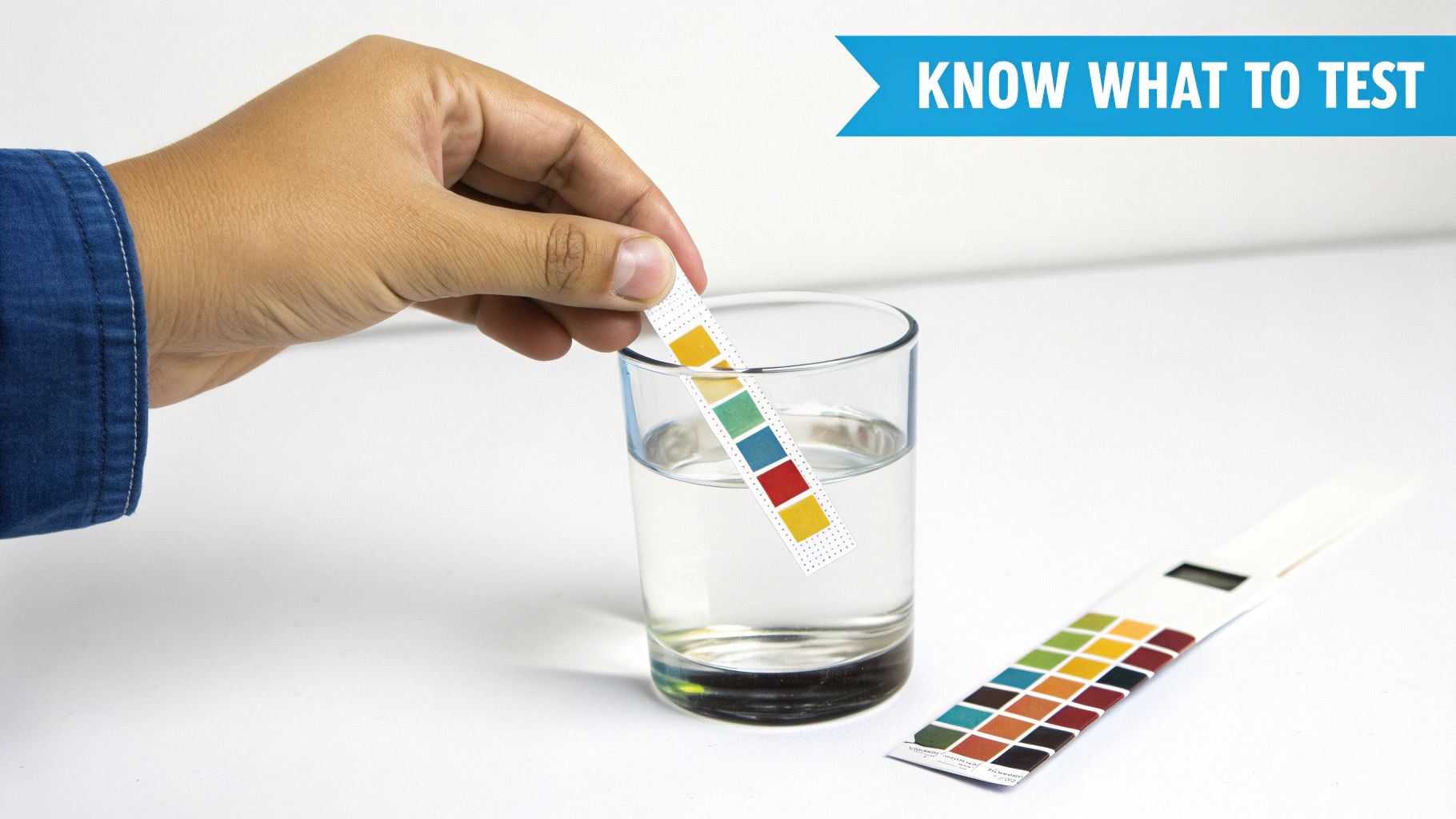
Before you can pick the right water filter, you first have to know what you’re up against. Think of it as playing detective—the clues are right there in your water. Learning how to test your water quality at home means knowing exactly which culprits to look for.
Most contaminants fall into a few key categories. This helps you figure out what matters most, whether you're dealing with city water and its treatment chemicals or you're a well owner worried about what's seeping into your groundwater.
Health Concerns
This is the big one. This group includes contaminants that pose a direct risk to your family's health. They’re often invisible, odorless, and tasteless, which makes testing the only way you’ll ever know they’re there.
- Lead: A serious neurotoxin that often leaches from older plumbing. There is no safe level of lead exposure, period. It's a top priority for testing, especially if your home was built before 1986.
- Bacteria and Viruses: If you're on a private well, microorganisms like E. coli are a major concern. They can get into your water from failing septic systems or farm runoff and make you sick fast.
- Nitrates: Another common problem for well water, nitrates come from fertilizers and animal waste. They're especially dangerous for infants because they can interfere with the blood's ability to carry oxygen.
Nuisance Issues
These guys aren't usually as dangerous as the first group, but they can still wreak havoc on your home and make life unpleasant. These are the problems you can often see, taste, or feel.
The most frustrating part of nuisance issues is the slow, silent damage they do. You might not notice the scale buildup inside your water heater until it fails, or the dingy look of your laundry until it's too late.
A perfect example is water hardness, which is caused by too much calcium and magnesium. It's the culprit behind that chalky white scale on your faucets and the soap scum ring in your shower. Another classic is iron, which leaves those ugly reddish-brown stains in your sinks and toilets and can give your water a metallic tang.
General Quality Indicators
Finally, there are the general indicators that give you a bigger picture of your water’s overall condition. They don’t point to one specific contaminant but offer clues that something might be off.
Total Dissolved Solids (TDS) is a measure of everything dissolved in your water, both organic and inorganic. A high TDS reading isn't necessarily a health risk (it can include harmless minerals), but a sudden spike can be a red flag that something new has gotten into your water supply.
Similarly, the pH level tells you how acidic or alkaline your water is. Water that’s too acidic can actually corrode your pipes, which might leach metals like copper and lead right into your drinking water.
This kind of household-level testing is becoming a big deal globally. Since 2012, large-scale surveys in 29 countries have started using home water tests to get a better handle on drinking water safety. This is especially important for rural and lower-income families who often face higher risks. The data shows where city monitoring falls short and proves just how critical it is to check your water right at the tap. You can learn more about how household surveys identify water safety gaps and help inform public health.
Choosing Your Testing Method: DIY Kits vs. Lab Analysis
Alright, so you know what you might be looking for in your water. Now comes the big question: how do you find it? This is where you decide on your approach.
You’ve got two main paths to choose from when it comes to testing your water quality at home: doing it yourself with a DIY kit or sending a sample off for a professional lab analysis.
Each one has its place, and the right choice really boils down to your specific situation, how much you want to spend, and what will give you peace of mind. I like to think of it like a quick health check—sometimes, taking your own temperature at home tells you all you need to know, but other times, you need to see a doctor for the full workup to get the real story.
The Fast and Easy Route: DIY Test Kits
For a quick, on-the-spot snapshot of your water, you can't beat a DIY kit. These are the test strips, color disk kits, and handheld digital meters you can find online or at your local hardware store. They're built for speed, convenience, and affordability.
Most of these kits are designed to flag general quality indicators and common nuisance problems. They’re fantastic for getting a baseline reading on things like:
- Chlorine: A must-have for anyone on city water who's curious about how much disinfectant is coming through their tap.
- Water Hardness: Essential if you’re seeing that chalky scale building up on faucets and want to know just how hard your water is.
- pH Levels: A good general indicator of acidity or alkalinity, which can impact your plumbing over the long haul.
You get results in minutes, which makes these kits a brilliant starting point. They empower you to quickly spot basic issues that a simple pitcher or faucet filter might be able to handle.
Choose a DIY kit when: You want a quick, general screening of your city water, you're curious about nuisance issues like hardness or chlorine, or you just need an affordable way to get an initial feel for your water's condition.
Digital Testers: A Step Up in DIY
A really popular type of DIY option these days are digital water testers. I've seen these handheld gadgets become a favorite for homeowners who want to keep a constant eye on their water. They usually measure things like Total Dissolved Solids (TDS), pH, and temperature, giving you an instant number on a screen.
Now, they won't tell you if you have lead or arsenic, but they're an excellent screening tool. For example, a TDS reading below 300 ppm is generally considered pretty good. But if you see a number over 500 ppm, that’s a clear sign it's time to dig a little deeper.
These digital testers, which usually run between $20 to $100, are also incredibly handy for checking if your filtration system, like a reverse osmosis unit, is still doing its job.
When You Need a Definitive Answer: Professional Lab Analysis
DIY kits are great for a quick look, but they have their limits. They simply can’t see everything.
When you're dealing with serious health concerns or complex water issues, nothing beats the accuracy and detail you get from a professional, state-certified laboratory test. This is the gold standard for filtration prep.
It’s the most thorough way to find out exactly what’s in your water. The process is straightforward: the lab sends you a special collection kit, you fill it up with your water, and you mail it back. In about a week or two, you’ll get a detailed report breaking down dozens of potential contaminants with scientific precision.
Once you have those results, figuring out the next steps can feel overwhelming. For more in-depth guidance on choosing the right filtration systems, you might find our full library of water filtration advice helpful.
Opt for a lab test when: You're on private well water, you have a reason to suspect dangerous contaminants like lead or arsenic, you have infants or immunocompromised folks at home, or you simply want the most accurate, complete picture before investing in a whole-house filter.
DIY Test Kits vs. Professional Lab Testing
Still on the fence? This head-to-head comparison should help you decide which water testing method is the right fit for your needs and your filtration goals.
| Feature | DIY Test Kits (Strips & Digital Meters) | Professional Lab Analysis |
|---|---|---|
| Accuracy | Good for general estimates, but not precise. | Highly accurate and scientifically precise. |
| Contaminants Detected | Limited to common parameters like chlorine, pH, hardness. | Can detect hundreds of contaminants, including heavy metals, VOCs, bacteria, and pesticides. |
| Speed | Instantaneous results (usually within minutes). | Slower turnaround, typically 1-2 weeks. |
| Cost | Very affordable, often $15 – $100. | More expensive, ranging from $100 to $500+ depending on the tests. |
| Best For | Quick screenings, identifying nuisance issues, monitoring city water, and checking filter performance. | Well water owners, confirming specific health-related contaminants, and getting a comprehensive water profile. |
Ultimately, the best method is the one that answers your specific questions and gives you confidence to choose the right water filter for the job.
Matching Test Results to the Right Water Filter
Okay, you've done the detective work and your water test results are in. This is where all that effort pays off, because you can finally turn that raw data into a real solution.
Instead of just guessing which filter to buy, you now have a clear roadmap. You know exactly what problem you need to solve.
Think of it like getting a prescription from a doctor. You wouldn't just grab any medicine off the shelf; you get the one prescribed for your specific issue. It’s the same exact principle with water filters. Matching the filter to your results saves you money and, more importantly, actually fixes the problem.
This infographic is a handy little decision tree to help you visualize whether a quick test strip check-up is enough or if you need to call in the big guns with a lab analysis.
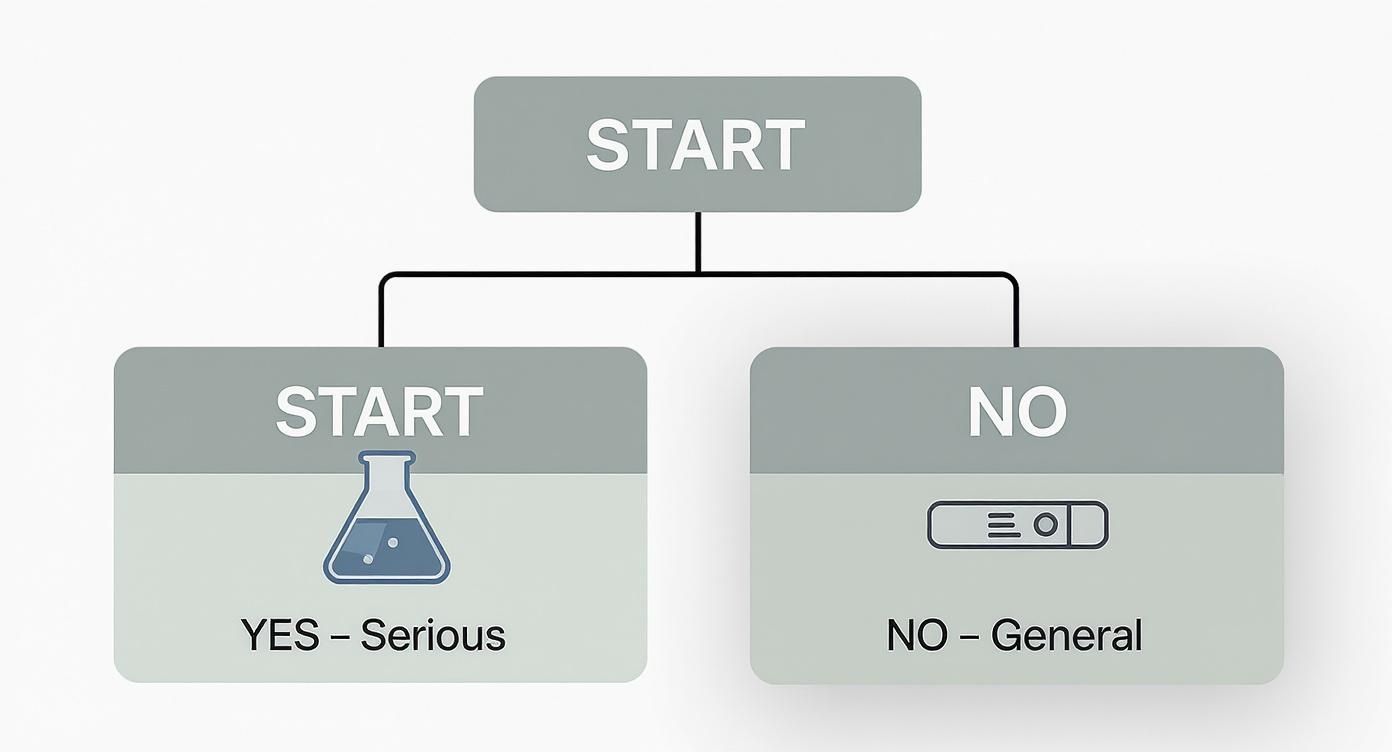
As you can see, the right testing method really depends on your initial concerns. This helps point you in the right direction from the get-go.
Solutions for Common Water Problems
Let's connect the dots between what your report says and the hardware that can fix it. Most water quality headaches fall into a few common buckets, and luckily, there are specialized filters for each one.
-
Problem: Chlorine Taste and Odor
Does your tap water taste and smell like a public pool? Your test results probably showed high chlorine levels. Good news: this is an easy fix. Activated carbon filters are your best friend here. They basically act like a magnet for chlorine, yanking it out of the water and making it taste and smell great. You'll find these in affordable options like water filter pitchers, faucet-mounted filters, and even most refrigerator filters. -
Problem: Hard Water and Scale Buildup
If your results flagged high levels of calcium and magnesium, you've got hard water. That's the stuff causing that chalky white scale on your faucets and making it impossible to get a good lather with soap. The only real fix for this is a water softener. These systems use a process called ion exchange to physically remove those hardness minerals, which will save your pipes and appliances from costly scale damage down the road. -
Problem: Heavy Metals Like Lead
A positive test for lead demands an immediate and serious response. Reverse osmosis (RO) systems are one of the most effective tools for removing lead and a whole bunch of other nasty contaminants. These are usually multi-stage filters installed right under your sink. They work by forcing water through a special membrane that blocks things like lead, arsenic, and nitrates.
Tackling Serious Contaminants
Some test results call for a much stronger defense. If you're on a private well or your lab report came back with microbiological threats, you need a system that offers true purification.
A UV purification system is a fantastic, chemical-free way to deal with bacteria and viruses. It uses powerful ultraviolet light to zap the DNA of nasty microorganisms like E. coli, which stops them from reproducing and making you sick. For well water, it's often paired with a sediment pre-filter to make sure the UV light can get a clear shot at any pathogens.
When you have real data from a water test, you're no longer just a consumer—you're an empowered homeowner. You stop buying generic products and start investing in a specific solution that’s perfectly matched to your home’s unique water profile.
This proactive mindset is catching on. Field studies have shown that the simple act of home water testing has a real impact on people's behavior. One study found that giving households access to water testing led to a 5.3 percentage point increase in the use of safer commercial water supplies over time.
It’s simple: when people know what’s in their water, they are far more likely to do something about it. You can read the full research on how testing changes water habits and see the data for yourself.
Maintaining Your Filter for Long-Term Purity
So you've installed a new water filter. That initial sense of relief is great, but the job isn't quite over. Keeping your water pure is an ongoing commitment, not a one-and-done deal.
Think of your filter like any other hard-working appliance in your home—it needs regular attention to keep doing its job right. This means you'll need to retest your water every so often to make sure your system is still working effectively.
Things can change with your water supply, sometimes without any warning. A big storm, a nearby construction project, or even small shifts in how your city treats its water can throw off the chemistry.
Create a Retesting Schedule
The best way to stay ahead of potential issues is to have a simple schedule based on where your water comes from and anything you notice that seems off.
- For well water owners: Getting an annual professional lab test is non-negotiable. Your water source isn't regulated by the city, which means you're the first and only line of defense against contaminants like bacteria and nitrates that can pop up over time.
- For city water users: Retest your water if you notice any sudden changes in taste, color, or smell. It’s also smart to test again after a "boil water" advisory is lifted, just to confirm everything is back to normal.
The Critical Role of Filter Cartridge Replacement
Beyond retesting, the single most important piece of maintenance is swapping out your filter cartridges on schedule. It’s so easy to let this slide, but putting it off can cause real problems.
An old, clogged filter doesn't just stop working; it can become a source of contamination itself.
Over time, all the junk your filter has been catching builds up. A saturated filter can turn into a breeding ground for bacteria, potentially making your so-called "filtered" water even worse than what's coming straight from the tap.
Sticking to the manufacturer’s replacement schedule—whether it’s every three months or once a year—is absolutely essential for protecting your investment and your family’s health.
And if you're thinking beyond just filtering what comes out of the tap, storing drinking water is another important step. You can find a comprehensive guide to potable water storage tanks that covers everything from materials and sizing to the crucial maintenance needed to ensure that water stays pure. Regular upkeep is the key to consistently safe water.
Answering Your Top Home Water Testing Questions
Even after you've got a plan, a few questions always seem to pop up. It's totally normal. Let's dig into some of the most common things people ask when they're figuring out how to test their water at home. This should clear up any last bits of confusion.
How Often Should I Be Testing My Water?
This is a big one, and the answer really hinges on where your water comes from. There's no single schedule that fits everyone.
If you have a private well, you're the one in charge of your water quality. Think of yourself as your own water utility manager. Because of that responsibility, an annual lab test is a must. Wells can be affected by all sorts of things—seasonal rain runoff, a neighbor's septic system, you name it. Consistent testing is the only way to stay on top of it and ensure your water is safe.
Now, if you get your water from the city, it's a bit different. That water is treated and tested before it even leaves the plant. The problem is, it can pick up contaminants on its long journey to your faucet. For city water, a good rule of thumb is to test every three to five years. The exception? Test immediately if you notice any weird taste or smell, or if the city issues a water advisory.
Can I Trust Those Free Tests from Water Filter Companies?
Ah, the "free" test. It's a tempting offer, but you have to be careful with this one. These tests usually come with a major catch.
More often than not, the person doing the test isn't a neutral water quality expert—they're a salesperson. Their entire job is to sell you a water filtration system. The "test" is really just a sales demonstration, designed to show you problems that their specific products can fix. It might reveal you have hard water or some chlorine, but it’s almost never a comprehensive, scientifically sound analysis of serious health concerns.
A free test might give you a small clue about your water, but it's usually just a high-pressure sales tactic in disguise. If you want a truly unbiased and accurate report on what's in your water, an independent lab test is the only way to go.
My Water Looks and Tastes Fine, So Why Bother Testing?
This is probably the most dangerous assumption you can make about your drinking water. So many of the worst contaminants are completely invisible to our senses. You simply cannot see, taste, or smell major threats like:
- Lead: A powerful neurotoxin that can seep into water from old pipes and plumbing.
- Arsenic: A known carcinogen that can be naturally present in groundwater, especially in certain regions.
- Bacteria and Viruses: Microscopic pathogens that can lead to serious gastrointestinal illnesses.
- Nitrates: A common contaminant in well water from agricultural runoff, which is especially dangerous for infants.
Let me say it again: clear water does not mean clean water. Testing is the only way to get the proof you need to know for sure that your water is free from these hidden dangers. It’s what lets you protect your family's health and make a smart, informed choice about whether you need a filter.
Ready to take the next step and find a filtration system that perfectly matches your water's needs? At Water Filter Advisor, we provide in-depth reviews, buying guides, and expert advice to help you make a confident, cost-effective choice. Explore our guides and find the right filter for your home today!
- October 26, 2025
- 0
- Uncategorized
