Water Quality Monitoring: A Complete Home Guide
Tap water that meets municipal standards can still carry contaminants that affect taste, health, and plumbing, and water quality monitoring is the onl ...
Tap water that meets municipal standards can still carry contaminants that affect taste, health, and plumbing, and water quality monitoring is the onl ...
The moment usually starts small. A text from the city about a boil water advisory. A lab report from your well test that doesn't look right. A sulfur smell at the sink that suddenly makes you question every glass of water in the house.
That uncertainty gets under your skin because bacteria are invisible. Water can look clear, taste normal, and still be unsafe. You can't trust your eyes for this one, and homeowners waste a lot of money when they treat the wrong problem with the wrong equipment.
If you're trying to figure out how to remove bacteria from water at home, the answer depends on your situation. Emergency water treatment is different from long-term home filtration. City water problems are different from well contamination. And recurring bacteria usually means the source problem hasn't been fixed.
A homeowner on city water usually gets the warning first. It might be a boil notice after a main break, heavy rain, or treatment disruption. The water still comes out of the tap, so the danger feels abstract. That's what makes it hard. People keep using water because nothing about it looks dramatic.
A well owner often gets the opposite experience. No public notice. No broad warning. Just a bad test result, a change in odor, or a slow realization that something in the system isn't right. That can feel even worse because the responsibility sits entirely on the homeowner.
The first practical thing to understand is simple. Bacteria contamination is not a taste-and-odor problem. It's a treatment and verification problem.
You don't solve bacteria by guessing. You solve it by confirming the source, using the right barrier, and preventing the water from getting contaminated again after treatment.
That last part gets missed all the time. Homeowners buy a filter, install it, and assume they're done. Sometimes that works for a very specific point-of-use need. Often it doesn't. If the well cap is compromised, if plumbing has biofilm, or if muddy water is reaching the treatment device, a good product can still give poor results.
The good news is that this is manageable. Municipal water systems have controlled bacteria for generations with a treatment train, not a miracle gadget. A properly designed plant using coagulation, sedimentation, filtration, and disinfection can remove or destroy more than 99.999% of coliform bacteria according to an NIH/NCBI review of water disinfection practices. That's the model homeowners should think in. Layers. Not shortcuts.
Before you buy anything, confirm what you're dealing with. A surprising number of homeowners chase bacteria when the actual issue is iron, sulfur, sediment, or plumbing odor. The reverse happens too. People assume a smell will warn them about contamination, when bacteria can be present without obvious clues.
Start with your utility's published water quality information and any active public alerts. City water is already treated, so a bacteria problem at home often points to a temporary distribution issue, a local plumbing problem, or an advisory that changes how you should use the water for a short period.
Look for:
If you've also had unexplained moisture or structural plumbing trouble, that deserves attention too. A hidden leak can create broader sanitation and plumbing complications. In that situation, a resource on Dallas-Fort Worth slab leak solutions can help you think through whether the problem is only water quality, or whether the home's plumbing system itself needs repair.
Well owners need to test. That's the starting point. Not a filter purchase, not a guess, not a conversation with a neighbor. A proper water sample analyzed by a certified lab gives you a real answer.
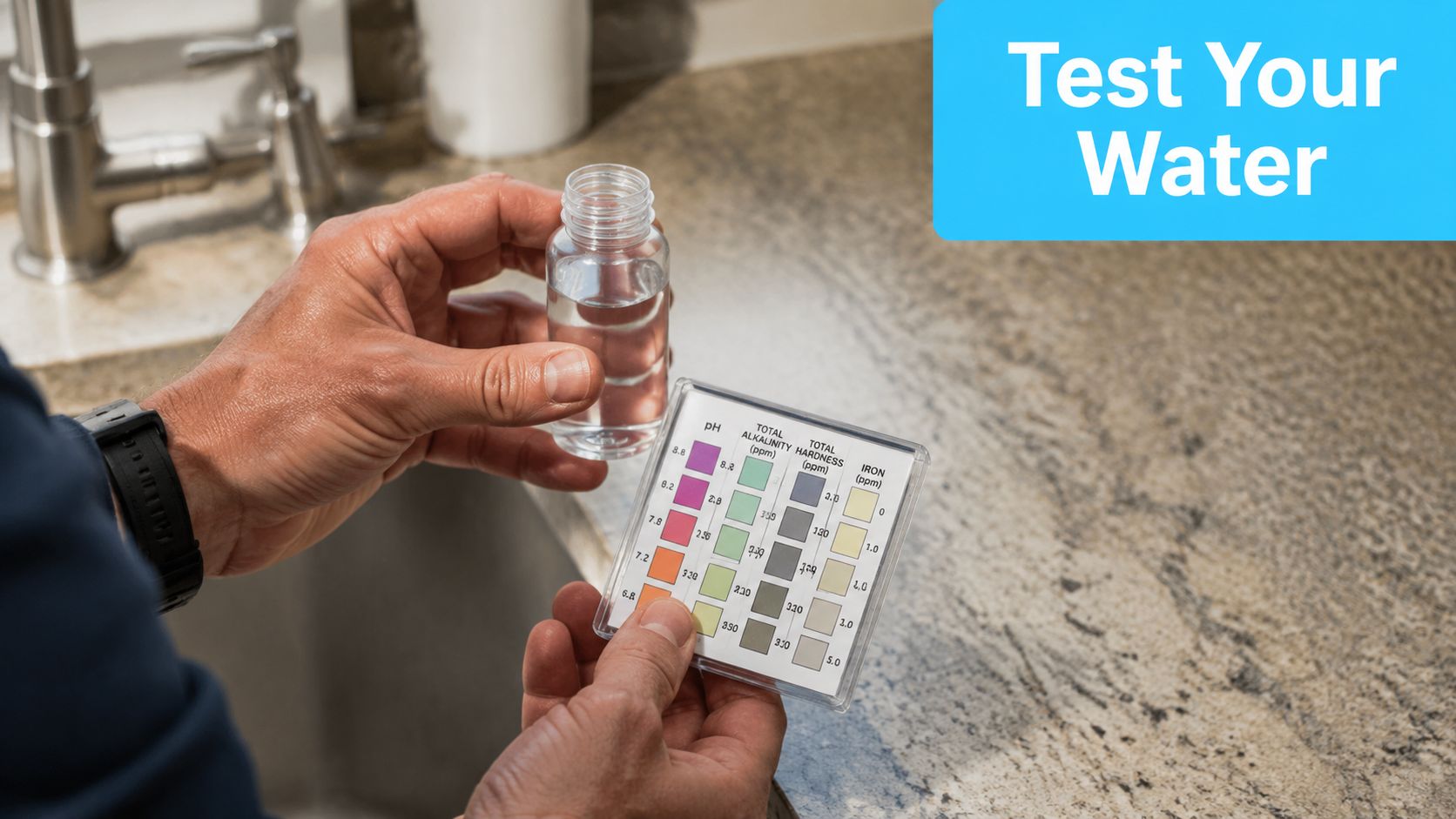
Ask for a bacteria test that covers total coliform and E. coli. Those names matter because they help distinguish a general warning sign from a more urgent fecal contamination concern.
When collecting a sample, keep the process clean and boring. That's what you want. False positives often come from sloppy sampling rather than the well itself.
A better sampling routine usually looks like this:
Practical rule: If the sample process felt casual, trust the result less and retest correctly before making an expensive equipment decision.
A positive bacteria result means more than "install a filter." It means you need to ask where the contamination is entering, whether it's ongoing, and whether point-of-use treatment is enough.
For city water, a positive result often pushes you toward short-term disinfection and a closer look at household plumbing conditions. For wells, it often means inspecting the source, the casing, the cap, drainage around the well, and the plumbing between the well and the tap.
That distinction saves a lot of frustration.
You turn on the tap after a storm, a power outage, or a boil-water notice, and now every normal task feels questionable. Drinking is the obvious concern, but the risk also extends to ice, infant formula, coffee, and brushing teeth. In that moment, the right choice depends on one question first. Do you need safe water for the next few hours, or for the next few days?
For immediate household use, boiling is usually the safest answer because it does not depend on guesswork, specialty equipment, or a perfect chemical dose. Bring clear water to a full rolling boil, then keep it there long enough to complete the treatment. At higher elevations, the required boil time increases because water boils at a lower temperature. If you want step-by-step help for short-term treatment decisions, this practical water safety advice guide is a useful reference.
If I am advising a homeowner during an active contamination event, boiling is my default recommendation unless fuel, power, or time make it unrealistic.
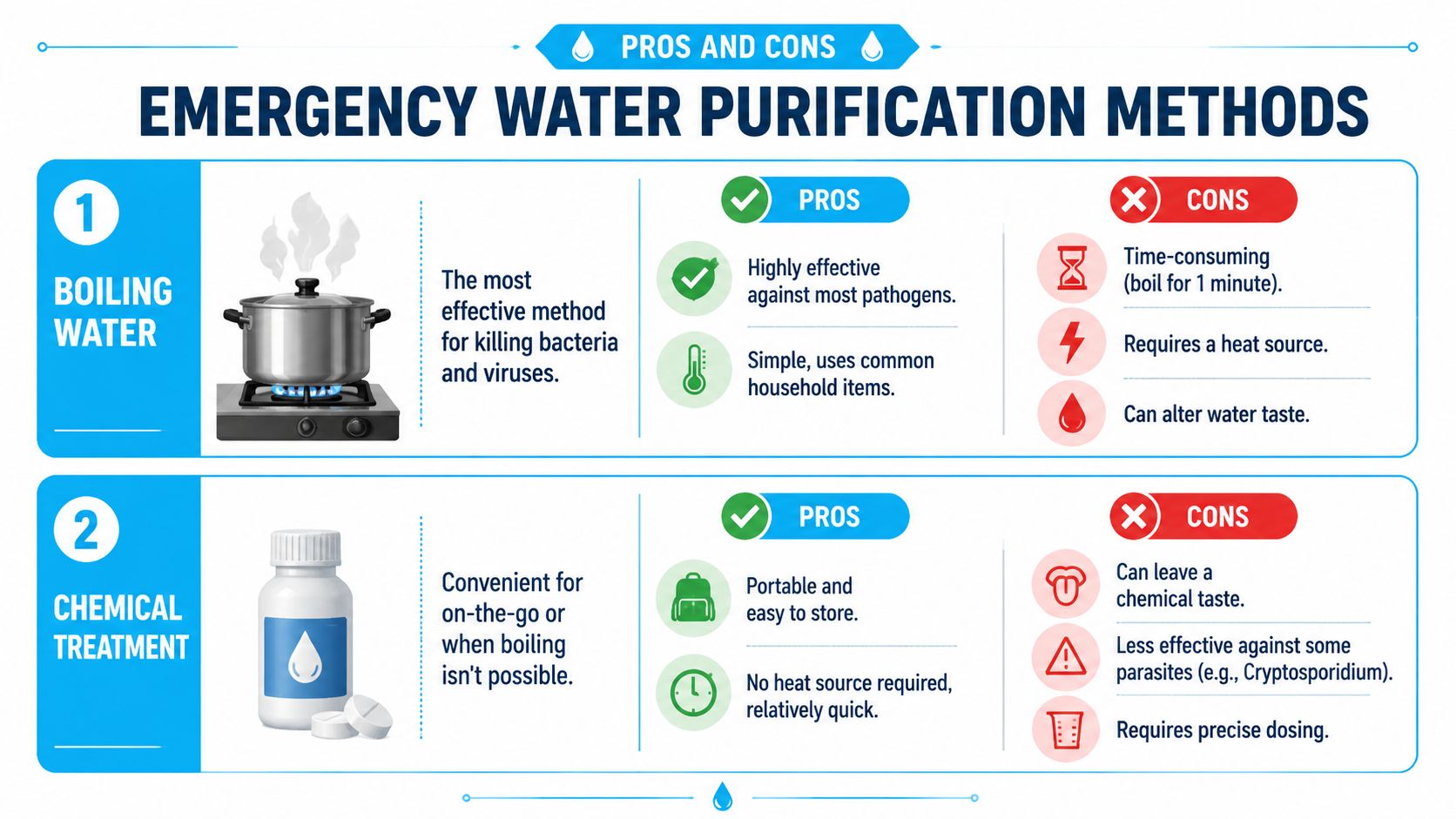
The details matter. Water that is hot is not treated water. Water with a few small bubbles is not treated water. Use a real rolling boil, let it cool, and store it in a clean container with a lid. I see plenty of failures after treatment, when safe water gets poured into a dirty pitcher or handled with contaminated hands.
Cloudy water changes the decision. Suspended particles can shield bacteria and make any emergency method less dependable. Let sediment settle if possible, pour off the clearer water, and filter it through a clean cloth if that is the best you have on hand. The goal is simple. Improve clarity before you disinfect.
Chemical disinfection still has a place, especially if the stove is out, fuel is limited, or you need a portable backup. The trade-off is control. You must use a product labeled for drinking water treatment, follow the label exactly, and allow the full contact time. This is one reason I treat chemicals as a backup option for homeowners, not the first option, unless boiling is off the table.
Use chemical treatment when:
Avoid relying on chemical treatment when:
The source of the contamination also affects the emergency plan. A city water advisory often points to a distribution problem, so temporary treatment may be enough until the utility clears the issue. A private well with repeated bacteria results is different. Emergency treatment can make water safer today, but it does not solve a bad well cap, surface runoff near the casing, or contamination entering through the plumbing.
That recurring-contamination problem is where homeowners lose time and money. They treat the water at the sink, then keep getting the same bacteria result because the entry point never got fixed.
If sewage has backed up, flooded a crawlspace, or contaminated the home environment, treat it as both a water safety problem and a sanitation problem. In that situation, guidance on Los Angeles sewage cleanup can help homeowners understand the cleanup side while they limit water use and switch to safe treated or bottled water.
Emergency fixes buy time. Long-term protection comes from matching the treatment method to the source water, the type of contamination, and the places in the home where you need protection.
The biggest mistake I see is homeowners shopping by product category instead of treatment objective. They ask whether they need reverse osmosis, UV, a whole-house filter, or a countertop unit. The better question is this: Do you need to remove bacteria, kill bacteria, or fix the source of recurring contamination?
Home water treatment works best as a multiple-barrier process. The UK Drinking Water Inspectorate notes that membrane processes such as microfiltration, ultrafiltration, nanofiltration, and reverse osmosis can provide adequate removal of pathogenic bacteria, while other processes reduce microorganisms before final disinfection in a layered system, as outlined in its treatment guidance on physical removal of contaminants.
For a homeowner, that usually means three jobs:
That sequence matters because filtration alone may not be enough for all microbial risks, especially when source conditions change.
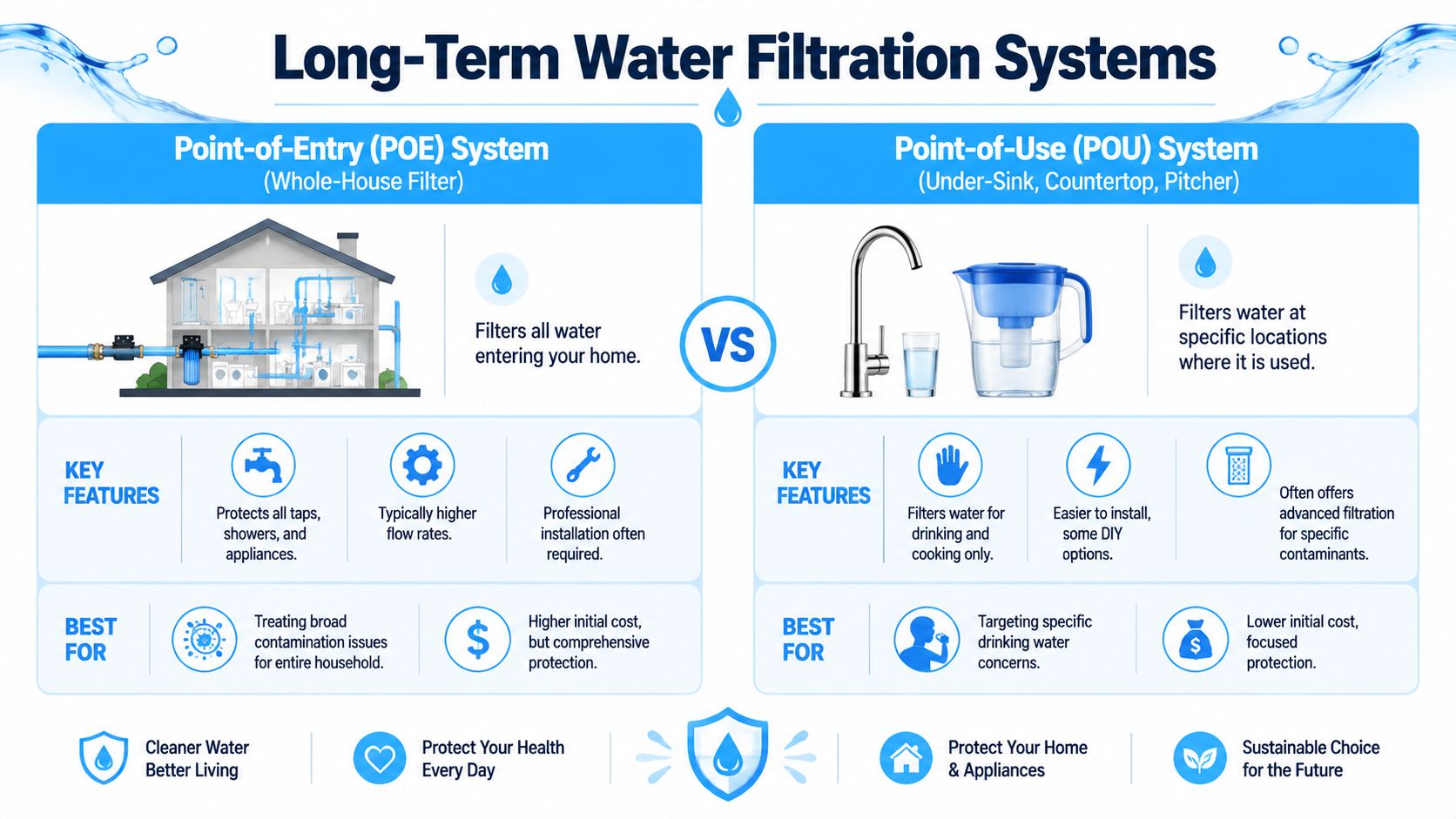
A quick visual makes the whole-house versus point-of-use decision easier:
When the goal is physical bacteria reduction, membrane filtration is the top tier. A 2024 systematic review found that microfiltration, ultrafiltration, and reverse osmosis removed bacteria most effectively, with an average log removal value of 4.5 and a 95% confidence interval of 3.9 to 5.1, which corresponds to roughly 99.9968% removal in that review's analysis. The same source also notes that reverse osmosis was strongest for viruses with an average LRV of 4.9, as summarized in this ACS Environmental Science & Technology review.
For practical household shopping, the CDC guidance summarized in that review notes that a filter with an absolute pore size of 0.3 microns or smaller will remove bacteria and parasites, while reverse osmosis filters remove parasites, bacteria, and viruses.
That gives you a useful screening question when reading product specs. If the manufacturer doesn't clearly state an absolute pore size or validated microbiological performance, don't assume the unit is suitable for bacteria.
Here's a useful video overview before getting into the side-by-side comparison:
Some homeowners need point-of-use protection at the kitchen sink. Others need point-of-entry treatment for the whole house because the source itself is suspect. That's why broad buying advice tends to fail.
| Method | How it Works | Best For | Typical Cost | Key Consideration |
|---|---|---|---|---|
| Reverse osmosis | Uses a tight membrane to physically reduce contaminants | Drinking and cooking water at one tap | Higher than basic faucet or pitcher filters | Usually point-of-use, slower production, needs maintenance |
| Ultrafiltration or microfiltration | Uses membrane pores sized for physical removal | Homes needing bacteria-focused filtration without full RO | Varies by system design | Verify the unit is intended for microbiological use |
| UV disinfection | Uses ultraviolet light to inactivate microbes | Clear water that already has particle control upstream | Equipment and lamp replacement costs vary | Water clarity matters, and UV doesn't remove particles |
| Whole-house chlorination or disinfection setup | Treats incoming water before distribution in the home | Recurring well contamination or whole-house protection needs | Usually professional installation territory | Best when paired with source correction and follow-up filtration |
| Sediment plus carbon only | Reduces particles, taste, and odor issues | Aesthetic improvement on treated municipal water | Usually lower entry cost | Not a stand-alone bacteria strategy |
You'll notice I didn't put pitcher filters in the bacteria-removal category. That's intentional.
A city-water homeowner usually does best with targeted treatment at the tap for drinking water unless there's an active utility issue or a building-specific contamination concern. In many homes, a bacteria-rated point-of-use system is the practical answer.
A private-well homeowner often needs more. If bacteria are recurring, the right answer is rarely a lone under-sink filter. It may be source repair plus shock disinfection plus a whole-house barrier, with an additional drinking-water polish at the kitchen sink.
A renter usually needs a removable point-of-use option and should be realistic about limits. If the building has a temporary advisory, boiling is still the emergency answer.
If you're comparing treatment categories beyond bacteria alone, a broader set of home water softener solutions can help separate hardness treatment from microbiological treatment, because homeowners often bundle those issues together when they shouldn't.
For broader filter selection help, this practical library of water filtration advice and buying guidance is useful once you've identified whether the problem is source-wide or only at the tap.
A filter that works beautifully for chlorine taste can be the wrong tool for bacteria. Buy for the contaminant, not for the category name on the box.
A bacteria treatment system can fail unnoticed. That's why maintenance matters more than the purchase. Homeowners love installation day because it feels like the problem is solved. The harder truth is that neglected equipment can turn a sound treatment plan into an unreliable one.
Filters load up. UV systems depend on clean water and functioning components. Housings, cartridges, and prefilters need regular attention. If a system includes multiple stages, the first stage protects the next one. Ignore the prefilter and the downstream equipment takes the hit.
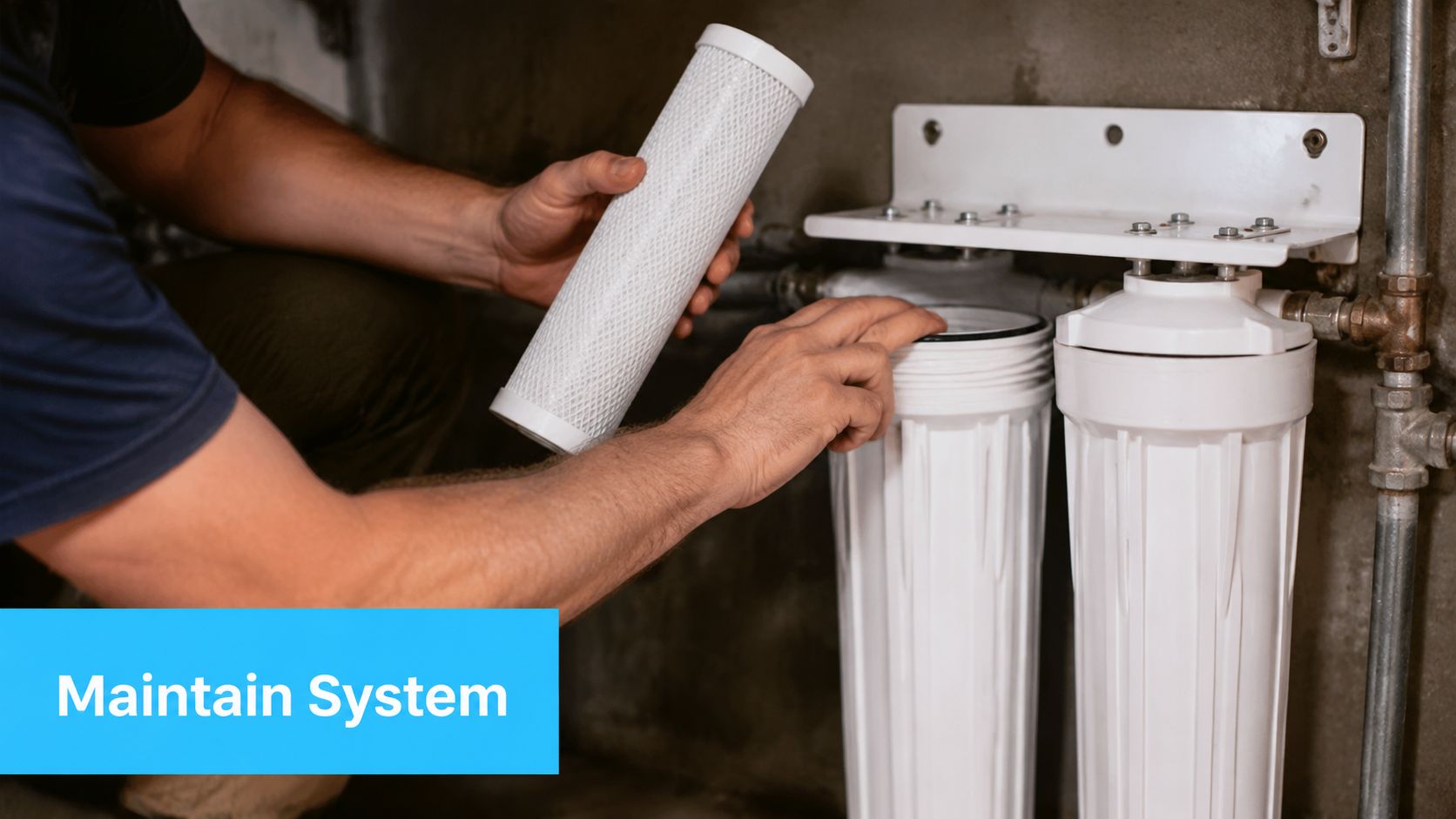
A smart maintenance routine includes:
This isn't just about equipment life. It's about whether the barrier still performs the job you bought it for.
For private wells, eliminating bacteria often requires more than just a filter. The Wisconsin DNR notes that bacteria in a water system are often eliminated by combining correction of sanitary defects with disinfection, and it recommends leaving chlorine in the system for 8 to 24 hours before thorough flushing and resampling in its technical note on well disinfection and cleaning.
That single point changes how homeowners should think. If bacteria keeps coming back, don't keep replacing cartridges and hoping. Inspect the well cap, casing, drainage, and any route for surface contamination. If needed, involve a licensed well driller or pump installer.
Even after treatment, bad handling can undo your work.
Use this checklist:
If you corrected the source, disinfected the system, and verified the result, you're managing risk. If you only installed a device, you're still guessing.
Usually, no. Pitcher filters are generally chosen for taste and odor improvement, not microbiological protection. If a product isn't clearly specified for bacteria reduction, don't assign it that job.
This confuses a lot of homeowners. A filter physically removes certain contaminants. A purifier addresses a broader microbiological problem, especially when viruses are part of the concern.
The National Park Service explains this distinction clearly in its water treatment guidance for filters and purifiers. A filter with a 0.3-micron pore size removes bacteria and parasites, but not viruses. For virus removal, you need a purifier, which could be reverse osmosis, UV disinfection, or boiling.
That matters because people often buy a portable or under-sink filter and assume "filter" means "safe against everything." It doesn't.
Usually not unless you have a specific building issue, a temporary contamination problem, or a special source concern. Most municipal systems already disinfect the supply before it reaches your home. For many households, the practical question is whether you want added point-of-use protection for drinking water, not whole-house bacteria treatment.
Stop treating that as a simple filter problem. Repeated contamination points to an unresolved entry path or sanitary defect. The well structure, cap, casing, nearby drainage, flood impact, or plumbing setup may be the actual issue.
At that stage, calling a licensed well professional is usually smarter than adding another device.
Sometimes for point-of-use drinking water, yes. But not as a blanket answer for every house and every source. If the source water is questionable, if turbidity is high, or if contamination is recurring, reverse osmosis works best as part of a wider treatment plan rather than as a lone fix.
Use this decision shortcut:
Most bad decisions happen when homeowners skip that first sorting step.
If you're comparing systems, replacement cartridges, and practical home setups, Water Filter Advisor is a solid place to keep researching. It helps homeowners sort through point-of-use filters, whole-house options, maintenance needs, and real-world trade-offs so you can choose equipment that fits your water, not just the marketing.
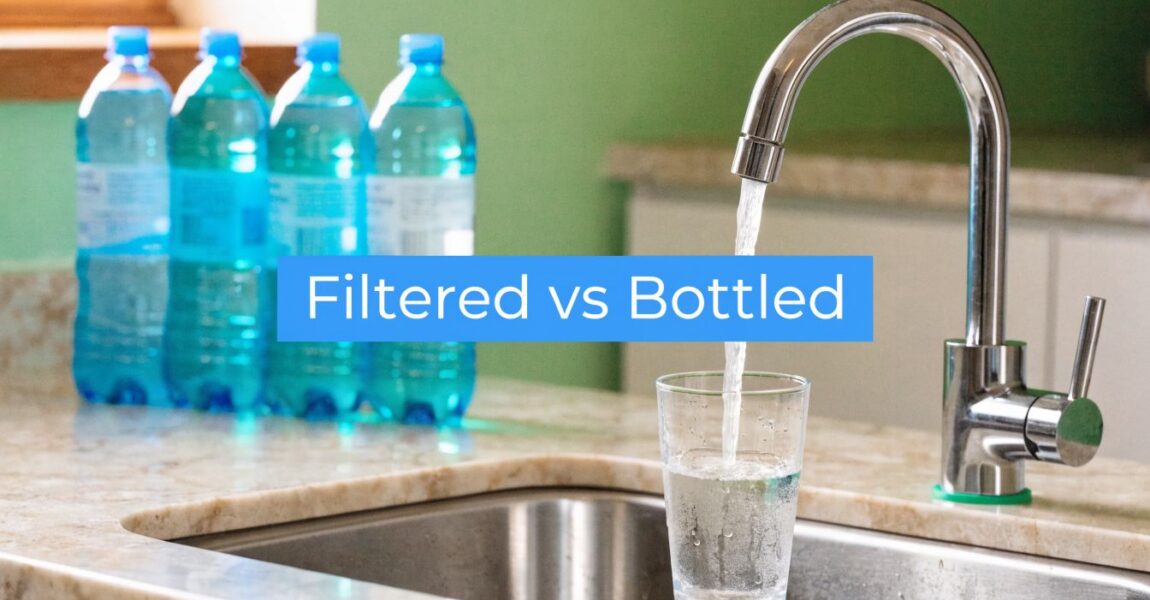
You’re standing in the store, looking at rows of bottled water with names that sound alpine, pure, and somehow safer than the faucet at home. One bottle says purified. Another says spring. A third promises crisp taste. Meanwhile, your tap water has a faint chlorine smell, and you’re wondering whether buying cases of water is the smart move or just an expensive habit.
That’s the core question behind is filtered water better than bottled water. For most homes, the answer is yes. But the useful answer is more specific than that.
Some bottled water is just repackaged municipal water. Some home filters work extremely well. Some don’t. Reverse osmosis can clean water impressively, but it also wastes water. Cheap, uncertified filters can disappoint. Neglected filters can make a good system perform badly. The right choice depends on your water source, your contaminants, your budget, and how much maintenance you’ll keep up with.
If you’ve also dealt with odd hot-water color changes or different water behavior around the house, this practical Big Bear homeowners' hot water guide is worth a read because it helps separate plumbing issues from actual drinking water quality concerns.
The bottled water aisle makes a simple decision feel technical. Families buy it for school lunches, road trips, emergencies, and peace of mind. Homeowners buy it because they don’t fully trust what comes out of the tap. Renters buy it because they don’t want to install anything. Everyone thinks they’re paying for certainty.
That’s why this question matters so much at home. It isn’t just about taste. It’s about what your kids drink every day, whether you’re overspending, and whether the “safer” option is safer.
When homeowners ask me about bottled versus filtered water, they’re usually asking four things at once:
Bottled water wins on convenience in the moment. Filtered water usually wins where it matters every day: control, cost, and targeted treatment.
The best water solution isn’t the one with the cleanest label. It’s the one matched to your home.
If your issue is chlorine taste, you don’t need the same setup as a family dealing with lead concerns or a homeowner on well water with iron and sulfur odor. That’s where people waste money. They buy water, or buy filters, without matching the tool to the problem.
Bottled water marketing is built on one message: trust the bottle more than the tap. That message doesn’t hold up very well once you look at sourcing, oversight, and actual test results.
According to the Environmental Working Group, approximately 64% of bottled water sold in the U.S. is sourced from municipal tap water, and when 10 popular brands were tested, they contained an average of 8 different contaminants, including caffeine, fertilizers, solvents, and plastic-derived chemicals, as summarized by this review of bottled water sourcing and testing.
That doesn’t mean every bottle is bad. It means the simple idea that bottled water is automatically purer than home drinking water isn’t reliable. In many cases, you may be paying a premium for water that began in a municipal system much like your own.
The practical issue is transparency. Consumers often assume the label tells the whole story. It usually doesn’t. If you’re trying to sort through technologies instead of brand language, it helps to compare water purification systems by what they’re designed to remove, not by the imagery on the packaging.
Public tap water and bottled water don’t operate under the same day-to-day consumer experience. Municipal water comes with routine public reporting. Bottled water is sold as a finished product, and most buyers never see much detail beyond the label.
That gap matters because safety depends on treatment and testing, not on whether water is sold in a bottle. A sealed cap is not a treatment method.
If you can’t verify what was removed, when it was tested, and what standard it met, you’re buying reassurance, not necessarily better water.
A short visual explainer helps make the industry contrast easier to digest:
People often buy bottled water to avoid whatever they dislike about tap water. Chlorine taste. Old pipes. News headlines. Cloudiness after plumbing work. That instinct is understandable.
But bottled water is a blunt instrument. It isn’t customized to your house, your plumbing, or your local water chemistry. A well-chosen home filter can be. That’s the difference between buying a product and solving a water problem.
Home filtration gets confusing because people lump very different systems into one category. A pitcher, a faucet filter, an under-sink reverse osmosis system, and a whole-house unit do not solve the same problems.
Pitchers and faucet-mounted filters usually rely on activated carbon. That media is excellent for improving taste and odor, especially where chlorine is the main complaint. It can also reduce certain contaminants when the unit is certified for them.
These are the easiest systems to live with in apartments and rental homes. They’re simple, portable, and fast to set up. Their limit is capacity. If you need stronger contaminant reduction or higher volume, they can feel small very quickly.
Under-sink systems are where home filtration starts getting more precise. Some use carbon blocks. Others use reverse osmosis, often called RO. A carbon-based under-sink unit is a strong fit when the goal is better taste and targeted reduction without a lot of complexity.
RO systems push water through a membrane that can remove a much wider range of contaminants. That’s why they’re popular for families focused on drinking and cooking water at one dedicated faucet. They’re powerful, but they’re not automatically the best choice for every house.
Practical rule: Buy a filter for the contaminant you have, not the contaminant you fear.
Whole-house systems treat water where it enters the home. That matters when the problem affects more than drinking water. Think chlorine smell in showers, sediment, iron staining, or sulfur odor.
These systems don’t replace point-of-use drinking water filters in every case. They serve a different purpose. A whole-house sediment and carbon setup can protect fixtures and improve bathing water, while an under-sink unit handles drinking water at the kitchen sink.
A quick way to understand this:
The best results come from matching the system to the actual water issue, then maintaining it on schedule.
When families compare these options, the answer usually becomes clearer. Bottled water is a convenience product. Home filtration is a treatment strategy.
| Factor | Filtered Tap Water | Bottled Water |
|---|---|---|
| Safety approach | Can target specific contaminants with certified filtration | Varies by brand and source |
| Regulatory visibility | Public tap systems require monitoring and public reports | Oversight applies after bottling, with less consumer visibility |
| Cost over time | Usually far cheaper per gallon after setup | Ongoing repeat purchase |
| Environmental footprint | Lower, though RO has water waste | High plastic and transport burden |
| Convenience | Best at home, refill-based | Easy to grab and carry |
| Taste control | Can be tuned by filter type | Depends on brand, source, and storage |
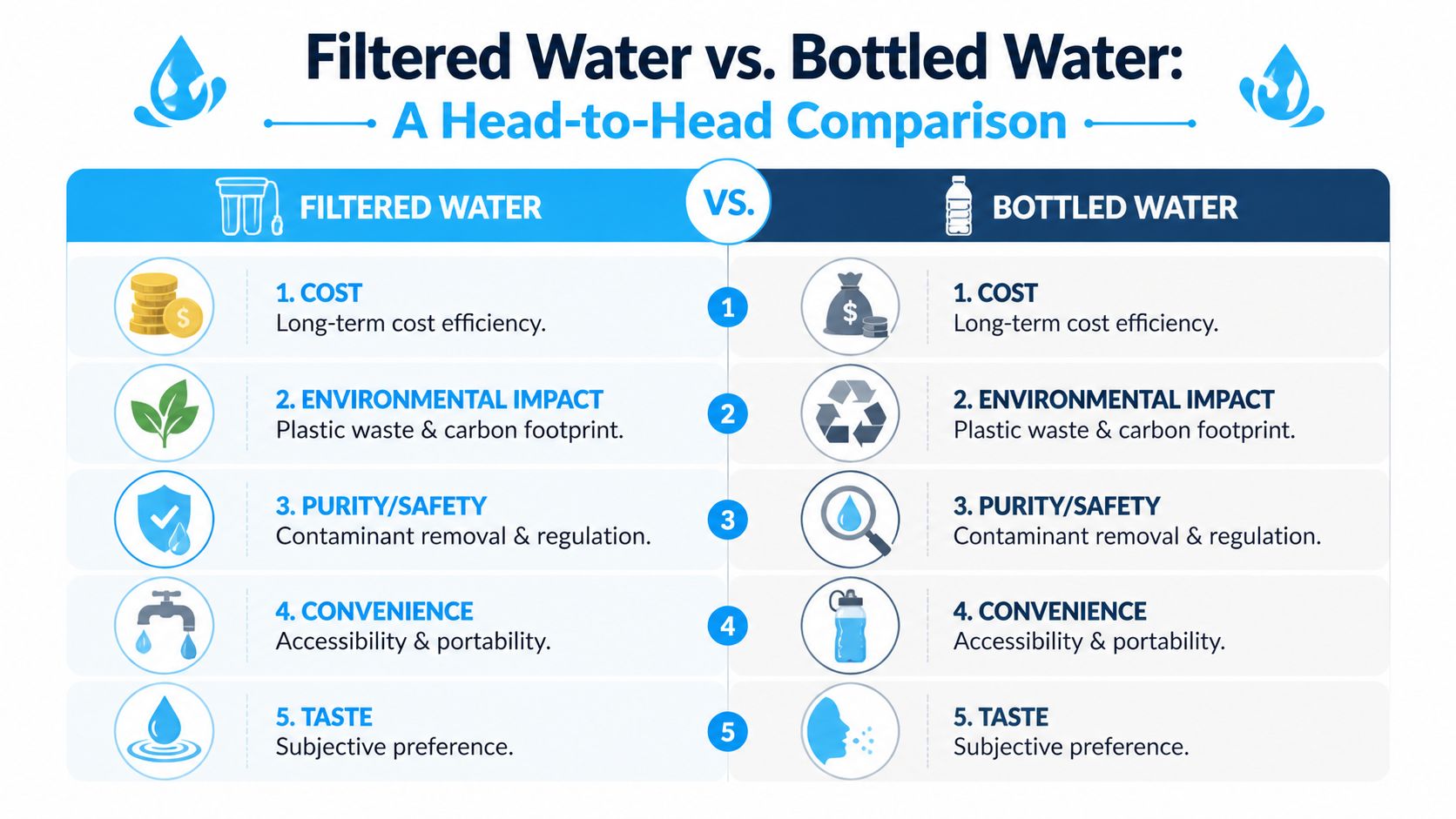
This is the category people care about most, and it’s where filtering at home has a real advantage when done properly. Public tap water is regulated by the EPA, requiring mandatory monitoring and public reports. Bottled water is regulated by the FDA with less stringent testing and disclosure rules. Certified home filters, including systems built to standards such as NSF/ANSI 58, can verifiably reduce specific contaminants like lead, TTHMs, and mercury at the point of use, often outperforming bottled products, as discussed in this water quality and filtration review.
That last point matters. A certified filter gives you a performance target. Bottled water usually gives you a brand promise.
If your concern is chlorine taste, a simple carbon filter may be enough. If your concern is lead, disinfection by-products, or a known local issue, a more specific certified filter is the stronger move. Home filtration lets you treat the water you have.
This one isn’t close. EPA WaterSense figures cited in this bottled versus filtered water cost comparison indicate average residential tap water costs about $6.64 per 1,000 gallons for water alone and about $15.21 per 1,000 gallons including sewer, while bottled water averages around $1.22 per gallon, making it roughly 180 to 300 times more expensive than tap water even before filtration.
That’s before you count the hassle of carrying cases, storing them, and making emergency runs when you run out.
For a household that drinks a lot of water, bottled water isn’t just a beverage choice. It becomes a recurring delivery problem you manage yourself.
Home filtration has upfront cost and maintenance cost. Bottled water has no setup cost, but the meter never stops running.
The environmental side is also one-sided in most homes. Americans consumed 14.4 billion gallons of bottled water in 2019, spent about $16 billion a year on bottled water, and bottled water production can require as much as 2,000 times the energy needed to produce tap water, according to this summary of bottled water’s financial and environmental costs.
Plastic use, transport, refrigeration, and disposal all stack up. A home filter doesn’t erase impact completely, especially if you choose RO, but it usually cuts the household waste stream dramatically compared with buying bottled water for daily use.
Bottled water still offers advantages. It’s portable, sealed, and available everywhere. For travel, emergencies, and short-term use, it’s practical.
At home, though, a good filter is more convenient after the first week. You stop loading cases into the cart. You stop wondering if you’ve got enough in the pantry. You refill a bottle from your own sink and move on.
Taste is personal. Some people prefer the mineral profile of certain bottled brands. Others just want to get rid of chlorine and odor. In most homes, a well-selected carbon filter handles the taste issue so well that bottled water stops feeling like an upgrade.
Filtered water is usually the better home choice, yet misguided advice often surfaces. People talk about filtration as if every system is efficient, foolproof, and maintenance-free. It isn’t.
Reverse osmosis works. That’s why so many serious drinking water systems use it. But RO has a hidden cost that many homeowners don’t hear about until after installation.
According to this discussion of bottled water versus filtered water and RO trade-offs, reverse osmosis systems can produce 3 to 4 gallons of wastewater for every gallon of purified water. For some households, that’s acceptable. For others, especially in drought-conscious areas or homes where efficiency matters, it’s a deal-breaker.
RO makes the most sense when you need broad contaminant reduction. It makes less sense when your real complaint is taste and odor that a carbon system could handle with less waste.
The second hidden issue is maintenance. A good filter that isn’t changed on time becomes a bad filter. Performance drops. Flow slows. Taste changes. In some cases, neglected cartridges can become part of the problem rather than the solution.
This isn’t a reason to avoid filtration. It’s a reason to avoid lazy filtration. If you know you won’t track replacement dates, don’t buy a complicated system with multiple stages and no reminders.
The best water filter is the one your household will maintain correctly.
A polished package doesn’t tell you much. Certification does. Some budget filters look convincing online and underperform in real kitchens.
The safest habit is simple:
People get into trouble when they buy the most aggressive system available or the cheapest filter on the shelf. Both mistakes come from skipping the water diagnosis.
There isn’t one correct answer for every house. There is a best-fit answer for your house.
A renter usually needs portability, easy setup, and no permanent changes. That points to a quality pitcher, countertop unit, or faucet-mounted filter.
You’re not building a forever system. You’re buying cleaner-tasting water with minimal friction. In this category, certification matters even more because marketing language can be vague and renters often shop by convenience first.
A family kitchen usually does best with an under-sink system. If your main issue is taste, odor, or common municipal concerns, a certified carbon block system is often the sweet spot. If you have a stronger contaminant concern and have confirmed the need, RO may be worth it despite the wastewater trade-off.
A critical purchasing factor is certification. Uncertified filters may not perform as advertised, with some studies showing 30% of budget filters fail independent tests. NSF-certified filters are verified to reduce specific contaminants like chlorine, microplastics, and nitrates, but require cartridge changes costing $50 to $200 annually, as noted in this guide to healthier bottled, filtered, or tap water choices.
That annual cartridge cost is not a downside. It’s part of responsible ownership. Budget for it from day one.
Well water changes the conversation completely. You shouldn’t guess. Test first, then build the system around the results.
A well-water home may need sediment treatment, iron reduction, sulfur control, softening, or a separate drinking water filter. That often means a layered setup, not one do-everything product. If you need help narrowing down system types and maintenance priorities, the practical advice library at Water Filter Advisor is a useful place to start.
Use this checklist before you buy anything:
Most homes don’t need bottled water as a daily plan. They need a properly matched filter and a replacement schedule that gets followed.
Some do, some don’t. Activated carbon filters generally focus on taste, odor, and selected contaminants. RO systems are more aggressive and can reduce minerals along with other dissolved substances.
For routine daily drinking, I’d rather see people use a durable reusable bottle and fill it with filtered water at home. Single-use bottles were built for convenience, not as a long-term household water strategy.
Start with your water source and your specific complaint. Municipal users should review local water reports. Well owners should test their water directly before buying equipment.
If you want help choosing a system that suits your home, Water Filter Advisor is a solid next stop. It’s built for households that want clear, practical guidance on water testing, filter types, certifications, replacement schedules, and the full cost of ownership before spending money on the wrong setup.
You’re standing at a sink in a guesthouse, staring at the tap like it might answer a question for you. The hotel says the water is “probably fine.” Your gut says maybe not. On another trip, it’s a trail stream that looks crystal clear until you remember that clear water and safe water aren’t the same thing.
That hesitation is why portable water treatment matters so much. It’s not just about avoiding a miserable travel day. It’s about removing one of the most common uncertainties on the road, whether you’re filling a bottle in a city apartment, a campsite, an airport bathroom, or a mountain hut.
For readers who usually think about filtration at home, travel gear can feel like a different world. The same core question still applies, though. What, exactly, are you trying to remove, and what’s the most practical way to do it where you’ll be using the water? The best portable water filter for travel isn’t a single product for everyone. It’s the one that matches your destination, your risk level, your patience, and the amount of water you need each day.
I’ve seen travelers overpack jackets, underpack socks, and spend more time choosing packing cubes than choosing how they’ll drink water safely. Then the trip starts, and the first real test arrives fast. A refill station in a train station. A lodge with uncertain plumbing. A trailhead faucet with no obvious treatment information.
That’s when water filtration stops being a nice extra and becomes one of the smartest pieces of gear you can carry. A good portable system buys confidence. It also cuts down on the constant hunt for sealed bottles, which gets old fast on long trips.
The hard part is that “portable water filter” gets used as a catch-all term. Some products are ideal for clear backcountry streams. Some are better for questionable tap water abroad. Some are fantastic for families at camp and annoying for solo travelers moving all day. A few are tiny enough to forget in your pocket, while others earn their space by making lots of safe water with less effort.
Practical rule: If your trip includes uncertain water and limited backup options, water treatment belongs in the same mental category as first-aid basics and navigation tools.
That’s also why many experienced travelers build a small safety system rather than relying on one item alone. On remote trips, I think about water treatment the same way I think about signaling or emergency communication. If you’re planning marine travel or isolated adventure routes, an ACR rescue beacon is the kind of gear that fits the same mindset: low bulk, high consequence if you need it.
A traveler filling a bottle from an alpine stream is dealing with one kind of problem. A traveler brushing their teeth from a hotel tap in a country with unreliable sanitation is dealing with another. The water may look equally clean, but the treatment plan should be different.

The useful way to sort travel water risks is by organism size and source. Protozoa are usually the easier target. Bacteria require finer filtration. Viruses are the category that forces a different buying decision, because many lightweight filters that work well outdoors do not address them.
Protozoa are larger waterborne pathogens, and many portable backcountry filters are built to remove them. On trekking routes, camping trips, and mountain travel, they are often part of the main risk calculation, especially where contamination comes from wildlife or upstream runoff rather than dense human settlement.
That matters because it explains why simple filter bottles, squeeze filters, and straw filters can perform well on some trips. If your water source is a stream, lake, or spring in a lower-risk wilderness setting, protection against protozoa and bacteria is often the main goal.
Bacteria are smaller, so filter performance matters more. Pore size becomes the practical checkpoint. A filter that is adequate for sediment and larger organisms may not give the same margin of safety against bacterial contamination.
This is one reason experienced travelers read beyond marketing labels like "outdoor" or "survival." The question is what the filter is rated to remove and whether that matches the places you are going. Travelers who want a stronger grounding in those specs can compare treatment methods in this portable water treatment advice guide.
Viruses are the dividing line that catches many travelers off guard. They are much smaller than protozoa and bacteria, so the common hollow-fiber filters used for hiking often are not enough on their own.
For international travel, urban travel, disaster zones, and destinations where sewage contamination is a realistic concern, viral protection moves from nice to have to sensible insurance. That usually means choosing a purifier, using chemical treatment alongside a filter, or carrying a UV system if the water is clear enough for it to work properly.
Use this shortcut:
The practical takeaway is simple. Match the treatment method to the source, not the product category. A minimalist trail filter can be the right tool for one trip and the wrong one for the next, even if both fit in the same side pocket.
You reach a guesthouse sink in one country, a mountain stream in the next, and a muddy roadside spigot a week later. The best portable water filter for travel changes with the source, the pace of the trip, and how much effort you want to spend getting each liter.
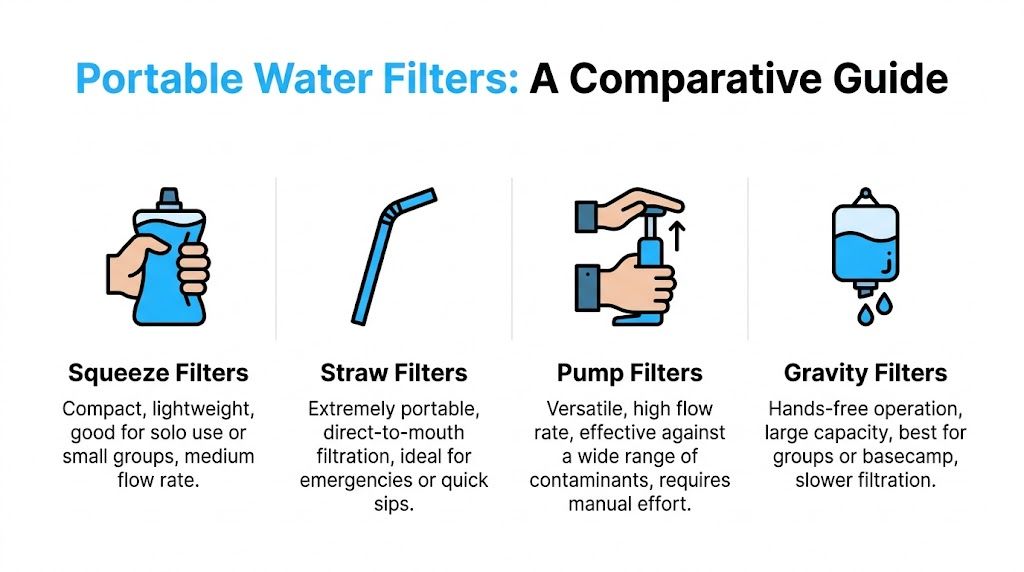
Most travel water treatment gear fits into five categories. The useful way to compare them is not by brand loyalty or marketing claims. It is by workflow. How do you collect water, how fast do you need it, how many people are sharing the system, and how bad is the source if the first plan fails?
Squeeze filters use a soft bottle or pouch. Fill it, thread on the filter, then squeeze water into a clean bottle, cook pot, or your mouth.
This is the light-and-fast option. It works well for solo travelers who care more about packed size than comfort at camp. On long days, the compromise shows up in your hands. Flow drops as the filter clogs, the pouch gets slippery or awkward, and filtering several liters in a row feels like a chore.
The Sawyer MINI is the product many travelers know in this category. Its appeal is simple: low weight, small size, and a long service life if you maintain it well. In real use, that makes sense for one person moving quickly, not for a tired group trying to fill dinner water before dark.
Best use case: solo hiking, ultralight packing, emergency backup, and trips where a compact setup matters more than speed.
What doesn’t work well: group use, silty water, and travel where virus protection is part of the plan.
Straw filters are even simpler. You drink directly from the source or from a bottle or cup.
That simplicity is both the benefit and the limitation. Straw filters are excellent as backups because they are tiny, cheap to carry, and fast to deploy. They are poor primary systems for most trips because they do not create a reserve of treated water for cooking, brushing teeth, or filling bottles before a bus ride.
I carry this type only when size matters more than convenience. For a short day hike or an emergency kit, that trade-off can be reasonable. For regular travel, it gets old fast.
Best use case: backup treatment, short hikes, minimalist kits, and emergency use.
What doesn’t work well: camp chores, family travel, and any trip where you want clean water ready before you need to drink it.
Pump filters pull water through an intake hose and push it through a cartridge with hand pressure. They are older tech by backpacking standards, but they still solve a real problem better than many newer designs.
A pump is useful when the source is shallow, stagnant, or hard to scoop. You can drop the intake into a trickle, puddle, or narrow creek and filter straight into nearly any container. That level of control is why pump filters still make sense for rough backcountry travel, including trips like hiking in Triglav National Park where access to water can be awkward rather than abundant.
The trade-off is labor. Pumping several liters takes time, and every moving part is another part that can wear out or need cleaning. Travelers who hate repetitive tasks usually stop loving pump filters after the first few long refill sessions.
Best use case: awkward water sources, backcountry travel, and people who want precise filling into bottles or pots.
What doesn’t work well: high-volume group use, lazy camp routines, and travelers who want the least effort possible.
Gravity systems turn filtering into a camp task instead of a hand task. Fill the dirty bag, hang it, connect the hose, and let the water run into a clean container while you cook or sort gear.
For two people or more, this is often the easiest system to live with. The big advantage is not just volume. It is reduced friction. Nobody stands there pumping or squeezing bottle after bottle. That matters on multi-day trips, family travel, overlanding, and any setup where you stop long enough for the system to work in the background.
The downside is bulk and setup time. Gravity systems take more room, and they shine when you have a camp or at least a decent pause in the day. They are less appealing for fast urban movement or all-day travel with short refill stops.
Best use case: couples, families, base camps, road trips, and repeated high-volume filtering.
What doesn’t work well: quick refills on the move, minimalist packing, and places where hanging or staging the system is annoying.
UV purifiers use ultraviolet light to neutralize microbes in water instead of forcing water through a physical membrane. That changes the decision in a big way because UV systems are often chosen for travel patterns, not wilderness habits.
For international trips with questionable tap water, a UV purifier can be very convenient. You treat water in a bottle, wait a short cycle, and drink. There is no filter to clog with normal clear tap water, and purifier models address viruses in a way standard trail filters usually do not.
The catch is straightforward. UV works best in clear water. If the source is cloudy, you need to pre-filter first or choose another method. You also need batteries or charging discipline, and the device needs more care than a simple squeeze filter tossed in a side pocket.
Best use case: city travel, hotel and guesthouse stays, airport or station refills, and destinations where virus risk changes the buying decision.
What doesn’t work well: muddy water, dead batteries, and rough treatment of delicate gear.
| Filter Type | How It Works | Best For | Avg. Weight | Virus Protection? | Pros | Cons |
|---|---|---|---|---|---|---|
| Squeeze filter | Water is pushed through a membrane by hand pressure | Solo hikers, ultralight travel, emergency use | Light | Usually no | Compact, versatile, good lifespan on some models | Hand effort, slower with clogging, awkward for groups |
| Straw filter | You drink directly through the filter | Backup use, fast trail sipping | Very light | Usually no | Tiny, simple, instant access | Doesn’t make stored clean water, poor for camp tasks |
| Pump filter | Manual pump forces water through a cartridge | Backcountry collection from tricky sources | Moderate | Depends on model | Controlled filtering into bottles or pots | Repetitive effort, bulkier feel |
| Gravity filter | Suspended bag system uses gravity to move water through filter | Families, base camps, overland travel | Moderate to heavier | Usually no | Hands-free, high volume, excellent for shared use | Less convenient on the move |
| UV purifier | UV light neutralizes microbes in water | International city travel, clear tap water | Light to moderate | Yes, on purifier models | Fast, broad biological protection, no clogging membrane | Needs power, doesn’t remove sediment |
You arrive late, the guesthouse tap looks questionable, and tomorrow’s bus leaves before sunrise. That is the moment your filter choice stops being theoretical. The right setup depends less on which product gets the loudest praise and more on how you travel under pressure.
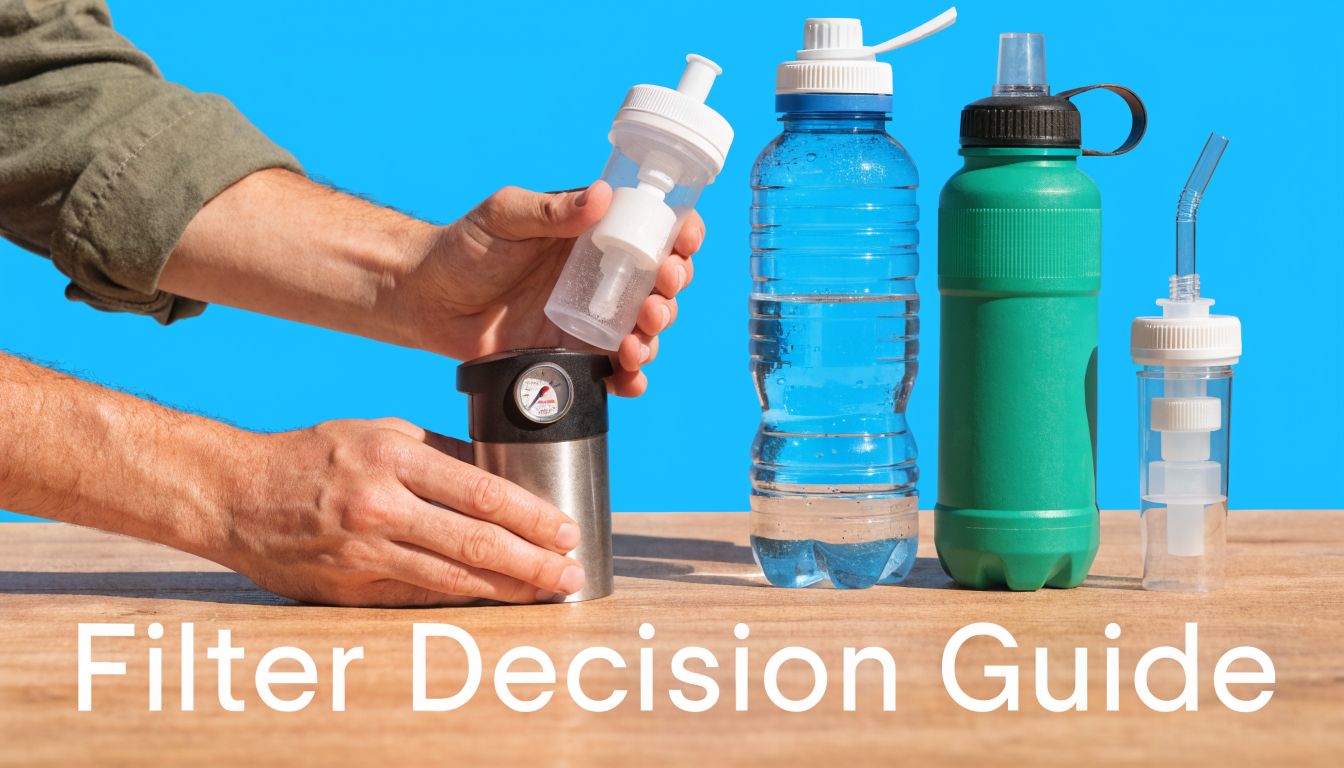
A good decision starts with four practical questions. What kind of water will you treat most often? How much do you need each day? How much effort are you willing to spend to get it? What is your backup plan if the unit clogs, runs out of power, or gets damaged?
Travelers often buy for the exception and ignore the routine. That leads to the wrong tool.
If your trip centers on mountain streams, lakes, and backcountry camps, flow rate and field maintenance usually matter more than virus protection. If your trip runs through cities, villages, transit hubs, and places with inconsistent sanitation, broad biological protection matters more. The best portable water filter for travel is the one that matches the sources you will face most often, not the one that looks strongest on a spec sheet.
Source quality also changes how forgiving a system feels. Clear water is easier on almost every filter. Silty water slows membrane systems, shortens cartridge life, and turns a quick refill into a chore.
Often, many buying mistakes happen. A filter can be light, compact, and technically capable, yet still annoy you enough that you stop using it consistently.
Squeeze and pump filters ask for repeated hand effort. They make sense when low weight or precise collection matters. Gravity systems trade pack space for comfort and higher output, which is a smart bargain for pairs, families, or slow travel with regular camp stops. UV purifiers are fast and convenient in hotels and apartments, but they depend on battery life and work best with relatively clear water.
Convenience is not a luxury feature. It affects whether you treat every bottle.
Every filter type has one.
Membrane filters can clog. UV units need charged batteries and intact electronics. Gravity bags can puncture. Straw filters are awkward when you need clean water for cooking, brushing teeth, or filling bottles for later. Pump filters have more moving parts and usually take more patience over a long trip.
That does not make one category better than another. It means the right choice is the one whose weak point you can handle without much trouble. Travelers who are disciplined about charging devices can do well with UV. Travelers heading somewhere remote usually benefit from simple gear that can be cleaned in the field and does not rely on power.
Purchase price only tells part of the story. Cartridge replacement, backflushing, drying time, and day-to-day mess matter just as much after the first week.
Some travelers are happy to maintain a filter if it saves weight. Others want something less fussy, even if it adds bulk. Be honest about your habits. If you rarely clean your gear at home, buy a system with simple upkeep and clear failure signs. If you do not mind routine maintenance, a backflushable filter can be a strong long-trip option.
For a broader guide to comparing specs, serviceability, and treatment methods, the resources at Water Filter Advisor’s advice hub are a useful reference.
Product pages often blur the line between filtration and purification. Those are not interchangeable terms. You need to know what the system is designed to address, what conditions it was tested under, and what kind of water it handles poorly.
Use this quick check before buying:
If you want to see a practical overview of how people set up and use compact systems in the field, this walkthrough is helpful before you buy:
You arrive late, the shops are closed, and the only water option is a tap in a guesthouse bathroom or a stream near camp. That is usually when travelers realize they did not just need a good filter. They needed the right one for the trip they booked.
Match the system to three things first. Water source, likely contaminants, and how much hassle you will tolerate when you are tired. That approach works better than chasing whichever model tops a generic roundup.
Low weight matters, but speed matters too. A tiny squeeze filter saves pack space, yet some ultralight setups get frustrating when flow slows down or when you need to fill bottles for a long dry stretch.
For backcountry routes with clear mountain water, a basic hollow-fiber filter is often the best weight-to-performance choice. If the trip shifts into villages, bus stations, or border towns where viral risk is less predictable, that same setup may be too narrow. In that case, carry a secondary treatment method instead of assuming one filter covers every source.
City travel creates a different problem. Water is usually easy to find, but harder to trust consistently from one country, neighborhood, or transit stop to the next.
A purifier often makes more sense than a wilderness-style filter here, especially for destinations where viruses are part of the risk picture. UV devices are compact and quick in clear water, and they fit hotel, airport, and apartment travel well. The limitation is straightforward. Murky water reduces effectiveness, and dead batteries turn a purifier into dead weight. Travelers who value simplicity over electronics may prefer a bottle-based purifier or chemical backup even if it adds a little time.

Group trips expose bad filter choices fast.
A straw or small squeeze unit can work for one person. It becomes tedious when several people need water for dinner, bottles, coffee, and the next morning’s start. Gravity systems earn their keep here because they trade some bulk for much less effort. Fill the bag once, hang it, and let it run while camp chores continue. For families and small groups, that convenience usually matters more than shaving a few ounces.
This traveler usually deals with taps, refill stations, and questionable sink water rather than lakes and rivers. That changes the buying decision. Compact purifiers, filtered bottles, and drop-in treatment systems are often more practical than a backcountry squeeze filter.
Convenience decides whether the system gets used. If setup is fussy, many travelers skip it and buy plastic bottles instead. For road trips, I would rather carry a slightly heavier option that works quickly at a gas station sink than a lighter setup that only shines beside a clear stream.
Mixed itineraries need balanced gear. A traveler doing hut-to-hut hiking, rail transfers, and village overnights may encounter spring water one day and tap water of uncertain quality the next.
If you’re planning routes like hiking in Triglav National Park, choose based on the sources you will rely on most. A lightweight filter works well for mountain refills. A purifier or hybrid setup makes more sense if the trip includes more towns, huts, or shared accommodations. The best choice is rarely the one with the longest feature list. It is the one you will trust and use every day on that specific trip.
The best filter in the world becomes a liability if you treat it carelessly. Most failures in the field aren’t dramatic manufacturing disasters. They’re maintenance mistakes, contamination mistakes, or storage mistakes.
This sounds basic, but it’s where people get sloppy. If the nozzle, threads, cap, or bottle rim touches untreated water, you can undo the whole process. Set up a routine and stick to it. Dirty bag in one hand, clean bottle in the other. Caps go back where they belong.
Hollow-fiber filters need backflushing when flow drops. Gravity systems also benefit from routine flushing and careful drying after trips. UV purifiers need clean contact points, charged power, and protection from rough packing.
If you use a pod-based option like the Go Pure Pod, one of its strengths is longevity. A single pod is rated to purify 264 gallons (1,000 liters) and it also removes nearly all fluoride, according to Adios Adventure Travel’s review. That doesn’t mean it’s maintenance-free. It means you still need to protect the bottle, keep the system clean, and replace the pod when its service life is reached.
For membrane filters, freezing is a silent problem. If trapped water freezes inside the media, the damage may be invisible. The filter can look fine and no longer be trustworthy. In cold conditions, sleep with the filter in your bag or an inner pocket if needed. This is not optional.
When a trip ends, don’t throw a damp filter into a drawer and forget it. Rinse as directed, dry what should be dried, and store it where it won’t get crushed or overheated. A few extra minutes at home are a lot easier than troubleshooting a musty, clogged, or questionable filter before your next departure.
Usually, yes. Portable filters and UV units are commonly packed for air travel. The key issue is less about the filter itself and more about any liquid accessories, damp components, or batteries if your system uses them. I pack the treatment device clean and dry whenever possible.
Pre-filter first. Even a bandana, coffee filter, or clean cloth can help reduce sediment before the main treatment step, as sediment clogs membrane filters and can interfere with UV treatment.
If your trip regularly involves dirty water sources, choose a system that handles particulates more gracefully or build pre-filtering into your routine from day one.
Pair it with a secondary treatment method that does. In practice, that often means carrying a chemical backup or using a purifier instead of a basic filter when the destination calls for it.
This is one of the most common mistakes I see. Travelers buy a lightweight backcountry filter, then use it for urban or developing-world travel where their real risk profile is different.
A backup works best when it fills the exact gap your main system leaves open.
Not by itself. Flow feels great at first, but the key question is whether the system stays practical after repeated use, dirty water exposure, and camp life. A fast filter that clogs easily or demands constant effort may still be the wrong choice.
For groups, high output matters more. For solo urban travel, compactness and treatment type may matter more than raw speed.
Yes, but choose with care. Some travel systems are designed primarily around microbiological protection, not taste improvement. Others do more to reduce unpleasant flavor notes. If your concern is mostly taste from treated tap water, the “best” option may be different from what a wilderness hiker needs.
That’s one area where home filtration habits can mislead travelers. On the road, taste is nice. Safety comes first.
Rarely in practice. Every design gives something up. UV needs clear water and power. Squeeze filters save weight but can be tedious. Gravity systems are excellent at camp and less useful on the move. Pod and bottle systems score high on convenience but may not fit every source type.
The best buyers accept that trade-off early. They don’t chase a perfect tool. They choose the right compromise for the trip they’re taking.
If you want help comparing travel filters, home systems, replacement costs, and what different filtration methods remove, Water Filter Advisor is a practical place to keep researching before you buy.
Think about that glass of water from your kitchen tap. It looks perfectly clean, right? You’ve been drinking it your whole life without a second thought. But what if the very chemical added to keep your water safe is creating a hidden problem? Welcome to the complicated truth about chlorine in our water, and why a good water filter isn't a luxury—it's your home's last line of defense.
For over a century, chlorine has been the superhero of public health, wiping out nasty waterborne diseases like cholera and typhoid. But like any good superhero story, there’s a twist. The real danger isn't the hero itself, but the mess it leaves behind.
That glass of water from your kitchen tap looks perfectly fine, right? It's clear, doesn't have much of a smell, and you've been drinking it your whole life without a second thought. But what if the very chemical added to keep it safe is creating a hidden problem? This is the complicated reality of chlorine in our drinking water.
For more than a century, chlorine has been the unsung hero of public health. It’s an incredibly powerful disinfectant that practically wiped out devastating waterborne diseases like cholera and typhoid, saving countless lives in the process. Its main job is to kill dangerous microorganisms, and it does that job extremely well.
But the story doesn't stop there. After chlorine neutralizes the bad guys in the water, it doesn't just vanish. It continues to react with whatever else is in the water—specifically, naturally occurring organic matter like bits of decaying leaves and soil. This reaction creates an entirely new group of compounds known as disinfection byproducts (DBPs).
It's a bit like a security guard who, after stopping a break-in, accidentally sets off a series of small, invisible fires throughout the building. The immediate threat is gone, but a new, smoldering danger has taken its place. The most common and well-researched of these DBPs are Trihalomethanes (TTHMs), which are recognized carcinogens.
The real issue isn't the chlorine itself, but what it turns into after it has done its job. These disinfection byproducts are the true source of the long-term health concerns that experts worry about. A home water filter is your best tool for dealing with them.
This isn’t some rare, isolated problem affecting a few unlucky households. It's a sobering fact that a huge portion of residential water in the U.S. contains measurable levels of chlorine and its byproducts. That means millions of homes are unknowingly dealing with these compounds every single day.
The tricky part is that you can’t see, smell, or taste most of these harmful DBPs. They are silent passengers in the water you use for everything:
Your local water utility does the essential job of making water biologically safe enough to reach your tap, but their responsibility pretty much ends at your property line. It’s now up to you, the homeowner, to take that final, crucial step. Dealing with the chemical risks that are created by the treatment process itself becomes a personal responsibility. This guide will walk you through exactly how to protect your family by filtering out these hidden dangers, turning your tap water from a source of worry into a source of clean, safe hydration.
While chlorine does a great job killing off immediate biological threats in our water, the real health concerns start after its work is done. The problem isn’t the chlorine itself, but what it leaves behind. The solution? Filtering it out before it ever reaches your glass.
When chlorine mixes with the natural organic stuff in water—think tiny bits of leaves or soil—it creates a new class of chemicals called disinfection byproducts (DBPs). The most well-known and concerning of these are Trihalomethanes (THMs).
This simple chemical reaction has some pretty complex consequences for our water supply.

As you can see, adding a disinfectant to water unintentionally creates new, potentially harmful substances that travel right through the pipes to your tap. The only way to stop them is to catch them with a filter right before you use the water.
Unlike the distinct smell of chlorine, THMs are typically tasteless, odorless, and invisible. You can’t rely on your senses to know if they’re in your water, which is what makes them so dangerous. This is why "just trusting your nose" is a bad idea and why a reliable filter is so critical.
The U.S. Environmental Protection Agency (EPA) specifically regulates Total Trihalomethanes (TTHMs) in drinking water for a reason: long-term exposure is directly linked to an increased risk of cancer.
When you drink water containing these compounds, they don’t just pass through. Your organs that process and store waste, like the bladder and rectum, end up with the most concentrated and prolonged exposure.
The primary danger in your tap water isn’t always the germ it’s designed to kill, but the chemical byproduct created in the process. A quality filter acts as a final checkpoint, removing these hidden threats before they enter your body.
This extended contact gives these carcinogenic compounds a greater chance to damage the cells in those organs, which can eventually lead to cancer. The risk builds up day by day, glass by glass, over a lifetime.
This isn't just a theory; it's backed by serious research. A major meta-analysis found a direct line from long-term consumption of chlorinated water to about 4,200 bladder cancer cases and 6,500 rectal cancer cases in the U.S. every single year.
That accounts for a shocking 9% of all bladder cancers and 18% of all rectal cancers annually. You can read the full research on these toxic water findings for a deeper dive into the data.
These numbers show the real, human cost of "chlorine water side effects." It’s a powerful reminder that the final, critical step of water protection—filtration—needs to happen inside your home.
While everyone is at risk from long-term exposure, some people are far more vulnerable to the effects of DBPs—especially pregnant women.
Studies have documented a disturbing link between high THM levels in drinking water and serious pregnancy complications, including:
A developing fetus is incredibly sensitive to toxins, and these chemicals can pass from mother to child with profound consequences. For expecting parents, ensuring water purity isn’t just a good idea; it’s an urgent priority. A quality home water filter becomes a critical tool for protecting the health of the whole family, starting with its most vulnerable members.
When you think of chlorine side effects, you probably picture a glass of water. But what if I told you the biggest dose you get all day isn't from drinking, but from your morning shower? This is where whole-house filtration becomes a game-changer.
That long, hot shower feels great, but it can create a concentrated dose of airborne chemicals right in your bathroom. The heat and steam vaporize chlorine and its byproducts, turning them into a gas you breathe.
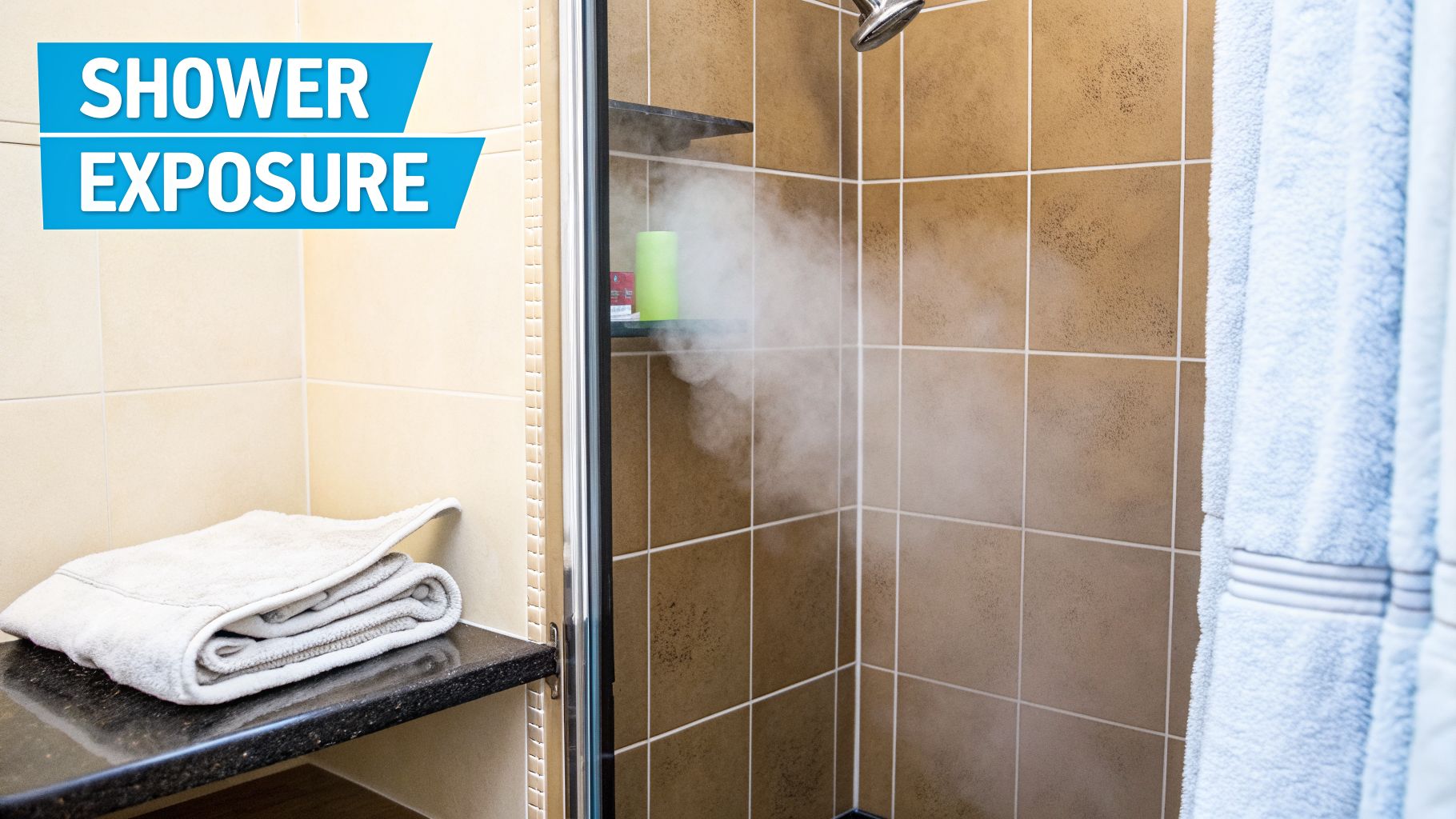
This process is called volatilization. It turns your shower stall into a mini gas chamber of chlorine and disinfection byproducts (DBPs) like chloroform. When you inhale that steam, these chemicals go directly into your lungs and bloodstream, completely bypassing your digestive system.
Your skin is your body’s largest organ, and it’s surprisingly porous. While it serves as a barrier, it also absorbs chemicals from your shower water.
A hot shower opens your pores, making it even easier for your skin to absorb chlorine. This direct contact is why so many people notice immediate side effects after showering in chlorinated water. A good shower filter or whole-house system is the only way to stop this.
These common problems are often the first sign a filter is needed:
Think of it this way: a 10-minute hot shower can expose your body to as many, if not more, volatile chemicals as drinking eight glasses of the same water. This is why focusing only on drinking water is a half-measure. To be fully protected, you need a filtration strategy for your shower too.
The respiratory effects of inhaling chlorine aren't just limited to your bathroom. They are even more pronounced in places with high concentrations of chlorinated water, like swimming pools.
When chlorine mixes with organic material from swimmers—sweat, oils, and urine—it creates a class of volatile DBPs called chloramines. These are the compounds responsible for that "pool smell" and for irritating the respiratory tract.
Studies show that swimming in chlorinated pools can trigger respiratory problems, particularly in children and competitive swimmers with frequent exposure. Constant inhalation of these airborne DBPs is linked to lung inflammation and a higher risk of developing asthma. Even a backyard or community pool could be contributing to chronic respiratory issues. You can discover more about the health findings from chlorinated pools and their impact on lung health.
This highlights a critical point: protecting yourself from chlorine side effects requires more than just filtering your drinking water. To be fully protected, you need to address the water in your entire home—especially your shower, where the risks from absorption and inhalation are highest.
To protect your home from the side effects of chlorine, you have to stop guessing what's in your water. The first step is to get the facts. This knowledge is what empowers you to pick the right filtration solution, and you don’t need a science degree to do it.
Your investigation starts with a document called your local water utility’s Consumer Confidence Report (CCR). Every community water system is required to give this annual water quality report to its customers.
Think of the CCR as a report card for your tap water. It lists what contaminants they found, at what levels, and if those levels break any federal rules. You can usually find it on your water utility’s website or by searching online for “[Your City Name] water quality report”.
Once you pull up your CCR, you’ll see a lot of data. You want to zero in on the important stuff. Look for a section called "Disinfection Byproducts" or for specific chemicals like "Total Trihalomethanes (TTHMs)" or "Haloacetic Acids (HAA5)."
The report will show a number next to these contaminants, usually in parts per billion (ppb). The U.S. Environmental Protection Agency (EPA) sets the maximum contaminant level (MCL) for TTHMs at 80 ppb.
It's critical to know that the EPA's legal limit isn't a "safe" limit. It's a regulatory balancing act between public health and the cost of water treatment. Many health experts agree there is no truly safe level of exposure to carcinogens. This means even legally compliant water should be filtered to remove these compounds.
If you see TTHM levels in your report getting close to that 80 ppb limit, that’s your signal. It's clear proof that your water has significant levels of these chemicals, turning a national issue into a personal one and giving you a solid reason to look into home filtration.
A CCR provides a great overview, but it’s based on averages or samples from different points in the system. It doesn’t tell you exactly what’s coming out of your specific faucet. For that, you need to test it yourself.
You’ve got a few options, each with different costs and levels of detail:
Once you have this data—either from your CCR or a home test—you're no longer in the dark. You now have the evidence you need to take the most important step: choosing the right water filter to protect your family from these hidden threats.
Alright, you know what's in your water. Now it's time to build your defense. Picking the right water filter can feel like a chore, but it really doesn't have to be. Let’s cut through the noise and break down the most practical home filtration options into a simple "Good, Better, Best" approach.
This guide will help you find the perfect shield for your family against chlorine and its tricky disinfection byproducts (DBPs), like Trihalomethanes (THMs). By matching the right technology to your needs, you can turn your tap from a source of concern into a source of clean, safe hydration.
If you're new to water filtration, renting your home, or just working with a tight budget, point-of-use filters are a fantastic place to start. They’re designed to be affordable, incredibly easy to set up, and do a solid job of removing the main culprits behind bad-tasting water.
The two most popular "Good" options are:
Both of these options rely on activated carbon. Think of activated carbon as a super-porous sponge. Its huge surface area is packed with millions of microscopic nooks and crannies that are perfect for trapping chlorine molecules, which is why they dramatically improve the taste and smell of your water.
But here’s the trade-off. While they’re great for chlorine, their ability to snag smaller, more complex chemicals like THMs is often limited. They also don't do anything to address the chlorine you’re exposed to in the shower.
Want a more permanent and powerful solution for your kitchen? An under-sink filter is the next logical step up. These systems are tucked away neatly under your sink, delivering a constant stream of filtered water through a separate, dedicated faucet. No countertop clutter.
Under-sink systems are a serious upgrade in filtration muscle. They use larger, more advanced multi-stage filter cartridges that can last anywhere from six months to a year, which is far more convenient than a pitcher filter.
The technology here gets more sophisticated, often using several stages:
These multi-stage systems are far more effective at grabbing a wider range of contaminants, including a good portion of THMs. By installing an under-sink system, you get high-quality filtered water on demand for all your drinking and cooking needs.
For homeowners who want to completely eliminate the effects of chlorine from every single tap, faucet, and showerhead, a whole-house water filtration system is the ultimate solution. We call this the "Best" option because it's the only one that tackles both the water you drink and the water you shower in.
A whole-house system is installed right where the main water line enters your home, purifying every drop you use. That means cleaner water for drinking, cooking, bathing, and even doing laundry.
These are robust systems, typically using large tanks packed with high-grade filter media, such as:
Filtering all the water in your home eliminates your exposure in the shower, where those volatile chemicals can be inhaled or absorbed through your skin. The result? Softer skin, healthier hair, and the peace of mind that comes from knowing your entire home is protected.
To help you weigh your options, we've put together a quick comparison table.
This table breaks down the common home filtration systems, showing how they stack up against chlorine and its byproducts, along with practical things like cost and maintenance.
| Filter Type | Chlorine Removal Effectiveness | THM Removal Effectiveness | Protects Showers | Typical Cost | Best For |
|---|---|---|---|---|---|
| Pitcher / Faucet | Good | Low | No | $20 – $50 | Renters, small budgets, improving drinking water taste. |
| Under-Sink | Excellent | Good to Very Good | No | $150 – $400 | Homeowners wanting high-quality drinking/cooking water without countertop clutter. |
| Whole-House | Excellent | Excellent | Yes | $800 – $2,500+ | Homeowners wanting to protect the entire home from chlorine, including showers. |
| Shower Filter | Excellent | Low | Yes | $30 – $100 | Anyone looking for a targeted, affordable solution to reduce chlorine in their shower. |
Choosing the right filter is about matching the technology to your specific goals and home. For more detailed reviews and buying guides, you might be interested in checking out our guide on selecting the right filtration system for your needs.
It's completely normal to have questions. The whole story of chlorine in our water—being both a lifesaver and a potential health risk—is a lot to take in. You're weighing the pros and cons, trying to figure out the best way forward for your family.
Let's tackle some of the most frequent questions and clear up any confusion about chlorine, its side effects, and how filtration really works. My goal is to give you the confidence to make the right call for your home.
This is probably the most common—and logical—question we get. The answer really boils down to a single word: priority. Your city's top priority is stopping deadly waterborne diseases like cholera and typhoid from making a comeback. And for that job, chlorine is a champ. It's powerful, it's cheap, and it does an incredible job of killing dangerous germs on the long journey from the treatment plant to your faucet.
Think of it this way: your water utility is focused on preventing immediate, acute threats. Their job is essentially done once that water is biologically safe. But that very process creates chemical byproducts that pose long-term risks. That’s where your responsibility begins—filtering out those chemicals to ensure the water is truly clean for your family.
The main active ingredient doing the heavy lifting is often a form of sodium hypochlorite. This is what gives chlorine its disinfection power, but it's also what reacts with organic materials in the water to create the byproducts we’ve been discussing.
This is a really common and dangerous assumption. Trusting your nose is a sure way to get a false sense of security. Here’s the hard truth: the most harmful chlorine byproducts, like the known carcinogen Trihalomethane (THM), are completely odorless, colorless, and tasteless.
That "pool smell" you might notice is often from a different compound called chloramine. But just because you don't smell it doesn't mean your water is free from danger. The invisible chemical threats are the ones we really worry about.
You simply can't trust your senses to detect the most serious risks in chlorinated water. The only way to know for sure is to get the facts—either by testing your water or reading your utility's official water quality report. This is why investing in the right filter is a decision based on science, not scent.
Getting the data takes all the guesswork out of the equation.
Not really. It might feel like an easy fix, but bottled water opens up a whole new can of worms. For starters, the EPA actually has stricter regulations for municipal tap water than the FDA has for the bottled water industry. Some of the most popular brands are literally just filtered tap water sold back to you at a massive markup.
And that’s just the beginning. You also have to consider:
A quality, certified home water filter is a much more reliable, affordable, and environmentally friendly choice. It gives you direct control over your water quality day in and day out.
Chloramine is another disinfectant that's gaining popularity with city water departments. It's a compound made by mixing chlorine with ammonia. The big advantage for utilities is that it’s more stable, so its disinfectant power lasts longer in the water pipes.
While chloramine might produce fewer THMs, it can create other disinfection byproducts that scientists are still studying. For you, the homeowner, the most important thing to know is this: chloramine is much more difficult to remove than chlorine.
A standard activated carbon filter does a great job on chlorine, but it's not very effective against chloramine. To get rid of it, you need a specialized filter media called catalytic carbon. This is exactly why you need to check your water report. Knowing whether your city uses chlorine or chloramine is the key to buying a filter that will actually solve your problem and give you safe, clean water.
Here at Water Filter Advisor, we live and breathe this stuff. Our mission is to cut through the noise and give you clear, research-backed advice. We have in-depth guides and reviews to help you pick the perfect filtration system, so your family gets the safest water possible. Feel free to explore your options and find the right solution at https://www.waterfilteradvisor.com.
Ever wondered what it would be like to have a VIP bouncer for your tap water? That's exactly what an ultra filtration system is. It's the ultimate gatekeeper for your home's water supply, using a high-tech membrane riddled with microscopic pores to physically block nasty intruders like bacteria and viruses from crashing your party. It’s a seriously powerful way to get exceptionally pure water right from your faucet, and it does it all using your home's regular water pressure—no chemicals or funny business required.
You know how a coffee filter lets that beautiful dark liquid through but holds back the gritty grounds? Ultra filtration works on the exact same principle, just on a ridiculously small scale. It's a straightforward but incredibly effective mechanical filtering process that's pure genius in its simplicity.
The real MVP of any ultra filtration (UF) system is its hollow fiber membrane. This isn't just a flat sheet; it's a dense bundle of thousands of tiny, hollow tubes, like a fistful of microscopic straws. The walls of these straws are peppered with pores typically between 0.01 and 0.1 microns wide. To put that in perspective, a single human hair is about 70 microns thick. These pores are so small they act as an impenetrable wall against most waterborne baddies.
When tap water enters the UF system, your home's water pressure shoves it against the outside of these hollow fibers. The tiny water molecules are small enough to do the limbo, squeezing through the pores and into the hollow center of the tubes. They emerge on the other side as sparkling, purified water.
But anything larger gets left behind, physically denied entry. This includes a whole rogue's gallery of things you don't want in your glass:
The beauty of ultra filtration is its brute-force elegance. It's not a complex chemical reaction. It's a physical barrier that separates pure water from the gunk, just like a sieve separates flour from lumps—only on a much, much finer level.
This all happens in real-time, giving you clean water whenever you turn on the faucet without needing a bulky storage tank. And since it runs on normal water pressure, it's about as energy-efficient as it gets.
This effective and efficient technology is really catching on. While it's long been a workhorse in large-scale municipal water treatment, it's becoming the go-to hero for homes and businesses. The global market for these systems shows just how reliable they are, projected to jump from USD 1,987 million in 2025 to USD 3,146 million by 2034. This trend highlights a growing demand for water purification that is both powerful and sustainable. You can discover more insights about this growing market and its applications.
At the end of the day, what's happening inside an ultra filtration system is beautifully simple. It’s a solid physical barrier making sure that what comes out of your tap is just clean, safe water, ready for drinking, cooking, and enjoying.
Trying to pick the right water filter for your home can feel like you've stumbled into the wrong aisle at the hardware store. You're bombarded with technical jargon and a ton of competing claims. To get it right, you need a clear, no-nonsense comparison of how these different technologies actually stack up.
Ultra filtration (UF) systems hold a really unique sweet spot in the world of water purification. They offer a fantastic balance of powerful filtration, efficiency, and health benefits that makes them stand out from the other filters you see on the shelf.
This diagram gives you a quick visual of how it works. Contaminated water goes in, gets squeezed through the UF membrane, and comes out pure. Simple as that.

As you can see, the membrane is a physical gatekeeper. It literally blocks the bad stuff while letting the good, clean water molecules flow right through.
Now, let's break down how UF throws down against the competition.
It's easy to get lost in the specs, so here's a quick cheat sheet comparing the most common filter types you'll find for your home.
| Filtration Method | Removes Bacteria & Viruses | Keeps Healthy Minerals | Wastes Water | Best Use Case |
|---|---|---|---|---|
| Ultra Filtration | Yes | Yes | No | Whole-home or POU for comprehensive microbiological safety without removing minerals. |
| Reverse Osmosis | Yes | No | Yes | POU for removing the widest possible range of contaminants, including salts and minerals. |
| Carbon Filter | No | Yes | No | Improving taste and odor by removing chlorine and chemicals; often used with other filters. |
| Microfiltration | Bacteria Only | Yes | No | Basic microbiological protection, good for sediment and larger bacteria like Giardia. |
This table makes it pretty clear—each filter has its own superpower. The right choice really depends on what's lurking in your water and what you want to kick out.
Think of Reverse Osmosis (RO) as the heavyweight champion of water purification. It's incredibly powerful. RO systems use intense pressure to force water through a membrane with pores so tiny—we're talking 0.0001 microns—that almost nothing else gets through. This process strips out bacteria, viruses, heavy metals, and even dissolved salts.
But that raw power comes with a couple of big downsides for the average home. First, RO wastes a lot of water. To make one gallon of pure water, it might send several gallons of wastewater right down the drain. Second, because the filter is so strict, it also removes beneficial minerals like calcium and magnesium, which give water its taste and have health benefits.
Ultra filtration, with its 0.01 micron pores, strikes a much better balance. It’s small enough to block all the nasty microbiological threats—bacteria, protozoa, and even tiny viruses—but it lets those healthy, dissolved minerals pass right on through. You get water that’s safe from pathogens but still has its natural, healthy mineral content, all without the wasteful habits of an RO system.
Activated carbon filters are everywhere, and for good reason. Imagine a carbon filter as a powerful magnet for chemicals. It works through a process called adsorption, where things like chlorine, pesticides, and VOCs (volatile organic compounds) get stuck to the carbon’s massive surface area. This is why carbon filters are rockstars at making your water taste and smell amazing.
But here’s the catch: they do next to nothing for microbiological safety. A typical carbon filter in a pitcher or on your faucet just can't physically stop bacteria or viruses. The pores are simply too big.
This is where ultra filtration really shines. The UF membrane is a physical barrier that those tiny pathogens simply can't squeeze through. In fact, the best UF systems actually include carbon filters as part of their dream team. This combo gives you the best of both worlds: the carbon removes chemicals and improves taste, while the UF membrane ensures the water is completely free of dangerous microorganisms.
For a homeowner, the goal isn't just to pick one filter type over another. It's about finding a system that combines the right technologies for complete protection. A UF system with carbon stages is a far more robust solution than either one on its own.
Microfiltration (MF) is UF's closest relative. It also uses a physical membrane to block contaminants, but the pores are a bit bigger, usually around 0.1 microns. That's plenty small enough to stop protozoa like Giardia and Cryptosporidium, and it gets most bacteria, too.
The critical difference comes down to viruses. Viruses are so small they can often slip right through a microfiltration membrane. An ultra filtration system, with pores that are ten times smaller, offers a much more reliable defense against viral threats. For families with small children, elderly members, or anyone with a compromised immune system, that extra layer of protection is absolutely essential.
So, you’ve decided that an ultra filtration system is the right move for safer, cleaner water. Fantastic choice! Now comes the fun part: which one is the right fit for your home? The choice really boils down to one simple question—are you looking to purify water for a single tap, or do you want to give the entire house the VIP treatment?

This isn't just about where the filter goes; it’s about tailoring the solution to your family’s needs and your water quality goals. The two main types of residential ultra filtration systems are Point-of-Use (POU) and Point-of-Entry (POE), and they each play a very different role.
Think of a Point-of-Use (POU) system as a precision instrument. It’s designed to deliver highly purified water to one specific spot, which is almost always the kitchen sink. These are compact units that tuck away neatly under the sink and connect to their own dedicated faucet.
The big win with a POU system is getting targeted, top-quality filtration exactly where you need it most—for the water you drink and cook with.
This makes POU systems a fantastic choice for renters, smaller households, or anyone whose main mission is to purify their drinking water from nasty microbiological contaminants.
A Point-of-Entry (POE) system, also known as a whole-house system, is your home's comprehensive bodyguard. It’s installed right where the main water line enters your house, treating every last drop of water that flows through your pipes. That means clean water from the kitchen tap, the showers, the dishwasher, and the washing machine.
Going with a POE system brings the benefits of purified water to every room. This is a game-changer for families dealing with sensitive skin, as it strips out the irritants that can cause problems. To see how these stack up against other options, it's worth comparing them with other whole home water filtration systems.
A POE system offers total peace of mind. It creates a complete barrier that stops contaminants from ever entering your home's plumbing. This isn't just about protecting your health; it's about protecting your pipes and appliances from sediment and other gunk, too.
With a POE system, you're not just drinking clean water—you're bathing in it, washing your clothes in it, and truly living in it.
Once you've decided between POU and POE, you need to look at a couple of key numbers to make sure the system can keep up with your household's daily life.
Flow Rate (GPM): This is measured in Gallons Per Minute and tells you how much filtered water the system can kick out at once. For a POU system at your kitchen sink, a flow rate of 0.5 to 1 GPM is typically plenty. But for a POE system, you'll need a much beefier rate—think 10 to 20 GPM—to run a shower and the dishwasher at the same time without your water pressure dropping to a sad trickle.
Filter Lifespan: This tells you how long the filter cartridges will last before you need to swap them out. Keep in mind, this can vary a lot based on how much water you use and how gunky your local supply is. Always check the cost of replacement filters and factor that into your long-term budget.
The good news is that the market for these filters is booming. The global ultrafiltration market is expected to jump from USD 56.63 billion in 2025 to USD 87.21 billion by 2030. That means more innovation and better prices are on the way for you. Once you've weighed these factors, you can invest with confidence, knowing you've picked the perfect guardian for your home's water. If you're looking for more guidance, check out our page to get more expert water filter advice.
So you've decided an ultra filtration system is the right move for your home's water. Great call. But even the best system in the world won't do you much good if it's not installed correctly and looked after properly.
The awesome news? Keeping these systems running in tip-top shape is surprisingly straightforward. You don't need a plumbing degree to get pure, clean water flowing from your tap.

Whether you're looking at a small under-sink setup or a full whole-house unit, getting a handle on the setup and upkeep is key. It’s what ensures you’ll get great-tasting, safe water for years to come.
One of the first things people ask is, "Can I really install this myself?" It really boils down to two things: which system you bought and how friendly you are with a wrench.
Under-Sink (POU) Systems: These are practically made for the weekend warrior. Most of the time, you're just mounting the unit under the sink, tapping into the cold water line with some simple push-to-connect fittings, and drilling a hole for a dedicated faucet. If you can follow instructions and aren't afraid of a little plumbing, you can knock this out in an afternoon.
Whole-House (POE) Systems: This is a different beast entirely. A whole-house system ties directly into your home's main water line. One wrong move here can mean a serious leak and thousands in water damage. For this reason, we almost always tell people to hire a licensed plumber. It's just not worth the risk.
Let’s be real: while an under-sink system is a perfect DIY project, the peace of mind you get from a pro installing your whole-house system is worth every single penny. You know it’s done right from the start.
When it comes to long-term care, ultra filtration systems are wonderfully low-drama. It’s all about simple, routine check-ups, not complicated repairs. Being proactive here is what keeps your water pure and your system happy. Think of it as a little Planned Preventive Maintenance for your water.
Here’s what a typical schedule looks like:
Sediment & Carbon Pre-Filters (Every 6-12 Months): These guys are the first line of defense, catching big gunk and chlorine before they can reach the main UF membrane. Swapping them out is critical and usually just involves unscrewing the filter housing and popping in a new cartridge. If your water has a lot of sediment, you might be doing this closer to the 6-month mark.
UF Membrane (Every 2-5 Years): The hollow fiber membrane is the heart of the system, and it's built to last. Most systems have a backwashing feature—either automatic or manual—that flushes out the gunk that builds up on the membrane. This self-cleaning process is why the membrane can go for years, often needing replacement only every 2 to 5 years.
System Sanitization (Annually): Once a year, when you're already changing filters, it's a smart idea to sanitize the system. This is a quick step that prevents any nasty bacteria from setting up shop inside the filter housings and keeps your water as fresh as possible.
Stick to this simple routine, and you'll sidestep problems like low water pressure or reduced flow. It's a small bit of effort for a huge payoff: knowing your family’s water is always clean and safe.
When you’re shopping for an ultrafiltration system, the packaging can be a real headache. It’s usually covered in labels, percentages, and acronyms that make you feel like you need a chemistry degree just to figure out what you’re buying.
But cutting through that marketing noise is the single best way to know if a filter will actually walk the walk. The key is to look for independent, third-party certifications.
Think of a certification as a report card from an unbiased expert. These organizations put the filter through its paces under tough, standardized conditions to verify the manufacturer’s claims. The most respected name in the water filtration game is NSF/ANSI (National Sanitation Foundation/American National Standards Institute).
Not all NSF/ANSI certifications are created equal. For home water filters, you’ll mainly see two standards, and they test for completely different things. Knowing the difference is critical.
NSF/ANSI 42 – The "Looks and Tastes Better" Standard: If a filter has this stamp of approval, it’s been proven to improve the aesthetics of your water—its look, taste, and smell. This standard focuses on non-health-related issues, like reducing chlorine or particulates that make water cloudy.
NSF/ANSI 53 – The "Health and Safety" Standard: This is the big one. A system certified to NSF/ANSI 53 has passed rigorous testing for its ability to reduce specific health-related contaminants like lead, cysts (such as Giardia), asbestos, and certain chemicals.
Any ultrafiltration system built for microbiological safety should, at a bare minimum, have performance data showing it can remove tiny living organisms, which is often validated under protocols similar to NSF/ANSI 53.
You'll often see performance claims like “99.99% reduction of bacteria.” In scientific terms, this is called a "log reduction," which is just a simple way to talk about really, really big numbers.
A "log reduction" is a measurement of how thoroughly a filter removes contaminants. Each "log" represents a 90% reduction. So, a 1-log reduction is 90%, a 2-log reduction is 99%, a 3-log is 99.9%, and a 4-log is 99.99%.
When a UF system claims a 4-log reduction of bacteria, it means for every 10,000 bacteria that went into the filter, only one made it out the other side. That’s the kind of proven, high-level performance you need when you’re dealing with microscopic threats.
The quality of the filter membrane is what makes this possible. Today, polymeric ultrafiltration membranes are the industry standard, making up 65.0% of the market because they're both durable and affordable. This technology is a huge deal in the water treatment sector, which itself made up 41.7% of all membrane filtration revenue in 2025. You can find more details about membrane filtration technology and see why it's becoming so important.
By looking for these specific, third-party-verified numbers and certifications, you can confidently choose a system. You're no longer just taking a company's word for it—you're relying on proven, scientific data to protect your home's water.
Even after getting the full scoop on ultra filtration, you probably have a few practical questions kicking around. That's perfectly normal. When you're thinking about an investment in your home's water, you want to be sure about the day-to-day details.
We’ve rounded up the most common questions homeowners ask before taking the plunge. Let's get you some clear, straightforward answers.
On its own, a UF membrane is a physical barrier—it stops particles, not the dissolved stuff like chlorine that can make water taste like a swimming pool.
That's why you'll almost always find high-quality UF systems paired with activated carbon filters. The carbon acts like a sponge for bad tastes and odors, soaking up chlorine and other chemical flavors. The UF membrane handles the germs, but it’s the carbon that delivers that crisp, clean taste.
Any filter will add a little bit of resistance, but a properly sized UF system shouldn't cause a noticeable drop in your water pressure. If your shower suddenly feels weak after installation, it's usually a red flag for one of two things.
First, your filter cartridges might just be clogged and screaming for a change. The second possibility is that the system's flow rate isn't high enough for your home's demand. Whole-house systems are built for high flow, but sticking to the maintenance schedule is key to keeping that pressure strong and steady.
Filter life really depends on your water quality and how much you use, but here’s a good rule of thumb for budgeting. The main ultra filtration membrane is the workhorse and can last anywhere from 2 to 5 years.
The sediment and carbon pre-filters that protect that main membrane need more frequent swaps, typically every 6 to 12 months.
As for cost, you could be looking at around $50 for a set of under-sink pre-filters or up to a few hundred dollars for a whole-house UF membrane replacement. It’s smart to factor these ongoing costs into your decision to see the true long-term price tag.
When comparing systems, look at the total cost of ownership—the upfront price plus the filter replacements over time. A slightly pricier unit with longer-lasting filters might actually be the better deal in the long run.
Absolutely. UF systems are a fantastic line of defense for well water, especially against microbiological threats like bacteria (think E. coli) and general cloudiness from sediment. The membrane is a physical wall these contaminants just can't get through.
But well water can be tricky. It often comes with other issues like hardness minerals, iron, or sulfur that UF won’t touch. That's why getting a comprehensive water test done first is non-negotiable.
More often than not, the best setup for a well is a multi-stage approach—like putting a water softener or an iron filter in front of the UF system. This protects the membrane and tackles all of your water problems at once.
This one trips a lot of people up since both deal with microbiological safety. The main difference is how they do their job.
Ultra Filtration (UF) is a physical barrier. It removes contaminants by blocking them with a fine membrane and flushing them away.
Ultraviolet (UV) Purification is a disinfection process. It uses a special light to inactivate microorganisms, scrambling their DNA so they can't make you sick.
UF also pulls out physical gunk like silt, making the water clearer. UV, on the other hand, only zaps germs and needs other filters to handle anything else.
This is a huge question right now. A standard UF membrane by itself is not effective against PFAS. These "forever chemicals" are dissolved in water and the molecules are just too small to get caught in the UF membrane's pores.
However, top-tier ultra filtration systems solve this by adding other filtration stages.
Bottom line: If a water test shows you have PFAS, make sure the system you choose specifically includes one of these technologies. The UF membrane alone won't get the job done.
Choosing the right water filtration system is a significant step toward a healthier home. At Water Filter Advisor, we are committed to providing the clear, research-driven guidance you need to make the best choice for your family.
Explore our in-depth guides and expert reviews at Water Filter Advisor
When you turn on your faucet and fill a glass, you expect that water to be pure. But what if it's hiding an invisible neurotoxin? Knowing how to filter lead from water isn't just another home improvement task—it's a critical step in protecting your family's health. This guide gives you the actionable steps you need to secure your home's water supply.
The water flowing from your kitchen tap looks clean. It’s clear, has no odd smell, and tastes fine. Yet, a hidden danger could be lurking inside—one you can't see, smell, or taste. Lead, a potent heavy metal, can leach into your drinking water from the very pipes that deliver it.
This isn't just a problem for old industrial towns or historic homes. While houses built before the 1980s are at higher risk because of lead pipes and solder, even modern plumbing isn't completely safe. Today's regulations for "lead-free" fixtures still permit trace amounts of lead in brass fittings, faucets, and valves, which can contaminate your water over time.
Here’s the hard truth: there is no safe level of lead exposure. The health effects are serious and often permanent, which makes the need to filter lead from water an urgent issue for every household. The risks are especially high for the most vulnerable among us.
This is why this contaminant needs your immediate attention:
This problem points to a troubling global reality. According to the World Health Organization (WHO), about 1 in every 3 children worldwide—a staggering 800 million kids—have elevated blood lead levels from sources that include drinking water. It really drives home the need for effective filtration. At Water Filter Advisor, we recommend certified systems proven to capture over 99% of lead, drastically cutting these risks. You can read more about the global commitment to safer drinking water on sdgs.un.org.
The biggest danger with lead in water is how sneaky it is. Contamination happens silently, day after day, and the health problems can build up for years before you even notice them. This is why being proactive with filtration is the only reliable way forward.
To fix the problem, you first have to know where it's coming from. Lead usually gets into your water after it leaves the municipal treatment plant. The contamination happens somewhere in the distribution system or right inside your home's plumbing.
The pipes that run from the street to your house, known as service lines, are a common source. Inside your home, older copper pipes joined with lead-based solder or old brass faucets are also big offenders. Because the problem is often so close to your tap, a point-of-use filter is an incredibly powerful defense. By taking control of your water quality right at the source, you create that final, vital barrier to protect your family.
Before you can even think about a filter, you have to know what you’re up against. Guessing just won’t cut it when it comes to your family’s health—you need to know for sure if lead is in your water and, if so, how much.
Think of it as the diagnostic step. You wouldn't take medicine without a diagnosis, right? Same principle. You have two solid options to get the data you need: quick-and-easy DIY kits or a full professional lab test.
For a fast, initial screening, a DIY home test kit is a decent place to start. You can grab these online or at most big-box hardware stores pretty cheaply. Most of them are simple test strips that change color if lead is detected above a certain level, usually around the EPA's action level of 15 parts per billion (ppb).
A word of caution, though: make sure you buy a kit specifically for water, not lead paint. While these kits are handy for a quick "yes" or "no" answer, that's all they give you. They can't tell you the exact concentration, just that you're over a certain threshold. They're great for a first look, but they don't give you the whole story.
If you want the real numbers, nothing beats sending a sample to a professional lab. This is the gold standard. It’s the most accurate method and gives you a detailed report with the precise concentration of lead, and often a whole list of other potential contaminants, too. This is the hard data that lets you choose the right filter with total confidence.
Finding a certified lab is simple. Just check with your local health department or water utility; they’ll have a list of state-approved labs.
The process is a breeze:
In a week or two, you’ll have a full report in your hands. This is the information you need to take targeted, effective action.
Pro Tip: The First Draw Technique
The "first draw" is key. It means you collect water from your tap first thing in the morning before you've run the shower, flushed a toilet, or made coffee. This captures the water that’s been sitting in your pipes overnight, which is when the highest amount of lead leaches out. It gives you the worst-case scenario reading, which is exactly what you need to know.
Your report will show a number in parts per billion (ppb) or micrograms per liter (µg/L). Here's the most important thing to remember: health experts agree that there is no safe level of lead. The EPA's 15 ppb "action level" is a guideline for municipal water systems, not a safety threshold for your home.
Any detectable lead is a signal to take action. Even a reading as low as 5 ppb means you should be seriously considering a filtration system. Now that you have the facts, the guesswork is over. You know the scale of the problem and can move forward to pick the right solution to get that lead out of your water for good.
Okay, you've got your water test results. The guessing game is over, and now you have the facts. This is the moment you switch from reactive to proactive, choosing the right defense to get that lead out of your water for good.
Stepping into the world of water filters can feel a bit overwhelming at first, with all the talk of "adsorption," "microns," and "membranes." But don't sweat it. We're going to break down the three most effective technologies for lead removal into plain English so you can feel confident in your choice.
When you want the absolute highest level of purification, you look at Reverse Osmosis, or RO. Think of it as the ultimate bouncer for your water supply—it has an incredibly strict guest list.
RO systems use household water pressure to push water through a special semi-permeable membrane. This membrane is so fine that only tiny, pure water molecules can pass through. Heavier stuff like lead, arsenic, and fluoride simply can't make it and get flushed away. It's a remarkably effective process, making RO a go-to for anyone who wants to be absolutely sure they’re getting rid of lead.
This flowchart can help you visualize the steps from initial testing to making a decision.
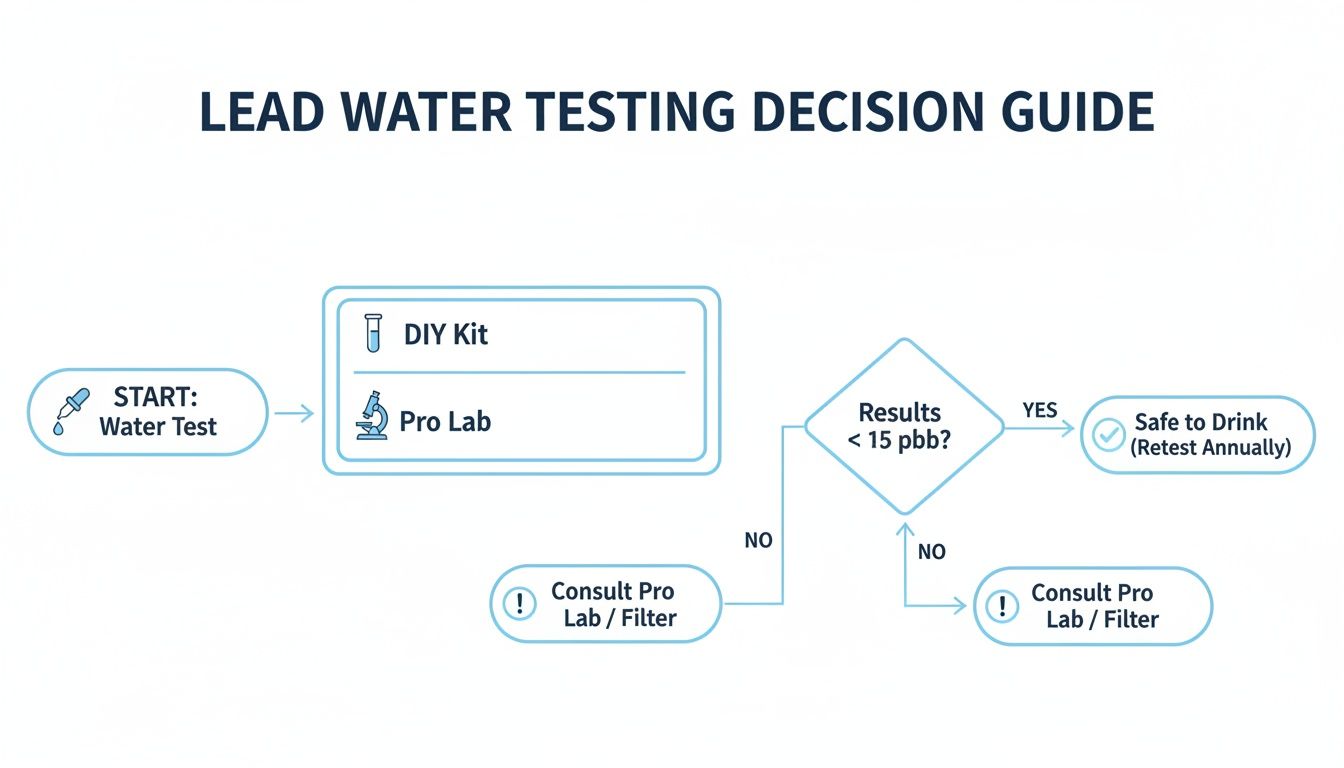
Whether you start with a quick DIY kit or go straight for a precise lab test, the goal is the same: get solid data so you can pick the right filter.
Activated carbon is probably the most familiar filter technology out there, but here's the crucial part: not just any carbon filter will handle lead. To be effective, it must be certified to NSF/ANSI 53.
That certification is your proof that the filter has been independently tested and proven to reduce lead. These filters use a process called adsorption, where lead particles essentially get stuck to the carbon's massive surface area, kind of like a magnet grabbing metal shavings.
The most important thing to remember is the certification. A basic carbon filter just for taste and odor won't do much for lead. Always look for that NSF/ANSI 53 mark on the box.
The great thing about activated carbon is its flexibility. You can find it in all sorts of formats:
Since we started in 2007, we've helped thousands of families find the right solution. Lead in water is a serious issue, but the fixes are incredibly effective. A quality RO system can reject 98-99% of lead, and a certified activated carbon filter can adsorb 95% or more. Installing a proven system is the best way to protect your family right now.
Ion exchange is a more specialized technology you’ll often find inside water softeners or as part of a multi-stage filter cartridge. It works like a trade. The filter media is loaded with harmless ions (like sodium) and when water flows through, it swaps them for undesirable ions, like lead.
While it's a great technology, you rarely see ion exchange used as a standalone lead filter for drinking water. It’s more of a team player, often working alongside activated carbon to provide a more complete filtration solution for various water quality issues.
To help you decide, it's useful to see how these top-tier technologies stack up. While a detailed guide to choosing the perfect water filter can provide more depth, this table gives you a quick, side-by-side look.
| Filtration Technology | Lead Removal Rate | Initial Cost | Annual Maintenance | Best For |
|---|---|---|---|---|
| Reverse Osmosis | 95-99+% | $150 – $500+ | $50 – $150 | Homeowners wanting the highest level of purification for drinking/cooking water. |
| Activated Carbon (NSF 53) | 95-99% | $30 – $400 | $40 – $120 | Renters and homeowners needing a flexible, effective solution for specific taps. |
| Ion Exchange | 95-98% | Varies | Varies | Homes with multiple water issues, often used in conjunction with other filters. |
At the end of the day, the best filter is one that's certified for lead, fits your budget, and is easy for you to maintain. Whether it’s a simple faucet filter or a full under-sink RO system, taking this step puts a vital barrier between your family and this invisible threat.
For more in-depth reviews and comparisons, check out our comprehensive advice on water filters at Water Filter Advisor.
Picking out the right filter feels like a huge win, but it’s really only half the job done. A top-of-the-line system is completely worthless if it’s installed incorrectly or you let its maintenance slide. This is where you come in—your ongoing attention is what keeps your filter doing its one critical job: to filter lead from water effectively, day after day.
Think of it like owning a high-performance car. It needs to be set up right from the start and requires regular tune-ups to keep running at its peak. If you skip these steps, you’re not just getting poor performance; you’re creating a false sense of security while contaminants slip right through.
Proper installation is the foundation for safe water. While a complex whole-house system is a job best left to a professional plumber, many of the point-of-use systems you'll encounter—like faucet mounts and under-sink units—are actually designed for a straightforward DIY setup.
Take a simple faucet-mounted filter, for example. Installing one of those often takes less than five minutes. Seriously. It's usually just a matter of unscrewing your faucet’s aerator and twisting the filter unit on. Most come with a handful of adapters to make sure you get a snug fit on any standard faucet. It’s an empowering first step toward cleaner water.
Under-sink systems, like a Reverse Osmosis (RO) unit, are a bit more involved but are still totally manageable for anyone with basic DIY confidence. The absolute key here is to follow the manufacturer's instructions to the letter. Don’t just skim them. Lay out all the parts, identify them with the manual, and take your time connecting the color-coded tubes. One wrong connection can lead to leaks or a system that doesn’t filter at all.
Once your system is up and running, the real work begins. Maintenance isn't just a suggestion; it's a non-negotiable part of keeping your water safe. An old, clogged filter can’t capture lead. Even worse, it can sometimes do the opposite and release a concentrated burst of trapped contaminants back into your water.
Here’s a practical breakdown of what needs your attention:
Pro Tip: Listen to Your Water
Your own senses can be a fantastic early warning system. If you ever notice a sudden drop in water pressure from your filtered tap, or if the water starts to taste or smell different, that’s a huge red flag. It’s a strong sign your filter is clogged and needs to be replaced right away, even if it’s before the scheduled date.
Besides a drop in water flow, other subtle clues can tell you a filter is on its last legs. Many modern systems come with a filter life indicator light, which is your most obvious signal. It usually changes from green to yellow (a warning) and finally to red (replace now).
But don't rely on the light alone. These indicators are often just simple timers and don't actually measure the filter's real-world performance. The most reliable method is sticking to a strict replacement schedule based on the manufacturer's gallon capacity rating. If you have a big family and go through a lot of water, you’ll probably need to replace filters more often than a single person would.
Following these guidelines is the only way to ensure your system continues to reliably filter lead from water, protecting your home and family with every glass you pour.
While a high-quality filter is your main line of defense, it’s not the only move you can make. A few smart habits can act as a powerful backup, creating an extra layer of protection that works with your filter to keep lead exposure to an absolute minimum.
These aren't complicated changes. They’re small, easy adjustments to your daily routine that make a surprisingly big difference in the quality of your water.
Here’s something to think about: when your home is quiet overnight, the water just sits in the pipes. It has hours and hours to pick up lead from older plumbing, solder, or even brass fittings. That means the very first glass of water from the tap in the morning can have the highest lead concentration of the day.
The fix is incredibly simple: flush your pipes. Before you make coffee or fill a glass, just run the cold water for a minute or two. This pushes out that stagnant, lead-heavy water and brings in fresh water from the main.
You don't have to waste it, either. Use that first bit of water for things you won't be drinking:
This one habit is probably the easiest and most effective way to support your efforts to filter lead from water.
"The first draw of water in the morning can be a real wild card. By simply running the tap for a minute, you’re not just flushing the line—you’re actively reducing the contaminant load your filter has to deal with, which can even help extend its life."
This is a golden rule in our house: the hot water tap is for cleaning, not for cooking or drinking. Period. Hot water is much more effective at dissolving metals like lead from your plumbing.
It’s tempting to use hot water to get a pot of pasta boiling faster, but it's a risky shortcut. The heat from your water heater actually speeds up the leaching process, potentially delivering a much higher dose of lead straight into your food. Always, always start with cold water and heat it on the stove or in a kettle.
You know that little screen on the tip of your faucet? That's an aerator. Its job is to mix air into the water so it doesn't splash everywhere, but it also acts like a tiny net, catching sediment and other gunk. If there's lead in your plumbing, lead particles can get trapped right there.
Every few months, just unscrew the aerators and give them a quick cleaning. A simple rinse and a gentle scrub with an old toothbrush is all it takes to clear out any buildup. It’s a two-minute job that keeps your water flowing clean.
The Flint water crisis back in 2014 was a tough lesson on what happens when corrosion control goes wrong, with some homes testing over 100 ppb for lead. While there's a global push for lead-free water by 2040, filtration is what protects families right now. You can read more about these global water safety initiatives on Frontiersin.org. Combining a good NSF/ANSI 53-certified filter with these simple habits gives you a rock-solid defense against lead.
Once you've picked a filtration system and started building better habits, a few questions almost always pop up. Getting these final details right is what gives you real confidence that your home's water is safe. Let's dig into some of the most common things people ask when they're tackling a lead problem.
Getting clear answers on these points helps you know you’ve covered all your bases. From what popular products can't do to knowing when you can finally stop worrying, these details bring your whole water safety plan together.
This is a huge point of confusion, and the answer is not necessarily. Your average water pitcher you grab off the shelf is really just designed to make your water taste and smell better, mostly by reducing chlorine. It’s simply not built to capture heavy metals like lead.
If you want a pitcher that works for lead, you absolutely have to find one that is certified under NSF/ANSI 53 for that specific job. Always check the box or, even better, look it up on the NSF's online database to be sure. Certified pitchers can be a great, convenient option, but remember they hold very little water and the filters need to be changed way more often than an under-sink system.
Having a new home is a fantastic head start, but it’s not a 100% guarantee against lead. Even though lead pipes and solder were banned decades ago, today's "lead-free" plumbing regulations still allow for up to 0.25% lead content in new fixtures like faucets, valves, and other fittings.
Over time, tiny amounts of lead can still leach out of these brand-new parts, especially if your city's water is on the corrosive side. There's also the service line—the pipe connecting your new house to the water main could still be an older, lead-based pipe owned by the utility. The only way to know for sure is to test the water coming directly out of your tap.
The term "lead-free" is a bit misleading. It just means very low lead, not zero. That's why testing is still so important, even in modern homes. It's the only way to confirm what's in your water and make the right call on filtration.
This all comes down to being diligent. The single most important thing you can do is stick to the manufacturer's filter replacement schedule. They don't just pull those timelines out of thin air; they're based on extensive testing to figure out the filter's maximum capacity in gallons or months.
For some extra peace of mind, you can also:
This is a dangerous myth that needs to be busted right now. Boiling water does NOT remove lead. In fact, it actually makes the concentration of lead higher.
Think about it: when water boils, some of it turns to steam and evaporates, but the lead gets left behind in the pot. This makes the lead in the remaining water more concentrated and even more hazardous to drink. The only methods proven to filter lead from water are technologies like reverse osmosis, specialized ion exchange, and properly certified activated carbon filters. Never, ever boil water to try and make it safe from lead.
At Water Filter Advisor, we're here to give you the clear, unbiased information you need to protect your family. From in-depth reviews to practical maintenance guides, we help you navigate every step of your journey to safer water. Explore our resources to find the perfect solution for your home at https://www.waterfilteradvisor.com.
That crystal-clear glass of H2O from your kitchen faucet looks innocent enough, but it could be a Trojan horse, smuggling in a microscopic army of troublemakers. We often blame stress, diet, or bad luck for those nagging headaches, surprise stomach bugs, or skin that just won't behave. But what if the real culprit is flowing right out of your pipes? Recognizing the sneaky symptoms of drinking contaminated water is the first step to reclaiming your health and turning your tap into a trusted source of pure refreshment.
Think of this guide as your "whodunit" for water-related woes. We're about to uncover eight tell-tale signs that your water might be working against you. From tummy troubles that strike out of nowhere to hair and skin issues that defy all logic, we'll connect the dots between how you feel and what’s really in your water. We’ll be looking at the usual suspects: bacteria, viruses, parasites, heavy metals, and pesky chemicals.
But this isn't just about doom and gloom—it's about empowerment. The hero of our story? The humble home water filter. We’ll show you how installing the right filtration system is like hiring a microscopic bodyguard for every faucet, effectively kicking those harmful contaminants to the curb. By the end, you'll be a water detective, ready to spot the signs and choose the perfect filter to ensure every drop in your home is delightfully clean and safe.
The most classic and fastest-acting symptom is a full-blown mutiny in your gut. Stomach cramps, nausea, vomiting, and diarrhea are your body’s emergency alarm bells, screaming, "Get this out of me, now!" When you unknowingly sip on water contaminated with party-crashers like E. coli, Salmonella, Norovirus, or parasites like Giardia, your digestive system goes into full-on eviction mode.
These unwelcome symptoms can pop up within hours or lie in wait for a few days, making it tricky to pinpoint your tap water as the villain. For a deeper dive into what makes your stomach churn, check out what causes viral gastroenteritis. This isn't just a day-ruiner; it can lead to serious dehydration, especially for kids and the elderly.
Think your water is waging war on your stomach? It's time to fight back with a smart filtration strategy.
With the right home water filter, you transform your faucet from a source of potential misery into a fountain of pure, safe hydration. For expert help choosing your system, check out this treasure trove of water filter advice.
Beyond what’s happening inside, your skin can be the billboard that announces your water is contaminated. That itchy, red, or angry rash that appeared out of nowhere could be your skin's reaction to bathing in or drinking water laced with irritants. The culprits are often chemicals like chlorine, pesticides, or heavy metals, but pesky bacteria can also be to blame.
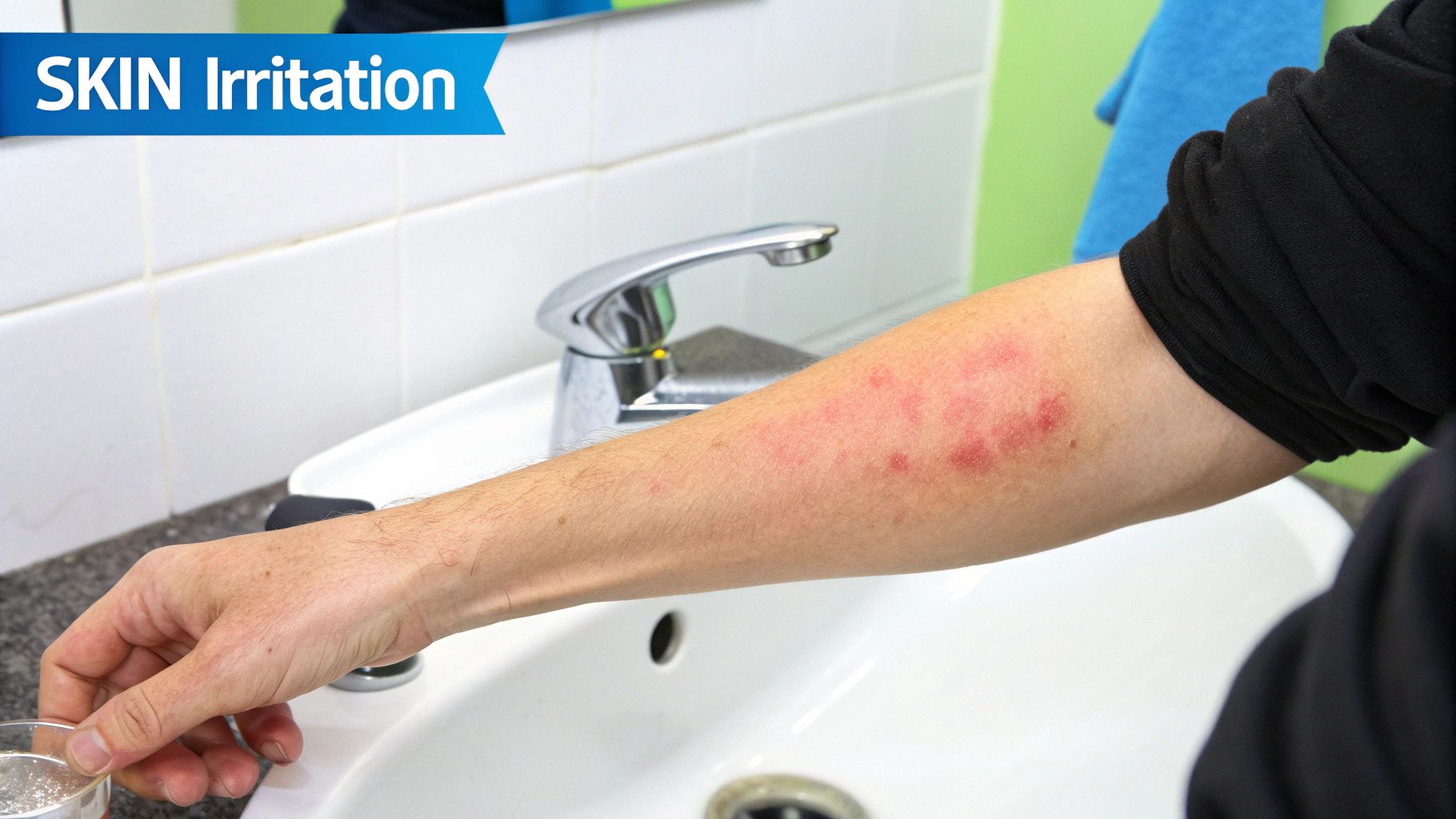
The signs can range from simple redness and itching to full-blown hives or dermatitis. Unlike an instant stomach ache, skin problems can develop over time or show up only on areas that get wet in the shower. This delay makes it easy to blame your soap or lotion, but your tap water could be the secret saboteur.
If unexplained skin issues are making you miserable, it's time to put your water quality under the microscope. The right filter can remove the specific troublemakers causing the irritation.
By filtering out the source of the irritation, you can protect your family's skin and turn every shower into a soothing, safe experience instead of a risky gamble.
If you're constantly battling headaches and a sense of fatigue that coffee can't fix, your tap water might be playing a sneaky neurological game. This isn't your typical "I need more sleep" tiredness. It's a profound lack of energy and persistent head pain that could signal the presence of heavy metals like lead or arsenic, nitrates, or other toxins that mess with your body's systems. These symptoms are particularly tricky because they build up slowly and are easy to dismiss as just a part of modern life.
Symptoms can vary from a dull, throbbing headache to intense migraines, paired with a bone-deep weariness. Because these signs are so vague, a family might drink contaminated water for months or even years before connecting the dots, which is why treating your water filter as an essential home appliance is so critical.
If brain fog, headaches, and fatigue have become the norm in your house, it's time to investigate your water supply. Targeted filtration isn't just a solution; it's a path back to feeling your best.
When your body forcefully rejects something, it’s not being subtle. Nausea and vomiting are your system’s most dramatic and unmistakable signs that you’ve consumed something toxic. This is a direct, often violent, response to water contaminated with pathogens, chemicals, or bacterial toxins. Your body’s self-preservation instincts kick in, triggering an immediate expulsion to stop the toxins from being absorbed. The onset can be terrifyingly fast, making these some of the scariest symptoms of drinking contaminated water.
This reaction is far more than just unpleasant; it can rapidly lead to dehydration and dangerous electrolyte imbalances. For young children, the elderly, or anyone with a compromised immune system, this can become a medical emergency in a very short time. If these symptoms hit after drinking tap water, treat it as a five-alarm fire.
If sudden nausea and vomiting strike your family, your water supply should be treated as "guilty until proven innocent." Swift, decisive action with filtration can prevent a bad situation from getting worse.
Some symptoms of contaminated water are sprinters, hitting you fast and hard. Others are marathon runners, causing damage slowly over time. Chronic muscle pain and aching joints fall into the second category. Long-term exposure to certain contaminants, especially heavy metals like lead or excessive minerals like fluoride, can cause them to build up in your body, triggering inflammation and interfering with your bone and nerve health.
This kind of pain develops so gradually that you'd almost never think to blame your tap water. Lead can cause inflammation that shows up as muscle and joint pain. Too much fluoride can lead to skeletal fluorosis, a painful condition that stiffens joints. Arsenic is also linked to inflammatory conditions that directly impact your muscles and joints. It's a silent attack that you might only notice after years of damage.
If you're dealing with persistent aches and pains with no obvious cause, it's time to investigate your water. The only way to stop this slow-motion assault is to filter out the contaminants at the source.
When you suddenly get the chills and your temperature spikes, your body is screaming that it's at war with an invader. A fever is one of the most serious systemic symptoms of drinking contaminated water, indicating that an infection has taken hold and your immune system is in an all-out battle. Drinking water contaminated with powerful bacteria like Salmonella or viruses like Hepatitis A triggers this response, as your body raises its internal temperature to try and cook the pathogens out.
A fever, especially a high one (over 103°F/39.4°C), is a major red flag that a waterborne illness is getting serious. It's often paired with other symptoms like stomach issues or muscle aches and means you need to take action fast. This isn't something to ignore; it’s a clear and present danger signal from your body.
A fever demands a two-pronged attack: immediate medical attention for the person who is sick, and an immediate lockdown of your water supply to protect everyone else.
By installing a robust, multi-stage filtration system with UV or RO, you can transform your home's water from a potential threat into a source of pure, life-giving refreshment.
Hair thinning and nails that constantly break or peel are frustrating beauty issues, but they can also be subtle signs that your body is dealing with long-term toxic exposure from your water. Chronic consumption of water containing heavy metals like arsenic, lead, or thallium can cause these toxins to accumulate in your system. They disrupt the vital processes your body uses to build strong hair and nails, leading to noticeable thinning, hair loss, and weak, discolored nails.
Because these symptoms develop slowly over months, it’s easy to overlook the connection to your tap water. However, the good news is that unlike some other chronic health issues, these symptoms can often be reversed once you remove the source of contamination by filtering your water.
If you're noticing more hair in your brush than on your head, it's time to give your tap water a hard look. The right filtration system can stop the exposure and help your body get back to building healthy hair and nails.
We think of water contamination as something we drink, but sometimes the danger is in the air we breathe at home. A persistent cough, wheezing, or shortness of breath can be surprising symptoms linked to contaminated water—specifically, water you inhale. When you take a hot, steamy shower, chemicals and pathogens in the water can become aerosolized, turning your bathroom into a delivery system for airborne threats.
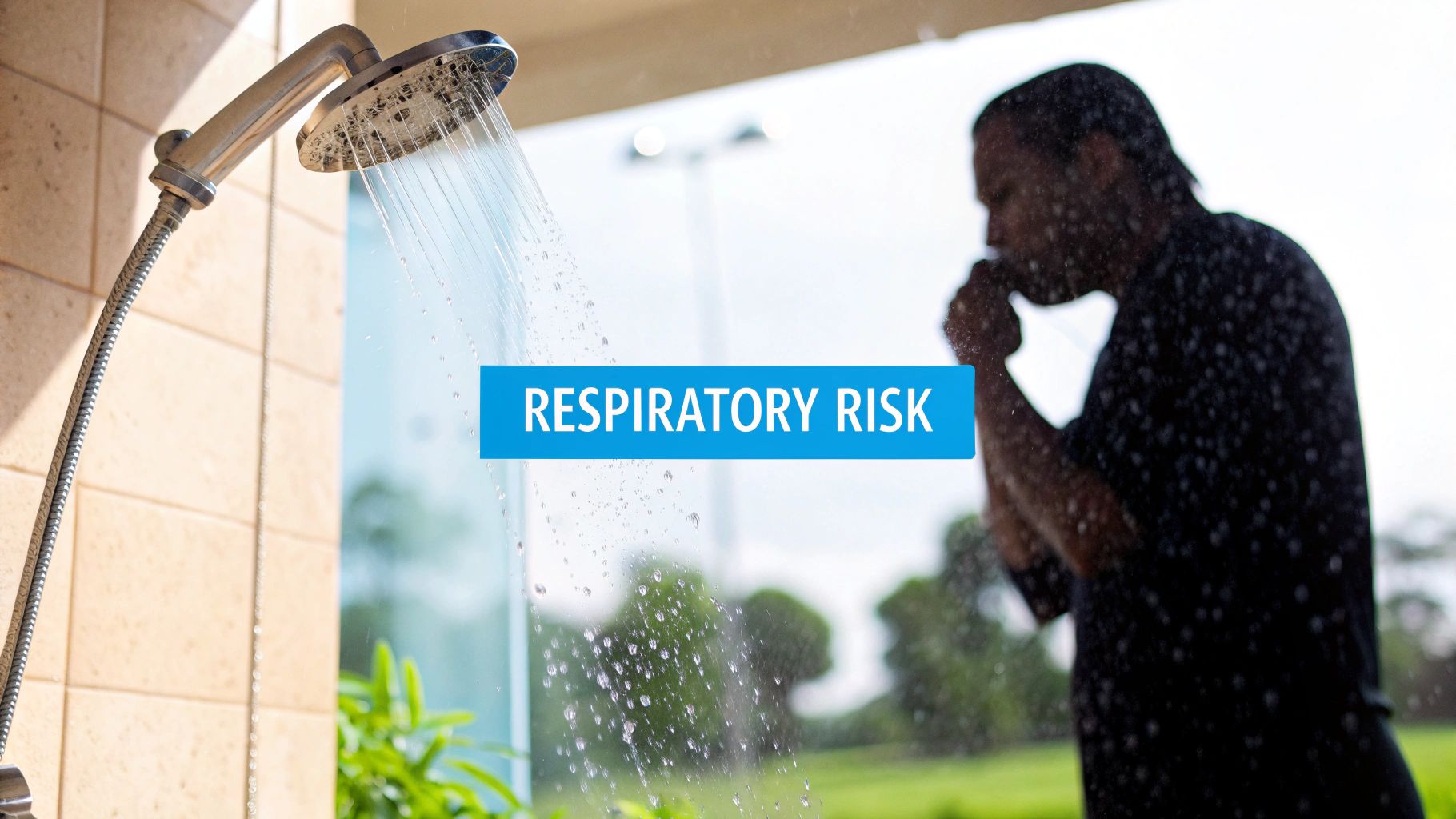
The number one offender here is the Legionella bacteria, which causes the severe pneumonia known as Legionnaires' disease. It loves to grow in warm water environments like hot water heaters and pipes. Chemicals like chlorine and volatile organic compounds (VOCs) can also turn into a gas in hot water, irritating your lungs and causing symptoms that mimic asthma, especially in a poorly ventilated bathroom.
Protecting the air you breathe during your daily shower is just as important as purifying the water you drink. A combination of smart filtration and maintenance is your best defense.
| Symptom | 🔄 Implementation Complexity | ⚡ Resource Requirements | ⭐ Expected Outcomes | 📊 Ideal Use Cases | 💡 Key Advantages / Tips |
|---|---|---|---|---|---|
| Gastrointestinal Distress and Diarrhea | Moderate — point‑of‑use + UV/RO or whole‑house multi‑stage | Moderate — RO/UV units, testing kits, possible medical care | High ⭐ — rapid reduction in pathogens and acute illness with proper filtration | Households facing bacterial/viral/parasitic contamination; wells, boil‑water alerts | Install RO/UV or multi‑stage carbon filters; keep test kits and use bottled water in emergencies |
| Skin Rashes and Irritation | Low–Moderate — shower/faucet filters or whole‑house chemical removal | Low–Moderate — shower filters, carbon cartridges, water tests | Moderate ⭐ — quick symptom improvement after removing chemical irritants | Homes with high chlorine/heavy metals or chemical exposure affecting skin | Use KDF/activated carbon shower filters and whole‑house carbon; test for chlorine and metals |
| Headaches and Fatigue | Moderate — whole‑house heavy‑metal removal; professional testing advised | Moderate–High — lab testing, RO, ion exchange, long‑term filtration | Moderate–High ⭐ — gradual cognitive/energy improvement after contaminant removal | Areas with suspected heavy metals, nitrates, or chronic low‑level exposure | Get certified testing; prioritize under‑sink RO for drinking water and whole‑house metal filters |
| Nausea and Vomiting | High — fast emergency response plus long‑term system upgrade | Moderate — emergency bottled/boiled water, portable filters, RO/UV | High ⭐ — immediate relief when water source removed; prevents dehydration | Acute outbreaks from bacterial toxins or rapid‑onset contaminants | Stop tap use, switch to bottled/boiled water; contact health dept and install emergency filtration |
| Musculoskeletal Pain and Joint Aches | High — long‑term remediation, pipe replacement and heavy‑metal filtration | High — certified lab tests, whole‑house RO/ion exchange, possible plumbing work | Moderate ⭐ — slow improvement; some damage may be irreversible if prolonged | Regions with chronic heavy metals or excess fluoride in groundwater | Test for metals/fluoride; install ion exchange/RO and consider replacing corroded pipes |
| Fever and Chills | High — urgent medical management and pathogen elimination (UV/RO) | Moderate — medical care, professional water testing, UV/RO systems | High ⭐ — fever resolution with treatment and pathogen removal; serious if delayed | Suspected systemic infections (typhoid, Legionella, hepatitis A) | Seek immediate medical care; discontinue tap use, report to authorities, use UV/RO and boiling as interim |
| Hair Loss and Brittle Nails | Moderate–High — targeted heavy‑metal removal and sustained filtration | Moderate — lab testing, RO, ion exchange, nutritional support | Moderate ⭐ — visible recovery over months after contaminant removal | Chronic heavy‑metal exposure in wells or industrial areas | Test for arsenic/thallium; use RO/ion exchange and document improvement with photos |
| Respiratory Issues and Coughing | High — building system remediation, shower filtration and temperature controls | Moderate–High — shower filters, UV, system flushing, HVAC/temperature maintenance | High ⭐ — can prevent aerosolized pathogen transmission with proper controls | Hot water systems, showers, buildings with Legionella or chemical aerosols | Install Legionella‑resistant shower filters, maintain hot‑water temps >55°C (131°F), flush unused lines and use UV purification |
Recognizing the diverse symptoms of drinking contaminated water is your superpower. We've seen how everything from an upset stomach and skin rashes to headaches and even a cough could be traced back to your tap. These symptoms are your body's way of sending an SOS, signaling that the water you depend on every day might be doing more harm than good.
But waiting for these alarms to go off is a risky game. Now that you're armed with this knowledge, you can switch from playing defense to playing offense. The most reliable and empowering solution to this invisible threat is a high-quality home water filtration system.
Realizing your fatigue could be linked to your faucet is a lightbulb moment. Now, it’s time to take action and turn that awareness into a safer home environment.
Your game plan is simple:
Investing in a water filtration system is one of the best investments you can make in your family's health. It ends the guessing game. Instead of wondering if your water is safe, you can drink, cook, and shower with the absolute confidence that you are protected from a whole host of contaminants.
Key Takeaway: A water filter isn't just another gadget; it's a preventative health tool for your home. It's your 24/7 bodyguard, stopping threats at the source so you don't have to deal with the symptoms later.
By taking this step, you're filtering out much more than just lead or chlorine. You're filtering out worry. You're creating a healthier home where your water actively supports your well-being instead of secretly undermining it. This shift from reactive worry to proactive confidence is the ultimate win, ensuring every glass of water is pure, safe, and delicious.
Ready to find the perfect filtration system to eliminate the root cause of these symptoms? The experts at Water Filter Advisor provide unbiased, in-depth reviews and guides to help you navigate the options. Visit Water Filter Advisor to compare systems, understand certifications, and make a confident choice for your home's water safety.
The most obvious signs of contaminated water are the ones that assault your senses—an off-putting flavor, a funky odor, or water that looks like it came from a puddle. These sensory clues are your home's built-in alarm system, screaming that it’s time to stop guessing what’s in your water and start filtering it.
We’ve all been there. You turn on the kitchen tap for a refreshing glass, and something just feels… wrong. Maybe it's a weird smell you can't quite place, or the water looks a little murky. That gut feeling is your first line of defense, telling you to put down the glass and pay attention.
But here’s the catch: the most dangerous stuff is often completely invisible, with no taste or odor. While crystal-clear water looks reassuring, it's no guarantee of purity. The journey from the treatment plant to your tap is a long one, and your water can pick up all sorts of unwanted hitchhikers from aging city pipes or even the plumbing inside your own walls. The only real way to take control is with a home water filtration system.
Before we dive deep, here's a quick, scannable table to help you connect the dots between what you're observing and which filter might be your hero. Think of it as a first-glance diagnostic tool for your home's water woes.
| Observable Sign (Taste, Smell, or Look) | Potential Problem Source | Your First Filtration Thought |
|---|---|---|
| Metallic or bitter taste | High levels of copper, iron, zinc, or lead | A reverse osmosis (RO) system is a powerhouse for this |
| Chlorine or bleach-like smell | Excess chlorine from municipal treatment | An activated carbon filter is the perfect chlorine-killer |
| Rotten egg (sulfur) odor | Hydrogen sulfide gas or certain bacteria | Look into a specialized iron/sulfur filter or an aeration system |
| Musty or earthy smell/taste | Algae blooms or decaying organic matter | A whole-house carbon filter will freshen things right up |
| Cloudy or milky appearance (turbidity) | Air bubbles or suspended solids/silt | A sediment pre-filter is your first line of defense |
| Red, brown, or orange discoloration | Rust from iron pipes or sediment | An iron filter or a water softener with iron removal is key |
| Green or blue stains on fixtures | High levels of copper, likely from pipe corrosion | An acid neutralizer filter can stop corrosion in its tracks |
| Gritty sediment or floating particles | Dirt, rust flakes, or scale from old pipes | A sediment filter is a must-have for catching this gunk |
This table covers the most common red flags, but remember, it’s a starting point. The only way to know for sure what's in your water is to test it, which will point you to the perfect filtration solution.
Long before you order a test kit, your own eyes, nose, and tongue are on the job. Paying attention to these subtle (and not-so-subtle) signals is the first real step toward choosing a filtration system that protects your family’s health and prevents costly damage to your pipes and appliances.
A sudden change in your water's taste, smell, or appearance isn't just a nuisance. It's a clear signal that something has shifted, and it's time to find the right filter to fix it.
Understanding what these signals mean is key. For instance, persistent moisture issues that lead to musty smells can be connected to bigger problems, so it's wise to understand the truth about mold contamination and health risks.
This guide will walk you through exactly what to look for. We'll break down the common signs of contamination, explain the likely causes, and give you clear, actionable steps to get your water back to clean and safe with the right filtration setup.
Your nose and taste buds are your home's front-line defense—they’re surprisingly good at detecting when your water is off. If it tastes or smells weird, that’s not something to ignore. It’s a clear warning that something isn’t right, and figuring out what that message means is the first step to choosing the perfect filter to fix it.
A distinct metallic taste is a big red flag for excess metals in your supply. It could be naturally occurring stuff like iron and manganese, or it could be something more serious like copper, zinc, or even lead that's leaching from old pipes. A bitter taste, on the other hand, often points to a high level of dissolved solids.
Either way, your water has picked up some unwanted hitchhikers. Your best bet for a permanent fix is an under-sink reverse osmosis (RO) system. It's a filtration powerhouse, stripping out a huge range of dissolved metals and getting your water back to tasting pure and clean.
Some smells are more common than others, but they're all cause for concern. Knowing where the odor comes from is the key to picking the right filter to get rid of it for good.
Here are the usual suspects:
A foul odor, especially one like rotten eggs or sewage, is one of the most urgent signs of contamination. It can signal hydrogen sulfide or, in a worst-case scenario, bacterial growth from sewage pollution.
This isn't just a local problem. According to the UN and WHO-UNICEF, a staggering 2.2 billion people don't have access to safely managed drinking water. If you're interested, you can read more about worldwide water scarcity issues to see the global scale of the challenge.
The good news? You don’t have to put up with nasty water. Modern filtration systems are built to zero in on these specific problems. You just have to match the filter to the contaminant.
It's like using the right tool for the right task—you wouldn't use a hammer on a screw. A filter that knocks out chlorine might not do a thing for a sulfur smell.
For example, a whole-house catalytic carbon filter is a fantastic choice for tackling odors. It’s a pro at removing chlorine, chloramine (another disinfectant), and those organic compounds that cause musty smells. But if you have a serious hydrogen sulfide problem, you'll probably need a dedicated iron and sulfur filter or an aeration system to completely knock it out.
Ultimately, identifying the specific taste or odor is your most important clue. It points you toward the most effective filtration strategy, ensuring you get a system that actually solves your problem.
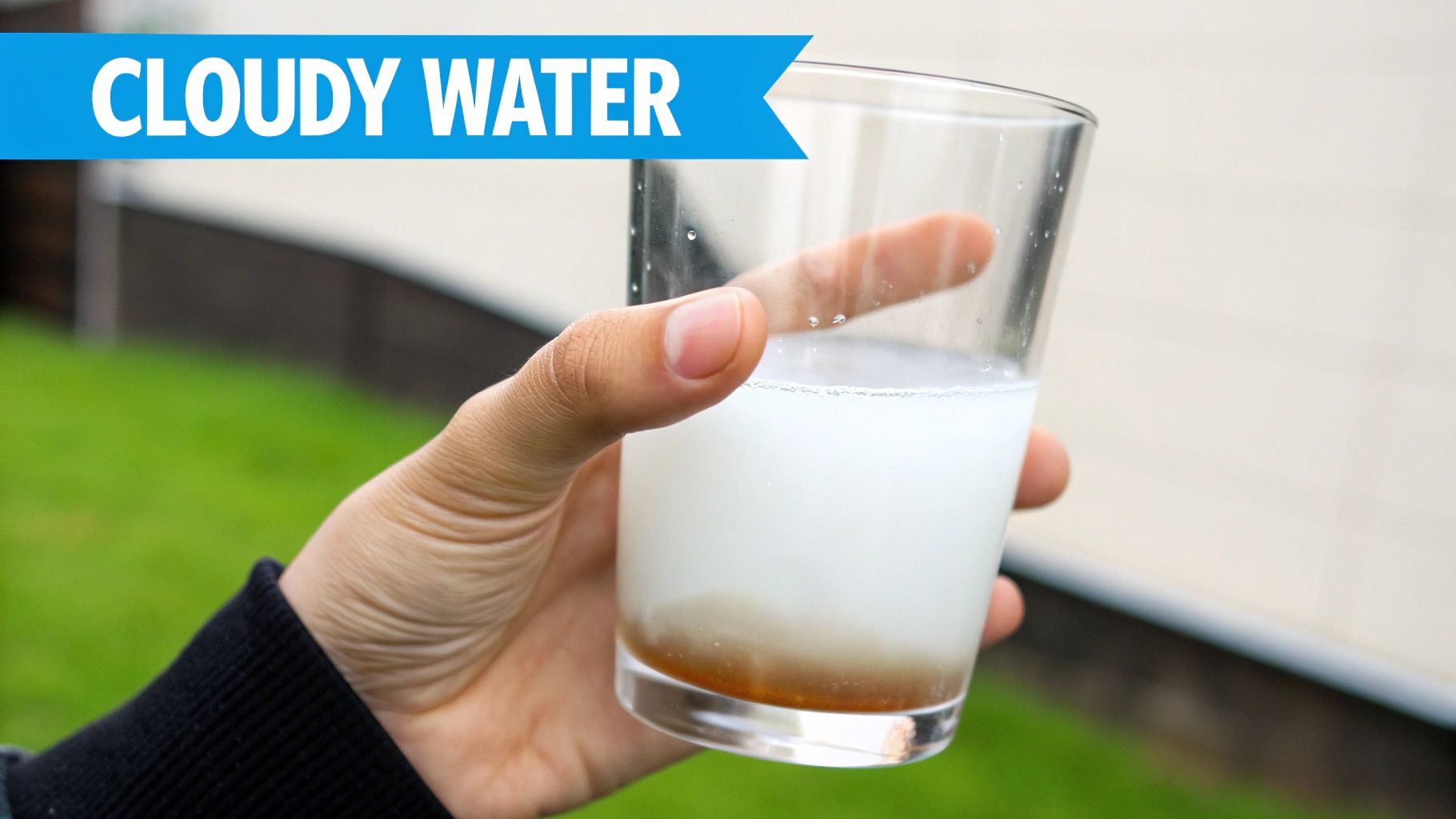
While odd tastes and smells are strong warnings, some of the most common signs of contaminated water are the ones you can see. Clear water isn’t automatically clean, but water that’s cloudy, discolored, or has stuff floating in it is sending a loud and clear message: it’s time to filter.
Think of your water glass as a window into your plumbing. Just like a mechanic can tell a lot about an engine by its exhaust, you can learn a ton just by looking at your water. These visual clues are your first step toward picking the right filter to get it back to crystal clear.
Ever fill a glass and it looks hazy or milky? That’s called turbidity, a fancy word for water that isn't clear. It’s caused by tiny suspended particles creating a noticeable cloudiness when they band together.
These particles could be anything from harmless air bubbles to silt, sand, or clay. There’s an easy test: fill a glass and let it sit. If the cloudiness clears from the bottom up, it’s just pressurized air bubbles—totally harmless.
If that water is still cloudy after a few minutes, you’ve got suspended solids. This is where a whole-house sediment filter really shines. It acts like a bouncer at the door, catching all those particles before they ever make it to your glass or start clogging up your appliances.
Discolored water is usually a more dramatic—and often more concerning—sign. The exact color is a huge clue that points you right to the type of contaminant you’re likely dealing with, and therefore, the type of filter you need.
Shifts in water color often signal the presence of heavy metals. In the United States, EPA data flags millions of homes with potential lead risks. You can learn more about global water quality goals and statistics to see how widespread these issues really are.
Once you’ve figured out what you're seeing, you can pick the right filter to fix it. It's just like using a specific cleaner for a rust stain versus a grease spot—you need the right tool for the job.
Solutions for Visual Contaminants:
| Visual Sign | Likely Contaminant | Recommended Filtration Solution |
|---|---|---|
| Cloudiness/Turbidity | Sediment, Silt, Clay | Whole-house sediment pre-filter |
| Red, Brown, Orange | Iron, Rust | Specialized iron filter or a water softener with iron removal capabilities |
| Yellow Tint | Iron, Tannins | Iron filter or a dedicated tannin removal system |
| Blue/Green Stains | Copper (from acidic water) | Acid neutralizer filter followed by a carbon filter |
Taking care of these visual signs isn't just about making your water look pretty. It's about protecting your home and your family. An iron filter, for example, doesn't just stop those ugly rust stains; it also makes your water taste better and keeps iron-loving bacteria from growing in your pipes. By paying attention to what you see, you can make a smart, targeted investment in a filtration system that truly solves the problem.
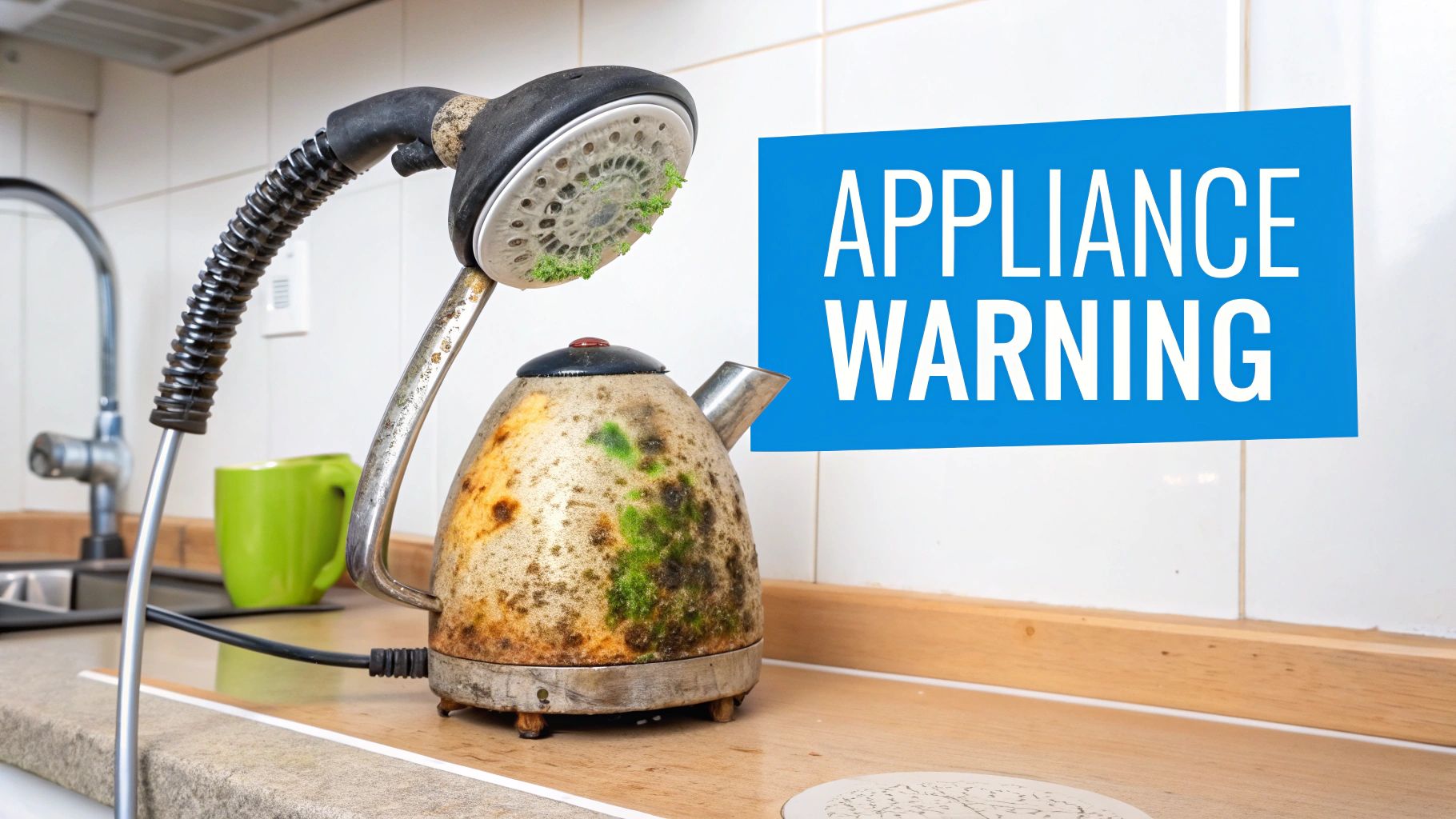
Sometimes, the clearest signs of contaminated water don't show up in your drinking glass. They’re hiding in plain sight, slowly destroying your home’s most valuable appliances. Your plumbing, dishwasher, and water heater will be the first to tell you when your water is waging a secret war on your home. If your water is full of minerals or corrosive elements, a home filtration system isn't a luxury—it's essential protection.
If you live in a hard water area, you know all about that chalky white residue. That’s limescale, a crusty deposit of calcium and magnesium that builds up, layer by stubborn layer. It's more than just an ugly nuisance; it’s a silent appliance killer.
Limescale basically suffocates your appliances from the inside. Your showerhead loses pressure because its nozzles get clogged. Your coffee maker sputters and takes forever. The biggest victim? Your water heater.
A study from the Water Quality Research Foundation found that hard water can slash a water heater's efficiency by up to 48%. The scale forces the heating element to work overtime, jacking up your energy bills and drastically shortening the unit's lifespan.
The only real defense here is a whole-house water softener or a scale-reduction filter. By treating water right as it enters your home, you protect every faucet and appliance from this costly mineral assault.
On the other end of the spectrum is water that's too soft or acidic, making it corrosive. This water literally eats away at metal, which is a massive problem for anyone with copper or galvanized steel pipes. You might first notice those blue-green stains we talked about, but the real damage is happening out of sight. Corrosive water can cause tiny pinhole leaks that lead to thousands in water damage behind your walls.
An acid neutralizer filter is the fix. It simply raises the water's pH before it gets a chance to circulate through your pipes, stopping corrosion cold and protecting your plumbing and your health.
Ever find a slimy, pinkish-orange film inside your toilet tank or around a faucet? That's usually the handiwork of iron-eating bacteria. These little microbes chow down on any iron in your water, leaving behind a nasty slime that clogs up pipes and fixtures.
While this biofilm isn't usually a direct threat, it’s a dead giveaway that you have iron in your water. A dedicated iron filter or a good whole-house system will take care of it easily. By getting rid of their food source, you stop the slime before it even starts.
You’ve seen the signs—the weird smell, the cloudy water, or the scaly buildup choking your showerhead. So, now what? The next step is to move from suspicion to certainty with water testing. This is the most important step before you buy a filtration system. If you just guess, you could easily buy a filter that does absolutely nothing to fix your actual problem. Testing gives you a precise roadmap, showing you exactly which contaminants you need to go after.
When it comes to testing your water, you really have two main paths: the quick-and-easy DIY route or a full-blown professional analysis. Each one has its place.
At-Home DIY Test Kits: These are fast, cheap, and great for a quick baseline. They’re perfect for checking things like chlorine, water hardness, pH, and sometimes basic metals like iron and copper.
Professional Lab Testing: This is the gold standard for accuracy. A certified lab will give you a detailed report on a huge range of contaminants, including the invisible threats like lead, arsenic, bacteria, pesticides, and volatile organic compounds (VOCs).
If you're noticing obvious issues like a chlorine smell or hard water buildup, a DIY kit might be all you need to confirm your suspicions and choose a basic filter. But if you have a private well, live in an area with known contamination problems, or have young children, a professional lab test is a very smart investment that will point you to the perfect filtration solution.
Choosing the right test is the first step toward the right solution. A lab test is the only way to get a definitive answer about hidden dangers, empowering you to select a filtration system certified to remove your specific contaminants.
Once you have your results, you're officially in the driver's seat. That test report is basically a personalized shopping list for the perfect water filter. If it shows high levels of sediment and iron, you know a whole-house sediment filter combined with an iron filter is your answer. If lead is the problem, then a certified under-sink reverse osmosis system is a non-negotiable.
This data-driven approach takes all the guesswork out of the process. Instead of just buying a generic filter and crossing your fingers, you can confidently pick a system that’s designed to solve your home's unique water quality challenges. For more help matching filters to specific problems, you can find a ton of information in our extensive water filtration advice articles.
Alright, you've done the detective work and spotted the signs of contaminated water in your home. Now it's time to switch hats from investigator to problem-solver. The good news is, all that knowledge you've gathered makes picking a filter a whole lot easier. You can narrow down the millions of options by thinking about two main strategies: spot treatment or a whole-house wash.
Point-of-Use (POU) systems are your "spot treatments." They filter water right at the specific tap where you need it most, like your kitchen sink or shower. This is the perfect solution if your main concern is getting pure water for drinking and cooking.
POU filters are targeted, effective, and usually don't hit the wallet as hard upfront.
These are great for renters or anyone who wants to fix a very specific issue—like getting rid of that chlorine taste—without overhauling their entire plumbing setup.
Point-of-Entry (POE) systems, often called whole-house filters, are the "full wash cycle" for your home. They get installed right where your main water line comes into the house, meaning they treat every single drop of water heading to every faucet, appliance, and shower.
This is the way to go when you're up against bigger problems like hard water scale, sediment throughout your pipes, or high iron levels that stain everything. A POE system doesn't just protect your family's health; it protects your home. By stopping contaminants at the source, you're preventing scale from killing your water heater and stopping rust from staining your sinks and tubs.
A whole-house system is really an investment in your property. It keeps your appliances running longer, saves your plumbing from expensive damage, and gives you the peace of mind that every tap is delivering clean, safe water.
Once you've decided between a targeted POU system or a comprehensive POE system, the last step is to match the filter technology to the specific problem you've found.
Activated Carbon: This is the undisputed champ for getting rid of chlorine and other gunk that causes funky tastes and smells. Think of it like a super-powered sponge that traps those unwanted particles.
Reverse Osmosis (RO): When you need serious filtration power, this is it. An RO system forces water through a special membrane that strips out a huge list of contaminants, including heavy metals like lead and arsenic, salts, and other dissolved solids (TDS).
UV Purification: If you’re worried about bacteria, viruses, or other living organisms in your water, a UV filter is a great chemical-free solution. It uses ultraviolet light to zap these microbes, making them harmless.
If your water is cloudy or turbid, the best way to tackle this is often with a multi-stage filter. For example, under-sink reverse osmosis systems can remove 99% of these tiny particles. For a whole-house fix, water softeners are fantastic for preventing the scale buildup that clogs pipes in so many homes. It’s all about picking the right tool for the job.
Even after you've spotted the signs and started looking at solutions, a few key questions always seem to come up. Let's tackle them head-on so you can feel confident about your home's water quality and pick the right filtration plan.
Boiling is a great go-to for killing biological nasties like bacteria, viruses, and parasites. If your town issues a boil water advisory, it's a solid, short-term fix to make your water safe for drinking.
But here's the catch: boiling does nothing to get rid of chemical contaminants. In fact, it can make things worse. As the water boils off, the concentration of things like lead and pesticides can actually go up. For real, long-term safety, you need a filtration system certified to remove those specific chemicals.
That little filter in your fridge is really just for one thing: making your water taste better. It uses a small activated carbon filter to pull out chlorine and other minor impurities that cause weird flavors or smells. It's fantastic for that, but it’s not a serious safety device.
These small filters just aren't designed to handle major health threats like lead, arsenic, or bacteria. To truly protect yourself, you’ll want a more powerful system, like an under-sink reverse osmosis unit or a full-on whole-house filter.
If you're on a city water supply, testing your water once a year is a smart move. You should test immediately if you ever notice a sudden, weird change in your water's taste, smell, or color.
For those with a private well, the EPA suggests annual testing for bacteria, nitrates, and pH levels. It’s also a good idea to test after big events like a flood or major plumbing work. Understanding the different kinds of water contamination is key, especially when dealing with severe problems like Category 3 water damage.
This flowchart can help you decide whether you need to treat water at a single tap or protect your entire home.
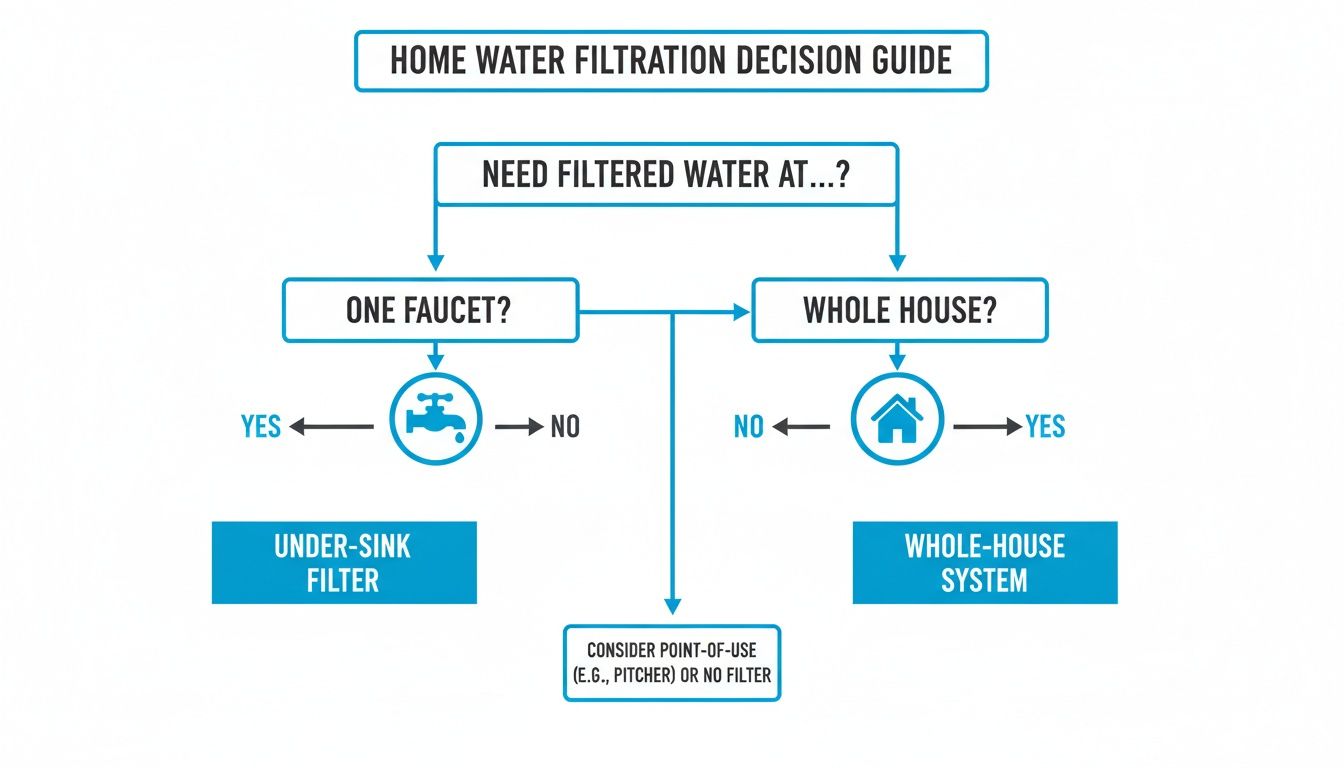
It all boils down to your goal: are you looking for targeted purity for drinking water, or do you want total protection for every faucet and appliance?
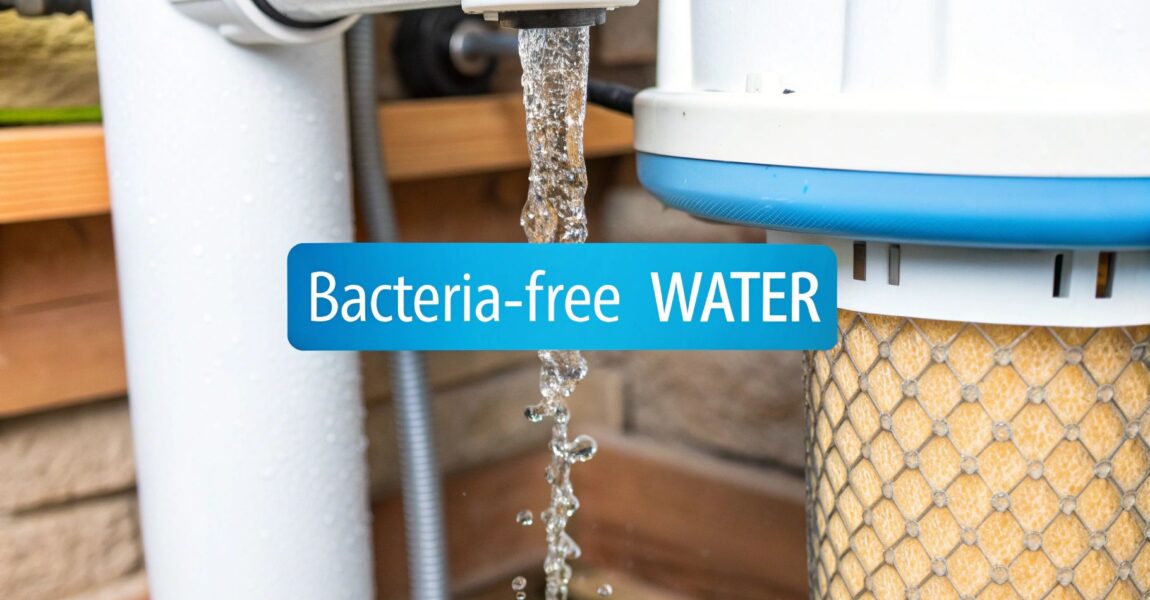
When you turn on your tap for a glass of water, you expect it to be clean, refreshing, and—most importantly—safe. The question on many homeowners' ...
