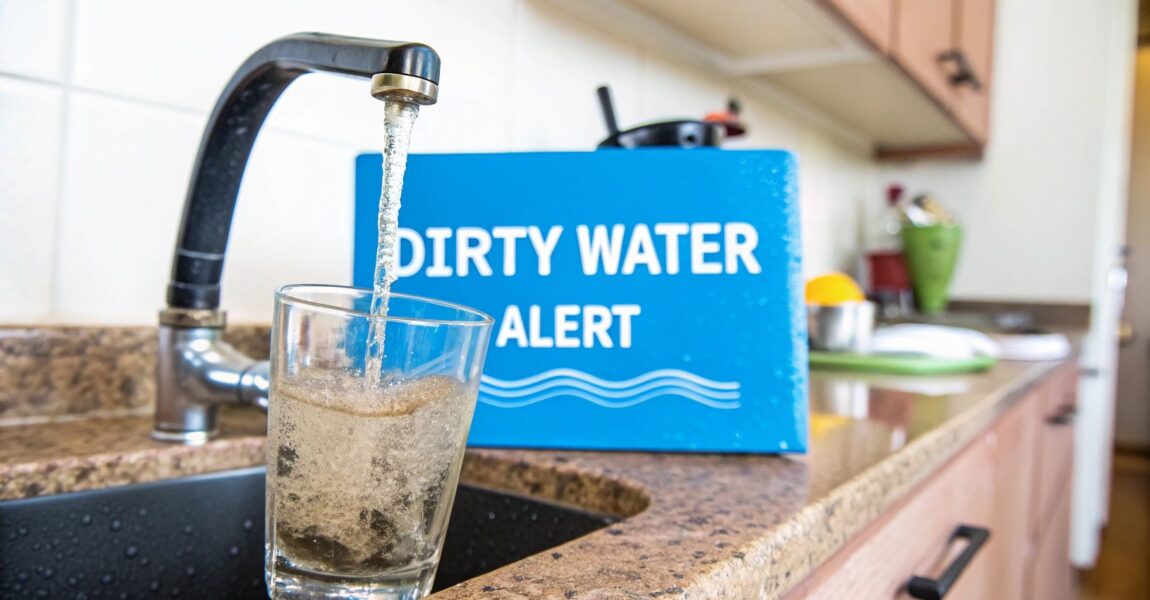
The most obvious signs of contaminated water are the ones that assault your senses—an off-putting flavor, a funky odor, or water that looks like it came from a puddle. These sensory clues are your home's built-in alarm system, screaming that it’s time to stop guessing what’s in your water and start filtering it.
Is Your Tap Water Secretly a Science Experiment?

We’ve all been there. You turn on the kitchen tap for a refreshing glass, and something just feels… wrong. Maybe it's a weird smell you can't quite place, or the water looks a little murky. That gut feeling is your first line of defense, telling you to put down the glass and pay attention.
But here’s the catch: the most dangerous stuff is often completely invisible, with no taste or odor. While crystal-clear water looks reassuring, it's no guarantee of purity. The journey from the treatment plant to your tap is a long one, and your water can pick up all sorts of unwanted hitchhikers from aging city pipes or even the plumbing inside your own walls. The only real way to take control is with a home water filtration system.
Quick Reference Guide to Filtration Clues
Before we dive deep, here's a quick, scannable table to help you connect the dots between what you're observing and which filter might be your hero. Think of it as a first-glance diagnostic tool for your home's water woes.
| Observable Sign (Taste, Smell, or Look) | Potential Problem Source | Your First Filtration Thought |
|---|---|---|
| Metallic or bitter taste | High levels of copper, iron, zinc, or lead | A reverse osmosis (RO) system is a powerhouse for this |
| Chlorine or bleach-like smell | Excess chlorine from municipal treatment | An activated carbon filter is the perfect chlorine-killer |
| Rotten egg (sulfur) odor | Hydrogen sulfide gas or certain bacteria | Look into a specialized iron/sulfur filter or an aeration system |
| Musty or earthy smell/taste | Algae blooms or decaying organic matter | A whole-house carbon filter will freshen things right up |
| Cloudy or milky appearance (turbidity) | Air bubbles or suspended solids/silt | A sediment pre-filter is your first line of defense |
| Red, brown, or orange discoloration | Rust from iron pipes or sediment | An iron filter or a water softener with iron removal is key |
| Green or blue stains on fixtures | High levels of copper, likely from pipe corrosion | An acid neutralizer filter can stop corrosion in its tracks |
| Gritty sediment or floating particles | Dirt, rust flakes, or scale from old pipes | A sediment filter is a must-have for catching this gunk |
This table covers the most common red flags, but remember, it’s a starting point. The only way to know for sure what's in your water is to test it, which will point you to the perfect filtration solution.
Your Senses Are The First Alert System
Long before you order a test kit, your own eyes, nose, and tongue are on the job. Paying attention to these subtle (and not-so-subtle) signals is the first real step toward choosing a filtration system that protects your family’s health and prevents costly damage to your pipes and appliances.
A sudden change in your water's taste, smell, or appearance isn't just a nuisance. It's a clear signal that something has shifted, and it's time to find the right filter to fix it.
Understanding what these signals mean is key. For instance, persistent moisture issues that lead to musty smells can be connected to bigger problems, so it's wise to understand the truth about mold contamination and health risks.
This guide will walk you through exactly what to look for. We'll break down the common signs of contamination, explain the likely causes, and give you clear, actionable steps to get your water back to clean and safe with the right filtration setup.
Unmasking Strange Tastes and Odors
Your nose and taste buds are your home's front-line defense—they’re surprisingly good at detecting when your water is off. If it tastes or smells weird, that’s not something to ignore. It’s a clear warning that something isn’t right, and figuring out what that message means is the first step to choosing the perfect filter to fix it.
A distinct metallic taste is a big red flag for excess metals in your supply. It could be naturally occurring stuff like iron and manganese, or it could be something more serious like copper, zinc, or even lead that's leaching from old pipes. A bitter taste, on the other hand, often points to a high level of dissolved solids.
Either way, your water has picked up some unwanted hitchhikers. Your best bet for a permanent fix is an under-sink reverse osmosis (RO) system. It's a filtration powerhouse, stripping out a huge range of dissolved metals and getting your water back to tasting pure and clean.
What Common Water Odors Are Telling You
Some smells are more common than others, but they're all cause for concern. Knowing where the odor comes from is the key to picking the right filter to get rid of it for good.
Here are the usual suspects:
- Rotten Eggs or Sulfur: You can't miss this one. It’s caused by hydrogen sulfide gas, which can come from bacteria in a well or even a funky reaction inside your hot water heater. A dedicated iron and sulfur filter or an aeration system will knock this out completely.
- Swimming Pool or Bleach: This is a dead giveaway for excess chlorine. Your city uses chlorine to keep water safe, but too much of it at the tap is unpleasant. A simple carbon filter is a master at removing chlorine.
- Earthy, Musty, or Fishy: These smells usually point to organic compounds, often from things like algae blooms in the source water. A whole-house catalytic carbon filter is your best friend for tackling these odors.
A foul odor, especially one like rotten eggs or sewage, is one of the most urgent signs of contamination. It can signal hydrogen sulfide or, in a worst-case scenario, bacterial growth from sewage pollution.
This isn't just a local problem. According to the UN and WHO-UNICEF, a staggering 2.2 billion people don't have access to safely managed drinking water. If you're interested, you can read more about worldwide water scarcity issues to see the global scale of the challenge.
Picking the Right Filter for the Job
The good news? You don’t have to put up with nasty water. Modern filtration systems are built to zero in on these specific problems. You just have to match the filter to the contaminant.
It's like using the right tool for the right task—you wouldn't use a hammer on a screw. A filter that knocks out chlorine might not do a thing for a sulfur smell.
For example, a whole-house catalytic carbon filter is a fantastic choice for tackling odors. It’s a pro at removing chlorine, chloramine (another disinfectant), and those organic compounds that cause musty smells. But if you have a serious hydrogen sulfide problem, you'll probably need a dedicated iron and sulfur filter or an aeration system to completely knock it out.
Ultimately, identifying the specific taste or odor is your most important clue. It points you toward the most effective filtration strategy, ensuring you get a system that actually solves your problem.
Visual Clues Hiding in Your Water Glass

While odd tastes and smells are strong warnings, some of the most common signs of contaminated water are the ones you can see. Clear water isn’t automatically clean, but water that’s cloudy, discolored, or has stuff floating in it is sending a loud and clear message: it’s time to filter.
Think of your water glass as a window into your plumbing. Just like a mechanic can tell a lot about an engine by its exhaust, you can learn a ton just by looking at your water. These visual clues are your first step toward picking the right filter to get it back to crystal clear.
Decoding Cloudy or Milky Water
Ever fill a glass and it looks hazy or milky? That’s called turbidity, a fancy word for water that isn't clear. It’s caused by tiny suspended particles creating a noticeable cloudiness when they band together.
These particles could be anything from harmless air bubbles to silt, sand, or clay. There’s an easy test: fill a glass and let it sit. If the cloudiness clears from the bottom up, it’s just pressurized air bubbles—totally harmless.
If that water is still cloudy after a few minutes, you’ve got suspended solids. This is where a whole-house sediment filter really shines. It acts like a bouncer at the door, catching all those particles before they ever make it to your glass or start clogging up your appliances.
Reading the Colors of Contamination
Discolored water is usually a more dramatic—and often more concerning—sign. The exact color is a huge clue that points you right to the type of contaminant you’re likely dealing with, and therefore, the type of filter you need.
- Red, Brown, or Orange Water: This rusty color almost always points to iron. This comes from rust flaking off old pipes or from naturally occurring iron in your water source, super common with well water.
- Yellow Tinge: A pale yellow hue can also be a sign of iron, but it might also indicate tannins. Tannins are harmless organic materials from decaying plants that seep into the water supply.
- Blue or Green Stains: If you're seeing blue-green stains on your sinks or tub, that’s a classic sign of copper corrosion. This happens when your water is acidic, causing it to eat away at your copper pipes.
Shifts in water color often signal the presence of heavy metals. In the United States, EPA data flags millions of homes with potential lead risks. You can learn more about global water quality goals and statistics to see how widespread these issues really are.
Choosing the Right Filter to Restore Clarity
Once you’ve figured out what you're seeing, you can pick the right filter to fix it. It's just like using a specific cleaner for a rust stain versus a grease spot—you need the right tool for the job.
Solutions for Visual Contaminants:
| Visual Sign | Likely Contaminant | Recommended Filtration Solution |
|---|---|---|
| Cloudiness/Turbidity | Sediment, Silt, Clay | Whole-house sediment pre-filter |
| Red, Brown, Orange | Iron, Rust | Specialized iron filter or a water softener with iron removal capabilities |
| Yellow Tint | Iron, Tannins | Iron filter or a dedicated tannin removal system |
| Blue/Green Stains | Copper (from acidic water) | Acid neutralizer filter followed by a carbon filter |
Taking care of these visual signs isn't just about making your water look pretty. It's about protecting your home and your family. An iron filter, for example, doesn't just stop those ugly rust stains; it also makes your water taste better and keeps iron-loving bacteria from growing in your pipes. By paying attention to what you see, you can make a smart, targeted investment in a filtration system that truly solves the problem.
How Your Appliances Signal Water Problems
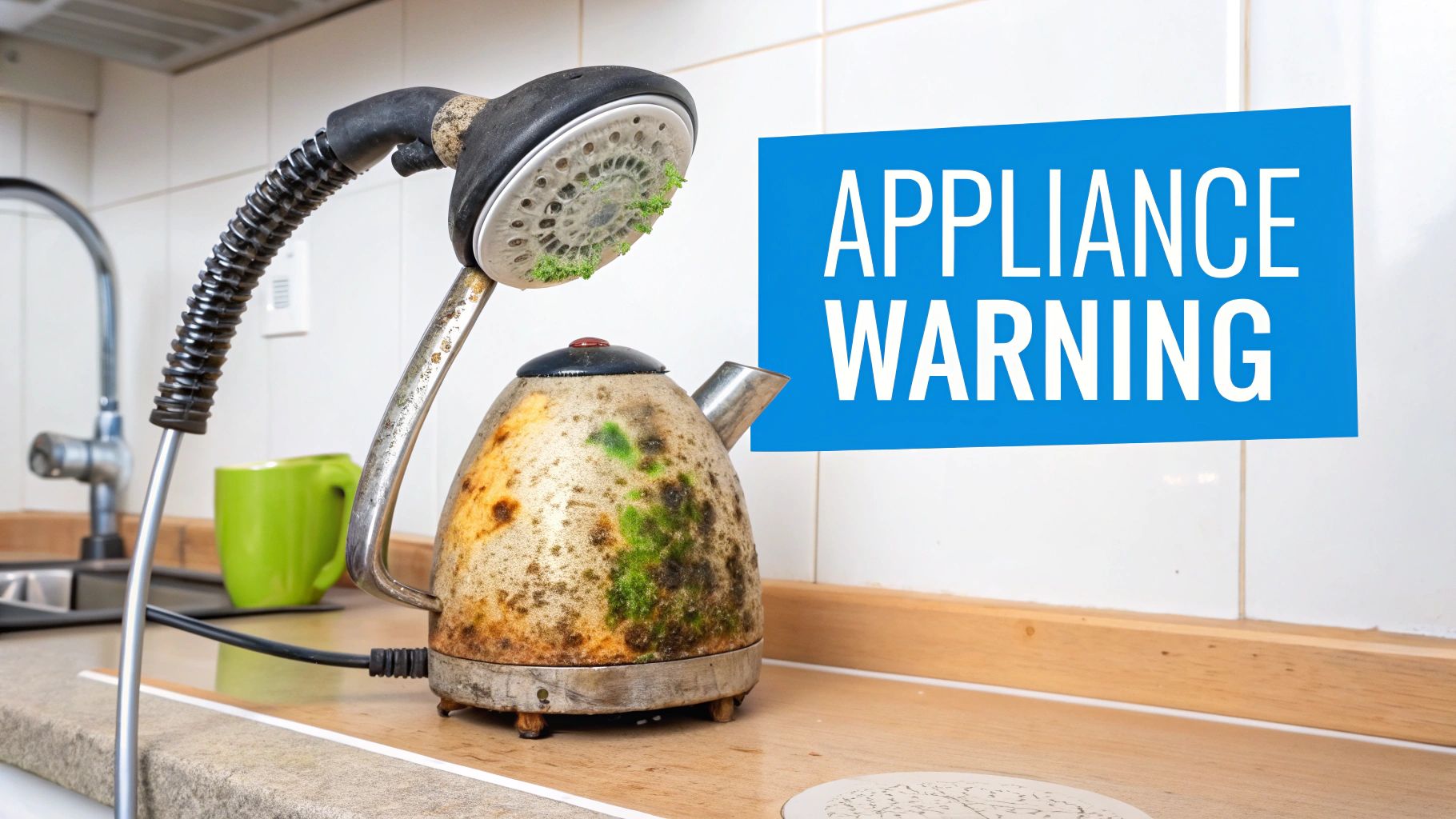
Sometimes, the clearest signs of contaminated water don't show up in your drinking glass. They’re hiding in plain sight, slowly destroying your home’s most valuable appliances. Your plumbing, dishwasher, and water heater will be the first to tell you when your water is waging a secret war on your home. If your water is full of minerals or corrosive elements, a home filtration system isn't a luxury—it's essential protection.
The Slow Creep of Limescale Buildup
If you live in a hard water area, you know all about that chalky white residue. That’s limescale, a crusty deposit of calcium and magnesium that builds up, layer by stubborn layer. It's more than just an ugly nuisance; it’s a silent appliance killer.
Limescale basically suffocates your appliances from the inside. Your showerhead loses pressure because its nozzles get clogged. Your coffee maker sputters and takes forever. The biggest victim? Your water heater.
A study from the Water Quality Research Foundation found that hard water can slash a water heater's efficiency by up to 48%. The scale forces the heating element to work overtime, jacking up your energy bills and drastically shortening the unit's lifespan.
The only real defense here is a whole-house water softener or a scale-reduction filter. By treating water right as it enters your home, you protect every faucet and appliance from this costly mineral assault.
When Water Turns Corrosive
On the other end of the spectrum is water that's too soft or acidic, making it corrosive. This water literally eats away at metal, which is a massive problem for anyone with copper or galvanized steel pipes. You might first notice those blue-green stains we talked about, but the real damage is happening out of sight. Corrosive water can cause tiny pinhole leaks that lead to thousands in water damage behind your walls.
An acid neutralizer filter is the fix. It simply raises the water's pH before it gets a chance to circulate through your pipes, stopping corrosion cold and protecting your plumbing and your health.
Slimy Buildup and Its Unseen Cause
Ever find a slimy, pinkish-orange film inside your toilet tank or around a faucet? That's usually the handiwork of iron-eating bacteria. These little microbes chow down on any iron in your water, leaving behind a nasty slime that clogs up pipes and fixtures.
While this biofilm isn't usually a direct threat, it’s a dead giveaway that you have iron in your water. A dedicated iron filter or a good whole-house system will take care of it easily. By getting rid of their food source, you stop the slime before it even starts.
Confirming Your Suspicions with Water Testing
You’ve seen the signs—the weird smell, the cloudy water, or the scaly buildup choking your showerhead. So, now what? The next step is to move from suspicion to certainty with water testing. This is the most important step before you buy a filtration system. If you just guess, you could easily buy a filter that does absolutely nothing to fix your actual problem. Testing gives you a precise roadmap, showing you exactly which contaminants you need to go after.
Your Two Main Testing Options
When it comes to testing your water, you really have two main paths: the quick-and-easy DIY route or a full-blown professional analysis. Each one has its place.
At-Home DIY Test Kits: These are fast, cheap, and great for a quick baseline. They’re perfect for checking things like chlorine, water hardness, pH, and sometimes basic metals like iron and copper.
Professional Lab Testing: This is the gold standard for accuracy. A certified lab will give you a detailed report on a huge range of contaminants, including the invisible threats like lead, arsenic, bacteria, pesticides, and volatile organic compounds (VOCs).
If you're noticing obvious issues like a chlorine smell or hard water buildup, a DIY kit might be all you need to confirm your suspicions and choose a basic filter. But if you have a private well, live in an area with known contamination problems, or have young children, a professional lab test is a very smart investment that will point you to the perfect filtration solution.
Choosing the right test is the first step toward the right solution. A lab test is the only way to get a definitive answer about hidden dangers, empowering you to select a filtration system certified to remove your specific contaminants.
From Test Results to a Filtration Plan
Once you have your results, you're officially in the driver's seat. That test report is basically a personalized shopping list for the perfect water filter. If it shows high levels of sediment and iron, you know a whole-house sediment filter combined with an iron filter is your answer. If lead is the problem, then a certified under-sink reverse osmosis system is a non-negotiable.
This data-driven approach takes all the guesswork out of the process. Instead of just buying a generic filter and crossing your fingers, you can confidently pick a system that’s designed to solve your home's unique water quality challenges. For more help matching filters to specific problems, you can find a ton of information in our extensive water filtration advice articles.
Choosing the Right Home Filtration System
Alright, you've done the detective work and spotted the signs of contaminated water in your home. Now it's time to switch hats from investigator to problem-solver. The good news is, all that knowledge you've gathered makes picking a filter a whole lot easier. You can narrow down the millions of options by thinking about two main strategies: spot treatment or a whole-house wash.
Spot Treatment with Point-of-Use Filters
Point-of-Use (POU) systems are your "spot treatments." They filter water right at the specific tap where you need it most, like your kitchen sink or shower. This is the perfect solution if your main concern is getting pure water for drinking and cooking.
POU filters are targeted, effective, and usually don't hit the wallet as hard upfront.
- Under-Sink Filters: These guys hide away under your kitchen sink, connecting to their own special faucet. They're the workhorses for making sure your drinking and cooking water is top-notch.
- Faucet-Mounted Filters: Super simple to install, these just screw onto your existing faucet. Most have a little switch so you can flip between filtered and unfiltered water.
- Showerhead Filters: If your skin and hair feel dry and brittle, chlorine is often the culprit. These filters are made specifically to reduce chlorine, making for a much nicer shower.
These are great for renters or anyone who wants to fix a very specific issue—like getting rid of that chlorine taste—without overhauling their entire plumbing setup.
The Whole-House Wash with Point-of-Entry Systems
Point-of-Entry (POE) systems, often called whole-house filters, are the "full wash cycle" for your home. They get installed right where your main water line comes into the house, meaning they treat every single drop of water heading to every faucet, appliance, and shower.
This is the way to go when you're up against bigger problems like hard water scale, sediment throughout your pipes, or high iron levels that stain everything. A POE system doesn't just protect your family's health; it protects your home. By stopping contaminants at the source, you're preventing scale from killing your water heater and stopping rust from staining your sinks and tubs.
A whole-house system is really an investment in your property. It keeps your appliances running longer, saves your plumbing from expensive damage, and gives you the peace of mind that every tap is delivering clean, safe water.
Matching the Filter to the Foe
Once you've decided between a targeted POU system or a comprehensive POE system, the last step is to match the filter technology to the specific problem you've found.
Activated Carbon: This is the undisputed champ for getting rid of chlorine and other gunk that causes funky tastes and smells. Think of it like a super-powered sponge that traps those unwanted particles.
Reverse Osmosis (RO): When you need serious filtration power, this is it. An RO system forces water through a special membrane that strips out a huge list of contaminants, including heavy metals like lead and arsenic, salts, and other dissolved solids (TDS).
UV Purification: If you’re worried about bacteria, viruses, or other living organisms in your water, a UV filter is a great chemical-free solution. It uses ultraviolet light to zap these microbes, making them harmless.
If your water is cloudy or turbid, the best way to tackle this is often with a multi-stage filter. For example, under-sink reverse osmosis systems can remove 99% of these tiny particles. For a whole-house fix, water softeners are fantastic for preventing the scale buildup that clogs pipes in so many homes. It’s all about picking the right tool for the job.
Common Questions About Water Contamination
Even after you've spotted the signs and started looking at solutions, a few key questions always seem to come up. Let's tackle them head-on so you can feel confident about your home's water quality and pick the right filtration plan.
Can Boiling My Water Make It Safe to Drink?
Boiling is a great go-to for killing biological nasties like bacteria, viruses, and parasites. If your town issues a boil water advisory, it's a solid, short-term fix to make your water safe for drinking.
But here's the catch: boiling does nothing to get rid of chemical contaminants. In fact, it can make things worse. As the water boils off, the concentration of things like lead and pesticides can actually go up. For real, long-term safety, you need a filtration system certified to remove those specific chemicals.
Is My Refrigerator's Water Filter Enough?
That little filter in your fridge is really just for one thing: making your water taste better. It uses a small activated carbon filter to pull out chlorine and other minor impurities that cause weird flavors or smells. It's fantastic for that, but it’s not a serious safety device.
These small filters just aren't designed to handle major health threats like lead, arsenic, or bacteria. To truly protect yourself, you’ll want a more powerful system, like an under-sink reverse osmosis unit or a full-on whole-house filter.
How Often Should I Test My Water?
If you're on a city water supply, testing your water once a year is a smart move. You should test immediately if you ever notice a sudden, weird change in your water's taste, smell, or color.
For those with a private well, the EPA suggests annual testing for bacteria, nitrates, and pH levels. It’s also a good idea to test after big events like a flood or major plumbing work. Understanding the different kinds of water contamination is key, especially when dealing with severe problems like Category 3 water damage.
This flowchart can help you decide whether you need to treat water at a single tap or protect your entire home.
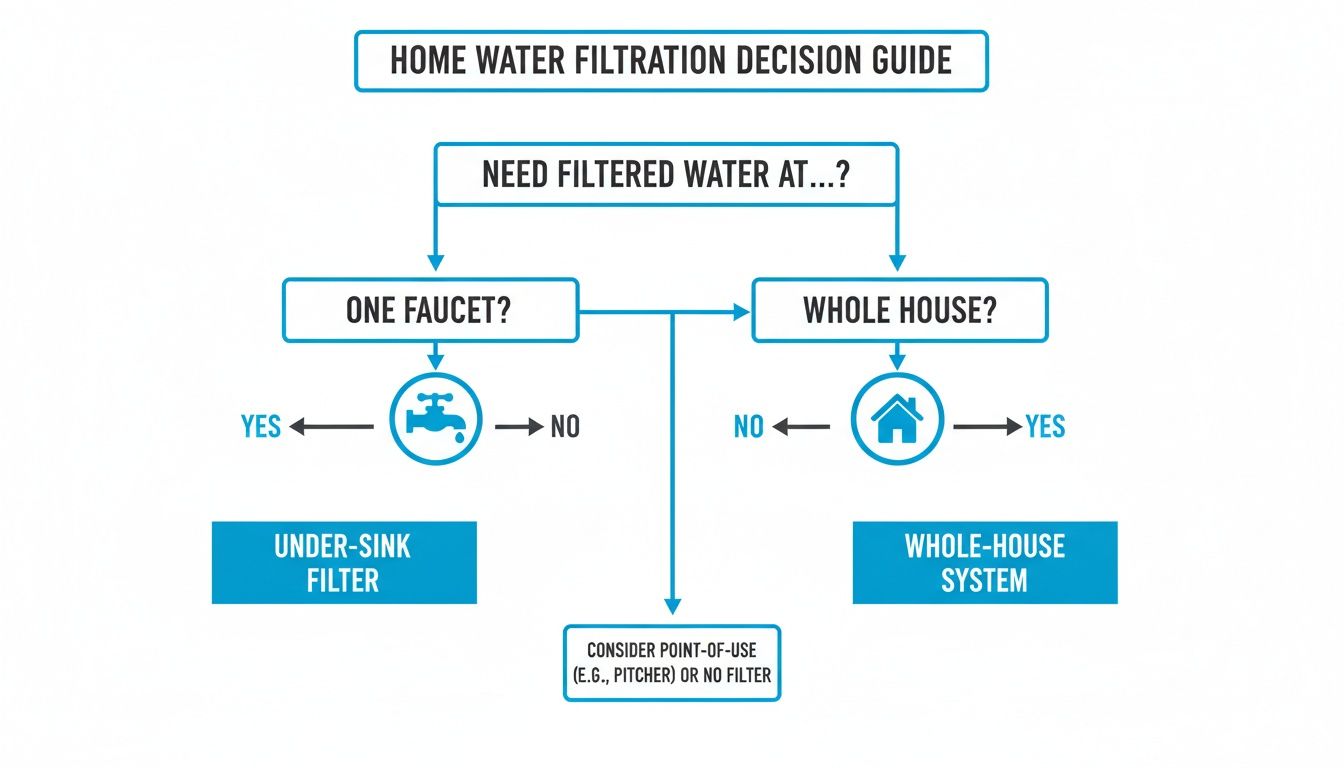
It all boils down to your goal: are you looking for targeted purity for drinking water, or do you want total protection for every faucet and appliance?
- February 2, 2026
- 0
- Uncategorized
