Your Guide to Vanquishing Sediment in Well Water

You pour a glass of water from your kitchen tap, hold it up to the light, and… there it is. Tiny particles doing a slow-motion dance—the tell-tale sign of sediment in your well water. It's an incredibly common issue for homeowners with wells, basically meaning bits of sand, silt, or clay have snuck into your plumbing. The good news? It's a completely winnable battle with the right filtration setup.

What Is This Gritty Stuff in My Well Water?

Ever noticed a gritty film at the bottom of a drinking glass after it sits for a while? Or found mysterious specks staining your freshly washed laundry? Congratulations, you've met sediment. At its heart, sediment is just a mix of natural, solid particles that get stirred up and hitch a ride in your water.

Think of your well as a giant straw sipping water from an underground aquifer. That aquifer is surrounded by layers of earth—sand, clay, rock, and silt. Heavy rain, a shifting water table, or even an aging well pump can shake these fine particles loose, pulling them right into your home's water supply.

Why You Should Actually Care About This Gritty Intruder

A little bit of grit might not seem like a big deal, but it’s a lot more than a visual annoyance. These tiny particles are the uninvited bullies of your plumbing system, acting like liquid sandpaper. They slowly wear down pipes, clog faucet aerators, and can absolutely wreck expensive appliances like your water heater, dishwasher, and washing machine. It’s a silent war that can cause serious financial damage over time.

And this isn't some rare occurrence. Sediment in well water is a widespread problem affecting millions, especially in areas not hooked up to a municipal water system. The United Nations World Water Development Report noted that in 2022, over 3.5 billion people relied on water sources outside of safely managed systems, and a huge number of them depend on wells. You can learn more about this global water challenge on UNESCO's site.

The most important thing to know is that you don't have to live with it. A good whole-house water filtration system acts like a bouncer at the club, stopping these unwelcome particles before they ever enter your home and wreak havoc.

Filtration: Your Ultimate Weapon Against Grit

Instead of constantly cleaning out clogged faucets or watching your appliances die a slow, painful death, a whole-house filtration system provides a real, permanent answer. By installing a filter right where your main water line enters your home, you guarantee that every single tap—from the kitchen sink to the shower—delivers clean, clear water.

Here’s what a dedicated filtration system brings to the party:

  • Crystal-Clear Water, Instantly: It gets rid of that cloudy, murky look and all the visible specks, giving you pristine water for drinking, cooking, and bathing.
  • Protection for Your Fortress: By catching all that abrasive sediment, it prevents clogs and helps your valuable appliances live long, prosperous lives.
  • Total Peace of Mind: There's a special kind of confidence in knowing your water is clean and free of suspended gunk every time you turn on the faucet.

At the end of the day, tackling sediment in well water is all about taking back control of your home’s most vital resource. With the right filter, you can make that cloudy, gritty water a distant memory.

Decoding the Sediment in Your Water

Clear glass jar containing layered sediment samples from well water for identification and testing purposes

Not all sediment is created equal, and the first step to clear water is figuring out exactly what you're dealing with. Think of yourself as a water detective. The clues are floating right there in your glass, and knowing what they mean is critical for choosing the right filter.

It’s like using the right tool for the job. You wouldn't use a spaghetti colander to strain coffee grounds, right? The same logic applies here—a filter designed for coarse sand won't do a thing against ultra-fine clay. This is where a little hands-on diagnosis pays off big time.

The Simple Jar Test: Your Secret Weapon

You don’t need a fancy lab to get started. Your best diagnostic tool is probably already in your kitchen cabinet: a plain, clear glass jar. This ridiculously easy test will tell you a surprising amount about the sediment in your well water.

Here’s your mission, should you choose to accept it:

  1. Collect Your Evidence: Grab a large, clear jar and fill it with cold water. Use a faucet that doesn’t have an aerator, like an outdoor spigot or your bathtub tap, to make sure you get a raw, unfiltered sample.
  2. Let It Chill: Put the jar on a counter or shelf where it won’t be disturbed. Now, just leave it alone for at least 24 hours. Patience, detective.
  3. Observe the Results: Take a look at what happened. How fast did the particles fall? What do the layers look like after they’ve settled at the bottom?

The way the particles separate tells a story. Heavy, coarse sand will drop to the bottom in just a few minutes, while fine silt might take a few hours. The absolute finest clay particles can stay suspended, keeping your water cloudy for a full day or even longer.

This simple observation is your cheat code for picking the right filtration system. Heavier gunk is easy to trap, but those tiny suspended particles require a much finer filter to get the job done.

Identifying the Common Culprits

Once your jar test is done, you can compare the layers at the bottom to figure out what’s floating around in your pipes. Here's a quick field guide to help you identify the usual suspects.

Common Well Water Sediment Types and Indicators

Sediment Type Appearance in Water Feel Potential Cause
Sand or Grit Heavy particles that settle instantly Coarse, gritty texture Failing well screen, pump set too low
Silt Muddy, cloudy, or murky water Soft, flour-like powder when dry Runoff, well construction issues
Clay Water stays cloudy for 24+ hours Very fine, almost sticky powder Surface water infiltration, very fine earth
Rust / Iron Red, orange, or brown flakes Flaky or gritty Aging iron pipes, high iron in groundwater

Knowing what you’re up against is half the battle.

Is it coarse sand? Or is it fine, suspended silt that just won't settle? The answer directly points to the type of filter you’ll need. Without this step, you’re just guessing, and that can lead to buying the wrong equipment and wasting a pile of money.

How Sediment Damages Your Home (And Maybe You)

You might not think much of those tiny particles swirling in your well water, but they're waging a slow, costly war on your home's plumbing and appliances. It's helpful to think of sediment as liquid sandpaper, constantly grinding away inside every pipe. This nonstop abrasive action is the start of a whole cascade of expensive problems.

This gritty flow gradually wears down everything from pipe fittings and faucet seals to valve seats. The result? Drips and leaks that can lead to serious water damage over time. Your water-using appliances, however, are on the front lines, taking the worst of the assault.

The Slow, Silent Appliance Killer

Sediment is the secret enemy of your home's hardest-working machines. It sneaks into tiny passages, builds up in tanks, and grinds away at delicate components, dramatically shortening their lifespan. You’ll find yourself facing more frequent repairs or, even worse, having to replace an expensive appliance far too soon.

The most common appliance casualties include:

  • Water Heaters: Sediment loves to settle at the bottom of the tank, forming a thick, insulating layer. This forces the heating element to work overtime just to heat your water, which spikes your energy bills and eventually burns out the element. In tankless heaters, it’s even worse—it can clog the heat exchanger and cause a total system failure.
  • Washing Machines and Dishwashers: Those little inlet valve screens get clogged with tiny particles, restricting water flow and triggering error codes. Over time, that same grit can destroy the water pump and leave a nasty, gritty film all over your clothes and dishes.
  • Faucets and Showerheads: The fine mesh screens (aerators) in your faucets and showerheads are magnets for sand and silt. This blockage is exactly why you end up with sputtering fixtures and a frustrating loss of water pressure.

When the staining and clogging from well water sediment gets bad enough, some homeowners find they need to look at major improvements like these sink and faucet upgrades just to get things working properly again.

Health Concerns Hiding in the Haze

Beyond the mechanical damage, sediment in well water can hide some real health concerns. While particles like sand, silt, and clay usually aren't toxic on their own, they create the perfect hiding spot for harmful microorganisms.

Think of a sediment particle as a tiny shield. It can protect dangerous bacteria, viruses, and protozoa from disinfectants like chlorine or UV light. This "shielding" effect means that even if you treat your water, nasty contaminants can survive by hiding behind the sediment.

This makes it incredibly difficult to know if your water is truly safe to drink. High turbidity—the technical term for cloudiness caused by suspended sediment—is often linked to a higher risk of gastrointestinal illnesses. The particles can also act like little sponges, soaking up and carrying contaminants like heavy metals or pesticides.

Ultimately, filtering out the sediment is a critical first step toward guaranteeing the safety and quality of your well water.

Choosing the Right Filtration System for Your Home

Alright, you've played detective with your water, seen what kind of gunk is floating around, and you know the damage it can cause. Now for the fun part: picking the right solution. It can feel like a lot to take in, but it really just boils down to matching the right filter to the type of sediment you have. You wouldn't use a tiny screwdriver on a massive bolt, right? Same idea here.

The goal is to get a whole-house sediment filter in place. This is a single unit that treats every drop of water coming into your home, protecting everything from your showerhead to your washing machine. Let's walk through the main options and break down how they work so you can feel confident you're making the right call.

Comparing Home Sediment Filtration Options

To make sense of the different technologies out there, it helps to see them side-by-side. Each type of filter has its own strengths and is designed to tackle a specific kind of sediment problem. This table lays out the most common choices to help you figure out what's best for your home, your water, and your budget.

Filter Type Best For Micron Range Maintenance Upfront Cost
Spin-Down Heavy, coarse sediment like sand and grit 75 to 1,000 microns Flush periodically (low) Moderate to High
Cartridge Fine particles like silt, clay, and rust 1 to 100 microns Replace cartridge regularly Low to Moderate
Backwashing Both fine and coarse sediment 5 to 100 microns Automatic (very low) High

Ultimately, the "best" filter is the one that directly addresses the type of sediment you discovered in your jar test. A spin-down is fantastic for "heavy" problems, while a cartridge filter is your go-to for clearing up that persistent cloudiness from fine particles.

Spin-Down Filters: The Centrifuge for Your Plumbing

If your jar test showed a layer of sand or heavier grit at the bottom, a spin-down filter is probably your best first move. These things are pretty clever—they work like a mini centrifuge right in your plumbing line. Water zips into the filter and is forced into a rapid spin.

This spinning motion throws the heavier sediment particles to the outside wall of the filter housing, where gravity takes over and they settle at the bottom. The clean, sediment-free water then continues on its way into your house. The best part? Maintenance is incredibly simple. When you see gunk building up in the clear housing, you just open a valve at the bottom and flush it all out. No cartridges, no fuss.

A spin-down filter is a great choice if you have:

  • Coarse sand or grit that settles out fast.
  • A lot of large sediment that would absolutely destroy a normal cartridge filter in a week.
  • The desire for a low-maintenance, reusable filter.

This diagram really drives home what happens when you let sediment problems go unchecked.

Diagram showing cloudy water causing home damage and health risks with magnifying glass icon

As you can see, what starts as cloudy water can quickly spiral into bigger issues for both your home and your health.

Cartridge Filters: The Microscopic Net

Now, if your water is murky with fine silt or clay that just seems to hang there forever, a cartridge filter is what you need. Think of these as a super-fine net. Water is pushed through a pleated or spun material that physically traps tiny particles, letting only the clean water get through.

The key to these filters is the micron rating. A micron is just a microscopic unit of measurement, and the rating on a filter tells you exactly how small of a particle it can catch.

A 100-micron filter is like a pasta strainer—great for catching big, obvious debris. But a 5-micron or 1-micron filter is more like an espresso filter, designed to grab the super-fine particles that make your water look hazy.

Getting the micron rating right is everything. For that fine silt you saw in your test, starting with a 20-micron or 5-micron filter is usually a sweet spot. It's fine enough to clear up the water but not so fine that it clogs up immediately and kills your water pressure.

Creating a Multi-Stage Filtration System

For a lot of well owners, the water has a mix of both heavy sand and fine silt. If that's you, a single filter might not cut it. The real pro move here is to combine filters into a multi-stage system. The most common and effective setup is putting a spin-down filter before a cartridge filter.

This one-two punch is incredibly effective:

  1. The Spin-Down (Pre-Filter): This first filter does all the heavy lifting, grabbing the sand and large grit.
  2. The Cartridge (Polishing Filter): Now that the big stuff is gone, this second filter can easily "polish" the water by trapping the fine silt and clay without getting overwhelmed.

Going this route will make your replacement cartridges last way, way longer, which saves you a ton of hassle and money over time. If you want to dive deeper into different filter setups, feel free to check out our other articles for more in-depth guidance at https://www.waterfilteradvisor.com/advice/.

And remember, your whole-house system is just one piece of the puzzle. Things like maintaining refrigerator water filters are also part of keeping clean water flowing everywhere. By matching the right filtration technology to the specific sediment in your well water, you can build a system that delivers perfectly clear water for years to come.

Installation, Maintenance, and Long-Term Costs

Picking the right filter is a huge step, but what you do next is just as crucial for keeping that water clear and clean for years. It's easy to focus on the upfront price, but thinking about the installation, ongoing upkeep, and the total cost of ownership is what really makes it a smart investment, not just a quick fix for the sediment in your well water.

Let's break down what you can really expect. This will help you budget your time and your money without any surprises down the road.

DIY vs. Professional Installation

First things first: are you going to install this yourself or call in a pro? There’s no single right answer, and it really depends on the filter’s complexity and how comfortable you are with plumbing.

For a lot of handy homeowners, putting in a simple cartridge or spin-down filter is a totally manageable weekend project. You'll likely need to cut into your main water line, fit some new connections, and mount the filter housing. If that sounds like something you can tackle, you could save a few hundred bucks on labor.

But when you get into more advanced systems like backwashing filters, things get tricky. These often involve wiring for the control valve and more complex plumbing. One wrong move could lead to leaks, a drop in water pressure, or a system that just doesn't work right. Hiring a licensed plumber, which usually runs between $300 and $800, buys you peace of mind. They'll get it done right and make sure everything is up to code.

Creating a Maintenance Playbook

Here's the secret to making your filter last: proper maintenance. If you ignore it, it’s like never changing the oil in your car—sooner or later, things are going to grind to a halt. A well-maintained filter doesn't just give you clear water; it protects your home's water pressure, too.

Your maintenance routine will look completely different depending on your filter type:

  • Spin-Down Filters: These are the simplest. Just open the flush valve at the bottom to purge all the gunk it’s collected. If you have a really sandy well, you might do this weekly. For water with less debris, once a month might be fine.
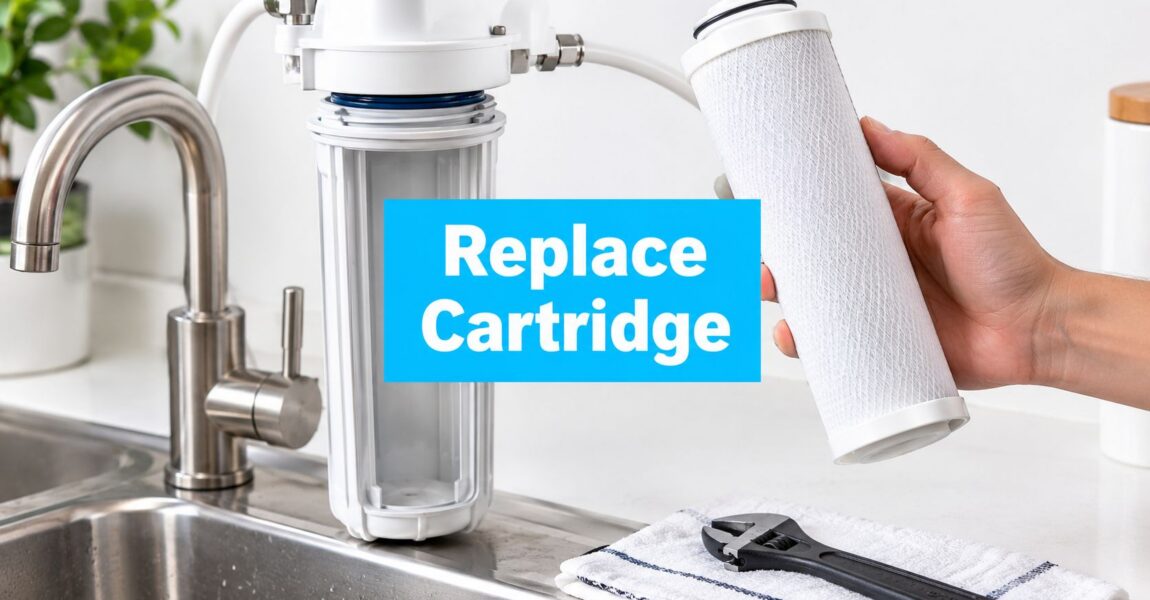
  • Cartridge Filters: The name of the game here is replacing the filter cartridge. The classic tell-tale sign is a noticeable drop in your water pressure. For most homes, you'll be swapping these out every 1-3 months.
  • Backwashing Filters: For the most part, these systems run on autopilot. The control valve will trigger a backwash cycle on its own to flush the media clean. Your only real job is making sure it has power and the drain line isn't blocked. The filter media inside can last a surprisingly long time—often 5 to 10 years—before it needs to be replaced.

Don't just guess when it's time for a filter change. Set a recurring reminder on your phone's calendar. It's a simple habit that protects your investment and keeps your system working like it should.

Understanding Long-Term Costs

When you’re budgeting, it’s critical to look past the sticker price. The true long-term cost is a mix of the initial purchase, the installation, and all the replacement parts you'll need over the years.

A basic cartridge filter system might only set you back $50-$150 to start, but those replacement filters ($20-$60 each) will add up over time. A spin-down filter costs a bit more upfront ($100-$300), but with a reusable screen, it has almost zero ongoing costs.

Backwashing systems carry the biggest initial price tag, often from $600 to over $1,500. But because they're automated and the media lasts for years, their long-term running costs are actually very low. For wells with stubborn, persistent sediment problems, they often end up being the most cost-effective choice. By weighing these factors, you can find the perfect solution for both your water and your wallet.

Your Questions About Well Water Sediment Answered

Figuring out the right filtration strategy can leave you with a few lingering questions. It's totally normal. Dealing with sediment in well water feels like a big job, so it’s smart to get all the facts straight first. Let's tackle some of the most common concerns homeowners run into.

We'll clear up the confusion so you can get the job done with confidence, knowing you’ve covered all the bases for crystal-clear water.

Will a Sediment Filter Reduce My Water Pressure?

This is the number one worry we hear, and for good reason—nobody wants to trade gritty water for a trickle of a shower. Here’s the short answer: a correctly sized and maintained sediment filter will not noticeably tank your water pressure.

Where people run into trouble is when a filter is too small for the home's flow rate, or the micron rating is way too fine for the kind of gunk in their water. Think about it like trying to drain a swimming pool through a coffee filter. It’s just not going to work, and you’ll get a major backup. The same principle applies when a filter gets clogged because it's the wrong type or it hasn't been changed on schedule.

Here’s how to keep your pressure up:

  • Size it right: Make sure the filter's flow rate (gallons per minute, or GPM) matches what your household actually uses at peak times.
  • Use a multi-stage approach: If you're dealing with a lot of sediment, a spin-down pre-filter is your best friend. It catches the big stuff before it ever gets to your finer cartridge filter.
  • Stay on top of maintenance: The minute you notice the pressure dropping, it's time to change that cartridge or flush your system.

What Is the Difference Between a Sediment Filter and a Water Softener?

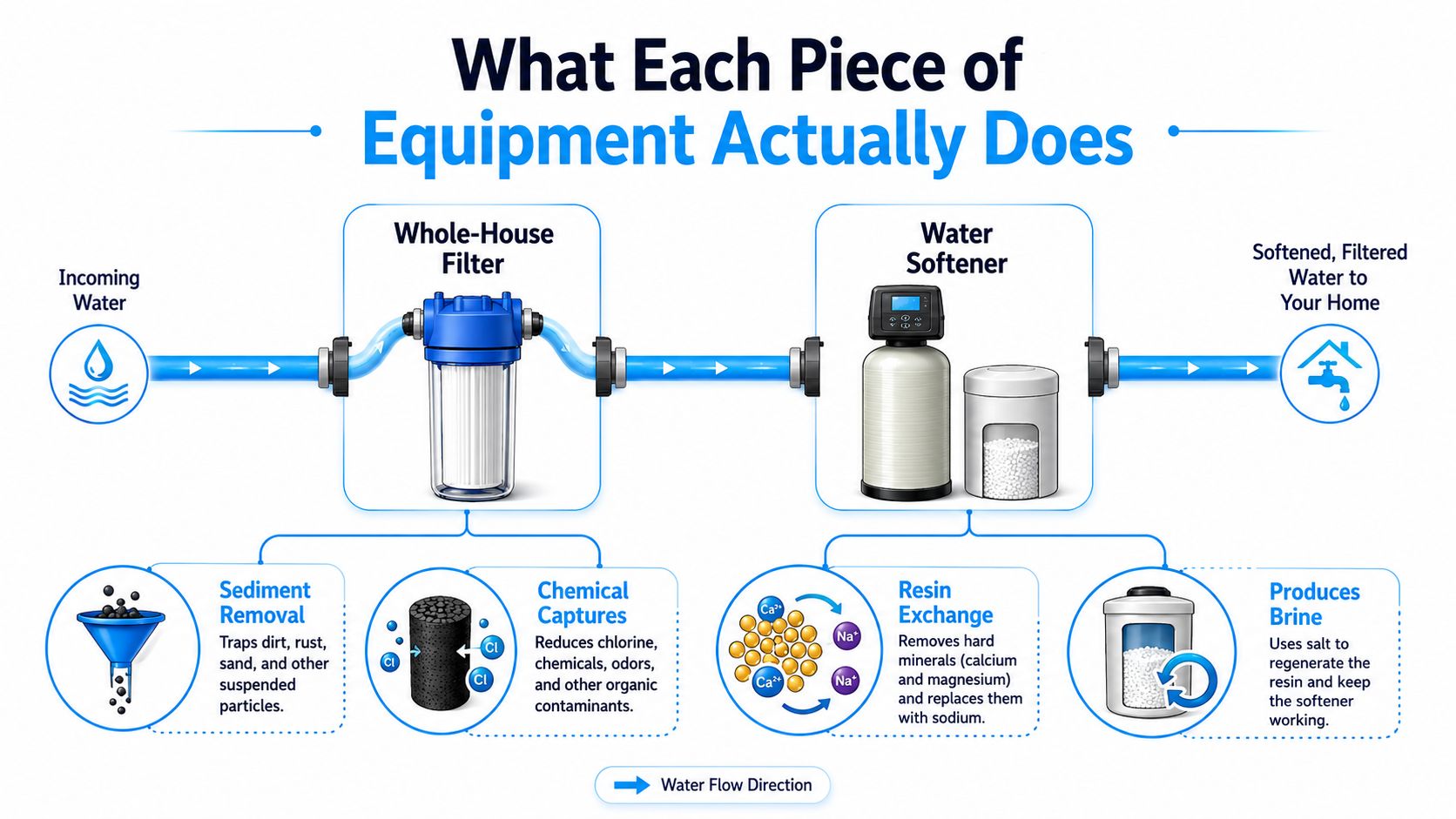
This is a classic mix-up, but they do completely different jobs. A good way to think about it is that a sediment filter is like a bouncer at a club, while a water softener is more like a chemist.

A sediment filter is a physical barrier. Its only job is to block and trap solid particles—sand, dirt, rust, and other debris. It grabs all the "floaties" to make your water clear.

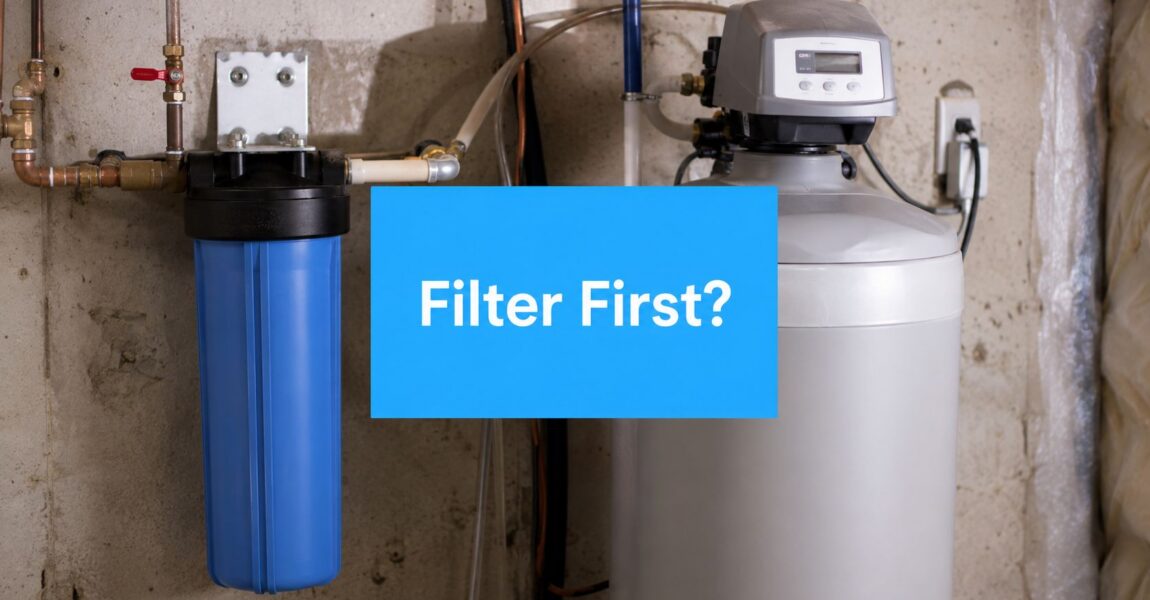
A water softener, on the other hand, doesn't remove particles at all. It uses a chemical process called ion exchange to target dissolved minerals like calcium and magnesium that make water "hard." Sediment can actually wreck a water softener, which is why you always install a sediment filter before the softener in your water line.

One can't do the other's job. You need a sediment filter for cloudy, gritty water and a water softener if you're fighting hard water stains and scaly buildup.

How Do I Choose the Right Micron Rating?

Picking a micron rating sounds technical, but it doesn't have to be. Just follow this simple rule of thumb: start with a higher micron rating (which is less fine) and only go lower if you need to.

If you can see coarse sand in your water, a 100-micron spin-down filter might be all it takes to solve the problem. For that general cloudy look caused by silt or clay, a 20- to 30-micron cartridge is a fantastic starting point. Only move down to a 5-micron filter if the water still isn't clear enough.

Jumping straight to a super-fine 1-micron filter without any pre-filter is just asking for constant clogs and pressure problems.


Here at Water Filter Advisor, we're all about helping you find a practical solution that actually works for your home. Our detailed guides and honest reviews are designed to cut through the marketing noise, making it easier to choose a system that will deliver clean, safe water for your family. To build the right plan for your well, check out our resources at https://www.waterfilteradvisor.com.

How to Improve Water Pressure (When Your Water Filter is the Culprit)

It’s a slow-burn kind of frustration, isn’t it? That moment you realize your shower feels more like a light mist than a powerful blast. Before you start blaming the city or picturing a catastrophic plumbing failure, take a breath. The fix is often surprisingly simple, and if you have a home water filter, that's the absolute best place to begin your search.

Your First Checks for Better Water Pressure

When your water flow drops, the first and most important clue is figuring out the scope of the problem. Is it just one sad, trickling faucet, or is every tap in the house feeling weak? Pinpointing this will immediately tell you if your whole-house filtration system is the likely villain.

This chart breaks down the thought process, helping you trace the issue back to its source.

Infographic about how to improve water pressure

As you can see, a single-faucet issue is almost always a small, local clog. But a whole-house problem? That points directly to something affecting your main supply line—and your filtration system is suspect number one.

Is It One Faucet or the Whole House?

Put on your detective hat. If the kitchen sink is dribbling but the bathroom shower is blasting away just fine, your culprit is likely a clogged faucet aerator. These little screens at the tip of your faucet are great at catching the exact sediment and mineral buildup your filters are meant to remove. Over time, they get gummed up and choke off the water flow.

But if every fixture in your home is underperforming, the problem is bigger and sits closer to where your water comes in. This is where you need to look hard at your whole-house water filter. A filter cartridge that's past its prime is one of the most common reasons for a gradual, house-wide pressure drop.

A pressure drop of 15 to 20 PSI from the inlet to the outlet of your filter system is a dead giveaway. It means the cartridges are clogged and fighting the flow of water.

Quick Water Pressure Diagnostic Checklist

Before you start disassembling your filtration system, run through this quick checklist. It helps you rule out the simple stuff first and confirm that your filter is the real problem.

Check What It Tells You Your Next Action
A Single Faucet The problem is isolated to that specific fixture, not your main filter. Unscrew the aerator and clean it. Check the shut-off valve under that sink.
All Hot Water Taps The issue is likely with your water heater, not your whole-house filter. Check the heater's shut-off valve to ensure it's fully open.
All Taps (Hot & Cold) The restriction is affecting your entire home's water supply. Your whole-house filter is the primary suspect. It's time to investigate it.
Neighbor's Pressure If they have low pressure too, it's a municipal problem. Call your local water utility to report an outage or issue.

Completing these checks gives you a much clearer picture. If everything points to a whole-house issue, your water filtration system is where the investigation begins.

The Easiest Things to Check First

A few quick inspections can save you a world of hassle. Before you get the wrenches out, give these a look:

  • Check the Shut-Off Valves: Your home has two main valves to check: the main shut-off for the house and the one on your water heater. If a plumber was just there or someone bumped one, it might be partially closed. Make sure both are turned fully counter-clockwise (all the way open).
  • Inspect Faucet Aerators: For those single-faucet issues, just unscrew the aerator from the end of the spout. You’ll probably see a screen caked with gunk. A quick rinse under a working faucet or a short soak in vinegar will usually clear it right out.
  • Confirm with Your Neighbors: This is the easiest check of all. A quick text or call to a neighbor can tell you if the problem is just your house or the whole block. If they’re having issues too, it’s time to call the water company.

Working through these steps will help you figure out if you have a simple fix on your hands or if it’s time to dig deeper into your filter system. For more expert tips, check out our in-depth advice on all types of water filters. Now, let's test your filtration system itself.

Is Your Water Filter the Hidden Culprit?

You got that whole-house water filtration system for crisp, clean water, but now your shower feels more like a weak mist. I've heard this story a thousand times. The very thing you installed to make your water better can, over time, turn into the biggest roadblock for your water pressure.

If you're seeing a gradual drop in pressure all over the house, a clogged or undersized filter is one of the first places I'd look.

Man inspecting his home water filtration system

Here’s what happens: every filter creates a little bit of resistance. That's its job. As the cartridge does its work trapping sediment, chlorine, and all the other gunk you don't want, the pathways for water get smaller and smaller. Eventually, it gets so saturated that it literally starts choking the water supply, and you feel that pressure drop at every single faucet.

Signs Your Filter Is the Problem

So, how do you know for sure the filter is the bad guy? Unlike a pipe that bursts suddenly, a filter issue is sneaky. The pressure doesn't just tank overnight; it slowly fades away over weeks or even months.

Keep an eye out for these tell-tale signs:

  • A Slow Fade: The pressure was fantastic right after you put in that new filter cartridge, but it's been a slow march downhill ever since.
  • Struggles Under Load: Running the dishwasher while someone tries to shower reduces the water flow to a pathetic trickle.
  • Funky-Looking Water: If you get cloudy or discolored water for a bit right after a filter change, it's a good sign the old one was seriously packed with gunk and let some loose when you moved it.

Think of it just like the air filter in your car. When it's clean, the engine gets all the air it needs and runs great. But when it gets clogged with dirt, the engine struggles to breathe and performance tanks. Same deal with your water filter—when it's clogged, your whole plumbing system is struggling for a drink.

The Bypass Test: Your Definitive Diagnostic Tool

There’s no need to guess. There's a simple test that will give you a definitive answer. Almost every whole-house filter system is installed with a bypass valve for this exact reason. This lets you route water around the filter for a short time, sending it straight into your home's pipes. It’s the ultimate diagnostic trick.

If you flip that bypass and your water pressure roars back to life, you've found your culprit. No doubt about it. The problem is your filtration system.

Here's the right way to do it:

  1. Find the Bypass Valve: Look for a loop of pipes and valves right next to your main filter tank. You'll typically see three valves: one on the pipe going in, one on the pipe coming out, and one on the pipe connecting the two (that's the bypass).
  2. Close the Main Lines: Turn the handles on the inlet and outlet pipes so they're perpendicular to the pipe. This cuts off water to the filter.
  3. Open the Bypass: Now, turn the handle on that middle bypass pipe so it's parallel with the pipe. This opens up the detour.
  4. Check Your Pressure: Head inside and turn on a sink. If you've got strong pressure again, the problem is 100% your filter.

Key Takeaway: The bypass test is the single most important diagnostic you can run for filter-related pressure loss. It gives you a clear yes or no without you having to take anything apart.

Why Different Filters Affect Pressure Differently

It's also worth knowing that not all filters are created equal when it comes to pressure. The type of system you have makes a big difference in how much of a pressure drop you should expect.

  • Sediment Filters: These are usually the first line of defense, catching sand, rust, and other big particles. Because they trap so much physical debris, they clog up the fastest, especially if you're on well water.
  • Carbon Block Filters: These filters use super-dense blocks of carbon to pull out chemicals. That compact design naturally creates more resistance, so you'll often see a bit of a pressure drop even with a brand-new cartridge.
  • Reverse Osmosis (RO) Systems: An RO system is the most restrictive filtration method out there. It shoves water through an incredibly fine membrane, which is a slow process that kills water pressure. That's why the under-sink RO systems you see have their own little storage tank and a special, smaller faucet.

Knowing this helps you manage your expectations. A small pressure drop is normal, but a huge one means it's time for maintenance. Sometimes, the problem is bigger than just a filter change. For instance, in areas with low municipal supply, installing pressure-boosting pumps and regulating valves is a common strategy. You can explore more about global water challenges to see how different technologies are used.

Keeping Your Filters Flowing Freely

So, you ran the bypass test, and surprise, surprise—your water filter is the culprit behind your weak shower. The good news? This is one of the easiest pressure problems to fix. You're not looking at a major repair bill; just a bit of simple, routine maintenance.

Think of it this way: a clean filter is a wide-open superhighway for your water. A clogged one is a five-o'clock traffic jam.

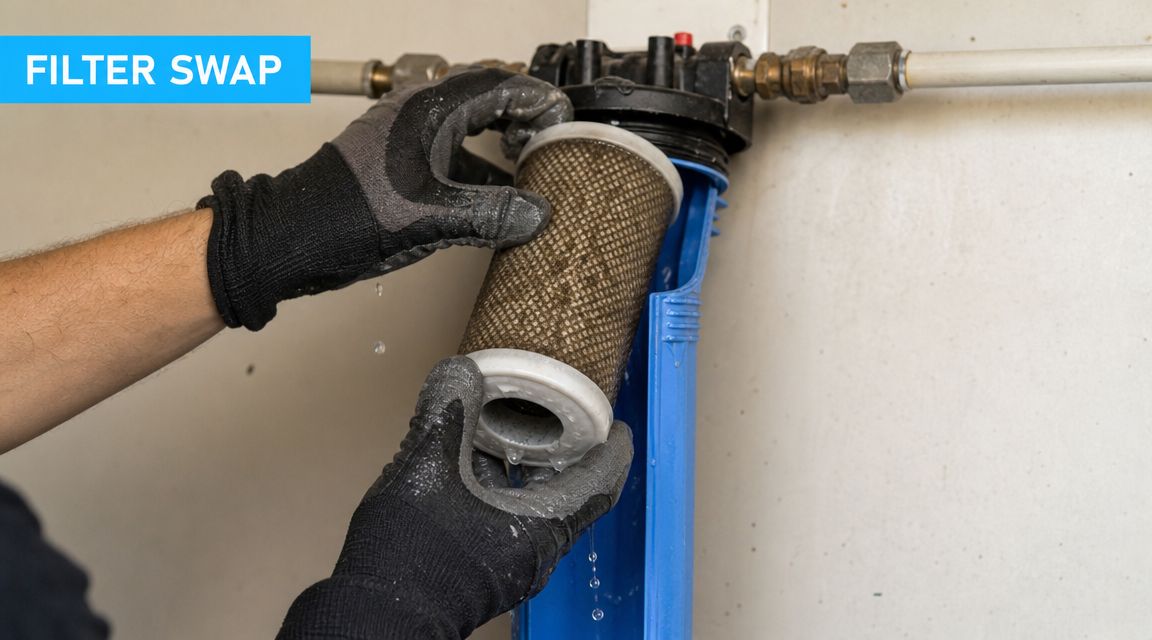
A person changing a whole-house water filter cartridge.

I'll walk you through everything you need to know to get your system tuned up and that strong, satisfying flow back where it belongs.

The Replacement Schedule Isn't Set in Stone

The manufacturer's guideline—"change every six months"—is a great starting point, but it's really just an educated guess. The reality of when you need to swap a filter depends entirely on your water and how you use it. Ignoring this is probably the single biggest mistake I see homeowners make, and it leads straight to pressure problems.

For example, if you have a sediment filter and you're on well water, it might get choked with silt and sand in just two months. But a carbon block filter on clean city water could easily go the full six months, maybe even longer.

Here's what you need to factor in:

  • Your Water Source: Well water is notorious for sediment, which will clog up pre-filters in no time. City water is usually much cleaner.
  • Your Household: A family of five puts a filter through its paces much faster than a couple does. More water used means a shorter filter life.
  • The Filter Itself: Denser filters like carbon blocks have more surface area to trap gunk, but they also offer more resistance right out of the box compared to a basic sediment filter.

The most reliable way to know it's time for a change is to trust your pressure gauge. Once you see a drop of 15-20 PSI from when the filter was new, it’s time for a swap. Forget the calendar—the pressure tells the real story.

How to Change a Whole-House Filter Cartridge

Swapping a filter is a job almost anyone can tackle in under 30 minutes. Follow these steps, and you’ll avoid a wet floor and get a perfect, leak-free seal every time.

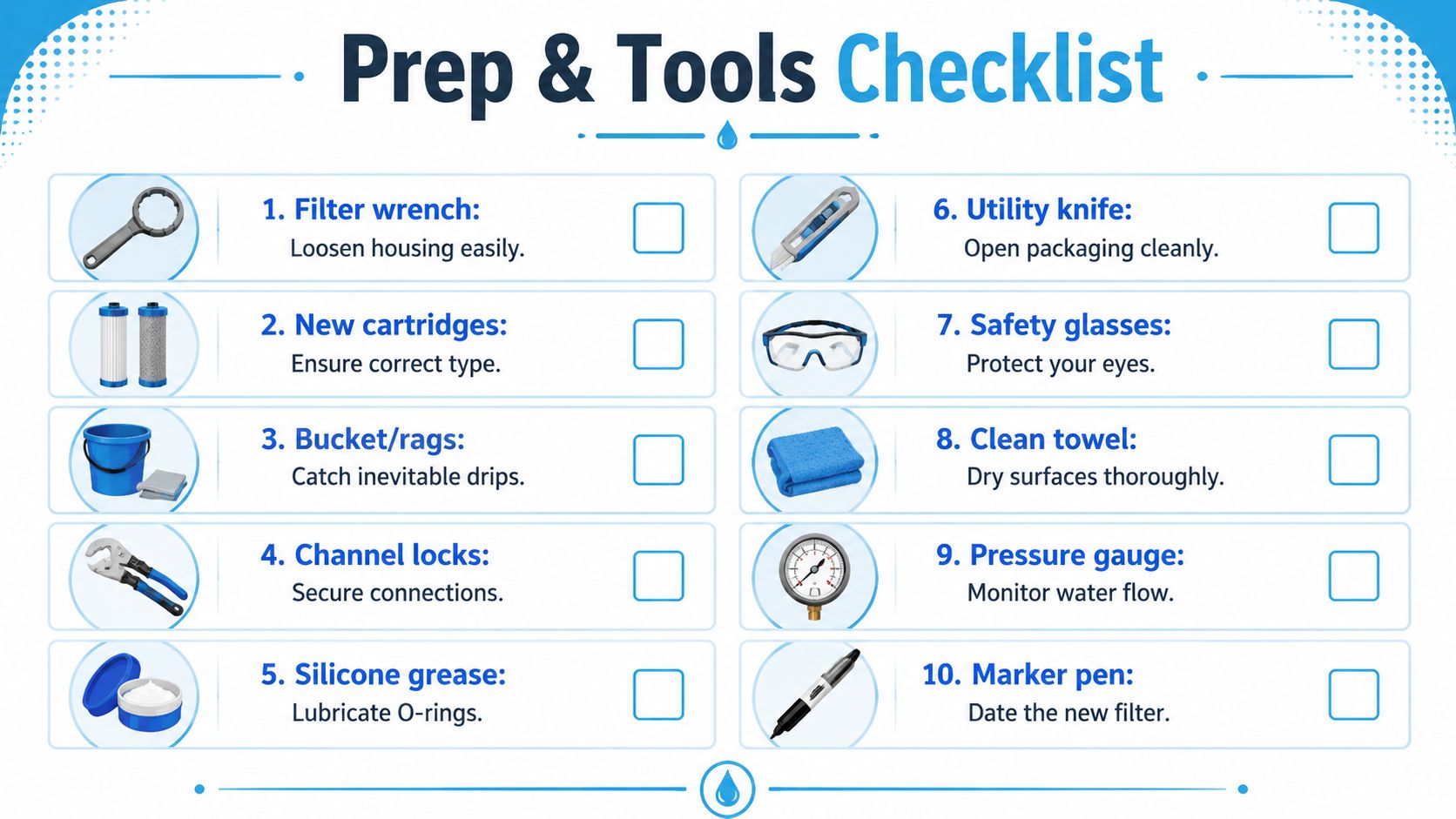
What You'll Need:

  • Your new replacement filter cartridge
  • The filter housing wrench (the plastic one that came with the system)
  • A bucket
  • An old towel or two
  • Food-grade silicone grease

Let's Get to It:

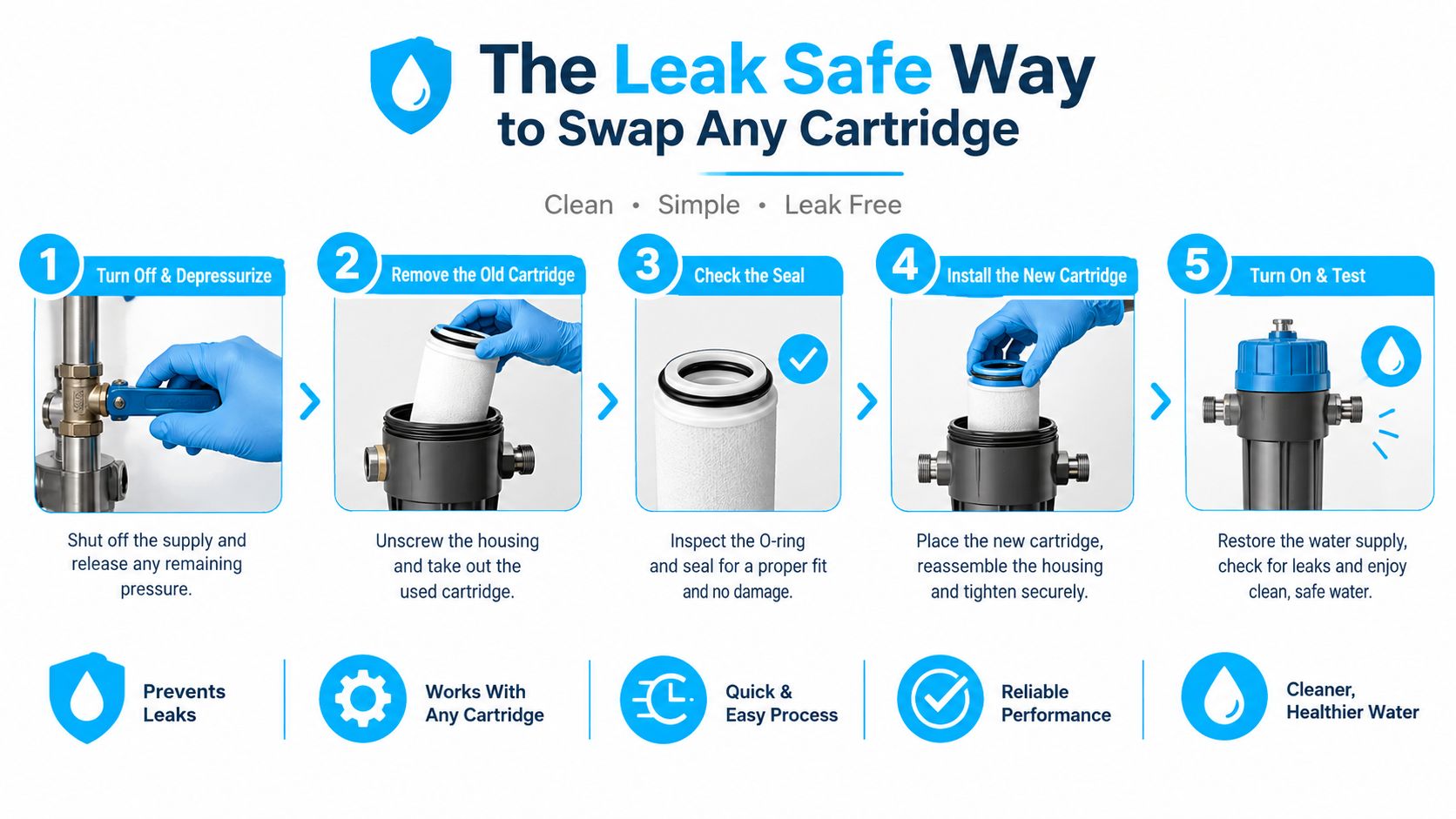
  1. Isolate the Filter and Kill the Pressure: First, put the system in bypass mode, just like you did for the pressure test. Shut the inlet and outlet valves, then open the bypass. Now, press that little red pressure-relief button on top of the housing. Keep pressing it until the hissing stops. This is the secret to getting the housing off without a fight.
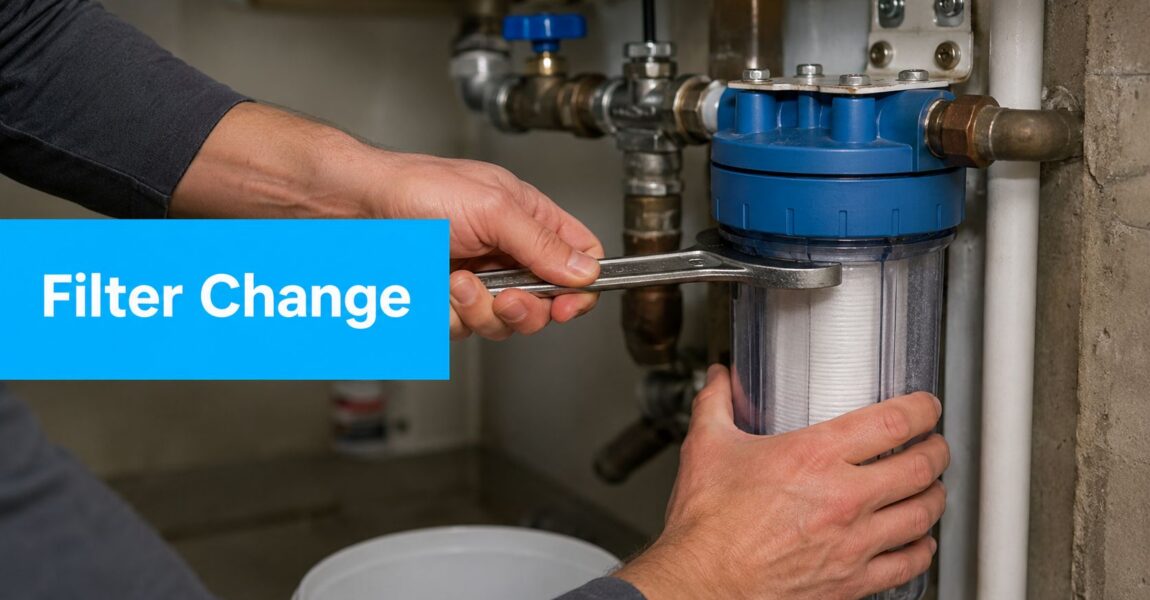
  2. Get the Housing Off: Stick your bucket underneath to catch the inevitable drips. Use the wrench to get the housing started—remember, lefty-loosey. Once it breaks free, you should be able to spin it off by hand.
  3. Scrub the Housing: This is the step everyone skips, and it's a big mistake. Over time, a slimy biofilm can build up inside the canister, which not only restricts flow but can also harbor bacteria. Give the inside a good scrub with warm, soapy water and a brush. For a true deep clean, you can use a diluted bleach solution (about a tablespoon per gallon of water), but make sure you rinse it out completely.
  4. Prep for the New Cartridge: Take a look at the large O-ring at the top of the housing. Is it cracked, dry, or flattened? If so, replace it. Smear a thin coat of silicone grease on it. This helps create a watertight seal and makes it easier to unscrew next time. Pop the new cartridge into the housing, making sure it sits straight.
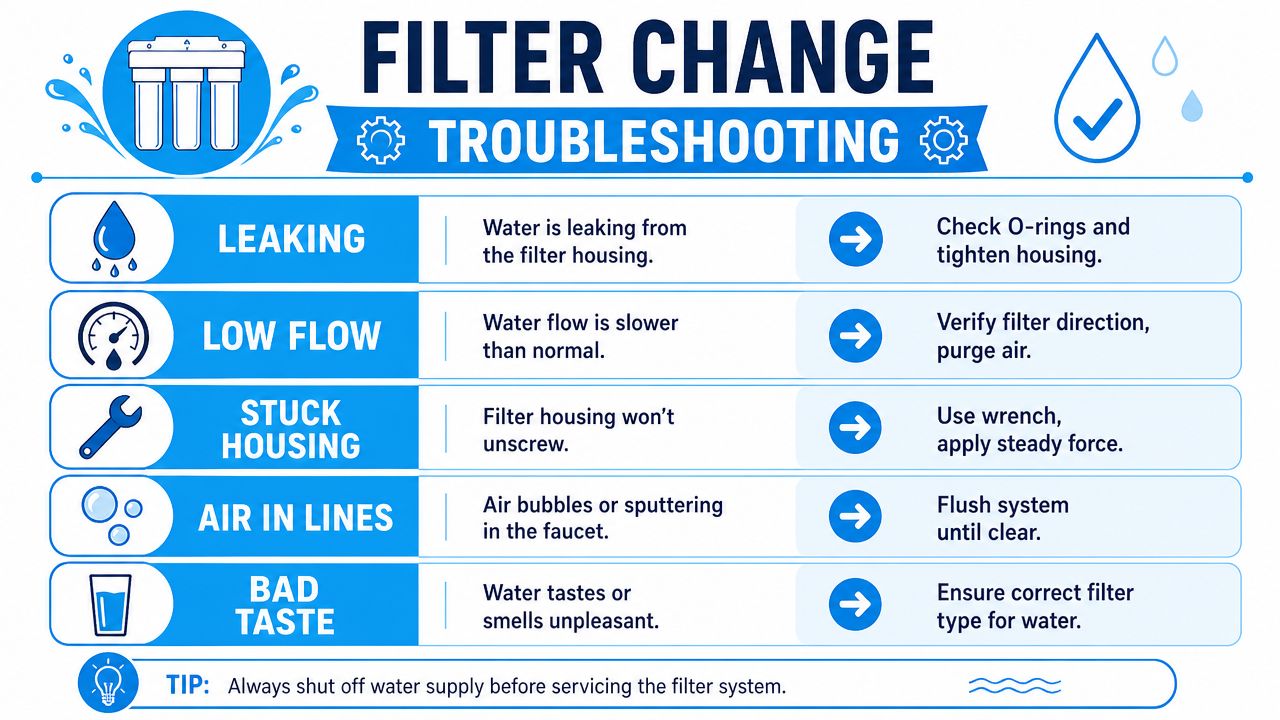
  5. Put It Back Together: Screw the housing back on by hand until it's snug. Then, give it one last quarter-turn with the wrench—and that's it. Don't go crazy tightening it, or you risk cracking the plastic. Slowly open the inlet valve to let it fill. You'll hear air gurgling; press the relief button again until water spurts out. Now, fully open the inlet and outlet valves and close the bypass. Give the seal a quick check for any drips.

Make this little routine a habit, and your water filter will never be the reason for weak water pressure again. It's a small bit of effort for a huge payoff in performance.

Beyond Filters Exploring Other Pressure Problems

If a fresh filter didn't bring back the power to your shower, it's time to briefly look at the bigger picture. Your home’s filtration system is just one piece of a much larger plumbing puzzle. While a clogged filter is the most common cause of pressure loss, it's worth knowing what other issues could be at play before you upgrade your system.

It's easy to point the finger at the filter, but if a new one doesn’t do the trick, you have to broaden your search.

A plumber inspecting the main water shut-off valve and pressure regulator for a home

Check Your Main Water Shut-Off Valve

First things first: find your main water shut-off valve. This valve is the gatekeeper for all water coming into your house. It’s usually a lever (a ball valve) or a round handle you turn (a gate valve). After a plumbing repair, or even just from an accidental bump, these can get partially closed, creating a bottleneck for your entire home.

A half-closed valve can feel exactly like a clogged filter, so it's a super common mix-up. Before you start tearing anything else apart, find this valve (check the basement, garage, or a utility closet) and make sure it's open all the way. 100% open.

  • Lever Handle: The handle should run parallel to the pipe.
  • Wheel Handle: Turn it counter-clockwise until it stops.

Inspect the Pressure Reducing Valve

Lots of homes, especially those in areas with high city water pressure, have what’s called a Pressure Reducing Valve (PRV). It’s a bell-shaped contraption, usually installed right after the main shut-off. Its job is to dial down the incoming pressure to a safe level, typically around 50-60 PSI, to keep your pipes and appliances from getting blasted.

But these valves don't last forever. The internal parts can wear out or get gunked up with sediment, causing them to fail and kill your flow. A bad PRV is a notorious pressure assassin.

A classic sign of a failing PRV isn't just low pressure, but inconsistent pressure. You might also hear a "water hammer" banging sound in your pipes, or sometimes, no water comes out at all.

You can often try adjusting the PRV yourself. There's usually a screw on top—turning it clockwise should increase the pressure. Just make small, quarter-turn adjustments at a time. If tweaking it does nothing, the valve needs to be replaced by a plumber.

The Problem of Aging Pipes

Okay, so your valves are wide open and the PRV seems fine. The next suspect? The pipes themselves. This is a huge issue in older homes with galvanized steel pipes. Over decades, they literally rust from the inside out, building up scale and corrosion that shrinks the pipe's diameter.

Think of it like a clogged artery. A new pipe is wide open, but after 50 years of mineral buildup, it can get so narrow that only a trickle of water can squeeze through. This causes a chronic, whole-house low pressure issue that no filter change on earth is going to fix.

When you're troubleshooting tricky issues that go beyond a simple filter swap, consulting a comprehensive plumbing guide can be a lifesaver. It helps you understand how everything connects and diagnose the root cause.

By ruling out these other potential causes, you can be 100% confident that it's time to focus on the heart of the matter: your filtration system.

When It’s Time to Upgrade Your Filtration System

Are you in a never-ending cycle of changing your filter cartridge just to keep your shower from slowing to a pathetic trickle? While staying on top of maintenance is a big part of the game, sometimes it just isn't enough.

If you feel like you're constantly fighting for decent water flow, that’s a huge red flag. It often means your filtration system is completely mismatched for what your home actually needs. This isn't about a single clogged filter—it's about having a system that's too small or just not designed for your family’s water habits. The only real, long-term fix is an upgrade.

Matching Flow Rate to Your Household Needs

The single most important number to look at when choosing a new system is its flow rate, measured in Gallons Per Minute (GPM). This tells you exactly how much water the filter can handle at once. If your family’s peak water usage is higher than your filter's GPM, you're guaranteed to see your water pressure tank every time.

Think of it like a two-lane road during rush hour. It’s just not built to handle that much traffic, and everything slows to a crawl. An undersized filtration system is that two-lane road, and your family's morning routine is that 8 AM traffic jam.

To figure out what you need, just add up your peak demand:

  • Shower: 2.5 GPM
  • Dishwasher: 2.0 GPM
  • Washing Machine: 2.5 GPM
  • Kitchen Faucet: 1.5 GPM

A family of four can easily hit 7-10 GPM during those busy morning hours. Your whole-house system needs to handle that demand without even flinching. If your current filter is only rated for 5 GPM, it's no surprise the pressure disappears.

The Micron Rating Balancing Act

Another spec you can't ignore is the filter's micron rating. This number tells you the size of the particles it can trap. A lower number means finer filtration—so a 1-micron filter grabs way smaller gunk than a 20-micron one. It's tempting to just grab the lowest number for the "cleanest" water, but that can be a massive mistake for your water pressure.

An overly fine filter acts more like a dam than a screen, choking your water flow from day one. You have to find the sweet spot: a micron rating that’s fine enough to remove what's in your water but coarse enough to let water flow through freely. For most folks on city water, a 5 to 20-micron sediment filter is the right call. It's helpful to compare sand and cartridge pool filters to get a sense of how different filtration media work.

Choosing the right micron rating is a strategic balance. It’s not about getting the finest filter; it’s about getting the right filter for your water quality and pressure needs.

Adding a Pressure Booster Pump for Ultimate Control

So, what do you do if your city pressure is low to begin with, or your dream filtration setup is so heavy-duty that some pressure loss is just part of the deal? This is where a pressure booster pump completely changes the game. You install this device before your filters, and it actively cranks up the force of the water coming into your house.

A booster pump makes sure your filters get water at the ideal pressure (usually around 50-60 PSI), letting them do their job without killing your flow. It’s the best solution for homes that have always struggled with low pressure, turning weak streams into a powerful flow no matter how many faucets are running.

Common Water Pressure Questions Answered

https://www.youtube.com/embed/7yXNY6gbdws

When you start digging into how to improve your water pressure, a bunch of specific questions tend to bubble up, especially if you have a water filter or softener in the mix. Let's walk through some of the most common things homeowners ask when they're staring down a weak stream.

Can a Water Softener Reduce My Water Pressure?

Absolutely. A water softener is a very common culprit behind a frustratingly slow flow. The softening process itself forces your water through a dense bed of resin beads, and that's going to create some natural resistance. This alone can cause a noticeable pressure drop of 5 to 15 PSI, depending on your softener's size and your home's flow rate.

The issue gets a whole lot worse if the softener is too small for your home's needs or if that resin bed gets clogged with sediment. To get ahead of this, always install a sediment pre-filter before the softener. Also, make sure it's regenerating correctly to keep the resin clean and loose.

How Do I Know if I Need a Pressure Booster Pump?

It’s time to seriously consider a pressure booster pump if your pressure is already low before it even hits your filters (think under 40 PSI), or if your filtration setup is so extensive that it's causing an unacceptable drop.

The very first thing you should do is test your home's incoming pressure. A simple gauge from the hardware store, attached to an outdoor spigot, will give you the answer.

If your pressure is low right from the street, your filters are just fighting a losing battle. On the other hand, if the incoming pressure is decent but plummets after running through your system, a booster pump is the most direct fix. It gives your water the muscle it needs to push through the filtration media without losing momentum.

A pressure booster pump acts as a powerful ally to your filtration system. It doesn't just fix low pressure; it ensures your filters can perform optimally without turning your shower into a drizzle.

Will a Whole House Sediment Filter Always Lower Pressure?

Any filter will create a slight pressure drop—that's just physics. But a properly sized and maintained sediment filter really shouldn't cause a noticeable decrease in your day-to-day water flow.

If you're suddenly dealing with a frustratingly weak shower, the problem is almost always one of three things:

  • The filter is clogged: Its job is done. The cartridge is saturated with gunk and needs to be replaced right away.
  • The micron rating is too fine: You might be using a 1-micron filter when a 20-micron would do the job, creating a ton of unnecessary resistance.
  • The housing is too small: The entire filter unit isn't big enough to handle your home's peak water demand, which creates a permanent bottleneck.

Choosing the right sediment filter is all about finding that sweet spot between effective filtration and maintaining the strong water pressure you expect at the tap.


At Water Filter Advisor, we believe you shouldn't have to choose between clean water and great pressure. Our expert guides and reviews help you find the perfectly matched filtration system for your home's unique needs. Explore our resources today at https://www.waterfilteradvisor.com.

Your Complete Guide to Point of Entry Water Filters

Picture this: you turn on any tap in your house—the kitchen sink for a glass of water, the shower after a long day, the bathroom faucet to brush your teeth—and out comes pure, clean, refreshing water. Every. Single. Time. That isn't a far-off dream; it's the reality a point-of-entry (POE) water filter delivers. Think of it as hiring a top-notch security guard for your home's entire water supply, inspecting and purifying every drop the moment it steps onto your property.

This isn't about slapping a filter onto a single faucet. A POE system is a comprehensive solution that cleans all your water at its source, protecting not just your family's health, but your expensive appliances from a whole rogues' gallery of unwanted contaminants.

What Are Point of Entry Water Filters?

A point-of-entry filter, known in the biz as a whole-house water filter, is a system plumbed directly into your main water line. It's the ultimate gatekeeper. Before a single drop of water can make its way to your shower, washing machine, or that fancy coffee maker, it has to pass inspection through this central filtration fortress.

This setup ensures that every drop you use for bathing, cooking, cleaning, and drinking is purified. Instead of playing whack-a-mole with water quality issues from room to room, a POE system provides one powerful, all-encompassing solution. These systems are true workhorses, built to handle a serious volume of water, easily purifying thousands of gallons a day without ever making your home's water flow skip a beat.

Why Whole-House Filtration Is a Big Deal

The quest for cleaner water is more than just a trend; it's a growing necessity. It's estimated that in the U.S. alone, over 7.1 million Americans fall ill each year from waterborne contaminants. That's a staggering public health issue, and it's prompting more and more homeowners to take a hard look at what's really flowing through their pipes.

This rising awareness is fueling a massive market shift. In fact, the demand for point-of-entry systems is projected to explode into an USD 18.15 billion industry by 2035. You can dive deeper into the data behind this trend over at Spherical Insights & Consulting.

By treating every drop entering your home, these systems solve a wide array of problems that affect your daily life, and the benefits extend far beyond just better-tasting water.

A point of entry system isn't just about purifying drinking water; it's about elevating the quality of life throughout your entire home. It protects your health, preserves your appliances, and enhances your daily routines, from showering to doing laundry.

Key Benefits for Your Home

Installing a point-of-entry water filter in your home brings a cascade of immediate and long-term perks:

  • Luxurious Showers and Baths: By removing chlorine and other harsh chemicals, the water becomes gentler on your skin and hair, reducing that annoying dryness and irritation. Hello, spa day at home!
  • Appliance Life Support: Sediment, minerals, and chlorine are the arch-nemeses of water-using appliances like dishwashers, washing machines, and water heaters. Filtered water helps them live longer, more efficient lives.
  • Better-Tasting Water, Everywhere: Enjoy the peace of mind that comes with clean, delicious water from every single faucet in the house—not just the one in the kitchen.
  • Brighter, Softer Laundry: When you eliminate the contaminants that make fabrics feel dingy and stiff, your clothes emerge from the wash brighter, softer, and cleaner than ever.

How a Whole House Filter Actually Works

To truly appreciate what a point-of-entry water filter does, you need to peek inside the tank. Don't imagine a simple screen; picture a highly coordinated team of filtration specialists, each with a specific mission to purify your water. When water flows in from your main line, it isn't just passing through a single barrier. It’s embarking on a journey through several sophisticated layers of filter media.

This multi-stage gauntlet is what makes these systems so formidable. Each layer is engineered to target and eliminate different types of impurities. By the time the water exits the tank, it has been thoroughly scrubbed, ensuring that one system can tackle a huge range of issues, from dirt and chemicals to heavy metals.

This graphic provides a clear visual of how a POE filter acts as the gatekeeper for your home's entire water supply, treating it before it ever reaches your faucets.

Infographic about point of entry water filters

As you can see, the filter is a central checkpoint. It guarantees that every tap—from your kitchen sink to your shower—delivers purified water.

The First Line of Defense: The Sediment Filter

The journey always begins with the sediment filter. Think of it as the bouncer at an exclusive club. Its sole job is to stop the big, obvious troublemakers from getting past the velvet rope. This initial stage snags physical debris like sand, dirt, silt, and rust that can make water cloudy and wreak havoc on your plumbing fixtures over time.

It's essentially a high-tech colander for your water. This simple but absolutely crucial first step prevents larger particles from clogging up the more delicate, specialized filter media that comes next. By clearing the path, the sediment filter protects the rest of the system, helping it perform better and last longer.

The Chemical Sponge: Activated Carbon

Once the water is free of sediment, it moves on to meet the undisputed champion of chemical removal: activated carbon. Now, this isn't the same charcoal you use for grilling. It's an incredibly porous material with a mind-boggling surface area—a single gram can have the surface area of an entire football field.

Activated carbon uses a process called adsorption, where chemical contaminants literally stick to its surface like tiny magnets. It’s a beast at grabbing things like chlorine, pesticides, herbicides, and those nasty volatile organic compounds (VOCs) that give your water weird tastes and smells. This is exactly why it’s a non-negotiable part of nearly every top-tier point-of-entry water filter.

By yanking out chlorine and its byproducts, activated carbon doesn’t just make your water taste and smell fantastic. It also makes it much kinder to your skin and hair when you shower.

The Elite Specialists: Advanced Media for Tough Contaminants

Some homes face water challenges that require more than just the basics. For those dealing with more stubborn or specific contaminants, advanced filtration media provides that next level of protection. These are highly engineered materials designed to tackle the tough stuff that standard carbon filters might miss.

To give you an idea of the available arsenal, we’ve put together a table breaking down the most common types of filter media and their specific targets.

Common Filtration Media and Their Targets

Filtration Media Primary Function Removes Contaminants Like…
Sediment Physical Particulate Removal Sand, silt, rust, dirt, and other suspended solids.
Activated Carbon Adsorption of Chemicals Chlorine, pesticides, herbicides, VOCs, and improves taste/odor.
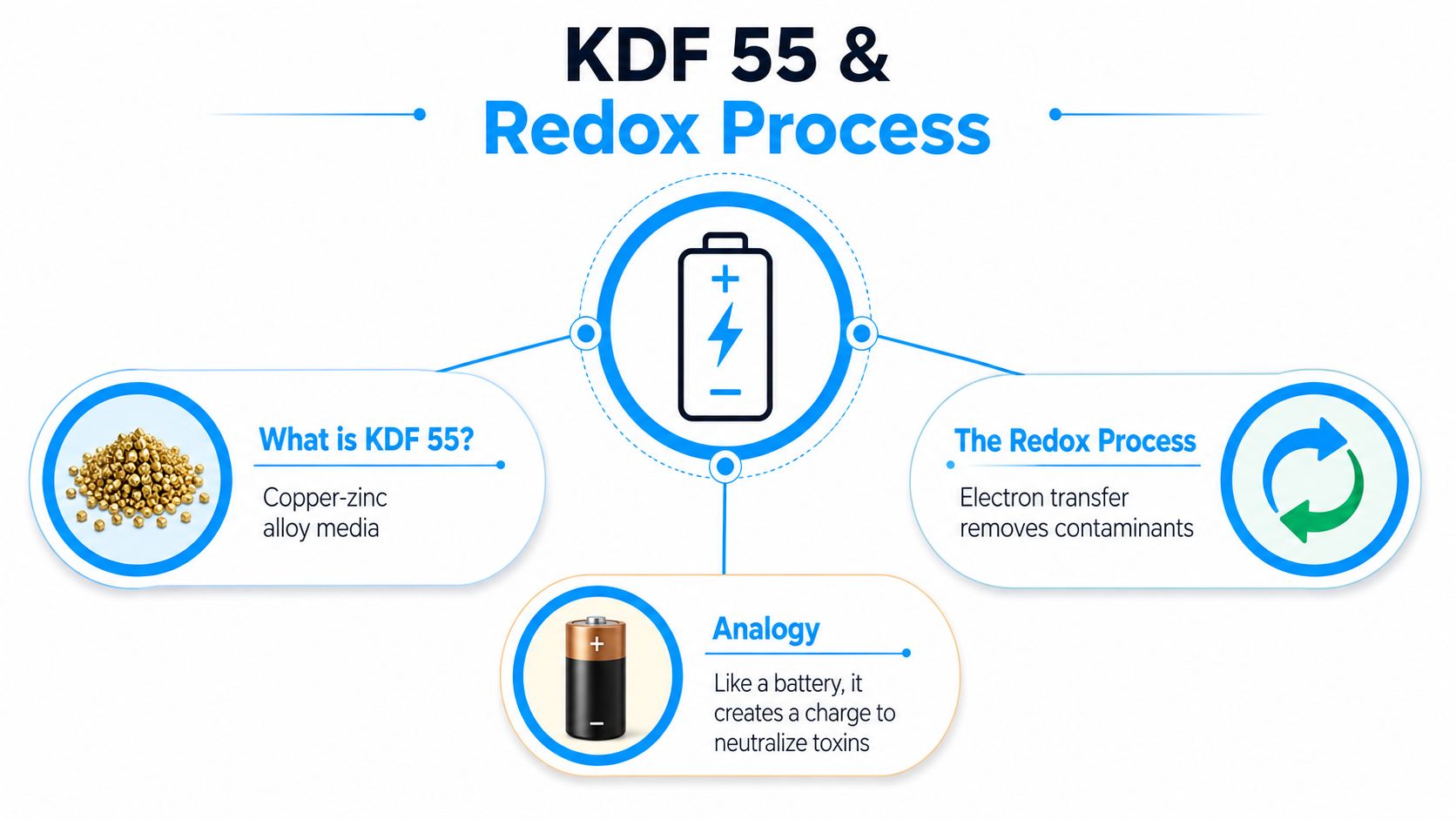
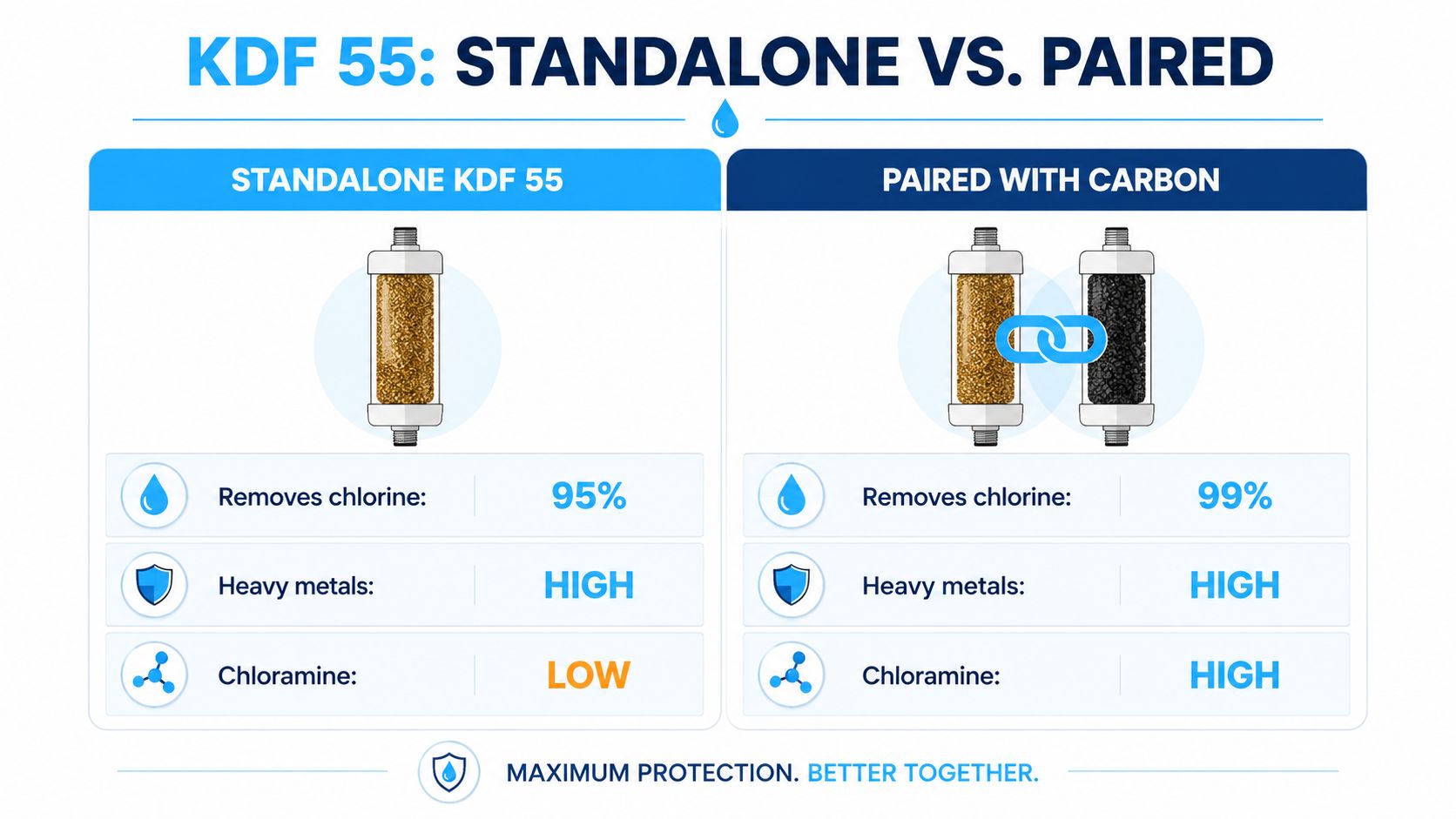
KDF (Kinetic Degradation Fluxion) Redox Reactions & Bacteriostatic Heavy metals (lead, mercury, iron), chlorine, and inhibits bacteria/algae growth.
Catalytic Carbon Catalytic Conversion Chloramine (a persistent chlorine/ammonia disinfectant), hydrogen sulfide.
Oxidation Media (e.g., Manganese Greensand) Oxidation and Filtration Iron, manganese, and hydrogen sulfide (rotten egg smell).

These advanced stages work in concert with the sediment and carbon layers. Each one builds on the last, systematically stripping away impurities until only clean, safe water is left to flow through your home. This teamwork is the real secret behind a truly effective whole-house system.

Choosing the Right System for Your Home

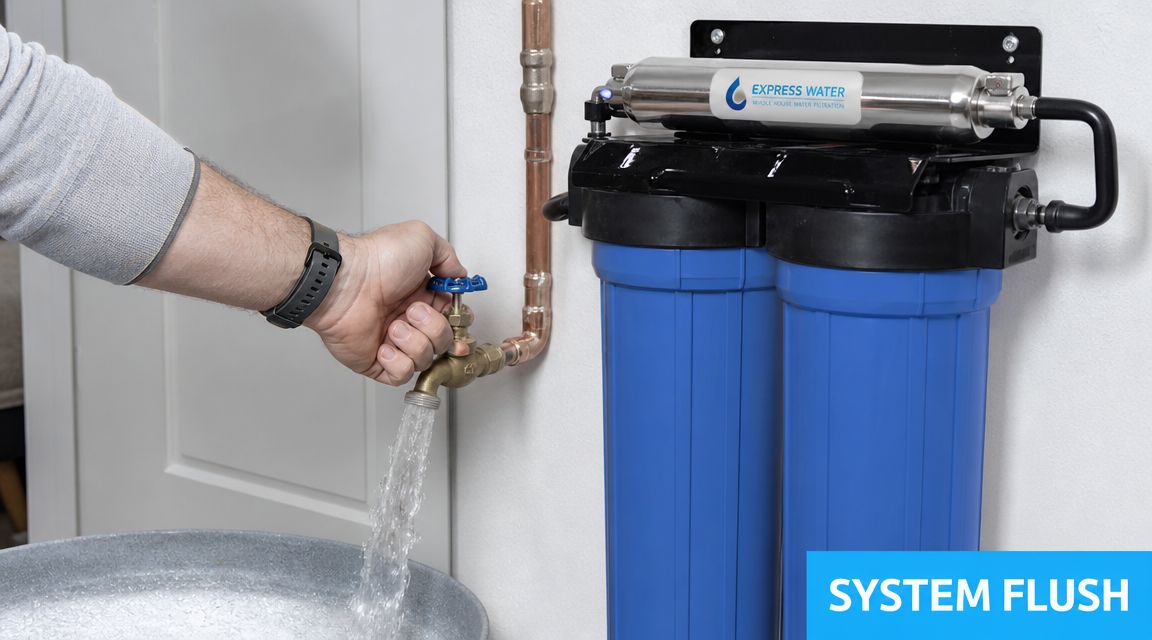
A close-up of a point of entry water filter system installed on a wall.

When you're picking out a point-of-entry water filter, it's not about finding the biggest, most expensive unit you can. The best system is the one that fits your home's unique water needs like a glove.

It’s a bit like buying a car. You wouldn't get a tiny two-seater sports car for a family of six, right? And you probably wouldn't commute to the office every day in a massive RV. Your water filter needs to be the right fit for your household, and that comes down to three things: sizing, flow rate, and performance certifications. Nail these, and you'll have clean, reliable water without any headaches.

Sizing Your System for Your Household

First things first, you need a handle on how much water your family actually uses. A system that’s too small will constantly struggle to keep up. You'll end up with clogged filters way too soon and, even worse, a drop in water pressure. On the flip side, an oversized system is just money down the drain.

To get a solid estimate, just look at two key factors:

  • Number of People: The classic rule of thumb is that each person uses somewhere between 75 and 100 gallons of water a day. That covers everything from showers and laundry to flushing the toilet.
  • Number of Bathrooms: A house with more bathrooms means more fixtures that can all be running at once. Think about those chaotic weekday mornings! A four-bathroom house is going to have a much higher peak demand than a one-bathroom apartment.

So, a family of four in a three-bathroom home has very different needs than a couple living in a two-bathroom condo. Sizing your system correctly ensures it can handle your busiest moments without skipping a beat. For more detailed help, you can find a ton of professional advice over at https://www.waterfilteradvisor.com/advice/.

Understanding Flow Rate and Water Pressure

Ever been enjoying a hot shower when someone flushes a toilet, and suddenly your water pressure tanks? That’s what a poor flow rate feels like. Flow rate is measured in gallons per minute (GPM), and it basically tells you how much water can pass through your filter at one time.

A point of entry water filter's flow rate must be high enough to meet your home's peak demand. This is the amount of water needed when multiple appliances and faucets are running simultaneously, like the shower, dishwasher, and a sink.

A standard shower head uses about 2.5 GPM, a dishwasher needs around 2 GPM, and a kitchen faucet runs at about 1.5 GPM. If your family often has all these going at once, your peak demand could easily be 6 GPM or more. You need to pick a system with a GPM rating that meets—or even better, exceeds—that number to keep the water pressure strong and steady everywhere in the house.

Why Certifications Matter

So, how can you be sure a filter actually does what the box says it does? This is where you look for certifications from independent organizations like the NSF (National Sanitation Foundation) and ANSI (American National Standards Institute). They’re your best friend in this process.

These certifications aren't just clever marketing. They are cold, hard proof that a third-party lab has put the system through its paces to make sure it really removes the contaminants it claims to.

For example, NSF/ANSI 42 certifies that a filter makes your water taste and smell better by reducing chlorine. NSF/ANSI 53, on the other hand, is a much more serious certification confirming it can remove health-related contaminants like lead or cysts. If you're building a new home, it's a good idea to review some essential questions to ask a custom home builder to ensure they plan for plumbing that can accommodate certified filtration systems.

Always check for these certification marks when you're shopping around. They give you an unbiased guarantee of performance and peace of mind that you're making a solid investment in your family's water quality.

Whole House vs Single Faucet Filters

So, you're trying to figure out if you need a big whole-house system or just something small for the kitchen sink. It can feel like a tough choice, but there's a simple way to think about it.

A whole-house filter is like your home's central air conditioning—it treats every single room, providing consistent comfort everywhere. A single-faucet filter, on the other hand, is like a portable window AC unit. It does an amazing job cooling one specific room, but the rest of the house is on its own.

Both are great at what they do. The right one for you really comes down to what you're trying to fix, your budget, and how much of your home you want to cover. Let's break down the differences.

The Point of Entry Advantage: Comprehensive Coverage

A point of entry (POE) system, also known as a whole-house filter, is the ultimate "set it and forget it" solution for your water. It gets installed right where the main water line enters your house, so it filters every single drop of water before it ever reaches a tap.

This means you get filtered water for everything, not just drinking. Think about it:

  • Better Showers: Less chlorine and other chemicals means softer skin and hair. No more that dry, itchy feeling after a shower.
  • Longer-Lasting Appliances: Your dishwasher, washing machine, and water heater are shielded from sediment and scale buildup that can cause damage over time.
  • Cleaner Laundry: Your clothes will feel softer and look brighter without all those harsh minerals and chemicals.

The biggest plus is peace of mind. You never have to wonder which faucet is safe—they all are. The trade-off? These systems have a higher upfront cost and usually need a professional to install them correctly.

The Point of Use Approach: Targeted and Affordable

Point-of-use (POU) filters are the sharpshooters of water filtration. These are your under-sink systems or faucet-mounted units that treat water at a single spot, usually the kitchen sink. They are fantastic for making sure the water you drink and cook with is as pure as possible.

To get a better idea of how these fit in, it helps to understand the various types of kitchen faucets where you'd typically install a POU filter. Their popularity comes from being affordable and pretty easy to install yourself.

In fact, the global water filter market is expected to reach USD 48.2 billion by 2025, and POU systems account for a huge chunk of that—almost 44.8% of total revenue. People love them because they're a low-cost, effective way to get great-tasting water right where they need it most.

The bottom line is this: POE systems give you complete, home-wide protection. POU filters give you high-purity water for drinking and cooking at a much lower cost, but they leave the rest of your home’s water untreated.

To give you a clearer picture, here’s a quick side-by-side comparison of the two approaches.

Whole-House vs. Single-Faucet Filter Comparison

Feature Point of Entry (Whole-House) Point of Use (Single-Faucet)
Coverage Treats all water entering the home. Treats water at a single tap (e.g., kitchen sink).
Protection Protects plumbing and all water-using appliances. Protects only the specific faucet it's attached to.
Installation Typically requires professional plumbing. Often a simple DIY installation.
Upfront Cost Higher initial investment ($500 – $3,000+). Lower initial investment ($50 – $500).
Maintenance Less frequent filter changes (e.g., 6-12 months or longer). More frequent filter changes (e.g., 2-6 months).
Best For Widespread issues like chlorine, sediment, or hard water. Targeted removal of contaminants for drinking water.

This table helps illustrate the core trade-offs. It's not about one being "better," but about which one is the right tool for your specific job.

Finding the Best of Both Worlds

For a lot of homeowners, the perfect setup isn't an "either/or" decision. It’s a "both/and" strategy. You can actually combine both types of systems to create a powerful, multi-layered defense against any water contaminant.

Here’s how it usually works: You install a whole-house carbon filter to take care of the big stuff—chlorine, sediment, and general chemicals—at every tap. Then, you add a specialized POU system, like a reverse osmosis unit, under the kitchen sink to get rid of the really tough contaminants like lead, fluoride, or arsenic.

This hybrid approach gives you the absolute best of both worlds. You get general protection for your appliances, pipes, and skin, plus surgical precision for the water you and your family actually drink. It's a comprehensive solution that leaves no stone unturned.

Installation, Maintenance, and Long-Term Costs

A plumber working on installing a point of entry water filter system in a residential setting.

Buying a whole-house water filter is a bit like buying a car. The sticker price is just the beginning. To really understand the investment, you have to factor in the installation, the regular maintenance, and the total cost over its lifetime. Think of it as the fuel, oil changes, and tune-ups that keep it running smoothly for years.

Planning for these things from the start means you’ll get the clean, safe water you paid for without any nasty surprises down the road. It turns a simple purchase into a smart, long-term investment in your home and your family's health.

Getting Your System Up and Running

So, you’ve picked out the perfect point of entry water filter. Now what? The first step is getting it installed, which usually means cutting into your home's main water line. It’s a job that demands a steady hand and a solid understanding of plumbing.

You’ve got two options here: DIY or hire a pro. Going the DIY route can definitely save you some money on labor, but it’s a serious project. One slip-up could lead to leaks, a drop in water pressure, or a system that isn't even filtering properly. For most people, hiring a licensed plumber is the way to go. It ensures the job is done right, meets local codes, and keeps your warranty intact.

Professional installation for a whole house system can run anywhere from $300 to over $1,000, depending on how complex your plumbing is and the going rates in your area. It's an extra cost, sure, but the peace of mind is often worth every penny.

Creating a Clear Maintenance Roadmap

Your whole-house filter is a workhorse, but it’s not a “set it and forget it” appliance. To keep it working at peak performance and maintain strong water pressure, you'll need to do some regular upkeep. The good news is the schedule is predictable and pretty easy to manage.

Maintenance mostly boils down to swapping out the filter media. How often you do this depends on the specific part and just how "gunky" your water is to begin with.

Here’s a general idea of what to expect for a replacement schedule:

  • Sediment Pre-filter: This is your first line of defense, and it catches the most stuff. Plan on replacing it every 3 to 12 months.
  • Carbon Pre/Post-filter: If your system has separate carbon block filters, they typically last about 6 to 12 months.
  • Main Media Bed: This is the heart of the system, where the heavy lifting happens with a big tank of activated carbon or KDF. This core component has a much longer lifespan, usually needing a replacement every 5 to 10 years or after filtering a huge volume of water, like 1,000,000 gallons.

Understanding the Total Cost of Ownership

To budget properly, you need to look past the initial price tag and think about the total cost of ownership over the filter's entire life. This gives you a clear, honest picture of what you'll be spending over time.

Let's break down the costs you can expect with a point of entry water filter:

  1. Initial System Cost: This is the price of the unit itself, which can be anywhere from $500 for a basic setup to $3,000+ for a beefy, multi-stage system.
  2. Installation Fee: As we mentioned, getting it installed professionally is a key part of that initial investment.
  3. Recurring Filter Replacements: This will be your main ongoing expense. You’ll want to budget for the annual sediment and carbon filter changes, plus the big, less frequent main media replacement down the line.
  4. Operational Costs: Most standard systems don’t use any electricity. However, if you get a model with a UV purifier or an automatic backwashing valve, you’ll see a small bump in your utility bill.

When you add it all up, you get a realistic picture of your investment. A little foresight here means you can enjoy great-tasting, clean water without any financial stress.

Answering Your Top POE Filter Questions

Even after you've got a handle on how these systems work, it's totally normal to have some practical questions pop up. Think of this section as your personal FAQ, where we'll tackle the common worries and head-scratchers we hear about all the time.

We've pulled together the top questions from homeowners just like you. Let's get you some answers.

Will a Whole House Filter Lower My Water Pressure?

This is probably the number one concern we hear, and for good reason. Nobody wants a weak shower. The short answer is no—a properly sized and installed system should have almost no noticeable effect on your home's water pressure.

If you do see a significant drop in pressure, it's a big red flag that something's wrong. The usual suspects are a system that’s too small for your house's needs or, more commonly, a filter cartridge that's clogged and way past its replacement date. Keeping up with the maintenance schedule is the single best way to keep your water flowing strong.

Do I Still Need a Water Softener?

This is a common mix-up. A whole-house water filter and a water softener are two completely different tools for two different jobs. Most POE filters are rockstars at pulling out things like chlorine, sediment, and other chemical contaminants. What they don't do is remove the dissolved minerals—calcium and magnesium—that cause hard water scale and soap scum.

So, the bottom line is yes, if you have hard water, you will likely still need a separate water softener. Many people opt for an integrated setup that combines both filtration and softening into one seamless system. It's the best way to get a complete fix for both water quality and hardness.

The only way to know for sure what's in your water is to test it. A good starting point is your local water utility's annual Consumer Confidence Report, which is free. For a much closer look, you can grab an at-home test kit or send a sample to a certified lab. The results will point you directly to the contaminants you need to address.

What Is the Average Lifespan of a POE System?

A good quality point-of-entry system is a long-term investment. The main tank and valve head—the core hardware—can easily last 10 to 15 years, or even longer if you take care of it.

The part that needs regular replacement is the filter media inside the tank. That's the stuff doing all the heavy lifting, and it eventually gets used up.

Here’s a general idea of the replacement timeline:

  • Sediment Pre-filters: These catch the big stuff and take the most abuse. Expect to change them every 3 to 12 months.
  • Main Media Bed: This is the big tank of carbon or other specialized media. It will typically last 5 to 10 years, but this can vary a lot based on your water quality and how much you use.

When you look at the system's longevity alongside its maintenance needs, you get a much clearer picture of what you're investing in for the long haul.


At Water Filter Advisor, we're committed to helping you find the perfect water filtration solution for your home. Explore our in-depth guides and unbiased reviews to make a confident decision for your family's health. Learn more at https://www.waterfilteradvisor.com.

Finding Your Perfect Home Water Filtration System: The Ultimate Guide

Let's be real: choosing the best home water filtration system feels a lot like trying to order a coffee in a café with a fifty-item menu. Do you want the pour-over, the cold brew, the reverse-osmosis-double-shot-latte? It's confusing! But relax. Finding the right system isn't about knowing all the jargon; it's about figuring out what you want from your water. For some, it’s a fortress-like whole-house system that guards every tap. For others, it's a specialized under-sink unit that turns kitchen water into liquid gold. The perfect fit is always a blend of power, price, and practicality for your home.

Your Guide to Choosing the Right Water Filter

A person pouring a glass of clean, filtered water from a kitchen faucet into a glass.

Diving into the world of home water filters can make your head spin. You’ll hear terms like "reverse osmosis," "activated carbon," and "point-of-entry," and it’s tempting to just close the tab and grab another bottle of water. But let's cut through the noise. The mission is simple: make the water your family drinks, cooks with, and bathes in as pristine as possible.

This guide is your friendly translator. We're going to give you a clear roadmap to help you pick the system that's genuinely right for you. Think of this not as a chore, but as an upgrade to your home—an investment in your family's health and your own peace of mind.

Why This Decision Matters More Than Ever

Let's face it, we're all a little more obsessed with what's in our water these days, and for good reason. The global market for home water filtration was pegged at around USD 13.98 billion in 2024, and it's projected to rocket to nearly USD 37.54 billion by 2034. That explosive growth isn't just a trend; it's a sign that we're all becoming more aware of waterborne contaminants and demanding safer options right from our own taps. You can read more about the growth of the home water filtration market if you love digging into the data.

We'll break down everything you need to know, from the big-gun systems to the quick-and-easy fixes, so you can match the right filter to your specific water woes.

A Quick Comparison of Popular System Types

Before we get into the nitty-gritty, let's get a bird's-eye view. This table is your cheat sheet to the most common options, showing you at a glance what they do and where they live.

System Type Primary Coverage Best For Typical Installation
Whole-House Every tap and appliance in the home Comprehensive protection against chlorine, sediment, and chemicals Professional installation at the main water line
Under-Sink A single tap, usually the kitchen sink Purifying drinking and cooking water with high precision DIY or professional installation under the sink
Faucet-Mounted A single faucet Renters or those seeking an easy, temporary solution Simple DIY installation directly on the faucet
Countertop Dispensing purified water Small households or individuals wanting a portable option No installation; sits on the counter

Once you see these categories, you can start to figure out which path makes sense for your home, your lifestyle, and your clean-water goals.

Comparing Home Water Filtration System Types

Figuring out the best water filter for your home really comes down to one question: where do you want to treat your water? Think of it like home security. You could install a massive system that guards every window and door, or you could put a single smart camera on the front porch. Both are effective, but they solve very different problems.

Each type of filter has a specific superpower. Your choice will likely depend on whether you own or rent, and if your main quest is simply better-tasting drinking water or protecting your entire home's plumbing from unseen villains. Let's meet the four main contenders.

Whole-House Systems: The All-Encompassing Guardian

A whole-house water filtration system is the big kahuna. Also known as a Point-of-Entry (POE) system, it’s the most comprehensive solution on the market. Installed right where your main water line enters your house, it acts as a bouncer, cleaning every drop of water before it gets inside. That means your kitchen faucet, showers, washing machine, and dishwasher all get the VIP treatment with filtered water.

This is the only setup that truly protects your plumbing and appliances from the crud—like sediment and chlorine—that can cause damage over time. For a homeowner, it’s a game-changer. You’ll get chlorine-free water for showers and baths (hello, softer skin and hair!), and you'll extend the life of your appliances by stopping scale and gunk before they can build up. It’s a long-term investment in your home’s health.

A huge, often overlooked benefit here is protecting your home's entire plumbing network. By catching sediment and chlorine at the source, a whole-house system stops the slow, steady corrosion and clogging that can lead to some seriously expensive repair bills down the road.

Under-Sink Systems: The Drinking Water Specialist

While a whole-house system is great for broad-spectrum defense, an under-sink water filter is a specialist, a sniper rifle aimed squarely at the water you drink and cook with. Tucked away in the cabinet under your kitchen sink, these systems use advanced technologies like reverse osmosis to deliver incredibly pure water right where it matters most.

These units tap into your cold water line and typically come with their own dedicated, elegant faucet. This is perfect for homeowners and renters who want to eliminate specific, hard-to-catch contaminants like lead, fluoride, pesticides, or pharmaceuticals from their drinking water, without wasting filter life on the water used to flush the toilet.

Here’s where an under-sink system really shines:

  • For the Health-Conscious Family: A good reverse osmosis system can remove up to 99% of total dissolved solids (TDS). That’s about as pure as H₂O gets.
  • For the Gourmet Cook: Filtered water makes everything taste better. Your morning coffee, evening tea, soups, and even pasta will have a cleaner, more vibrant flavor without the chemical aftertaste.
  • For Apartment Dwellers: Many of these systems are surprisingly easy to install and, more importantly, uninstall, making them a practical, high-performance choice when you can't make permanent changes.

Countertop and Faucet-Mounted Filters: The Convenient Solvers

If you're looking for simplicity and a setup you can complete in the time it takes to make a cup of coffee, countertop filters and faucet-mounted filters are your heroes. These Point-of-Use (POU) systems are incredibly easy to install and are a fantastic choice for renters, dorm rooms, or anyone who can't (or doesn't want to) mess with their plumbing.

A faucet-mounted filter screws right onto your kitchen tap, and a little lever lets you switch between filtered and unfiltered water instantly. Countertop filters sit next to your sink, connecting with a small tube to filter water into their own dispenser. Both are champions at making tap water taste and smell better by kicking chlorine to the curb. Just know their capacity is smaller, and they won't remove as broad a range of contaminants as the bigger systems.

Still, their convenience and low upfront cost make them the best home water filtration system for individuals, college students, or small households with basic water quality concerns.

How Different Water Filtration Technologies Perform

Choosing the best home water filtration system is less about the box it comes in and more about the magic happening inside. Once you understand how different filtration methods work, you can match a system to the specific troublemakers in your water. Let's pull back the curtain on what these technologies actually do.

We'll look at the four major players in home water filtration: Activated Carbon, Reverse Osmosis (RO), UV Purification, and Ion Exchange. Each one is a specialist, designed to tackle a different set of challenges, from a funky chlorine taste to invisible microbial invaders.

This map gives you a quick visual on how different filters are categorized by where they go in your home.

Infographic about best home water filtration system

As you can see, the first decision is where you need filtration—the whole house, a single sink, or just a countertop pitcher. That choice starts to narrow down the technology you'll probably end up with.

Activated Carbon: The Workhorse for Taste and Odor

Activated carbon is the rockstar of the filter world, found in everything from simple pitchers to massive whole-house systems. It works like a chemical magnet. Its surface is covered in millions of microscopic pores, creating a huge surface area that traps organic compounds and chemicals like chlorine through a process called adsorption.

This is precisely why activated carbon filters are the undisputed champions at making municipal water taste and smell fantastic. They are brilliant at removing chlorine, chloramines, volatile organic compounds (VOCs), and some pesticides. For most people on city water, a good carbon filter is all it takes to turn funky tap water into something crisp and refreshing.

Just know its focus is specific. Activated carbon won’t touch heavy metals like lead, dissolved minerals, nitrates, or microorganisms. It's a targeted tool, not a cure-all.

Reverse Osmosis: The Purity Powerhouse

When you want water that is as pure as a mountain spring, Reverse Osmosis (RO) is the undisputed king. This technology uses household water pressure to force water through a semipermeable membrane with pores so tiny that almost nothing besides a water molecule can squeeze through.

RO systems are absolute beasts at removing a massive list of contaminants, including:

  • Heavy metals like lead, arsenic, and mercury.
  • Dissolved solids such as salts, fluoride, and nitrates.
  • Even some viruses and bacteria.

This level of purification makes it the gold standard for drinking water. The market agrees; reverse osmosis systems claimed over a 38% revenue share in 2021 because they’re just that effective. UV systems also hold a big piece of the market, valued for their ability to neutralize pathogens. You can review the home water filtration unit market analysis for more data on these trends.

But this power comes with a trade-off. The RO process is slow and it produces wastewater—for every gallon of pure water, several gallons carrying the rejected contaminants are flushed away. It also strips out beneficial minerals like calcium and magnesium, which can affect the water’s taste and pH.

UV Purification: The Microbial Guardian

Unlike other methods that physically trap contaminants, UV Purification is a silent assassin. It zaps water with ultraviolet light, which scrambles the DNA of microorganisms like bacteria, viruses, and protozoa (think Giardia and Cryptosporidium). This renders them harmless, preventing them from reproducing and making you sick.

A UV purifier isn't a "filter" in the traditional sense, since it doesn't remove anything from the water. Its one and only job is to make water microbiologically safe. This makes it an absolute must-have for homes on well water, which isn't treated by a municipality and can be a breeding ground for nasty bugs.

It's critical to remember that UV systems always need a pre-filter, usually for sediment. UV light can only work its magic in clear water; any murkiness can act like a shield, protecting pathogens from the purifying light. It has zero effect on chemicals, heavy metals, or chlorine.

Ion Exchange: The Hard Water Specialist

Ever seen that chalky white limescale on your faucets or struggled to get a good lather from your soap? You've met hard water. Ion Exchange is the technology built to solve that exact problem and is the science behind traditional water softeners.

The system uses a bed of resin beads charged with sodium (or sometimes potassium) ions. As hard water flows through, the beads grab onto the hardness minerals—calcium and magnesium—and release the sodium ions in their place. This "exchange" effectively softens the water, saving your plumbing and appliances from scale buildup.

Some specialized ion exchange resins can also target other contaminants like nitrates or even heavy metals. But like UV, it’s a highly specific tool. It won't remove chlorine, sediment, or bacteria, so it’s usually part of a larger system, not a standalone solution for drinking water.

To help you sort through it all, here's a quick breakdown of how each technology stacks up against common water issues.

Filtration Technology Performance Matrix

Technology Removes Chlorine & Odor Removes Lead & Heavy Metals Removes Bacteria & Viruses Average Annual Cost Best For
Activated Carbon Excellent Poor No $50 – $200 Improving the taste and smell of city water.
Reverse Osmosis Excellent Excellent Good $150 – $300 Maximum purity for drinking water, removing a wide range of contaminants.
UV Purification No No Excellent $100 – $150 Disinfecting well water or ensuring microbiological safety.
Ion Exchange No Some (Specialized) No $200 – $400+ Softening hard water to prevent scale buildup and protect appliances.

At the end of the day, the best home water filtration system is often a combination of these technologies, custom-built to tackle the unique chemistry of your home's water.

Finding a Filter for Your Unique Household Needs

A family smiling and drinking glasses of clean water in their kitchen.

Sure, the technical specs on a water filter box are a good start, but they don't tell the whole story. The best filter is the one that solves your problems and fits into your life without a fuss. A powerful whole-house system is overkill for a solo renter, while a simple pitcher just won't cut it for a large family on well water.

Let's walk through a few real-world scenarios to see how to match the right technology to the right home.

The Renter in a City Apartment

Picture this: you're in a downtown apartment. You can't touch the plumbing, but you're tired of that swimming-pool taste in your tap water and the endless parade of plastic water bottles. Your mission is simple: get better-tasting water for drinking and cooking, no plumber required.

In this scenario, a non-permanent, point-of-use (POU) system is the hero. Your best bets are:

  • A High-Quality Water Pitcher: The easiest fix of all. A pitcher with a solid activated carbon filter will zap that chlorine taste and smell almost instantly.
  • A Faucet-Mounted Filter: This gives you filtered water on demand, right from the tap. It screws on in minutes and comes off just as easily when you move.
  • A Countertop Reverse Osmosis System: If you’re worried about more than just taste—like lead from the building's old pipes—a countertop RO unit brings serious purification power without any installation headaches.

The name of the game here is convenience. These options require zero permanent changes and deliver immediate results where you need them most: the kitchen.

The Health-Focused Family with Young Children

Now, let's imagine a family in a suburban home with young kids. Safety is their top priority. They’ve seen their local water quality report and are concerned about potential lead from aging city pipes, industrial chemicals like PFAS, and disinfection byproducts.

This family needs a serious line of defense for their drinking water. The clear winner is an under-sink reverse osmosis (RO) system. An RO system is a purification powerhouse, capable of removing up to 99% of all dissolved solids from your water.

This technology is a champion at targeting contaminants like:

  • Lead and other heavy metals
  • PFAS "forever chemicals"
  • Chlorine and chloramines
  • Nitrates and fluoride

By putting an RO system under the kitchen sink, this family gets peace of mind. They know every glass of water, every baby bottle, and every pot of pasta is made with truly purified water. It's targeted, high-level protection without the cost of treating every drop in the house.

If you're already planning some work, keep in mind that a big project like an ultimate kitchen remodel checklist is the perfect time to integrate an under-sink system. Planning for it during a renovation makes the installation seamless.

The Rural Homeowner on Well Water

Finally, let’s head out to the country to a home on a private well. Unlike city water, well water is untreated. It can come with a whole menu of surprises depending on the local geology—sediment, hard water minerals, iron that leaves ugly orange stains, and even bacteria or viruses.

For this homeowner, a single filter won't do the job. The best solution is a customized, multi-stage whole-house (point-of-entry) system designed to tackle the well's specific problems head-on.

A common setup for well water usually involves a few key stages:

  1. A Sediment Pre-Filter: This is the first line of defense, catching all the sand, dirt, and rust to protect the more delicate filters downstream.
  2. An Iron Filter or Water Softener: An iron filter gets rid of that metallic taste and prevents staining, while a softener tackles the calcium and magnesium that cause nasty limescale buildup.
  3. A Carbon Filter: This stage handles chemical contaminants, pesticides, and any lingering bad tastes or odors.
  4. A UV Purifier: This is the non-negotiable final step. An ultraviolet light zaps any bacteria, viruses, or other microorganisms, making the water safe to drink without adding chemicals like chlorine.

This layered strategy ensures that every single tap—from the kitchen sink to the shower—delivers clean, safe, and great-tasting water, protecting both the family's health and the home's plumbing.

What to Look For Before You Buy a Water Filter

So, you’re ready to get cleaner water. Fantastic! But it’s easy to get swayed by marketing hype. To find a system that actually delivers on its promises, you need to look past the flashy ads and focus on a few key details.

This is your final checkpoint. We'll walk through the essential questions to ask, making sure the filter you choose is a sound investment for your home and health.

The absolute first thing to look for is third-party certification. This isn't just a "nice to have"—it's proof that a filter actually works. Certifications from organizations like the NSF (National Sanitation Foundation) and ANSI (American National Standards Institute) mean the system has been independently tested to do what it claims.

Understanding Key Certifications

Not all certifications are created equal. They test for different contaminants, so knowing what they mean helps you find the right filter for your specific water problems.

  • NSF/ANSI 42: Think of this as the "taste and smell" certification. It confirms a filter's ability to reduce aesthetic impurities like chlorine. If your goal is simply better-tasting tap water, this is a great standard to look for.
  • NSF/ANSI 53: This one is all about health effects. It's a much tougher standard that verifies a filter can remove specific, harmful contaminants like lead, mercury, asbestos, and parasites like Cryptosporidium. If you have health concerns, this certification is non-negotiable.
  • NSF/ANSI 58: This standard is specifically for reverse osmosis (RO) systems. It validates the system’s power to drastically reduce a long list of contaminants, including hard-to-remove ones like fluoride, nitrates, and heavy metals.

A filter without independent certification is just making a promise. An NSF/ANSI certified system has provided proof, giving you confidence that it will protect your family's health as advertised.

Flow Rate and Long-Term Costs

Beyond what a filter removes, you have to consider how it performs day-to-day. For whole-house systems, the flow rate—measured in gallons per minute (GPM)—is a huge deal. An undersized system will lead to a frustrating drop in water pressure whenever you try to shower and run the dishwasher at the same time.

Make sure the GPM rating of any whole-house system can handle your household's peak demand. A good rule of thumb is to estimate the flow rates of your major water-using appliances and fixtures.

Finally, think beyond the sticker price. The true cost of ownership includes the initial purchase, installation, and the ongoing expense of replacement filters. A cheap system with expensive, short-lived filters can end up costing you far more over time than a quality unit with longer-lasting filters. For more guidance on this, check out our collection of water filter advice.

Installation and Professional Help

The last piece of the puzzle is getting it installed. Faucet filters and countertop units are easy DIY jobs you can finish in minutes.

However, under-sink and whole-house systems often require cutting into your home’s plumbing. If that sounds intimidating, it's wise to budget for a professional. Understanding the scope of general plumbing services can help you find a qualified installer to get the job done right—no leaks, no hassle, just peace of mind.

Common Questions About Home Water Filtration

It’s normal to have a few final questions before choosing a new filter. Getting a handle on the day-to-day details is what makes the difference between a good purchase and a great one. Let's tackle some of the most common things people ask when choosing the best home water filtration system.

First, how do you even know what you’re trying to filter out? It’s simpler than you might think.

Your local water utility is required to publish an annual Consumer Confidence Report (CCR), or water quality report. A quick search on your town's website should bring it right up. This report gives you a detailed look at what contaminants were tested for and at what levels.

If your home uses a private well or you just want a more specific reading of the water coming from your pipes, grab an at-home water test kit. It's a great way to pinpoint issues like lead, bacteria, or hardness that a city-wide report might miss.

Do Water Filters Remove Healthy Minerals?

This is a fantastic question, and the answer depends entirely on the filtration technology.

Filters that rely on activated carbon—including most pitchers, faucet attachments, and many basic whole-house systems—are selective. They excel at grabbing chemicals like chlorine but typically let beneficial minerals like calcium and magnesium pass right through. You get cleaner water without sacrificing the good stuff.

A Reverse Osmosis (RO) system, on the other hand, is a purist. Its membrane is so fine that it strips out nearly everything, including those healthy minerals. While this produces incredibly pure water, many people add a remineralization filter to their RO setup to put those essential minerals back into the water for better taste and health benefits.

How Often Should I Change The Filter?

Sticking to the manufacturer's replacement schedule is non-negotiable. An old, clogged filter doesn't just stop working; it can become a breeding ground for bacteria and potentially dump all the contaminants it caught right back into your water.

Here’s a rough idea of what to expect:

  • Faucet Filters: Every 2 to 3 months is typical.
  • Under-Sink Carbon Filters: Plan on every 6 to 12 months.
  • RO Membranes: These are the long-haul players, often lasting 2 years or more.
  • Whole-House Sediment Filters: This depends heavily on your water quality, but a 3 to 6-month swap is common.

Always follow the official schedule for your specific model. It’s the only way to guarantee your system is working as certified and keeping your water consistently safe and delicious.


Ready to take the next step toward cleaner, safer water? The experts at Water Filter Advisor provide in-depth reviews, comparisons, and maintenance guides to help you make a confident choice. Visit us at https://www.waterfilteradvisor.com to find the perfect solution for your home.

Water Filter System Comparison: Your Ultimate Home Guide

Choosing a water filter system is like picking the right superhero for the job. Do you need a mighty guardian for your entire home, deflecting unseen villains before they even enter? That’s your whole-house system. Or do you need a specialist, a culinary artist dedicated to crafting the perfect, pure drinking water right at your kitchen sink? That’s your under-sink filter. The best choice for your fortress (aka your home) depends on whether you’re after total protection, targeted purity, or something in between.

How To Choose Your Ideal Home Water Filter

A modern kitchen faucet with a water filter system installed underneath the sink

I get it—the world of water filters can seem as vast and mysterious as the deep blue sea. But don't worry, you don't need a submarine to navigate it. The journey starts with one simple question: what problem are you trying to solve? Is your tap water just a bit funky-tasting, or are you waging war against hard water scale that’s slowly assassinating your appliances?

Every filter type has its own special mission. Once you understand their superpowers, picking your champion becomes a whole lot easier. This quick rundown will help you assemble your team of heroes before we dive into the nitty-gritty lab specs.

A Quick Guide To Filter Types

The main types of home filtration systems are designed to solve very different problems. A whole-house system is the all-powerful titan of filtration—it’s installed at the point where your main water line enters your home and purifies every single drop of water you use. This is the ultimate weapon if you’re fighting battles against chlorine, sediment, and hard water minerals that can wreck appliances and leave your skin feeling as dry as a desert.

On the other hand, point-of-use (POU) systems are the specialists, treating water in one specific spot, like your kitchen sink or shower. These include:

  • Under-Sink Filters: These stealthy operators are installed neatly out of sight under the counter, providing a dedicated faucet for perfectly pristine water for drinking and cooking.
  • Faucet-Mounted Filters: A super-simple, no-fuss sidekick that attaches right to your existing faucet for instant filtration. No plumber sidekick needed.
  • Countertop Filters: These units sit on your counter and connect to the faucet, offering some serious filtration power without any permanent installation.

The decision often comes down to scope. If you're only worried about the quality of your drinking water, a point-of-use system is a smart, budget-friendly choice. But if you’re tackling system-wide problems like hard water or contaminants in all your taps, a whole-house solution is the only investment that truly makes sense.

If you’re already planning some major home upgrades, that’s the perfect time to get your water sorted. For example, if you consider water filtration as part of a whole house remodel, you can build the system right in from the get-go to protect all your new plumbing and fixtures.

To make it even simpler, here's a quick reference table to match your mission with the right kind of filter.

Quick Guide to Home Water Filtration Systems

Your Primary Need Recommended Filter Type Core Benefit
Purified drinking and cooking water Under-Sink or Countertop Filter High-level contaminant removal at a single tap.
Protect all plumbing and appliances Whole-House Filter Comprehensive treatment for every faucet and shower.
Improve tap water taste affordably Faucet-Mounted Filter Easy, low-cost solution for better-tasting water.
Softer hair and skin in the shower Shower Head Filter Reduces chlorine and minerals that cause dryness.

By figuring out your main goal first, you can confidently start looking at specific models that fit your home and lifestyle. For a deeper dive, there's a ton of great, practical advice on choosing water filters to help with your home’s unique situation. Next up, we'll break down the different technologies that make these systems work.

Getting to Grips with Filtration Tech and What It Removes

Let's be clear: not all water filters are created equal. Not even close. The real magic happens inside the filter housing, where different technologies go to battle against the specific gunk you want out of your water. You wouldn't hire a superhero to do your taxes, right? Same idea here. That’s why any real water filter system comparison starts by looking under the hood at the science.

But before you even think about which filter to buy, take a look at your overall water system. If you have a water tank, for example, you need to deal with any sediment or microbial growth in there first. A great guide I saw pointed out that ensuring a clean water tank is a vital precursor to effective filtration. It just makes sense—starting with a cleaner source lets your new filter focus on the microscopic villains it was designed for.

With that out of the way, you can pick the right tool for the job. Each filtration method has its own superpower, designed to take out different kinds of impurities.

Activated Carbon: The King of Taste and Odor

Activated carbon is the dependable workhorse of the filter world—it's probably the most common tech you'll run into. It operates on a principle called adsorption, which basically means contaminants get stuck to the carbon's incredibly vast surface area. Think of it like a microscopic, super-porous magnet that traps impurities as water flows past.

This method is an absolute champ at fixing aesthetic issues and improving the general quality of your tap water. It’s best known for removing:

  • Chlorine: This is the main culprit behind that "public pool" smell and taste in city water.
  • Volatile Organic Compounds (VOCs): A fancy name for things like pesticides and herbicides that can sometimes seep into the water supply.
  • Funky Tastes and Smells: Carbon is fantastic at neutralizing whatever is making your water taste off.

What it won't do is remove dissolved minerals, salts, or most heavy metals like lead. It's a specialist for making water pleasant, not a catch-all purifier.

Reverse Osmosis: The Purity Powerhouse

When you absolutely, positively need the purest water possible, Reverse Osmosis (RO) is the undisputed champion. This process uses pressure to push water through a super-fine, semipermeable membrane, leaving up to an incredible 99% of all contaminants behind. It's like having a microscopic bouncer at the door who only lets pure water molecules get past.

RO systems are brutally effective against a huge list of contaminants:

  • Dissolved Solids: This includes salts and the minerals like calcium and magnesium that cause hard water.
  • Heavy Metals: Nasty stuff like lead, arsenic, mercury, and even fluoride are effectively removed.
  • Microorganisms: Most bacteria and viruses are simply too large to squeeze through the RO membrane.

The trade-off for this level of purity is water waste. An RO system has to flush the rejected contaminants down the drain, so it uses several gallons of "waste" water to produce one gallon of pure water. Still, for anyone with serious water quality concerns, its performance is second to none.

Sediment and UV: Your System's Bodyguards

Last but not least, we have two technologies that act as defenders for your entire water system. Sediment filters are your first line of defense. They’re simple screens designed to physically block larger particles like sand, silt, rust, and other debris. Their job is to keep that gunk from clogging up the more complex, expensive filters that come after them.

UV (Ultraviolet) sterilization, on the other hand, is a microbial hitman. It zaps water with UV light, which scrambles the DNA of bacteria, viruses, and cysts so they can't reproduce and make you sick. It doesn't actually remove anything, but it renders microscopic baddies harmless. This is an absolute must-have for homes on well water.

A Detailed Comparison of Home Water Filter Systems

Trying to pick the right water filter can feel overwhelming. It’s not about finding the single “best” system, but about finding the right one for your home. A whole-house filter that treats every drop of water serves a totally different purpose than a targeted under-sink unit that purifies your drinking water. It all comes down to what you’re trying to fix.

This need for cleaner water isn't just a feeling; it's a massive global trend. The water filter market was valued at USD 15.88 billion in 2024 and is expected to rocket to USD 26.42 billion by 2032. This boom is all thanks to better technologies like reverse osmosis and UV purifiers becoming more common. For a deeper dive, you can check out the full report on global water filter market growth.

To get a quick handle on what different technologies do, this chart breaks down their strengths against common contaminants.

Infographic about water filter system comparison

As you can see, Reverse Osmosis is the heavy hitter, tackling the widest range of contaminants. Activated Carbon is fantastic for improving taste and smell, while UV is the specialist for zapping germs. Now, let’s see how these are used in the real world.

To give you a clearer picture, here’s a direct comparison of the top 5 home water filter types. This table breaks down everything from cost to performance, helping you match a system to your specific needs and budget.

Side-by-Side Water Filter System Analysis

Filter System Type Best For Average Initial Cost Annual Maintenance Cost Key Contaminants Removed Impact on Water Flow
Whole-House Treating all water for general issues like chlorine & sediment. $500 – $3,000+ $100 – $300 Chlorine, sediment, hard water minerals, some VOCs. Minimal to none.
Under-Sink Highest purity drinking & cooking water at the kitchen tap. $150 – $600 $80 – $200 Lead, arsenic, fluoride, nitrates, TDS, viruses. None on main faucet; dedicated faucet has slower flow.
Faucet Filter Renters or anyone needing a simple, low-cost taste improvement. $20 – $50 $40 – $80 Chlorine, some lead, and particulates. Noticeable reduction in flow rate.
Countertop Better performance than a faucet filter without installation. $50 – $200 $60 – $120 Chlorine, lead, VOCs, cysts, and sometimes fluoride. Can be slow; filters one batch at a time.
Shower Filter Reducing skin/hair irritation from chlorine in municipal water. $25 – $75 $30 – $60 Chlorine and chloramines. Negligible.

This table lays out the fundamental trade-offs. Now, let’s get into the specifics of what makes each of these systems tick and who they’re really for.

Whole-House Systems: The Complete Home Solution

A whole-house water filter is the big gun. Also known as a point-of-entry (POE) system, it’s installed right where your main water line comes into the house. From that point on, every single drop of water is treated—kitchen, bathrooms, laundry, you name it.

This is the system you want if you have a problem that affects your entire home. Think hard water minerals clogging your pipes and ruining appliances, or high chlorine levels that make your skin itch after a shower. A whole-house filter is your single line of defense against these widespread issues.

The catch? It's a real investment. These systems can cost anywhere from a few hundred to several thousand dollars, and you’ll almost certainly need a plumber to install it. But the long-term payoff is huge, protecting your home’s plumbing and expensive appliances from damage.

Under-Sink Systems: Precision Purity for Drinking Water

If a whole-house filter is a shotgun, an under-sink system is a sniper rifle. As a point-of-use (POU) filter, it’s all about delivering exceptionally pure water right where you need it most: the kitchen sink. Tucked away under the counter, these systems feed a special, dedicated faucet for pristine drinking and cooking water.

This is where the most powerful filtration tech, like Reverse Osmosis (RO), really gets to work. A good RO unit can strip out up to 99% of all dissolved solids, including nasty stuff like lead, fluoride, arsenic, and nitrates that simpler filters can’t touch.

Key Differentiator: The real difference is scope versus intensity. A whole-house system gives you good water everywhere. An under-sink system gives you perfect water in one place.

Many handy homeowners can tackle the installation, but a plumber is always a safe bet. The main things to budget for are the upfront cost of the unit and the ongoing replacement of the various filter cartridges and the RO membrane.

Faucet and Countertop Filters: Convenience and Simplicity

For anyone who wants better water right now without a big project, faucet and countertop filters are the answer. A faucet filter is exactly what it sounds like—it screws directly onto your kitchen tap. A little lever lets you switch between filtered and regular tap water on the fly.

They are dirt-cheap, take seconds to install, and mostly rely on activated carbon to get rid of that chlorine taste and smell. The downside is that they don’t filter a whole lot else, and they will slow down the water flow from your tap.

A countertop filter is a nice step up. It sits on your counter and connects to the faucet with a small tube, giving it room for bigger, more effective carbon block filters. This means it can remove more contaminants and the filters last longer than the little faucet-mounted ones. Both are perfect for renters or anyone on a budget.

Shower Filters: Targeted Treatment for Skin and Hair

A shower filter is one of those small upgrades that makes a huge difference. You might not think about filtering your shower water, but it can be a game-changer. It simply screws on between the shower arm and your showerhead and gets to work on one major culprit: chlorine.

Chlorine and its cousin, chloramine, are great for disinfecting city water but terrible for your body. They strip the natural oils from your skin and hair, leaving you feeling dry, itchy, and frizzy. A simple shower filter removes those chemicals at the source.

They're cheap, you can install one in two minutes, and they’re an absolute must if your city’s water has a strong chemical smell. It won't make your water drinkable, but it will make your daily shower a whole lot more pleasant.

Which Water Filter Is Right for Your Home?

A family smiling and drinking clean water from glasses in their kitchen.

Getting a handle on the technology is the first step, but the real confidence comes from knowing how it fits into your day-to-day life. The "best" water filter isn't always the one with the most bells and whistles or the highest price tag; it's the one that directly solves your water problems.

Let's walk through a few common situations. This isn't just a generic water filter system comparison—it's about connecting the dots between features and real-world needs. Every home is different, from the age of its pipes to where the water comes from. See if you recognize your own situation in one of these profiles.

For the Family in an Older Home

You've fallen for a charming house built back in the 1960s. It has character for days, but you can't help but worry about the decades-old plumbing. The risk of lead from old pipes or solder is a serious concern, especially with kids in the house. Your main goal? Maximum purity for every glass of water and every pot of pasta.

The Solution: An Under-Sink Reverse Osmosis (RO) System.

This is your ace in the hole. An under-sink RO system is a targeted powerhouse, installed right under the kitchen sink with its own dedicated faucet. It pushes water through a multi-stage process, and its specialized membrane is a beast when it comes to heavy metals, capable of reducing lead by over 95%.

Think of it as a surgical strike. Instead of treating every drop of water in the house for lead, you're creating exceptionally pure water right where you drink and cook. It delivers total peace of mind without the cost and complexity of a whole-home setup.

For the Apartment Renter

You're living in an apartment, which means tearing into the plumbing is a non-starter. You're over the swimming-pool taste of chlorinated city water but hate the waste (and cost) of buying bottled. What you need is an effective, non-permanent fix you can install in minutes and pack up when you move.

The Solution: A High-Quality Countertop or Faucet-Mounted Filter.

These systems are the definition of convenient. A faucet filter just screws onto your existing tap and gets to work immediately, using activated carbon to zap that chlorine taste and smell. A countertop model is a slight step up, often with bigger carbon block filters that can also tackle things like lead and certain VOCs, all without a single permanent modification.

For the Household on Well Water

Your water comes from a private well, so you're the one in charge of quality control. A recent test showed some sediment, a bit of iron, and the dreaded presence of coliform bacteria. You need a full-on defense system to make your water safe and pleasant for everything from showering to laundry.

The Solution: A Multi-Stage Whole-House System with UV Sterilization.

This situation calls for the big guns—a point-of-entry system that treats water as it comes into your home. A solid setup would look like this:

  1. A Sediment Pre-Filter: The first line of defense, catching all the sand, silt, and gunk to protect the other filters from getting clogged.
  2. A Carbon or KDF Filter: This stage tackles the iron that causes staining and gets rid of any weird tastes or smells.
  3. A UV Purifier: This is the game-changer. UV light zaps bacteria and viruses, making them harmless without adding a single chemical to your water.

Together, these components ensure that every tap in your house delivers water that’s clear, clean, and biologically safe.

For the New Parents

With a newborn at home, your priorities have shifted. Making sure the water for baby formula is absolutely pristine is at the top of the list. You want the highest level of contaminant removal possible to protect a tiny, developing immune system from fluoride, nitrates, and other dissolved solids that basic filters just don't touch.

The Solution: An NSF/ANSI 58 Certified Under-Sink RO System.

We're back to the RO system, but this time with a laser focus on certification. A system that's been certified to NSF/ANSI 58 has been rigorously tested by a third party to prove it can reduce a huge list of contaminants. This standard is your guarantee that the water going into that baby bottle is as pure as it gets, removing up to 99% of total dissolved solids (TDS).

How to Read Filter Certifications and Performance Data

When you're trying to compare water filter systems, the technical sheet can look like it's written in a foreign language. But getting a handle on certifications and performance data is your best weapon against marketing hype. It lets you see what a product can really do.

This is the line between buying a filter that just claims it works and one that's actually proven to protect your family.

Third-party certifications are your non-negotiable seal of approval. The big name you want to see is the NSF (National Sanitation Foundation). They're an independent group that tests and verifies the claims companies make. If you see an NSF/ANSI certification, it means a filter went through some serious testing to prove it gets specific contaminants down to safe levels.

With the global water filter market projected to hit a staggering $84.2 billion by 2032, it's clear more people are taking their water quality seriously. You can dive deeper into this market growth data to see just why certified performance is so crucial today.

Decoding the Most Common NSF Standards

Not all NSF certifications are created equal. Each one targets a different job, so you need to match the standard to your specific water concerns.
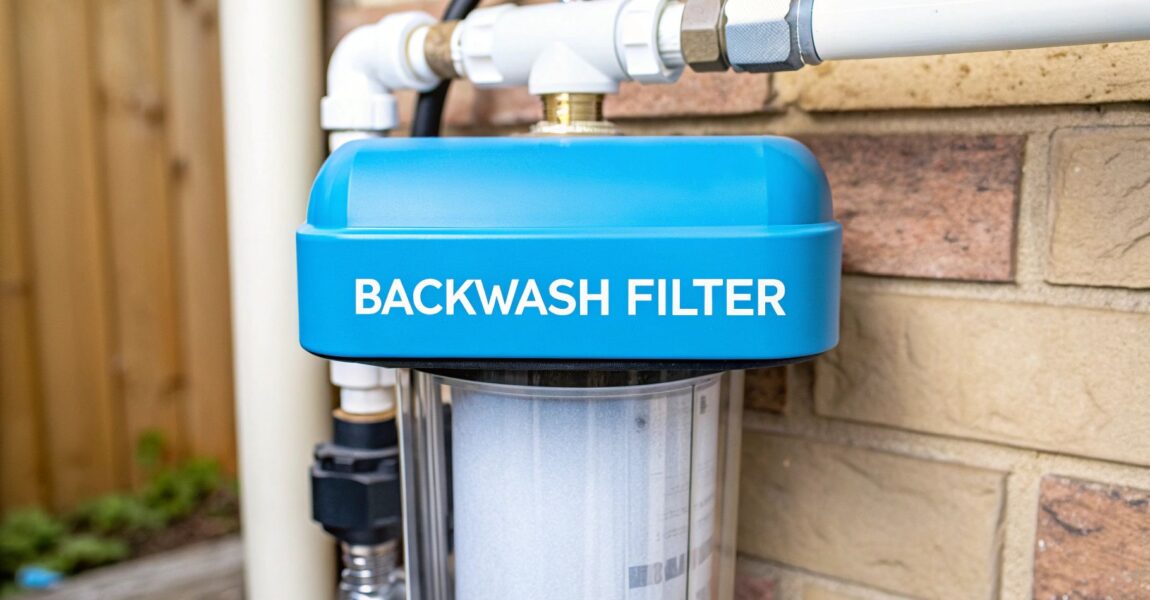
Here are the three you’ll see pop up most often on home systems:

  • NSF/ANSI 42 (Aesthetic Effects): Think of this as the "taste and odor" certification. It proves a filter can reduce things like chlorine that make your water taste or smell funky. It's all about improving the general experience of drinking your tap water.
  • NSF/ANSI 53 (Health Effects): This one is a much bigger deal. This standard certifies a filter can remove contaminants with known health risks—we’re talking lead, mercury, asbestos, and nasty parasites like Giardia. If safety is your top priority, this is the certification you need to look for.
  • NSF/ANSI 58 (Reverse Osmosis Systems): This is the gold standard for RO units. It confirms the system can drastically reduce a whole laundry list of total dissolved solids (TDS), including tough stuff like nitrates, fluoride, and arsenic.

A filter might be certified for just one of these standards, or it could be certified for all three. Always dig into the details to see the specific contaminants a filter is proven to reduce. One certification doesn't mean it removes everything in that category.

Interpreting Key Performance Metrics

Beyond the official stamps of approval, the performance data sheet gives you the real-world rundown of how a filter will work in your home day-to-day.

Keep an eye out for these key numbers:

  1. Micron Rating: This tells you the size of the pores in the filter material. It's simple: a smaller micron rating catches smaller particles. A 1-micron filter is going to block a lot more than a 5-micron filter.
  2. Filter Lifespan (Gallons): This is the number that tells you how much water a filter can clean before you have to swap it out. It’s absolutely essential for figuring out your long-term costs.
  3. Flow Rate (GPM): Measured in gallons per minute, this shows how fast water can move through the filter. A low GPM might be fine for an under-sink system, but in a whole-house filter, it could mean a frustrating drop in water pressure every time you turn on the shower.

Making a Confident Final Decision

Alright, you’ve explored the tech, compared the different systems, and figured out what all those certifications actually mean. Now it’s time to put it all together and pick the right water filtration system for your home, with total confidence.

The final choice really boils down to a clear-eyed look at your main goal, your budget, and what your home actually needs. This isn't just about bells and whistles; it’s about finding a solution you can stick with that fits your real life. You’re essentially balancing the trade-off between all-out, whole-house protection and getting targeted purity right where you need it most.

Are you trying to solve a widespread problem like hard water scale wrecking your appliances, or do you just want perfectly clean drinking water from the kitchen tap?

Your Decision-Making Framework

To get from research to action, just think through these three critical points. Answering them honestly will point you straight to the perfect system for your family.

  1. What’s Your #1 Goal? What's the biggest water problem you're trying to fix?

    • Bad Taste and Odor: A simple activated carbon filter—whether it’s on your faucet, a countertop pitcher, or under the sink—will usually knock this out.
    • Health Contaminants: If you’re worried about things like lead, you need a system with NSF/ANSI 53 certification. That often means an under-sink reverse osmosis (RO) unit.
    • Appliance Protection: A whole-house system is the only real way to stop hard water scale and sediment buildup everywhere from your water heater to your dishwasher.
  2. What’s Your Real Budget? You have to look past the sticker price. A system that’s cheap to buy but needs expensive filters every few months might cost you more in the long run than a pricier, more durable unit. Always calculate the total cost of ownership, including filter replacements for at least three years.

  3. How Handy Are You? Be honest about your DIY skills. Faucet filters are a snap to install, but a whole-house system is a job for a professional plumber. Make sure you factor that potential installation cost into your budget.

The sweet spot is where effectiveness, affordability, and convenience all meet. A super-powerful system that’s a pain to maintain is useless if you end up neglecting it. A simpler one you can easily keep up with will serve you much better.

This push for better water is a massive global trend. Just look at the Asia-Pacific water purifier market—it was valued at USD 14.10 billion in 2024 and is projected to more than double by 2034. You can read more about these global water quality trends to see how growing awareness is pushing the industry forward.

By taking a structured approach, you can make sure your investment is a perfect match for your family's health and practical needs for years to come.

A Few Common Questions About Home Water Filters

Once you start digging into the specs and comparing systems, a few questions almost always pop up. It's one thing to pick a filter, but it's another to know what it’s actually like to live with. Let's clear up some of the most common things people ask when they're about to buy.

These are the practical, day-to-day details that will help you feel confident in whatever system you choose.

How Often Do I Really Need to Change My Water Filters?

This is probably the biggest variable you'll deal with, and it really comes down to the type of filter and how much water your family uses. As a general rule, simple pitcher and faucet filters need a new cartridge every 2-3 months.

Step up to a more serious under-sink carbon filter, and you're looking at a 6-12 month lifespan. Whole-house sediment filters, which are your first line of defense against gunk, usually need to be swapped every 3-6 months. The marathon runners are reverse osmosis membranes—those can last anywhere from 2-5 years. Just be sure to follow the manufacturer's schedule. An old, clogged filter isn't just ineffective; it can become a breeding ground for bacteria.

Will a Water Filter Wreck My Home's Water Pressure?

It's a great question, and the honest answer is: it can, but it depends. A simple faucet or countertop filter will only slow down the flow right at that one tap, and it’s usually not enough to be annoying.

An under-sink system might cause a slight drop at its dedicated faucet, but again, you’re not using that to fill a bathtub, so it’s rarely an issue. The real potential for a pressure drop comes from a whole-house system. If you get one that’s too small for your home's plumbing, you'll definitely notice it. This is exactly why getting a pro to help you size and install those big units is so important.

The bottom line is that a properly sized system shouldn't cause a frustrating drop in pressure. As long as the filter's flow rate (measured in GPM) matches your household's needs, you'll hardly notice it's there.

Is Bottled Water Just a Better, Safer Option?

It's easy to think so with all the marketing, but bottled water isn't automatically the gold standard. The quality can be all over the place, and the regulations aren't always as strict as you’d think. With a good home filter, you are in control of your water quality.

Besides, filtering your own water at home is way cheaper and better for the planet. You stop paying for and throwing away all that single-use plastic. A certified home filter is just a smarter choice for your wallet and the environment in the long run.

Can I Install a Water Filtration System Myself?

That all depends on the filter you buy and how comfortable you are with a little plumbing work.

  • No Tools Needed: Pitchers and countertop units are good to go right out of the box.
  • Super Easy DIY: Faucet filters and most shower filters just screw right on. You can do it in minutes.
  • Manageable DIY: A lot of under-sink systems are made for homeowners to install. They usually come with good instructions and push-to-connect fittings that make it pretty simple.
  • Call a Pro: Whole-house systems are a different beast. You’re cutting into your home's main water line, and if you mess it up, you could be dealing with leaks or major pressure issues.

When in doubt, especially with a whole-house system, just hire a licensed plumber. It’s the safest bet.


Ready to find the perfect filter for your home? The expert guides and unbiased reviews at Water Filter Advisor break down everything you need to know to make a confident choice. Start your search for cleaner, safer water today at https://www.waterfilteradvisor.com.

How to Install a Water Filter: Your Ultimate Guide to Cleaner Sips

So, you're ready to learn how to install a water filter? Let's start with a splash of reality: not every filter is a perfect match for every home or DIY skill level. What's a dream for a renter in a tiny apartment is a plumbing nightmare for a homeowner battling cloudy well water.

The secret isn't just about plumbing; it's about matching the filter's complexity to your own comfort zone. Let's turn that tap water into liquid gold, one step at a time.

Matching a Filter to Your Home and Skills

A person pointing to different types of water filters on a store shelf.

Before you even think about grabbing a wrench, you need to pick your battle. Installing a water filter isn’t a one-size-fits-all mission. The right choice boils down to your living situation, what you’re trying to filter out, and—let's be honest—your willingness to get up close and personal with the pipes under your sink.

It's no secret that the thirst for clean water is real. The global water filter market is projected to swell to an incredible $84.2 billion by 2032, a huge jump from $48.2 billion in 2025. This wave is powered by a growing focus on health and water purity. While this means you have more options than ever, it can also make choosing one feel like navigating a maze.

Finding Your Perfect Filtration Fit

Let's dive into a couple of common home scenarios.

If you're renting an apartment, making permanent changes to the plumbing is a one-way ticket to losing your security deposit. Your best friends here are a simple faucet-mounted filter or a countertop dispenser. These heroes usually require zero tools and can be set up in minutes, giving you an instant upgrade in taste and odor without any landlord drama.

On the flip side, if you own your home and want to declare war on specific contaminants like lead or chlorine, an under-sink system is your long-term champion. This is a more hands-on adventure. You'll need to shut off the water, possibly drill a hole in your countertop for a dedicated faucet, and ensure every connection is as tight as a drum.

Your goal isn't just to install a filter. It's to conquer a project that leaves you feeling accomplished and delivers delicious, clean water—without accidentally creating an indoor swimming pool. Choose a system that aligns with your skills today, not the master plumber you hope to become someday.

To help you out, here’s a quick comparison table that breaks down the most common home water filter types.

Home Water Filter Installation Comparison

Filter Type Installation Difficulty Common Tools Needed Best For
Pitcher/Dispenser Very Easy None Individuals, renters, basic taste/odor removal
Faucet-Mounted Easy None, maybe pliers Renters, small kitchens, improving tap water taste
Under-Sink Moderate Wrench, drill, bucket Homeowners, targeted contaminant removal
Whole-House Difficult Pipe cutter, wrenches, plumbing tape Homeowners, treating all water in the house

This table should give you a clear starting point. A pitcher is a grab-and-go solution, while a whole-house system is a serious commitment—a true weekend warrior project.

Weighing Your Filtration Options

To zero in on your perfect match, keep these three key factors in mind:

  • Installation Difficulty: Does it just screw on, or will you be cutting into your home's main arteries? Be brutally honest with yourself about what you can comfortably handle.
  • Maintenance Commitment: How often does the filter cartridge need changing? A fridge filter is a 30-second snap, but wrangling a whole-house system in a cramped crawl space is a whole different beast.
  • Long-Term Costs: Don't get mesmerized by the initial price tag. Calculate the cost of replacement filters over the next few years to see the real investment.

And remember, if you're eyeing a complex whole-house installation or the thought of touching your main water lines gives you the shivers, there's zero shame in calling in the cavalry. It's always a smart move to consult professional plumbing services when in doubt. Starting with the right filter for your home is the first and most important step to a successful installation.

Your Pre-Installation Toolkit and Workspace Prep

I’ve seen it a thousand times: a flawless, leak-free water filter installation has less to do with being a plumbing wizard and more to do with what happens before you ever touch a pipe. A little preparation is what separates a smooth DIY victory from a frantic, wallet-draining call to a plumber. It all comes down to having the right gear and a clean battlefield.

Diving in without the proper tools is like trying to bake a cake without an oven—it’s just not going to end well. Ever try to tighten a fitting under the sink with just one wrench? The whole thing just spins around mockingly. That’s why having two adjustable wrenches is my golden rule; one to hold the fort (the fitting), the other to do the tightening.

Gathering Your Essential Tools

Beyond the wrenches, a few other items will become your new best friends. You’ll absolutely need a roll of Teflon tape (aka plumber's tape) to create those beautiful, watertight seals on threaded connections. And please, do not underestimate the sheer genius of a good headlamp. It’s a dark, mysterious world under that sink, and a headlamp frees up both your hands for the important work, instead of one holding a flashlight.

Make sure you also have:

  • A bucket to catch the water that will inevitably escape the lines.
  • A few old towels for the drips and spills that are guaranteed to happen.
  • A utility knife or a dedicated tube cutter to get clean, square cuts on plastic tubing.

This nifty infographic breaks down the whole pre-installation game plan into three simple stages.

Infographic about how to install water filter

As you can see, a successful job starts with your toolkit, moves to prepping the space, and hinges on one critical action: shutting off the water.

Preparing Your Under-Sink Workspace

The space you're working in deserves just as much attention as your tools. First things first: completely empty that cabinet under your sink. You need room to maneuver and a clear line of sight to the plumbing. This isn’t just for comfort; it’s to save your cleaning supplies from an unexpected shower.

Here's the most critical tip I can give you: before you disconnect a single thing, find and test the water shut-off valves for your sink. Don't just assume they work. Old valves can seize up like they're frozen in time. Give each handle a gentle turn to make sure it moves freely and actually stops the water flow.

Once the cabinet is clear, lay down your old towels to cover the bottom. This small step is a game-changer, containing any stray water and making cleanup a breeze. With your tools at the ready and your space prepped, you’re officially ready to get started without any nasty surprises.

Installing an Under-Sink Water Filter

An under-sink water filter system neatly installed in a kitchen cabinet.

Alright, this is where the magic happens. Installing an under-sink water filter is hands-down one of the most popular and satisfying DIY projects for your home. It feels like a massive kitchen upgrade, but trust me, it’s completely manageable with a little patience. My goal here is to be your guide, walking you through it step-by-step so you end up with a professional, leak-free setup you can brag about.

First, and I cannot shout this from the rooftops enough: shut off the water. Find the cold water shut-off valve under your sink—it's that small, usually oval-shaped handle. Turn it clockwise until it stops. Next, open your kitchen faucet to let the line drain completely. This gets the leftover water out and, more importantly, relieves the pressure so you don’t get a surprise geyser to the face when you disconnect the supply line.

Making the T-Fitting Connection

That small T-fitting, sometimes called an adapter valve, is where most people get a little nervous. Don't be. This little piece is the heart of your new system. It brilliantly splits the cold water, sending some to your new filter and the rest along to your main faucet. With the water off, use an adjustable wrench to disconnect the flexible cold water line from the shut-off valve.

Now, screw the T-fitting directly onto the valve. Pro tip: wrap the male threads on the valve with a few layers of Teflon tape to guarantee a watertight seal. Once it's on, reconnect the original faucet supply line to the top of the T-fitting. And just like that, you’ve created a dedicated path for your filter.

A Word of Caution: When tightening the compression fittings on that T-adapter, you're aiming for "snug," not "crushed." If you unleash your inner Hulk and crank down too hard, you can damage the delicate plastic or rubber seals inside. That’s the number one cause of those slow, maddening drips that haunt you later.

Mounting the Filter and Faucet

With the plumbing rerouted, it’s time to find a forever home for the filter unit. Pick a spot on the cabinet wall where you can easily reach it for future filter changes. Don't banish it to the dark back corner where it can't be seen or reached! Mark your screw locations with a pencil, drill some small pilot holes, and then screw the mounting bracket securely to the cabinet wall.

Next up is the sleek new filter faucet that came with your kit.

  • Look for an existing hole: Many sinks have a pre-drilled hole covered by a cap, perhaps for a soap dispenser or an old sprayer. This is your golden ticket—the path of least resistance.
  • Drilling a new one: If you have to drill, lay down a layer of masking tape first. This gives your drill bit something to grab onto so it doesn't skate across your beautiful countertop. Always start with a small pilot hole before graduating to the larger bit designed for your specific material (like a diamond hole saw for granite).

This part requires a steady hand, but taking it slow is the secret to avoiding a countertop catastrophe.

Cutting and Connecting the Tubing

The final piece of this puzzle is all about precision. Your kit came with a roll of plastic tubing. You'll use this to connect the T-fitting to the filter's inlet, and then the filter's outlet to the new faucet. The secret to a leak-proof connection here is a perfectly square cut. If the end of the tube is jagged or angled, it won't create a proper seal inside the push-to-connect fittings.

I recommend using a sharp utility knife or, even better, a dedicated tube cutter for a clean, professional edge. Once cut, push the tube firmly into the fitting until you feel a distinct click or feel it bottom out. Give it a gentle tug to make sure it's locked in place. Repeat for all your connections, and you're golden.

This project is a fantastic way to upgrade your home’s water quality on your own terms. Of course, if this installation is part of a larger renovation or you'd just prefer a professional touch, you might want to look into professional kitchen remodeling services to get a seamless integration. But with these tips, you are well on your way to enjoying fresh, filtered water right from your own tap.

Whole-House Systems and Refrigerator Filters: The Full Spectrum

While an under-sink filter is a fantastic weekend project, it only purifies the water at one specific tap. If you're looking to go bigger—or even smaller and simpler—you'll encounter two other common players in the home filtration game: the mighty whole-house system and the humble refrigerator filter.

These two could not be more different in difficulty, but understanding them gives you the complete picture of your home water filtration options.

The Pro-Level Project: Whole-House Filter Installation

A whole-house filter is the undisputed heavyweight champion of water treatment. It cleans every single drop of water entering your home, meaning better water for your showers, your laundry, and every faucet in between.

But let's be crystal clear: this is a major league step up from an under-sink job. For most homeowners, this is a project best left to a professional plumber.

The process involves locating your main water line, usually hiding in a basement or utility closet, right after the water meter. You have to shut off the water to the entire house, drain all the pipes, and then physically cut into your main copper or PEX supply line. This is the point of no return where most DIYers understandably start to sweat. A mistake here isn't just a small leak under the sink; it's a potential indoor water park.

After the pipe is cut, the filter unit is installed using specialized fittings. These units are heavy, especially when full of water, so they also need to be securely anchored to a wall.

Even if you hire this job out, it pays to understand what's involved. You'll be able to ask your plumber intelligent questions, make sense of their quote, and know exactly what a safe, professional installation should look like.

The Easiest Win: Swapping Your Refrigerator Filter

On the complete opposite end of the spectrum, you have the refrigerator filter. This is likely the simplest filter change you will ever perform in your home.

Most modern fridges with water and ice dispensers have a small, built-in filter that needs to be replaced every six months. If you forget, you'll eventually notice the water flow slowing to a trickle and your ice starting to taste a bit…off.

The manufacturers design this to be a ridiculously easy process:

  • Find the filter. It's usually inside the fridge compartment behind a small pop-open door or tucked away at the bottom behind the base grille.
  • Pop the old one out. Most use a simple push-button or a quarter-turn twist-and-lock mechanism to release the old cartridge.
  • Slide the new one in. Just insert the new filter and twist it the opposite way until you hear or feel it click securely into place.
  • Flush the system. This is a critical final step! Run about two gallons of water through the dispenser. This clears out any harmless carbon dust from the new filter and purges any trapped air bubbles, preventing sputtering.

Modern filtration technology, from complex membranes in reverse osmosis systems to the simple activated carbon in your fridge filter, has given homeowners incredible power over their water quality. As you'd expect, different technologies often need specific installation know-how to function correctly. You can dig deeper into how these advancements are changing the market by checking out recent industry research.

Whether you're tackling a major plumbing overhaul or just a five-minute filter swap, doing it right is the key to getting the clean, great-tasting water you deserve.

Final Checks and Troubleshooting Common Drips

A person using a dry paper towel to check a water filter connection for leaks under a sink.

You’ve tightened the last fitting, the filter is mounted, and you're feeling victorious. It feels like you're done, right? Not so fast. These next few minutes are the most critical part of the entire installation. This is where we hunt down and eliminate the tiny drips that grow into big, ugly problems.

The trick is to reintroduce the water slowly. Don’t just crank the shut-off valve open. Crack it just a quarter turn to let the system fill up gently. You’ll hear the filter housing gurgle and sigh as it fills with water.

Now, pause. Just stop and listen for a moment. A hiss or a spray is an immediate red flag. If you hear anything like that, shut the water off instantly and revisit that connection. If all is quiet, you can proceed to the inspection.

The Paper Towel Test

This is an old plumber’s trick, and it's absolutely foolproof. Take a completely dry paper towel and wipe down every single connection you touched—the T-fitting, the lines going in and out of the filter, and the base of the new faucet.

Even the sneakiest, slowest seep will show up instantly on that dry paper towel. It’s a dead giveaway for a leak your eyes might have missed. A single drop every few minutes might seem harmless, but over time it’s more than enough to warp and rot the bottom of your cabinet.

A successful DIY job isn't about finishing fast. It's about not having to call a plumber a week later. Taking a few extra minutes for these final checks is your insurance policy against water damage and a world of frustration.

If everything stays bone-dry for a few minutes, you’re in the clear. Go ahead and open the shut-off valve the rest of the way. Now, run your new filter faucet for a while to flush the system out, just like the manufacturer's instructions recommend.

Solving Common Installation Hiccups

Even when you're careful, a couple of small issues can pop up. Don’t panic; the fixes are almost always surprisingly simple.

  • A Stubborn Drip at a Fitting: If that paper towel test reveals a slow drip from a threaded connection, your first instinct might be to tighten it more. Resist! Turn off the water, disassemble the fitting, and simply re-wrap the threads with some fresh Teflon tape. For compression fittings, usually, a simple quarter-turn with a wrench is all it needs to get a good seal.
  • Sputtering or Low Water Flow: This is almost always one of two things. First, quickly check that the plastic tubing hasn't been kinked or bent sharply. Second, you probably just have some air trapped in the lines, which is completely normal. Let the faucet run for a good 5-10 minutes. This will purge the air, and you’ll see the flow smooth out into a beautiful, steady stream.

By taking the time to perform these final checks, you can pack up your tools with the cool confidence of a pro. This careful finish ensures your hard work pays off with delicious, clean water and a leak-free setup you can count on.

Your Water Filter Installation Questions Answered

Got your filter installed? Fantastic. But if you’re like most people, a few questions are probably bubbling up right about now. It's totally normal to wonder about maintenance, how long the filter really lasts, and if you’ve set everything up for the best possible results.

Let's dive into some of the most common questions we hear in the world of home water filtration. Think of this as your final check-in to make sure you're ready to enjoy that pristine water with total peace of mind.

How Often Should I Really Change My Filter Cartridge?

This is the number one question, and the honest answer is: it depends. The manufacturer’s guideline—usually every six months—is a solid starting point. They base that on an "average" home with "typical" water.

But your home isn't average; it's yours. Your schedule might need to be different.

  • Is your water full of sediment? If you're on a well or live in an area with old city pipes, you’ll probably notice your water pressure dropping sooner. That’s your filter's way of crying for help. Time for an early change.
  • Do you have a big family? A house full of people cooking, drinking, and filling water bottles will exhaust a filter way faster than a single person would.
  • Can you taste a difference? The most reliable sign is when that old chlorine taste or funky smell starts to creep back in. Trust your taste buds—they are your best indicator that the filter has given its all.

Do I Need to Sanitize the System During a Filter Change?

Yes, and please don't skip this crucial step! It’s super simple. Over time, the inside of the filter housing can develop a thin, slimy biofilm made of harmless bacteria. When you remove the old cartridge, you have the perfect opportunity to give the housing a quick clean.

All it takes is a little unscented bleach or a dedicated sanitizer solution followed by a thorough rinse. This simple habit ensures that the pure water coming through your brand-new filter actually stays that way.

Taking a moment to sanitize the filter housing is a small investment in maintaining the highest water quality. It prevents the system itself from becoming a source of contamination, ensuring every glass is as pure as the first.

It's no surprise that more and more people are focused on this. The global water purifier market was valued at around $35.25 billion in 2024 and is expected to more than double by 2034. That incredible growth shows just how much people around the world care about water safety at home. You can dig into the numbers and trends by checking out the latest market research on water purifiers.

Can I Connect My Under-Sink Filter to My Refrigerator?

Absolutely! This is one of our favorite DIY home filtration upgrades. You get pristine, filtered water and ice right from your fridge dispenser without having to buy those pricey, brand-specific refrigerator filters.

You'll just need a T-fitting and some extra quarter-inch tubing. This lets you "split" the filtered water line, sending it to both your new faucet and your fridge's icemaker line. Just double-check that your under-sink system has enough water pressure to run the icemaker properly. Most modern systems can handle it just fine.


At Water Filter Advisor, our goal is to empower you with the knowledge to achieve safer, better-tasting water at home. From choosing the right system to a successful installation, we're here to help every step of the way. Explore our in-depth guides and reviews at https://www.waterfilteradvisor.com.

Finding the Best Whole House Water Filtration Systems for Your Home

Ever turn on your tap and get a whiff of a public swimming pool? Or notice your "clean" dishes have weird, chalky spots? You're not alone. When you're on the hunt for one of the best whole house water filtration systems, you’ll discover they are multi-stage powerhouses designed to tackle everything from chlorine and sediment to a whole army of unwanted chemicals. Top-tier systems like SpringWell's CF1 are the workhorses of the water world, boasting impressive flow rates and filters that last for what feels like forever.

The whole point of these systems is simple but brilliant: make sure every single tap in your house—from the kitchen sink to the shower—pours out clean, safe, and fantastic-tasting water.

Why Every Tap in Your Home Deserves a Guardian

Imagine a single, powerful security checkpoint for all the water entering your home. It’s a bouncer at the door that makes sure every last drop is purified before it ever reaches your family. That’s the genius behind a whole house water filtration system. It moves way beyond a dinky pitcher filter and instead treats everything right at the source.

When you take this approach, you're doing more than just improving the taste of your drinking water. You're fundamentally changing your relationship with water all through your house. Every time you cook, clean, shower, or do laundry, you're using healthier, cleaner water. It's a total home upgrade.

The Growing Demand for Cleaner Water

Let's be honest, people are more aware than ever about what's actually flowing through their pipes. There are real concerns about the byproducts of city water treatment, like chlorine, not to mention sneaky contaminants like lead or nasty industrial chemicals. This isn't just a small trend anymore; it's a full-blown movement of homeowners wanting to take control of their water quality.

You can see this shift in the market's explosive growth. The global water filtration market, currently valued at around $14 billion, is expected to skyrocket to nearly $35 billion by 2034. That kind of growth tells you one thing: families everywhere are demanding safer, more reliable water. If you want to dive deeper, you can discover more insights about the whole house filtration market trends and see why so many people are making the switch.

For a quick visual, this infographic breaks down how a whole house system works in a really straightforward way.

Infographic about best whole house water filtration systems

As you can see, the process is logical. It starts by figuring out what gunk is in your water, then uses the right filter technology to get rid of it, and finally sends that purified water to every tap in your house.

To give you a snapshot of what these systems bring to the table, here's a quick rundown of the main benefits.

Key Benefits of Whole House Water Filtration

Benefit Area Impact on Your Home
Health & Safety Reduces exposure to contaminants like chlorine, lead, and pesticides in drinking, cooking, and bathing water.
Appliance Longevity Prevents sediment and scale buildup, extending the life of water heaters, washing machines, and dishwashers.
Better Skin & Hair Filtering out chlorine and other harsh chemicals can lead to softer skin and healthier, less brittle hair.
Improved Taste & Odor Eliminates the chemical taste and smell common in municipal water, making everything from coffee to pasta taste better.
Cost Savings Dramatically reduces or eliminates the need for bottled water, saving you money and reducing plastic waste.

Ultimately, a good system improves nearly every aspect of how you use water at home.

A whole house system is more than an appliance; it's an investment in your home's infrastructure and your family's well-being, providing peace of mind with every glass you drink and every shower you take.

This guide is your complete roadmap to pure water. We'll cut through the marketing noise and technical jargon to help you pick the best whole house water filtration system for your home and your family. We’ll get into how the different technologies work, what features really matter when you're choosing, and how to understand the true cost over the long haul.

How a Whole House Filter Actually Cleans Your Water

A diagram showing the different stages of a whole house water filtration system.

Ever wondered what's really going on inside one of these systems? It's not magic, but it’s a pretty smart process. Think of it like a high-tech car wash for your water. Before a single drop enters your home's pipes, it has to pass through a series of checkpoints, each one designed to grab a different kind of unwanted gunk.

The whole operation is installed right where your main water line comes into the house—what plumbers call the point of entry. This is key. By treating the water here, every single tap in your house gets the good stuff, from your kitchen sink and shower all the way to your washing machine and dishwasher.

Let's walk through the journey your water takes.

Stage 1: The Sediment Pre-Filter

First up is the bouncer of the system: the sediment filter. Its job is simple but absolutely critical—it catches all the big, clunky stuff.

This first line of defense is all about trapping the physical particles you can sometimes see, the things that make water look cloudy and can wreck your pipes and appliances over time.

  • Rust Flakes: Little bits that break loose from old city mains or even your own plumbing.
  • Sand and Silt: Super common in well water, but can show up in city water, too.
  • Dirt and Debris: Pretty much any other solid junk that has hitched a ride in your water supply.

By yanking these larger particles out from the get-go, the sediment filter acts as a bodyguard for the more sensitive and expensive filters that come next. Without it, those finer filters would get clogged up in no time, making them less effective and forcing you to replace them way too often. Most of these sediment filters need to be swapped out every 6 to 9 months, depending on how much sediment is in your water.

Stage 2: The Carbon Filter Workhorse

Once the water is clear of the big debris, it flows into the main event: the main filtration tank. This is usually packed with a high-grade activated carbon, and it's where the real heavy lifting happens, especially if you're on city water.

Carbon is a master of a process called adsorption. Don't confuse it with absorption. Think of it more like a powerful magnet for chemicals. The carbon itself is incredibly porous, giving it a massive surface area to trap and hold onto chemical contaminants as water passes through.

The number one target for these carbon filters is chlorine. It's used in over 98% of U.S. public water systems to kill germs, but it’s also what gives your tap water that "public pool" smell and taste.

A good catalytic carbon filter will remove up to 99.6% of chlorine and its cousin, chloramine, which makes a huge difference in how your water tastes and smells. But it doesn't stop there. This stage also does a fantastic job of reducing:

  • Pesticides and Herbicides
  • Industrial Solvents
  • Volatile Organic Compounds (VOCs)
  • Trihalomethanes (TTHMs), which are nasty byproducts from the disinfection process.

The best part? The carbon media in this main tank is the heart of the whole system and it's built to last. We're talking a lifespan of 1,000,000 gallons or up to 10 years before you even have to think about replacing it. It's a true set-it-and-forget-it solution for better water.

Stage 3: Optional Specialized Treatments

For a lot of folks, those first two stages are all they need for pristine home water. But if you have specific water headaches, especially with well water or ridiculously hard water, you can add specialized stages to the mix.

  • UV Purifiers: You can add an ultraviolet (UV) light chamber to the end of the line. It's a chemical-free way to zap microorganisms. The UV light scrambles the DNA of bacteria, viruses, and cysts, making them completely harmless before they ever reach your tap.
  • Water Softeners: If you're tired of hard water scale building up on everything, an ion exchange water softener can be integrated into the system. It specifically goes after the minerals that cause all that trouble, like calcium and magnesium, saving your appliances and getting rid of those annoying spots on your glassware.

By layering these stages, a whole house system gives you a complete defense, delivering water that isn't just clean, but is customized to fix exactly what’s wrong with your water.

What Really Matters When Choosing Your System

Shopping for a whole-house water filter can feel like a chore. You're hit with a dozen different brands, all making huge promises, and it’s easy to get lost in the marketing noise. But here’s the secret: the best system isn't about the flashiest brand. It's about understanding what actually makes a filter work for your home.

To cut through the hype, we're going to focus on four core pillars. Get these right, and you'll be making a smart investment instead of an expensive mistake. By the end of this, you’ll know exactly how to look past a sales pitch and find a system truly built to solve your specific water problems.

Pillar 1: Know Your Enemy (The Contaminants)

Before you can pick the right weapon, you need to know what you're fighting. Every single water source is different, carrying its own unique cocktail of contaminants. Just guessing what's in your pipes is a surefire way to waste money on a system that doesn't do what you need.

So, the very first step is to get a clear picture of your water's chemistry.

  • If you have city water: Your local municipality is required to publish a Consumer Confidence Report (CCR) every year. This is a great starting point, as it lists everything they test for and whether any contaminants are pushing legal limits.
  • If you have well water (or just want the full story): A home water test kit is your best bet. These give you precise readings on everything from chlorine and lead to iron and pH, essentially creating a detailed blueprint of what's flowing from your taps.

Once you know exactly what’s in your water, then you can find a filter specifically designed to take it out.

Pillar 2: Master Your Flow Rate

Ever jump into what you thought would be a great shower, only to be met with a weak, dribbling disappointment? A low flow rate is usually the culprit, and picking the wrong filter can make it so much worse.

Flow rate is measured in gallons per minute (GPM), and it’s one of the most critical specs people overlook.

Think of it this way: your plumbing is a highway, and water is the traffic. A filter with a low GPM rating is like shutting down a few lanes during rush hour. The moment you run the dishwasher, a shower, and a sink at the same time, you get a traffic jam. The result? Your water pressure tanks.

To keep things flowing smoothly, pick a system with a GPM rating that can handle your home's peak demand. A house with 1-3 bathrooms generally needs a system that can push at least 10 GPM. For larger homes, you'll want to look for 15 GPM or more to maintain that strong, steady pressure everywhere.

Pillar 3: Decode the Filter Media

The real magic of filtration happens inside the tank, within the filter media. Different materials are engineered to grab different contaminants. Knowing what they are and what they do is how you match a system perfectly to your water test results.

Here’s a quick rundown of the main players:

  • Catalytic Activated Carbon: This is the industry workhorse. It's fantastic for pulling out chlorine, chloramine, pesticides, and other chemicals that give water that "off" taste and smell. Its surface is incredibly porous, acting like a magnet for chemicals.
  • Kinetic Degradation Fluxion (KDF): Often paired with carbon, KDF is a mix of copper and zinc. It’s a beast when it comes to removing heavy metals like lead and mercury. As a bonus, it also stops bacteria and algae from growing inside your filter tank.
  • Sediment Filters: This is your first line of defense. These filters are designed to catch the big stuff—dirt, rust, sand, and sediment. By trapping these particles upfront, they protect the more sensitive filter stages from getting clogged.
  • Ion Exchange Resin: If you have hard water, this is what you need. This is the heart of a water softener, designed specifically to grab the minerals like calcium and magnesium that cause scale buildup.

The best systems out there will use a combination of these, creating a multi-stage defense against whatever's in your water.

Pillar 4: Trust, but Verify with Certifications

So, how do you actually know if a filter does what the box says it does? That's where third-party certifications come in. They are your proof of performance, confirming a system has been put through the wringer to meet strict, independent standards.

The gold standard to look for is NSF/ANSI (National Sanitation Foundation/American National Standards Institute).

  • NSF/ANSI 42: This certifies a system reduces aesthetic issues—things like chlorine taste and odor.
  • NSF/ANSI 53: This is a much tougher standard. It verifies the filter reduces health-related contaminants, including lead, cysts, and certain industrial chemicals (VOCs).
  • NSF/ANSI 401: This one addresses "emerging contaminants," like trace amounts of pharmaceuticals and pesticides that are becoming more common.

Before you buy, always check the product's official specs for these certifications. It’s the single best way to know you're putting your money into a system that will deliver on its promise of cleaner, safer water. This demand for proven performance is a big deal; a recent analysis shows the whole-house water purifier market is on track to hit $16.91 billion, largely because more people are concerned about water quality. You can read the full research about water purifier market trends to get the details.

Comparing the Top Types of Whole House Systems

A side-by-side comparison of different whole house water filtration systems installed on a wall.

Picking the best whole house water filter isn't a one-size-fits-all deal. Honestly, the right system for you comes down to your water source and the specific problems you're trying to fix. Not all filters are created equal, and choosing the right type of system is the single most important decision you'll make.

Let's break down the three main players in the home filtration game. Each one is built for a different battle—whether you're dealing with chemically-treated city water, mineral-heavy hard water, or the unique curveballs that come from a private well. Understanding their strengths and weaknesses will help you zero in on the perfect fit for your home.

Multi-Stage Carbon Filters: The City Water Champion

For the vast majority of people hooked up to a municipal water supply, a multi-stage carbon filter is your best bet. Think of it as the ultimate chlorine-killer. Cities treat water with chlorine or chloramine to keep it safe on its way to you, but those chemicals often leave behind a funky taste and smell.

These systems are absolute masters at getting rid of those aesthetic issues, making your water taste and smell fresh and clean again.

  • What they remove best: They nail chlorine and chloramines, getting rid of over 99% of them. They're also great at pulling out things like pesticides, herbicides, and other volatile organic compounds (VOCs).
  • Maintenance: This is a huge win. The main carbon media can last for 1,000,000 gallons or up to 10 years. All you have to do is swap out the inexpensive sediment pre-filter every 6-9 months.
  • Cost: In general, these are the most affordable whole-house systems out there, offering incredible value for anyone on city water.

Water Softener Combination Systems: The Hard Water Hero

If you're seeing chalky buildup on your faucets, can't get your soap to lather, and find spots all over your clean dishes, you've got hard water. The culprit is a high concentration of minerals like calcium and magnesium. A standard carbon filter won't touch this stuff; you need a system specifically designed to fight minerals.

A water softener combination system does just that. It's a two-in-one setup that pairs a powerful carbon filter with an ion-exchange water softener. First, the carbon filter strips out chemicals like chlorine, and then the softener gets to work removing the hard minerals.

This integrated approach not only improves taste and odor but also protects your entire plumbing system and water-using appliances from the damaging effects of scale buildup.

Specialized Well Water Systems: The Rural Guardian

Well water is a completely different ballgame. It's untreated, which means it can have a wild mix of contaminants coming straight from the ground. Common culprits include high levels of iron that stain your sinks and tubs, hydrogen sulfide that gives off that "rotten egg" smell, manganese, and even potentially harmful bacteria.

A standard carbon filter just isn't built for this kind of job. Specialized well water systems are the heavy-duty units you need for these specific issues.

  • Iron and Manganese: Many use what's called an air-injection oxidation (AIO) process to literally force these minerals out of the water. Systems like the SpringWell WS1 can remove up to 7 PPM of iron and 8 PPM of hydrogen sulfide.
  • Bacteria and Viruses: Since well water isn't disinfected, pairing the system with a UV purifier is a must-have to neutralize any microbiological threats.
  • Maintenance: You'd think these beefy systems would be a pain, but they're surprisingly low-maintenance. Many have an automatic backwash cycle that cleans the filter media on its own, so there are often no filters to replace.

To make the choice even clearer, let's put the key facts side-by-side.

Comparison of Whole House Filtration System Types

Here’s a quick-glance table to help you compare the main system types based on what they do best, what they remove, and what you can expect for upkeep.

System Type Best For Primary Contaminants Removed Average Maintenance
Multi-Stage Carbon Homes with city/municipal water Chlorine, chloramine, pesticides, VOCs, sediment Replace pre-filter every 6-9 months; main media lasts 5-10 years.
Softener Combo Homes with hard water (city or well) Hard minerals (calcium, magnesium), chlorine, sediment Same as carbon filter, plus the need to occasionally add salt to the brine tank.
Well Water System Homes using private well water Iron, manganese, sulfur, sediment, bacteria (with UV) Often self-cleaning with automatic backwash; no regular filter changes.

Ultimately, this chart should give you a solid starting point. Pinpoint your water source and your main complaints, and you'll be well on your way to choosing the right solution.

Understanding Installation, Maintenance, and Long-Term Costs

Buying one of the best whole house water filtration systems is really just the beginning. To make a smart investment, you have to look past the sticker price and understand what you're really signing up for—from installation to keeping it running year after year.

Taking an honest look at these long-term factors helps you budget properly and avoids any nasty surprises later on.

DIY vs. Professional Installation

Your first big decision is how to get the system up and running. Some of the simpler, single-tank units are definitely geared toward the handy homeowner. If you're comfortable with basic plumbing like cutting pipe and fitting valves, a DIY install is totally doable.

However, for the more complex multi-stage systems, calling in a licensed plumber is usually the smart play. A pro makes sure the job is done right, meets local plumbing codes, and—most importantly—doesn't void your system's warranty. Improper installation is a real headache, with 17.3% of users complaining about leaking fittings. If you need help weighing your options, you can find more helpful advice at https://www.waterfilteradvisor.com.

The Reality of Long-Term Maintenance

Once it’s in, you have to keep up with maintenance to keep it working at its best. Think of it like an oil change for your car—it’s a non-negotiable task if you want performance and a long life. The exact schedule really depends on the system you pick.

  • Pre-Filter Changes: This is your most frequent job. The sediment pre-filter is the first line of defense and usually needs swapping out every 3 to 9 months. It’s a quick and easy task you can handle yourself.

  • Main Filter Replacement: The main filter media, typically a big carbon tank, is the workhorse. This thing is built to last. Depending on the model, it can go for 3 to 10 years or up to a specific capacity like 1,000,000 gallons.

  • Salt for Softeners: If your system includes a water softener, you'll need to top off the brine tank with salt every so often to keep it regenerating properly.

To get the most out of your system, you need to understand what's involved in its ongoing care. You can learn more about general filter replacement procedures to get a feel for the process.

Budgeting for the Total Cost of Ownership

The real cost of a whole house water filter is more than just the price you pay upfront. To get an accurate picture, you need to factor in all the expenses over the life of the system.

The total cost of ownership is a combination of the initial system price, the ongoing cost of replacement filters, and any potential fees for professional installation or maintenance.

High filter replacement costs are a major issue, with 8.9% of owners citing it as a big pain point. You can seriously lower your long-term expenses by picking a system with filters that last a long time. It’s the best way to avoid that common frustration. Proper planning ensures you invest in a system that delivers pure water without draining your wallet.

Alright, we’ve covered the "what" and "why" of whole house filtration. Now, let's get practical and look at some of the best systems on the market.

Trying to pick the right filter can feel overwhelming, so I've picked out a few top-tier models that are absolute workhorses for specific situations. Instead of just crowning one "best," these are my go-to recommendations for the most common water problems people face.

These picks are based on real-world performance, filtration power, flow rate, and long-term value. Whether you’re on city water or a private well, this should give you a solid starting point.

Best for City Water: SpringWell CF1

If you're on city water, your main battle is usually with chlorine, chloramines, and other chemicals used for disinfection. For that job, the SpringWell CF1 is tough to beat. It’s specifically engineered to target and remove those contaminants.

This thing is built to last and doesn't demand a lot of attention. It uses a smart 4-stage process, combining KDF media with catalytic carbon to get the job done right.

  • Filtration Power: It’s certified to remove up to 99.6% of chlorine and chloramines. It also grabs pesticides, herbicides, and other nasty VOCs.
  • Flow Rate: You get a solid 9 GPM, which is more than enough for a home with up to three bathrooms. No more weak showers.
  • Filter Lifespan: The main filter media is a beast, rated for 1,000,000 gallons. For most families, that’s about 10 years of use, making it a fantastic set-it-and-forget-it investment.

The only thing you’ll need to do is swap out the sediment pre-filter every six to nine months. For city dwellers who want clean, safe water without the hassle, this is my top recommendation.

Top Choice for Well Water: SpringWell WS1

Well water is a whole different ballgame. You’re often dealing with iron, manganese, and that lovely rotten-egg smell from hydrogen sulfide. A basic carbon filter just won't make a dent. That’s where the SpringWell WS1 comes in.

This is a specialized system that uses an air-injection oxidation process to literally force those well-specific contaminants out of your water before they can stain your fixtures or make your water smell.

The WS1 is engineered to remove up to 7 PPM of iron, 8 PPM of hydrogen sulfide, and 1 PPM of manganese. This process gets rid of stains and odors without adding any chemicals to your water.

One of the best things about this system is that it cleans itself. It automatically backwashes to flush the trapped gunk down the drain and refresh its internal air pocket. That means no filters to replace, which is a huge win for a system this powerful. Plus, with a 12 GPM flow rate, it can handle larger homes without skipping a beat.

Best Softener Combo System: Aquasana EQ-1000

What if you've got both chemical contaminants and hard water scale buildup? A combo system is your best bet. The Aquasana EQ-1000 Whole House Filter & Salt-Free Descaler tackles both problems in one streamlined unit.

Water first passes through a multi-stage filter to get rid of chlorine and other chemicals. Then, it goes through a salt-free descaler to handle the hard water minerals.

  • Dual Functionality: It’s proven to reduce over 97% of chlorine, while its Scale Control Media (SCM) technology conditions the water to stop minerals from clinging to your pipes and appliances.
  • Eco-Friendly: Since it’s a salt-free system, it doesn't need electricity or waste water during a regeneration cycle like a traditional softener.
  • Long Lifespan: Just like the SpringWell CF1, the main filter here is rated for 1,000,000 gallons or 10 years. It’s an excellent all-in-one solution for homeowners who want to solve multiple water issues at once.

Your Questions Answered

Even after doing all the homework, a few questions can still pop up when you're ready to choose a system. Let's tackle the most common ones we hear from homeowners to clear up any final confusion.

We want you to feel totally confident when you pick a whole house water filtration system for your family.

Will a Whole House Filter Kill My Water Pressure?

When it’s sized and installed right, you should not notice a drop in your water pressure. If you do run into pressure problems, it’s almost always one of two things: the system’s flow rate (GPM) is too low for your house, or the filters are clogged and need changing.

Pro Tip: Pick a system with a GPM rating that can handle your family's peak water usage. For most homes, 10-15 GPM is a solid bet to keep your showers strong and every faucet running smoothly.

How Often Do I Really Need to Change the Filters?

This is a big one, and it really depends on the type of system you have and how dirty your local water is to begin with.

Here’s a quick guide:

  • Sediment Pre-filters: These guys do the initial heavy lifting. Plan on swapping them out every 3 to 9 months.
  • Main Carbon Media: This is the core of the system and lasts a lot longer. You’re typically looking at 3 to 10 years of use, or up to a specific capacity like 1,000,000 gallons.

Always double-check what the manufacturer suggests for your model. It’s the best way to keep your system working like it should and protect your investment.

Can I Just Install This Thing Myself?

If you’re pretty handy and have some plumbing experience, you might be able to tackle a simpler, single-tank system. But for the more complex systems that hook right into your main water line, we strongly recommend calling a licensed plumber.

Getting it done professionally means it’s up to code, you won’t have to worry about surprise leaks, and—most importantly—it keeps your product warranty valid.


At Water Filter Advisor, our job is to give you clear, practical advice for getting safer, better-tasting water at home. Check out our guides and reviews to make your choice with complete confidence. Find the right solution for you at https://www.waterfilteradvisor.com.

Finding the Best Water Filter for Your Home: The Ultimate 2024 Guide

Let's be real for a second: have you ever looked at a glass of tap water and wondered what's really in there? Sure, city water gets the spa treatment at a plant somewhere, but then it travels through miles of ancient pipes to get to you. Along the way, it can pick up some uninvited guests like chlorine, lead, and other mystery gunk. A good water filter isn't just a gadget; it's the final bouncer at the door, making sure only the good stuff gets in.

Why a Great Water Filter is Your Home's Unsung Hero

A person pouring filtered water from a modern pitcher into a glass in a kitchen setting.

Choosing the best water filter for your home is more than just a kitchen upgrade; it's a power move for your family's health and your own sanity. Even when your local water report says everything is "A-OK" by federal standards, that piece of paper doesn't tell you the whole story of what's splashing out of your faucet.

Think of it like this: the water that leaves the treatment plant is like a freshly detailed car. But by the time it gets to your driveway after a long, dirty road trip, it's not so pristine anymore. It can pick up all sorts of contaminants from underground pipes, some of which might be older than your grandparents. This is why even "safe" water can taste like a swimming pool or leave chalky buildup on your faucets.

The Usual Suspects Lurking in Your Tap Water

To win the war for clean water, you have to know your enemy. Different filters are like different superheroes, each with a specific villain they're built to defeat. Figure out what's in your water, and you're halfway to finding the perfect sidekick for your home.

Here are a few of the common troublemakers a quality filter can show the door:

  • Chlorine and Chloramine: The stuff cities use to disinfect water. Great for killing germs, not so great for taste and smell.
  • Heavy Metals: Nasty characters like lead and arsenic can sneak in from old plumbing and pose serious health risks, even in tiny amounts.
  • Sediment and Particulates: We're talking about little bits of rust, sand, and silt that make your water cloudy and are rough on your appliances.
  • Volatile Organic Compounds (VOCs): These are industrial and agricultural chemicals that you definitely don't want in your morning coffee.

We're witnessing a huge cultural shift. People are waking up to the reality of their water quality. A home filtration system is no longer a luxury—it's becoming as essential as a lock on the front door.

A Growing Global Thirst for Purity

This quest for clean water isn't just happening in your neighborhood; it's a worldwide movement. The global water purifier market was valued at a cool USD 45.7 billion in 2024 and is projected to nearly double to over USD 88.8 billion by 2034. That's not just growth; it's a revolution, fueled by a greater understanding of waterborne contaminants. You can explore more about these market dynamics to see just how big this wave is.

At the end of the day, the mission is simple: make sure every drop you and your family drink is as clean, safe, and delicious as possible. In this guide, we’ll arm you with the knowledge to choose your champion filter with total confidence.

Decoding the Magic Behind Water Filtration Tech

A close-up of water flowing through a filtration system's internal layers.

To find the best water filter for your home, you need to peek behind the curtain and see how the magic happens. Different filtration technologies are designed to solve different problems. The real secret is matching the right tech to the specific junk you're trying to kick out of your water. Let's pull apart the most common systems to see what makes them tick and where they truly excel.

This isn't about blindly trusting a brand's flashy promises. It's about understanding the science so you can cut through the marketing noise. Each method has its superpowers, its perfect mission, and yes, its kryptonite. Knowing these details is the difference between a brilliant investment and a regrettable paperweight.

Activated Carbon: The Crowd-Pleasing Workhorse

You'll find activated carbon in practically everything, from your basic pitcher filter to beefy whole-house systems. It's the undisputed MVP of filtration. Imagine it as a microscopic sponge with a massive surface area, covered in tiny nooks and crannies that trap contaminants through a process called adsorption.

When water flows through, unwanted guests like chlorine, pesticides, and VOCs get stuck to the carbon's surface. The result? Water that tastes and smells crisp and clean. Since most city water has a chemical aftertaste from disinfectants, carbon filters are fantastic for an instant upgrade. If you want to nerd out, you can check out the science behind hypochlorous acid, a common chlorine treatment.

Ideal Use Case Comparison

Filter Type Best For Contaminant Focus
Pitcher/Faucet Filters Renters or small households who just want better-tasting drinking water, fast. Chlorine, taste, odor.
Whole House Carbon Filters Homeowners ready to banish chlorine from every tap, protecting skin and hair in the shower, too. Chlorine, chloramine, VOCs.

But here's the fine print: while carbon is a champion at improving your water's vibe, standard versions won't touch things like lead, nitrates, or microorganisms. For that level of security, you need to call in the special forces.

Reverse Osmosis: The Purity Powerhouse

If you’re looking for water that’s as close to pure H₂O as you can get at home, Reverse Osmosis (RO) is your answer. This system uses pressure to force water through a special membrane with pores so ridiculously small that only water molecules can get through. It’s like having a molecular bouncer at a VIP club, turning away almost everything else.

This process is ruthlessly effective at removing a massive range of contaminants. A good RO system will decimate or completely eliminate:

  • Heavy metals like lead, arsenic, and mercury.
  • Dissolved solids like salt, fluoride, and nitrates.
  • It can even kick out some bacteria and viruses, elevating it to purification status.

The classic knock against RO was water waste. Old systems were infamous for flushing gallons of water down the drain for every clean gallon produced. Luckily, modern high-efficiency models have dramatically improved, making them much friendlier to the planet and your water bill.

Because it’s so thorough, RO is typically installed under the sink with its own sleek, dedicated faucet, giving you ultra-pure water for drinking and cooking right where you need it most.

UV Purification: The Microbe-Slaying Guardian

Unlike filters that physically trap gunk, a UV purifier is an assassin. It uses a powerful ultraviolet lamp to bombard water with germicidal rays. This light attacks the DNA of bacteria, viruses, and nasty protozoa like Giardia and Cryptosporidium, making it impossible for them to reproduce and make you sick.

UV purification is a clean, chemical-free hit. It adds nothing to your water and doesn't change the taste at all. It’s an absolute non-negotiable for anyone on private well water, since wells don't get the city treatment and are far more vulnerable to microbiological party-crashers.

Just remember, a UV system is a specialist—it only handles living threats. It must be teamed up with sediment and carbon filters to tackle particles and chemicals. If your water is cloudy, the sediment can act like tiny bodyguards, shielding microbes from the UV light. Pre-filtration isn't just a suggestion; it's a mandatory partner for a successful mission.

Comparing the Top Home Water Filtration Systems

Let's cut to the chase. Choosing the right water filter for your home goes beyond flashy packaging. It's a practical decision that boils down to performance, long-term costs, and how much hassle you're willing to endure. To make the smart choice, you need a no-nonsense, head-to-head comparison of how these systems perform in the real world.

We're about to put the leading technologies in the ring together, judging them on what really counts—what they remove, what they'll cost you over five years, and what it actually takes to get one up and running.

Effectiveness in Contaminant Removal

The entire point of a filter is to deliver cleaner, safer water. But "clean" is a relative term. A filter's true might is measured by the specific villains it can vanquish, which is why hunting for NSF/ANSI certifications is your secret weapon.

An Activated Carbon filter—the hero of most pitchers and faucet attachments—is your go-to for making water taste and smell like it came from a mountain spring. It's a beast at grabbing chlorine and some VOCs. But that's where its power ends. It won't lift a finger against dissolved solids, heavy metals like lead, or microbial invaders.

On the other end of the battlefield, a Reverse Osmosis (RO) system is the heavyweight champion. It forces water through an impossibly fine membrane, stripping out a massive list of impurities. We're talking lead, arsenic, fluoride, nitrates, and even some viruses, achieving up to a 99% reduction in total dissolved solids (TDS).

Then there's the UV Purifier, the specialist operative. It doesn't actually remove anything. Instead, it unleashes a blast of ultraviolet light to neutralize bacteria and viruses by scrambling their DNA. This makes UV an essential guardian for well water, but it needs backup to handle chemical contaminants.

Key Insight: The "best" filter is the one that's perfectly matched to the specific contaminants in your water. You won't know your enemy until you get a water test. Only then can you decide if you need the overwhelming force of an RO system or if a simple carbon filter can win the day.

Installation and Maintenance Realities

Setting up a filter can range from "easier than making toast" to a full-blown weekend project. This is a massive factor that determines which system truly fits your home and lifestyle.

  • Pitcher and Faucet Filters: These are the definition of plug-and-play. You can have one running in minutes. Maintenance is a simple cartridge swap every few months. They're a perfect match for renters or anyone allergic to commitment.

  • Under-Sink RO Systems: This is more of a commitment. It involves tapping into your cold water line, drilling a hole in your countertop for a dedicated faucet, and connecting a drain line. It's a manageable DIY for the handy, but it's a permanent modification. Maintenance is also more involved, with multiple filters and the RO membrane needing replacement on different schedules (from 6 to 24 months).

  • Whole House Systems: This is the big kahuna. It requires a professional plumber to install it where the main water line enters your home. The upside? Once it's in, maintenance is often a breeze, with some filter media lasting for years. You're trading upfront cost and complexity for ultimate long-term convenience.

This infographic gives you a quick visual on how these technologies compare when you factor in effectiveness, cost, and installation.

Infographic about best water filter for home

As you can see, it’s all about trade-offs. Reverse Osmosis delivers the best filtration, but you'll pay for it in price and installation effort. Activated Carbon is cheap and easy, but its filtering power is limited.

The True Cost of Ownership

That price on the box? That's just the entry fee. The number you should really care about is the Total Cost of Ownership, which includes the initial purchase, installation, and all the replacement filters you'll buy over the next few years. Looking at it this way often reveals that the "cheapest" option is anything but.

Let's crunch the numbers for a family of four choosing between a pitcher and an RO system.

Scenario A: The Pitcher Filter
A pitcher costs about $30. Filters are around $8 each and need replacing every 40 gallons. If your family drinks two gallons a day, you're swapping filters every 20 days. That's roughly 18 filters a year.

  • Annual Filter Cost: 18 filters x $8 = $144 per year

Scenario B: The Under-Sink RO System
A quality RO system costs about $250 upfront. But its filters have serious staying power. The pre-filters might run $40 a year, while the main RO membrane costs $50 but only needs replacing every two years (averaging $25 per year).

  • Annual Filter Cost: $40 + $25 = $65 per year

The RO system has a higher sticker price, but its annual filter costs are less than half the pitcher's. Over five years, the family would spend $720 on pitcher filters, compared to just $575 for the RO system (initial purchase included). And for that lower long-term cost, they get dramatically better water quality.

This is exactly why you have to play the long game. As more people wise up, the market is exploding. The home water filtration industry, valued at USD 20.5 billion in 2021, is set to rocket past USD 25.3 billion by 2025. You can discover more insights about home water filtration trends to see how this health-conscious revolution is reshaping our kitchens.

Choosing the Right Filter for Your Home and Lifestyle

https://www.youtube.com/embed/DOPweBJInr4

Let's bust a myth right now: there is no single "best water filter for home." The idea of a one-size-fits-all champion is pure fiction. The right system is the one that seamlessly integrates with your life, your home, and the unique cocktail of contaminants flowing from your tap. It's a personal decision that balances performance with practicality.

Instead of drowning in technical specs, let's approach this like a matchmaker, pairing common household scenarios with their ideal filtration partner. This way, you can see how different technologies solve real, everyday problems.

The Smart Choice for Apartment Renters

Living in an apartment means you can't just start playing plumber. This immediately knocks complex under-sink or whole-house systems out of the running. For renters, the perfect solution has to be effective, ridiculously easy to install, and just as simple to pack up when you move.

This is where faucet-mounted filters and high-quality water pitchers absolutely dominate. A good faucet filter twists onto your kitchen tap in seconds, giving you on-demand filtered water. They typically use activated carbon to eliminate that funky chlorine taste and smell, making your tap water instantly more enjoyable.

  • Top Recommendation: A faucet-mounted filter with NSF certification for reducing both chlorine and lead.
  • Why It Works: You get point-of-use convenience without leaving a trace. It's designed for a life on the move.
  • Cost Factor: The initial cost is tiny, and swapping filters every few months won't break the bank.

The Workhorse System for Large Families

A busy family of four or more goes through water like it's their job. You're not just pouring drinks; you're boiling pasta, washing vegetables, and filling an endless stream of water bottles. A small pitcher just can't keep up, and constantly changing those little filters becomes a tedious and surprisingly expensive chore.

For this level of demand, an under-sink Reverse Osmosis (RO) system is the undisputed champion. Installed neatly out of sight, it provides a limitless supply of incredibly pure water from its own stylish faucet. This is a true powerhouse, built to remove a huge list of contaminants like heavy metals, fluoride, and dissolved solids.

An under-sink RO system is an investment in both convenience and quality. For a large family, it eliminates the constant refilling of pitchers and provides a virtually unlimited supply of purified water, ultimately proving more cost-effective than smaller filters.

Yes, the initial setup is more involved, but the long-term rewards are massive. The filters last much longer—often 6 to 12 months for pre-filters and up to two years for the main RO membrane—making maintenance a far less frequent and more predictable task.

The Essential Filter for Well Water

If your water comes from a private well, you're playing a completely different game than city folks. Well water isn't treated by a municipality, which means it’s vulnerable to microbiological invaders like bacteria, viruses, and cysts. These aren't just gross; they can pose serious health risks.

For any home on a well, a UV Purifier is not a luxury; it's an absolute necessity. This system uses ultraviolet light to zap the DNA of microorganisms, rendering them harmless without adding a single chemical to your water. It’s a powerful, reliable method for disinfection.

However, a UV system is a specialist and needs a team. To work properly, it must be paired with pre-filters:

  1. Sediment Filter: This is the first line of defense, catching dirt, sand, and rust. UV light can't work in cloudy water, so clarity is key.
  2. Activated Carbon Filter: Stage two removes chemicals and polishes the water's taste before its final pass by the UV lamp.

This multi-stage fortress provides a complete point-of-entry solution, ensuring your well water is safe for the entire house. For more detailed guidance, you can find a wealth of practical advice for your water filter needs to make sure you've covered all your bases.

The Budget-Friendly Option for Singles and Couples

For an individual or a couple, the primary goal is often just to make tap water taste better without a major investment. Since water usage is lower, a high-capacity system is usually overkill. The focus here is on a solution that's effective, affordable, and blissfully simple.

A high-quality water filter pitcher is the perfect starting point. Modern pitchers are light-years ahead of older models, with many now certified to reduce serious contaminants like lead, mercury, and certain pesticides. They require zero installation and offer the flexibility of having cold, filtered water ready to go in the fridge.

The only catch is staying on top of filter changes, typically every 40 gallons or two months. If you slack off, the filter stops working and can even become a breeding ground for bacteria. But for its low cost and proven performance, a certified pitcher remains the best water filter for home use when budget and simplicity are your top priorities.

The Future of Water Filtration in Smart Homes

A sleek, modern smart water filter integrated into a kitchen counter, with a digital display showing water quality data.

The days of sticking a reminder note on your fridge to change your water filter are fading fast. Home water filtration is getting a massive tech upgrade, ushering in a new era of systems that are smarter, more connected, and far more intuitive. These aren't just filters anymore; they're intelligent guardians of your home's water supply.

This evolution is powered by the integration of AI and IoT (Internet of Things) technology directly into the filtration systems. The newest models can monitor your water quality in real-time, track your household's usage patterns, and send detailed updates straight to your smartphone. It’s a quantum leap from a simple calendar alert.

The Rise of Intelligent Water Management

Smart water filters are changing the game by arming us with proactive, data-driven knowledge. Instead of blindly following a generic replacement schedule, these systems analyze your actual water consumption to predict the precise moment a filter's effectiveness begins to drop. This predictive maintenance ensures your system is always operating at peak performance.

And the world is taking notice. The global residential water purifier market, valued at around USD 21.96 billion in 2024, is projected to surge to an astonishing USD 76.61 billion by 2034. This boom is driven by innovations like AI-powered contaminant detection and dynamic filtration that adjusts to your water's needs.

This intelligence delivers real, tangible benefits:

  • Real-time Quality Monitoring: Onboard sensors continuously test your water, giving you an instant snapshot of its purity.
  • Predictive Filter Alerts: The system notifies you before a filter expires, based on actual usage, not just a date on a calendar.
  • Leak Detection: Some advanced models can even detect leaks and automatically shut off the water, preventing a potential catastrophe.

A smart water filter does more than just clean your water—it gives you peace of mind. When you know the exact status of your system and your water quality at any given moment, all the guesswork just disappears.

Seamless Smart Home Integration

The real magic unfolds when these systems begin to communicate with the rest of your smart home ecosystem. Imagine your water filter syncing with other devices to create a truly automated and responsive living environment.

You could ask Amazon Alexa or Google Assistant for a quick water quality update or check your filter's remaining lifespan with a simple voice command. Some systems can even be programmed to automatically reorder new filters when they're running low, ensuring you never miss a swap. As filtration becomes more intelligent, it solidifies its place as a cornerstone of the connected home. To see how it all fits together, check out this ultimate guide to smart apartment technology.

Ultimately, a smart purifier offers a level of convenience and control that traditional models simply can't match, making it a natural and powerful addition to any modern home.

Common Questions About Home Water Filters

Even after diving deep into the world of filtration, it’s normal to have a few questions lingering. Choosing the right water filter is a big decision, and you want to be absolutely sure you’re making the best call for your home.

We’ve rounded up some of the most frequent questions we hear. Consider this your final cheat sheet to help you choose with total confidence.

Do I Really Need a Water Filter If My City Water Is Safe?

This is the million-dollar question. While your city's water may meet federal standards when it leaves the plant, that's just the start of its journey. The water then travels through miles of pipes—some potentially decades old—before reaching your tap.

Along the way, it can pick up unwelcome hitchhikers: lead from old plumbing, residual chlorine from the treatment process, and other sediment. A home filter acts as your personal, last line of defense. It's an extra layer of security that also happens to make your water taste and smell infinitely better, which is the main reason most people get one.

How Do I Know What Contaminants Are in My Water?

You can't solve a problem you can't see. Identifying what's actually in your water is the most crucial first step. The easiest starting point is your local utility's annual Consumer Confidence Report (CCR). This gives you a general overview of the municipal supply.

But for the truth about what’s coming from your own faucet, you need to test it.

  • At-Home Test Kits: These are perfect for quick checks on things like chlorine and water hardness.
  • Lab Testing: To get the complete, detailed story, send a water sample to a state-certified lab. This is the gold standard and an absolute must if you're on a private well.

Don't guess. A proper water test is an investment that pays for itself. It guarantees you buy a filter that targets your specific problems, saving you from wasting money and time on the wrong solution.

What Is the Difference Between Water Filtration and Purification?

People often use these terms interchangeably, but they mean different things in the water world. Filtration is a physical process, like a high-tech strainer that traps particles like sediment, chlorine, and some larger bacteria.

Purification is the next level. It removes or neutralizes even the tiniest microscopic threats, including viruses. This is typically achieved with technologies like UV light (which deactivates them) or the ultra-fine membranes found in Reverse Osmosis systems. An RO system is powerful enough to be classified as a purifier because it can remove up to 99% of all dissolved solids, including microbiological contaminants.

How Often Should I Change My Water Filters?

This one is non-negotiable. The simple answer is: follow the manufacturer's instructions to the letter. Filter replacement schedules vary wildly depending on the system type and your household's water usage.

For example:

  • A pitcher filter might need a new cartridge every two months.
  • An under-sink system's pre-filters could last 6-12 months.
  • The main RO membrane in a reverse osmosis system can go for two years or more.

Procrastinating on this is a huge mistake. A clogged filter doesn't just stop working; it can become a breeding ground for bacteria. Even worse, it can release all the contaminants it has captured back into your water, potentially making it dirtier than unfiltered tap water.


At Water Filter Advisor, we give you the resources to make a smart choice, from deep-dive reviews to easy-to-follow maintenance guides. Check out our expert advice and find the perfect water filter for your family.
Find your ideal water filter on WaterFilterAdvisor.com

3 Best Whole House Water Filtration Systems for Well Water (Iron + Sulfur Removal!)

3 Best Whole House Water Filtration Systems for Well Water (Iron + Sulfur Removal!)


📌Here are the discount links I promised:

1️⃣ SpringWell WS1: (57% off)

2️⃣ US Water Systems Matrixx Infusion: (40% off)

3️⃣ SoftPro Iron Master: (34% off)

🔬Don’t forget to test your well water first:
—————————
In this video, I’m going to break down the top 3 whole-house water filters for well water that effectively remove iron and sulfur, maintain excellent flow rate, and are built to last a lifetime:

00:00: Intro
00:39: SpringWell WS1
03:04: US Water Systems Matrixx Infusion
05:19: SoftPro Iron Master Water Filtration System

📝Lab Test Reports:
—————————–
🧑🏻‍🏫Disclaimer:

Some of the footage used in this video is not original content produced by AquaProfessor. Portions of stock footage of products were gathered from manufacturers, fellow creators, and various other sources. If something belongs to you and you want it to be removed, please do not hesitate to contact us at adarsh@aquaprofessor.com.

📝Note: This video is not sponsored. If you click any of our links above and make a purchase, we may earn a small commission at no extra cost to you.

Original Video Source