Ever look at a glass of tap water and wonder what's really in there? If you're tired of funny tastes, funky smells, or just the thought of invisible gunk in your H2O, you've come to the right place. Understanding the different types of water filtration methods is your first step to taking back control of your tap. There’s a filter for everything from basic chlorine to serious contaminants like lead and bacteria, so let's dive in and find the perfect match for your home.
Finding the Right Water Filter for Your Home

We get it. Questioning your water quality is a common—and smart—thing to do. Whether it's a cloudy look, a weird aftertaste, or concerns about things you can't even see, you deserve water you can trust. This guide will cut through the jargon and get straight to the solutions.
Forget the dense technical manuals. We’re here to give you a fun, straightforward tour of the main types of water filtration methods so you can find a real, effective solution for your household.
Why Your Water Isn't Just H2O
The journey from the treatment plant to your faucet is a long one, and your water picks up all sorts of passengers along the way. It’s got minerals, disinfection chemicals, and sometimes unwanted hitchhikers like rust or sediment from old pipes. While your city's water has to meet legal safety standards, "legally safe" doesn't always mean "great."
The difference between tap water and filtered water can be night and day. It's not just about safety; it's about getting water that actually tastes delicious, protecting your expensive appliances, and gaining peace of mind about what you're drinking.
Here are the most common culprits homeowners face:
- The "Swimming Pool" Effect: If your kitchen smells like the local pool, that's chlorine. Cities use it to disinfect water, but you don't have to drink it. A simple filter can zap this taste and smell in a flash.
- The Scale Monster: See that chalky white crust on your faucets or in your coffee pot? That's hard water scale, caused by calcium and magnesium. It's a silent killer for appliances.
- The Invisible Intruders: Depending on where you live, you could be dealing with lead from old pipes, pesticides from farm runoff, or other chemicals you’d rather not have in your morning coffee.
Matching the Problem to the Filter
Once you’ve identified the villain, you can choose your hero. A simple pitcher filter is great for some things, while a whole-house system might be the superhero your home needs. Each type of filter is designed to defeat a different set of water woes.
This guide will break down all the major filter technologies. We'll show you what they do, how they work, and which one is the right champion for your home. By the end, you'll be a water-wise warrior, ready to bring safer, better-tasting water to your family.
The Core Water Filtration Technologies You Need to Know

Trying to choose a water filter can feel like deciphering an ancient language. With so many terms and technologies, it's easy to get lost. But here's a secret: most home systems are built around just a few core methods.
Think of it like building a toolkit. You wouldn’t use a hammer to turn a screw, right? The same goes for water filtration. Each technology is a specialist with its own unique superpower.
Let's meet the main players in the home water filtration game so you can see exactly what they do and how they work their magic.
Activated Carbon: The Crowd-Pleaser for Taste and Smell
If your tap water tastes or smells "off," activated carbon is your new best friend. It’s the single most common filter technology out there, found in everything from your trusty water pitcher to high-tech whole-house systems.
So, how does it work? It’s not just a simple strainer. Activated carbon uses a clever process called adsorption. Imagine it’s like a super-sticky surface for contaminants. As water flows by, certain impurities literally stick to the filter. The carbon is "activated" with heat and oxygen to create a mind-bogglingly huge internal network of pores.
Get this: just one gram of activated carbon can have a surface area bigger than a football field. This gives impurities a massive playground to get stuck in.
This makes it a rockstar at tackling the most common complaints with city water:
- Chlorine: It erases that chemical taste and smell used to disinfect municipal water.
- Volatile Organic Compounds (VOCs): It can grab onto nasty stuff like pesticides or industrial solvents.
- Bad Tastes and Odors: It pulls out the organic compounds that create musty or swampy smells.
Because it's a master at improving the general quality and taste of water, you’ll often find activated carbon as the opening act in more complex filtration systems.
Reverse Osmosis: The Purity Powerhouse
When you want to remove the absolute maximum number of contaminants, reverse osmosis (RO) is the undisputed heavyweight champion. An RO system acts like an incredibly picky bouncer for your water. Only the purest water molecules get on the guest list.
Using your home’s water pressure, it forces water through a special semipermeable membrane. The pores in this membrane are almost impossibly small—around 0.0001 microns. That’s just barely bigger than a water molecule itself.
Anything larger gets denied entry and flushed away. This allows RO to remove a huge list of bad guys that many other filters can't touch:
- Heavy metals like lead, arsenic, and mercury.
- Dissolved solids, including salts.
- Fluoride and nitrates.
- Even some bacteria and viruses.
Because they are so thorough, RO systems are perfect for installing under the sink, giving you exceptionally pure water right where you need it for drinking and cooking.
Ion Exchange: The Hard Water Hero
Tired of that crusty white scale cementing itself onto your faucets and inside your appliances? That’s the work of hard water minerals, and ion exchange is the technology built to fight it. You'll find it at the heart of every true water softener.
The concept is a brilliant bait-and-switch. The filter contains a bed of resin beads loaded with "soft" sodium ions. When hard water flows through, the resin grabs the "hard" mineral ions—calcium and magnesium—and releases the harmless sodium ions into the water instead.
This swap effectively neutralizes the minerals that cause scale buildup. While not a "filter" for dangerous contaminants, a softener is essential for protecting your plumbing and appliances from hard water damage. You can even learn how to plumb a water softener yourself to tackle mineral buildup head-on.
Ultraviolet (UV) Purification: The Germ Guardian
For anyone on a private well or in an area where boil-water advisories are a thing, microbial safety is the top priority. Ultraviolet (UV) purification offers a powerful, chemical-free way to make your water microbiologically safe. It’s like giving your water a sci-fi-style sterilization.
A UV system doesn’t actually filter anything out. Instead, it exposes water to a powerful UV lamp as it flows by. This UV light zaps microorganisms like bacteria, viruses, and cysts, instantly scrambling their DNA and making it impossible for them to reproduce and make you sick.
It's an incredibly effective final line of defense to ensure your water is safe from invisible threats that can cause serious illness.
A Deep Dive Into Reverse Osmosis Systems
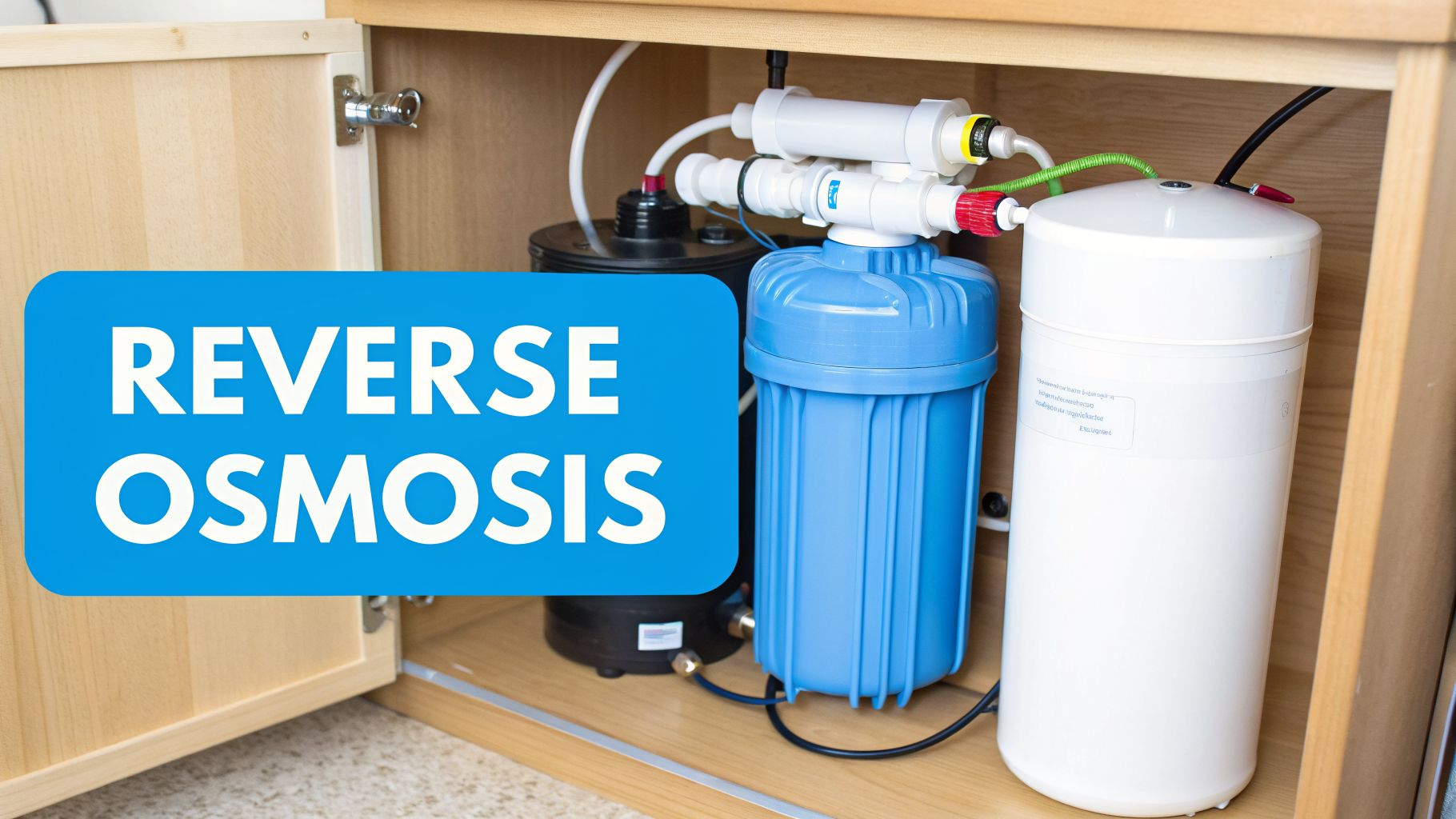
While a good carbon filter is fantastic for making water taste great, some homes need to bring in the big guns. When you're aiming for the highest level of purity, reverse osmosis (RO) is the gold standard among the different types of water filtration methods.
Think of it as a microscopic bouncer at the door of a very exclusive club, but for water. Using your home’s existing water pressure, an RO system forces tap water through a special semipermeable membrane. This isn't just any filter—its pores are incredibly tiny, around 0.0001 microns.
Only pure water molecules are small enough to get past this gatekeeper. Everything else, from dissolved salts and minerals to heavy metals, gets turned away and flushed down the drain. It’s an amazingly effective way to remove a long list of contaminants that other filters just can’t handle.
How The Multi-Stage Process Delivers Purity
An RO system isn't just one filter; it's a team of filters working in harmony. A typical system you'd install under your sink uses several stages to deliver that pristine-tasting water.
- Sediment Pre-Filter: This is the bouncer at the front door. It catches the big stuff like sand, silt, rust, and other debris. Its main job is to protect the more sensitive filters down the line from getting gummed up.
- Carbon Pre-Filter: Next, the water flows through an activated carbon filter. This stage is crucial because it removes chlorine and other chemicals that could damage the delicate RO membrane.
- The RO Membrane: Here's where the real magic happens. Pressurized water is forced through the membrane, which separates the pure H₂O from almost all other dissolved solids and contaminants.
- Carbon Post-Filter: After the purified water leaves a small storage tank, it gets a final "polish" from another carbon filter. This step ensures any lingering tastes or odors are gone before the water hits your glass, making it taste crisp and clean.
This multi-pronged attack is why RO is so trusted for tackling some of the toughest water problems.
A high-quality RO system can remove up to 99% of total dissolved solids (TDS), including difficult contaminants like lead, fluoride, arsenic, nitrates, and salts.
Reverse Osmosis is easily one of the most popular types of water filtration methods, especially for people dealing with tricky contaminants in either city or well water. In fact, RO systems are expected to corner the market, projected to capture about 55% of the global share by 2026 as more people grow concerned about water quality. It's the go-to choice for removing heavy metals, nitrates, and even some bacteria. You can see the data behind this trend by exploring the full report on global water purifiers.
Practical Things To Consider Before You Buy
While RO delivers incredible purity, there are a few practical points to know upfront. The process is extremely thorough, which also means it's slow. That’s why RO systems include a small storage tank under the sink—to keep a supply of purified water ready for you whenever you need it.
You also have to account for wastewater. To keep the membrane from clogging up with all the junk it removes, the system constantly flushes the rejected contaminants away. Modern, high-efficiency systems have gotten much better at reducing this, but it’s just part of how RO works.
Finally, the intensive filtering process lowers the water pressure slightly, which is why most RO kits come with their own dedicated faucet. These are pretty minor trade-offs when you consider you're getting exceptionally clean, safe drinking water right at your kitchen sink.
Advanced and Specialized Filtration Systems
Sometimes, the usual suspects like carbon and reverse osmosis filters aren't enough. Certain situations, especially if you're on well water, call for a more specialized approach to handle specific, often invisible, threats.
Think of these advanced systems as the specialists on your water treatment team. They work alongside your primary filters, adding another layer of defense to create a truly comprehensive shield against a wider array of contaminants.
Ultraviolet (UV) Purification: The Germ Killer
If your water comes from a private well, your number one concern should be microbiological safety. This is exactly where Ultraviolet (UV) purification comes in. It's a completely chemical-free process that acts like a final security checkpoint, zapping dangerous microorganisms before they can ever get to your glass.
A UV system doesn’t actually remove anything. Instead, as water passes through a chamber, it's blasted with powerful UV-C light. This light instantly scrambles the DNA of living organisms, making it impossible for them to reproduce and make you sick.
It's incredibly effective against:
- Bacteria like E. coli and coliform
- Viruses like rotavirus and norovirus
- Protozoan Cysts like Giardia and Cryptosporidium
Here's the critical part: UV light only works if the water is clear. If your water is cloudy or has sediment, those tiny particles can act like microscopic shields, protecting germs from the UV rays. That's why a UV system must always be installed after a sediment pre-filter.
Kinetic Degradation Fluxion (KDF): The Heavy Metal & Chlorine Neutralizer
Another specialist filter is Kinetic Degradation Fluxion, or KDF. This unique filter media uses a clever electrochemical process—basically, a tiny battery—to transform or remove very specific contaminants. It's made from granules of high-purity copper and zinc.
As water flows across the KDF media, the two different metals create a small electrical charge. This process instantly converts chlorine into a harmless chloride salt. It also helps get rid of heavy metals like lead, mercury, and iron by causing them to plate onto the surface of the KDF media itself.
One of the best things about KDF is that it's bacteriostatic—it stops bacteria, algae, and fungi from growing right inside the filter. This keeps the filter unit clean and can dramatically extend the life of other filters, like activated carbon, when they're used together. While these systems are common for homes, even more specialized equipment like a lab water purifier for distilled water exists for highly specific purification needs.
The demand for this kind of advanced technology is exploding. The market for systems including UV and KDF is projected to hit a massive USD 113.7 billion by 2034, thanks to new tech and a growing public awareness about complex water quality problems.
How to Choose the Right Filtration Method for Your Home
Alright, now that you're an expert on filter types, let's get down to business: picking the right one for your home. Don't overthink it. This really comes down to a simple, three-step approach: know your water, know your goal, and know your budget.
First, You Have to Know What's in Your Water
You can't fix a water problem if you don't know what it is. The first move is always to get a clear picture of what's coming out of your tap. How you do this depends on where your water comes from.
-
For City Water: If you pay a water bill, your water utility provides an annual water quality report, often called a Consumer Confidence Report (CCR). This is your starting point—it lists all the contaminants they've tested for and what levels they found. Look it up on their website!
-
For Well Water: If you're on a private well, you're the water manager. The only way to really know what's in your water is to test it. You can get a basic idea with a DIY test kit from a hardware store, but for the full, accurate story, you'll want to send a sample to a state-certified lab.
Next, What's Your Main Goal?
Once you know what you’re up against, you can decide what you want to achieve. What's the number one thing you want to fix?
-
Bad Taste and Odor: Is your water tasting like a swimming pool or smelling a bit funky? An activated carbon filter is your best friend. It’s a straightforward and affordable way to make your water taste great again.
-
Hard Water Scale: Sick of that white, chalky buildup on your faucets, showerheads, and inside your appliances? Your enemy is hard water minerals. The only tool built specifically for this job is an ion exchange water softener.
-
Specific Health Contaminants: Did your water test flag high levels of things like lead, arsenic, fluoride, or nitrates? Now you need serious protection. A reverse osmosis (RO) system is the gold standard for stripping out these tough contaminants.
This diagram shows how your water source, especially well water, points you toward the right solution for microbiological safety.

As you can see, there's one non-negotiable rule here: if you have well water, you need a UV filter to protect against bacteria and viruses. It’s all about safety.
Finally, Consider Your Budget and Maintenance
The perfect system is one you can actually afford to buy and maintain. Think about the upfront cost, but don't forget the long-term expenses.
The total cost of ownership includes not just the initial system but also the price and replacement frequency of its filters. A cheap system with expensive or hard-to-find filters can be a headache down the road.
Think about installation, too. Many under-sink and countertop filters are easy enough to install yourself. But whole-house systems? You'll likely need to call in a plumber.
Factoring in these real-world details will help you pick a filter you’ll be happy with for years to come. For more personalized recommendations, you can always check out our resources on choosing the right water filter for your home.
Your Top Water Filtration Questions Answered
Diving into the world of water filters can feel overwhelming. A lot of questions come up, and you need clear, straight answers. We've been there. Let's tackle some of the most common questions we hear from homeowners just like you.
What Is the Real Difference Between Filtration and Purification?
It's simpler than it sounds. Think of filtration as a physical barrier. It’s like a screen that stops the big stuff—sediment, rust, and silt. It can also use materials like activated carbon to grab hold of chemicals like chlorine, which is why it's so good at making your water taste and smell better instantly.
Purification goes a step further. It targets the microscopic threats you can't see, like bacteria, viruses, and other nasty organisms. A UV light purifies by zapping these germs so they can't reproduce, while a system like reverse osmosis purifies by forcing water through a membrane so fine that almost nothing but pure H₂O gets through.
Should I Get a Whole House Filter or Is Under Sink Enough?
This all depends on your main goal.
If you're just looking for pristine water for drinking and cooking, an under-sink system is a fantastic, targeted solution. You get maximum power right at the kitchen tap where you use it most, without spending a fortune.
But if you’re fighting hard water that's wrecking your pipes and appliances, or if you can't stand that chlorine smell in the shower, a whole-house system is the way to go. It treats every drop of water entering your home, protecting your entire plumbing system and giving you filtered water from every faucet.
How Often Do I Really Need to Change My Filters?
This is the most important part of owning a filter. If you don't change them, they don't work. Period. The schedule depends on the filter type and how much water you run through it.
Here’s a quick rundown:
- Pitcher Filters: These work hard but don't last long. Plan on changing them every 2 months.
- Under-Sink Carbon/Sediment Filters: You'll typically get 6 to 12 months out of these.
- Reverse Osmosis Membranes: The RO membrane is the heart of the system and is built to last, usually from 2 to 5 years.
Pay attention to the manufacturer's instructions. An old, clogged filter won't just stop working; it can dump all the junk it's collected right back into your water. Do yourself a favor and set a reminder on your phone. It’s a simple step that makes all the difference.
What Do Those NSF Certifications Actually Mean?
Think of an NSF certification as proof. It's an independent, third-party guarantee that the filter actually does what the company claims it does. It's a big deal.
Here are the main ones to look for:
- NSF 42: This certifies the filter makes your water look, taste, and smell better by reducing things like chlorine.
- NSF 53: This is a much stricter standard. It verifies the filter removes contaminants that can affect your health, like lead, mercury, and cysts.
- NSF 58: This is specifically for reverse osmosis systems. It confirms the system is effective at drastically reducing a long list of contaminants.
Ready to find the perfect filtration system for your home? At Water Filter Advisor, we provide in-depth reviews, buying guides, and practical advice to help you make a confident choice. Visit us at https://www.waterfilteradvisor.com to get started on your journey to safer, better-tasting water.
- March 13, 2026
- 0
- Uncategorized
