You turn on the kitchen tap, fill a glass, and catch that sharp sulfur smell before the water even reaches your lips. Then the shower starts to smell the same way. Laundry picks up a faint funk. Suddenly a normal part of home life feels off.
If that sounds familiar, you're not dealing with “bad tasting water” in some vague sense. You're dealing with a specific water problem that usually has a specific fix. The trick is choosing the right one. A water filter for rotten egg smell has to match the cause and the strength of the contamination, or you'll waste money on a system that never had a fair chance.
That Unmistakable Rotten Egg Smell in Your Water
Most homeowners notice it the same way. One day the water seems fine. Then a faucet runs, and the room gets hit with an odor that smells like a carton of eggs forgotten in the sun. You rinse a dish and wonder if the sink drain is the problem. You take a sip and realize it's the water itself.
That smell often points to hydrogen sulfide, the contaminant behind the classic rotten egg odor in household water. It's common in homes on private wells, but the location of the smell matters just as much as the smell itself. Some houses have odor in every tap. Others only notice it in hot water. Those are not the same problem, and they shouldn't get the same treatment.
A lot of people make the same first mistake. They buy a basic taste-and-odor filter, install it under one sink, and hope for the best. Then the bathroom still smells. The shower still smells. The washing machine still gets smelly water. That's like trying to stop a roof leak with a towel on the floor. You're treating the symptom where you notice it, not the source.
Practical rule: Rotten egg odor is usually fixable, but only when the filter matches the actual source and concentration of the sulfur problem.
The good news is that this is a very solvable issue. You don't need to become a chemist. You just need a simple way to diagnose where the smell comes from, understand why one filter works at one sulfur level and fails at another, and pick a system that fits your home instead of guessing.
Why Your Water Smells Like a Science Experiment
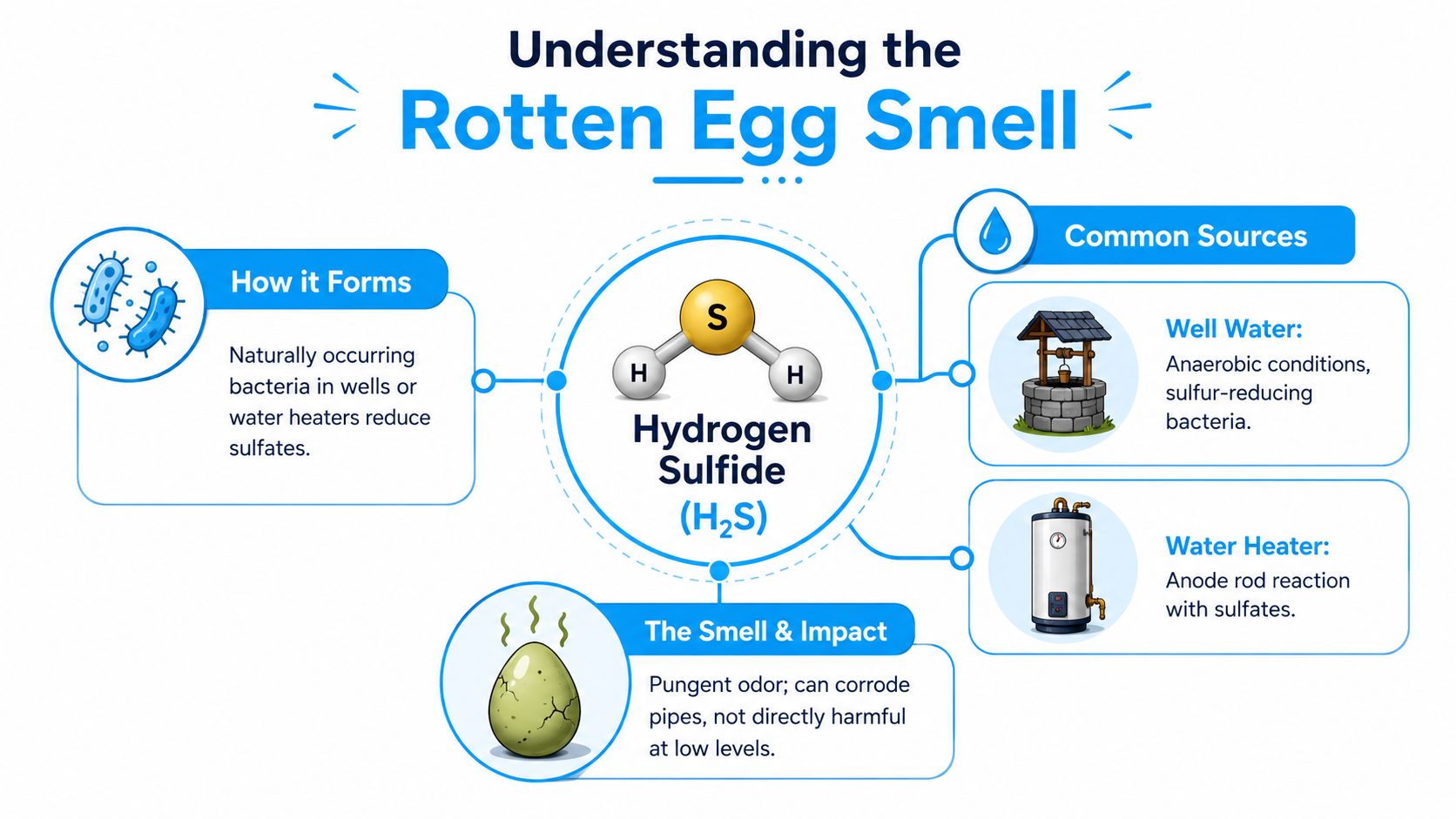
Hydrogen sulfide gas, written as H2S, is usually the reason water smells like rotten eggs. The smell can start underground before the water ever reaches your house, or it can develop inside plumbing equipment after the water gets there.
How hydrogen sulfide forms
Here's what is happening in plain English. In places with little oxygen, such as parts of a well system or inside a water heater, sulfur-related bacteria can convert naturally occurring sulfur compounds into hydrogen sulfide gas. That gas dissolves into the water while it sits under pressure. Once the water comes out of the faucet, some of the gas escapes into the air, and your nose catches it fast.
Heat makes that process more obvious. Warm water releases dissolved gas more readily, the same way a warm soda goes flat faster once opened. That is why showers, dishwashing, and hot tap water often make the odor seem stronger even when the water looks perfectly clear.
The important part is this. Smell strength gives you a clue about treatment size. A faint odor can sometimes be handled by a simple adsorptive filter. A stronger or persistent odor usually needs a system that changes the hydrogen sulfide first, then removes the byproducts. That is the difference between a fix that lasts and a filter that disappoints after a short time.
Two common sources inside a home
The source usually falls into one of two categories.
- Incoming well or supply water. Sulfur is already present before the water enters the house, so the smell can show up throughout the plumbing system.
- The water heater. Conditions inside the heater can create or worsen hydrogen sulfide, especially when the anode rod and sulfur-related bacteria interact.
That distinction matters because the same smell can come from very different chemistry. If the heater is the only source, replacing parts or disinfecting the heater may solve it. If the well water carries the sulfur, the treatment usually belongs at the point where water enters the house.
Why the right filter depends on sulfur level
Filter choice makes more sense when you match it to how much hydrogen sulfide is in the water. A light-duty carbon filter can sometimes reduce a low level of sulfur odor, much like using a small kitchen fan to clear a little smoke. If the concentration is higher, carbon gets used up quickly because it is trying to catch too much at once.
At that point, oxidation becomes the better tool. Oxidizing media or air-injection systems convert hydrogen sulfide into a form the filter can remove more effectively. In practical terms, low sulfur levels may respond to carbon, while moderate to higher levels usually call for oxidation followed by filtration.
The goal is not to buy the strongest system on the market. The goal is to choose a system that matches your actual hydrogen sulfide level, so you do not overspend on heavy equipment or under-treat a serious odor problem.
That is why sulfur treatment is more diagnostic than decorative. Different filters solve different ranges of contamination, and the concentration of hydrogen sulfide is what tells you which tool belongs in your home.
Pinpointing the Source of the Sulfur Smell
Before you buy anything, do a little detective work. The goal is to answer one question first: Is the smell coming from the water heater, or from the water entering the house?
Start with the hot-versus-cold test
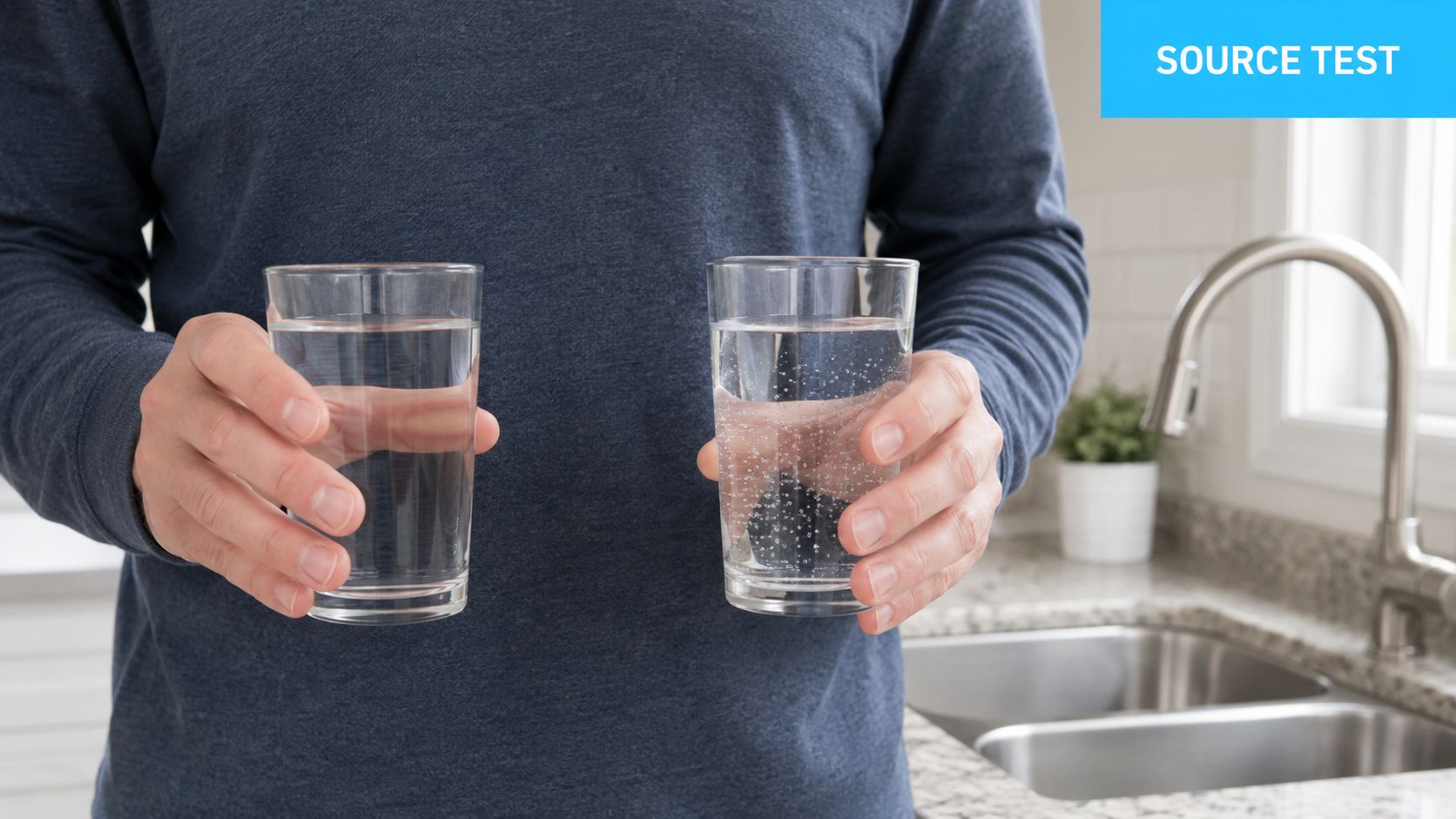
Pour one glass of cold water and one glass of hot water from the same faucet. Smell each one.
- Only the hot water smells. The water heater is the first place to inspect.
- Both hot and cold smell. The issue is more likely in the well or incoming water.
- The smell shows up at some taps but not others. Plumbing location, stagnant lines, or fixture-specific issues may be making the problem seem bigger or smaller than it is.
This quick test saves people from buying the wrong system all the time.
Use your nose, but don't stop there
You can also note when the odor is strongest.
- At first draw in the morning can suggest water sitting in plumbing.
- During hot showers often makes sulfur more noticeable because heat releases gas.
- At every faucet in the house points toward whole-house treatment, not a kitchen-only fix.
A short walkthrough can tell you a lot. Check the kitchen sink, a bathroom sink, the tub, and an outdoor spigot if you have one.
For a visual walkthrough of common causes and treatment approaches, this video is a useful starting point:
Get the number before you choose the filter
If the smell is in the incoming water, the next step is water testing. You want the hydrogen sulfide concentration, usually reported in mg/L or ppm. For this contaminant, those units are commonly treated as roughly equivalent in practical home filtration discussions.
That number matters because filter selection depends on it. Without it, choosing a sulfur filter is a little like buying eyeglasses without an eye exam. You might get lucky, but you probably won't.
Best habit: Test first, buy second. Sulfur treatment works best when it's sized to a measured problem, not a guessed one.
Matching the Filter to Your Water Problem
A rotten egg smell at one sink can tempt you to buy the first sulfur filter you find. That is how homeowners end up paying for a system that is too small to keep up, or far more equipment than the water needs.
The smarter approach is to match the treatment to the measured hydrogen sulfide level. The concentration tells you how hard the system has to work. A light odor and a heavy sulfur problem may smell similar at first, but they do not call for the same tool.
Low sulfur levels
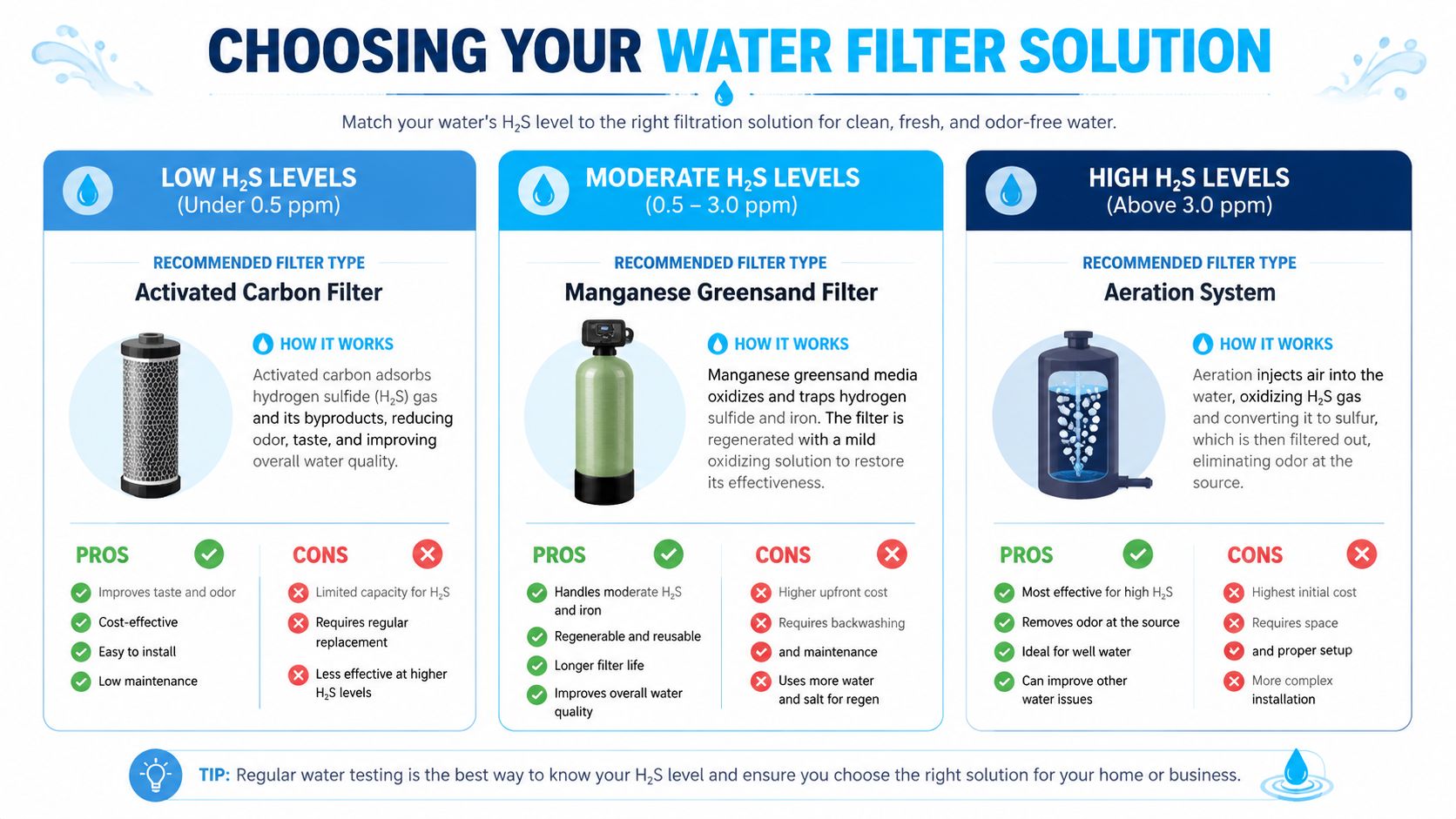
If your test result is below 1.0 mg/L, activated carbon is often enough.
Carbon works best when the sulfur level is mild because it removes odor by holding contaminants on its surface. That is useful for a lighter sulfur load, but it has limits. If hydrogen sulfide is too high, the media gets used up too quickly and performance drops sooner than many homeowners expect.
This range is often a good fit for a properly sized whole-house carbon system, especially if your main goal is odor control rather than heavy chemical treatment. If you are comparing whole-house housings and setups, filtration for your entire home can help you picture what that equipment category looks like.
Moderate sulfur levels
If testing lands between 1.0 mg/L and 6.0 mg/L, standard carbon usually stops being the best choice.
At this point, you usually need an oxidizing media filter, such as manganese greensand. These systems do two jobs in sequence. First, they change dissolved hydrogen sulfide into solid sulfur particles. Then they trap those particles in the filter bed.
That two-step process matters. Carbon is mainly a holding media. Oxidizing media actively changes the contaminant before removal, which is why it holds up better when sulfur levels move past the mild range.
High sulfur levels
If hydrogen sulfide is above 6.0 mg/L, treatment needs to be more aggressive. Continuous chlorination followed by filtration is the common answer in this range, as noted earlier.
The reason is straightforward. At higher concentrations, sulfur odor is no longer a small nuisance that a simple media bed can handle easily. You need a method that can oxidize the sulfur consistently and then clean up the byproducts before the water reaches your fixtures.
Why the number matters so much
A low reading points you toward a simpler, lower-cost fix. A moderate reading points you toward oxidation media. A high reading calls for chemical feed and follow-up filtration.
That is the part many buying guides skip. They list products, but they do not explain why one filter works at one concentration and struggles at another. Choosing by test result helps you avoid under-treating the water, and it also helps you avoid overspending on equipment meant for a problem you do not have.
Aeration is a good example. It can help in lighter sulfur situations, but once levels climb, relying on air alone often leaves odor behind. The filter has to match the actual sulfur load, not just the smell in your memory from the tap.
Water Filter Options for Rotten Egg Smell
| Treatment Method | Effective H2S Range (mg/L) | How It Works | Typical Maintenance |
|---|---|---|---|
| Activated carbon filtration | Below 1.0 | Adsorbs hydrogen sulfide onto carbon media | Replace media or cartridges as performance drops |
| Manganese greensand or similar oxidizing media | 1.0 up to 6.0 | Oxidizes hydrogen sulfide into sulfur particles, then filters them out | Periodic regeneration with potassium permanganate |
| Continuous chlorination followed by filtration | Exceeds 6.0 | Chlorine oxidizes hydrogen sulfide, then filtration removes the byproducts | Refill chemical feed and maintain downstream filtration |
| Air injection with catalytic activated carbon | Higher-capacity sulfur treatment in some applications | Uses aeration and catalytic carbon to oxidize and filter sulfur | Monitor media condition and system performance |
If you want more side-by-side help comparing treatment styles, maintenance demands, and sizing questions, the guides in Water Filter Advisor's advice library are a useful next step.
Advanced and Whole-House Sulfur Removal Systems
A small under-sink filter can help one faucet. A whole-house sulfur problem needs equipment at the main line, where all water enters the home. That is the difference between treating a symptom and fixing the source for every shower, sink, toilet, and appliance.
The right system depends on why the smell is happening and how much hydrogen sulfide your water test found. That number matters. A light sulfur problem can often be handled with simpler oxidation and filtration. Higher concentrations usually need a system that can oxidize more sulfur, hold more media, and clean itself through backwashing so it does not clog and lose performance.
Air injection oxidation systems
Air injection oxidation systems, often called AIO systems, add a pocket of air inside the treatment tank. As water passes through, the oxygen reacts with dissolved hydrogen sulfide. The smell-causing gas is changed into sulfur particles, and the filter media traps those particles.
AIO works like pre-soaking a stained shirt before washing it. The air does the prep work so the media can finish the job.
This type of setup makes sense when sulfur odor shows up throughout the house and your test results point to a moderate sulfur load that can be handled without chemical feed equipment. It is also a practical fit for homeowners who want one central system instead of replacing cartridges at several taps.
Catalytic carbon and combination media
Catalytic carbon is a stronger version of standard carbon for sulfur control. Standard activated carbon is better suited to lighter odor issues. Catalytic carbon does more. It helps speed up oxidation while also filtering out the byproducts, which is why it is often paired with air injection in whole-house systems.
That pairing is useful in the middle range, where basic carbon cartridges are too small and too limited, but a chemical injection system may be more than the water requires. If your hydrogen sulfide level sits in that middle ground, catalytic carbon can be the right-sized tool instead of an expensive overcorrection.
Some combination media go a step further by targeting sulfur, iron, and manganese together. That matters because these contaminants often travel as a group in well water. If you only treat the sulfur smell and ignore iron or manganese, you may still end up with staining, media fouling, or shortened filter life.
High-capacity systems for mixed water problems
Specialty backwashing media systems are built for heavier work. They are often chosen when sulfur odor is strong, the measured hydrogen sulfide concentration is higher, or the water test also shows iron and manganese. In that situation, a single-tank backwashing system can make more sense than stacking several smaller filters that each handle only part of the problem.
A good comparison helps here. A cartridge housing is like a kitchen strainer. It catches what reaches it, but it fills up fast. A backwashing sulfur filter is closer to a self-cleaning yard drain. It is designed to handle a larger load and flush itself on schedule.
If you're comparing whole-house layouts and want a simple example of filtration for your entire home, it helps to see how entry-level whole-house housings differ from sulfur-specific backwashing systems. They may both connect to the main water line, but they solve very different problems.
Bigger equipment only helps when the water chemistry calls for it. The goal is not the largest tank. The goal is enough oxidation capacity and enough media for your measured sulfur level and household flow rate.
Chemical injection systems
When hydrogen sulfide levels are high, chemical injection systems are often the next step. These systems feed an oxidant, commonly chlorine or hydrogen peroxide, into the water before filtration. The oxidant reacts with the sulfur gas first. A downstream filter then removes the oxidized material.
This approach is often chosen because strong sulfur loads can overwhelm simpler systems. It also gives more treatment control when the smell is severe or when multiple nuisance contaminants are present.
Hydrogen peroxide gets attention from homeowners who want an oxidant that does not create the same taste concerns people sometimes associate with chlorine. Chlorine systems remain common because they are familiar, widely available, and can also disinfect when the water has a bacteria concern. The better choice depends on the test results and on whether your problem is odor alone or odor plus microbial risk.
For a homeowner, the practical takeaway is simple. Low sulfur levels can often be handled by smaller systems. Moderate levels often point toward air injection and catalytic carbon. Higher levels, or sulfur combined with iron and manganese, usually justify backwashing specialty media or chemical injection. Match the system to the measured concentration, and you avoid paying for treatment power you do not need or living with a system that never fully solves the smell.
Installation and Long-Term Maintenance Tips
A sulfur filter can be perfectly chosen on paper and still disappoint in real life if it is installed in the wrong spot or maintained like an afterthought. Homeowners often blame the equipment first. The setup is just as important.
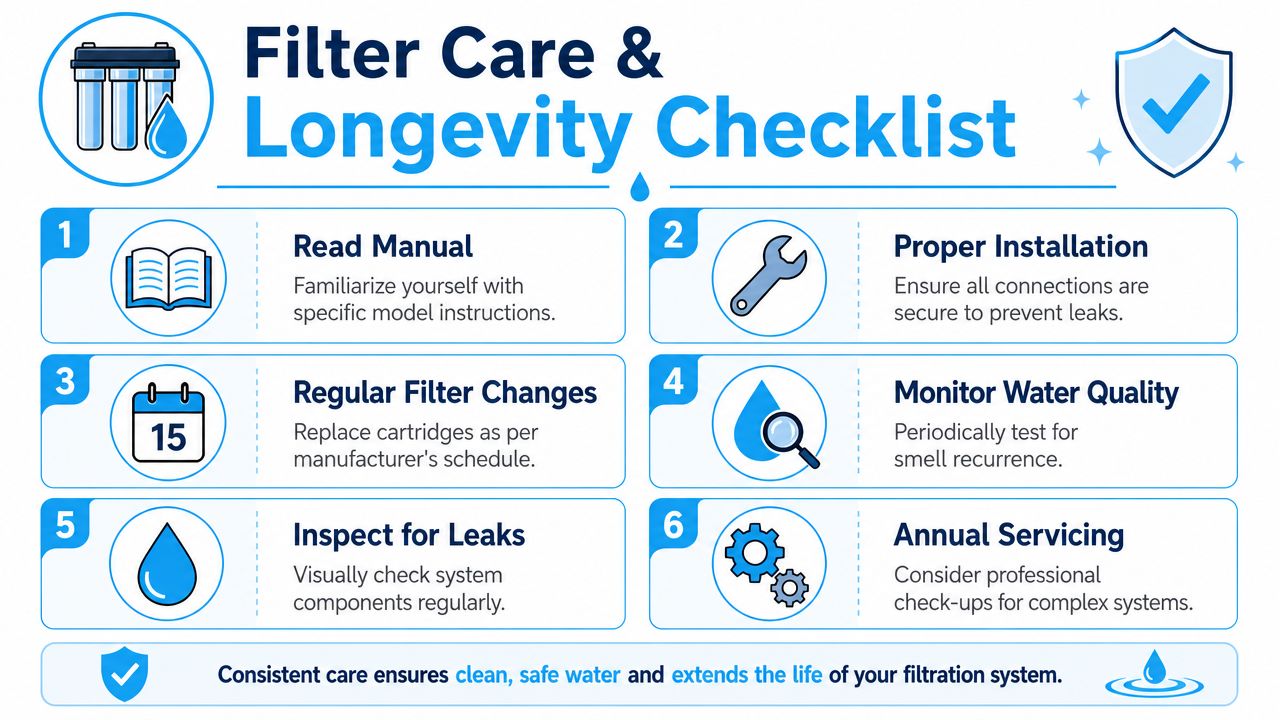
What to check before installation
Start with placement and sizing, not the box label.
A sulfur system has to match three things at once. Your water chemistry, your household flow rate, and the kind of maintenance you will keep up with. A good comparison is a furnace filter. The right filter still fails if the airflow is wrong or nobody changes it.
Before installing anything, check these practical points:
- Flow rate for backwashing. Backwashing filters need enough water volume to lift and clean the media bed. If the well pump or plumbing cannot deliver that flow, the media can foul early and lose performance.
- Space and drain access. Air injection, oxidizing filters, and other whole-house systems usually need tank clearance, a power outlet, and a place to send backwash water.
- Measured sulfur level. This matters more than many homeowners realize. A system sized for a light odor can struggle if hydrogen sulfide is much higher, and an oversized system can cost more than you need to spend.
- Iron and manganese in the same water. These contaminants often travel with sulfur. They can clog media, stain fixtures, and change which filter media makes sense.
- Where the smell shows up. One sink may call for a local fix. Odor in showers, laundry, and every faucet points to whole-house treatment.
- Your maintenance tolerance. Some systems ask for little more than periodic checks. Others require solution refills, regeneration chemicals, or valve programming.
Why maintenance changes results so much
Two homes can install the same carbon filter and get very different results. The reason is simple. The filter is doing a workload, and that workload depends on how much hydrogen sulfide is in the water, how much water the family uses, and what else is competing for the media.
Carbon works like a sponge for odor compounds, but a sponge fills up. If your sulfur level is low, carbon may last a reasonable amount of time. If the sulfur level is higher, or iron and manganese are also present, that same carbon can load up fast. That is why matching the system to the tested concentration matters not just at purchase, but for the long haul. It helps you predict maintenance instead of being surprised by it.
This is also where homeowners overspend or under-treat. A heavier-duty system is not automatically better. It is better only when the sulfur load calls for it.
A simple maintenance calendar mindset
Put maintenance on the calendar and treat odor return as a clue, not a mystery.
- Carbon systems. Replace cartridges or media before odor fully returns. Waiting for a strong smell usually means the media has been spent for a while.
- Backwashing sulfur filters. Check that backwash cycles are happening on schedule and that the drain line is clear.
- Manganese greensand systems. Keep regeneration supplies topped off and confirm the control valve settings are still correct.
- Chemical injection systems. Refill the oxidant solution, inspect the feed pump, and make sure the injection point and retention components stay clean.
- Any whole-house system. Watch for pressure drop, leaks, unusual sounds, or bypass valves left in the wrong position after service.
A sulfur filter rarely fails without a reason. The usual causes are exhausted media, missed maintenance, changing water conditions, or an installation that never matched the home's flow needs.
DIY or professional install
A basic cartridge setup is often manageable for a confident DIY homeowner. Whole-house sulfur treatment is a different tool altogether. Backwashing filters and injection systems usually involve plumbing changes, drain connections, startup settings, and a few details that affect performance for years.
Professional installation often makes sense when the system is tied closely to a measured hydrogen sulfide level and a target flow rate. If the setup is off, the filter may look fine but never treat the water properly. Paying for correct installation once is often cheaper than replacing media early, chasing odor complaints, or buying a second system to fix the first one.
Frequently Asked Questions About Sulfur Odor
Is rotten egg smell in water dangerous
In many homes, sulfur odor is a water quality nuisance more than an immediate health threat. The smell usually comes from hydrogen sulfide gas, and even small amounts can make a glass of water unpleasant to drink or cook with.
That said, smell alone is a poor measuring tool. Two people can notice the same odor very differently. Testing matters because sulfur odor can appear alongside iron, manganese, bacteria, or corrosion problems, and the right fix depends on what is present in the water.
Will a water softener fix sulfur smell
Usually, no.
A water softener is built to remove hardness minerals such as calcium and magnesium. It is the wrong tool for dissolved hydrogen sulfide, much like using a broom when the problem calls for a mop. If your test shows sulfur as the main issue, choose a sulfur treatment system sized for that measured level instead of expecting the softener to do a job it was not designed to do.
Why does only my hot water smell
A hot-water-only sulfur smell often points to the water heater. Warm conditions inside the tank can encourage reactions that create or release that rotten egg odor, even when the cold water seems normal.
A simple check helps narrow it down. Run cold water at the same faucet, then hot water. If the smell appears only on the hot side, the heater is a likely suspect. If both smell, the source is more likely in the incoming water.
What's the cheapest water filter for rotten egg smell
The cheapest option that works depends on your hydrogen sulfide level.
Low sulfur levels may respond to catalytic carbon. Higher levels usually need a stronger approach, such as an oxidizing filter or an injection system. Many homeowners, however, waste money. They buy the lowest-cost filter first, but if it is undersized for the contamination level, the odor returns, media wears out faster, and the second purchase ends up costing more than the right system would have in the first place.
The smart question is not “What is the cheapest filter?” It is “What filter matches my test result?”
Is hydrogen peroxide injection a real option
Yes, for some wells it is a practical choice. Hydrogen peroxide works by oxidizing hydrogen sulfide so the smell can be removed more effectively downstream. It can be a good fit when sulfur levels are too high for simple carbon alone, or when water conditions change enough that a stronger treatment method makes sense.
It also asks more from the homeowner. You have to keep the solution filled, check the feed equipment, and make sure the rest of the system is set up to handle the oxidized sulfur properly. As noted earlier, some homeowners use it as an alternative to periodic chlorination, but its success depends on matching the setup to the water test, not just installing a pump and hoping for the best.
If you're ready to stop guessing, Water Filter Advisor is a solid place to compare filter types, understand sulfur treatment options, and find a water filter for rotten egg smell that fits your home's water conditions.
- July 3, 2026
- Uncategorized
