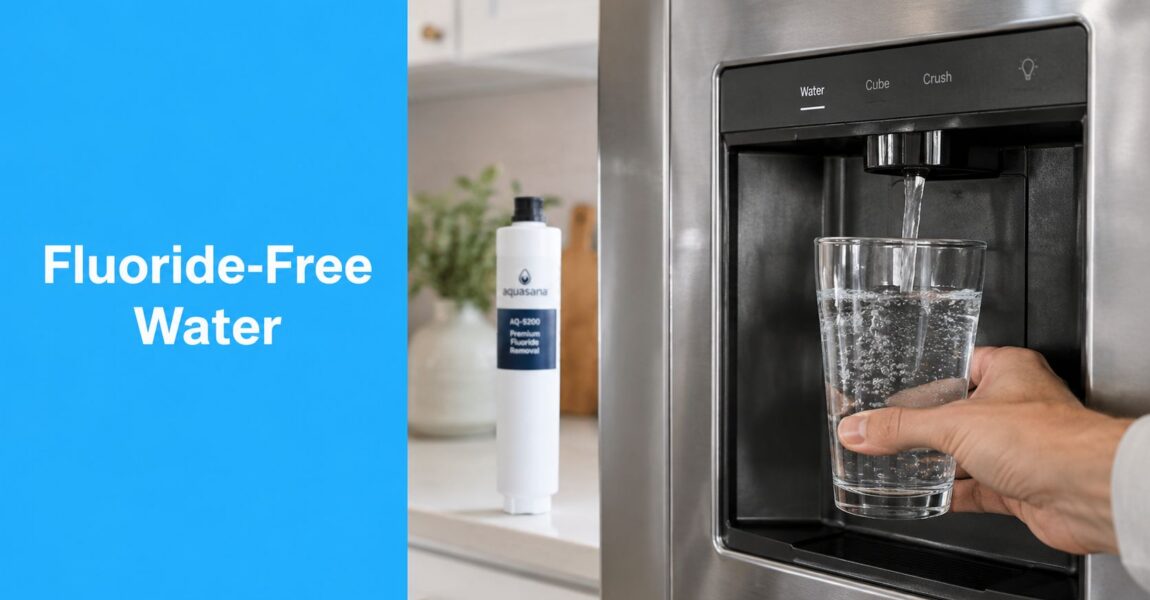
Standard refrigerator filters don't remove fluoride. Most are carbon filters with pores around 20 microns, while specialty options like reverse osmosis or fluoride-specific media can reach about 90 to 100% fluoride reduction when the system is designed for that job.
That surprises a lot of homeowners because a built-in fridge dispenser feels like the final step in clean water. You buy the fridge, snap in a fresh cartridge, and assume the water coming out is cleaner in every meaningful way. For chlorine taste and odor, that assumption is fair. For fluoride, it usually isn't.
If you're trying to find refrigerator water filters that remove fluoride, the first thing to know is simple: the standard filter inside the fridge almost certainly isn't doing it. The second thing to know is better news. There are workable solutions for home use, including setups that still let you get filtered water and ice right from the refrigerator door.
Your Fridge Filter and Fluoride The Unfiltered Truth
A lot of people trust the factory filter because it came with the appliance. That's understandable. Built-in filters feel official, and the dispenser gives the impression that the hard part is already handled.
But the common assumption is wrong more often than many realize. Emerging 2025 data says inline fluoride filters are now available for fridges, but 60% of buyers still assume standard fridge filters work, and 90% of fridge filters remove only 5 to 20% of fluoride. The same source notes that standard ANSI/NSF 42 fridge filters are built for chlorine, taste, and odor, not fluoride removal, which is why so many households think they're covered when they aren't (SoftPro Water Systems on refrigerator filters and fluoride).
That doesn't mean fluoride is automatically a villain. Some households want to keep it. Others want to reduce it. If you're still sorting out that decision, this plain-language explainer on how fluoride strengthens teeth gives useful context before you buy equipment.
Why this matters in real kitchens
Water treatment decisions get muddled when people mix up two different goals:
- Better taste: A fridge filter often helps a lot with chlorine smell and off flavors.
- Fluoride reduction: A standard fridge filter usually isn't built for that.
- Convenience: The dispenser is easy to use, which makes people assume it's also broadly effective.
Practical rule: A refrigerator filter is usually a taste-and-odor filter first. If you want fluoride reduction, you need a dedicated technology that targets fluoride on purpose.
Families often spend months replacing cartridges faithfully while fluoride levels stay largely unchanged. That isn't user error. It's a mismatch between the contaminant and the filter media.
So if your target is fluoride-free or fluoride-reduced water from the fridge, the fix isn't buying another generic replacement cartridge and hoping for better luck. The fix is choosing the right treatment method upstream or using a true specialty system.
The Science Behind Why Your Fridge Filter Fails
The reason most fridge filters miss fluoride comes down to physics and chemistry, not marketing language.
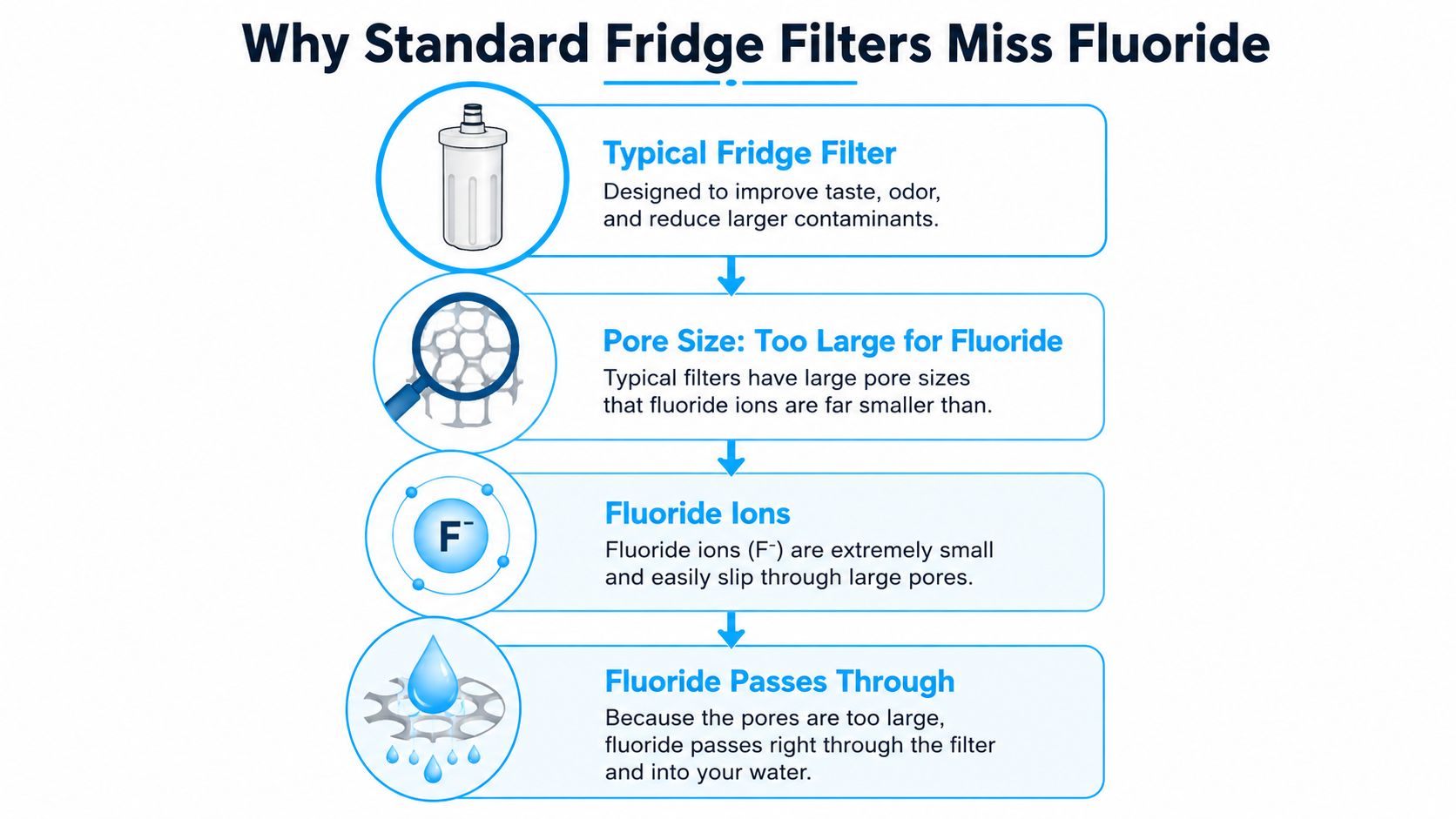
Most refrigerator filters rely on activated carbon. Carbon is excellent at grabbing chlorine compounds that cause bad taste and odor. It's much less useful for dissolved fluoride ions moving in water.
Carbon is a good sponge for some things, not all things
Think of a standard refrigerator filter like a fishing net made for leaves and twigs. It does a solid job when the target is relatively easy to catch. Fluoride is more like fine dye dissolved in water. The water carries it right through.
Standard refrigerator water filters rely primarily on activated carbon with pore sizes around 20 microns and can't effectively remove fluoride ions from tap water. They're typically certified under ANSI/NSF 42 for chlorine, taste, and odor reduction, which tells you what they are designed to do and, just as important, what they are not designed to do (Onit on fridge filters and fluoride removal).
Why fluoride slips through
Fluoride in drinking water exists as a dissolved ion. That matters because dissolved ions don't behave like sediment, rust flakes, or chlorine byproducts.
A standard fridge cartridge is usually good at these jobs:
- Chlorine reduction: Carbon adsorbs chlorine compounds well.
- Taste improvement: Better tasting water is exactly what many fridge filters are built for.
- Odor control: Sulfur-like or chemical smells may improve depending on the water.
It's usually poor at this one:
- Fluoride removal: The media and design aren't specialized for binding fluoride ions.
If a filter only says it reduces chlorine, taste, and odor, don't assume fluoride is included. It usually isn't.
Why a better carbon cartridge still won't solve it
Homeowners waste money in this scenario. They upgrade from one carbon cartridge to another, maybe from generic to premium, and expect fluoride performance to jump.
It usually won't.
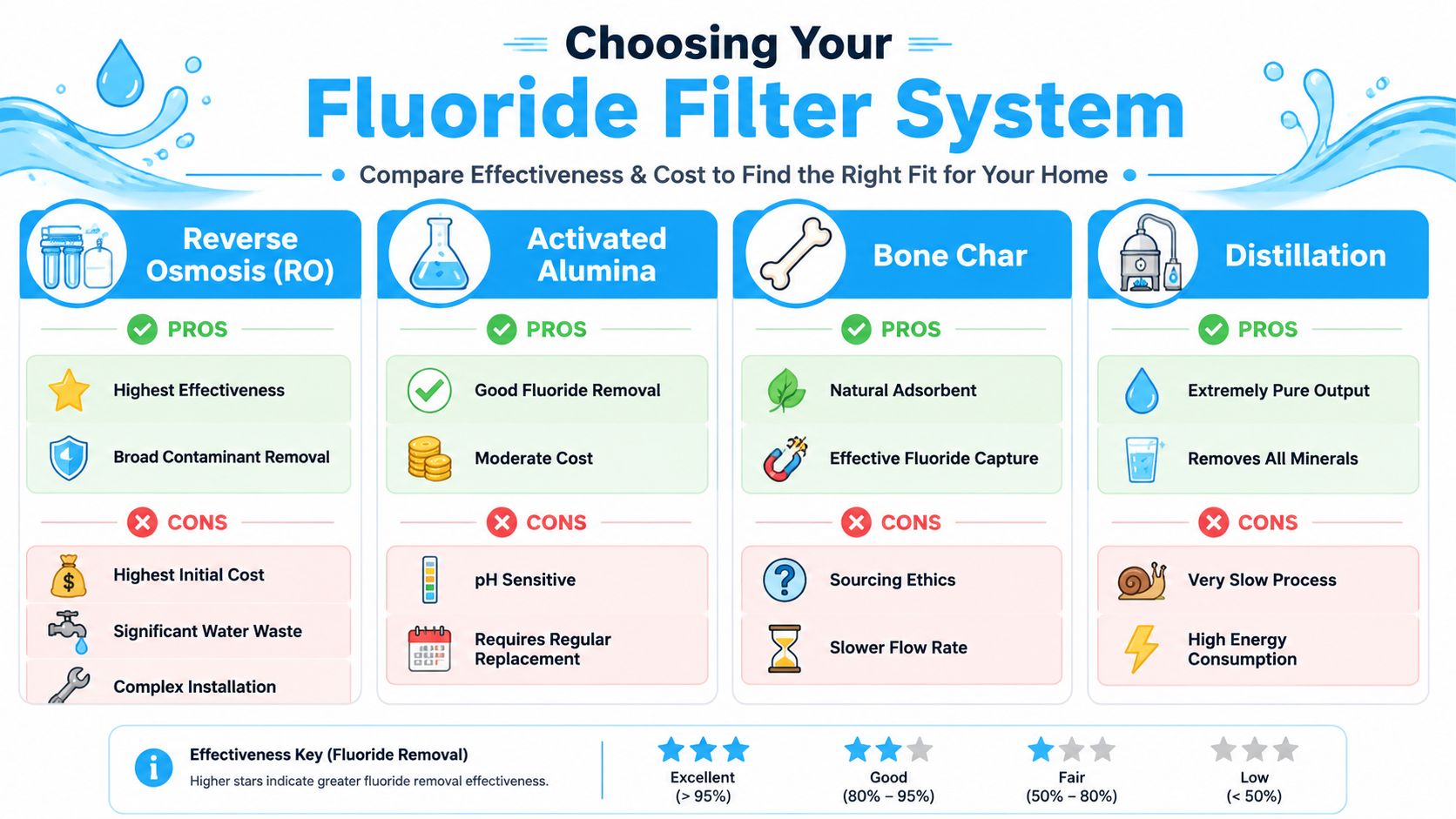
You aren't looking for a stronger version of the same idea. You're looking for a different idea entirely. Fluoride removal calls for media or membrane technologies designed to reject or bind fluoride, such as reverse osmosis, activated alumina, bone char, or certain anion exchange approaches. If the product doesn't clearly use one of those approaches, it's probably just a taste filter in a different box.
Meet the Heavy Hitters Technologies for Fluoride Removal
Fluoride removal starts getting serious when you switch from taste-filter thinking to ion-removal thinking. For refrigerator water, the three technologies that matter most are reverse osmosis, activated alumina, and bone char. They do not work the same way, and they do not respond the same way to your water.
That last point gets missed all the time. Water pH can make or break a specialty fluoride filter, especially media-based options like activated alumina and bone char. A homeowner buys the right category of filter, installs it correctly, and still gets disappointing fluoride reduction because the water chemistry was never checked.
Reverse osmosis
RO uses a membrane to reject dissolved contaminants, including fluoride. In plain English, it works like a very fine screening barrier at the molecular level.
For home use, RO is usually the safest bet if you want predictable fluoride reduction across a wide range of water conditions. pH still affects overall system performance and membrane life, but RO is generally less sensitive to pH swings than adsorption media. That is why I usually point neighbors toward RO first when they want fewer variables and less guesswork.
The trade-off is practical, not mysterious. RO systems take more space, create some wastewater, and usually need an under-sink install rather than a simple cartridge swap behind the fridge.
Activated alumina and bone char
Activated alumina and bone char remove fluoride by adsorption. The media grabs fluoride and holds it as water passes through.
These options can work very well, but they are more chemistry-dependent than RO. A specialty refrigerator inline system from Crystal Quest states performance for feed water up to 10 ppm F+, effluent below 0.2 ppm, and approximately 90 to 100% removal when the system uses fluoride-targeting media such as activated alumina or fluoride-specific carbon blends (Crystal Quest refrigerator inline fluoride system).
Here is the catch. Media filters are not plug-and-forget. pH matters. If the water is outside the range the media performs best in, fluoride pickup can drop fast. Contact time matters too. So does replacement timing. A filter that looked great on day one can underperform later because the media is exhausted or the water chemistry changed.
Bone char follows the same practical rule from the homeowner's side. It can be a strong fluoride option, but only if the manufacturer is clear about the media, the expected capacity, and the water conditions the filter was designed for.
Fluoride Removal Technology Comparison
| Technology | How It Works | Fluoride Removal | Typical Cost | Key Consideration |
|---|---|---|---|---|
| Reverse Osmosis | Membrane rejects dissolved fluoride | High | Higher | Usually the most predictable choice for home water |
| Activated Alumina | Adsorption media binds fluoride | High when conditions are right | Moderate | Performance depends heavily on pH, contact time, and maintenance |
| Bone Char | Adsorption media captures fluoride | High when conditions are right | Moderate | Verify the exact media, service life, and water chemistry fit |
Which one fits which homeowner
RO is usually the better fit for homeowners who want one answer that works in more situations. It asks more of you upfront during installation, then usually asks fewer chemistry questions later.
Activated alumina or bone char make sense when you want a smaller inline setup feeding the refrigerator line and you are willing to verify the details before buying. That means checking your water report, asking about pH, and confirming the media is specifically rated for fluoride instead of general taste improvement.
For readers who want more background on membrane design, Purecowater industrial membrane solutions offer a useful reference point. Home RO systems are much simpler, but the same separation principle is at work.
Bottom line: Buy a system that clearly names RO, activated alumina, bone char, or another fluoride-specific medium. If the product page skips the media type or says only chlorine, taste, and odor, keep looking.
Three Practical Setups for Your Refrigerator
Theory translates into a component ready for kitchen installation.
Under-sink RO feeding the fridge
This is the cleanest long-term setup for many homes. You install an under-sink RO system, then run one output to a small faucet at the sink and another line to the refrigerator for water and ice.
That gives you one treatment system handling both drinking points. The fridge still dispenses water normally, but now the source water feeding it has already gone through fluoride-capable treatment.
This setup usually makes the most sense when:
- You want reliability: RO is the most chemistry-independent option discussed here.
- You use both sink and fridge water: One system serves both.
- You don't want to hunt for oddball fridge cartridges: Replacement parts are usually easier to source.
Specialty inline fluoride filter on the fridge line
This is the retrofit route. A plumber or capable DIY homeowner cuts into the cold-water line feeding the refrigerator and adds a fluoride-specific inline filter.
That can be a smart move when under-sink space is tight or when you only care about water and ice from the fridge. The important part is the media. The filter has to be explicitly built with fluoride-reduction media such as activated alumina or bone char. A random inline carbon canister won't solve the problem.
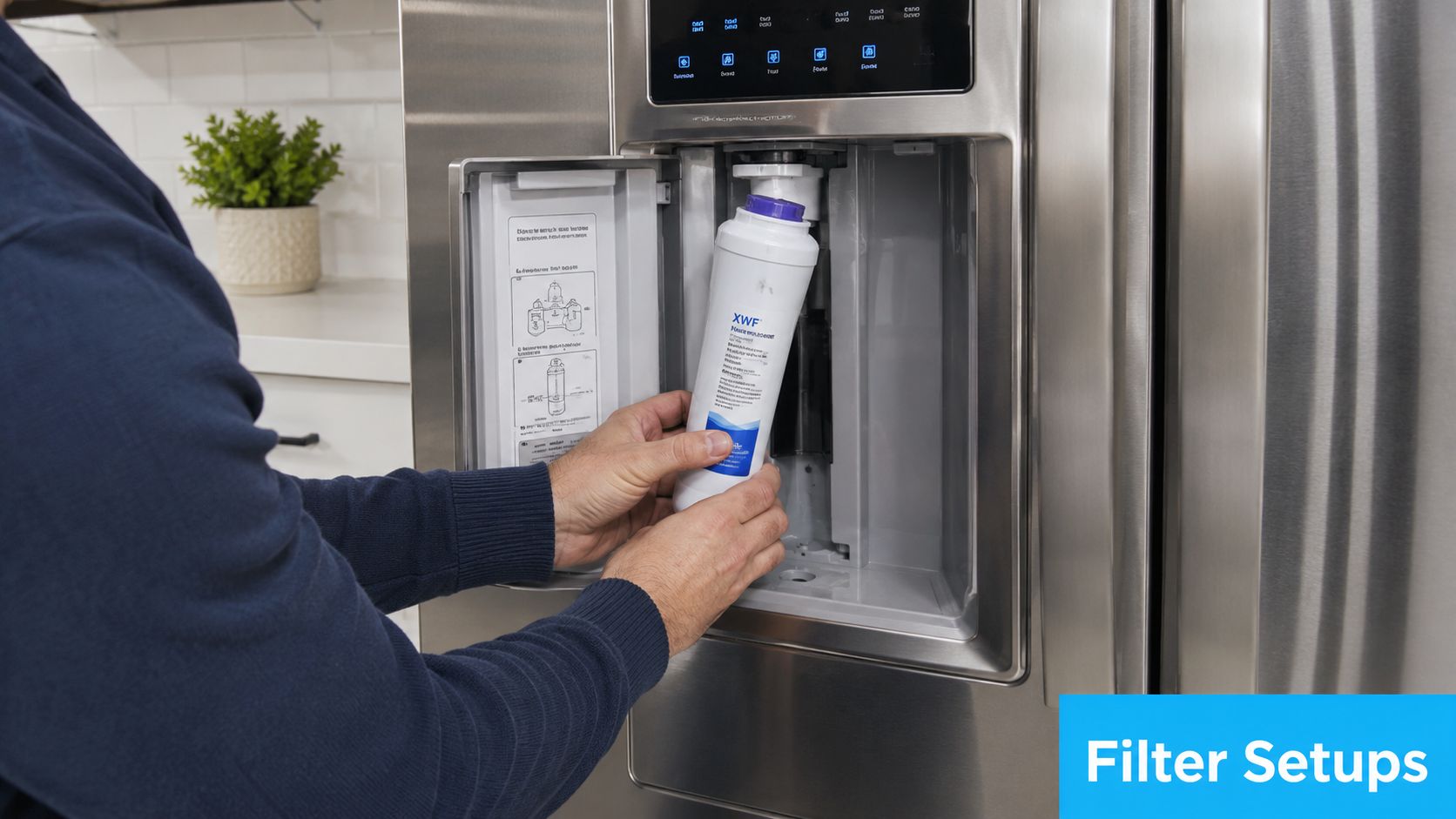
Rare specialty replacement cartridges
These are the unicorns. Every so often, you'll see a third-party refrigerator cartridge claiming fluoride reduction.
Some may be legitimate. Many are vague. In such instances, homeowners need to slow down and read carefully.
Check these details before buying:
- Exact media listed: If it just says carbon, move on.
- Explicit fluoride claim: It should name fluoride directly, not hide behind "reduces impurities."
- Fit and flow compatibility: A cartridge that technically fits but chokes flow or leaks isn't a win.
- Maintenance schedule: Specialty media has a service life, and once it's spent, performance drops.
Which setup is easiest to live with
If someone asks me neighbor-to-neighbor, I usually frame it this way:
- Most effective choice: Under-sink RO feeding the refrigerator.
- Most compact retrofit: Inline fluoride-specific canister on the fridge supply line.
- Most hit-or-miss option: Replacement fridge cartridge claiming fluoride reduction.
The first option asks for more installation effort up front. The second can work well when chosen carefully. The third requires the most skepticism because the market is full of products that sound more capable than they are.
How to Choose the Right Fluoride Filter System
A lot of buying mistakes happen because people compare only size and price, not chemistry. For fluoride reduction, that's backwards.
The hidden factor is water pH. This is the part most consumer guides skip, and it's the detail that can make a fluoride-specific inline filter work beautifully or disappoint you.
The pH issue most buyers never hear about
The critical nuance is that even fluoride-specific inline filters using bone char or activated alumina require extremely low pH water for effective removal. Data discussed in the water treatment community shows these filters can fail if pH isn't optimal, while reverse osmosis consistently removes 100% of fluoride regardless of water chemistry (discussion of pH sensitivity in fluoride-specific inline filters).
That matters because many homeowners buy an inline fluoride filter assuming the media alone guarantees performance. It doesn't. With some media, your source water chemistry decides whether the claim holds up in real use.
A practical way to choose
If you want the shortest path to a smart decision, use this filter-selection logic:
- Choose RO if you want the most dependable fluoride reduction and can handle a more involved install.
- Choose activated alumina or bone char if you want a smaller specialty system and you're willing to pay attention to source water conditions.
- Choose a fridge replacement cartridge only if the fluoride claim is explicit and the media is clearly identified.
For broader homeowner guidance on comparing systems, maintenance, and testing, the advice library at Water Filter Advisor is a good companion resource.
Here's a helpful video overview before you decide:
What to verify before spending money
Use a short checklist.
- Certification first: For RO, look for NSF/ANSI 58 because that's the certification path tied to fluoride-capable RO performance in the verified data.
- Media second: For non-RO systems, confirm the unit uses activated alumina, bone char, or another fluoride-targeting medium.
- Water chemistry third: If you're considering activated alumina or bone char, don't ignore pH.
- Maintenance fourth: Any system is only as good as its service schedule.
Buy the system that matches your water, not the box with the best marketing copy.
Your Action Plan for Clean Fluoride-Free Water
Your fridge filter is rarely the answer. If fluoride reduction is the goal, the winning move is to match the filter to your water chemistry, especially pH, and then route that treated water to the refrigerator.
That pH piece gets missed all the time. Reverse osmosis is usually the safest bet because its performance is far less dependent on source-water chemistry. Specialty media such as activated alumina or bone char can work well, but their fluoride performance can change a lot if the water is outside the range the filter was designed for. A system that looks great on the box can disappoint in the kitchen if the water chemistry is wrong.
Do these three things
- Test first: Check your tap water for fluoride, and if you're considering a specialty fluoride filter, check pH too.
- Choose the setup that fits your house: Under-sink RO with a line to the fridge is the dependable option. A specialty inline filter can make sense if you know your water chemistry. A replacement fridge cartridge only belongs on the list if the fluoride claim is explicit and the media is clearly identified.
- Maintain it on schedule: Fluoride filters do not fail all at once in an obvious way. They lose performance over time, and missed cartridge changes turn a good system into an expensive bypass.
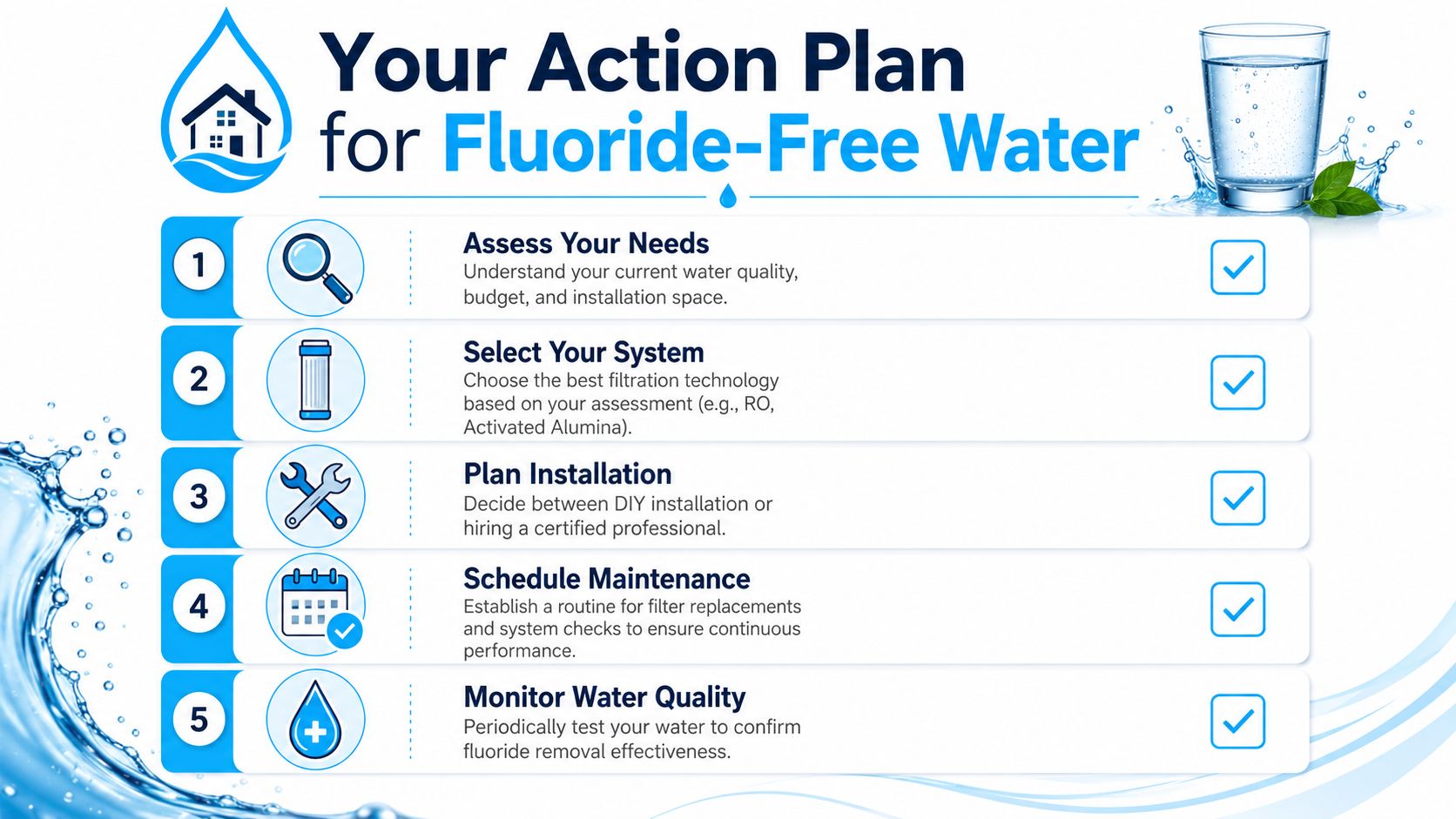
DIY or hire it out
A simple fridge-line filter swap is one kind of project. Feeding RO water to a refrigerator is another. You may need a storage tank, a dedicated line, shutoff valves, and enough room to work without putting stress on fittings.
If the space under your sink is tight, the fridge line disappears into cabinets, or you do not want to deal with leaks, hire a pro. Good installation matters because even the best filter cannot help if the tubing is kinked, the connections seep, or the service schedule gets ignored.
I usually give homeowners one plain rule. Buy for the water you have, not the promise on the label.
If you want refrigerator water that is low in fluoride, start with a water test, pick a filter technology that matches that result, and keep up with replacement intervals. That is the action plan that holds up in real homes.
If you want help comparing systems without wading through vague product listings, Water Filter Advisor is a practical place to start. It breaks down filtration types, replacement needs, and real-world trade-offs so you can choose a setup that fits your home and your water.
- June 29, 2026
- Uncategorized
