You fill a glass from the kitchen tap, glance at a headline about contamination, and instantly do the math every parent and homeowner does. Did we already drink this? Is this in our water? Do I need a filter right now, or am I about to waste money on the wrong one?
That's where chromium-6 gets people. It's familiar enough to be scary, mostly because of the Erin Brockovich story, but confusing enough that many households still don't know what to test for, what standard matters, or which filter claims are real. A lot of people end up buying a pitcher filter that improves taste and does almost nothing for the contaminant they're worried about.
A good chromium 6 water filter can absolutely help. But the right answer starts with two things: understanding what chromium-6 is, and separating proven filtration from marketing.
The Erin Brockovich Chemical in Your Tap Water?
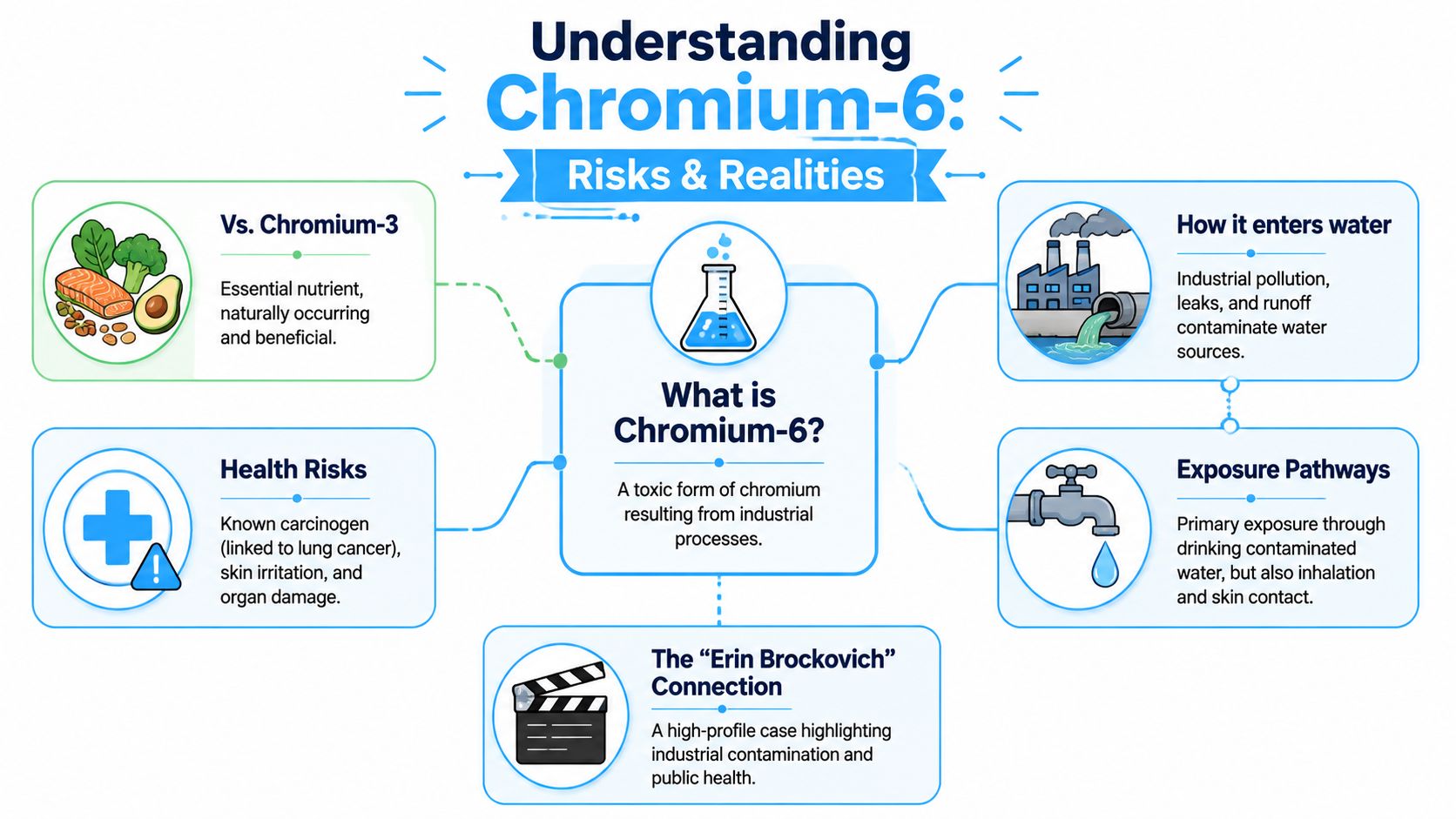
If the name sounds cinematic, that's because it is. For many people, chromium-6 first entered the conversation through the Erin Brockovich case, and once you hear that connection, tap water stops feeling routine for a minute.
That reaction is reasonable. Chromium-6 isn't just another nuisance contaminant that makes water taste odd or leaves a stain in the sink. Chromium-6 (hexavalent chromium) is a Group 1 carcinogen confirmed by the World Health Organization, causing cancer at concentrations as low as 0.02 parts per billion in California, which is 5,000 times lower than the EPA's current total chromium limit of 100 ppb (0.1 mg/L), as described in Clearly Filtered's discussion of chromium-6 standards.
The problem is that concern often pushes people into fast decisions. They buy a basic faucet filter, a refrigerator cartridge, or a standard pitcher because it's easy, familiar, and on the store shelf. Then they assume they've solved a chromium problem when they may not have addressed it at all.
Practical rule: If a filter claim doesn't clearly address chromium-6 or hexavalent chromium, don't assume it covers it.
There's also a big emotional gap between “my city treats water” and “my kitchen tap is fine.” Most municipal water is treated for many contaminants, but that doesn't mean every home concern is handled the same way, or that every benchmark reflects the level of risk a cautious household is comfortable with.
That's why this topic needs a calm filter-first lens. Not panic. Not movie drama. Just a clear look at what chromium-6 is, how it gets into water, how to test for it, and which home systems are built for the job.
Understanding Chromium-6 and Its Health Risks
Chromium can be confusing because the word itself covers more than one form. For home filtration, the distinction matters a lot.
Chromium-3 and chromium-6 are not the same thing
Think of them as two versions of the same metal with very different behavior. Chromium-3 is the form people usually hear about in nutrition contexts. Chromium-6, also called hexavalent chromium, is the one that raises drinking water concerns.
That difference is why “removes chromium” on a label isn't always enough. A product may talk about total chromium, while your actual concern is the hexavalent form.
Where it comes from and why flushing won't help
With lead, people often think about old plumbing, stagnant water, and flushing the tap before use. Chromium-6 works differently. Hexavalent chromium is a known human carcinogen that enters drinking water via industrial waste streams infiltrating rivers and groundwater, and unlike lead or other contaminants that leach from pipes, it originates directly from source water, meaning flushing pipes or boiling water does not reduce its concentration, as explained by Hydroviv's chromium-6 water guide.
That one point changes the whole home strategy. If the contaminant is dissolved in the source water, you can't fix it by running the tap longer or boiling a pot on the stove. You need filtration that physically separates or captures it.
If you want a broader look at how industrial byproducts should be managed before they ever reach water supplies, this primer on safe hazardous waste disposal is worth reading. It gives useful context for how preventable contamination problems can start upstream.
A quick visual helps:
- Lead problem: Often associated with plumbing contact.
- Chromium-6 problem: Often associated with contamination already present in the water source.
- Home implication: Plumbing habits won't solve a source-water contaminant.
Here's a short explainer that helps put the issue in context:
What the health concern means in practical terms
The reason filtration guidance around chromium-6 sounds more serious is simple. It's not just a taste or odor issue. It's associated with cancer risk, and discussions of exposure also point to respiratory and digestive system effects.
Chromium-6 is the kind of contaminant that makes certification matter more than convenience.
For a homeowner, that means two practical takeaways. First, don't rely on boiling, flushing, or a generic carbon pitcher. Second, don't shop by brand popularity alone. Shop by contaminant-specific performance.
Testing Your Water for Chromium-6
Before buying a chromium 6 water filter, test first. That sounds less exciting than shopping, but it's how you avoid paying for a system you don't need, or worse, buying one that doesn't match the problem.
One of the biggest gaps in this category is false confidence from home kits. Most existing content fails to address the critical gap that 90% of U.S. water systems contain chromium-6, yet nearly all consumer home testing kits do not specifically detect it, leaving homeowners unable to verify exposure without EPA-certified lab testing, as noted in CNN's coverage of chromium-6 testing limits.
What to do instead of buying a generic test strip
The better route is an EPA-certified laboratory test that specifically identifies chromium-6, not just a broad contaminant screen.
Use this process:
Start with your water source
If you're on city water, review your annual water quality report first. It may not answer the chromium-6 question directly, but it tells you what your utility is already measuring and how your source water is described.Ask the lab the right question
Don't just ask for “chromium.” Ask whether the test measures chromium-6, hexavalent chromium, or only total chromium.Follow the sampling instructions exactly
Labs usually provide a sampling bottle and handling instructions. Use them. A contaminated or mishandled sample can make the result useless.Keep the result in ppb
Labs often report in parts per billion. That's the unit most homeowners will see in guidance and product literature.
For a broader technical overview of how professionals approach sampling and analysis, these insights for water quality specialists are a useful background read.
How to read the result without overreacting
Don't stop at the number. Ask three questions:
| Question | Why it matters |
|---|---|
| Is this chromium-6 or total chromium? | The two are not interchangeable for filter shopping. |
| Is this the kitchen tap or a raw source sample? | You want the water you actually drink. |
| What treatment decision does this support? | The goal is action, not just information. |
A few practical notes help keep your expectations realistic:
- A “non-detect” result doesn't mean every possible trace is absent. It means the lab did not detect the contaminant above its method capability.
- A total chromium result is less useful when your concern is hexavalent chromium specifically.
- A one-time result is a snapshot. If water conditions change, testing again can make sense.
Lab-first advice: Test before you buy, and test for the exact contaminant you care about.
Many people save themselves from the wrong purchase by focusing on their specific needs. A household with no chromium-6 issue may choose a simpler system for chlorine, lead, or hardness. A household that does have a chromium-6 concern can then shop with a clear target and ignore vague claims.
Comparing Filtration Methods That Remove Chromium-6
The shopping experience now shifts to practical concerns. For chromium-6, the question isn't “which filter tastes better?” It's “which technology has a credible mechanism for this dissolved contaminant, and which products prove it?”
What fails first
A lot of common filters are built to improve taste, reduce chlorine, and make tap water more pleasant. That's useful, but it's not the same as removing chromium-6.
The most important line in the sand is this: No established safe lifetime exposure level for chromium-6 exists federally, though the EPA enforces 100 ppb for total chromium, and critical filtration data shows Aquasana's NSF-certified Reverse Osmosis + Claryum systems remove ≥97% of chromium-6, while Black Berkey elements exceed 99.8% reduction per EPA Method 218.6, whereas standard filters like Brita, PUR, and many mass-market units fail entirely, according to Aquasana's chromium-6 filtration explanation.
That last part is what catches people. A pitcher may reduce chlorine and improve taste, but chromium-6 is a dissolved contaminant that needs more specialized treatment.
The technologies that actually belong in the conversation
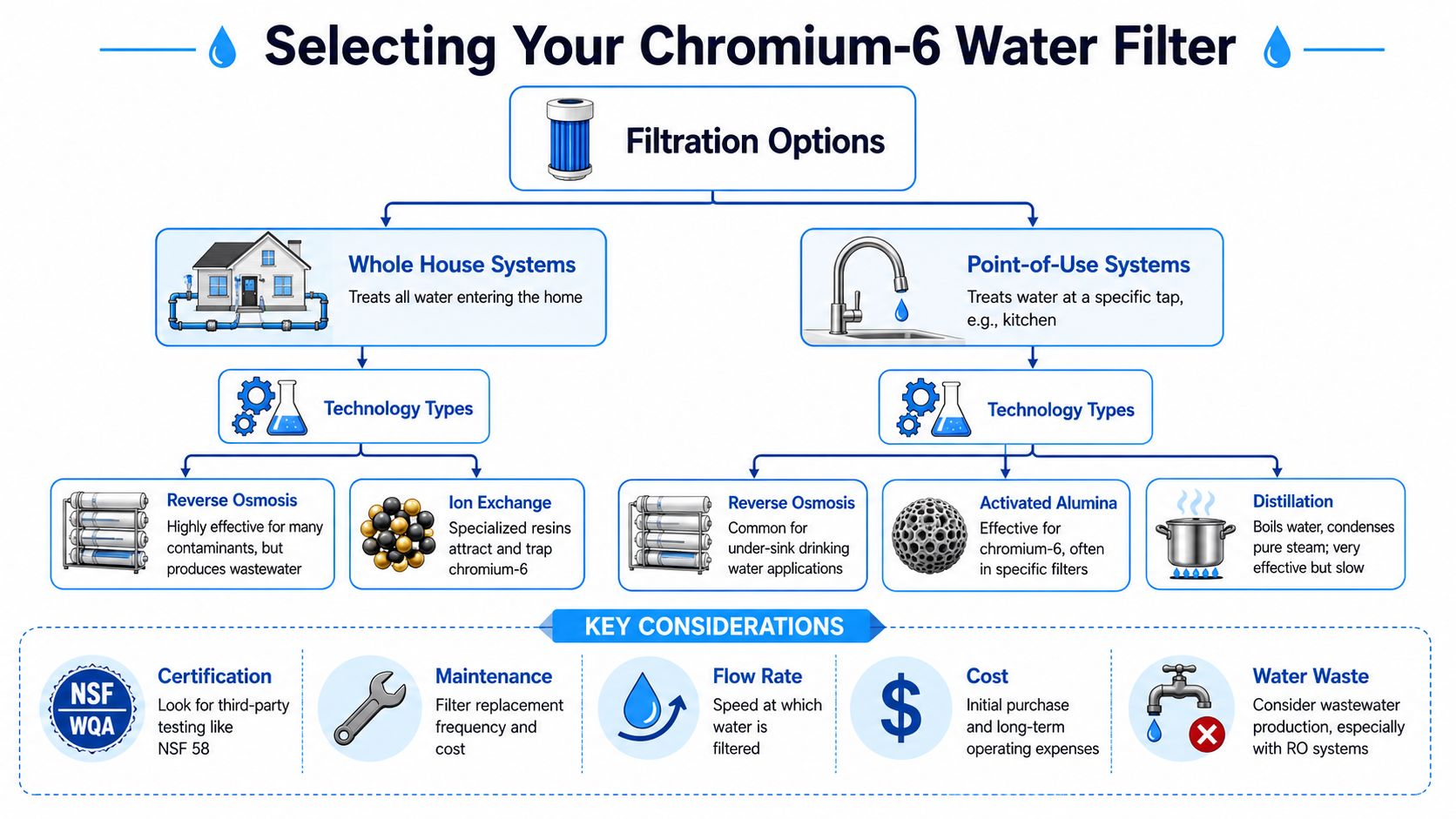
Three categories deserve serious attention in a home setting.
Reverse osmosis
Reverse osmosis, or RO, pushes water through a membrane that acts like an ultra-fine barrier. For chromium-6, this is one of the most established residential choices.
Why people like it:
- Strong contaminant reduction profile for many dissolved contaminants
- Widely available in under-sink and some countertop formats
- Useful for drinking and cooking water at a single tap
Trade-offs:
- Needs maintenance
- Usually sends some water to drain
- Often slows flow compared with an unfiltered faucet
- May require more involved installation
The key shopping filter here is certification. If you're considering RO for chromium-6, NSF/ANSI 58 is the standard to watch closely.
Ion exchange
Ion exchange works more like a selective trap. The media is designed to attract and hold certain dissolved ions while letting treated water continue through.
In practice, ion-exchange media can be a very serious option for chromium-6, especially when a manufacturer specifically designs the cartridge around this contaminant. It can also make sense for people who don't want the typical wastewater profile associated with RO.
Trade-offs are usually less about effectiveness in theory and more about cartridge design, capacity, and whether the product was tested for chromium-6 instead of making broad heavy-metal claims.
Specialized adsorptive media
This category includes purpose-built media aimed at difficult dissolved contaminants. It's not as simple as “carbon equals good.” Standard activated carbon alone is not the hero here.
Some systems combine media types to improve chromium capture. These can be useful, but they require careful reading of the performance data. “Removes contaminants” is not enough. You want a product that names chromium-6 directly or gives contaminant-specific testing.
A filter can be well made, popular, and still be the wrong tool for chromium-6.
Chromium-6 filtration technology comparison
| Technology | Removal Effectiveness | NSF Certification | Pros | Cons |
|---|---|---|---|---|
| Reverse osmosis | Proven option for chromium-6 when the system is specifically certified or tested for it | Look for NSF/ANSI 58 | Strong choice for drinking water, broad dissolved contaminant reduction, widely available | More complex installation, ongoing maintenance, wastewater, slower delivery |
| Ion exchange | Can be highly effective when the media is designed for chromium-6 | Certification varies by product | Targeted removal approach, can avoid some RO trade-offs, useful in specialized cartridges | Product quality varies, cartridge details matter, claims can be vague |
| Specialized adsorptive media | Can work when the media and testing are chromium-6 specific | Certification varies | Sometimes available in simpler formats, can be targeted to the contaminant | Harder for shoppers to verify, standard carbon alone is not enough |
| Standard activated carbon pitchers and common fridge filters | Not reliable for chromium-6 based on the source above | Usually not the certification to rely on for this contaminant | Cheap, easy, familiar | The wrong choice for chromium-6 |
What this means for a homeowner
If your only concern is taste and odor, a basic filter may be fine. If your concern is chromium-6, move cheap pitchers and generic faucet filters out of the decision tree quickly.
For most households, the primary decision is between a certified RO system and a specialized media system with clear chromium-6 performance data. The rest is mostly convenience theater.
Choosing Your Home Chromium-6 Water Filter
Once you have a test result, the right system usually becomes clearer. The biggest mistake here is shopping by category alone. “Under-sink,” “countertop,” and “whole-house” tell you where a filter sits, not whether it's built for chromium-6.
Start with the result, not the brand
California's current regulatory picture gives homeowners a useful reference point. In 2024, the California State Water Resources Control Board adopted a legally enforceable maximum contaminant level of 10 parts per billion for chromium-6, and a 2024 study of 250 tested Santa Clara County wells found 99% fell below that 10 ppb MCL, with a median of 2 ppb and a range from non-detect to 19 ppb. The same source notes that reverse osmosis can reduce chromium-6 by over 97% when NSF/ANSI 58 certified, according to APEC Water's summary of California chromium-6 conditions.
That tells you two important things. Chromium-6 can be widespread and still vary a lot from one location to another. And the choice of filtration should follow the level and the use case, not just fear.
A practical buying framework
Use these decision points in order.
If you want the safest mainstream path
Choose an under-sink reverse osmosis system with NSF/ANSI 58 certification and documented chromium-6 reduction. For most homeowners, this is the cleanest answer for drinking and cooking water.
This setup works well when:
- You own the home
- You want a dedicated drinking-water tap
- You're comfortable with filter changes and membrane upkeep
If you rent or can't modify plumbing
A specialized countertop system may be easier to live with than a plumbed system. The key is the same as above: contaminant-specific proof, not just “premium filtration” language.
For renters, the best filter is often the one you can install correctly, maintain consistently, and take with you.
If you're thinking whole-house
A whole-house approach can make sense if your goal goes beyond drinking water or if you want one treatment barrier at the point water enters the home. But whole-house systems for chromium-6 require more planning, more money, and more attention to waste, flow, and service needs.
For many families, a point-of-use system at the kitchen sink is the better first move because that's where drinking and cooking water comes from.
Non-negotiables before you buy
- Certification first. For RO, NSF/ANSI 58 should be on your checklist.
- Chromium-6 specificity. Don't settle for a vague total chromium claim if the product can't explain hexavalent chromium performance.
- Replacement availability. A great filter with hard-to-find cartridges becomes a problem fast.
- Real maintenance fit. If you won't keep up with service, buy a simpler system you'll maintain.
If you want broader guidance on matching system type to household needs, this collection of water filtration advice and buying guidance is a useful next step.
Buying filter advice: The best chromium 6 water filter is the one matched to your test result, your installation limits, and a certification you can verify.
Filter Maintenance and Replacement Guide
A chromium 6 water filter only protects you if it's maintained. Homeowners often focus hard on the purchase and then treat replacement schedules like a suggestion. They aren't.
A neglected filter can stop performing long before it looks dirty. In some systems, prefilters clog, carbon stages exhaust, membranes foul, and specialty media loses capacity. Water may still flow, which is exactly why neglect is risky. The system can feel normal while performance imperceptibly slips.
What to stay on top of
For home systems, the smart habit is simple:
- Follow the manufacturer's schedule for every stage, not just the main cartridge.
- Replace on time or earlier if your water quality is challenging.
- Keep a written install date on each filter or inside the cabinet door.
- Sanitize when recommended during cartridge changes, especially on plumbed systems.
Different systems need different attention
RO systems usually ask more from the owner. They often include sediment and carbon prefiltration, a membrane, and a polishing stage. Specialty media systems may be simpler, but they still need timely cartridge swaps.
A few real-world signs that service is overdue:
- Flow slows down
- Taste changes
- The system hasn't been touched in a long time
- You can't remember when the filter was installed
Filters don't fail with a dramatic warning light in most homes. They usually fail quietly.
If you want long-term protection, build maintenance into the buying decision. The easier the upkeep feels in daily life, the better the odds you'll keep the system working the way it should.
Chromium-6 Water Filter FAQs
Can I boil water to remove chromium-6?
No. As covered earlier, chromium-6 is a dissolved contaminant in the water itself. Boiling doesn't remove it, and flushing the tap doesn't solve a source-water problem.
Do I need a whole-house filter for chromium-6?
Not always. If your main concern is drinking and cooking water, a point-of-use system at the kitchen sink is often the most practical place to start. Whole-house treatment can make sense, but it's a bigger commitment.
Are pitcher filters enough?
For chromium-6, don't assume they are. Many common pitchers are built for taste and odor improvement, not this contaminant. If the manufacturer doesn't clearly document chromium-6 performance, move on.
What should renters do?
Renters should look hard at countertop options or other systems that don't require permanent plumbing changes. The best renter setup is one that installs cleanly, has clear contaminant claims, and can move with you.
Is reverse osmosis always the best choice?
It's often the safest mainstream recommendation for home drinking water when the unit is properly certified, especially with NSF/ANSI 58. But “best” depends on your test result, your willingness to maintain it, your available space, and whether you're okay with RO's typical trade-offs.
What's the biggest shopping mistake people make?
Buying before testing, then trusting a general filter claim. If you're worried about chromium-6, first confirm whether it's in your water. Then verify that the filter addresses chromium-6 specifically, not just “contaminants” in broad marketing language.
If you're comparing systems and want help sorting real certifications from vague filter claims, Water Filter Advisor is a practical resource for choosing, comparing, and maintaining home water filtration without the usual guesswork.
- June 26, 2026
- Uncategorized
