Best Home Water Filter for Well Water: A 2026 Guide

If you're shopping for the best home water filter for well water, you're probably already dealing with a clue your water is sending you. Orange stains in the toilet bowl. A rotten egg smell when the shower starts. Grit in aerators. Laundry that never looks fully clean. Or maybe the water looks fine, but you know private wells don't come with a city utility watching over them.

That last point matters most. Well water problems are local, specific, and often layered. One home has iron and sediment. The house next door has sulfur odor and bacteria concerns. A third has water that tastes metallic but leaves no visible staining. That's why the right answer usually isn't a single product recommendation. It's a system built from your test results, your plumbing, and your maintenance budget.

I've seen homeowners lose money by buying the wrong equipment for the right problem, and I've seen them lose even more by buying the right equipment in the wrong size. A proper setup treats the contaminants you have, preserves pressure throughout the house, and doesn't surprise you later with ugly maintenance costs. That's the framework that matters.

First Things First Test Your Well Water

Buying filtration before testing is like buying prescription glasses before the eye exam. You might get lucky. That, however, is rare.

A private well can carry several issues at once. Some are obvious, like metallic taste or staining. Others don't announce themselves at all. If you want the best home water filter for well water, your first job is to figure out exactly what your water contains and what it's doing inside the house.

A person wearing a black nitrile glove holding a water sample bottle in front of a rustic well house.

Use screening tools carefully

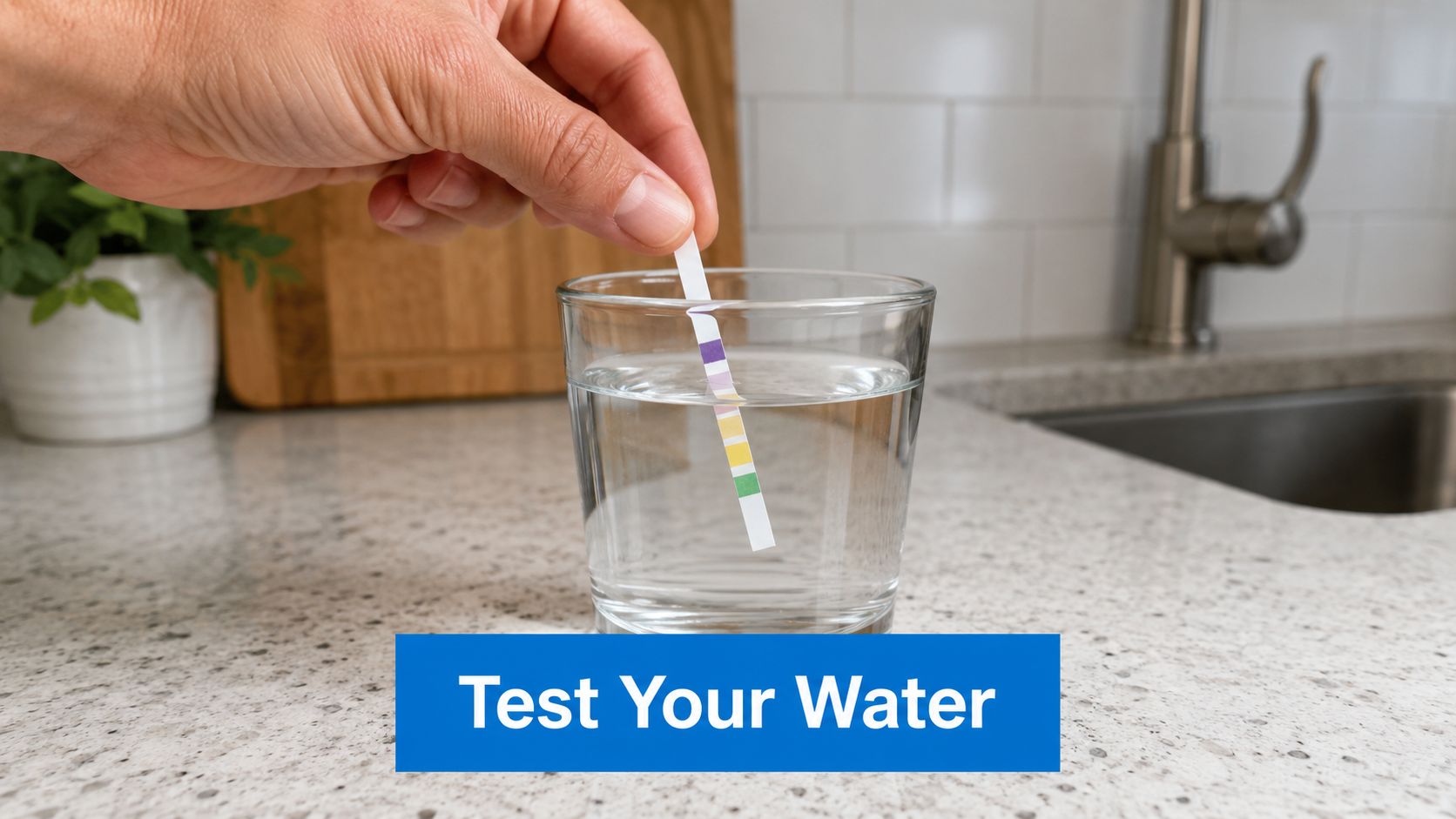
Home test strips and basic kits can be useful as an early warning. They can tell you whether you're likely dealing with hardness, pH issues, or a staining problem. They can also help you notice a change after a heavy rain, plumbing work, or a pump repair.

But strips don't give you the level of confidence you need before spending real money on treatment equipment. For a whole-house system, send a sample to a state-certified lab. That report becomes your equipment blueprint.

Practical rule: Don't size equipment from a hunch, a smell, or a strip color. Size it from a lab report.

What to ask the lab to test

A good well water panel should cover the contaminants most likely to affect home filtration decisions. Focus on the issues that change equipment selection:

  • Iron and manganese: These cause staining, taste issues, and can foul plumbing and fixtures.
  • Hydrogen sulfide: This is the classic rotten egg odor problem.
  • Sediment or turbidity indicators: These help you decide whether you need a strong pre-filter stage.
  • Bacteria or microbial indicators: Invisible problems need a different response than staining problems.
  • pH and general water chemistry: Some treatment media only work well inside certain operating ranges.

The collection step matters too. Use the lab's bottle, follow their timing instructions, and avoid contaminating the sample with dirty hands, faucet debris, or a bottle cap set on the counter. Small mistakes at this stage can push you toward the wrong system.

Think of water quality as a whole-house issue

Water testing also fits into the broader way you evaluate a home environment. Homeowners who are careful about private well safety often take the same approach with air and soil concerns. If you're already looking at broader property health, a guide to radon testing is another useful example of why proper diagnostics come before treatment.

For hands-on help with how to compare results and treatment options, a solid next stop is the practical guidance library at Water Filter Advisor advice.

Decoding Your Water Test Results

A lab report can look like it was written for a chemist. Homeowners don't need to become chemists. They need to know what each result means for faucets, laundry, plumbing, smell, and day-to-day use.

The most common well water troublemakers usually show up in patterns. Some leave visible evidence. Others announce themselves when you run hot water. A few don't show themselves at all until the lab report comes back.

Common well water contaminants and their symptoms

Contaminant Common Symptoms Impact on Home & Health
Iron Orange or reddish-brown staining, metallic taste, discolored laundry Stains fixtures and fabrics, can build up in plumbing and make water unpleasant to use
Manganese Dark brown or black staining, bitter or metallic notes Stains fixtures and laundry, can foul appliances and leave stubborn deposits
Hydrogen sulfide Rotten egg odor, stronger smell when water is first run Makes water unpleasant for showering and cooking, can contribute to corrosion problems
Sediment Grit in water, cloudy appearance, clogged faucet screens Wears on valves and appliances, reduces pressure, loads up downstream filters quickly
Bacteria or viruses Often no obvious sign, sometimes odor or slime depending on the cause Raises safety concerns and usually calls for disinfection rather than basic filtration alone

What the big five usually mean

Iron is the classic well-water nuisance. The verified data for whole-house systems notes that private wells across the United States frequently contain high levels of iron, hydrogen sulfide, and manganese, affecting an estimated 15 million private wells, with specialized systems such as the SpringWell WS1 designed to remove up to 7 PPM of iron, 8 PPM of hydrogen sulfide, and 1 PPM of manganese without chemicals using air injection oxidation technology, according to lab-test-based system data. In a home, iron usually shows up before the lab report does. Sinks, tubs, toilets, and white laundry tell on it quickly.

Manganese is iron's less famous cousin. It often creates darker staining and can leave black or brown marks that homeowners mistake for dirt or mold. It also changes what media type makes sense in an oxidation filter.

Hydrogen sulfide gives you the odor complaint that drives many well-water purchases. Standard carbon alone often won't solve a sulfur problem if the gas load is significant. That's where people waste money by buying a taste-and-odor filter for what is really an oxidation job.

If the problem stains, smells, and clogs, treat it as a system issue, not a drinking-water-only issue.

Pay attention to combinations

Sediment by itself is straightforward. Sediment combined with iron is not. Bacteria combined with sulfur odor is not. The report matters because contamination stacks change the order of treatment.

Here are the signs I tell homeowners to connect to the report:

  • Orange stains plus metallic taste: Usually points toward iron treatment, often ahead of any final polishing stage.
  • Black staining plus grit: Often means manganese and sediment both need attention.
  • Rotten egg smell with clear-looking water: Commonly calls for an oxidizing approach, not just a cartridge swap.
  • Pressure loss throughout the home: Frequently means sediment loading, fouled media, or both.

The most important reading skill

Don't read a lab report as a pass-fail document. Read it as a design document. A test result doesn't just tell you whether something is present. It tells you what treatment technology fits, where that treatment belongs in the sequence, and whether the long-term maintenance burden will be light or annoying.

That's the difference between buying a filter and building a water treatment plan.

Your Filtration Arsenal Matching Tech to Contaminants

Water treatment works best when you stop thinking in terms of one magic filter. A strong well-water setup is more like a layered security team. One stage catches grit. Another handles dissolved minerals that cause staining. A later stage cleans up odor or chemical carryover. If needed, a final stage deals with microbes.

That sequence matters because each component protects the one after it.

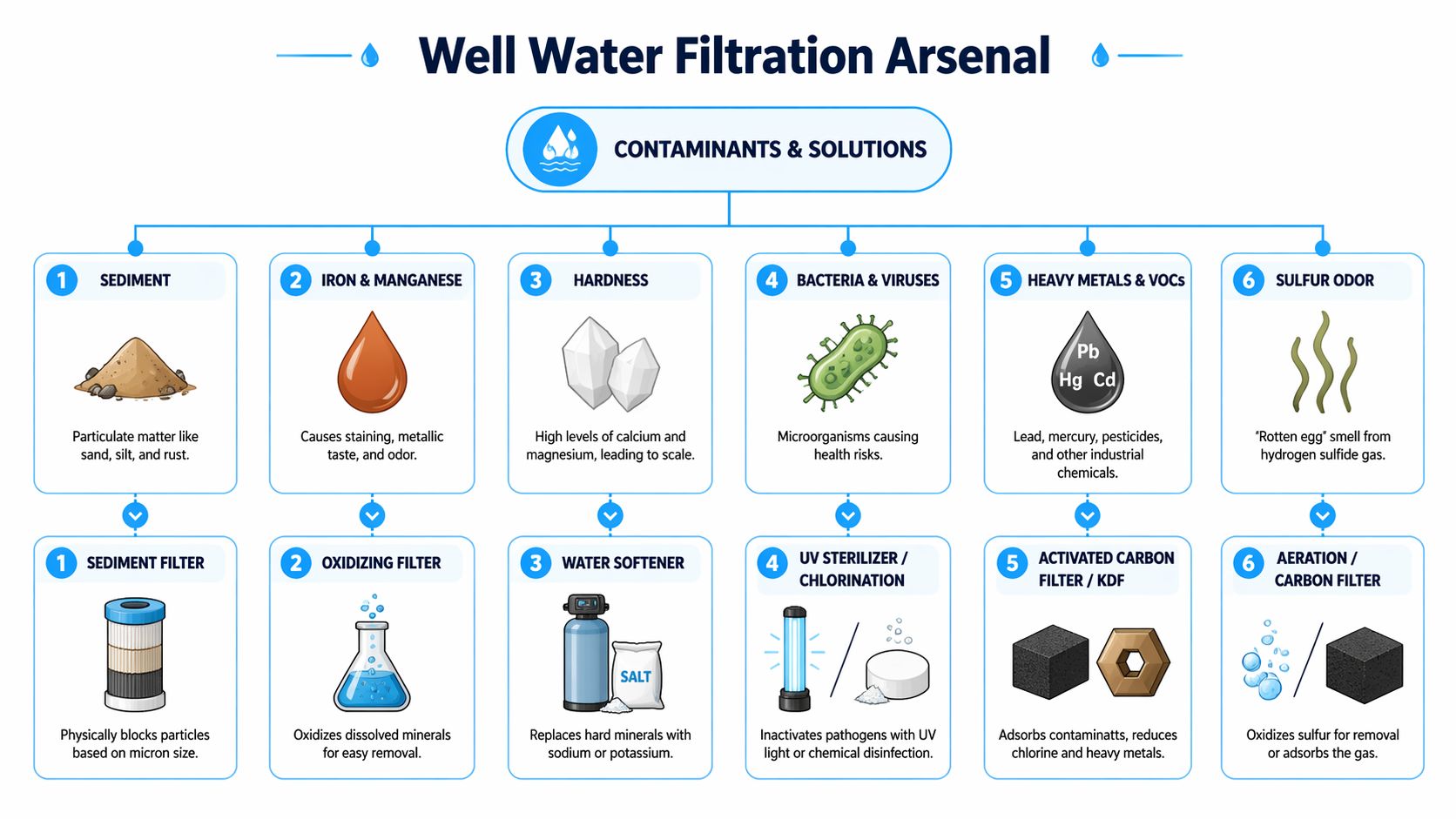
A chart illustrating different well water contaminants and their corresponding effective filtration or treatment solutions.

Sediment filters as the first line

A sediment pre-filter is the bouncer at the door. It catches sand, silt, rust flakes, and other particles before they crowd out the equipment downstream. If you skip this stage in a sediment-heavy home, you force every later filter to do a dirty job it wasn't meant to do.

Sediment filtration isn't glamorous, but it's often what preserves pressure and extends the life of expensive equipment. In homes with visible grit, this stage is rarely optional.

Oxidizing filters for iron manganese and sulfur

Specialized well-water gear proves its worth. Air injection oxidation systems create an air pocket inside the tank that oxidizes dissolved contaminants so the media can remove them. That's why systems like the SpringWell WS1 are built around oxidation rather than simple cartridge filtration.

When homeowners ask me what works for bad staining and sulfur odor, this category is usually the answer. The verified lab-based performance data tied to the WS1 is strong because it addresses the contaminants that show up repeatedly in private wells.

What doesn't work well is trying to force a generic whole-house carbon unit to solve heavy iron or sulfur. Carbon is a finisher. It is not a substitute for a proper iron filter when the chemistry says oxidation is needed.

A sulfur smell that survives a carbon cartridge usually isn't asking for more carbon. It's asking for the right pretreatment.

Carbon filters for polishing and chemical reduction

Activated carbon and catalytic carbon have a different job. They improve taste and odor, reduce certain chemical contaminants, and serve as a polishing stage after the rougher work is done upstream.

Carbon works best when the water reaching it has already been cleaned of sediment and major iron loading. If you send dirty or iron-heavy water through carbon first, you shorten its useful life and lower performance.

This is also where whole-house systems designed for chemical reduction can shine in the right application. They are especially useful when the concern isn't just staining but broader water quality cleanup through the home.

KDF media and specialty applications

KDF media often appears in specialty setups or in combination systems aimed at heavy metals and added protection for downstream media. It isn't the star of most private-well treatment trains, but it can make sense where water chemistry supports it and where the system builder is solving more than one issue at once.

The practical point is simple. Specialty media should be matched to a known problem. Don't buy it because it sounds advanced.

UV purifiers and disinfection stages

A UV purifier is the final guard. It doesn't remove staining minerals or sediment. It disinfects water by inactivating microorganisms as water passes the lamp. That means UV belongs after filtration stages that improve clarity. Dirty water can interfere with disinfection performance.

Some homes need UV. Some need a different disinfection strategy. But if the water test flags microbial concern, don't expect a sediment cartridge or iron tank to handle it.

A good system is staged on purpose

A practical well-water train often looks like this:

  • Stage one, sediment control: Protects valves, media tanks, and appliances from abrasive particles.
  • Stage two, problem-specific treatment: This might be an AIO iron and sulfur filter or a softener, depending on the water.
  • Stage three, polishing: Often carbon, used to improve final taste and odor.
  • Stage four, disinfection if needed: UV or another dedicated microbial treatment step.

That order keeps each component doing the work it was designed to do.

Deciding Between Whole House and Point of Use Systems

This decision gets simpler when you ask one question first. Are you trying to protect the whole home, or are you trying to improve the water at one tap?

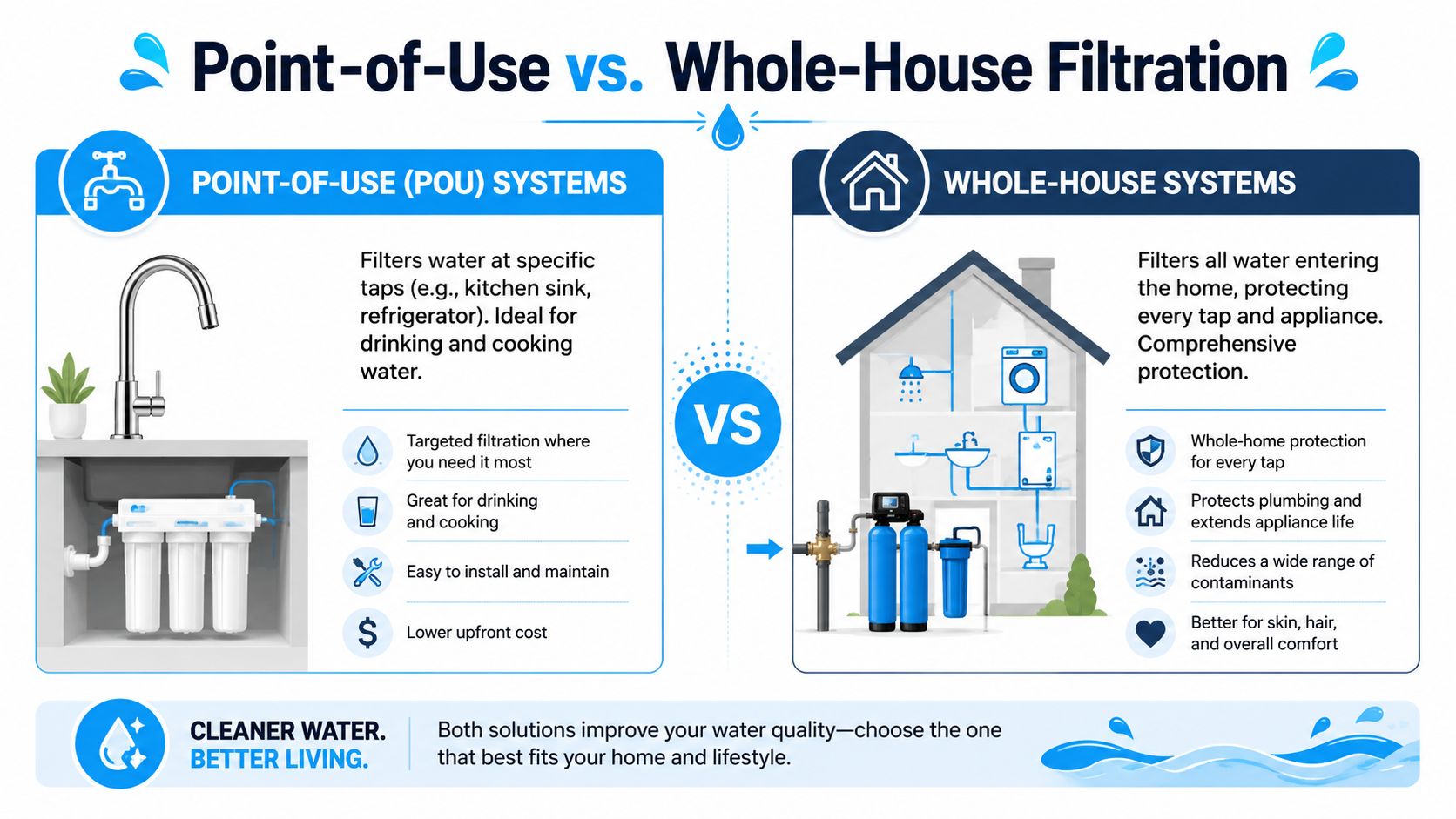
If the problem is staining, sediment, sulfur odor in showers, or equipment wear, a point-of-use filter won't solve the full problem. It may improve drinking water at the kitchen sink while the rest of the house still suffers.

Where whole-house systems make sense

A whole-house system, also called point-of-entry treatment, handles water as it enters the home. That's the right strategy when the water is affecting plumbing, fixtures, appliances, bathing, laundry, or the water heater.

A strong example in this category is the SpringWell CF Series. According to SpringWell's CF Series specifications, the CF4 and CF+ provide 1,000,000-gallon capacity, 99.6% chlorine removal, and service flows of 12 GPM for the CF4 and 20 GPM for the CF+ at 25-80 PSI, with reduction claims that include PFAS, PFOA, and PFOS. Those numbers matter because undersized whole-house units often create pressure complaints before they solve water-quality ones.

If your water issue follows you into every bathroom and appliance, whole-house treatment is usually the practical choice.

Where point-of-use systems earn their place

A point-of-use system works at one location, usually under the sink or on a countertop. These setups are useful when your main goal is drinking and cooking water quality.

They can be a smart add-on even in homes with whole-house treatment. A homeowner might use whole-house filtration for sediment, iron, and odor control, then add a dedicated kitchen unit for a final drinking-water polish.

Side-by-side trade-offs

  • Scope of protection: Whole-house protects plumbing and appliances. Point-of-use protects only the tap where it's installed.
  • Installation complexity: Whole-house equipment usually requires more space, plumbing work, and proper sizing.
  • Maintenance style: Whole-house upkeep tends to involve fewer but larger service events. Point-of-use systems usually mean smaller, more frequent cartridge changes.
  • Best use case: Whole-house for house-wide water problems. Point-of-use for targeted drinking-water improvement.

If your shower smells bad and your toilet stains orange, don't try to fix a whole-house problem under the kitchen sink.

For many well-water homes, the answer isn't one or the other. It's a combination with each system doing a different job.

Sizing Your System and Calculating Long Term Costs

A filter can be technically correct and still be a bad purchase. That happens when the unit is undersized for the house, oversized for the chemistry, or cheap upfront but expensive to keep alive.

The homeowners who make the best decisions usually stop asking, "What's the price?" and start asking, "What will this cost me to run well for years?"

Flow rate is a comfort issue

Flow rate is the amount of water the system can move without choking the house. In practical terms, it shows up during peak use. Someone is showering, the dishwasher is running, and a toilet refills. If the equipment is too small, pressure drops and complaints start.

The simplest way to think about sizing is by household demand:

  • Small demand homes: Fewer bathrooms and less overlapping water use can often work with lower service flow.
  • Busy family homes: More fixtures running at the same time need more capacity and better valve performance.
  • Large homes or multi-bath layouts: These are where undersized treatment systems become obvious fast.

A filter that looks affordable but can't keep up isn't a bargain. It's a bottleneck.

The real number to watch is ownership cost

Many "best well water filter" lists fail people. They compare features and skip the long-term bill. Verified background on well-water filtration points to the importance of total cost of ownership, noting that replacement media under heavy contamination loads can run $200-500 annually, and that air injection systems such as the WS1 may keep media for up to 10 years under ideal conditions, while high iron levels above 5 PPM can cut that to 2-3 years, which can inflate costs 3x, according to Crystal Quest's well water filtration discussion.

That single point changes how you should shop. A system that looks inexpensive can become the expensive option if your water chemistry exhausts media early.

A better way to compare systems

When comparing two filtration setups, calculate the following over the years you expect to own the home or the equipment:

  • Pre-filter replacements: These are often the routine cost people forget to include.
  • Main media life: Ask how your actual water chemistry affects replacement timing, not just the best-case brochure claim.
  • Service needs: Some systems need more hands-on upkeep than others.
  • Related supplies: If a setup uses salt, chemicals, or power, include that in your budget.

The TCO questions that expose weak options

Ask every vendor these questions:

  1. How does my iron load affect media life?
  2. What part of this system needs replacement most often?
  3. What maintenance am I expected to do myself?
  4. What happens to pressure as the system loads up?
  5. Which costs are not included in the initial quote?

A good answer is specific to your report. A weak answer sounds generic.

Building Your Perfect Well Water Filtration System

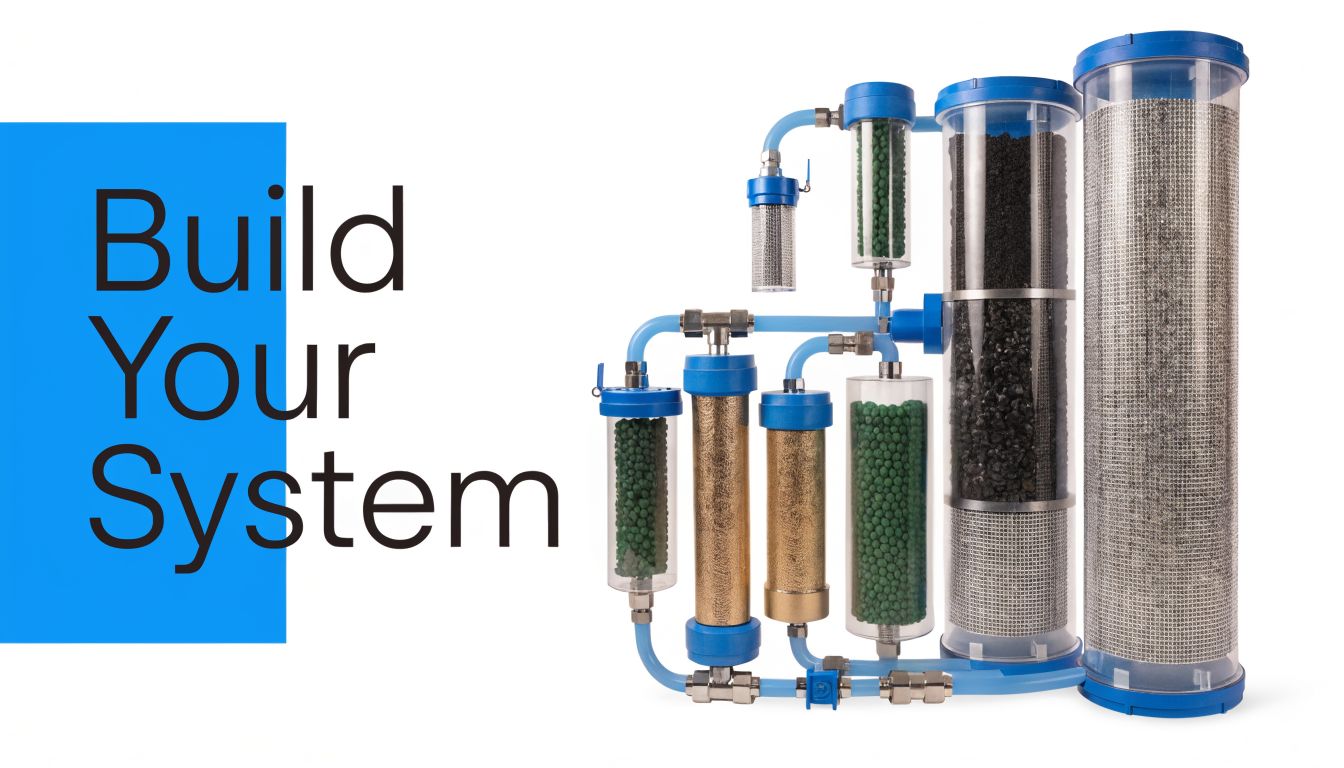
The best home water filter for well water is usually not a single filter. It's a filtration train, arranged in the order your water needs.

That sounds complicated until you reduce it to a simple rule. Put the rough treatment first, the specialized treatment next, and the polishing or disinfection stage last.

A modular water filtration system showing various clear filter cartridges with different internal media components connected by blue tubes.

Matching the train to the test

Here are practical system layouts that make sense for common well-water scenarios.

  • Sediment plus iron: Start with a sediment pre-filter, then an iron filter, then a carbon polishing stage if taste or odor still needs cleanup.
  • Hydrogen sulfide odor plus staining: Use sediment protection if needed, then an oxidation-based sulfur and iron filter, followed by carbon if you want final odor polishing.
  • Bacteria concern with otherwise manageable water: Pre-filtration first, then the core treatment stages for any minerals or odor issues, with UV at the end.
  • Heavy particulate load with mixed nuisance issues: Use strong sediment control up front so the specialty tanks don't get buried in debris.
  • Hard water layered onto other problems: Treat nuisance contaminants in the right order, and place softening where it supports the system rather than interfering with it.

The order matters as much as the parts. A UV unit before cloudy water is a bad sequence. Carbon before heavy iron is usually a short-lived sequence. A softener thrown into the wrong place can complicate the system instead of helping it.

A few combinations that work well

A common setup for visible staining and dirty water is:

Sediment filter → AIO iron filter → carbon filter

A common setup where microbial protection is part of the plan is:

Sediment filter → primary contaminant treatment → UV

If your water smells bad at every tap but also carries particles, don't skip that first barrier. Sediment is what gradually shortens the life of everything behind it.

Good treatment trains don't ask one component to do three jobs badly. They give each stage one clear job and enough protection to keep doing it.

A short visual walkthrough can help if you're trying to picture how these parts fit together in a real installation.

The shopping list mindset

When I review a homeowner's plan, I don't look for the fanciest brand list. I look for a clean answer to four questions:

  • What exactly are we removing?
  • What has to be protected first?
  • Where is pressure most likely to become a problem?
  • What will this setup cost to maintain?

If you can answer those four, your system design is usually headed in the right direction.

Installation Upkeep and Common Troubleshooting

Even a well-chosen filtration system can disappoint if it's installed poorly or ignored after startup. Most long-term complaints come from three places. Bad placement, skipped maintenance, or unrealistic expectations about what the equipment is supposed to do.

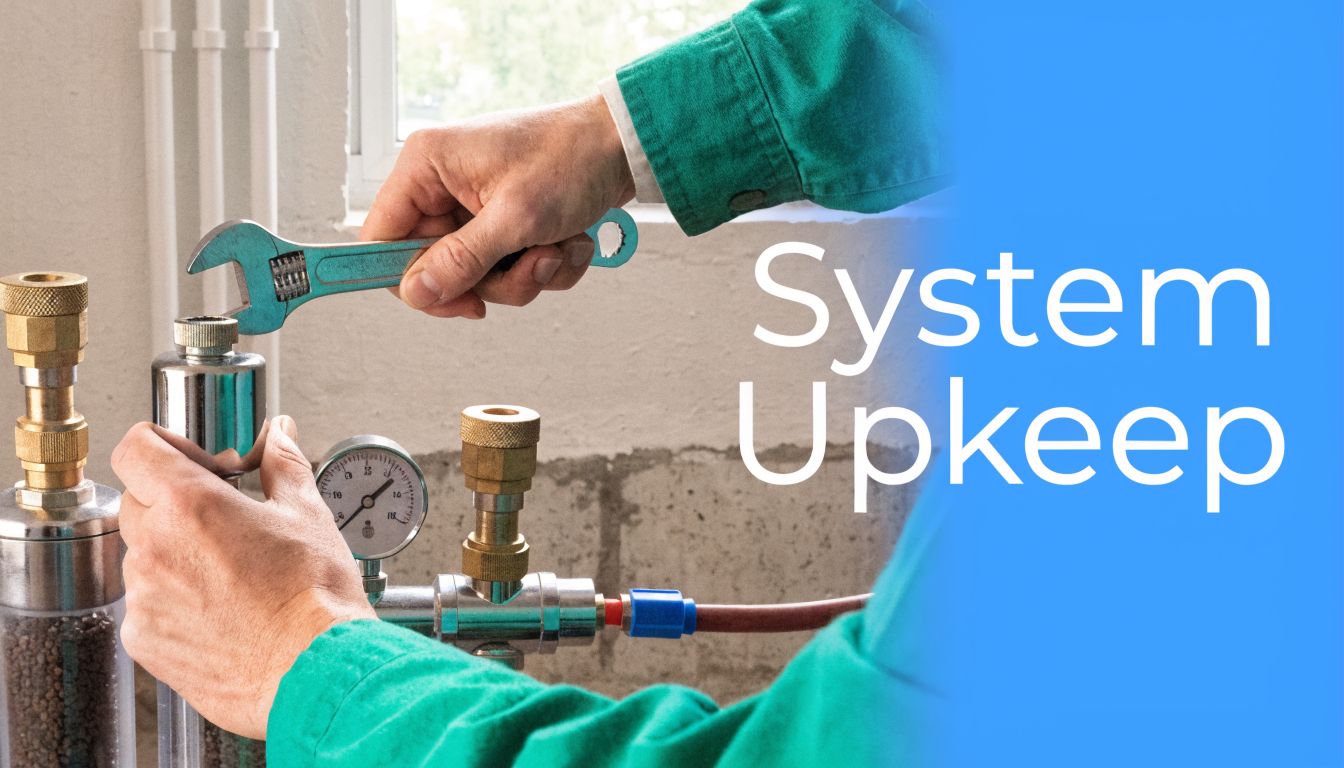
A professional technician wearing a green uniform performs maintenance on a home water filtration system.

DIY or hire a pro

Some homeowners can handle basic installation work, especially when the system is simple and the plumbing layout is clean. Whole-house well systems get more demanding when they involve larger tanks, bypass valves, drain lines, pressure concerns, or disinfection equipment.

If you hire a professional, look for someone who can do more than connect pipes. You want a person who understands well-water chemistry, equipment order, service access, and how to leave room for future maintenance.

A maintenance routine that keeps systems honest

Create a written service schedule and keep it near the equipment. Don't rely on memory.

  • Check pre-filters regularly: These are often the first point of pressure loss.
  • Watch for returning odor or staining: That usually means a treatment stage is overloaded, exhausted, or bypassing.
  • Inspect bypass settings and valves: A partly closed or incorrectly set valve can make a healthy system look broken.
  • Look around the equipment base: Small leaks can gradually create bigger house problems over time.

If you're not sure what hidden moisture problems look like once water escapes containment, this guide on signs of water damage in your home is useful for spotting trouble early.

Quick troubleshooting that saves time

If pressure suddenly drops, start with the simplest suspect. Check the sediment stage first. That's often where a system announces that it has been doing its job.

If a sulfur smell comes back, don't assume the whole system failed. It may be one exhausted stage or a change in raw water conditions. If staining returns, compare where it appears. Whole-house return usually points to treatment performance. One fixture only may point to local plumbing or fixture buildup.

A good troubleshooting habit is to ask what changed. Water conditions, usage, service intervals, and valve positions usually explain the problem faster than guesswork.

Frequently Asked Questions About Well Water Filters

Can one filter handle all well water problems

Usually not. Well water often has layered issues, and different contaminants need different treatment methods. The best results usually come from staged treatment rather than a single all-purpose box.

Is a whole-house system better than an under-sink filter

It depends on the goal. If you're dealing with staining, odor, sediment, or appliance wear, whole-house treatment makes more sense. If you only want better drinking water at one tap, an under-sink unit may be enough.

Will a carbon filter remove iron and sulfur odor by itself

Sometimes it can help with mild odor polishing, but it often isn't the right primary treatment for heavier iron or hydrogen sulfide problems. Those usually need specialized pretreatment.

How do I know what size system I need

Start with your water test and your household demand. A system has to match both the chemistry and the amount of water your home uses at peak times.

Why do some homeowners regret the cheapest system

Because initial price isn't the full cost. Media replacement, routine upkeep, and pressure complaints can make a low-priced system the costly choice over time.

Should I install UV just to be safe

Only if the water conditions and test results support it and the system is built to feed UV properly. UV is a disinfection tool, not a substitute for sediment or iron treatment.


If you're comparing systems and want clear, practical help without the marketing fog, Water Filter Advisor is a solid place to research filters, maintenance needs, and the trade-offs that matter in a real home.

Your Guide to the Best Water Filtration System for Well Water

When you have a private well, you're not just a homeowner—you're your own water manager. A water filtration system for well water is a combination of technologies that removes contaminants, improves taste, and makes your water safe. It's your home's personal water treatment plant.

Your Guide to Pure and Safe Well Water

A smiling person fills a clear glass with pure, safe water from a kitchen tap.

Owning a home with a private well means you don’t have to deal with municipal water bills or the chemicals used in city treatment. But this also means you carry a critical responsibility: ensuring the water from your taps is safe and clean.

Unlike city water, no public utility is monitoring your well. The quality is entirely in your hands. This guide gives you the expert information you need to turn your well into a reliable source of pure water.

What This Guide Covers

We're here to give you the knowledge to make the right decisions for your water. We will show you how to solve the most common issues well owners face.

  • Safety: We’ll show you how to identify and get rid of harmful bacteria, viruses, and chemicals you can’t see, smell, or taste.
  • Taste and Odor: Learn how to eliminate "rotten egg" smells from sulfur or the metallic tastes that make water unpleasant.
  • Staining and Damage: Find out how to stop minerals like iron and manganese from leaving ugly orange or black stains on sinks, tubs, and laundry.

A well water filtration system should use a multi-barrier approach. Think of it as layers of defense. Different stages work together to stop different threats before they get to your faucet.

The Multi-Barrier Approach

No single filter can solve every water problem. A complete system uses a team of filters working in sequence.

One filter might remove large particles like sand and sediment. Another filter might be a specialist, targeting specific chemicals or minerals. A final stage, like a UV light, can neutralize any bacteria or viruses that got through the other defenses.

This guide will walk you through this strategic approach. We will help you build a system that matches your water's specific chemistry. By the end, you'll have the confidence to choose, install, and maintain the right equipment to protect your family, your plumbing, and your peace of mind.

Understanding What's Really in Your Well Water

Let’s pull back the curtain on the world hiding inside your well water. Unlike city water that gets tested and treated before it ever reaches your faucet, well water is a direct pipeline from the ground to your glass. That means you’re getting water in its most natural state—which can also include a whole cast of uninvited guests.

This isn't to scare you; it’s to empower you. Knowing exactly what you’re up against is the first step in choosing a filtration plan that actually works for your home. You're not alone in this—over 13 million households across the country rely on private wells. That’s a huge number of families who could be dealing with contaminants that sneak into groundwater from all sorts of places. If you want to dive deeper, you can explore Frizzlife's complete 2026 guide for well water filters.

The "Nuisance Crew": Annoying but Mostly Harmless

Some contaminants are more of an annoyance than a real danger. I call them the "Nuisance Crew," and you'll know they're around by the headaches they cause. They’re often the reason you started looking for a water filtration system for well water in the first place.

  • Iron: The classic rusty stain artist. If you’re seeing reddish-brown streaks in your sinks, toilets, and even on your laundry, you’ve met iron. It also gives your water a distinct metallic taste.
  • Manganese: Think of manganese as iron's darker cousin. It leaves behind blackish or dark brown stains and can make your water taste bitter or metallic.
  • Hydrogen Sulfide: This is the prankster of the group, responsible for that unmistakable rotten-egg smell. While the smell is awful, the gas itself is typically not a health risk at the low levels found in residential wells.
  • Hardness Minerals: This is the duo of calcium and magnesium that causes hard water. They don’t stain like iron, but they leave behind a chalky scale buildup on faucets, showerheads, and inside your appliances, which slowly strangles their efficiency and shortens their lifespan.

The Invisible Invaders: The Real Health Threats

Much more serious are the contaminants you can’t see, smell, or taste. I call these the "Invisible Invaders" because they pose genuine health risks, and their presence is the number one reason why testing your water is non-negotiable.

The most dangerous contaminants are often undetectable by your senses. Relying on clear, good-tasting water as a sign of safety is a gamble. Professional testing is the only way to be certain.

These invaders can come from anywhere. Agricultural runoff can introduce nitrates and pesticides. A neighbor’s failing septic system can leach bacteria into the groundwater. Even the natural geology of your area can be a source of heavy metals. To grasp the severity, it's useful to know what professionals consider truly contaminated water—like Category 3 water damage, also known as 'black water', which illustrates the worst-case scenarios that good filtration helps you avoid.

Here are the main threats you need to be aware of:

  • Bacteria and Viruses: Pathogens like E. coli and coliform bacteria are major red flags. Their presence usually means sewage or animal waste has contaminated your water, and they can cause serious gastrointestinal illnesses.
  • Nitrates: Often found in agricultural areas from fertilizer runoff, high levels of nitrates are especially dangerous for infants and pregnant women.
  • Heavy Metals: Arsenic and lead are two of the most concerning. They can leach into groundwater from natural mineral deposits or old industrial sites and are linked to severe, long-term health problems.

To make this easier to spot, I've put together a quick reference table. It connects the dots between what you're seeing, smelling, or tasting and what might be causing it.

Common Well Water Contaminants and Their Telltale Signs

Contaminant Potential Sign Primary Concern
Iron Rusty/orange stains, metallic taste Staining, pipe buildup, metallic taste
Manganese Black/dark brown stains, bitter taste Staining, appliance damage, unpleasant taste
Hydrogen Sulfide Rotten egg smell Unpleasant odor and taste
Hardness (Calcium & Magnesium) White, chalky scale; soap scum Appliance inefficiency, pipe blockage
Bacteria (e.g., E. coli) Often no sign (sometimes slight odor) Gastrointestinal illness, serious infection
Nitrates No sign (tasteless, odorless, colorless) Developmental issues in infants ("Blue Baby Syndrome")
Arsenic No sign (tasteless, odorless, colorless) Long-term health effects, including cancer
Lead No sign (tasteless, odorless, colorless) Neurological damage, developmental delays

Remember, this table is a starting point. While these signs are good clues, the only way to know for sure what's in your water is to get it professionally tested.

Know Your Water Before You Filter

You can't choose the right water filtration system for well water until you know what's in your water.

Buying a filter without a water test is a guess. This is the first and most important step to getting clean, safe water from your well.

A water test gives you a detailed report on every contaminant in your well.

DIY Strips vs. Professional Lab Testing

You have two options for testing. They serve different purposes.

  1. DIY Test Strips: These give you a quick look. You can buy them at hardware stores or online. Dip them in water for instant results on basics like pH, hardness, and chlorine. They are good for a quick check but are not accurate enough to base your filtration system choice on.

  2. Professional Lab Testing: This is a full diagnosis and is non-negotiable for well owners. A state-certified lab provides a highly accurate, detailed analysis. This is the only way to find dangerous contaminants like bacteria, arsenic, lead, and volatile organic compounds (VOCs).

A professional lab report is the blueprint for your entire water filtration system. Without it, you are buying a system blind and may not be removing the most serious threats in your water.

How to Use a Certified Lab

Getting a professional test is a straightforward process.

First, find a state-certified laboratory. Search online for "[Your State] certified water testing lab" or check your state's Department of Environmental Protection (DEP) or Department of Health website for a list.

Next, request the right tests for a well owner. This should include:

  • Total Coliform and E. coli: Checks for bacterial contamination.
  • Nitrates/Nitrites: Important for wells near agricultural areas.
  • pH Level and Hardness: Tells you if your water is acidic or alkaline and the level of minerals like calcium and magnesium.
  • Iron and Manganese: These are what cause staining on fixtures and laundry.
  • Lead and Arsenic: Critical tests for heavy metals with serious health risks.

The lab will give you a special collection kit with strict instructions. Follow them exactly. Use their bottles, do not touch the inside of the cap, and return the sample to the lab quickly. This ensures your results are accurate.

Your report will show results with terms like "mg/L" (milligrams per liter) or "CFU/100mL" (colony-forming units per 100 milliliters). The report will list your results next to the EPA’s maximum contaminant levels (MCLs). If your water exceeds an MCL, you need to address it. This data will point you directly to the correct filtration solution.

Assembling Your Filtration Dream Team

Choosing the right water filtration system for well water isn't about finding one magic bullet. It’s more like building a team where every player has a key role. No single filter can solve every problem, so the goal is to create a strategic lineup that guarantees pure, safe water for your home.

Your lab report is your playbook. It tells you exactly what you’re up against—sediment, iron, bacteria, you name it. Now, let’s go over the key players you can recruit for your home's water defense.

The Bouncer at the Door: Sediment Filters

Every great system starts with a solid front line. For water filtration, that's your sediment filter. It's almost always the very first stage in a whole-house system for a good reason: its job is to act as a bouncer.

Think of it this way: your water is a stream carrying all sorts of debris. The sediment filter is the screen that catches all the big stuff—dirt, sand, rust, and silt. It doesn't handle dissolved chemicals or bacteria, but it stops the grit that clouds your water and would otherwise clog up every other filter down the line.

  • How It Works: A physical barrier, often a pleated or wound-string cartridge, uses microscopic pores to trap physical particles.
  • Pros: Protects all your other filters and appliances, makes water clearer, and is cheap to install and maintain.
  • Cons: Doesn't remove anything you can't see, like dissolved contaminants, bad tastes, odors, or bacteria.

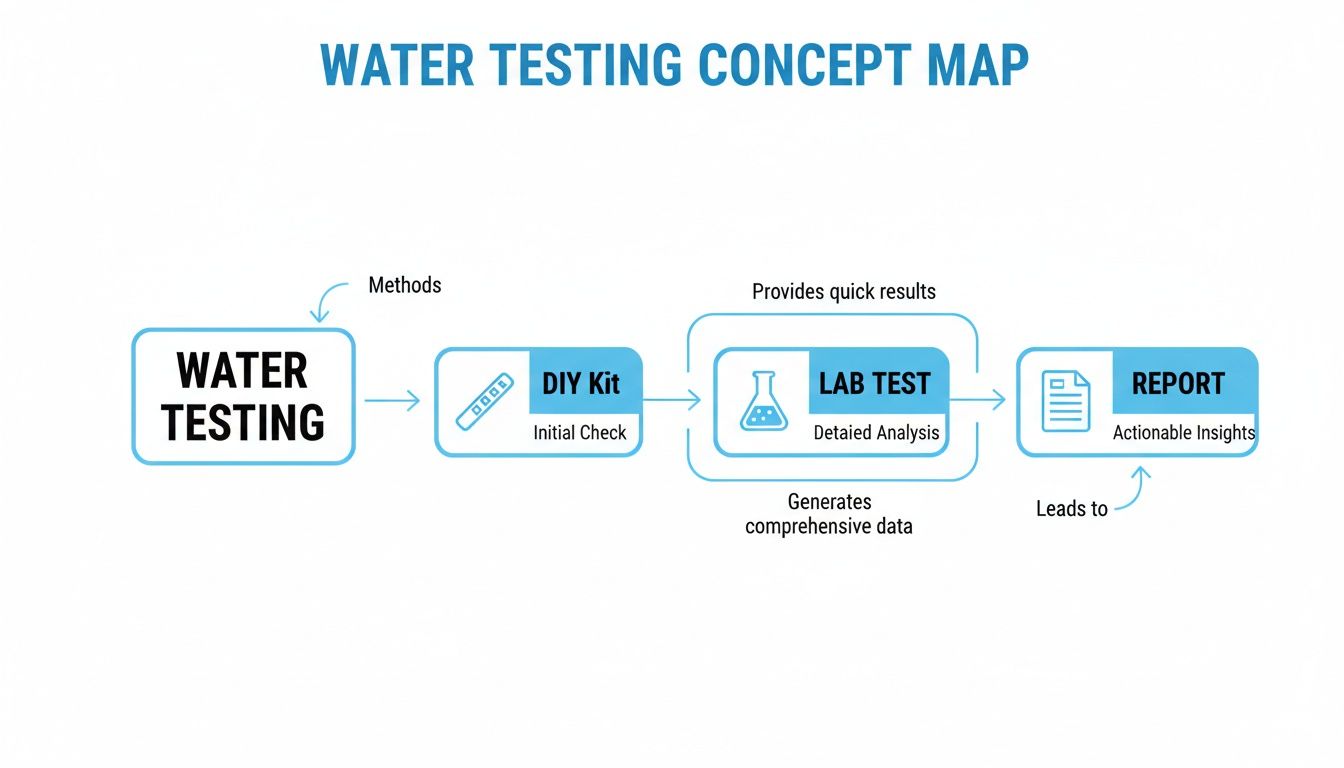
This is how you go from suspecting a problem to knowing exactly what to fix. From a simple DIY test to a full lab analysis, you get the data you need to build the right filtration plan.

A water testing concept map illustrating DIY kit initial checks, detailed lab analysis, and actionable reports.

Once you have that detailed lab report, you can start picking the right players for your team.

The Chemical Sponge: Activated Carbon Filters

Next up is your team's workhorse, the activated carbon filter. The best way to picture it is as a massive sponge with millions of tiny, porous pockets. Its job is to grab all the things that make your water taste and smell off.

Activated carbon uses a process called adsorption, where contaminants literally stick to its surface. It's incredibly effective against chemicals like chlorine, pesticides, and many volatile organic compounds (VOCs). This is the filter that takes water with a funky chemical or earthy smell and makes it taste crisp and clean.

The Heavy Lifters: Water Softeners and Iron Filters

Some problems just need brute force. That's where water softeners and iron filters come in—they are the heavy-lifters on your team, built to tackle the minerals that cause the most obvious headaches around the house.

A water softener goes after one thing: hardness minerals like calcium and magnesium. Through a process called ion exchange, it swaps out those scale-forming minerals for sodium ions. This is what stops that chalky buildup that destroys appliances and leaves spots all over your dishes.

An iron filter is even more specialized. It's designed specifically to get rid of iron. It oxidizes the dissolved iron in your water, turning it into a solid particle that can then be easily filtered out. This is your go-to defense against those ugly rusty-orange stains that plague so many homes with well water.

The Silent Assassin: UV Purifiers

For the threats you can't see, you need a silent assassin. A UV purifier is your final line of defense against the nasty biological stuff. It's unique because it doesn’t add any chemicals to the water, nor does it remove anything.

Instead, a UV light chamber bombards the water with powerful ultraviolet rays, scrambling the DNA of bacteria, viruses, and protozoa like E. coli and Giardia. This neutralizes them, making it impossible for them to reproduce and make your family sick. It’s a simple, set-it-and-forget-it solution for microbiological safety.

A UV purifier is a must-have for well owners. Bacteria can get into your well without changing the water's taste or smell, and a UV system provides a constant guard against illness-causing pathogens.

The Perfectionist: Reverse Osmosis (RO) Systems

Finally, for the absolute purest drinking water right from the tap, you bring in the perfectionist: a reverse osmosis (RO) system. This is typically a point-of-use system installed right under your kitchen sink.

An RO system works by forcing water through a special semi-permeable membrane, which strips out up to 99% of all dissolved solids at a molecular level. We’re talking about nitrates, arsenic, lead, fluoride, and so much more. For the 15% of Americans on private wells, this technology can be a lifesaver. In the Flint water crisis, for instance, certified RO filters reduced lead to safe levels, with filtered water showing over 20 times less lead than unfiltered tap water. For well owners, an RO system is the final word in purity.

Getting a system like this installed properly is key to making sure it works right from day one. If you're not comfortable doing it yourself, finding a qualified plumber is a smart investment to protect your system and your home.

Alright, you've gotten your water test results back and you have an idea of what needs to be filtered out. Now comes the big decision: choosing the right hardware for the job.

Picking the best water filtration system for well water isn't about buying the most expensive gear you can find. It’s about matching the right equipment to your well, your home, and your family. The goal is to get clean, safe water without creating new headaches, like a sudden drop in water pressure every time someone starts the dishwasher.

Let's break down the technical specs you'll see on the box and translate them into what they actually mean for your day-to-day life. This way, you can feel confident you’re getting a system that’s a perfect fit.

Matching Flow Rate to Your Family's Needs

Have you ever been the last one to get in the shower, only to have the water pressure drop to a pathetic trickle? That’s what an undersized filtration system can feel like—all the time. This is why flow rate is the first thing you need to get right.

Flow rate, measured in gallons per minute (GPM), is simply how much water can move through the filter at once. If your system's GPM is too low, it creates a bottleneck for your entire home.

To figure out what you need, think about your family's busiest time of day. A shower might use 2.5 GPM, a dishwasher 1.5 GPM, and a washing machine 2 GPM. If all those are running during the morning rush, you need a system that can keep up.

A good rule of thumb is to budget 3-5 GPM for each person in your house. For a family of four, that means you should be looking for a system that can handle at least 12-15 GPM. This ensures you have plenty of water pressure, even when life gets hectic.

Filtration System Comparison for Well Water

With so many types of filters on the market, it can be tough to keep them straight. This table breaks down the most common options for well water, showing what they target, what they typically cost upfront, and what kind of maintenance you can expect.

System Type Primary Target Contaminants Typical Cost Range (Initial) Ongoing Maintenance
Sediment Filter Sand, silt, dirt, rust particles $50 – $500 Cartridge replacement every 3-12 months.
Carbon Filter Chlorine, pesticides, herbicides, VOCs, bad taste/odor $100 – $1,500 Cartridge replacement every 6-12 months or based on gallon rating.
Water Softener Hardness minerals (calcium, magnesium) $800 – $3,000+ Replenishing salt regularly (monthly); resin media lasts 10-15 years.
Iron/Manganese Filter Iron, manganese, hydrogen sulfide (rotten egg smell) $1,000 – $3,500+ Backwashing (automatic); media replacement every 5-10 years.
Reverse Osmosis (RO) Salts, lead, arsenic, fluoride, nitrates, cysts $200 – $1,000 (POU) Pre/post filter changes (6-12 mos); membrane change (2-4 yrs).
UV Purifier Bacteria, viruses, protozoa (E. coli, Giardia) $400 – $1,500+ UV lamp replacement annually; quartz sleeve cleaning.

Use this as a starting point. Your water test results will point you toward the right column, and from there you can begin to weigh the initial cost against the long-term upkeep.

Decoding Filter Capacity and Long-Term Costs

The sticker price is just the beginning. To understand the true cost of a system, you have to look at its filter capacity and lifespan. This is what determines how often you'll be pulling out your wallet for maintenance.

  • Filter Capacity: This tells you how much water a filter can clean before it's "full" and needs to be replaced. You'll often see this measured in gallons. For example, a whole-house carbon filter might be rated for 100,000 gallons.

  • Lifespan: This is the manufacturer's estimate of how long a filter or media will last, usually given in months or years. For systems that clean themselves, like backwashing iron filters or water softeners, this refers to the media inside the tank, which can last 5 to 10 years or even longer.

A cheap system with a filter you have to swap out every three months can easily end up costing more over time than a more expensive unit with a high-capacity filter that lasts a full year. Do the math on the long-term costs before you buy.

The Importance of NSF/ANSI Certifications

With well water, you can't just hope a filter is doing its job—you need proof. That’s where certifications from organizations like the NSF (National Sanitation Foundation) and ANSI (American National Standards Institute) come in. These aren't just fancy logos; they are a guarantee that the product performs as advertised.

Think of an NSF/ANSI certification as a promise that’s been independently verified. It means the filter has gone through rigorous testing to prove it removes the specific contaminants listed on the box, down to the percentages claimed.

For example, a filter with an NSF/ANSI 53 certification is certified to reduce health-related contaminants like lead or cysts. A filter with NSF/ANSI 42 is certified for aesthetic issues, like improving bad taste from chlorine. For any well owner, choosing a certified water filtration system for well water is the only way to be absolutely certain your family is getting the protection they need.

Keeping Your System Running Smoothly

A person replacing a filter, following a maintenance checklist for a system.

Putting in a water filtration system for well water is a great move for any well owner. But it's not a "set it and forget it" kind of appliance. You have to think of it like your car—it needs regular, simple tune-ups to keep it performing at its best for years.

Consistent upkeep is what protects your investment and makes sure your family's water stays pure and safe. The good news is, most of this maintenance is straightforward and something any homeowner can handle.

DIY Tasks vs. Professional Help

Not every maintenance job requires a phone call to a pro. Some are quick DIY tasks you can do in minutes, while others are best left to a plumber to avoid a simple job turning into a costly mistake.

Most of the routine stuff is designed to be user-friendly. For instance, swapping a sediment or carbon cartridge is usually as simple as unscrewing a filter housing, popping in the new filter, and screwing it back on. That’s a perfect DIY job.

But for the bigger jobs—like replacing the filtration media inside a large backwashing tank or troubleshooting a finicky control valve—you’ll want an expert. If a task involves cutting pipes or messing with complex wiring, calling a pro is always the safer and smarter choice.

Your Fridge-Worthy Maintenance Checklist

The secret to staying on top of maintenance is a simple schedule. No need to memorize it all. Use this checklist as your guide and pop some reminders in your phone's calendar to stay on track.

  • Every 3-6 Months: Swap Your Sediment Filter
    This filter is your first line of defense against sand, silt, and grit. How often you change it really depends on how much sediment your well kicks up, but checking it every three months is a great habit to get into.

  • Every 6-12 Months: Replace Your Carbon Filter
    The carbon filter is what gets rid of bad tastes and smells, but it has a limited capacity. Once it's "full" of contaminants, it can't absorb any more. Most whole-house carbon filters are good for about a year.

  • Monthly: Check Your Water Softener Salt Level
    If you have a water softener, it's useless without salt. Just pop the lid once a month and make sure the brine tank is at least half-full. It’s a two-second job that prevents hard water from coming back.

Consistent maintenance does more than just keep your system running; it ensures the water quality you paid for. A clogged filter can't remove contaminants effectively, and an expired UV lamp offers a false sense of security against bacteria.

Annual System Check-Up

Once a year, it's time for a more thorough check-in. This is a critical part of keeping your system in top shape for the long haul.

  1. Replace Your UV Lamp: This is non-negotiable. A UV lamp’s power to kill germs fades over time, even if the light still looks like it's on. You must replace the lamp every year to guarantee it's actually killing bacteria and viruses.

  2. Clean the UV Quartz Sleeve: While you have the lamp out, take a minute to gently clean the glass sleeve it sits in. Any mineral buildup on the sleeve will block the UV light and make it less effective.

Following a simple schedule like this will keep your water filtration system for well water working perfectly for a decade or more. It’s a small bit of effort that delivers huge returns in water quality, appliance life, and your own peace of mind. For more expert tips, you can find helpful advice on all types of water filters to keep your home's water pure.

Frequently Asked Questions About Well Water Filtration

Here are answers to the most common questions from well owners about water filtration. Use this information to choose, install, and maintain the right system for your home.

Do I Really Need a Whole House System or Is an Under Sink Filter Enough?

For well water, a whole-house system is almost always the best choice. Under-sink filters like reverse osmosis systems are designed for a single faucet, primarily for drinking water.

A whole-house system protects your entire plumbing infrastructure. It is the only way to guard appliances like water heaters, washing machines, and dishwashers from sediment, iron, and hard water minerals. It also provides cleaner water for showering and laundry, preventing skin irritation and stains on clothes. An under-sink unit cannot provide this level of comprehensive protection.

How Often Should I Test My Well Water?

The CDC recommends a professional lab test for your well at least once a year. The annual test should check for total coliform and E. coli bacteria, nitrates, pH levels, and total dissolved solids (TDS).

Do not wait for the annual test if you notice any changes. You should test your water immediately if:

  • You notice a change in taste, smell, or color.
  • A household member has recurring gastrointestinal illness.
  • A flood, chemical spill, or major construction has occurred nearby.
  • You have performed any maintenance on the well, like replacing the pump.

Annual testing is the best way to identify problems before they become health risks. Many dangerous contaminants are undetectable by taste, smell, or sight.

Can I Install a Well Water Filtration System Myself?

Installation depends on the system type and your skill level. A simple single-cartridge sediment or carbon filter can be a straightforward DIY project with basic tools.

Complex multi-tank systems—including backwashing iron filters, water softeners, or UV purifiers—are different. These require precise plumbing work, and UV systems also involve electrical wiring. Incorrect installation can cause leaks, void the system’s warranty, or make the filter ineffective. When in doubt, hiring a qualified, insured professional is the safest investment.

What Does an NSF Certification Mean and Why Does It Matter for Wells?

NSF certification is independent, third-party proof from the National Sanitation Foundation that a filter performs as advertised. An NSF/ANSI mark means the system was tested against strict public health and safety standards.

This certification is critical for well owners. With the variable quality of well water, an NSF seal provides peace of mind. For example, a filter certified to NSF/ANSI 53 is proven to reduce specific health-related contaminants like lead or cysts. Choosing a certified product ensures your system is protecting your family from the specific contaminants found in your water test.


At Water Filter Advisor, we help you make decisions with clarity. Our guides and reviews are here to support you from understanding your water test to choosing the right system. Explore our resources at https://www.waterfilteradvisor.com to get started.