You’re likely facing a common scenario for those who begin comparing water filters. You pour a glass from the tap, take a sip, and wonder if that chlorine taste is normal. Then you notice dry skin after showers, white buildup on fixtures, or rust-colored sediment in a sink, and the question changes from “Is my water safe?” to “Why am I putting up with this?”
That’s where the whole house vs under sink water filter decision gets real. These aren’t just two versions of the same product. They solve different problems in different ways. One treats the water entering your home. The other focuses on the water you drink and cook with.
I’ve installed both types, tested both types, and watched people buy the wrong one for the wrong reason. That’s the expensive mistake. If you want cleaner showers, less chlorine throughout the house, and better protection for plumbing and appliances, a whole-house system is usually the right move. If your main concern is premium drinking water from one faucet, an under-sink filter is often the smarter buy.
The Great Water Debate In Your Home
Few embark on this search out of a passion for filtration technology. Instead, the journey is prompted by concerns about one's water quality.
Maybe it’s the smell at the kitchen tap. Maybe the shower leaves your skin tight and your hair dull. Maybe you’re on a well and you’re tired of sediment showing up where it shouldn’t. Or maybe you’ve read enough about lead, PFAS, or old plumbing that you want control over what your family drinks.
The mistake is assuming every filter fixes every problem.
A whole-house filter and an under-sink filter follow two completely different philosophies. One says every drop entering the home matters. The other says the water you ingest matters most, so focus your budget there.
Here’s the quick comparison before we go deeper:
| Feature | Whole House Filter (Point of Entry) | Under Sink Filter (Point of Use) |
|---|---|---|
| Main job | Treats water entering the home | Treats water at one faucet |
| Best for | Showers, laundry, appliances, plumbing | Drinking and cooking water |
| Contaminants it commonly targets well | Chlorine, sediment, broad household water issues | Lead, PFAS, VOCs, fine drinking-water contaminants |
| Installation | Usually professional | Often DIY-friendly |
| Good fit for renters | Rarely | Usually yes |
| Best buyer | Homeowner who wants full-home protection | Household focused on premium potable water |
Choose based on where the problem shows up. If the problem is everywhere, filter everywhere. If the problem is mostly what you drink, filter at the sink.
That’s the practical way to think about it.
The Guardian Approach Whole House Filtration Explained
A whole-house filter treats water the moment it enters the house. That changes more than the taste at one tap. It changes how your shower feels, how much sediment reaches your plumbing, and how hard your appliances have to work every day.

What it does well
Choose a whole-house system if the water problem shows up all over the home. Chlorine smell in the shower. Grit in fixtures. Staining, buildup, or premature wear on water-using equipment. This is the point-of-entry option for people who want the entire house protected, not just one drinking faucet.
That broader protection is the true value. Certified systems meeting NSF/ANSI 42 and 61 can achieve up to 97% chlorine reduction (https://www.hartwater.co.uk/blog/under-sink-vs-whole-house-water-filter/). Some models are also rated for 1,000,000 gallons or 10 years (https://www.hartwater.co.uk/blog/under-sink-vs-whole-house-water-filter/). In practice, that means less chlorine odor in bathrooms, less sediment moving through valves and fixtures, and better conditions for water heaters, dishwashers, and washing machines.
Here’s where whole-house filtration earns its keep:
- Showers and baths: Lower chlorine exposure usually means water feels less harsh on skin and hair.
- Appliances: Sediment and debris cause wear. Filtering them out helps water heaters, dishwashers, and washing machines last longer.
- Laundry: Treated water is easier on fabrics than raw water loaded with chlorine or particles.
- Plumbing: Cleaner incoming water reduces the amount of grit traveling through pipes, aerators, and valves.
This is the system I recommend when a family complains about the water in more than one room. If the water is affecting daily life across the house, treat the house.
What it does not solve by itself
A whole-house filter is built for broad protection. It usually is not the best choice for highly targeted drinking-water purification.
That matters if your biggest concerns are lead, PFAS, fluoride, dissolved solids, or the kind of fine contaminant reduction people expect from a dedicated reverse osmosis setup at the kitchen sink. A whole-house system can handle sediment, chlorine, and general household water issues very well. It does not automatically give you the highest level of treatment for every ingestible contaminant.
Buy based on the problem. If you want better water for bathing, cleaning, plumbing, and appliances, whole-house filtration is the right tool. If you also want stronger purification for drinking and cooking, pair it with a second system at the kitchen tap.
Who should choose it
Homeowners get the most value from whole-house filtration, especially if they plan to stay put and want to protect both the family and the house itself. This option makes the most sense with chlorinated city water, sediment-heavy well water, or any situation where bad water is affecting comfort, maintenance, and long-term equipment costs.
It also fits well during a remodel or plumbing upgrade. If walls are open or lines are being reworked, install the filtration system then and do it once. Domicile Construction's renovation guide is useful if you want to see how filtration and plumbing upgrades fit into a larger renovation budget.
The Specialist Approach Under Sink Filtration Explained
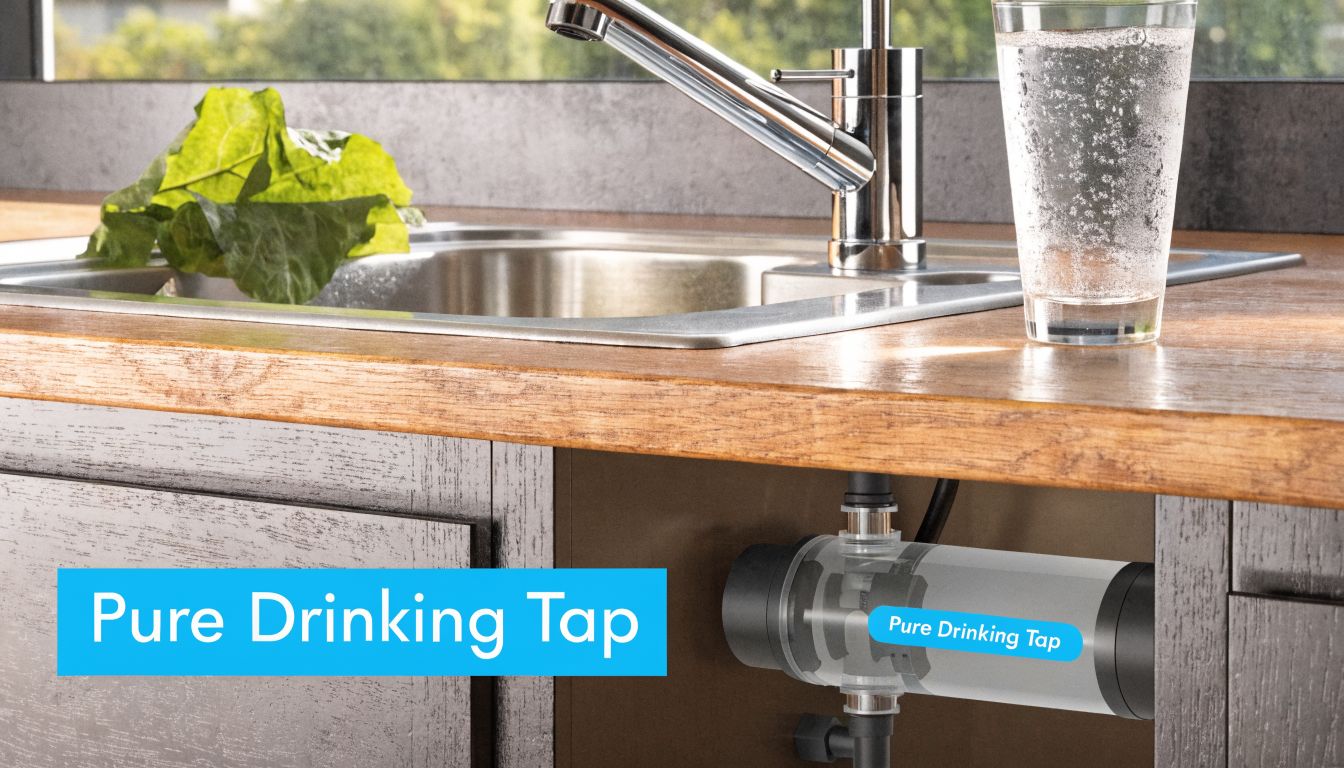
You fill a baby bottle, make coffee, boil pasta, and pour a glass of water straight from the kitchen tap. That is the water your family ingests. An under-sink system is built for that exact job.
It treats water at the point of use, usually one kitchen faucet, with far more precision than a broad house-wide filter.
Why under-sink systems hit harder at the tap
If your top concern is what goes into your body, under-sink filtration is often the smarter buy. This category is built to target drinking-water contaminants such as lead, PFAS, VOCs, bad tastes, odors, and in many cases dissolved solids.
Many of the best units use multi-stage carbon blocks, ion exchange, or reverse osmosis. That matters because the kitchen tap demands higher performance than the rest of the house. You do not need lab-grade water in a toilet tank. You do want better treatment where you drink, cook, rinse produce, and mix formula.
I install these for families who are tired of compromising. They want cleaner water at the tap that matters most, and they do not want to pay to treat every gallon used for flushing or mopping.
Why renters and budget-focused buyers pick them
Under-sink systems take up little space and usually cost less to buy and install than a whole-house setup. Many models are realistic DIY projects if the cabinet has room and the plumbing is accessible.
They also make financial sense because they treat a small share of total household water use. The U.S. Environmental Protection Agency shows that toilets, clothes washers, and showers make up the bulk of indoor residential water use, which is why filtering only the kitchen line can be the more efficient choice for ingestion-focused households (https://www.epa.gov/watersense/statistics-and-facts).
That is the primary appeal. You spend your filter budget where it delivers the biggest day-to-day payoff.
Where under-sink systems fall short
An under-sink filter will not help dry skin from chlorinated showers. It will not reduce scale or sediment feeding the water heater. It will not protect the dishwasher, washing machine, or ice maker unless those lines are connected to the system. It will not fix a whole-home water quality problem.
That household impact is the deciding factor. Under-sink filtration improves the water you consume. It does little for the water your home uses.
My recommendation is simple. Choose under-sink filtration if your main complaint is drinking and cooking water. Skip it as a standalone fix if your water is damaging appliances, irritating skin and hair, or causing problems at every tap.
Head-to-Head A Detailed Comparison of Filtration Systems
If you want the short version, here it is. Whole-house filtration is better for coverage. Under-sink filtration is better for precision.
That’s the fight.
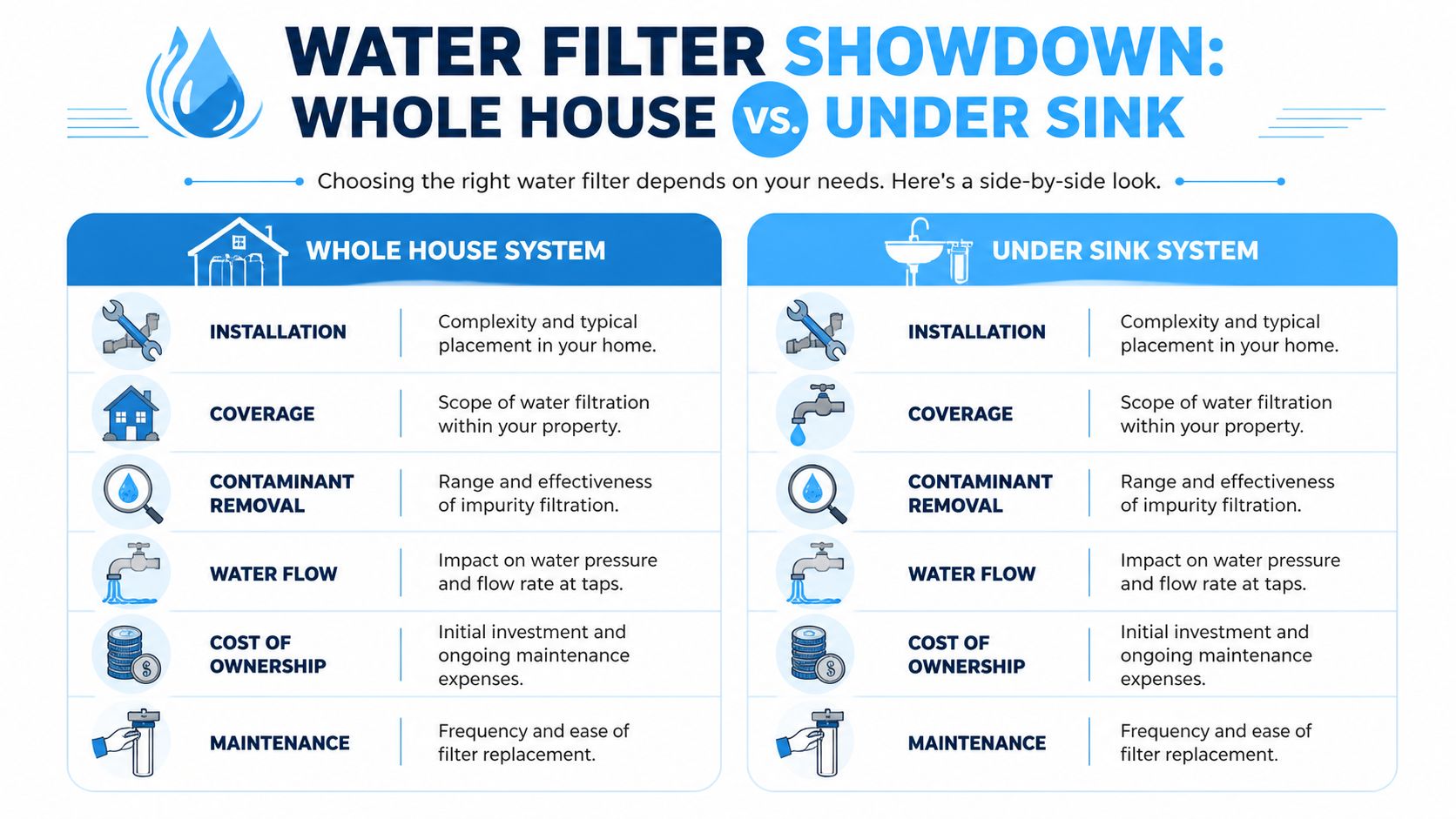
| Feature | Whole House Filter (Point of Entry) | Under Sink Filter (Point of Use) |
|---|---|---|
| Placement | Main incoming water line | Under one sink, usually kitchen |
| Coverage | Entire home | One faucet |
| Main strength | House-wide water treatment | Premium drinking and cooking water |
| Best contaminant focus | Chlorine, sediment, broad household treatment | Lead, PFAS, VOCs, fine contaminant reduction |
| Pressure impact | Depends on sizing, but designed for full-house flow | Usually limited to one faucet |
| Installation difficulty | Higher | Lower |
| Maintenance style | One central service point | Cartridge changes at the sink |
| Best user | Homeowner | Renter, apartment dweller, or drinking-water-focused homeowner |
Filtration performance
Whole-house systems win on scope. Under-sink systems win on intensity.
A whole-house unit treats every drop coming into the home, so it helps with shower water, bath water, and appliance feed lines. That gives it a broader household impact. But broad treatment is not the same as the highest level of contaminant removal at one tap.
An under-sink system is where you go when your priority is drinking-water quality first. That’s where technologies like reverse osmosis and multi-stage specialty media make sense.
Practical rule: Use whole-house filtration to improve the home’s water environment. Use under-sink filtration to improve the water you ingest.
Water flow and pressure
Flow matters more than most shoppers realize.
A whole-house system has to feed the entire property. If it’s properly sized, it can handle household demand without creating the kind of pressure drop people worry about. If it’s undersized, the whole family notices it when multiple fixtures run at once.
Under-sink systems only serve one faucet, so the pressure discussion is much smaller in scope. That said, some highly purified systems, especially reverse osmosis designs, can feel slower than a regular tap. Plenty of homeowners accept that tradeoff because they care more about water quality than faucet speed at that one location.
Installation complexity
This category isn’t close.
A whole-house filter usually means cutting into the main line, setting up bypass options, making room for service access, and ensuring the system is sized correctly for the home. That’s usually professional work.
Under-sink systems are much easier to live with if you’re handy. They’re compact, localized, and often manageable with basic tools. That makes them especially attractive for apartments and homes where a major plumbing job doesn’t make sense.
Maintenance demands
Whole-house systems are easier to forget about once installed, but the service isn’t optional. When a main filter is due, the entire house depends on that maintenance being handled on time.
Under-sink systems usually ask for more hands-on awareness because the cartridges are right there under the cabinet. The upside is simple. You can monitor the system more directly, and replacement is often straightforward.
Here's a helpful perspective:
- Whole-house maintenance: Less frequent feeling, higher consequence if ignored.
- Under-sink maintenance: More visible, more routine, usually less disruptive.
Certifications that matter
Certifications tell you what the filter is built to do. Ignore marketing language and read the certifications.
For whole-house systems, NSF/ANSI 42 and 61 matter when you’re evaluating chlorine reduction and material safety. For under-sink systems, NSF/ANSI 42, 53, and 58 are the big ones to watch depending on whether you want taste improvement, health-related contaminant reduction, or reverse osmosis performance.
Which system is easier to justify
This depends on your problem list.
If you say any of these, a whole-house system is easier to justify:
- My water smells like chlorine in every bathroom
- My skin and hair hate my shower water
- I want to protect appliances and plumbing
- I’m on a well and sediment is a constant nuisance
If you say any of these, an under-sink system is easier to justify:
- I want the cleanest water for drinking
- I’m worried about lead, PFAS, or VOCs
- I rent and need something practical
- I don’t care about filtering shower or laundry water
Unpacking the True Cost of Ownership
A family buys a cheap under-sink filter to fix bad-tasting water. Six months later, the kitchen water tastes better, but the showers still smell like chlorine, the dishwasher still spots glasses, and the water heater is still taking the hit. That is how people misread cost.
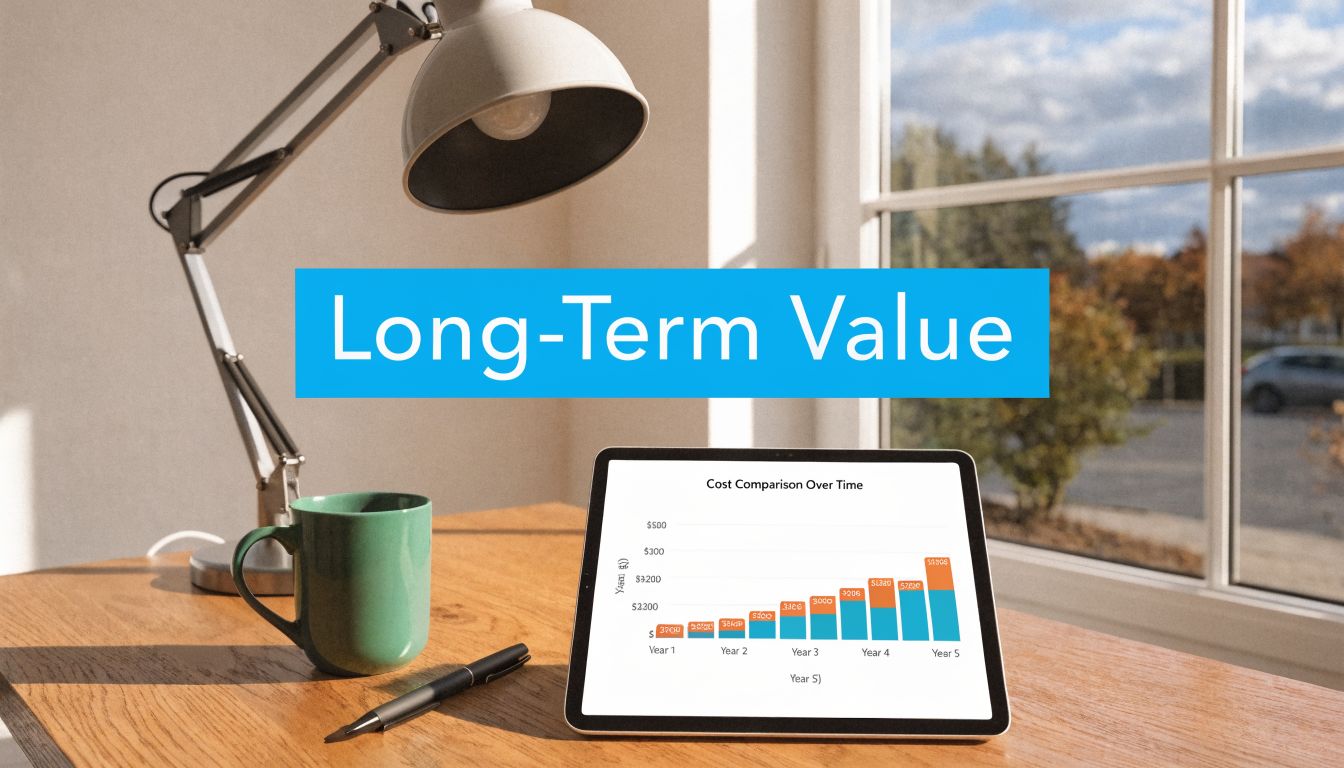
A filter's overall cost encompasses purchase price, installation, replacement filters, appliance protection, and how much of your daily water use it improves.
Whole-house cost reality
Whole-house filtration costs more up front because it treats every tap in the home. Aquasana says installation can range from $1,500 to $5,000 and that some advanced systems can reach 1,000,000 gallons or a 10-year lifespan in its whole-house vs under-sink comparison.
That price is justified only if you need whole-home results. If your water is rough on skin, leaves chlorine odor in bathrooms, clogs fixtures with sediment, or shortens the life of appliances, a main-line system addresses the full problem in one place. It can also cut the wear that poor water puts on plumbing, the water heater, the dishwasher, and the washing machine. Those savings are slow and unglamorous, but they are real.
If you plan to stay in the home for years, whole-house filtration usually makes more financial sense than patching symptoms room by room.
Under-sink cost reality
Under-sink systems win on entry price. Aquasana lists $100 to $500 as a typical upfront range for under-sink systems in its under-sink water filter guide.
That lower cost is the right move for a lot of households. If your main goal is clean water for drinking and cooking, an under-sink filter gives you the best return per dollar. You are filtering the water you consume most directly, not paying to treat toilet fill water or every shower in the house.
This is also the easier option for tighter budgets, smaller homes, and renters who want better water without a major install. If you want help comparing ownership questions before you buy, our water filtration advice library covers the basics clearly.
Where people waste money
Overspending usually happens in two predictable ways.
The first mistake is buying a whole-house system for a drinking-water-only problem. If the shower water feels fine, the laundry is fine, and your concern is lead, PFAS, taste, or odor at the kitchen faucet, a whole-house unit is overkill.
The second mistake is buying an under-sink system for a whole-home water problem. It will not fix chlorine in the shower, sediment at multiple fixtures, or the long-term strain on appliances.
Buy for the problem you have, not the product category that sounds bigger.
Cost over time comes down to maintenance discipline
Filters only pay off when you replace cartridges and media on schedule. Ignore maintenance and the value drops fast. A neglected whole-house system can reduce flow and stop protecting the plumbing side of the home. A neglected under-sink system can leave you drinking water that no longer matches the performance you paid for.
Use this rule:
- Choose whole-house filtration if you want to improve water for bathing, laundry, appliances, and the kitchen in one move.
- Choose under-sink filtration if your money should go toward the highest-quality drinking and cooking water first.
- Choose both if your house has broad water issues and you still want stronger contaminant reduction at the tap you drink from most.
For a useful overview of what installation and ownership questions buyers often ask before choosing a system, this video gives a solid general primer:
Matching the Filter to Your Lifestyle and Water Source
The right answer changes with the home, the people in it, and the water coming in. That’s why blanket advice is usually bad advice.
The family tired of chlorine in showers
A suburban family on city water often notices the same pattern. The tap is drinkable, but the water smells harsh, the bathrooms carry that swimming-pool note, and showers leave skin and hair feeling rougher than they should.
That household should usually start with a whole-house filter.
Why? Because their complaint isn’t just at the kitchen sink. It’s everywhere water touches daily life. A kitchen-only upgrade won’t change shower comfort, bathroom odor, or laundry water.
The renter in a small apartment
This one is easy. If you rent and your main concern is drinking water, buy an under-sink system.
You probably don’t need a plumber cutting into the main line. You probably don’t own the building. You probably want something compact, removable, and focused on the water you consume.
That’s exactly where under-sink filtration shines.
The homeowner on well water
Well water changes the conversation. Sediment, iron, odor, and other nuisance issues often show up long before you even think about the kitchen faucet. If the house has visible water problems across fixtures, a whole-house setup is usually the anchor solution.
That said, many well-water homes benefit from a layered approach. The whole-house system handles the broad nuisance load. A kitchen filter can then polish drinking water further if needed.
For broader home-water decision help tied to testing, maintenance, and choosing the right type of treatment, Water Filter Advisor’s home filtration advice library is a useful resource.
The health-focused cook
Some people care less about shower feel and more about what goes in the pot, kettle, and glass. If you cook constantly, make coffee daily, or mix formula, the case for an under-sink filter gets stronger.
You’re paying for targeted purification where flavor and ingestion matter most.
The best-fit summary
Use this quick guide:
- Choose whole-house if your complaints include showers, chlorine odor throughout the home, sediment, appliance protection, or broad well-water issues.
- Choose under-sink if your focus is drinking, cooking, lead concerns, or renter-friendly installation.
- Choose both if you want house-wide comfort and dedicated premium water at the kitchen faucet.
Your Final Decision A Practical Checklist
If you’re stuck, stop comparing marketing pages and answer these questions thoughtfully.
Start with where the problem shows up
If the problem affects more than one room, a whole-house system usually makes more sense.
Ask yourself:
- Do showers smell strongly of chlorine?
- Does your skin or hair feel irritated after bathing?
- Are you seeing sediment, staining, or appliance wear?
- Do you want treated water in laundry, bathrooms, and the kitchen?
If you answered yes to most of those, lean whole-house.
Focus on what you actually consume
Now ask the kitchen questions.
- Is your biggest concern the safety and taste of drinking water?
- Are lead, PFAS, or similar contaminants on your mind?
- Do you want a lower-cost starting point?
- Do you rent or want easier installation?
If that list sounds like you, lean under-sink.
The right choice gets obvious when you stop asking which system is “better” and start asking which problem you’re paying to solve.
Check the home itself
Your house matters as much as your water priorities.
A practical checklist:
- Ownership status: Homeowners can justify point-of-entry upgrades more easily than renters.
- Plumbing access: If access is tight or old plumbing needs attention, installation complexity rises.
- Length of stay: The longer you’ll stay, the easier it is to justify a bigger whole-house investment.
- Water source: Well-water homes often need broader treatment than city-water apartments.
- Local water report: You need to know whether your issue is chlorine, lead, sediment, or something else.
If you’re buying a home and evaluating systems before move-in, it helps to look at water quality as one part of the broader property checklist. Can Do Duct Cleaning's home guide is useful for spotting hidden house-condition issues before you commit to major upgrades.
My direct recommendation
Here’s the blunt version.
- Buy a whole-house filter if you want cleaner water for living in the home.
- Buy an under-sink filter if you want cleaner water for drinking in the home.
- Buy both if you’re serious about comfort, plumbing protection, and premium kitchen water.
Frequently Asked Water Filtration Questions
Can you install both systems
Yes, and in many homes that’s the best setup.
A whole-house system handles chlorine, sediment, and broad incoming-water problems. An under-sink filter then gives you high-end drinking and cooking water at the kitchen tap. That combination makes a lot of sense for larger households, well-water homes, and anyone who wants full-home comfort without giving up finer filtration where they ingest water.
How does hard water affect the choice
Hard water changes maintenance and equipment planning more than people expect. If you have scale buildup on fixtures, water heaters, or shower doors, a filter alone may not solve everything. Some homes need dedicated treatment for hardness in addition to filtration.
The practical takeaway is simple. If hard water affects the whole house, think beyond a sink-only solution. If your concern is only what you drink, an under-sink unit still has a place, but it won’t fix scale on plumbing or fixtures.
Do whole-house filters remove enough for safe drinking water
Sometimes yes. Sometimes no.
A whole-house filter can do a strong job on chlorine, sediment, and broad household treatment. But if your main concern is highly targeted drinking-water contaminants, many buyers still prefer an under-sink system at the kitchen for an extra layer of confidence.
That’s not a contradiction. It’s using each tool properly.
Whole-house filtration improves the water your home uses. Under-sink filtration improves the water your family swallows.
How long do filters last with heavy sediment or high chlorine
Heavy sediment and strong chlorine load usually shorten effective service life in real-world use. That applies to both system types. The dirtier or more chemically aggressive the incoming water, the harder the media has to work.
That’s why maintenance schedules should never be treated as decoration. If your water quality is rough, inspect performance sooner, watch for pressure changes, and don’t stretch replacement intervals just to save money.
Is under-sink always better for contaminant removal
For one faucet, often yes. For the whole home, no.
Under-sink systems are usually the better choice when you want focused contaminant reduction for potable water. Whole-house systems are better when you want every shower, bathroom, laundry line, and appliance feed protected. Different mission. Different winner.
What’s the biggest mistake people make
Buying based on fear instead of fit.
People read about a contaminant, panic, and buy the most aggressive system they can find without matching it to their home, water source, and daily use. That’s how they end up with a premium under-sink filter while still hating their showers, or a whole-house filter while still wanting better drinking water at the kitchen faucet.
The best decision comes from matching the filter to the lived problem.
If you want help comparing systems, understanding certifications, or figuring out what type of filtration fits your home, visit Water Filter Advisor. It’s a practical resource for homeowners and renters who want clear answers, not marketing fluff.
- April 30, 2026
- Uncategorized
