
You sit down with your annual water quality report, skim past the chemical names, and then one abbreviation grabs your attention: TTHM. It looks technical, a little ominous, and not at all homeowner-friendly.
That reaction is normal. You probably don't spend your weekends thinking about disinfection byproducts, chlorine chemistry, or vapor exposure from a hot shower. You just want to know whether your water is safe, what the term means, and whether you need a filter.
If you've been searching what are trihalomethanes in water, the short answer is this: they're chemical byproducts that can form after water is disinfected. The more useful answer is what they mean for your home, your family, and the type of filter that works. That's where things get practical.
That Funny Acronym on Your Water Report
You open your water report at the kitchen counter, spot TTHM, and suddenly a routine document feels a lot more personal. If you have kids, if you drink tap water, or if someone in your house takes long hot showers, that little acronym stops looking abstract very quickly.
Trihalomethanes, or THMs, are chemicals that can form after a water utility disinfects water. On many reports, you will see TTHMs, which means total trihalomethanes. That term is the combined measurement of the main THMs being tracked in the water supply.
TTHMs work like the total on a grocery receipt. You may buy four separate items, but the number that catches your eye is the combined cost at the bottom. A water report does the same thing by grouping four related chemicals into one total:
- Chloroform
- Bromodichloromethane
- Dibromochloromethane
- Bromoform
A lot of homeowners assume this kind of result means the treatment plant made a mistake. In reality, TTHMs usually show up because disinfection happened. Utilities use disinfectants such as chlorine or chloramine to reduce the risk from bacteria, viruses, and other pathogens. THMs are one of the byproducts that can form during that process.
That does not mean you should ignore the number.
The reason TTHMs matter in a home is broader than a glass of tap water. People often focus on drinking water first, which makes sense, but THM exposure can also happen when warm water turns them into vapor in a shower or bath. That detail changes the question from “Do I need a filter on my sink?” to “How much of my daily exposure happens throughout the house?”
Why the term sounds more confusing than it is
“TTHM” sounds technical because it is a lab and regulatory term. For a homeowner, the plain-English meaning is much simpler. It is a summary number used to show how much of these related disinfection byproducts are present together.
Water utilities monitor that total because regulators set limits for it. If you see TTHMs listed on a Consumer Confidence Report, you are looking at a standard water quality category, not some strange one-off contaminant that appeared out of nowhere.
Why homeowners pay attention
You are reading the report for one reason. You want to know whether this number calls for action in your home.
That is a reasonable question, especially because THM exposure is not limited to what you swallow. A pitcher filter may improve the water you drink, but it does nothing for the steam you breathe in during a hot shower or for the air released from bathwater. For households concerned about THMs, that full exposure picture often points toward whole-house treatment rather than a kitchen-only fix.
How THMs Get Into Your Water
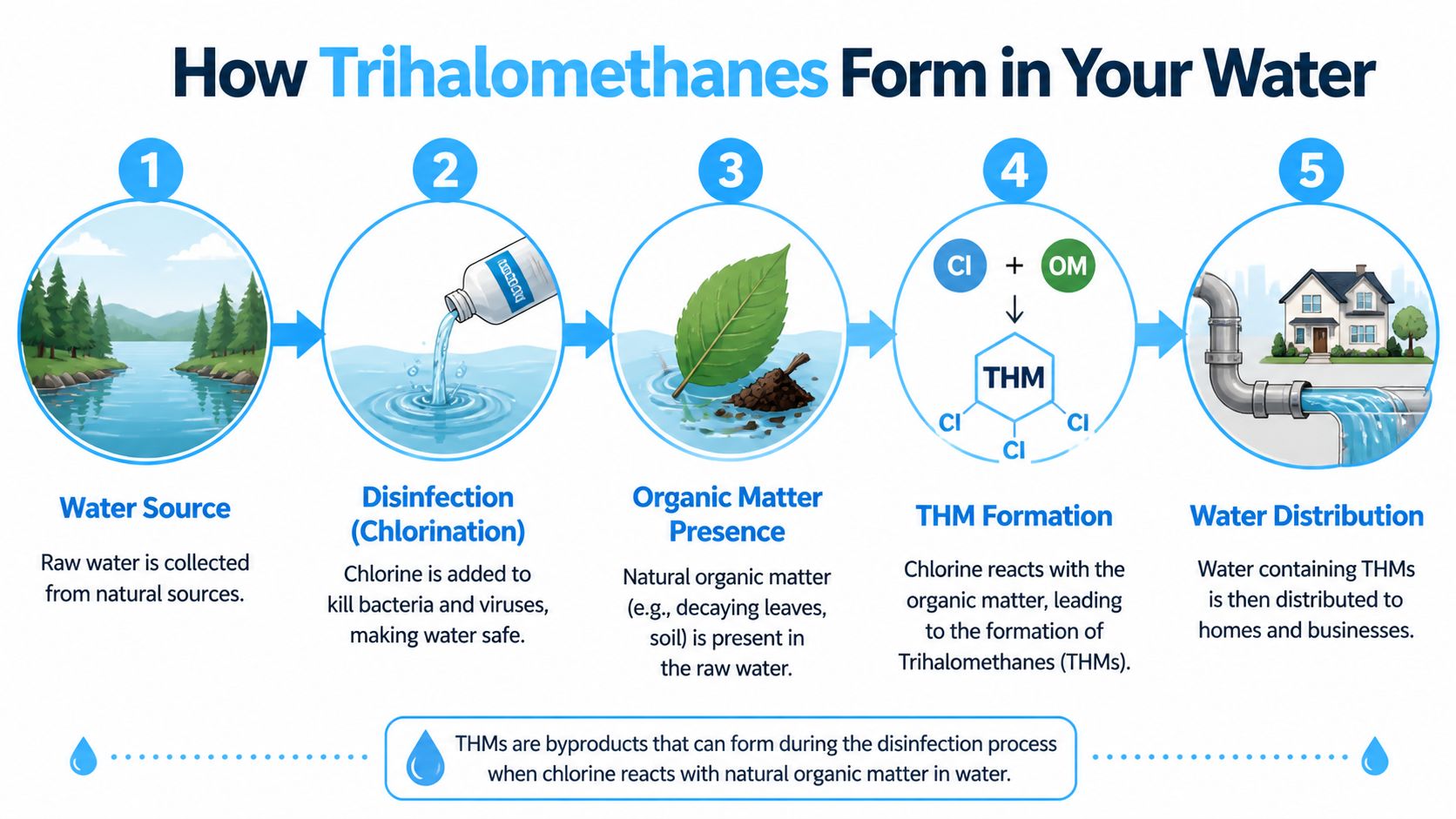
Your water utility adds chlorine for a good reason. It kills bacteria, viruses, and other microbes that can make people sick as water travels from the treatment plant to your home.
THMs form because chlorine does not stop reacting once the germs are handled.
It also reacts with naturally occurring organic material already in the source water, such as decaying leaves, algae, and small bits of plant matter. That chemical reaction creates a group of compounds called disinfection byproducts. Trihalomethanes are one of the most common examples homeowners see on a water report.
A simple way to understand the chemistry
A helpful comparison is a treatment plant working with raw ingredients that are never perfectly clean. The utility needs to disinfect the water to make it safe, but the same chlorine can also combine with leftover organic material and create byproducts. In plain English, THMs are the unintended chemical leftovers from that safety step.
The four chemicals behind the name
The four primary THMs are:
- Chloroform, often the dominant one
- Bromodichloromethane
- Dibromochloromethane
- Bromoform
The exact mix changes from one water system to another. Source water matters. Treatment methods matter too. That is why two towns can both disinfect with chlorine and still end up with different THM profiles.
Why levels change through the year
THM levels can rise in summer and fall in cooler months because warmer water speeds up the reactions that form them. Time in the pipes matters too. The longer disinfected water sits in the distribution system, the more opportunity chlorine has to keep reacting with organic material.
Ohio Watersheds at Ohio State explains that trihalomethanes form when chlorine or chloramines react with naturally occurring organic matter, and notes that warmer conditions can increase formation. That same reference also describes treated-water concentrations reaching 189.52 μg/L, with chloroform as the dominant species in the research discussed there.
Utilities may also see temporary increases after repairs, water main breaks, or periods when they raise disinfectant levels to control microbial risk. From a public health standpoint, that tradeoff makes sense. For a homeowner, it helps explain why THM levels are not always static.
This matters for more than drinking water. Once THMs are in the water, they do not stay limited to your kitchen tap. Warm water in showers and baths can release some of them into the air, which is one reason a sink filter may address only part of your household exposure.
Health Risks of Trihalomethane Exposure
A homeowner usually notices THMs on a water report long before they notice any symptom. That is part of what makes this topic confusing. The main concern is not a one-time exposure. It is repeated exposure over many years.
Health agencies have linked long-term exposure to high trihalomethane levels with a higher risk of bladder cancer. Researchers have also examined possible links to colon and rectal cancers, along with developmental effects during pregnancy. In plain terms, THMs are less like an immediate poison and more like a low-level stressor your body would rather avoid over time.

The safety benchmark homeowners should know
The EPA limit for total trihalomethanes, often listed as TTHMs on a water report, is 80 micrograms per liter. That number is the reference point utilities use to show whether their system is staying within federal standards.
For a homeowner, that limit is best understood as a warning line, not a comfort guarantee. A water system can meet the legal standard and still leave you wanting lower exposure in your own home, especially if your family takes long hot showers, has small children, or already uses filtration for other contaminants.
How to interpret the risk without panic
It helps to separate two questions that often get mashed together.
First, why is chlorine used at all? Because disinfected water protects households from bacteria, viruses, and other microbes that can cause immediate illness. Second, why pay attention to THMs? Because the same disinfection process can leave behind byproducts that raise concern over the long run.
A simple analogy helps here. Chlorine works like a strong cleaning tool that does an important job, but the cleanup process can leave residue behind. THMs are part of that residue. The practical goal at home is to keep the protection from disinfection while reducing your contact with the leftover byproducts.
Why this section matters for the rest of your house
Many homeowners hear "health risk" and think only about the glass in their hand. That is only part of the picture.
THMs can enter the body through drinking water, through the skin, and through the air once warm water releases them indoors. That airborne route is one reason families concerned about THMs often end up looking beyond sink filters and start thinking about whole-house treatment and even improving indoor air quality in Tucson.
The practical takeaway is simple. Repeated high THM exposure deserves attention, and the complete exposure picture goes beyond what you drink at the kitchen tap.
The Hidden Risk From Your Shower and Bath
It is often assumed that water exposure starts and ends with what one drinks. For THMs, that’s an incomplete picture.
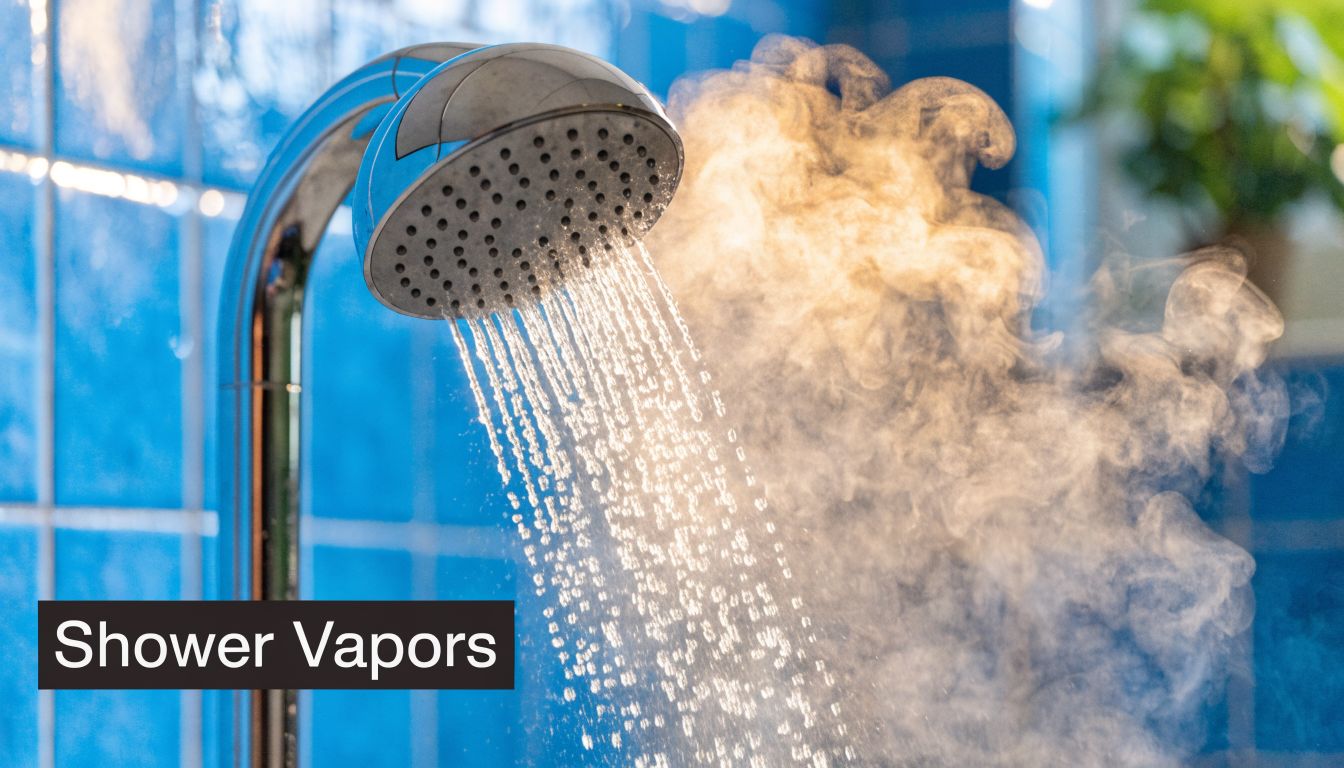
These compounds are volatile, which means they can move from water into air. In a hot shower or bath, that matters. The steam in the room isn't just warm moisture. It can also carry vaporized THMs, which you then breathe in, and your skin is in contact with the water the entire time.
Why the bathroom changes the equation
A kitchen filter only treats the water you drink or cook with. It does nothing for steam rising off a shower head.
That’s the blind spot with THMs. The Nova Scotia overview on THMs states that, due to their volatility, dermal and inhalation exposure during showering and bathing can result in “significantly higher” blood concentrations than ingestion alone. The same reference also notes that human bladder cancer risk rises by 59% at exposures greater than 50 ppb via all routes, citing the WHO.
For homeowners, the message is straightforward. If your concern is THMs, an under-sink filter solves only part of the problem.
What this means for filter choice
Filtration strategy requires more serious consideration.
A pitcher filter or faucet filter may help reduce what ends up in your glass. But if your family takes long showers, bathes children nightly, or spends a lot of time in steamy bathrooms, your exposure isn't limited to drinking water. That's why many households end up looking beyond point-of-use systems.
Three common approaches make sense:
- Shower filter for renters or single-bathroom homes that want a quick improvement at one fixture
- Under-sink system for households focused mainly on drinking and cooking water
- Whole-house carbon filtration for homes that want to reduce THM exposure across taps, tubs, and showers
The bathroom air piece is often overlooked in broader home health conversations too. If you're already thinking about reducing airborne chemical exposure indoors, this guide on improving indoor air quality in Tucson is a useful companion read because it helps connect water-related vapor exposure with the bigger indoor air picture.
A short explainer may help you visualize why shower exposure matters:
The strongest case for whole-house filtration
If a contaminant stays mostly in cold drinking water, a kitchen filter can be enough. THMs don't behave that way.
They move through the entire house. They can affect the water you drink, the water your kids bathe in, and the air in the bathroom during a hot shower. That doesn't mean every home needs the biggest system available. It does mean your filter decision should match your exposure pattern, not just your water bottle filling routine.
A THM problem is often a whole-home exposure problem disguised as a drinking water problem.
How to Test Your Water for THMs
Testing for THMs is one of those jobs where the smartest first step is usually free. Before you buy any gear, look up your local utility’s Consumer Confidence Report and find the TTHM entry.
That report gives you the official compliance picture. It won't answer every question, but it tells you whether your system has reported TTHMs near or above the regulatory threshold and whether there have been recent issues in the distribution system.
Start with the water report
Look for terms such as TTHM, Total Trihalomethanes, running annual average, or individual sampling site results. If the numbers feel abstract, compare them to the EPA benchmark already discussed earlier.
This step is especially important because THM levels are not consistent from place to place. Research summarized in the PMC report on geographic and seasonal variation notes that some U.S. cities have recorded levels over 300 ppb, nearly four times the EPA limit in that context, and identifies Louisiana, Oklahoma, and Texas as the states with the highest number of cities facing contamination issues among the most-affected municipalities studied.
Use a home kit for a snapshot
If you want a faster, more immediate sense of your household water, a home testing kit can help. The key word is snapshot.
A kit is useful when:
- You want current conditions, not last year’s utility average
- Your water smells more chlorinated than usual
- Recent repairs or flushing happened in your neighborhood
If you're comparing options, this overview of essential water quality tests gives a practical framework for deciding when an at-home screen is enough and when a lab test makes more sense.
Get a certified lab test when the decision matters
If you’re about to invest in a whole-house system, or if your utility report leaves you uneasy, a state-certified laboratory gives you the clearest answer. That’s the route I’d take if the result will affect a major filter purchase.
Timing matters too. Seasonal variation can change your results. Some systems peak in warmer summer months, while others can spike in colder periods depending on local conditions, treatment practices, and infrastructure patterns, as noted in the earlier PMC source. If your area has a history of higher readings, testing once during a lower period may give you false confidence.
A simple testing plan works well for most homeowners:
- Read the CCR first for the official baseline.
- Use a home kit if you want a household-level snapshot.
- Confirm with a lab before spending serious money on a treatment system.
Your Complete Guide to Removing THMs
Removing THMs gets easier once you match the filter to the way your family uses water.
If your only goal is better-tasting drinking water, a kitchen filter may be enough. If your concern includes long showers, hot baths, and steamy bathrooms, the answer often shifts toward whole-house treatment because THMs are part of your water use beyond the glass.
Activated carbon is the main tool homeowners use for THM reduction. It works like a sponge with millions of tiny pores. As water moves through that carbon, THM compounds stick to the surface instead of continuing on to the tap, showerhead, or tub faucet.
Performance depends on design details. Carbon type, contact time, flow rate, cartridge size, and replacement schedule all affect results. The performance of a tiny, uncertified cartridge is not comparable to a properly designed carbon block or GAC system.
Why certification matters
Marketing language can make weak products sound capable. For THMs, the shortcut is simple. Look for a clear claim for THM reduction and check whether the system is certified to NSF/ANSI 53 for that purpose.
That label matters because THM reduction is more specific than basic taste-and-odor improvement. Some filters are built mainly to reduce chlorine or improve flavor, which can leave homeowners assuming they solved a bigger problem than they did.
For practical help comparing filter types, installation limits, and upkeep, the articles in Water Filter Advisor’s water treatment advice library can help you narrow the options.
Comparing THM Water Filtration Methods
| Filter Type | THM Removal Effectiveness | Average Cost (System and Annual) | Best For |
|---|---|---|---|
| Pitcher with activated carbon | Can help, but capacity and contact time are limited | Varies by brand and cartridge schedule | Renters, low-commitment trial use |
| Faucet-mounted carbon filter | Covers one tap and offers moderate improvement when certified for THM reduction | Varies by model and replacement interval | Small households focused on kitchen tap water |
| Under-sink carbon system | Strong option for drinking and cooking water | Higher than faucet or pitcher systems | Homeowners who want dedicated kitchen treatment |
| Shower filter with carbon media | Can reduce exposure at one shower, but only at that fixture | Varies by cartridge life and design | Renters or homeowners focused on one bathroom |
| Whole-house GAC system | Treats water before it reaches taps, showers, and tubs | Highest upfront and maintenance commitment | Families addressing whole-home THM exposure |
Which option makes sense for your home
A pitcher or faucet unit can be reasonable if you rent and your main concern is drinking and cooking water. An under-sink system makes more sense if your household uses a lot of kitchen water and you want longer contact time with better filter media.
A shower filter can help in one bathroom, especially when a whole-house install is not realistic. But it does not address the rest of the home. You still have untreated water at other showers, bath faucets, and taps.
Whole-house GAC deserves a close look when your concern includes inhalation and skin contact during bathing. That setup treats the water before it spreads through the house, which gives you broader coverage where THMs often get overlooked most.
One practical rule helps many homeowners: if the contaminant matters in steam and vapor, not just in a glass, point-of-use drinking water filters only solve part of the problem.
Maintenance decides whether a good system stays good. Carbon has a working life. Once it is spent, removal drops off, so follow the replacement schedule, keep a simple service record, and choose a system you will realistically maintain.
Frequently Asked Questions About THMs
Does boiling water remove trihalomethanes
Boiling isn’t my first recommendation for THMs. Because these compounds are volatile, heating water changes how they behave, and boiling also reduces the volume of water left in the pot. That can make DIY “fixes” unreliable for household treatment.
For THMs, a properly selected activated carbon filter is the more practical home solution.
Are Brita-style or refrigerator filters enough
Sometimes, but not automatically. The deciding factors are the filter media, the size of the cartridge, and whether the product is certified for THM reduction under NSF/ANSI 53. Some basic refrigerator filters focus more on taste and odor than on broad contaminant reduction.
Read the spec sheet, not just the box front.
Do private well owners need to worry about THMs
Usually, THMs are more closely associated with disinfected water supplies, especially municipal systems that use chlorine or chloramines. If a private well isn't being chemically disinfected, THMs are often less central than issues like bacteria, iron, sulfur odors, or nitrate.
But if well water is chlorinated for treatment or shock disinfection, byproducts can become part of the conversation.
Should I buy a shower filter or a whole-house filter
That depends on your housing situation and how complete a solution you want.
A shower filter makes sense when installation needs to be simple or temporary. A whole-house carbon system makes more sense when you want one approach for showers, baths, sinks, and appliances. If your concern is what are trihalomethanes in water and how do I reduce my family’s overall exposure, whole-house treatment is usually the most complete answer.
What’s the smartest first move
Check your water report, then decide whether you need a home test or lab confirmation. Don’t buy filtration based on fear alone, but don’t ignore a pattern of high TTHMs either.
The best filter decisions come from matching the contaminant, the exposure route, and the home setup.
If you’re ready to compare practical filtration options without the jargon, Water Filter Advisor can help you sort through whole-house, under-sink, faucet, shower, and portable filters so you can choose a system that fits your water and your home.
- May 3, 2026
- Uncategorized
