When you have a private well, you're not just a homeowner—you're your own water manager. A water filtration system for well water is a combination of technologies that removes contaminants, improves taste, and makes your water safe. It's your home's personal water treatment plant.
Your Guide to Pure and Safe Well Water

Owning a home with a private well means you don’t have to deal with municipal water bills or the chemicals used in city treatment. But this also means you carry a critical responsibility: ensuring the water from your taps is safe and clean.
Unlike city water, no public utility is monitoring your well. The quality is entirely in your hands. This guide gives you the expert information you need to turn your well into a reliable source of pure water.
What This Guide Covers
We're here to give you the knowledge to make the right decisions for your water. We will show you how to solve the most common issues well owners face.
- Safety: We’ll show you how to identify and get rid of harmful bacteria, viruses, and chemicals you can’t see, smell, or taste.
- Taste and Odor: Learn how to eliminate "rotten egg" smells from sulfur or the metallic tastes that make water unpleasant.
- Staining and Damage: Find out how to stop minerals like iron and manganese from leaving ugly orange or black stains on sinks, tubs, and laundry.
A well water filtration system should use a multi-barrier approach. Think of it as layers of defense. Different stages work together to stop different threats before they get to your faucet.
The Multi-Barrier Approach
No single filter can solve every water problem. A complete system uses a team of filters working in sequence.
One filter might remove large particles like sand and sediment. Another filter might be a specialist, targeting specific chemicals or minerals. A final stage, like a UV light, can neutralize any bacteria or viruses that got through the other defenses.
This guide will walk you through this strategic approach. We will help you build a system that matches your water's specific chemistry. By the end, you'll have the confidence to choose, install, and maintain the right equipment to protect your family, your plumbing, and your peace of mind.
Understanding What's Really in Your Well Water
Let’s pull back the curtain on the world hiding inside your well water. Unlike city water that gets tested and treated before it ever reaches your faucet, well water is a direct pipeline from the ground to your glass. That means you’re getting water in its most natural state—which can also include a whole cast of uninvited guests.
This isn't to scare you; it’s to empower you. Knowing exactly what you’re up against is the first step in choosing a filtration plan that actually works for your home. You're not alone in this—over 13 million households across the country rely on private wells. That’s a huge number of families who could be dealing with contaminants that sneak into groundwater from all sorts of places. If you want to dive deeper, you can explore Frizzlife's complete 2026 guide for well water filters.
The "Nuisance Crew": Annoying but Mostly Harmless
Some contaminants are more of an annoyance than a real danger. I call them the "Nuisance Crew," and you'll know they're around by the headaches they cause. They’re often the reason you started looking for a water filtration system for well water in the first place.
- Iron: The classic rusty stain artist. If you’re seeing reddish-brown streaks in your sinks, toilets, and even on your laundry, you’ve met iron. It also gives your water a distinct metallic taste.
- Manganese: Think of manganese as iron's darker cousin. It leaves behind blackish or dark brown stains and can make your water taste bitter or metallic.
- Hydrogen Sulfide: This is the prankster of the group, responsible for that unmistakable rotten-egg smell. While the smell is awful, the gas itself is typically not a health risk at the low levels found in residential wells.
- Hardness Minerals: This is the duo of calcium and magnesium that causes hard water. They don’t stain like iron, but they leave behind a chalky scale buildup on faucets, showerheads, and inside your appliances, which slowly strangles their efficiency and shortens their lifespan.
The Invisible Invaders: The Real Health Threats
Much more serious are the contaminants you can’t see, smell, or taste. I call these the "Invisible Invaders" because they pose genuine health risks, and their presence is the number one reason why testing your water is non-negotiable.
The most dangerous contaminants are often undetectable by your senses. Relying on clear, good-tasting water as a sign of safety is a gamble. Professional testing is the only way to be certain.
These invaders can come from anywhere. Agricultural runoff can introduce nitrates and pesticides. A neighbor’s failing septic system can leach bacteria into the groundwater. Even the natural geology of your area can be a source of heavy metals. To grasp the severity, it's useful to know what professionals consider truly contaminated water—like Category 3 water damage, also known as 'black water', which illustrates the worst-case scenarios that good filtration helps you avoid.
Here are the main threats you need to be aware of:
- Bacteria and Viruses: Pathogens like E. coli and coliform bacteria are major red flags. Their presence usually means sewage or animal waste has contaminated your water, and they can cause serious gastrointestinal illnesses.
- Nitrates: Often found in agricultural areas from fertilizer runoff, high levels of nitrates are especially dangerous for infants and pregnant women.
- Heavy Metals: Arsenic and lead are two of the most concerning. They can leach into groundwater from natural mineral deposits or old industrial sites and are linked to severe, long-term health problems.
To make this easier to spot, I've put together a quick reference table. It connects the dots between what you're seeing, smelling, or tasting and what might be causing it.
Common Well Water Contaminants and Their Telltale Signs
| Contaminant | Potential Sign | Primary Concern |
|---|---|---|
| Iron | Rusty/orange stains, metallic taste | Staining, pipe buildup, metallic taste |
| Manganese | Black/dark brown stains, bitter taste | Staining, appliance damage, unpleasant taste |
| Hydrogen Sulfide | Rotten egg smell | Unpleasant odor and taste |
| Hardness (Calcium & Magnesium) | White, chalky scale; soap scum | Appliance inefficiency, pipe blockage |
| Bacteria (e.g., E. coli) | Often no sign (sometimes slight odor) | Gastrointestinal illness, serious infection |
| Nitrates | No sign (tasteless, odorless, colorless) | Developmental issues in infants ("Blue Baby Syndrome") |
| Arsenic | No sign (tasteless, odorless, colorless) | Long-term health effects, including cancer |
| Lead | No sign (tasteless, odorless, colorless) | Neurological damage, developmental delays |
Remember, this table is a starting point. While these signs are good clues, the only way to know for sure what's in your water is to get it professionally tested.
Know Your Water Before You Filter
You can't choose the right water filtration system for well water until you know what's in your water.
Buying a filter without a water test is a guess. This is the first and most important step to getting clean, safe water from your well.
A water test gives you a detailed report on every contaminant in your well.
DIY Strips vs. Professional Lab Testing
You have two options for testing. They serve different purposes.
DIY Test Strips: These give you a quick look. You can buy them at hardware stores or online. Dip them in water for instant results on basics like pH, hardness, and chlorine. They are good for a quick check but are not accurate enough to base your filtration system choice on.
Professional Lab Testing: This is a full diagnosis and is non-negotiable for well owners. A state-certified lab provides a highly accurate, detailed analysis. This is the only way to find dangerous contaminants like bacteria, arsenic, lead, and volatile organic compounds (VOCs).
A professional lab report is the blueprint for your entire water filtration system. Without it, you are buying a system blind and may not be removing the most serious threats in your water.
How to Use a Certified Lab
Getting a professional test is a straightforward process.
First, find a state-certified laboratory. Search online for "[Your State] certified water testing lab" or check your state's Department of Environmental Protection (DEP) or Department of Health website for a list.
Next, request the right tests for a well owner. This should include:
- Total Coliform and E. coli: Checks for bacterial contamination.
- Nitrates/Nitrites: Important for wells near agricultural areas.
- pH Level and Hardness: Tells you if your water is acidic or alkaline and the level of minerals like calcium and magnesium.
- Iron and Manganese: These are what cause staining on fixtures and laundry.
- Lead and Arsenic: Critical tests for heavy metals with serious health risks.
The lab will give you a special collection kit with strict instructions. Follow them exactly. Use their bottles, do not touch the inside of the cap, and return the sample to the lab quickly. This ensures your results are accurate.
Your report will show results with terms like "mg/L" (milligrams per liter) or "CFU/100mL" (colony-forming units per 100 milliliters). The report will list your results next to the EPA’s maximum contaminant levels (MCLs). If your water exceeds an MCL, you need to address it. This data will point you directly to the correct filtration solution.
Assembling Your Filtration Dream Team
Choosing the right water filtration system for well water isn't about finding one magic bullet. It’s more like building a team where every player has a key role. No single filter can solve every problem, so the goal is to create a strategic lineup that guarantees pure, safe water for your home.
Your lab report is your playbook. It tells you exactly what you’re up against—sediment, iron, bacteria, you name it. Now, let’s go over the key players you can recruit for your home's water defense.
The Bouncer at the Door: Sediment Filters
Every great system starts with a solid front line. For water filtration, that's your sediment filter. It's almost always the very first stage in a whole-house system for a good reason: its job is to act as a bouncer.
Think of it this way: your water is a stream carrying all sorts of debris. The sediment filter is the screen that catches all the big stuff—dirt, sand, rust, and silt. It doesn't handle dissolved chemicals or bacteria, but it stops the grit that clouds your water and would otherwise clog up every other filter down the line.
- How It Works: A physical barrier, often a pleated or wound-string cartridge, uses microscopic pores to trap physical particles.
- Pros: Protects all your other filters and appliances, makes water clearer, and is cheap to install and maintain.
- Cons: Doesn't remove anything you can't see, like dissolved contaminants, bad tastes, odors, or bacteria.
This is how you go from suspecting a problem to knowing exactly what to fix. From a simple DIY test to a full lab analysis, you get the data you need to build the right filtration plan.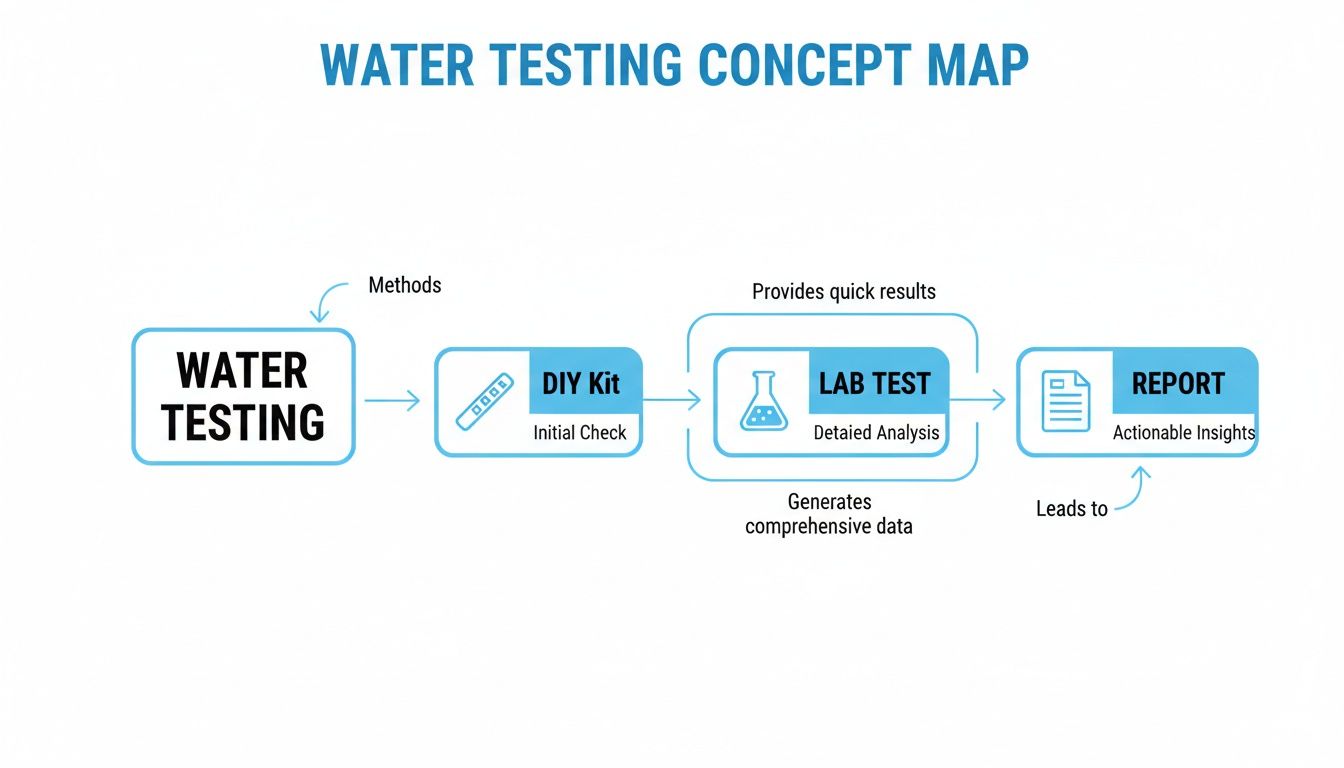
Once you have that detailed lab report, you can start picking the right players for your team.
The Chemical Sponge: Activated Carbon Filters
Next up is your team's workhorse, the activated carbon filter. The best way to picture it is as a massive sponge with millions of tiny, porous pockets. Its job is to grab all the things that make your water taste and smell off.
Activated carbon uses a process called adsorption, where contaminants literally stick to its surface. It's incredibly effective against chemicals like chlorine, pesticides, and many volatile organic compounds (VOCs). This is the filter that takes water with a funky chemical or earthy smell and makes it taste crisp and clean.
The Heavy Lifters: Water Softeners and Iron Filters
Some problems just need brute force. That's where water softeners and iron filters come in—they are the heavy-lifters on your team, built to tackle the minerals that cause the most obvious headaches around the house.
A water softener goes after one thing: hardness minerals like calcium and magnesium. Through a process called ion exchange, it swaps out those scale-forming minerals for sodium ions. This is what stops that chalky buildup that destroys appliances and leaves spots all over your dishes.
An iron filter is even more specialized. It's designed specifically to get rid of iron. It oxidizes the dissolved iron in your water, turning it into a solid particle that can then be easily filtered out. This is your go-to defense against those ugly rusty-orange stains that plague so many homes with well water.
The Silent Assassin: UV Purifiers
For the threats you can't see, you need a silent assassin. A UV purifier is your final line of defense against the nasty biological stuff. It's unique because it doesn’t add any chemicals to the water, nor does it remove anything.
Instead, a UV light chamber bombards the water with powerful ultraviolet rays, scrambling the DNA of bacteria, viruses, and protozoa like E. coli and Giardia. This neutralizes them, making it impossible for them to reproduce and make your family sick. It’s a simple, set-it-and-forget-it solution for microbiological safety.
A UV purifier is a must-have for well owners. Bacteria can get into your well without changing the water's taste or smell, and a UV system provides a constant guard against illness-causing pathogens.
The Perfectionist: Reverse Osmosis (RO) Systems
Finally, for the absolute purest drinking water right from the tap, you bring in the perfectionist: a reverse osmosis (RO) system. This is typically a point-of-use system installed right under your kitchen sink.
An RO system works by forcing water through a special semi-permeable membrane, which strips out up to 99% of all dissolved solids at a molecular level. We’re talking about nitrates, arsenic, lead, fluoride, and so much more. For the 15% of Americans on private wells, this technology can be a lifesaver. In the Flint water crisis, for instance, certified RO filters reduced lead to safe levels, with filtered water showing over 20 times less lead than unfiltered tap water. For well owners, an RO system is the final word in purity.
Getting a system like this installed properly is key to making sure it works right from day one. If you're not comfortable doing it yourself, finding a qualified plumber is a smart investment to protect your system and your home.
Alright, you've gotten your water test results back and you have an idea of what needs to be filtered out. Now comes the big decision: choosing the right hardware for the job.
Picking the best water filtration system for well water isn't about buying the most expensive gear you can find. It’s about matching the right equipment to your well, your home, and your family. The goal is to get clean, safe water without creating new headaches, like a sudden drop in water pressure every time someone starts the dishwasher.
Let's break down the technical specs you'll see on the box and translate them into what they actually mean for your day-to-day life. This way, you can feel confident you’re getting a system that’s a perfect fit.
Matching Flow Rate to Your Family's Needs
Have you ever been the last one to get in the shower, only to have the water pressure drop to a pathetic trickle? That’s what an undersized filtration system can feel like—all the time. This is why flow rate is the first thing you need to get right.
Flow rate, measured in gallons per minute (GPM), is simply how much water can move through the filter at once. If your system's GPM is too low, it creates a bottleneck for your entire home.
To figure out what you need, think about your family's busiest time of day. A shower might use 2.5 GPM, a dishwasher 1.5 GPM, and a washing machine 2 GPM. If all those are running during the morning rush, you need a system that can keep up.
A good rule of thumb is to budget 3-5 GPM for each person in your house. For a family of four, that means you should be looking for a system that can handle at least 12-15 GPM. This ensures you have plenty of water pressure, even when life gets hectic.
Filtration System Comparison for Well Water
With so many types of filters on the market, it can be tough to keep them straight. This table breaks down the most common options for well water, showing what they target, what they typically cost upfront, and what kind of maintenance you can expect.
| System Type | Primary Target Contaminants | Typical Cost Range (Initial) | Ongoing Maintenance |
|---|---|---|---|
| Sediment Filter | Sand, silt, dirt, rust particles | $50 – $500 | Cartridge replacement every 3-12 months. |
| Carbon Filter | Chlorine, pesticides, herbicides, VOCs, bad taste/odor | $100 – $1,500 | Cartridge replacement every 6-12 months or based on gallon rating. |
| Water Softener | Hardness minerals (calcium, magnesium) | $800 – $3,000+ | Replenishing salt regularly (monthly); resin media lasts 10-15 years. |
| Iron/Manganese Filter | Iron, manganese, hydrogen sulfide (rotten egg smell) | $1,000 – $3,500+ | Backwashing (automatic); media replacement every 5-10 years. |
| Reverse Osmosis (RO) | Salts, lead, arsenic, fluoride, nitrates, cysts | $200 – $1,000 (POU) | Pre/post filter changes (6-12 mos); membrane change (2-4 yrs). |
| UV Purifier | Bacteria, viruses, protozoa (E. coli, Giardia) | $400 – $1,500+ | UV lamp replacement annually; quartz sleeve cleaning. |
Use this as a starting point. Your water test results will point you toward the right column, and from there you can begin to weigh the initial cost against the long-term upkeep.
Decoding Filter Capacity and Long-Term Costs
The sticker price is just the beginning. To understand the true cost of a system, you have to look at its filter capacity and lifespan. This is what determines how often you'll be pulling out your wallet for maintenance.
Filter Capacity: This tells you how much water a filter can clean before it's "full" and needs to be replaced. You'll often see this measured in gallons. For example, a whole-house carbon filter might be rated for 100,000 gallons.
Lifespan: This is the manufacturer's estimate of how long a filter or media will last, usually given in months or years. For systems that clean themselves, like backwashing iron filters or water softeners, this refers to the media inside the tank, which can last 5 to 10 years or even longer.
A cheap system with a filter you have to swap out every three months can easily end up costing more over time than a more expensive unit with a high-capacity filter that lasts a full year. Do the math on the long-term costs before you buy.
The Importance of NSF/ANSI Certifications
With well water, you can't just hope a filter is doing its job—you need proof. That’s where certifications from organizations like the NSF (National Sanitation Foundation) and ANSI (American National Standards Institute) come in. These aren't just fancy logos; they are a guarantee that the product performs as advertised.
Think of an NSF/ANSI certification as a promise that’s been independently verified. It means the filter has gone through rigorous testing to prove it removes the specific contaminants listed on the box, down to the percentages claimed.
For example, a filter with an NSF/ANSI 53 certification is certified to reduce health-related contaminants like lead or cysts. A filter with NSF/ANSI 42 is certified for aesthetic issues, like improving bad taste from chlorine. For any well owner, choosing a certified water filtration system for well water is the only way to be absolutely certain your family is getting the protection they need.
Keeping Your System Running Smoothly

Putting in a water filtration system for well water is a great move for any well owner. But it's not a "set it and forget it" kind of appliance. You have to think of it like your car—it needs regular, simple tune-ups to keep it performing at its best for years.
Consistent upkeep is what protects your investment and makes sure your family's water stays pure and safe. The good news is, most of this maintenance is straightforward and something any homeowner can handle.
DIY Tasks vs. Professional Help
Not every maintenance job requires a phone call to a pro. Some are quick DIY tasks you can do in minutes, while others are best left to a plumber to avoid a simple job turning into a costly mistake.
Most of the routine stuff is designed to be user-friendly. For instance, swapping a sediment or carbon cartridge is usually as simple as unscrewing a filter housing, popping in the new filter, and screwing it back on. That’s a perfect DIY job.
But for the bigger jobs—like replacing the filtration media inside a large backwashing tank or troubleshooting a finicky control valve—you’ll want an expert. If a task involves cutting pipes or messing with complex wiring, calling a pro is always the safer and smarter choice.
Your Fridge-Worthy Maintenance Checklist
The secret to staying on top of maintenance is a simple schedule. No need to memorize it all. Use this checklist as your guide and pop some reminders in your phone's calendar to stay on track.
Every 3-6 Months: Swap Your Sediment Filter
This filter is your first line of defense against sand, silt, and grit. How often you change it really depends on how much sediment your well kicks up, but checking it every three months is a great habit to get into.Every 6-12 Months: Replace Your Carbon Filter
The carbon filter is what gets rid of bad tastes and smells, but it has a limited capacity. Once it's "full" of contaminants, it can't absorb any more. Most whole-house carbon filters are good for about a year.Monthly: Check Your Water Softener Salt Level
If you have a water softener, it's useless without salt. Just pop the lid once a month and make sure the brine tank is at least half-full. It’s a two-second job that prevents hard water from coming back.
Consistent maintenance does more than just keep your system running; it ensures the water quality you paid for. A clogged filter can't remove contaminants effectively, and an expired UV lamp offers a false sense of security against bacteria.
Annual System Check-Up
Once a year, it's time for a more thorough check-in. This is a critical part of keeping your system in top shape for the long haul.
Replace Your UV Lamp: This is non-negotiable. A UV lamp’s power to kill germs fades over time, even if the light still looks like it's on. You must replace the lamp every year to guarantee it's actually killing bacteria and viruses.
Clean the UV Quartz Sleeve: While you have the lamp out, take a minute to gently clean the glass sleeve it sits in. Any mineral buildup on the sleeve will block the UV light and make it less effective.
Following a simple schedule like this will keep your water filtration system for well water working perfectly for a decade or more. It’s a small bit of effort that delivers huge returns in water quality, appliance life, and your own peace of mind. For more expert tips, you can find helpful advice on all types of water filters to keep your home's water pure.
Frequently Asked Questions About Well Water Filtration
Here are answers to the most common questions from well owners about water filtration. Use this information to choose, install, and maintain the right system for your home.
Do I Really Need a Whole House System or Is an Under Sink Filter Enough?
For well water, a whole-house system is almost always the best choice. Under-sink filters like reverse osmosis systems are designed for a single faucet, primarily for drinking water.
A whole-house system protects your entire plumbing infrastructure. It is the only way to guard appliances like water heaters, washing machines, and dishwashers from sediment, iron, and hard water minerals. It also provides cleaner water for showering and laundry, preventing skin irritation and stains on clothes. An under-sink unit cannot provide this level of comprehensive protection.
How Often Should I Test My Well Water?
The CDC recommends a professional lab test for your well at least once a year. The annual test should check for total coliform and E. coli bacteria, nitrates, pH levels, and total dissolved solids (TDS).
Do not wait for the annual test if you notice any changes. You should test your water immediately if:
- You notice a change in taste, smell, or color.
- A household member has recurring gastrointestinal illness.
- A flood, chemical spill, or major construction has occurred nearby.
- You have performed any maintenance on the well, like replacing the pump.
Annual testing is the best way to identify problems before they become health risks. Many dangerous contaminants are undetectable by taste, smell, or sight.
Can I Install a Well Water Filtration System Myself?
Installation depends on the system type and your skill level. A simple single-cartridge sediment or carbon filter can be a straightforward DIY project with basic tools.
Complex multi-tank systems—including backwashing iron filters, water softeners, or UV purifiers—are different. These require precise plumbing work, and UV systems also involve electrical wiring. Incorrect installation can cause leaks, void the system’s warranty, or make the filter ineffective. When in doubt, hiring a qualified, insured professional is the safest investment.
What Does an NSF Certification Mean and Why Does It Matter for Wells?
NSF certification is independent, third-party proof from the National Sanitation Foundation that a filter performs as advertised. An NSF/ANSI mark means the system was tested against strict public health and safety standards.
This certification is critical for well owners. With the variable quality of well water, an NSF seal provides peace of mind. For example, a filter certified to NSF/ANSI 53 is proven to reduce specific health-related contaminants like lead or cysts. Choosing a certified product ensures your system is protecting your family from the specific contaminants found in your water test.
At Water Filter Advisor, we help you make decisions with clarity. Our guides and reviews are here to support you from understanding your water test to choosing the right system. Explore our resources at https://www.waterfilteradvisor.com to get started.
- April 2, 2026
- Uncategorized
