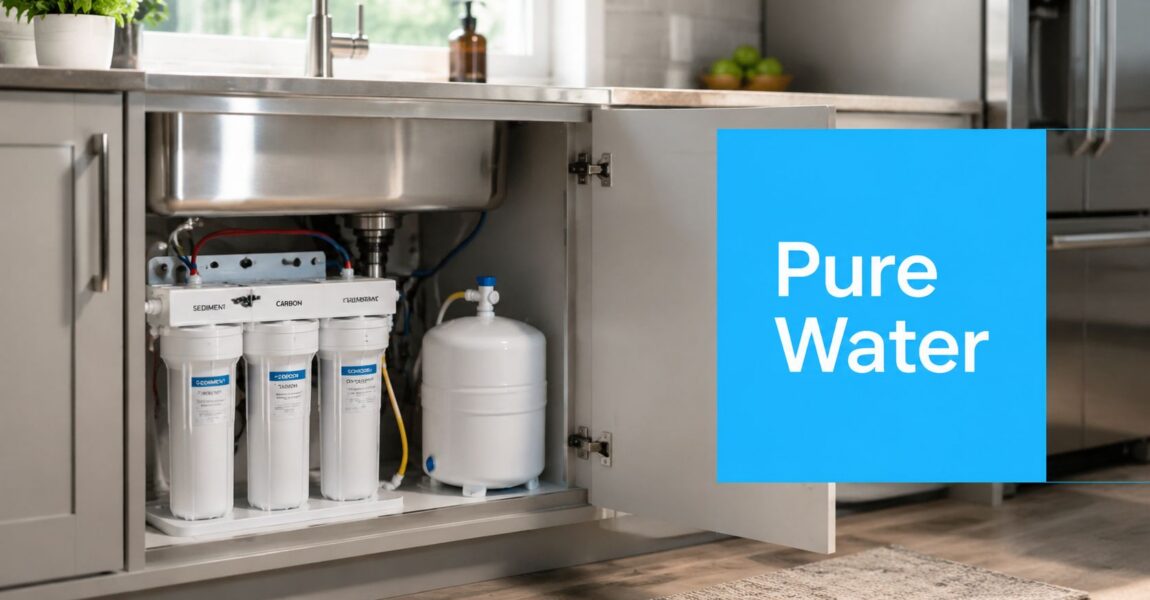
You're probably here because your kitchen tap has started raising questions. Maybe the water tastes flat, smells a little chlorinated, leaves you second-guessing what your family drinks every day, or doesn't inspire confidence. That's the moment many homeowners stop treating filtration like a gadget and start treating it like part of the house.
An under sink water filter kit fits that shift well. It stays out of sight, feeds water where you use it, and avoids the clutter of countertop machines or the compromises of a pitcher. More important, it gives you a way to choose treatment based on your real water concerns instead of guessing from taste alone.
The Hidden Hero in Your Kitchen Cabinet
People generally don't focus on the space under the kitchen sink until something leaks or runs out of room. But that cabinet is where one of the most practical water upgrades in a home can live.
The CDC classifies under-sink systems as point-of-use filters, meaning they treat water at a single tap instead of filtering the whole house. The same CDC guidance points buyers toward NSF standards 42, 53, and 58 as the main benchmarks for comparing claims, and notes that by 2026 Consumer Reports had rated under-sink systems ranging from $86 to nearly $700, with category capacities around 1,000 to 2,000 gallons in many systems, showing how far the market has matured beyond simple add-ons and into long-life household appliances (CDC guidance on choosing home water filters).
That matters because a serious under sink water filter kit isn't just there to make water taste nicer. It's a piece of equipment with performance standards, maintenance schedules, and a clear job description. It should tell you what it's designed to reduce, how long the cartridge lasts, and what certification backs that claim.
Why this category keeps winning space in kitchens
An under-sink setup solves a very practical problem. You want cleaner water, but you don't want to give up counter space or deal with filtering every drop used in showers, toilets, and laundry when your main concern is drinking and cooking water.
That point-of-use approach is efficient. You treat the water that matters most at the place you need it most.
Practical rule: Buy an under-sink system the same way you'd buy a smoke detector or a sump pump. Start with the risk it needs to handle, then check whether the product was built and certified for that job.
What makes it feel like an appliance, not an accessory
A mature category has a few signs. Under-sink systems now span budget and premium tiers, they publish service life expectations, and they're built around standard testing language. That's a big improvement over the old “better tasting water” pitch that told you almost nothing.
If you want a reliable buying framework, think in this order:
- Your water concern first. Taste and odor need a different solution than lead or PFAS concerns.
- Certification second. The right standard matters more than a flashy product page.
- Service life third. A filter you won't maintain isn't a good filter.
- Fit and convenience last. Cabinet space and faucet setup still matter, but they're not the starting point.
How Under Sink Water Filters Actually Work
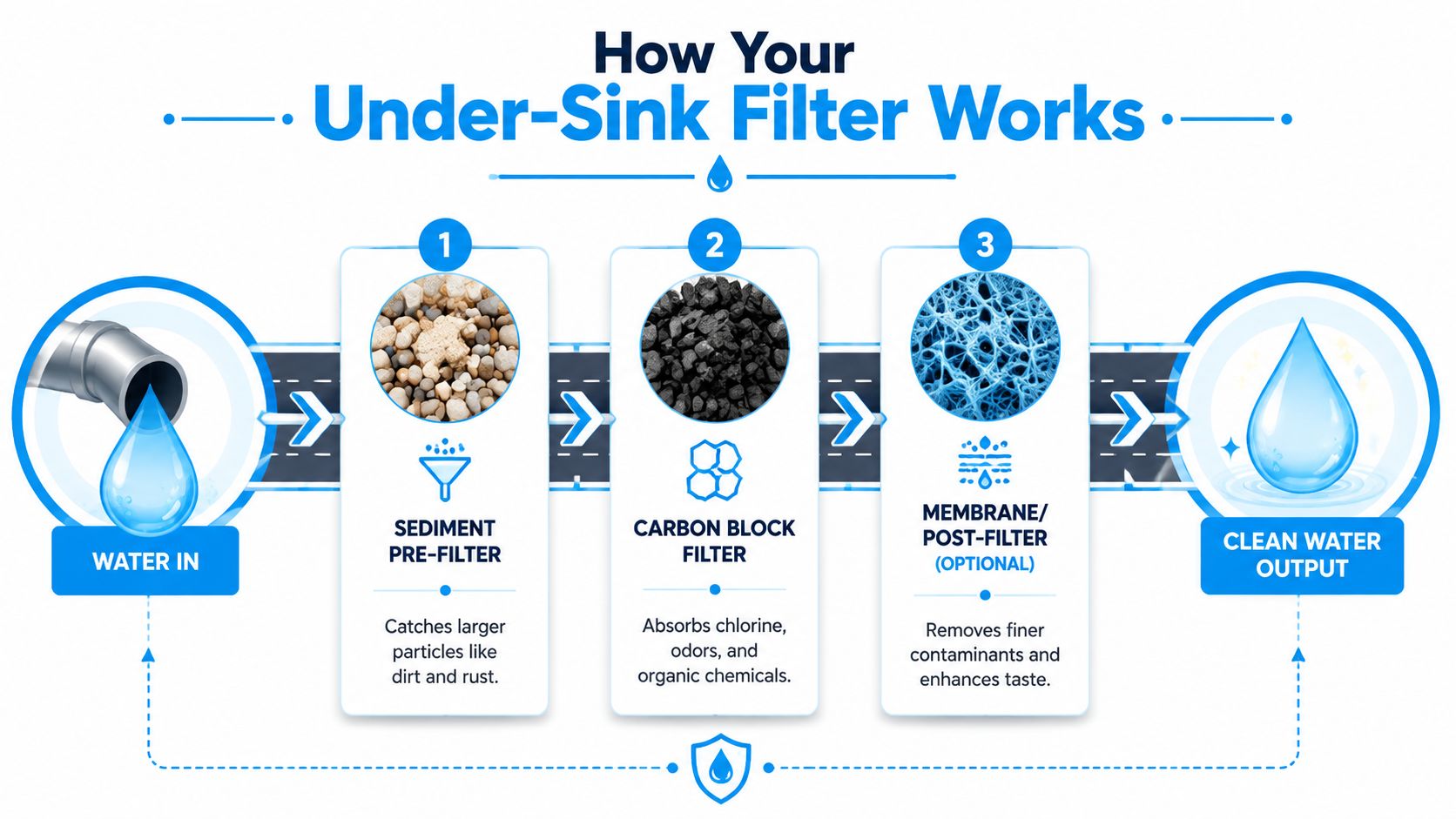
An under sink water filter kit works like a multi-stage security checkpoint for water. Water comes in from the cold-water line, moves through one or more treatment stages, and exits at either a dedicated drinking-water faucet or the main faucet, depending on the design.
Each stage has a job. One catches grit and sediment. Another absorbs chlorine, odors, or organic compounds. In more advanced systems, a membrane or final polishing filter handles smaller or more difficult contaminants. The filtration process resembles a highway with different exits. Large particles get stopped early, chemical tastes and smells get intercepted further down the road, and the finest screening happens at the strictest checkpoint.
The basic path from supply line to glass
The flow usually looks like this:
- Cold water enters the system through a feed connection under the sink.
- A pre-filter stage catches sediment like rust or debris that would otherwise foul later media.
- A carbon stage reduces chlorine, odor, and some organic contaminants.
- An optional membrane or post-filter handles finer reduction and taste polishing.
- Filtered water exits at the drinking faucet.
That sequence is why stage order matters. If you send dirty, particle-heavy water straight to a delicate membrane, you shorten its useful life. Good systems are built to protect the most sensitive component, not just advertise the final result.
Why point-of-use differs from other filter styles
A faucet-mounted filter is visible and easy to add, but it's usually a lighter-duty option. A whole-house system treats more water and solves different problems, but it's not always the right answer if your priority is drinking water at the kitchen sink.
Under-sink systems sit in the middle. They're more substantial than temporary add-ons and more targeted than whole-house treatment. That makes them ideal when the problem you care most about is what goes into coffee, pasta, baby bottles, and drinking glasses.
A filter format doesn't tell you what it can handle. The treatment technology and certification do.
That distinction matters because buying by shape alone can lead people into the wrong system. Guidance tied to NSF/ANSI standards makes clear that different certifications cover different contaminant claims, and recent EPA attention to PFAS has made that matching process more important for households with specific chemical concerns rather than simple taste complaints (under-sink treatment guidance and certification context).
What works and what doesn't
What works is matching the tool to the job. A carbon system can be a very sensible choice for many kitchens. It can also be the wrong choice if your concern calls for a different technology.
What doesn't work is assuming every under sink water filter kit does the same thing because it installs in the same place. Two systems may look nearly identical in photos and perform very differently once you read the certification details and contaminant list.
Decoding the Specs What Really Matters When You Buy
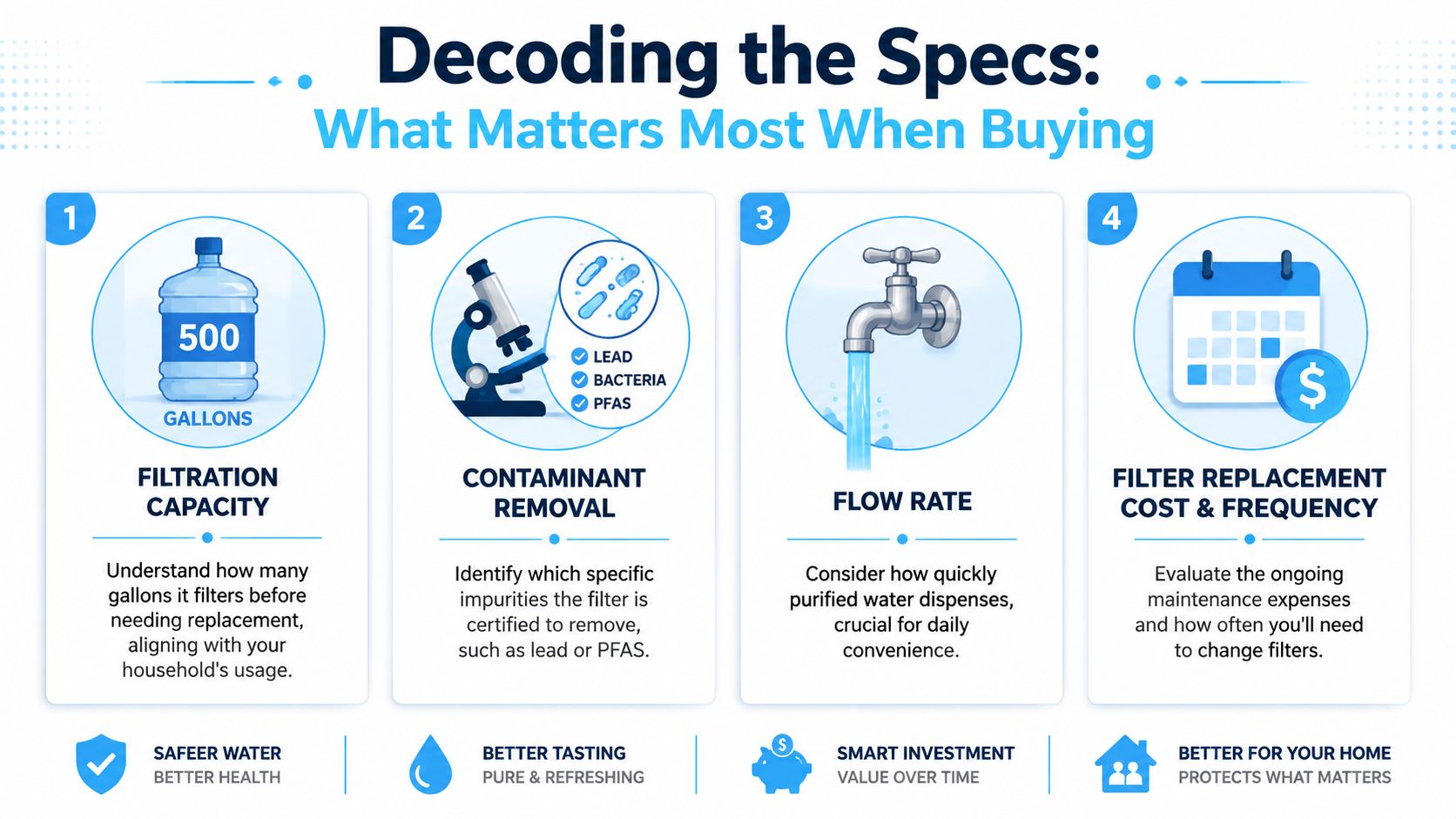
Specs can either help you buy smart or bury you in jargon. The trick is to ignore the flashy phrasing and focus on four things that affect daily use and long-term value.
Start with capacity, not marketing
Capacity tells you how much water a cartridge is expected to treat before replacement. That number gives you something concrete to compare across systems.
Published summaries of under-sink carbon systems commonly place them in a range of 500 to 2,000 gallons, with lower-capacity basic models and higher-capacity premium systems at the upper end. The same category overview notes examples such as Hydroviv, which reports 720 gallons per cartridge and IAPMO certification to NSF/ANSI 42, 53, and 372 while targeting contaminants such as PFAS, lead, arsenic, chromium-6, VOCs, and disinfection byproducts (Frizzlife market guide summary).
A simple way to think about capacity is this: it's the size of your fuel tank. A bigger tank doesn't automatically mean better filtration, but it does tell you how often you'll be stopping for maintenance.
Certifications tell you more than brand language
A product page may say “cleaner,” “healthier,” or “advanced.” Those words don't mean much by themselves. Certification language does.
Here's the practical interpretation:
- NSF/ANSI 42 usually matters when taste and odor are front and center.
- NSF/ANSI 53 matters when the system makes health-related contaminant reduction claims.
- NSF/ANSI 58 is the benchmark you'll see tied to reverse osmosis systems.
A buyer who only reads the headline benefit often misses the true question: certified for what?
Filter media is the engine room
Different media do different jobs, leading to many buying mistakes. Carbon is a strong option when the issue is chlorine taste, odor, or some organics. Sediment media protects downstream components. More advanced systems add membrane-based treatment when the contaminant profile calls for it.
A useful way to judge product copy is to ask whether it explains why each stage exists. If every stage sounds interchangeable, the listing probably isn't helping you compare intelligently.
Buyer's shortcut: If the product page makes broad promises but doesn't clearly show contaminant claims, certifications, and cartridge life, keep shopping.
Flow rate affects daily annoyance more than people expect
Flow rate is the convenience spec. It decides whether filling a pot feels normal or whether you stand there waiting with a glass in your hand.
You won't always get an apples-to-apples comparison across brands, and some listings handle this poorly. But you can still think through the consequence. A more compact direct-connect filter may feel more effortless in daily use, while a deeper treatment system may trade some speed or setup complexity for broader reduction claims.
Here's a simple buying table to keep your priorities straight:
| What you care about | What to check first | Why it matters |
|---|---|---|
| Better taste and odor | Certification scope and carbon stage | Helps separate cosmetic improvement from broader treatment |
| Health-related concerns | NSF/ANSI 53 or technology-specific certification | Supports claims tied to specific contaminants |
| Fewer cartridge changes | Capacity rating | Helps estimate maintenance rhythm |
| Easy everyday use | Faucet style, layout, and flow feel | A system you enjoy using gets used |
The Three Main Filter Kits Explained
There are three broad under-sink categories most homeowners end up comparing. Think of them like home security choices. One is a basic lock, one is a deadbolt and sensor package, and one is a more complete security setup with layers working together.
Single-cartridge kits
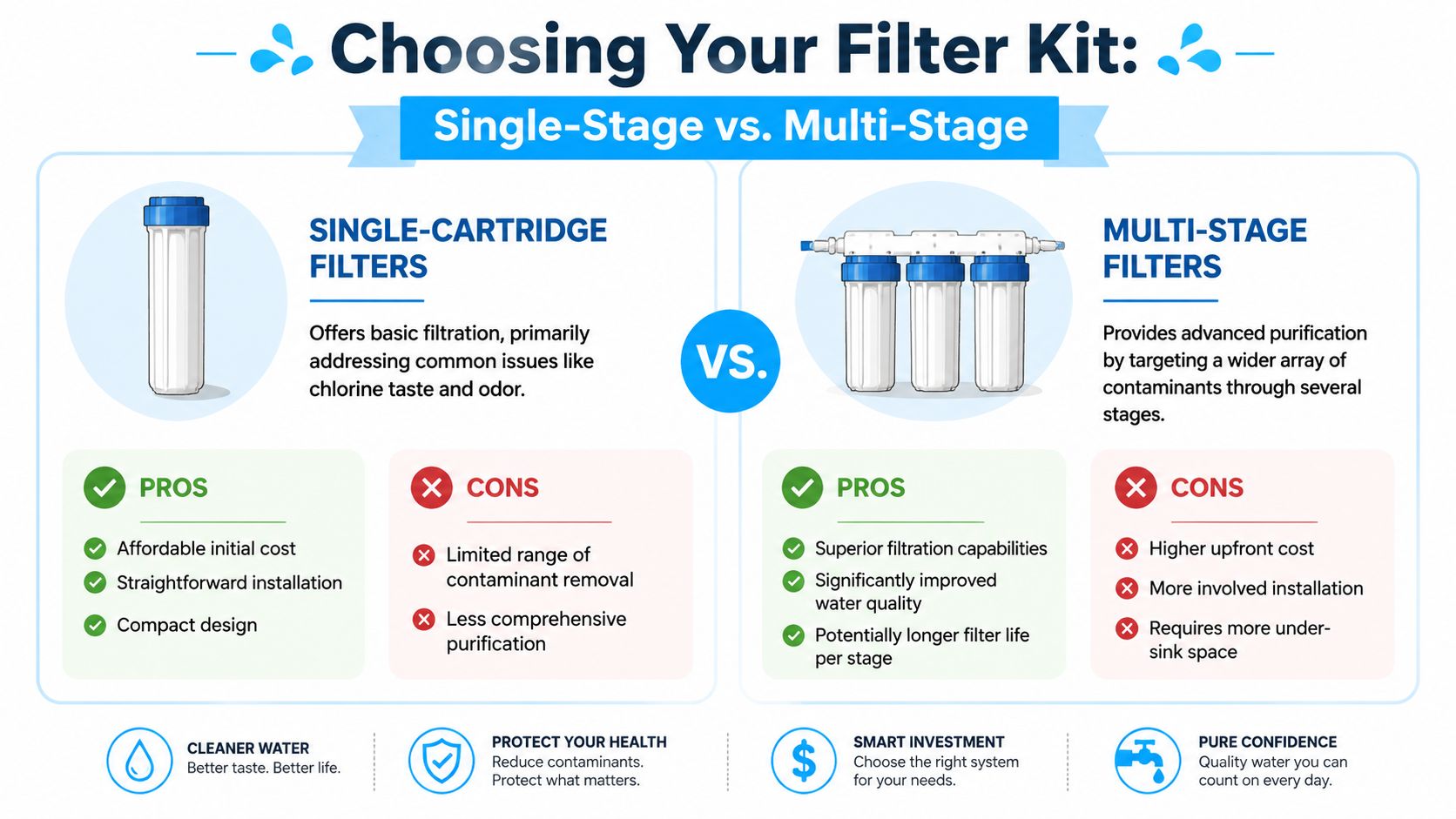
This is the straightforward option. One cartridge, fewer connections, less cabinet impact.
These systems usually make the most sense when your main complaint is taste, smell, or convenience. They're often easier to install and easier to live with if you want a clean, compact setup.
Good fit:
- Renters or simple remodels where minimal disruption matters
- Households focused on chlorine taste and odor
- Buyers who want fewer parts under the sink
Trade-off: they're usually less versatile than systems built with separate stages.
Multi-stage carbon systems
These are the practical middle ground. Instead of asking one cartridge to do everything, they divide the work among multiple stages.
That separation often leads to better protection for each filter stage and more targeted treatment. It also gives you a more transparent system. You can usually see what each stage is there to do.
This category often suits homeowners who want more than cosmetic improvement but don't necessarily want a full RO setup.
A decent analogy is a mudroom. If you stop dirt at the door, then remove wet shoes, then hang up the coat, the house stays cleaner. Multi-stage systems use that same logic. Each stage handles its own mess before the next stage takes over.
Reverse osmosis kits
RO is the heavy-duty option in the under-sink world. It's the system people choose when they want broader reduction capability and are willing to accept more installation complexity, more parts, and a dedicated service schedule.
AquaTru's under-sink RO design is a good example of why stage separation matters. The manufacturer describes a pre/carbon filter with about a 6-month service life, an RO membrane with about a 2-year service life, and a VOC carbon filter with about a 1-year service life, with the system positioned to remove up to 84 contaminants. The pre-stages protect the membrane, and the final carbon stage helps with taste and residual organics (AquaTru under-sink reverse osmosis purifier).
That's not just a stack of parts. It's a chain of custody for the water.
If you choose reverse osmosis, don't judge it like a single-cartridge filter. Judge it like a layered system with different parts wearing at different speeds.
Which one is right for you
Here's the simplest side-by-side view:
| Kit type | Best for | Main strength | Main compromise |
|---|---|---|---|
| Single-cartridge | Taste and odor concerns | Simplicity | Narrower treatment scope |
| Multi-stage carbon | Broader non-RO treatment goals | Better task separation | More parts and space |
| Reverse osmosis | Households with more demanding contaminant concerns | Deep, layered treatment | More complex setup and maintenance |
The mistake I see most often is people buying the most complicated unit when a simpler one would've solved the actual problem, or buying the simplest one when their water concern clearly called for more.
Planning Your Installation A DIY Guide
Installation scares off more buyers than maintenance does. In practice, most of the stress comes from not knowing what to check before the box arrives.
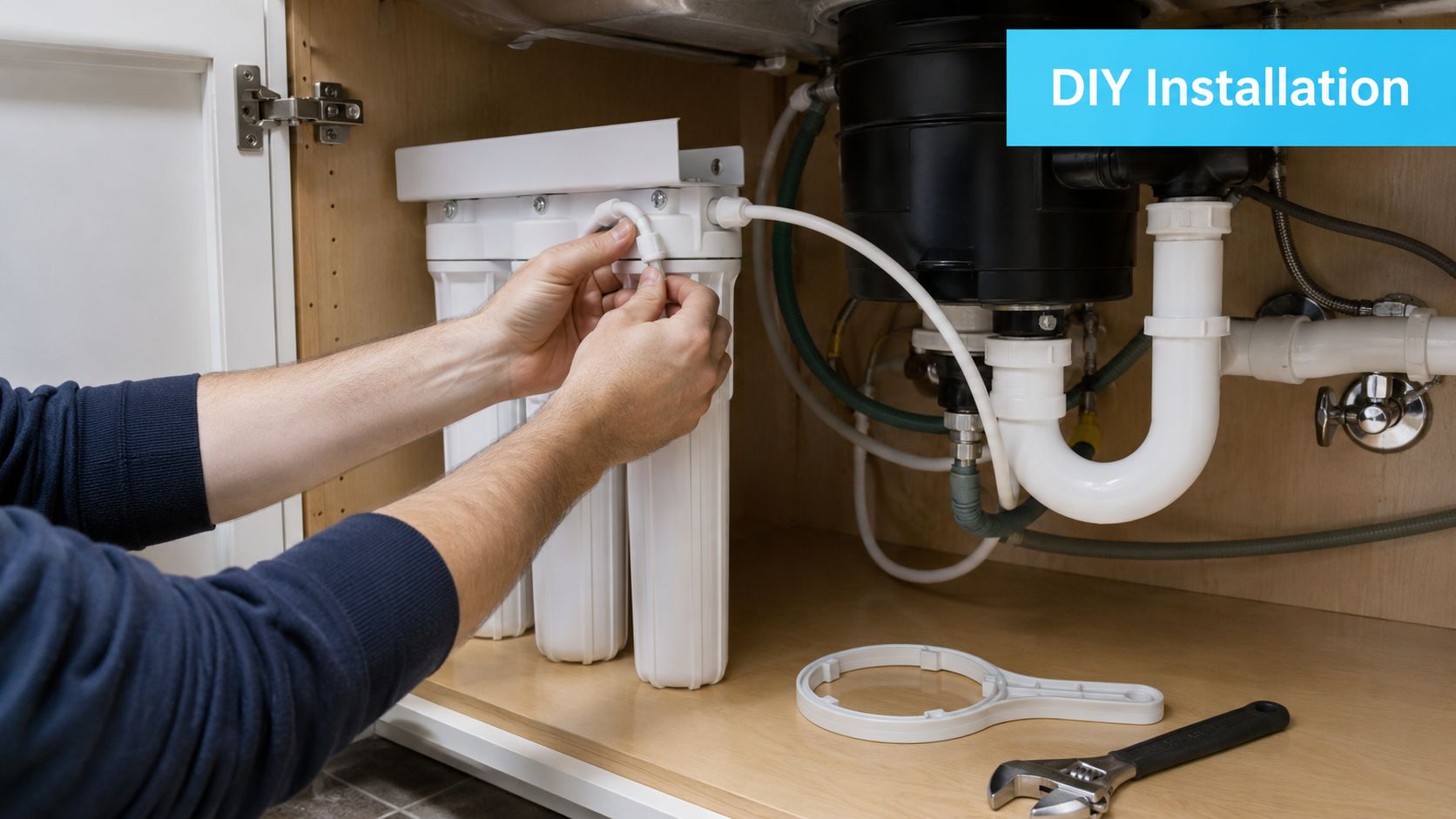
Check the cabinet before you buy
Open the sink base and look at it like a mechanic, not a shopper. Note the cold-water shutoff, the drain path, garbage disposal clearance, and where the filter body could mount or sit without getting bumped every time someone puts away cleaners.
If you're not used to looking at sink plumbing, a plain-language guide on plumbing rough-in explained helps make sense of what's fixed in place and what usually has room to work around. That's useful before you choose between a compact direct-connect unit and a larger dedicated-faucet system.
A few pre-purchase checks matter most:
- Measure usable space. Don't count the whole cabinet. Count the area not occupied by the sink bowl and disposal.
- Identify your faucet plan. Some kits need a dedicated drinking-water faucet. Others tie into the existing line.
- Locate shutoffs and access points. Tight quarters make simple installs frustrating.
What usually comes in the box
Most under-sink kits include the filter body, cartridges, tubing, fittings, and mounting hardware. Dedicated-faucet kits usually include the faucet too. The details vary, but the basic rhythm is the same. Connect cold-water feed, route tubing, mount the unit, flush the system, and inspect for leaks.
The job isn't exotic. It's mostly about patience, clean connections, and giving yourself enough room to tighten fittings without forcing anything.
For a visual walkthrough, this installation video from Water Filter Advisor guidance is a useful reference before you start turning valves.
How the job usually unfolds
Most DIY installs follow this sequence:
- Shut off cold water and relieve pressure.
- Mount the filter where cartridges can still be changed later.
- Connect the feed line and outlet tubing.
- Install the faucet if required.
- Turn water back on slowly and check every joint.
- Flush the system until the water runs as the manufacturer directs.
Tighten fittings firmly, not aggressively. Under-sink leaks are often caused by rushed connections, crossed threads, or tubing that wasn't fully seated.
What doesn't work is cramming a larger multi-stage unit into a cabinet that can barely fit it. What does work is planning for cartridge access now instead of discovering later that you have to uninstall half the system just to service it.
The True Cost of Clean Water Maintenance and Cartridges
The purchase price gets attention because it's visible. The actual cost of an under sink water filter kit shows up over time in cartridge replacements, service intervals, and how willing you are to keep the system maintained.
Think in cycles, not sticker price
A useful benchmark comes from Hydroviv's under-sink system, which is rated for 720 gallons per cartridge, or about 6 months in a typical home, and carries NSF/ANSI 53 certification for health-related contaminant claims such as lead. That kind of rating gives homeowners a practical baseline for estimating replacement frequency and comparing ongoing value (Hydroviv under-sink filter details).
You don't need a complicated spreadsheet to make that useful. You just need the cartridge price and the gallon rating. Then ask two questions:
- How often will this system likely need service in my household?
- Am I comfortable paying that on a recurring basis?
If the replacement cost feels annoying every time it comes up, you probably bought the wrong system for your habits, even if the filtration is solid.
Cost per gallon is the honest metric
Cost per gallon strips away a lot of sales language. If one filter has a lower upfront price but short service life, and another costs more but lasts longer, the better long-term buy may not be the cheaper box on day one.
You can compare systems with a plain formula:
| What to calculate | Formula |
|---|---|
| Replacement frequency | Household usage divided into rated gallons |
| Cost per gallon | Cartridge cost divided by rated gallons |
| Ownership rhythm | Filter lifespan plus how easy replacements are |
That last point matters more than people think. Some homeowners are good at calendar-based maintenance. Others need a simple cartridge swap and fewer parts to track.
Signs a filter is ready for replacement
Most systems don't fail dramatically. They get less convenient first.
Watch for:
- Slower flow that wasn't there after installation
- Taste or odor changes returning
- Calendar milestones based on the manufacturer's service life
- System-specific reminders if your model includes them
RO systems add another layer because not all stages age at the same speed. That's one reason they can perform well over time, but it also means you need to keep the maintenance plan straight.
Maintenance isn't the downside of filtration. Neglected maintenance is.
The households happiest with their under-sink system are usually the ones that treat cartridge replacement like buying HVAC filters or smoke-alarm batteries. It becomes routine instead of a surprise expense.
Your Final Checklist for Choosing the Right Kit
Buying the right under sink water filter kit gets much easier when you stop asking, “Which one is best?” and start asking, “Which one matches my water and my household?”
Use this decision framework
If your main goal is better taste and odor, a simpler carbon-based system is often the sensible place to start. You want clear contaminant claims, straightforward maintenance, and a setup that doesn't take over the cabinet.
If your main concern is health-related contaminants, don't buy based on format alone. Focus on certification and treatment method. A system that looks sleek under the sink can still be the wrong tool if it isn't built for the contaminants you care about.
If you want stronger overall treatment, and you're comfortable with more parts and a dedicated maintenance schedule, a multi-stage system or reverse osmosis unit will usually make more sense than a basic single-cartridge filter.
If your cabinet is tight, your plumbing access is awkward, or you want the easiest ownership experience, prioritize compact design and cartridge access. A system that fits your space and routine usually performs better in real life because you'll regularly maintain it.
The short version
- Taste and chlorine concerns call for a simpler, well-specified carbon setup.
- Broader contaminant concerns call for careful certification matching.
- Maximum treatment ambition points toward multi-stage or RO.
- Low tolerance for maintenance means you should favor simpler service schedules, even if the system is less elaborate.
Clean water is a daily-use upgrade. The right choice isn't the flashiest box or the biggest claims. It's the one that matches your water risk, fits your kitchen, and keeps doing its job long after the excitement of installation wears off.
If you want help narrowing the field, Water Filter Advisor offers practical buying guides, maintenance advice, and side-by-side explanations that can help you compare under-sink options without getting lost in marketing language.
- June 14, 2026
- Uncategorized
