Under Sink Water Filter Kit: Safe, Great-Tasting Water

You're probably here because your kitchen tap has started raising questions. Maybe the water tastes flat, smells a little chlorinated, leaves you second-guessing what your family drinks every day, or doesn't inspire confidence. That's the moment many homeowners stop treating filtration like a gadget and start treating it like part of the house.

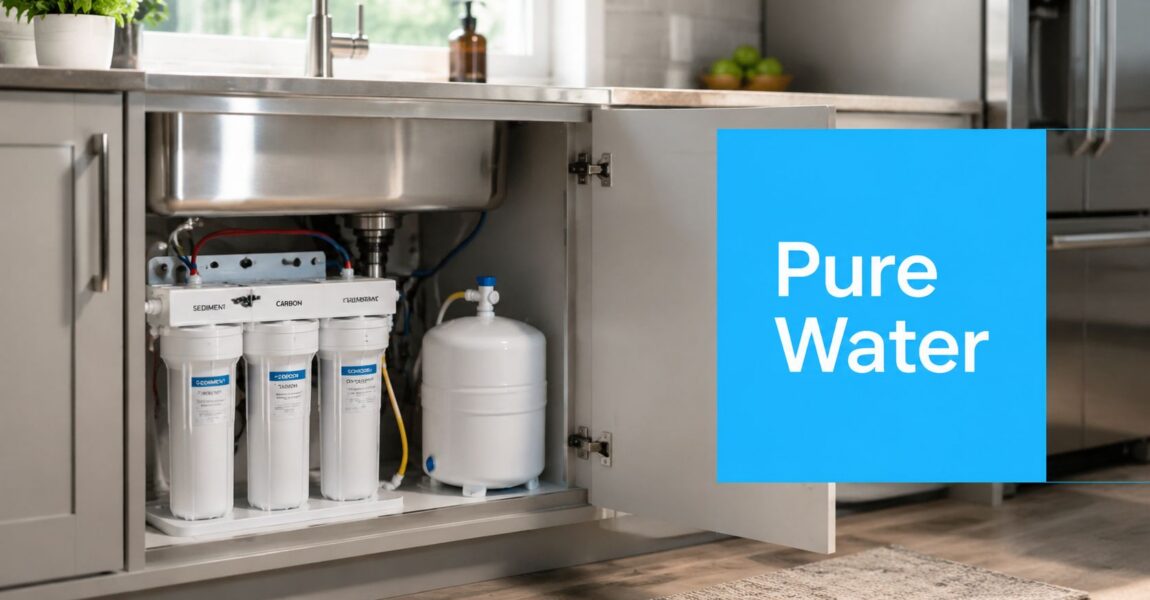
An under sink water filter kit fits that shift well. It stays out of sight, feeds water where you use it, and avoids the clutter of countertop machines or the compromises of a pitcher. More important, it gives you a way to choose treatment based on your real water concerns instead of guessing from taste alone.

The Hidden Hero in Your Kitchen Cabinet

People generally don't focus on the space under the kitchen sink until something leaks or runs out of room. But that cabinet is where one of the most practical water upgrades in a home can live.

The CDC classifies under-sink systems as point-of-use filters, meaning they treat water at a single tap instead of filtering the whole house. The same CDC guidance points buyers toward NSF standards 42, 53, and 58 as the main benchmarks for comparing claims, and notes that by 2026 Consumer Reports had rated under-sink systems ranging from $86 to nearly $700, with category capacities around 1,000 to 2,000 gallons in many systems, showing how far the market has matured beyond simple add-ons and into long-life household appliances (CDC guidance on choosing home water filters).

That matters because a serious under sink water filter kit isn't just there to make water taste nicer. It's a piece of equipment with performance standards, maintenance schedules, and a clear job description. It should tell you what it's designed to reduce, how long the cartridge lasts, and what certification backs that claim.

Why this category keeps winning space in kitchens

An under-sink setup solves a very practical problem. You want cleaner water, but you don't want to give up counter space or deal with filtering every drop used in showers, toilets, and laundry when your main concern is drinking and cooking water.

That point-of-use approach is efficient. You treat the water that matters most at the place you need it most.

Practical rule: Buy an under-sink system the same way you'd buy a smoke detector or a sump pump. Start with the risk it needs to handle, then check whether the product was built and certified for that job.

What makes it feel like an appliance, not an accessory

A mature category has a few signs. Under-sink systems now span budget and premium tiers, they publish service life expectations, and they're built around standard testing language. That's a big improvement over the old “better tasting water” pitch that told you almost nothing.

If you want a reliable buying framework, think in this order:

  • Your water concern first. Taste and odor need a different solution than lead or PFAS concerns.
  • Certification second. The right standard matters more than a flashy product page.
  • Service life third. A filter you won't maintain isn't a good filter.
  • Fit and convenience last. Cabinet space and faucet setup still matter, but they're not the starting point.

How Under Sink Water Filters Actually Work

An under sink water filter kit works like a multi-stage security checkpoint for water. Water comes in from the cold-water line, moves through one or more treatment stages, and exits at either a dedicated drinking-water faucet or the main faucet, depending on the design.

Each stage has a job. One catches grit and sediment. Another absorbs chlorine, odors, or organic compounds. In more advanced systems, a membrane or final polishing filter handles smaller or more difficult contaminants. The filtration process resembles a highway with different exits. Large particles get stopped early, chemical tastes and smells get intercepted further down the road, and the finest screening happens at the strictest checkpoint.
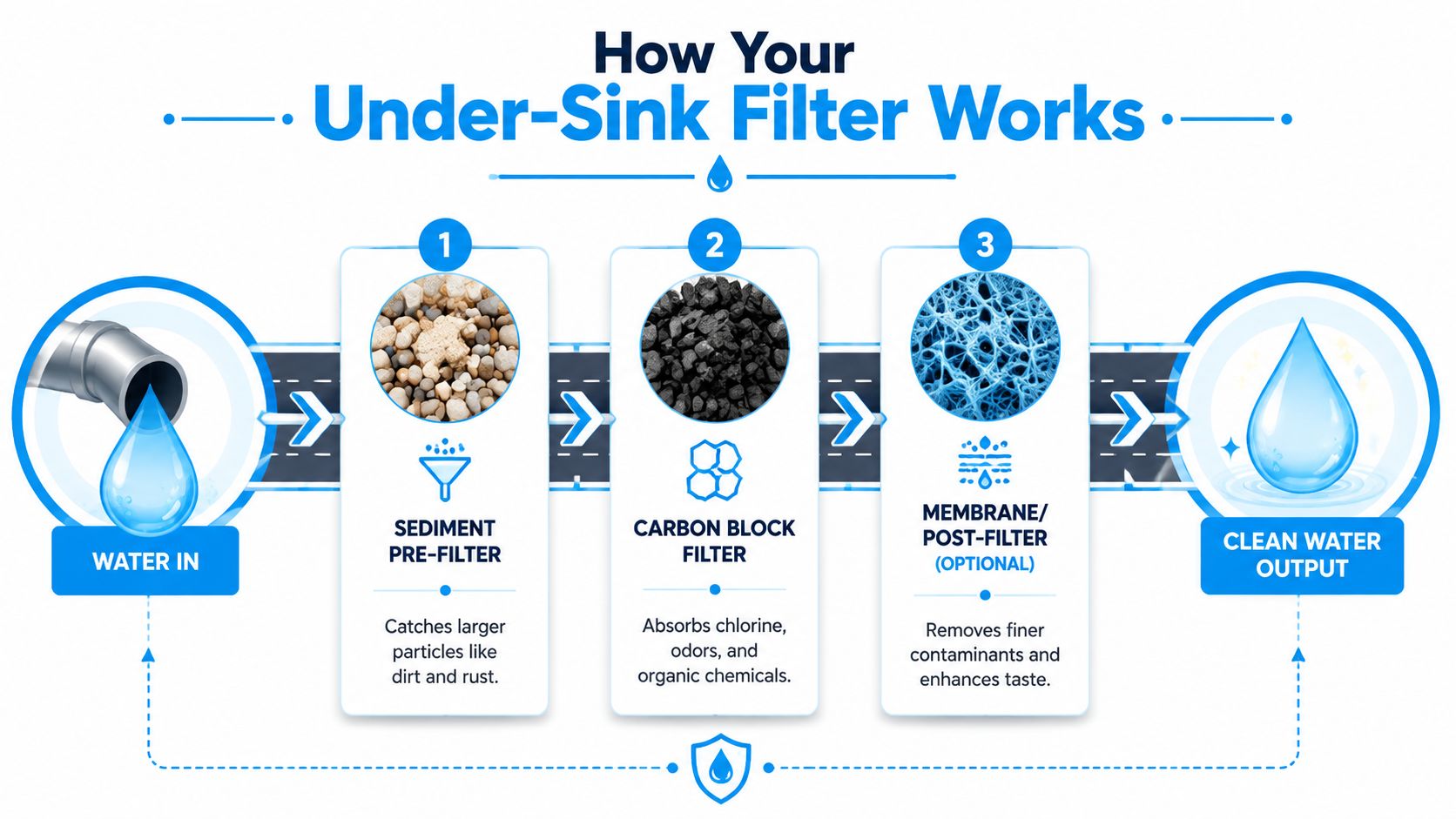
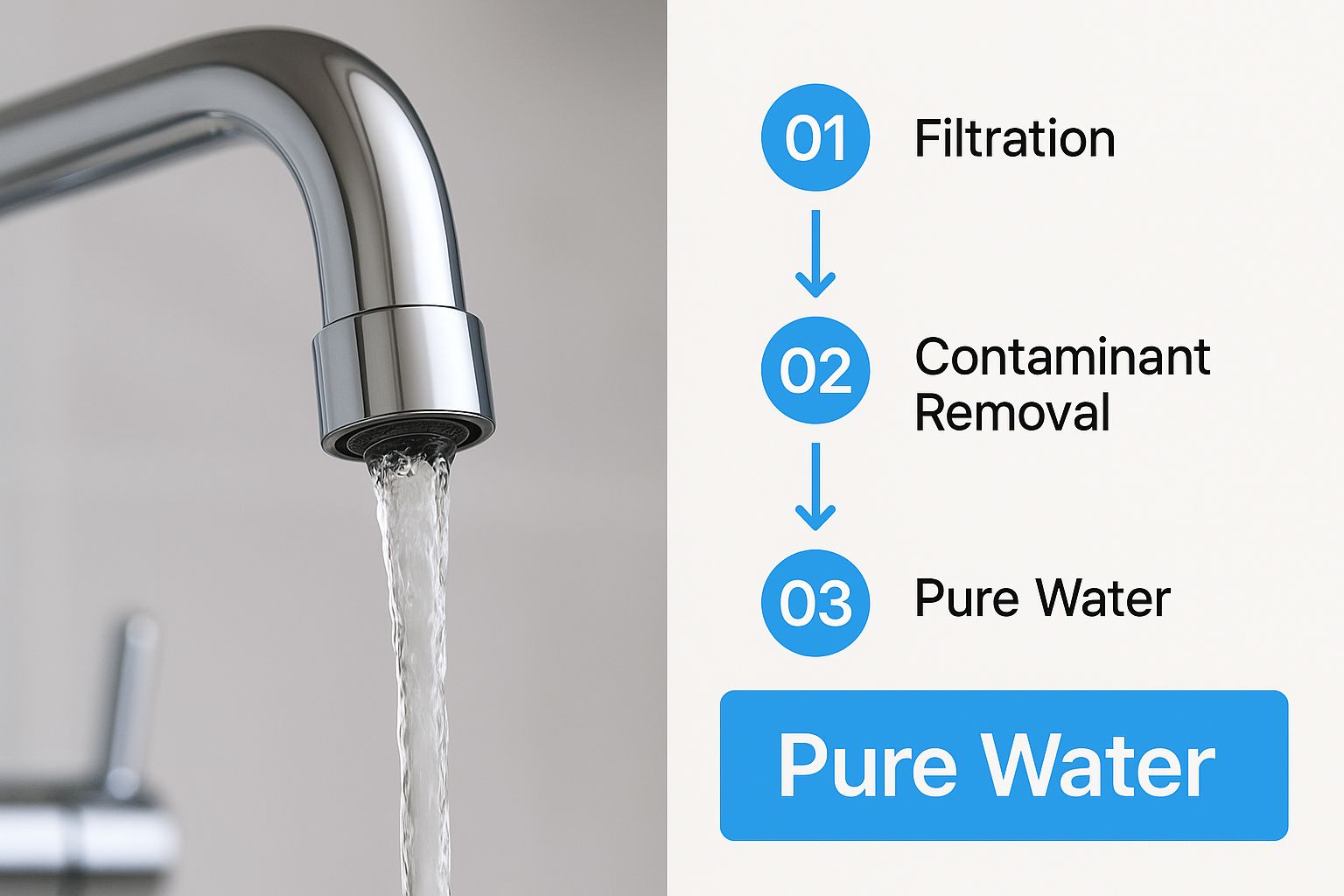
A diagram illustrating the three-stage filtration process of an under-sink water filter system from intake to output.

The basic path from supply line to glass

The flow usually looks like this:

  1. Cold water enters the system through a feed connection under the sink.
  2. A pre-filter stage catches sediment like rust or debris that would otherwise foul later media.
  3. A carbon stage reduces chlorine, odor, and some organic contaminants.
  4. An optional membrane or post-filter handles finer reduction and taste polishing.
  5. Filtered water exits at the drinking faucet.

That sequence is why stage order matters. If you send dirty, particle-heavy water straight to a delicate membrane, you shorten its useful life. Good systems are built to protect the most sensitive component, not just advertise the final result.

Why point-of-use differs from other filter styles

A faucet-mounted filter is visible and easy to add, but it's usually a lighter-duty option. A whole-house system treats more water and solves different problems, but it's not always the right answer if your priority is drinking water at the kitchen sink.

Under-sink systems sit in the middle. They're more substantial than temporary add-ons and more targeted than whole-house treatment. That makes them ideal when the problem you care most about is what goes into coffee, pasta, baby bottles, and drinking glasses.

A filter format doesn't tell you what it can handle. The treatment technology and certification do.

That distinction matters because buying by shape alone can lead people into the wrong system. Guidance tied to NSF/ANSI standards makes clear that different certifications cover different contaminant claims, and recent EPA attention to PFAS has made that matching process more important for households with specific chemical concerns rather than simple taste complaints (under-sink treatment guidance and certification context).

What works and what doesn't

What works is matching the tool to the job. A carbon system can be a very sensible choice for many kitchens. It can also be the wrong choice if your concern calls for a different technology.

What doesn't work is assuming every under sink water filter kit does the same thing because it installs in the same place. Two systems may look nearly identical in photos and perform very differently once you read the certification details and contaminant list.

Decoding the Specs What Really Matters When You Buy

Specs can either help you buy smart or bury you in jargon. The trick is to ignore the flashy phrasing and focus on four things that affect daily use and long-term value.
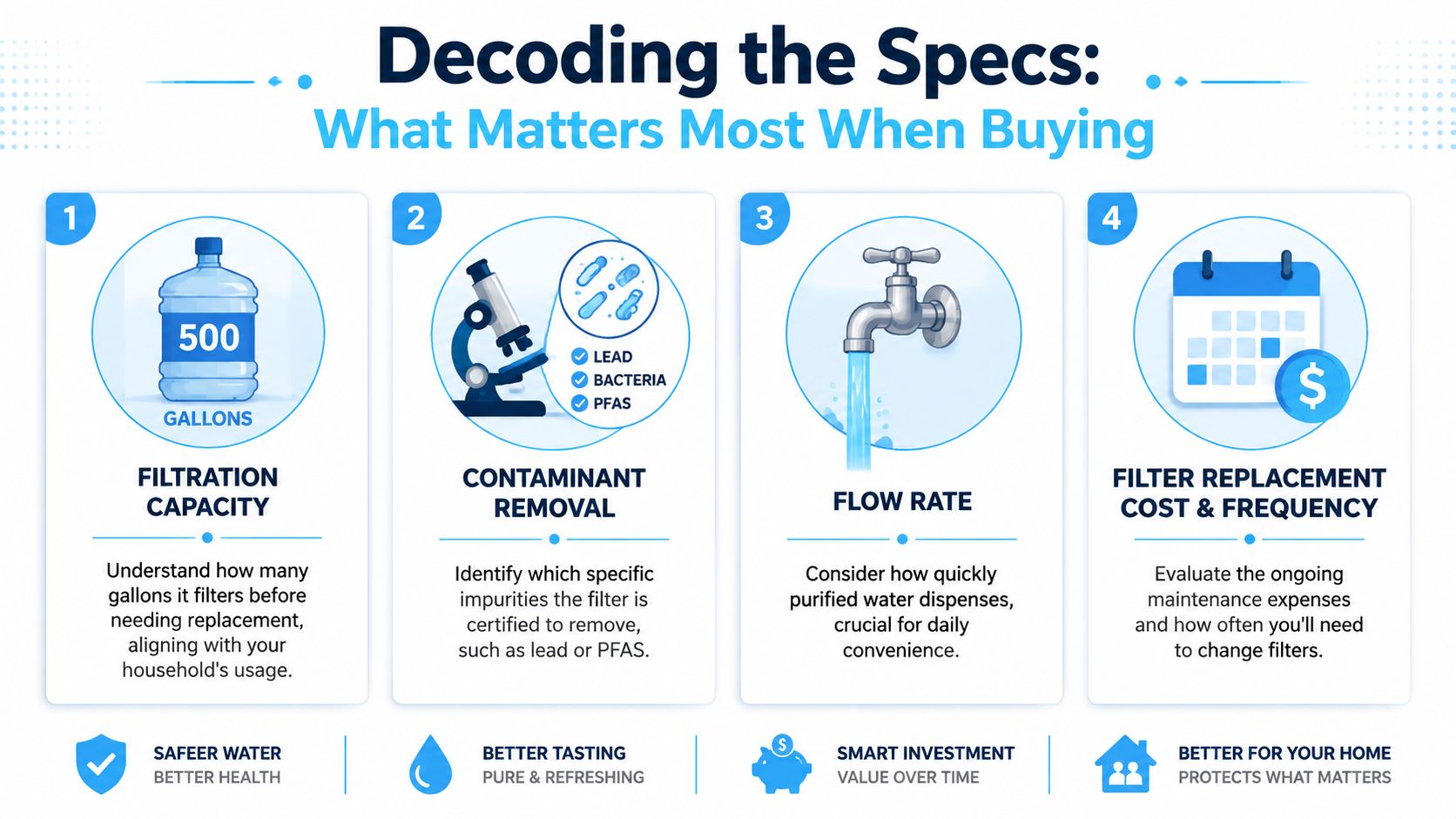
An infographic detailing the four key specifications to consider when purchasing a home water filtration system.

Start with capacity, not marketing

Capacity tells you how much water a cartridge is expected to treat before replacement. That number gives you something concrete to compare across systems.

Published summaries of under-sink carbon systems commonly place them in a range of 500 to 2,000 gallons, with lower-capacity basic models and higher-capacity premium systems at the upper end. The same category overview notes examples such as Hydroviv, which reports 720 gallons per cartridge and IAPMO certification to NSF/ANSI 42, 53, and 372 while targeting contaminants such as PFAS, lead, arsenic, chromium-6, VOCs, and disinfection byproducts (Frizzlife market guide summary).

A simple way to think about capacity is this: it's the size of your fuel tank. A bigger tank doesn't automatically mean better filtration, but it does tell you how often you'll be stopping for maintenance.

Certifications tell you more than brand language

A product page may say “cleaner,” “healthier,” or “advanced.” Those words don't mean much by themselves. Certification language does.

Here's the practical interpretation:

  • NSF/ANSI 42 usually matters when taste and odor are front and center.
  • NSF/ANSI 53 matters when the system makes health-related contaminant reduction claims.
  • NSF/ANSI 58 is the benchmark you'll see tied to reverse osmosis systems.

A buyer who only reads the headline benefit often misses the true question: certified for what?

Filter media is the engine room

Different media do different jobs, leading to many buying mistakes. Carbon is a strong option when the issue is chlorine taste, odor, or some organics. Sediment media protects downstream components. More advanced systems add membrane-based treatment when the contaminant profile calls for it.

A useful way to judge product copy is to ask whether it explains why each stage exists. If every stage sounds interchangeable, the listing probably isn't helping you compare intelligently.

Buyer's shortcut: If the product page makes broad promises but doesn't clearly show contaminant claims, certifications, and cartridge life, keep shopping.

Flow rate affects daily annoyance more than people expect

Flow rate is the convenience spec. It decides whether filling a pot feels normal or whether you stand there waiting with a glass in your hand.

You won't always get an apples-to-apples comparison across brands, and some listings handle this poorly. But you can still think through the consequence. A more compact direct-connect filter may feel more effortless in daily use, while a deeper treatment system may trade some speed or setup complexity for broader reduction claims.

Here's a simple buying table to keep your priorities straight:

What you care about What to check first Why it matters
Better taste and odor Certification scope and carbon stage Helps separate cosmetic improvement from broader treatment
Health-related concerns NSF/ANSI 53 or technology-specific certification Supports claims tied to specific contaminants
Fewer cartridge changes Capacity rating Helps estimate maintenance rhythm
Easy everyday use Faucet style, layout, and flow feel A system you enjoy using gets used

The Three Main Filter Kits Explained

There are three broad under-sink categories most homeowners end up comparing. Think of them like home security choices. One is a basic lock, one is a deadbolt and sensor package, and one is a more complete security setup with layers working together.
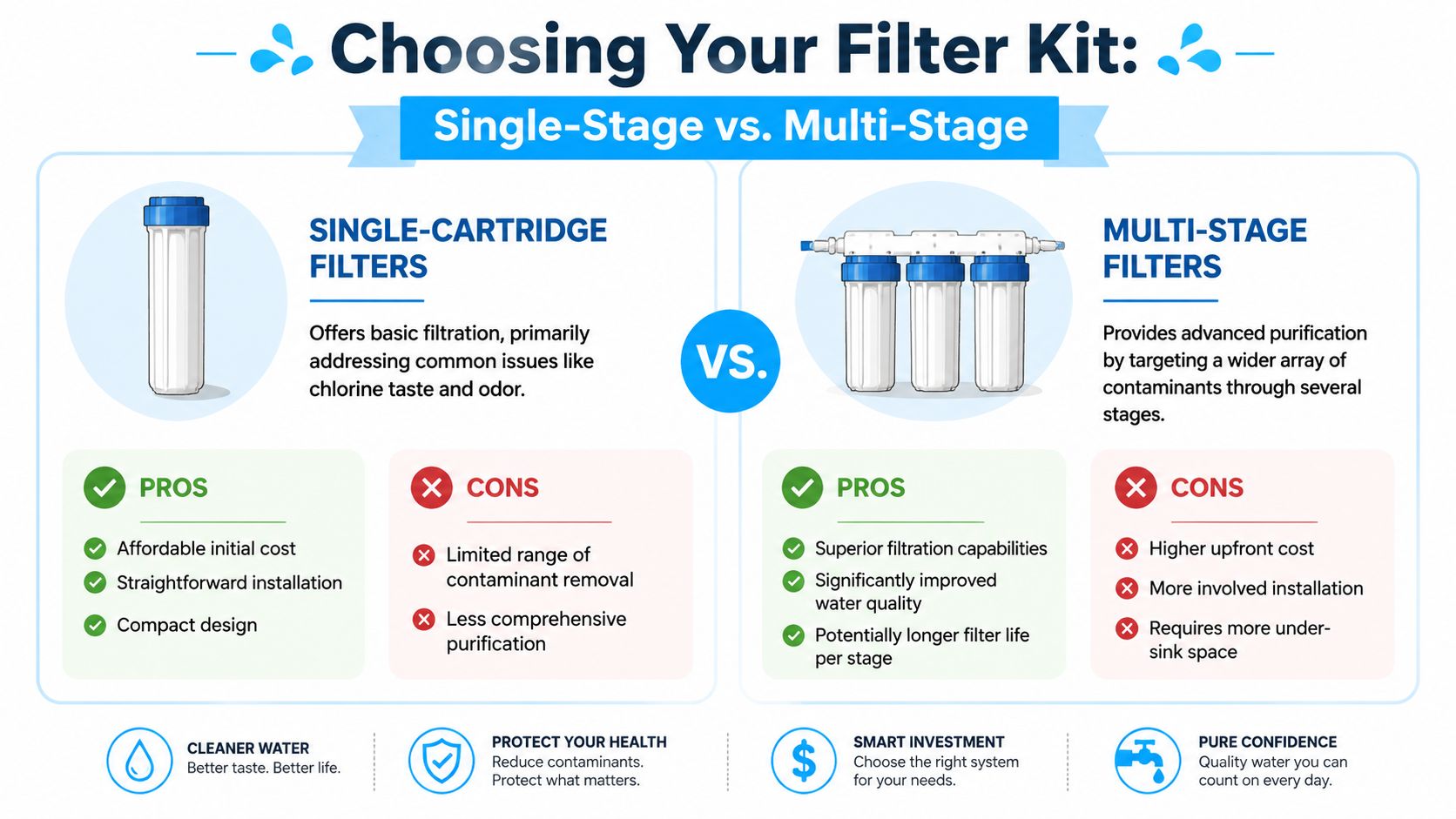
A comparison chart outlining the pros and cons of single-stage versus multi-stage under sink water filter kits.

Single-cartridge kits

This is the straightforward option. One cartridge, fewer connections, less cabinet impact.

These systems usually make the most sense when your main complaint is taste, smell, or convenience. They're often easier to install and easier to live with if you want a clean, compact setup.

Good fit:

  • Renters or simple remodels where minimal disruption matters
  • Households focused on chlorine taste and odor
  • Buyers who want fewer parts under the sink

Trade-off: they're usually less versatile than systems built with separate stages.

Multi-stage carbon systems

These are the practical middle ground. Instead of asking one cartridge to do everything, they divide the work among multiple stages.

That separation often leads to better protection for each filter stage and more targeted treatment. It also gives you a more transparent system. You can usually see what each stage is there to do.

This category often suits homeowners who want more than cosmetic improvement but don't necessarily want a full RO setup.

A decent analogy is a mudroom. If you stop dirt at the door, then remove wet shoes, then hang up the coat, the house stays cleaner. Multi-stage systems use that same logic. Each stage handles its own mess before the next stage takes over.

Reverse osmosis kits

RO is the heavy-duty option in the under-sink world. It's the system people choose when they want broader reduction capability and are willing to accept more installation complexity, more parts, and a dedicated service schedule.

AquaTru's under-sink RO design is a good example of why stage separation matters. The manufacturer describes a pre/carbon filter with about a 6-month service life, an RO membrane with about a 2-year service life, and a VOC carbon filter with about a 1-year service life, with the system positioned to remove up to 84 contaminants. The pre-stages protect the membrane, and the final carbon stage helps with taste and residual organics (AquaTru under-sink reverse osmosis purifier).

That's not just a stack of parts. It's a chain of custody for the water.

If you choose reverse osmosis, don't judge it like a single-cartridge filter. Judge it like a layered system with different parts wearing at different speeds.

Which one is right for you

Here's the simplest side-by-side view:

Kit type Best for Main strength Main compromise
Single-cartridge Taste and odor concerns Simplicity Narrower treatment scope
Multi-stage carbon Broader non-RO treatment goals Better task separation More parts and space
Reverse osmosis Households with more demanding contaminant concerns Deep, layered treatment More complex setup and maintenance

The mistake I see most often is people buying the most complicated unit when a simpler one would've solved the actual problem, or buying the simplest one when their water concern clearly called for more.

Planning Your Installation A DIY Guide

Installation scares off more buyers than maintenance does. In practice, most of the stress comes from not knowing what to check before the box arrives.
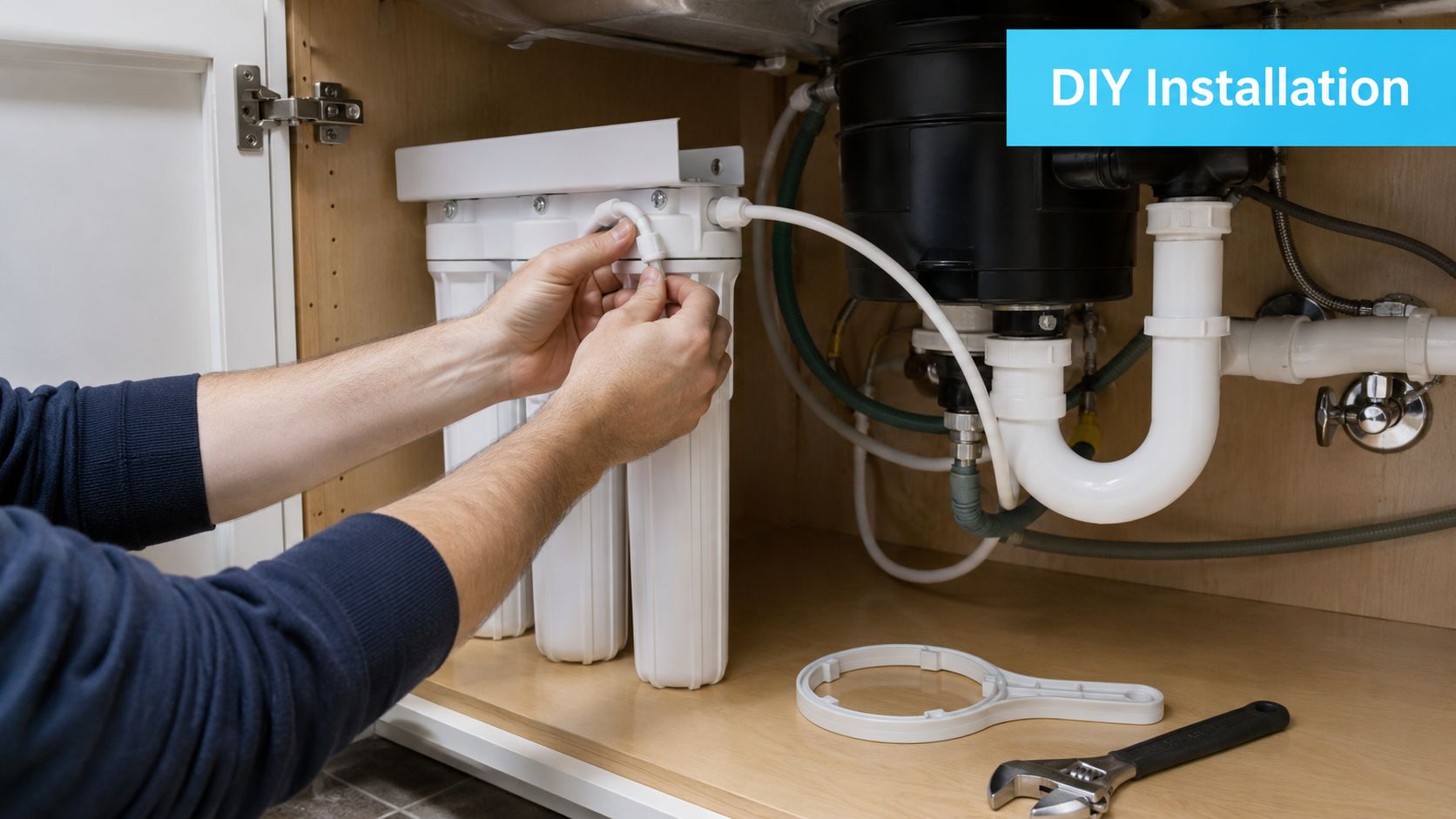
A person installing a multi-stage under sink water filter kit in a kitchen cabinet.

Check the cabinet before you buy

Open the sink base and look at it like a mechanic, not a shopper. Note the cold-water shutoff, the drain path, garbage disposal clearance, and where the filter body could mount or sit without getting bumped every time someone puts away cleaners.

If you're not used to looking at sink plumbing, a plain-language guide on plumbing rough-in explained helps make sense of what's fixed in place and what usually has room to work around. That's useful before you choose between a compact direct-connect unit and a larger dedicated-faucet system.

A few pre-purchase checks matter most:

  • Measure usable space. Don't count the whole cabinet. Count the area not occupied by the sink bowl and disposal.
  • Identify your faucet plan. Some kits need a dedicated drinking-water faucet. Others tie into the existing line.
  • Locate shutoffs and access points. Tight quarters make simple installs frustrating.

What usually comes in the box

Most under-sink kits include the filter body, cartridges, tubing, fittings, and mounting hardware. Dedicated-faucet kits usually include the faucet too. The details vary, but the basic rhythm is the same. Connect cold-water feed, route tubing, mount the unit, flush the system, and inspect for leaks.

The job isn't exotic. It's mostly about patience, clean connections, and giving yourself enough room to tighten fittings without forcing anything.

For a visual walkthrough, this installation video from Water Filter Advisor guidance is a useful reference before you start turning valves.

How the job usually unfolds

Most DIY installs follow this sequence:

  1. Shut off cold water and relieve pressure.
  2. Mount the filter where cartridges can still be changed later.
  3. Connect the feed line and outlet tubing.
  4. Install the faucet if required.
  5. Turn water back on slowly and check every joint.
  6. Flush the system until the water runs as the manufacturer directs.

Tighten fittings firmly, not aggressively. Under-sink leaks are often caused by rushed connections, crossed threads, or tubing that wasn't fully seated.

What doesn't work is cramming a larger multi-stage unit into a cabinet that can barely fit it. What does work is planning for cartridge access now instead of discovering later that you have to uninstall half the system just to service it.

The True Cost of Clean Water Maintenance and Cartridges

The purchase price gets attention because it's visible. The actual cost of an under sink water filter kit shows up over time in cartridge replacements, service intervals, and how willing you are to keep the system maintained.

Think in cycles, not sticker price

A useful benchmark comes from Hydroviv's under-sink system, which is rated for 720 gallons per cartridge, or about 6 months in a typical home, and carries NSF/ANSI 53 certification for health-related contaminant claims such as lead. That kind of rating gives homeowners a practical baseline for estimating replacement frequency and comparing ongoing value (Hydroviv under-sink filter details).

You don't need a complicated spreadsheet to make that useful. You just need the cartridge price and the gallon rating. Then ask two questions:

  • How often will this system likely need service in my household?
  • Am I comfortable paying that on a recurring basis?

If the replacement cost feels annoying every time it comes up, you probably bought the wrong system for your habits, even if the filtration is solid.

Cost per gallon is the honest metric

Cost per gallon strips away a lot of sales language. If one filter has a lower upfront price but short service life, and another costs more but lasts longer, the better long-term buy may not be the cheaper box on day one.

You can compare systems with a plain formula:

What to calculate Formula
Replacement frequency Household usage divided into rated gallons
Cost per gallon Cartridge cost divided by rated gallons
Ownership rhythm Filter lifespan plus how easy replacements are

That last point matters more than people think. Some homeowners are good at calendar-based maintenance. Others need a simple cartridge swap and fewer parts to track.

Signs a filter is ready for replacement

Most systems don't fail dramatically. They get less convenient first.

Watch for:

  • Slower flow that wasn't there after installation
  • Taste or odor changes returning
  • Calendar milestones based on the manufacturer's service life
  • System-specific reminders if your model includes them

RO systems add another layer because not all stages age at the same speed. That's one reason they can perform well over time, but it also means you need to keep the maintenance plan straight.

Maintenance isn't the downside of filtration. Neglected maintenance is.

The households happiest with their under-sink system are usually the ones that treat cartridge replacement like buying HVAC filters or smoke-alarm batteries. It becomes routine instead of a surprise expense.

Your Final Checklist for Choosing the Right Kit

Buying the right under sink water filter kit gets much easier when you stop asking, “Which one is best?” and start asking, “Which one matches my water and my household?”

Use this decision framework

If your main goal is better taste and odor, a simpler carbon-based system is often the sensible place to start. You want clear contaminant claims, straightforward maintenance, and a setup that doesn't take over the cabinet.

If your main concern is health-related contaminants, don't buy based on format alone. Focus on certification and treatment method. A system that looks sleek under the sink can still be the wrong tool if it isn't built for the contaminants you care about.

If you want stronger overall treatment, and you're comfortable with more parts and a dedicated maintenance schedule, a multi-stage system or reverse osmosis unit will usually make more sense than a basic single-cartridge filter.

If your cabinet is tight, your plumbing access is awkward, or you want the easiest ownership experience, prioritize compact design and cartridge access. A system that fits your space and routine usually performs better in real life because you'll regularly maintain it.

The short version

  • Taste and chlorine concerns call for a simpler, well-specified carbon setup.
  • Broader contaminant concerns call for careful certification matching.
  • Maximum treatment ambition points toward multi-stage or RO.
  • Low tolerance for maintenance means you should favor simpler service schedules, even if the system is less elaborate.

Clean water is a daily-use upgrade. The right choice isn't the flashiest box or the biggest claims. It's the one that matches your water risk, fits your kitchen, and keeps doing its job long after the excitement of installation wears off.


If you want help narrowing the field, Water Filter Advisor offers practical buying guides, maintenance advice, and side-by-side explanations that can help you compare under-sink options without getting lost in marketing language.
What is Reverse Osmosis? Your Guide to Ridiculously Pure Water at Home

Ever wondered how you can get that crisp, clean taste of bottled water right from your kitchen sink? The secret for many is reverse osmosis (RO), a seriously impressive water filtration method that can remove up to 99% of the unwanted gunk lurking in your tap water.

Think of it like an exclusive club for water molecules. A high-tech bouncer stands at the door—the RO membrane—letting only the purest H₂O get past the velvet rope. Everything else gets kicked to the curb.

Your Crash Course on Reverse Osmosis

So, what exactly is reverse osmosis? At its heart, it's a process that uses your home's water pressure to push tap water through a special, semi-permeable membrane.

This isn't your average Brita filter. The pores in an RO membrane are unbelievably small—around 0.0001 microns. For a little perspective, a single human hair is about 75 microns wide. It's this microscopic barrier that makes the magic happen. As water is forced through, the membrane acts like an ultra-fine sieve, catching and rejecting a massive list of impurities.

Reverse osmosis is built to snag the tiny contaminants that other filters just can't catch. It's incredibly effective at removing dissolved solids like salts, lead, and arsenic, which simply pass right through simpler filter types.

This is what makes it such a powerful line of defense against some of the most stubborn water quality issues out there.

To get a clearer picture, let's break down the basics of how this technology works.

Reverse Osmosis at a Glance

This table gives a quick rundown of the core concepts behind RO.

Concept Simple Explanation
Semi-Permeable Membrane An extremely fine filter with microscopic pores that only allow water molecules to pass through.
Applied Pressure Your home's water pressure is used to force water against the membrane, overcoming natural osmotic pressure.
Permeate (Clean Water) The purified water that successfully passes through the RO membrane. This is what comes out of your tap.
Brine (Waste Water) The concentrated solution of rejected contaminants that are flushed away down the drain.

Understanding these four elements is key to seeing how RO transforms your tap water into something much purer.

What RO Removes from Your Water

The whole point of an RO system is to deliver exceptionally clean, great-tasting water. This technology is a champion at removing:

  • Heavy Metals: Lead, mercury, arsenic, and chromium don't stand a chance.
  • Dissolved Salts: It drastically reduces total dissolved solids (TDS), which includes things like sodium and fluoride.
  • Chemicals: Chlorine and other chemicals that give water an off-putting taste or smell are filtered out.

The infographic below really brings home the end result of this powerful purification process—crystal-clear water, ready to drink.

Infographic about what is reverse osmosis

This simple visual shows what an RO system is all about: taking your standard tap water and turning it into a cleaner, safer, and better-tasting drink for your family. Once you grasp this fundamental idea, it's easy to see why it's become the gold standard for so many households.

The Journey of a Water Drop Through an RO System

To really get what reverse osmosis is all about, let’s follow a single drop of water as it makes its way from your pipes to your glass. Most RO systems you’ll find for your home aren't just one filter. They're a multi-stage purification machine, built to methodically strip away impurities layer by layer. It’s less like a simple kitchen strainer and more like an intense obstacle course for contaminants.

Water drop passing through a reverse osmosis system

The whole thing happens in just a few moments, turning that cloudy, off-tasting tap water into something remarkably pure. Each stage has a very specific job, getting the water ready for the next step and protecting the more delicate, high-tech parts of the system down the line.

Stage 1: The Sediment Pre-Filter

The trip kicks off at the sediment pre-filter. You can think of this as the bouncer at the front door—it's there to stop the most obvious troublemakers right away. Its mission is to trap bigger particles that make water look cloudy or could gum up the works of the filtration system.

  • What it removes: This filter grabs all the physical gunk like rust flakes from old pipes, sand, dirt, and silt.
  • Why it matters: By catching this stuff first, it keeps the more sensitive carbon filters and the RO membrane from getting clogged. That means they last longer and the whole system keeps working like it should.

This is the "macro" cleaning stage. It clears the path for the real fine-tuned purification that’s about to happen.

Stage 2: The Carbon Pre-Filter

After it’s been screened for sediment, our water drop heads to the carbon pre-filter. This part of the system goes after chemical contaminants—the things that mess with the taste and smell of your water. Activated carbon is wild stuff; it's incredibly porous, which gives it a huge surface area to grab onto these unwanted elements.

This filter is like a chemical sponge. It’s especially good at soaking up chlorine, which is what most cities use to treat water. Getting the chlorine out not only makes your water taste better, but it's also absolutely essential for protecting the RO membrane itself, which can get damaged by long-term exposure to it.

Stage 3: The Reverse Osmosis Membrane

Now we get to the main event. This is the heart of the whole operation. The water, now free of big particles and harsh chemicals, gets pushed hard up against the reverse osmosis membrane. This is where the magic happens, separating pure water molecules from a massive list of microscopic junk.

The membrane itself is a sheet of material wound up tightly with pores so tiny—around 0.0001 microns—you can't see them. Only water molecules (H₂O) are small enough to wiggle their way through.

This one stage does the heavy lifting, removing up to 99% of all total dissolved solids (TDS). We're talking heavy metals like lead and arsenic, salts, fluoride, and tons of other invisible contaminants. Everything else that can't fit through gets rejected and flushed down the drain as wastewater.

The demand for this level of clean water is exploding. The global market for reverse osmosis membranes is expected to jump from USD 4.04 billion in 2024 to a whopping USD 13.78 billion by 2037. That growth just goes to show how crucial this technology is for homes everywhere. You can discover more insights about the RO membrane market and its public health impact.

Stage 4: The Post-Filter Polish

Finally, the now-purified water goes into a small storage tank. But before it gets to your faucet, it makes one last pass through a carbon post-filter. This is the final polish. It's designed to catch any lingering tastes or odors the water might have picked up sitting in the tank. This makes sure every glass you pour is as fresh and clean as possible, finishing the water drop's journey to pure perfection.

What Contaminants Does Reverse Osmosis Remove?

So, after a single drop of water makes its way through all those filtration stages, what actually gets kicked to the curb? The real magic of a reverse osmosis system is its incredible ability to remove a massive list of unwanted guests from your tap water.

It's not just about filtering out a few obvious things. We're talking about a near-total purification that completely transforms your water's quality and safety.

The easiest way to understand just how effective an RO system is, is to look at the different types of contaminants it targets. We can break them down into three main categories.

Dissolved Solids and Heavy Metals

This is where reverse osmosis really shines. A lot of the most concerning things in water are totally invisible—dissolved solids that simpler filters just can't catch. The pores of an RO membrane are so microscopic they slam the door shut on these contaminants.

Here are the key offenders in this group:

  • Lead: A nasty heavy metal that can leach from old plumbing. It poses serious health risks, especially for kids.
  • Arsenic: A dangerous element that can find its way into groundwater supplies.
  • Fluoride: While it's added to municipal water for dental health, some people simply prefer to remove it.
  • Salts and Nitrates: These can mess with the taste of your water and often show up in areas with a lot of agricultural runoff.

Getting these out is a huge deal for your health. An RO system acts as the final line of defense, making sure these harmful substances don't make it into your family's drinking glasses.

Harmful Microorganisms

Most city water is already treated to kill off biological contaminants, but things can go wrong. A broken water main or issues with a private well can introduce some nasty microorganisms. This is where reverse osmosis provides an amazing extra layer of security.

The membrane’s pores are just 0.0001 microns wide. That's way too small for bacteria, protozoa (like Giardia and Cryptosporidium), and even viruses to squeeze through. This makes RO an exceptional final safeguard for microbial purity.

Aesthetic Impurities

Finally, let's talk about the stuff that just ruins the simple enjoyment of your water. These are the culprits behind funky tastes and smells that make you reach for a bottle instead of the tap.

An RO system, especially with its carbon filters, is fantastic at removing these aesthetic impurities. This includes chlorine—the chemical most cities use for disinfection—and sulfur compounds that give water that "rotten egg" smell.

By wiping them out, you get water that’s not only pure but also tastes and smells clean and crisp. It makes everything from your morning coffee to your home-cooked pasta taste better.

Contaminant Removal: RO vs. Other Filters

It's one thing to say RO is powerful, but seeing how it stacks up against other common filters really puts things in perspective. Pitcher filters and basic sediment filters have their place, but they operate on a completely different level when it comes to the types of contaminants they can handle. RO's semi-permeable membrane gives it a massive advantage, especially against the smallest, most difficult-to-remove dissolved solids.

Contaminant Type Reverse Osmosis (RO) Activated Carbon (Pitcher) Sediment Filter
Heavy Metals (Lead, Arsenic) Excellent (95-99%+) Limited to Good (Specific models) None
Dissolved Solids (Salts, Fluoride) Excellent (90-99%+) None None
Chlorine (Taste & Odor) Excellent (via carbon pre-filter) Good to Excellent None
Bacteria & Viruses Excellent (membrane blocks them) None None
Sediment (Sand, Silt, Rust) Good (protected by pre-filters) Poor Excellent
Pesticides & Chemicals (VOCs) Excellent (via carbon pre-filter) Good None

As you can see, for comprehensive purification that tackles everything from heavy metals to viruses, reverse osmosis is in a class of its own.

This superior performance is a huge reason why these systems are becoming so popular. The global market for RO filtration is on track to hit around USD 15 billion in 2025, and it’s only expected to keep climbing as more people get serious about clean water in their homes. You can learn more about the reverse osmosis market growth and what's driving this trend.

The Pros and Cons of a Home RO System

So, you're thinking about getting a reverse osmosis system. It’s a fantastic way to upgrade your home's water, but like any big decision, it’s smart to look at the whole picture. There are some serious upsides and a few things to keep in mind.

Getting a clear-eyed view of both sides will help you figure out if an RO system is the right fit for your family and your home.

A glass of pure water next to a kitchen sink with an RO faucet.

On one hand, the benefits can be a game-changer for everything from the taste of your morning coffee to your peace of mind. On the other, it's an appliance that needs an upfront investment and a little bit of regular upkeep.

Let's break it all down.

The Clear Advantages of RO Water

The biggest win here is the incredible purity of the water. RO technology is a true powerhouse, capable of removing up to 99% of the nasty stuff other filters just can't touch.

  • Unmatched Water Purity: We're talking about a massive list of dissolved solids getting knocked out—lead, arsenic, fluoride, salts, you name it. It acts as a final, powerful barrier between your faucet and common water contaminants.
  • Noticeably Better Taste and Smell: By getting rid of chlorine and other chemicals, RO systems give you water that’s just crisp, clean, and free of weird odors. A lot of people say it tastes even better than expensive bottled water.
  • Long-Term Cost Savings: Sure, there's an upfront cost. But when you stop buying cases of bottled water, an RO system pays for itself over time. The cost per gallon is just a fraction of what you'd pay at the grocery store.
  • Environmental Friendliness: Ditching all those single-use plastic bottles is a huge plus for the planet. An RO system is a simple way to drastically cut down on your household's plastic waste.

The Potential Drawbacks to Consider

Of course, no system is perfect, and it’s good to know about the potential downsides before you pull the trigger. These are the most common things people worry about, but luckily, they're all pretty manageable.

Reverse osmosis is a powerful purification technology because it forces water through a semi-permeable membrane, effectively removing nearly all dissolved salts and contaminants. The process works by applying pressure to reverse the natural flow of osmosis, providing clean drinking water for homes. You can learn more about how this core RO technology works on a global scale.

This powerful process does have a few trade-offs:

  • Wastewater Production: To flush away all those rejected contaminants, RO systems have to send some water down the drain. This is called brine. While older models were pretty wasteful, modern systems have gotten way better, with some even hitting a 1:1 pure-to-waste ratio.
  • Removes Beneficial Minerals: That super-fine membrane is so good at its job that it also pulls out healthy minerals like calcium and magnesium. This is an easy fix, though. Just choose a system that has a remineralization filter to add those good minerals back in before the water gets to your glass.
  • Initial Investment: A quality RO system costs more upfront than a basic pitcher or faucet filter. Think of it as an investment in your home and health.
  • Filter Maintenance: To keep the system working its best, you'll need to replace the filters and membrane on a regular schedule. Typically, the pre- and post-filters need changing every six months to a year, and the RO membrane itself lasts about two years.

How to Choose the Right RO System for Your Home

https://www.youtube.com/embed/QtdOOYJ7DTs

Ready to bring the power of reverse osmosis into your home? Picking the right system can feel like a big decision, but it really just comes down to a few key things: your family's needs, your kitchen setup, and what you want out of your water.

Thinking through these points first will help you land on a system you'll be happy with for years to come. The first big choice is deciding where the unit will actually live. This affects both your daily convenience and how your kitchen looks, so it’s the perfect place to start.

System Type: Under-Sink vs. Countertop

You’ve got two main options here: under-sink and countertop models. Under-sink systems are definitely the most popular choice for a permanent, set-it-and-forget-it solution. They get installed right under your kitchen sink, hidden away, and connect directly to your plumbing to deliver pure water from a separate, dedicated faucet.

Countertop models, on the other hand, are all about portability and a super easy setup. These units just sit on your counter and usually don't need any permanent installation. That makes them a fantastic option if you're renting or just want the flexibility to move the system around.

Water Production Capacity

Next up, you need to think about how much water your household actually uses. RO systems are rated by their Gallons Per Day (GPD) capacity. That number tells you the maximum amount of purified water the system can crank out in a 24-hour period, assuming ideal conditions.

  • A 50 GPD system is typically plenty for a smaller family of one to four people.
  • A 75-100 GPD system is a better fit for larger families or anyone who uses a lot of purified water for drinking, cooking, and constantly refilling water bottles.

It's often a smart move to choose a slightly higher GPD than you think you need. This ensures you never run out of clean water, even on those days when everyone seems extra thirsty.

Don't overlook the importance of certifications. A system that is NSF/ANSI 58 certified has been independently tested and verified to remove a specific list of contaminants, giving you true peace of mind about its performance and safety.

This certification is your guarantee that the system actually does what the company claims it does.

Key Features and Filter Options

Modern RO systems come with some fantastic upgrades that can make your water even better. One of the most important add-ons to look for is a remineralization filter. The RO membrane is so effective that it strips out nearly everything—including beneficial minerals like calcium and magnesium.

A remineralization stage adds these healthy minerals back into the water after it's been purified. Many people find this really improves the taste and can even add healthy alkaline properties. For more help navigating different features and setups, you can find a lot of great advice on water filtration systems to guide your decision. Picking the right features from the start ensures your system perfectly matches your household's health goals and taste preferences.

Common Questions About Reverse Osmosis Systems

Once you understand how reverse osmosis works, a few practical questions usually pop up. It's a big step up from a simple pitcher filter, so it’s smart to get a handle on what it’s like to own one day-to-day.

Let's walk through some of the most common things people ask about performance, upkeep, and what to really expect from an RO system.

Does Reverse Osmosis Waste a Lot of Water?

This is probably the number one concern we hear, and it's a fair question. Yes, the RO process creates wastewater, which you'll often hear called "brine." But it’s not really "wasted" water—it's the vehicle that carries away all the nasty stuff the membrane catches.

Think of it like this: you rinse a muddy boot with a hose before bringing it inside. That rinse water isn't wasted; it served a critical purpose. The brine in an RO system does the same thing, flushing away contaminants like lead and chlorine to keep the membrane from getting clogged.

Older systems were definitely water hogs, but modern RO systems are way more efficient. Many high-quality models now have a 2:1 or even a 1:1 ratio. That means for every gallon of pure water you get, only one gallon goes down the drain.

Do I Need to Add Minerals Back Into RO Water?

The RO membrane is so good at its job that it strips out nearly everything—including healthy minerals like calcium and magnesium. This leads to a big debate: is the water too clean?

For most of us, the water we drink is only a small source of our daily mineral intake; we get the vast majority from our food. Still, those minerals do affect the water's taste and pH.

That's where a remineralization filter comes into play.

  • Better Taste: A lot of people just prefer the taste of mineral water. Remineralization adds back a touch of those healthy minerals, which gives the water a smoother, more natural flavor.
  • Balanced pH: The purification process can make water a little acidic. A remineralization stage bumps the pH back up, making it more alkaline.

It's a popular add-on that gives you the best of both worlds: pure, contaminant-free water that still tastes great.

How Often Do I Need to Change RO Filters?

Just like changing the oil in your car, regular filter changes are what keep your system running at peak performance. The good news is that it’s a simple and predictable schedule.

Sticking to a basic maintenance schedule is the best way to protect your investment and ensure your family gets the highest quality water for years to come.

Here's a typical timeline for a standard under-sink system:

  1. Pre-Filters (Sediment & Carbon): These guys do the heavy lifting. Plan on replacing them every 6 to 12 months.
  2. RO Membrane: The heart of the system is built to last. You’ll only need to replace it every 2 to 3 years.
  3. Post-Filter (Polishing & Remineralization): This final step keeps water tasting crisp and should be changed every 12 months.

Of course, always double-check the manufacturer's guide, as the timing can vary a bit from one model to the next.

Can I Install an RO System Myself?

If you're comfortable with basic DIY tasks around the house, installing an under-sink RO system is totally doable. Most kits are designed for homeowners, with clear instructions, color-coded tubing, and easy push-to-connect fittings.

You’ll just need a few common tools, like a drill and a wrench. Most people can get the job done in an hour or two.

But if you’re not a fan of working under sinks or have some funky plumbing, there's no shame in calling a pro. A plumber will get it done quickly and make sure everything is connected correctly, so you don't have to worry about leaks.


At Water Filter Advisor, we're here to help you make sense of it all with clear, honest advice. Whether you're trying to figure out the right GPD rating or what filter stages you need, we have the resources to help you find the perfect filtration system for your home. Check out all of our in-depth guides and reviews at https://www.waterfilteradvisor.com.

Discover the BRITA Water Filter Jug Style

Discover the BRITA Water Filter Jug Style


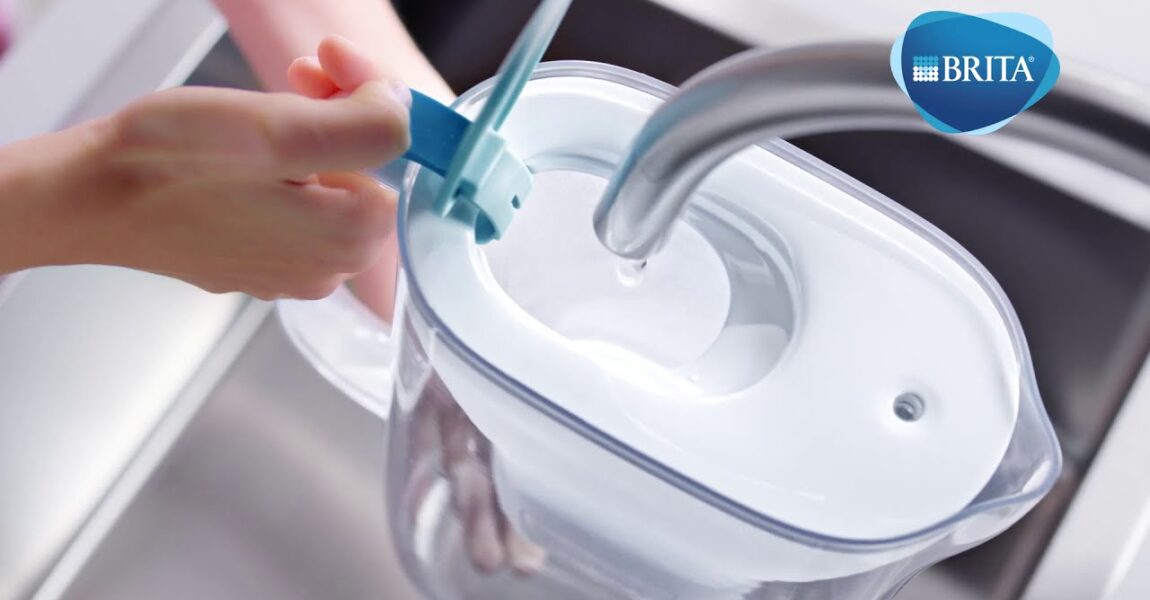
Introducing the BRITA Water Filter Jug Style – innovative BRITA Smart Light LED uses traffic light system to signal when it’s time to replace the cartridge (depending on time and water quality). Stylish design with flip-top lid for one-hand filling and dishwasher-safe (except BRITA Smart Light LED) – easy to clean. Designed to fit with BRITA MAXTRA+ for optional filtration. Reduce single use plastic!

Original Video Source

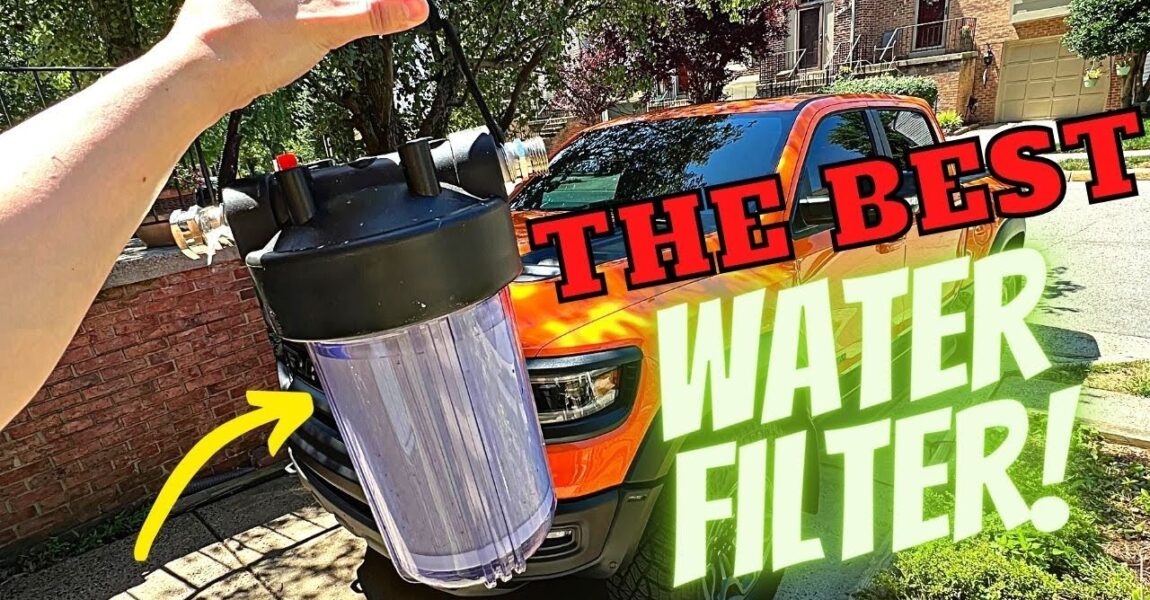
Best Water Filter For Washing Cars!

Best Water Filter For Washing Cars!


This in my opinion is the best water filter for washing your car if you live at a place where there is a lot of contaminates or harsh metals in your water. I recently moved and the water at my house is very harsh and awful for washing vehicles.

About this item
[CARBON FIBER CARTRIDGE] The upgraded cartridge can remove sediments, 99.5% of chlorine, 95.78% of chloroform, 99.5% of iron, 98.7% of manganese, 99.2% of lead, 98.8% of arsenic, odors, bad tastes and more
[THREE STAGE IN ONE] Integrates pleated polyester, carbon fiber and KDF55 in one 4.5×10 inch cartridge, while reducing the quantity of housing, the service life of each stage are 2.7 times more than the 2.5×10“ water filter with three housing
[ANTI-CLOGGING DESIGN] Pleated polyester design greatly increases the filter area to 1000 square inch, makes it 256 times more than small RV water filters, one cartridge can filter at least 18000 gallons of water without clogging
[FRESH WATER IN FULL FLOW] Benefit from NSF certified carbon fiber, you can hardly feel the drop in water pressure. Moreover, 0.1-6GPM outlet flow rate can be accepted, easily works perfect under most high water pressure
[18000 GALLONS CAPACITY] One replacement cartridge (ASIN:B094HXMLM5 ) have a 7 times of service life than ordinary small RV water filter, enjoy excellent performance and full water flow, will also reduce your spending by 60%

Kintim 3 Stage in 1 Water Filter:

Original Video Source

WATER FILTRATION SYSTEM IN A WATER PURIFICATION PLANT - WATER TREATMENT PROCESS

WATER FILTRATION SYSTEM IN A WATER PURIFICATION PLANT – WATER TREATMENT PROCESS


In this video, you will learn:
– How do a water purification plant work ?
– What is filtration ?
– Classification of filters
– Components of a filter
– Filtration mode
– How to calculate head loss in a filter
If you want to learn more about water treatment and waste water treatment equipments, subscribe to my channel !!!

And if you find this video interesting, please do like and share this video with your friends, and don’t forget to write on the comments what equipment do you want me to explain in the next Video.

Original Video Source