Orange streaks on white laundry. A faint metallic taste in coffee. That sulfur smell in the shower that makes you hope no guest turns on the hot water. If you're dealing with any of that, you're not picky and you're not imagining it. Iron and sulfur are common water problems in homes, especially on private wells, and they can make perfectly safe-looking water feel impossible to live with.
The good news is that these problems are usually very fixable. The less-good news is that many homeowners buy the wrong system first. They shop by label, grab the biggest filter they can afford, and then wonder why the stains come back or the unit clogs early. A good water filter for iron and sulfur has to match your actual water chemistry and your home's flow rate, not just a product page headline.
The End of Stains and Smells in Your Home
A neighbor once described her water this way: “It looks fine in the glass, but my bathroom says otherwise.” That's how iron and sulfur often show up. The faucet runs clear, but the sink gets orange rings. Towels smell musty after washing. The toilet tank collects ugly buildup. You clean, and the problem comes right back.
That mismatch is what makes these water issues so frustrating. If mud splashed out of the tap, the cause would be obvious. Iron and sulfur are sneakier. They leave clues around the house instead of always showing themselves in the water itself.
The daily signs most people notice first
You might already recognize some of these:
- Laundry trouble that turns light fabrics yellow, orange, or dingy
- Bathroom stains on tubs, sinks, and toilets that seem to “grow back”
- Odor at the tap that smells like rotten eggs, especially when water sits in plumbing
- Metallic taste in drinking water, tea, or coffee
- Fixture buildup that makes a clean home look neglected
These aren't just cosmetic annoyances. Iron can stain fixtures and laundry. Sulfur odor can make water unpleasant to use for bathing, cooking, and washing dishes. Manganese sometimes joins the party too, leaving dark staining that homeowners often mistake for dirt or mold.
Clean-looking water can still be problem water.
A lot of people assume they need “some kind of whole-house filter” and stop there. That's where expensive mistakes begin. A sulfur odor problem and an iron staining problem can overlap, but the best treatment depends on what form the contaminants are in, how much is present, and whether your well pump can support the filter's cleaning cycle.
Once you understand those three pieces, shopping gets easier. You stop guessing. You stop paying for equipment that sounds impressive but doesn't fit your house.
Diagnosing Your Water Problem Iron and Sulfur Explained
Iron and sulfur often travel together in well water, but they do not act the same way inside your plumbing. That difference is why one home gets orange stains in every sink while another gets a strong rotten-egg smell, even if both owners say they have an "iron problem."
The practical split is simple. Iron usually shows up as staining. Sulfur usually shows up as odor. The hard part is that both can hide in clear-looking water at first, which makes filter shopping confusing.
Iron has an invisible form and a visible form
Iron in water behaves much like a cut apple. At first, the inside looks clean. After it sits in air, it turns brown.
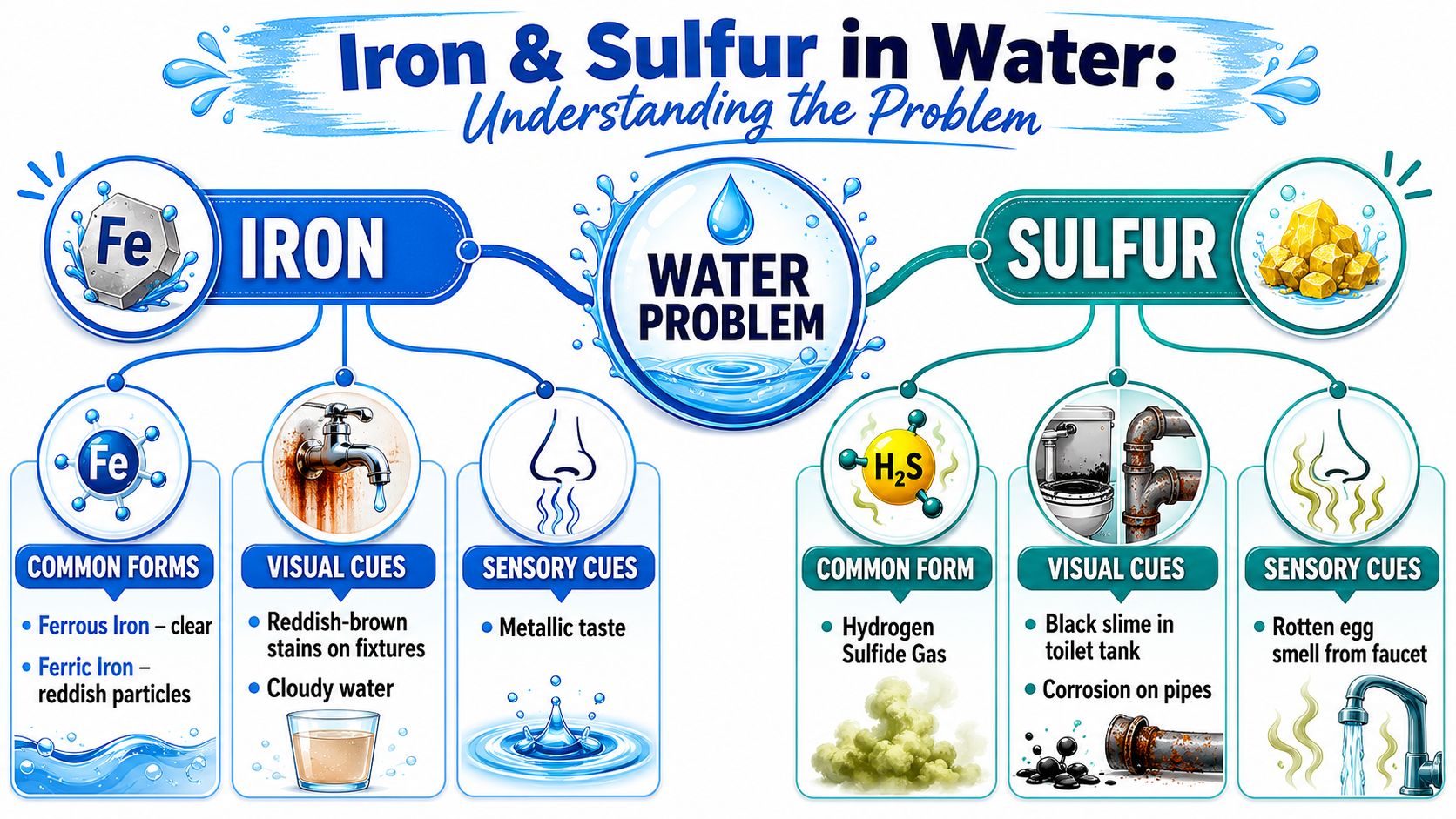
Ferrous iron is the dissolved form. Water with ferrous iron can come out of the tap looking perfectly clear, then leave rust-colored staining after it meets air in the sink, toilet, or washing machine.
Ferric iron has already oxidized. In that case, you may notice reddish particles, cloudy water, or sediment that settles out.
That distinction matters because filters are built for different jobs. Some work like a fine sieve and catch particles that already exist. Others first change dissolved iron into solid particles, then filter it out. If you choose the wrong style, the filter can clog early, miss the problem, or wear out faster than expected. You can browse more well water treatment guidance and troubleshooting advice if you want a broader overview before comparing systems.
Sulfur is usually a gas problem
That rotten egg smell usually comes from hydrogen sulfide gas. Gas behaves differently from dirt or rust particles. It can be strongest when water has been sitting in pipes, and many homeowners notice it more in hot water because warm water releases gas faster.
A common assumption is that a simple carbon cartridge should solve the issue because the problem is "just smell." Sometimes carbon helps at low levels, but sulfur odor often needs oxidation first so the system can remove the source of the smell instead of just trying to mask it.
Why oxidation shows up in so many treatment systems
Many whole-house iron and sulfur filters use oxidation because dissolved contaminants are hard to catch directly. Oxidation changes them into forms that filtration media can trap more easily.
A kitchen comparison helps here. Trying to filter dissolved iron before it changes form is like trying to catch sugar after it has dissolved in tea. Once that iron oxidizes into particles, the job starts to look more like straining pulp from juice.
That is also where flow rate starts to matter, even at the diagnosis stage. A filter may use air, media, or backwashing cycles to handle iron and sulfur, but if your home pushes more water through the system than it was designed for, contact time drops and performance follows. Many "bad filter" complaints are really a mismatch between the water problem and the amount of water the house uses at once.
Clear water can still contain dissolved iron or hydrogen sulfide.
Clues from around the house
The signs around your home can point you in the right direction before you test:
| Symptom | Likely culprit |
|---|---|
| Orange or reddish-brown stains | Iron |
| Rotten egg smell from faucet | Hydrogen sulfide |
| Black staining on fixtures or laundry | Manganese or sulfur-related issues |
| Metallic taste | Iron |
| Cloudy rusty water | Oxidized iron |
These clues are useful, but they are still clues. They tell you what kind of problem you may have. They do not tell you the concentration, the iron form, or whether your home's flow rate will let a given filter do its job properly.
Testing Your Water The Critical First Step
Buying a filter before testing your water is like buying shoes without knowing your size. Sometimes you get lucky. Most of the time, you waste money and still end up uncomfortable.
A basic water test can keep you from making a very expensive mismatch. A system that's too small won't solve the problem. A system that's too aggressive can add complexity you didn't need. The right water filter for iron and sulfur starts with your numbers, not a sales pitch.
What to test for
For iron and sulfur problems, ask for these basics:
- Iron
- Hydrogen sulfide or sulfur-related indicators
- Manganese
- pH
- Hardness
If you're on a private well, it also makes sense to ask whether there are any other local concerns worth checking. But for choosing an iron and sulfur system, those five items do the heavy lifting.
The decision point that changes everything
The most important number is usually the iron level. According to this well water filter selection guide, below 1 ppm, a simple cartridge works; 1 to 7 ppm requires an air-injection oxidation system; and above 7 ppm often necessitates an advanced matrix system or chemical feed. The same source says water pH must be at least 8.0 for manganese removal.
That gives you a practical buying map:
- Below 1 ppm iron. You may not need a heavy-duty whole-house iron unit.
- From 1 to 7 ppm. This is classic air-injection territory.
- Above 7 ppm. You're entering stronger-treatment territory.
- Low pH with manganese present. Even a strong filter can disappoint if the chemistry isn't right.
That's why test results matter more than brand names.
How to use the report
Don't stare at the sheet and panic. Read it like a matching exercise.
- If iron is modest, simpler equipment may work.
- If sulfur odor is present with moderate iron, oxidation-based systems usually make more sense than basic cartridges.
- If manganese shows up too, check pH before assuming a filter will remove all three well.
- If one contaminant is very high, look past general-purpose systems.
Practical rule: Match the filter to the lab report first, then match it to your home's plumbing.
If you want plain-English help translating test results before you shop, the advice library at Water Filter Advisor's guidance hub is a useful place to compare common filtration paths without jumping straight to product hype.
The Main Event Comparing Iron and Sulfur Filtration Methods
By this point, you know what is in the water. Now the question becomes simpler. Which treatment method fits the problem without creating a new one at the shower, washing machine, or kitchen sink?
The easiest way to sort these systems out is to separate them into two jobs. First, some method has to change dissolved iron or hydrogen sulfide into a form a filter can catch. Second, the filter media has to hold that material long enough to remove it, then clean itself properly. A system can look impressive on paper and still disappoint in a real home if either job is mismatched.
Air injection oxidation systems
For many well-water homes, air injection is the practical middle ground.
These systems pull air into the treatment tank, creating an oxygen-rich space that helps convert dissolved iron and sulfur into particles. The media bed then catches those particles. It is a bit like letting wet paint dry before trying to wipe it up. Once the contaminant changes form, removal gets much easier.
According to Mid Atlantic Water's overview of advanced iron filters, modern air-injection oxidation iron filters can remove up to 30 ppm of iron, 10 ppm of hydrogen sulfide, and 15 ppm of manganese without chemicals, while handling flow rates up to 25 GPM.
That sounds broad, and it can be. But capacity claims only help if your home can supply the flow the system needs during service and backwash. That matching problem gets missed all the time, and it is one of the big reasons homeowners replace media sooner than expected.
Best fit: Homes with noticeable staining and sulfur odor that want whole-house treatment without a chemical feed pump.
Why people like them:
- No chemical feeder in many designs
- Good whole-house treatment for iron, sulfur, and sometimes manganese
- Automatic backwashing helps refresh the media bed
- Less day-to-day attention than chemical injection systems
Watch-outs:
- Backwash flow still has to match the tank and media
- Manganese removal can depend heavily on pH
- Two air-injection systems can perform very differently because the media inside may not be the same
Water softeners for very low iron
A softener is built to remove hardness minerals first. Iron removal is a side job, and only a small one.
That matters because homeowners sometimes use a softener where a dedicated iron filter should be doing the work. The result is familiar. Resin fouls, salty cleaning increases, stains start creeping back, and the softener gets blamed for doing a job it was never designed to carry.
A better comparison is this: a softener handles a little dissolved iron the way a kitchen strainer handles a few grains of rice that slipped into the sink. It can manage a small amount. Dump in gravel, and trouble starts fast.
Best fit: Homes with very low iron where hardness is the bigger daily annoyance.
Why people choose them:
- One system can address hardness and a trace amount of iron
- Maintenance is familiar to many homeowners
- Can be enough when iron is barely present
Watch-outs:
- Resin beds foul as iron rises
- Sulfur odor usually remains unless another treatment step is added
- Visible orange staining in multiple fixtures usually means you are beyond softener territory
Hydrogen peroxide injection with catalytic carbon
Hydrogen peroxide injection is often the better answer for tougher water.
Instead of relying on air inside the tank, this setup feeds peroxide into the water line before filtration. The peroxide reacts quickly with iron, sulfur, and manganese. Catalytic carbon then helps complete the reaction and filter out what was created. In plain terms, it is a faster and more forceful prep step before the water reaches the media bed.
This method is commonly used when iron is high, sulfur smell is stubborn, or mixed contamination keeps overwhelming simpler systems. It also gives a homeowner more treatment muscle when water conditions swing during the year.
Best fit: Homes with heavy iron, strong rotten-egg odor, or water that has already defeated a lighter-duty filter.
Pros:
- Fast oxidation
- Strong performance on difficult mixed contamination
- Useful for problem wells where odor and staining come back quickly
- Often more forgiving than air-only systems when the water is especially challenging
Cons:
- The peroxide solution has to be refilled
- Feed pumps and solution tanks add parts to maintain
- Setup quality matters a lot, especially contact time and injection rate
Catalytic carbon and specialty media systems
Catalytic carbon is useful, but it is not a magic catch-all. In some systems it acts as the finishing stage after oxidation. In others, specialty media do most of the heavy lifting inside a single backwashing tank.
That is why media details matter so much. Grain size, coating, oxidation ability, and backwash needs all change how a unit behaves in an actual house. Mid Atlantic Water's Katalox-Light filter information states that Katalox-Light can remove up to 30 ppm of iron, 10 ppm of hydrogen sulfide, and 15 ppm of manganese in a single tank, with a 10-year service life, no chlorine or potassium permanganate, and a minimum flow rate of 5 gpm to initiate backwash while operating efficiently up to 12 gpm.
That last part deserves your attention. A media tank is not just a chemistry choice. It is also a flow-rate choice. A media bed that performs beautifully at one home may struggle at another if the well pump, pressure tank, or plumbing cannot support how that media needs to clean itself.
A simple comparison
| Method | Best use case | Main advantage | Main drawback |
|---|---|---|---|
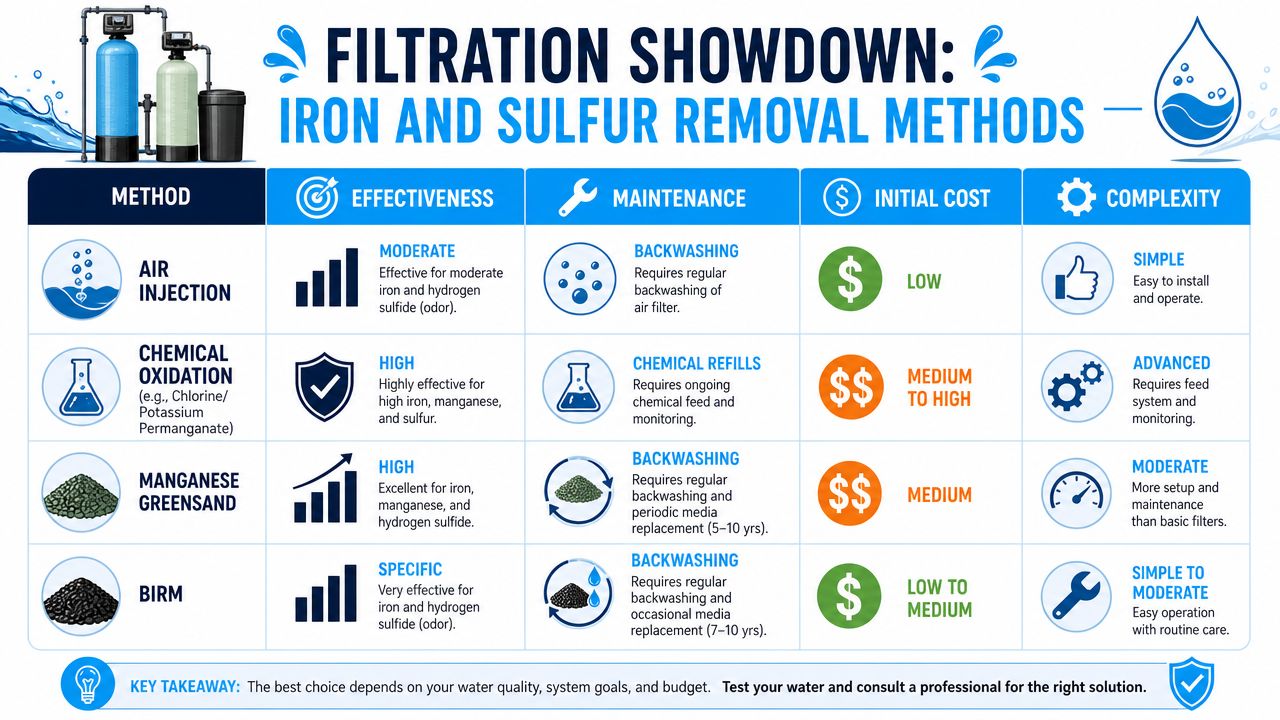
| Air injection oxidation | Moderate to high iron and sulfur in many homes | Chemical-free treatment | Performance depends heavily on proper flow and backwash |
| Softener | Very low iron with hardness issues | Helps with hardness at the same time | Not built for strong iron or sulfur problems |
| Hydrogen peroxide injection | Severe contamination or stubborn odor | Fast, aggressive oxidation | Requires chemical refills and more maintenance |
| Advanced media tank | Homes where the water chemistry and flow match the media requirements | Can solve multiple issues in one tank | Wrong flow rate can shorten media life and reduce cleaning ability |
The best filter is rarely the fanciest one. It is the one that matches your lab report, your home's water use, and the flow your well system can deliver.
Right-Sizing Your Filter System to Avoid Failure
This is the part most buying guides skip, and it's the reason some perfectly good filters fail in perfectly normal homes.
A backwashing iron filter has to clean itself. If your well pump can't deliver enough water during that cleaning cycle, the media doesn't get flushed properly. The bed compacts, fouls, and loses performance. Homeowners often blame the brand when the problem was sizing.
Bigger isn't always better
People assume a larger filter gives more protection. Sometimes it gives you a bigger problem.
A larger tank often needs a stronger backwash. If your pump can't supply it, the filter becomes like a self-cleaning oven that never gets hot enough to burn off the mess. Dirt stays behind. Performance drops. Maintenance gets ugly.
A widely overlooked mismatch sits right here. 70% of commercial wells operate below the 12 GPM needed for many filters to self-clean, and this oversight is linked to system failure within 6 months, appearing in 45% of complaints reported to the Groundwater Protection Foundation in 2024. That doesn't mean every home will fail. It does mean flow rate deserves just as much attention as iron level.
How to measure your well flow rate at home
A simple bucket test gives you a useful starting point.
- Find a hose bib or faucet supplied directly by your well system.
- Use a container with a known volume.
- Time how long it takes to fill.
- Convert that result to gallons per minute.
If the number seems weak, don't assume the filter brochure is wrong. Your plumbing may be telling you that a certain tank size is unrealistic for your house.
Field note: The best filter on paper is the wrong filter if your pump can't backwash it.
Match the system to the house, not just the water
Household size also matters. According to this sizing discussion for air-injection units, a 1 cubic foot air injection system with a 5.3 gpm flow requirement is suitable for households with 1 to 4 people and iron below 2 ppm, while homes with 4 to 6 people and iron above 2 ppm need larger systems. The same source notes model-specific capacities, with FOK up to 9 ppm iron, FOB up to 4 ppm, and FOC up to 1 ppm.
That's a good reminder that “one size fits all” is fantasy in water treatment.
What to confirm before you buy
Check these details on every quote:
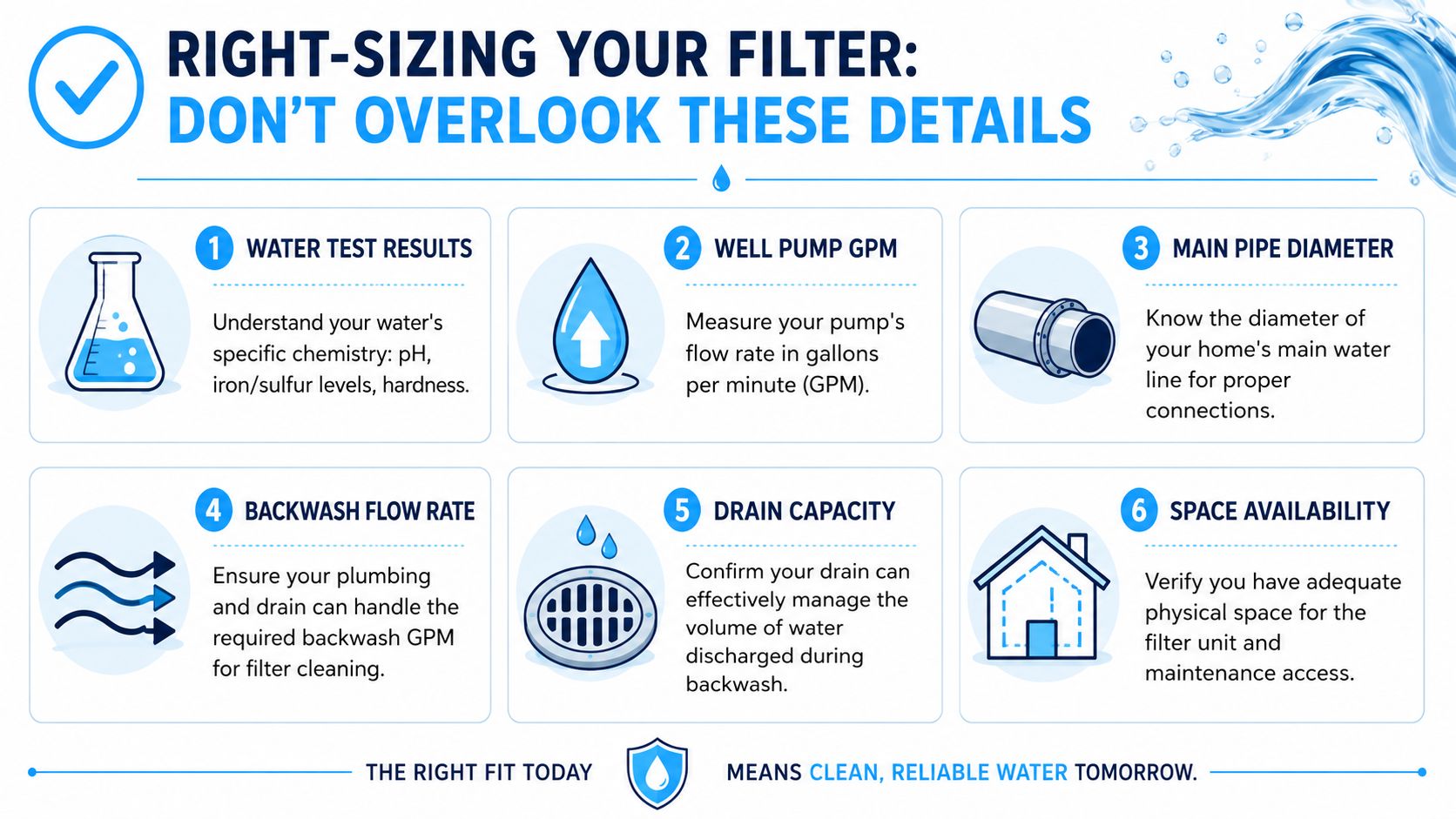
- Backwash requirement versus your measured flow rate
- Service flow for how your home uses water
- Main line size so the filter doesn't choke the plumbing
- Drain capacity because backwashing has to go somewhere
- Physical footprint for install and future maintenance access
A properly sized water filter for iron and sulfur doesn't just remove contamination. It keeps working.
Installation Maintenance and Long-Term Costs
A whole-house iron and sulfur filter becomes part of your plumbing system, not just another appliance in the basement. It has to fit the way your home moves water. If the plumbing, drain, or flow conditions are wrong, even a well-chosen filter can act like a good furnace with a bad chimney. The parts may be fine, but the setup keeps the system from doing its job.
That is why installation deserves more attention than homeowners often give it. The unit usually sits where water enters the house, ties into a drain for backwashing, and needs enough room to service the control valve, media tank, and bypass. Some systems also need an electrical outlet and basic programming so the backwash cycle runs at the right time.
A handy homeowner may be able to install a simpler unit. That usually means cutting pipe cleanly, adding shutoffs, setting a bypass, checking for leaks, and confirming the drain line is secure. If your house has older plumbing, a crowded mechanical area, or inconsistent pressure, professional installation is usually the safer path.
What maintenance really means over time
Different filter types ask for different kinds of care. A backwashing air-injection system is closer to a self-rinsing strainer. It can be lower maintenance day to day, but only if the valve stays clean, the air draw keeps working, and the media bed is still matched to your water.
Chemical injection systems are more hands-on. A hydrogen peroxide setup adds an oxidizer ahead of the filter, which can be very effective for stubborn iron and sulfur problems, especially when simpler methods struggle. The tradeoff is ongoing attention. You need to keep the solution tank filled, check the feed equipment, and plan for media replacement over time. Penn State Extension's guidance on iron and sulfur treatment explains why oxidizing chemicals are sometimes used when problem water needs stronger treatment than aeration alone can provide: https://extension.psu.edu/iron-and-manganese-in-private-water-systems
The practical question is not “Which system needs the least maintenance?” It is “Which system can my household realistically keep up with?” A lower-maintenance filter that is undersized for your flow rate often fails sooner than a slightly more involved system that is properly matched and properly serviced.
How to look at long-term cost without fooling yourself
The purchase price is only the front door cost. Ownership comes in layers; many bad buying decisions begin at this stage.
Start with installation. If the filter needs new shutoffs, a better drain connection, electrical access, or plumbing changes to handle backwash correctly, that work belongs in the actual price. Then add operating costs. Injection systems need chemical refills. Backwashing systems use water and a little power. Every media tank eventually needs fresh media, and some homes will want occasional service calls instead of DIY upkeep.
Here is the simple way to compare options. A less expensive unit that clogs early, loses pressure, or never backwashes correctly is like buying cheap tires for a truck that hauls heavy loads every day. You paid less up front, but the mismatch shows up later in shorter life, more maintenance, and more frustration.
When a plumber is the smart call
Professional help makes sense when the filter install affects more than one part of the system. That includes tight spaces, questionable drain routing, old galvanized lines, mixed pipe materials, pressure problems, or a setup that needs cleanly installed bypass valves and shutoffs.
If you want a local example of what full-service residential plumbing support looks like before committing to a whole-house install, Boerne plumbing services from Stultz Plumbing gives a helpful picture of the kind of work homeowners often need around filtration hookups, shutoffs, drains, and related plumbing updates.
A filter can remove stains and sulfur odor. Good installation is what gives it a fair chance to keep doing that year after year.
Your Final Iron and Sulfur Filter Checklist
By the time you're ready to buy, the decision should feel narrower than it did at the start. That's a good sign. Most bad purchases happen when homeowners try to solve every possible water issue with one oversized system and no testing.
Use this checklist like a last pass before checkout or before signing an install estimate.
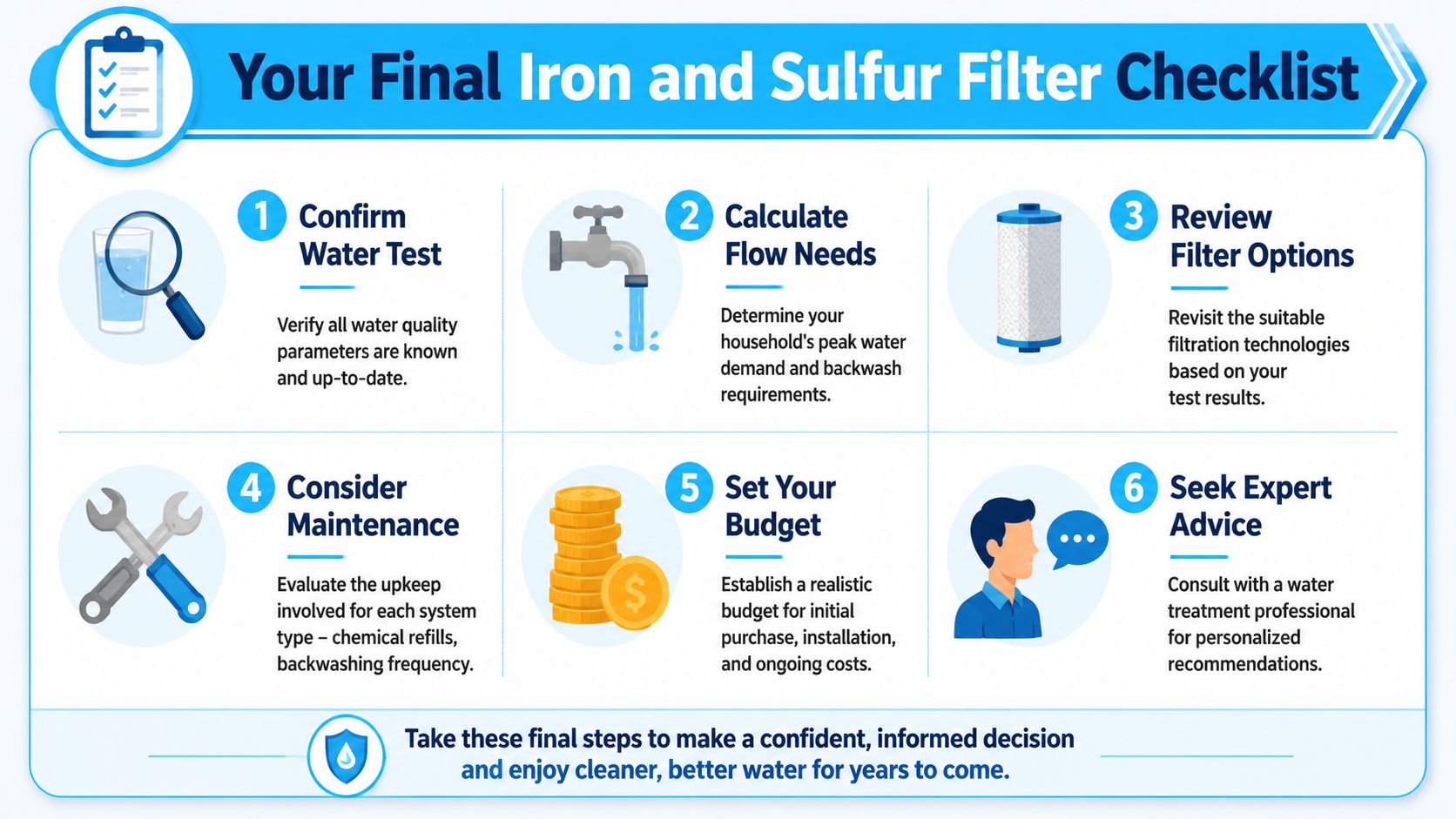
The six questions that keep you out of trouble
Have you tested the water recently?
Don't buy from symptoms alone. You need current results for iron, sulfur-related issues, manganese, pH, and hardness.Do you know your iron range?
The treatment path changes depending on whether your water falls below 1 ppm, in the 1 to 7 ppm range, or above that.Have you measured your available flow rate?
This is the hidden deal-breaker. A filter that can't backwash properly won't stay effective.Does the filter technology match the problem?
Mild iron, strong sulfur odor, mixed manganese, and severe contamination don't all call for the same setup.Have you checked the maintenance reality?
Chemical-free systems and injection systems ask different things from you over time. Know what you're agreeing to.Will the system physically fit your home?
Confirm space, drain access, main line size, and room to service the unit later.
The smartest way to choose
A good choice usually checks four boxes at once:
- Correct for the lab results
- Compatible with your pump and plumbing
- Reasonable to maintain
- Sized for the way your household uses water
That's how you choose a water filter for iron and sulfur that solves the smell and staining without creating a new plumbing headache.
Save this checklist. Better yet, keep it on your phone while you compare quotes. It's much easier to ask sharp questions before you buy than to explain orange laundry after.
If you want help comparing filter types, understanding maintenance tradeoffs, or translating a water test into practical next steps, Water Filter Advisor is a useful place to start. It's built for homeowners who want clear, research-based filtration guidance without the usual confusion.
- June 24, 2026
- Uncategorized
