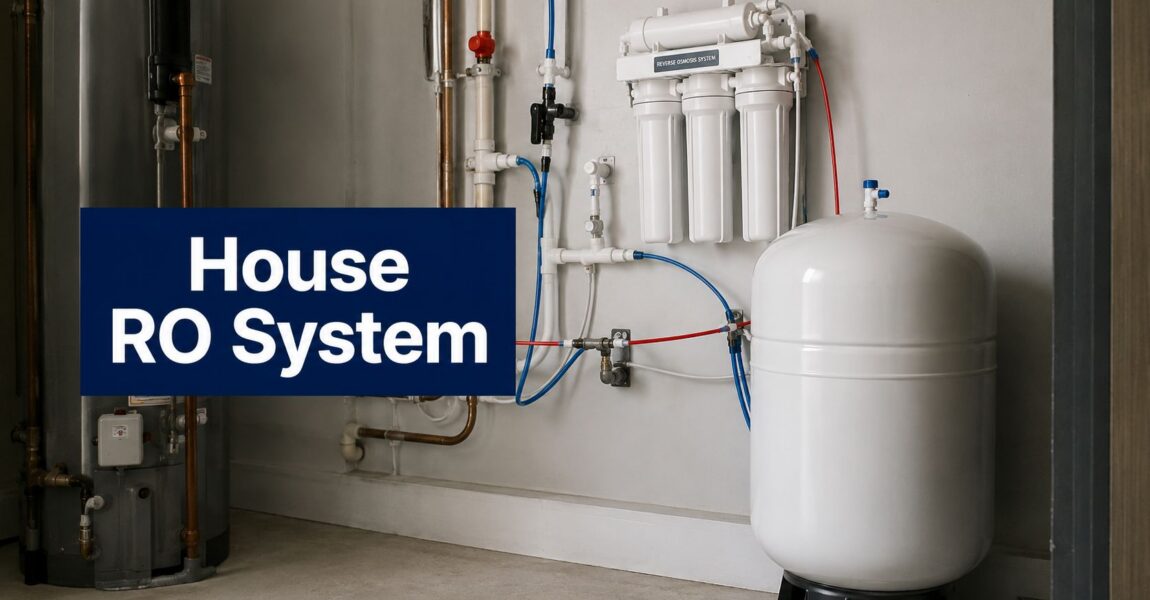
A house RO system treats all water entering the home, but most home units recover only 20% to 30% of the feed water, so a lot of what comes in has to leave as concentrate. That's why whole-house RO is uncommon on municipal water and usually only makes sense when the home has serious drain, storage, and pump planning in place.
A homeowner usually starts thinking about this system in a very specific moment. Maybe the well water tastes odd, leaves residue on fixtures, or keeps showing up in test results in ways that simpler filters can't solve. Or maybe the family wants every tap, shower, and appliance fed by the same treated water, not just the kitchen sink.
That idea sounds simple until you trace the plumbing. A house RO system is not just a larger under-sink unit. It's a point-of-entry treatment setup, installed where water enters the home, so the entire house receives RO-treated water before it reaches any fixture. For readers comparing options, a technical resource like lab water purification systems can be helpful because it shows how membrane-based treatment is designed when water quality targets are strict.
What a House RO System Actually Is
A house RO system is easiest to understand through a homeowner's real decision. Someone with stubborn well water may want every shower, laundry load, and glass of drinking water to come from the same purified source. Another homeowner may be worried that one kitchen filter solves taste at the sink but leaves the rest of the house untouched. In both cases, the question is the same, should treatment happen at one faucet, or at the main line.
Whole-house means point of entry
A whole-house reverse osmosis system sits where the water line enters the home. That placement matters because every fixture downstream receives treated water, not just the kitchen. It's the difference between polishing one cup of water and treating the entire incoming supply before it reaches pipes, appliances, showers, and hose bibs.
That's a meaningful engineering leap. Under-sink RO is built for a small flow at one tap, which is why it fits neatly under a cabinet. Whole-house RO has to behave more like a utility system, with enough pretreatment, storage, drainage, and pressure management to support the whole home without making showers weak or laundry cycles inconvenient.
Where the system lives also affects the experience. Most installations end up in a basement, utility room, or garage, because those spaces can handle the rack, tank, pump, and drain needs. They also make service easier. A membrane swap is much less frustrating when the equipment isn't wedged into a cramped cabinet behind trash bins.
Practical rule: if the system can't be accessed easily for maintenance, it's usually in the wrong place.
That's why house RO planning starts with space and plumbing, not just contamination concerns. It's also why homeowners who are serious about whole-home treatment usually compare it with more basic whole-house filtration first, then decide whether RO is really justified for their water and their layout.
How Reverse Osmosis Works in a Home Setting
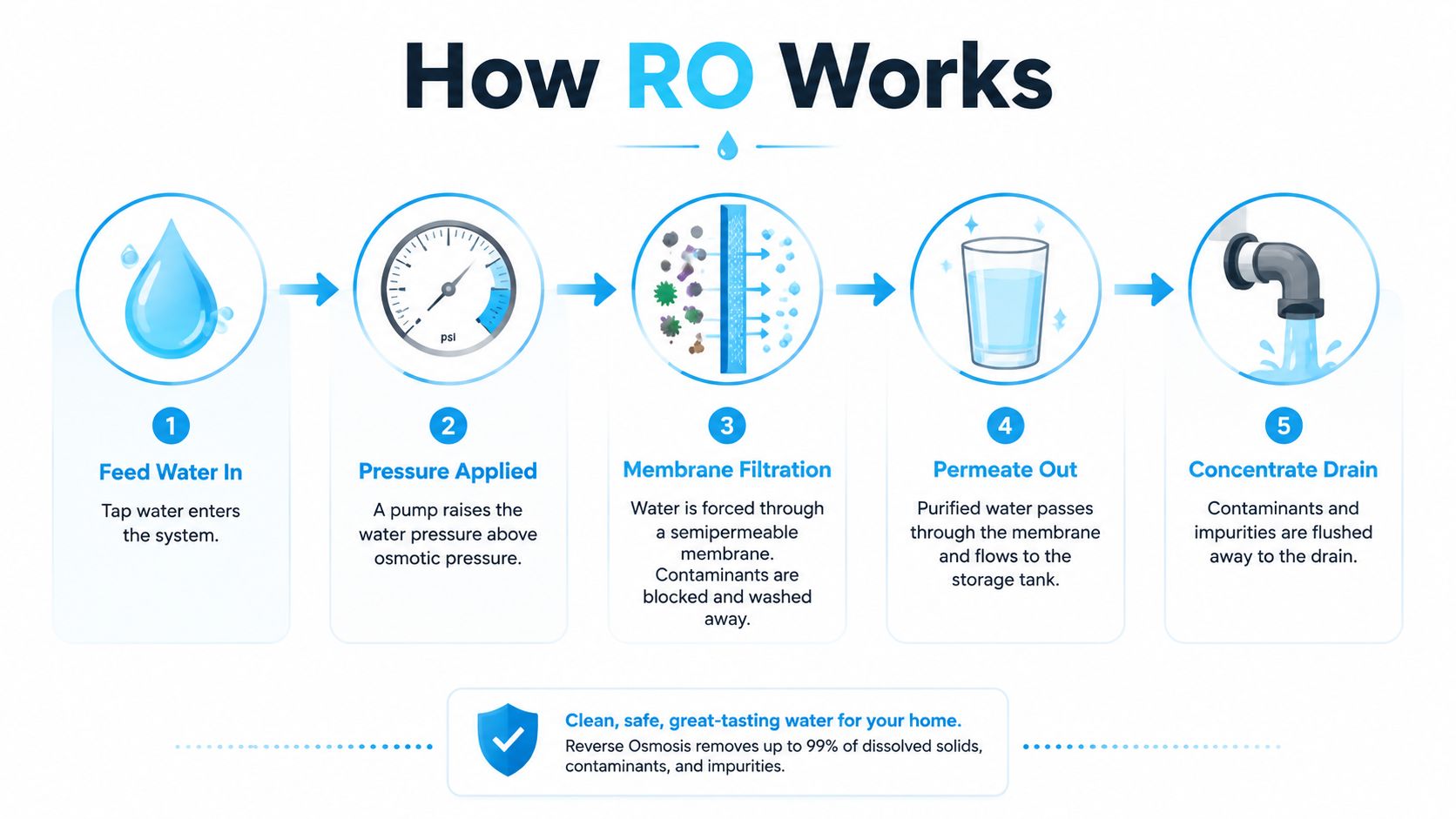
A house RO system works by pushing water against a very fine membrane so only the water molecules that pass the test move through. A coffee filter gives the basic idea. Grounds stay behind while brewed liquid flows through. RO does the same kind of separation, except the membrane is semi-permeable and the water has to be under enough pressure to cross it.
The two water streams homeowners should know
The water that makes it through the membrane is called permeate. The stream that carries away the rejected material is called concentrate. In plain terms, permeate is the treated water you keep, and concentrate is the water that leaves with the material the membrane did not allow through.
That split is why RO feels backward at first. The system removes a lot, so it also sends a portion away. Home RO systems usually recover only a limited share of the incoming water, and a home membrane typically produces a modest amount each day, according to Nebraska Extension Nebraska Extension. Those limits explain why RO is excellent for highly treated drinking water, while whole-house use raises a different set of plumbing questions.
Why the terminology matters
You'll also see terms like TDS and rejection rate on spec sheets. TDS means total dissolved solids, a shorthand for dissolved minerals and other material in the water. Rejection rate describes how well the membrane keeps that material out of the finished water.
A higher rejection rate does not mean the system wastes less water. It usually means the membrane is separating the clean stream more effectively. The trade-off is that a larger share of the feed water ends up in the concentrate stream. That is why whole-house RO always brings up drain capacity, storage volume, and pressure support, not just contaminant removal.
Cleaner water at the tap often asks more from the plumbing room.
Typical Components and Configurations
A homeowner looking at a house RO system should think in terms of a treatment train, not a single box. The equipment usually works in sequence. Water enters, gets pretreated, passes through the membrane, gets polished, then gets stored and pushed back into the house.
The basic parts most systems share
The first line of defense is usually sediment pre-filtration. That filter catches particles that could clog the membrane. Next comes a carbon pre-filter, which helps protect the membrane from chlorine and other oxidizing compounds. After that, the water reaches the RO membrane housing, the heart of the system where the separation happens.
A post-filter often sits near the end, usually another carbon stage that improves taste before the water reaches a faucet or storage tank. Many whole-home setups also include an atmospheric storage tank and a re-pressurization pump, because the membrane itself is slow compared with normal household demand.
Why stage count can look confusing
One guide says residential systems commonly use a sediment pre-filter, carbon pre-filter, RO membrane, and post-carbon filter, while another notes that total stage count can run from 3 to 17+ depending on the model The Water Softener Blog. That range sounds huge, but it doesn't mean every extra stage is better.
More stages only help when they solve an actual water problem. A system that needs extra carbon for taste, mineral reduction, or membrane protection may be justified. A system that adds stages just to look more advanced is mostly adding cost, maintenance, and space use. For a homeowner, the question is whether each stage matches the source water and the household's flow needs.
What the layout means in practice
A single-membrane residential setup is simpler to maintain, but it may struggle with flow if the home has higher demand. A multi-stage design can offer more control, better protection, or smoother delivery, but it also takes more room and often creates more points of failure. That's why planning for access, noise, and service space matters as much as the membrane rating.
If you're sketching a mechanical room in your head, think of the system as a small water plant. It needs a place for pretreatment, a place for storage, and a place where the drained concentrate can leave safely.
Municipal Water vs Well Water Use Cases
Municipal water and well water push homeowners toward very different filtration choices. City water is already disinfected and tested before it reaches the house, so whole-house RO is usually more system than the home needs. In many cases, a point-of-use RO system at the kitchen, or a standard whole-house filter for taste and sediment, is the more proportionate solution.
When municipal water makes RO feel excessive
A homeowner on municipal water usually wants better taste, fewer plumbing concerns, or help with a specific contaminant in the report. Whole-house RO can address that, but it also treats water that may not need that level of intervention in every room. Showers, toilets, and laundry don't all require the same purification standard as drinking water.
That's why the “whole-house” idea needs to be tested against the actual problem. If the issue is taste at the tap, or a narrow set of contaminants at drinking-water points, a smaller system often fits better. If the issue is broader and tied to a specific utility or service-line concern, whole-home treatment can become more reasonable, but only after the plumbing side is checked.
Why well water changes the equation
Well water is different because it can vary from property to property and even change with season, pump behavior, or nearby geology. Homeowners often need a more customized approach. For that reason, a well guide from Bear Valley Plumbing's well guide can be useful for seeing how private well plumbing can complicate treatment decisions.
A well-fed house may have hardness, iron, sulfur, nitrates, or high dissolved solids that show up everywhere in the home, not just at the kitchen sink. That's where point-of-use RO starts to look limited, because it can't improve shower water or laundry water if the problem is in the whole supply. Whole-house RO becomes more plausible when the homeowner wants one treatment strategy for the entire property and the well water test justifies that level of intervention.
The simplest way to think about it is this, municipal water often needs targeted treatment, while well water more often pushes you toward a whole-system response. That doesn't mean RO is always the answer for wells, but it does explain why the conversation comes up more often there than on city water.
Performance, Recovery Rates, and Water Waste
A house RO system can make very clean water, but the plumbing behind that result is where the trade-off shows up. The membrane removes a lot of dissolved material, and the same process sends part of the incoming water to the drain. For a homeowner, that drain flow is not a small detail. It is part of how the system works.
Recovery rate is the number that changes the conversation
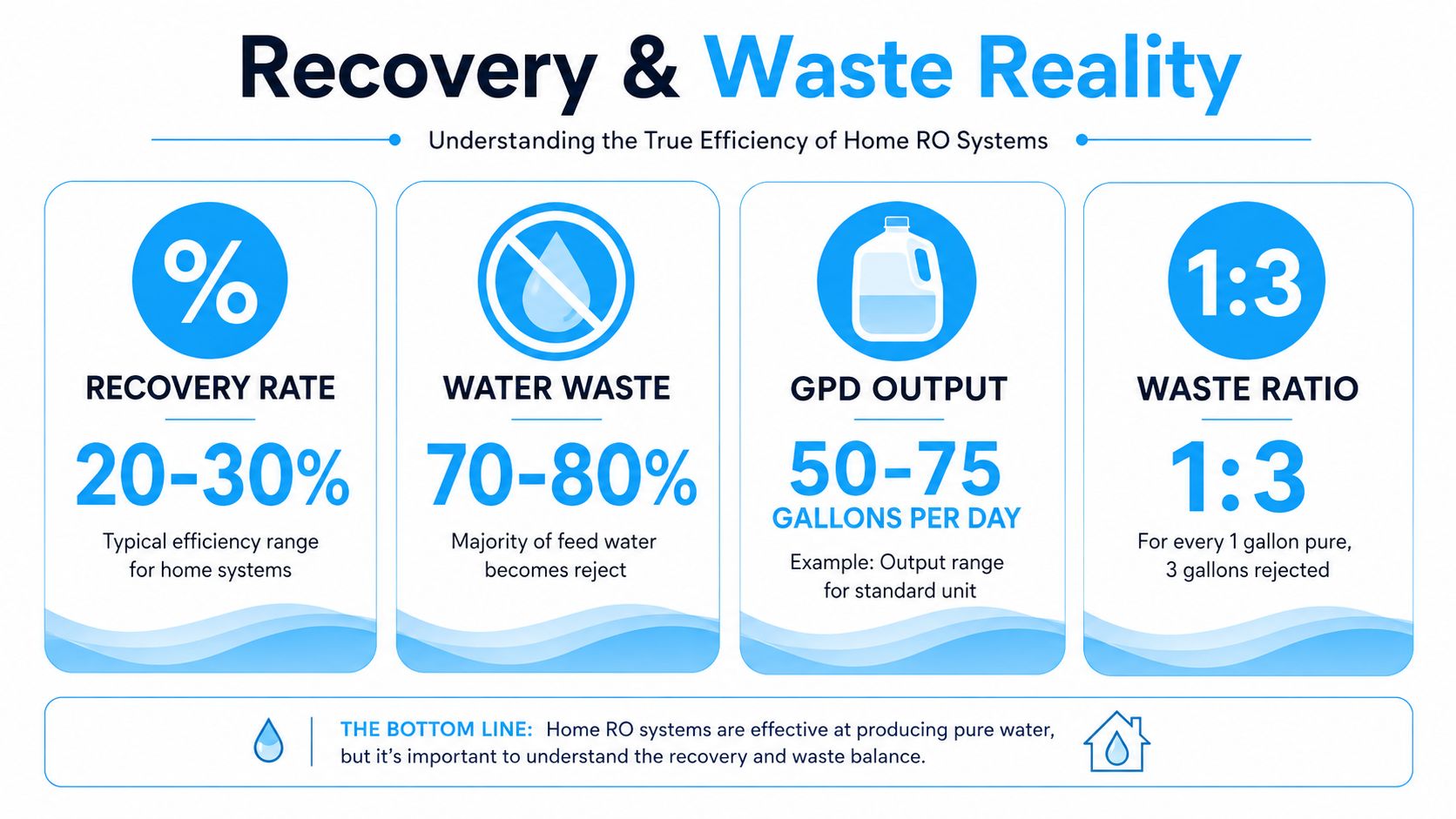
Nebraska Extension says most home RO systems are designed for only a 20% to 30% recovery rate Nebraska Extension. In plain terms, that means only a portion of the feed water becomes usable product water, while the rest leaves as concentrate. The EPA says a typical point-of-use RO system can generate 5 gallons or more of wastewater for every gallon produced, and some inefficient units reach 10:1 waste ratios EPA WaterSense.
That is why people should judge whole-house RO by more than contaminant reduction alone. The membrane can be very effective at lowering dissolved contaminants, but the water balance still matters. WaterSense-labeled systems are designed to use more than 3,100 gallons less water per year than a typical unit, totaling about 47,000 gallons saved over the system lifetime EPA WaterSense. The point is simple. Wastewater is a real stream, and the home has to handle it every time the system runs.
Whole-house systems improve recovery, but not enough to erase the issue
A commercial whole-house RO platform lists 35% to 50% recovery at production capacities from 0.17 to 1.38 gpm, with 98.5% nominal rejection AFW Filters commercial whole-house RO system. That is better than the low recovery profile of many home systems, but it still leaves a concentrate stream that needs a place to go.
That hidden infrastructure problem is what many sales pages skip. Recovery is only one side of the equation. The other side is drain capacity, storage, and pump sizing. If the drain cannot accept the reject flow, or if the storage tank and pressure pump are too small, the system will not deliver the kind of service the equipment rating suggests.
Output and demand have to match
A home RO membrane that only makes 10 to 35 gallons per day can cover drinking and cooking, but it cannot keep up with a whole family's showers, laundry, and appliance use without storage behind it Nebraska Extension. That is why whole-house RO usually depends on an atmospheric tank and a re-pressurization pump, not direct membrane-to-fixture supply.
The practical question is not whether RO makes clean water. It does. The practical question is whether the home can handle the waste stream and still keep pressure steady at the taps. If that part is overlooked, the system may look good on paper and feel disappointing in the house.
Bottom line: high permeate quality does not cancel out poor water balance.
Installation, Drainage, and Code Requirements
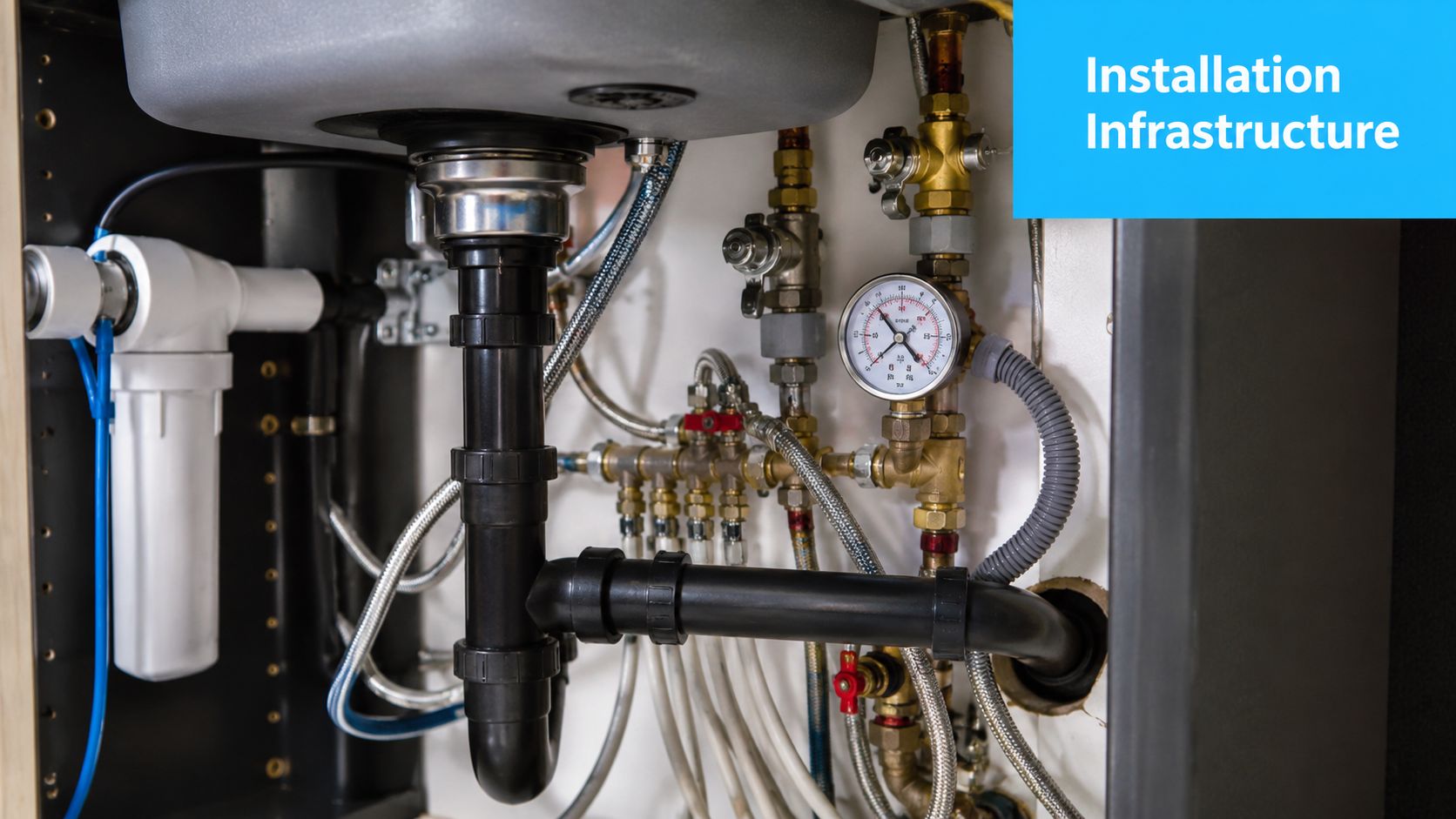
A whole-house RO system can fail on the installation details long before it fails on water quality. Pressure, drain path, and space all have to be considered before a homeowner signs off on the equipment. If any of those are wrong, the system becomes noisy, weak, or unsafe.
Pressure and space come first
One residential whole-home RO specification allows 45 psi minimum feed pressure, 50 to 150 psi operating pressure, 96% to 98.5% NaCl rejection, and feed water up to 1,000 to 2,000 ppm TDS with hardness up to 15 gpg and pH 3 to 11 Crystal Quest whole-house reverse osmosis system. That tells you two things right away. First, the system is designed around a defined operating window. Second, pretreatment and pump sizing are not optional.
If feed pressure is too low, a booster pump may be needed. If the home's demand is high, an atmospheric tank and re-pressurization pump may be needed after storage. That's how the system keeps showers from trickling while the membrane works at its own pace.
Drainage is a code issue, not an accessory
Minnesota's health department says RO systems must include an air gap or air-gap device, and the concentrate line must enter sewer plumbing through that air gap to prevent contamination of the drinking water supply Minnesota Department of Health. In practical terms, that means the reject stream has to have a safe exit path. A floor drain, sump arrangement, or dedicated discharge point may need to be built or upgraded to handle the flow.
That's the part homeowners usually underestimate. The system isn't just making purified water, it's also moving a lot of reject water somewhere else. If the plumbing can't accept that load, the whole installation becomes a drainage problem.
Readiness checklist before purchase
- Feed Pressure: Verify the home can supply the minimum pressure the system needs.
- Drain Capacity: Confirm there's a safe, code-compliant way to handle concentrate discharge.
- Equipment Space: Measure room for pretreatment, tank, pump, and service access.
- Noise Tolerance: Expect pump and flow noise in the mechanical area.
- Layout Fit: Check whether the home can support re-pressurization after storage.
A well-planned installation feels boring, and that's a compliment. The less drama the system creates in the basement or garage, the more likely it is to work the way the homeowner expects.
How House RO Compares to Other Filtration Options
A homeowner comparing filtration choices usually starts with the wrong question. The better question is what problem the system is meant to solve, because different filters handle different parts of the water job. A whole-house RO system is built for dissolved contaminants across the home, while other options focus on one tap, hardness control, or basic improvement in taste and clarity.
| System | What it removes | Water waste | Best fit |
|---|---|---|---|
| Whole-house RO | Dissolved solids and many difficult contaminants | High relative to other home filters | Homes that need full-home treatment and can support drain, tank, and pump requirements |
| Point-of-use RO | High-level drinking water contaminants at one tap | Lower than whole-house RO because it treats only one faucet | Kitchens where drinking and cooking water are the priority |
| Water softener | Hardness minerals | Minimal compared with RO | Homes with scale issues, spotty fixtures, and appliance protection goals |
| Standard whole-house filter | Sediment, taste, odor, and some chemical issues | Low | Homes that need broad but non-RO filtration |
The trade-offs are clearer than the marketing
A point-of-use RO unit gives high-purity water at the kitchen sink without asking the rest of the plumbing to carry the load. That makes it a simpler fit when the main concern is what people drink and cook with. A softener handles hardness, so it can help with scale on fixtures and appliances, but it does not work like RO on dissolved contaminants. A standard whole-house filter is often the first stop for sediment, taste, and odor, yet it does not target the same dissolved solids, nitrates, or similar concerns that push homeowners toward reverse osmosis.
The sample tests matter more than the sales sheet. If hardness is the main issue, RO is usually solving the wrong problem first. If the water has dissolved solids that affect every tap, whole-house RO moves up the list, but only if the plumbing can support the drain, storage tank, and pump needs that come with it. If the goal is cleaner drinking water, a smaller system often gives more value with less disruption to the house.
For homeowners who want a practical buying checklist and plain-language maintenance guidance, Water Filter Advisor advice is a useful place to compare filtration categories and see how the choices differ.
The practical lesson is straightforward. Whole-house RO makes sense when the home needs purification at every tap and the infrastructure can handle the drain path, storage, and pressure support. A narrower system wins when it can solve the same water concern with less waste and less complexity.
Cost of Ownership and a Homeowner Decision Checklist
A house RO system should be judged by more than the price on the product page. The cost includes the equipment, installation, drain work, pump support, storage, and the replacement parts that keep the system running over time. That is the difference between a system that looks affordable at first glance and one that fits a home's plumbing and budget.
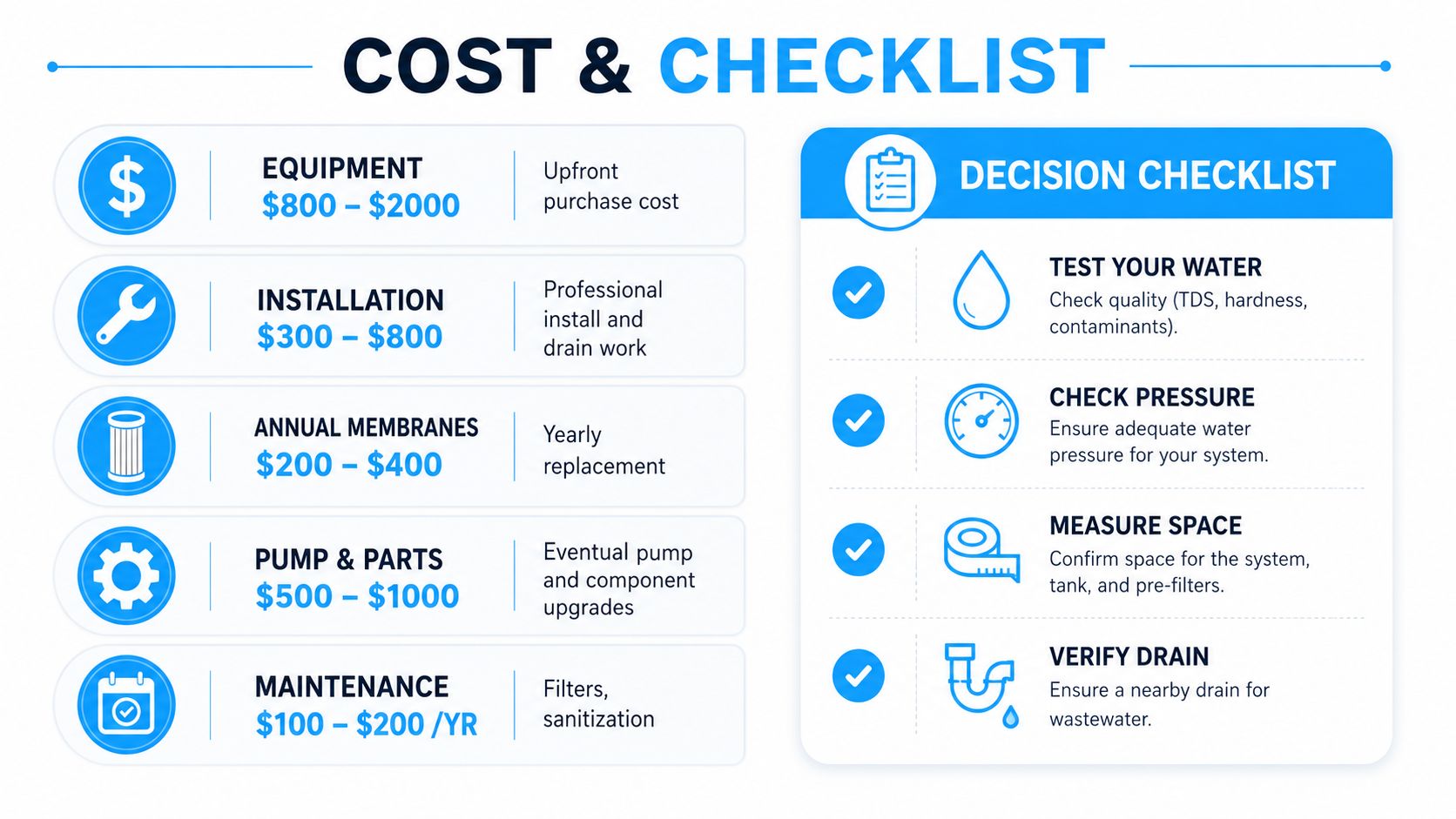
The ongoing work matters as much as the install
Membranes and filters wear out. A homeowner has to plan for membrane replacement, pre-filter and post-filter changes, and occasional service on pumps or valves. If the system uses storage tanks and re-pressurization, those parts add another layer of maintenance, like a water system with both a holding tank and a pressure booster that each need attention.
Drain flow affects ownership cost too, even when the system works correctly. A membrane that rejects more water sends more to the drain, and that can show up in the household water bill. That is not always a problem, but it belongs in the decision because it changes how the system fits the home.
Use a simple readiness checklist
- Test the water: Look for the actual contaminants or water-quality issues, not just a general sense that the water is “bad.”
- Check pressure: Make sure the incoming supply can support the system or that a booster can be added.
- Measure space: Confirm there is room for pretreatment, storage, and service access.
- Verify drainage: Confirm the house can handle an air-gap discharge and the expected concentrate flow.
- Match demand: Decide whether the home needs full-house treatment or just one drinking-water point.
- Plan maintenance: Be honest about how often you will change filters and keep the system serviced.
When whole-house RO is the right answer
Whole-house RO makes sense when the water test supports full-home treatment, the home has a private well with broad water-quality issues, or the household wants one treatment approach across every fixture and can support the drain path, storage, and pressure needs that come with it. It is a serious system for serious water problems.
For many homes, though, the simpler route is better. A point-of-use RO unit at the kitchen, plus a softener or carbon filter where needed, can give strong results with less waste and far less installation complexity. For a practical comparison of system types and maintenance basics, the Water Filter Advisor advice hub is a useful reference.
- August 8, 2026
- Uncategorized
