The white crust on the faucet is back, and the soap still will not lather. The shower door looks cloudy the day after you wipe it. That pattern is almost always hardness, calcium and magnesium dissolved in the water, not a mystery poison in the pipes. An ion exchange whole house filter in a typical home is a water softener. It swaps those hardness ions for sodium or potassium. It is not a whole-house purifier, and one tank will not fix chlorine, lead, sediment, or germs. A lab report comes first. The numbers decide the tank, the add-ons, and the problems you should stop expecting a softener to solve.
Which Water Problems an Ion Exchange Filter Fixes
Scale on fixtures and soap that slides off your hands are a hardness problem. That is the core job of cation exchange. Residential ion-exchange equipment is built as a water softener for supplies that are already microbiologically safe and of known quality. It is not a universal cleaner for every dissolved contaminant.
The surprises sit in the middle rows. Low dissolved iron and manganese can trade places on the resin, but only while they stay dissolved and the levels stay low. Once they turn into particles, they coat the beads instead of swapping cleanly. Chlorine, chloramine, and rust flakes are not ions the softener was built to catch. Nitrate and arsenic need a different resin, anion exchange, not the sodium-loaded beads in a standard softener. Lead needs media certified for lead reduction. Bacteria and viruses need disinfection before the softener ever sees the water.
| Water problem | Ion exchange handles it? | Better fit or add-on |
|---|---|---|
| Hardness (calcium and magnesium) | Yes, primary use | Cation-exchange softener |
| Low dissolved iron | Low levels only | Iron pretreatment ahead of the resin |
| Manganese | Low levels only | Oxidizing or greensand pretreatment |
| Chlorine or chloramine | No | Carbon filtration |
| Sediment and rust particles | No | Sediment prefilter |
| Nitrate or arsenic | Only with anion-exchange media | Specialized anion-exchange unit |
| Lead | Not reliably | Certified lead-reduction media |
| Bacteria and viruses | No | Disinfection upstream |
Practical rule: Circle your top problem in that table before you price a tank. If the row does not say the softener is the primary use, budget the add-on, not a bigger resin bed.
A certified softener can still be the right centerpiece when hardness is the complaint you feel every day. Soap works, heaters stay clearer, and glass spots ease up. Claims for lead, chlorine, nitrate, or microorganisms need their own testing. They do not ride along with a softening certificate.
Mark the row that matches what you see at the sink. Pretreatment covers iron, manganese, and grit. Regeneration controls cover how often the bed resets. Sizing turns the lab numbers into a capacity you can use.
How Ion Exchange Swaps Ions Inside the Tank
Think of the resin beads as seats on a train. Each seat starts with a sodium passenger already buckled in. Hard water arrives with calcium and magnesium looking for seats. Those riders are positively charged, the beads are negatively charged, and the swap is chemistry, not a strainer catching sand.
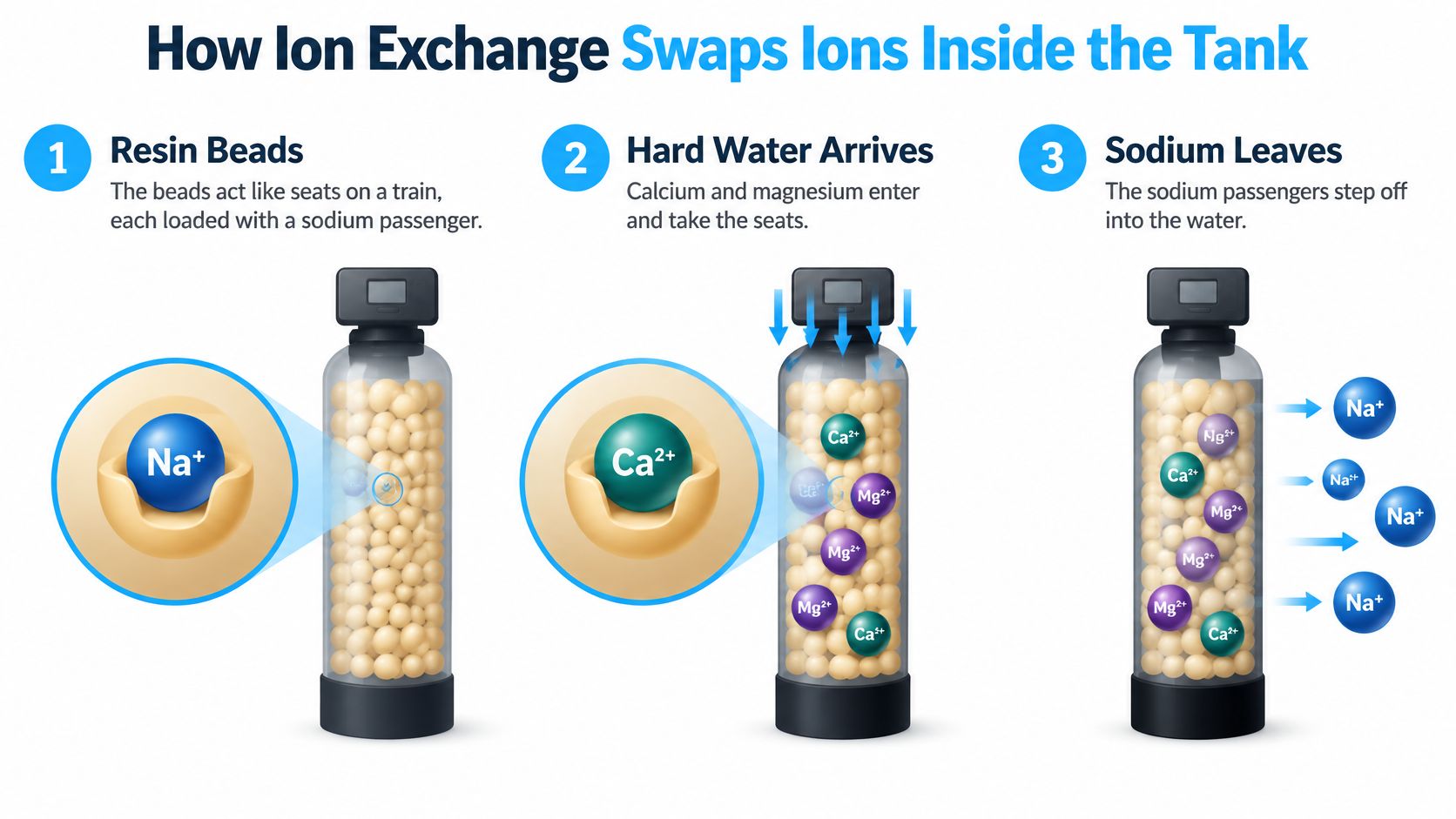
A residential cation-exchange softener uses negatively charged resin beads loaded with sodium or potassium ions, and as hard water passes through the mineral tank the calcium and magnesium attach and push sodium or potassium into the water, according to the EPA WaterSense at Work purification section. The unit removes the ions that cause hardness. It does not physically strain them out. When the exchange sites are used up, regeneration has to restore softening capacity.
The service cycle, seat by seat
- Hard water enters the mineral tank and calcium and magnesium take the seats.
- Treated water leaves with sodium, or potassium, where the hardness used to be.
- The beads fill up, and hardness in the outlet water starts to climb.
- A brine rinse floods the bed with salt and reloads the seats with sodium.
- A backwash lifts loosened debris off the bed.
- A final rinse clears leftover brine so the next gallons do not taste like the salt tank.
- The unit returns to service and the train fills again.
The water you shower in has less hardness and more sodium. That trade is why salt choice and daily flow both matter when you size the unit and when you think about drinking water. People who limit sodium often leave the kitchen cold tap on bypass, or they regenerate with potassium chloride instead.
The cycle repeats every time operating capacity runs out. A timer guesses that moment. A meter measures it. Either way, an empty train cannot soften another gallon until the brine step reloads the seats.
Test Your Water Before Sizing
Do not price a tank until you have numbers. A home kit is a screen. The lab report is what an installer uses to size resin and to see competing ions.
- Order a lab analysis for hardness, iron, manganese, sulfate, nitrate, and pH. A home kit for hardness and iron is a fair first screen, and we link readers to water test kits for that check. Our guide to reading water test results walks through the columns so the units do not blur together.
- Record hardness in grains per gallon. If the report lists mg/L as CaCO3, divide by 17.1.
- Match each result to the problem list so you know which pretreatment stages belong in the quote.
- Measure peak flow in gallons per minute with a shower and a laundry load running together, and read daily gallons off the water meter.
| Test | Unit | Decision it drives |
|---|---|---|
| Hardness | grains per gallon (gpg) or mg/L as CaCO3 | Daily grain load and how often the bed must regenerate |
| Iron | mg/L | Whether an iron pretreatment stage is needed |
| Manganese | mg/L | Whether oxidizing or greensand pretreatment is needed |
| Sulfate | mg/L | Competing ions that shorten capacity |
| Nitrate | mg/L | Whether an anion-exchange unit is needed |
| Peak flow | gallons per minute | Unit flow rating |
Our Choosing a Water Filter guide covers how to pick a system once those numbers are in hand, and our review pages include the Fleck 5600SXT water softener alongside pitchers and a reverse osmosis system. Occupancy guesses are a weak substitute for this sheet.
Order the lab test before you read a capacity chart. Keep the PDF with every quote.
Iron, Manganese and Sediment Need Pretreatment
Ion exchange is a targeted process for charged, dissolved contaminants. It is not a catch-all whole-house filter. The EPA ion exchange materials describe it as effective for charged contaminants, while uncharged compounds such as chlorine, many volatile organic compounds, and sediment need different media or pretreatment.
Dissolved iron and manganese can exchange at low levels. When they oxidize in the tank or in the pipes, they become particles. Those particles coat the beads the way rust stains a white towel. Capacity falls, and the bed stops softening long before the nameplate says it should. Higher iron calls for an oxidizing iron filter ahead of the resin. Manganese calls for greensand or other oxidizing media. Our notes on iron and manganese filters cover when that stage belongs on a well.
A sediment prefilter, often a few microns, sits in front of everything. It keeps grit out of the resin and out of the control valve.
Put the stages in this order, and do not shuffle them:
- Sediment prefilter.
- Iron or manganese treatment.
- The softener.
- A carbon polish last, if chlorine taste is the leftover complaint.
What strong ion exchange can do, and where it fails early
The same EPA materials report that ion-exchange units can remove more than 90% of several ionic contaminants, including nitrate, arsenic(V), chromium(VI), barium, cadmium, and selenium, under suitable operating conditions. Performance is site-specific. Competing ions can push the target contaminant through before nominal capacity is reached. A standard softener is still the wrong tool for nitrate or arsenic. Those jobs need anion-exchange media and their own regenerant plan.
Regeneration of a softener uses a concentrated sodium chloride or potassium chloride solution, then a backwash and rinse, which produces a brine wastewater stream. Sodium chloride is common because it is inexpensive. Sodium in the treated water can rise, so potassium chloride is the alternative when that matters.
Every pretreatment unit sits upstream of the softener, never after it. The lab sheet decides which of those stages you buy. Regeneration settings should follow the feedwater you measured, not a default sticker on the valve.
Fixed Timer or Demand-Initiated Regeneration
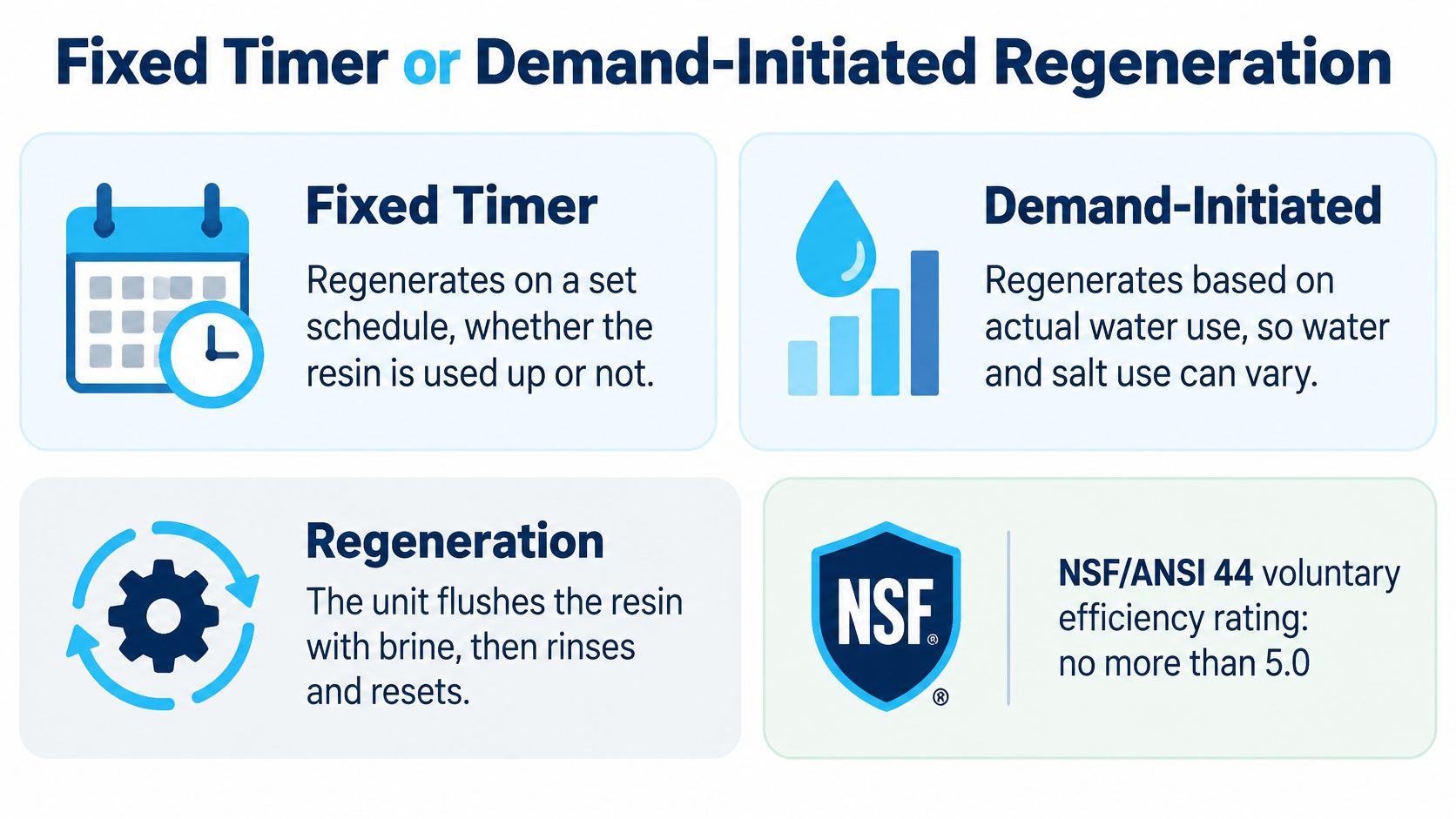
Regeneration is the reset. Brine flushes the resin, a rinse clears the salt, and the bed goes back into service. Water use and salt use change with hardness, household demand, system capacity, and the control method. EPA WaterSense materials report that the voluntary NSF/ANSI 44 efficiency rating requires a residential softener to use no more than 5.0 gallons of water per 1,000 grains of hardness removed. Salt efficiency is grains of hardness removed per pound of salt. EPA identifies demand-initiated regeneration as more efficient than a fixed schedule because it cleans from actual water use, not an arbitrary timetable.
| Control type | What triggers regeneration | Water and salt use | Best fit |
|---|---|---|---|
| Fixed timer | Set number of days, regardless of use | Often regenerates when little water was used | Steady, predictable household use |
| Demand-initiated (metered) | Measured water volume since last cycle | Regenerates only when capacity is used | Variable use, vacation homes, lower waste goals |
One week away tells you which control you bought
Say the house is empty for a week. A timer unit still regenerates on Tuesday night. Salt dissolves, rinse water runs to the drain, and nobody used a shower. A metered unit waits until the set volume has passed through. The resin is still loaded when you get home, so the next showers stay soft without a wasted cycle.
That gap adds up. EPA WaterSense guidance on cation-exchange softeners reports that regeneration can consume 25 gallons of water or more per day, amounting to as much as 10,000 gallons per year. A softener can cut scale and help soap work while raising household water use if it regenerates when it does not need to, or if it is sized poorly. The 5.0-gallon benchmark is a useful comparison even where local plumbing rules, wastewater limits, and certification programs differ.
Check the controller type before you buy. Demand-initiated settings only stay efficient if the hardness value programmed into the valve matches the lab report. A wrong grains-per-gallon entry makes a smart meter act like a sloppy timer.
How to Size a Unit From Your Water Test
Size from operating capacity, not the resin's advertised total and not from how many people live in the house. The EPA overview of drinking water treatment technologies puts it that way because usable capacity changes with influent concentration, service flow rate, regeneration strength, bed design, and competing ions. High hardness, sulfate, nitrate, and other dissolved minerals use up exchange sites and can cut removal of a target contaminant, which shortens the time between regenerations. For cation exchange, calcium and magnesium trade for sodium or potassium. For anion exchange, nitrate, arsenic, chromium-6, perchlorate, sulfate, and uranium can trade for chloride or another regenerant ion. You need a laboratory analysis, peak flow, and a treated-water limit.
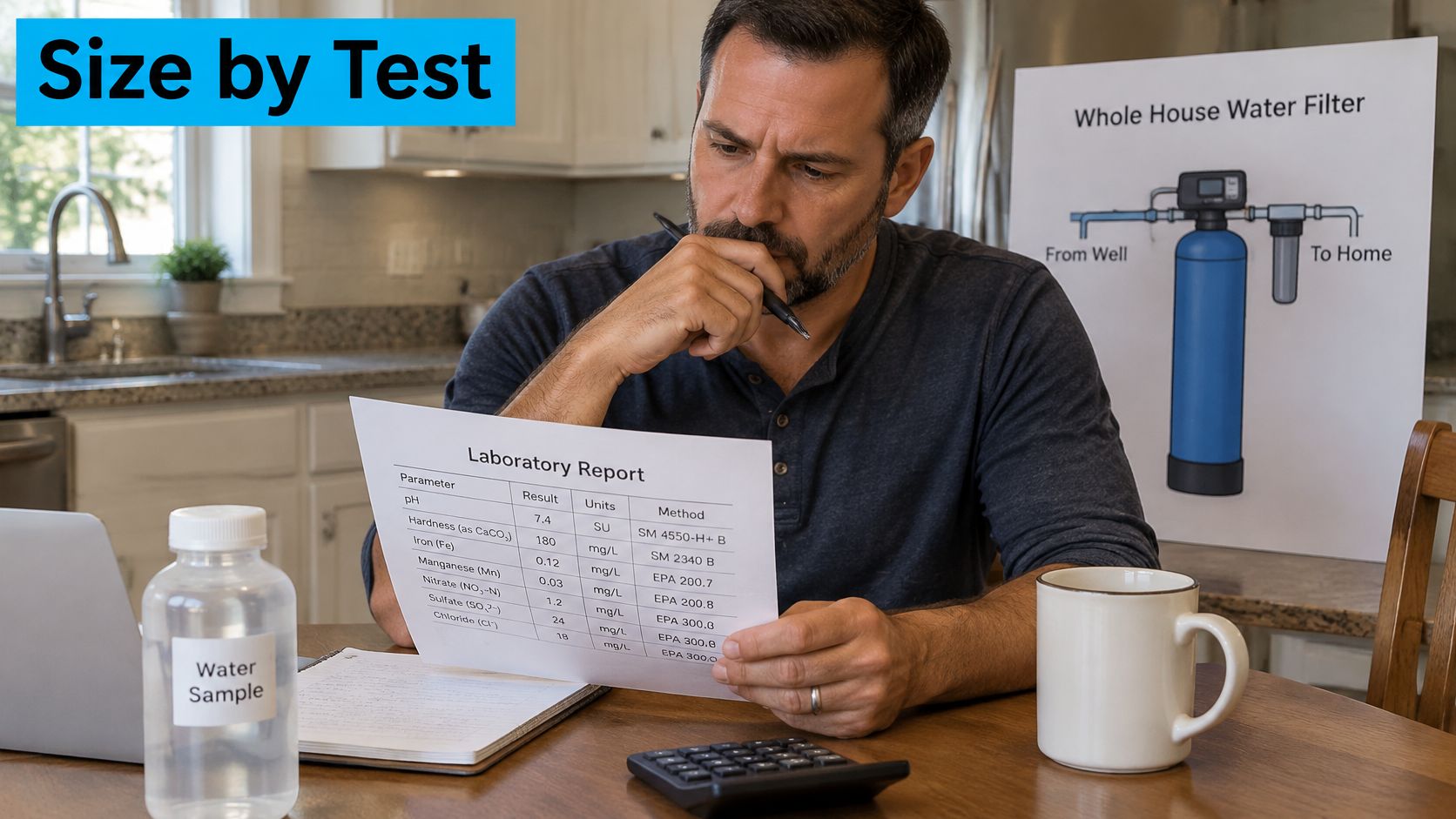
Use the lab sheet you already ordered. Convert hardness from mg/L as CaCO3 to grains per gallon by dividing by 17.1 before you multiply.
- Pull hardness in grains per gallon, plus iron, sulfate, and nitrate, from that report.
- Measure peak flow in gallons per minute with a shower and laundry running at once, and match the valve's service flow to that peak.
- Estimate daily gallons from the meter, not from a generic per-person chart.
- Multiply daily gallons by hardness. That product is grains removed per day.
- Multiply by the days you want between regenerations. Seven days is a common planning interval.
- Add margin for competing ions, then pick a unit whose operating capacity covers that load.
- Confirm a demand-initiated controller and name the treated-water hardness you want leaving the tank.
A week of grains, on paper
Say a house uses 300 gallons a day at 12 grains per gallon. That is 3,600 grains a day. Over seven days the load is about 25,200 grains. A unit with operating capacity near 30,000 grains leaves margin for sulfate and iron that the nameplate does not feel. If the quote only lists a cubic-foot resin total, ask for the operating figure at the salt dose the installer plans to use. A stronger brine dose raises capacity and raises salt use. A weak dose does the opposite.
A demand-initiated controller is the better default because it regenerates from measured demand or hardness instead of a calendar, which cuts unnecessary salt and rinse water. Keep the lab report clipped to the quote so the installer can check the multiplication before the tank is on the floor.
Salt, Water Use and Yearly Costs
A typical U.S. dual-tank ion-exchange water-softener installation cost an average of $2,500 in 2025, including parts and labor, according to Fixr. That figure is the starting check, not the yearly bill. Single-tank installs and well add-ons move the number. Pretreatment, drain routing, and electrical work are the usual extras.
Recurring costs show up in the order you will meet them:
- Prefilter cartridges: Swap them on the interval printed on the housing, sooner if pressure drops. A clogged cartridge is cheaper than a fouled resin bed.
- Salt bags: Use tracks hardness and how often the valve calls for brine. A metered valve on variable use buys fewer bags than a timer that fires on empty weeks.
- Regeneration water: Price those gallons on your local meter. A unit that resets too often turns a softening benefit into a quiet water bill.
- Resin replacement: Beads wear out, and iron fouling can force an earlier changeout than a clean city supply.
- One lab test a year: It tells you whether hardness, iron, or competing ions have shifted enough to redo the grain math.
Salt and rinse water follow the grains you actually remove. A harder well and a busier laundry week cost more to run than a soft city supply with the same tank on the floor.
Sodium added during softening matters for anyone on a low-sodium diet. Many households leave drinking and cooking water untreated at a kitchen tap and soften the rest of the house. That split keeps scale off the heater without putting every glass through the resin.
A workable yearly budget is the install cost spread over the years you expect to keep the unit, plus salt, plus regeneration water, plus prefilter swaps, plus that one test. Ask the installer to write expected yearly salt pounds on the quote so the bag cost is not a surprise in month four.
Common Problems and How to Fix Them
The complaint that brings most calls is hard water returning, spots on glasses, and soap that stops working. The bed is exhausted, or a regeneration was skipped, or brine never reached the resin. Check the salt level and the valve schedule, then run a manual regeneration before you assume the resin is dead. A same-day fix is common when the timer was set incorrectly.
| Symptom | Likely cause | Fix |
|---|---|---|
| Hard water returns, spots on dishes | Exhausted resin or missed regeneration | Check regeneration settings and salt level, run a manual regeneration |
| Salty taste at the tap | Sodium in softened water | Switch to potassium chloride or bypass the kitchen tap |
| Rust-colored staining | Iron fouling the resin | Add an iron prefilter and clean the resin |
| Low water pressure | Clogged prefilter or resin bed | Replace the prefilter and run a backwash |
| Brine tank not drawing salt | Salt bridge in the brine tank | Break the crust and keep salt above the water line |
| Capacity used up too fast | High iron, sulfate or competing ions | Retest the water and check sizing |
| Frequent regeneration | Timer set too short or demand settings too sensitive | Review controller settings against the water test |
What you can do today, and what needs a truck
A salt bridge is a hard crust over a hollow in the brine tank. The valve thinks salt is there. Break the crust with a broom handle, not a hammer on the tank wall, and keep the salt level above the water line so a new crust is less likely. Replacing a clogged prefilter and starting a backwash are homeowner jobs on most valves. Cleaning iron-fouled resin, resizing a bed that exhausts in two days, and repairing a valve that will not draw brine are service visits.
Log the symptom, the date, and what you already tried. A technician who sees "spots since March, salt full, manual regen did nothing" diagnoses faster than a note that only says the water feels wrong. If capacity collapses right after a new well pump or a change in city supply, retest before you buy a larger tank. Competing ions, not a broken valve, are often the reason the bed gives up early.
Buying Checklist Before You Sign
The lab report and the grain math should already be done. Use them as the filter for every quote.
- Confirm the softening claim is backed by NSF/ANSI 44. NSF's technical requirements note that the standard was first designated as an American National Standard on June 15, 2004, covering materials, construction, performance, and owner information for residential cation-exchange softeners, including manual, automatic, and demand-initiated regeneration. Certification does not mean the unit removes lead, chlorine, nitrate, or microorganisms. Those claims need their own testing.
- Confirm the controller is demand-initiated, and ask how the hardness value from your report gets programmed.
- Check operating capacity and regeneration water use against the grains-per-day math on your sheet.
- Confirm the quote includes the sediment prefilter and any iron or manganese stage your results require.
- Ask each installer for a written quote that lists the prefilter, the controller, the sizing basis, and expected yearly salt use.
Red flags are easy to spot once you have numbers. A quote that cites only tank diameter or how many bedrooms you have is guessing. A unit with no regeneration settings cannot be tuned to your water. A seller who will not show the grain multiplication is asking you to trust a sticker.
Bring the lab report to every quote. The installer who will mark it up with you is the one who can stand behind the tank after the first month of showers.
Water Filter Advisor has helped households sort softeners, pretreatment, and test kits since 2007, with plain guidance on what an ion exchange whole house filter will and will not do. If you want help matching a lab report to a softener, a prefilter, or a point-of-use drinking filter, start at Water Filter Advisor. Bring your test results and we will help you read them before you sign a quote.
- November 9, 2026
- Uncategorized
