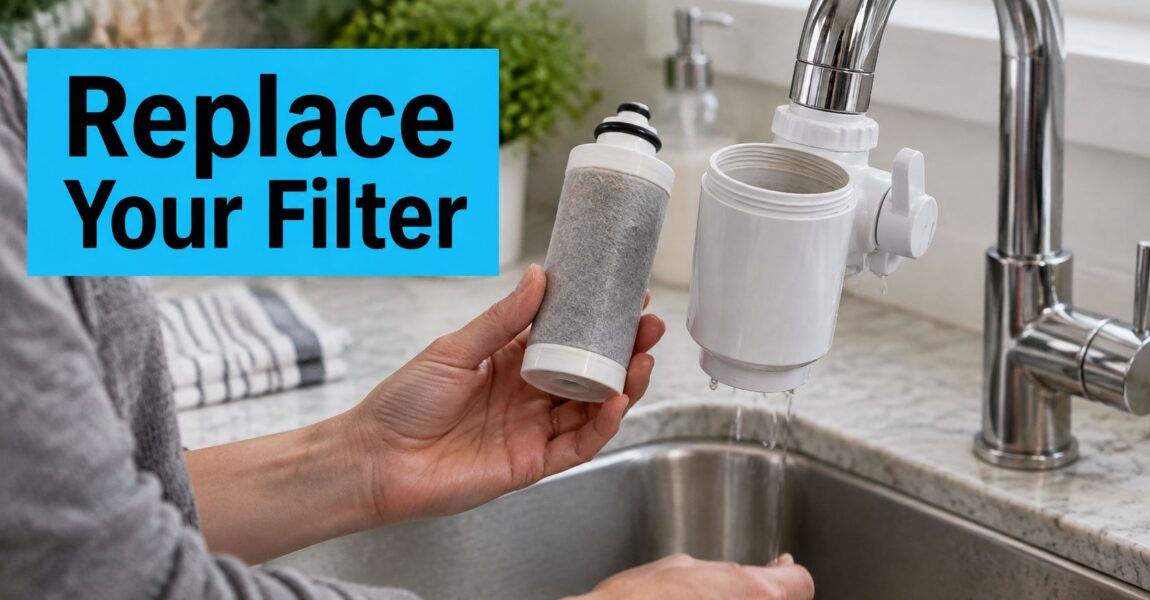
You're filling the kettle when you notice the filter light is red. Or the stream has slowed to a trickle, and you can't remember whether you changed the cartridge before the holidays or after them. The plastic attachment still looks fine. That doesn't tell you much about what's happening inside it.
Faucet water filter replacement starts with the cartridge rating, not a taste test. Track how much filtered water your household uses, respect the maximum service interval, and check the seals when you swap cartridges. Those habits make the difference between a filter that's merely attached and one you're maintaining properly.
Replacement Intervals for Common Faucet Filters
For a usable starting point, Brita's faucet-system guidance specifies 100 gallons, or about four months, for SAFF-100 and FF-100 systems, based on an average household drinking 11 glasses daily. PUR's filter guidance specifies 100 gallons or three months.
The EPA's maintenance guide gives a general faucet-cartridge lifespan of two to six months, with actual life affected by model, consumption, and water quality. A 2026 market analysis from Marketintelo estimates typical faucet-mount ratings of 100 to 200 gallons, with approximately four to six replacement purchases per household annually.
Replacement limits for common faucet filter sources
| Source | Rated life | Time limit | Notes |
|---|---|---|---|
| Brita SAFF-100 and FF-100 faucet systems | 100 gallons | About 4 months | Based on 11 glasses per day for an average household |
| PUR faucet filters | 100 gallons | 3 months | Replace at whichever limit comes first |
| EPA general range for faucet cartridges | Use the model's labeled gallon capacity | 2 to 6 months | Model, consumption, and water quality affect life |
| 2026 market analysis of faucet-mount cartridges | 100 to 200 gallons | Use the manufacturer's calendar limit | About 4 to 6 replacement purchases per household annually |
Make gallons your working clock
Use this calculation:
Rated gallons ÷ average daily filtered gallons = estimated days to capacity.
Count drinking water, kettle refills, cooking water, and anything else passing through the cartridge. Don't include water that bypasses it.
A busy family can exhaust the gallon allowance before the calendar reminder arrives. A light user may reach the maximum time interval with capacity remaining. For broader household planning, use our water filter replacement schedule.
Practical rule: Replace at the earliest applicable gallon limit, calendar limit, or replacement indication. Low usage isn't permission to extend the manufacturer's maximum interval.
The box or manual for your exact cartridge overrides every general estimate in the table.
Tools and Step-by-Step Faucet Filter Replacement
A cartridge can look compatible and still leak if it does not match the housing. Check the model number on the old cartridge against the replacement packaging before opening the filter.
Gather a towel and shallow tray for residual water, a clean soft cloth, and the specified replacement cartridge with its protective packaging intact. Use the supplied wrench only if the instructions call for it. Many twist-lock and push-fit cartridges need no tools.
If lead reduction matters, check the exact cartridge and system combination in NSF's certified lead-reduction listings for an NSF/ANSI Standard 53 lead-reduction claim. A general certification logo does not establish every contaminant claim.
Water Filter Advisor's Choosing a Water Filter guide answers how to pick a system if the existing unit does not meet your needs. If replacing the faucet itself is also on the agenda, you can explore bathroom tapware options from SanCub. Check filter-adapter compatibility separately. Appearance does not establish thread fit.
Remove the cartridge without damaging the seal
Stop water entering the filter and relieve pressure. Turn off the faucet. Use the diverter or cold-water isolation valve as the model directs, then briefly open the appropriate outlet to release trapped pressure. A diverter does not isolate every design.
Release the old cartridge. Place the towel underneath, then twist the cartridge toward its release mark or press its release button. Hold the filter body so you do not twist the entire attachment against the faucet.
Remove, inspect, and wipe. Lift out the cartridge. Record its removal date and, if known, its installation date. Wipe accessible grit from the housing and O-ring groove without opening sealed components. Check the O-ring for cuts, flattening, or displacement. Debris on a sealing surface can cause a leak even with the correct cartridge.
Align and seat the replacement. Remove shipping caps, match the arrows or tabs, and push or twist the cartridge into its specified locked position. For threaded designs, start the threads squarely by hand. If resistance comes before the parts align, back off and restart instead of forcing them.
Flush, reset, and check the connection
Use lubricant only when specified. Follow the manual's seal-care instructions and use its named lubricant if required. Do not use cooking oil, petroleum jelly, or general-purpose spray. Some cartridge seals need no added lubricant.
Restore water gradually and flush with cold water. Follow the prescribed flushing sequence, which may take several minutes. The EPA's installation guidance notes that cartridges may require priming or flushing before use. Discard the flush water to clear trapped air and loose carbon fines.
Reset the indicator and start the log. Follow the model's reset sequence, which may involve holding a button. Record the installation date, reset date, and starting gallon count. Installing a cartridge does not necessarily reset the electronics.
Dry the joints and inspect for drips. Wipe the connection completely dry so new moisture is easy to spot. Check it during operation, then again after about fifteen minutes. Correct seating comes before tightening. Tool-free connections usually need only hand pressure.
A successful replacement has steady flow, dry connections, and the expected new-cartridge indication. These checks confirm installation behavior, not contaminant removal. Keep a sealed spare if compatible replacements are difficult to obtain locally.
Signs a Cartridge Is Spent and How to Track It
Pleasant-tasting water isn't proof that a cartridge still reduces the contaminant you bought it for. The EPA's guidance on filters certified to reduce PFAS explains that activated carbon has limited treatment capacity and warns that delayed replacement can undermine contaminant reduction.
Capacity, not appearance, determines whether the media has useful treatment life remaining. You can't inspect that reliably through the plastic shell.
Read the replacement signals correctly
Use these checks in a consistent order, without allowing one to cancel another:
- Calendar limit: Read the maximum service interval printed on the packaging or manual.
- Gallon limit: Compare the rated capacity with your running usage estimate.
- Indicator: Respond to the model's replacement signal, while remembering that some indicators track time rather than actual contaminant loading.
For a hypothetical two-person home using half a gallon daily through a 100-gallon cartridge, the capacity calculation is 100 ÷ 0.5 = 200 days. If that cartridge also has a three-month or four-month maximum interval, the calendar limit arrives first. The arithmetic estimates consumption; it doesn't extend approved service life.
Count full pitchers, measured bottle refills, and cooking water in a phone note. Use the container's marked volume rather than guessing from the size of a glass.
Normal flow proves that water can pass through. It doesn't prove that the cartridge still reduces lead, PFAS, or another target contaminant.
A sharp flow decline is a secondary warning. Sediment can clog the cartridge early, making replacement necessary before its scheduled date, but an unrestricted stream doesn't clear an overdue cartridge for continued use.
Finish your tracking setup with a short checklist:
- Date marked: Installation date on the cartridge or housing where it remains readable.
- Usage recorded: A running filtered-gallon estimate in your log.
- Reminder set: The earlier expected deadline, adjusted when household use changes.
Fixing Leaks, Slow Flow and Air in the Line
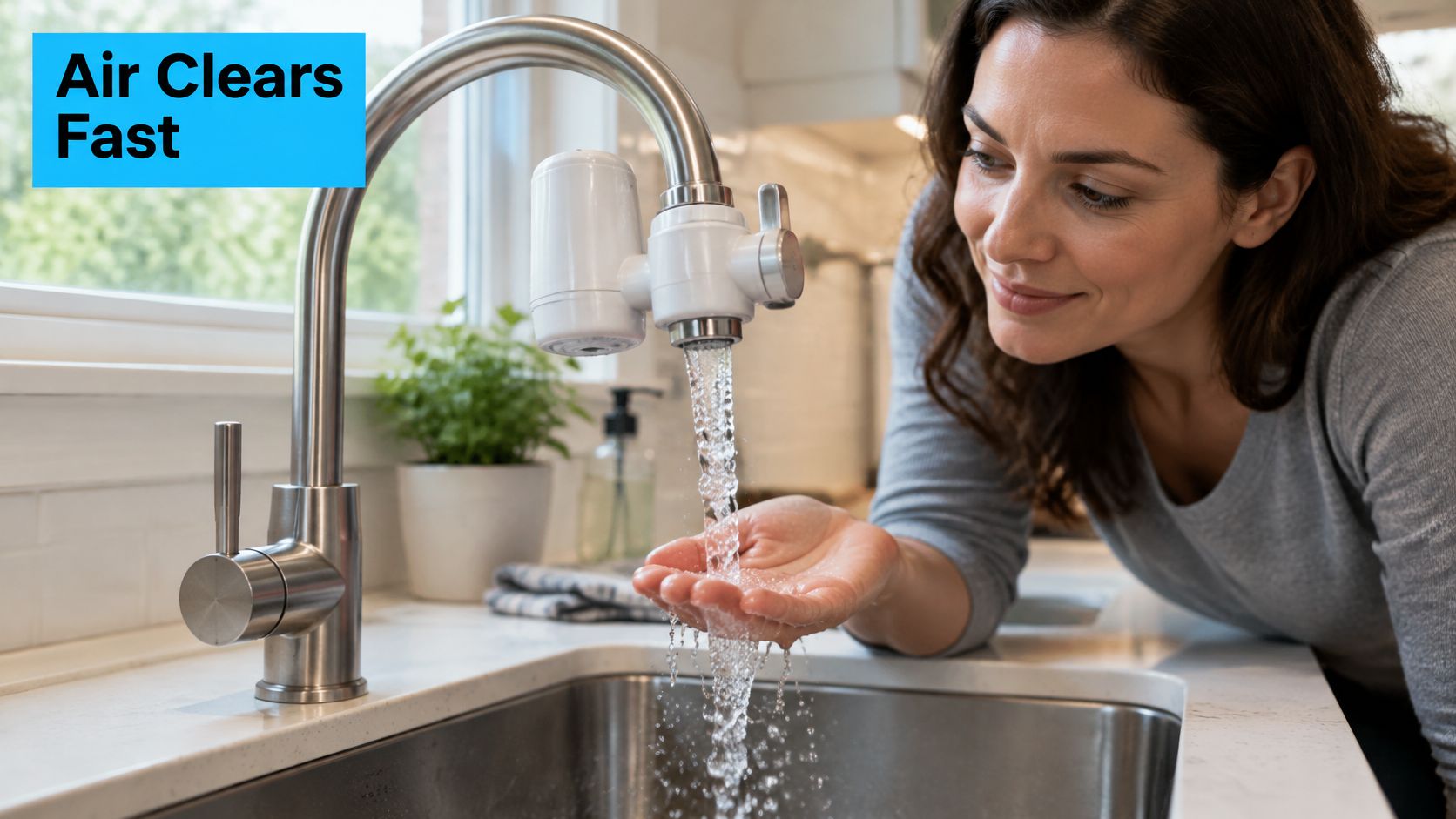
A filter that sputters right after installation usually has air in the line. Flush it with cold water for the time specified in the manual, until the stream runs steadily. If flow drops later, check the cartridge's fit and condition, then compare filtered and bypass flow if your model allows it.
Check the filter attachment and outlet while water is running.
Match the symptom before buying parts
If filtered and bypass flow are both weak, check the faucet, aerator, or water supply before blaming the cartridge. If only filtered flow has slowed, confirm the cartridge is fully locked in place.
Faucet filter symptoms, likely causes and fixes
| Symptom | Likely cause | Fix |
|---|---|---|
| Air spits from the tap after installation | Air trapped in the line | Run cold water as the manual directs until flow is steady |
| Flow slows after use | Sediment clogging the cartridge | Check the cartridge's rated limit and replace it if needed |
| Drip at the filter connection | Unseated fitting or worn O-ring | Shut off the supply, reseat the cartridge, and tighten by hand |
| Water tastes or smells off | Exhausted carbon or skipped flushing | Confirm the model, flush a new cartridge, and replace a spent one |
| Indicator stays on after a swap | Reset not performed | Reset it as the manual describes |
| Leak continues after reseating | Cracked housing or cross-threaded fitting | Shut off the water and replace the damaged housing or fitting |
Use the demonstration below to identify components, but follow your own model's manual for the correct procedure.
Know when to stop tightening
A loose fitting may need careful reseating. A cracked housing or damaged thread will not seal with more force. Stop, isolate the water, and replace the faulty component.
If moisture comes from the faucet body or supply connection rather than the filter attachment, a plumber may need to trace the leak. For that separate problem, water leak detection and repair addresses leaks beyond the filter itself.
Recycling and Disposing of Spent Cartridges
Hold the removed cartridge over a bucket or the sink and let residual water drain. Keep it away from clean replacement parts and food-preparation surfaces. Don't cut open a sealed cartridge just to separate the materials.
Follow the disposal route in order
- Manufacturer collection: Check the brand's current packaging or website for a take-back or mail-back option. Confirm that your cartridge is accepted and follow its drying and packing requirements.
- Local recycling guidance: Ask whether the complete cartridge is accepted. A plastic recycling mark alone doesn't establish that a mixed-material filter belongs in curbside collection.
- Household waste: If neither collection route accepts it, follow local disposal rules for the intact cartridge and spent media.
Plastic housings and carbon media may require different handling. Don't put loose carbon into a recycling bin, pour it down a drain, or flush any filter components down a toilet.
Keep the reusable housing when the system is designed for cartridge-only replacement. Replace the treatment insert, not every sound component around it.
Before keeping a housing, inspect the threads, latch, and sealing surfaces. Reuse makes sense only when the part remains undamaged and accepts the specified replacement.
Bag the drained cartridge during the swap, then move it to its approved disposal or return location. That's better than leaving an unidentified, dripping filter under the sink until the next replacement.
Yearly Cartridge Count and Cost Estimates
Budget for cartridges consumed, not just replacement shopping trips. Multipacks change how often you buy, but they don't change the filter's service limits.
Convert the interval into an annual allowance
The table uses straightforward calendar arithmetic, twelve months divided by the replacement interval. These are planning calculations, not promises of actual cartridge life.
| Hypothetical calendar limit | Cartridges per year | Annual cost using your local unit price |
|---|---|---|
| 2 months | About 6 | 6 × your cartridge price |
| 3 months | About 4 | 4 × your cartridge price |
| 4 months | About 3 | 3 × your cartridge price |
| 6 months | About 2 | 2 × your cartridge price |
Consider a hypothetical household filtering 0.5 gallons daily through a 100-gallon cartridge. That gives 200 days per cartridge, or roughly two cartridges annually on volume alone. A shorter manufacturer calendar limit increases the purchasing allowance.
For a busy household, budget toward the heavier-use benchmark rather than assuming the calendar-only count will be enough. Seasonal guests and more cooking at home can change consumption.
Compare equivalent replacements
Annual cartridge cost = expected cartridges per year × current local price per cartridge. Use the price of the exact compatible model, including delivery where relevant, rather than a generic faucet-filter price.
Our water filter replacement cost guide can help organize the broader comparison. For property managers comparing supply categories, Yasu Trading Co. LLC's filtration cartridges for building maintenance provides another purchasing reference, but each installed system still needs a compatibility check.
Compare the certified contaminant claim alongside price. A cheaper look-alike isn't an equivalent purchase merely because it fits inside the housing.
Set Your Replacement Reminder Before the Next Refill
Make the maintenance decision while the model number and packaging are in front of you. A reminder based on the actual cartridge is more useful than a vague intention to change it when the water seems different.
Put the next swap on record
Write down the installation date. Mark the cartridge or housing and add the same date to a phone note. Include the replacement model so ordering doesn't become another search.
Set the calendar deadline. Use the manufacturer's maximum interval. For a model specifying three months, set that deadline now; for a different model, follow its own limit rather than imposing an arbitrary schedule.
Start the gallon log. Count measured pitcher fills, drinking bottles, kettle refills, and cooking water. Estimate when your cartridge's labeled capacity will be reached and bring the reminder forward if necessary.
Keep a sealed spare when access is difficult. Check availability before the installed cartridge expires. Research on household-filter use in PLOS Water identifies spare-part availability and ease of assembly as factors associated with consistent use. An improvised replacement isn't a sound substitute.
Test for the concern you have. If you're unsure about treatment performance, choose testing that measures the target contaminant in treated water. We link readers to water test kits for checking their home supply, and our Simple Water Test Kits section lists the available options. A general-purpose test doesn't necessarily assess every contaminant.
Don't use a reassuring taste or a green light to overrule an expired cartridge. Set the reminder before you leave this page.
Visit Water Filter Advisor for guidance on choosing compatible filters, understanding contaminant-reduction claims, and maintaining household filtration. Use our replacement guidance and water-testing resources to build a schedule around your cartridge, your water use, and the contaminants you need to address.
- November 8, 2026
- Uncategorized
