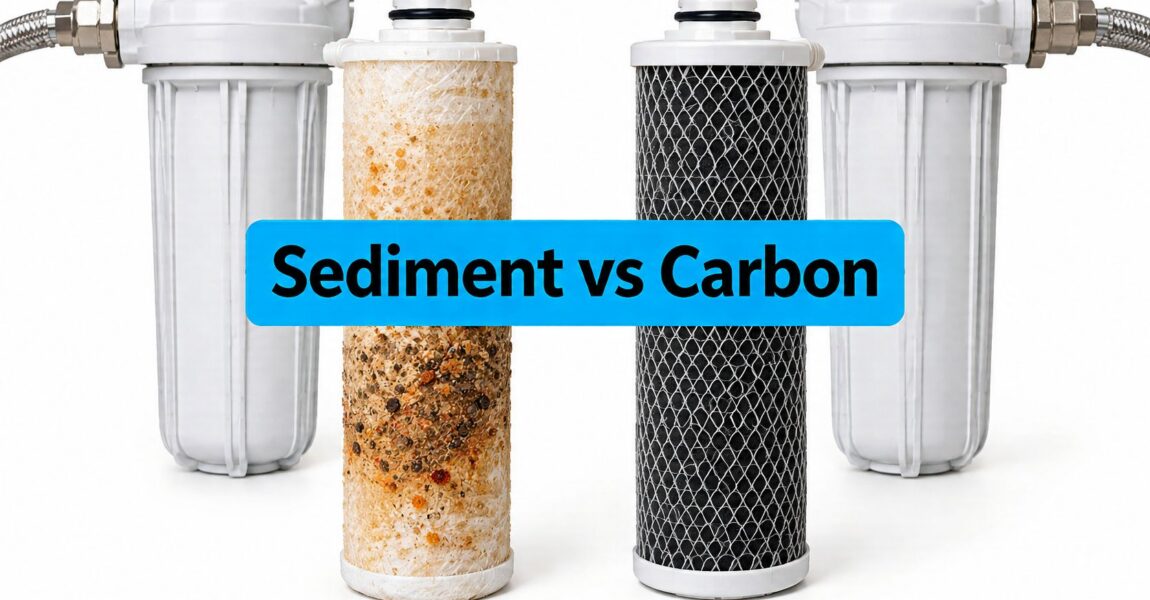
“Just buy a carbon filter” is poor advice when your water carries sand, silt, or rust. So is buying a finer sediment cartridge to fix chlorine taste. In the sediment filter vs carbon filter comparison, the useful question isn't which filter is better. It's which job your water needs done, and whether the complete system can keep doing it at your household's flow rate.
A good setup must do more than make the first glass taste better. It must control particles, meet its specific contaminant claims, and remain hygienic after weeks of use or a vacation shutdown.
Sediment vs Carbon Filter at a Glance
Sediment filters catch suspended particles; carbon filters treat selected dissolved chemicals. A home with visible grit and chlorine taste usually needs both, with sediment first and carbon after it.
| Criterion | Sediment filter | Carbon filter |
|---|---|---|
| Primary job | Stops suspended particles such as sand, silt, and rust | Reduces chlorine, taste, odor, and selected organic chemicals |
| Removal mechanism | Physical straining of particles | Adsorption of dissolved compounds onto porous carbon, plus chemical reactions for disinfectants |
| Typical position | First stage, before carbon | Second stage, after sediment |
| Typical lifespan | Follow the cartridge's service interval; particle loading can require earlier replacement | Follow the service interval and contaminant-specific rated capacity, whichever comes first |
| Flow-rate sensitivity | Flow slows as particles build up | Removal can fall when water moves too fast through the bed |
| Replacement signal | Reduced pressure and visible dirt | Rated capacity or service interval reached; returning chlorine taste or odor is a warning |
| Cost per cartridge | Use the price for the exact cartridge size and particle rating | Use the price for the exact cartridge and certified reduction claim |
These are residential cartridge selection rules, not universal product specifications. The label, performance sheet, and certificate for the actual product override generic comparisons, including advertised replacement schedules.
Start with the job, not the cartridge shape
Sediment filtration works like a selective screen. Water passes through the medium while particles large enough to be retained remain behind. Sand, silt, rust flakes, and floc belong in this category. Dissolved chemicals generally do not.
Activated carbon has a different working surface. In adsorption, substances attach to the carbon's surfaces and pores rather than being stopped because they are too large to pass through. The NSF explanation of water-treatment standards distinguishes adsorption from mechanical filtration and explains why treatment claims must be matched to the particular system.
That difference explains the normal installation order. A carbon cartridge that spends its useful hydraulic capacity holding dirt has less left for the chemical treatment it was installed to perform. A separate sediment stage intercepts the particulate load first.
Buying rule: Choose a sediment cartridge by the particles it must retain. Choose a carbon cartridge by the contaminants it's certified to reduce.
Read the flow and replacement rows together
A dirty sediment cartridge usually gives a hydraulic warning: water has more difficulty moving through it. Carbon exhaustion can be less obvious. A cartridge may still deliver a comfortable stream after its capacity for a particular dissolved contaminant has been used.
That makes “the water still runs fine” a weak maintenance test for carbon. Taste can provide a warning when chlorine returns, but it cannot verify reduction of contaminants you cannot reliably taste or smell. A dated service record is more useful than a quick sip.
A smaller particle rating also does not make every filter better. Particle capture and chemical adsorption are different performance questions. For a carbon product, the claim, operating flow, media configuration, and capacity matter alongside any particle rating printed on the package. A carbon block rated at a low flow rate will not necessarily hold its rated reduction when the household pushes more water through it than the test assumed.
Clearer water and better chemical removal aren't the same result
Turbidity and dissolved-organic removal are separate treatment outcomes, and a filter can perform well on one while performing less well on the other. Sediment media target the first; carbon targets the second. Judging either by the wrong measurement produces a misleading comparison.
For a homeowner, the practical consequence is straightforward: don't accept a single sweeping purification percentage. Ask what was measured. A particulate claim does not establish chlorine reduction, and chlorine reduction does not establish removal of every organic chemical.
Carbon has one further wrinkle that sediment media does not. Trapped particles and adsorbed organics can give the cartridge's surface material for microorganisms to work on when the system sits idle, and fine carbon particles can carry through into the treated water, which is one reason cartridges are flushed on installation and after long shutdowns.
Compare cost by completed treatment
The lowest shelf price is not necessarily the lowest running cost. A cartridge that clogs early, needs an unusual replacement format, or lacks the required contaminant claim may be the wrong purchase even if it fits the housing.
Compare replacement availability, usable capacity, maintenance requirements, and the household demand the product can serve. An inexpensive sediment cartridge and a certified carbon cartridge are not competing purchases when the water needs both jobs performed.
Use appearance as an initial clue, not a final diagnosis. Grit or cloudiness points toward investigating sediment treatment; chlorine taste or odor points toward a suitable carbon stage. Neither observation tells you whether the water also contains an invisible health-related contaminant.
Which Contaminants Each Filter Actually Reduces
| Contaminant | Sediment filter | Carbon filter |
|---|---|---|
| Sand, silt, and rust particles | Yes, primary target | Limited; particles can clog the carbon |
| Chlorine | No | Yes, through chemical reduction |
| Chloramines | No | Suitable carbon products, through catalytic reduction |
| Taste and odor compounds | Not dissolved compounds | Yes, selected compounds through adsorption |
| Color | Limited to particle-associated color | Can reduce selected color-causing compounds |
| Volatile organic compounds, pesticides, solvents | No | Some products; verify the specific claim |
| Trihalomethanes | No | Partial reduction with suitable products |
| Radon | No | Partial reduction with suitable products |
| Lead, dissolved | No | Only with a relevant certified lead-reduction claim |
| Hardness minerals, including calcium and magnesium | No | No |
| Fluoride and nitrate | No | No reliable reduction by ordinary carbon |
| Bacteria and microorganisms | Not a dependable disinfection treatment | Not a dependable disinfection treatment |
The University of Georgia guide to activated-carbon devices explains the distinction between adsorption of organic compounds and chemical reduction of disinfectants. It also identifies potential carbon applications involving pesticides, industrial solvents, PCBs, PAHs, trihalomethanes, and radon, without treating every carbon product as equally capable.
Read the conditional entries carefully. “Carbon can reduce pesticides” doesn't mean a cartridge certified only for chlorine taste has demonstrated pesticide reduction. Chloramine treatment also needs a product selected for that purpose, not a purchase based solely on the word carbon.
Why hardness surprises buyers
Hardness minerals are dissolved in the water. They aren't grit waiting for a sediment cartridge to catch them, and ordinary carbon doesn't reliably remove them.
The EPA home-water-treatment guide specifically identifies hardness minerals, fluoride, nitrate, and chloride among substances ordinary household carbon filters don't effectively address. A better-tasting glass therefore doesn't establish that the water has been softened or that these dissolved substances have been reduced.
Example, scale on fixtures: If your main complaint is mineral buildup, a sediment-and-carbon package can leave the underlying problem unchanged. Select treatment for the measured hardness rather than adding more cartridges that perform unrelated jobs.
Why clear water isn't proof of microbial safety
The same distinction matters for microbes. Ordinary carbon isn't a disinfectant, and a general-purpose sediment cartridge shouldn't be treated as one either.
Specialized products can carry particular microbial or cyst-reduction claims, but those claims aren't transferable to an ordinary cartridge of similar appearance. Water with known or suspected bacterial contamination needs an appropriate disinfection strategy and confirmation that the source is safe.
A contaminant name on the certificate is more useful than a long list of possible benefits on the box.
For a closer explanation of the treatment medium, use our activated carbon media guide. When comparing products, distinguish NSF/ANSI 42 aesthetic claims, such as chlorine taste and odor, from NSF/ANSI 53 health-related claims, such as lead reduction. The certificate must name the exact reduction you need, not merely show that the product contains carbon or has some form of certification.
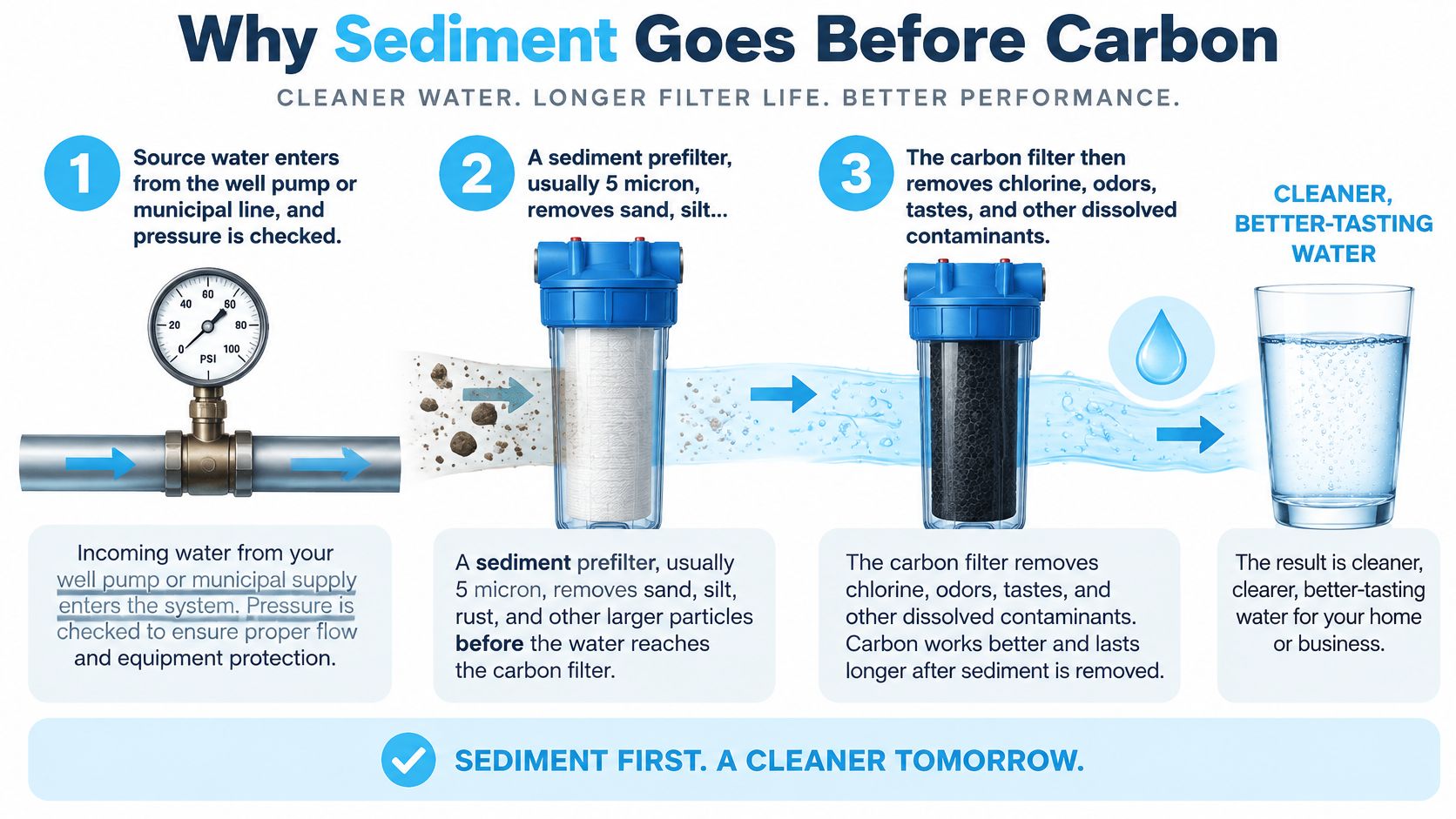
Why Sediment Goes Before Carbon
- Check the incoming supply. Identify whether water enters from a well pump or municipal line, then check pressure under normal use.
- Install a sediment prefilter selected for the incoming sand, silt, and rust.
- Add a finer sediment stage only when particle conditions justify it and the available pressure can support it.
- Route the prefiltered water through the carbon stage selected for the chemical-treatment job.
- Where required by the system design, use an appropriately rated postfilter to retain released media particles before water reaches the tap.
The flow path keeps particle control separate from chemical treatment.
Protect the carbon without choking the supply
Checking pressure first helps you avoid stacking restrictive cartridges into a system that already struggles to supply the fixtures. Record performance with clean cartridges so you have a useful baseline when flow later declines.
The sediment stage prevents the carbon from becoming an expensive dirt screen. WHO drinking-water treatment guidance distinguishes media filtration for suspended solids from activated-carbon adsorption and describes how particle-removal processes can precede later treatment.
A finer sediment stage is a design choice, not an automatic upgrade. If the first cartridge loads rapidly or fine material reaches the carbon, investigate particle size, housing capacity, and source conditions rather than buying the smallest rating available.
Iron staining deserves separate attention. Test for iron before choosing a carbon-only system, because a cartridge that catches rust particles doesn't necessarily address dissolved iron. The treatment must match the form present in the water.
Why a postfilter is a separate decision
A prefilter sits upstream, so it can't capture carbon released downstream. This is the reason a system may need both sediment pretreatment and a media-retention stage after carbon.
Laboratory work described by Water Online's report on carbon particles found superfine carbon particles that passed sand filtration and even a 0.45-micrometer membrane; those particles could carry adsorbed contaminants such as lead.
That controlled finding doesn't establish that ordinary household carbon filters routinely create a health hazard. It does show why dissolved-contaminant removal alone isn't a complete description of treatment performance.
Check whether a particle rating is nominal or absolute, and read the manufacturer's stated retention performance. Don't assume a general sediment cartridge will retain every carbon fine. After installation, flush the carbon cartridge through the specified outlet until initial black dust clears, while completing the manufacturer's full flushing procedure before drinking.
Flow Rate, Lifespan and Running Cost Compared
| Configuration | Typical flow | Replacement interval | Rating to check |
|---|---|---|---|
| Under-sink sediment cartridge | Within the cartridge and housing's stated operating flow | Service interval or earlier restriction from particle loading | Particle rating and nominal or absolute designation |
| Finer under-sink sediment cartridge | Check pressure loss at the required tap flow | Earlier replacement when fine particles cause restriction | Retention performance and pressure-drop information |
| Under-sink carbon block | Within the flow listed for the required reduction claim | Time limit or rated gallons, whichever comes first | Contaminant-specific capacity and tested flow |
| Under-sink granular activated carbon | Manufacturer's rated service flow | Stated service interval or rated capacity | Rated gallons and certified reduction claim |
| Whole-house sediment tank | Sized for full household demand | Cleaning, backwashing, or media service specified for the unit | Flow rating and particle-removal performance |
| Whole-house carbon tank | Sized for simultaneous household use | Media service based on stated capacity and operating conditions | Capacity and flow for each required claim |
A filter's flow rating isn't merely a convenience specification. It helps define the conditions under which treatment performance was demonstrated.
One configuration in the NSF certified drinking-water treatment listings was evaluated at 0.5 gallons per minute with a rated capacity of 300 gallons for chlorine, Particulate Class I, and taste-and-odor reduction under NSF/ANSI 42. Those figures belong to that tested configuration, not to carbon cartridges as a category.
A faster stream can mean less treatment
When you push water through carbon faster, you shorten contact time. A cartridge can therefore deliver water at an apparently acceptable pressure while operating outside the conditions supporting its reduction claim.
Example, a busy kitchen: A household chooses a drinking-water cartridge but connects it to a fixture used for rapid pot filling. If that flow exceeds the certified operating rate, the household can't assume the stated contaminant performance still applies.
Whole-house equipment needs a different sizing exercise. Consider simultaneous showers, appliance use, and other fixtures, then match the system to that demand. A larger-looking tank isn't proof that every reduction claim remains valid at peak flow.
Sediment cartridges require a different check: compare pressure or flow with the clean-cartridge baseline. A progressively restricted cartridge needs attention even when its calendar replacement date hasn't arrived.
Calculate cost from usable capacity
There isn't a defensible universal cartridge price or replacement interval. Use the replacement price you can obtain, including any required proprietary cartridge, and calculate against your household's use.
Illustrative cost method: Annual cartridge cost equals cartridge price multiplied by annual replacements. Cost per treated gallon equals cartridge price divided by the gallons actually treated before replacement, not automatically the advertised maximum.
For a carbon cartridge replaced because its time limit arrives before its gallon limit, use the lower actual volume in your calculation. For sediment, include extra replacements caused by seasonal particle loading rather than assuming every cartridge lasts equally long.
This also explains why a cheap cartridge can become costly in a poorly sized housing. Frequent changes and unacceptable pressure loss can outweigh the initial saving.
Write the installation date on the housing or service label, record any gallon-meter reading, and retain the performance sheet. Replace at the earlier applicable time or capacity limit, with earlier service when operating conditions or the manufacturer's instructions require it.
Maintenance Habits That Keep Carbon Safe
Carbon isn't a set-and-forget fix. Its porous surface can support microbial growth, particularly after it removes the disinfectant that previously limited growth in the incoming water.
An EPA-hosted study of household granular activated-carbon filters found that point-of-entry units became colonized within one month and discharged bacterial counts of about 1,000 colony-forming units per milliliter into household plumbing, significantly higher than in control homes.
That finding doesn't establish that every carbon filter causes disease. It establishes a narrower, important point: a treatment stage can become a microbial source, so chemical removal and hygienic operation must be evaluated separately.
Treat shutdowns as maintenance events
An idle carbon bed isn't equivalent to a freshly installed cartridge. During stagnation, oxygen conditions and water quality can change, and restarting the unit may release water that shouldn't be treated as ready to drink.
After a vacation or extended shutdown, follow the unit's restart procedure. Flush cartridges as specified; backwash tanks when the operating instructions require it. Clear-looking water alone isn't proof of microbial safety, so running the tap until it looks clear isn't a substitute for the prescribed restart process.
A kitchen-tap cartridge treats a limited outlet, while a whole-house carbon tank affects the water entering household plumbing. That difference changes the scope of maintenance, but it doesn't justify assigning every small cartridge a universally low risk. A whole-house system deserves a written service and restart plan.
Keep a usable maintenance checklist
- Replace on schedule. Don't extend carbon service beyond its applicable time or capacity limit because the water still tastes acceptable.
- Plan for idle periods. Keep the flushing or backwashing instructions accessible before leaving the system unused.
- Record service. Note installation, replacement, cleaning, and restart dates.
- Protect clean components. Keep spare cartridges sealed until use and avoid touching clean internal surfaces during installation.
- Address an unreliable source. Select appropriate downstream disinfection or other treatment with qualified guidance rather than relying on carbon alone.
For an additional household service reference, keep the SouthRay Kitchen & Bath maintenance guide alongside the instructions for your specific equipment. The equipment instructions remain the authority for flushing, sanitizing, and replacement procedures.
Sediment filters aren't automatically hygienic alternatives. Trapped organic material can also support growth, so clean handling and timely service apply to both stages.
Choose Your Setup After a Water Test
Test first, then buy treatment for the result. Start with chlorine, hardness, iron, lead, and bacteria concerns appropriate to your supply. Our water-quality testing kits help readers check their home water, but suspected health-related contamination should be confirmed through suitable laboratory testing.
| Home situation | Starting setup | Why it fits |
|---|---|---|
| Municipal water with chlorine taste or odor | Under-sink or whole-house carbon | Targets chlorine, taste, and odor |
| Well water with sand or cloudiness | Sediment prefilter, then carbon if taste also needs treatment | Separates particle control from chemical treatment |
| Visible rust or iron staining | Test for iron, select sediment treatment, then assess additional treatment | Iron form determines the treatment needed |
| Whole house serving several bathrooms | Whole-house sediment stage, then carbon when required | Can serve simultaneous fixtures when correctly sized |
| Hard water or fluoride concern | Neither filter alone; select different treatment | Ordinary carbon doesn't reliably address either concern |
| Known or suspected bacteria | Appropriate disinfection, not either filter alone | General-purpose cartridges don't establish microbial safety |
Match the result to the certificate
Use a simple routine: record the test result, select the treatment category, then verify the exact reduction claim and operating flow. Hardness, fluoride, nitrate, or bacteria require a different treatment approach, not another ordinary carbon cartridge.
For broader layout choices, PureHQ's guide to home water filtration offers another resource for considering household systems. Our Choosing a Water Filter guide also answers how to pick a filter.
Test first, choose the stage that matches the result, and never let carbon stand in for a needed sediment stage.
Our Choosing a Water Filter guide, treatment comparisons, and maintenance advice help you turn a water-test result into a practical setup. Visit Water Filter Advisor to compare sediment and carbon options, check the claims that matter for your supply, and plan cartridge replacement before you buy.
- November 4, 2026
- Uncategorized
