What Is a Sediment Filter and How Does It Work?
Ever wonder what’s actually in your water? A sediment filter acts as a physical gatekeeper, stopping party crashers like sand, silt, rust, and other debris from getting into your home's water. You can think of it as the bouncer for your water supply, catching all the big, visible gunk before it has a chance to cause any real trouble. It’s the crucial first piece of the puzzle in most home water filtration setups.
Your Home's First Line of Defense Against Gunk

If your home water system was a football team, the sediment filter would be the hard-working defensive lineman. Its job isn't flashy, but it's absolutely essential. Before your water ever gets to the more specialized filters—like carbon blocks that tackle chlorine taste or reverse osmosis systems that purify down to the molecule—it has to get past this checkpoint first.
This pre-filtration step is a must-have for protecting your entire plumbing ecosystem. Without it, those larger particles would quickly clog up and ruin the more sensitive and expensive filters down the line. That means your other filters would wear out fast, and your appliances could take a beating from all that grit and grime.
The Guardian Role of a Sediment Filter
A sediment filter works just like a screen door or a kitchen colander. It physically stops any particles that are too big to squeeze through its pores. The main job here is to get rid of suspended solids—all that gritty, insoluble stuff you might see floating in a glass of tap water.
This simple mechanical process does a few key things for your home:
- Protects Your Plumbing and Appliances: It stops sand and rust from building up inside your pipes, water heater, dishwasher, and washing machine, helping them last longer and avoid costly repairs.
- Improves Water Clarity: It grabs the tiny specks that can make your water look cloudy or "dirty," giving you crystal-clear water for drinking, cooking, and bathing.
- Enhances Other Filters' Performance: By doing the heavy lifting upfront, it frees up your carbon and other specialty filters to do what they do best, like removing chemicals and making your water taste great.
You don't have to just take our word for it—the market shows how important this first stage of filtration is. The global sediment filter market is on track to become a $15.8 billion industry by 2025. This growth is mostly driven by homeowners who want to protect their appliances and enjoy better water quality. You can discover more insights about these market trends on datainsightsmarket.com.
What a Sediment Filter Does and Doesn't Remove
It's crucial to know what a sediment filter is designed to do—and what it's not. It has one job, and it does it very well: capturing physical particles. It's not built to handle invisible chemical or biological contaminants.
Here’s a simple breakdown to help you see the difference.
| What It Removes (Physical Particles) | What It Does NOT Remove (Dissolved Contaminants) |
|---|---|
| Sand, dirt, and grit from wells or aging city pipes | Chlorine and chloramine (chemicals used for disinfection) |
| Silt and clay that cause cloudy water (turbidity) | Lead, mercury, and other heavy metals |
| Rust flakes from corroded plumbing | Bacteria, viruses, and other microorganisms |
| Small organic matter like tiny plant debris or insect fragments | Pesticides, herbicides, and Volatile Organic Compounds (VOCs) |
| Scale particles that break off from pipes and water heaters | Dissolved minerals that cause water hardness (calcium and magnesium) |
Think of the sediment filter as the bouncer that keeps the obvious troublemakers out of the club, letting your other filtration systems focus on the more specialized work of purifying your water.
How a Sediment Filter Actually Works

It seems almost magical how a sediment filter can catch so much sand, rust, and silt without completely blocking your water flow. But it's not magic—it’s just smart engineering. The whole process boils down to two simple approaches: filtering like a sieve or filtering like a sponge.
Getting a handle on these two methods will show you exactly how your filter is keeping your water clean and help you choose the right one for your home.
The Sieve Method: Surface Filtration
First up is surface filtration. This is your classic sieve. Think of a pleated sediment filter, with its large, folded surface area. It works just like a screen door.
When water flows through, any particles bigger than the filter's tiny pores get stuck on the outside. The water passes right through, but the sand, dirt, and rust can't. It’s a simple, effective way to grab larger sediment without causing a big drop in water pressure right away.
One of the best things about this "sieve" design is that a lot of pleated filters are reusable. Since all the junk is just sitting on the surface, you can often just take the filter out, spray it clean with a hose, let it dry, and pop it back in. This makes them a great choice if you have a lot of visible sediment and want to keep your water flowing strong.
The Sponge Method: Depth Filtration
The other approach is depth filtration. This method is less like a screen and much more like a sponge. Instead of one flat surface, these filters use a thick web of fibers, like you'd find in a spun polypropylene or string-wound cartridge.
Picture water pushing its way through a dense, fibrous mat. There's no single barrier. Instead, particles get tangled up and trapped throughout the entire thickness of the filter. The bigger chunks get caught near the outside, while finer particles get lodged deeper inside.
This layered trapping is what makes depth filters so good at capturing a whole range of particle sizes. They create a 3D maze that sediment gets lost in.
The trade-off? Once this "sponge" is full, it's full for good. You can't clean it; you just have to replace it. You'll know it's time when you notice your water pressure starting to drop. That's your sign that the filter has done its job and is clogged with all the gunk it has successfully removed from your water.
At the end of the day, both the sieve and the sponge have the same mission: to physically block particles from getting into your home's water. The only difference is how they catch the debris, which in turn affects your water pressure and whether you can clean the filter or need to toss it.
Understanding Micron Ratings to Choose the Right Filter
Choosing the right sediment filter can feel a bit like cracking a secret code. The single most important clue you need to look at is the micron rating. This number tells you exactly how fine a particle the filter is designed to catch.
So, what’s a micron? It’s incredibly small—one-millionth of a meter.
To give you some real-world perspective, a single strand of human hair is about 70 microns thick. The smallest thing you can see with your naked eye is around 40 microns. Anything smaller than that is totally invisible unless you’ve got a microscope. Nailing down this scale is the key to matching a filter to your specific water problems.
What the Numbers Really Mean
Micron ratings on sediment filters aren't just arbitrary numbers; they translate directly to how that filter will perform in your home. A larger number means larger pores in the filter material, which lets more through. A smaller number means a much tighter filter that’s built to capture finer, almost invisible particles.
Here’s a quick guide to what these common micron ratings will actually pull out of your water:
- 100 Microns: This is a coarse filter, like a bouncer for big rocks. It’s your first line of defense, designed to catch large, visible gunk like sand, grit, and scale flaking off old pipes. It's a great starting point, especially if you're on well water.
- 25-30 Microns: Taking it a step finer, these filters are excellent for trapping smaller bits of sand, silt, and rust that a 100-micron screen might miss. This is a very common rating for pleated, reusable filters.
- 5 Microns: This is the go-to standard for solid, all-around sediment filtration for both city and well water. A 5-micron filter will remove most of the sediment you can see, including fine silt and clay, leaving you with noticeably clearer water. It's often the minimum rating you'll want to protect more sensitive equipment down the line.
- 1 Micron: Now we're talking about a fine filter that captures microscopic particles. It will remove nearly all suspended solids that cause cloudy water, including very fine silt and even some larger cysts (like Giardia).
Choosing the right micron rating is all about efficiency. You don't want to use a 1-micron filter to catch large grains of sand that a 50-micron filter could handle with ease. The finer filter will just clog up way too fast and crush your water pressure.
Nominal vs. Absolute Ratings
As you compare filters, you’ll bump into two terms that sound alike but have very different meanings: nominal and absolute. Getting this right is critical to making sure you're actually buying the level of protection you think you are.
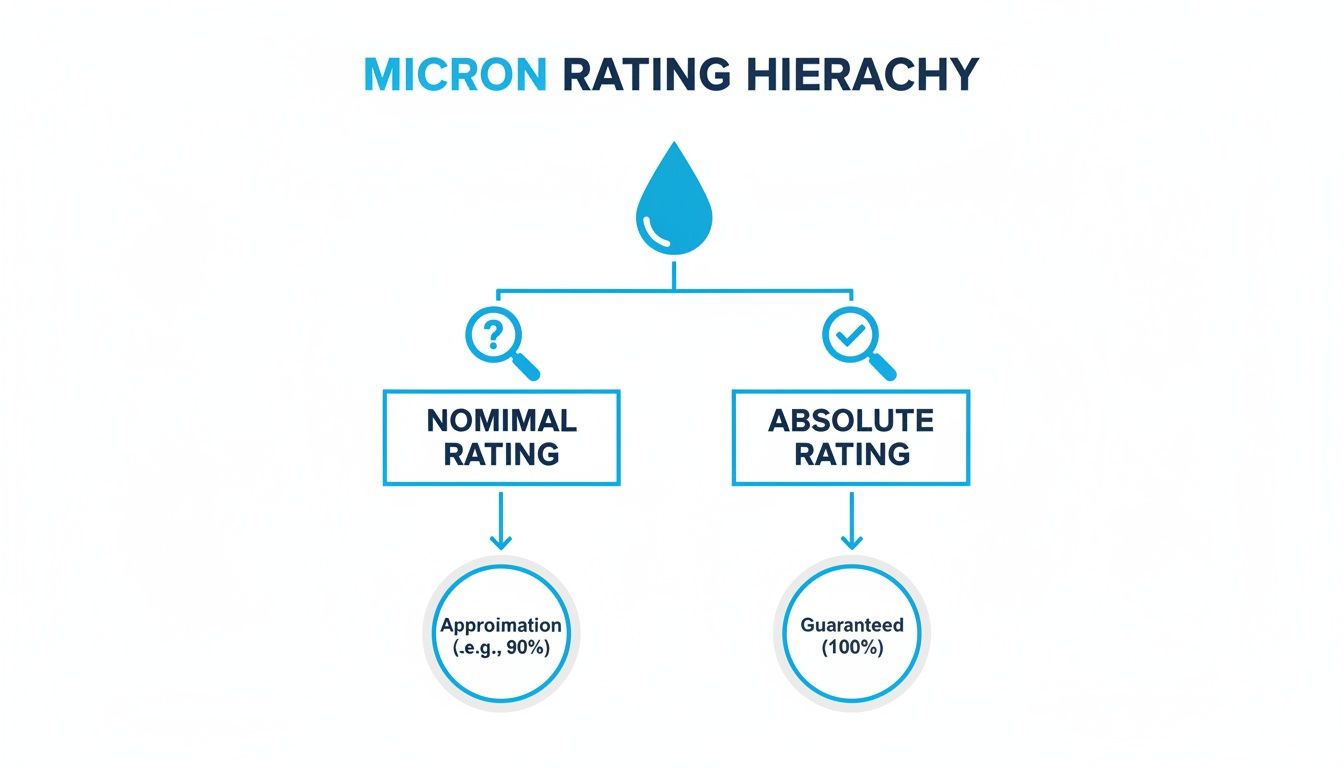
A nominal 5-micron filter, for example, is rated to remove most particles that are 5 microns or larger. It might be designed to capture around 85% of particles at that size, meaning some 5-micron particles (and even a few slightly larger ones) might still slip through. Think of it as "mostly" getting the job done.
Absolute-rated filters offer a much higher level of certainty. An absolute 5-micron filter is guaranteed to remove at least 99.9% of all particles that are 5 microns or larger. No guesswork, no exceptions.
If you’re just trying to keep sand out of your sprinkler system, a nominal filter will do the job just fine. But if you're trying to protect a sensitive and expensive reverse osmosis system, an absolute-rated filter provides the guaranteed protection you need. This kind of pre-filtration isn't just a "nice-to-have." Unfiltered sediment can slash the life of an RO membrane from 3-5 years down to just 6-12 months. For the 15 million U.S. homes on private wells, a 5-10 micron sediment filter is often essential for making water safe and pleasant.
Once you understand micron ratings and the difference between nominal and absolute, you can cut through the technical jargon and make a smart choice. You're no longer just buying a filter; you're picking the exact level of protection your home's water system needs to run its best.
Comparing the Most Common Types of Sediment Filters
Alright, now that you’ve got a handle on how these filters work and what those micron numbers actually mean, let’s meet the main players. Walking into the world of sediment filters can feel a bit like wandering down the tool aisle—there are a bunch of different models, and each one is designed for a specific job.
They’re all built with different materials and designs, making them better suited for certain types of water, budgets, and how much maintenance you’re willing to do.
We’ll break down the four most common types you’re going to run into: Spun Polypropylene, String-Wound, Pleated, and Spin-Down filters. Knowing their strengths and weaknesses is the key to picking a filter that doesn't just work, but works perfectly for your home.
Spun Polypropylene (Melt-Blown) Filters
Think of a spun polypropylene filter as the trusty, all-purpose disposable option. These are made by melting and blowing polypropylene fibers into a dense, multi-layered cylinder. This creates a depth filter—that "sponge" we talked about earlier—which traps particles all the way through its core.
The outer layers are a bit looser to catch the big stuff, while the inner layers are packed tight to grab the finer silt. This gradient design is great because it can hold a lot of gunk before it finally clogs up.
- Best For: General-purpose use with city water or well water that has pretty consistent, fine sediment. They’re a fantastic, low-cost first line of defense for protecting other systems like a carbon filter or water softener.
- Pros: Super affordable, great at catching a wide range of particle sizes, and you can find them just about anywhere.
- Cons: They are single-use only. Once they’re full, you have to toss them and put in a new one, which means ongoing costs and more waste.
String-Wound Filters
String-wound filters are the rugged, old-school workhorses of the sediment world. They’re made by winding a cord—usually polypropylene or cotton—very tightly around a central core. The crisscrossing pattern creates a tough depth filter that’s exceptionally good at trapping all sorts of sediment sizes.
Their durable build makes them a go-to for more challenging water, especially from wells that can kick up a random mix of sand, silt, and rust. They also tend to handle higher temperatures better than some of their counterparts.
We often recommend string-wound filters for well owners because they offer a fantastic balance of high filtration capacity and pure structural integrity. They're built to handle the tough, unpredictable stuff that wells can dish out.
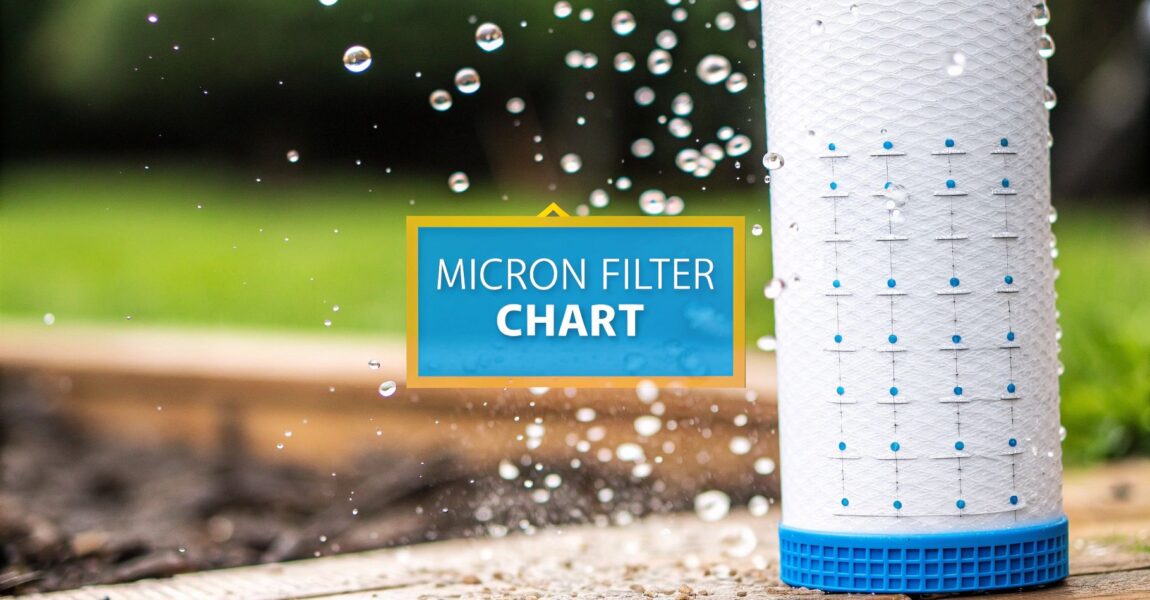
To give you a sense of scale for what these filters are up against, this chart shows just how tiny these particles are.

As you can see, a filter rated to stop silt is capturing particles that are many, many times smaller than a single human hair. It really shows the precision involved in getting your water clean.
Pleated Filters
Pleated filters work more like a "sieve," using a large, folded sheet of material to catch particles on its surface. The accordion-like folds give them way more surface area than a standard filter of the same size. This design lets water flow through with less resistance, which means you get better flow rates and less of a drop in water pressure.
The biggest perk for most homeowners? They’re often reusable. Since all the sediment is just sitting on the outside surface, you can usually take the cartridge out, give it a good spray with a hose, and pop it right back in.
- Best For: Homes where keeping strong water pressure is a big deal. They’re also perfect if your water has larger, more uniform sediment, since you can clean and reuse them several times.
- Pros: High flow rates, low impact on water pressure, and being reusable makes them cheaper in the long run.
- Cons: They cost more upfront than spun or string-wound types. They can also clog up faster if your water has a lot of fine, slimy gunk.
Spin-Down (Self-Cleaning) Filters
Spin-down filters are really in a class of their own. They use centrifugal force to create a vortex inside the filter housing, which slings the heavier sediment to the outside wall where it collects at the bottom. The cleaner water in the middle then passes through a screen (usually stainless steel) for a final polish.
The "set it and forget it" appeal comes from their super easy cleaning. You don’t have to shut off the water or take anything apart. You just open a little valve at the bottom, and the collected sediment flushes right out. This makes them a lifesaver for homes with very heavy sediment, like those on well water.
Choosing the right filter isn't just about convenience; it's a major public health decision. Sediment filters directly tackle turbidity, a risk factor the WHO has identified in the water supplies of 1.8 billion people. By capturing 98-99.9% of these particles, they help prevent health issues that can arise from cloudy, contaminated water. You can read more on the global importance of filtration at gminsights.com.
To make it even easier to decide, we’ve put together a quick comparison table breaking down the most common options for homeowners.
Sediment Filter Comparison for Homeowners
| Filter Type | How It Works | Best For | Pros | Cons |
|---|---|---|---|---|
| Spun Polypropylene | Depth filter; traps particles throughout its multi-layered core. | General city or well water with fine sediment. | Very affordable, widely available, good all-around performance. | Single-use only; creates ongoing replacement costs and waste. |
| String-Wound | Depth filter; a wound cord creates a durable structure to trap varied sediment sizes. | Challenging well water with mixed sediment (sand, silt, rust). | Very durable, handles high flow and temperature well. | Can be less precise with micron ratings than spun filters. |
| Pleated | Surface filter; large, folded surface area catches particles on the outside. | Homes needing high flow rates and minimal pressure drop. | Reusable (can be cleaned), excellent flow, lower long-term cost. | Higher initial price, can clog with very fine or slimy sediment. |
| Spin-Down | Centrifugal force spins out heavy debris before water passes through a screen. | Water with very heavy, large sediment (like sand from a well). | Self-cleaning (just flush the valve), minimal maintenance. | Highest upfront cost, mainly for larger particles. |
Ultimately, the best filter is the one that matches your water source and your lifestyle. Whether it's a cheap and easy disposable filter or a reusable, heavy-duty model, there’s a solution that will keep your water clear and your pipes protected.
Key Signs Your Sediment Filter Needs Replacing
Your sediment filter is a quiet workhorse, but it's not a "set-it-and-forget-it" part of your home. Just like the oil filter in your car, it eventually gets clogged with all the gunk it’s pulling from your water. Letting it go for too long can cause more headaches than the sediment you were trying to fix in the first place.
Manufacturers usually suggest swapping the filter out every 3 to 6 months, but that's just a starting point. The real factor is your water quality. If you're on a private well, for instance, sediment levels can swing wildly with the seasons. Luckily, your home gives you some pretty clear signals when it's time for a change.
The Slowdown: A Noticeable Drop in Water Pressure
This is the big one. It's the most common and annoying sign that your filter has clocked out. If your morning shower suddenly feels like a weak drizzle or it takes ages to fill a pot at the sink, a clogged filter is almost always the culprit.
Think of it this way: a new filter is like a freshly paved, wide-open highway for your water. As it traps sand, dirt, and rust, it’s like closing down lanes one by one. Eventually, you've got a full-blown traffic jam, and only a trickle of water can squeeze through. That's what causes that frustrating pressure drop you feel all over the house.
A clogged sediment filter literally chokes off your home’s water supply. This isn't just an inconvenience; it’s a direct sign the filter is so packed with debris that it has become the main bottleneck in your plumbing.
The Return of Cloudy or Gritty Water
Remember why you got the filter in the first place? To get rid of that nasty, cloudy water. If you start seeing little floaties in your glass again or find a film of silt at the bottom of your toilet bowl, your filter has probably thrown in the towel.
Once a filter cartridge is completely saturated with sediment, a couple of things can happen, and neither is good:
- Bypass: The water pressure gets high enough to force a path around the filter media. Untreated water then flows right past it and into your pipes.
- Unloading: A sudden surge in pressure can actually tear the filter or dislodge a concentrated burst of trapped gunk back into your water system.
This completely defeats the purpose of having a filter. You'll end up with clogged faucet aerators and gummed-up showerheads, which are just another chore to clean.
A Change in Taste or Odor
A standard sediment filter isn't built to remove chemicals like chlorine. Its job is to trap physical particles, including fine organic matter like dirt and silt.
When all that organic stuff gets trapped and sits in a wet, clogged filter, it can start to decay. This can breed a musty, earthy, or even swampy taste and smell in your water. If your water starts tasting "off" and you've ruled out other issues, your dirty filter is the likely source. It’s become a breeding ground for the very junk it was meant to remove.
A Homeowner's Guide to Filter Installation and Maintenance

Knowing how to install or change your own sediment filter can save you both time and a service call fee. Whether you're a seasoned DIYer or just want to know what the plumber is doing, it's a simple skill that puts you in control of your home’s water quality.
Most often, you'll find a sediment filter set up as a whole-house system at the point of entry—that's right where the main water line comes into your house. This is a great setup because it protects every single tap, shower, and appliance from grit and other gunk. Swapping out the cartridge in these systems is a quick job you can easily master.
How to Replace a Sediment Filter Cartridge
When your filter is spent, it’s time for a change-out. This is the most basic part of keeping your system running right. The exact steps might change a little depending on the brand, but the process is pretty much the same across the board.
Here's how to get your water flowing clean again.
Turn Off the Water: Find the main shut-off valve for your water line and crank it closed. This stops water from flowing into the system while you're working.
Relieve the Pressure: This is a crucial step! Look for a red pressure-relief button on top of the filter housing. Push it down and hold it until you don't hear any more hissing. Releasing this trapped pressure makes the housing way easier to unscrew.
Unscrew the Housing: Grab the filter wrench that came with your system and use it to get the housing (the big canister part) loose. After a good turn, you should be able to unscrew it the rest of the way by hand. Keep a bucket handy to catch the water that will spill out.
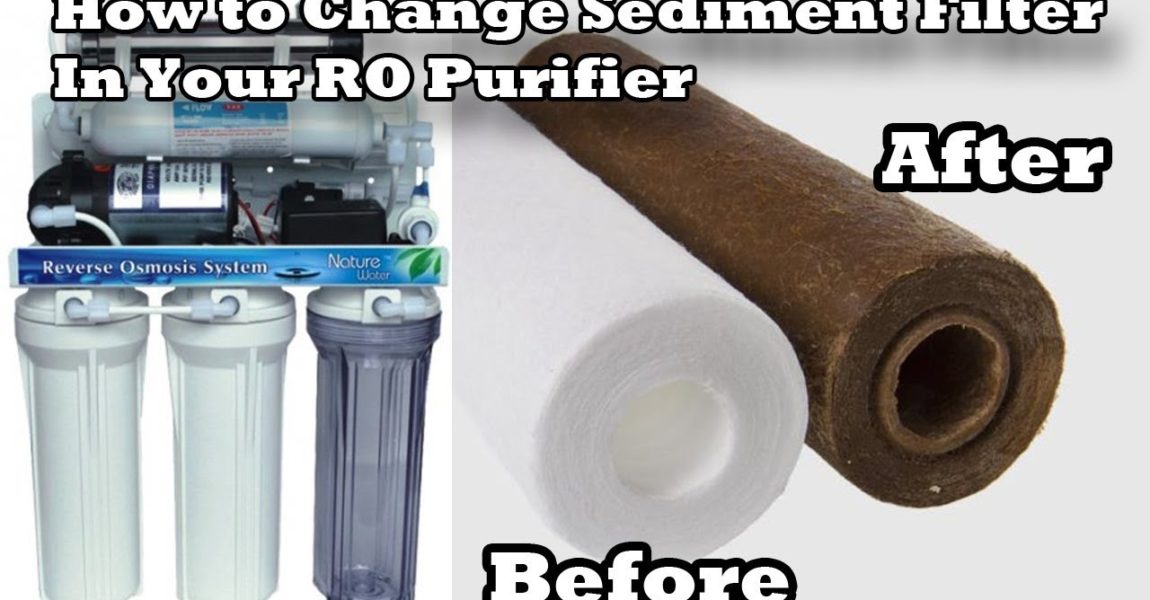
Swap the Filters: Pull out the old, dirty filter and toss it. It's a good idea to give the inside of the housing a quick rinse to get rid of any sediment that's settled at the bottom.
Inspect and Lube the O-Ring: At the top of the housing threads, you'll see a black rubber O-ring. This is what creates the seal. Check it for cracks or damage. A light coat of food-grade silicone grease will help it seal perfectly and make it easier to open next time.
Install the New Filter: Pop the new filter cartridge into the housing. Make sure it sits straight and is centered on the post at the bottom.
Tighten and Check for Leaks: Screw the housing back on by hand until it's snug. Then, give it one last quarter-turn with the wrench—be careful not to overtighten! Slowly turn your water back on. Press the relief button one more time to let any trapped air escape. Now, just watch for any drips around the seal to make sure it's tight.
Pro Tip: Keep a spare O-ring on hand. They’re cheap and can be a real lifesaver if the old one gets stretched or nicked during a filter change, saving you from a surprise leak.
This simple job is the key to keeping your filter system working perfectly. Following these steps will ensure your sediment filter provides clean, clear water for your whole house.
Frequently Asked Questions About Sediment Filters
Even after you’ve got the basics down, a few questions always seem to pop up. Sediment filtration sounds simple enough, but the practical side of things is what really matters for your home. Here are the straight answers to the questions we get asked all the time.
Will a Sediment Filter Alone Make My Water Safe to Drink?
No, and this is the most important thing to get straight. A sediment filter is a mechanical filter. All it does is grab physical junk like dirt, sand, and rust. Think of it like a bouncer at a club who only stops the people who look like they're going to cause a scene.
What it doesn't do is remove dissolved chemicals like chlorine or lead. It also can't touch microorganisms like bacteria or viruses. To get truly safe, drinkable (potable) water, your sediment filter needs to be the first step in a multi-stage system. That means pairing it with something like an activated carbon filter and a UV purifier or a reverse osmosis system.
Do I Really Need a Sediment Filter with City Water?
In most cases, yes, you absolutely do. It's a huge myth that city water arrives at your faucet perfectly clean. Sure, it gets treated at a municipal plant, but then it has to travel through miles of old underground pipes to get to you.
On that journey, it’s all too easy for the water to pick up rust from old iron pipes, sediment from a water main break, or all sorts of other debris.
Think of a sediment filter as an inexpensive insurance policy. It protects your pricey appliances—dishwashers, washing machines, and water heaters—from getting wrecked by that hidden grit. That little filter can save you a ton of money on repairs down the road.
What Happens if I Forget to Change My Sediment Filter?
Letting a clogged filter sit in the housing is a bad idea. Forgetting about it can lead to two big problems, and you might end up with water that's even worse than having no filter at all.
First, you'll notice a serious drop in water pressure all over the house. Your shower will feel weak and faucets will trickle. That’s because the filter is so jammed with gunk that water can barely squeeze through.
Second, a filter can get so overloaded that it might tear or "unload" all that trapped sediment back into your pipes in one big burst. This sends a concentrated shot of filth into your faucet aerators and showerheads, clogging them up. Keeping up with filter changes is a key part of any good home maintenance plan. If you want to stay on top of everything, an ultimate annual home maintenance checklist can be a lifesaver.
Can a Sediment Filter Fix Bad-Tasting or Smelly Water?
It really depends on what’s causing the issue. If your water has an earthy or musty taste from actual dirt or silt particles, then yes, a sediment filter will probably help a lot by removing the physical source of the taste.
However, it won't do a thing for chemical tastes or odors. It has zero effect on:
- The taste of chlorine that’s so common in city water.
- A "rotten egg" smell from hydrogen sulfide gas, often found in well water.
- A metallic taste caused by dissolved iron or other minerals.
To tackle those problems, you’ll need an activated carbon filter. It’s designed specifically to adsorb those taste and odor compounds, which is why carbon filters are almost always placed right after the sediment filter in a complete system.
At Water Filter Advisor, our goal is to empower you with the knowledge to make confident decisions about your home's water quality. From choosing the right micron rating to understanding maintenance, we're here to provide clear, research-driven guidance. Explore our in-depth guides and reviews to find the perfect filtration solution for your family at https://www.waterfilteradvisor.com.