You turn on the kitchen tap, catch a swimming-pool smell, and reach for the pitcher filter. The water tastes better for a while, but a refrigerator cartridge may barely touch a rotten-egg odor, and a whole-house filter advertised as “carbon” may do little against chloramine. The problem usually isn't that activated carbon media is useless. It's that the wrong grade, pore structure, or contact time is being asked to solve the wrong water problem.
Activated carbon is the workhorse inside many home filtration systems, from faucet and refrigerator cartridges to under-sink blocks and whole-house tanks. Yet the word carbon on a package doesn't tell you which contaminants the media targets, how quickly water may flow through it, or when its adsorption sites will be exhausted. This guide connects each major carbon grade to a practical household concern, including chlorine, chloramine, volatile organic compounds, sulfur odor, and situations where carbon is the wrong tool entirely.
Why Activated Carbon Media Matters in Home Water Filters
A homeowner with chlorinated municipal water may notice a sharp smell when filling a glass. Standard granular activated carbon, or GAC, can often improve that taste and odor because chlorine and many organic compounds attach to the carbon surface as water passes through the bed. The U.S. Environmental Protection Agency's overview of drinking water treatment technologies identifies GAC as effective for taste- and odor-producing compounds, natural organic matter, volatile organic compounds, synthetic organic compounds, and disinfection byproduct precursors.
That same homeowner might install the same style of cartridge after moving to a home supplied with chloraminated water. The result can be disappointing. Chloramine is more persistent than free chlorine, and ordinary activated carbon doesn't handle it through simple adsorption alone. A chlorine filter and a chloramine filter aren't automatically interchangeable.
Practical rule: Choose media according to the contaminant in your water, not according to the word “carbon” on the label.
Why labels create confusion
Manufacturers may describe a product as coconut-shell carbon, catalytic carbon, carbon block, or activated carbon media. Those terms describe different things. The base material influences the carbon's hardness and pore profile, while particle size and surface chemistry affect flow and selectivity. A dense carbon block can behave differently from loose granules even when both products begin with carbon-rich material.
The history also explains why carbon remains so common. Historical sources describe carbonized wood charcoal in ancient Egypt as early as 3750 BC, with medicinal use noted around 1500 BC. Large-scale industrial production and development began in Europe at the start of the 20th century, giving activated carbon a development path spanning more than 5,000 years from early purification practices to modern regeneration and solvent-recovery systems, as documented in this historical overview of activated carbon.
The modern market is broad because homes, utilities, and industries use different carbon forms for different jobs. One market forecast values the activated carbon market at USD 5.62 billion in 2025, projecting USD 11.9 billion by 2034 at an 8.8% CAGR. Another estimate places the market at USD 4.16 billion in 2026 and USD 5.47 billion by 2031. These are projections from separate market analyses, not a guarantee of household filter performance, but they show how widely the material is used. A market review cited by Fortune Business Insights reports 2024 global consumption of 2.6 million tons and production of 2.8 million tons, with China holding 28% of consumption and 36% of production.
How Activated Carbon Adsorbs What Your Tap Water Carries
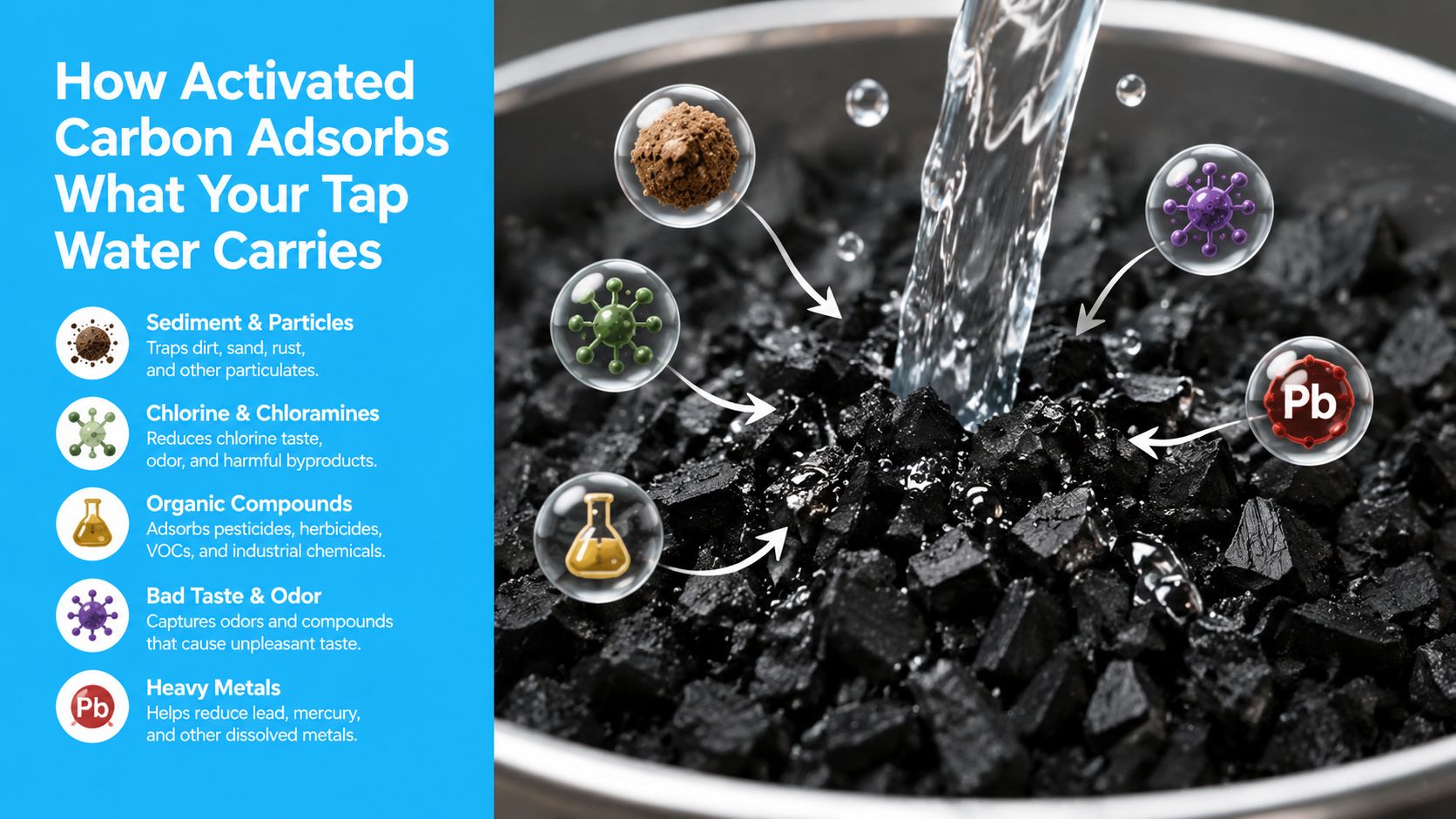
Activated carbon doesn't work like a towel soaking up a spill. It works more like a surface covered with countless tiny docking spaces. Dissolved molecules move through the water, enter the carbon's pores, and cling to the internal surfaces through physical and chemical attractions. That process is called adsorption, with a “d,” because the contaminant stays on a surface rather than moving into the material as water moves into a towel.
Activation creates the structure that makes this possible. Manufacturers treat carbon-rich materials with heat, steam, or chemical processes that open and enlarge pores. The result is a particle with a huge internal surface area. A commonly used analogy compares the internal surface of a teaspoon of activated carbon with the area of a football field, but pore arrangement matters more than a headline surface-area figure alone. Two carbons can have similar total surface area and still perform differently because their pores accept different molecule sizes.
Pores determine what fits
Carbon pores are commonly discussed by size:
- Micropores: Pores under 2 nanometers are suited to small molecules, including many VOCs.
- Mesopores: Pores from 2 to 5 nanometers can provide room for larger molecules, including some chlorination byproducts.
- Macropores: Larger channels help water travel into the particle and reach smaller internal pores.
This is why “more surface area” doesn't automatically mean “better for every contaminant.” A carbon grade with many micropores may be useful for small organic molecules but less suited to larger compounds. Surface chemistry also changes how strongly a contaminant interacts with the carbon.
Contact time controls the outcome
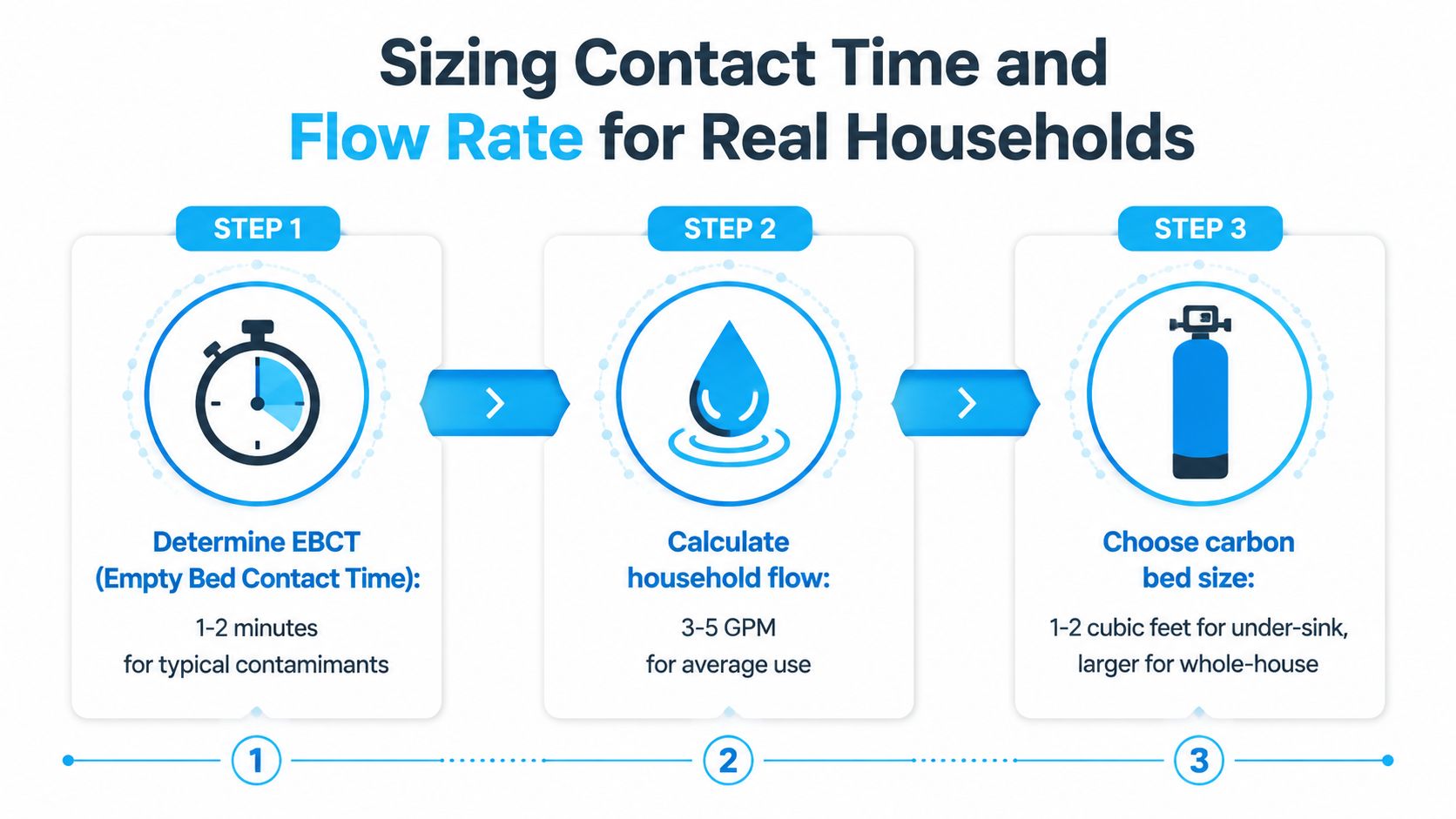
Water needs time inside the carbon bed. The key measurement is empty bed contact time, or EBCT, which describes how long water would occupy the empty volume of the media bed at a stated flow rate. Longer contact generally gives molecules more opportunity to move from the water into available pores.
Peer-reviewed work on activated carbon filters found that a minimum EBCT of 20 to 30 minutes was necessary for micropollutant removal regardless of GAC type. Broader water-treatment literature commonly places usable EBCT in the 10 to 50 minute range, as discussed in the peer-reviewed activated carbon filter research. A cartridge pushed beyond its rated flow can therefore perform poorly even if it contains high-quality media.
Adsorption capacity is finite. At first, fresh carbon may reduce a target contaminant effectively. As sites fill, the contaminant eventually begins to pass through. This is called breakthrough, and excessive flow can make it arrive sooner by reducing the time available for mass transfer.
The Main Types of Activated Carbon Media Explained
The four categories below differ in physical form, surface behavior, and intended use. The practical question isn't which grade is universally best. It's which grade matches the water entering your home.
Granular activated carbon
GAC consists of loose granules. Its particle size allows water to pass with less pressure drop than very fine carbon, making it common in whole-house tanks and larger cartridge filters. GAC is a sensible starting point for chlorine taste and odor, many VOCs, synthetic organic compounds, and some disinfection byproduct precursors. The EPA describes these as important GAC treatment targets in drinking water systems.
GAC needs an adequately deep bed and controlled flow. A small cartridge can improve water at a kitchen tap, while a whole-house tank needs enough media volume to support peak household demand. A label that names GAC but omits flow limits or contaminant-specific certification leaves important buying questions unanswered.
Powdered activated carbon
PAC is a fine powder with short diffusion paths and rapid mixing potential. Water utilities may add it during treatment when they need flexible contact with dissolved contaminants. PAC is less convenient for ordinary home point-of-use filtration because loose powder requires containment, separation, and careful handling.
For a homeowner, PAC usually appears indirectly in specialized treatment rather than as a loose material poured into a pitcher. Fine particles can restrict flow and escape without proper downstream filtration.
Catalytic carbon
Catalytic carbon is modified to promote reactions as well as adsorption. That distinction matters most for chloramine and hydrogen sulfide. The Water Quality Association's chloramine reference explains that activated carbon can act as a catalyst, breaking chloramines down into chloride and other innocuous products. The U.S. EPA's maximum residual disinfectant level for chloramines is 4.0 mg/L as Cl2, but a regulatory limit doesn't tell you whether a particular home cartridge is correctly sized for removal.
Catalytic carbon still needs contact time. A cited University of Texas at Austin study reported nearly 90% monochloramine removal at 0.75 minutes of EBCT, while another source notes that standard activated carbon may require up to four times the contact time of catalytic carbon for thorough chloramine removal, as summarized in this background on chloramination.
Impregnated carbon
Impregnated carbon has been treated with another substance, such as silver, iodine, or a specialized chemical agent. The added chemistry can target a narrow problem or inhibit bacterial growth under specific product conditions. It isn't a universal upgrade, and the exact impregnant matters more than the general category.
| Carbon Grade | Grain Size | Typical Contact Time | Target Contaminants |
|---|---|---|---|
| Standard GAC | Loose granules | Depends on bed depth and flow | Chlorine, taste, odor, VOCs, some organic compounds |
| PAC | Fine powder | Rapid mixing, controlled treatment | Organic contaminants in specialized treatment |
| Catalytic carbon | Engineered granular or block media | Contact time is critical, especially for chloramine | Chloramine, chlorine, hydrogen sulfide, selected organics |
| Impregnated carbon | Granular or block media with added chemistry | Product-specific | Narrow contaminant targets, selected inorganics, or microbial-growth control |
Coconut-shell, coal, and wood feedstocks affect hardness and pore distribution. For home filtration, though, the grade and verified performance claim usually matter more than the feedstock name by itself.
Matching Carbon Grades to Common Home Water Problems
Start with the complaint, then identify the chemistry behind it. A chlorine smell, a sulfur odor, and a solvent-like taste may all be described as “bad water,” but they don't call for the same activated carbon media.
Chlorine taste and odor
Standard GAC is usually the straightforward choice for free chlorine, taste, and odor. The University of Nebraska Extension guide to activated carbon states that activated carbon reduces chlorine, tastes, and odors, while warning that it doesn't remove metals, nitrate, microbial contaminants, or other inorganic contaminants.
NSF/ANSI 42 covers aesthetic effects such as chlorine taste and odor. One certification guide describes test water containing 3.0 mg/L chlorine and a passing effluent level of 0.5 mg/L or less. It also identifies Class I as 75% or greater chlorine reduction, Class II as 50% to 74%, and Class III as 25% to 49%, according to this NSF/ANSI 42 carbon certification guide. Look for the actual class and rated capacity rather than assuming every carbon cartridge performs alike.
Chloramine
Chloramine requires more careful selection. Catalytic carbon is designed to promote the breakdown reaction, while ordinary GAC may need substantially more contact time to achieve meaningful reduction. If your utility uses chloramine, check its water quality information before buying a whole-house carbon tank.
Hydrogen sulfide and sulfur odor
A rotten-egg odor points toward hydrogen sulfide, although water chemistry can affect the diagnosis. Catalytic carbon or a specifically impregnated carbon may outperform standard GAC for this reactive odor. Adding a sediment prefilter won't fix the underlying sulfur chemistry.
VOCs, pesticides, and PFAS
Dense carbon with a pore structure suited to the target molecule can reduce VOCs and pesticides, but performance depends on contact time, concentration, competing organic matter, and cartridge capacity. PFAS treatment requires particular caution. Certain coconut-shell GAC and catalytic blends show measurable removal when the product is certified and properly sized, so a general “carbon reduces PFAS” statement isn't enough.
| Water Problem | Standard GAC | Catalytic Carbon | Impregnated Carbon |
|---|---|---|---|
| Free chlorine | Strong fit | Strong fit | Product-specific |
| Chloramine | Limited unless carefully sized | Preferred grade | Product-specific |
| Hydrogen sulfide odor | Variable | Often better suited | Can be useful when specifically designed |
| VOCs and pesticides | Common choice with adequate contact time | Can also adsorb organics | Depends on formulation |
| PFAS | Selected certified products may help | Selected blends may help | Claim must be product-specific |
The review of activated carbon's limitations and hybrid treatment emphasizes that carbon performs better for many organics than for dissolved inorganic contaminants. That contrast is the reason a cartridge swap should begin with water testing, not with a larger marketing claim.
When Activated Carbon Is the Wrong Tool for the Job
Activated carbon is powerful, but it isn't a universal purifier. It works best when a contaminant can attach to the carbon surface. Highly soluble ions and many dissolved inorganic substances don't interact strongly enough with ordinary carbon to make a dependable treatment step.
That includes hardness minerals, such as calcium and magnesium, along with nitrate, nitrite, fluoride, sodium, and total dissolved solids. Activated carbon also isn't a reliable standalone solution for arsenic unless the media has been specially impregnated and certified for that purpose. Heavy metals often require ion exchange, reverse osmosis, or another treatment selected for the specific metal.
Problems carbon won't solve by itself
- Hard water: Carbon can improve taste or odor, but it won't soften water by removing calcium and magnesium.
- Nitrate and nitrite: These dissolved ions generally need a treatment process designed for inorganic contaminants.
- Fluoride and sodium: Ordinary GAC isn't the right removal mechanism.
- Heavy metals: Use a certified ion-exchange, reverse-osmosis, or specialized impregnated-carbon system.
- Microbes: Carbon doesn't provide dependable disinfection against bacteria and viruses.
Microbiological risk deserves special attention. A carbon bed can collect organic material and provide a place where bacteria may persist if the system isn't properly designed and maintained. Pair microbial treatment with an appropriate disinfection method, such as UV, when testing or source conditions justify it.
Think of carbon as an organics-and-oxidant filter, not a complete treatment plant in a tank. A softener can address hardness, reverse osmosis can target selected dissolved solids and ions, and UV can provide microbial disinfection. The right combination depends on the test results and the water source.
Sizing Contact Time and Flow Rate for Real Households
A carbon filter can contain excellent media and still disappoint if water moves through it too quickly. EBCT describes the time water spends in the carbon bed. More time generally allows more molecules to reach adsorption sites and gives catalytic reactions more opportunity to proceed.
Calculate EBCT by dividing the empty bed volume by the flow rate. In practice, you'll use the media volume and the system's rated flow information rather than treating the tank's outside dimensions as usable carbon volume. A point-of-use cartridge may work well because one faucet draws a modest flow. A whole-house system must cope with simultaneous showers, toilets, washing machines, and kitchen demand.
Use the target, not the tank label
The correct target depends on the contaminant and the manufacturer's tested performance. Peer-reviewed work cited earlier found 20 to 30 minutes necessary for micropollutant removal in the studied activated carbon filters, while broader treatment references describe a 10 to 50 minute usable EBCT range. Don't substitute an attractive tank size for a contaminant-specific rating.
A simple sizing review should ask:
- What is the peak flow? Use the household's likely simultaneous demand, not just the flow from one quiet faucet.
- What EBCT does the contaminant require? Chlorine, chloramine, VOCs, and micropollutants may have different design needs.
- What does the certification test? A product certified for chlorine taste and odor isn't automatically certified for chloramine or PFAS.
- What happens at the end of media life? Confirm the rated capacity and replacement plan before installation.
Flow warning: Running an under-sink cartridge above its rated flow reduces contact time and can shorten its useful life.
An undersized bed can let chloramine or VOCs pass through before the carbon has enough opportunity to react or adsorb them. An oversized bed can add cost and media without solving a contaminant that carbon cannot remove. Proper sizing is a balance among flow, bed volume, water chemistry, and the verified claim you need.
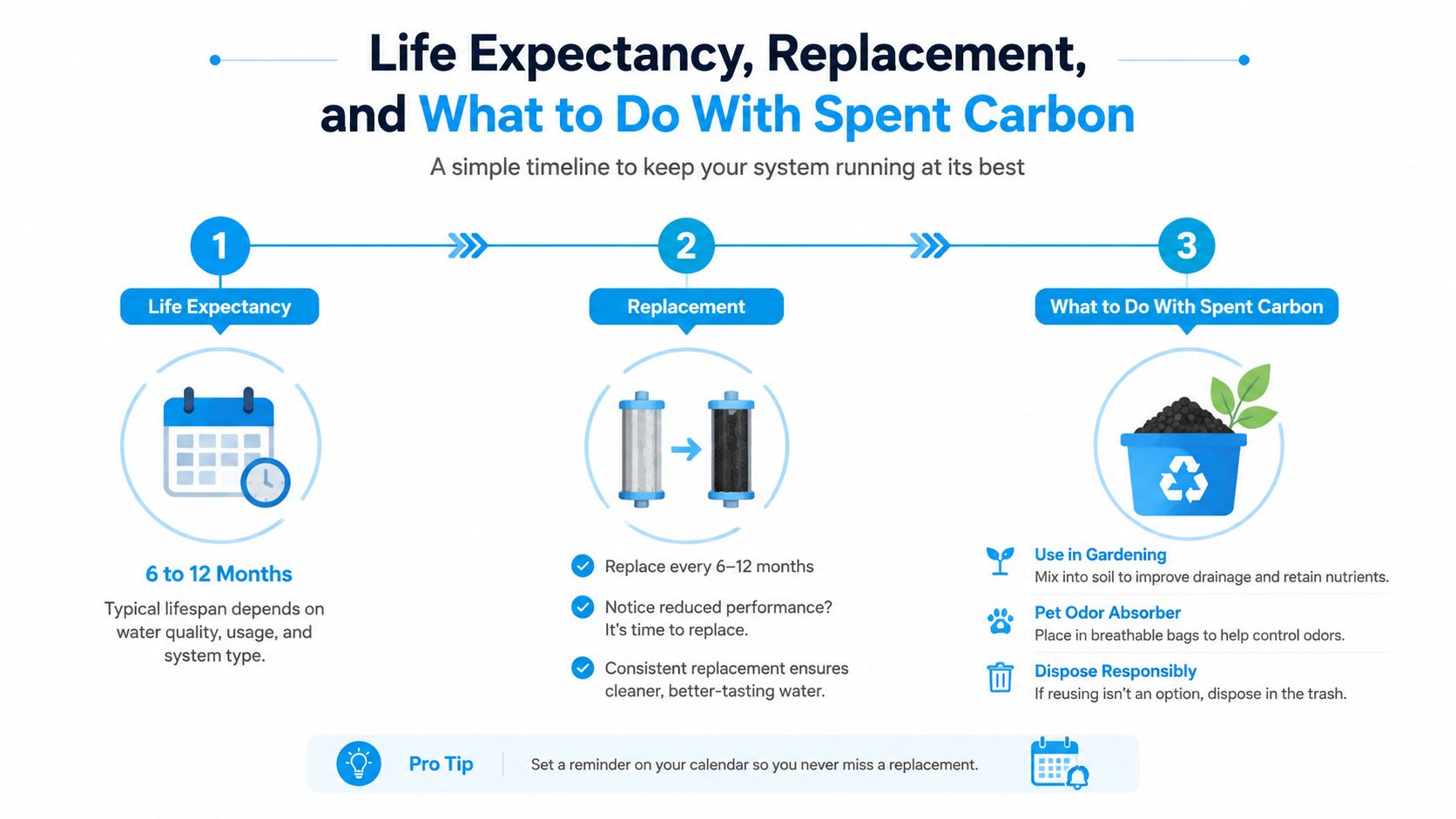
Life Expectancy, Replacement, and What to Do With Spent Carbon
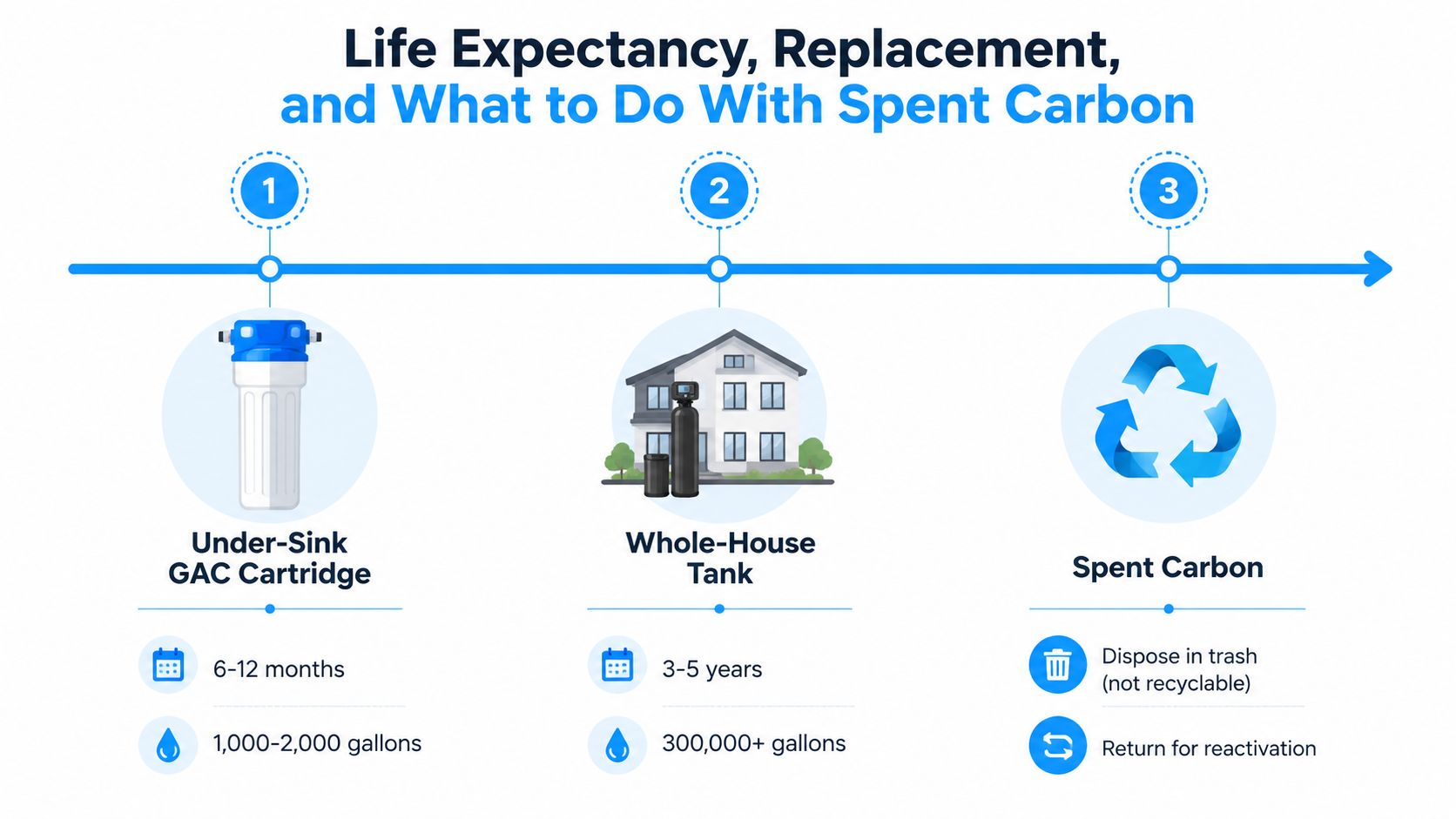
A calendar reminder helps, but service life depends on water passing through the media. Contaminant concentration, household consumption, flow rate, and competing organic matter all affect how quickly adsorption sites fill. A cartridge used by one person may last longer than the same cartridge serving a large family, while heavily contaminated water can exhaust media sooner.
The supplied lifecycle guidance lists a typical under-sink GAC cartridge at 6 to 12 months and roughly 1,000 to 2,000 gallons. A whole-house tank is listed at 3 to 5 years or 300,000+ gallons. These figures are practical reference points, not universal guarantees. Follow the specific manufacturer's rated capacity and replacement instructions.
Signs the bed needs attention
- Returning chlorine taste: A familiar disinfectant taste can indicate breakthrough, especially if it returns before the planned replacement date.
- Changing pressure: A noticeable pressure drop can signal loading, fouling, or a clogged prefilter.
- Channeling: Water may carve preferred pathways through the bed, reducing its contact with much of the media.
- Unusual particles or odor: Media fines or biological growth require inspection and prompt maintenance.
Homeowners generally can't regenerate spent carbon in a meaningful way. True thermal reactivation requires industrial kilns operating around 800 to 900°C, according to the supplied technical guidance. Rinsing a cartridge or leaving it in sunlight doesn't restore its original adsorption capacity.
Disposal choices
Don't assume spent carbon belongs in a recycling bin. Follow local disposal rules, because the media may contain the contaminants it removed. Some municipal programs may accept it, while industrial spent carbon can go to specialized reclaimers that burn off contaminants and reactivate the pore structure.
Avoid backyard dumping or placing loose media where it can contact soil and groundwater. The carbon may look harmless, but trapped contaminants can move back into the environment under changing conditions.
Choosing the Right Activated Carbon Media for Your Home
The best purchase starts with a water problem stated precisely. “My water tastes bad” is a useful observation, but “free chlorine taste at the kitchen tap” points toward standard GAC, while “persistent chloramine residual” points toward catalytic carbon. Testing keeps the system from becoming an expensive guess.
A practical selection checklist
- Test before choosing media. Obtain your local water quality report or send a sample for VOC, PFAS, hardness, nitrate, and other relevant testing. A well-water household shouldn't assume its chemistry matches a municipal supply.
- Match the grade to the contaminant. Standard GAC fits chlorine taste and odor. Catalytic carbon is the stronger candidate for chloramine and sulfur-related odor. PAC or tightly engineered carbon blocks may suit specialized VOC and PFAS applications, but only when the product carries a relevant performance claim. Impregnated carbon belongs in a narrow, verified application for selected dissolved metals or other specific targets.
- Protect contact time. Check the rated flow and EBCT at the household's peak demand. A filter that works at one faucet may not work when several fixtures run at once.
- Verify certification. NSF/ANSI 42 addresses aesthetic effects such as chlorine taste and odor. NSF/ANSI 53 is used for health-effect claims such as certain VOC and PFAS reductions, but the exact contaminant and capacity must appear in the certification listing. The standard number alone isn't proof that a product removes every contaminant in that category.
- Plan maintenance costs. Budget for cartridge replacement or media changeouts based on the manufacturer's rated life, household consumption, and water quality. Delaying replacement turns a filter into an unmonitored container of exhausted media.
For installation notes, maintenance checklists, and broader guidance on comparing home filtration options, consult water filtration advice for homeowners.
The central decision is simple: the right carbon grade addresses a real contaminant through the right mechanism. The wrong grade may improve a smell while leaving the target contaminant untouched, which makes it an expensive placebo.
Water Filter Advisor offers practical guides for comparing whole-house, under-sink, refrigerator, faucet, and replacement-filter options, with clear explanations of media, certifications, testing, and maintenance. Visit Water Filter Advisor to match your home's water problem with a filtration approach you can maintain confidently.
- August 27, 2026
- Uncategorized
