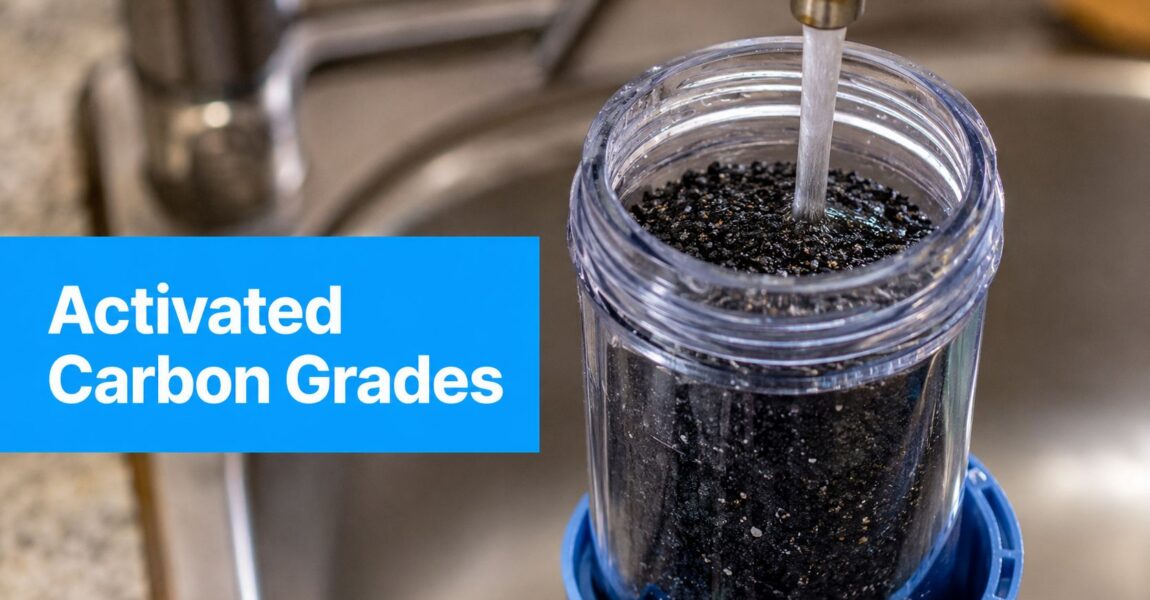
Activated Carbon Media: Choosing the Right Grade
You turn on the kitchen tap, catch a swimming-pool smell, and reach for the pitcher filter. The water tastes better for a while, but a refrigerator ca ...
You turn on the kitchen tap, catch a swimming-pool smell, and reach for the pitcher filter. The water tastes better for a while, but a refrigerator ca ...
The most popular advice about a chloramine water filter shower is also the least useful: buy any shower filter with a carbon cartridge and look for an NSF logo. That shortcut confuses free chlorine reduction with chloramine reduction. NSF/ANSI 177 covers free available chlorine, not chloramine, and many products marketed for chloramine don't show comparable independent testing.
Chloramine is still a regulated municipal disinfectant, not a fringe contaminant. The U.S. EPA's chloramine guidance says compliant chloraminated water is safe for bathing and showering, and agencies describe inhalation and dermal exposure during bathing as negligible. The practical filtration question is different: if you want less disinfectant at one shower outlet, does the cartridge contain the right media, hold enough media, and give water enough contact time to react?
That's the standard I use when judging shower units. Ignore the number of “stages” on the box. Focus on media chemistry, flow rate, bed depth, and cartridge life.
Chloramine isn't an exotic contaminant that appears only in unusual water supplies. Utilities form it by adding ammonia to chlorine, then use the resulting disinfectant to maintain protection as treated water travels through distribution pipes. The EPA classifies this as secondary disinfection, because the residual is designed to persist beyond the treatment plant.
The EPA and CDC both identify 4.0 mg/L, or 4 ppm, as the relevant safe level for chloramine in drinking water. EPA technical material says residual chloramine in distribution systems is commonly around 1.5 to 2.5 mg/L, below the enforceable limit, as described in this technical filtration overview of chlorine and chloramine. That means a household using chloraminated water is usually dealing with a regulated, measurable residual that arrives at the tap on purpose.
Practical rule: Find out whether your utility uses chlorine, chloramine, or both before buying a shower filter. Your annual Consumer Confidence Report is the sensible starting point.
The health agencies' position matters. EPA says water meeting its standards is safe for showering, while Canadian guidance says inhalation and dermal exposure during bathing is expected to be negligible and reports no published cases of dermal or ocular irritation from bathing in chloraminated tap water. You shouldn't buy a filter because a product page suggests your shower is poisoning you.
You might still choose filtration for comfort, odor, hair-care routines, or personal preference. The problem is that the market often blurs those goals. NSF/ANSI 177 is a free-chlorine standard, so a certified filter can reduce free chlorine while offering no proof that it meaningfully reduces chloramine. The buying test is whether the product explains its catalytic media, tested flow conditions, contact time, and replacement schedule.
Think of monochloramine as chlorine paired with a small amount of ammonia. The combination creates a slower, more stable disinfectant than free chlorine. Utilities use that stability because the residual can remain active while water moves through long pipe networks, instead of disappearing quickly.
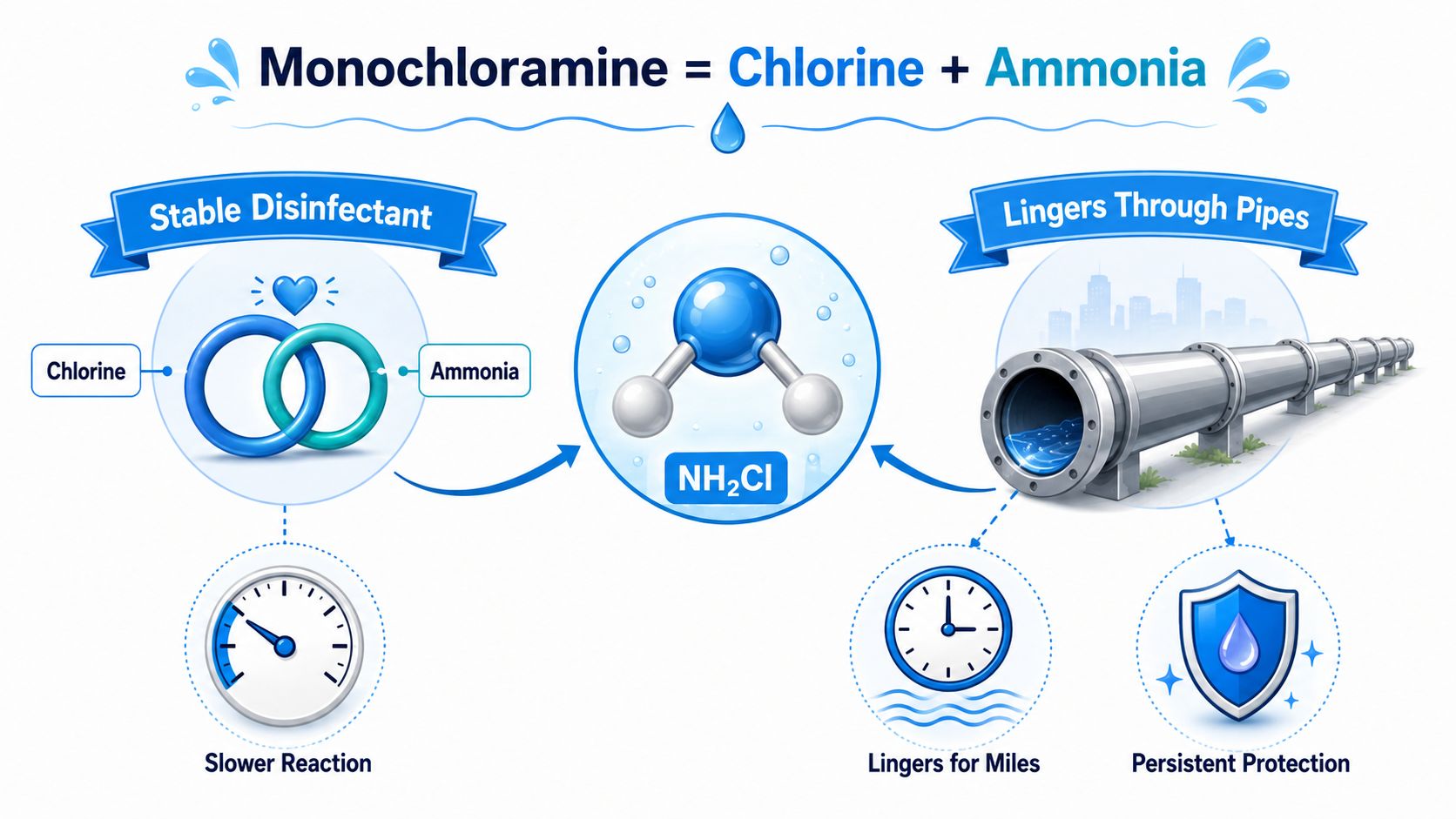
Free chlorine is comparatively straightforward for ordinary activated carbon. Carbon can adsorb it, and a properly designed carbon filter can reduce its taste and odor. Chloramine behaves differently because the chlorine and ammonia form a more stable compound. Standard carbon may reduce some chloramine under certain conditions, but a thin, fast-flowing shower cartridge doesn't give that reaction much opportunity.
Chloramine also remains in the water as it travels toward your home. That persistence is the reason utilities choose it for longer-lasting distribution protection, and it's why standing water or casual off-gassing isn't a practical shower-treatment strategy. A shower filter has to treat the water at the point of use, while the water is moving quickly through a compact housing.
Hot water makes a bathroom steamy, but steam isn't proof that chloramine is filling the room. EPA guidance says monochloramine doesn't easily enter the air and considers inhalation and skin exposure during bathing negligible. Aerosolized water can still contact skin and airways, but the public-health evidence doesn't support treating a compliant shower as an acute exposure emergency.
For filtration, heat creates a different concern. Shower cartridges must work under warm-water conditions and high flow, not under the slow laboratory conditions that give media more time to react. The utility trade-off is clear: chloramine offers a persistent disinfectant residual and can help reduce regulated disinfection byproducts, but that same persistence makes it harder for basic shower media to remove.
The cartridge label tells you more than the outside housing. Standard activated carbon, catalytic carbon, KDF, and vitamin C don't perform the same job, and calling all of them “carbon filtration” hides the trade-offs.
| Media | Chloramine Reduction | Free Chlorine | Flow Sensitivity | Typical Life |
|---|---|---|---|---|
| Standard activated carbon | Weak and unreliable in a fast shower cartridge | Good | High | Depends on media amount and water load |
| Catalytic activated carbon | The primary media to investigate for meaningful reduction | Good | High, contact time matters | Depends on bed depth, flow, and loading |
| KDF-55 or KDF-85 | Limited as a standalone chloramine treatment | Good through redox chemistry | Moderate to high | Depends on media mass and water conditions |
| Vitamin C | Effective neutralization when properly dosed | Effective | Very high | Usually shorter and dose-dependent |
Granular activated carbon is excellent at reducing free chlorine under suitable conditions. It isn't automatically a chloramine solution. If a product lists only “activated carbon” and then makes a broad chloramine claim, I treat that as incomplete evidence, not a buying recommendation.
Catalytic activated carbon is the serious option. Its enhanced catalytic surface helps break chloramine down rather than relying only on adsorption. Published treatment research has shown monochloramine can degrade to nitrogen gas as a main product under catalytic-carbon treatment, as discussed in this WaterWorld explanation of catalytic carbon for chloramine removal.
KDF media uses a copper-zinc redox process and can be valuable in a shower cartridge, especially alongside catalytic carbon. I wouldn't choose KDF alone for a strong chloramine claim unless the manufacturer provides specific test evidence. It's commonly more useful as a supporting stage than as the entire answer.
Vitamin C, or ascorbic acid, chemically neutralizes chlorine and chloramine quickly. That makes it attractive for shower use, but the cartridge is highly dependent on dosing and flow. A fast shower can consume the active material quickly, so replacement timing matters more than the marketing phrase “vitamin C infused.”
A shower filter can contain the right chemistry and still disappoint. Water moves quickly, the housing is compact, and chloramine needs enough empty-bed contact time with reactive media. If the design sacrifices contact time for unrestricted flow, the cartridge may deliver a pleasant shower while doing little chloramine reduction.
Four variables control the result:
The common claim that lowering shower flow from 2.5 gallons per minute to 1.75 gallons per minute roughly doubles contact time is an engineering approximation, not a universal product result. Actual contact time also depends on media volume and internal flow distribution. Likewise, claims about a 1.5 to 2 inch minimum bed depth or about 6 seconds of contact time shouldn't be treated as universal certification thresholds without a product-specific test.
| Parameter | Threshold for Real Reduction | Marketing Trap |
|---|---|---|
| Media type | Catalytic carbon or validated specialty chemistry | “Carbon” without identifying whether it's catalytic |
| Flow rate | Must match the manufacturer's tested condition | Maximum flow printed without reduction data |
| Contact time | Longer is generally better for chloramine chemistry | Many “stages” in a thin housing |
| Bed depth | Enough media volume for a meaningful water path | A shallow disc presented as a deep-bed system |
| Cartridge life | A stated capacity tied to actual usage | Replacement advice based only on calendar time |
Hot water may speed some chemical reactions, but it doesn't rescue a badly undersized cartridge. Watch for a sudden pressure drop, reduced spray pattern, or channeling around the cartridge. Those symptoms can indicate clogging or exhaustion, but pressure alone doesn't prove chloramine removal. The only reliable performance evidence is a test performed at stated concentration and flow conditions.
Installation mistakes cause more leaks than bad filter design. An inline unit belongs between the shower arm and your existing showerhead, while a replacement showerhead filter is often the cleaner renter-friendly choice.
Don't attack a plastic housing with a wrench. Overtightening can crack the housing or distort the washer. Silicone grease also doesn't belong on the housing threads unless the manufacturer specifically calls for it.
Choose a twist-off showerhead filter that requires no tools and can be reversed at move-out. Keep the original showerhead and its washers in a labeled bag. Before leaving, reinstall the original hardware and check that the connection doesn't drip.
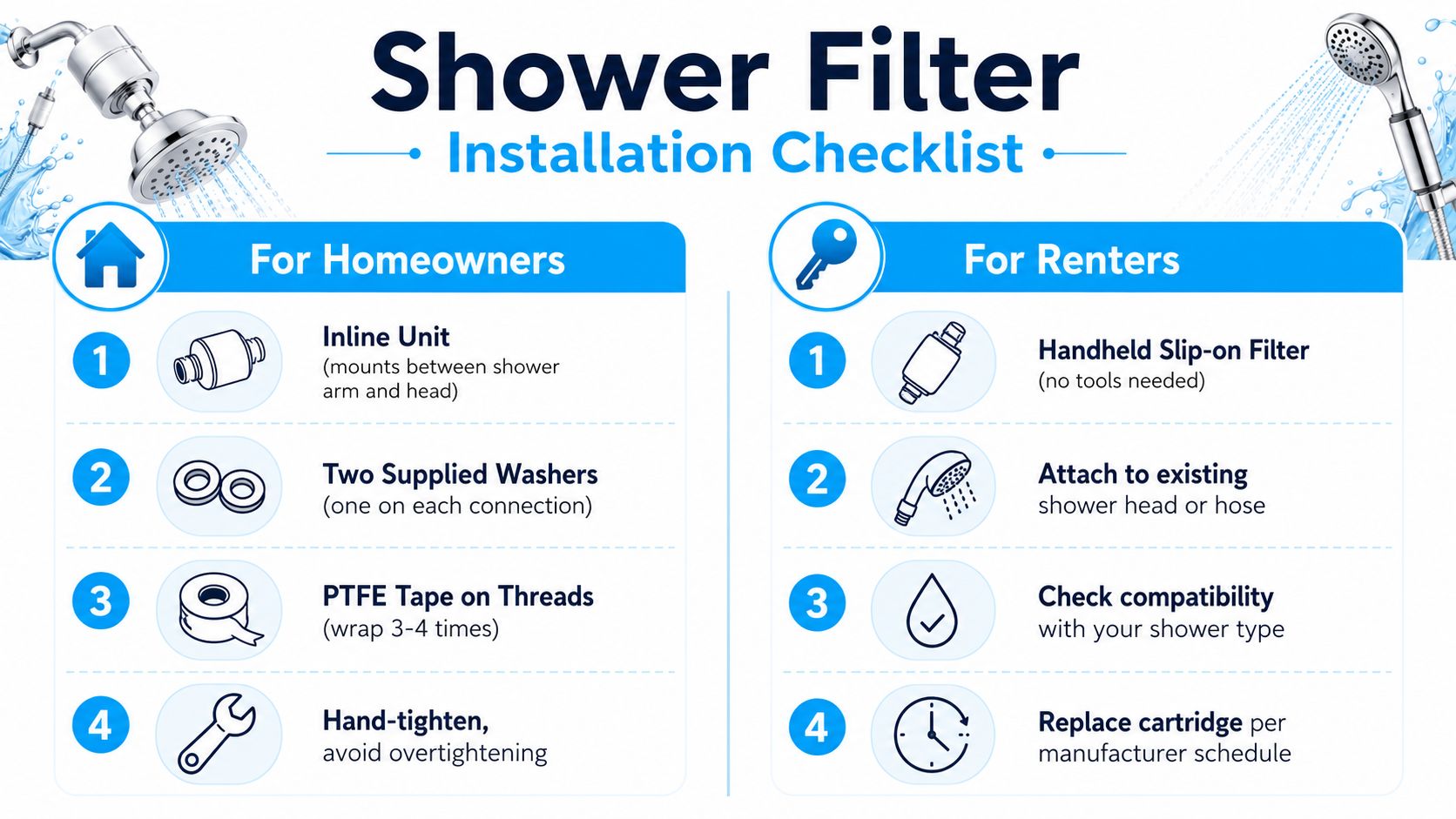
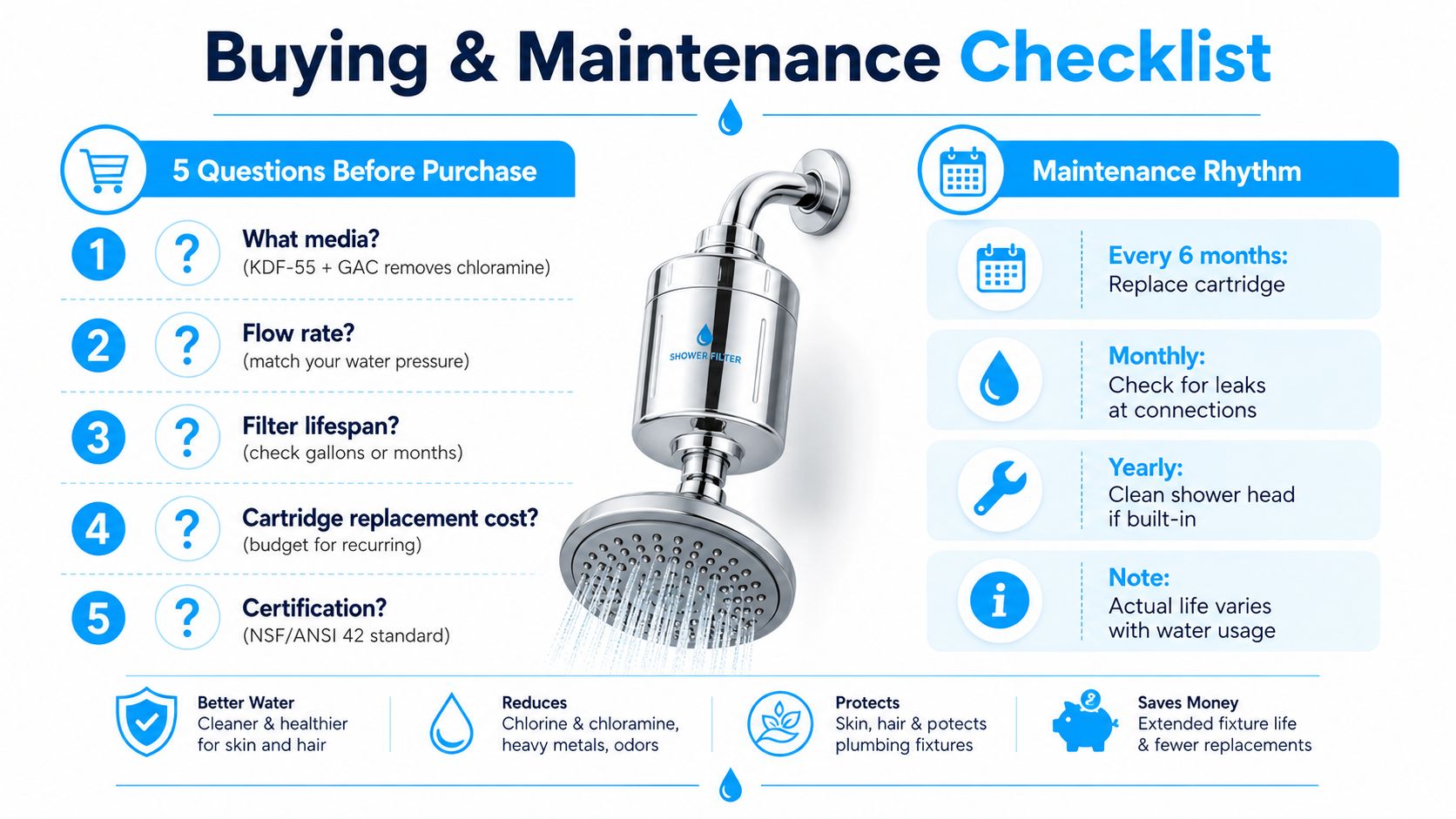
Flush a new cartridge for 60 seconds before the first shower. Mark the installation date directly on the housing with a permanent marker. For many catalytic-carbon units, manufacturers use a schedule of six months or 8,000 gallons, as reflected in the supplied product guidance, but household use and water chemistry can shorten that interval. Replace earlier if pressure drops, the cartridge reaches its stated capacity, or the original water issue returns.
This video shows the basic connection process before you start:
A simple maintenance rhythm works better than guessing. Check connections monthly, inspect the cartridge at each cleaning, and record every replacement. If the product gives a gallon capacity, track household use rather than relying only on the calendar.
NSF/ANSI 177 is useful, but it isn't a chloramine certification. NSF describes shower filters certified to this standard as systems installed directly in front of the showerhead and certified to reduce free available chlorine. The NSF consumer explanation of water-treatment standards makes that scope clear.
The standard's performance target is also specific. An ANSI/NSF product document says NSF/ANSI 177 requires at least 50% free available chlorine reduction, tested against 2 mg/L FAC challenge water, along with material safety, structural integrity, minimum flow, and literature requirements. Those requirements are valuable for the contaminant tested. They don't establish chloramine performance.
A brand can display an NSF/ANSI 177 claim accurately and still leave shoppers with the impression that the unit handles chloramine. The logo tells you the product met a free-chlorine protocol. It doesn't tell you that monochloramine was tested, that catalytic carbon was used, or that the result applies at your home's shower flow.
Certification check: Read the exact contaminant name. “Free available chlorine” and “monochloramine” are not interchangeable test claims.
For a chloramine purchase, look for product-specific evidence beyond NSF 177. That might include an explicit chloramine claim under an applicable standard, a WQA Gold Seal listing that names monochloramine, or a detailed independent laboratory report. Don't accept a generic “removes chlorine and chloramine” statement without the test conditions.
A useful verification workflow is short:
A shower filter is a point-of-use device. It treats one outlet, installs quickly, and makes sense when your priority is shower water. A whole-house catalytic-carbon system is installed at the point of entry and treats water before it reaches showers, sinks, laundry equipment, and humidifiers.
The financial trade-off is substantial. Shower units commonly sell for roughly $40 to $150, while whole-house catalytic-carbon tanks are commonly priced around $800 to $2,500, according to the supplied filtration-market guidance. Those figures are purchase ranges, not guarantees of total installed cost, and they don't include every plumbing modification or replacement expense.
| Factor | Shower Filter (POU) | Whole-House System (POE) |
|---|---|---|
| Coverage | One shower outlet | All treated household outlets |
| Installation | Usually simple threaded connection | Requires plumbing space and professional or skilled DIY work |
| Media volume | Compact cartridge | Much larger catalytic-carbon bed |
| Drinking-water protection | None at other outlets | Covers kitchen and other connected fixtures |
| Best fit | Renters, condos, targeted shower comfort | Owners seeking home-wide treatment |
| Maintenance | Frequent cartridge replacement | Media service and system maintenance |
A whole-house system is the more coherent choice for a large family, a home with several bathrooms, or an owner who wants chloramine reduction for bathing and drinking. It also deserves attention where chloramine may accelerate deterioration in copper or rubber plumbing, but water chemistry and plumbing condition should be assessed before making that investment.
A quality shower unit is enough for many renters, condo residents, and households focused on one bathroom. The practical hybrid is often better than pretending one tiny cartridge can do everything: use a chloramine-capable shower filter for bathing and a properly selected under-sink or countertop drinking-water system at the kitchen.
Start with your municipal report, not a product roundup. If your utility uses free chlorine, NSF 177 may match your shower goal. If it uses chloramine, demand media and test evidence that address chloramine specifically.
Don't buy a shower filter because the package says “multi-stage.” Ask five questions before paying for it:
Owners can choose an inline unit mounted at the shower arm, particularly when they want to keep an existing showerhead. Renters should prioritize a reversible, no-tool showerhead swap, preserve the original hardware, and avoid connections that require permanent plumbing changes.
Request your local Consumer Confidence Report and baseline the shower water before you buy. If chloramine is present, match the unit to the tested flow rate and schedule a 90-day reassessment of performance and comfort. For broader guidance on choosing, testing, and maintaining household filtration, use the Water Filter Advisor filtration advice.
If you want help comparing a chloramine-capable shower unit with under-sink or whole-house options, Water Filter Advisor provides practical buying guides, media explanations, certification checks, and maintenance guidance for home filtration. Visit Water Filter Advisor to choose a system based on your water report, installation limits, and replacement plan.
If you’ve ever poured a glass of water and thought, "Hmm, smells like a swimming pool," you might be quick to blame chlorine. But these days, the culprit is more likely chlorine's tougher, more persistent cousin: chloramine. It's a blend of chlorine and ammonia, and it’s the new go-to disinfectant for many water treatment plants to keep our supply safe all the way to your home.
So, why did your local utility make the switch to this super-disinfectant? It all comes down to staying power.
Standard chlorine is a fantastic germ-killer, but it has the stamina of a sprinter. It fizzles out pretty quickly. By the time water travels through miles and miles of pipes to reach your house, that chlorine protection can wear off, giving nasty microorganisms a chance to throw a party before they get to your faucet.
Chloramine, on the other hand, is a marathon runner. It's designed for the long haul and doesn't fade away easily, providing what's known as a "disinfectant residual." This ensures your water stays protected right up until the moment you turn on the tap. That stability is the number one reason so many cities have made the switch.
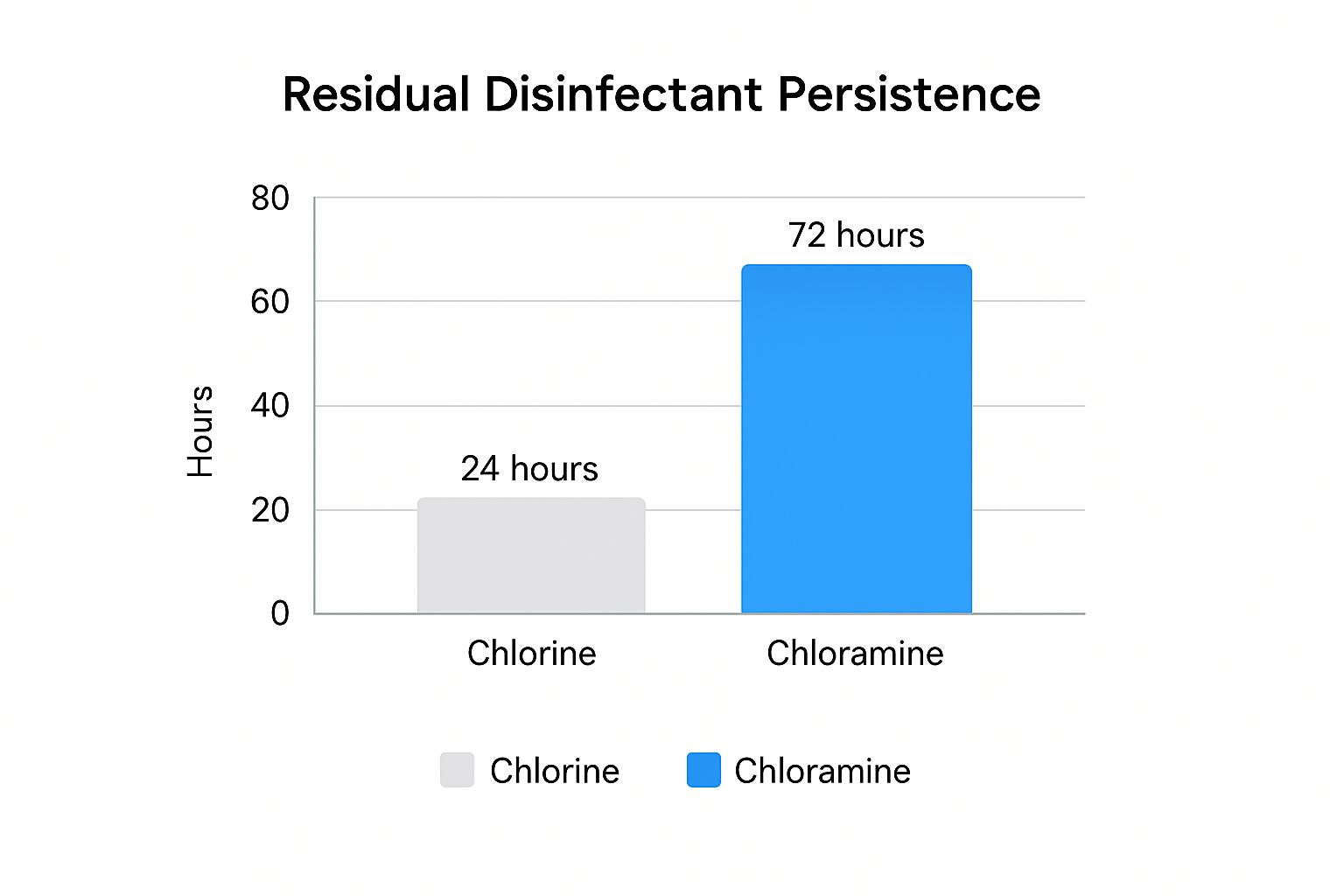
As you can see, chloramine's persistence is a huge plus for water utilities, lasting three times longer than free chlorine.
This isn't a brand-new idea. While chlorine has been used in water since around 1908, chloramine started popping up in the 1930s. The real push came more recently as regulations tightened to reduce harmful disinfection byproducts. In fact, between 2007 and 2010 alone, chloramine use jumped by about 37% in the U.S. as utilities sought safer alternatives. You can dig deeper into the history of water disinfection on NCBI.
While chloramine is a public health hero for your city, its stubborn nature can cause some real headaches inside your home. Once you get the downsides, you can decide if a home water filtration system is the right move for you.
Here are the most common reasons people want it gone:
Knowing why chloramine is used and why you might want it out of your life is key. The goal isn't just to remove a chemical; it's to get your water back to a state that's pure, pleasant, and perfect for everything you do at home.
If you’re on a mission to kick chloramine out of your water, you've probably heard about "carbon" filters. But here's a crucial secret most people don't know: not all carbon is created equal. The chemical bond in chloramine is notoriously tough—way more stubborn than plain chlorine—and your average carbon filter just can't crack it.
This is where a special kind of filter media enters the scene: catalytic carbon. Think of it as activated carbon's smarter, more powerful older sibling. While standard activated carbon just passively traps contaminants, catalytic carbon is engineered to actively break apart the chloramine molecule.
It works by triggering a chemical reaction that splits the bond between chlorine and ammonia. This catalytic action is the secret sauce, neutralizing the chloramine and leaving you with water that tastes, smells, and feels noticeably better. It's the gold standard for a reason.
Let me put it this way. Trying to remove chloramine with a standard activated carbon filter is like trying to open a high-security lock with a regular house key. You might jiggle it around and get lucky once in a blue moon, but it’s simply not the right tool for the job.
Catalytic carbon, on the other hand, is the master key cut specifically for that lock. It slides in, turns, and gets the job done instantly. It's built to promote the exact chemical reaction needed to dismantle chloramine, making it wildly more efficient and perfect for a home water filtration system.
This isn't just theory—it's a critical solution for the 20% of Americans whose water is treated with chloramine. With the right setup, catalytic carbon can slash chloramine levels by over 90%, all without tanking your water pressure. You can dive deeper into the official chloramine treatment guidelines on WQA.org.
The bottom line is this: you need a filter that does more than just trap stuff. For chloramine, you need a filter that actively dismantles it. That's what catalytic carbon does.
To help you see the difference, here’s a quick comparison of the most common filter options.
| Filtration Media | Effectiveness on Chloramine | Best For | Relative Cost |
|---|---|---|---|
| Catalytic Carbon | Excellent (90%+ reduction) | Whole-house (POE) or dedicated drinking (POU) systems specifically targeting chloramine. | $$$ |
| Standard Activated Carbon | Poor (Minimal reduction) | Chlorine removal, taste, and odor improvement. Not recommended for chloramine. | $ |
| Coconut Shell Carbon | Fair to Good (Moderate reduction) | Point-of-use filters where space is limited; better than standard carbon but not as effective as catalytic. | $$ |
As you can see, if chloramine is your main enemy, catalytic carbon is the undisputed champion, even with the higher initial investment.
Once you know catalytic carbon is the secret weapon, your next big decision is where to put it. This really comes down to two main strategies, each with its own pros and cons.
Let's break down what this looks like in the real world.
A POU system is a fantastic choice if your main concern is the water you drink and cook with. Think of an under-sink filter dedicated to your kitchen faucet. It's out of sight, relatively easy to install, and concentrates its filtering power right where it matters most for consumption.
Pros of POU Systems:
Cons of POU Systems:
If you're renting, living in an apartment, or just want to drastically improve the taste of your drinking water, a POU filter is often the most practical and effective solution.
Now, for the total home upgrade, there’s the point-of-entry, or whole-house, system. This is the go-to for anyone who wants to get chloramine out of every tap, shower, and appliance. By installing it at the main water line, you're essentially creating a protective shield for your entire home.
For instance, if you or your family members have sensitive skin, you know how drying shower water can be. A whole-house system removes that chloramine, which can make a huge difference in skin irritation and brittle hair. It also protects your expensive appliances—like the dishwasher and water heater—from the long-term corrosive damage chloramine can cause.
Pros of POE Systems:
Cons of POE Systems:
The choice between POU and POE really boils down to your goals and budget. Are you looking for a laser-focused fix for better-tasting water, or do you want a comprehensive, whole-home solution that benefits your health and your house?
While a whole-house catalytic carbon system is the undisputed champ for purifying your home’s water, it’s not always the right tool for every job. Sometimes you don't need to treat every single drop. You just need a quick, reliable way to neutralize chloramine in a small batch of water.
Think of these methods as the precision tools in your water quality toolkit—perfect for specialized tasks.
This is where chemical neutralization shines. Instead of filtering chloramine out, you add a substance that instantly breaks it down. It’s a fast, affordable fix for targeted situations where full-blown filtration is simply overkill.

One of the simplest and safest ways to knock out chloramine is with Vitamin C, specifically ascorbic acid. It's shockingly effective. A tiny pinch of pure ascorbic acid powder can neutralize all the chloramine in a gallon of water in just seconds.
This method has become incredibly popular for a few key reasons:
A perfect example is prepping bathwater. If you have sensitive skin, soaking in chloraminated water can leave you feeling dry and itchy. By adding about 1,000 mg (roughly a quarter teaspoon) of ascorbic acid powder to your bath as it fills, you can neutralize those harsh chemicals and enjoy a much gentler soak.
For homebrewers and aquarists, Campden tablets are the gold standard. These small tablets contain potassium metabisulfite or sodium metabisulfite, potent compounds that obliterate both chlorine and chloramine on contact.
Why are they so beloved by hobbyists? Because precision is everything. When you’re brewing beer, even a trace of chloramine can react with yeast and create a medicinal, plastic-like off-flavor called chlorophenol. One crushed Campden tablet is typically enough to treat up to 20 gallons of brewing water, keeping your batch clean.
It’s a similar story for fish owners. Chloramine is lethal to fish—it damages their gills and can quickly lead to death. Treating tap water with a Campden tablet before adding it to a tank is a non-negotiable step for a safe aquatic environment. Just be sure to follow the dosage instructions carefully, as a little goes a very long way.
Important Takeaway: Chemical neutralization is a fantastic tool for specific, small-scale tasks. Whether you're filling a fish tank, watering delicate orchids, or drawing a bath, these methods offer an instant solution without the cost of a full filtration system.
The science behind this is pretty straightforward. Compounds like ascorbic acid and sulfites are known as "reducing agents." They essentially donate electrons to the chloramine molecule, which forces its chemical bonds to break apart, rendering it harmless.
This chemical stability is exactly why standard treatments like UV light just bounce off chloramine. You need something that can chemically dismantle it. While catalytic carbon is the most robust filtration method, removing up to 90-95% of chloramines, chemical reduction with ascorbic acid or sulfites gives you an immediate alternative for specific uses. To dive deeper into these different treatment methods, check out the official guidance on chloramine from Health Canada.
So, how do you decide when to use a pinch of Vitamin C versus relying on your filter? It all comes down to the scope of the job.
These methods are ideal when you need a few gallons of chloramine-free water, right now. They are not, however, a substitute for a whole-house system. Constantly treating every glass of water you drink or all the water for your shower this way would be impractical. For everyday, whole-home protection, filtration is still king.
Feeling swamped by all the options for getting chloramine out of your water? Let's cut through the noise. Choosing the right filtration system isn’t about finding the single “best” one—it’s about finding the best one for you. It really comes down to a balance of your budget, your daily routine, and your home’s specific water situation.
The secret is to ask the right questions before you start shopping. Think of it like buying a car. You wouldn't get a two-seater sports car for a family of five, and you wouldn't try to parallel park a giant SUV on a tiny city street. Water filters are no different; the perfect fit is all about your circumstances.

First things first, let’s get a handle on the scale of your chloramine issue and what your daily water demands look like. A couple living in a small condo has completely different needs than a family of five in a sprawling house.
Start with your household size and how much water you use each day. A bigger family doesn't just drink more water—they also do more laundry, take more showers, and use more water for cooking. All that high demand puts a real strain on a filter, meaning a small under-sink unit might not be able to keep up.
This is where you need to be honest with yourself. Are you mostly worried about the chemical taste in your drinking water? Or are you also trying to stop chloramine from drying out your skin in the shower? Your answer will point you toward either a targeted point-of-use (POU) system or a comprehensive point-of-entry (POE) whole-house solution.
Let's look at a couple of real-world scenarios to make this choice clearer.
Scenario 1: The Family of Five
Meet the Millers. They've got three active kids, a dog, and a big house. They’ve noticed a chemical taste in the tap water, and their youngest's eczema seems to flare up after bath time. For them, a whole-house (POE) system with catalytic carbon is the clear winner. It’ll deliver chloramine-free water to every single faucet, protecting their child’s sensitive skin, making their drinking water taste better, and even helping their dishwasher and washing machine last longer.
Scenario 2: The Condo Couple
Now, picture Sarah and Tom in their two-bedroom condo. Their main goal is simple: get rid of the chemical smell in their drinking water and coffee. They don’t own the place, so a major plumbing overhaul for a whole-house system is a non-starter. A high-quality under-sink (POU) catalytic carbon filter is their perfect match. It's a more affordable, less invasive solution that fixes their main problem without treating water they aren’t even drinking.
If you happen to be building a new home, you have a unique opportunity. It's much easier to start thinking about integrating water quality solutions into your new home design from the very beginning.
Your choice isn't just about technology; it's about lifestyle. The best system is the one that seamlessly integrates into your daily life, solving your specific problems without creating new ones.
Once you've decided between a whole-house and a point-of-use system, it's time to dig into the specific models. Don't just get fixated on the price tag. The true cost of a system includes its performance, how long it lasts, and the maintenance it'll need down the road.
Here’s a quick checklist to keep in your back pocket:
Navigating these choices can be tough, but expert resources can really help. You can get more practical guidance and in-depth reviews by checking out the expert advice on water filters, which is great for comparing specific models.
By thinking through these key factors—your household needs, the right scale for the solution, and these performance metrics—you can go from feeling overwhelmed to feeling confident. You’ll be ready to pick a chloramine removal system that fits your home, your budget, and your life perfectly.
So, your new filtration system is in, and the water tastes fantastic. Job done, right? Well, not quite.
Getting the system installed is the big first step, but the real secret to enjoying chloramine-free water for years is consistent maintenance. Think of it like your car—you wouldn't just drive it forever without an oil change and expect it to run perfectly.
A little upkeep protects your investment and, more importantly, prevents that chemical taste from creeping back into your life. When you skip maintenance, you’re not just letting chloramine through; you could also be setting yourself up for lower water pressure or even damage to the system.
Your filter will start dropping hints when it needs some attention. The trick is to know what you're looking for before it becomes a major issue. Most of the time, the red flags are subtle at first, but they clearly signal that your catalytic carbon media is getting worn out.
Keep an eye (and nose) out for these tell-tale signs:
Your own senses are your best maintenance tool. The second you notice a change in your water's taste, smell, or flow, that's your filter telling you it needs help. Ignoring it just means you're no longer getting the clean water you paid for.
Staying on top of filter changes doesn't have to be a drag. The best way to handle it is to be proactive, not reactive. Set a schedule and stick to it, and your system will always be working at its best.
Here are a few tips to make it painless:
While this guide is all about your chloramine system, good homeownership involves keeping everything in order. For a bigger picture, you might find a comprehensive monthly home maintenance list helpful for keeping your whole property in great shape.
Ultimately, a little planning makes all the difference. Regular maintenance is the only way to guarantee your system keeps delivering the pure, chloramine-free water your family deserves. It’s a small bit of effort that pays off with every glass you drink.
When you start digging into how to get chloramine out of your water, you’ll run into a ton of questions. It's easy to get lost in a sea of myths and half-truths, so let's cut through the noise and get you some clear, straightforward answers.
This is probably the most common question, and the answer is a hard no. Those basic water filter pitchers you grab off the shelf at Target or Walmart? They almost all use standard activated carbon. That stuff is great for chlorine, bad tastes, and weird smells, but it's completely outmatched by the much tougher chloramine molecule.
Chloramine is chemically way more stable and just doesn't break down easily. To actually get rid of it, you need a filter specifically built for the task, which almost always means it uses catalytic carbon. Without that special media, your pitcher is just letting chloramine flow right on through to your glass.
Boiling is another old wives' tale that just doesn't hold up for chloramine. It works for free chlorine, which will gas off pretty quickly when you heat water, but chloramine is incredibly stubborn.
You’d have to keep a pot of water at a rolling boil for a ridiculously long time to even make a dent in the chloramine levels. Honestly, it's not a practical or reliable way to treat your water at all. You're much better off sticking with proven methods like proper filtration or chemical neutralization if you want real results.
Don't waste your time or energy trying to boil chloramine away. The chemical bond is simply too strong, making filtration with the right media the only truly effective household solution.
Now this one is a bit more complicated. A reverse osmosis (RO) system can be fantastic for chloramine removal, but there’s a catch: its success is 100% dependent on its pre-filters. The RO membrane itself, which is the real workhorse of the system, can't remove chloramine.
Good news is, any quality RO system is designed with this in mind. They come equipped with one or more pre-filter cartridges loaded with catalytic carbon blocks. These pre-filters are there specifically to tackle chloramine before the water gets to the sensitive RO membrane. This not only purifies the water but also protects the membrane from damage. If you're looking at an RO system, just make sure you see it's officially rated for chloramine reduction.
Finding out what’s in your tap water is actually simpler than you’d think. Your local water utility is required by law to publish an annual water quality report, which you might see called a Consumer Confidence Report (CCR).
This report is a complete breakdown of your water source, treatment methods, and what’s in it, including the specific disinfectant used. You can almost always find it on your utility's website, or just give them a call and ask for a copy. It will tell you in black and white whether you’re dealing with chlorine, chloramine, or a combination of both. No more guesswork.
Ready to stop guessing and start enjoying pure, chloramine-free water? The experts at Water Filter Advisor provide in-depth guides and unbiased reviews to help you find the perfect filtration system for your home. Explore your options and make a confident choice today at https://www.waterfilteradvisor.com.
