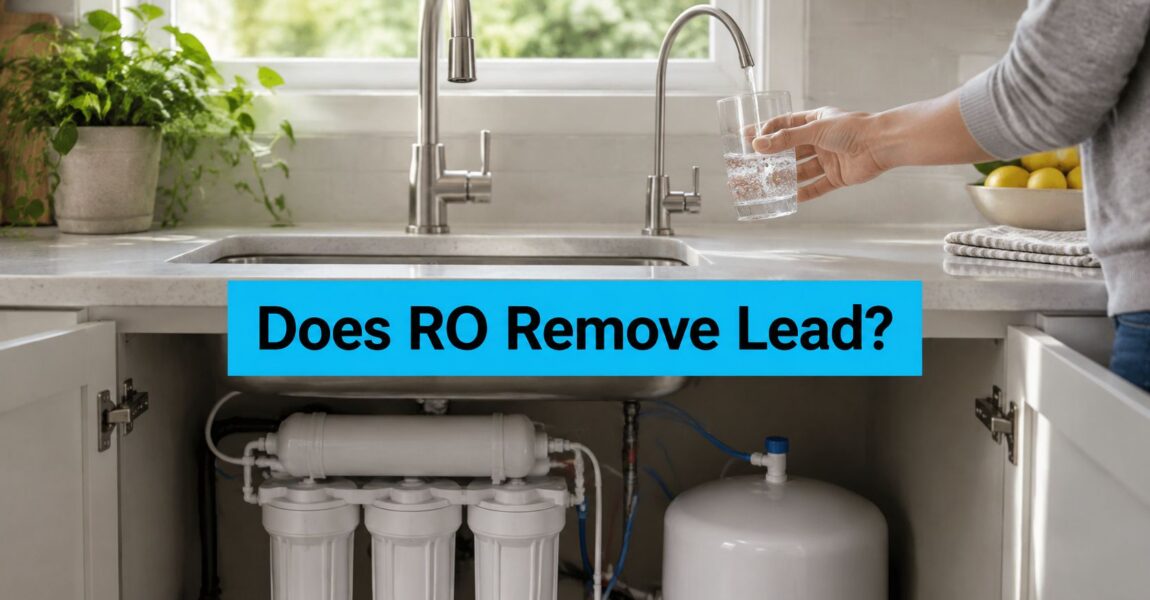
NSF/ANSI 58 testing starts with water containing 150 parts per billion of lead and requires a tested system to reduce it to 10 ppb or less, at least 93.3 percent removal. Some lab membranes have exceeded 99 percent. These figures describe tested systems and membranes, not every product with an RO label.
The membrane works like a very fine sieve: water passes through, while dissolved lead is held back. But the membrane is only one part of the path to your glass. A worn membrane can perform less effectively, and a faucet or brass fitting after it can add lead to the filtered water.
An RO label alone does not confirm lead reduction. Many RO labels do not show that the system was tested for lead, so check the product's specific certification and lead claim. The EPA's WaterSense performance summary for RO systems describes RO system performance, but it does not support the specific standard and lead-claim figures above.
The drinking spout matters too. Even when a certified membrane removes lead, corrosive RO water may pick it up from a downstream fitting. Testing the water at the tap helps show what reaches your glass.
Does Reverse Osmosis Remove Lead at the Kitchen Tap
A reverse osmosis system can reduce dissolved lead, but the result depends on the specific model and the water coming out of the drinking faucet. “Reverse osmosis” describes a treatment method, not a lead-removal result. Look for a system tested and certified for lead reduction, then remember that the water may meet other materials after it leaves the membrane.
The evidence below shows why lab performance and a household claim are not interchangeable.
| Evidence | Test condition | Lead result | Home takeaway |
|---|---|---|---|
| Bolivia pilot, Tarija and La Paz | Drinking-water sources; peak dose 50 mg/L lead at pH 5.7 | Rejection close to 99%; maximum 99.44% | A membrane can reject nearly all dissolved lead in a controlled pilot |
| 2025 pressure study | 10 bar; flux 67.44 L/m2/h | Maximum 99.75%; generally above 99% | High removal needs real pressure, not just an RO label |
| NSF/ANSI 58 lead claim | Influent water containing lead | The system must meet the standard's lead-reduction test | Check for a certified lead claim on the model you are considering |
Reading the Benchmarks Like a Shopper
The Bolivia pilot gives a useful picture of what a membrane can do under controlled conditions. Researchers modeling RO treatment for drinking-water sources in Tarija and La Paz reported rejection close to 99 percent, including a maximum of 99.44 percent for a solution dosed at 50 milligrams of lead per liter at pH 5.7 (the Tarija and La Paz reverse osmosis modeling study). That test used a lead concentration far above what a household should assume for its own supply, so treat the result as evidence of membrane capability, not a promise about your tap.
The same study describes an experimental run at 10 bar, with a flux of 67.44 liters per square meter per hour. It reached a maximum removal of 99.75 percent, with tested values generally above 99 percent. Pressure helps push water through the membrane while lead is held back. A lab setup can control that pressure, but the RO label alone does not tell you how a particular system performs at home.
For a household purchase, the certification row is the practical one. NSF/ANSI 58 includes an optional lead-reduction claim that a manufacturer must substantiate for the tested system. That matters because a model certified for other performance measures is not automatically certified for lead. Check the exact product and claim, rather than relying on a general description of reverse osmosis.
Read the claim, not the headline. A lab's high removal figure describes a particular test. A certified lead claim tells you that the named system was evaluated for lead reduction.
Even a certified membrane is only part of the path to the glass. Water can contact the storage tank, tubing, faucet, or brass fittings after treatment. If one of those parts contributes lead, the drinking-spout result can differ from the membrane's performance. The next step is to test the water at the tap you use.
How a Home RO Membrane Rejects Dissolved Lead
The parts matter more than the badge on the box, so follow the water from the supply line to the glass.
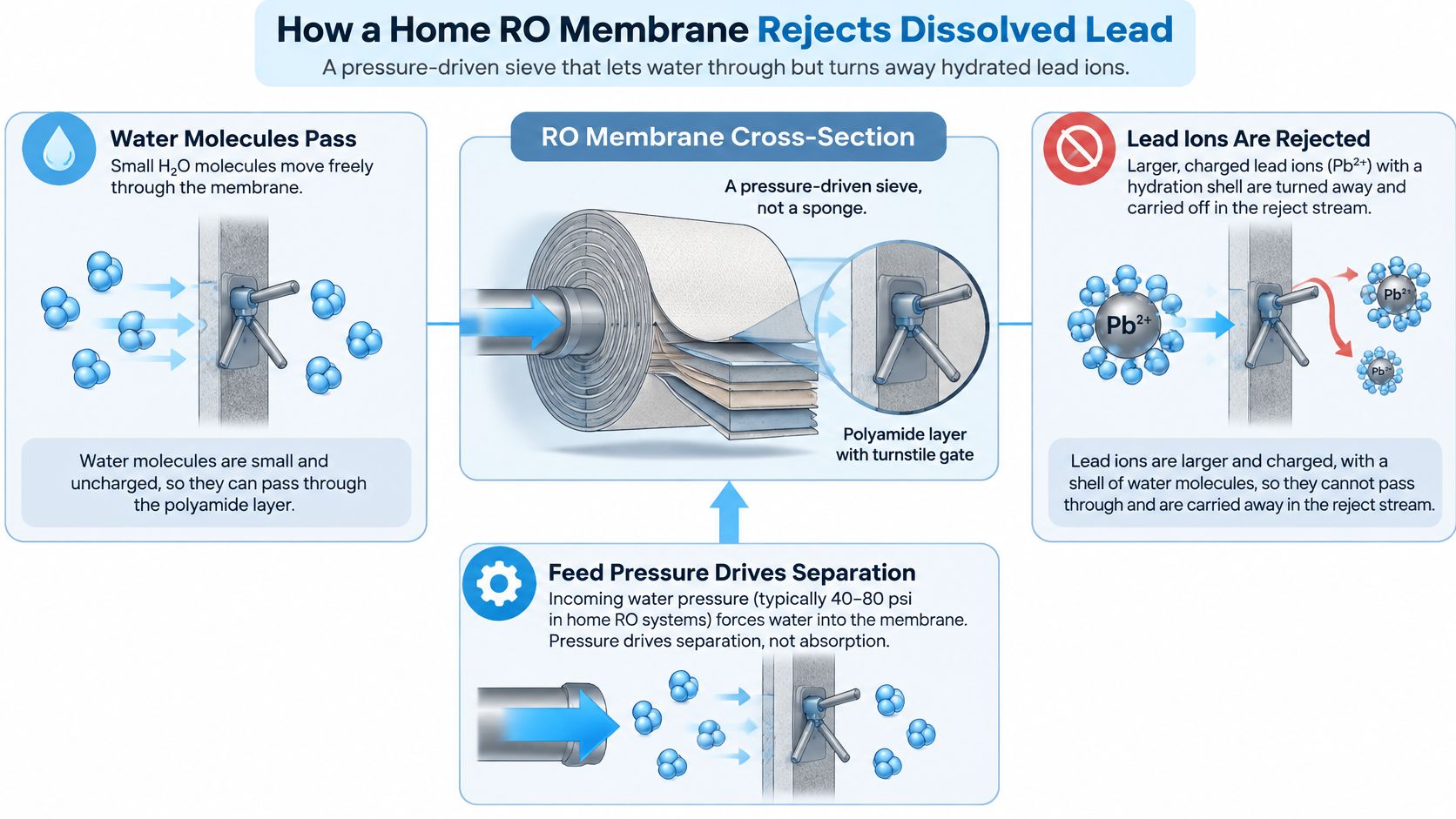
Think of the membrane as a turnstile, not a sponge. A water molecule is small and uncharged enough to slip through the polyamide layer when pressure pushes it. A lead ion is larger and carries a charge, and in water it drags a shell of water molecules around itself, so the gate turns it away and the reject stream carries it to the drain.
That's the whole trick. Hydraulic pressure drives water through a semipermeable barrier that prefers water molecules and rejects dissolved ions and larger species, which is exactly why the EPA's point-of-use reverse osmosis guidance calls lead reduction a potential capability of these systems rather than a promise.
The Parts Water Passes Before and After the Membrane
- Shutoff valve. Where the supply tees in, usually under the cold line.
- Sediment prefilter. Catches rust, sand, and silt before they foul the membrane surface.
- Carbon block. Strips chlorine, which would otherwise degrade many thin-film membranes long before their rated life.
- The RO membrane. The only stage in the stack doing lead work.
- Storage tank. Holds treated water under pressure, and holds it for hours.
- Polishing carbon. Cleans up residual taste before the glass.
- Dedicated faucet. The last thing the water touches, and often the most overlooked.
Only one of those seven is the lead step. The sediment and carbon stages improve taste and protect the membrane; they aren't what removes lead, and replacing them won't restore a spent membrane.
A carbon block is not a lead filter. In an RO stack its job is to eat the chlorine that would chew through the membrane.
The EPA guidance is blunt about the buying decision: performance is system-specific, so check the manufacturer's performance data sheet and look for an NSF/ANSI 58 claim covering lead. Where a system makes that claim, WaterSense expects the verified reduction to be reported; where it doesn't, the system should say plainly that it hasn't been certified to remove lead. One more limit belongs here. This hardware sits at a single drinking-water fixture, so it protects that tap and nothing else in the house.
What Changes Lead Removal in a Real Kitchen
A certification is a snapshot taken at installation. What happens in your cabinet over the next two years is a different experiment.
Where a Good Membrane Loses Its Edge
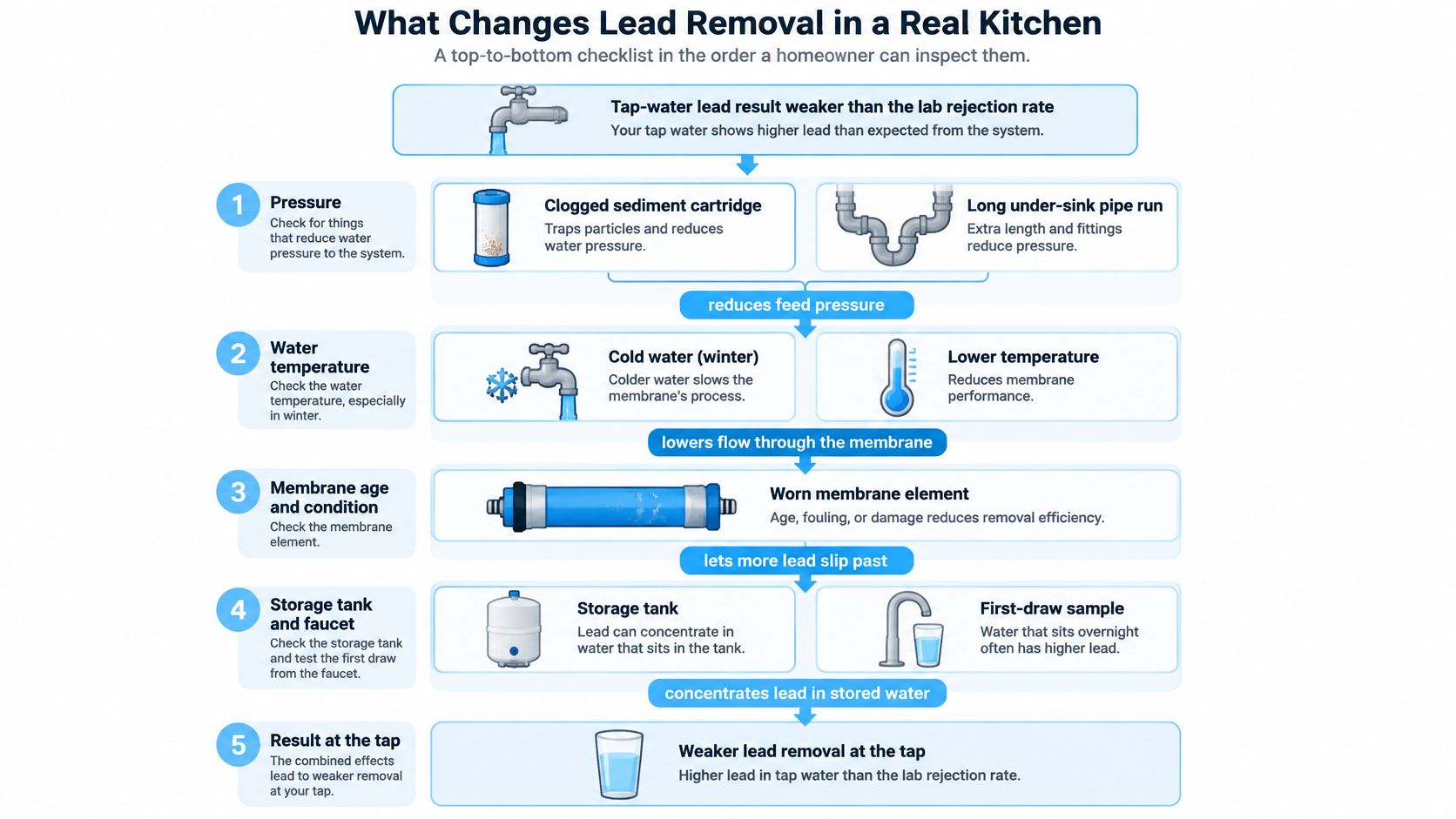
Three everyday conditions pull a certified unit off its pass mark.
- Feed pressure. A membrane separates lead because water is forced across it. Starve the feed with a browned-out sediment cartridge, a half-open saddle valve, or a long run of skinny tubing and you get less treated water and weaker rejection. Add a booster pump only if the manufacturer's instructions call for one.
- Pretreatment condition. Chlorine that slips past a spent carbon block attacks the membrane itself. That can end the lead step months before the printed membrane life, which is why the carbon change schedule matters as much as the membrane's.
- Water temperature and chemistry. Cold winter water, pH, and dissolved solids all change flux and output. A system that passed in July can look sluggish in January.
Here's a short walkthrough of how these systems are put together and where they typically go wrong.
Age is the quiet one. Replace cartridges and the membrane on the printed schedule rather than waiting for a taste change, and sample both incoming and treated water when lead exposure is plausible, especially in buildings with lead service lines, brass fixtures, or older plumbing. The EPA technology assessment of reverse osmosis treatment makes the same point from the certification side: a claim has to match the contaminant you care about, because not every RO system removes every contaminant.
A TDS pen cannot see lead. Total dissolved solids is a conductivity snapshot of everything dissolved at once. It tells you the membrane is working broadly; it says nothing about the one metal you're worried about.
Finally, the drain line. The concentrate carries the rejected lead with it, so it goes to the drain and never into a kettle, a humidifier, or the dog's bowl.
How to Confirm an NSF ANSI 58 Lead Claim
You can settle the label question in about five minutes, in the aisle or on the product page, with the model number in hand.
Five Steps From Box to Listing
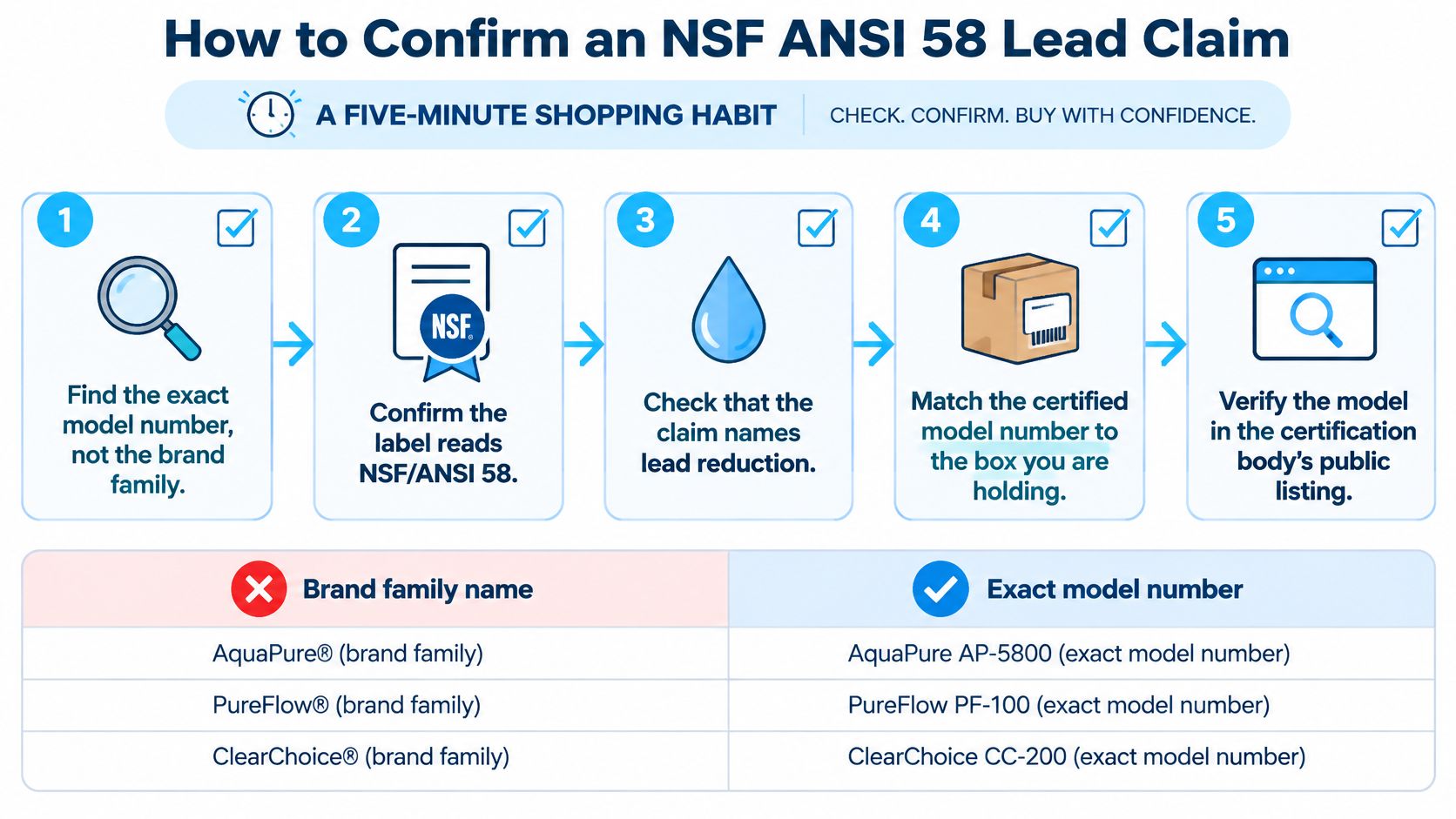
- Find the exact model number, not the brand family. Lead reduction is an optional, model-specific claim, so a sibling unit's certificate tells you nothing.
- Confirm the listing is for lead, not only for the total-dissolved-solids test that every certified unit has to pass.
- Read the pass numbers on the performance data sheet instead of a slogan like removes heavy metals.
- Match that model number to the box in your hand. Retailers swap revisions.
- Look the model up in the certifier's public listing before you install anything under the sink.
What the pass numbers look like: NSF states that certified systems are tested with influent water at 150 ppb of lead, which it describes as 10 times the EPA maximum allowable drinking-water level it cites, and must reduce lead to 10 ppb or less. That's at least 93.3 percent removal; where updated criteria use a 5 ppb endpoint, the bar is at least 96.7 percent (NSF's lead reduction certification listings).
The EPA's proposed WaterSense performance specification puts the same benchmark in regulatory language: lead tested at 0.15 milligrams per liter with a permitted variation of ±10 percent, and a verified reduction the manufacturer has to report.
| What the label says | Is lead specifically tested | Benchmark if it passes | What to do |
|---|---|---|---|
| NSF/ANSI 58 lead reduction for this model number | Yes, elective claim | 150 ppb down to 10 ppb or less, or 5 ppb under updated criteria | Match the replacement membrane to the same listing |
| NSF/ANSI 58 TDS reduction only | No | At least 75% TDS where the WaterSense baseline applies | Do not treat it as a lead filter |
| Removes heavy metals or up to 99% of impurities | Not by itself | No defined lead challenge | Read the performance data sheet before relying on it |
| No lead claim, or a note that lead is not certified | No | None | Use it for taste or TDS only and test if lead is a concern |
One more habit pays for itself. When the membrane comes due, buy a replacement that carries the same lead claim. A generic element can keep TDS reduction intact while dropping the contaminant you bought the system for.
If comparing models side by side is easier than reading twelve data sheets, our guide to certified lead water filters covers systems whose listings name lead rather than solids alone.
When the Faucet Adds Lead Back After the Membrane
A reverse osmosis membrane can reduce lead, yet water can pick some up again before it reaches your glass. The tank, tubing, faucet, and fittings all sit downstream of the membrane.
Lead reduction is an optional, model-specific claim under NSF/ANSI 58. An RO certification by itself does not show that the tank, faucet, or final fittings have been tested for lead. The NSF guidance on NSF/ANSI 58 reverse osmosis systems explains why you should check the specific model's lead claim.
Mapping the Kiosk Finding to Your Sink
Low-mineral RO water can be more prone to picking up metals from brass parts downstream. That concern applies to water kiosks, but the same basic setup can exist under a kitchen sink: treated water contacts fittings after it leaves the membrane.
A dedicated faucet may contain brass beneath its chrome finish. Water can also sit in the storage tank, or pass through a brass tee, saddle valve, or refrigerator line before reaching the glass. If those parts release lead, the membrane cannot remove it after the fact.
The practical step is to use lead-safe, certified post-treatment parts and avoid fittings whose materials are unknown. A sample taken before the tank or faucet only shows the water at that point in the system. It cannot tell you whether the final faucet adds lead back.
Test the water at the drinking spout. A membrane certificate covers its stated claim, not every part the water touches afterward.
How to Test Incoming and RO Water for Lead
Two samples tell you almost everything, and neither needs a plumber.
Sampling So the Result Means Something
- Take a first-draw sample from the kitchen cold tap after the water has sat overnight. Lead from pipes and old brass shows up worst in this sample.
- Take a flushed sample after the cold tap has run for a couple of minutes. The difference between the two tells you whether the plumbing or the supply is the source.
- Fill a third bottle from the RO faucet after the tank has rested, because that's the water you drink, including anything it picked up from the tank and spout.
- Use a lead-specific method that reports parts per billion. A TDS pen, a taste test, or a chlorine strip cannot see lead at these levels. A certified lab mailer or a lead-focused home kit is the right tool.
- Write inlet and treated numbers side by side and compare them with the 10 ppb certification endpoint on the label and with the utility-level action figure you hear about for city water.
- If treated water isn't clearly lower, or it climbs back toward those marks, stop using that faucet for drinking and cooking until you've found the cause: a missing lead certification, an overdue membrane, weak pressure, or a brass part after the membrane.
Our walkthrough of how to test water for lead at home covers kit selection and bottle handling in more detail than fits here.
Then fix and confirm. Replace the failed part, flush the tank to clear stored water, and retest before you trust the tap again. Households on a well should pretreat sediment first, because a membrane fouled in the first week will fail the retest and send you chasing the wrong problem.
Choose a Certified Under Sink System and Retest
If lead is plausible in your water, the decision tree is short. Start with an under-sink reverse osmosis unit whose exact model number carries an NSF/ANSI 58 lead-reduction claim. Not a system sold on total dissolved solids, and not a brand you remember from a commercial.
Pair that unit with a lead-safe dedicated faucet, tank, and fittings. The corrosiveness of low-mineral RO water is the reason: ordinary brass downstream of a very clean membrane is the one place lead can show up after you've paid to remove it.
Then prove it. Test at the drinking spout after installation, and again after every membrane change, using a parts-per-billion method and comparing inlet water with the glass you pour. A certified system plus a verified spout is the whole answer.
A few things worth skipping. Pitchers and basic faucet filters are taste tools unless their own certification names lead. Whole-house RO as a first move means high wastewater, pressure loss, and cost for water you mostly flush or wash with. And any claim on a box that doesn't name the contaminant and the model number is marketing, not data.
Retesting is the part people drop. Membranes age, tanks sit, and fittings get swapped. A one-time pass tells you about the day of installation, which is why the calendar matters as much as the certificate. Our Choosing a Water Filter guide walks through matching a certification to the contaminant you have, if you want to compare formats before committing to a cabinet.
Water Filter Advisor has spent years digging into the details that decide whether a filter protects a household, from certification language to sampling procedure. If you're weighing an under-sink system, our reviews and buying guides compare membrane systems, replacement schedules, and lead-reduction claims so you can match the right unit to your water instead of guessing from a box. Visit Water Filter Advisor to check a model, plan a test, and get your drinking tap verified rather than assumed.
- November 19, 2026
- Uncategorized
