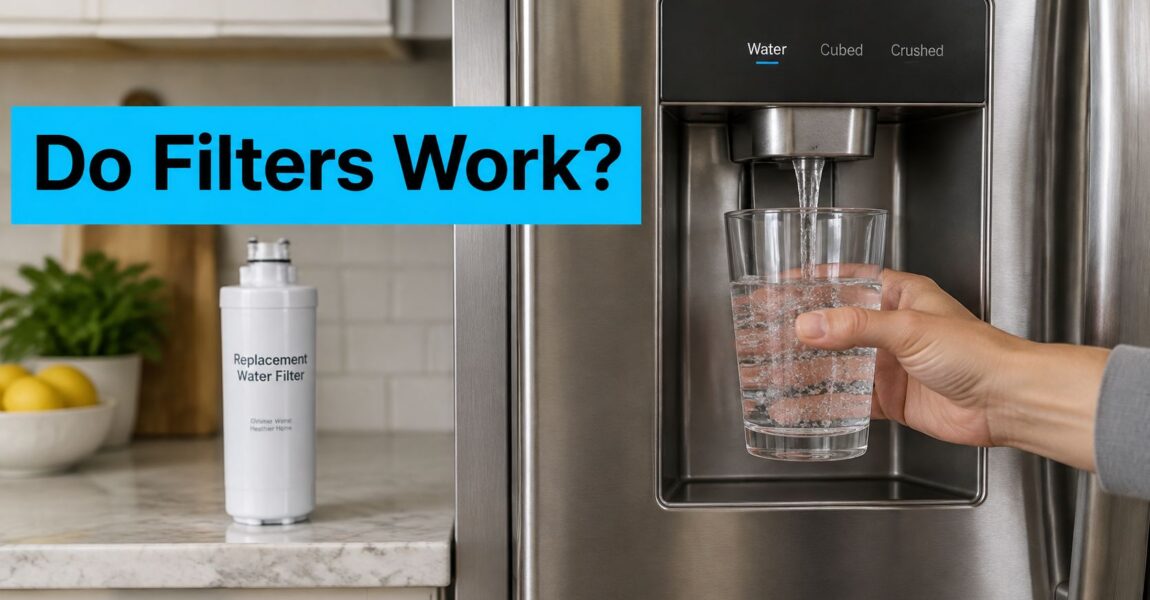
A refrigerator water filter works for the job most of them are built for, and that job is chlorine, taste, and odor, not lead, PFAS, or germs. The certification line is where the bar sits: a cartridge rated for lead under NSF/ANSI 53 has to pull water from 150 ppb of lead down below 5 ppb in the test lab, and a cartridge carrying only a taste-and-odor claim never had to clear that bar.
So the honest answer to do refrigerator water filters work is yes, some of them, for some contaminants, until the rated capacity runs out.
Run the tap at a friend's house and the water tastes clean. Run yours and the ice smells like a hotel pool. Both kitchens have a filter in the door, and the difference isn't the appliance. It's the cartridge, the claim printed on it, and how much life is left inside it.
The Short Answer for Home Tap Water
The dispenser light is off, the ice has gone flat, and nobody in the house can tell whether the cartridge is doing real work or just polishing the smell of the water. That uncertainty is the normal state of refrigerator filtration, because the appliance gives you almost no feedback about what it's removing.
Refrigerator filters can work. Whether yours does comes down to three things: the contaminant you actually care about, the independently verified claim printed for your exact model, and how much capacity is left in the cartridge.
Most of these cartridges are activated carbon sitting on one cold line that feeds the dispenser and usually the ice maker. The Centers for Disease Control and Prevention describes them as mainly intended to improve taste and smell rather than to provide broad protection against unsafe water, and the U.S. EPA guide to choosing a water filter draws the same line at the certification level.
That guide identifies NSF/ANSI 53 as the relevant certification for lead reduction, including dissolved lead, and NSF/ANSI 42 Class 1 for very small particulate matter that may contain lead. A filter marketed for taste and odor is not automatically a lead-removal device.
Here's the split the rest of this guide uses. Aesthetic problems such as chlorine taste and odor are the job these filters were built for. Lead, cysts, PFAS, iron, and microbes each need their own proof, and a cartridge certified only to NSF/ANSI 42 shouldn't be assumed to touch any of them.
A logo alone proves nothing. NSF states that manufacturers select specific reduction claims and that its certification verifies whether the product meets those claims. A box that says "NSF" or "purifies" without naming a contaminant tells you very little.
Pull the performance data sheet for your fridge model, set it beside the latest city water report or a home test result, and read the next section as the lookup between the two.
Find Your Contaminant on the Water Report
Get the document before you get the cartridge. Most U.S. utilities publish an annual Consumer Confidence Report, and many post it on a billing portal or a city website. Read it for lead, copper, PFAS, total coliform or E. coli, chlorine residual, hardness, iron, and any boil-water notice attached to the system.
Write down each detected contaminant and the level beside the health benchmark the report lists. Then sort what you found into three buckets, because they lead to completely different purchases.
- Taste and odor problems: chlorine, a sulfur smell, or water that tastes flat. These point toward a carbon filter that names chlorine on its claim.
- Health-related contaminants: lead, PFAS, or cysts. These point toward a specific certification, or toward a treatment type the fridge door can't provide.
- Microbial or emergency results: coliform hits, E. coli, or an active advisory. Follow local health guidance first, because the fridge dispenser isn't the tool for that job.
One caveat that catches people. The report describes water at the treatment plant or a sampling point, not necessarily the water at your kitchen tap. Older homes with lead service lines or brass fittings can add lead after the meter, so order a certified lab test when the report is silent on lead or your plumbing is old.
If the results are in front of you and the units look like a foreign language, our walkthrough on how to read water test results translates the benchmarks. Carry the exact contaminant name into the table that follows.
What Fridge Filters Reduce and What They Miss
| Concern | Typical fridge-filter result | Claim to verify | Treat as solved? |
|---|---|---|---|
| Chlorine taste and odor | Often reduced while the carbon is fresh | NSF/ANSI 42 for chlorine, taste, and odor | Yes, if that claim is on the exact cartridge |
| Chloramine | Not automatic with a chlorine filter | NSF/ANSI 42 naming chloramine | Only if chloramine is listed |
| Dissolved lead | Only with a lead-reduction claim | NSF/ANSI 53 for lead | Only with that claim, plus the particulate claim below |
| Particulate that may contain lead | Needs a Class 1 particulate claim | NSF/ANSI 42 Class 1 | Separate from dissolved lead |
| Cysts | Only if cysts are a listed health claim | NSF/ANSI 53 for cysts | Only if cysts are named |
| PFAS | Inconsistent carbon results, no guaranteed cut | Contaminant-specific certification, not a general NSF mark | No; consider reverse osmosis or a two-stage system if PFAS is the issue |
| Bacteria, viruses, and other germs | Most fridge filters aren't designed to remove them | Not a disinfectant | No |
| Iron and heavy sediment | May clog the cartridge before the gallon rating | Not a typical fridge-filter treatment | No; fix sediment upstream |
The Rows Homeowners Misread Most
Start with the top row, because it's the one these filters were designed around. A fresh activated-carbon cartridge commonly improves taste and smell by reducing chlorine, and the CDC's guidance on choosing home water filters confirms that's the main job, along with the fact that these cartridges may reduce heavy metals only when the claim says so.
Chloramine is the trap. It's a different compound from chlorine, and the same standard number doesn't cover it unless the listing names it. A filter that fixed a chlorine taste can leave a chloramine taste untouched.
Lead is where a single row splits in two. Dissolved lead and particulate lead are separate problems with separate claims, and a cartridge proven for one hasn't been tested for the other. That's why EPA wants both a lead-reduction claim and a Class 1 particulate claim when lead is the worry.
The bottom three rows are the ones marketing tends to blur. Carbon results for PFAS swing widely from model to model and from one water system to the next, germs are outside the design of most pitcher and fridge filters, and iron and sediment are more likely to clog the cartridge than to be treated by it.
One row, one purchase. Circle the row that matches your water report, then check that the cartridge names that contaminant. Anything on the box that isn't in your row is decoration.
How the Cartridge Changes Water in the Door
Water enters through a quarter-inch line, runs into the cartridge housing, and leaves through the dispenser and usually the ice maker too. One cartridge, two outputs. That's why ice can taste off when the glass seems fine: the same media feeds both, and a nearly spent cartridge shows up first in the slower, larger draw.
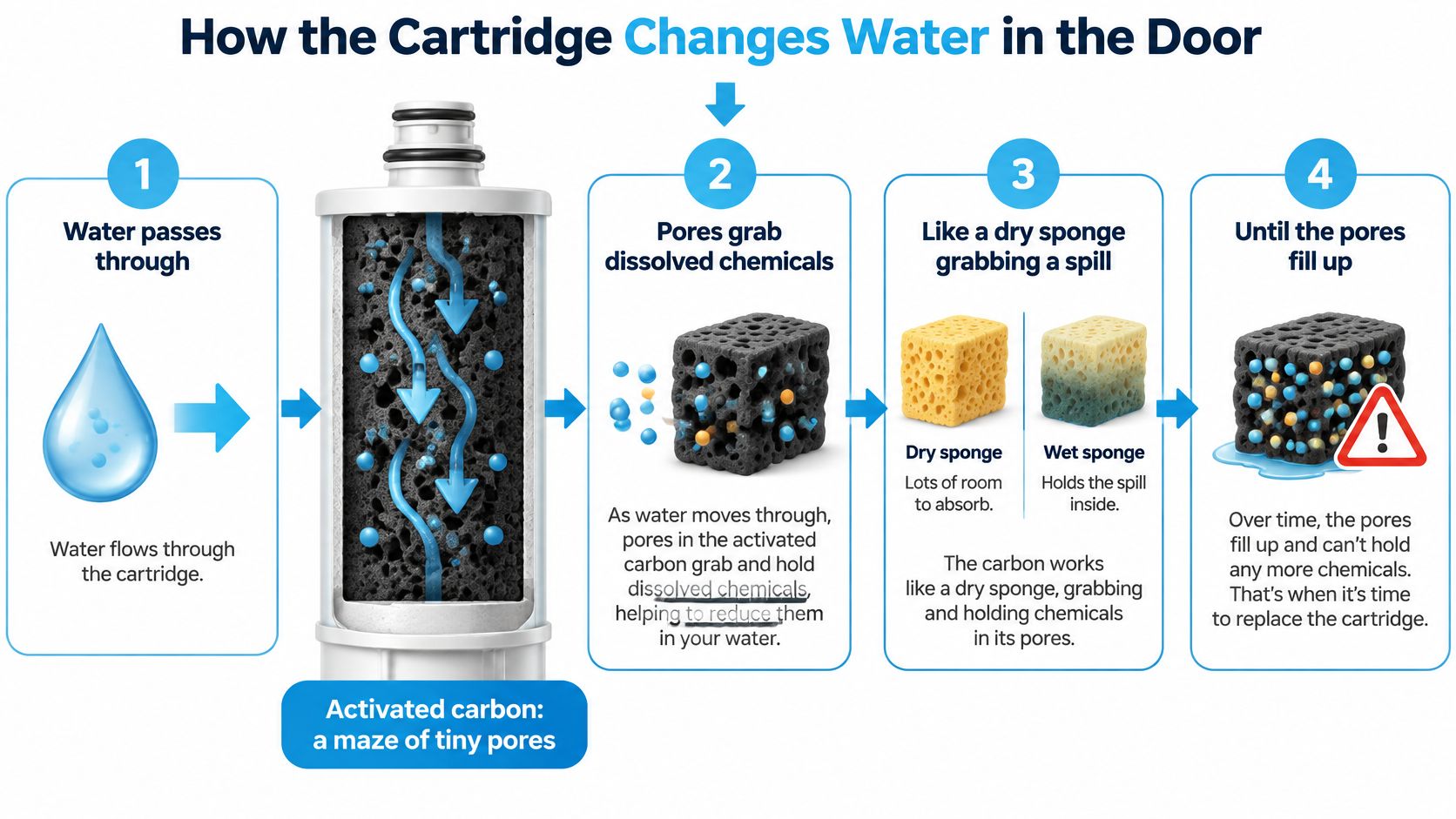
Activated carbon is a block of tiny pores, and the easiest way to picture it is a dry sponge taking up a spill. Water moves past millions of those pores, and certain dissolved chemicals stick to the carbon surface instead of continuing to your glass.
Adsorption isn't the same as straining. Chlorine and many taste-and-odor compounds bond to the carbon as water passes, while a Class 1 particulate claim is closer to catching very small bits before they reach the dispenser. Two mechanisms, two different promises.
What Saturation Looks Like
Once the pores fill, chlorine and other targeted compounds start passing through again. Nothing beeps. The water just drifts back toward its old taste, which is why a filter can seem fine one month and pointless the next.
A clogged cartridge causes the other failure. Flow slows to a trickle, and the usual fix in a busy kitchen is to bypass the cartridge or stop using the door altogether, which means unfiltered water from that point on.
Manufacturers choose which claims to test, so two black cartridges can look identical, fit the same housing, and hold proof for completely different lists of chemicals. Capacity works the same way. NSF's lead-reduction certification requires the manufacturer to state the filter's capacity, the volume of water that can pass through before replacement, and that number tells you more than any calendar sticker because real households empty a cartridge at wildly different rates. The stronger evidence set combines a named contaminant claim, an applicable standard such as NSF/ANSI 42 or 53, and a stated capacity, and you can check those listings in NSF's certification database before you trust the box.
Every certified claim is also tied to a tested flow rate. Force water through faster than that condition, by cranking pressure or fitting the wrong cartridge, and you're outside the proof entirely.
How to Check the Certification on the Box
You can run this check in five minutes at the kitchen counter with the old cartridge in one hand and the new box in the other. Keep the old cartridge for comparison, because brand families reuse names and packaging across models that don't share claims.
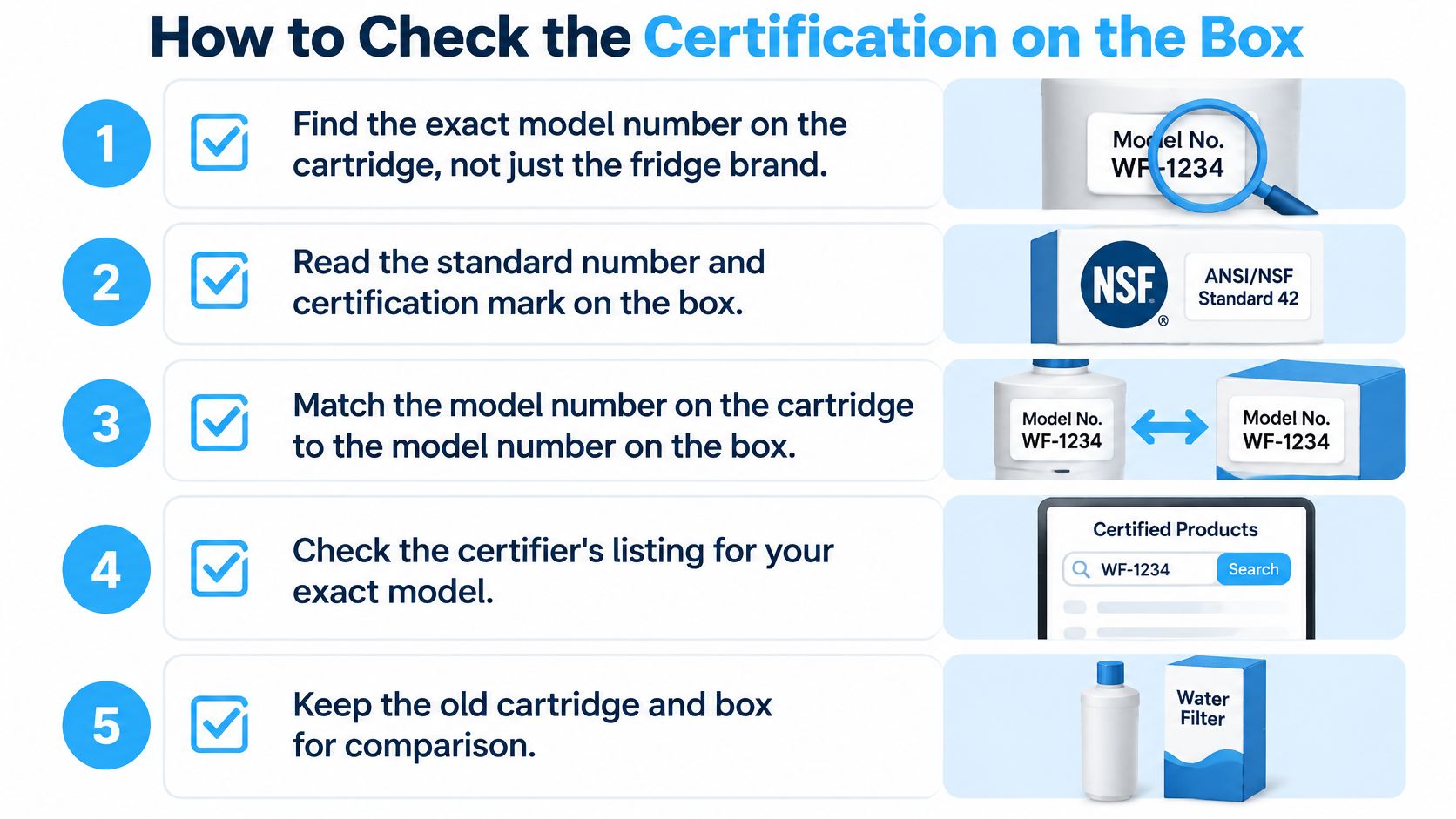
- Find the exact model number on the cartridge. Not the fridge brand, not the family name. The model number is the only thing a certification listing is keyed to.
- Read the standard number and the contaminant list as two separate facts. One tells you which test family applies, the other tells you what was tested.
- Treat NSF/ANSI 42 as the aesthetic family. The NSF explanation of standards 42, 53, and 401 places chlorine, taste, odor, chloramine, and particulates here, and only the ones printed for your model count.
- Treat NSF/ANSI 53 as the health family. Lead and cysts live here, again only when the contaminant is named on the package.
- Look the model up in an independent listing. Confirm three things at once: the claim, the product type (integrated, aftermarket refrigerator, or standard refrigerator filter), and the rated capacity.
Two filters can carry the same standard number and still have different approved reductions, because the maker picks the claims and NSF verifies those specific claims. That's the single most misread fact in this category.
Tested For Versus Certified to Reduce
The lead benchmark is worth knowing in one sentence: lead-reduction systems are tested with influent water at 150 ppb and must bring it below 5 ppb to qualify under NSF/ANSI 53, and NSF's lead-reduction listing shows that refrigerator, aftermarket refrigerator, and integrated refrigerator filters can all be evaluated against it. That's a lab condition, not a promise about your house, your pipes, or your flow rate.
"Tested for" is marketing language. "Certified to reduce" means an independent body checked the claim against a standard. If you want the longer version of how that system works, our explainer on what NSF certification means covers the mark and the testing behind it.
A general NSF reference, a certification logo with no contaminant beside it, or a claim borrowed from a different cartridge in the same brand family is not a match for your water.
When a Fridge Filter Is the Wrong Tool
PFAS is where the friendly advice falls apart. A 2025 Duke analysis of 76 point-of-use filters found that activated-carbon systems, the technology inside many refrigerator filters, removed 73% of tested PFAS contaminants on average, but the results were inconsistent and unpredictable. Reverse-osmosis and two-stage systems in the same Duke Nicholas School analysis reached at least 94% reduction.
An independent ACS study cited in that analysis found that only 68% of refrigerator filters tested showed significant removal of targeted PFAS compounds, and geography moved the number: some southeastern North Carolina refrigerator filters exceeded 92% removal, while central North Carolina filters removed about 50%.
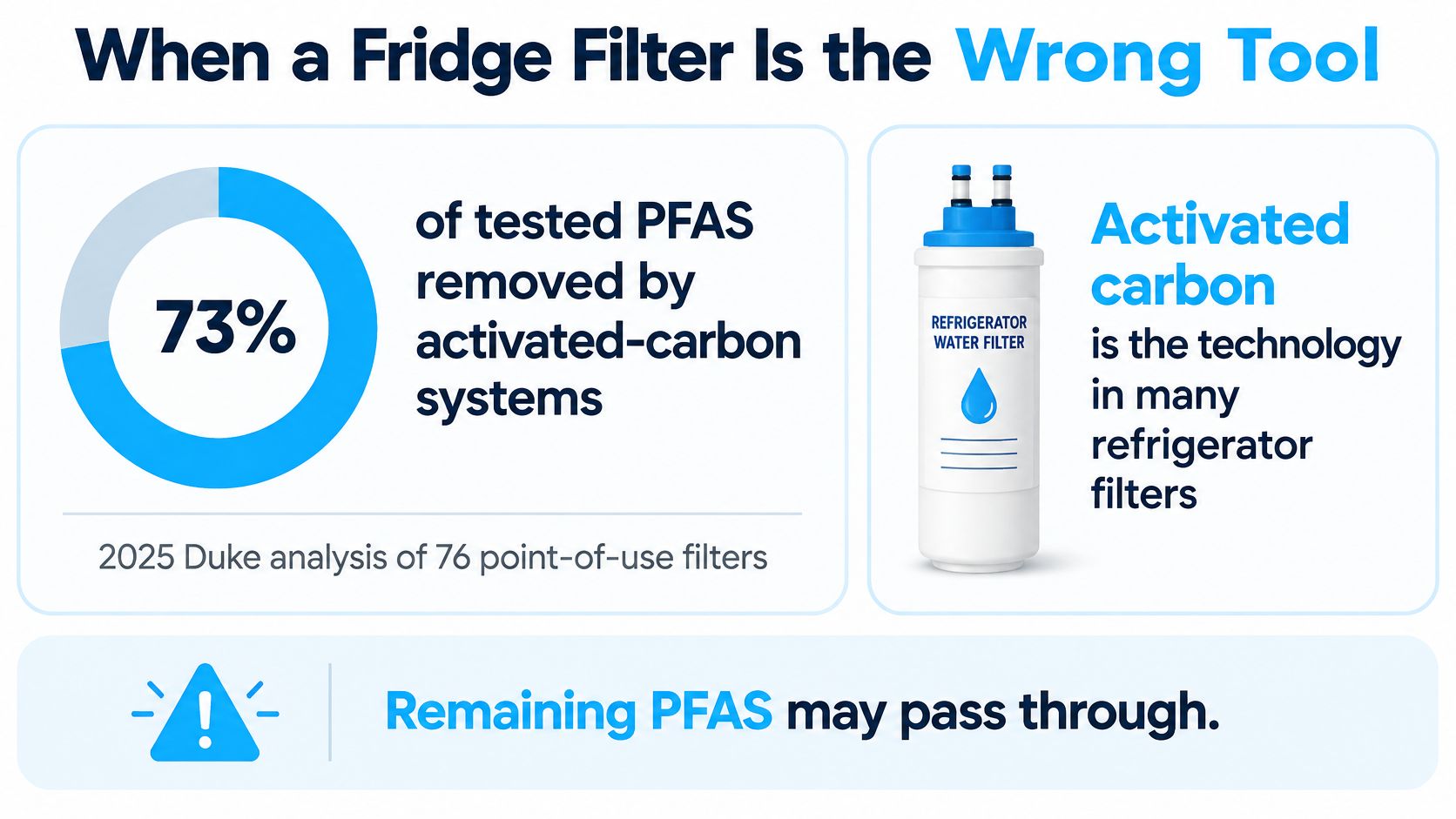
That's the pattern to hold onto. A cartridge can be excellent at chlorine and mediocre at the contaminant your water report flagged, and no amount of fresh-cartridge discipline fixes a technology mismatch.
The video below is worth a few minutes if you're weighing a fridge cartridge against a dedicated system.
Three Steps From Report to Purchase
Confirm the exact model carries a claim for every contaminant on your report. Not the category, not the brand. Your model number, in a listing, with that contaminant named. If lead is on the list, you want both the lead-reduction claim and the Class 1 particulate claim.
If a claim is missing, change the treatment type rather than the cartridge. PFAS, germs, and heavy iron are the usual triggers. Certified under-sink carbon, reverse osmosis, or a two-stage system sized for the specific problem is the honest next step, and it costs less over five years than replacing a fridge cartridge repeatedly for a job it was never certified to do.
If the report is silent, test before buying. A lab test on your own tap settles what no spec sheet can. We link readers to water test kits for the home supply for exactly this step, because guessing at the contaminant is how people end up with three filters and no answer.
Hardness belongs in a different conversation. A fridge cartridge doesn't soften water, and the visible cost of hard water turns up in kettles, irons, and showerheads. For that scale, a kettle and iron descaler is the practical tool, and a softener is the system decision.
Refrigerator filtration is treatment for the glass and the ice, not protection for the shower, the laundry, or the rest of the house.
When to Replace the Cartridge
A cartridge runs out on a gallon budget, not on a date stuck to the fridge door. NSF's certified refrigerator-filter listings show examples rated at 150 gallons and others at 250 gallons, both at a flow rate of 0.55 gallons per minute, alongside claims for chlorine, chloramine, particulates, taste, and odor. Those figures are model-specific, so read your own NSF certified refrigerator filter listing rather than assuming a number applies to your appliance.
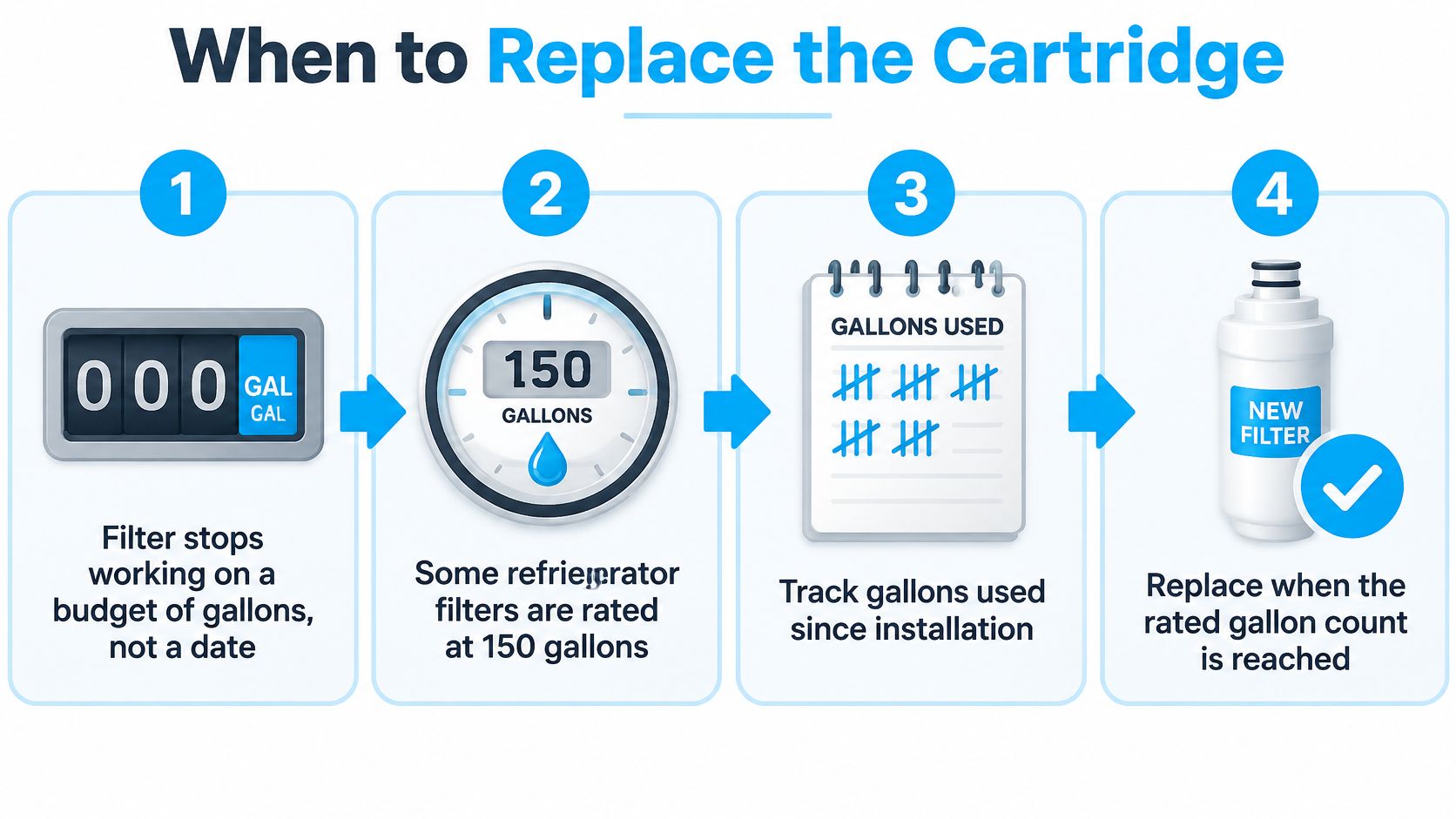
Translate the rating into your own kitchen. A family drawing several liters a day for drinking water and ice cubes will hit 150 gallons far sooner than a household that opens the dispenser for weekend guests. The calendar advice floating around assumes an average nobody lives.
Triggers That Beat the Gallon Count
Flow is the most useful signal you have, and Consumer Reports notes that a filter may stop being useful once dispenser flow slows substantially, even when the nominal lifespan hasn't elapsed, as summarized in NSF's guide to contaminant reduction claims. A sediment or rusty-water event is the second trigger, because it can load the carbon long before the gallon count. Chlorine taste returning is the third.
Public-health guidance is blunt about the stakes: poorly maintained or overdue filters, including refrigerator and icemaker filters, may stop performing as designed and can harbor bacteria. Replacement is a health step, not a taste preference.
Five-minute maintenance routine: record the install date and rated gallons, flush the new cartridge as the maker specifies before drinking or making ice, check the housing for leaks, replace at capacity or sooner if flow or taste changes, and confirm the replacement carries the same contaminant-specific certification.
That last point matters more than shoppers expect. A cheaper aftermarket cartridge that fits the housing but lacks your lead-reduction claim turns a working filter into a taste filter overnight. And bypassing a clogged cartridge to get the dispenser flowing again means nothing coming out of that door is filtered.
If your water report shows lead, PFAS, or a chlorine taste that keeps returning, the next step isn't another guess at the grocery shelf. Water Filter Advisor has compared refrigerator, under-sink, whole-house, portable, and shower filters since 2007, and we keep guides, water test kits, and plain-language certification explainers in one place so a lab result can turn into a specific purchase. Visit Water Filter Advisor to match the cartridge, the claim, and the contaminant before you spend another dollar on filtration.
- November 18, 2026
- Uncategorized
