If your cartridge box says six months, that number is only half the rule. The replacement date for a carbon filter is whichever comes first, the rated gallon capacity or the manufacturer's time limit, and six months is a common benchmark rather than a guarantee. Most household carbon filters land somewhere between about two months and three years, depending on the type.
So why does one home get a full six months from a cartridge while the identical model two streets away is spent in five weeks? Nothing is broken. Carbon doesn't wear out on a clock, it wears out on contact. Every liter that passes through spends a little of a fixed budget, and your water chemistry decides how fast that budget drains.
The University of Massachusetts Amherst fact sheet on activated carbon treatment puts numbers on the spread: small carbon units exposed to heavy contaminant loads may need replacement monthly or more often, while a six-month interval is frequently advised for cartridge filters. Every homeowner eventually asks how long do carbon filters last, and the only honest answer starts with two numbers printed on the packaging.
Typical Carbon Filter Lifespans by Filter Type
Most carbon filters last somewhere between two months and about three years, and your filter type narrows that range quickly. The table below is the default lookup. Find your cartridge, then check the figures on your own packaging, because a maker's rating always overrides a general range.
Typical carbon filter lifespans by filter type
| Filter type | Typical service life | Typical rated capacity | What shortens it |
|---|---|---|---|
| Pitcher filter | About 2 months | About 40 gallons | Hard or heavily chlorinated water, large households |
| Faucet-mount filter | About 3 months | About 100 gallons | High flow rates, sediment |
| Refrigerator filter | About 6 months | About 200 gallons | Well water, high organic matter |
| Under-sink carbon block | 6 months to 1 year | About 300 to 800 gallons | Sediment, chloramine, high daily use |
| Shower filter | About 6 months | Usually rated in months, not gallons | Hard water and hot water |
| Whole-house carbon tank | 1 to 3 years of media | Sized by bed volume in cubic feet | Sediment, iron, high flow |
Treat these as illustrative typical ranges for common household filter types, not promises. A pitcher cartridge from the grocery aisle and a whole-house tank plumbed into the basement aren't doing the same job: one polishes a few quarts a day, the other treats every tap, shower and washing machine load in the house.
If you want to know what's inside each of those cartridges, our guide to activated carbon media explains how block, granular and catalytic carbon differ and why the type changes the lifespan.
Every cartridge carries two limits. One is a time limit in months. The other is a capacity limit in gallons. Whichever arrives first is your replacement date, and which one wins depends on your household. A family of five pushing water through a faucet mount will hit the gallon limit long before the printed three months. A single person who fills a pitcher twice a day often hits the time limit first.
Don't assume a gallon figure transfers between brands, either. Ratings are established at specific test conditions. NSF's drinking-water certification listings show how much certified carbon products differ: one activated-carbon model is listed at 2,642 gallons at 0.8 gallons per minute for chlorine and taste-and-odor reduction, while another NSF/ANSI 42 test reports 4,000 liters for the same general claims. Different flow, different claim, different number.
Read the box twice. One figure is months. The other is gallons. You're looking for whichever runs out first.
Find your filter type in the table, read both the rated gallons and the rated months on your cartridge, and write those two limits where you'll see them, on the housing with a marker or in your phone.
Turning Gallon Ratings Into a Replacement Date
A gallon rating works like the mileage cap on a car lease. It counts actual wear instead of passing months, so it predicts when the carbon is spent far better than a calendar can. When a maker publishes both a capacity and a test flow rate, you can turn that rating into a real date for your kitchen.
NSF's drinking-water certification listings report service cycles in gallons, and product ratings run from a few thousand gallons to tens of thousands depending on cartridge design and contaminant claim. Pentair's NSF/ANSI 42-certified CB5-S carbon cartridges, for example, are listed with capacities from 3,000 to 30,000 gallons, with individual models rated at 3,000, 6,000 or 10,000 gallons. Take the 3,000-gallon model and watch what household size does to it.
Days to reach a 3,000-gallon rating at different daily use
| Daily use | Days to 3,000 gallons | Approximate months |
|---|---|---|
| 5 gallons per day | 600 days | About 20 months |
| 10 gallons per day | 300 days | About 10 months |
| 20 gallons per day | 150 days | About 5 months |
| 30 gallons per day | 100 days | About 3 to 4 months |
Same cartridge, a sixfold spread in working life. Say the box also prints a six-month time limit. The two light-use rows never reach their gallon rating, because the calendar gets there first. The heavy-use rows hit the cap early, the thirstiest in a little over three months. That is why "about six months" is such a rubbery answer to the lifespan question.
Do the Division in Four Steps
- Estimate daily drinking and cooking water per person. Count glasses, cooking water, coffee and the water used to rinse produce.
- Multiply by the number of people. Four people drawing a gallon each is 4 gallons a day before the dog bowl.
- Divide the rated gallons by that daily total. 3,000 divided by 4 gives 750 days.
- Compare the result with the time limit printed on the cartridge, then replace at the earlier of the two.
If you'd rather measure than estimate, read your water meter before and after a normal day, or fill a measured jug each time you draw from the filter for one week and add it up. Seven days catches the pattern, weekends included.
Then there's the caveat manufacturers bury in the fine print. Ratings are set under test conditions, at a specified flow rate and a specified water type, and real kitchens rarely match the bench. Any honest prediction has to account for contaminant level, flow rate, filter depth, prefiltering and the amount of carbon in the cartridge, and some cartridges wear out well ahead of the general recommendation as a result.
Do the division once, write the gallon-limit date next to the printed time limit, and circle the earlier one. The circled date is your replacement date.
How Water Quality Shortens or Stretches Filter Life
Carbon doesn't burn out, it fills up. Picture a parking garage with a fixed number of spaces and every glass of water sending more cars up the ramp. Once the spaces are taken, molecules drive straight through while water keeps flowing normally. That's breakthrough, and your water chemistry decides how fast the garage fills.
Which Water Chemistries Take Years Off
- Chlorine only, clean municipal water. The easiest life a carbon cartridge can have. Chlorine adsorbs readily and there's little competing organic matter, so the cartridge often reaches its printed date.
- Chloramine. Many carbon filters handle chloramine less gracefully than chlorine, so you'll change sooner. Check the cartridge is certified for it at all before you rely on it.
- Well water with iron, sediment or heavy organic matter. Life shortens, sometimes sharply, and you want a lab test before you set a schedule rather than after.
- Warm or hot water. Removal behavior shifts and the carbon fouls faster. Check the maker's temperature limit. Shower filters live in hot water all day, which is part of why they're rated in months.
- Flow above the rated value. Faster water means less contact time with the carbon bed, so it exhausts sooner. A flow restrictor earns its keep here.
- Short-chain PFAS. These bind weakly to carbon and can break through early. EPA's PFAS treatment presentation notes that short-chain PFAS can experience relatively quick breakthrough and require frequent replacement, and reports removal ranges of 40 to 99% for PFOA and 18 to 98% for PFOS.
A sediment prefilter is the cheapest life extension available, and it pays to be precise about why. It catches grit before it clogs the carbon's pores and keeps flow steady at the rated rate. It does not add contact time, and it does not restore adsorption sites. What it does is buy back the rated life you paid for by preventing premature clogging, and our guide to sediment water filter replacement covers how often those cartridges themselves need changing.
EPA research on granular activated carbon shows how wide the range runs: predicted GAC bed lives of roughly 3 months to 2 years, with 2 to 3 years typical for taste-and-odor control under the studied conditions, while some solvent-treatment designs reached about 11 months before replacement was indicated. Separate research on dissolved organic matter and PFAS breakthrough found that changing organic matter composition can cause earlier PFAS breakthrough in aged carbon and even desorption of shorter-chain compounds, reducing adsorption capacity by at least an order of magnitude in tested conditions.
Same house, same habits, shorter filter life. When your water source changes, your schedule changes with it, even if nobody in the household used more water.
Signs a Carbon Filter Is Spent Before Its Date
Two different failures get blamed on the same cartridge, and they need different responses. A clogged filter is blocked by sediment and announces itself as pressure loss. An exhausted filter has full adsorption sites and may announce itself as nothing at all.
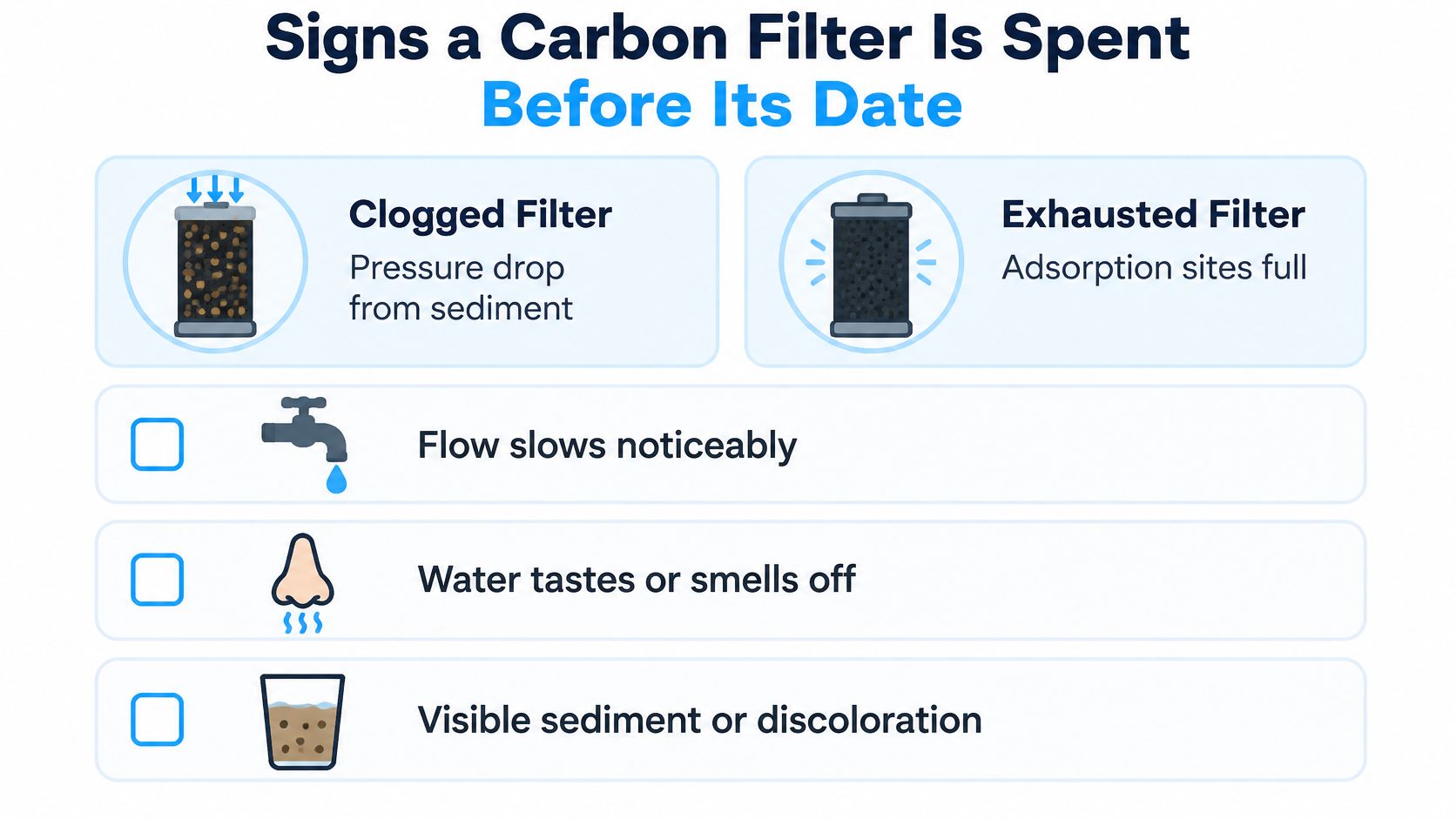
Here's the checklist to run every couple of months, between scheduled changes.
- Flow slows noticeably. Usually clogging rather than exhaustion. Pull the cartridge and look at it.
- Visible grit, sediment or cloudiness. Something is passing through, so the cartridge is done regardless of the date.
- Taste or odor returns. A real signal, but a late and unreliable one.
- Rated gallons reached. Change it even if the water seems fine.
- Time limit reached. Change it even if usage was light.
- A water test shows your target contaminant above where it should be. The only definitive answer where health is concerned.
The uncomfortable part is what happens between those signals. Full-scale research on PFAS removal by granular activated carbon found removal ranged from 92 to 100% in newer media but fell as low as 7% in older filters after up to 357 operating days and 29,300 bed volumes. The water still flowed at full pressure. Nothing tasted wrong. The same research found that biofilm aging can clog pores and reduce PFAS removal capacity, which means a cartridge can decline gradually and never give you a warning you can taste.
The EPA frames it around a single word: carbon becomes "spent" when the contaminant concentration in treated water reaches an unacceptable level, at which point the media has to be replaced with virgin or reactivated carbon, and the interval between replacements is what the agency calls carbon bed life, measured in days or months.
Taste is not a test. Lead, PFAS and VOCs can pass a carbon cartridge while the water still tastes clean and the tap still runs hard.
Replace on any one of these signs, and if health is the concern, trust the gallon rating and a lab test over your nose.
Three Households and Their Replacement Schedules
Numbers get friendlier once you attach them to a household. Here are three, all built on the same rule: capacity first, calendar second.
The solo pitcher drinker. One adult fills a pitcher filter rated 40 gallons, drawing about a gallon a day. Forty days of use exhausts the capacity while the box still advertises two months. The gallon limit wins, so the cartridge gets changed at just under six weeks. Same filter, earlier date, no drama.
The family of four on city water. An under-sink carbon block rated 500 gallons, with four people drawing about 8 gallons a day between drinking, cooking and the coffee machine. 500 divided by 8 is 62.5, so roughly 60 days. That's a two-month rhythm, not the six months the packaging suggests. A household that assumes otherwise spends four months drinking through a spent block.
The well-water home with iron. Iron, sediment and organic matter compete for the same adsorption sites as anything else you're trying to remove, so this schedule can't be copied from a municipal-water neighbour. Test first, add a sediment prefilter, and expect a tighter interval than the cartridge's headline rating.
A verified EPA test adds one more layer. An EPA environmental technology verification report describes a household system whose operating instructions required carbon filter replacement when the meter indicated either six months or 750 gallons. The filters were tested at a flow rate of 0.5 gallons per minute, the system's stated design capacity was 750 gallons, and testing examined 375 gallons, half of that capacity.
The lesson lies in why both numbers exist. Capacity tracks the water you treat. The time limit protects you when usage is uncertain, when the cartridge sat idle through a holiday, or when water chemistry shifted.
Find the household above that looks most like yours, then run your own arithmetic instead of borrowing mine.
Set Your Replacement Reminder Today
Everything above reduces to one habit: choose a date before you need it, and let a reminder carry the memory for you.
EPA WaterSense guidance on maintaining water treatment equipment is blunt about the cost of skipping this. Replace household treatment filters according to the manufacturer's instructions and schedule rather than waiting for obvious taste or odor changes. Activated carbon and resins are commonly used to trap contaminants and improve taste and odor, but poorly maintained systems can make water quality worse, and maintenance may include cartridge replacement, disinfection, mineral-scale removal and backwashing depending on the equipment.
Five Steps You Can Finish Today
- Write the installation date on the cartridge body or the housing in permanent marker. Not in your head.
- Record gallons used. Read the meter, or count fills with a measured jug for one week and multiply out.
- Set two reminders, one for the time limit and one for the gallon limit, and act on whichever fires first. A phone alert works, and if you'd rather not babysit it, you can set up always-on deadline reminders that keep a countdown visible instead of buried in a calendar you never open.
- Test your water once a year, and again after any change in supply. We link readers to water test kits for exactly this reason, because a year of guessing tells you less than one panel.
- Keep the packaging. It holds the rated capacity and the specific contaminants the cartridge is certified to reduce, and you'll want both when you buy the next one.
If the cartridge is there for PFAS, lead or VOCs, only a certified lab test confirms it's still working. Taste can't show you that, and neither can the label. When it's time to buy a replacement rather than just install one, our Choosing a Water Filter guide covers matching certifications to your test results before you spend anything.
The reminder is the safest signal you have. Follow it, not your nose.
Water Filter Advisor has been digging into home filtration since 2007, comparing pitcher cartridges, under-sink blocks and whole-house carbon tanks so households can work out their own replacement math instead of guessing at six months. If you'd like help matching a certified cartridge to what's in your water, visit Water Filter Advisor for replacement guides, testing advice and side-by-side comparisons.
- November 14, 2026
- Uncategorized
