In field studies reviewed by the U.S. EPA, 1,512 of 1,528 filters, or 99%, reduced lead to or below the certification benchmark in force at the time. Those units were NSF/ANSI 53 filters made after 2007. The result should reset how you shop for an under sink water filter for lead. A listed cartridge can work at a real kitchen tap. It still leaves a gap when the claim, the cartridge in the housing, or the replacement date does not match what was tested.
A utility that passes its sampling rules and a box that says "certified" are not the finished product. The product you own is the named lead claim on the data sheet, plus the date you change the cartridge. Pipes and fixtures inside the house can add lead after treatment. One filter on the cold drinking line only covers that line.
What a 15 ppb Lead Action Level Means at Your Tap
The figure many readers already know is 0.015 milligrams per liter, equal to 15 parts per billion (ppb), the federal lead action level measured at customer taps. Read it as a corrosion-control trigger for a public water system. It is not a declaration that 15 ppb is a safe amount in one home.
The response rule is specific. If lead is above 15 ppb in more than 10% of sampled taps, the system has to act. The usual tools are public education, corrosion-control changes, or lead service line replacement. A system can stay inside that rule and still deliver water into a house whose own plumbing adds lead.
A clean utility report tells you how the system performed on its sample set. It does not certify the glass you fill at 7 a.m.
Two kitchens show the gap. In the first, the cold line runs through older copper joined with lead solder. Compliance samples never sat in that branch overnight, so the utility can pass while the first draw at the sink does not. In the second, a home test finds lead even though the utility's sampling still clears the 10% test. The annual notice looks fine. The faucet does not.
An under-sink filter is a point-of-use device. It treats the cold line you plumb it to, which is the water you drink and cook with. Showers and bathroom taps stay on the untreated side of the cabinet.
Before you compare housings, find out whether this home has a known lead service line or a plumbing problem. Decide that a certified lead filter is warranted, then start shortlisting models.
Certified Filter Types and What the Lead Claim Covers
Technology names are a weak way to pick a lead filter. Certification scope is the comparison that matters. A five-stage stack with no lead listing can lose to a single carbon block that has one.
| Technology | What to verify for lead | Certification to look for | Typical replacement interval |
|---|---|---|---|
| Reverse osmosis | Dissolved lead reduction on the performance data sheet | NSF/ANSI 53 for lead; NSF/ANSI 42 Class I if listed | Prefilters about 6-12 months; membrane 2-3 years, per manufacturer |
| Certified carbon block | Lead claim tied to a named NSF/ANSI 53 test | NSF/ANSI 53 for lead; NSF/ANSI 42 Class I for particulate lead | Usually about 6 months, or sooner at high use, per manufacturer |
| KDF with carbon media | Lead reduction stated in the certification, not only the media type | NSF/ANSI 53 for lead | Usually 6-12 months, per manufacturer |
| Uncertified activated carbon | No independently verified lead claim | None for lead | Not reliable for lead removal; certification absent |
Two standards, two forms of lead
EPA consumer guidance treats NSF/ANSI 53 as the principal standard for lead reduction, including dissolved lead, and NSF/ANSI 42 Class I as the standard for very small particles that may contain lead. For drinking and cooking water, look for both. The same guidance says certification testing uses influent water with about 150 ppb of lead, about 10 times the former U.S. EPA maximum allowable level, and that you should not rely on the listing above that challenge. A stricter evaluation target assesses reduction to 5 ppb or less. One example protocol reports 99.5% reduction at pH 6.5 and 99.6% at pH 8.5, from about 150 ppb down to 5 ppb.
A carbon cartridge with no lead listing and a carbon block with an NSF/ANSI 53 lead listing are not the same product. EPA filter guidance is direct on this. A unit that lists only NSF/ANSI 42, or that merely says it uses activated carbon, does not establish certified dissolved-lead performance. Federal law does not require point-of-use filters to be tested or third-party certified, so the mark and the searchable listing are the independent check, not a legal guarantee.
What to read on the data sheet
Compare four items, not the stage count.
- Exact claim: The sheet should name lead reduction, not a general "impurities" line.
- Cartridge model: The listing has to match the cartridge you will install.
- Rated capacity: Gallons and months both belong on your calendar.
- System versus part: Confirm whether the certificate covers the assembled unit or only a component.
Our certified lead water filter notes walk through how to read that listing before you pay for hardware. Independent roundups, including filter recommendations from Praz Pure Water, are useful only after you have checked the same claim yourself.
Reverse osmosis is broader, and heavier to live with
A reverse osmosis unit with a certified lead stage removes a wide set of dissolved substances, not only lead. You pay for that with reject water sent to the drain, a storage tank or a larger manifold, and more than one replacement interval. A certified carbon block or a KDF-carbon cartridge with an NSF/ANSI 53 lead claim is the tighter fit when lead is the contaminant you have confirmed and cabinet space is short.
Keep only units with a verified lead claim. Then compare technology, space, wastewater, and what the cartridges will cost you each year.
Matching the Filter to Your Household Situation
Most buyers start in the same place. One kitchen tap supplies drinking and cooking, and a certified under-sink unit with a lead listing is the match. The cases around that default change the hardware, the schedule, or whether you should buy yet.
| Household situation | Likely filter approach | What to confirm first |
|---|---|---|
| Drinking and cooking from one kitchen tap | Certified under-sink unit with a lead claim | NSF/ANSI 53 lead listing for the exact cartridge |
| Recent plumbing work or known lead service line | Certified unit with earlier cartridge changes and retesting | Replacement schedule after disturbance; utility status |
| Well water with unknown lead | Test first, then choose a certified unit if lead is present | Lab results, since certification covers defined challenge levels |
| Several taps used for drinking | Point-of-use unit at each tap, or whole-house treatment | Which taps the filter covers |
| Renter with limited installation rights | Certified unit that can be removed without plumbing changes | Landlord approval and fitting requirements |
When the default is enough
A single cold drinking faucet, city water, and no recent pipe work is the straightforward case. Confirm the NSF/ANSI 53 lead listing on the exact cartridge, then stop shopping on stage count.
When the schedule has to tighten
Recent plumbing work, a known lead service line, or old brass fixtures call for a certified unit and a shorter fuse. Particles can spike after a disturbance even if last year's test was quiet. Plan an earlier cartridge change and a retest. Utility compliance status is context, not a substitute for the sample at this sink.
Well water with unknown lead is a different gate. Certification is built around defined challenge water, so a lab result comes before any housing goes under the cabinet. If the test is clear for lead, you may still want filtration for taste or other contaminants, but you should not buy a lead claim you have not shown you need.
Formula, extra taps, and renters
Households mixing infant formula or cooking daily on tap water should put the certified lead claim on the cartridge at the kitchen tap ahead of flow rate or finish. If several taps are used for drinking, one under-sink filter covers one of them. Either add a point-of-use unit at each drinking tap or look at whole-house treatment, and write down which taps stay untreated.
Renters need a yes from the landlord and a unit that comes back off without cutting pipe. A system that needs a new faucet hole or a permanent drain saddle is a poor fit if the lease forbids it.
If lead is confirmed or suspected, choose a certified lead filter. If lead status is unknown, test first. If several taps matter, plan coverage before you buy.
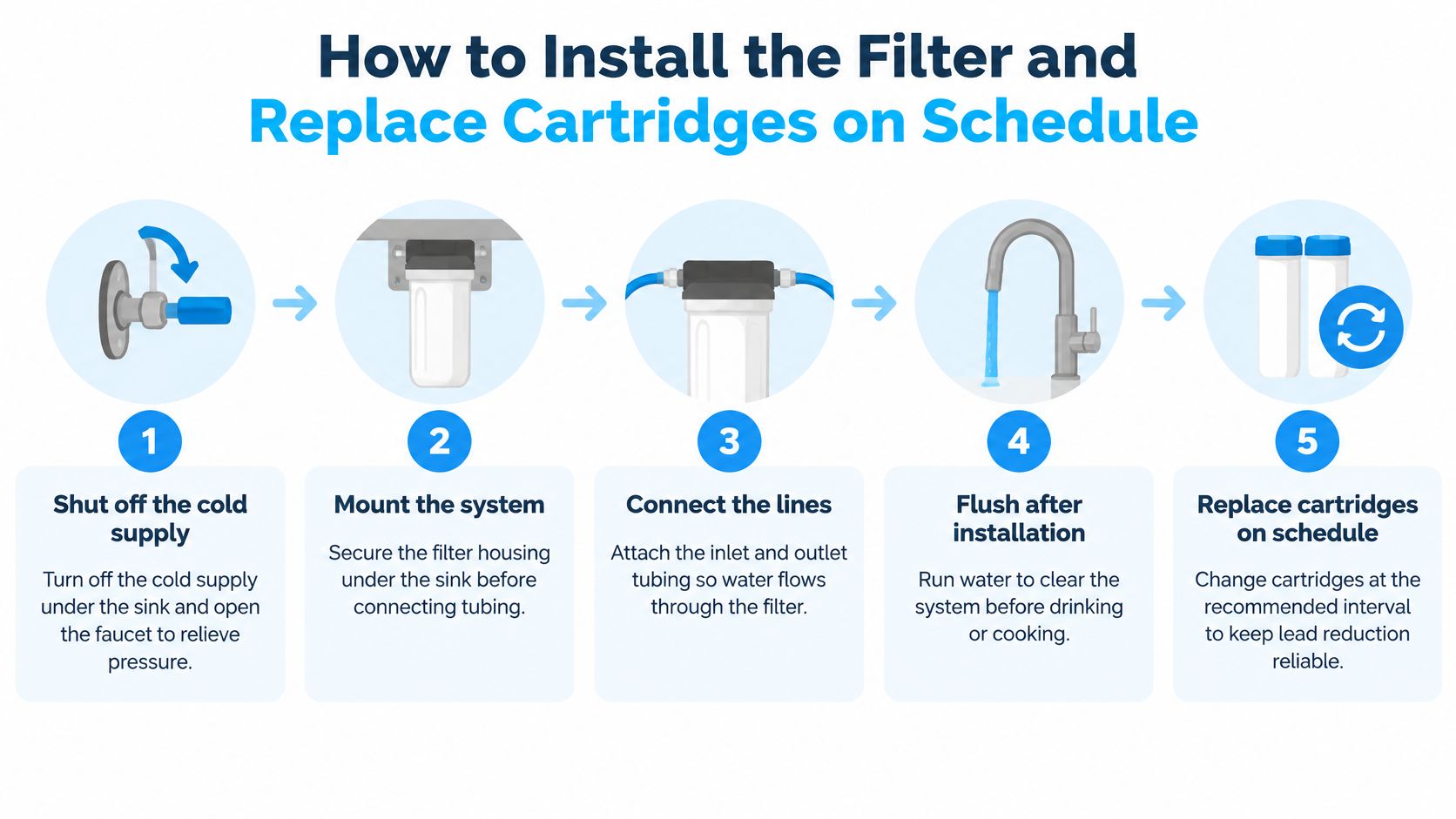
How to Install the Filter and Replace Cartridges on Schedule
Advertised gallon ratings assume the unit was installed in the right direction, flushed, and changed on time. Miss those steps and the listing on the box is no longer the filter in your cabinet.
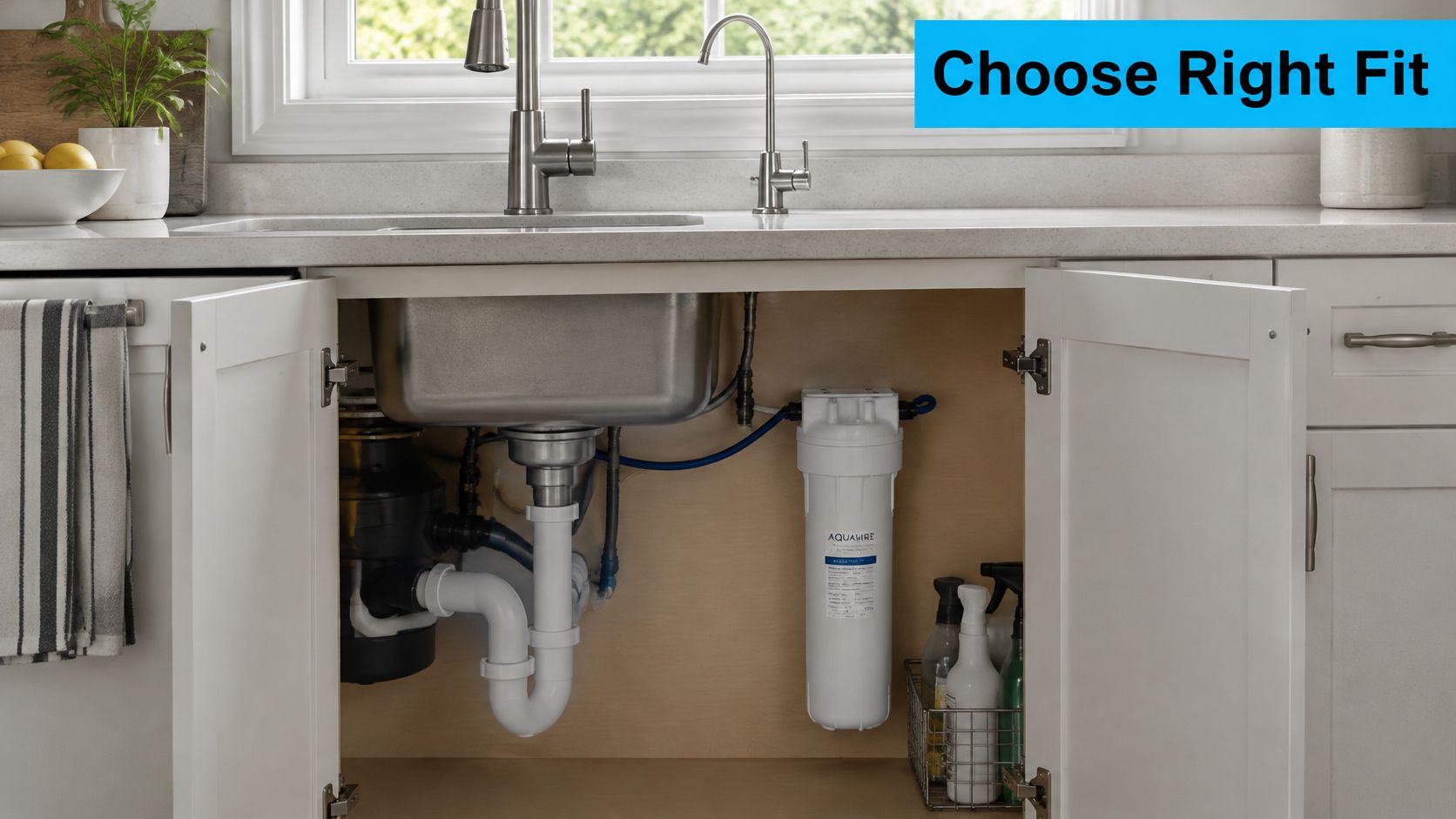
Clearance matters as much as the fittings. A tight cabinet, like the layout you can explore this Alexandria design project, has to share space with a disposal, supply lines, and cleaning bottles. Measure the housing against that space before you commit.
- Shut off the cold supply under the sink and open the faucet to relieve pressure. Trapped pressure makes fittings hard to seat and soaks the cabinet if a nut is only half on.
- Mount the filter head where the manual shows, and follow the flow arrow on the housing. Backward flow bypasses the media even when every joint looks tidy.
- Connect the supply and outlet lines with the supplied fittings. Hand-tighten plastic parts. A wrench on a plastic nut is how housings crack.
- Flush as the manual directs, often for several gallons, before anyone drinks. New carbon sheds fines that look like a failure and are not.
- Check every joint after the system has been pressurized for a day. Slow weeps show up after the first night, not during the install photo.
- Write the installation date and the rated capacity on the housing. A date on the plastic beats a reminder you meant to set.
The deadline is whichever limit arrives first
EPA lead guidance states that expired cartridges can become less effective at removing lead, and it tells users to follow installation, maintenance, and replacement directions. Track calendar time and throughput. Treat whichever limit comes first as the deadline.
A six-month rating with unusually high use, visible sediment, a lead-service-line disturbance, or a missed date is not a reason to "finish the cartridge." Change it early after plumbing work or after a shift in taste or flow. Replacement cartridges should be compatible with the system, claim lead reduction, and list NSF/ANSI 53 certification in the manufacturer's materials. A cheaper lookalike that only matches the thread does not carry the claim.
The same guidance notes that affected water systems must provide certified point-of-use devices and replacement cartridges after certain lead-line replacement work. Treat your own schedule the same way, as a risk-control plan. The filter protects only the treated tap. It does not cover the shower, the bathroom faucets, or any other line you left alone.
Verifying Performance With Testing and Limits
A listing predicts performance inside a test protocol. A sample at your tap tells you whether this install is inside that protocol.
- Test the cold water before you install anything, using a certified lab or a certified lead test kit. Our walk-through on how to test water for lead at home covers what a first-draw sample can and cannot show.
- Install and flush exactly as the manual directs. A sample taken during the flush measures carbon fines and air, not the filter's steady state.
- After the water has sat in the pipes for several hours, collect a sample at the treated tap. Stagnant water is where lead from solder and fixtures shows up highest.
- Retest after the first cartridge period, and again after any plumbing disturbance.
- Set the numbers next to two benchmarks, not one. The Lead and Copper Rule uses an action level of 0.015 milligrams per liter, equal to 15 ppb, at customer taps. That threshold is a measure of how a public system controls corrosion, not a finding that 15 ppb is safe in an individual home. If lead exceeds 15 ppb in more than 10% of sampled taps, the system must take corrective measures. Also compare your treated-tap result with the stricter 5 ppb point-of-use evaluation target used in certification protocols.
Where a certified cartridge stops being enough
NSF's lead-reduction listings describe testing at 150 ppb lead, and performance has not been evaluated above that level. Water that may sit above the challenge needs professional testing and guidance. Do not assume a certified cartridge handles any amount.
Say a homeowner replaces a fitting and the next first draw is high. Flush the line, then retest before you decide the filter is enough on its own. Particulate lead can appear in one sample and miss the next, which is why a single clean bottle is a weak proof. Repeat the sample.
A clean result at the treated kitchen tap proves that tap, on that day, under the stagnation you waited for. It does not prove the bathroom sink, the refrigerator line, or a pitcher someone filled from the hot side.
What Certified Filters Cost to Own
Price the cartridge schedule, not the box. Annual cartridge cost equals the price of each cartridge multiplied by how many times you replace it in a year. Pull both numbers from the exact model.
| Cost item | What drives it | Source to check |
|---|---|---|
| Replacement cartridges | Model price and replacement interval | Manufacturer listed replacement parts and the interval printed for that cartridge |
| Installation | Owner install with supplied fittings or licensed plumber | Local plumber quote, or the fittings in the box if you install it |
| Lead testing | Certified lab sample or home test kit, repeated after plumbing work | Lab or retailer price list for the kit you will repeat |
| Reverse osmosis wastewater | Gallons of waste per gallon filtered | Manufacturer data sheet for the waste ratio |
How the intervals change the yearly total
Use the interval that belongs to the technology you shortlisted. A certified carbon block is often about every six months at normal use, so a household that stays on that cadence buys two cartridges a year. Reverse osmosis prefilters often land at about 6-12 months, with the membrane at about 2-3 years, all per the manufacturer. High use or sediment shortens every one of those windows, and the extra cartridge belongs in the yearly total.
A carbon-block home can put two cartridge purchases side by side with a reverse osmosis set whose prefilters and membrane stretch over a longer schedule. Add the costs that never show up as a cartridge receipt. Reject water is a real operating cost on a reverse osmosis unit. Cabinet space is the other. Neither appears on the sticker.
Installation is either your time with the supplied fittings or a licensed plumber. The plumber figure is unknown until you get a local quote. A lead test is a repeating cost if you sample again after plumbing work or after the first cartridge period.
Cost is a tie-breaker among units that already have a verified lead claim. The cheapest housing with no NSF/ANSI 53 lead listing has no verified lead performance, so it does not belong in the price comparison at all.
Confirm Your Certification and Replacement Plan Before You Buy
Make the decision in order, and stop when a step says you are not ready to buy.
Confirm lead status first, from the utility report and from a home test when the report cannot speak for your faucet. Water Filter Advisor links readers to water test kits so they can check their home water supply, and the Choosing a Water Filter guide answers how to pick a unit once that result is in hand.
Select a unit whose listing covers dissolved lead under NSF/ANSI 53. Where particulate lead is a concern, also require NSF/ANSI 42 Class I. Match both claims to the exact cartridge model, not to the brand family.
Set the replacement schedule by time and by throughput, using the manufacturer's interval, and treat the first limit as the change date. Budget the annual cartridge cost from the ownership items above before you compare sale prices.
Schedule a retest after the first cartridge period and after any plumbing disturbance. A filter you never sample again is a hope, not a check.
Three things should leave this page with you.
- The claim: NSF/ANSI 53 for dissolved lead, plus NSF/ANSI 42 Class I when particles matter.
- The upkeep: the named cartridge and a schedule based on time and gallons.
- The proof: a test at the treated tap, repeated after the first cartridge and after pipe work.
If the utility report is missing or too coarse for this faucet, request the utility's lead status or order a certified lead test before you order a housing.
Water Filter Advisor publishes practical comparisons of under-sink and other home filters, with a focus on certified lead reduction and the cartridge schedule that keeps a claim honest. You can use the guides to match a listing to your tap, then look through test-kit options if you still need a sample. Visit Water Filter Advisor when you are ready to check the claim before you buy.
- November 10, 2026
- Uncategorized
