Whole House Water Filter NSF Certified: A 2026 Guide
NSF/ANSI 53 is the specific standard for health contaminants such as lead and cysts, whereas NSF/ANSI 42 covers taste and odor. A whole-house filter labeled NSF certified may improve chlorine taste without being certified to reduce health-related contaminants.
You turn on the kitchen tap, fill a glass, and the water looks perfectly clear. Then you notice a chlorine smell, a metallic taste, or a shower that leaves your skin feeling dry. The natural question is simple: does “NSF certified” mean the filter protects the whole family from everything that might be in the water?
It doesn't. NSF certification applies to specific standards, claims, and test conditions, not to every possible contaminant. A whole-house water filter can carry certification for aesthetic improvements while offering no certified protection against lead, PFAS, cysts, or chloramine.
That distinction matters because the right filter depends on your water problem. Before comparing housings, media, flow rates, or replacement cartridges, identify the exact NSF/ANSI standard attached to the reduction claim. The Water Filter Advisor guidance library offers additional homeowner-focused information for comparing filtration options.
Understanding NSF Certified Water Filtration
The confusion usually starts at the store shelf. A homeowner sees a large NSF logo on a box and reasonably assumes the product has passed one universal safety test. The label may look reassuring, but the standard number beside it tells you what the system was evaluated to do.
Think of certification like a plumbing inspection with a written scope. An inspector checking a water heater for leaks hasn't also certified the electrical panel, and a filter tested for chlorine reduction hasn't automatically been tested for lead or PFAS. The standard defines the job.
What the NSF mark actually tells you
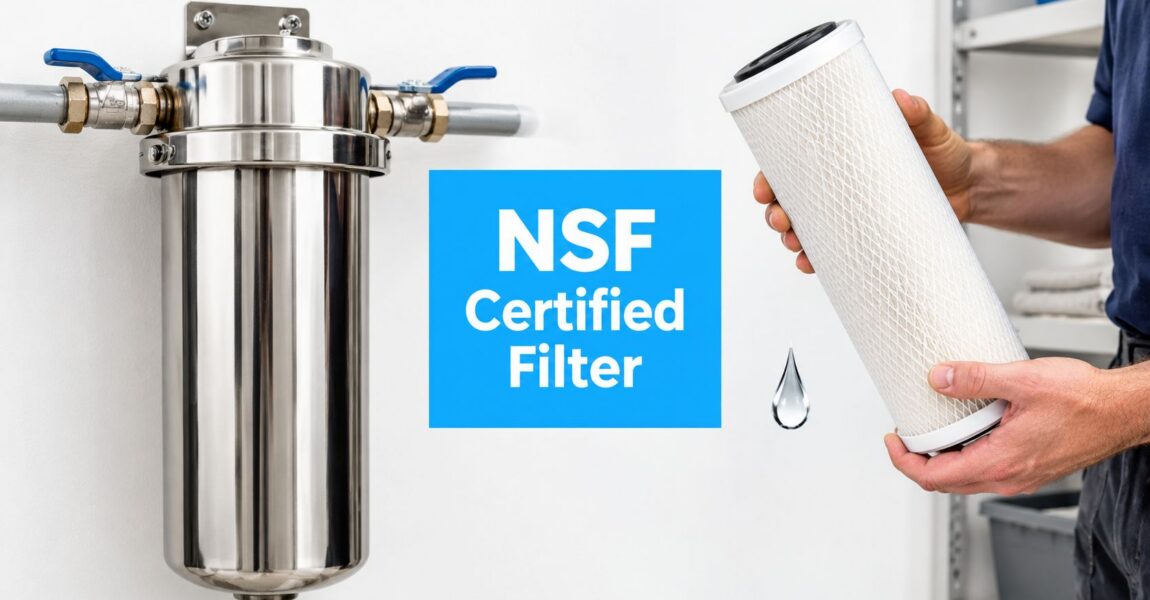
NSF's home water-treatment framework distinguishes point-of-entry systems, including whole-house filters, from point-of-use systems, which treat water at a particular fixture. NSF/ANSI 42 specifically covers point-of-entry systems designed to reduce aesthetic impurities such as chlorine, taste, and odor. NSF's water-filtration overview explains that certified home systems are evaluated for structural integrity, material safety, performance testing, and label claims.
For a pressurized whole-house unit, that scope is broader than testing loose filter media on a workbench. The housing and connected components must withstand pressure testing, the materials must not introduce contaminants, performance claims must meet pass/fail testing, and packaging claims must match official results. NSF also describes independent testing and ongoing verification, which gives certification more meaning than a manufacturer's internal statement.
Practical rule: Read the standard number and the certified contaminant claim together. The logo alone isn't enough.
NSF began testing and certifying water-related products in 1980, and standards 60 and 61 were completed by 1988, according to NSF's historical overview from Multipure. NSF later became NSF International in 1990, and it now reports more than 140 active public-health standards and independent testing protocols. Multipure's NSF overview also identifies NSF/ANSI 42 and 53 as important reference points for certified filters.
Why the distinction protects your budget
Suppose your main complaint is a swimming-pool smell throughout the house. A system certified under NSF/ANSI 42 may be a sensible match. If a water test also raises concern about lead, the same system might not satisfy that need unless its certification record specifically includes the relevant NSF/ANSI 53 claim.
A filter can therefore be properly certified and still be the wrong purchase. Certification isn't a promise that one cartridge handles every contaminant. It's evidence that a defined product, under a defined standard, achieved defined results.
Decoding the Key NSF/ANSI Standards
The standard number is the quickest way to separate a taste-and-odor filter from a health-focused system. Read it as a label for the filter's tested assignment, not as a score that ranks one product above another.
NSF/ANSI 42 for aesthetic effects
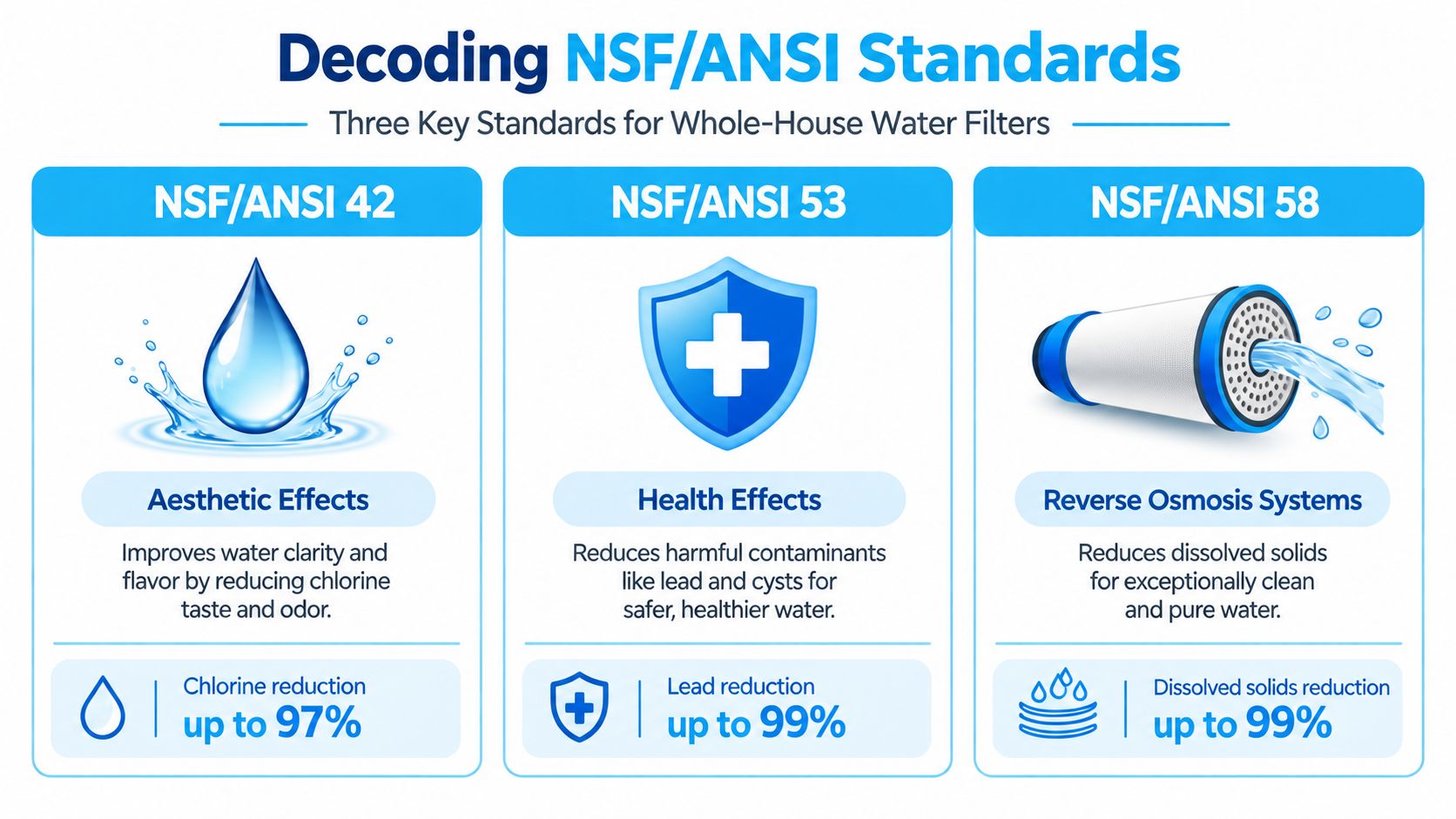
NSF/ANSI 42 addresses aesthetic impurities, including chlorine, taste, and odor. In a whole-house installation, that can improve water from multiple fixtures, so the benefit may be noticeable at the kitchen sink, shower, bath, and laundry connection.
This standard is useful when the problem is sensory or cosmetic. It can make water more pleasant to drink and reduce an objectionable smell, but it shouldn't be read as certification for lead, PFAS, cysts, or every other health-related contaminant. A 42-certified system may be exactly right for municipal chlorine, yet insufficient for a separate contaminant concern.
NSF/ANSI 53 for health-related contaminants
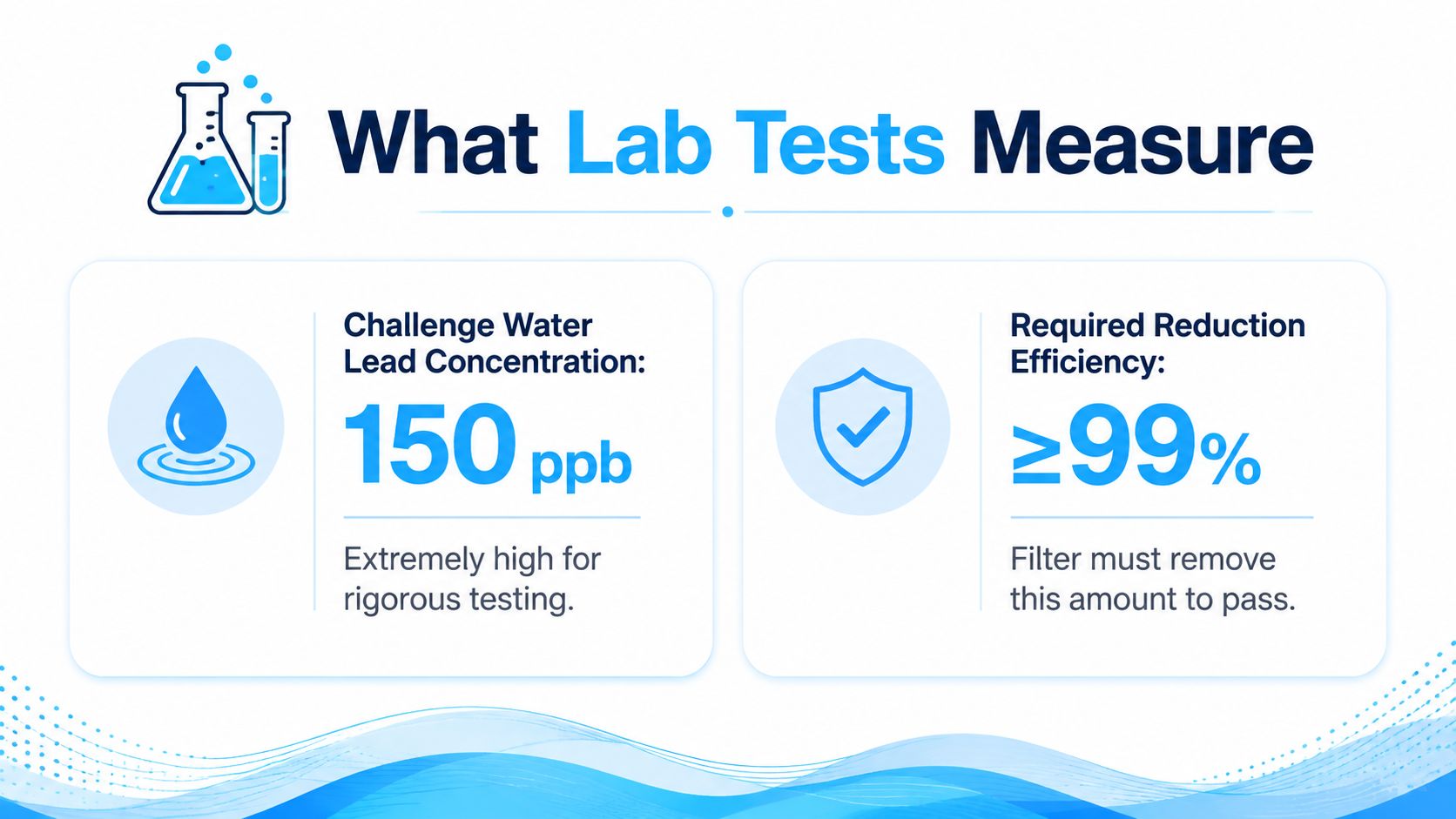
NSF/ANSI 53 covers health-related contaminant reduction claims. Lead and cysts are examples relevant to the homeowner choosing a drinking-water filter, but the certification still depends on the specific product record and listed claim.
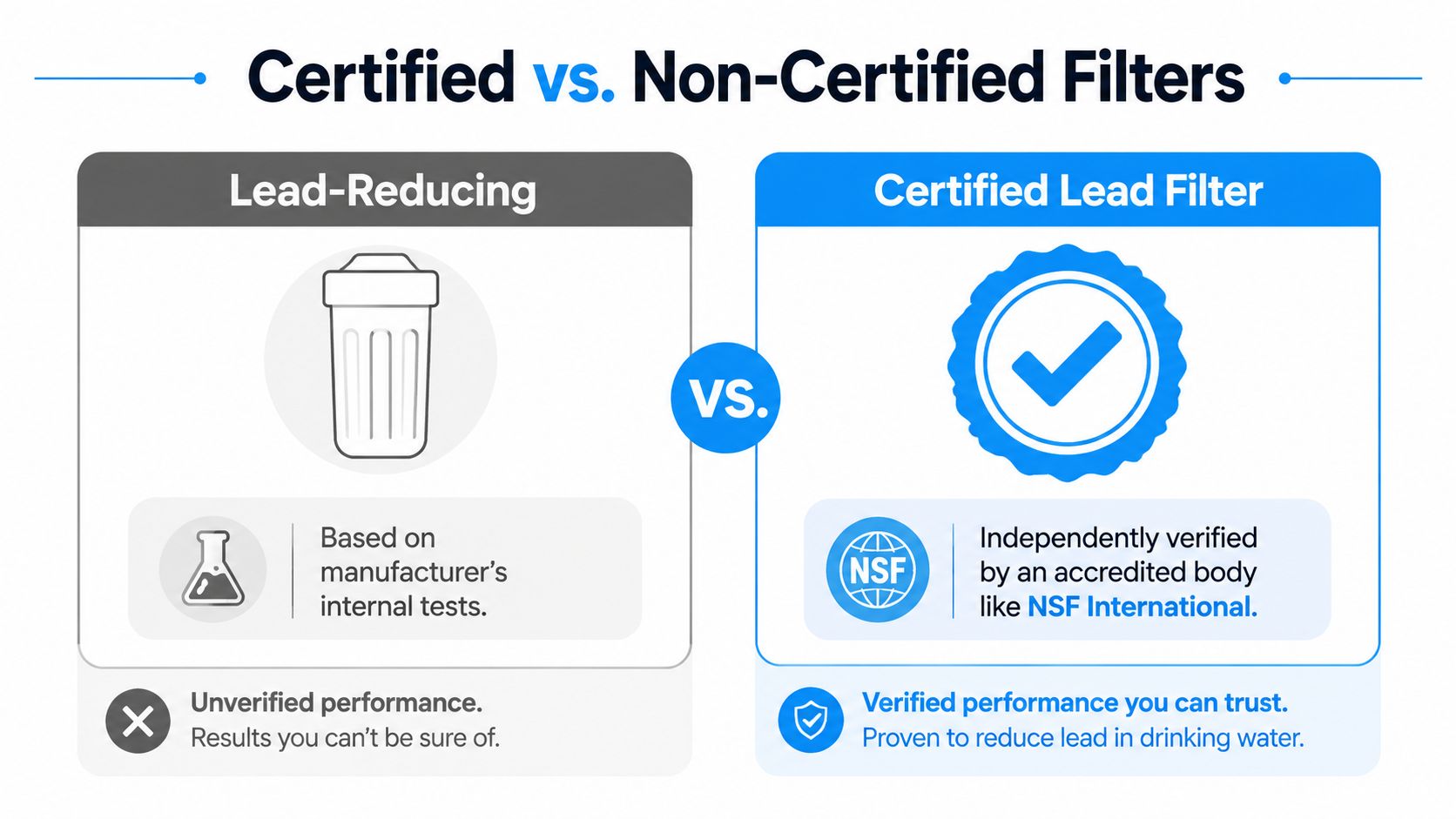
Many buyers make an expensive assumption. Seeing “NSF certified” beside a chlorine claim doesn't prove the unit has passed testing for lead. The CDC's guidance on choosing home water filters explains that manufacturers choose which contaminants to certify for, so the label alone doesn't reveal performance against lead, PFAS, cysts, or chloramine.
NSF/ANSI 401 for emerging contaminants
NSF/ANSI 401 addresses emerging contaminants identified in published studies. NSF says the standard covers up to 15 emerging contaminants, including pharmaceuticals and other trace compounds. NSF's explanation of standards 42, 53, and 401 shows why modern filtration claims extend beyond chlorine and lead.
The practical question is not whether a product mentions “emerging contaminants.” Ask which contaminants the exact model is certified to reduce. A broad-sounding phrase in an advertisement isn't a substitute for a listed standard and claim.
NSF/ANSI 372 for lead-free materials
NSF/ANSI 372 focuses on lead content in water-contact materials. That makes it useful for evaluating whether components are designed to meet lead-free material requirements, but it isn't the same as NSF/ANSI 53 certification for reducing lead already present in the water.
The difference is similar to checking the plumbing pipe versus checking the treatment result. A 372 claim concerns the material itself. A 53 claim concerns reduction of a specified health contaminant under the applicable test conditions.
| Standard | Focus area | Key contaminants or claims |
|---|---|---|
| NSF/ANSI 42 | Aesthetic effects | Chlorine, taste, odor |
| NSF/ANSI 53 | Health-related reduction | Lead, cysts, and other listed health contaminants |
| NSF/ANSI 401 | Emerging contaminants | Pharmaceuticals and other listed trace compounds |
| NSF/ANSI 372 | Water-contact materials | Lead content in components and materials |
NSF/ANSI 58 is also important when the product is a reverse osmosis system, particularly for drinking-water treatment. The EPA's PFAS filter guidance advises consumers to look for NSF/ANSI 53 or NSF/ANSI 58 certification when choosing a home filter for PFAS reduction, including PFOA and PFOS, and to verify the listing through the certifying body's directory.
Point-of-Entry vs Point-of-Use Systems
A whole-house filter is a point-of-entry, or POE, system. It sits on the main water line, so treated water travels to the fixtures throughout the property. A drinking-water filter installed beneath the kitchen sink is a point-of-use, or POU, system, because it treats water at one selected location.
The installation point changes the job. A POE filter can address water used for bathing, cooking, washing, and drinking, while a POU system concentrates its treatment on the tap where people consume water. NSF's home water-treatment framework distinguishes these categories and evaluates certified systems for structural integrity, material safety, performance, and label claims.
Choose POE when the whole home matters
A point-of-entry system makes sense when chlorine odor comes from several fixtures, when shower water is a major concern, or when you want treated water reaching appliances and plumbing branches. It also avoids the narrow coverage of a single faucet cartridge.
The trade-off is that the system must handle the home's incoming pressure and demand. A filter that works nicely at one tap may create an unacceptable restriction when several fixtures operate at once. That's why whole-house selection requires attention to the main-line connection, housing size, media type, and certified flow conditions.
Choose POU when drinking water is the priority
A point-of-use system can be more focused. If your concern is a contaminant in drinking and cooking water, an under-sink filter or reverse osmosis unit may treat the water you consume without filtering every shower or laundry load.
This approach can also suit renters or homeowners who don't want to modify the main supply line. It won't provide whole-home coverage, though, and it won't address water at fixtures outside the treated outlet.
A whole-house filter answers “What reaches every fixture?” A point-of-use filter answers “What comes from this one outlet?”
Some households combine both approaches. A POE carbon system may address house-wide chlorine taste and odor, while a POU system handles a specific drinking-water claim. If you're also researching broader indoor environmental equipment, Living Water for indoor air is a separate resource, so keep its purpose distinct from water-filtration certification.
How to Verify Certification Claims
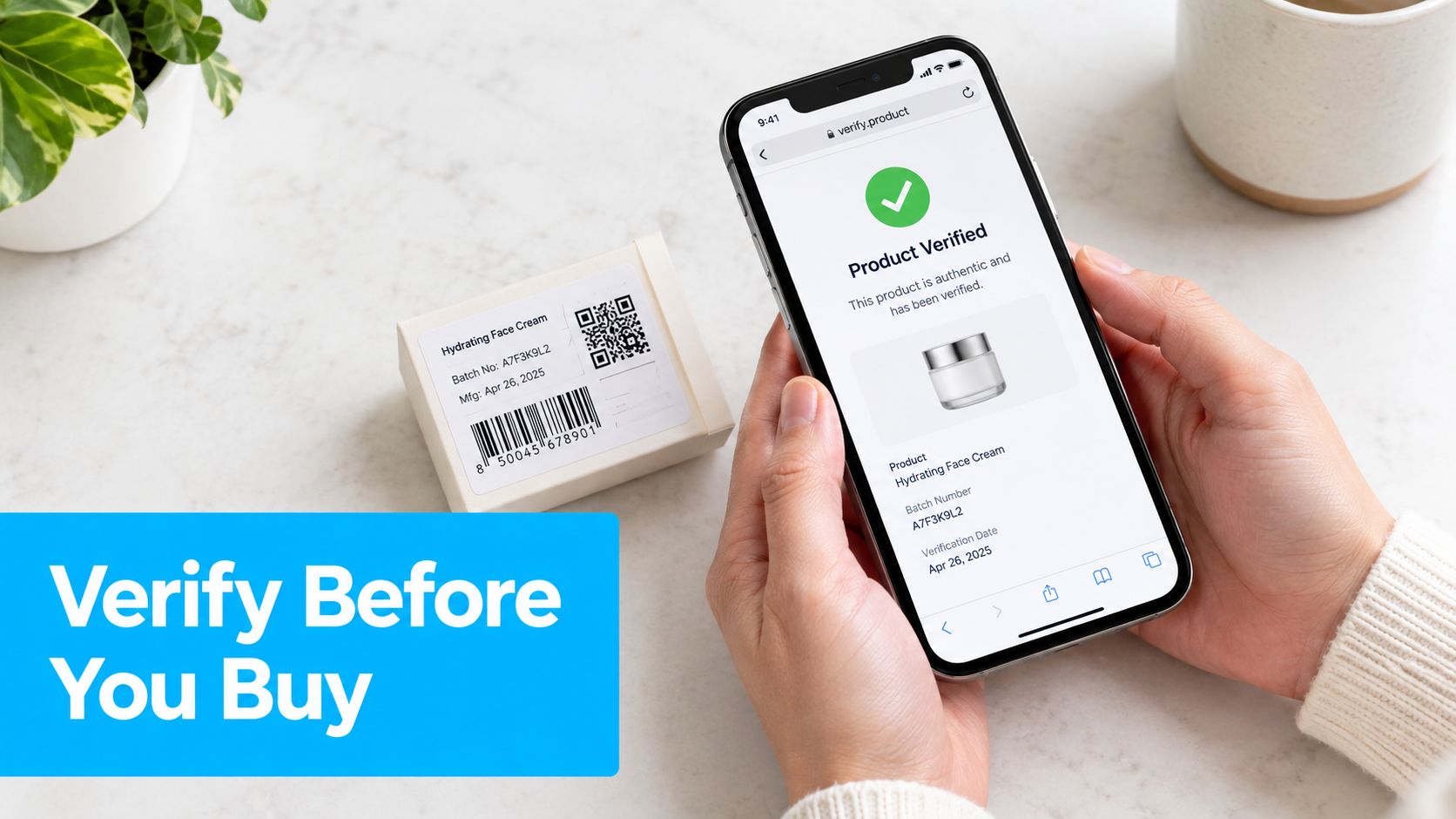
Don't stop at the logo. A box can display a standard prominently while leaving the certified model, contaminant, or active status unclear. Verification takes a few minutes and can prevent a mismatch between the water problem and the product you buy.
Use the official product directory
Start with NSF's certified-products directory. Search by the manufacturer name, then narrow the result by the exact model and applicable standard. You can also search using the model number when the product page provides it.
Check these details before placing the order:
- Match the complete model number. Similar names may refer to different units or configurations.
- Read the listed standard. Confirm whether the record shows NSF/ANSI 42, 53, 401, 58, 372, or another applicable standard.
- Inspect the contaminant claim. A standard may cover a category, but the listing should identify the tested reduction claim.
- Confirm active status. A historical or inactive listing isn't the same as a currently verifiable certification.
- Compare the record with the packaging. The product name, model, manufacturer, and claims should align.
The NSF FAQ on water treatment explains that label review checks whether percentage-reduction claims match official test results. That makes the directory valuable because it lets you compare the marketing language with the certification record rather than relying on a badge.
A manufacturer may certify a complete installed unit, a component, or a material. Those are different claims. Ask the seller which one applies, especially if the product page says “NSF materials” instead of stating that the complete system is certified for a particular contaminant.
Here's a short verification demonstration to use alongside the written record:
If the exact model doesn't appear, or if the standard in the directory doesn't match the contaminant you care about, pause the purchase. A seller should be able to provide a clear explanation and a verifiable record.
Buying Considerations and Total Cost of Ownership
Certification answers whether a product has been tested for a defined claim. It doesn't answer whether the system fits your pipes, maintains usable pressure, or remains affordable after installation. Those questions determine whether the filter works well in a real home.
Start with flow demand. Count the fixtures that may run together, including showers, toilets filling, washing machines, dishwashers, and outdoor taps. Then compare the manufacturer's pressure-drop and flow information under conditions that resemble your installation. A cartridge that clogs quickly or a housing that's too restrictive can turn a certified system into a daily nuisance.
Calculate the cost beyond the box
Total cost of ownership is the useful number, not the purchase price alone. A practical formula is:
TCO = equipment and installation + replacement cartridges + routine service + disposal or related operating costs
You don't need an elaborate spreadsheet. Record the purchase price, installation supplies or labor, the price of each required cartridge, and the replacement interval stated for your water conditions. Then compare the estimated annual operating cost across systems.
A cheaper housing may require more frequent cartridge changes. A larger system may cost more initially but offer a service arrangement that better matches your household's demand. Don't assume the largest unit is automatically economical, because media type, contaminant load, flow, and maintenance access all affect the result.
Check the plumbing details first
Before ordering, confirm the inlet and outlet size, available wall space, shutoff valves, bypass arrangement, drain needs, and clearance for cartridge changes. A whole-house filter should be installed where you can safely isolate it and inspect it without moving heavy equipment or dismantling unrelated plumbing.
Sediment is another practical consideration. If the incoming water carries sand, rust, or other particles, a prefilter can protect downstream media from loading prematurely. That doesn't turn a sediment screen into a health-contaminant filter, but it can give the main treatment stage a cleaner operating environment.
For installation planning, Praz Pure Water's installation advice provides a useful comparison point for thinking through system placement and whole-house setup. Treat any guide as a planning aid, then confirm the final arrangement against your local plumbing requirements and the manufacturer's instructions.
Match the system to the water source
Municipal water and well water can create different treatment priorities. A chlorine complaint may point toward NSF/ANSI 42, while a laboratory result may require a product certified under NSF/ANSI 53, 401, or another relevant standard. Don't select media based only on a neighbor's system, because two properties can have different source water, plumbing materials, and contaminant profiles.
Budget test: If you can't explain the filter's certified claim, replacement plan, and flow fit in plain language, you aren't ready to compare prices.
Maintenance and Long-Term Performance
A certified filter can only perform as tested when it's installed and maintained as specified. The mark doesn't remove the need to change cartridges, inspect seals, monitor pressure, or follow the product's service instructions.
Use a simple maintenance log with the installation date, cartridge model, replacement date, and any changes in taste, odor, pressure, or leakage. Replace prefilters and main cartridges according to the manufacturer's stated time or capacity limits, whichever applies first. Heavy sediment or unusual source-water conditions may shorten useful life, so don't rely on appearance alone.
A practical inspection routine
- Check pressure and flow: A noticeable drop can indicate a loaded cartridge, closed valve, clogged prefilter, or installation problem.
- Inspect for leaks: Look around housings, unions, relief valves, and fittings after service and during routine checks.
- Watch for taste changes: A return of chlorine odor or an unexpected taste may signal exhausted media or a connection issue.
- Use the bypass correctly: Follow the manufacturer's procedure during cartridge changes so untreated water doesn't create confusion about system performance.
- Keep the records: Documentation helps you confirm that the system remains within its certified operating instructions.
Don't extend a cartridge indefinitely because the water still looks clear. Many contaminants are invisible, and neglect can undermine performance even when the housing appears clean. If the system leaks, loses pressure suddenly, or produces a persistent taste after a correct cartridge change, shut it down as appropriate and have a qualified plumber inspect the installation.
Water Filter Advisor helps homeowners compare whole-house, under-sink, faucet, shower, and replacement-filter options while explaining the certification standard tied to each removal claim. Visit Water Filter Advisor to review its buying guides, testing advice, installation resources, and maintenance checklists before choosing your NSF-certified system.