You're standing in a home-improvement aisle, or scrolling through filter listings late at night, comparing two products with the same NSF logo. One promises better-tasting water by reducing chlorine. The other is certified for lead reduction. The symbol looks identical, but the protection isn't.
That's the central issue behind what NSF certification means for water filters. NSF certification is independent verification that a specific product has met defined requirements for particular performance, safety, or materials-contact claims. It isn't a blanket approval of every contaminant, every filter type, or every product sold by a manufacturer.
Why the NSF Mark on Your Water Filter Matters
A homeowner dealing with chlorine taste may be perfectly served by a filter certified to reduce aesthetic impurities. A neighbor in an older home may be shopping for verified lead reduction. Both shoppers might see “NSF-certified” on the package, yet the relevant standard and contaminant claim can be completely different.
That's why the NSF mark should be treated as a trust signal with a scope, not as a promise that water becomes universally pure. The important question isn't, “Does this filter have NSF certification?” It's, “Which exact model is certified, to which standard, and for which contaminant?”
NSF's history helps explain why the mark carries weight. NSF was established in 1944 by Walter Snyder, Henry Vaughan, and Nathan Sinai within the University of Michigan School of Public Health. Its early work included NSF Standards 1 and 2 for food equipment. In 1967, NSF Testing Laboratories became a not-for-profit corporation, and drinking-water standards such as NSF Standards 60 and 61 were later adopted across U.S. states and Canadian provinces, as documented in NSF's institutional history.
Practical rule: Read the contaminant claim beside the NSF mark. The logo tells you that certification exists. The standard and listing tell you what was actually evaluated.
For water filtration, this distinction protects homeowners from a common shopping mistake. A carbon cartridge that improves taste can be useful, but it may not address a health-related contaminant. A filter certified for lead reduction may be the more appropriate choice for a specific plumbing concern, but only if the exact model and claim match the water problem.
The logo matters because it points to independent evaluation. It doesn't replace reading the label, checking the model number, or understanding the standard.
How NSF Certification Testing Works
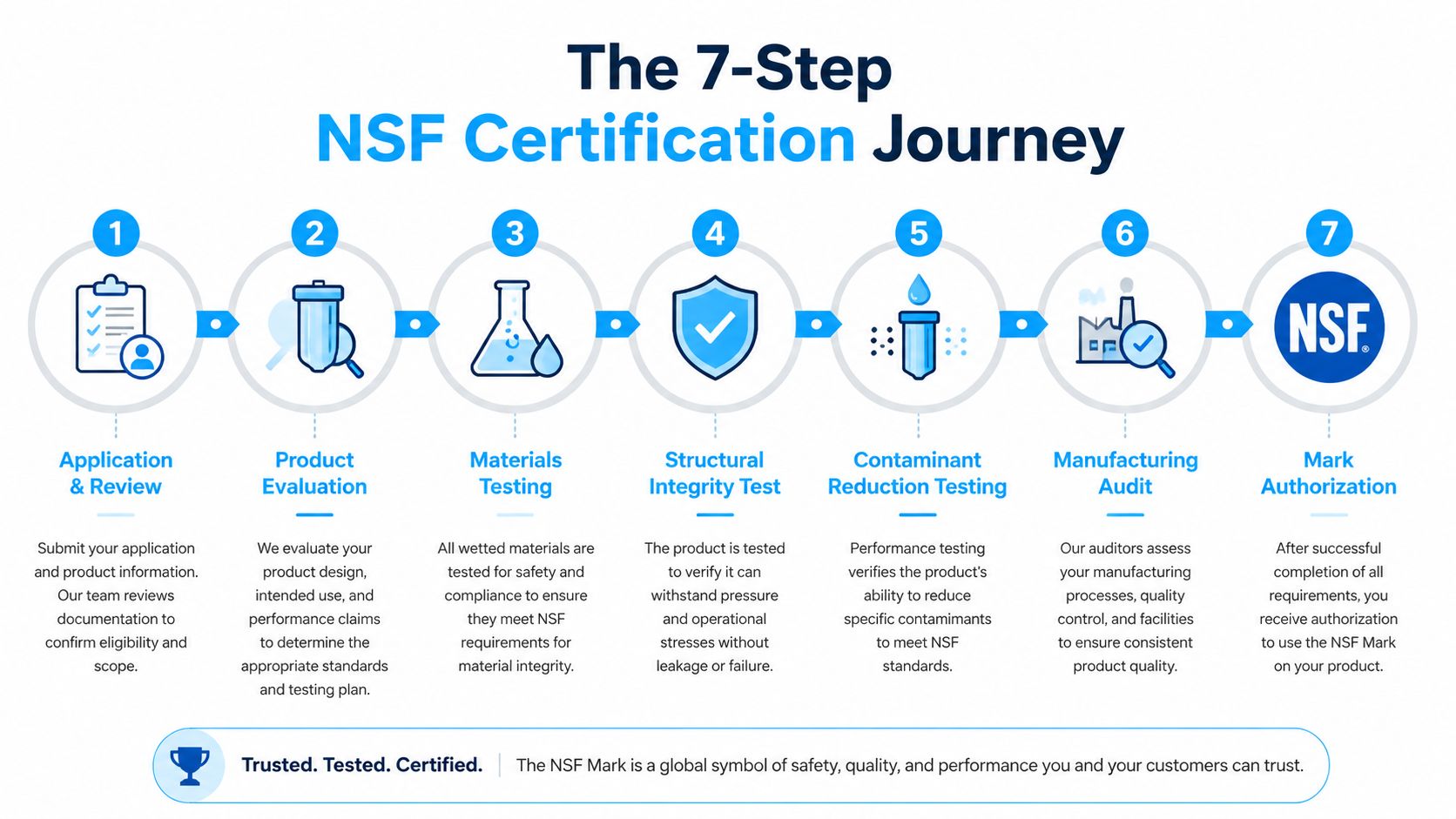
A filter can pass a laboratory test and still require oversight after approval. NSF certification follows a seven-step process: application, product evaluation, laboratory testing, facility inspection and product sampling, review of test results, contract signing and product listing, followed by annual plant inspection and retesting. NSF outlines these stages in its NSF certification process.
The initial evaluation
The manufacturer starts by submitting an application and product information. NSF examines the product, its intended claims, and the requirements for its category. The evaluation therefore begins with a defined certification scope. A general statement that a filter is “good” or “safe” cannot establish what NSF assessed.
Laboratory testing then focuses on the claims the manufacturer seeks to make. For a drinking-water filter, testing may examine contaminant reduction, structural performance, or the safety of materials that contact drinking water. The exact tests depend on the product and its certification scope.
A homeowner should read the result at claim level. A product can be evaluated for one performance area without receiving approval for every contaminant or use.
Inspection and review
NSF inspects the manufacturing facility and collects product samples. This connects laboratory findings with the filters being produced for sale. Consistent manufacturing matters because a single well-performing sample does not represent every unit if production quality varies.
NSF reviews the testing and inspection results. If the product meets the applicable requirements, the manufacturer signs the relevant contract and NSF places the product on its certification listing. That listing connects certification to a specific product, rather than only to the manufacturer's name.
Certification continues after approval
Certification requires regular on-site inspections and product retesting, including annual plant inspection and retesting. Continued monitoring and inspection are also described by Drinking Water Filter.
Consider a manufacturer renewing certification for a filter that remains on the market. The company must continue supporting the certified claims while NSF checks production and product performance over time. For homeowners, the practical step is to check whether the listing is current and still matches the exact model and claims on the product you plan to buy.
This ongoing work also helps explain why certification can add cost. Testing, documentation, facility inspections, sampling, and retesting all require continuing resources. The NSF mark has greater meaning when the claim is tied to a current listing and a defined scope, rather than treated as a general promise about the filter.
Understanding the Key NSF Standards for Home Water Filters
The standards most often encountered in residential filtration divide claims into three broad categories. NSF/ANSI 42 addresses aesthetic improvements, NSF/ANSI 53 addresses health-related contaminant reduction, and NSF/ANSI 401 addresses emerging contaminants, according to NSF's explanation of standards 42, 53, and 401.
| Standard | What It Covers | Common Contaminants | Typical Filter Types |
|---|---|---|---|
| NSF/ANSI 42 | Aesthetic improvement | Chlorine, taste, odor, clarity-related impurities | Carbon cartridges, faucet filters, whole-home systems |
| NSF/ANSI 53 | Health-related contaminant reduction | Lead and other contaminants covered by the product listing | Under-sink filters, faucet filters, specialty cartridges |
| NSF/ANSI 401 | Emerging-contaminant reduction | Certain pharmaceuticals, herbicides, and other listed emerging contaminants | Advanced carbon systems, under-sink and faucet filters |
| NSF/ANSI 58 | Reverse-osmosis system performance | Contaminants covered by the specific RO listing | Reverse-osmosis systems |
| NSF/ANSI 372 | Lead-free materials compliance | Materials-contact requirements, not a broad removal claim | Plumbing components and water-contact products |
NSF/ANSI 42 and the taste-versus-health distinction
A filter certified only to NSF/ANSI 42 may be evaluated for chlorine, taste, odor, or clarity improvements. That can make water more pleasant to drink, but it doesn't automatically mean the filter has been evaluated for lead or another health-related contaminant.
NSF/ANSI 53 is the standard commonly associated with health-effects claims. The exact contaminant still matters. A product carrying NSF/ANSI 53 certification isn't automatically certified for every contaminant covered by that standard.
NSF/ANSI 401, 58, and 372
NSF/ANSI 401 is used for selected emerging contaminants. The label must identify the specific reduction claim, because certification doesn't mean the system addresses every pharmaceutical or herbicide.
For reverse osmosis, NSF/ANSI 58 is the relevant recognized standard. An RO system may carry additional certifications, but the listing determines which contaminants and performance characteristics were evaluated.
NSF/ANSI 372 concerns lead-free materials compliance. That's a materials-safety claim, not the same thing as proving that a filter removes lead from water.
Homeowners considering larger installations can also compare these standards while researching whole-home water treatment systems. A whole-home system designed for chlorine taste may need a different certification profile from an under-sink unit intended to reduce lead at a drinking-water tap.
What NSF Certification Does Not Guarantee
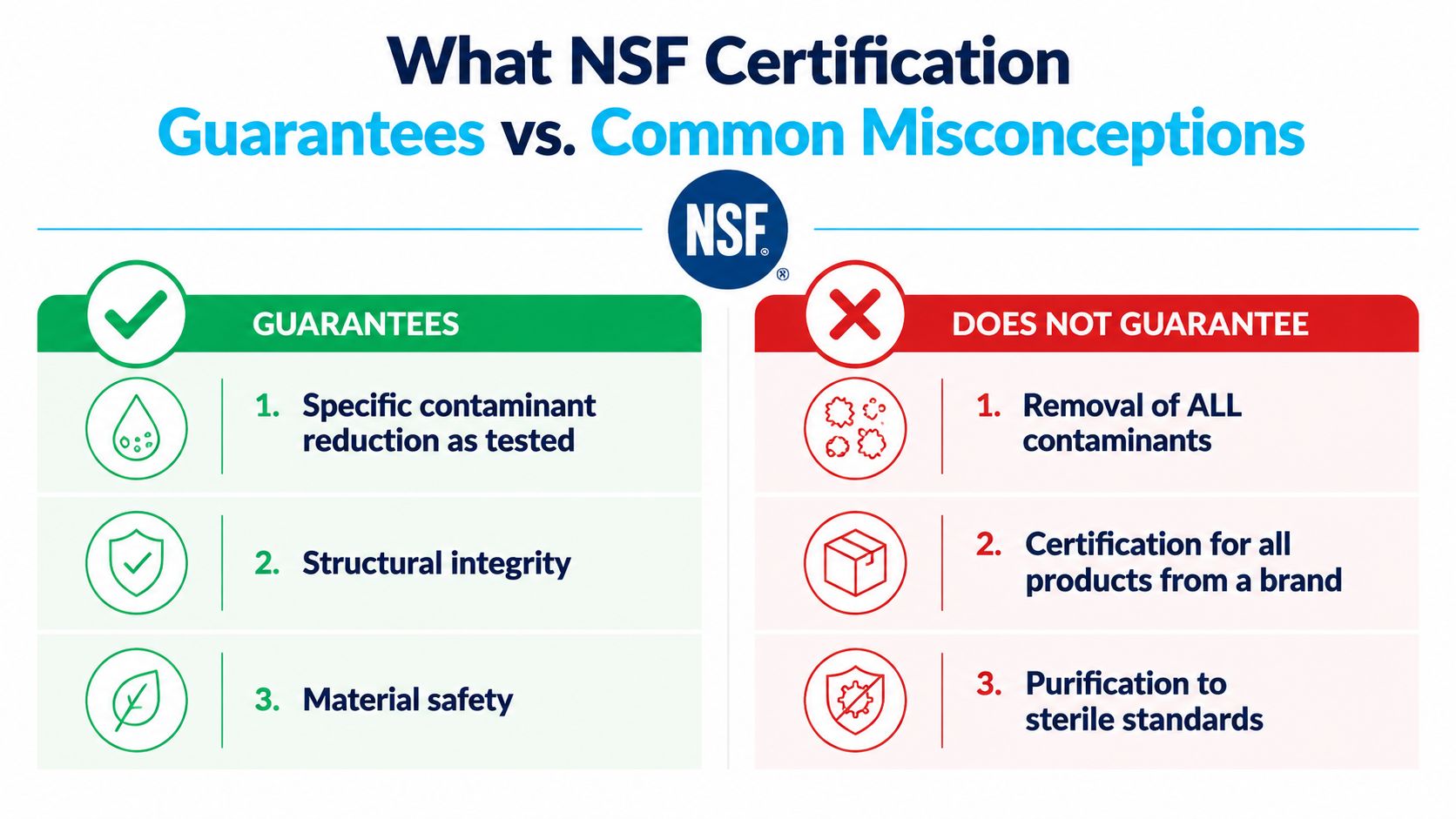
The phrase “NSF-certified filter” sounds broad, but the certification itself is narrow by design. NSF states that certification to an NSF/ANSI standard doesn't mean a system will reduce all possible contaminants. Consumers should verify the exact standard connected to the contaminants they care about, as explained in NSF's drinking-water guidance.
Certification belongs to the product and claim
A brand may sell several cartridges, pitchers, faucet filters, and reverse-osmosis systems. One model may be certified for chlorine reduction, another for lead reduction, and another for a different group of contaminants. The brand name alone doesn't transfer one product's certification to the rest of the lineup.
The same principle applies to a single product with multiple claims. A filter certified under NSF/ANSI 42 for taste and odor hasn't automatically been tested for lead removal. If lead is the concern, the product listing must show the relevant health-effects certification and lead-reduction claim.
Capacity and unlisted contaminants still matter
Certification also doesn't guarantee performance beyond the filter's rated capacity. Filter media can become less effective as it approaches replacement, and a certified flow rate or capacity is part of the product's defined operating conditions.
A certified system also isn't automatically validated against contaminants absent from its listing. “Reduces contaminants” is not the same as “removes everything.” Nor does an NSF mark, by itself, promise purification to sterile standards.
The question to ask: What does this exact filter reduce, under which standard, at what rated capacity?
That question prevents several expensive assumptions. A homeowner may buy a certified filter for better taste while expecting protection from lead. Another may see NSF/ANSI 372 and mistake a materials-contact certification for a contaminant-removal claim. The mark can be meaningful in both cases, but only when the shopper reads the scope correctly.
How to Verify Your Water Filter Certification Claims
Verification takes a few deliberate checks. Don't stop at a product photograph, a retailer bullet point, or a brand's general statement about certification.
Start with the exact product identity
Find the complete model number on the box, product label, installation guide, or manufacturer documentation. Product families often contain similar names, and a replacement cartridge may not share the same certification as the housing or complete system.
Look for the NSF mark and any certification number or standard reference shown on the product. Then compare that information with the official listing.
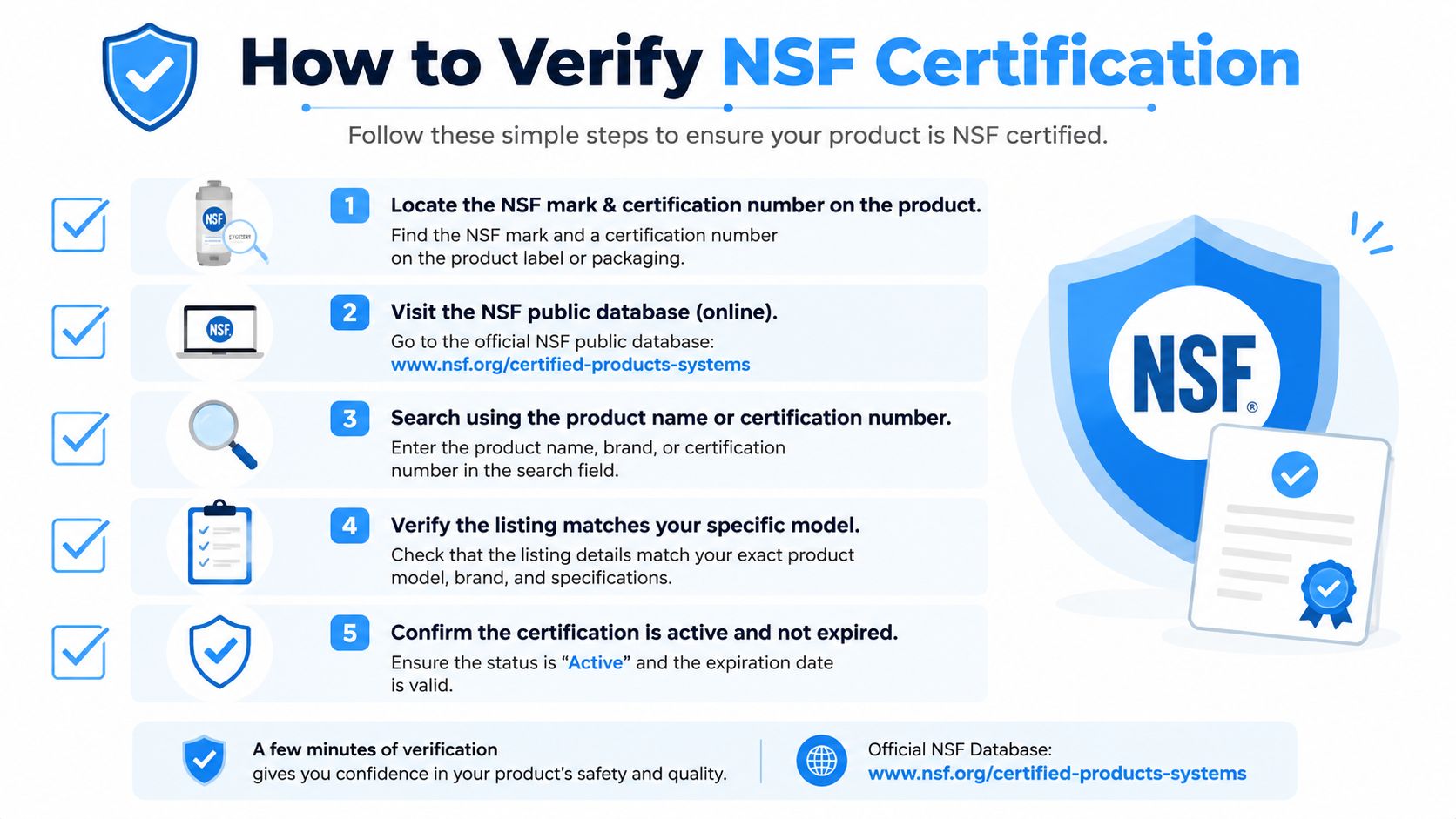
Search the public listing
NSF maintains a public certification listing that shows the exact standards, specific contaminants, certified flow rate, and certified capacity for a product, as summarized by this certification-listing guide.
Use the listing to confirm:
- Model match: The listing should identify the same model, not merely the same brand.
- Standard match: Confirm whether the product carries NSF/ANSI 42, 53, 401, 58, 372, or another relevant standard.
- Contaminant match: Check the named contaminant, such as chlorine or lead, rather than assuming the standard covers every possible claim.
- System match: Make sure the listing applies to the complete system, cartridge, or component you're buying.
- Capacity and flow: Compare the certified operating details with how your household plans to use the filter.
If the retailer's description says “NSF-certified” but the official listing doesn't match the model or claim, pause before buying. Ask the manufacturer for clarification and request documentation that identifies the exact certification scope.
Real Examples of NSF Certification in Home Water Filtration
Certification becomes easier to understand when you match the standard to the household problem.
A home with municipal water that tastes strongly of chlorine might choose a carbon-based whole-house system carrying NSF/ANSI 42 for the relevant aesthetic claim. The goal in that case is improved taste, odor, or appearance. The certification doesn't establish lead reduction unless the listing includes that separate claim.
An older home presents a different decision. If a homeowner is concerned about lead from aging plumbing, an under-sink or faucet system should be checked for the exact NSF/ANSI 53 lead-reduction claim. Health Canada recommends looking for the certification body's mark and a statement that the filter was tested against NSF/ANSI 53 for lead reduction, with NSF/ANSI 42 particulate reduction, Class I, as an additional performance indicator, according to Health Canada's referenced certification information.
Three common household choices
- Municipal chlorine concern: Look for the specific NSF/ANSI 42 chlorine claim. A point-of-use cartridge may improve drinking water, while a whole-home system treats water at more fixtures.
- Lead concern at the kitchen tap: Look for the specific NSF/ANSI 53 lead claim and verify the exact model. A general taste-and-odor certification isn't enough.
- Reverse-osmosis treatment: Check for NSF/ANSI 58 and review the contaminants, capacity, and flow information in the listing.
For emerging contaminants, a faucet or under-sink system may carry NSF/ANSI 401. Again, the listing matters because the certification applies to identified contaminants, not to every substance that might be present in a water supply.
Private well owners need an extra layer of caution. A filter's certification doesn't replace water testing, and a system selected for chlorine taste may not address a well-water concern. The appropriate equipment depends on the contaminant identified and the performance claim attached to the exact system.
Making Smart Water Filter Purchasing Decisions
A homeowner may see several NSF marks on one package and assume the filter handles every water concern. Certification works more like a checklist: each mark supports a particular tested claim. Start with your water problem, whether it involves taste and odor, a named contaminant, an emerging contaminant, plumbing-material safety, or several concerns together.
Use this sequence when comparing products:
- Test the water: Identify which contaminants need attention before choosing equipment.
- Match the claim: Connect each result to the relevant NSF/ANSI standard and named contaminant.
- Verify the model: Search the exact product number in the public certification listing.
- Review operating limits: Check certified flow rate and capacity, then schedule cartridge replacement accordingly.
- Confirm current status: Ensure the listing describes the product you are buying and shows its current certification status.
- Maintain the system: Replace cartridges and service equipment according to the manufacturer's instructions.
Several certifications can be useful, but a group of logos does not equal one broad guarantee. Read every claim separately. NSF/ANSI 42 may address chlorine, NSF/ANSI 53 may address lead, and NSF/ANSI 401 may address selected emerging contaminants. These are separate protections, even when printed together.
Treat older reviews as historical guidance rather than proof of the current configuration. The model number, cartridge, design, or certification scope may have changed. Check the current listing. If the product does not appear as expected, ask the manufacturer whether certification applies to the exact model and replacement cartridge.
For practical guidance on selecting and maintaining filtration equipment, review Water Filter Advisor's water filtration advice.
The useful question is specific: does this exact certified claim address your water at the flow rate and capacity you require? That question turns a familiar logo into a practical buying check.
Water Filter Advisor provides homeowner-focused information for comparing filter types, interpreting contaminant claims, and checking certification details before purchase. Its Water Filter Advisor resources also cover buying and maintenance considerations for home filtration.
- August 23, 2026
- Uncategorized
