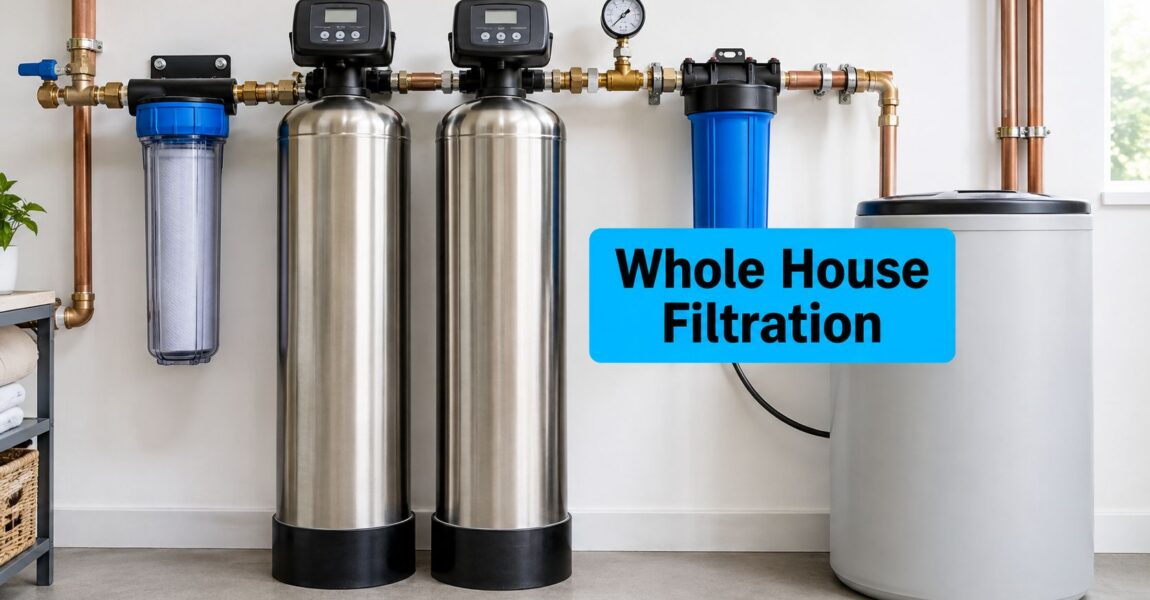
The most popular advice about the best whole house filtration system for well water is often the wrong place to start: compare brands, count stages, and choose the tank with the highest advertised flow rate. That approach treats every well as if it had the same chemistry.
A private well can deliver clear, pleasant-tasting water while still containing contaminants you can't see or taste. The practical answer isn't a universal cartridge or an impressive product label. It's a treatment train built from current laboratory results, correctly sized for household demand, and verified after installation.
Why Lab Results Must Dictate Your Filter Choice
Buying a filter before testing the water is backwards. Public officials don't routinely regulate, treat, or monitor private wells under federal drinking-water rules, so the homeowner carries primary responsibility for identifying contaminants and selecting treatment. The CDC's guidance for testing well water recommends testing at least once every year for total coliform bacteria, nitrates, total dissolved solids, and pH, with additional testing based on local geology, agriculture, mining, industrial activity, or changes in water quality.
A clear glass doesn't prove a safe well. A cartridge filled with sediment media may remove sand and visible particles, while activated carbon may improve odor and taste. Neither result establishes that the system addresses bacteria, nitrate, arsenic, or another dissolved contaminant.
Practical rule: Test first, specify second, install third.
A certified drinking-water laboratory should report measured concentrations, not just label the water “good” or “bad.” Those results determine whether your home needs sediment filtration, iron or manganese treatment, a softener, activated carbon, ultraviolet disinfection, reverse osmosis at a drinking-water tap, or a combination.
What a universal filter can't promise
A single cartridge-based “universal” filter can be useful for appearance and taste, but its media has limits. Physical filtration captures particles. Adsorption media such as carbon interacts with particular compounds. Ion exchange changes the balance of dissolved ions. Oxidation converts some dissolved metals or sulfur compounds into forms that downstream media can capture.
Those mechanisms aren't interchangeable. A filter that handles sediment may leave nitrate untouched. A softener is designed for hardness, not bacterial disinfection. A carbon stage may polish odor after oxidation, but it isn't automatically an arsenic or bacteria treatment.
The U.S. Geological Survey found that about one in five private wells, roughly 20%, contained at least one contaminant above a human-health benchmark for drinking water, as summarized by the CDC's private-well contamination guidance. That finding doesn't prescribe one system for every property. It reinforces why the lab report must drive the design.
Turn the report into a treatment brief
When reviewing results, identify the contaminant, measured concentration, treatment claim required, expected household flow, and maintenance requirement. For help with choosing the right testing approach, focus on sampling quality and laboratory reporting rather than relying on a low-cost screening strip alone.
The Water Filter Advisor advice library can also help organize questions about media, replacement filters, and system specifications. Use that information to interpret options, not to bypass testing.
Matching Filtration Media to Well Contaminants
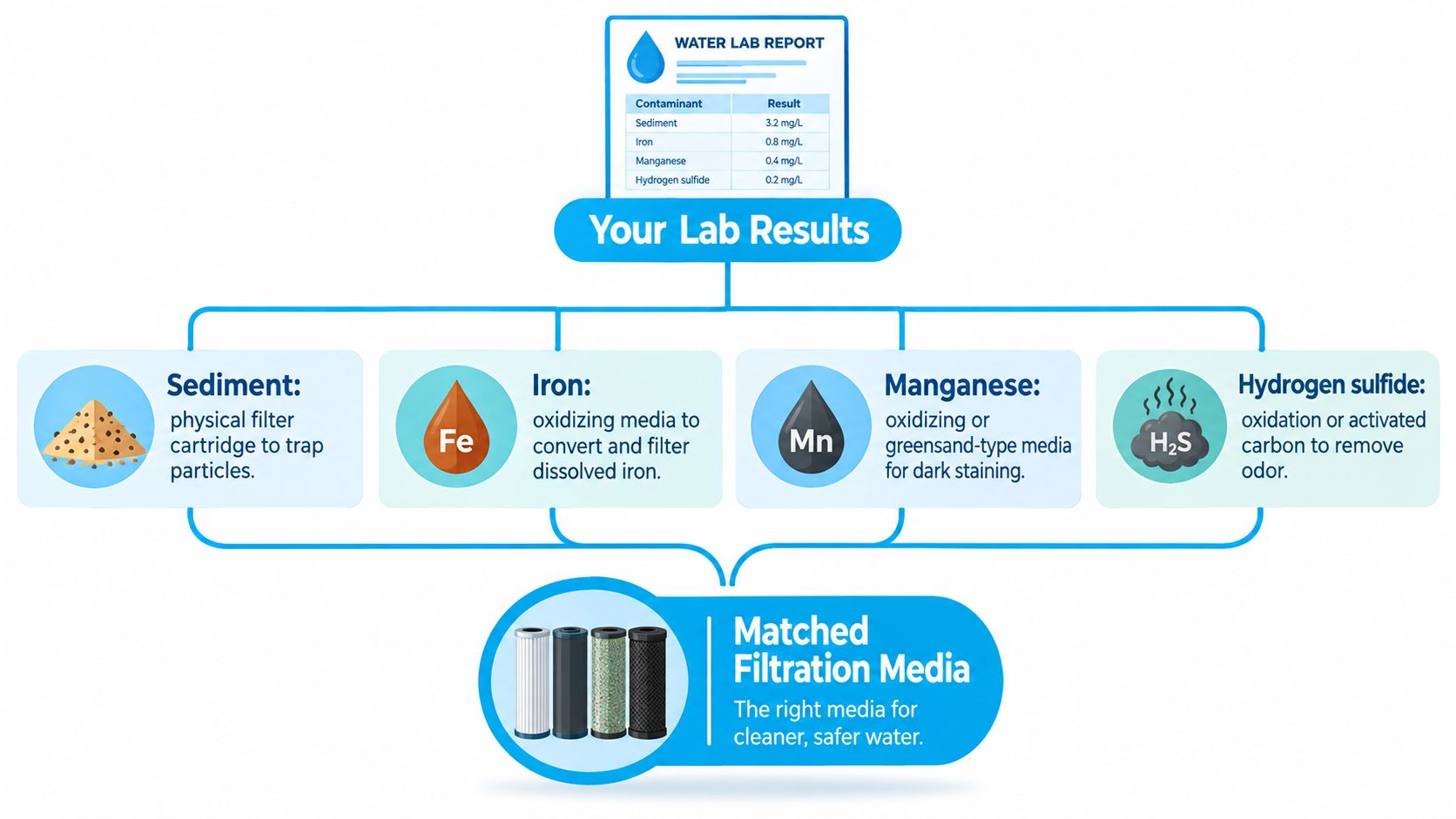
A lab result is only useful when it leads to the correct treatment mechanism. Sediment, iron, manganese, hydrogen sulfide, and hardness behave differently in water, so they need different media or processes.
Start with particles, then protect the equipment
Sand, silt, rust flakes, and other suspended particles usually belong at the front of the treatment train. A cartridge or backwashing sediment filter catches particles before they reach control valves, softener resin, carbon beds, ultraviolet sleeves, or fine membranes.
Sediment filtration doesn't remove dissolved iron, hardness, nitrate, or arsenic. Its value is protective. Without it, downstream equipment can foul prematurely, lose pressure, or require unnecessary servicing.
Treat iron and manganese as chemistry problems
Dissolved iron may pass through a basic sediment cartridge and later oxidize into orange staining. Manganese can create dark staining and deposits. Oxidizing media, catalytic media, aeration, or another oxidation process can convert these dissolved substances into particles that a filter bed can retain.
USGS identifies secondary limits of 0.3 mg/L for iron and 0.05 mg/L for manganese. Elevated levels can promote deposits and bacterial growth that clog pipes, valves, pumps, and other equipment, according to NSF's water-treatment standards guidance.
Activated carbon alone is a weak choice for heavily iron- or manganese-affected wells. Carbon can become fouled, lose capacity, and create a maintenance problem when pretreatment is missing. A better sequence often places sediment protection and oxidation before carbon polishing.
Match sulfur and hardness to their own solutions
Hydrogen sulfide produces the familiar rotten-egg odor. Depending on the measured concentration and well conditions, oxidation, aeration, catalytic media, activated carbon, or chemical disinfection may be appropriate. Carbon can be effective as a polishing stage, especially after oxidation, but it shouldn't be treated as a universal answer.
Hardness is a different problem again. Ion exchange in a water softener addresses calcium and magnesium that produce scale. It doesn't disinfect water, remove every dissolved contaminant, or solve sulfur odor. A homeowner researching rainwater solutions for local homeowners may encounter broader water-management ideas, but well filtration still requires a design based on the actual source-water analysis.
Sizing Your System for Peak Household Demand
A filter can meet a laboratory claim and still disappoint at home if it restricts flow during simultaneous use. The system must deliver enough service flow for showers, toilets, faucets, appliances, and other fixtures without excessive pressure loss.
Begin by listing the fixtures that may operate together. A morning shower combined with toilet refilling and a washing machine creates a different demand from one kitchen faucet running alone. Your installer should translate that pattern into a peak flow requirement, then compare it with the treatment tank's service flow and the well pump's available capacity.
Use the tank as a working component
Media volume affects contact time, contaminant capacity, and backwash behavior. A tank that is too small may foul quickly or create a sharp pressure drop. A tank that is oversized may cost more and require backwash conditions the pump can't provide.
Backwashing deserves particular attention. Oxidizing media, carbon beds, and other tanks need enough water flow to lift and clean the bed. If the well pump cannot supply that flow while maintaining pressure, the media may not clean properly, even if the control valve is programmed correctly.
| Bathrooms | Peak Flow Rate (GPM) | Recommended Tank Size |
|---|---|---|
| One | Confirm from fixture demand and pump capacity | Match media volume to the laboratory result and service flow |
| Two | Confirm simultaneous-use demand | Select a tank that maintains flow without excessive pressure loss |
| Three or more | Confirm peak household demand with the installer | Size for service flow and verified backwash capacity |
The table is a sizing framework, not a substitute for measured system conditions. The verified data doesn't establish universal GPM or tank-size values by bathroom count, and manufacturers use different media, bed depths, and operating requirements.
Specify these numbers before comparing products
Ask for the service flow, peak flow, pressure drop, media volume, and backwash flow requirement. Then compare those figures with the pump curve, pressure-tank settings, plumbing size, and available drain capacity.
Don't select a unit because its marketing page lists a large nominal flow. The relevant question is whether it can maintain acceptable pressure while treating the water at your home's actual demand and whether it can clean itself afterward.
Decoding NSF Certifications for Well Water
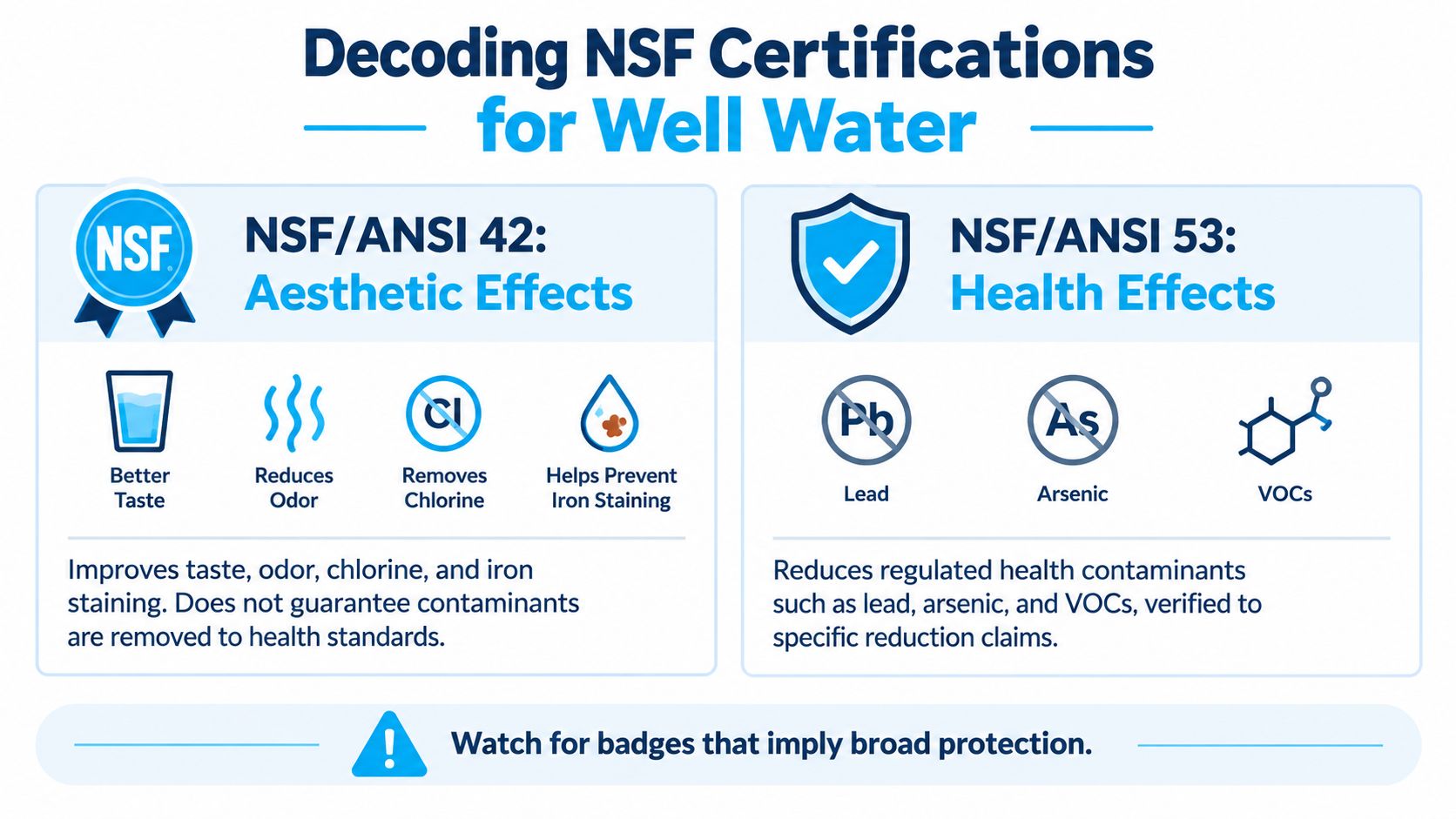
Certification badges don't mean a filter removes every contaminant. They apply to specific claims tested under defined conditions, so the badge must be read alongside the contaminant and capacity details.
Aesthetic and health claims are not interchangeable
NSF/ANSI 42 addresses primarily aesthetic reductions such as taste, odor, and particulate, while NSF/ANSI 53 covers health-related claims including lead and certain other contaminants, as explained in NSF's comparison of filtration standards.
| Certification | What it generally addresses | What to verify |
|---|---|---|
| NSF/ANSI 42 | Aesthetic concerns such as taste, odor, particulate, iron, and manganese | The exact contaminant claim and rated capacity |
| NSF/ANSI 53 | Health-related claims such as lead and certain other contaminants | The specific health contaminant, test conditions, flow, and capacity |
A general NSF mark or an NSF/ANSI 42 listing doesn't establish arsenic performance. If arsenic appears in the laboratory report, verify an exact certified arsenic-reduction claim. USGS materials identify the U.S. EPA arsenic maximum contaminant level as 10 micrograms per liter, a useful screening benchmark for treatment decisions.
Read the performance details, not just the logo
Compare the certified flow rate, rated capacity, influent challenge concentration, maximum permissible product-water concentration, and replacement interval. A percentage-reduction statement without those conditions tells you less than many buyers assume.
Industry descriptions of NSF testing report that Standard 53 chemical-reduction evaluations operate at the maximum flow associated with 60-psi dynamic inlet pressure and may continue to 120% or 200% of rated capacity, depending on product configuration. Those figures describe testing conditions, not a promise that every product will perform identically in your home.
For nitrate, arsenic, and other dissolved contaminants, specialized media or point-of-use reverse osmosis may be more appropriate than a broad whole-house cartridge. Confirm the result with laboratory testing after installation.
Building a Treatment Train for Common Scenarios
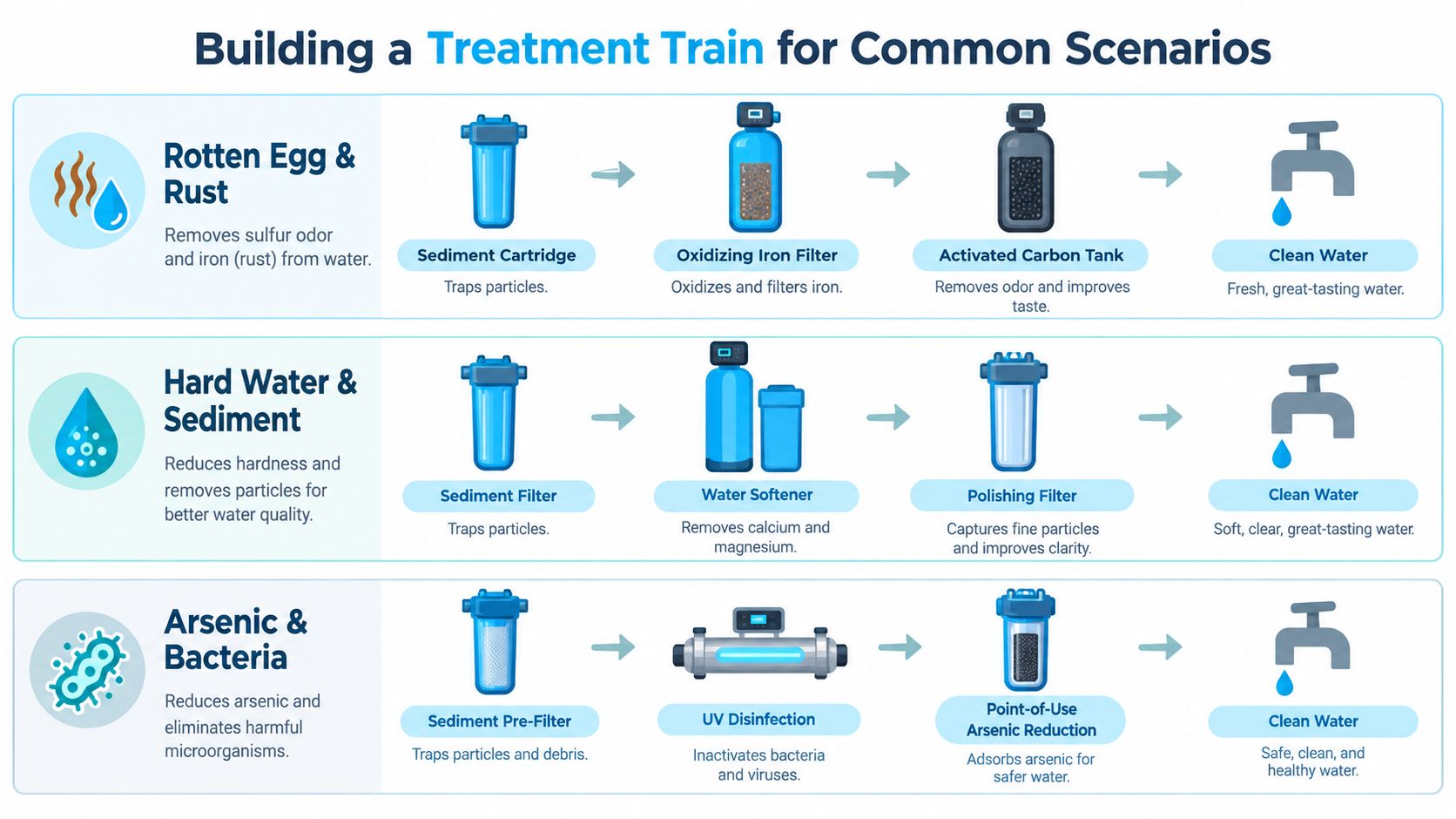
Most wells need a sequence, not a single heroic tank. Each stage should perform a defined job while protecting the stage that follows.
Rotten egg odor with rust staining
For a well with confirmed hydrogen sulfide and iron, begin with a sediment prefilter. It catches existing particles and protects valves. Follow it with an oxidizing iron or sulfur treatment matched to the test results. Finish with activated carbon when the design calls for odor polishing or removal of oxidation byproducts.
This arrangement separates conversion from capture. The oxidation stage changes the contaminant's form, while the downstream bed captures or polishes the result. Carbon placed first may foul rapidly when iron and other oxidized material enter without protection.
Hard water with manganese or sediment
A practical train may start with sediment filtration, followed by treatment designed for manganese, then a softener for hardness, and a final polishing stage if the water still needs aesthetic improvement. The order matters because a softener isn't a substitute for manganese treatment.
If the lab report identifies only hardness, a softener may be the simplest appropriate solution. If it identifies manganese, iron, or bacteria as well, add only the technologies that address those findings.
Arsenic or bacteria
A health-risk profile requires more caution than an odor complaint. Use sediment pretreatment to protect sensitive equipment. For microbial contamination, ultraviolet disinfection or another validated disinfection process may be required. For arsenic, verify an exact arsenic-reduction claim, and consider point-of-use reverse osmosis for drinking and cooking water when the treatment design calls for it.
Whole-house treatment and point-of-use treatment can work together. The former protects water throughout the property, while the latter concentrates specialized treatment where people drink and cook.
The following video can help homeowners visualize how staged treatment differs from a one-filter approach:
Evaluating Maintenance and Cost of Ownership
The purchase price is only one part of a filtration system's cost. A cartridge filter creates recurring replacement work. A softener requires salt and regeneration. A backwashing tank consumes water and needs a suitable drain, while specialized media eventually loses capacity and must be replaced or replenished.
Calculate operating burden before buying
For cartridge systems, record cartridge price, replacement frequency, and the labor involved. Heavy sediment can shorten service life, so the least expensive cartridge may not be the least expensive operating choice.
For softeners, account for salt use, regeneration settings, valve servicing, and any prefiltration needed to protect the resin. For catalytic carbon, KDF, or other specialty media, ask how the manufacturer defines exhaustion and whether the media can be replenished or must be replaced.
Backwashing systems also have indirect costs. They use water during cleaning, require electrical power for automated controls, and depend on adequate well-pump performance and drainage. A system that cannot backwash correctly is not economical, even if its media appears inexpensive.
Use a practical ownership worksheet
Create a year-by-year worksheet covering:
- Consumables: Cartridges, salt, disinfectant, and replacement media.
- Water use: Backwash frequency and the volume discharged during each cycle.
- Service: Valve inspection, plumbing work, laboratory retesting, and troubleshooting.
- Downtime: The cost and inconvenience of bypassing treatment during maintenance.
- Verification: Follow-up laboratory analysis when a health claim matters.
Don't force every system into a ten-year cost calculation with invented assumptions. Use the manufacturer's replacement guidance, your laboratory concentrations, actual water use, and local service rates. A smaller verified treatment train often costs less to operate than a large collection of unnecessary stages.
Installation Best Practices and Verification
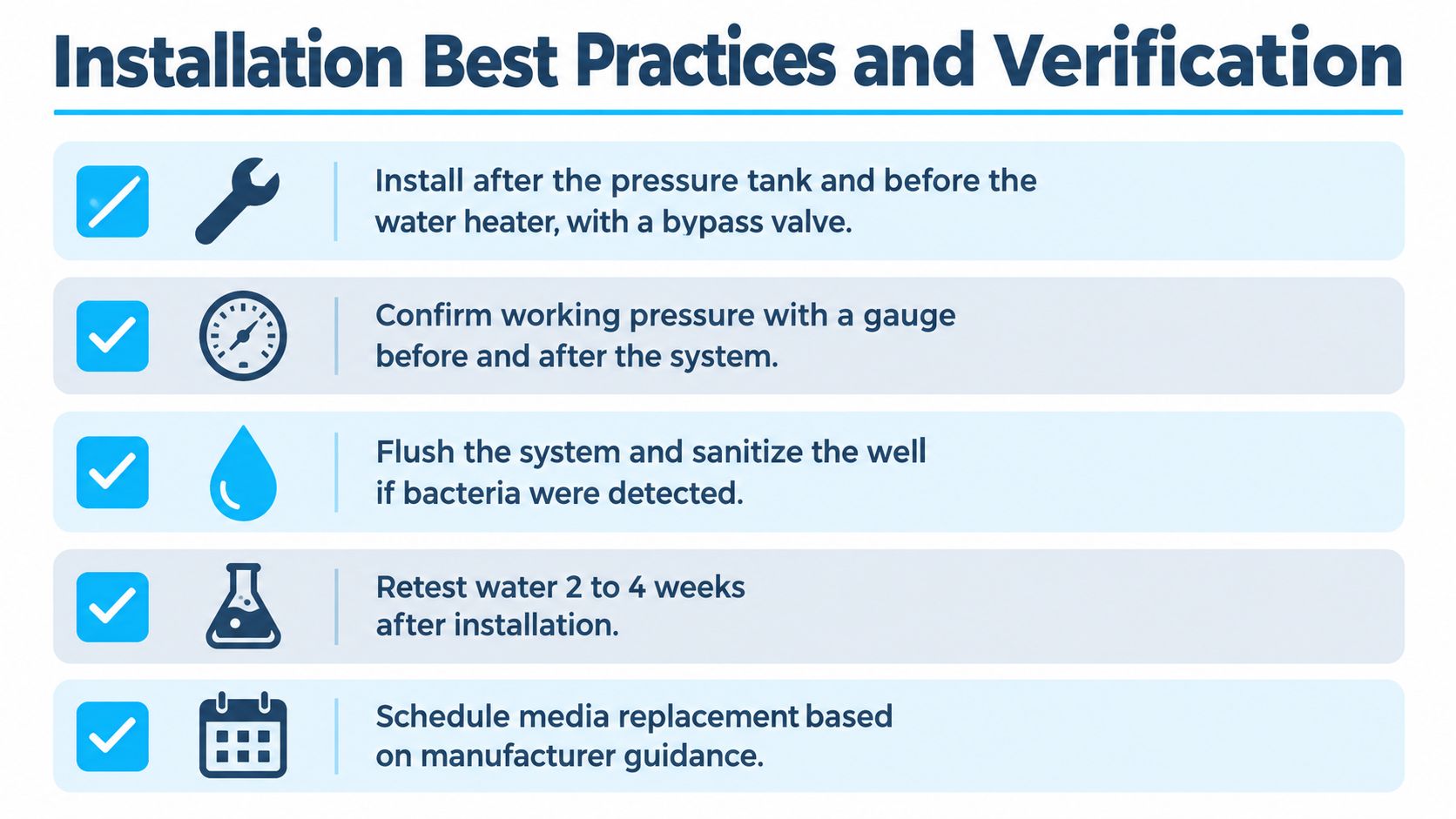
Correct installation protects both performance and safety. Place treatment equipment after the pressure tank and before the water heater, include a bypass valve, provide service access, and route backwash discharge to a suitable drain.
Follow a verification checklist
- Install isolation and bypass controls. You should be able to service the equipment without shutting down the entire home.
- Install pressure gauges before and after treatment. The difference helps reveal fouling and pressure loss.
- Flush new media and cartridges. Follow the manufacturer's procedure before sending treated water to fixtures.
- Address bacteria separately. If bacteria were detected, use the prescribed disinfection method and sanitize the well when appropriate.
- Set the maintenance schedule. Record cartridge changes, salt checks, backwash settings, and media replacement guidance.
Retest water after installation instead of judging success by taste, odor, or clarity. For health-critical contaminants, laboratory confirmation is the only dependable way to establish whether the selected treatment is working under household conditions.
The EPA recommends immediate testing after flooding, major land disturbance, well or plumbing repairs, or noticeable changes in color, taste, or odor, as stated in its private-well protection guidance. Those events can change the water chemistry or introduce contamination, even when an existing system has performed well.
Review pressure gauges routinely and investigate rising differential pressure, reduced flow, new staining, or a return of odor. Keep laboratory reports, installation records, and maintenance dates together so the next service decision is based on evidence rather than guesswork.
Water Filter Advisor offers practical guides for comparing whole-house, under-sink, and specialty filtration options, along with advice on media, certifications, testing, installation, and replacement filters. Visit Water Filter Advisor with your laboratory results and household requirements in hand, then use its guidance to build a treatment train that addresses your actual well water instead of paying for unverified stages.
- October 12, 2026
- Uncategorized
