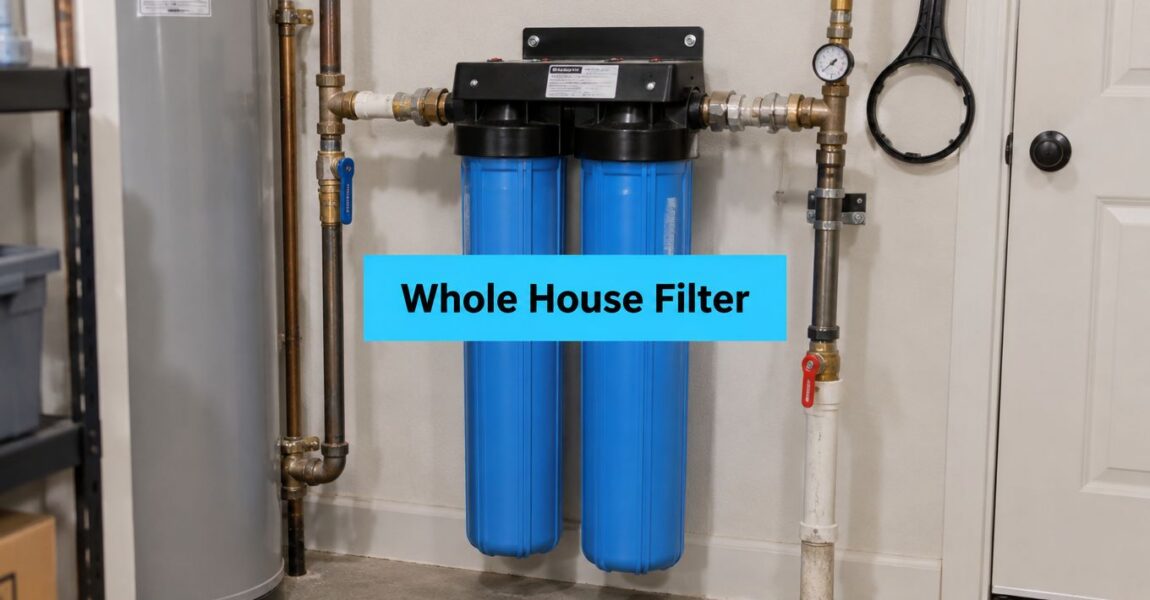
You step out of the shower with dry, uncomfortable skin. The laundry comes out with rusty marks, and the coffee tastes faintly metallic. A pitcher filter might improve the water at the kitchen sink, but it can't change what flows through the shower, washing machine, or bathroom tap.
That is where a whole-house water filtration system enters the conversation. It is not a larger cartridge. It is a treatment device connected to the home's incoming water line, designed to manage water before it travels through the plumbing. Understanding that distinction helps you choose equipment for the water problem you have, rather than buying a tank because its label promises more filtration stages.
What a Whole House Water Filtration System Actually Does
A whole-house water filtration system, also called a whole-home or point-of-entry (POE) system, is installed where water enters a building instead of at one faucet or appliance. The treated water then travels through the home's plumbing to every outlet, including sinks, showers, bathtubs, washing machines, and toilets. The Centers for Disease Control and Prevention's explanation of home water treatment systems describes whole-home systems as treating most or all water entering the home, while the U.S. Environmental Protection Agency describes POE systems as treating water for uses such as toilet flushing, showering, and clothes washing.
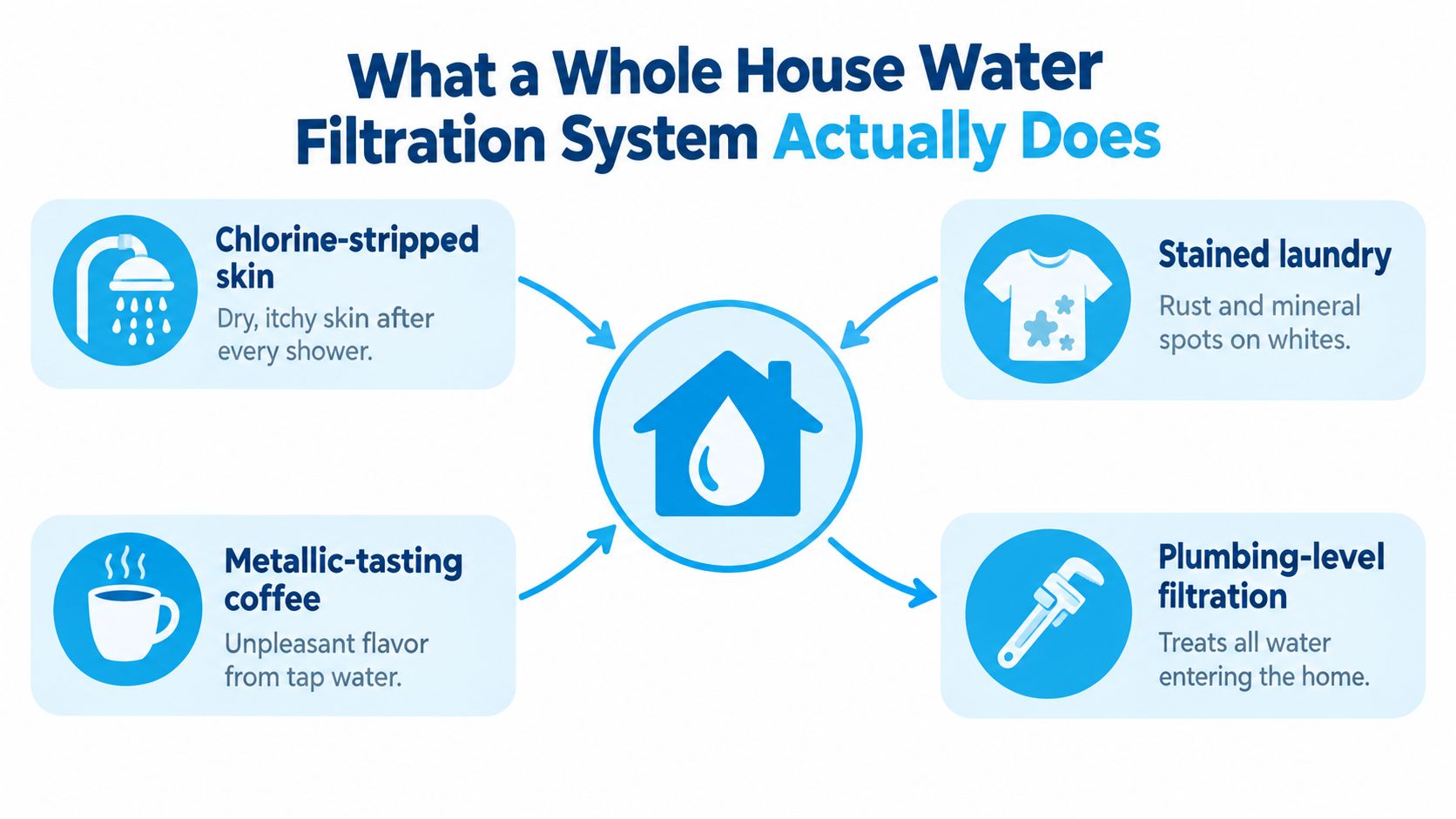
A pitcher, faucet filter, countertop unit, or under-sink filter is a point-of-use (POU) device. It treats water at one location, usually for drinking or cooking. If you install an under-sink filter, the water in your shower and washing machine remains untreated because those outlets sit outside the filter's path.
Distribution is the defining feature
The phrase “whole house” describes where treatment happens and how water is distributed, not how many cartridges or tanks a product contains. A system with several stages isn't automatically a whole-house system. If it connects only to one faucet, it remains point-of-use equipment.
Think of a POE system as placing a checkpoint at the entrance to a building. Every person, or in this case every gallon, passes through before reaching the rooms beyond. That arrangement requires the equipment to handle much more water than a drinking-water filter, especially when several fixtures operate at once.
Filtration is a plumbing decision
This distinction matters because a POE system affects the home's water supply as a whole. It may improve shower water, laundry water, and tap water at the same time, but it also introduces equipment into the main plumbing line. That can mean shut-off valves, drain connections, media tanks, replacement schedules, and professional installation.
A whole-house system can be appropriate when a contaminant affects water used for bathing or cleaning as well as drinking and cooking. It isn't automatically the right answer for every taste complaint. If only the kitchen drinking water needs treatment, a POU filter may be the more focused choice.
How Water Moves Through a Whole House System
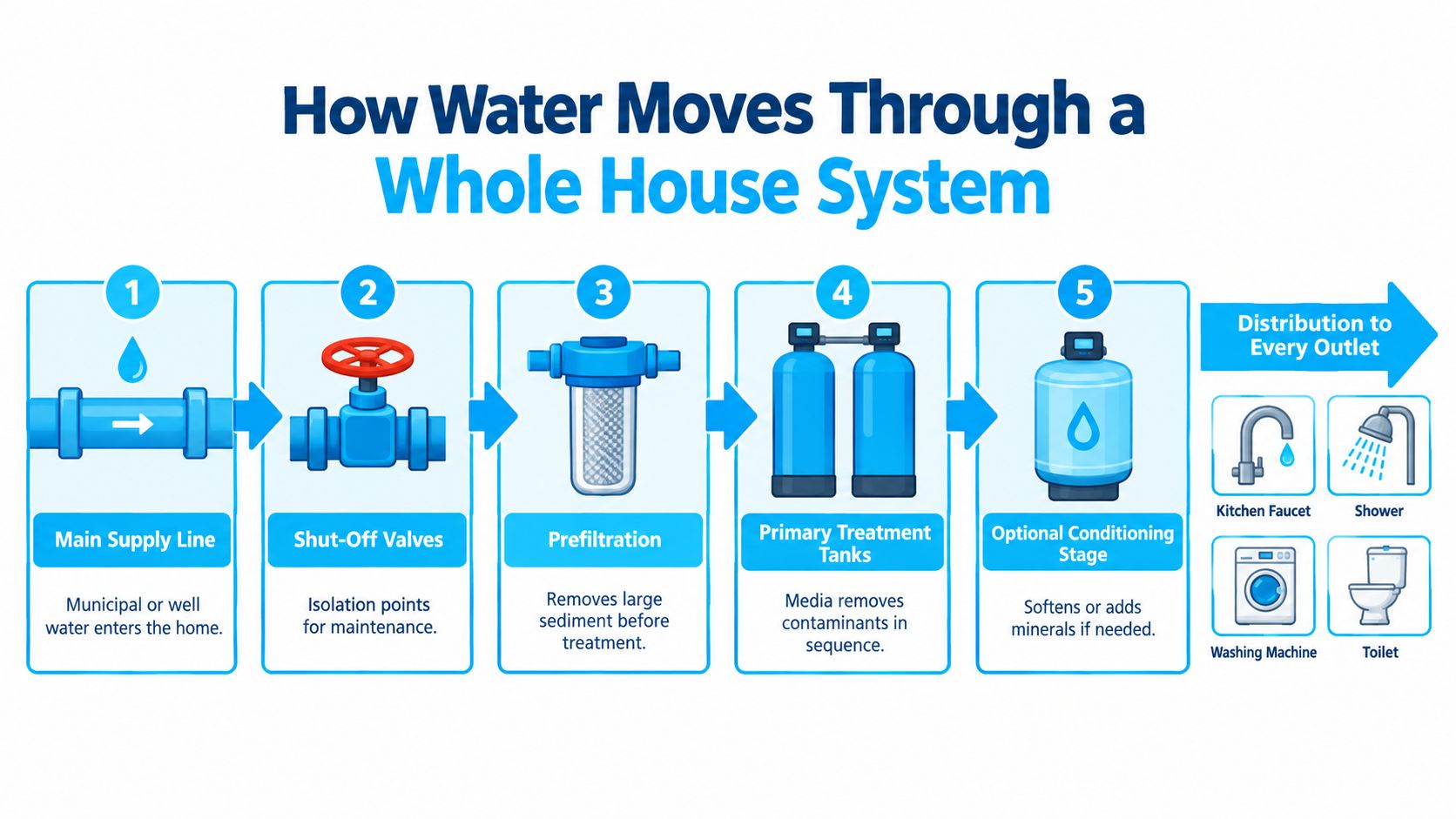
Water normally enters through the main supply line, passes through treatment equipment, and then continues toward the home's fixtures. A whole-house setup turns that route into a series of checkpoints. Each stage has a specific job, much like an airport security line where one station checks bags while another verifies identity.
The plumbing path
The exact design varies, but the path often includes:
- Main supply line. Municipal or well water enters the building through the incoming pipe.
- Shut-off and bypass valves. These let a homeowner or technician isolate the equipment during service while keeping the rest of the plumbing manageable.
- Prefiltration. A sediment stage catches larger particles before they reach finer media or valves.
- Primary treatment tanks. Carbon, specialty media, or other treatment materials address the contaminants identified in the source water.
- Optional conditioning. A separate stage may address hardness or another water characteristic that filtration alone doesn't solve.
- Distribution. Treated water continues to the kitchen faucet, shower, bath, washing machine, toilet, and other outlets.
A backwashing tank may send water to a drain during its cleaning cycle. That means the installation needs appropriate drainage, and the control valve may require an electrical connection.
Why water speed changes performance
A filter must process the home's peak flow demand, not only the modest flow from a drinking-water faucet. If someone showers while the washing machine fills and another person uses a sink, water moves through the treatment media quickly. The media needs enough capacity and contact time to perform its assigned job.
The EPA's home water treatment guide explains that undersizing can create pressure loss or inadequate contaminant reduction because treatment media need sufficient vessel capacity and contact time at higher flow rates.
A tall tank can look impressive, but appearance doesn't tell you whether water spends enough time in the media. An undersized system may produce a weak shower, while excessive flow through carbon can reduce treatment performance. Proper sizing connects the source water, household demand, plumbing connections, and selected media.
For a visual walkthrough of the plumbing route, this video illustrates how water can move through a whole-house treatment arrangement:
The Media Inside the Tanks and What Each One Targets
Filtration media work like a toolkit, not a universal checklist. One material may catch particles, another may adsorb selected chemicals, and another may exchange hardness minerals. A product advertised as “four-stage” still needs to identify what each stage does and whether those claims match the tested water.
Sediment handles particles first
A sediment filter can catch sand, silt, rust, and other suspended material. It often sits before carbon or specialty media because particles can clog or coat downstream treatment surfaces. Its limitation is just as important as its benefit: sediment filtration doesn't automatically remove dissolved chemicals, hardness, nitrate, or bacteria.
Carbon addresses selected taste and odor problems
Activated carbon works mainly through adsorption. Instead of chemically destroying every contaminant, dissolved or suspended substances adhere to the carbon's surface or pores. The NSF overview of water treatment standards and filtration systems explains why carbon can improve chlorine-related taste and odor and may reduce selected metals or organic chemicals when the product carries the appropriate tested claim.
Carbon performance depends on the carbon type, bed size, flow rate, contact time, and contaminant-specific certification. A large tank isn't proof of effective treatment, just as the word “carbon” isn't a complete performance description.
Other media solve different problems
Some systems use specialty materials for particular source-water conditions. KDF media may be selected for certain metals or scale-related concerns, while ion-exchange resin is used in water softening to exchange hardness minerals such as calcium and magnesium. A catalytic carbon stage may target particular compounds, including chloramines or hydrogen sulfide, when the product has a substantiated claim.
Backwashing tanks clean or recharge media by sending water through the vessel in a reverse direction. This can help manage accumulated particles and extend media service, but the process requires suitable plumbing and a drain connection.
Use a guide to filtration media to compare materials by target contaminant rather than by the number of stages printed on a product box.
| Media | Primary targets | Best use case | Main limitation |
|---|---|---|---|
| Sediment filter | Sand, silt, and rust particles | Protecting downstream media from suspended solids | Doesn't address dissolved contaminants |
| Activated carbon | Selected chlorine, taste, odor, metals, and organic compounds | Improving aesthetic water quality when the claim matches the source | Performance falls with unsuitable flow, contact time, or missing certification |
| Specialty media | Specific metals, odors, or chemical compounds | A confirmed contaminant that needs targeted treatment | Not interchangeable across contaminants |
| Ion-exchange resin | Hardness minerals | Water conditioning or softening applications | Doesn't replace contaminant-specific filtration |
| Backwashing media tank | Media maintenance and particle management | Installations with suitable drain and control equipment | Requires water, space, upkeep, and correctly configured controls |
Certifications and Claims Worth Trusting
Certification language becomes useful only when you read the claim beside the contaminant. NSF/ANSI 42 covers point-of-use and point-of-entry systems intended to reduce aesthetic contaminants, including chlorine, taste, odor, particulate matter, chloramine, iron, manganese, zinc, and total dissolved solids. NSF/ANSI 53 addresses specific health-related contaminants such as lead, volatile organic compounds, chromium, and Cryptosporidium, according to NSF's explanation of standards 42, 53, and 401.
That doesn't mean one certified product removes every substance listed under a standard. Certification applies to specific claims for a specific product, with stated operating conditions and rated capacity. A filter certified for chlorine reduction shouldn't be assumed to remove lead, nitrate, bacteria, hardness, or dissolved salts.
Read the performance sheet, not just the badge
Before buying, look for four details:
- Exact contaminant claim. Identify the substance the product has been tested to reduce.
- Rated capacity. Check how much water the product is designed to treat under its stated conditions.
- Flow and pressure requirements. Confirm that the home can supply the equipment without creating unacceptable pressure loss.
- Maintenance conditions. Find out which cartridges, media, cleaning procedures, or sanitization steps the manufacturer requires.
A certification mark can establish that a particular claim was evaluated. It can't tell you whether that claim matters in your home. Source-water testing should come first, because the lab results identify the problem that the performance sheet needs to address.
The product also needs to be evaluated as a complete system. A sediment prefilter may protect carbon, but it doesn't turn carbon into a disinfecting device. A softener may address hardness, but it doesn't automatically remove an organic chemical.
The Chlorine Paradox and Other Surprising Trade-Offs
Chlorine removal can make shower water smell and taste better, but whole-home removal also changes the plumbing environment. The CDC's guidance on choosing home water filters warns that removing chlorine or other disinfectants throughout the home can allow more germs to grow in household plumbing.
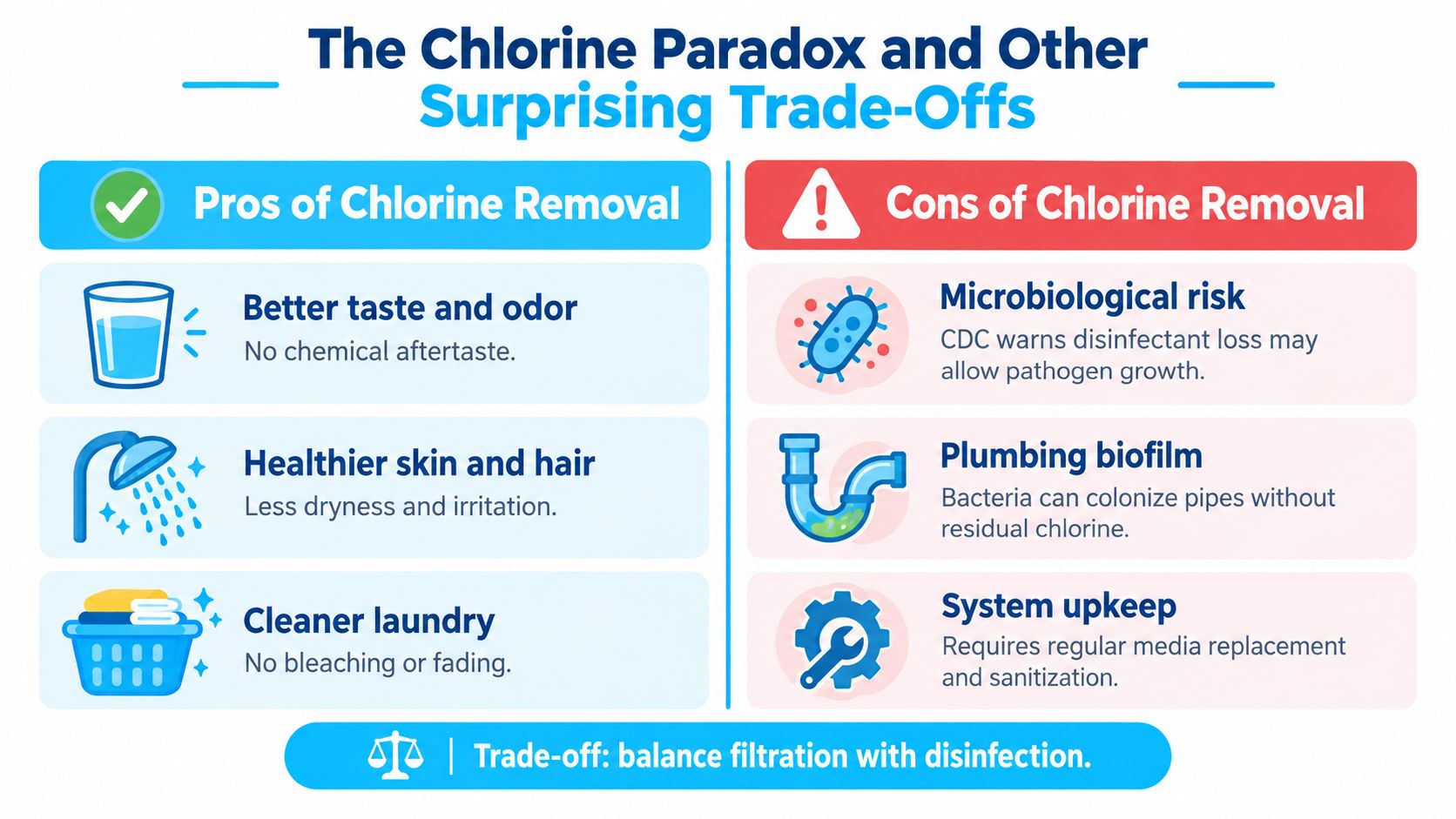
This is the chlorine paradox. A disinfectant residual may contribute to an unpleasant chemical taste or dry-feeling shower, yet it also helps limit microbial growth as water travels through pipes. Removing it across the entire home can improve comfort while creating a maintenance and microbiological consideration that a single drinking-water filter may avoid.
Filtration isn't the same as disinfection
Conventional filters can reduce sediment, chlorine, and selected organic compounds. They aren't designed to remove or destroy bacteria unless they are specifically labeled and validated as purifiers. A carbon tank may improve odor, but it shouldn't be treated as a substitute for a validated disinfection process when the source presents microbial risk.
Private wells require particular care. Public drinking-water rules don't apply to privately owned wells, and government agencies generally don't monitor or treat that water for the homeowner. The CDC recommends that private-well owners test for harmful germs and chemicals at least once each year, with additional testing when the water changes in color, taste, or smell, as described in its guidance for testing well water.
Practical rule: Don't select a whole-house filter from an odor, stain, or product photograph alone. Test the source, identify the contaminant, then choose treatment and maintenance that address the actual result.
A well owner may need sediment treatment, hardness control, iron or sulfur treatment, nitrate reduction, arsenic treatment, or validated microbial protection. Those are different problems, and a single carbon tank can't be expected to solve them all.
Sizing a System to Your Home
Right-sized filtration begins with water demand. The equipment must handle the home's busiest realistic period, not just the flow from one faucet. Consider a morning when someone is showering, the dishwasher is running, and the washing machine is filling. That combined demand is more relevant than a product's tank height.
Questions to answer before requesting quotes
- How many fixtures operate together? Count bathrooms, showers, laundry appliances, and other high-use outlets.
- What does the water report show? Municipal reports and laboratory testing can reveal whether the issue involves particles, chlorine, a health-related contaminant, hardness, or something else.
- Where will the equipment sit? A garage, basement, utility room, or crawlspace may have different limits for floor space, temperature, access, and drainage.
- Can the plumbing support the installation? A plumber can assess static pressure, pipe connections, shut-off access, bypass design, and available drain capacity.
- Does the system need power? Automatic control valves may require an electrical connection, while some simpler arrangements don't.
Tank capacity and media volume must suit both the contaminant and the flow. Too little media can shorten contact time, while restrictive or poorly matched equipment can reduce pressure at fixtures.
Before you compare quotes, write down the number of occupants, fixture count, typical simultaneous uses, source type, known water concerns, available installation space, and your willingness to perform maintenance. This short inventory gives a professional something concrete to size against and helps expose systems that rely more on marketing language than household requirements.
What Whole House Filtration Costs and What It Takes to Maintain
A whole-house system is a significant plumbing project, not merely a cartridge purchased at a store. EPA guidance notes that installation commonly costs several thousand dollars and may require plumbing changes and professional maintenance. The final amount depends on the treatment technology, equipment capacity, site access, drain requirements, electrical work, and condition of the existing plumbing.
The whole-house water filter cost guide can help organize the difference between equipment, installation, and continuing ownership expenses.
Separate installation from ownership
The initial project may include the treatment tanks, valves, bypass plumbing, prefilter housing, fittings, labor, and any required changes to the main line. A backwashing system may also need a drain connection and control-valve setup.
Ongoing costs can include:
- Cartridge replacement. Prefilters need replacement according to the manufacturer's schedule and the sediment load in the source water.
- Media service. Carbon or specialty media may eventually need replacement, replenishment, or professional inspection.
- Backwash operation. Automatic systems use water and need a suitable drain route.
- Cleaning and sanitization. Some installations require periodic cleaning or disinfection.
- Testing. Post-installation testing can confirm whether the selected treatment is doing what the source-water results required.
Maintenance isn't cosmetic. A clogged cartridge can restrict flow, exhausted media can stop reducing the target contaminant, and a neglected housing can create hygiene problems. Systems that require pretreatment, cleaning, or disinfection need those tasks recorded rather than left to memory.
Keep the owner's manual, installation details, filter model numbers, service dates, and water-test results in one place. A simple calendar reminder for inspections and replacements is more reliable than waiting for taste, pressure, or odor to change.
A Simple Decision Checklist Before You Buy
A sensible purchase follows four checkpoints. Each one prevents a different kind of mistake.
- Test the source water. Use a state-certified laboratory for private-well testing and investigate the municipal supply or a representative household sample when the concern is specific. Testing replaces guesses based on stains, odor, or taste.
- Match results to verified claims. Select media and equipment that carry an independently verified reduction claim for the contaminant detected. Don't treat a general certification badge, carbon label, or stage count as proof of universal performance.
- Size for peak household flow. Account for simultaneous fixtures, available pressure, pipe size, contact time, tank capacity, drain access, and installation location. The right system must deliver treated water without creating an avoidable pressure problem.
- Commit to maintenance. Write down cartridge changes, media service, backwashing requirements, cleaning, sanitization, and any follow-up testing. A system that isn't maintained won't reliably deliver its intended result.
The central answer to what is a whole house water filtration system is straightforward: it's a point-of-entry treatment strategy that manages water before distribution throughout the home. The difficult part is choosing the right treatment for the source, because whole-house equipment can improve the wrong problem just as efficiently as the right one.
Start with the water test before comparing tank sizes or filtration stages. Then ask a qualified installer to connect the results with your household flow, plumbing layout, and maintenance capacity.
Water Filter Advisor offers consumer guides on whole-house systems, filtration media, certifications, water testing, installation, and maintenance. Visit Water Filter Advisor to compare treatment approaches and build a source-specific plan before you buy.
- October 15, 2026
- Uncategorized
