Reverse Osmosis Water Filter Whole House: A 2026 Guide

You're probably here because your water is bothering you in a very normal homeowner way.

Maybe the drinking water tastes off. Maybe the shower leaves your skin feeling tight. Maybe the ice cubes smell faintly like a swimming pool. Or maybe you had your water tested and saw enough on the report to make you wonder whether you should stop thinking small and just filter everything.

That's where the idea of a reverse osmosis water filter whole house system gets attractive fast. It sounds like the ultimate answer. Clean water at every sink. Better water for showers, laundry, cooking, appliances, and drinking. No weak compromises.

I get the appeal. If you're already spending money and opening walls or reworking plumbing, why not go straight to the top shelf?

Because in real houses, the most powerful water treatment system isn't always the smartest one. Whole-house reverse osmosis can be the right move. It can also be a big, expensive machine solving a problem you don't have.

The Dream of Perfect Water from Every Tap

A lot of homeowners start in the same place. The kitchen faucet is the first thing that raises suspicion, but it rarely stays there. Once you start thinking about water quality, you notice everything else.

You notice the shower smell. You notice spots on dishes. You wonder what's running through the washing machine, the water heater, and every bathroom tap. Pretty soon, an under-sink filter starts to feel too small. You want one fix for the whole house.

Why whole-house RO sounds like the final answer

Whole-house reverse osmosis gets sold, and often discussed, as the closest thing to “perfect water” at home. That's not a crazy idea. RO is valued because it can target a broad range of dissolved contaminants that simpler filters often don't handle well.

If your concern is serious dissolved contamination, that matters. A basic carbon filter can help with chlorine, taste, and odor. Reverse osmosis lives in a different category. It's the system people look at when they want a much deeper level of treatment.

Whole-house RO is the kind of system people ask about when they're tired of partial fixes.

That said, homeowners often jump to it before answering the boring question that saves the most money: What problem are you trying to solve?

The real decision most people skip

If your home uses well water with difficult chemistry, whole-house RO may deserve a hard look. If you're on municipal water and your main complaints are chlorine smell, taste, or general “city water” annoyance, a full-house RO setup may be more machine than you need.

That distinction matters because public-health guidance still frames RO primarily as a point-of-use treatment method, not the standard whole-house default. The gap is practical. A lot of advice online jumps from “RO removes a lot” to “therefore every home should have whole-house RO,” and that's a leap.

For many families, the smartest water setup isn't “RO everywhere.” It's targeted filtration where it counts most, plus simpler treatment for the rest of the house.

How a Whole House RO System Actually Works

A whole-house RO system is a point-of-entry setup. That means it treats water as it enters the home, before that water heads out to sinks, showers, toilets, and appliances.

The heart of the system is the RO membrane. A whole-house reverse osmosis system uses a high-pressure pump to force water through a semi-permeable membrane, and the membrane pore size can be as small as 0.0001 microns according to Canney's explanation of whole-house RO operation. That's why RO can remove dissolved salts and many other contaminants instead of just catching visible particles.

Think of the membrane like a bouncer

The easiest way to picture it is a nightclub door with a very picky bouncer.

Water molecules get through. A lot of dissolved junk doesn't.

That's the big difference between RO and simpler filters. A sediment filter is more like a screen door. It catches grit and debris. An RO membrane is much more selective, which is why it needs pressure and a more complex system around it.
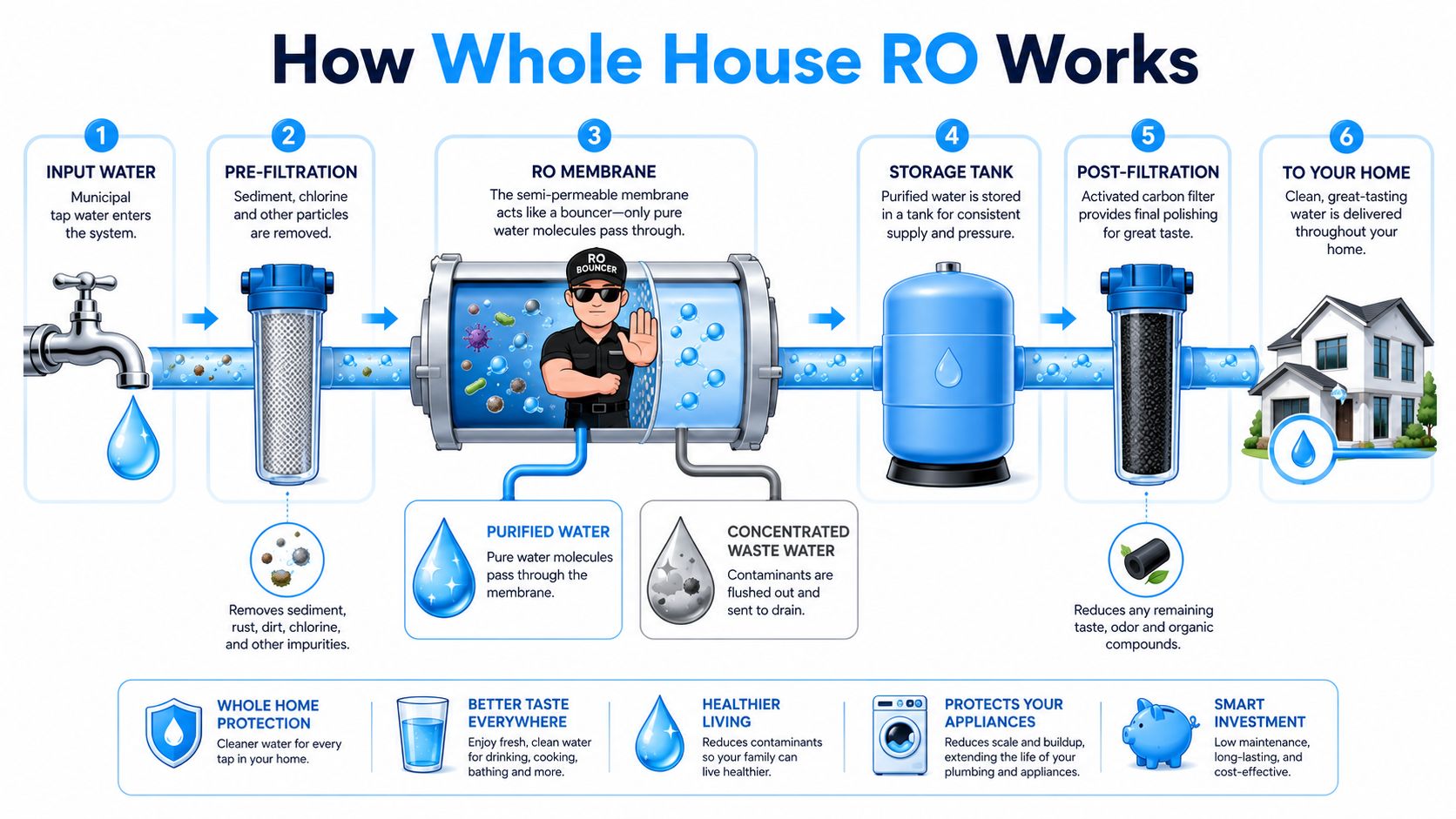
A diagram illustrating the six-step process of how a whole house reverse osmosis water filtration system works.

The parts that make the system work

A proper whole-house RO setup usually includes several working pieces, not just one filter canister.

  • Pre-filters: These handle sediment and other material that could foul or damage the membrane.
  • High-pressure pump: This is the muscle. Without pressure, RO doesn't do its job.
  • RO membrane: Dissolved contaminants are separated from the cleaner water stream here.
  • Storage tank: The system needs somewhere to hold treated water so the house can draw from it when demand spikes.
  • Delivery pump: This pushes stored water back into the house at usable pressure.
  • Post-filter: Often carbon, this gives the finished water a final polish.

Why the tank and pump confuse homeowners

Many individuals expect water treatment to work like a simple pass-through device. Water goes in, water comes out.

Whole-house RO isn't that kind of system.

RO treatment takes effort and time. It doesn't instantly make huge volumes of purified water on demand the way a plain pipe can deliver untreated municipal water. That's why storage matters. The system slowly builds a supply of treated water, then the delivery side sends it through the home when you open a faucet or start a shower.

Practical rule: If you're thinking about a reverse osmosis water filter whole house system, think “equipment room,” not “single filter.”

The other concept that trips people up is reject water. RO doesn't split all incoming water into usable product water. Some water carries concentrated contaminants away from the membrane. That's part of how the system protects itself and keeps the separation process working.

The Pros and Cons of Going All In on RO

A whole-house RO system can sound like the perfect answer. Cleaned water at every tap, every shower, every appliance.

That promise is real. So are the trade-offs.

Before you commit to treating every gallon that enters the house, it helps to ask a plumber's question instead of a marketing question. What problem are you trying to solve, and do you need this much treatment everywhere?
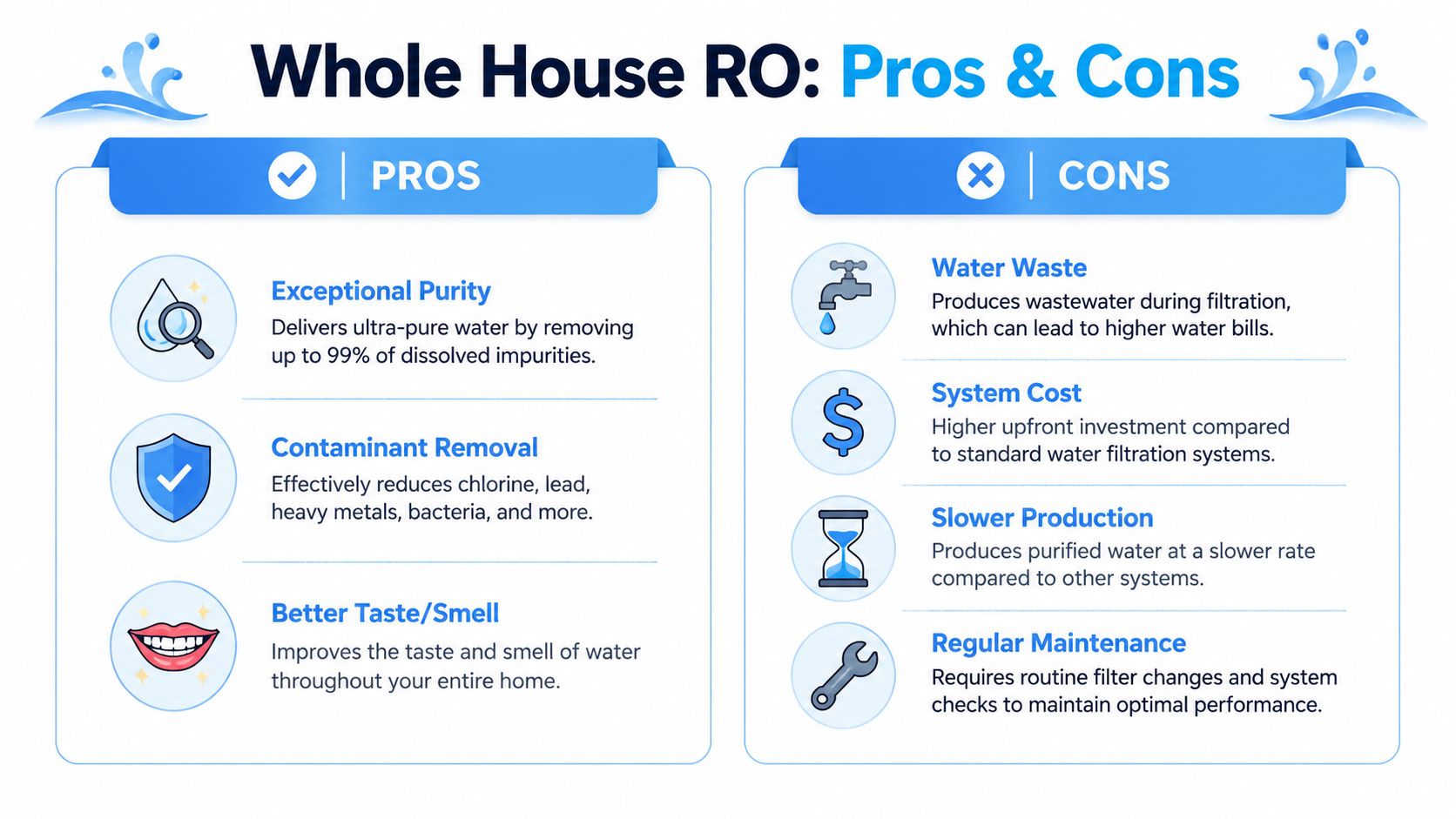
A comparison chart outlining the pros and cons of installing a whole house reverse osmosis water system.

What makes whole-house RO so appealing

Reverse osmosis earns its reputation because it can reduce a wide range of dissolved contaminants that simpler filters may miss. Consumer Reports' water filter buying guide describes RO as one of the stronger options for reducing dissolved solids and contaminants such as lead, arsenic, nitrates, and some PFAS.

That matters if your water problem goes beyond chlorine taste or a musty smell. A carbon filter can improve taste and odor. RO goes after the dissolved material mixed into the water itself.

For some homes, that broader treatment brings real peace of mind. If you have troubling lab results, or you want better water feeding fixtures and water-using appliances throughout the house, whole-house RO can solve a bigger problem than an under-sink unit can.

Still, broad treatment is not always smart treatment. Cleaning every drop to a very high level can be a lot like buying hospital-grade air handling because one room gets dusty. It works, but the cost and complexity may not match the actual problem.

Here's a quick visual breakdown before the trade-offs get muddy.

The drawbacks that change the conversation

Whole-house RO asks more from your home than many buyers expect.

You are not only paying for filtration media and a membrane. You are paying for a system that needs space, drain connections, routine service, storage capacity, and enough support equipment to keep water moving through the house at usable pressure. If one part is undersized, the whole setup feels disappointing.

Water efficiency is the other big reality check.

The Water Quality Association explains that reverse osmosis creates a treated-water stream and a concentrate stream that carries rejected contaminants away from the membrane in its overview of reverse osmosis and water efficiency. In plain English, RO works more like sorting than straining. Some water becomes product water. Some water is used to flush the dissolved material away so the membrane can keep working.

That does not mean every whole-house system wastes the same amount of water. Design, recovery rate, controls, and pretreatment all affect performance. But it does mean reject water is built into how RO works, not a small footnote.

Pressure can also surprise homeowners. A whole-house RO setup is a bit like filling a large cooler slowly, then using a pump so the house can draw from it at a normal pace. If the system is poorly designed, showers, tubs, and simultaneous water use can expose its limits fast.

Pros and cons in plain language

Side What it means in real life
Pro Reduces dissolved contaminants that basic sediment or carbon filters may leave behind
Pro Improves drinking and cooking water when dissolved solids are part of the problem
Pro Sends treated water to more than one fixture, not just the kitchen sink
Con Takes more room and more installation planning than many homeowners expect
Con Usually needs tanks, pumps, and controls to keep water available at a usable rate
Con Maintenance is ongoing because several parts need service, not just one cartridge
Con Produces reject water as part of normal operation, so efficiency matters
Con Can solve a bigger problem than the house actually has, which raises cost fast

A simple rule helps here. Whole-house RO makes sense when the water issue is serious, confirmed by testing, and affects the whole home.

If your main complaint is drinking-water taste, chlorine, or one or two contaminants at the kitchen tap, going all in on RO can be more system than you need.

Is Whole House RO Overkill for Your Home

For a lot of homes, yes, it is.

That doesn't mean whole-house RO is bad. It means the right filtration system should match the actual water problem, not the homeowner's anxiety after a late-night internet search.

A major missing piece in many buying guides is exactly this question. Practical coverage often skips whether whole-house RO is right for typical municipal-water homes, even though EPA guidance frames RO primarily as point-of-use technology. National Water Service makes that gap clear in its discussion of whole-house RO pros and cons.
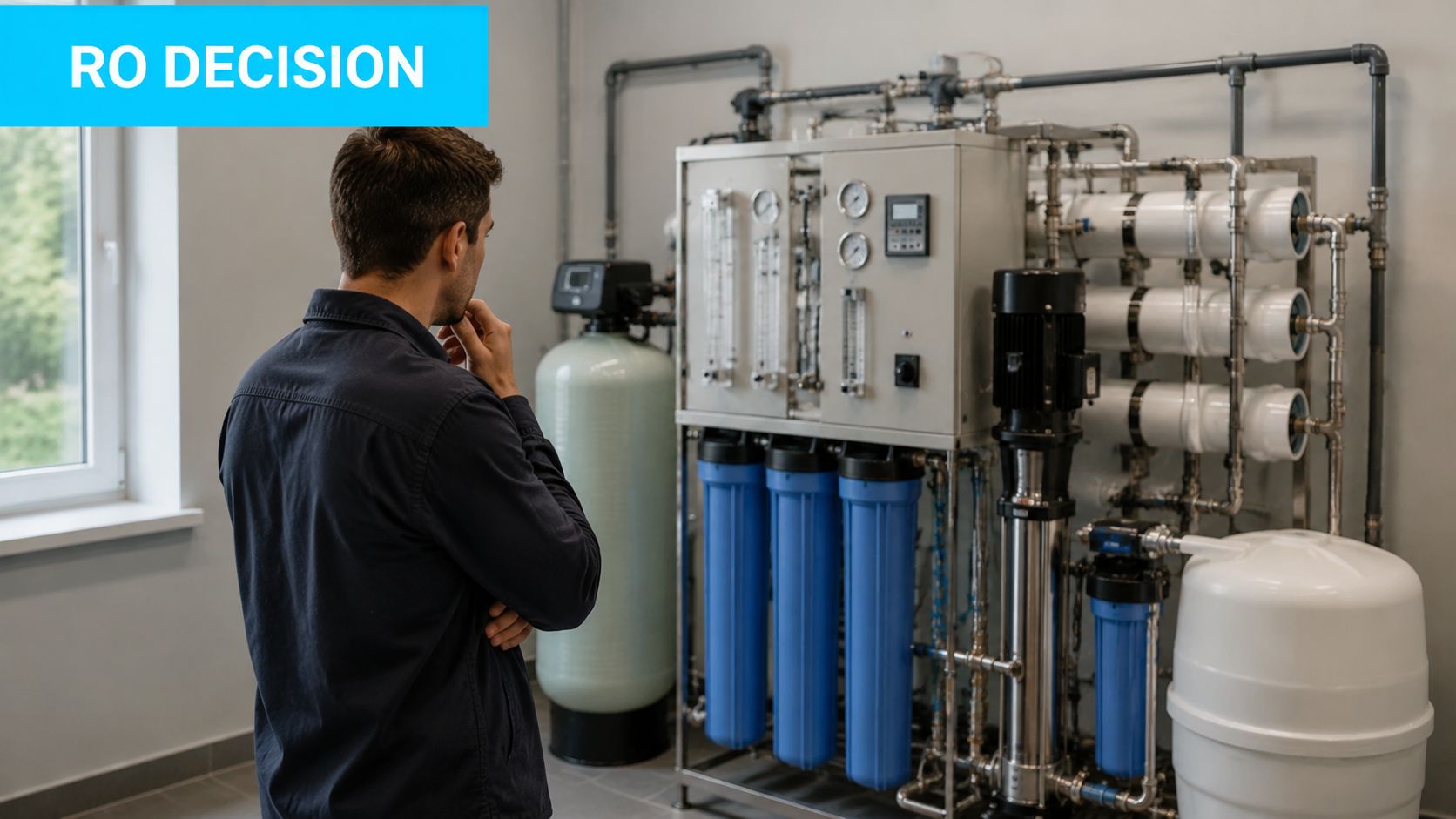
A technician stands in a utility room, thoughtfully examining a complex industrial reverse osmosis water filtration system.

When whole-house RO makes more sense

If you're on well water and the test results show dissolved contaminants that need aggressive treatment, whole-house RO moves from “fancy option” to “serious candidate.”

That's because a private well can present issues across the whole home, not just at the kitchen sink. If the incoming water itself needs heavy treatment before anyone drinks it, showers in it, or runs it through equipment, a point-of-entry solution becomes easier to justify.

When it's often too much

If you're on municipal water and your main complaints are:

  • Chlorine smell: A carbon-based whole-house system often addresses this more directly.
  • Taste issues at the sink: A point-of-use RO unit may solve the part you drink.
  • General improvement everywhere: A whole-house carbon filter can improve shower and tap experience without treating every gallon to RO level.

Municipal-water homes often need better-targeted filtration, not maximum filtration.

A simple homeowner checklist

Ask yourself these questions before you shop:

  1. What did the water test show?
    If you don't have a clear test result, you're guessing.

  2. Is the problem whole-house or point-of-use?
    Drinking water and shower water don't always need the same treatment strategy.

  3. Am I trying to remove dissolved contaminants or improve taste and odor?
    Those are different jobs.

  4. Do I want RO water from toilets, laundry lines, and outdoor fixtures?
    Some homeowners do. Many realize they don't.

The biggest money-saving insight in this whole topic is simple. You do not need the most advanced system available. You need the system that matches your water.

Smarter Alternatives to Whole House Filtration

A lot of homeowners reach this point and realize they were aiming a very large solution at a much smaller problem.

If the complaint is, "I want better water to drink, better-smelling showers, and less chlorine taste," you usually do not need reverse osmosis at every fixture. Treating every gallon to RO level can be a bit like buying bottled water for the washing machine. It works, but it is often more treatment, cost, and maintenance than the house needs.

Option one. Under-sink RO where you drink it

If your biggest concern is drinking and cooking water, start at the kitchen sink.

An under-sink RO system treats the water you consume most. That keeps the purified water focused on coffee, ice, pasta pots, baby formula, and glasses at the table, instead of sending RO water to toilets, hose bibs, and the laundry line. For many municipal-water homes, that is the most sensible place to use RO.

The waste side matters too. Point-of-use RO still sends some water to drain as part of the process, but keeping RO at one sink usually makes that trade-off easier to live with than processing the entire house. If earlier numbers about RO efficiency caught your attention, that is exactly the reason to ask a simpler question first. Do you need purified water everywhere, or mainly where people drink it?

Option two. Whole-house carbon for comfort throughout the home

Whole-house carbon is often the better match when the water is safe to drink but unpleasant to live with.

This setup is commonly used to reduce chlorine taste and odor, improve shower experience, and make tap water feel less harsh around the house. It does not try to strip out dissolved solids the way RO does. That is the point. Carbon handles a different job, and for many city-water homes, it is the more direct tool.

Homeowners usually notice the difference in the places they use every day. Morning showers smell better. Bathroom sinks are more pleasant. Cooking water tastes cleaner before you ever get into specialty treatment.

Option three. A hybrid setup that matches how families actually use water

For a lot of homes, the practical sweet spot is a split approach.

Use a whole-house carbon system at the main line for everyday water quality and an under-sink RO unit at the kitchen for drinking and cooking. That gives you broad improvement across the house without asking an RO membrane to handle every flushed toilet and every load of towels.

It also keeps equipment sizing more reasonable. Smaller RO systems are usually easier to service, and they avoid some of the pressure and storage complications that show up when RO is asked to feed an entire house.

A smart middle ground: whole-house carbon for comfort, under-sink RO for the water you consume most.

Filtration system comparison

Filtration Type Best For Average Cost (System + Install) Water Waste Key Benefit
Whole-house RO Homes with serious dissolved contaminant concerns across the entire water supply Higher than simpler systems Part of RO design, varies by system and setup Deep treatment at the point of entry
Under-sink RO Drinking and cooking water Lower than whole-house RO Present, but limited to one use point High-purity water where you use it most
Whole-house carbon Chlorine, taste, odor, and overall comfort Often simpler than whole-house RO None in the RO sense Improves water at every tap
Hybrid system Families wanting better whole-house water plus purified drinking water Mid-range compared with full-house RO Limited to the point-of-use RO portion Balanced, targeted treatment

One more practical note. Some whole-house systems need added electrical support for pumps or controls, so installation planning can overlap with home power work such as electrical panel installation.

If you want a plain-English way to compare filter types, maintenance needs, and common use cases, Water Filter Advisor's water filtration advice library is a helpful reference.

Your Whole House RO Buyer and Installation Checklist

You are standing in the utility room with a contractor, looking at tanks, pipes, a drain line, and maybe a booster pump, and the project suddenly feels a lot bigger than "buy a filter." That moment is useful. It pushes you to ask the right question: do you indeed need whole-house RO, or are you about to pay for treatment your home does not need at every tap?

If you have already tested your water and still have a clear reason to treat the full supply, a careful checklist can save you from an expensive mismatch. Whole-house RO can work very well, but only when the equipment fits both the water and the house.
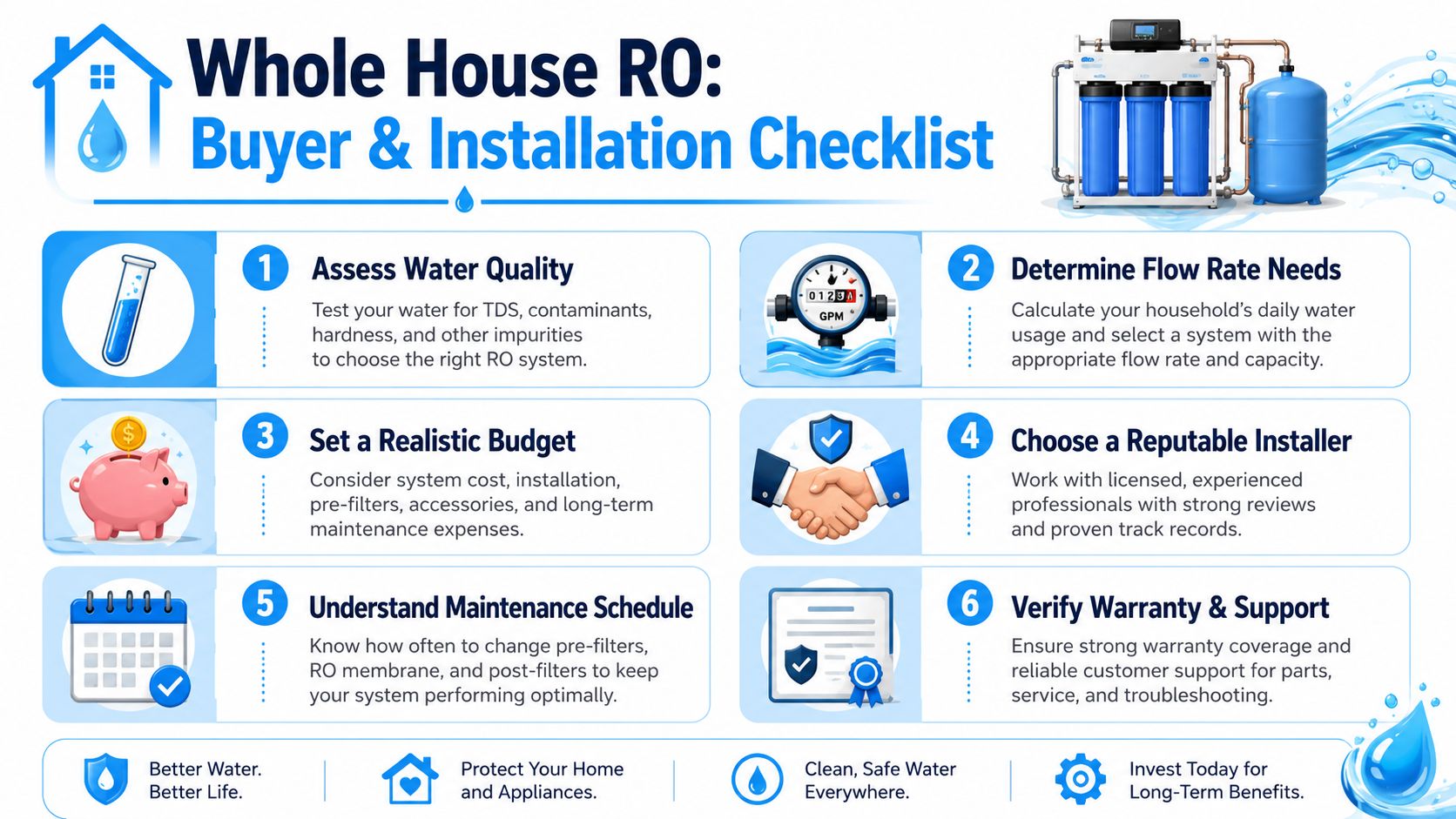
A helpful infographic showing a six-step checklist for buying and installing a whole house reverse osmosis system.

Start with the water test

A lab test comes first.

Without it, you are guessing about the one thing the system is supposed to fix. Smell, taste, and a neighbor's opinion can point to a problem, but they cannot tell you whether dissolved contaminants are serious enough to justify whole-house RO instead of a simpler setup.

The test also helps answer a question many homeowners skip. Is RO even the right tool here? If your main complaint is chlorine taste or odor, full-house RO may be more system than you need.

Match the system to your daily water use

Do not shop by bathroom count alone. Look at how your home uses water.

A family that runs two showers, a washing machine, and a dishwasher around the same time needs a different setup than a couple with lighter habits, even if both homes are the same size. Whole-house RO relies on storage and delivery equipment, so sizing is a little like planning a pantry. You do not shop only for the meal in front of you. You plan for the busy days too.

Ask the installer how they are sizing the system for your peak use, not just your average day.

Understand recovery and drain planning in plain English

RO does not turn every gallon coming in into a gallon going back out to the house. Some water carries the rejected contaminants away to drain.

That is normal. A better way to picture it is rinsing dirt off a screen. The rinse water is part of how the screen stays clear enough to keep working. For a whole-house system, that affects drain routing, storage capacity, and operating cost, so it should be explained clearly before you buy.

If a contractor gets vague here, slow down and ask more questions.

Check the house, not just the equipment sheet

A whole-house RO system needs room to live and room to be serviced. Tanks need floor space. Filters and membranes need access. Pumps and controls may need power nearby.

Some installations also involve home electrical planning, especially if the system uses pumps or added controls. In that case, related work such as electrical panel installation can become part of the project if the existing panel is already crowded or not well set up for new equipment.

A cramped corner can turn simple maintenance into an awkward, recurring mess.

Ask questions that reveal whether the design is sensible

Use this checklist during quotes and walkthroughs:

  • Get the water test in writing: Do not approve a system based on a sales pitch alone.
  • Ask why whole-house RO is being recommended: The installer should explain why a smaller point-of-use RO or a whole-house carbon system would not solve the problem.
  • Review pretreatment needs: Membranes last longer when sediment, chlorine, hardness, or other upstream issues are handled properly first.
  • Confirm peak flow planning: Ask what happens during back-to-back showers or heavy evening water use.
  • Look at the drain route: The waste line needs a practical, code-compliant path.
  • Check service space: A future filter change should not require dismantling half the mechanical room.
  • Ask about replacement parts and local service: You want filters, membranes, and support that are easy to get.
  • Get maintenance expectations in plain language: Know what gets changed, how often, and who will do it.

If you want a straightforward reference for comparing system types, upkeep, and common use cases, Water Filter Advisor's water filtration advice library is a useful place to keep researching before you sign anything.

The best whole-house RO install is usually the one that still makes sense after the sales meeting is over. If the design feels oversized, vague, or hard to maintain, that is often a sign to reconsider whether full-house RO is the smart choice for your home.

Frequently Asked Questions About Whole House RO

Does whole-house RO hurt water pressure

It can affect how the system feels if it isn't designed well.

RO treatment needs pressure to work, and whole-house systems rely on storage and pumping to deliver treated water back through the house in a usable way. If the equipment is undersized or poorly installed, homeowners notice it at the shower first. Good design is what keeps the system from feeling sluggish.

Does RO water taste too flat

Some people think it does.

That usually comes down to preference. RO strips out a lot of dissolved material, and that can change the taste profile. Some homeowners like the very clean taste right away. Others prefer adding a remineralization stage after treatment to give the water a different finish.

Can I install a whole-house RO system myself

Most homeowners shouldn't.

This isn't the same level of project as swapping an under-sink cartridge or hanging a shower filter. Whole-house RO involves plumbing layout, drain planning, pumps, storage, and enough system interaction that mistakes can get expensive fast. A skilled DIY homeowner may be comfortable with portions of the work, but most families are better off using a qualified water-treatment installer and plumber.

Is whole-house RO worth it for city water

Sometimes, but not automatically.

If municipal water testing shows a real dissolved-contaminant problem, the answer may be yes. If the main issue is chlorine taste, odor, or general water comfort, many homes are better served by a simpler setup such as whole-house carbon or a hybrid system.

What's the best mindset before buying

Treat whole-house RO like a medical prescription, not a luxury upgrade.

You want it because your water and your goals justify it, not because it sounds like the strongest option on the shelf. The best water filtration plan is rarely the most extreme one. It's the one that solves the actual problem without adding unnecessary complexity.


If you're comparing whole-house RO, under-sink RO, carbon systems, or hybrid setups, Water Filter Advisor is a practical place to keep researching. It focuses on helping homeowners choose filtration based on their water source, contaminants, and maintenance needs instead of defaulting to a one-size-fits-all answer.
Whole House GAC Filter Guide: Clean Water for Your Home

The problem usually starts small. Shower steam carries a faint pool smell. Coffee tastes flat even when the beans are good. White towels come out of the wash clean, but the water itself still seems off.

That's when many homeowners start looking at a whole house GAC filter. Not because they want a science project in the utility room, but because they want one system at the main line that improves water at every shower, sink, and appliance connection inside the home.

Your First Step to Better Water Everywhere

A whole house GAC filter is one of the most common starting points for homes that need better-tasting, better-smelling water across the board. GAC stands for granular activated carbon, and it has long been a foundational filtration medium because it's effective at reducing chlorine, objectionable tastes and odors, and certain organic chemicals. Minnesota health guidance describes GAC as a “proven option” for removing certain chemicals and notes that whole-house units are installed at the main supply line so they treat water to all faucets and fixtures in the home, not just the kitchen sink, as explained in Minnesota's GAC treatment guidance.

That point-of-entry placement matters more than most buyers realize. If water quality is bothering you in the shower, at the bathroom sink, and in the laundry room, a small drinking-water filter won't solve the full problem. A whole-house setup addresses the water before it branches through the house.

Why homeowners choose GAC first

Many don't begin with hardness charts or micron ratings. They begin with daily annoyances:

  • Shower odor: Chlorine smell becomes much more noticeable in warm water.
  • Kitchen frustration: Ice, tea, and coffee all pick up the taste of the tap.
  • Whole-home comfort: Water quality affects bathing, washing, and cleaning, not just drinking.

Practical rule: If the problem shows up in more than one room, start by thinking at the main water line.

A good whole house GAC filter isn't the answer to every water issue. It won't act like a softener, and it won't replace specialized treatment where that's needed. But for many homes, it's the right foundation because it improves the water you live with every day.

If you're sorting through options and trying to separate real performance from marketing, practical buying help from Water Filter Advisor's filtration advice library is a useful next step.

How a GAC Filter Cleans Your Water

The easiest way to understand a GAC filter is to stop thinking of it as a screen. It's not mainly a fence that blocks things. It works more like a chemical parking garage.

Water flows through a bed of carbon granules. Inside those granules is a huge network of tiny pores and surfaces. As water passes through, certain unwanted compounds cling to those surfaces. That process is called adsorption. The contaminant sticks to the outside and internal surfaces of the carbon instead of continuing down the pipe.

A four-step infographic illustrating how granular activated carbon (GAC) filters remove contaminants from water through adsorption.

Adsorption is different from straining

Homeowners often get confused by this distinction. A sediment filter strains out visible particles. GAC targets many dissolved compounds that affect smell, taste, and chemical exposure.

Think of it this way:

  • A sediment filter works like a sieve.
  • A GAC bed works like a magnetized sponge for certain chemicals.
  • A carbon block combines adsorption with tighter physical structure, which is why it often catches finer particles than GAC.

That distinction matters because buyers sometimes expect loose carbon to do jobs it wasn't designed for. If your water issue is chemical taste and odor, GAC is in its lane. If your issue is fine particulate capture, that's a different conversation.

Why the granular form matters

The word granular isn't just technical labeling. It tells you something important about performance. Loose carbon granules let water move through with less resistance than denser media. That's one reason GAC is so common in point-of-entry systems. A whole house filter has to serve showers, faucets, toilets, and appliances without making the house feel starved for water.

Water treatment that looks good on paper but chokes flow at the master shower usually doesn't last long in a real home.

The trade-off is simple. Higher flow is easier with GAC, but performance still depends on giving water enough contact with the carbon. If water rushes through too quickly, the carbon has less time to grab what you want removed. That's why tank size, media volume, and plumbing design matter so much.

What actually happens inside the tank

A practical way to picture it:

  1. Water enters the tank and spreads through the carbon bed.
  2. Contaminants meet carbon surfaces and attach through adsorption.
  3. Cleaner water exits to the house plumbing.
  4. The media gradually fills up and loses effectiveness over time.

That last point is the part many sales pages skip. Carbon doesn't stay fresh forever. It's a working media bed, not a permanent fix.

What GAC Filters Remove and What They Miss

A whole house GAC filter has a clear job. It improves water aesthetics and reduces certain chemicals that carbon handles well. It also has clear limits. Knowing both sides saves money and prevents bad system choices.

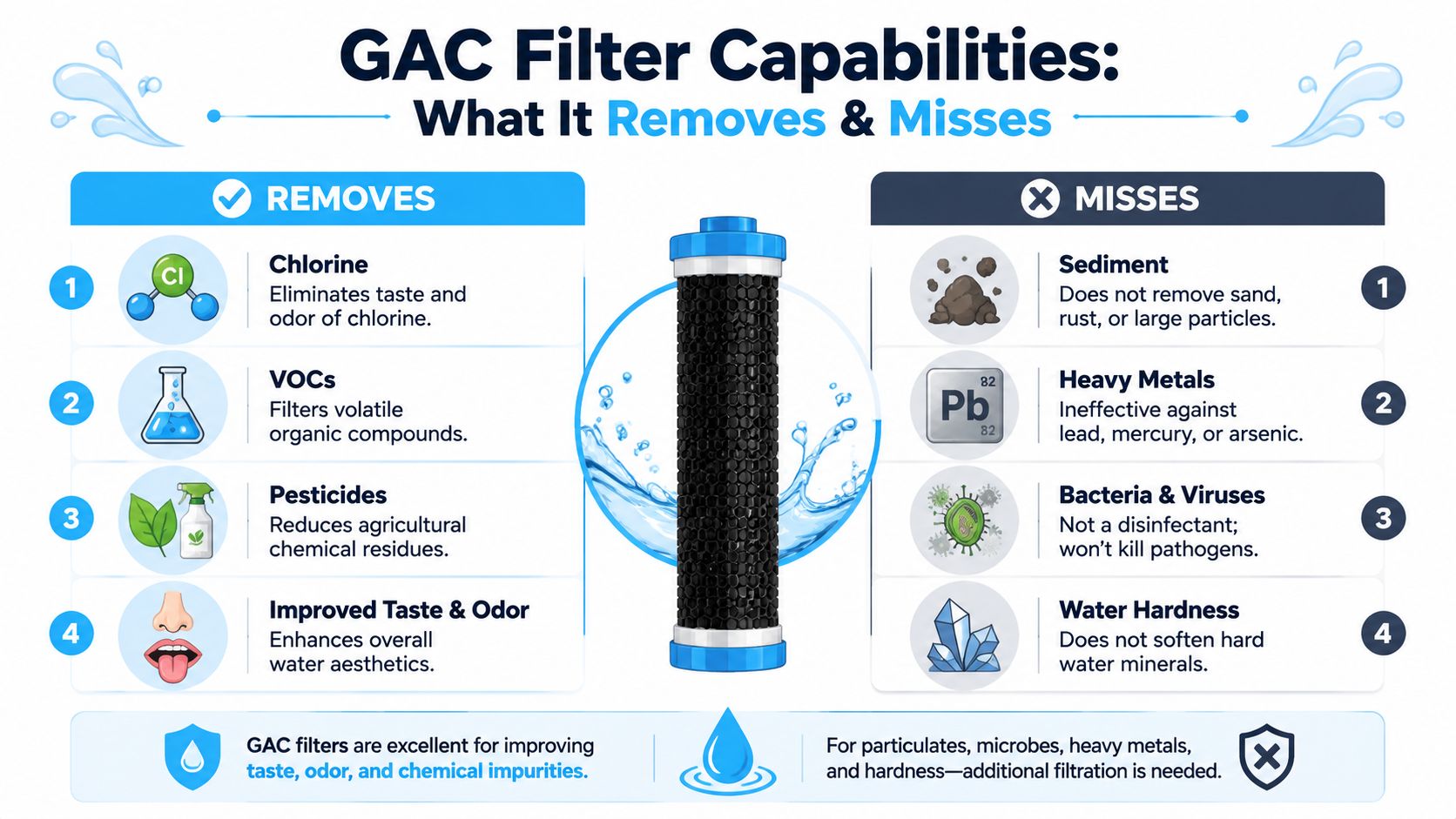
An infographic detailing the contaminants removed and missed by GAC whole house water filters.

Where GAC does its best work

GAC earns its reputation in homes where the main complaints are smell, taste, and chlorine-related irritation.

  • Chlorine reduction: This is one of the strongest reasons homeowners install carbon at the main line.
  • Taste and odor improvement: Water often becomes more neutral and easier to drink and cook with.
  • Certain organic chemicals: GAC is widely used where those compounds are a concern.
  • Whole-home treatment: Because the system sits at the main line, the benefit reaches showers and sinks throughout the house.

If your city water smells sharp or medicinal, carbon usually gives the most noticeable day-one improvement.

What GAC doesn't solve on its own

Many homeowners get burned. They buy one tank and expect it to solve every water problem in the house.

A standard GAC system doesn't do these jobs well by itself:

  • Hard water minerals: It won't soften water or stop scale the way a softener does.
  • Most dissolved solids: If your concern is total dissolved solids, carbon isn't the main tool for that.
  • Heavy metals: A plain GAC system shouldn't be assumed to handle lead, mercury, or arsenic without additional treatment stages designed for that purpose.
  • Bacteria and viruses: Carbon is not a disinfectant.
  • Visible sediment: Sand, rust, and grit are usually better handled by a sediment pre-filter placed ahead of the carbon.

Buy carbon for what carbon does well. Don't ask it to act like a softener, a disinfection system, and a fine-particle filter all at once.

A simple way to decide

If your water problem sounds like this, GAC is often a strong fit:

Good fit for GAC Usually needs something else too
Chlorine smell in showers Hard water scale on fixtures
Bad taste in drinking water Bacteria concerns
Chemical odor concerns Lead-specific reduction
General whole-home odor improvement Heavy sediment loading

The smart approach is to match the media to the problem. Carbon is excellent when used for carbon jobs. It's disappointing when it's used as a universal cure.

Sizing Your Filter for Peak Performance

Saturday morning is when sizing mistakes show up. Two showers are running, the washer kicks on, someone starts the dishwasher, and the kitchen faucet opens. If the carbon system was sized too small, that is when chlorine odor slips back in and the house suddenly feels like it lost water pressure.

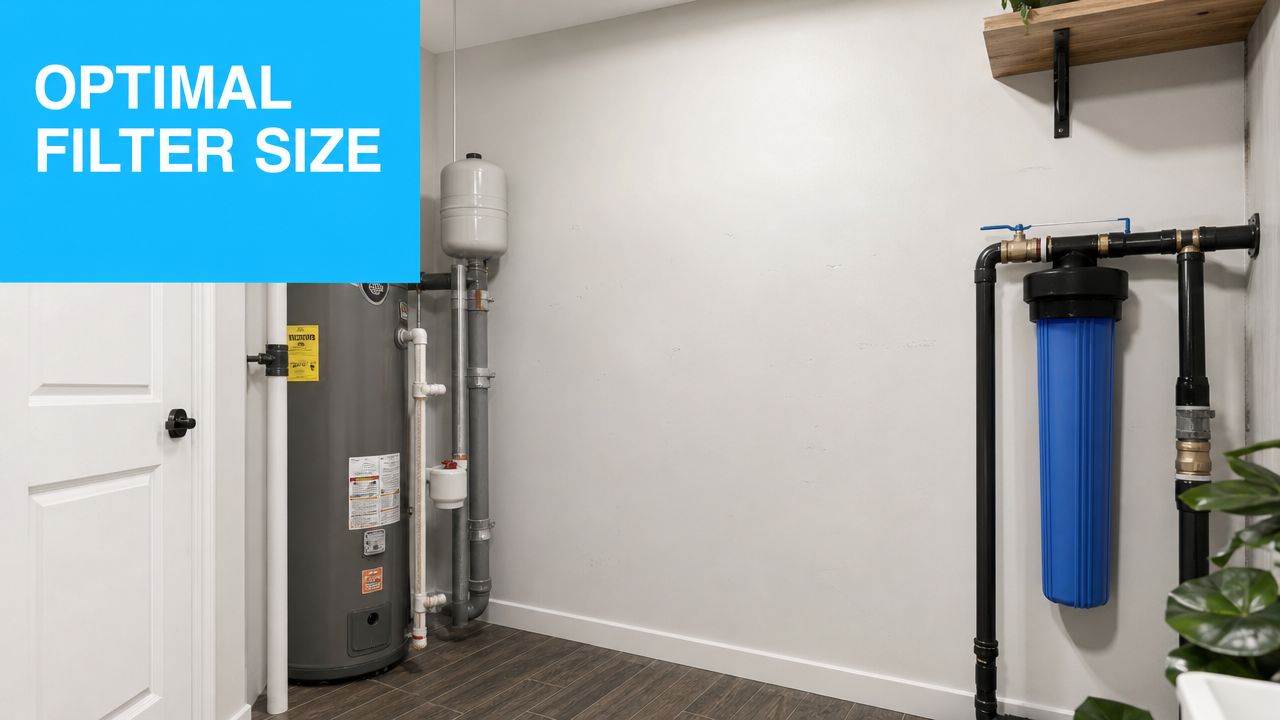
A utility room featuring a large blue whole house water filter system and a residential water heater.

Size for the busiest hour in the house

Average daily water use is not the number that matters most. Peak flow is.

A whole-house GAC filter has one job during high-demand periods. It needs to keep enough water moving to the fixtures while still holding that water in the carbon bed long enough for adsorption to happen. Adsorption works like a sponge with limited contact time. If water rushes past the carbon too quickly, the media gets less chance to grab chlorine, odors, and organic compounds.

That trade-off is what homeowners feel in real life. High flow supports comfort. More contact time supports treatment. Good sizing balances both.

Why undersizing costs more than it looks

An undersized filter usually creates two problems at once.

The first is performance loss. Fast flow shortens contact time, so taste and odor reduction often falls off sooner than expected. Homeowners then assume the carbon is poor quality, when the underlying issue is that the system was asked to treat more water than it was built to handle.

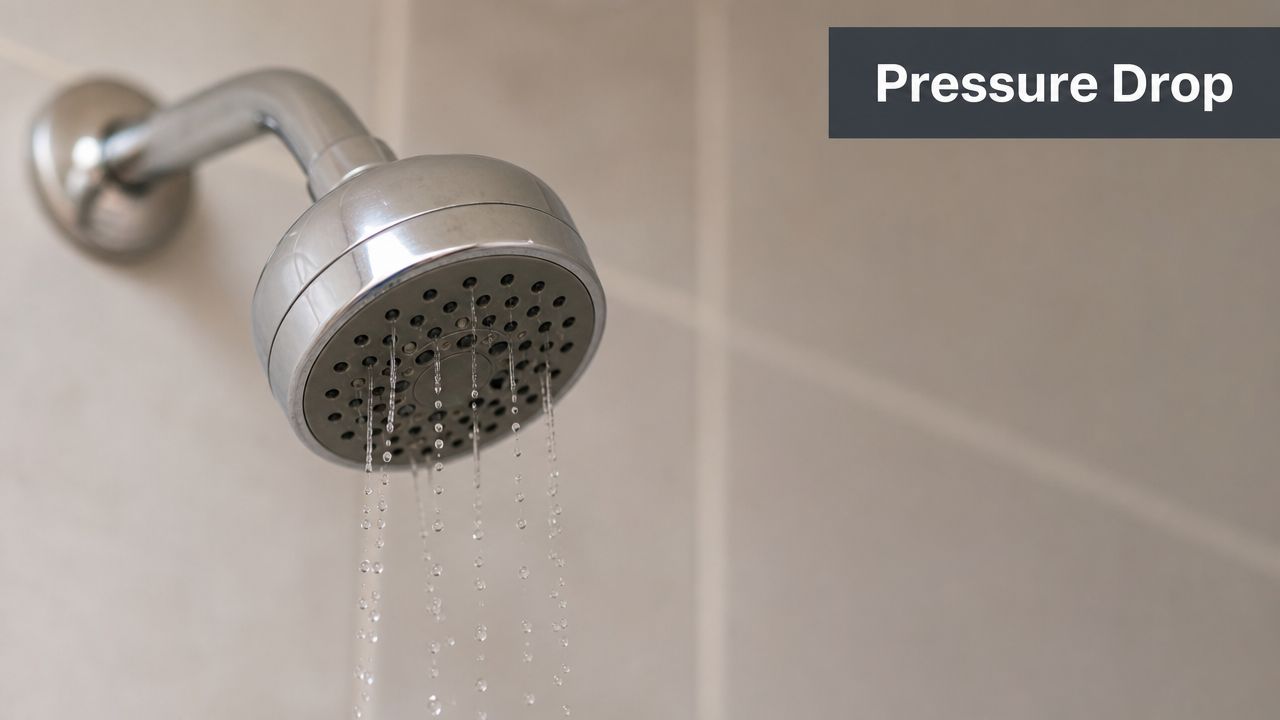
The second is pressure loss. Every filter adds some resistance. If the system is too small for the home's plumbing and fixture demand, showers feel weaker and fill times get longer. In houses that already have modest incoming pressure, a restrictive filter can turn a decent setup into a daily annoyance.

I see this often with cartridge systems chosen because the upfront price looks attractive. They can work well, but only when the cartridge size, housing size, and expected flow match the house.

What to check before you buy

A sizing conversation should get specific fast. These are the details that change the recommendation:

  • How many fixtures can run at once: Count real overlap, not ideal behavior.
  • Main water line size: A larger service line usually calls for a filter that will not choke that flow.
  • Incoming pressure at the house: Marginal pressure leaves less room for a restrictive filter.
  • Bathrooms and appliance load: A three-bath home with a large tub and irrigation use is different from a two-person household in the same square footage.
  • Whether outdoor spigots are filtered: Sending hose and irrigation water through carbon adds wear and shortens media life.

That last point affects cost more than many homeowners expect. If the system treats outside water that does not need treatment, you burn through media capacity faster and pay for replacement sooner.

Bigger helps, until it doesn't

Oversizing has a cost too. A larger tank, more media, and a more involved install can make sense in a busy house, but there is no prize for buying more filter than the plumbing and family usage require. Water can sit longer in a large system, which is fine when the match is reasonable, but the primary downside for most homeowners is simpler. They spend more upfront and may never use the added capacity.

The better target is a filter that matches the home's peak demand with enough margin to avoid complaints, without paying for unused capacity.

A practical way to judge the recommendation

If a seller jumps straight to a one-size-fits-all model, slow the conversation down. Ask what flow rate the system is designed to handle, what pressure drop to expect at that flow, and how often the media will need replacement under your household's usage. Those answers matter more than tank color or marketing claims.

Homeowners comparing specialty water systems sometimes notice that sizing logic is similar across very different applications. The same discipline used in reliable solutions for laboratory water needs applies at home. Match the equipment to the demand, or the results disappoint.

A properly sized GAC system feels boring in the best way. Showers stay strong, chlorine stays down, and maintenance costs stay closer to what you were promised.

GAC Compared to Other Filtration Media

A whole-house filter is rarely a one-media decision. Homeowners usually end up choosing which compromise they can live with: higher flow with broader treatment, finer filtration with more pressure loss, or a staged system that costs more up front but solves more than one problem well.

GAC earns its place because it fits the way a house uses water. It handles chlorine, taste, odor, and many organic compounds without choking flow at showers, tubs, and laundry the way tighter media often can. In plain terms, loose-bed carbon gives water more paths through the tank, while denser media forces water through smaller channels. That difference shows up at the tap.

GAC versus carbon block

Carbon block and GAC both use activated carbon, but they behave very differently in a plumbing system. Carbon block is tighter and usually better when the job calls for finer particulate reduction at a lower flow point, such as drinking water at a sink. GAC is usually the better fit at the main line, where the system has to feed several fixtures at once without making the house feel starved for pressure.

The trade-off is straightforward. Carbon block often filters more precisely, but it usually creates more restriction and needs closer attention to pressure drop as it loads up. GAC is less exacting on particulate capture, yet it is often easier to live with in whole-house service because it supports higher flow and larger treatment volumes.

NSF notes that activated carbon systems are commonly used for taste, odor, and chemical reduction, while system design and certification determine what a given unit is tested to remove, as outlined by NSF consumer guidance on carbon water filters.

Where other media make more sense

Some water problems call for something beyond standard GAC.

  • Catalytic carbon: A stronger choice when water chemistry makes standard activated carbon less effective, particularly in homes dealing with tougher disinfectant-related taste and odor issues.
  • KDF media: Often blended with carbon in specialty systems. It can support a broader treatment strategy, but it does not replace the adsorption role of carbon.
  • Water softener resin: Built for hardness minerals like calcium and magnesium. If your problem is scale on fixtures or poor soap performance, carbon will not fix it.

Homeowners overspend if they buy by marketing category instead of water problem. A softener will not remove chlorine. Carbon will not stop hard-water scale. A mixed-media system can work very well, but only if each stage has a clear job.

If you're comparing household equipment to specialized treatment systems in technical settings, the contrast is useful. reliable solutions for laboratory water needs show how system design changes once the goal shifts from comfortable whole-home water use to tightly controlled process water.

Filtration media comparison

Media Type Primary Use Flow Rate Impact Typical Lifespan
GAC Chlorine, taste, odor, certain organic chemicals Lower restriction in whole-house use Varies with water conditions and usage
Carbon block Finer filtration plus carbon adsorption More restrictive than GAC Varies with loading and flow demand
Catalytic carbon Specialized carbon treatment applications Depends on system design Varies by media and water chemistry
KDF Used as a companion media in some systems Depends on blend and tank design Varies by application
Water softener resin Hardness reduction Usually designed around whole-house flow Regenerates rather than acting like spent carbon

Cost shapes the decision too

The cheapest media on paper is not always the lower-cost system to own. A tighter filter that causes noticeable pressure loss often leads to larger housings, more frequent cartridge changes, or point-of-use installation instead of whole-house treatment. A GAC tank may cost more at the start than a basic cartridge setup, but in many homes it spreads that cost across better flow, longer service intervals, and fewer complaints from the family.

That is usually the practical test. Choose the media that solves the main water problem without creating a daily nuisance or an expensive maintenance cycle. For many municipal-water homes, GAC still lands in that sweet spot.

Installation and Maintenance Best Practices

A whole house GAC filter can be simple to live with if the installation is thoughtful. It becomes annoying when the installer treats maintenance as an afterthought.

One good layout choice changes the ownership experience immediately: build the system so it's easy to isolate, service, and flush. That usually means planning around access, not just squeezing the tank into whatever corner is open.

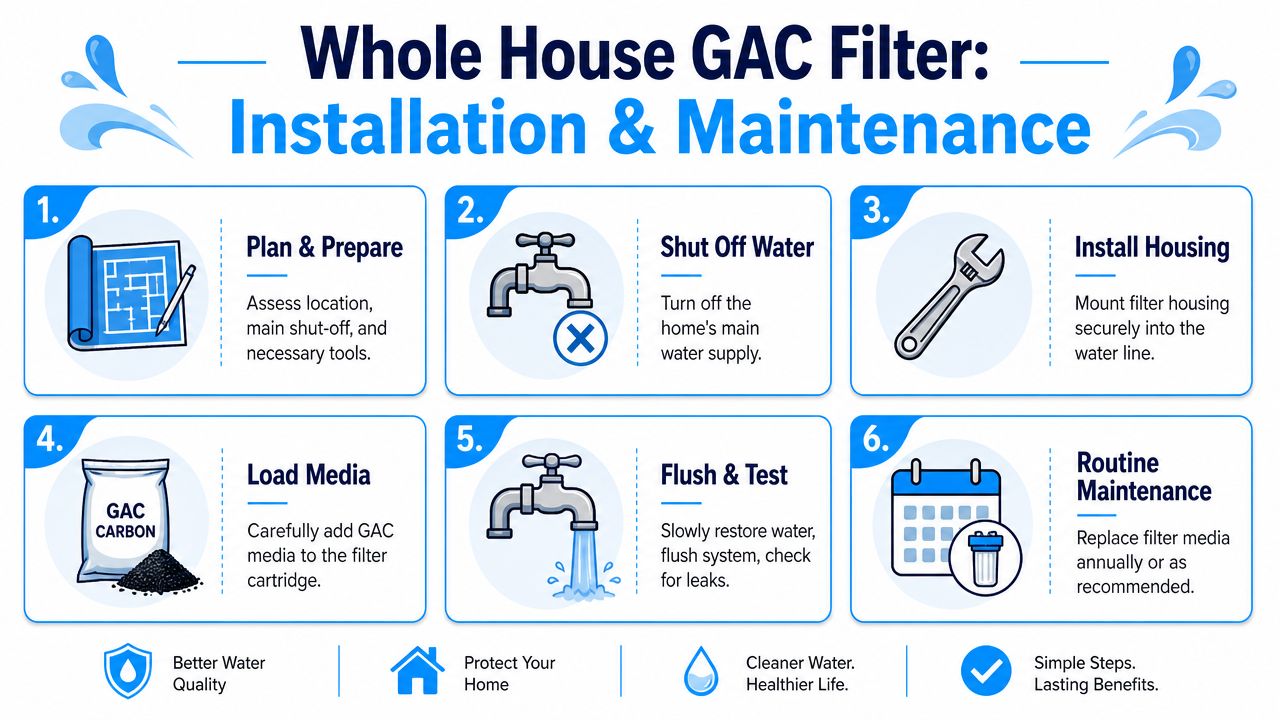
A step-by-step infographic showing how to install and maintain a whole house GAC water filter system.

Installation details that pay off later

A practical installation usually includes these basics:

  • Sediment protection first: A pre-filter ahead of the carbon helps keep rust, sand, and grit from loading the carbon bed too quickly.
  • A bypass valve: This makes service possible without shutting down water to the entire house longer than necessary.
  • Enough clearance: Cartridge housings and tanks need room for servicing, not just room to exist.
  • Thoughtful plumbing layout: Some installers place the system before outside spigots are branched off so irrigation and hose use don't waste carbon capacity.

Minnesota health guidance also notes that carbon should be replaced based on contaminant levels and water use because effectiveness declines as the media loads up, as described earlier in that state guidance.

Know the signs of exhausted carbon

Carbon usually announces its decline in familiar ways. Homeowners often notice the problem before they think to check the filter.

Watch for these clues:

  • Chlorine smell returns: Often most obvious in the shower first.
  • Taste gets sharper: Coffee, tea, and plain drinking water lose that neutral profile.
  • Pressure changes: This can point to loading, fouling, or a pre-filter that needs attention.
  • Service intervals start shrinking: If media seems to “wear out” fast, the system may be undersized or poorly protected from sediment.

A carbon filter rarely fails all at once. It usually fades, and the house slowly reminds you.

Here's a useful installation overview if you want to see the sequence in motion:

Cartridge systems and tank systems

Ownership feels different depending on the style of system.

Cartridge systems are straightforward. You replace the cartridge, flush the housing, and move on. They're easier for many DIY-minded homeowners, but they can become a frequent maintenance item in bigger households.

Tank-based systems often suit homes that want a more substantial point-of-entry setup. Some require backwashing, and all of them still depend on proper sizing and service timing. They aren't “install it and forget it” equipment.

If a seller tells you the filter is maintenance-free, assume the conversation just got less reliable.

How to Make a Smart GAC Filter Purchase

The smartest buyers don't shop by brand first. They shop by problem, then by fit, then by ownership cost.

Start with the water issue that's bothering you most. If the main complaints are chlorine smell, unpleasant taste, and whole-home odor concerns, a whole house GAC filter is often a sensible foundation. If the primary pain point is hardness or scale, a GAC system by itself won't solve it.

A short buyer checklist

Use this before you commit:

  • Match the media to the problem: Carbon for chlorine, taste, odor, and certain organic chemicals. Different equipment for hardness, microbes, or heavy-metal-specific goals.
  • Size for real household demand: Think about peak fixture use, not quiet-hour flow.
  • Check replacement access: If maintenance looks miserable, it usually becomes neglected.
  • Compare cartridge versus tank systems: Lower upfront simplicity versus larger whole-house capacity and different service routines.
  • Look for relevant certifications: Pay attention to claims around chlorine reduction and health-related contaminant performance, and make sure those claims are supported by actual product certification rather than vague marketing language.

A good purchase feels boring in the best way. The water improves, the showers stop smelling like a pool, and the system doesn't constantly demand attention or surprise you with the wrong kind of maintenance.

The final decision usually comes down to this: buy the system that fits your water, your house, and your willingness to maintain it. Not the biggest tank. Not the flashiest claims. The right fit wins.


If you're narrowing down options and want plain-English help comparing systems, media types, maintenance demands, and buying trade-offs, Water Filter Advisor is a solid place to research your next filter with less guesswork.

Whole House Filter System: 2026 Buyer’s Guide

The usual path to a whole house filter system starts with a small annoyance. Your shower smells faintly like a pool. White spots keep showing up on glasses that just came out of the dishwasher. Laundry looks clean but doesn't feel clean. Or maybe you read your local water report and realized “meets standards” isn't the same thing as “water I want running through every pipe in my house.”

That's when many homeowners stop thinking about filters as a kitchen-sink accessory and start thinking about water treatment as part of the home itself. A whole house filter system sits in that category. It's less like a pitcher in the fridge and more like a gatekeeper on the main line.

That shift is showing up in the broader market too. The global home water filtration systems market was valued at USD 8.12 billion in 2023 and is projected to reach USD 16.62 billion by 2032 according to Straits Research's home water filtration systems market report. That doesn't mean every home needs one. It does mean this has become a mainstream home-improvement decision, not a niche plumbing experiment.

Is a Whole House Filter Right for Your Home?

A whole house filter system makes sense when the problem follows you through the house.

If the water tastes off only at one tap, a targeted filter may be the smarter move. But if the chlorine smell shows up in the shower, the guest bathroom sink, the washing machine, and the kitchen faucet, a point-of-entry system starts to look practical. It treats the water before your plumbing distributes it, so the improvement shows up where you live with water, not just where you drink it.

The homes that benefit most

A few situations push homeowners toward a whole house setup faster than others:

  • Whole-home chlorine complaints: Showers, bath water, and sink water all have the same sharp smell.
  • Visible sediment or rust: Faucet screens clog, toilet tanks collect debris, or appliances don't like what's coming through.
  • Taste and odor throughout the house: Not a single-tap problem. A house-wide water problem.
  • Plumbing and appliance protection: You want cleaner water moving through fixtures, valves, and water-using appliances.

There's a useful parallel here with indoor air. Homeowners who upgrade water quality often think the same way about air quality. If you're evaluating broader home comfort, Precision Air Solutions air filtration is a relevant example of the same whole-home mindset applied to what your family breathes.

When it's the wrong tool

A whole house filter system isn't automatically the best answer.

If your concern is highly specific, such as a drinking-water issue at the kitchen sink, treating the entire home can be overkill. You may end up paying to process shower water and toilet water when your actual goal is cleaner water for drinking and cooking.

A whole house filter is a lifestyle upgrade when the problem is everywhere. It's a poor value when the problem lives at one faucet.

If you're still sorting that out, a good next step is practical decision support, not product shopping. Water filtration advice for homeowners should help you narrow the problem before you invest in hardware.

How a Whole House Filter System Works

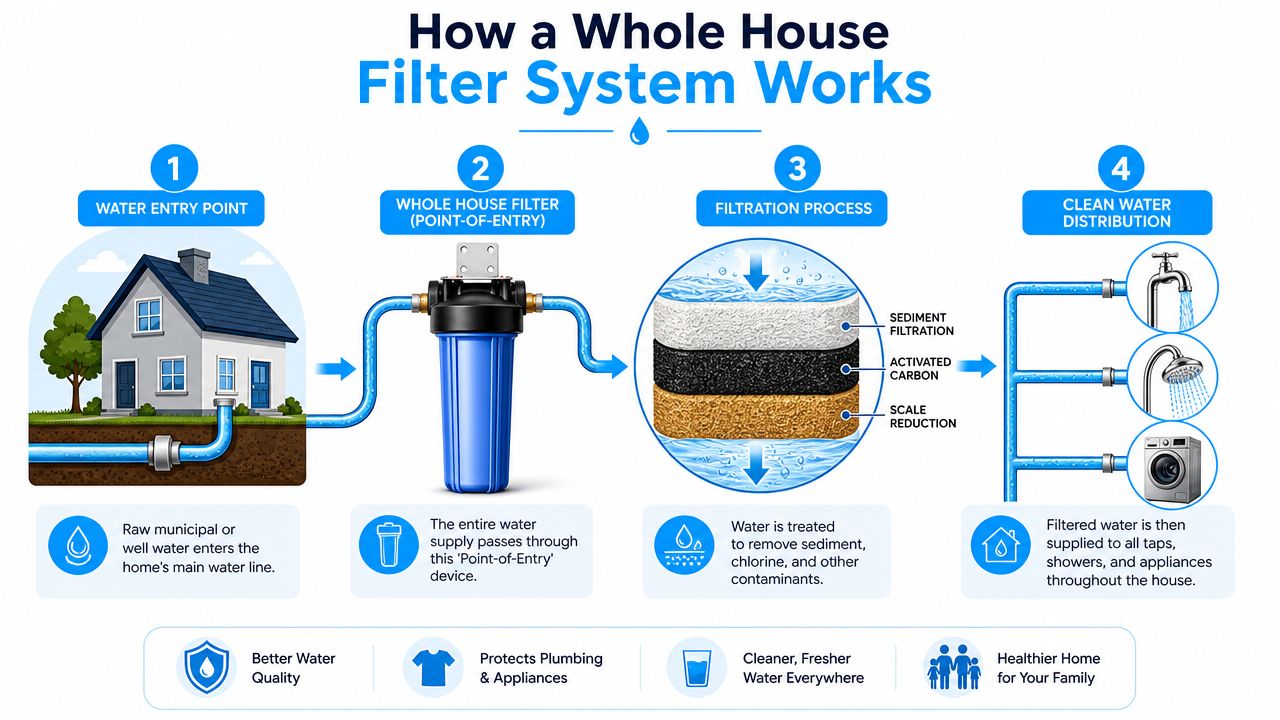
A whole house filter system is a point-of-entry system, often shortened to POE. Think of it as the front gate to your home's water supply. Every drop passes the guard station before it heads to the shower, dishwasher, washing machine, or kitchen faucet.

The public-health definition is straightforward. The CDC defines whole-home filters as systems that treat water as it enters the home, and notes these POE systems are typically certified against NSF/ANSI 42 for aesthetic effects and NSF/ANSI 53 for health effects in applicable products, as described in the CDC guide to choosing home water filters.

A diagram illustrating the four steps of how a whole house water filtration system works for homes.

Where it sits in the plumbing

Most systems are installed on the main incoming line, usually near where water enters the house. In practical terms, that's often near the water meter for municipal water or near the pressure tank setup for well water.

Once installed, the system treats the water before it branches out through the house. That's the main distinction from an under-sink or faucet filter. A POE system works upstream. A point-of-use filter works downstream.

What happens inside the system

Most whole house filter systems follow a simple sequence:

  1. Incoming water enters the housing or tank
  2. Media inside the system captures or reduces target contaminants
  3. Treated water exits the unit
  4. Filtered water moves through the home's plumbing network

The details depend on the media. A sediment stage screens out physical debris like dirt and rust. A carbon stage targets chlorine, taste, and odor. Some systems use multiple stages because one media bed rarely does everything well.

Practical rule: The best whole house filter system isn't the one with the longest feature list. It's the one placed correctly on the main line and matched to the problem in your water.

What a whole house system does not mean

Homeowners often hear “whole house” and assume “solves everything.” That's where people get disappointed.

A whole house filter system can improve water quality throughout the home, but it isn't a universal cure. The CDC also notes that if a whole-home filter removes chlorine or other disinfectants, more germs may grow in plumbing. That's why a whole-house system should be treated as part of a broader water-treatment strategy, not a magic tank that fixes every possible issue.

Decoding Filter Media and the Contaminants They Target

The tank or housing is just the container. The actual work happens in the filter media inside it.

Homeowners often make expensive mistakes. They buy a system based on brand, housing size, or glossy marketing language, then find out the unit is great for chlorine but does almost nothing for the specific water issue they have. Media selection matters more than appearance.

The main media types you'll see

Sediment filters are the workhorses for visible debris. They target dirt, rust, sand, and other particles. If you've ever cleaned faucet aerators and found grit, sediment filtration usually belongs at the front of the system.

Activated carbon is the usual choice for chlorine, taste, and odor. This is the media homeowners notice fastest because it often changes how shower water smells and how drinking water tastes.

Catalytic carbon is often discussed when standard carbon isn't enough for the job at hand, especially in cases where a homeowner wants stronger chemical reduction performance. It's best viewed as a specialized version of carbon media rather than a universal upgrade.

Specialty media can be added for specific problems. That may include media aimed at metals, nuisance contaminants, or water conditions that standard sediment and carbon stages don't address well.

Filter media versus water softening

A lot of buyers blur filtration and softening together. They overlap in real-world outcomes, but they are not the same tool.

A filter is designed to reduce or remove target contaminants. A softener or conditioner is used to address hardness-related issues. If your main complaint is scale buildup, stiff laundry, soap that doesn't rinse the way you want, or mineral spotting, a whole house filter alone may not deliver the result you expect.

That's why many well-designed systems are combinations. Sediment first. Carbon or specialty filtration next. Softening if hardness is part of the problem. Sometimes UV disinfection is added in well-water applications where microbiological concerns are part of the picture.

Don't buy a whole house filter system to fix a softening problem unless the system specifically addresses it. Clear water and soft water are not the same thing.

Matching the media to the problem

This is the shortcut most homeowners need. Start with the water complaint, then work backward to the media.

Filter Media Primary Contaminant Target Best For
Sediment filter Dirt, rust, sand, particulates Homes with visible debris, well water with grit, protecting downstream filters
Activated carbon Chlorine, taste, odor Municipal water with chlorine smell or unpleasant taste
Catalytic carbon More stubborn chemical-related taste and odor issues Homes needing more robust carbon-based treatment
Specialty metal-reduction media Metals and specific nuisance contaminants Water with test-confirmed metals or similar contaminant issues
Softener or conditioner Hardness minerals Scale control, spotting, soap performance, mineral-related buildup

What actually works in the field

For most city-water homes, a simple combination often delivers the biggest quality-of-life improvement: sediment prefiltration plus carbon. That setup handles the complaints people notice every day, such as grit, chlorine smell, and off-tasting water.

For well-water homes, the conversation usually gets more specific. You need testing first. Without that, choosing media is guesswork. Well water can look clear and still require a very different treatment strategy than municipal water.

The biggest mistake is expecting one generic cartridge to handle every category of water problem. It won't. A whole house filter system works best when each stage has a job and the jobs match your actual water.

Sizing Your System to Avoid Water Pressure Problems

A whole house filter system can clean up your water and still make daily life worse if it strangles flow. That's the livability issue many buyers overlook. Nobody wants a premium filtration setup that turns a shower into a drizzle when the dishwasher starts.

The core measurement is flow rate, usually expressed in gallons per minute (GPM). What matters is peak demand, not average use. The system has to handle the busiest moment in your home, not the quietest one.

A close-up view of a metal shower head spraying water against a tiled bathroom wall.

What the ratings mean in practice

To avoid noticeable pressure loss, a whole-house filter's flow capacity must be sized for peak demand. Many certified systems are rated for 7 GPM continuous and can handle peaks around 14 to 15 GPM, according to WaterBoss whole house filter sizing guidance.

That tells you two things. First, a whole house filter system isn't just about contaminant reduction. Second, ratings matter most when people are using water at the same time.

A simple way to think about peak demand

You don't need to over-engineer this. Think about the busiest normal stretch in your house:

  • Morning shower use: One or two showers running
  • Appliance overlap: Dishwasher or washing machine operating during the same window
  • Fixture stacking: Someone opens a bathroom faucet or kitchen tap while all that is happening

That's the moment the filter must survive without becoming the narrowest point in the plumbing.

What causes pressure complaints

Three issues show up over and over:

  • Undersized system: The filter can treat the water quality problem, but not at the flow your home needs.
  • Dirty cartridges: Even a well-sized unit loses performance as sediment and debris load up the media.
  • Poor plumbing layout: Small ports, restrictive fittings, or a cramped install can add resistance.

If your home has strong pressure before the filter and weak pressure after it, the system is acting like a kink in the hose.

The fix is usually straightforward. Choose a system with headroom above your real peak demand, not one that only looks adequate on paper. Then keep up with maintenance so the filter doesn't slowly turn into its own blockage.

Whole House Filters vs Point-of-Use Filters

This isn't a battle where one side wins. It's a location decision.

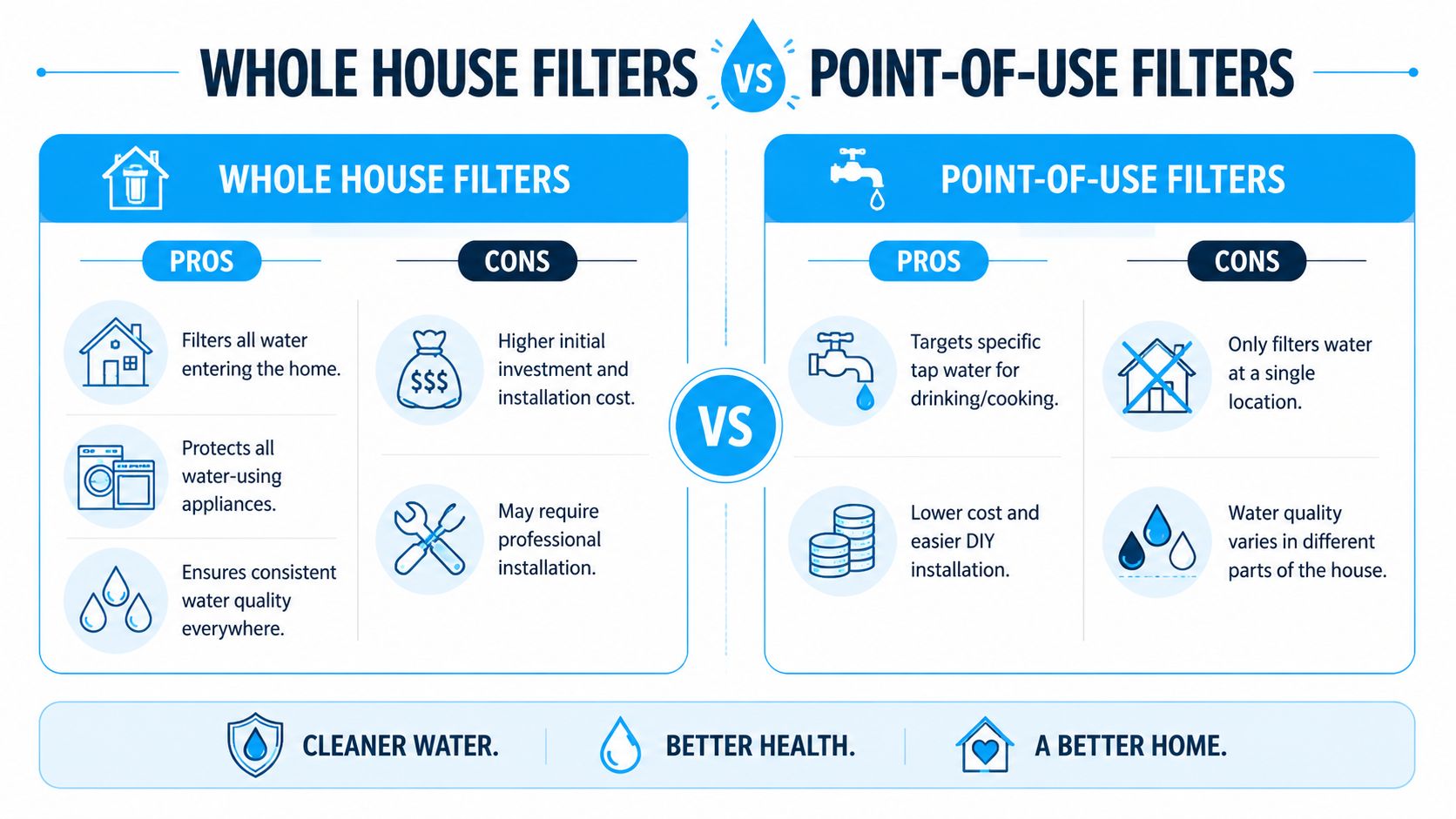
A whole house filter system treats water at entry. A point-of-use filter treats water at the tap or appliance where you use it. The right choice depends on whether your problem is broad, targeted, aesthetic, or health-focused.

A quick visual makes the trade-off easier to see.

A comparison infographic showing the pros and cons of whole house water filtration versus point-of-use systems.

Where whole house systems shine

Whole house systems are strong when you want one move to improve water quality across the home.

  • Bathing comfort: Better shower experience when chlorine or odor is the issue.
  • Fixture-wide coverage: Sinks, tubs, laundry, and appliances all get treated water.
  • Less piecemeal maintenance: One central treatment point instead of filters scattered around the house.

They're also the better fit when your complaint isn't limited to drinking water. If the water smells bad in the bathroom, a kitchen-only filter won't solve the part of the problem you feel every morning.

Where point-of-use systems win

Point-of-use systems are more surgical.

NSF advises consumers to identify the specific contaminants in their water before choosing a system, and notes that while whole-house systems are often well suited for chlorine and sediment, many health-related contaminants are better addressed by certified point-of-use systems, as explained in NSF's home water treatment guidance.

That's the key distinction. If your goal is highly targeted treatment at a drinking-water tap, a POU system may be the more precise tool.

Here's the practical split:

Option Best Use Case Main Trade-Off
Whole house filter system House-wide chlorine, sediment, odor, or comfort issues Higher install complexity and ongoing maintenance on a larger system
Under-sink or faucet filter Targeted drinking and cooking water treatment Doesn't improve showers, laundry, or whole-home plumbing
Shower filter Bathing-specific comfort concerns Limited scope and no protection for other fixtures

A short video can help if you're comparing these setups visually before buying.

The strategy that works best most often

Many homes benefit from a layered approach. Use a whole house filter system for broad treatment and comfort, then add a certified point-of-use filter where drinking-water concerns are more specific.

That combination avoids two common mistakes. One is overbuilding the whole-house system to chase contaminants better handled at the tap. The other is underbuilding with a single faucet filter when the rest of the home still smells, stains, or feels unpleasant.

Installation, Maintenance, and Lifetime Cost

The buying decision is only half the job. A whole house filter system has to be installable, serviceable, and affordable to live with. That's where plenty of “good” systems turn into frustrating ones.

Installation choices that affect daily life

If you're handy with plumbing, some systems are within DIY range. But this isn't a casual project if your main line access is tight, the plumbing is older, or you're adding multiple stages. A sloppy install can create leaks, awkward service access, and pressure issues that have nothing to do with the filter itself.

The smartest install detail is often the least glamorous: a bypass valve. It lets you isolate the system during service so you aren't shutting down the house every time a cartridge needs replacement.

A good install location should also give you enough room to:

  • Change cartridges easily: If the housing is jammed into a corner, maintenance gets postponed.
  • Monitor performance: You want clear access to the system, not a crawlspace punishment chamber.
  • Protect the floor area: Filters eventually need servicing, and water will show up during that process.

The best maintenance schedule is the one you'll actually follow. Easy access beats a beautiful install hidden in the worst spot in the house.

Maintenance is not optional

Whole house systems need regular attention. Even the best media can't keep working indefinitely once it's loaded with what it removed.

What maintenance usually looks like:

  • Sediment stages: These need the most frequent attention because they catch the bulk debris first.
  • Carbon stages: These generally last longer, but they still have a service life and eventually lose effectiveness.
  • Specialty media or add-ons: These depend heavily on water conditions and usage patterns.
  • System checks: Housings, seals, shutoffs, and bypass components should be inspected during service.

NSF's consumer guidance emphasizes regular replacement as part of proper use. That's easy to underestimate when you're shopping. Buyers focus on the purchase price, but livability depends just as much on whether replacement parts are available, easy to change, and realistically affordable over time.

How to think about total cost of ownership

A whole house filter system has three cost buckets.

  1. The equipment itself
    This includes housings, tanks, valves, mounting hardware, and the media or cartridges that ship with the unit.

  2. Installation
    Costs rise with complexity. Single-stage installs are simpler than multi-stage systems, and professional installation may be worth it if the main line layout is awkward.

  3. Ongoing replacement and service
    Cheap systems can become expensive because of ongoing replacement and service. Proprietary cartridges, hard-to-find parts, and frequent service can outweigh a tempting upfront price.

Certifications matter more than branding

If you're comparing systems, pay close attention to NSF/ANSI certifications and what the certification covers. A claim tied to NSF/ANSI 42 generally relates to aesthetic effects such as chlorine, taste, and odor. A claim tied to NSF/ANSI 53 addresses certain health-related effects in products certified for those reductions.

That's far more useful than vague packaging language. “Premium,” “advanced,” and “high-capacity” don't tell you what the system has been tested to do. Certification language does.

Your Practical Buying Checklist and Final Questions

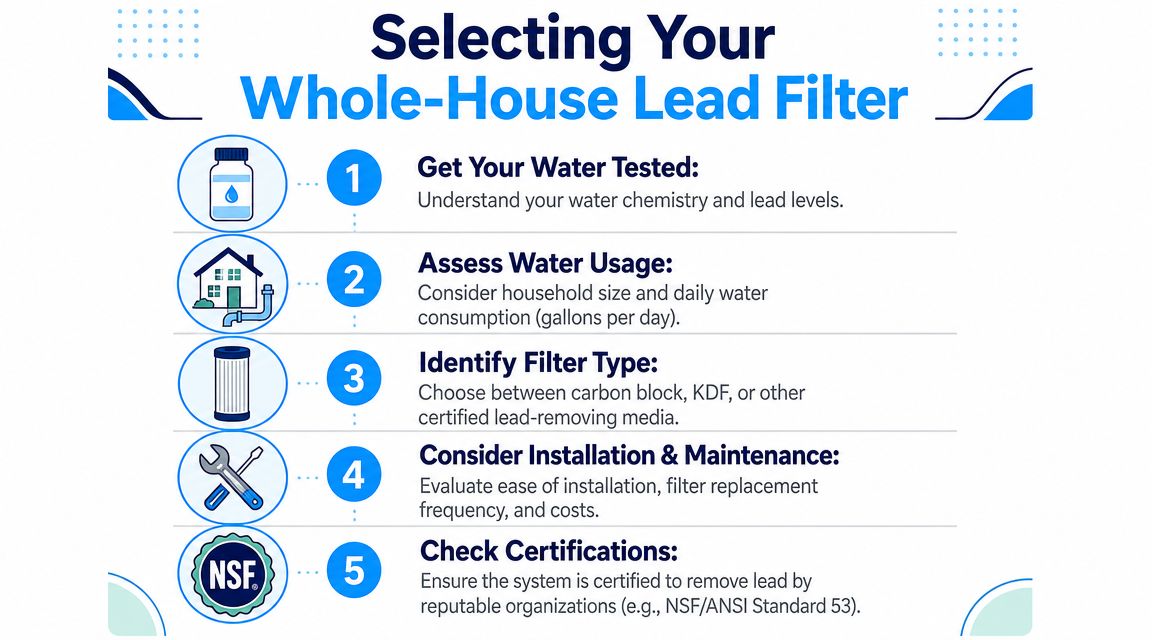
Buying a whole house filter system gets easier when you stop asking, “What's the best one?” and start asking, “What's the right one for my water, my plumbing, and my tolerance for maintenance?”

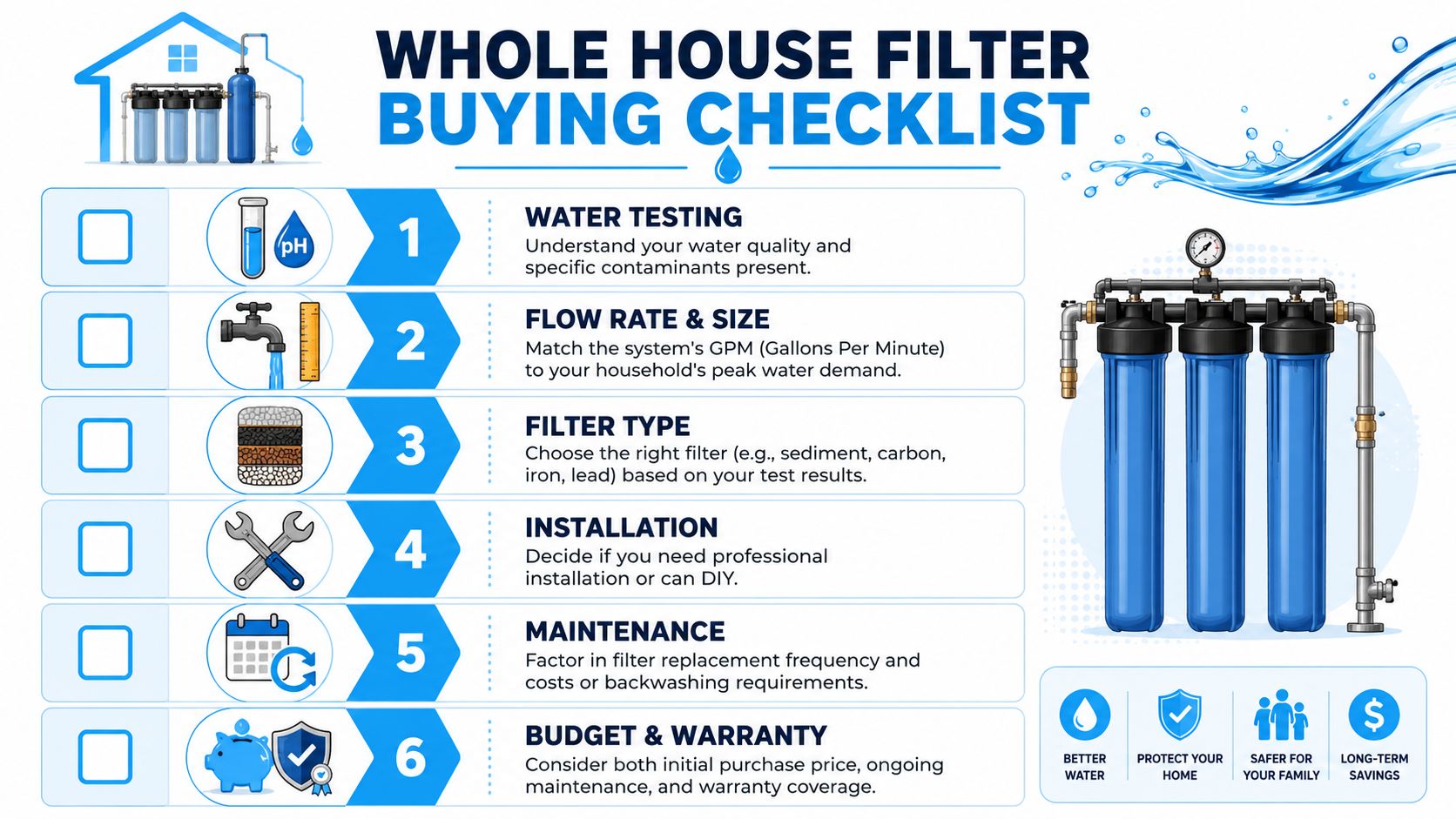
A six-step buying checklist for choosing a whole house water filtration system for your home.

The short checklist

  • Test your water: Don't choose media blind. Know whether your issue is sediment, chlorine, odor, metals, hardness, or something more specific.
  • Check peak flow: Size for the busiest water-use moment in the home, not the quiet one.
  • Match the media to the problem: Sediment and carbon handle common complaints well, but not every complaint.
  • Verify certifications: Look for NSF/ANSI claims that match what you're trying to reduce.
  • Plan the install: Make sure there's room for service access and include a bypass.
  • Compare ownership costs: Don't stop at sticker price. Replacement parts and maintenance effort matter.

Final questions homeowners ask

Will a whole house filter system remove every contaminant?
No. Some systems mainly improve taste, odor, and sediment performance. Other contaminants may be better handled at the point of use.

Is a whole house system good for well water?
It can be, but well water should be treated as a test-first situation. Well-water setups often need a more customized treatment train.

Will it hurt water pressure?
It can if the system is undersized or neglected. A properly sized and maintained unit is far less likely to create noticeable pressure loss.

Do I still need another filter at the kitchen sink?
Sometimes yes. If your drinking-water goals are more specific than your whole-home comfort goals, layering a point-of-use filter can be the smarter strategy.

A good whole house filter system doesn't just remove things from water. It fits the way your home operates. That means clean enough water, enough pressure, manageable maintenance, and a cost you won't resent a year from now.


If you want help comparing systems, understanding certifications, or figuring out whether your home needs whole-house filtration, a point-of-use filter, or both, visit Water Filter Advisor. It's a practical resource for homeowners who want clearer buying decisions, not just bigger product claims.

Whole House Filter for Lead: A 2026 Buyer’s Guide

A lot of people land on this topic the same way. A water report comes back with lead. A neighbor mentions old service lines. A child's pediatric visit turns a vague concern into a very specific one.

That's when the search for a whole house filter for lead starts, and that's also where the confusion starts.

A whole-house system sounds like the obvious answer. Treat everything. Protect every faucet. Stop worrying about which tap is safe. That instinct makes sense. But lead is one of those contaminants where the details matter more than the marketing. The biggest issue is not just whether a system says “lead” on the box. It's whether that claim is backed by the right kind of testing, installed in the right place, and matched to the way lead is showing up in your home.

If your concern includes possible exposure that's already happened, it also helps to understand the health side alongside the filtration side. A plain-language guide to assessing blood lead levels can be useful context while you work through the water treatment decision.

Is a Whole House Lead Filter Right for Your Home

A whole-house lead filter can be the right move, but it's not automatically the safest move, and it's not always the most effective first move.

Think of it as a house-wide shield. If it's designed well and installed properly, it treats water before it spreads through the plumbing. That matters if you want coverage at multiple outlets, not just the kitchen sink. Many homeowners like that idea because it feels complete. You're not relying on one person to remember which faucet has the filter.

The catch is that lead behaves differently from chlorine or sediment. It can show up as dissolved lead, particulate lead, or contamination tied to your own interior plumbing. One setup may handle one form better than another. That's why “whole-house lead filter” is not one product category with one clear answer.

When it makes sense

A point-of-entry system is worth serious consideration if your goal is broad household treatment and you've confirmed that the contamination problem isn't limited to a single drinking tap.

It's often a reasonable fit when:

  • You want protection at every outlet. That includes kitchen taps, bathroom sinks, tubs, and showers.
  • Your plumbing layout allows proper installation. The unit needs to go where water enters the house, before branch lines split off.
  • You're willing to maintain it on schedule. A lead system that isn't serviced becomes an expensive canister with fading performance.
  • You understand its role. In many homes, whole-house treatment works best as part of a layered setup, not as a one-box promise.

Practical rule: Buy a whole-house lead system only after you know where the lead is coming from and what form it's taking.

When it may not be the best first purchase

Sometimes a whole-house system is solving the wrong problem.

If lead risk is concentrated at drinking and cooking taps, a certified point-of-use filter can be easier to verify, easier to maintain, and easier to trust. If the lead is coming from disturbed plumbing or intermittent particulate release, a broad “lead reduction” claim may not tell you enough about how the system will perform in your house.

That's the core decision. Are you buying full-home treatment because you need it, or because the label sounds reassuring?

A seasoned buyer slows down there. The right answer starts with the plumbing map and the water test, not the product photo.

Understanding Point-of-Entry Filtration for Lead

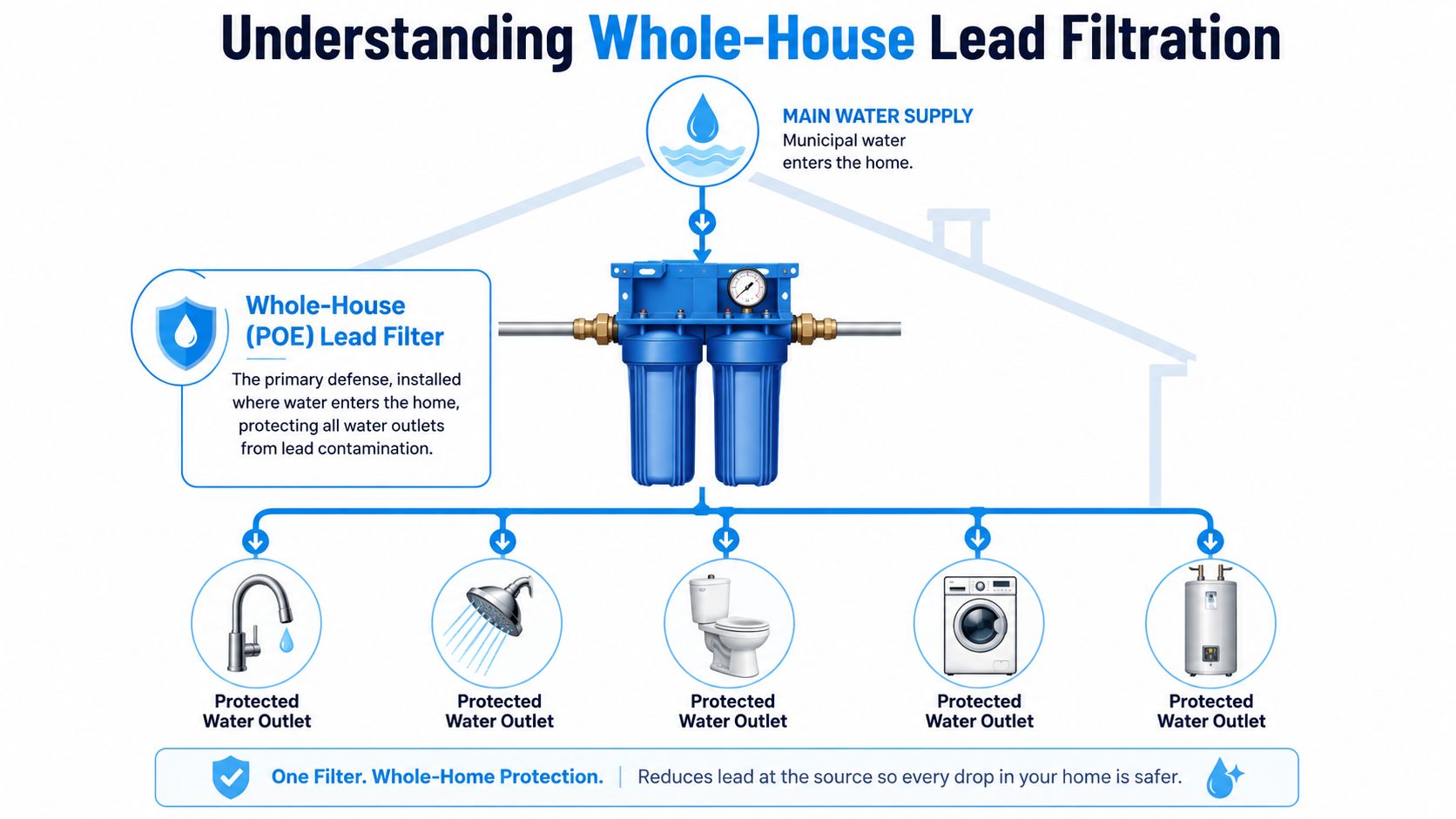
A point-of-entry, or POE, system is installed where water enters the home. That's why people call it a whole-house filter. It sits on the main line and treats water before the plumbing branches off to the kitchen, bathrooms, laundry, and other fixtures.

A diagram illustrating how a whole-house lead filtration system protects all water outlets in a home.

The simplest way to picture it is this. A POE filter is the guard at the front gate. A point-of-use filter is the guard standing at one door inside the house. Both can be useful, but they're doing different jobs.

Why installation location matters

With lead, placement isn't a small detail. It's the whole game.

Whole-house lead control is a point-of-entry hydraulics problem, not just a media problem. To reduce lead at all fixtures, the system has to be installed on the main line before branch distribution so every outlet receives treated water. NSF also notes that performance is only validated up to 150 ppb, and if source water exceeds that level, the filter should not be relied on as the sole control measure, according to the NSF lead reduction listings guidance.

That sentence carries more weight than most product pages do. It means a system can have impressive materials and still fail your household goals if it's undersized, installed too late in the plumbing path, or expected to handle conditions beyond the tested range.

What POE systems do well

A whole-house unit can solve a real convenience problem. Once it's properly plumbed into the main line, every downstream fixture gets treated water. That can matter if your concern goes beyond drinking water and you want broad coverage without adding filters at multiple sinks.

A good POE design can also help with mixed contamination issues when lead appears alongside sediment or other nuisance contaminants. In practical terms, that often means using staged treatment, with one component catching particles and another doing the actual lead reduction work.

What POE systems do not do automatically

They don't guarantee lead safety just because they're big.

A larger tank doesn't override poor contact time. A heavy-duty housing doesn't prove lead performance. And a whole-house label doesn't tell you whether the system is best at dissolved contaminants, particulate contaminants, or something else entirely.

A whole-house system covers more plumbing. That doesn't mean it gives you stronger proof of lead reduction at the tap you drink from.

That's the distinction many buyers miss. Scope and certainty are not the same thing. A POE filter treats more water. A tap-mounted or under-sink filter can offer tighter contaminant-specific verification for the water you consume.

The Technology That Actually Removes Lead

Lead removal isn't magic. A filter has to capture, adsorb, or exchange something specific in the water stream. If you don't know which mechanism a system uses, you can't judge whether it fits your problem.

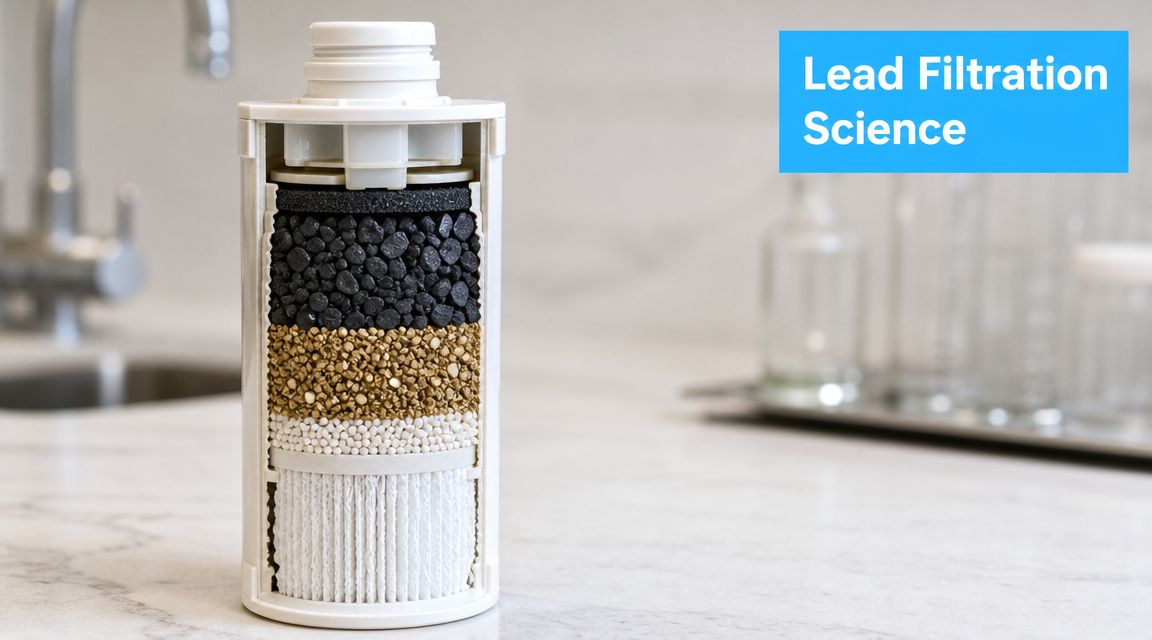
A cutaway view of a multi-stage water filter cartridge designed for effective lead filtration and removal.

That matters because lead doesn't always show up the same way. Some homes deal with fine particulate lead shed from pipes or fittings. Others have dissolved lead in the water itself. Some have both. The filter media needs to match that reality.

Particle capture and adsorptive media

One common design approach combines fine particle filtration with media that can hold onto lead. Think of this as a two-step trap. First, the system screens out small particles. Then the adsorptive media grabs contaminants that aren't just floating as visible debris.

A lead-focused whole-house system may combine sub-micron particle capture with adsorptive media to target soluble and particulate lead. One example product description specifies a 0.5-micron nominal filtration level and claims reduction of soluble lead, particulate lead, and more than 99.95% of cysts, as described on the US Water Systems Pioneer whole-house lead system page.

That kind of description is more useful than a vague “heavy metal reduction” badge. It tells you what the system is trying to do and gives clues about how it's built.

Ion exchange and why flow matters

Ion-exchange systems work differently. Instead of trapping particles in a maze-like structure, they use resin beads that swap ions in the water. In lead applications, those beads can exchange lead ions out of the flow.

That can work well for dissolved lead, but it depends heavily on contact time and flow rate. If water races through the system too quickly, the exchange process has less opportunity to happen. That's one reason whole-house claims deserve scrutiny. A system that looks impressive on paper can lose effectiveness if the home's demand outruns the media bed.

Here's a practical way to think about it. A lead filter is not a sponge with unlimited grab power. It's more like a loading dock. Water has to arrive at a pace the system can handle.

For a broader technical overview of treatment methods and household options, this guide on how to remove lead from water is a useful companion.

Why generic media lists aren't enough

Some homeowners shop by ingredient list. Carbon. Resin. KDF. Sediment stage. That's understandable, but it's incomplete.

What matters in the field is the combination of:

  • Media type
  • Micron rating
  • Flow rating
  • Housing size
  • Change-out schedule
  • Whether the claim matches your contaminant form

A product can contain good media and still be wrong for the job. If you have particulate lead from aging interior plumbing, a dissolved-lead solution alone may leave a gap. If your home has high simultaneous demand, a system that depends on slow contact may not perform as expected during busy morning use.

This walkthrough helps visualize how staged filtration components are arranged inside a system.

What I trust more than marketing language

I trust systems that describe the mechanism plainly. I trust rated flow and cartridge capacity more than vague promises. I trust product claims that tell you whether they're aimed at soluble lead, particulate lead, or both.

Buy the system that tells you how it works under load. Skip the one that just says “advanced filtration.”

That doesn't make the decision simple, but it does make it cleaner. You're not buying a word like “lead reduction.” You're buying a process.

Decoding Lead Filter Certifications and Claims

On this specific matter, many homeowners get misled.

A product page says “whole-house lead filter,” so people assume it has the same kind of proof behind it as a lead-certified faucet filter. Usually, it doesn't. That's the certification gap, and it's the most important thing to understand before spending real money.

What NSF certification actually tells you

NSF notes that certified lead filters are independently verified to reduce lead from 150 ppb to 10 ppb or less, or 5 ppb under updated requirements, but it also states that there are currently no whole-house systems certified to reduce lead, according to NSF's consumer guidance on lead in drinking water and filter certification.

That single point changes how you should read almost every whole-house lead claim on the market.

If a faucet filter or under-sink unit carries the relevant lead-reduction certification, you're looking at a claim that has a recognized certification pathway behind it. If a whole-house system says it reduces lead, you need to ask a harder question: what exactly is supporting that statement?

The language that should make you pause

Watch for phrases like:

  • “Designed for lead reduction”
    That may describe intent, not certification.

  • “Tested media”
    Media can be tested in isolation. That's not the same as a certified finished whole-house system.

  • “Removes heavy metals including lead”
    “Heavy metals” is a broad category. It doesn't tell you how the claim was validated.

  • “NSF components”
    Certified parts and certified finished systems are not the same thing.

A lot of product pages blur those distinctions because most buyers don't know to ask.

What to ask before you buy

You don't need to be a chemist. You need a short list of sharp questions.

Question Why it matters
Is the whole-house system itself certified for lead reduction? This gets straight to the core gap.
If not, what testing supports the lead claim? You want specifics, not broad reassurance.
Was the claim based on dissolved lead, particulate lead, or both? Different lead forms may need different treatment behavior.
What flow rate was the system evaluated at? Whole-house performance changes with demand.
What is the rated change-out capacity? A lead claim without a maintenance boundary isn't useful.

Buyer warning: If the seller can't explain the basis of the lead claim in plain language, treat that as part of the answer.

What this means for your decision

It doesn't mean every whole-house lead system is worthless. It means you should judge it differently.

For whole-house units, I look at them as engineered treatment systems with varying levels of evidence, not as certification-equivalent substitutes for lead-certified tap filters. That's a more realistic frame. It protects you from assuming that “whole-house” means “more proven.”

EPA guidance also aligns with the practical side of this issue. Consumers should use a filter tested and certified by an independent third party, and an expired filter can become less effective. For lead, that advice pushes buyers toward verification and maintenance discipline, not toward the biggest housing they can afford.

How to Size and Select the Right System

Most bad filtration purchases start with shopping before testing.

That's especially risky with lead because the right system depends on what form the contamination takes and where it's entering the water. A broad marketing pitch can make one product sound like it handles everything. In real homes, the right answer changes fast once you know whether the lead is dissolved, particulate, or tied to internal plumbing.

An infographic showing five steps to choose a whole-house water filter for removing lead from home systems.

Start with a testing-first framework

Homeowners need a testing-first framework to match treatment technology to the contamination form. EasyWater markets a whole-house unit for lead, arsenic, and fluoride, but the real decision question is whether the lead is dissolved, particulate, or coming from internal plumbing, as shown on the EasyWater LeadShield product page.

That's the right mindset even if you never buy that system.

A practical selection process looks like this:

  1. Test the incoming water and the tap water

    Test at the point where water enters the house if possible, and also at the tap you care about most. If the results differ, your interior plumbing may be part of the story.

  2. Identify the lead form

    A system aimed at dissolved lead may not be the right answer for particle shedding from old plumbing components.

  3. Check where you need protection

    If the concern is mostly drinking and cooking water, a dedicated tap solution may be the smarter buy. If you want broad household treatment, then whole-house sizing matters more.

Size for your house, not for the brochure

Once you know the target, size the system around actual household demand.

A whole-house filter has to keep up with showers, sinks, toilets, and appliances without starving the house for pressure. That doesn't mean buying the biggest tank available. It means matching the media bed and housing to your home's peak use pattern.

Look at these selection points:

  • Rated flow: The flow rating should fit how your household uses water during busy periods.
  • Port size: Undersized connections can create unnecessary pressure drop.
  • Prefiltration needs: Sediment ahead of lead media can protect the main treatment stage from premature fouling.
  • Service interval: If replacement is complicated or expensive, missed maintenance becomes more likely.
  • Installation footprint: Some systems need more clearance than homeowners expect.

For readers comparing broader POE options, Water Filter Advisor also maintains a practical guide to whole-house water filtration systems that helps narrow the field by application.

A short homeowner checklist

Before you approve a purchase, make sure you can answer yes to most of these:

  • I know where the lead is likely entering the water.
  • I know whether I'm targeting dissolved lead, particulate lead, or both.
  • I know the house's busiest water-use period and expected demand.
  • I know how often the media or cartridge must be replaced.
  • I know who will install and service it.

The best-sized system is the one that fits your plumbing, your demand, and your maintenance habits. Not the one with the most dramatic label.

A whole-house filter for lead should feel like a plumbing solution, not a gadget purchase. If you buy it that way, you'll make fewer expensive mistakes.

Budgeting for Installation and Lifetime Maintenance

The purchase price is only the first invoice.

With a whole-house lead system, the larger cost question is ownership. Installation, replacement media, plumbing adjustments, and ongoing service are what determine whether the system remains useful or slowly turns into neglected hardware in the basement or garage.

What drives installation complexity

Some homes make this easy. There's a clear main line, enough wall space, and room for shutoffs and housings. Other homes fight you from the start. Tight mechanical rooms, awkward pipe runs, or older plumbing materials can turn a simple install into a more involved job.

A realistic budget should account for:

  • Plumber labor if you're not doing it yourself
  • Bypass valves and shutoffs so the system can be serviced cleanly
  • Mounting and support hardware for heavy housings or tanks
  • Prefilter stages if your water carries sediment that could foul the lead media
  • Space for future service because cartridges and media beds need access

A homeowner who budgets only for the canister usually gets surprised later.

Maintenance is the real commitment

Lead media doesn't last because the calendar changed. It lasts until the system reaches the end of its usable capacity under your water conditions. That's why maintenance schedules on product pages should be treated as starting points, not promises.

In practice, the recurring questions are simpler than the chemistry:

Cost area What to ask
Replacement cartridges or media How hard are they to source and change on time?
Service calls Will you need a professional every time?
Prefilter changes Does the lead stage depend on upstream sediment protection?
Post-install testing How will you confirm the system is still doing its job?

That last point gets overlooked. If you never retest, you're trusting the label longer than the water may deserve.

Where homeowners overspend and underspend

They overspend on oversized housings with vague claims. They underspend on testing, valve layout, and maintenance planning.

That's backward.

The strongest budget approach is to buy enough system for your real demand, leave room for easy service, and plan for routine replacement from day one. If replacing media is messy, expensive, or easy to postpone, many households will postpone it. Lead treatment is not the place to build around procrastination.

A whole-house filter is affordable only if you can maintain it without excuses.

If that sounds blunt, it should. A cheaper system with disciplined upkeep often serves a family better than a premium-looking setup that nobody wants to service.

Whole House vs Point-of-Use Filters for Lead

This is the decision most homeowners are making. They may start by searching for a whole-house lead filter, but the choice is broader. Do you want house-wide treatment, tap-specific treatment, or a layered combination?

For lead, bigger isn't automatically better. Sometimes the smartest setup is a whole-house system for general treatment plus a certified point-of-use filter for the water you drink and cook with.

What real-world evidence says about POU filters

A field study in Flint, Michigan, found that certified faucet-mounted point-of-use filters reduced very high lead levels extremely well under difficult conditions. More than 97% of filtered samples contained lead below 0.5 μg/L, and the devices consistently achieved lead levels at or below 1 μg/L, which is far below the EPA action level of 15 μg/L and below the 10 ppb benchmark tied to lead-reduction certification, according to the Flint field study on certified faucet filters.

That study also matters for another reason. The paper notes that using whole-house or point-of-entry devices for lead removal instead of certified POU devices can create problematic water-quality changes, including chlorine removal that may increase bacteriological risk and potentially increase lead release from premise plumbing after the filter.

That's why I don't treat whole-house and point-of-use lead options as interchangeable versions of the same idea. They solve different problems and carry different trade-offs.

Whole-House vs. Point-of-Use for Lead: A Comparison

Feature Whole-House (POE) Filter Point-of-Use (POU) Filter
Coverage Treats water sent to the full home Treats water at one tap or appliance
Best use case Broad household treatment goals Drinking and cooking water protection
Lead proof standard Lead claims often rely on product-specific testing or marketing language Lead reduction is most rigorously established through recognized tap-level certification pathways
Installation Requires main-line plumbing work Usually simpler and more localized
Maintenance Larger components, house-wide service planning Smaller, more frequent but easier change-outs
Flow concerns Must balance treatment with whole-home demand Lower flow demand makes lead treatment easier to manage
Confidence at drinking tap Can be indirect, depending on design and plumbing conditions Directly targets the water people consume most
Typical smart strategy Use when broad treatment is needed and justified Use when verified drinking-water lead reduction is the top goal

Which option I'd choose in different homes

If a family's main concern is safe water for drinking, cooking, infant formula, and food prep, I usually lean first toward a certified POU filter.

If the family also wants treatment at bathroom sinks, tubs, and other fixtures, then a whole-house system may make sense. But I'd still think hard about adding a dedicated drinking-water filter at the kitchen sink rather than asking the whole-house unit to carry the entire safety burden.

That layered approach respects the certification gap instead of pretending it doesn't exist.

The most defensible lead strategy in many homes is not one filter. It's one broad treatment decision plus one highly targeted drinking-water decision.

A whole-house filter for lead can be useful. It can also be oversold. The safest buyers are the ones who separate convenience from proof, and whole-home coverage from drinking-water certainty.


If you're comparing systems and want a practical way to sort through certifications, filter media, installation trade-offs, and maintenance demands, Water Filter Advisor is a useful place to continue your research. The site focuses on household filtration guidance, including whole-house and point-of-use options, so you can match the system to the actual water problem instead of the marketing claim.