The problem usually starts small. Shower steam carries a faint pool smell. Coffee tastes flat even when the beans are good. White towels come out of the wash clean, but the water itself still seems off.
That's when many homeowners start looking at a whole house GAC filter. Not because they want a science project in the utility room, but because they want one system at the main line that improves water at every shower, sink, and appliance connection inside the home.
Your First Step to Better Water Everywhere
A whole house GAC filter is one of the most common starting points for homes that need better-tasting, better-smelling water across the board. GAC stands for granular activated carbon, and it has long been a foundational filtration medium because it's effective at reducing chlorine, objectionable tastes and odors, and certain organic chemicals. Minnesota health guidance describes GAC as a “proven option” for removing certain chemicals and notes that whole-house units are installed at the main supply line so they treat water to all faucets and fixtures in the home, not just the kitchen sink, as explained in Minnesota's GAC treatment guidance.
That point-of-entry placement matters more than most buyers realize. If water quality is bothering you in the shower, at the bathroom sink, and in the laundry room, a small drinking-water filter won't solve the full problem. A whole-house setup addresses the water before it branches through the house.
Why homeowners choose GAC first
Many don't begin with hardness charts or micron ratings. They begin with daily annoyances:
- Shower odor: Chlorine smell becomes much more noticeable in warm water.
- Kitchen frustration: Ice, tea, and coffee all pick up the taste of the tap.
- Whole-home comfort: Water quality affects bathing, washing, and cleaning, not just drinking.
Practical rule: If the problem shows up in more than one room, start by thinking at the main water line.
A good whole house GAC filter isn't the answer to every water issue. It won't act like a softener, and it won't replace specialized treatment where that's needed. But for many homes, it's the right foundation because it improves the water you live with every day.
If you're sorting through options and trying to separate real performance from marketing, practical buying help from Water Filter Advisor's filtration advice library is a useful next step.
How a GAC Filter Cleans Your Water
The easiest way to understand a GAC filter is to stop thinking of it as a screen. It's not mainly a fence that blocks things. It works more like a chemical parking garage.
Water flows through a bed of carbon granules. Inside those granules is a huge network of tiny pores and surfaces. As water passes through, certain unwanted compounds cling to those surfaces. That process is called adsorption. The contaminant sticks to the outside and internal surfaces of the carbon instead of continuing down the pipe.

Adsorption is different from straining
Homeowners often get confused by this distinction. A sediment filter strains out visible particles. GAC targets many dissolved compounds that affect smell, taste, and chemical exposure.
Think of it this way:
- A sediment filter works like a sieve.
- A GAC bed works like a magnetized sponge for certain chemicals.
- A carbon block combines adsorption with tighter physical structure, which is why it often catches finer particles than GAC.
That distinction matters because buyers sometimes expect loose carbon to do jobs it wasn't designed for. If your water issue is chemical taste and odor, GAC is in its lane. If your issue is fine particulate capture, that's a different conversation.
Why the granular form matters
The word granular isn't just technical labeling. It tells you something important about performance. Loose carbon granules let water move through with less resistance than denser media. That's one reason GAC is so common in point-of-entry systems. A whole house filter has to serve showers, faucets, toilets, and appliances without making the house feel starved for water.
Water treatment that looks good on paper but chokes flow at the master shower usually doesn't last long in a real home.
The trade-off is simple. Higher flow is easier with GAC, but performance still depends on giving water enough contact with the carbon. If water rushes through too quickly, the carbon has less time to grab what you want removed. That's why tank size, media volume, and plumbing design matter so much.
What actually happens inside the tank
A practical way to picture it:
- Water enters the tank and spreads through the carbon bed.
- Contaminants meet carbon surfaces and attach through adsorption.
- Cleaner water exits to the house plumbing.
- The media gradually fills up and loses effectiveness over time.
That last point is the part many sales pages skip. Carbon doesn't stay fresh forever. It's a working media bed, not a permanent fix.
What GAC Filters Remove and What They Miss
A whole house GAC filter has a clear job. It improves water aesthetics and reduces certain chemicals that carbon handles well. It also has clear limits. Knowing both sides saves money and prevents bad system choices.
Where GAC does its best work
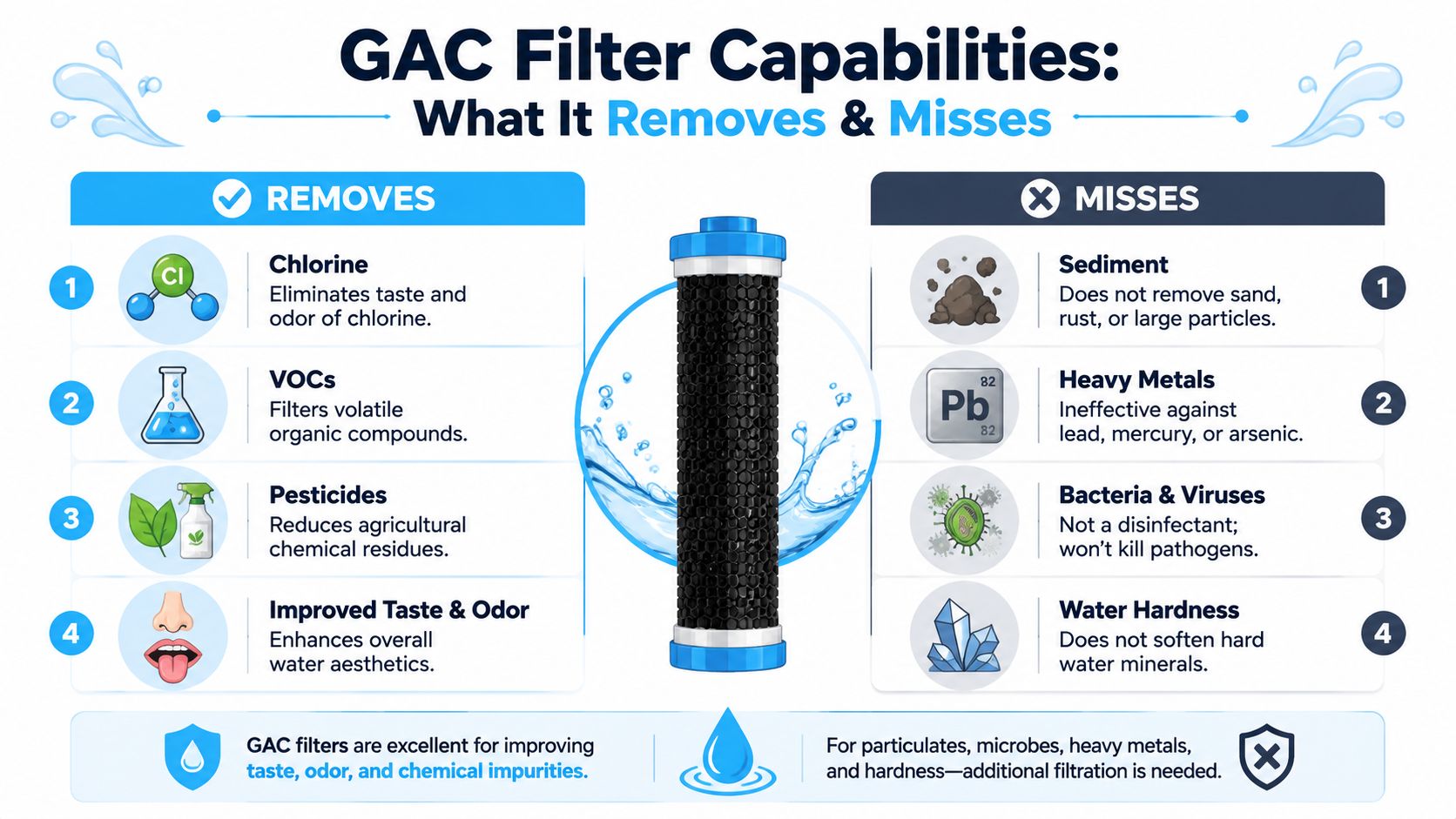
GAC earns its reputation in homes where the main complaints are smell, taste, and chlorine-related irritation.
- Chlorine reduction: This is one of the strongest reasons homeowners install carbon at the main line.
- Taste and odor improvement: Water often becomes more neutral and easier to drink and cook with.
- Certain organic chemicals: GAC is widely used where those compounds are a concern.
- Whole-home treatment: Because the system sits at the main line, the benefit reaches showers and sinks throughout the house.
If your city water smells sharp or medicinal, carbon usually gives the most noticeable day-one improvement.
What GAC doesn't solve on its own
Many homeowners get burned. They buy one tank and expect it to solve every water problem in the house.
A standard GAC system doesn't do these jobs well by itself:
- Hard water minerals: It won't soften water or stop scale the way a softener does.
- Most dissolved solids: If your concern is total dissolved solids, carbon isn't the main tool for that.
- Heavy metals: A plain GAC system shouldn't be assumed to handle lead, mercury, or arsenic without additional treatment stages designed for that purpose.
- Bacteria and viruses: Carbon is not a disinfectant.
- Visible sediment: Sand, rust, and grit are usually better handled by a sediment pre-filter placed ahead of the carbon.
Buy carbon for what carbon does well. Don't ask it to act like a softener, a disinfection system, and a fine-particle filter all at once.
A simple way to decide
If your water problem sounds like this, GAC is often a strong fit:
| Good fit for GAC | Usually needs something else too |
|---|---|
| Chlorine smell in showers | Hard water scale on fixtures |
| Bad taste in drinking water | Bacteria concerns |
| Chemical odor concerns | Lead-specific reduction |
| General whole-home odor improvement | Heavy sediment loading |
The smart approach is to match the media to the problem. Carbon is excellent when used for carbon jobs. It's disappointing when it's used as a universal cure.
Sizing Your Filter for Peak Performance
Saturday morning is when sizing mistakes show up. Two showers are running, the washer kicks on, someone starts the dishwasher, and the kitchen faucet opens. If the carbon system was sized too small, that is when chlorine odor slips back in and the house suddenly feels like it lost water pressure.
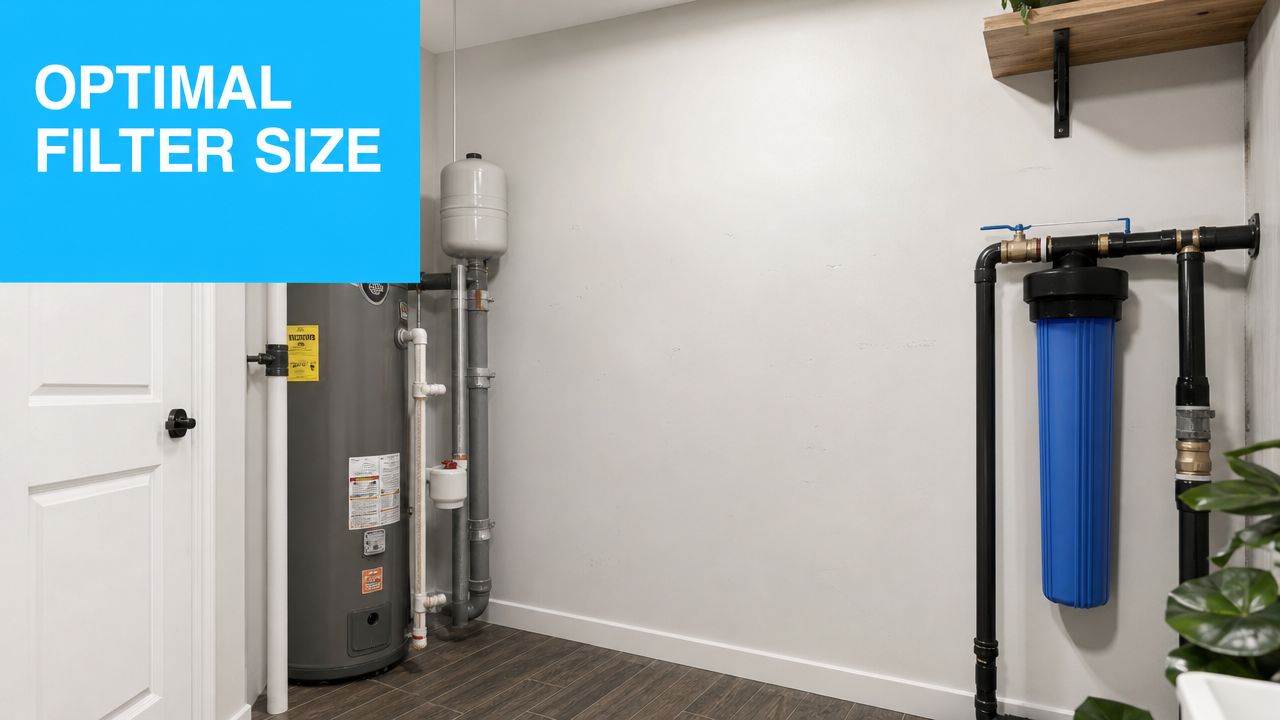
Size for the busiest hour in the house
Average daily water use is not the number that matters most. Peak flow is.
A whole-house GAC filter has one job during high-demand periods. It needs to keep enough water moving to the fixtures while still holding that water in the carbon bed long enough for adsorption to happen. Adsorption works like a sponge with limited contact time. If water rushes past the carbon too quickly, the media gets less chance to grab chlorine, odors, and organic compounds.
That trade-off is what homeowners feel in real life. High flow supports comfort. More contact time supports treatment. Good sizing balances both.
Why undersizing costs more than it looks
An undersized filter usually creates two problems at once.
The first is performance loss. Fast flow shortens contact time, so taste and odor reduction often falls off sooner than expected. Homeowners then assume the carbon is poor quality, when the underlying issue is that the system was asked to treat more water than it was built to handle.
The second is pressure loss. Every filter adds some resistance. If the system is too small for the home's plumbing and fixture demand, showers feel weaker and fill times get longer. In houses that already have modest incoming pressure, a restrictive filter can turn a decent setup into a daily annoyance.
I see this often with cartridge systems chosen because the upfront price looks attractive. They can work well, but only when the cartridge size, housing size, and expected flow match the house.
What to check before you buy
A sizing conversation should get specific fast. These are the details that change the recommendation:
- How many fixtures can run at once: Count real overlap, not ideal behavior.
- Main water line size: A larger service line usually calls for a filter that will not choke that flow.
- Incoming pressure at the house: Marginal pressure leaves less room for a restrictive filter.
- Bathrooms and appliance load: A three-bath home with a large tub and irrigation use is different from a two-person household in the same square footage.
- Whether outdoor spigots are filtered: Sending hose and irrigation water through carbon adds wear and shortens media life.
That last point affects cost more than many homeowners expect. If the system treats outside water that does not need treatment, you burn through media capacity faster and pay for replacement sooner.
Bigger helps, until it doesn't
Oversizing has a cost too. A larger tank, more media, and a more involved install can make sense in a busy house, but there is no prize for buying more filter than the plumbing and family usage require. Water can sit longer in a large system, which is fine when the match is reasonable, but the primary downside for most homeowners is simpler. They spend more upfront and may never use the added capacity.
The better target is a filter that matches the home's peak demand with enough margin to avoid complaints, without paying for unused capacity.
A practical way to judge the recommendation
If a seller jumps straight to a one-size-fits-all model, slow the conversation down. Ask what flow rate the system is designed to handle, what pressure drop to expect at that flow, and how often the media will need replacement under your household's usage. Those answers matter more than tank color or marketing claims.
Homeowners comparing specialty water systems sometimes notice that sizing logic is similar across very different applications. The same discipline used in reliable solutions for laboratory water needs applies at home. Match the equipment to the demand, or the results disappoint.
A properly sized GAC system feels boring in the best way. Showers stay strong, chlorine stays down, and maintenance costs stay closer to what you were promised.
GAC Compared to Other Filtration Media
A whole-house filter is rarely a one-media decision. Homeowners usually end up choosing which compromise they can live with: higher flow with broader treatment, finer filtration with more pressure loss, or a staged system that costs more up front but solves more than one problem well.
GAC earns its place because it fits the way a house uses water. It handles chlorine, taste, odor, and many organic compounds without choking flow at showers, tubs, and laundry the way tighter media often can. In plain terms, loose-bed carbon gives water more paths through the tank, while denser media forces water through smaller channels. That difference shows up at the tap.
GAC versus carbon block
Carbon block and GAC both use activated carbon, but they behave very differently in a plumbing system. Carbon block is tighter and usually better when the job calls for finer particulate reduction at a lower flow point, such as drinking water at a sink. GAC is usually the better fit at the main line, where the system has to feed several fixtures at once without making the house feel starved for pressure.
The trade-off is straightforward. Carbon block often filters more precisely, but it usually creates more restriction and needs closer attention to pressure drop as it loads up. GAC is less exacting on particulate capture, yet it is often easier to live with in whole-house service because it supports higher flow and larger treatment volumes.
NSF notes that activated carbon systems are commonly used for taste, odor, and chemical reduction, while system design and certification determine what a given unit is tested to remove, as outlined by NSF consumer guidance on carbon water filters.
Where other media make more sense
Some water problems call for something beyond standard GAC.
- Catalytic carbon: A stronger choice when water chemistry makes standard activated carbon less effective, particularly in homes dealing with tougher disinfectant-related taste and odor issues.
- KDF media: Often blended with carbon in specialty systems. It can support a broader treatment strategy, but it does not replace the adsorption role of carbon.
- Water softener resin: Built for hardness minerals like calcium and magnesium. If your problem is scale on fixtures or poor soap performance, carbon will not fix it.
Homeowners overspend if they buy by marketing category instead of water problem. A softener will not remove chlorine. Carbon will not stop hard-water scale. A mixed-media system can work very well, but only if each stage has a clear job.
If you're comparing household equipment to specialized treatment systems in technical settings, the contrast is useful. reliable solutions for laboratory water needs show how system design changes once the goal shifts from comfortable whole-home water use to tightly controlled process water.
Filtration media comparison
| Media Type | Primary Use | Flow Rate Impact | Typical Lifespan |
|---|---|---|---|
| GAC | Chlorine, taste, odor, certain organic chemicals | Lower restriction in whole-house use | Varies with water conditions and usage |
| Carbon block | Finer filtration plus carbon adsorption | More restrictive than GAC | Varies with loading and flow demand |
| Catalytic carbon | Specialized carbon treatment applications | Depends on system design | Varies by media and water chemistry |
| KDF | Used as a companion media in some systems | Depends on blend and tank design | Varies by application |
| Water softener resin | Hardness reduction | Usually designed around whole-house flow | Regenerates rather than acting like spent carbon |
Cost shapes the decision too
The cheapest media on paper is not always the lower-cost system to own. A tighter filter that causes noticeable pressure loss often leads to larger housings, more frequent cartridge changes, or point-of-use installation instead of whole-house treatment. A GAC tank may cost more at the start than a basic cartridge setup, but in many homes it spreads that cost across better flow, longer service intervals, and fewer complaints from the family.
That is usually the practical test. Choose the media that solves the main water problem without creating a daily nuisance or an expensive maintenance cycle. For many municipal-water homes, GAC still lands in that sweet spot.
Installation and Maintenance Best Practices
A whole house GAC filter can be simple to live with if the installation is thoughtful. It becomes annoying when the installer treats maintenance as an afterthought.
One good layout choice changes the ownership experience immediately: build the system so it's easy to isolate, service, and flush. That usually means planning around access, not just squeezing the tank into whatever corner is open.
Installation details that pay off later
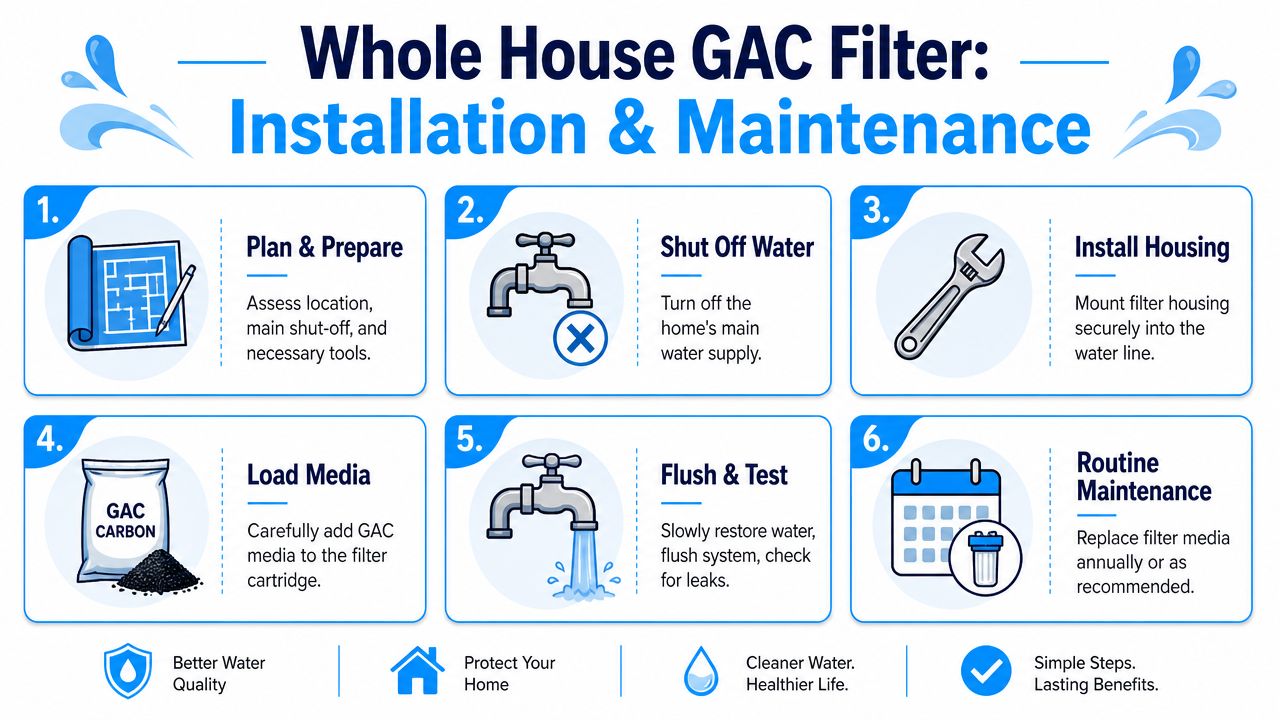
A practical installation usually includes these basics:
- Sediment protection first: A pre-filter ahead of the carbon helps keep rust, sand, and grit from loading the carbon bed too quickly.
- A bypass valve: This makes service possible without shutting down water to the entire house longer than necessary.
- Enough clearance: Cartridge housings and tanks need room for servicing, not just room to exist.
- Thoughtful plumbing layout: Some installers place the system before outside spigots are branched off so irrigation and hose use don't waste carbon capacity.
Minnesota health guidance also notes that carbon should be replaced based on contaminant levels and water use because effectiveness declines as the media loads up, as described earlier in that state guidance.
Know the signs of exhausted carbon
Carbon usually announces its decline in familiar ways. Homeowners often notice the problem before they think to check the filter.
Watch for these clues:
- Chlorine smell returns: Often most obvious in the shower first.
- Taste gets sharper: Coffee, tea, and plain drinking water lose that neutral profile.
- Pressure changes: This can point to loading, fouling, or a pre-filter that needs attention.
- Service intervals start shrinking: If media seems to “wear out” fast, the system may be undersized or poorly protected from sediment.
A carbon filter rarely fails all at once. It usually fades, and the house slowly reminds you.
Here's a useful installation overview if you want to see the sequence in motion:
Cartridge systems and tank systems
Ownership feels different depending on the style of system.
Cartridge systems are straightforward. You replace the cartridge, flush the housing, and move on. They're easier for many DIY-minded homeowners, but they can become a frequent maintenance item in bigger households.
Tank-based systems often suit homes that want a more substantial point-of-entry setup. Some require backwashing, and all of them still depend on proper sizing and service timing. They aren't “install it and forget it” equipment.
If a seller tells you the filter is maintenance-free, assume the conversation just got less reliable.
How to Make a Smart GAC Filter Purchase
The smartest buyers don't shop by brand first. They shop by problem, then by fit, then by ownership cost.
Start with the water issue that's bothering you most. If the main complaints are chlorine smell, unpleasant taste, and whole-home odor concerns, a whole house GAC filter is often a sensible foundation. If the primary pain point is hardness or scale, a GAC system by itself won't solve it.
A short buyer checklist
Use this before you commit:
- Match the media to the problem: Carbon for chlorine, taste, odor, and certain organic chemicals. Different equipment for hardness, microbes, or heavy-metal-specific goals.
- Size for real household demand: Think about peak fixture use, not quiet-hour flow.
- Check replacement access: If maintenance looks miserable, it usually becomes neglected.
- Compare cartridge versus tank systems: Lower upfront simplicity versus larger whole-house capacity and different service routines.
- Look for relevant certifications: Pay attention to claims around chlorine reduction and health-related contaminant performance, and make sure those claims are supported by actual product certification rather than vague marketing language.
A good purchase feels boring in the best way. The water improves, the showers stop smelling like a pool, and the system doesn't constantly demand attention or surprise you with the wrong kind of maintenance.
The final decision usually comes down to this: buy the system that fits your water, your house, and your willingness to maintain it. Not the biggest tank. Not the flashiest claims. The right fit wins.
If you're narrowing down options and want plain-English help comparing systems, media types, maintenance demands, and buying trade-offs, Water Filter Advisor is a solid place to research your next filter with less guesswork.
- June 6, 2026
- Uncategorized
