
You fill a glass from the kitchen tap, raise it for a sip, and catch that familiar sharp smell first. It's clean water, but it smells a little like a pool. Then the questions start. Is this normal? Is something wrong with the city water? Do you need a filter, and if so, what kind?
That reaction is common. In home water testing, one of the biggest points of confusion isn't whether chlorine exists in tap water. It's what kind of filter deals with the version of disinfectant your utility uses. A lot of products say they're a chlorine water filter, but that label alone doesn't tell you enough.
The useful question is simpler: Are you trying to fix chlorine taste at one faucet, chloramine throughout the house, shower odor, or all of the above? Once you know that, the right filter choice gets much easier.
Why Your Tap Water Smells Like a Swimming Pool
You turn on the shower, and the bathroom fills with that sharp pool-like smell before the water even warms up. Or you pour a glass at the kitchen sink and notice the odor most after the water has been sitting in the pipes for a while. In lab terms, that usually points to disinfectant residual reaching your home. In plain language, the utility treated the water, and you can still smell part of that treatment.
For many homes, that smell comes from free chlorine. In others, it can be chloramine, which is chlorine combined with ammonia and often behaves differently in filtration. That distinction matters because a filter that handles free chlorine well may do a weaker job on chloramine, especially if the system is small or the water moves through it too quickly.

Why the smell is not always bad news
A chlorine smell can be unpleasant, but by itself it does not mean the water is unsafe. Disinfectants are added so water stays protected as it travels through storage tanks, water mains, and the plumbing that leads into your house. The smell is often a sign that some of that disinfectant residual is still present by the time the water reaches your tap.
Homeowners sometimes assume a strong odor means something went wrong at the treatment plant. Sometimes the explanation is simpler. Warmer water releases odor more easily. Water that sat overnight in household plumbing can smell stronger at first draw. A shower can make the smell seem more intense because heat and spray push volatile compounds into the air faster than a cold glass at the sink.
Lab perspective: City treatment and home filtration serve different purposes. The utility keeps water microbiologically stable across the distribution system. A home filter is usually there to reduce taste, odor, and day-to-day nuisance at the point where you use the water.
The comparison to pool water helps only up to a point. If you have ever tried to maintain crystal clear pool water, you know chlorine is useful and easy to notice when levels feel off. Tap water is managed to different standards and for a different purpose, but the sensory clue is familiar. Your nose picks up the disinfectant before you know whether you need a simple carbon filter or a system designed for chloramine.
What a home filter is actually solving
For one household, the problem is only taste in drinking water. For another, it is shower odor in two bathrooms. For another, it is dry-feeling water, a pool smell at every faucet, and a utility that uses chloramine instead of free chlorine.
Those are different jobs.
A good filter choice starts with matching the technology to the problem:
- Free chlorine at one sink: A certified carbon filter is often enough.
- Chloramine taste or odor: You may need catalytic carbon or a filter specifically rated for chloramine reduction.
- Shower or whole-home odor: The issue may call for a larger system with enough contact time to treat the water before it branches through the house.
- Odor only after water sits: The first step may be confirming whether the smell is coming from disinfectant residual, household plumbing, or even the water heater.
That is why the label "chlorine water filter" can be too vague to shop from confidently. The better question is more specific. What disinfectant is in your water, where do you notice it, and how much water needs treatment?
How Filters Magically Remove Chlorine from Water
A chlorine filter works the way a good scrub brush works on a dirty pan. The cleaning happens because the surface is doing the work, and the water needs enough time in contact with that surface for the job to happen.
For most homes, that surface is activated carbon. Carbon has a huge network of tiny pores, which gives it a lot of area for chlorine compounds to cling to. In water treatment, that process is called adsorption. Chlorine sticks to the surface of the media rather than soaking into it like water into a towel.
That distinction helps explain why one filter can cut pool-like taste and odor well, while another barely makes a dent.
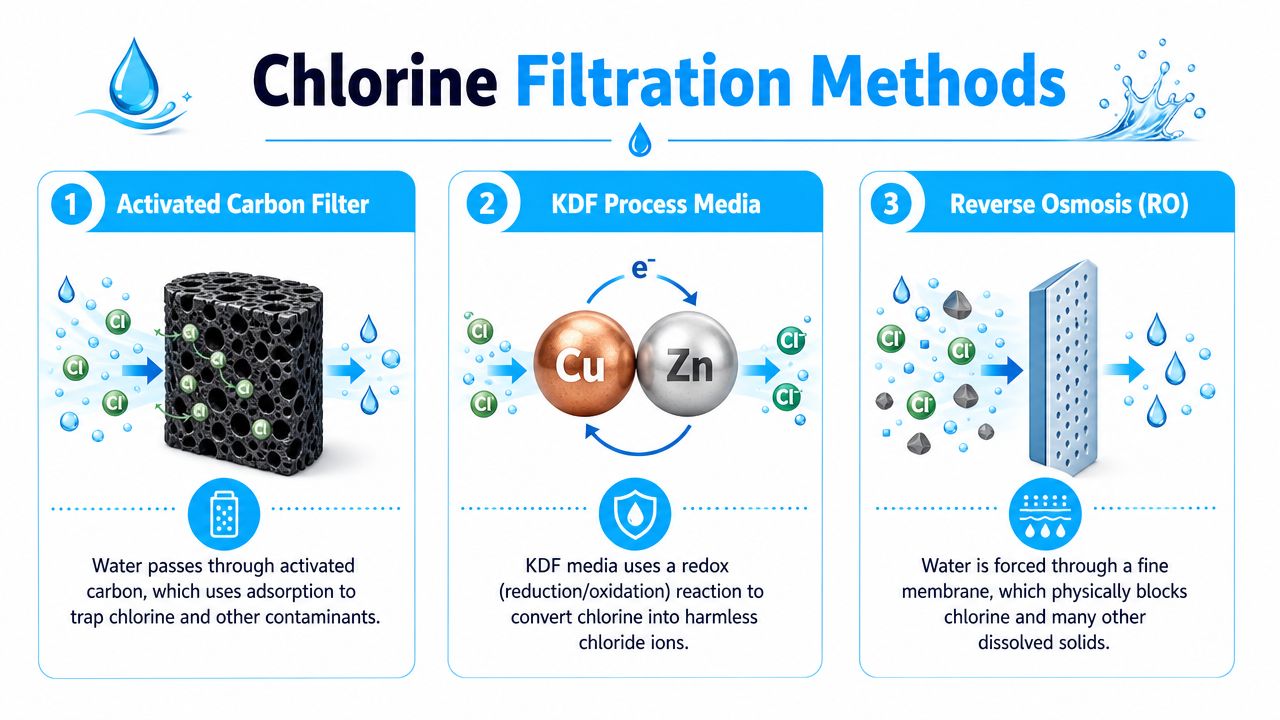
Activated carbon and why design matters
Homeowners often see the word carbon on the box and assume all carbon filters do the same thing. They do not.
Some filters use granular activated carbon (GAC), which is loose media. Others use a carbon block, which packs carbon into a denser form. A denser block can improve contact between the water and the media, and that can improve chlorine reduction in many point-of-use designs.
Actual performance depends on three basics:
- Media type
- How much media the filter contains
- How quickly water passes through it
A small cartridge can work well at one sink because the flow is limited. A whole-house tank can also work well, but only if it is sized so water does not rush through too fast. If contact time is too short, the filter may leave chlorine behind even if the label sounds promising.
Free chlorine and chloramine need different tools
This is the part many product pages gloss over. Free chlorine and chloramine are both disinfectants, but they do not behave the same way in a filter.
The CDC advises homeowners to check the filter label for the specific substances reduced, because a filter that works for one contaminant may not work for another, as explained in CDC guidance for choosing home water filters.
Free chlorine is usually the easier target. Standard activated carbon is commonly used for it.
Chloramine is harder to remove. Many homes served by chloramine do better with catalytic carbon or a system specifically labeled for chloramine reduction. Catalytic carbon is still carbon, but it has been processed to improve how it handles compounds that standard carbon removes more slowly.
A simple rule helps here:
Match the filter to the disinfectant, not to the marketing headline.
If your water utility uses chloramine, a generic "chlorine water filter" may disappoint you even if it works well on free chlorine.
Chlorine vs Chloramine Removal Technologies
| Technology | Removes Chlorine? | Removes Chloramine? | Best For |
|---|---|---|---|
| Activated carbon | Yes, commonly used for free chlorine reduction | Sometimes limited, depends on design and labeling | Taste and odor improvement at a faucet, under sink, or shower |
| Catalytic carbon | Yes | Better suited than standard carbon when chloramine is the target | Homes served by utilities using chloramine |
| KDF media | Can be used alongside carbon for chlorine treatment approaches | Performance depends on system design and claims | Systems that combine media for broader treatment goals |
| Reverse osmosis | Can contribute to chlorine reduction when paired with suitable pretreatment | Depends on full system design and pretreatment | Drinking water systems focused on multiple contaminants |
KDF shows up often in shower filters and mixed-media cartridges. It is best viewed as one part of a larger design, not proof by itself that the filter will solve every chlorine problem. The same goes for reverse osmosis. RO systems are excellent for many drinking water concerns, but the membrane and prefilters have to be designed to handle disinfectants correctly.
One more point causes confusion. Filtration and chemical neutralization are different jobs. If you also maintain spa water, this guide on using hot tub neutralizer safely shows that distinction clearly. Neutralizing sanitizer in a hot tub is a separate process from filtering tap water for daily household use.
Choosing Your Battleground Point-of-Use vs Whole-House Systems
Once you know what you're removing, the next decision is where to remove it. This is the split between point-of-use and whole-house systems.
A point-of-use system treats water at one outlet. That could mean a faucet filter, pitcher, under-sink unit, refrigerator filter, or shower filter. A whole-house system, also called point-of-entry, treats water as it enters the home so every sink, shower, and appliance gets filtered water.
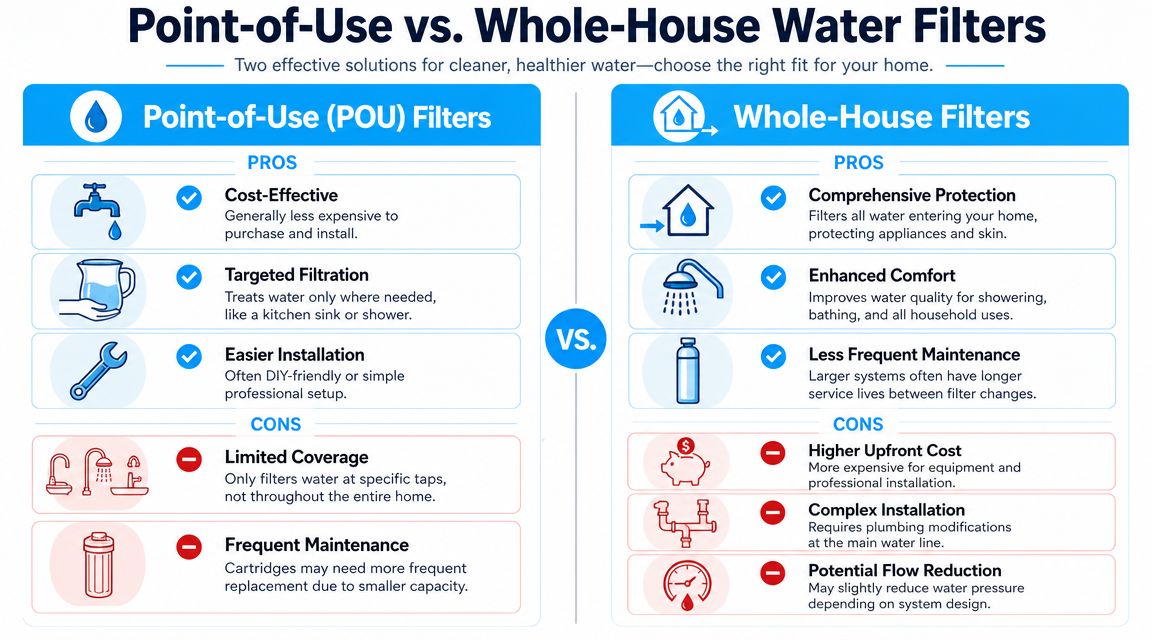
When point-of-use makes the most sense
If your main complaint is, “I hate the taste from the kitchen sink,” a point-of-use filter is usually the cleanest answer. It's cheaper to start with, easier to install, and easier to test. Renters often do well with faucet filters, pitchers, or countertop units because they can take them along when they move.
Under-sink filters make sense when you want filtered water for drinking and cooking without changing the whole home. Shower filters can help when your issue is mostly the smell in one bathroom.
A good point-of-use setup fits homeowners who want:
- Targeted improvement: One sink, one shower, one refrigerator line.
- Lower upfront commitment: Good for trying filtration without plumbing work at the main line.
- Simple maintenance: Smaller cartridges are easy to swap, even if they need replacement more often.
When whole-house is the better tool
If the chlorine smell hits you in the shower, laundry room, and every bathroom sink, a single faucet filter won't solve the whole experience. That's when whole-house filtration starts to make more sense.
It changes the water everywhere. Drinking, bathing, washing clothes, and filling the tub all come through the same treated line. It can also help protect downstream devices that don't love heavily chlorinated water.
Here's a helpful visual if you want to compare the layouts and trade-offs in action:
Whole-house systems also force you to think about capacity more seriously. According to Morton's MCWF chlorine reduction specifications, one example system is rated for about 570,000 gallons at an incoming chlorine level of 2.0 ppm, and the company notes an average media life of about 10 years. The same specifications make clear that media life depends on source-water chlorine concentration, so higher residuals can shorten service life.
Practical rule: A whole-house carbon tank isn't “good for ten years” in every home. Its useful life depends on how much chlorine is entering the house and how much water your household uses.
A quick way to choose
Use this simple lens:
- Choose point-of-use if your problem is mostly drinking water taste, one sink, or one shower.
- Choose whole-house if the odor follows you around the house and you want all water treated.
- Choose both if you want broad treatment for bathing and a more specialized drinking-water setup at the kitchen sink.
That last option is common. Many households use a whole-house carbon system for comfort plus a dedicated under-sink system for the water they drink every day.
Your Filter-Buying Checklist What Really Matters
A lot of chlorine filter shopping goes wrong in the same place. A homeowner sees “reduces chlorine” on the box, buys the cheapest carbon filter that fits, and then finds out the water still smells off because the utility uses chloramine instead.
That is the checklist question. You are not just buying “a chlorine water filter.” You are matching a treatment method to the disinfectant in your water, the place you want to treat it, and the amount of maintenance you will keep up with.
Five things to check before you buy
Start with certified performance
If a product claims chlorine reduction, look for third-party testing and a clear certification claim such as NSF/ANSI 42 for chlorine taste and odor reduction. A marketing phrase is only a promise. Certification is tested performance under defined conditions.Confirm whether your water has chlorine or chloramine
This is the step many buyers skip. Free chlorine is usually easier for standard activated carbon to reduce. Chloramine is harder to treat and often needs more contact time, more specialized carbon, catalytic carbon, or a different system design. If the product page only says “chlorine filter,” do not assume it will handle chloramine well.Check capacity in gallons, not just months
Time-based replacement advice is only half the story. Two homes can use very different amounts of water in six months. Gallon ratings give you a better sense of how long the media may last in your house.Look at flow rate under normal use
A filter can test well and still be annoying to live with. Under-sink units that trickle slowly frustrate people at the kitchen sink. Whole-house systems that are undersized can cause weak showers or noticeable pressure drop when more than one fixture is running.Add up the total cost
The purchase price is only the entry ticket. Include replacement cartridges, media changes, any prefilters, installation parts, and service calls if needed. A lower-priced system with frequent replacements can cost more over a few years than a better-sized unit bought once.
Read the product page like a lab sheet
Product pages often hide the important details in plain sight. The big headline says “fresh, clean water.” The useful information is usually farther down in the specifications table.
Check for a named contaminant claim. Check whether the claim is tied to certification or in-house testing. Check the replacement schedule. Check whether the unit is intended for municipal water, well water, or both. If your utility uses chloramine, look for that word specifically.
A good shortcut is to ask one plain question: What, exactly, was this filter tested to reduce? If the answer stays vague, keep shopping.
If you want more help comparing media types, certifications, and treatment approaches, the guides in Water Filter Advisor's learning center are a useful reference. If you are still narrowing down brands and product categories, these home water filter recommendations can help you survey the market.
The best filter is the one that matches your water chemistry, your household water use, and your willingness to replace media on time.
Red flags worth noticing
Some product descriptions deserve extra skepticism.
| What you see | What it may mean |
|---|---|
| “Improves water quality” with no contaminant list | The claim is too vague to judge |
| “Carbon filter” with no certification detail | Carbon type and amount may not be enough for your problem |
| “Long life” with no gallon rating or replacement schedule | You cannot estimate ongoing cost or useful life well |
| “Removes chlorine/chloramine” in one phrase with no explanation | The product may be glossing over two different treatment jobs |
| “Fits all homes” or similar broad language | Filter sizing, flow rate, and disinfectant type still matter |
Careful shopping is mostly about refusing to guess. If the manufacturer does not clearly tell you what the filter reduces, how it was tested, and how long it is expected to last, move on.
Filter Installation and Maintenance Made Simple
Most homeowners can install some filters in one afternoon. Others should be left to a plumber. The trick is knowing where that line is.
Faucet filters, pitchers, countertop systems, and many shower filters are usually the easiest. You remove the aerator or showerhead, attach the housing, tighten by hand or with simple tools, flush the new cartridge, and you're in business. These are good entry points if you want a chlorine water filter without changing permanent plumbing.
Installing common home filters
For under-sink systems, expect a few more steps. You'll usually shut off the cold-water line, mount the filter head, connect tubing, install a dedicated faucet if the design requires one, and flush the system thoroughly. If your sink cabinet is cramped or your shutoff valve is old and stiff, that's where DIY confidence often fades.
For whole-house filters, installation is more serious. The system needs to be placed on the main incoming water line, usually with shutoff valves and often with a bypass arrangement so you can service the filter without shutting down water to the house for long. If you're not comfortable cutting and reconnecting main plumbing, hire it out.
A small leak under a sink is annoying. A small leak on the main line can become a much bigger problem fast.
A maintenance routine that actually works
Homeowners often think maintenance means “replace it when the water tastes bad again.” That's too late. Better results come from a simple routine:
- Check the replacement schedule: Follow the manufacturer's interval for cartridges or media.
- Watch for pressure changes: A sudden slowdown can mean a clogged cartridge or a valve issue.
- Inspect fittings and housings: Look for drips, cracked O-rings, or loose threaded connections.
- Flush after replacement: New carbon media often releases fine particles at first.
- Sanitize housings when appropriate: If the design allows, clean the filter housing during cartridge changes according to the manufacturer's instructions.
Keep a simple filter log
You don't need anything fancy. A note on your phone works fine. Track:
- Install date
- Replacement date
- Filter model
- Any change in taste, odor, or flow
That tiny habit prevents the most common maintenance mistake, which is forgetting how long the current cartridge has been in service.
Troubleshooting Common Chlorine Filter Problems
A chlorine filter doesn't have to be broken for it to act disappointing. Most problems come from sizing, installation details, or overdue maintenance.
Low pressure after installation
Start with the basics:
- Check valve positions: A partially closed shutoff valve can mimic a bad filter.
- Confirm cartridge seating: If the cartridge isn't installed correctly, water flow can choke down.
- Review system sizing: A small point-of-use filter may struggle if you expect whole-house style flow from it.
If pressure dropped immediately after install, the issue is often mechanical, not chemical.
Leaks at fittings or housings
Look at the simple causes first:
- Thread alignment: Cross-threading is common on plastic housings.
- O-ring condition: A twisted or dry O-ring causes many slow leaks.
- Overtightening: More force doesn't always mean a better seal.
Shut the water off, relieve pressure, reseat the parts, and recheck. If the housing is cracked, replace it rather than trying to force it closed.
The chlorine taste came back too soon
This usually points to one of three issues:
- The filter is exhausted: The media may be spent.
- The water contains chloramine instead of free chlorine: The filter may be the wrong technology.
- Actual flow is too high: Water may be moving through the media too quickly for effective treatment.
If the product was chosen only because it said “chlorine filter,” this is the moment when that vague label often gets exposed.
Gurgling, sputtering, or cloudy water
New carbon filters often trap air. After installation or cartridge replacement, some sputtering is normal during flushing. Temporary black specks can also appear with new carbon media. If it doesn't clear after a proper flush, check the manual and inspect whether the cartridge is seated correctly.
Frequently Asked Questions About Chlorine Filters
Will a chlorine filter remove healthy minerals too
Usually no. A standard activated carbon filter targets chlorine, chloramine byproducts, and many taste and odor compounds. It does not work like a water softener or reverse osmosis system, so calcium and magnesium usually stay in the water.
That matters if you like the taste of your tap water but want the pool smell gone. In many homes, carbon solves that problem without stripping out the minerals that contribute to flavor.
Do I need a chlorine filter if I have well water
Only if chlorine is part of your well treatment. Many private wells are not continuously disinfected, so a chlorine filter may do little or nothing there. But some well systems use chlorination pumps or periodic shock treatment, and carbon filtration can help remove the leftover taste and odor after disinfection.
Start with your actual setup, not the label on the filter box.
How do I know if my city uses chlorine or chloramine
Check your utility's annual water quality report, often called a Consumer Confidence Report, or call the water department and ask which disinfectant they maintain in the distribution system.
This answer shapes the whole buying decision. Free chlorine is often handled well by standard activated carbon. Chloramine is harder to remove and usually calls for catalytic carbon, longer contact time, or a filter specifically rated for chloramine reduction.
Is a shower filter enough for chlorine smell
It depends on where the problem shows up. If one shower is the only place you notice the smell, a shower filter may be enough. If the odor is present at kitchen taps, bathroom sinks, and showers, a whole-house system usually matches the problem better.
A shower filter is a room-level fix. A whole-house system treats the water before it branches through the home.
Can I just let water sit out to get rid of chlorine
Sometimes, for a glass or pitcher of water, free chlorine can dissipate over time. That approach is slow, inconsistent, and limited to small batches. It also does not help with shower water, laundry, ice makers, or whole-home odor.
Chloramine is the bigger catch. It is designed to stay in the water longer, so letting water sit is much less effective.
What's the smartest first step before buying
Match the filter to the disinfectant and the location of the problem.
Ask these two questions first:
- Does your water contain free chlorine or chloramine?
- Do you want treatment at one faucet, one shower, or the whole house?
Those two answers narrow the field fast. They tell you whether a basic carbon cartridge is likely enough, whether you need catalytic carbon, and whether a point-of-use filter or a whole-house tank makes more sense for your budget and goals.
If you want help comparing chlorine, chloramine, under-sink, shower, and whole-house options without getting buried in marketing claims, Water Filter Advisor is a practical place to start. It's built for homeowners who want clear filtration guidance, honest buying criteria, and maintenance advice that makes better-tasting water easier to keep.
- June 3, 2026
- Uncategorized
