You fill a glass from the kitchen tap, take a sip, and pause. Maybe it smells faintly earthy. Maybe there's a swimming-pool note, a metallic edge, or that unmistakable rotten-egg odor that makes you second-guess every shower and coffee pot in the house. If you're on a private well, that reaction is common.
A lot of homeowners land on one solution fast: install a carbon filter for well water. That instinct isn't wrong. Carbon is one of the most useful tools in home water treatment. It can make water far more pleasant to drink and use around the house.
But carbon also gets oversold. It's often treated like a cure-all, when in real well-water work it's usually a specialist. It shines in some jobs and completely misses others. If you know where it fits, you can build a system that works. If you expect it to do everything, you can spend good money and still have unsafe or frustrating water.
Why Your Well Water Tastes and Smells So Funny
You pour a glass from the tap, take a sip, and immediately notice something is off. Maybe the water smells like wet leaves after rain. Maybe it has a sharp chemical edge. Maybe the odor only shows up in hot water, or only at one bathroom sink. Those details matter, because taste and odor problems in well water usually come from a specific source, not from “bad water” in some general sense.
A private well pulls water straight from the ground under your home. On its way to your faucet, that water can pick up natural organic material, dissolved gases, minerals, or leftover treatment chemicals. Your nose and tongue often catch those changes first.
That is why odd taste and smell are useful clues.
What homeowners usually notice first
A carbon filter for well water often enters the conversation after complaints like these:
- Musty or earthy taste and smell: Often linked to natural organic matter or decaying material in the water source.
- Chemical or medicinal notes: Sometimes related to chlorine added for disinfection, or to certain organic compounds.
- Flat, stale, or unpleasant flavor: Water may be technically clear but still unpleasant to drink.
- Sulfur or rotten-egg odor: Often associated with hydrogen sulfide gas or sulfur-related bacteria.
- One-faucet-only odor: This can point to a plumbing or water-heater issue rather than a whole-house water problem.
A helpful overview from Wellness Apothecary's water guide explains how different filter types target different classes of contaminants. That distinction matters with well water, because the smell you notice and the problem you have are not always the same thing.
Why smell does not always point to the right fix
Carbon is often a good match for water that tastes or smells unpleasant because it is very good at catching many organic compounds and removing chlorine after disinfection. It works a bit like a sponge for certain chemical compounds that cause bad taste and odor.
But a bad smell does not automatically mean carbon is the answer.
Rotten-egg odor is a good example. Homeowners often hear “bad smell” and buy carbon first. Sometimes that helps. Sometimes it barely changes anything, because the underlying issue is hydrogen sulfide, sulfur bacteria, iron, manganese, or a water heater reaction. In those cases, carbon may be only one player on the treatment team, or the wrong first step entirely.
The expensive mistake many well owners make
Water that smells better is not always water that is fully treated.
That is the trap. A carbon filter can make water more pleasant very quickly. The odor drops. The taste improves. The family stops complaining. Meanwhile, other problems can still be present, including hardness, bacteria, nitrates, or dissolved metals that carbon does little or nothing to remove.
For your well, the practical takeaway is simple: treat taste and odor as a starting clue, not a full diagnosis. If the problem is mainly unpleasant flavor or smell, carbon may be a strong fit. If the concern is safety, staining, corrosion, or known contaminants from a water test, carbon alone is often not enough.
How Carbon Filters Magically Clean Your Water
A carbon filter looks simple. Inside, though, it works less like a screen door and more like a giant parking garage built for unwanted chemicals.

Think parking spaces, not holes
When carbon is activated, it's processed so it has a huge network of tiny internal surfaces. That matters because contaminants don't just get blocked. Many of them stick to the surface of the carbon.
That sticking process is called adsorption.
Absorption is what a bath towel does when it soaks up water. Adsorption is different. It's more like dust clinging to a TV screen or a magnet attracting filings. In a carbon filter, certain compounds in water are drawn to the carbon's surface and stay there while the water keeps moving.
What the water is doing inside the filter
Think of the filter this way:
- Water enters the system carrying a mix of useful water molecules and unwanted compounds.
- Those unwanted compounds move past millions of surface sites inside the carbon media.
- The right contaminants park there and stay behind.
- Cleaner-tasting, better-smelling water exits the filter.
That's why carbon is so good at taste and odor work. It doesn't need to strain out every dissolved substance. It just needs to attract and hold the compounds it's good at targeting.
If you want a broader plain-English overview of common home filter types, Wellness Apothecary's water guide is a helpful companion read.
Why contact time matters
A carbon filter for well water needs enough time and enough media to do its job. If water rushes through too quickly, contaminants have fewer chances to stick. If the carbon is exhausted, the “parking spaces” are already full.
That's why two carbon filters can perform very differently even if both are called “whole-house carbon filters.” Tank size, media type, flow rate, and cartridge design all matter.
Carbon works best when water moves through it at a pace the media can handle. Faster isn't always better.
Why some filters feel more “powerful” than others
Some systems use loose granular activated carbon, often called GAC. Others use a dense carbon block. Some use catalytic carbon, which is modified for tougher chemistry.
To a homeowner, the simplest way to think about it is this:
- GAC systems are usually good at handling larger household flow.
- Carbon block systems usually provide tighter filtration and more contact, but they can restrict flow more.
- Catalytic carbon systems are chosen when standard carbon isn't enough for the smell or chemistry involved.
A carbon filter isn't magic in the mystical sense. It's selective chemistry packed into a very practical piece of plumbing. Once you see it that way, the key question becomes much easier: what exactly is your water asking the carbon to remove?
What Carbon Filters Remove and What They Ignore
You turn on the kitchen tap because the water smells earthy, oily, or a little like a swimming pool after shock chlorination. A carbon filter can help with some of that. It can also leave the underlying problem untouched.
That gap matters. Many well owners buy carbon expecting “cleaner” water in the broad sense, then learn later that the filter improved flavor while doing little for bacteria, hardness, nitrate, or metal problems.
Where carbon earns its keep
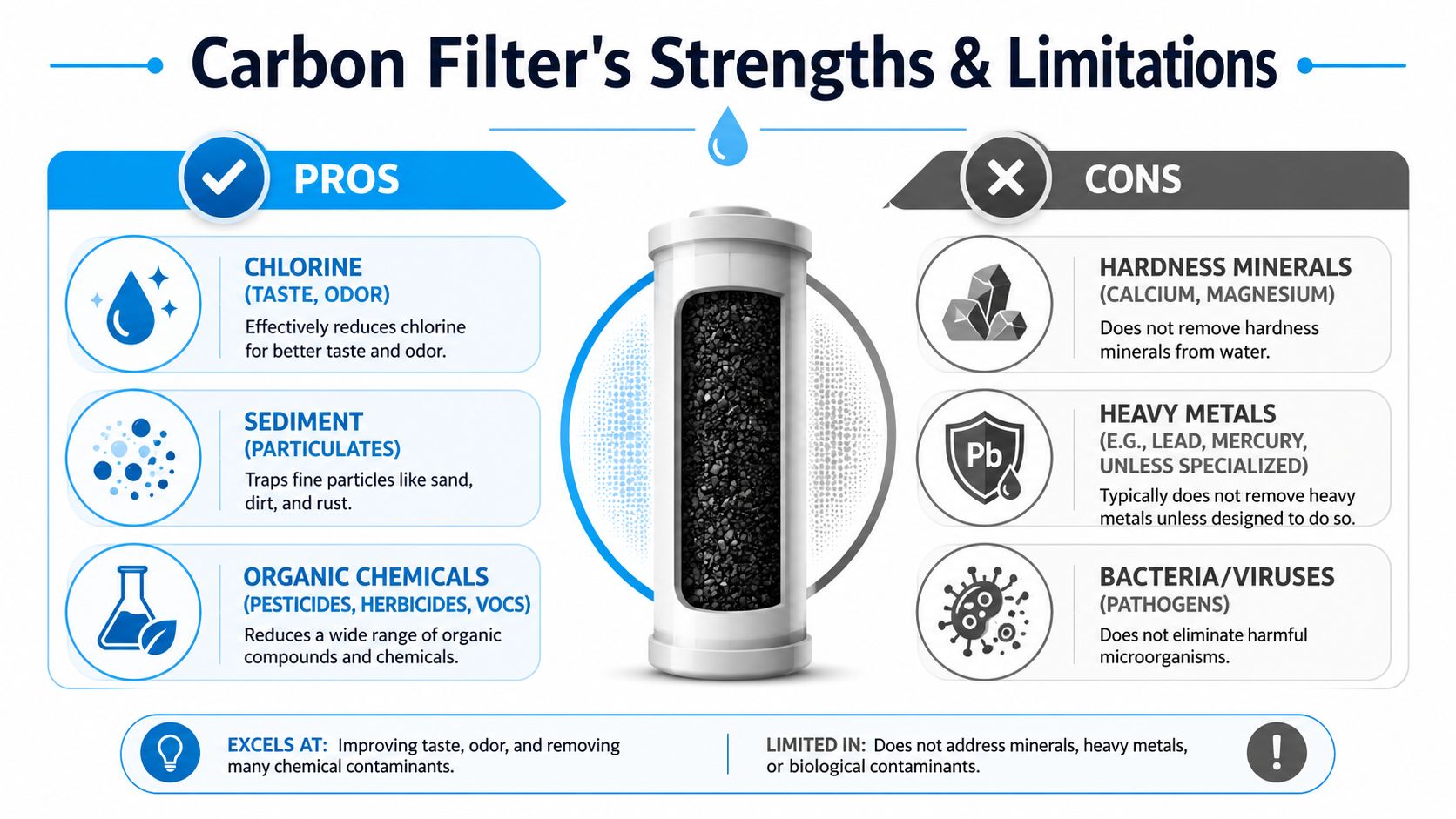
Activated carbon works like a sponge for many taste, odor, and chemical compounds. It is especially useful with certain organic contaminants that want to cling to the carbon surface instead of staying in the water.
For a homeowner, that usually shows up as improvement in a few familiar areas:
- Bad taste: musty, stale, chemical, or unpleasant flavors
- Odor problems: especially smells tied to organic compounds
- Chlorine taste and smell: often after a well has been disinfected or when chlorine is being used as part of treatment
- Some VOCs and related organics: carbon is often used for these chemicals when the system is sized and maintained correctly
The U.S. Environmental Protection Agency explains that activated carbon can reduce many organic contaminants and is commonly used for taste and odor improvement in drinking water treatment (EPA overview of activated carbon treatment).
That is why carbon often feels impressive at the tap. Water that smelled harsh or tasted flat can become much easier to drink.
What carbon leaves behind
Carbon has clear limits, and from these limits, costly misunderstandings arise.
A carbon filter for well water usually does not solve these problems:
- Bacteria
- Viruses
- Nitrates
- Hardness minerals
- Dissolved iron and manganese as primary contaminants
- Many other dissolved metals
A simple way to picture it is this. Carbon is good at grabbing many chemical hitchhikers that affect taste, smell, and some organic contamination. It is not built to remove every dissolved mineral or kill living organisms.
So if your lab report shows E. coli, nitrate, hard water, arsenic, iron staining, or manganese, carbon should not be your main answer. It may still belong in the system, but only as one part of it.
Why the bacteria myth causes trouble
Homeowners often hear that carbon “purifies” water. That word causes confusion.
Research published in Applied and Environmental Microbiology found that activated carbon did not significantly reduce bacteria in domestic water use conditions (study on activated carbon and bacteria in household water). In plain terms, carbon can make unsafe water taste better without making it microbiologically safe.
That is a dangerous combination. Better-tasting water can create false confidence.
A quick reality check for your well
Use this table as a first screen before you spend money:
| Water problem | Is carbon usually a strong fit? |
|---|---|
| Musty or chemical taste | Yes |
| Odor from many organic compounds | Yes |
| Chlorine taste after disinfection | Yes, often as a polishing step |
| VOC concerns | Often, if the filter is properly selected |
| Hard water scale | No |
| Bacteria concerns | No |
| Nitrate concerns | No |
| Iron staining | Usually no, not as the main treatment |
If your water problem sits mostly in the “No” column, carbon is being asked to do the wrong job.
Homeowners who want help matching symptoms to the right treatment order can review well water treatment advice by problem type. If you are also sorting out plumbing flow issues around the system, water filter drain cleaning can help you understand that side of the setup.
Building Your Well Water Treatment Team
A lot of expensive well water mistakes start with one assumption: “If I buy a carbon filter, I'm done.”
For some wells, carbon is a smart part of the answer. For many others, it is only one player in a larger setup. That difference matters, because carbon can make water smell and taste better while leaving the underlying problem untouched.
Carbon is one specialist on the team
Well water is local. Two homes on the same road can need completely different treatment because the wells, plumbing, geology, and contamination risks are different.
Carbon works like a sponge for many taste, odor, chlorine, and organic chemical issues. It does not solve every well water problem. If your concerns are bacteria, nitrates, hardness, or heavy metals, carbon is usually the wrong lead treatment. As noted earlier, in such instances, homeowners can spend real money and still end up with unsafe or frustrating water.
That is why a treatment system should be built from your test results, not from the most appealing product page.
Match each device to one clear job
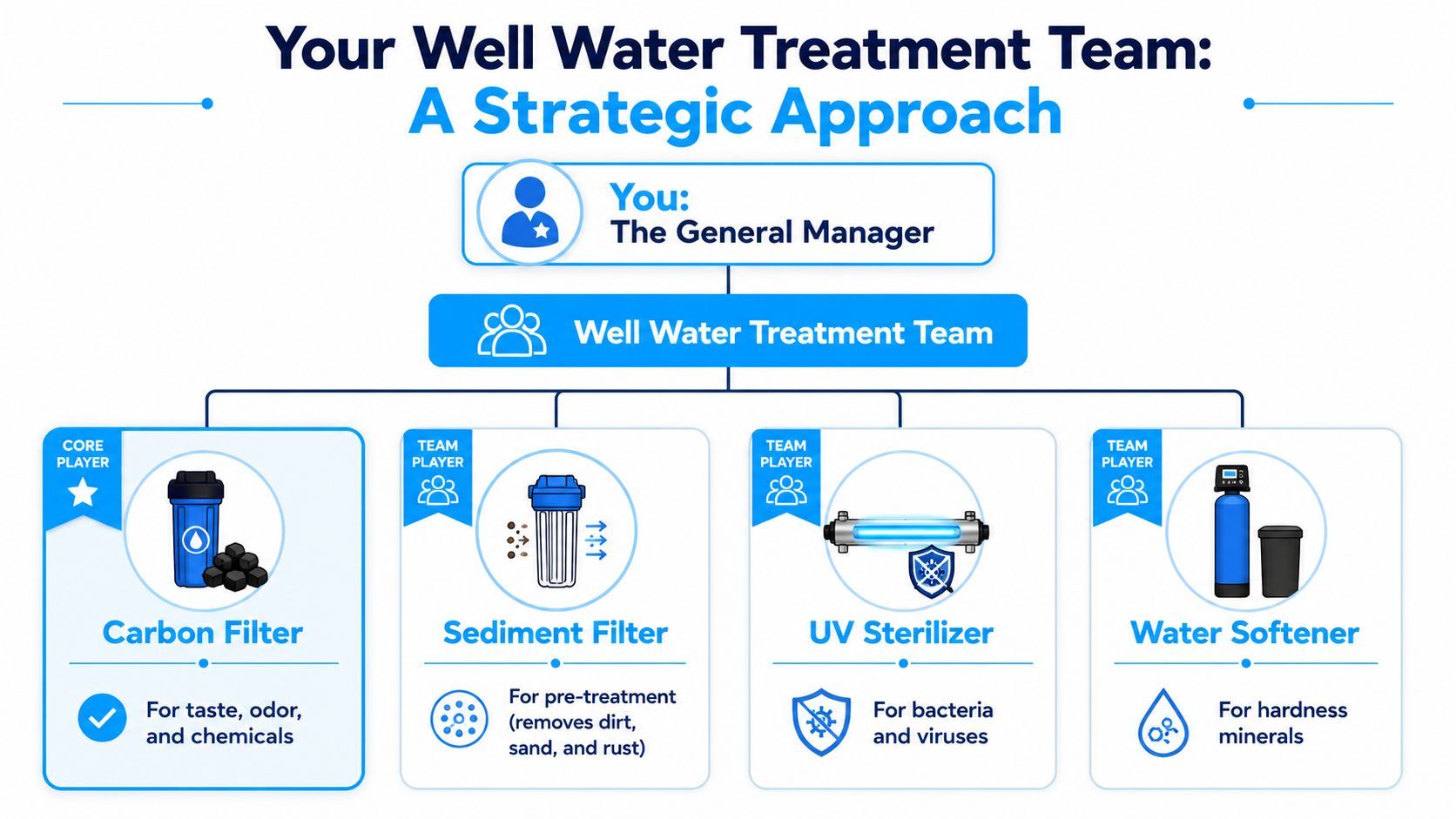
A good well setup works best when each piece of equipment has a narrow role.
- Sediment filter: Catches sand, grit, rust, and other particles before they clog downstream equipment.
- Carbon filter: Improves taste and odor, removes chlorine after shock treatment or continuous disinfection, and can reduce some organic contaminants.
- Water softener: Removes hardness minerals that leave scale on fixtures, shorten appliance life, and make soap harder to rinse.
- UV sterilizer: Disinfects clear water when microbial protection is part of the plan.
- Other targeted treatment: Some wells need dedicated equipment for iron, manganese, sulfur, arsenic, nitrate, or other contaminants that carbon does not handle well.
The practical lesson is simple. Ask each device to do the job it is good at, and no more.
Order matters as much as equipment choice
Treatment equipment works like a relay team. If the first runner stumbles, the rest of the system struggles too.
Sediment ahead of carbon helps the carbon last longer. Problem-specific treatment ahead of carbon prevents the carbon from getting overloaded with the wrong contaminant. UV usually belongs after the water is physically clear, because cloudy water can block the light and reduce disinfection performance.
A common sequence looks like this:
- Sediment reduction
- Treatment for the main well problem
- Carbon as a polishing stage, when carbon fits the water
- UV at the end, if disinfection is needed
That middle step is where many systems succeed or fail. If iron is the primary concern, iron treatment often belongs there. If sulfur is the main complaint, the right sulfur strategy belongs there. If lab testing shows bacteria, the plan needs to center on microbial safety, not on carbon.
Three real-world examples
Bad smell, clear lab results for bacteria:
Carbon may be a good finishing step if testing points to organic-related odor or leftover chlorine taste after disinfection.
Orange stains, metallic taste, clogged fixtures:
Start by looking at iron or manganese treatment. Carbon alone usually disappoints because it is being asked to fix a staining problem it was not designed to solve.
A failed bacteria test after heavy rain:
Carbon should not be treated as the fix. The system needs a disinfection strategy, often with correction of the source issue and possibly UV or another appropriate treatment method.
This is the honest part that sales pages often skip. Better-tasting water is not the same as fully treated water.
If you are comparing combinations and trying to avoid buying equipment in the wrong order, this collection of well water treatment advice by problem type can help you sort symptoms into the right treatment roles. Homeowners planning drain lines, backwash routing, or service access can also review this guide to water filter drain cleaning before installation.
Choosing the Right Carbon Filter System
Once you know carbon belongs in your setup, the next job is choosing the right style. In this process, many homeowners accidentally buy a system that sounds good online but doesn't match their water or their house.
GAC, carbon block, and catalytic carbon
The biggest distinction is the type of carbon media.
Standard GAC is loose granular activated carbon. It's widely used in whole-house systems because it can support household flow without feeling too restrictive.
Carbon block compresses carbon into a denser form. That usually means finer mechanical filtration and stronger contact, but it can also mean more pressure drop and more frequent cartridge changes in some applications.
Catalytic carbon is the one homeowners should pay close attention to when odor is the main complaint. Technical guidance notes that standard GAC excels at chlorine and VOCs, while catalytic carbon is superior for chloramines and hydrogen sulfide, the classic rotten-egg smell in well water (technical guide to carbon types and well-water odor issues).
If you have sulfur odor and a seller is pushing ordinary carbon without discussing catalytic media, ask harder questions.
Cartridge system or tank system
The next decision is the system format.
A cartridge system is common for smaller installations or point-of-use treatment. It's straightforward, easy to understand, and familiar to DIY-minded homeowners. The trade-off is hands-on maintenance. You have to stay on top of replacements.
A tank-based system is more common for whole-house treatment. It's usually better suited to larger flows and whole-home polishing. Up front, it's a bigger commitment. Over time, many homeowners prefer it because daily use feels more automatic.
Flow and placement matter more than people expect
Some whole-house inline carbon systems commonly target about 4–10+ GPM service flow, and technical guidance often recommends treatment order of sediment first, then carbon, then optional lead, cyst, or UV equipment downstream (whole-house inline carbon filter technical guidance).
That matters because a carbon filter for well water must fit your house at peak use. If two showers, a washing machine, and a kitchen faucet run at once, an undersized system can choke flow and make the filter seem defective when it's really just too small.
Carbon Filter Type Comparison
| Filter Type | Best For | Maintenance Level | Typical Cost |
|---|---|---|---|
| GAC tank | Whole-house taste, odor, chlorine, some organics | Moderate | Varies by size and system design |
| Carbon block cartridge | Finer filtration at a point of use or smaller-scale applications | Higher | Usually lower up front, ongoing cartridge replacement |
| Catalytic carbon tank or cartridge | Chloramines and hydrogen sulfide odor issues | Moderate | Usually higher than basic standard carbon options |
A practical buying checklist
Before you buy, answer these questions:
- What did your water test show? Buy to the test, not the symptom alone.
- Is the problem taste and odor, or safety? Carbon handles one category far better than the other.
- Do you need whole-house flow or single-tap treatment? Don't undersize.
- Is rotten-egg smell part of the complaint? If yes, look closely at catalytic carbon.
- Will the filter sit after sediment treatment? It should, in most well setups.
The best carbon system is rarely the one with the loudest claims. It's the one whose media, size, and placement match the exact job.
From Box to Tap Installation and Maintenance
Saturday morning is when many well water mistakes show up. The new carbon filter is in place, the first faucet opens, and out comes gray water, weak pressure, or a taste that somehow seems unchanged. In many cases, the filter itself is fine. The trouble is the setup around it.
Put carbon in the right place
Carbon usually works best near the end of the treatment line, not at the front. A good way to picture it is as a finishing sponge for dissolved taste and odor compounds. If you force that sponge to catch sand, rust, and heavy well contamination first, it plugs up faster and does a worse job.
For many private wells, the sequence looks something like this:
- Sediment filtration first: catches grit, sand, and debris before they load up the carbon
- Problem-specific equipment next: such as iron treatment, softening, or other equipment your water test calls for
- Carbon after that: improves taste, odor, and some chemical-related complaints
- UV last, when used: keeps the disinfection step downstream of the other treatment stages
That order matters because carbon is not a cure-all. If your well has iron, manganese, sulfur bacteria, or other raw-water problems, carbon often needs help from other equipment. Putting it in the wrong spot can make a decent filter look ineffective when the actual problem is that it was asked to do a job outside its lane.
Don't skip the startup flush
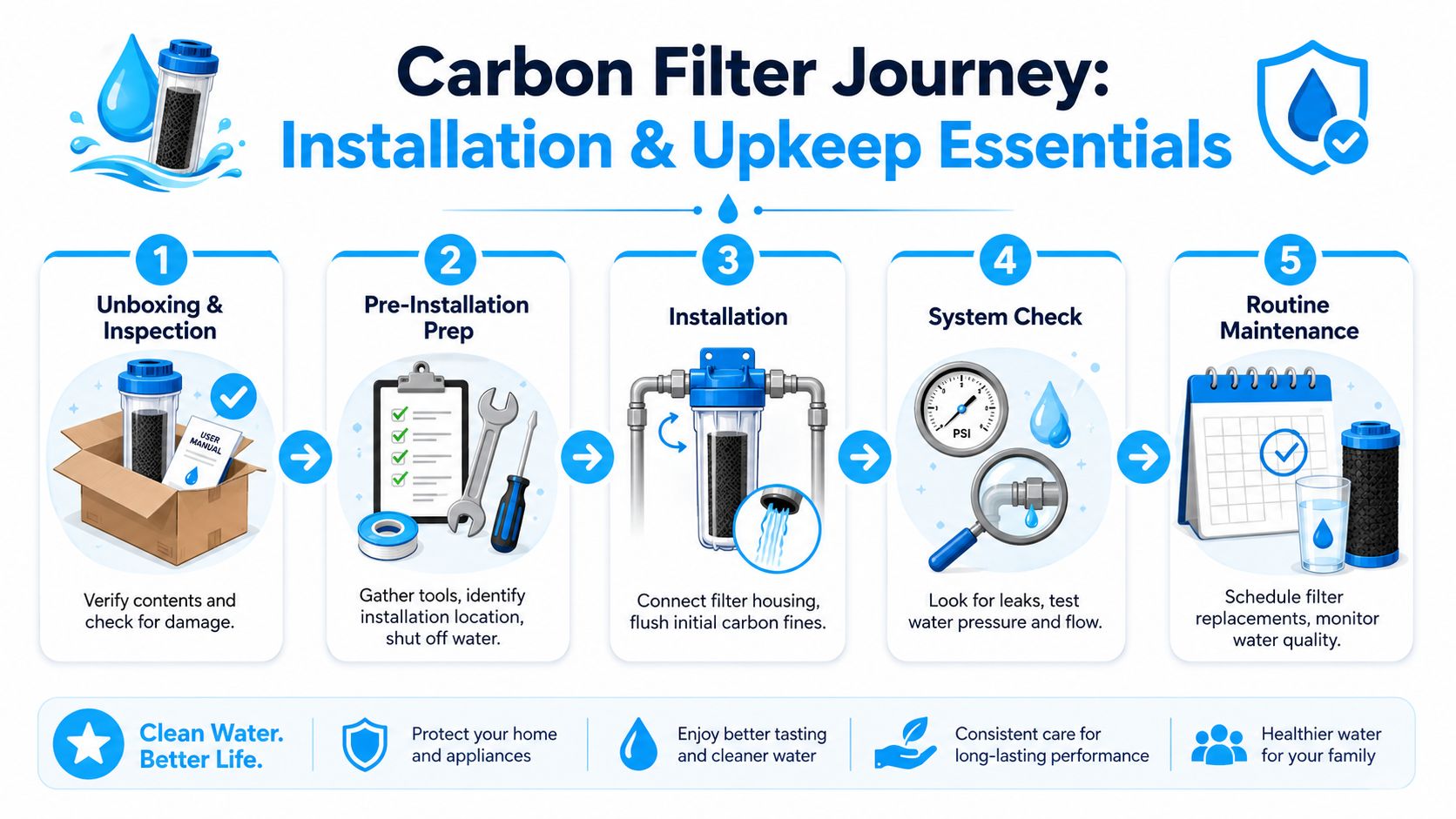
Fresh carbon media often sheds a small amount of black dust at startup. Those particles are called fines. They look alarming, but they are common with new media and after service.
Flush the system exactly as the manufacturer instructs before using the water normally. That first flush is like rinsing a new coffee filter before brewing. Skip it, and the mess shows up in the cup.
This installation video gives a helpful visual reference for what a residential filter setup process can look like in practice.
Maintenance is where carbon systems succeed or fail
Carbon rarely quits in a dramatic way. More often, performance fades a little at a time. The water starts to smell different. The taste gets flatter or mustier. Pressure slips enough that a shower feels weaker, but not weak enough to trigger immediate concern.
Watch for these clues:
- Taste or odor returns: a common sign that the carbon is used up or no longer matches the water conditions
- Pressure drops: often caused by a clogged sediment pre-filter, a loaded cartridge, or flow restrictions around the system
- Uneven flow in the house: can point to valve issues, partial clogging, or an installation problem
- Black specks after service: usually disturbed carbon fines that need flushing out
Tank systems and cartridge systems have different service schedules, but the homeowner routine is similar. Keep a simple log. Write down install dates, flush dates, filter changes, and any change in taste, smell, or pressure. That record helps you tell the difference between normal carbon exhaustion and a bigger well water problem that carbon was never meant to solve.
New carbon systems often need a good flush before the water runs clear. Black fines at startup are usually a commissioning issue, not a contamination emergency.
Keep the system easy to service
Service access sounds boring until the first filter change. Then it becomes the difference between a 15-minute job and a half-day hassle.
Leave enough room around housings and tanks to open them properly. Make shutoff valves easy to reach. Install the system where you can change cartridges without moving storage boxes or kneeling in a cramped corner. Homeowners delay maintenance when service is awkward. Delayed maintenance leads to weak performance, shorter filter life, and the mistaken belief that carbon filters do not work.
A well-installed carbon system should be easy to reach, easy to flush, and easy to maintain. If it is difficult to service, the design needs work, even if the filter itself is the right one.
Troubleshooting Common Carbon Filter Problems
When a carbon filter for well water acts up, the symptom usually points to the cause if you know what to watch for.
Symptom and likely cause
Water pressure drops suddenly
The first suspect is often the sediment pre-filter. If that's loaded up, the carbon downstream doesn't get proper flow. In cartridge systems, the carbon block itself may also be spent or clogged.
Black or gray water appears after installation
That's usually carbon fines from new media or from a recent service event. Flush the system until the water runs clear.
Bad taste or smell comes back
Carbon media doesn't last forever. If the original complaint returns, the media may be exhausted or the water chemistry may have changed enough that the existing filter no longer matches the job.
A sulfur smell never improved much in the first place
That often points to the wrong carbon type. If hydrogen sulfide is the issue, standard carbon may not be the right choice.
Leaking around the housing
Check the O-ring, the seating surface, and whether the housing was tightened correctly. A tiny twist or bit of debris can cause a frustrating drip.
One modern troubleshooting check
If your concern is a newer contaminant category such as PFAS, don't rely on marketing language alone. The U.S. EPA's April 2024 guidance identifies granular activated carbon as one of the main household filter types that can reduce PFAS and advises consumers to look for certification to NSF/ANSI 53 or NSF/ANSI 58. The same EPA fact sheet also notes that certification claims currently center on PFOA and PFOS, and cites an independent summary reporting activated carbon removed about 73% of PFAS contaminants in drinking water (EPA PFAS and home water filter guidance).
A simple troubleshooting mindset
Start upstream, then move downstream.
- Check the pre-filter.
- Check whether the system was flushed properly.
- Check whether the carbon type matches the actual contaminant.
- Check whether the media is due for replacement.
- Check installation seals and housing connections last.
Most carbon problems aren't mysterious. They come from clogging, exhausted media, wrong media selection, or poor placement in the treatment train.
If you're comparing systems, replacement filters, certifications, or whole-house setups for your home, Water Filter Advisor is a practical place to continue your research. It's built for homeowners who want clear explanations, realistic buying guidance, and maintenance help without the usual filtration jargon.
- May 31, 2026
- Uncategorized
