You fill a glass from the refrigerator door, hear the ice clink, take a sip, and think, “Good. Filtered.”
That word does a lot of work in most kitchens.
For some people, “filtered” means safer. For others, it means cleaner, colder, better tasting, or somehow more trustworthy than straight tap water. And that's where the confusion starts. A refrigerator filter can absolutely improve your water, but the actual answer to what refrigerator water filters remove is narrower than most box labels and product pages make it sound.
I've spent enough time around filter media, certification sheets, and water test reports to tell you this plainly. A fridge filter is usually a specialist, not a superhero. It's often very good at handling the things that make water taste or smell off. It's usually not built to solve every water quality problem in a home.
If you've ever seen marketing that says a filter removes “70+ contaminants,” while another listing for what looks like the same style cartridge only talks about chlorine and odor, you're not imagining things. Both claims can exist in the same market, and both can be technically true for different filters. The trick is knowing how to tell which one applies to your refrigerator.
That Crisp Glass of Water From Your Fridge
A neighbor once asked me a question I hear all the time in one form or another: “If my fridge water tastes better, does that mean the filter removed the bad stuff?”
Sometimes yes. Sometimes only some of it.
That cold glass from the dispenser feels reassuring because the experience is so polished. The water is chilled. The dispenser is built into a major appliance. There's a filter hidden neatly inside the fridge, so it seems reasonable to assume serious cleanup is happening. But your refrigerator cartridge is usually designed for a fairly specific job.
What people expect
Most households expect a fridge filter to do at least three things:
- Make water taste better by cutting the pool-like or chemical taste many city water users notice
- Reduce odor so the water smells fresher
- Catch visible particles such as rust or grit that can sneak in from older plumbing
Those are fair expectations. In many homes, the filter does help with exactly that.
Where the misunderstanding happens
The problem starts when “better tasting” gets confused with “broadly purified.”
A standard refrigerator filter often works like a cleanup crew for nuisance issues, not like a full treatment plant for every contaminant category. If your water already comes from a treated municipal source, that may be enough for your daily drinking water preferences. If you have a specific concern, such as lead, cysts, PFAS, well-water contamination, or microbiological risk, the answer depends on the exact filter certification, not on the fact that it lives inside a refrigerator.
A fridge filter can make water much more pleasant to drink without being a complete solution for every health-related contaminant.
That's the mindset worth keeping as you read any label, online listing, or replacement cartridge description.
What Fridge Filters Are Designed to Remove
You fill a glass from the fridge, take a sip, and it tastes cleaner than the tap. That quick improvement leads many homeowners to assume the filter is handling a long list of contaminants behind the scenes. Sometimes it is. Often, it is doing a much narrower job.
A standard refrigerator filter is usually built to improve the water you notice with your senses first. That means chlorine taste, chlorine odor, and small bits of sediment are the usual starting targets. In plain terms, many fridge filters act more like polishers than full treatment systems.
That gap matters because marketing language can blur it. A box may promise that a filter "reduces 70+ contaminants," but that claim only means something if that exact cartridge was tested and certified for those specific reductions. Two filters can look nearly identical on a shelf and do very different work once water flows through them.
What a typical fridge filter usually handles well
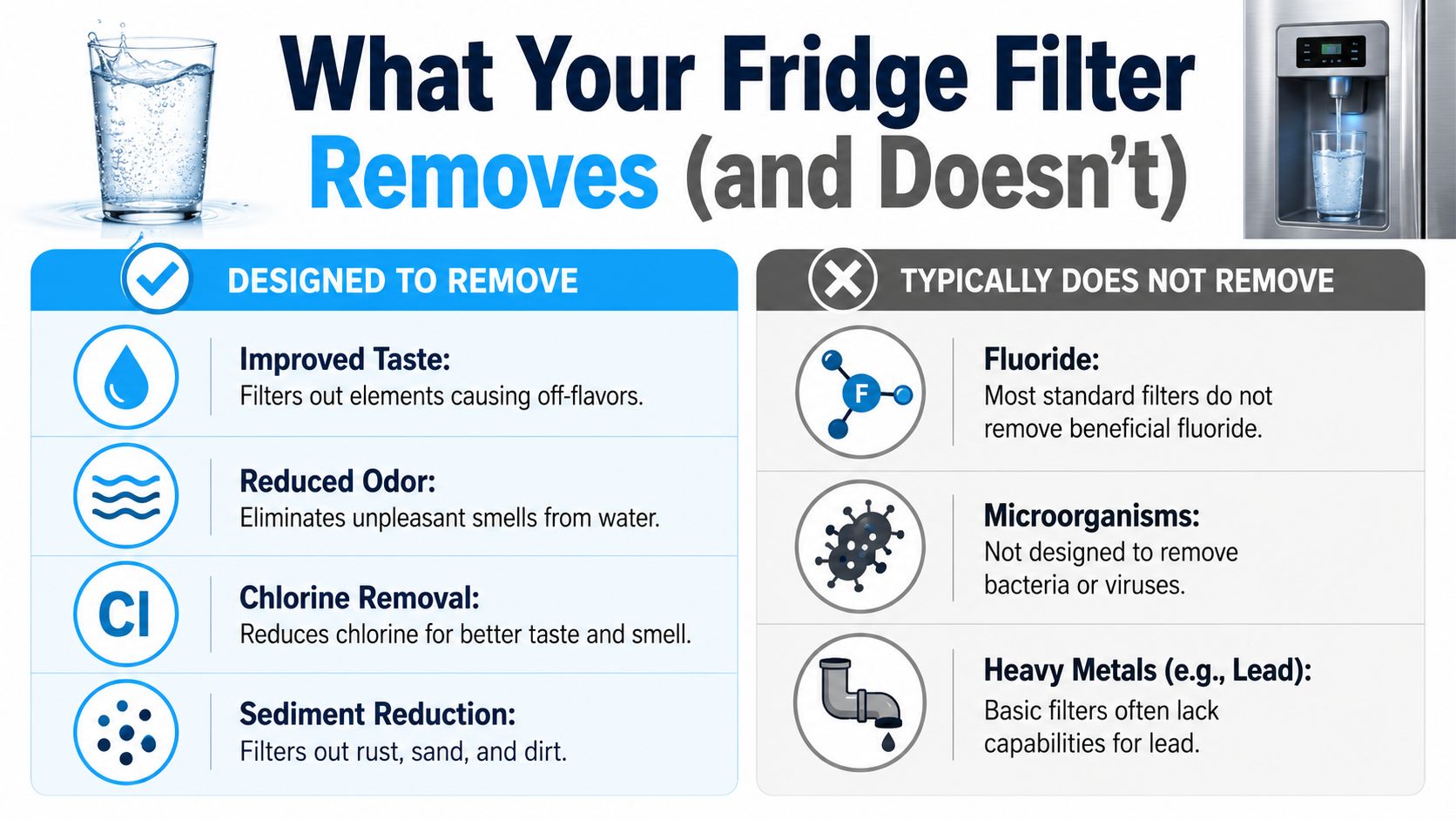
For many households on municipal water, a common off-the-shelf refrigerator filter is designed to reduce:
- Chlorine taste and odor, which is why water often tastes less like a swimming pool
- Sediment, such as tiny bits of rust, dirt, or grit from aging pipes
- Some nuisance compounds that affect flavor, which can make water seem fresher or "crisper"
That last point trips people up. "Crisper" does not automatically mean "safer against every contaminant category." It usually means the filter removed compounds that were easy to taste or smell.
To make that easier to visualize, here's a simple comparison.
Where the big claims can mislead
The broadest claims in fridge filter marketing usually combine several possible contaminant categories into one impressive headline. The fine print is what tells the true story. One model may be certified for chlorine reduction only. Another may also be certified for lead, cysts, or a short list of additional contaminants.
A good way to read those claims is to ask a simple lab-style question: What was this exact filter tested to reduce? If the product page does not clearly name the certification and the contaminant list, treat the headline as advertising, not proof.
You can see the same problem in other small-appliance filtration products. PureHQ's coffee filter guide is a helpful example of how appliance-specific filter claims can vary by design and use case. If you want a broader reference point while comparing systems, our guides for choosing home water treatment options can help you sort taste-improvement claims from health-related reduction claims.
The practical takeaway is simple. Most fridge filters are designed to make water more pleasant to drink. Some go further, but only the certification for your exact cartridge tells you whether it does.
A short visual walk-through helps here too:
How Your Refrigerator Filter Works
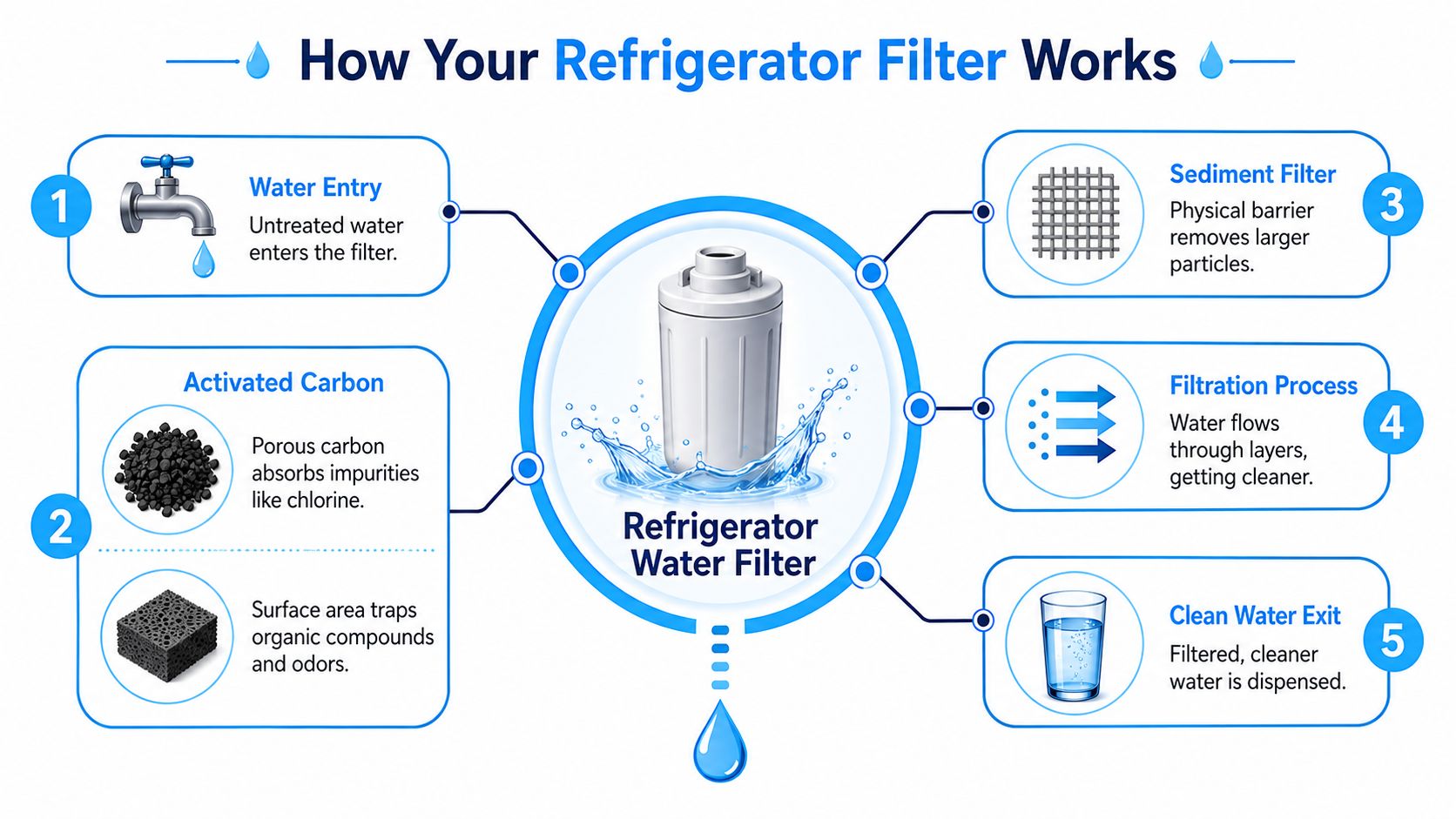
Most refrigerator filters rely on activated carbon. If you sliced one open, you wouldn't find a tiny water treatment plant with a dozen advanced stages. You'd usually find a compact cartridge built around carbon and a structure that forces water through it.
Think of activated carbon as a sponge made of tunnels, pores, and hiding places. Water passes through. Certain compounds cling to the carbon surface. That sticking process is called adsorption.
The easiest way to picture it
If absorption is a towel soaking up a spill, adsorption is more like dust sticking to a strip of tape.
That distinction matters. The filter doesn't “destroy” chlorine taste compounds or magically neutralize every contaminant. It provides a huge internal surface where certain unwanted compounds can latch on while water keeps moving.
What happens inside the cartridge
A basic refrigerator filter usually works in a sequence like this:
- Water enters the cartridge from your household supply line.
- A physical barrier catches larger particles such as sediment or rust.
- Activated carbon interacts with dissolved compounds that affect taste and smell.
- Water exits cleaner-looking and better tasting than it entered.
- The dispenser or ice maker receives the treated water for daily use.
Why some filters do more than others
Not all cartridges use the same media mix. Some advanced filters include materials meant to target a narrower set of contaminants beyond chlorine and sediment. That's one reason two filters with similar shapes and brand language can perform very differently.
The cartridge itself is also tiny compared with an under-sink reverse osmosis unit or a whole-house treatment system. Size matters. Contact time matters too. The less time water spends moving through the right media, the fewer opportunities the filter has to catch or reduce difficult contaminants.
Lab shortcut: When you want to understand a filter, stop looking at the plastic shell and start looking for the media type and certification sheet.
That one habit will save you from most marketing confusion.
What Most Fridge Filters Leave Behind
This is the part many shoppers need most. A fridge filter can improve your water and still leave behind contaminants you care greatly about.
That isn't a defect. It's a design limit.
The big gap between marketing and performance
Some refrigerator filter pages use broad language that makes the cartridge sound almost universal. In practice, standard fridge filters usually do not remove PFAS, viruses, bacteria, or fluoride, according to major-brand and independent explanations summarized in Whirlpool's refrigerator filter FAQ.
That gap matters because people often buy a replacement cartridge to solve a problem it was never built to address.
What standard fridge filters commonly miss
A standard filter is often not the right tool for these concerns:
- Bacteria and viruses. Most fridge cartridges are not designed for microbiological protection.
- PFAS. These “forever chemicals” generally call for more specialized treatment.
- Fluoride. Standard refrigerator cartridges usually let it pass through.
- Many difficult dissolved contaminants. Some chemicals need different media or a more intensive process.
- Well-water safety issues. If the water source itself may be microbiologically unsafe, the fridge filter isn't your main line of defense.
For people looking at broader household treatment, this overview of the benefits of whole home water filtration is helpful because it shows how point-of-entry systems solve different problems than a single refrigerator cartridge.
Why well-water homes need extra caution
Municipal water users and well-water users are not playing the same game.
A refrigerator filter usually assumes the incoming water is already disinfected and generally safe from a microbiological standpoint. That assumption often fits treated city water. It may not fit private well water, especially if testing has flagged contamination concerns.
If your household has received a contamination advisory, if you rely on untreated or inconsistently treated well water, or if you're worried about emerging contaminants, a fridge filter may improve taste while leaving the safety question unanswered.
If your concern is “Does this water taste better?” a fridge filter may help. If your concern is “Is this water safe from difficult contaminants?” you need model-specific proof or a different treatment method.
That's the most important distinction in the whole article.
Decoding NSF Certifications for Filters
You swap in a new fridge filter, pour a cold glass, and the box says it removes dozens of contaminants. That sounds reassuring until you look closer and realize those big promises usually rest on a few small certification numbers.
Those numbers matter more than the headline.
A standard refrigerator filter is not a magic catch-all. In lab terms, it is a cartridge tested for specific reduction claims under specific conditions. If you want to know what your filter does for your family, read the certification like a test result, not like an advertisement.
NSF 42, NSF 53, and NSF 401 in plain English
The broad idea is simple. Different NSF standards point to different kinds of claims.
- NSF 42 usually covers aesthetic improvements, such as reducing chlorine taste and odor
- NSF 53 covers certain health-related contaminant reductions, but only for the contaminants specifically listed for that filter
- NSF 401 applies to some newer or "emerging" contaminants on certain models
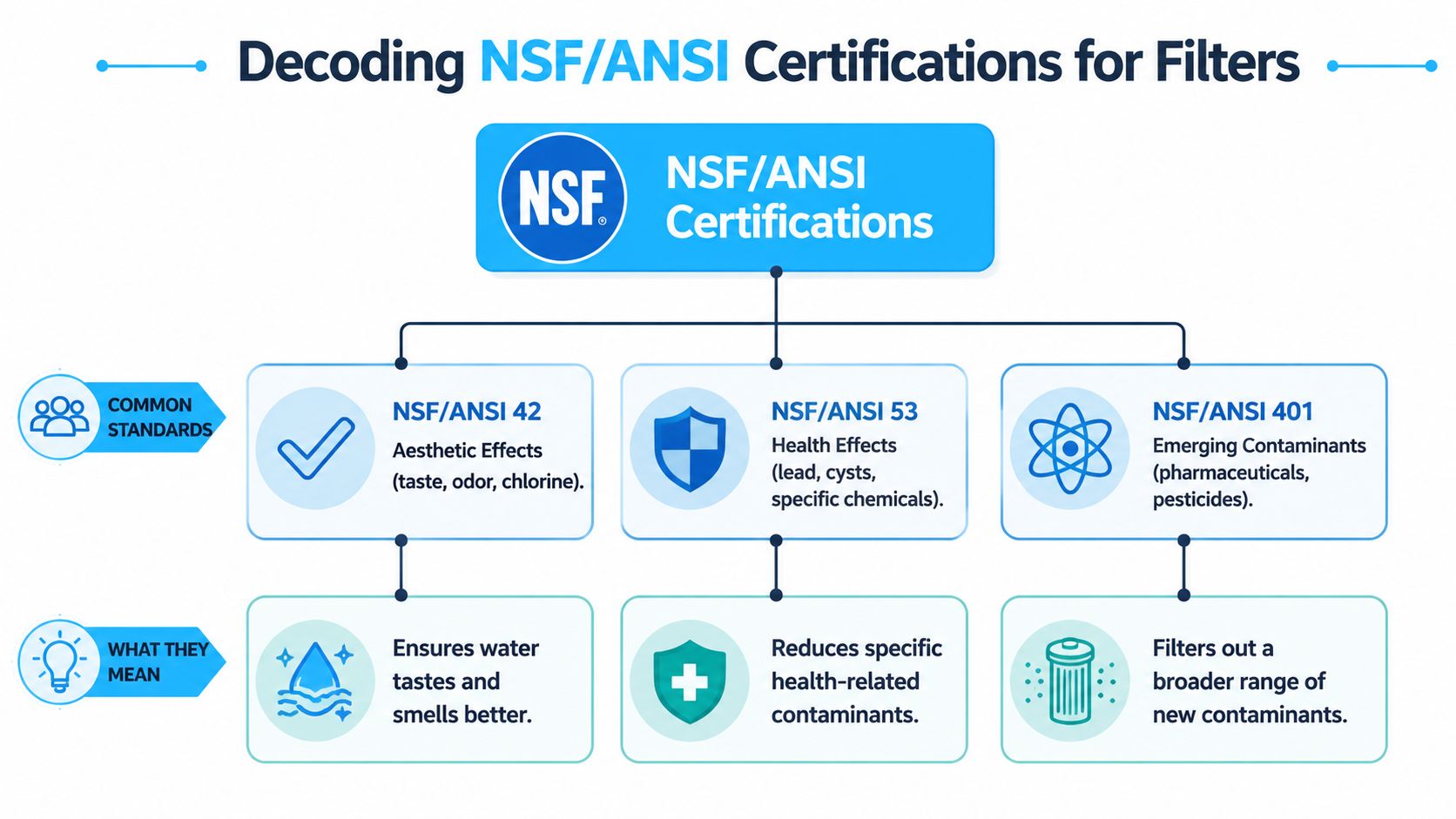
Here is the practical translation:
| Standard | What it usually tells you | What that means at home |
|---|---|---|
| NSF 42 | Aesthetic effects | Better taste and smell, especially from chlorine |
| NSF 53 | Health-related reductions | The filter was tested for certain contaminants, such as lead or cysts, if those are named |
| NSF 401 | Emerging contaminants | Some filters are tested for a limited list of newer contaminant categories |
The part that confuses shoppers
A filter can say NSF 53 certified and still not be certified for every health-related contaminant people worry about.
That is the gap between marketing and reality.
Manufacturers often spotlight the category because it sounds broad. The actual certification is narrower. It works like a student report card. Seeing "science" on the report does not tell you whether the student studied chemistry, biology, or physics. In the same way, seeing "NSF 53" does not tell you which contaminants were reduced unless the package or product sheet names them.
So if your concern is lead, look for lead. If your concern is cysts, look for cysts. If the contaminant is not named, do not assume the filter handles it.
A simple way to read the box
When you are standing in a store aisle or comparing filters online, check the label in this order:
- Find the NSF standard number. This tells you the type of claim being made.
- Find the contaminant list. This tells you what that specific filter was tested to reduce.
- Match the list to your concern. A good filter for chlorine taste is not automatically a good filter for lead.
- Check the exact model compatibility. A cartridge has to fit and seal correctly to do its job.
One more detail matters. Some boxes use phrases like "tested to NSF standards" or "made with NSF-certified materials." Those phrases are weaker than a clear statement that the finished filter is certified for named contaminant reductions.
Plain rule: Treat NSF numbers as the table of contents. Treat the named contaminants as the real answer.
That small shift in how you read the label helps you sort out a realistic fridge filter from one that only sounds impressive.
How to Read Filter Claims and Avoid Scams
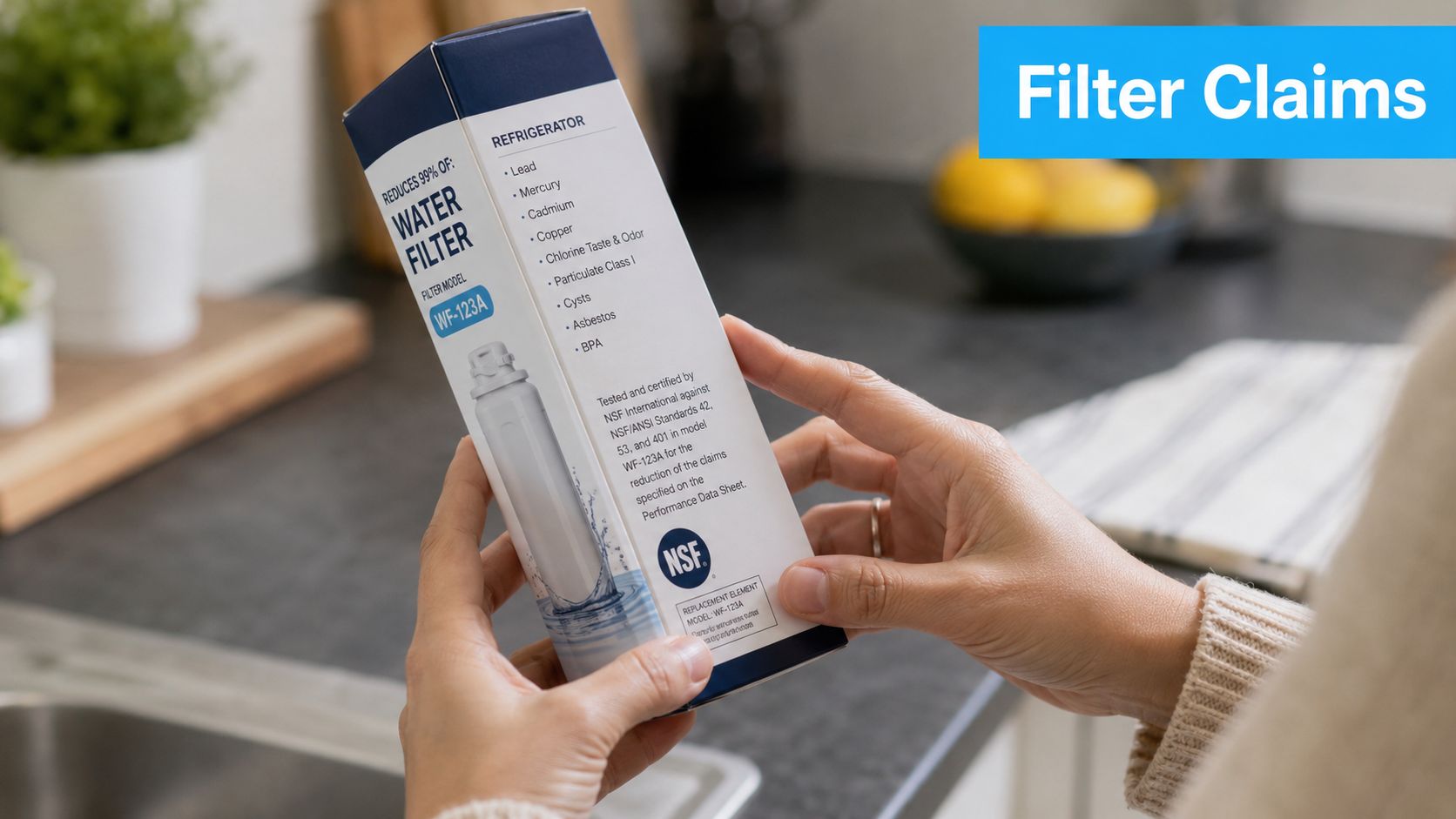
Filter packaging often mixes useful facts with fluffy language. The safest move is to treat every claim like a label on a toolbox. You want to know exactly what tool it is, exactly what job it does, and exactly what job it does not do.
What a trustworthy claim looks like
A reliable listing usually includes these details:
- Specific certification language instead of vague promises
- Named contaminants rather than “impurities” or “harmful substances”
- Exact refrigerator compatibility so you know the cartridge fits and seals correctly
- Brand transparency about whether it's an original manufacturer part or a third-party replacement
What should make you pause
Be careful when a product page leans on phrases like these:
- “Removes contaminants” with no certification shown
- “Comparable to major brands” without naming tested standards
- “Advanced coconut carbon technology” with no actual reduction list
- Very low-price listings from unclear sellers where packaging, model numbers, or photos look inconsistent
Counterfeit and poorly documented replacement filters are a real concern because the cartridge can look convincing while giving you little proof of performance.
A quick gut check helps. If a listing sounds sweeping but avoids naming standards, named contaminants, and compatible refrigerator models, keep scrolling.
Why and When to Change Your Refrigerator Filter
A refrigerator filter isn't a permanent part. It's a consumable. Once the media is used up or the cartridge has sat wet for too long, performance drops.
Two things happen as a filter ages. First, it can lose its ability to hold the compounds it was meant to reduce. Second, buildup inside the cartridge can restrict flow or create pathways where water doesn't interact with the media as evenly as it should.
Replacement is about performance, not just reminders
People often treat the change light like a gentle suggestion. It's better to think of it as a maintenance warning.
Change your fridge filter when the manufacturer says to, and sooner if your water flow drops, your ice tastes off, or the water develops the same smell the filter used to remove. An old carbon cartridge can stop improving the water in any meaningful way, and a damp, neglected filter is not something you want to keep in service indefinitely.
If your household uses a lot of dispenser water or if your incoming water carries more sediment than average, the filter may wear out faster in practical terms, even before the reminder becomes impossible to ignore.
Frequently Asked Questions About Fridge Filters
Can a refrigerator filter make unsafe water safe to drink
Usually, no. A standard fridge filter is not a universal safety device. If the concern is bacteria, viruses, PFAS, or another difficult contaminant, you need a filter specifically certified for that concern or a different treatment system.
If my water tastes fine, do I still need the filter
That depends on why you're using it. Some people want better ice quality and less chlorine taste. Others are trying to reduce a specific contaminant. Taste alone doesn't tell you what is or isn't in the water.
Is an original brand filter always better than a third-party one
Not automatically. What matters is fit, certification, and trustworthy documentation. A third-party filter can be a reasonable choice if it clearly lists the right certifications and matches your refrigerator model correctly.
Will a fridge filter help if I already have a whole-house system
It can. A whole-house system and a fridge filter do different jobs. Some homes use whole-house filtration to treat the supply broadly, then rely on the fridge cartridge for final taste improvement at the dispenser.
Why does my filtered water still leave mineral spots
Because a standard refrigerator filter usually isn't built to remove the minerals that cause spotting or hardness residue. If spotting is your main complaint, you may be dealing with a different water treatment issue than what the fridge cartridge was designed to fix.
What's the smartest way to answer what refrigerator water filters remove for my home
Look up your exact filter model and read its certification sheet. That's the most reliable answer. Not the brand family, not the refrigerator ad, and not a generic marketplace bullet list.
If you want help comparing filter types, understanding certifications, or figuring out whether your home needs a refrigerator filter, under-sink system, or broader treatment, Water Filter Advisor is a useful place to start. It breaks down filtration options in plain language so you can make a decision based on your actual water concerns, not marketing shortcuts.
- May 30, 2026
- Uncategorized
