
You're probably here because your water feels like a question mark.
Maybe you're on a private well and the last test raised concerns about bacteria. Maybe your town has had boil water advisories often enough that you no longer trust “clear” water at face value. Or maybe you've gone down the rabbit hole of home treatment systems and found the same confusing promise over and over: UV fixes everything.
It doesn't. But it does one job very well.
Ultraviolet light water filtration systems can be an excellent way to make water microbiologically safer in a home. They're especially appealing because they work as a chemical-free disinfection step, which sounds almost too clean and simple to be true. The catch is that UV only solves the part of the problem that UV is built to solve. If you expect it to remove sediment, metals, chlorine taste, or mystery contaminants, you'll end up disappointed.
That's why the smartest way to shop for a UV unit isn't to ask, “Which one is best?” It's to ask, “What role should UV play in my system?”
Is UV Light the Answer to Your Water Worries?
A lot of homeowners start looking at UV after a stressful moment. A well test comes back with a bacterial concern. A neighbor mentions Giardia. A municipal notice says boil your water until further notice. Suddenly the water that looked fine yesterday doesn't feel fine at all.
That reaction makes sense. Microorganisms are invisible, and that's what makes them unsettling. You can see rust. You can smell sulfur. You can taste chlorine. You can't look at a glass of water and know whether bacteria or viruses are part of the picture.
UV enters the conversation because it offers a modern line of defense without adding chemicals to the water. For many homes, that's exactly the appeal. You're not pouring something into the water. You're passing water through a treatment chamber that targets living organisms.
Clean-looking water can still need disinfection. Appearance tells you very little about microbial safety.
The important part is keeping expectations realistic. UV is often sold as if it's a complete purifier. In practice, it's better understood as a specialist tool. If microorganisms are your main concern, UV may be the right answer. If your water also carries sediment, iron staining, chlorine taste, or dissolved contaminants, UV needs help from other treatment stages.
That distinction is where good decisions start. The homeowners who end up happy with ultraviolet light water filtration systems are usually the ones who treat UV as part of a complete plan, not a magic tube with a glowing lamp.
How UV Light Makes Water Safe Without Chemicals
UV sounds technical, but the working idea is simple. Water passes by a UV lamp, and that light disrupts the genetic material of microorganisms. Instead of “filtering out” bacteria or viruses like a screen would, UV inactivates them.
A useful analogy is a bouncer who doesn't throw every troublemaker out of the building, but does take away their ability to cause any more trouble. The organisms are still physically present in the water stream, but their DNA or RNA has been damaged, so they can't reproduce the way they normally would.
What UV is actually doing
Modern UV disinfection is a physical, chemical-free process. UV-C light around 254 nm damages microbial DNA and RNA, and practical home systems commonly target a 40 mJ/cm² dose to achieve 99.9% to 99.99% microbial reduction when the water is clear enough and the system is properly maintained, according to the University of Hawaiʻi guidance on UV water treatment.

That's why UV is so attractive for homes with microbial concerns. It's effective against most viruses, bacteria, and protozoa under the right conditions, including Giardia and Cryptosporidium, as explained in this overview of how UV water disinfection works in home systems.
If you want a plain-language primer on germicidal ultraviolet light itself, this guide to killing harmful germs is a useful companion read.
What UV does not do
Here is where buyers get tripped up.
UV does not remove chlorine. It does not remove VOCs. It does not remove sediment. It does not remove heavy metals. And it does not improve water by physically straining out particles.
That means UV is a disinfection device, not a stand-alone filter.
If your water has dirt, iron, manganese, or other particles, those can absorb or scatter the UV light before it reaches microorganisms. The effect is similar to trying to shine a flashlight through muddy water. The lamp may be working perfectly, but the light isn't penetrating the way it should.
Practical rule: UV works best on clear water. If the water isn't clear, treat that problem before the UV chamber.
Why prefiltration matters so much
The best home UV setups almost always include upstream filtration. What that looks like depends on the water problem:
- For sediment and cloudiness: install a sediment prefilter so particles don't shield microbes from the UV light.
- For iron or manganese issues: use treatment that addresses those minerals before the UV stage, because they can reduce light transmission and foul components.
- For chlorine taste or odor: add carbon filtration if taste and smell matter, since UV won't change either.
This is the practical heart of ultraviolet light water filtration systems. The UV unit is your microbiological safety step. The filters before it prepare the water so the UV light can do that job reliably.
Deciding Between UV and Other Water Treatments
Most homeowners aren't choosing between “safe water” and “unsafe water.” They're choosing between treatment methods that solve different problems.
If your goal is to deal with bacteria in well water, UV deserves serious attention. If your goal is to remove chlorine taste from city water, carbon filtration makes more sense. If you want broad contaminant reduction, you may need a layered system rather than one device.
Match the treatment to the problem
Here's the simplest way to think about it.
If you say, “I want to remove bacteria from my well water,” UV is often a strong fit because disinfection is exactly what it's designed to do.
If you say, “I want my water to stop tasting like a pool,” UV won't help much. That's a carbon filter job.
If you say, “I want to remove particles and improve drinking water quality at one sink,” you may be looking at a point-of-use system with filtration stages, possibly with UV added if microbial risk is part of the picture.
UV versus chlorination versus carbon
| Method | Primary Target | Effect on Taste/Odor | Ongoing Maintenance | Chemicals Added |
|---|---|---|---|---|
| UV | Microorganisms such as bacteria, viruses, and protozoa | Usually doesn't change taste or odor | Lamp changes and sleeve care | No |
| Chlorination | Microbial disinfection | Can affect taste and odor | Chemical monitoring and replenishment | Yes |
| Carbon Filtration | Chlorine, some taste and odor issues, and selected organic compounds | Often improves taste and odor | Cartridge replacement | No |
That table leaves out one important reality: these methods are often partners, not rivals. A house can use sediment filtration, carbon filtration, and UV together because each stage handles a different job.
Why UV systems aren't all equal
One of the better indicators of whether a UV unit matches your water challenge is its classification. The NSF/ANSI 55-2024 ultraviolet treatment standard identifies Class A systems at 40 mJ/cm² for disinfecting contaminated water and Class B systems at 16 mJ/cm² for supplemental treatment of already potable water.
That difference matters in practice. A homeowner with a well and a known microbial concern shouldn't shop the same way as someone adding an extra barrier to an already acceptable municipal supply.
A UV system isn't “good” or “bad” in the abstract. It's either matched to the water challenge, or it isn't.
If you've ever been frustrated by broad claims that a UV purifier “does it all,” this is the corrective. UV can be the star of the show when microbial risk is the main issue. It becomes a supporting actor when the bigger problems are chlorine, sediment, dissolved contaminants, or aesthetic complaints.
How to Choose the Right UV System for Your Home
A common homeowner mistake happens at the kitchen table, not in the basement. They pick a UV unit by brand or price before they know two things: how fast water moves through the house at busy times, and what has to be removed before that water reaches the UV chamber.

That second point gets missed all the time. UV is a disinfection step. It does not strain out sand, clear up cloudy water, reduce iron, or improve taste. If the water is dirty enough to block light, even a well-made UV unit can underperform. For many homes, choosing the right UV system really means choosing the right treatment train around it.
Point-of-entry or point-of-use
A point-of-entry UV system treats water where it enters the home. This is usually the better fit for private wells or any house where the goal is whole-home microbial protection. Showers, bathroom sinks, the kitchen tap, and the washing machine all get water that has passed through the same disinfection stage.
A point-of-use UV system treats one faucet or appliance. It makes sense for a narrow job, such as protecting a drinking water tap, but it leaves the rest of the plumbing untreated.
For most houses with a bacteria concern, whole-house UV is the practical choice. Under-sink UV is better suited to limited use cases.
Size by peak flow, then build the pre-filtration around it
UV units are sized by flow rate, usually in gallons per minute. That number matters more than lamp marketing terms because water needs enough contact time inside the chamber for the UV dose to do its job.
Start with your busiest water-use moment, not your average day. A shower running while a toilet refills and a faucet is open can push demand much higher than homeowners expect. If the house can draw more water than the UV unit is rated to treat, you get reduced protection right when demand is highest.
Then look upstream. A UV system should usually sit after the filters or treatment stages that improve clarity. Depending on the water, that may include:
- Sediment filtration for sand, silt, or rust
- Carbon filtration if chlorine needs to be reduced before UV equipment or for taste and odor improvement
- Iron or manganese treatment if staining minerals are present
- Water softening or scale control if hardness is likely to foul the quartz sleeve
This is the part that separates a UV add-on from a working system. If the water has visible turbidity, iron, or scale issues, solve those first. For broader system planning beyond the UV chamber itself, the articles in Water Filter Advisor's advice center can help you compare filter stages and layout options.
What to check before you buy
A good buying checklist stays grounded in daily use and service reality:
- Choose the application: whole-house for full plumbing protection, point-of-use for one tap or appliance
- Match the unit to peak flow: size for simultaneous use, not a quiet hour
- Verify the certification: look for a unit tested to NSF/ANSI 55, with the class matched to your water situation
- Review water quality first: cloudy water, hardness, iron, and sediment often need treatment before UV
- Check service clearance: leave enough room to remove the lamp and quartz sleeve
- Confirm operating conditions: residential UV systems are typically installed on cold water lines
This walkthrough shows the kind of installation layout homeowners often see in real systems:
The best UV unit is the one that fits your actual flow rate, your actual water quality, and the rest of the treatment system feeding it. In many homes, the smartest purchase is not a bigger UV chamber. It is better pre-filtration ahead of the UV chamber.
Your Guide to UV System Installation and Maintenance
A UV system often looks deceptively simple once it is on the wall. Water goes in, treated water comes out, and the controller shows a reassuring light. In practice, long-term performance depends on two plain things: correct installation and routine service.
The biggest installation mistake is treating the UV unit like a standalone fix. It is the final disinfection step in the treatment train, not the whole treatment train. If sediment, hardness, iron, or staining minerals are still in the water, they can block UV light or coat the sleeve. That is why the UV chamber usually belongs after the filters and conditioning equipment that clean up the water first.
Installation details that make or break performance
Placement matters more than many homeowners expect. The chamber needs enough room for someone to remove the lamp and quartz sleeve without fighting the wall, ceiling, or nearby piping. I have seen good UV units turn into frustrating service calls because the installer left no clearance to pull the lamp straight out.
It also helps to install shutoff valves or a bypass where they make service easier. That can reduce the mess and cut downtime during lamp changes or sleeve cleaning.
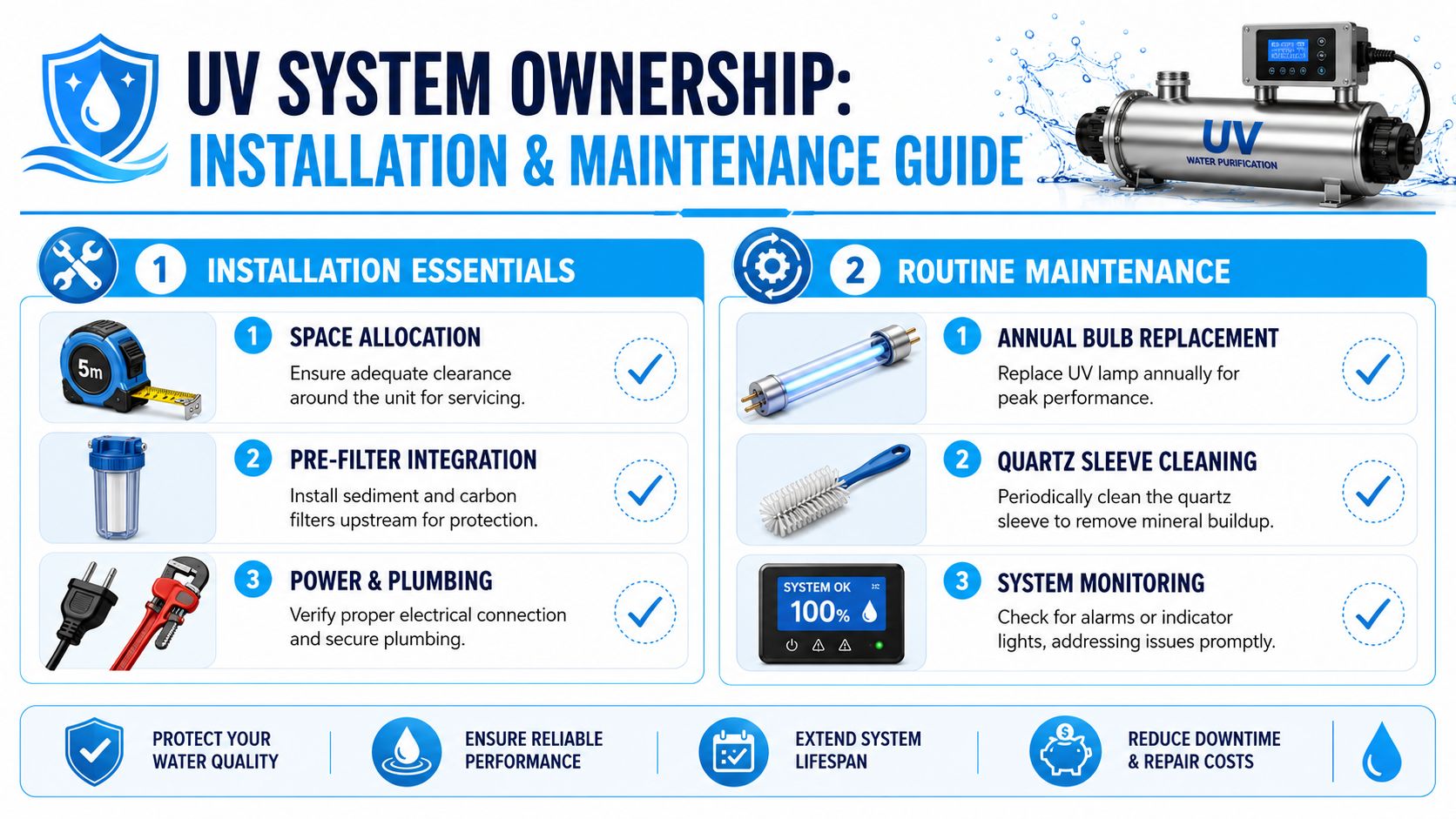
Service access should be part of the layout from day one. If maintenance is awkward, it usually gets postponed.
The annual lamp replacement
UV lamps need replacement on schedule, usually once a year or after about 9,000 hours of use, because a lamp can keep glowing after its germicidal output has fallen below the effective range. That guidance is outlined in this home UV maintenance reference.
That catches homeowners by surprise. A blue glow does not confirm proper disinfection. The lamp may look normal while delivering much less useful UV energy to the water.
For that reason, lamp replacement is a calendar task, not a wait-until-it-fails task.
The quartz sleeve needs attention too
The quartz sleeve is the clear tube that separates the lamp from the water while letting UV light pass through. If minerals or fouling build up on that surface, the lamp can be working correctly and the water still receives less UV exposure than the system was designed to provide.
Prefiltration's utility is evident. A sediment filter helps keep particles from shading microbes. Water treatment for hardness or iron can reduce the scale and staining that often collects on the sleeve. Homeowners sometimes blame the UV unit when the actual issue is the water feeding it.
A good maintenance routine looks like this:
- Replace the lamp on schedule. Do not wait for the lamp to go dark.
- Inspect the sleeve during lamp service. Check for haze, scale, or discoloration.
- Clean the sleeve if needed. Light buildup is much easier to remove than heavy mineral crust.
- Check the controller and any alarms. A warning light should lead to inspection, not be ignored.
- Keep the upstream filters serviced. A neglected prefilter can reduce UV performance even if the UV unit itself is fine.
A homeowner checklist that holds up over time
- Write down the install date and lamp change date: annual service is easy to forget
- Keep the replacement lamp on hand before the due date: delays often turn a one-day job into a multiweek one
- Review prefilters on their own schedule: the UV stage depends on the water arriving clear enough for treatment
- Look for signs of fouling if your water has hardness or iron: those homes often need more frequent sleeve checks
- Treat the UV unit like safety equipment: if an alarm sounds or service is overdue, address it promptly
The best results usually come from systems that are boring to own. Correct layout, clear water entering the chamber, and routine service keep UV doing the job it is meant to do.
Understanding the Total Cost of a UV System
A lot of homeowners price the stainless UV chamber and stop there. That is how budgets go sideways.
The overall cost is the cost of the full treatment train, not just the disinfection device. If the water reaches the UV chamber with sediment, tannins, or other light-blocking material, the lamp may be on and the water may still not be getting the dose you paid for. In homes with city water, that full setup might include a sediment filter and carbon ahead of the UV unit. On private wells, it can also mean iron reduction, softening, or both.
That is why UV often looks inexpensive in a catalog and more expensive on the final quote. The UV unit itself is only one part of a working system.
Ongoing costs are usually straightforward. Plan for a lamp replacement on schedule, periodic sleeve cleaning or replacement if fouling is an issue, and whatever prefilter cartridges your setup uses. Electricity is usually a minor line item for a residential unit compared with service parts and filters.
A simple way to budget is to split the cost into two categories:
- Purchase and installation: the UV reactor, controller, plumbing labor, and any prefiltration the water needs
- Annual operating cost: replacement lamp, replacement cartridges, sleeve service if needed, and power use
This is also where homeowners make better decisions by asking one practical question. Are you buying UV to solve a disinfection problem, or are you expecting it to fix overall water quality? If the water also has taste, odor, hardness, iron, or staining issues, the total project cost rises because those problems need their own treatment stages.
A UV system is often a good value. A UV chamber by itself can be a false economy.
Common Questions About Home UV Water Purifiers
What happens during a power outage?
A UV system needs power to disinfect. If the power is out, the UV lamp isn't operating. In practical terms, that means you shouldn't assume the water passing through the chamber is being disinfected during the outage.
Does UV change the taste or smell of water?
Usually, no. UV is a disinfection method, not a taste-and-odor treatment. If your water tastes like chlorine or has an earthy or metallic note, that points to other treatment stages such as carbon or specialty filtration.
Is the UV light dangerous to be around?
In a properly assembled home unit, the UV light is enclosed inside the chamber. You're not meant to be exposed to the lamp directly during operation. A primary safety issue for most homeowners isn't stray UV exposure. It's neglecting maintenance and assuming an aging lamp is still protective.
Can I install it myself?
That depends on your plumbing comfort level, the electrical setup, and local code expectations. Some skilled DIY homeowners can handle straightforward installations. Many people are better off using a qualified installer, especially when the UV unit is part of a larger whole-house treatment train with multiple filters.
Is UV enough by itself?
Sometimes, but not often. If the only issue is microbial contamination and the water is already clear, UV can be a strong solution. In many homes, it works best as the final disinfection stage after the water has already been cleaned up by prefiltration or other treatment.
Is UV a good fit for city water?
It can be, especially if you want an added microbiological barrier. But many city-water homeowners care more about chlorine taste, odor, or chemical reduction. In those cases, UV may be secondary rather than the first device to buy.
If you're comparing treatment options and want help sorting out what your home needs, Water Filter Advisor is a solid place to start. The site does a good job of breaking down filtration types, maintenance demands, and buying decisions in plain language, which makes it easier to build a water treatment setup that solves the right problem instead of just adding more hardware.
- May 29, 2026
- Uncategorized
