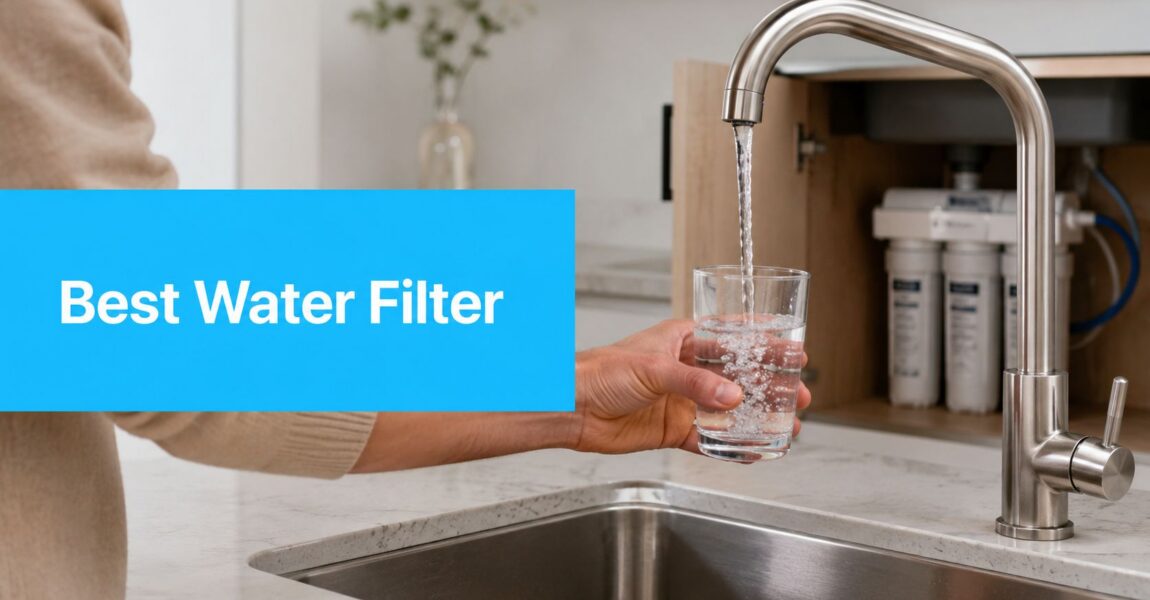
You're probably here because your tap water is doing at least one annoying thing. It smells like a swimming pool. It tastes flat or metallic. It leaves you wondering whether that glass from the kitchen sink is fine for coffee, cooking, and your kids' water bottles, or whether you've been trusting the wrong filter for years.
That's the trap in this category. Many individuals search for the best water filter as if there's one universal winner. There isn't. A renter with chlorinated city water needs a different setup than a homeowner dealing with lead concerns, PFAS anxiety, sulfur smell, or hard water scale. The right answer starts with your water, your plumbing, and how much hassle you're willing to live with.
I've seen expensive systems solve the wrong problem and cheap filters work perfectly for the right one. That's the difference that matters.
Why Your Tap Water Needs a Second Look
A lot of filter purchases start the same way. Someone fills a glass, takes a sip, and notices something is off. Maybe it's a chlorine smell. Maybe the water looks cloudy for a second after pouring. Maybe the taste changes from season to season and nobody in the house can agree whether it's normal.
Those are the obvious reasons people start shopping. The bigger reason is the one you can't see. Many homeowners and renters aren't just trying to make water taste better. They want a practical way to deal with concerns about contaminants, old pipes, or inconsistent municipal treatment.
That concern is no longer niche. The U.S. water purifier market was valued at USD 6.75 billion in 2024 and is projected to reach USD 10.35 billion by 2032, while a separate survey reported that 77% of Americans filtered their drinking water at home in 2022, according to Fortune Business Insights on the U.S. water purifier market.
Bad taste is only one clue
Taste and odor complaints are often the easiest problem to solve. A basic carbon filter can do a good job when chlorine is the main issue. But the same filter that makes water taste cleaner may not be the right tool for dissolved contaminants or more serious drinking water concerns.
That's where people waste money. They buy the product with the slickest ads instead of buying the technology that fits the problem.
Practical rule: If you don't know what's in your water, don't start with a brand. Start with a water report or a test.
The goal isn't the fanciest system
Home filtration works best when you match three things:
- Your water problem: Taste, odor, sediment, lead, PFAS, staining, scale, or all of the above.
- Your treatment point: Every tap in the house, or just the water you drink and cook with.
- Your maintenance tolerance: Some systems are easy to live with. Others perform well but demand more attention.
The best water filter for one home can be a bad choice for the next. That's not marketing talk. It's how water treatment works.
Matching the Right Filter Type to Your Home
The first decision isn't which brand to buy. It's where to filter.
Some people need treatment at one faucet. Others need water improvement everywhere, including showers, laundry, and appliances. That choice changes everything, from installation to upkeep to long-term cost.
Independent guidance on choosing the best home water filters from Tap Score makes this point clearly. Faucet or pitcher filters can be appropriate for taste and odor, while under-sink or whole-home systems are better suited to serious concerns like lead or PFAS. The technically correct answer depends on testing your water and deciding whether you need drinking-water treatment only, or filtration for every tap and shower.

| Filter Type | Best For | Typical Cost | Installation |
|---|---|---|---|
| Whole-house system | Improving water quality throughout the home, protecting plumbing and appliances, reducing sediment or general treatment at every tap | Varies widely by system and media | Usually professional |
| Under-sink filter | Drinking and cooking water at one sink, especially for households that want stronger treatment than a pitcher or faucet filter | Moderate to high, depending on technology | DIY-friendly on some models, professional for others |
| Faucet-mounted filter | Renters or households focused on taste and odor at the kitchen tap | Low | Easy DIY |
| Countertop filter | Homes that can't modify plumbing, apartments, backup filtration, or users who want portability | Low to moderate | No plumbing or light setup |
| Shower filter | Improving shower water for chlorine-related comfort concerns | Low to moderate | Easy DIY |
| Refrigerator filter | Basic taste and odor improvement from fridge dispensers | Low to moderate over time | Usually simple cartridge replacement |
Whole-house or point-of-use
A whole-house system treats water as it enters the home. That makes sense when the problem affects bathing, laundry, fixtures, or appliance life. Sediment, widespread odor, and general water quality issues often fit here.
A point-of-use system treats water where you consume it. That usually means the kitchen sink, sometimes the fridge line, and occasionally a second dedicated faucet. If your main concern is what you drink and cook with, this route is often smarter and cheaper.
What usually works best by scenario
- You hate chlorine taste at the kitchen tap: A faucet-mounted, countertop, or basic under-sink carbon filter is often enough.
- You're concerned about lead or PFAS in drinking water: Under-sink filtration, especially RO, usually makes more sense than a basic faucet filter.
- Your whole house has unpleasant water: Start looking at whole-house treatment.
- Your showers are the problem but drinking water is fine: A shower filter or targeted bathing solution may be the better move.
- Your water causes scale buildup: Filtration may not be the whole answer. If hardness is the issue, a guide to water softener systems helps explain when softening and filtration should be treated as separate jobs.
If your only complaint is chlorine taste, don't let anyone sell you a large whole-house buildout as the automatic answer.
The mistake I see most often
People buy an under-sink reverse osmosis system because it wins lab tests, then realize they only wanted better-tasting water for coffee and pasta. They end up paying for performance they didn't need.
The opposite mistake is worse. A household with real contaminant concerns buys a pitcher because it's cheap and convenient, then assumes the job is done.
The right filter type solves the actual use case. That's the foundation for every good recommendation that follows.
Decoding Filter Technologies and Contaminants
Once you know where to filter, the next question is how the filter works. Product pages often obscure this information, as brands love to stack media names and buzzwords into a long list that sounds impressive, even when the core treatment is simple.
Most home systems come back to a few core technologies. If you understand those, you can ignore a lot of the fluff.

Activated carbon
Activated carbon is the workhorse for chlorine, taste, and odor. Think of it as a medium that grabs many unwanted compounds as water passes through. It's common in pitchers, faucet filters, fridge filters, shower filters, and many under-sink systems.
For city water with a strong chemical smell, carbon is often the first thing I'd try. It's simple, widely available, and often enough for households that mainly want better taste.
What it doesn't do is make every water issue disappear. Carbon can be excellent for the right job and underpowered for the wrong one.
Sediment filtration
Sediment filters catch physical particles like dirt, rust, and sand. They don't usually solve taste problems on their own, but they protect downstream filters and equipment.
This matters more than many buyers realize. If you have visible particulates or older plumbing shedding debris, a sediment stage can keep the rest of the system from clogging early.
Reverse osmosis
Reverse osmosis, or RO, is the heavy hitter for drinking water treatment. It pushes water through a membrane that blocks a wide range of dissolved contaminants. When households ask for the strongest contaminant reduction at one sink, this is usually where the conversation lands.
Independent 2026 testing from TechGearLab's best water filter review reported that RO units, especially the APEC ROES-50 and other under-sink RO models, removed nearly all contaminants tested and delivered the strongest PFAS removal, reducing both PFNA and PFBA to near- or fully undetectable levels in both tap water and heavily contaminated samples.
That result lines up with what installers and water treatment professionals already expect. If the benchmark is broad contaminant reduction, RO is the system to beat.
UV and specialty stages
UV treatment targets biological concerns by inactivating microorganisms. It's not a cure-all for chemical contamination, so it works best as a specific tool, not a magic add-on.
Some systems also include specialty media for targeted reduction, but those claims only matter if they're verified and if they match your water profile.
Match technology to the problem
A quick way to consider it:
- Chlorine, taste, odor: Carbon
- Particles, rust, sand: Sediment
- Broad dissolved contaminant reduction: RO
- Microbial treatment needs: UV in the right context
A filter can be excellent and still be wrong for your house. Technology choice matters more than brand loyalty.
If you spend time outdoors, this is also why survival and travel filters shouldn't be confused with home treatment systems. A good resource on that distinction is HYDAWAY's guide to portable water filters for adventure, which is useful for understanding why emergency filtration and household filtration solve different problems.
How to Read Certifications and Spot Real Performance
The water filter industry has no shortage of bold claims. “Removes harmful contaminants.” “Advanced multi-stage purification.” “Cleaner, safer, better water.” Most of that language tells you almost nothing.
What matters is independent certification.
According to NSF's research on certified water filters, 92% of filtration buyers prefer independently certified filters, 83% support mandatory independent certification, and buyers are willing to pay an average of 17% more for certified products. That's a rational response to a market full of lookalike products and uneven testing standards.
Why certification matters
Certification is how a buyer separates tested performance from packaging design. If a filter claims to reduce lead, PFAS, or another serious contaminant, you want proof that the claim was verified against a recognized standard.
You also want confidence that replacement cartridges are legitimate. Counterfeit or off-brand replacements can wreck an otherwise good system.
The standards worth understanding
Here's the plain-English version:
- NSF/ANSI 42 usually relates to aesthetic issues like chlorine, taste, and odor.
- NSF/ANSI 53 is associated with health-related contaminant reduction claims, including things like lead and cysts.
- NSF/ANSI 58 applies to reverse osmosis systems.
- NSF/ANSI 401 covers certain emerging contaminants.
You don't need to memorize every standard. You do need to check that the certification matches the contaminant you care about.
What to look for on a product page
Use this checklist before you buy:
- Find the exact certification: Don't settle for vague phrases like “tested to NSF standards.”
- Check the actual contaminant claim: A filter certified for chlorine isn't automatically certified for lead.
- Verify the replacement cartridge: A strong system can become a weak one if the refill isn't the genuine, certified component.
Buy the certification before you buy the brand.
That habit saves people from a lot of expensive mistakes.
Our Recommended Water Filters for 2026
A homeowner on chlorinated city water can waste a lot of money by buying the same system a well-water household needs. I see that mistake all the time. The right pick starts with the job the filter has to do, how much treated water the home uses, and whether the system belongs at one tap or across the whole house.
These recommendations are organized by use case, not hype. I'm weighing treatment range, installation demands, cartridge availability, maintenance burden, and how the category holds up after a year or two of ownership.
Best under-sink RO for contaminant reduction
Primary pick: APEC ROES-50
Who it's for: homeowners who want high-level drinking water treatment at the kitchen sink and have room for a traditional tank-based RO setup.
Why I picked it: if the goal is broad contaminant reduction, under-sink RO remains the category I trust most for point-of-use treatment. Analysts at TechGearLab highlighted the APEC ROES-50 among strong-performing RO systems, and it fits the kind of homeowner who accepts slower dispensing and more parts in exchange for stronger reduction capability.
This is usually the right category when the problem is at the tap you drink from, not in every shower, toilet, and appliance line.
Runner-up: another under-sink RO model from the top-tested RO category
Who it's for: buyers who want RO performance but need a different tank layout, easier service access, or a different faucet setup.
Why it made the list: once you decide on RO, the deciding factors are often practical. Can you fit the tank? Are replacement filters easy to get? Is annual service straightforward, or does the system turn a simple filter swap into a half-day project?
Best under-sink non-RO option
Primary pick: a certified multi-stage carbon under-sink filter
Who it's for: households mainly trying to improve taste and odor, with a lower-maintenance setup than RO.
Why I picked it: this category makes sense for a lot of municipal water users. If the water report does not point to a problem that calls for RO, a certified carbon system often gives the better ownership experience. You avoid wastewater, storage tanks, and membrane replacement while still getting a noticeable improvement in drinking water.
For many homes, that is the smarter buy.
Runner-up: a compact direct-connect under-sink filter
Who it's for: smaller kitchens, condos, and homeowners who want filtered water without adding a separate faucet.
Why it made the list: footprint matters. A system can test well and still be the wrong fit if it blocks storage, complicates plumbing access, or becomes annoying to maintain.
Best whole-house filter category
Primary pick: a whole-house system sized to your water report
Who it's for: homes with water issues at multiple fixtures, or households trying to protect plumbing, water heaters, and appliances as well as improve water quality.
Why I picked it: whole-house filtration pays off when the problem is house-wide. Sediment, chlorine, and certain odor issues often belong at the entry point, not under the sink. But this category gets oversold. A whole-home unit is rarely the most cost-effective answer for high-purity drinking water by itself. In many homes, the better plan is whole-house pretreatment plus a point-of-use drinking system at the kitchen sink.
That split setup costs more upfront, but it often solves the right problems in the right places.
Runner-up: a staged whole-house setup with prefiltration plus targeted media
Who it's for: larger homes or houses with layered issues such as sediment, odor, and drinking-water concerns that still need a separate sink filter.
Why it made the list: one tank cannot do every job well. Staged treatment is usually easier to size correctly and easier to troubleshoot later.
Best faucet-mounted filter
Primary pick: a certified faucet filter from a major replacement-cartridge ecosystem
Who it's for: renters, students, and households that need a low-cost starting point without changing plumbing.
Why I picked it: faucet filters are a sensible short-term or budget option when the main complaint is chlorine taste and odor. They are easy to install, easy to remove, and cheap to try. The trade-off is cartridge life, reduced flow, and limited treatment compared with under-sink systems.
That is fine, as long as the buyer understands the limit.
Runner-up: a premium faucet unit with stronger flow and easier cartridge swaps
Who it's for: households that want the convenience of a faucet filter without the flimsy feel common in cheaper units.
Why it made the list: if a filter is awkward to use, people bypass it. Day-to-day usability matters more than marketing copy.
Best countertop category
Primary pick: a countertop gravity filter for portability and no-plumbing setups
Who it's for: renters, temporary living situations, and homes where plumbing changes are not allowed.
Why I picked it: countertop gravity systems still have a place. They are portable, simple, and useful where installation is off the table. The trade-offs are slower output, regular refilling, and the fact that many owners get tired of giving up counter space.
I've seen plenty of households start here and later move to under-sink filtration once they realize the daily inconvenience.
Runner-up: a powered countertop treatment unit
Who it's for: buyers who want stronger treatment than a basic gravity setup and accept the space and visual clutter that come with a countertop appliance.
Why it made the list: some households prefer equipment they can see and access easily, especially if it avoids cabinet work.
Best shower filter category
Primary pick: a shower filter certified for chlorine reduction
Who it's for: people bothered by chlorine smell during showers or looking for a more comfortable bathing experience.
Why I picked it: shower filters should be judged narrowly. They are useful for the problems they are built to address, and disappointing when buyers expect them to fix whole-home water quality. I put honest, targeted products ahead of broad claims in this category.
Runner-up: a compact inline shower unit with easy cartridge replacement
Who it's for: apartments, guest baths, and households that want a fast DIY install with simple upkeep.
Why it made the list: shower filtration works best when it stays simple and easy to maintain.
My blunt buying advice
If the concern is serious contaminant reduction for drinking and cooking water, buy a point-of-use RO system and accept the extra upkeep.
If the problem is mostly taste and odor, a certified carbon system is usually the better value.
If every tap in the house is affected, start with a properly sized whole-house system, then decide whether the kitchen still needs a higher-treatment filter.
Calculating the True Cost of Ownership
Consumers compare water filters the way they compare blenders. They look at the purchase price first and assume the cheapest acceptable option is the better value.
That's how bad filtration decisions get made.
A filter isn't a one-time product. It's a small household utility. You're buying the system, the cartridges, the maintenance burden, the installation complexity, and in some cases the wastewater penalty.

What buyers underestimate
Recent comparative review commentary in this video discussion on water filter trade-offs highlights a point I wish more guides emphasized. The best filter isn't always the one with the highest contaminant reduction score. A top-rated tankless RO system may offer low cost per gallon, while a high-performing gravity filter can require more frequent filter changes.
That's the practical view. Performance on day one is only part of the story.
A simple ownership comparison
Consider two households.
- Household A buys a gravity countertop filter because the upfront cost feels safer. Over time, they deal with regular cartridge replacement, slower output, counter space loss, and the irritation of keeping it filled.
- Household B buys an under-sink RO system. They pay more upfront and accept the extra hardware, but they get stronger treatment and potentially better long-term economics depending on cartridge life and daily use.
Neither choice is automatically cheaper. It depends on usage, replacement schedule, and whether the system solves the right problem.
Cheap to buy and expensive to live with is common in water filtration.
The real checklist
Before calling anything the best water filter, price these five things:
- Replacement filters: How often they need changing matters as much as the system price.
- Water waste: RO systems can carry a wastewater trade-off.
- Installation: DIY-friendly systems lower cost. Complex plumbing raises it.
- Maintenance effort: Easy service usually means better long-term compliance.
- Opportunity cost: A cheaper filter that doesn't solve the problem often leads to buying twice.
I'd rather see a homeowner buy a simpler filter they'll maintain correctly than a premium system they resent after six months.
A Practical Guide to Filter Installation and Maintenance
A filter can test beautifully and still fail in your house if it's installed poorly or ignored after month three. I've seen leaks caused by rushed fittings, housings overtightened into cracks, and expensive systems ruined by off-brand replacement cartridges.
Good filtration is part equipment, part habits.
When DIY makes sense
DIY installation is realistic for many faucet filters, shower filters, countertop units, and some under-sink systems. If the product uses straightforward adapters, push-fit connections, or standard cartridge housings, a careful homeowner can usually handle it.
Whole-house systems are different. Those often belong in a plumber's hands because sizing, shutoff strategy, mounting, and bypass planning matter.
If you're on the fence, use this rule:
- DIY it when the install is reversible, localized, and clearly explained.
- Call a pro when the system affects the main line, drainage, or multiple fixtures.
The maintenance habits that prevent problems
Keep this short list in mind:
- Change filters on schedule: Waiting until taste turns bad is not a maintenance plan.
- Use the correct cartridge: Don't assume a lookalike replacement performs the same way.
- Clean housings and contact surfaces: That includes O-rings, sumps, and threads.
- Lubricate O-rings when appropriate: It helps seals seat correctly and reduces twisting damage.
- Keep a bucket and towel nearby: Even clean installs drip.
- Watch for pressure drop: Lower flow often signals a clogged stage or overdue cartridge.
If a filter's maintenance routine is too annoying, the system was wrong for that household from the start.
Signs your system needs attention
A filter usually tells on itself before it fails completely.
Reduced flow, returning odor, odd tastes, noisy operation, and leaks around connection points all deserve attention. For shower and faucet units, declining performance often appears as the original smell creeping back in. For under-sink systems, the first clue is often slower delivery.
If you want ongoing help with replacement timing, troubleshooting, and setup choices, the practical advice section at Water Filter Advisor advice articles is a useful place to keep bookmarked.
A well-maintained system doesn't have to be complicated. It just has to be consistent.
If you're trying to choose the right setup without getting buried in marketing claims, Water Filter Advisor offers practical guidance on filter types, certifications, maintenance, and side-by-side comparisons to help you match a system to your home.
- May 26, 2026
- Uncategorized
