UV Water Purification Systems: Your 2026 Guide
You get your water test back, and one line grabs all your attention: bacteria. Or maybe you're on city water, everything seems fine most days, and then a boil-water notice lands in your inbox. Either way, the feeling is the same. The water looks normal, tastes normal, and suddenly doesn't feel normal at all.
That's where UV water purification systems earn their place. They're not flashy. They don't change the taste of your water, and they don't usually become the part of the plumbing system people brag about. But when they're installed correctly, they act like a silent final barrier against microbiological contamination.
For homeowners, that's the right way to think about UV. Not as a magic box that fixes every water problem, but as a focused tool for one job: making biologically unsafe water microbiologically safer to drink. If your concern is bacteria, viruses, or cyst-related risk, UV is one of the cleanest, most targeted solutions available. If your water also has sediment, metals, staining, sulfur smell, or chemical contamination, UV still helps, but only as one stage in a complete treatment setup.
The Invisible Shield Protecting Your Home's Water
You can have clear water, no odor, no staining, and still have a problem that only shows up on a lab report. That is usually the moment homeowners start looking at UV.
I see it in two situations all the time. Well owners want a final disinfection step after finding bacteria risk, and city-water homeowners want backup protection after a service interruption or boil-water notice. In both cases, the appeal is practical. UV adds disinfection without feeding chlorine or another chemical into the plumbing.
Why UV feels different from ordinary filtration
A sediment filter catches grit. Carbon reduces chlorine, taste, and some organic compounds. UV does a different job. It passes water through a chamber and exposes microorganisms to germicidal light, which works a lot like sunscreen in reverse for microbes. Instead of shielding them, the light damages them so they cannot keep multiplying.
That difference matters in real-world system design. Homeowners often expect one device to handle everything, but UV is usually the last protective step, not the whole treatment plan. If the water is cloudy or full of iron, hardness scale, or fine sediment, those issues need to be handled before the UV unit can do its job well.
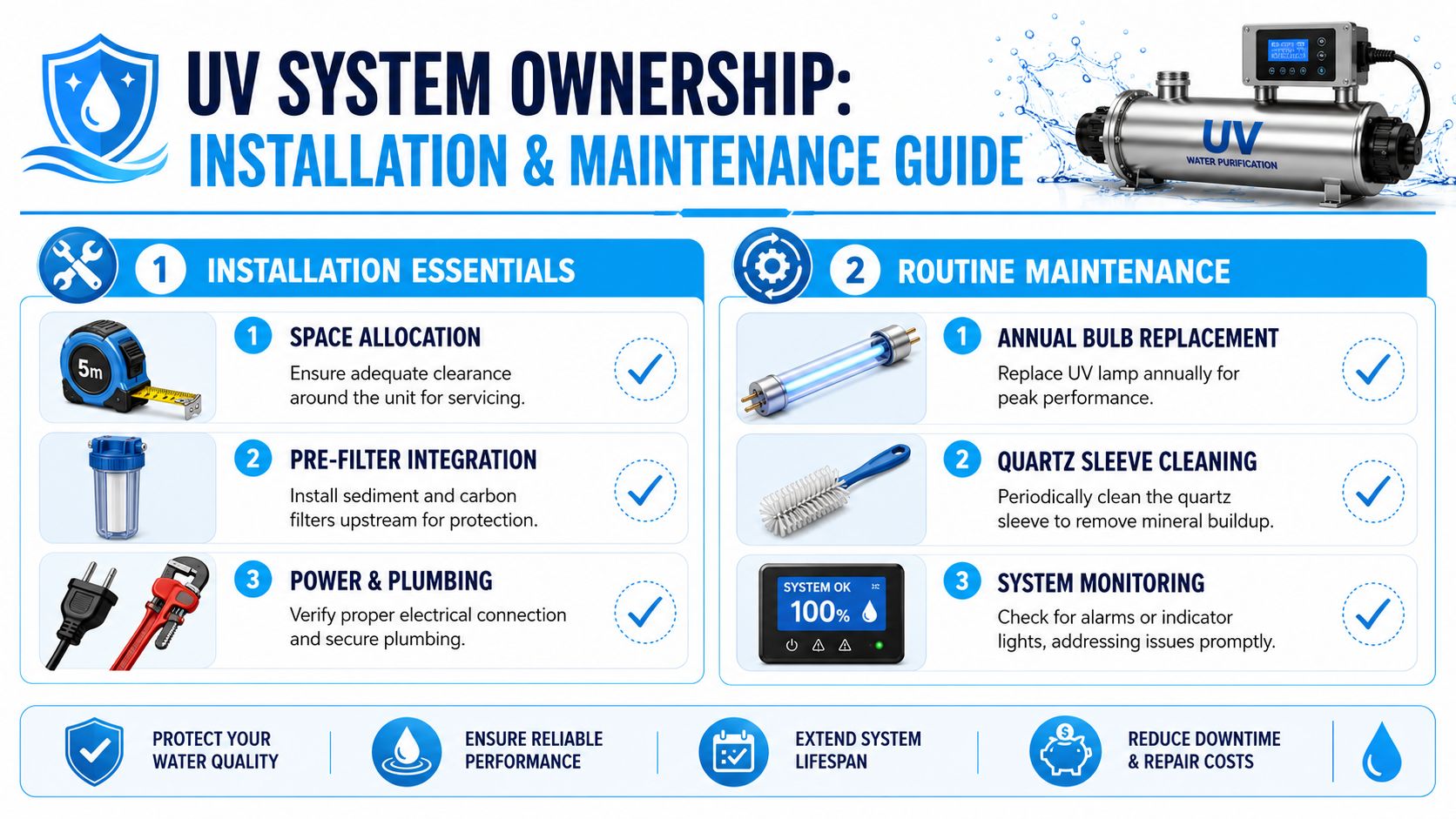
That is also why ownership costs start before the unit is installed. A UV system may look simple on the wall, but the full decision includes prefiltration, lamp replacement, sleeve cleaning, and making sure the flow rate matches the house. The unit itself is only part of the purchase.
Where homeowners usually use it
Residential UV systems usually fit one of two setups:
- Whole-house protection: Installed on the main line, usually after prefilters and any softener or iron treatment.
- Point-of-use protection: Installed under a sink or at a dedicated drinking water tap.
Whole-house UV gives broader protection, but it costs more upfront and usually needs more careful sizing. Point-of-use UV costs less and can make sense if the concern is limited to drinking and cooking water, though it does nothing for showers, bathroom sinks, or ice makers on untreated lines.
Homeowners who have looked at HEPA and UV air systems already know the basic idea. UV handles threats you cannot see. In water treatment, the same principle applies, but sizing and water quality matter a lot more because the light has to reach organisms as water moves through the chamber.
One more distinction helps set expectations early. Some UV systems are built for contaminated water risk, while others are intended as added protection for already treated municipal water. That is why product class, flow rating, and the condition of your incoming water matter more than marketing language. UV is a targeted disinfection step, and it works best when the rest of the treatment train is planned around it.
How UV Light Makes Your Water Safe
A family can fill glasses from a perfectly clear tap and still have a disinfection problem. That is the part UV is built to address. It targets living microorganisms that you cannot see, taste, or smell.
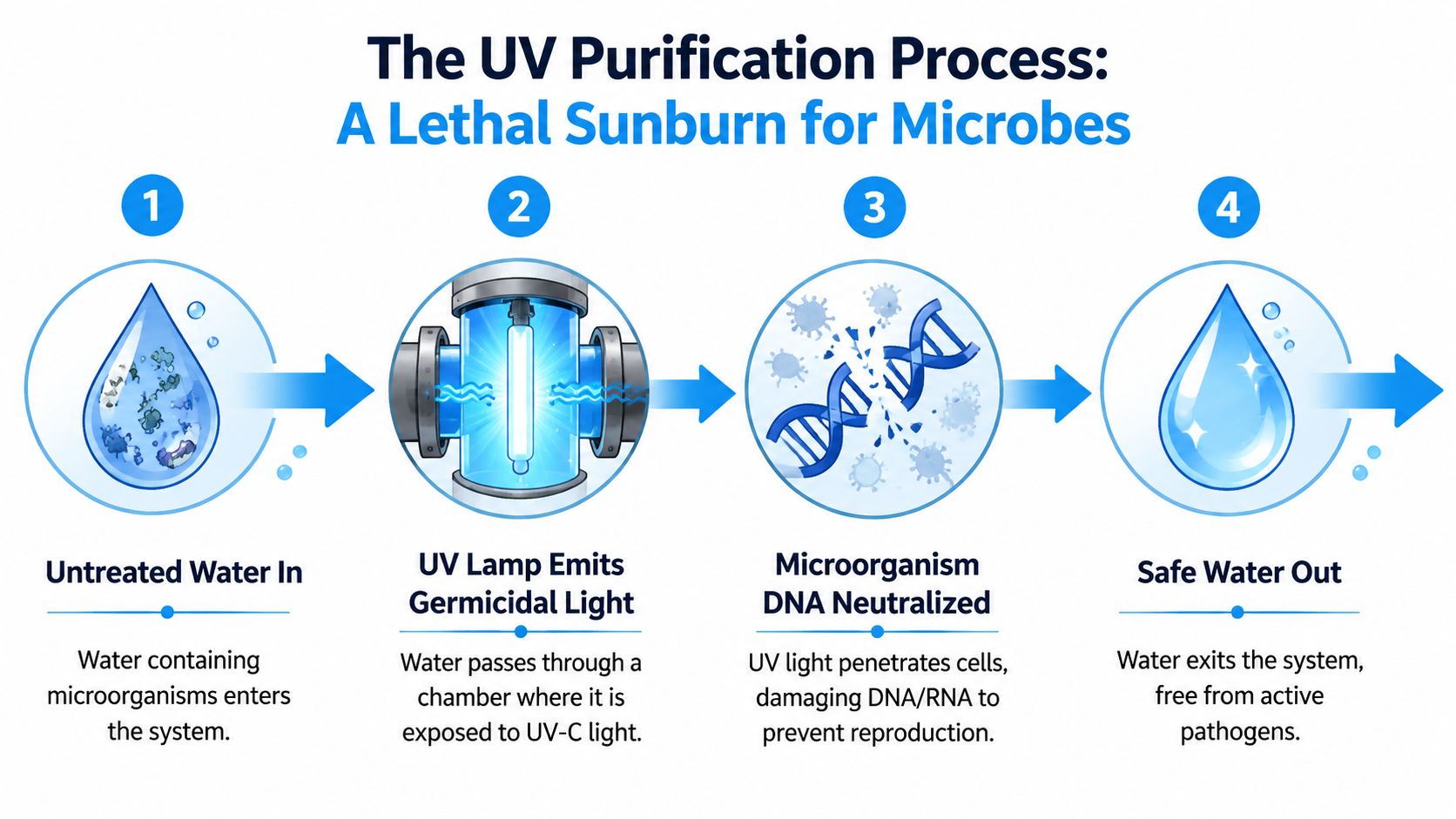
UV treatment uses UV-C light, typically at 254 nm, to damage the genetic material inside microbes. A practical way to picture it is sunscreen in reverse. Instead of shielding cells from light damage, the system exposes bacteria, viruses, and protozoa to a level of light that keeps them from reproducing. Once they cannot reproduce, they cannot keep infecting people.
What actually happens inside the chamber
Inside the reactor, water flows past a UV lamp that sits inside a clear quartz sleeve. As water moves through that treatment zone, microorganisms are exposed to germicidal light for a controlled amount of time. If the unit is sized correctly and the water is clear enough for the light to pass through, the organisms are inactivated before the water reaches the rest of the house.
That last part matters. UV is a disinfection step, not a capture step. It does not strain organisms out of the water, and it does not remove dirt, chlorine, iron, hardness, or chemical contaminants. It changes whether microbes are still viable.
For homeowners, that distinction affects planning and long-term cost. A UV unit can do its job very well, but only if the water reaching the chamber gives the light a fair shot. Cloudiness, sediment, and mineral fouling on the sleeve all reduce performance, which is why prefiltration and sleeve maintenance are part of the complete ownership picture, not optional add-ons.
Why dose matters more than bulb wattage
A lot of product pages push lamp wattage because it is easy to compare. Wattage alone does not tell you whether the system will disinfect your water under real household conditions. UV dose matters more.
Dose is the amount of germicidal energy the water receives as it passes the lamp. A simple paint analogy fits here. A bigger paint sprayer helps, but coverage still depends on speed and distance. In a UV chamber, delivered dose depends on lamp output, contact time, flow rate, and how clear the water is.
This is why sizing mistakes show up later as ownership problems. A unit picked only by price or bulb size may look fine on paper, then struggle during high-demand periods when several fixtures run at once. A properly sized system is built around your peak flow, your incoming water quality, and the maintenance routine you will keep up with.
Why filtration and UV are often paired
If you've looked into indoor air quality, the logic will sound familiar. Homeowners often pair filtration with UV in air treatment for the same reason they pair sediment or carbon filtration with UV in water treatment. Each stage does a different job. This overview of HEPA and UV air systems shows that same layered approach in a different setting.
Here's a quick visual if you want to see the water-side process in action:
Practical rule: Judge a UV system by delivered dose at your home's real flow rate, and by the prefiltration and upkeep it needs to keep that dose consistent over time.
Anatomy of a Home UV Purification System
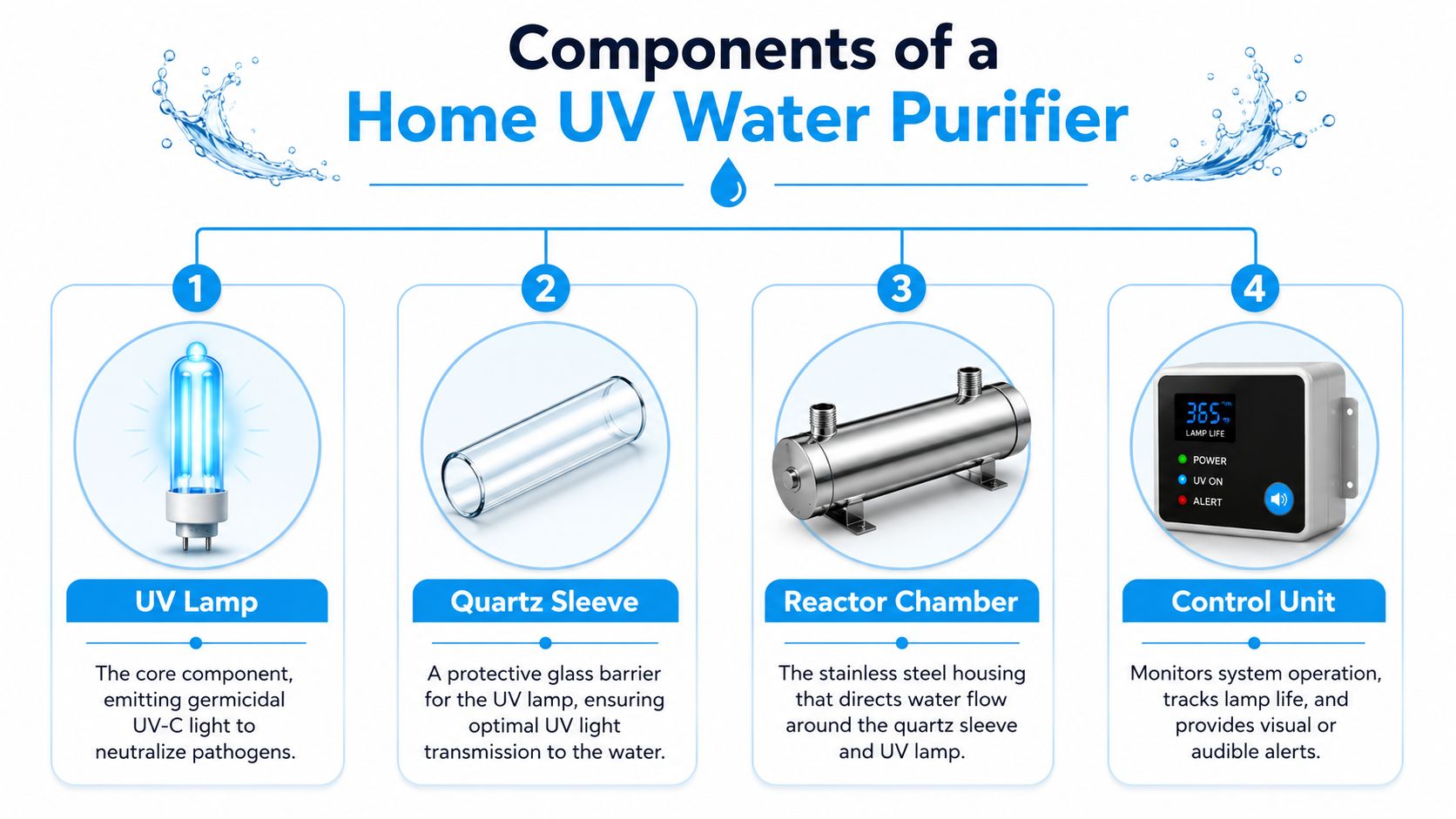
A home UV unit looks simple from the outside. Inside, four parts do almost all the work.
The lamp
The UV lamp is the heart of the system. It generates the germicidal light that treats the water. When the lamp ages, the system may still appear to be on, but disinfection performance can drop if output isn't maintained. That's why lamp replacement is part of ownership, not an optional extra.
The quartz sleeve
The quartz sleeve is a clear protective tube that separates the lamp from the water. It lets UV light pass through while keeping the electrical lamp dry.
This part often gets ignored until performance problems show up. If minerals, iron fouling, or film build up on the sleeve, the lamp may still be glowing while less useful light reaches the water.
The reactor chamber
The reactor chamber is usually stainless steel. It holds the sleeve and lamp in the correct position and directs water through the treatment zone.
Good chamber design matters because water needs consistent exposure as it passes through. In practical terms, residence time and exposure path are combined.
The controller
The controller or ballast powers the lamp and usually provides status information. Better controllers help homeowners notice trouble early by tracking lamp condition or signaling when service is due.
A simple way to think about the whole assembly:
| Component | Job in the system |
|---|---|
| UV lamp | Produces germicidal UV-C light |
| Quartz sleeve | Protects lamp while allowing light through |
| Reactor chamber | Routes water through the disinfection zone |
| Controller | Powers and monitors system operation |
When homeowners understand these parts, maintenance starts to make sense. You're not just “changing a bulb.” You're preserving the conditions that make disinfection possible.
What UV Purifiers Do and Do Not Remove
You install a UV unit, the lamp is glowing, and the water still smells like chlorine or leaves orange stains in the sink. That does not mean the UV system failed. It means it was asked to solve the wrong problem.
UV water purification systems target living contaminants. They are built to disable bacteria, viruses, and other microbes so they cannot reproduce and spread illness. In a home setup, that makes UV a disinfection step, not a catch-all treatment method.
What UV is good at
A properly sized UV system works like sunscreen for microbes. The light damages their genetic material, so they can no longer multiply. That is why UV is often the last stage in the treatment line, after other filters have already cleaned up the water enough for the light to do its job.
This matters in real homes. If your concern is well water with possible bacterial contamination, UV can be a smart final barrier. If your concern is metallic taste, hard scale on fixtures, or chemical runoff, UV will not fix those issues.
What it leaves behind
UV does not remove:
- Sediment and turbidity: Dirt, silt, rust, and cloudiness remain in the water.
- Chemicals: Chlorine, pesticides, and many dissolved contaminants stay put.
- Metals: Lead, iron, manganese, and similar metals are not filtered out by UV.
- Hardness minerals: Calcium and magnesium still form scale.
- Taste and odor compounds: If the cause is chemical, mineral, or organic, UV usually will not change the flavor or smell.
That limitation shapes the whole ownership cycle. A UV system is rarely a one-box answer. It usually sits behind sediment filtration, and often behind carbon as well, because those earlier stages handle the contaminants UV cannot touch. Homeowners comparing setups can review broader treatment combinations in this home water filtration advice library or find your ideal water purification system.
Why pre-filtration matters so much
Clear water gives UV the best chance to work. Cloudy water does the opposite.
Suspended particles can shield microbes from the light. I explain it to homeowners this way: if the germ is hiding behind a speck of sediment, the UV light may never reach it with enough strength to do the job. The lamp can be on, the controller can look normal, and protection can still drop if the upstream filtration is undersized or overdue for service.
That is one of the practical trade-offs many guides skip. The cost of owning UV is not just the unit itself. It includes the sediment filters, carbon cartridges if needed, and the maintenance discipline required to keep the water clear enough for the UV chamber to stay effective.
Choosing the Right UV System for Your Home
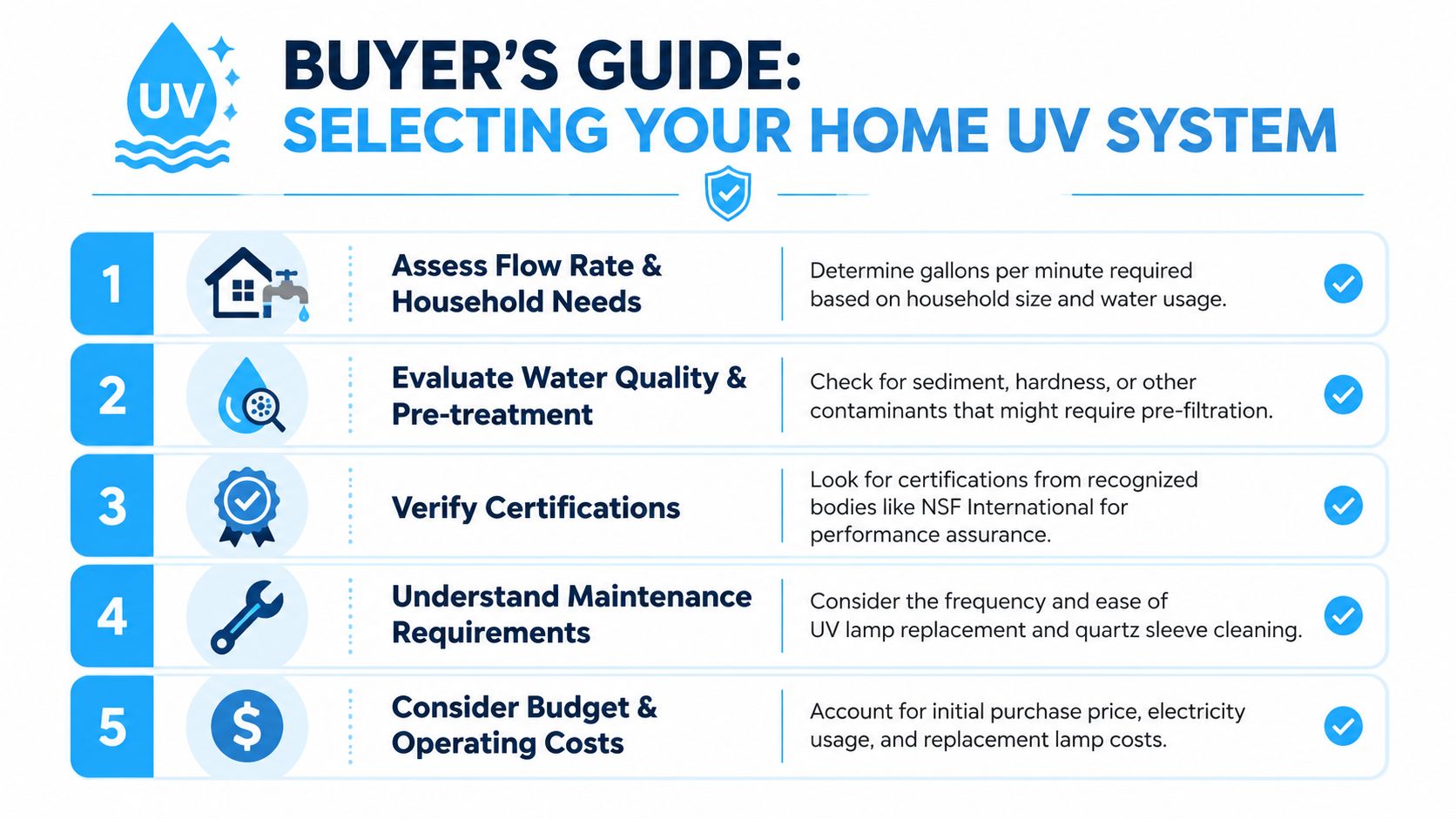
A family can live with a UV unit for years and still buy the wrong one on day one. The usual mistake is focusing on the box and forgetting the ownership cycle: water source, peak flow, pre-filtration, service access, and the steady cost of lamps, sleeves, and replacement filters.
Start with your water source
The right UV choice starts with one basic question: what water are you treating?
Private well owners usually need to be stricter about UV selection because they are responsible for the treatment barrier at the house. Municipal water users are often adding UV as extra protection at the point of entry or point of use, not replacing the utility's disinfection. That difference affects how much safety margin you want, whether whole-house treatment makes sense, and how much attention you need to give upstream filtration.
Water test results matter here. A UV chamber works like sunscreen for microbes. It blocks their ability to reproduce, but only if the light reaches them cleanly and at the right dose.
Whole-house or under-sink
A whole-house UV system treats incoming water for the entire home. That matters if you want every cold-water outlet covered, or if the concern is the source itself rather than one drinking tap.
An under-sink UV system is a narrower tool. It can be a practical fit for city water users who mainly want added protection for drinking and cooking water, or for homes where space and budget rule out a full point-of-entry install.
The better choice depends on risk and daily use, not just price. If the water source is questionable, treating one faucet leaves the rest of the house outside that protection.
Size for peak demand, not quiet-hour use
Sizing mistakes usually show up during busy household moments. One shower is running, a toilet refills, the washer starts, and someone opens the kitchen tap. That is the flow the UV unit has to handle.
UV is dose-based. As flow rises, contact time drops. In plain terms, water moving too fast through the chamber gets less exposure to the lamp. A unit that looks fine on paper can be undersized in real use if it was chosen around average consumption instead of simultaneous demand.
This is also where buyers miss the full-system cost. If the home needs better sediment reduction or carbon pre-treatment to support the UV chamber, the correct purchase is not just the UV unit. It is the UV unit plus the filter stages that keep it working as intended.
Understand Class A and Class B
Certification still matters, even if the labels are not always explained well in product listings.
Class A systems are intended for situations where microbiological safety is the main concern. Class B systems are typically used as an added measure on already potable water. For a homeowner, the practical takeaway is simple: if the source water itself may be unsafe, Class A is usually the category to look for first. If the goal is extra polish on treated city water, Class B may fit.
Do not treat those labels as marketing language. They describe different jobs.
A buying checklist that avoids expensive mistakes
Use this checklist before you order:
- Test first: Confirm whether the problem is microbial, or whether sediment, iron, hardness, tannins, or chemicals also need treatment elsewhere in the system.
- Match the unit to actual flow: Count fixtures that may run at the same time, not just your usual low-demand hours.
- Choose the treatment scope: Whole-house for source-water protection across the home. Under-sink for one tap or a limited use case.
- Confirm the certification class: Class A and Class B are not interchangeable.
- Check pre-filtration needs: UV performs best when upstream filters are sized and maintained properly.
- Leave room for service: Lamp changes and sleeve cleaning are routine ownership tasks, so cramped installs become expensive installs.
- Price the full lifecycle: Include the lamp schedule, sleeve replacement risk, quartz cleaning, and any sediment or carbon cartridges the system depends on.
If you are still comparing treatment paths, these home water filtration advice resources can help you sort out where UV fits. You can also find your ideal water purification system if you are weighing UV against broader whole-home treatment setups.
Installation Tips and Lifetime Ownership Costs
A UV system usually succeeds or fails long before the first lamp change. The deciding work happens at installation. A well-sized unit, placed in the right spot with enough room to service it, tends to be quiet and dependable. A cramped install with weak pre-filtration turns routine maintenance into a recurring headache.
Set UV at the end of the treatment train, after sediment filtration and after any other treatment stages that can add debris or cloudiness. UV light only disinfects what the light can reach. If the water carries silt, rust, or other suspended material, some microbes can pass through shaded from the lamp, like sunscreen for microbes.
Where installation usually goes right or wrong
Placement is only part of the job. Service clearance matters just as much.
Leave enough straight space to remove the lamp and quartz sleeve without cutting pipe or unmounting the chamber. I have seen solid UV units installed so tightly against a wall joist that a simple lamp swap turned into a plumbing call. That is avoidable. Check the manufacturer's clearance requirements before the unit is mounted, not after.
Flow rate is the other common mistake. UV works on contact time. If the home can demand more water than the chamber is rated to treat, exposure drops right when protection is needed most. Size for real peak use, such as showers, laundry, and kitchen demand happening together, not for the quiet hour when one faucet is running.
A few practical install habits also pay off over the full life of the system:
- Add isolation valves and a bypass if the layout allows. This makes lamp or sleeve service much easier.
- Protect the chamber with the right pre-filtration. Sediment control upstream usually does more for long-term UV performance than homeowners expect.
- Install where status lights or the controller are easy to see. Hidden alarms get missed.
- Avoid hard-to-drain locations if your area deals with freezing risk or seasonal shutdowns.
- Check water conditions before finalizing the layout. Hardness, iron, and manganese often decide how often the sleeve needs attention.
The best UV install is the one that is easy to maintain a year from now, not just easy to pipe in today.
What ownership actually costs
The purchase price is only the front end of ownership. The true budget shows up in the annual lamp schedule, occasional sleeve replacement, electricity use, and the filters that protect the chamber.
Here is where the money usually goes:
- Lamp replacement: UV lamps are consumable parts. Even when a lamp still glows, its disinfecting output drops with age, so replacement follows the manufacturer's schedule.
- Quartz sleeve cleaning: Mineral scale, iron film, and fouling reduce how much UV reaches the water. Some homes need only occasional cleaning. Others need it as part of regular service.
- Quartz sleeve replacement: Sleeves can crack during handling, become badly etched, or stay fouled enough that cleaning is no longer worth the effort.
- Pre-filter cartridges: This is the cost many buying guides skip. If the UV unit depends on sediment or carbon stages upstream, those filters are part of the UV system's real operating cost.
- Power use: UV systems run continuously in many homes, so they add a small but ongoing electrical cost.
This is why I tell homeowners to price the first three years, not just the box on the shelf. A cheaper unit with expensive lamps, awkward sleeve access, or fussy pre-filtration can cost more to live with than a better-designed system.
Maintenance mindset
UV ownership works best with a calendar, not guesswork.
Check the controller or indicator lights. Replace the lamp on schedule. Inspect the sleeve if your water has hardness or iron. If water quality changes seasonally, pay closer attention during those months. Homes on wells often see this more than homes on stable municipal water.
Treat UV like a safety device that needs routine attention. It functions discreetly, but only if the lamp is fresh, the sleeve is clear, and the water reaching the chamber has already been properly filtered.
Frequently Asked Questions About UV Water Purifiers
Some questions keep coming up because they sit right at the intersection of plumbing, water quality, and daily life. Here are the short answers homeowners usually need.
Quick answers that matter in practice
| Question | Answer |
|---|---|
| Does UV change the taste of water? | Usually no. UV disinfects microbiologically, but it doesn't remove chlorine, minerals, or other compounds that affect flavor. |
| Can UV fix cloudy water? | No. Cloudiness and suspended matter should be handled upstream with filtration. |
| Is UV enough for well water? | Sometimes, but only when microbiological contamination is the main issue. Many wells also need sediment, iron, hardness, or other treatment stages. |
| Should UV go before or after other filters? | Usually after them, as the final disinfection step. |
| Can I install UV under the sink instead of treating the whole house? | Yes, if your goal is protected drinking and cooking water at one location rather than every fixture in the home. |
| If the lamp is glowing, is the system definitely working properly? | Not always. Lamp output, sleeve condition, and flow conditions all matter. |
| Does UV remove lead or pesticides? | No. Those require other treatment methods. |
| What's the biggest mistake homeowners make? | Buying UV to solve every water problem, instead of using it for the specific job it's designed to do. |
The best owner mindset
The happiest UV owners usually do three things well. They test their water before buying, they build the treatment system in the right order, and they treat maintenance as part of the purchase, not a surprise later.
That approach keeps expectations realistic. It also keeps the UV unit doing the one thing it's meant to do well.
Buy UV for microbiological protection. Buy other filtration stages for everything else.
If you're comparing filtration options or trying to build the right treatment train for your home, Water Filter Advisor is a practical place to start. It helps homeowners sort through whole-house filters, under-sink systems, replacement cartridges, certifications, and maintenance questions so you can choose a setup that fits your actual water problems, not just the marketing.