Faucet Water Filter for Lead: A Practical Buyer’s Guide

You turn on the kitchen tap to fill a glass, then notice the lab report still sitting beside the sink. The result says 14 ppb of lead. Suddenly, the small white filter attached to the faucet looks less like a convenience and more like a decision about what your family drinks every day.

A faucet-mounted filter can be a practical first response, especially for renters, older homes, and households that need filtered water at one kitchen fixture. It can also be the wrong answer if the home has unusually high lead levels, an unknown cartridge history, or plumbing that continues releasing lead after the filter has reached its limit. The useful question isn't whether a faucet water filter for lead “works.” It's whether the specific model is certified for lead, installed correctly, maintained within its rated capacity, and matched to the conditions in your home.

Why a Faucet Filter and Why Lead

Lead can enter tap water from plumbing rather than from the water leaving the treatment plant. Corroding service lines, old solder, brass fittings, and faucets can all contribute, which means a household can have a reassuring utility report and still need to investigate the water at its own tap.

A homeowner in an older house may discover lead after testing the first glass of water in the morning. Another household may become concerned after a renovation disturbs an old pipe. A renter may not be able to replace a service line or open a wall at all. In each situation, a faucet filter offers a limited but useful form of control, it treats the water used for drinking and cooking without requiring a permanent plumbing project.

Practical perspective: A faucet filter treats exposure at the point where you fill the glass. It doesn't repair a lead service line or remove lead from every outlet in the home.

The U.S. EPA action level for lead is 15 ppb, but an action level isn't a guarantee that an individual tap contains no lead. A household result near or above that level deserves careful follow-up, particularly in a home built before the federal ban on new lead plumbing installations in 1986, or where infants or pregnant people live. The health goal for lead in drinking water is zero, as described in the EPA consumer guidance on lead filters.

A faucet-mounted unit is attractive because it's removable, relatively simple to install, and focused on the tap that matters most. But the badge on the box matters more than the shape of the device. A filter marketed for chlorine taste or sediment isn't automatically a lead filter, and a cartridge that has exceeded its capacity may no longer provide verified performance.

The rest of the buying decision comes down to four questions: what certification covers lead, what enters the filter, how long the cartridge lasts, and when a faucet unit is no longer enough.

How Lead Gets Into Tap Water and How Filters Trap It

Lead usually reaches a glass through one of two plumbing routes. A lead service line can carry water from the municipal main toward the house, while lead-based solder, brass fittings, and older faucet components can add lead inside the building. Corrosion releases lead into the water, sometimes as dissolved metal and sometimes as particles that move when water flow changes.

Lead doesn't announce itself with a smell or unusual color. A clear glass can still contain it. Flushing may reduce stagnant water, but it can't guarantee that particles won't detach later or that the plumbing won't continue contributing lead.
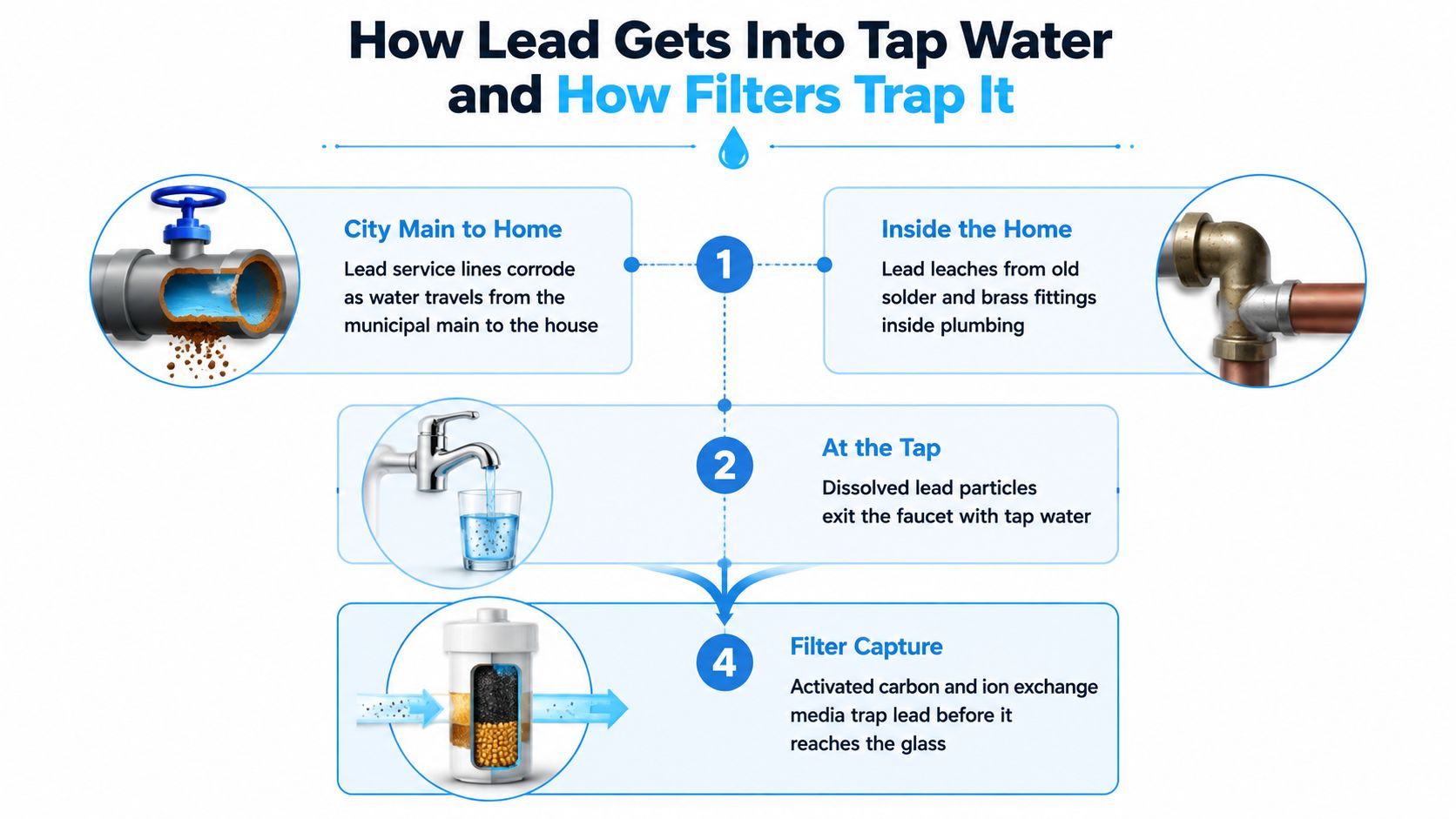
An infographic illustrating how lead enters tap water through plumbing and is removed by water filtration systems.

What the cartridge is doing

Inside a certified cartridge, the media performs more than one job.

  • Activated carbon: Think of it as a porous, sticky sponge. It attracts and holds certain dissolved contaminants, including lead when the cartridge has been designed and certified for that reduction.
  • KDF-55 media: This media uses a redox reaction that changes soluble lead into a less soluble form, which the filter bed can retain. The chemistry matters because ordinary carbon intended only for taste and odor isn't automatically designed for lead.
  • Mechanical filtration: A fine pre-filter can catch particles that break away from pipe walls. This stage is important when lead travels as particulate matter rather than only as dissolved metal.

A basic carbon cartridge can improve chlorine taste and odor while doing little or nothing that has been verified for lead. That's why the claim on the package must identify lead reduction, not just “carbon,” “metal reduction,” or “NSF components.”

For readers comparing broader filtration equipment, Allied Drinks Systems filter options can help explain how different media and cartridge designs are used in water-treatment applications. The same principle applies at a kitchen faucet: the media must match the contaminant and the testing claim.

The filter also needs the right flow conditions. Water moving too quickly may not contact the media long enough, while an exhausted cartridge may allow contaminants through even if the original cartridge passed its certification test.

Here's a short visual explanation of the process:

NSF and ANSI 53 Standards and What the 5 ppb Benchmark Really Means

A certification badge is useful only when you read the words attached to it. NSF/ANSI 53 is the main benchmark for health-related contaminant reduction in drinking-water treatment units, including lead-reduction claims for faucet-mounted filters.

NSF explains that certified lead-reduction devices are challenged with water containing 150 ppb lead, which is 10 times the U.S. EPA action level of 15 ppb. Under the updated requirement, treated water must be at or below 5 ppb, a 50% tightening from the previous 10 ppb limit. The stricter requirement became effective immediately for new products after the 2022 update, according to the NSF certified lead-reduction listings.

That test setup gives shoppers a meaningful performance ceiling. A device challenged at 150 ppb and required to finish at 5 ppb or below must achieve at least a 96.7% reduction from the test influent. NSF also states that performance isn't evaluated above 150 ppb, so a home with an unusually high result needs testing and professional advice rather than a generic faucet-filter recommendation.

The labels that cause confusion

NSF/ANSI 42 generally relates to aesthetic issues such as chlorine taste, odor, and sediment. It doesn't, by itself, establish a lead-reduction claim. A package saying “NSF tested components” also isn't the same as a complete product certified under NSF/ANSI 53 for lead.

Standard Influent Challenge Max Permissible Effluent What It Means for You
NSF/ANSI 53, current lead criterion 150 ppb lead 5 ppb or less A stricter current benchmark for certified lead reduction
NSF/ANSI 53, previous lead criterion 150 ppb lead 10 ppb or less The earlier benchmark used for older certifications
NSF/ANSI 42 Not a lead certification challenge Not a lead limit Useful for taste, odor, and particulate claims, but not proof of lead reduction

The EPA consumer tool for point-of-use filters is aimed at products certified to reduce drinking-water lead to 5 ppb or less. Before buying, search the manufacturer's exact model number in the NSF database and confirm that the listing names lead reduction. Don't rely on a logo printed beside broad language.

Field evidence supports the value of verified certification. A review of 1,528 NSF/ANSI 53-certified filters found that 99% reduced lead to the applicable certification benchmarks in the reviewed field studies, as summarized in this Environmental Science & Technology Letters evidence review. That result reflects certified products used correctly, not every carbon filter sold for a kitchen faucet.

Faucet Mount Versus Pitcher Versus Under Sink for Lead

The best format depends on how much water your household uses, how much plumbing you can change, and how closely you need to control lead at one fixture. A pitcher is easy to move, a faucet mount provides water on demand, and under-sink reverse osmosis offers a more involved installation with deeper treatment.

Feature Faucet Mount Pitcher Under Sink (RO)
Lead certification Look for NSF/ANSI 53 specifically listing lead Look for the same contaminant-specific certification Verify the applicable lead and RO certifications
Daily capacity Convenient for drinking and cooking at one tap Batch-based and slower to refill Dedicated filtered faucet with stored or on-demand production
Countertop footprint Small device attached to the faucet Takes refrigerator or counter space Hidden inside the cabinet
Installation complexity Usually simple and reversible None Requires a cold-water connection and dedicated faucet
Cartridge cost Recurring cartridge expense Recurring pitcher cartridge expense Multiple filters and membrane maintenance
Best fit Renters, smaller kitchens, one primary drinking tap Backup water or modest household demand Homes needing more extensive treatment or higher volume

Faucet mounts

A faucet unit is often the sensible starting point when the concern is limited to drinking and cooking water. It avoids drilling and usually switches between filtered and unfiltered flow, so washing dishes doesn't consume the lead cartridge. Its limitation is scope. It protects the connected fixture, not bathroom taps, ice makers, or the plumbing itself.

Pitchers

Pitchers work when the household can plan ahead. They're useful for filling a refrigerator container or keeping a backup supply, but their slower flow and small batch size become irritating when everyone is drinking filtered water and cooking with it. Certification still matters. A pitcher labeled for chlorine isn't automatically suitable for lead.

Under-sink reverse osmosis

Under-sink RO hides the equipment and uses a dedicated faucet, which keeps the main kitchen faucet available for ordinary tasks. It typically involves more installation, replacement parts, and maintenance than a faucet mount. Choose it when testing suggests the faucet unit's performance ceiling isn't appropriate, when the household needs broader dissolved-contaminant reduction, or when the plumbing condition calls for a more controlled point-of-use setup.

If lead repeatedly appears at levels that concern you, the long-term remedy may be service-line or pipe replacement, not a larger cartridge. A filter is an exposure-control measure. It isn't a structural repair.

Compatibility and Installation Tips That Actually Matter

Many faucet filters fail before the first cartridge is exhausted because the device never fit the tap properly. Start by removing the faucet aerator and checking the thread. Many U.S. faucets use a 55/64-inch female thread, but pull-down faucets, sprayers, and decorative or non-standard fittings may require an adapter or may not accept a faucet-mounted unit at all.

Tool-free models can replace the aerator quickly, while threaded models may need a wrench and plumber's tape. Don't force a plastic adapter onto a metal thread. Cross-threading can damage the fitting and create a leak that looks like a cartridge problem.
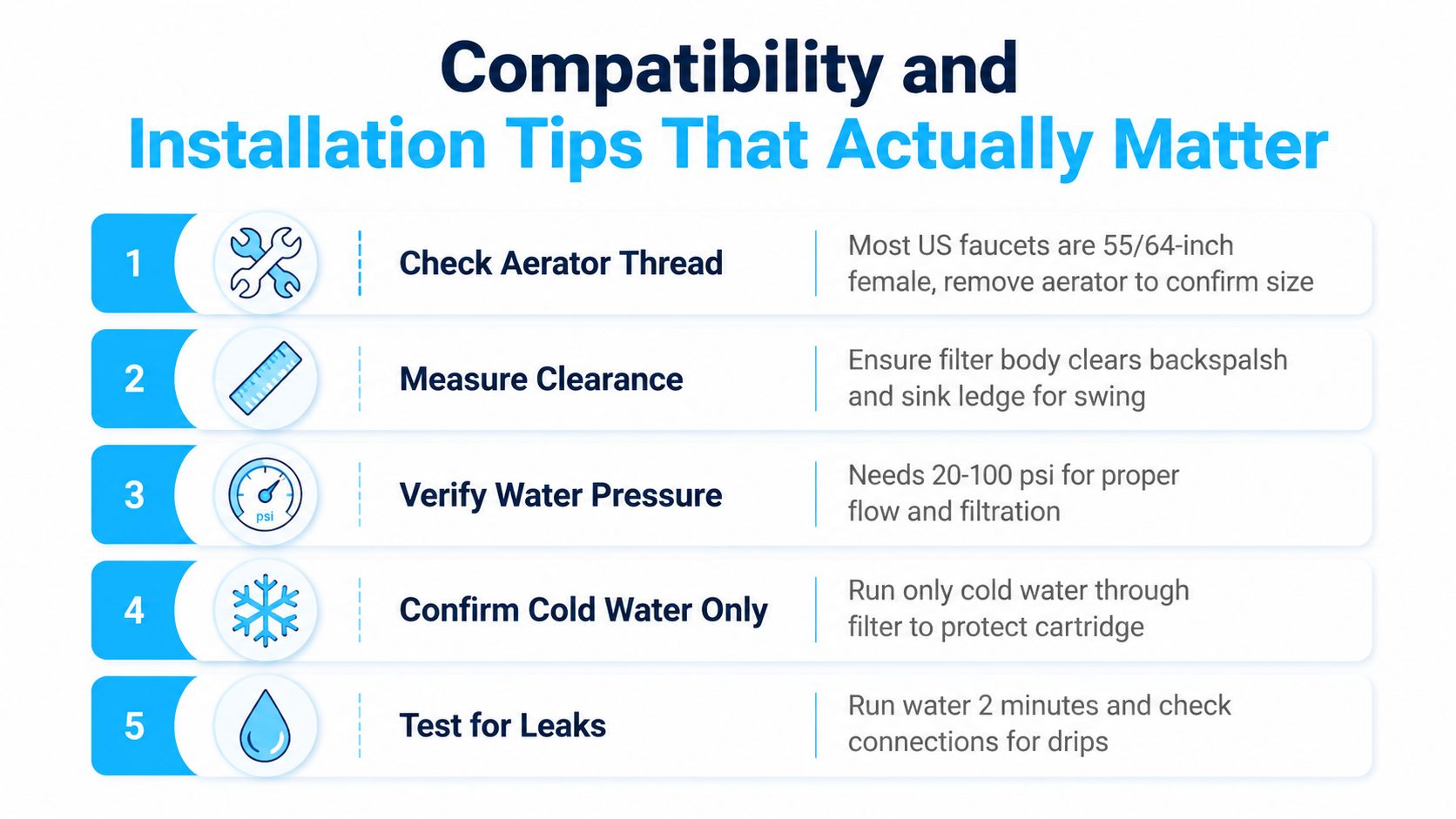
An instructional graphic detailing five important steps for installing and checking the compatibility of a faucet water filter.

A cleaner installation sequence

  1. Check the faucet: Remove the aerator, identify the thread, and confirm that the manufacturer supplies the needed adapter.
  2. Measure the space: Make sure the filter body clears the backsplash, sink ledge, and tall pots. A unit that blocks the faucet's swing will become a daily nuisance.
  3. Use cold water only: Hot water can damage the cartridge and may carry more lead from plumbing. Use the unfiltered setting for hot water.
  4. Flush the cartridge: Run the specified amount of cold water through a new cartridge before drinking it. Manufacturing dust and loose carbon fines need to leave the media bed.
  5. Inspect the bypass: If the diverter hose kinks or the selector remains in bypass, you may fill glasses with unfiltered water while assuming the filter is active.

A pull-down or sprayer faucet may leave no practical space for a mounted cartridge. In that case, consider a countertop unit with a diverter, or a dedicated drinking-water faucet connected to an under-sink system. The objective isn't to force a particular format onto an unsuitable tap. It's to preserve a clear, reliable path between the cold-water supply and the filtered glass.

Replacement Timing, Maintenance, and Simple At Home Testing

A lead cartridge has a working life, and the calendar alone doesn't define it. Capacity depends on the cartridge's rated gallons, household use, water quality, and the amount of sediment entering the media. Many faucet cartridges are rated around 100 to 150 gallons, while the plan notes for a family of four translate that into roughly two to four months of use. Treat those figures as a planning range, not permission to exceed the model's printed rating.

A drop in flow is a useful warning, but it isn't a certification test. Gray discoloration, returning chlorine taste, or visible sediment also justify inspection and replacement. If the cartridge has reached its rated capacity, replace it even if the water still tastes fine.

A simple household routine

  • At installation: Flush the new cartridge according to its instructions and record the date.
  • Each week: Wipe and clean the diverter, outlet, and visible housing. This keeps grime from entering the clean-water path.
  • Each month: Flush the unit after a long period without use, and inspect connections for leaks or buildup.
  • At the capacity limit: Replace the cartridge rather than stretching its life because flow still seems acceptable.
  • After replacement: Test again if lead is a known concern, and compare the result with the previous sample.

At-home lead kits can provide a screening signal, but they don't replace a laboratory analysis. Compare a first-draw sample with water collected after the faucet filter has been flushed and operated normally. Follow the kit instructions precisely, and use a certified laboratory when results are high, inconsistent, or important to a medical or renovation decision. For help with understanding your lead test results, focus on the sample method as well as the number.

The Water Filter Advisor advice library can also help you keep a written record of cartridge changes, test dates, and fixture locations. That record is valuable when several people use the kitchen or when a filter serves as temporary protection during plumbing work.

Cost, Cartridges, and the Real Price of Ownership

The purchase price is only the first line on the receipt. A low-cost faucet body with expensive, frequent cartridges may cost more over time than a sturdier unit with a slower replacement cycle. NSF/ANSI 53-certified cartridges generally cost more than basic taste-and-odor replacements because the manufacturer must support a specific contaminant claim and testing scope.

Consider two hypothetical buying patterns. A $30 faucet unit with $50 quarterly cartridges has a different ownership profile from a $50 unit with $30 cartridges replaced every six months. The second model may have a higher starting price but a lower recurring burden. These examples illustrate the arithmetic, not typical market pricing.

Filter Tier Unit Cost Cartridge Cost Replacements Per Year Annual Total
Basic taste and odor Varies by model Lower than certified lead cartridges Depends on use Unit plus cartridge purchases
Certified lead faucet unit Varies by model Often higher than basic replacements Based on gallon capacity Unit plus certified cartridge purchases
Higher-capacity point-of-use system Higher initial cost possible Multiple stages or higher-priced cartridges Based on rated capacity Unit, cartridges, and any adapters

A practical comparison method is to amortize the unit over three years and add the cost of four to six cartridges to estimate ownership. That formula helps expose models that look inexpensive at checkout but require frequent replacements.

Don't forget accessory costs. Non-standard faucet threads may require an adapter kit. A household may keep a pitcher available while a cartridge is being changed, and low-flow models may increase the time the tap runs, adding water use without improving lead protection.

Pay extra for verified lead-reduction certification, a clear cartridge indicator or timer, and a design that fits the tap securely. Decorative finishes, novelty mineral-infusion cartridges, and appearance upgrades don't add lead protection unless the product documentation supports a relevant certification.

Choosing the Right Faucet Water Filter for Lead

Start with the water result, not the product category. If a certified tap test shows lead above 5 ppb, treat a faucet filter as a stopgap while you investigate under-sink RO, plumbing repairs, service-line replacement, or additional laboratory testing. The 5 ppb threshold reflects the current NSF lead-reduction benchmark for certified products, not a promise that every home with a higher result can be handled safely by any faucet cartridge. See the NSF lead-reduction requirements for the test ceiling and limitations.

For a household at or below the EPA action level, the buying checklist becomes more focused:

  • Verify lead certification: Find NSF/ANSI 53 certification that specifically names lead reduction. NSF/ANSI 42 alone isn't enough.
  • Match the capacity: Choose a cartridge with a stated gallon rating, then compare it with your actual drinking and cooking habits.
  • Confirm the fit: Measure the faucet thread, check whether an adapter is included, and leave room for the filter to swing.
  • Control replacement timing: Prefer an indicator light, timer, or an easy way to record the installation date.
  • Plan for testing: Retest when plumbing changes, the cartridge reaches its limit, or the household's risk profile changes.

A slower certified flow is preferable to a fast stream that bypasses the cartridge or comes from a model with no verified lead claim. Flow rate is a comfort feature. Certification, capacity, and correct installation are performance features.

Water Filter Advisor publishes comparison and maintenance guidance for faucet, under-sink, and other household filtration formats, including certification-focused buying criteria. Use that kind of documentation to compare the exact model number, cartridge life, replacement price, and fixture compatibility rather than choosing from a broad “lead removal” label.

The final decision should fit the home's actual risk. A renter with one tested kitchen tap may need a certified faucet mount. A family with recurring high results or a damaged service line may need a more controlled under-sink system and a plumbing plan. A household facing an unusually high lead result should prioritize laboratory confirmation and professional guidance before relying on a generic faucet cartridge.


If you're comparing a faucet water filter for lead, visit Water Filter Advisor for practical guides on certifications, cartridge replacement, installation, and water testing. Use the site's comparisons to match the filter format and maintenance plan to your tap results, plumbing, and daily household use.
What Do Refrigerator Water Filters Remove: A 2026 Guide

You fill a glass from the refrigerator door, hear the ice clink, take a sip, and think, “Good. Filtered.”

That word does a lot of work in most kitchens.

For some people, “filtered” means safer. For others, it means cleaner, colder, better tasting, or somehow more trustworthy than straight tap water. And that's where the confusion starts. A refrigerator filter can absolutely improve your water, but the actual answer to what refrigerator water filters remove is narrower than most box labels and product pages make it sound.

I've spent enough time around filter media, certification sheets, and water test reports to tell you this plainly. A fridge filter is usually a specialist, not a superhero. It's often very good at handling the things that make water taste or smell off. It's usually not built to solve every water quality problem in a home.

If you've ever seen marketing that says a filter removes “70+ contaminants,” while another listing for what looks like the same style cartridge only talks about chlorine and odor, you're not imagining things. Both claims can exist in the same market, and both can be technically true for different filters. The trick is knowing how to tell which one applies to your refrigerator.

That Crisp Glass of Water From Your Fridge

A neighbor once asked me a question I hear all the time in one form or another: “If my fridge water tastes better, does that mean the filter removed the bad stuff?”

Sometimes yes. Sometimes only some of it.

That cold glass from the dispenser feels reassuring because the experience is so polished. The water is chilled. The dispenser is built into a major appliance. There's a filter hidden neatly inside the fridge, so it seems reasonable to assume serious cleanup is happening. But your refrigerator cartridge is usually designed for a fairly specific job.

What people expect

Most households expect a fridge filter to do at least three things:

  • Make water taste better by cutting the pool-like or chemical taste many city water users notice
  • Reduce odor so the water smells fresher
  • Catch visible particles such as rust or grit that can sneak in from older plumbing

Those are fair expectations. In many homes, the filter does help with exactly that.

Where the misunderstanding happens

The problem starts when “better tasting” gets confused with “broadly purified.”

A standard refrigerator filter often works like a cleanup crew for nuisance issues, not like a full treatment plant for every contaminant category. If your water already comes from a treated municipal source, that may be enough for your daily drinking water preferences. If you have a specific concern, such as lead, cysts, PFAS, well-water contamination, or microbiological risk, the answer depends on the exact filter certification, not on the fact that it lives inside a refrigerator.

A fridge filter can make water much more pleasant to drink without being a complete solution for every health-related contaminant.

That's the mindset worth keeping as you read any label, online listing, or replacement cartridge description.

What Fridge Filters Are Designed to Remove

You fill a glass from the fridge, take a sip, and it tastes cleaner than the tap. That quick improvement leads many homeowners to assume the filter is handling a long list of contaminants behind the scenes. Sometimes it is. Often, it is doing a much narrower job.

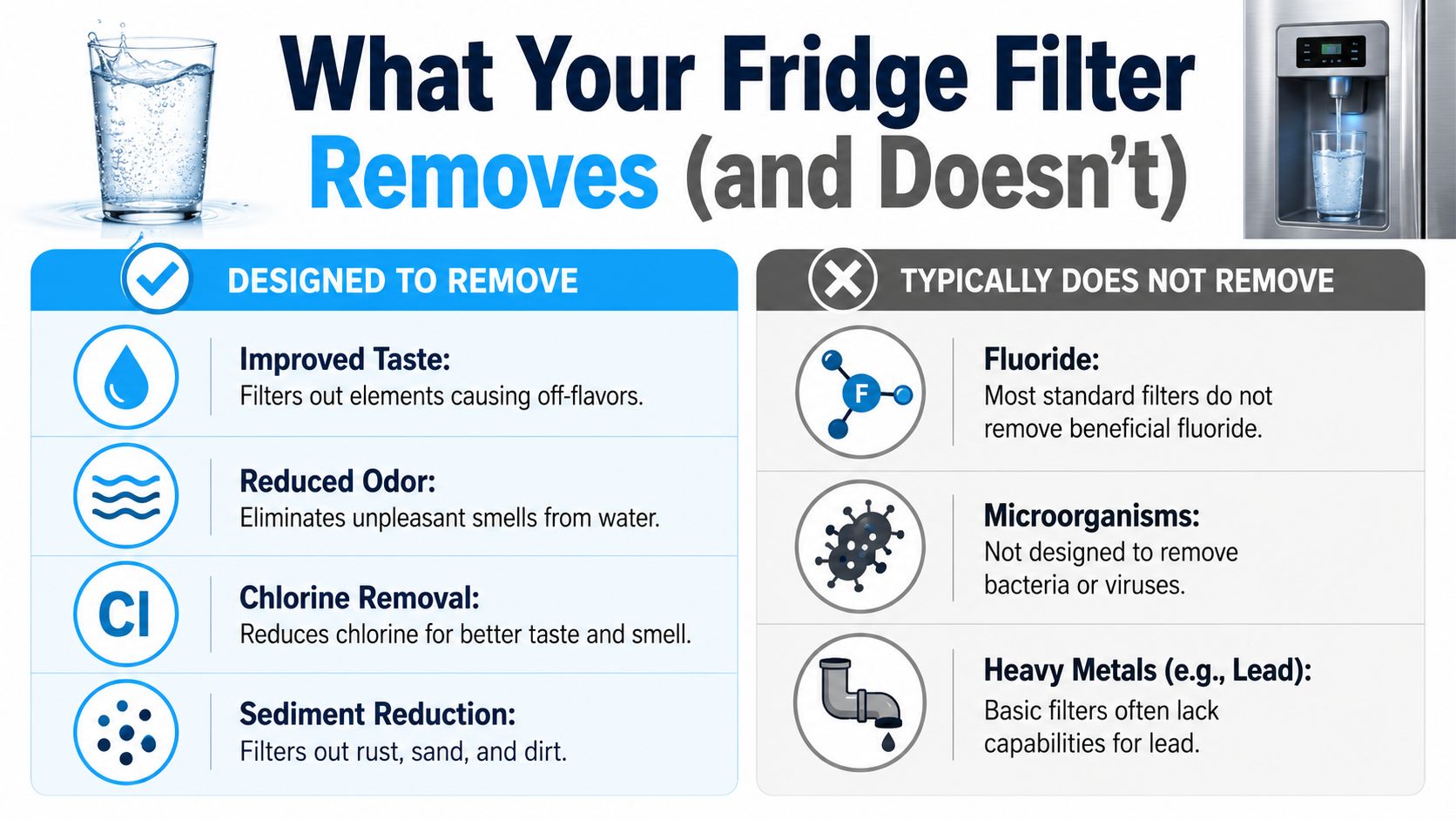
A standard refrigerator filter is usually built to improve the water you notice with your senses first. That means chlorine taste, chlorine odor, and small bits of sediment are the usual starting targets. In plain terms, many fridge filters act more like polishers than full treatment systems.

That gap matters because marketing language can blur it. A box may promise that a filter "reduces 70+ contaminants," but that claim only means something if that exact cartridge was tested and certified for those specific reductions. Two filters can look nearly identical on a shelf and do very different work once water flows through them.

What a typical fridge filter usually handles well

For many households on municipal water, a common off-the-shelf refrigerator filter is designed to reduce:

  • Chlorine taste and odor, which is why water often tastes less like a swimming pool
  • Sediment, such as tiny bits of rust, dirt, or grit from aging pipes
  • Some nuisance compounds that affect flavor, which can make water seem fresher or "crisper"

That last point trips people up. "Crisper" does not automatically mean "safer against every contaminant category." It usually means the filter removed compounds that were easy to taste or smell.

To make that easier to visualize, here's a simple comparison.

A chart showing what standard refrigerator water filters are designed to remove and what they do not remove.

Where the big claims can mislead

The broadest claims in fridge filter marketing usually combine several possible contaminant categories into one impressive headline. The fine print is what tells the true story. One model may be certified for chlorine reduction only. Another may also be certified for lead, cysts, or a short list of additional contaminants.

A good way to read those claims is to ask a simple lab-style question: What was this exact filter tested to reduce? If the product page does not clearly name the certification and the contaminant list, treat the headline as advertising, not proof.

You can see the same problem in other small-appliance filtration products. PureHQ's coffee filter guide is a helpful example of how appliance-specific filter claims can vary by design and use case. If you want a broader reference point while comparing systems, our guides for choosing home water treatment options can help you sort taste-improvement claims from health-related reduction claims.

The practical takeaway is simple. Most fridge filters are designed to make water more pleasant to drink. Some go further, but only the certification for your exact cartridge tells you whether it does.

A short visual walk-through helps here too:

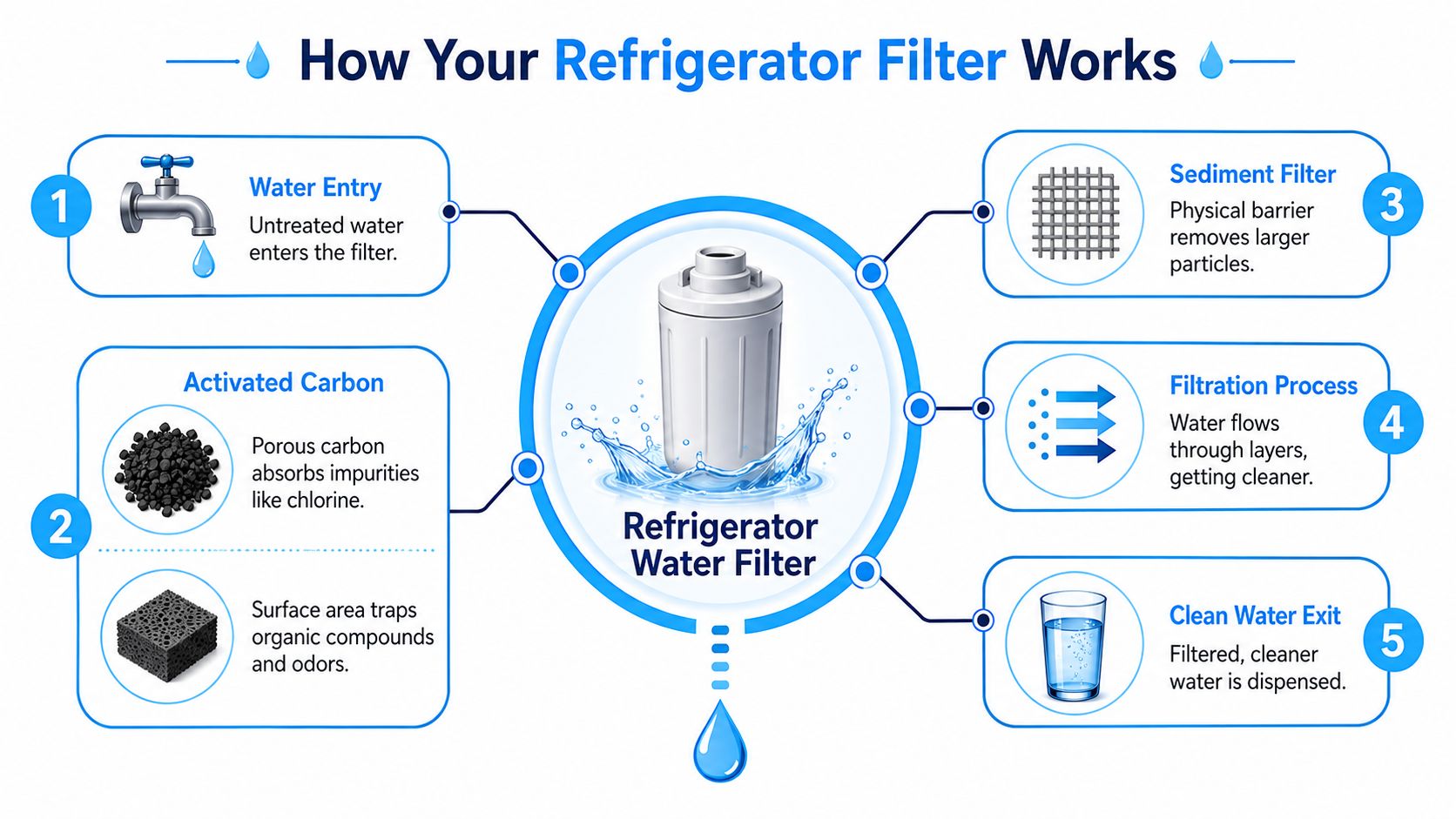
How Your Refrigerator Filter Works

Most refrigerator filters rely on activated carbon. If you sliced one open, you wouldn't find a tiny water treatment plant with a dozen advanced stages. You'd usually find a compact cartridge built around carbon and a structure that forces water through it.

Think of activated carbon as a sponge made of tunnels, pores, and hiding places. Water passes through. Certain compounds cling to the carbon surface. That sticking process is called adsorption.

The easiest way to picture it

If absorption is a towel soaking up a spill, adsorption is more like dust sticking to a strip of tape.

That distinction matters. The filter doesn't “destroy” chlorine taste compounds or magically neutralize every contaminant. It provides a huge internal surface where certain unwanted compounds can latch on while water keeps moving.

An infographic showing the five-step process of how a refrigerator water filter cleans incoming tap water.

What happens inside the cartridge

A basic refrigerator filter usually works in a sequence like this:

  1. Water enters the cartridge from your household supply line.
  2. A physical barrier catches larger particles such as sediment or rust.
  3. Activated carbon interacts with dissolved compounds that affect taste and smell.
  4. Water exits cleaner-looking and better tasting than it entered.
  5. The dispenser or ice maker receives the treated water for daily use.

Why some filters do more than others

Not all cartridges use the same media mix. Some advanced filters include materials meant to target a narrower set of contaminants beyond chlorine and sediment. That's one reason two filters with similar shapes and brand language can perform very differently.

The cartridge itself is also tiny compared with an under-sink reverse osmosis unit or a whole-house treatment system. Size matters. Contact time matters too. The less time water spends moving through the right media, the fewer opportunities the filter has to catch or reduce difficult contaminants.

Lab shortcut: When you want to understand a filter, stop looking at the plastic shell and start looking for the media type and certification sheet.

That one habit will save you from most marketing confusion.

What Most Fridge Filters Leave Behind

This is the part many shoppers need most. A fridge filter can improve your water and still leave behind contaminants you care greatly about.

That isn't a defect. It's a design limit.

The big gap between marketing and performance

Some refrigerator filter pages use broad language that makes the cartridge sound almost universal. In practice, standard fridge filters usually do not remove PFAS, viruses, bacteria, or fluoride, according to major-brand and independent explanations summarized in Whirlpool's refrigerator filter FAQ.

That gap matters because people often buy a replacement cartridge to solve a problem it was never built to address.

What standard fridge filters commonly miss

A standard filter is often not the right tool for these concerns:

  • Bacteria and viruses. Most fridge cartridges are not designed for microbiological protection.
  • PFAS. These “forever chemicals” generally call for more specialized treatment.
  • Fluoride. Standard refrigerator cartridges usually let it pass through.
  • Many difficult dissolved contaminants. Some chemicals need different media or a more intensive process.
  • Well-water safety issues. If the water source itself may be microbiologically unsafe, the fridge filter isn't your main line of defense.

For people looking at broader household treatment, this overview of the benefits of whole home water filtration is helpful because it shows how point-of-entry systems solve different problems than a single refrigerator cartridge.

Why well-water homes need extra caution

Municipal water users and well-water users are not playing the same game.

A refrigerator filter usually assumes the incoming water is already disinfected and generally safe from a microbiological standpoint. That assumption often fits treated city water. It may not fit private well water, especially if testing has flagged contamination concerns.

If your household has received a contamination advisory, if you rely on untreated or inconsistently treated well water, or if you're worried about emerging contaminants, a fridge filter may improve taste while leaving the safety question unanswered.

If your concern is “Does this water taste better?” a fridge filter may help. If your concern is “Is this water safe from difficult contaminants?” you need model-specific proof or a different treatment method.

That's the most important distinction in the whole article.

Decoding NSF Certifications for Filters

You swap in a new fridge filter, pour a cold glass, and the box says it removes dozens of contaminants. That sounds reassuring until you look closer and realize those big promises usually rest on a few small certification numbers.

Those numbers matter more than the headline.

A standard refrigerator filter is not a magic catch-all. In lab terms, it is a cartridge tested for specific reduction claims under specific conditions. If you want to know what your filter does for your family, read the certification like a test result, not like an advertisement.

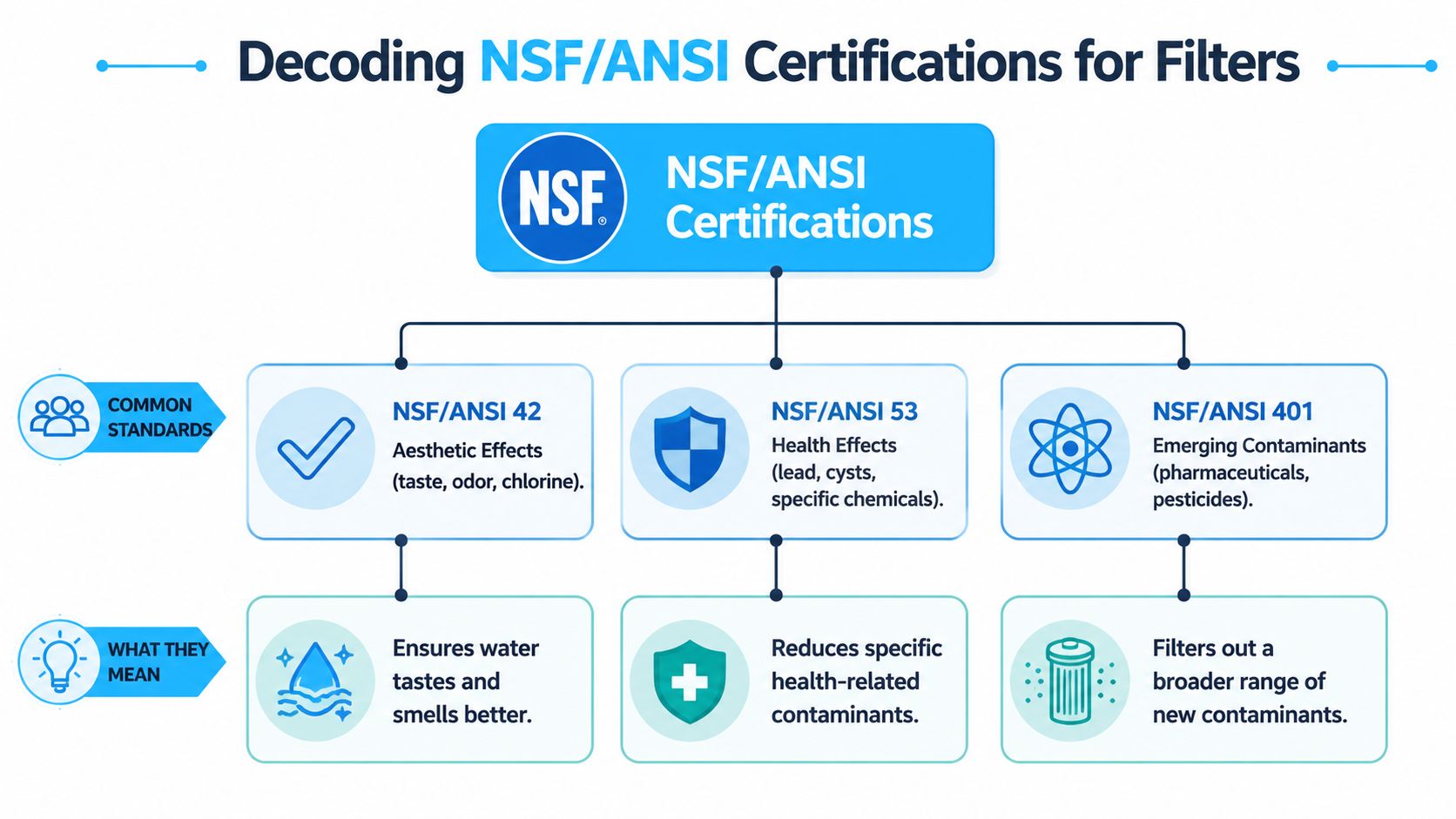
NSF 42, NSF 53, and NSF 401 in plain English

The broad idea is simple. Different NSF standards point to different kinds of claims.

  • NSF 42 usually covers aesthetic improvements, such as reducing chlorine taste and odor
  • NSF 53 covers certain health-related contaminant reductions, but only for the contaminants specifically listed for that filter
  • NSF 401 applies to some newer or "emerging" contaminants on certain models

A chart explaining NSF/ANSI certifications for water filters including standards 42, 53, and 401 and their meanings.

Here is the practical translation:

Standard What it usually tells you What that means at home
NSF 42 Aesthetic effects Better taste and smell, especially from chlorine
NSF 53 Health-related reductions The filter was tested for certain contaminants, such as lead or cysts, if those are named
NSF 401 Emerging contaminants Some filters are tested for a limited list of newer contaminant categories

The part that confuses shoppers

A filter can say NSF 53 certified and still not be certified for every health-related contaminant people worry about.

That is the gap between marketing and reality.

Manufacturers often spotlight the category because it sounds broad. The actual certification is narrower. It works like a student report card. Seeing "science" on the report does not tell you whether the student studied chemistry, biology, or physics. In the same way, seeing "NSF 53" does not tell you which contaminants were reduced unless the package or product sheet names them.

So if your concern is lead, look for lead. If your concern is cysts, look for cysts. If the contaminant is not named, do not assume the filter handles it.

A simple way to read the box

When you are standing in a store aisle or comparing filters online, check the label in this order:

  1. Find the NSF standard number. This tells you the type of claim being made.
  2. Find the contaminant list. This tells you what that specific filter was tested to reduce.
  3. Match the list to your concern. A good filter for chlorine taste is not automatically a good filter for lead.
  4. Check the exact model compatibility. A cartridge has to fit and seal correctly to do its job.

One more detail matters. Some boxes use phrases like "tested to NSF standards" or "made with NSF-certified materials." Those phrases are weaker than a clear statement that the finished filter is certified for named contaminant reductions.

Plain rule: Treat NSF numbers as the table of contents. Treat the named contaminants as the real answer.

That small shift in how you read the label helps you sort out a realistic fridge filter from one that only sounds impressive.

How to Read Filter Claims and Avoid Scams

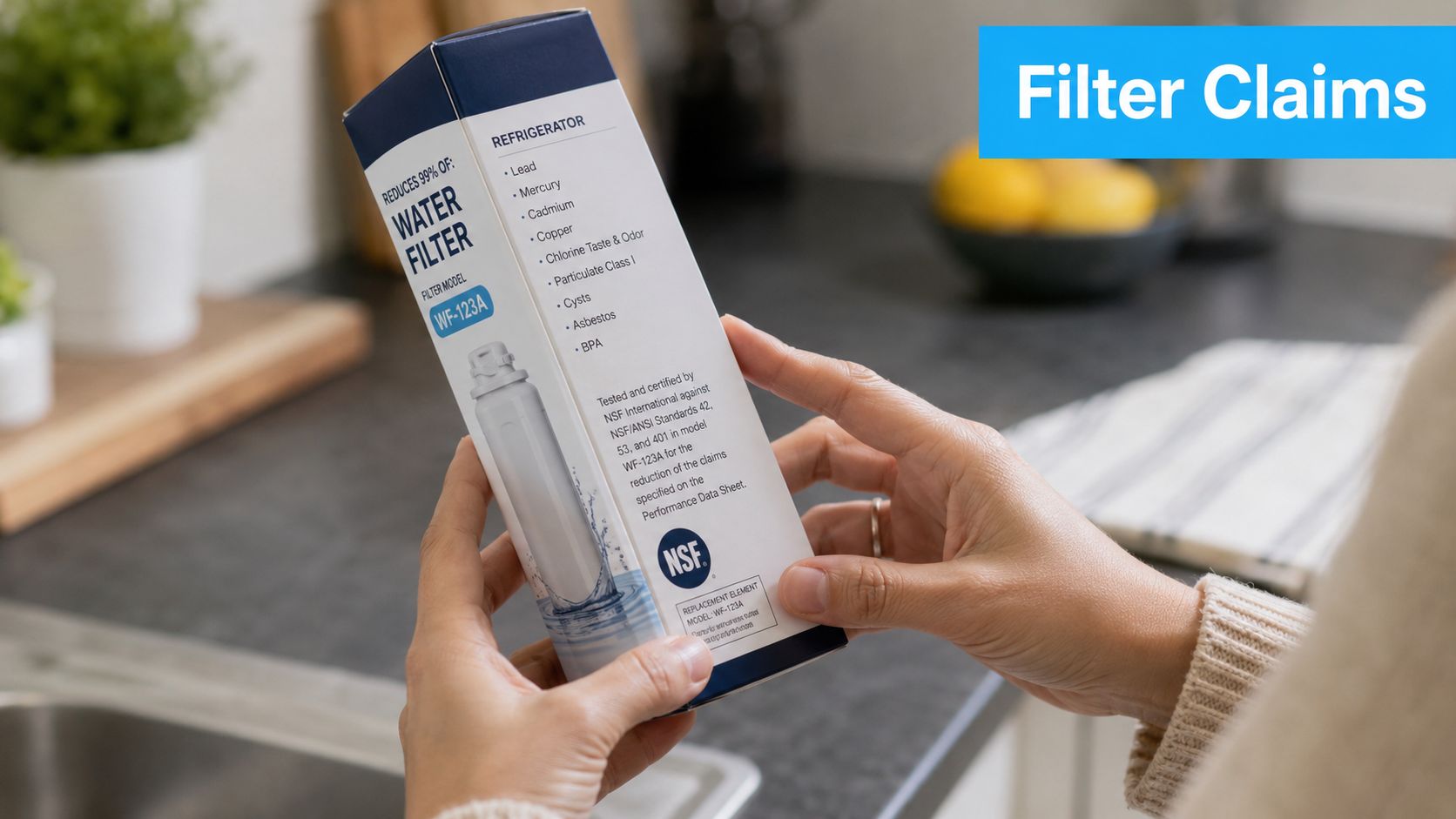
Filter packaging often mixes useful facts with fluffy language. The safest move is to treat every claim like a label on a toolbox. You want to know exactly what tool it is, exactly what job it does, and exactly what job it does not do.

A person holding a water filter box detailing the contaminants it removes from refrigerator water.

What a trustworthy claim looks like

A reliable listing usually includes these details:

  • Specific certification language instead of vague promises
  • Named contaminants rather than “impurities” or “harmful substances”
  • Exact refrigerator compatibility so you know the cartridge fits and seals correctly
  • Brand transparency about whether it's an original manufacturer part or a third-party replacement

What should make you pause

Be careful when a product page leans on phrases like these:

  • “Removes contaminants” with no certification shown
  • “Comparable to major brands” without naming tested standards
  • “Advanced coconut carbon technology” with no actual reduction list
  • Very low-price listings from unclear sellers where packaging, model numbers, or photos look inconsistent

Counterfeit and poorly documented replacement filters are a real concern because the cartridge can look convincing while giving you little proof of performance.

A quick gut check helps. If a listing sounds sweeping but avoids naming standards, named contaminants, and compatible refrigerator models, keep scrolling.

Why and When to Change Your Refrigerator Filter

A refrigerator filter isn't a permanent part. It's a consumable. Once the media is used up or the cartridge has sat wet for too long, performance drops.

Two things happen as a filter ages. First, it can lose its ability to hold the compounds it was meant to reduce. Second, buildup inside the cartridge can restrict flow or create pathways where water doesn't interact with the media as evenly as it should.

Replacement is about performance, not just reminders

People often treat the change light like a gentle suggestion. It's better to think of it as a maintenance warning.

Change your fridge filter when the manufacturer says to, and sooner if your water flow drops, your ice tastes off, or the water develops the same smell the filter used to remove. An old carbon cartridge can stop improving the water in any meaningful way, and a damp, neglected filter is not something you want to keep in service indefinitely.

If your household uses a lot of dispenser water or if your incoming water carries more sediment than average, the filter may wear out faster in practical terms, even before the reminder becomes impossible to ignore.

Frequently Asked Questions About Fridge Filters

Can a refrigerator filter make unsafe water safe to drink

Usually, no. A standard fridge filter is not a universal safety device. If the concern is bacteria, viruses, PFAS, or another difficult contaminant, you need a filter specifically certified for that concern or a different treatment system.

If my water tastes fine, do I still need the filter

That depends on why you're using it. Some people want better ice quality and less chlorine taste. Others are trying to reduce a specific contaminant. Taste alone doesn't tell you what is or isn't in the water.

Is an original brand filter always better than a third-party one

Not automatically. What matters is fit, certification, and trustworthy documentation. A third-party filter can be a reasonable choice if it clearly lists the right certifications and matches your refrigerator model correctly.

Will a fridge filter help if I already have a whole-house system

It can. A whole-house system and a fridge filter do different jobs. Some homes use whole-house filtration to treat the supply broadly, then rely on the fridge cartridge for final taste improvement at the dispenser.

Why does my filtered water still leave mineral spots

Because a standard refrigerator filter usually isn't built to remove the minerals that cause spotting or hardness residue. If spotting is your main complaint, you may be dealing with a different water treatment issue than what the fridge cartridge was designed to fix.

What's the smartest way to answer what refrigerator water filters remove for my home

Look up your exact filter model and read its certification sheet. That's the most reliable answer. Not the brand family, not the refrigerator ad, and not a generic marketplace bullet list.


If you want help comparing filter types, understanding certifications, or figuring out whether your home needs a refrigerator filter, under-sink system, or broader treatment, Water Filter Advisor is a useful place to start. It breaks down filtration options in plain language so you can make a decision based on your actual water concerns, not marketing shortcuts.

2026 Faucet Water Filter Reviews: The Ultimate Home Guide

Tired of tap water that tastes like it came from a swimming pool or smells a bit… funky? A faucet-mounted filter is one of the fastest, cheapest ways to get delicious, clean water right from your kitchen sink. Our faucet water filter reviews are diving deep into what really matters: what junk they pull out, if they're certified to do it, what they'll cost you long-term, and how they survive the chaos of a busy kitchen.

Your Guide to Choosing the Best Faucet Filter

A modern kitchen with a shiny chrome faucet over a double sink and a plant on the windowsill.

Picking the right faucet filter shouldn't feel like a high-stakes guessing game. It all boils down to a few key factors. This guide is designed to help you see past the flashy packaging and pick a filter based on what it actually does. The mission is simple: get clean, great-tasting water straight from your tap, without the hassle and plastic waste of bottled water.

These nifty gadgets attach directly to your kitchen faucet, giving you purified water with a simple flick of a switch. It's why they're a smash hit in homes and apartments alike. They are engineered to tackle the common water quality gremlins that sabotage both the safety and taste of your H2O.

What Really Matters in a Faucet Filter

Before we start naming names, let's talk about what separates a champion filter from a dud. We've zeroed in on the most critical things to look for.

  • Contaminant Removal: This is the filter's whole reason for being. The best models are certified to yank out villains like lead, chlorine, mercury, and even some pesticides.
  • Certifications: Always, always look for NSF/ANSI certifications. These are independent, third-party tests that prove a filter walks the walk, not just talks the talk.
  • Long-Term Cost: The price on the box is just the cover charge. The real cost of admission is the price of replacement cartridges and how long they last.
  • Flow Rate and Usability: A filter shouldn't slow your water to a sad trickle. It also needs to be a breeze to install and simple enough for daily use without a second thought.

When you focus on these pillars, you can tune out the marketing noise and find a filter that delivers real value and confidence in every glass.

A filter's true worth isn't just in the water it provides, but in the contaminants it removes. Independent certifications like NSF/ANSI 53 for lead reduction are your best guarantee of safety and performance.

We’ll use these core principles to pit the top filters on the market against each other. The table below gives you a quick snapshot of how different filter types stack up.

Feature Faucet Filters Water Pitchers Under-Sink Systems
Convenience Instant access Requires filling/waiting Instant access
Installation Simple, no tools None More complex
Cost Low initial cost Very low initial cost Higher initial cost
Filter Lifespan ~100 gallons ~40 gallons ~500+ gallons

Why Faucet Filters Are an Essential Home Upgrade

Turning on your tap should be a simple act of trust. You expect clean, safe water. But with aging city pipes and a growing list of "what-ifs," that trust has eroded for many of us. This is why home water filtration is exploding in popularity—it’s not just about better taste, it's about taking back control.

A great faucet filter is your personal bodyguard for your water, right where you need it most. It’s an instant, effective solution for common tap water woes, from that chlorinated pool taste to more serious, invisible threats.

The Hidden Risks in Your Tap Water

Just because your water looks crystal clear doesn't mean it's pure. That water quality report from your city is a snapshot taken at the treatment plant, miles away. It says nothing about the nasty hitchhikers your water can pick up on its journey through pipes—some of which are older than your grandparents—to your kitchen.

A faucet filter is built to battle these very issues:

  • Lead: A serious health risk, especially for kids, that often leaches from old pipes and plumbing fixtures.
  • Chlorine: It’s used to disinfect our water, but it leaves behind an unpleasant chemical taste and smell.
  • Trihalomethanes (TTHMs): These are nasty byproducts that form when chlorine parties with organic matter in the water, and they carry potential health risks.
  • Sediment and Particulates: Little bits of rust, sand, and other gunk that can make water cloudy and taste "earthy."

A reliable filter gives you direct authority over what ends up in your glass, serving up peace of mind every time you hydrate.

The real value of a faucet filter is simple: it instantly turns uncertain tap water into a source of clean, trustworthy hydration. It's a small change that makes a huge difference in your health and daily routine.

Smart Economics and Environmental Impact

The case for faucet filters goes way beyond health. Financially and environmentally, it’s a slam dunk. One filter cartridge can replace hundreds—sometimes thousands—of single-use plastic water bottles. You’re not just slashing your plastic waste; you’re saving a boatload of money over time. The cost per gallon for filtered tap water is a tiny fraction of what you'd shell out for bottled water.

This shift to filtering at the tap is a full-blown movement. The market for filtered water systems was valued at USD 12.72 billion in 2023 and is projected to skyrocket to USD 25.2 billion by 2032. It’s proof that households are choosing filtration to cut costs and waste. If you're a data nerd, you can dive into the full filtered water faucets market analysis to see the numbers. It confirms that making the switch is a smart and popular decision.

Understanding Filter Certifications and Performance

When you're shopping for faucet filters, you'll be bombarded with claims. But how do you separate marketing magic from real-world muscle? The answer is certifications—the independent, third-party proof that a filter actually does what it claims.

Trying to decode water filtration can feel a bit like science class, but mastering these certifications is the single most important thing you can do. Without them, you're just crossing your fingers and hoping for the best.

Decoding the NSF/ANSI Standards

The most important certifications come from NSF International. When a filter is NSF certified, it means it has been put through a grueling, standardized wringer to prove it removes the specific contaminants the company claims it does.

For faucet filters, you really only need to know about two key standards:

  • NSF/ANSI 42 (Aesthetic Effects): This one is all about taste and smell. If your main gripe is that your tap water has a pungent chlorine aroma, a filter certified to Standard 42 is your champion.
  • NSF/ANSI 53 (Health Effects): This is the heavyweight champion of health and safety. Filters with this certification are proven to reduce specific health-related contaminants like lead, mercury, asbestos, cysts (like Giardia), and certain chemicals (VOCs).

A filter can be certified for one or both. If a filter is certified to Standard 53 for lead, for example, it has been scientifically proven to remove a specific amount of lead, giving you verifiable protection.

When you pick a filter certified to NSF/ANSI 53, you're not just buying a product. You're getting a scientifically proven safeguard for your family's health. It's the only way to be certain that dangerous contaminants like lead are actually being removed from your water.

Why Certification Is Non-Negotiable

Any company can slap "reduces lead" on a box, but without that NSF/ANSI 53 certification, it's just empty words. Certification means the company is held accountable. It proves the entire system—the filter media, the housing, everything—works in harmony to get the job done right, from the first glass to the last.

This is exactly why savvy shoppers now make certification their top priority. The game has changed.

A recent survey revealed that 92% of buyers now look for independently certified filters before making a purchase. People want proof, especially when it comes to specific contaminants. The best models, for example, demonstrate up to 99.3% lead reduction—and not surprisingly, those are the same filters that score the highest for taste improvement. You can see how this has become a massive factor for shoppers by checking out the latest water filter market trends.

Ultimately, these standards put the power in your hands. They let you look right past the slick ads and focus on what really counts: proven, data-backed performance. By checking for those NSF/ANSI certifications, you can be sure your faucet filter is a true tool for cleaner, safer water.

Detailed Faucet Water Filter Comparison for 2026

Alright, let's get to the main event: our faucet water filter reviews. Forget the marketing hype. We're running the top models through a real-world gauntlet to see how they stack up head-to-head. We’re judging them on what actually matters in your kitchen: contaminant removal, true cost over time, water flow, and the all-important taste test.

Our mission here is to lay out the pros and cons for each filter, plain and simple. This will help you see past the feature lists and find the perfect match for your sink, your family, and your wallet.

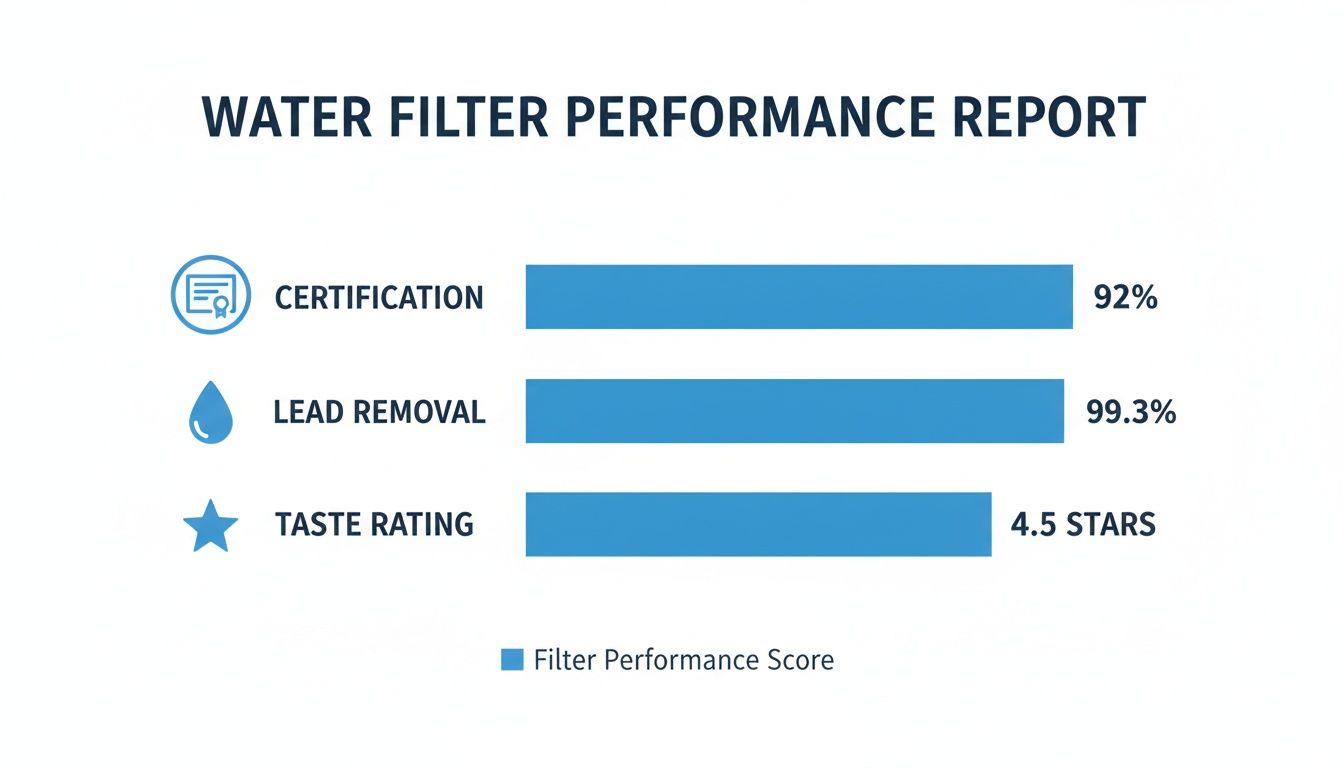
This chart breaks down the key performance data that separates a good filter from a great one. We're looking at certifications, lead removal capability, and how users rate the final taste.

A bar chart displaying a water filter performance report, showing certification, lead removal, and taste rating.

As you can see, the top performers don't just talk a big game—they deliver outstanding lead removal and earn high marks on taste, all backed by independent certification.

To give you a clearer picture, this table provides a side-by-side look at how leading faucet filters compare on the metrics that define performance and long-term value.

Faucet Water Filter Head-to-Head Comparison

Model Key Certifications Removes Lead? Filter Lifespan (Gallons) Average Cost Per Gallon Best For
Model A NSF/ANSI 42 No 100 $0.20 Basic taste and odor improvement
Model B NSF/ANSI 42 & 53 Yes, >99% 100 $0.28 Health protection, families with children
Model C NSF/ANSI 42, 53, 401 Yes, >99% 120 $0.25 Comprehensive removal of emerging contaminants
Model D NSF/ANSI 42 No 200 $0.15 Budget-conscious users focused on chlorine

This comparison highlights the critical trade-offs. While some models boast a lower cost per gallon, they often sacrifice the power to remove dangerous contaminants like lead. For true peace of mind, investing in a filter with NSF/ANSI 53 certification is the only way to go.

Contaminant Removal Efficacy

First things first: a water filter's primary mission is to make your tap water safer. When you're comparing faucet filters, nothing is more important than what they take out of your water. We always hunt for NSF/ANSI 53 certification first, as this is the standard that covers health-related baddies like lead, mercury, and cysts.

Let's see how two different types of filters handle this job:

  • Model A (Basic Filtration): This filter is certified to NSF/ANSI 42. That means it does a bang-up job removing chlorine, the main culprit behind water that tastes and smells like a swimming pool. If that's your only issue, it's a solid choice. But it won't touch lead or other heavy metals.
  • Model B (Advanced Filtration): This is the one you want for real protection. It carries both NSF/ANSI 42 and 53 certifications. It banishes chlorine just like the other model, but it's also proven to reduce lead by over 99%, along with other nasty stuff. If you live in a home with older plumbing or have young kids, this level of filtration isn't a luxury—it's essential.

The bottom line is simple. For better-tasting water, Model A works. For safer water, Model B is the only choice.

Real-world impact is everything. A filter that only makes water taste better without removing harmful contaminants is a job half-done. Prioritizing NSF/ANSI 53 certification for lead is the most critical step you can take to protect your family's health.

Filter Lifespan and Long-Term Cost

Don't be fooled by a low sticker price. The true cost of a faucet filter is all about the replacement cartridges—how much they cost and how often you have to buy them. A cheap filter can easily become a money pit if its cartridges are expensive and don't last.

Let's do some quick kitchen-table math on the cost per gallon:

  • Filter System X: The unit costs $30 upfront and includes one filter that lasts for 100 gallons. A replacement cartridge costs $20. If you use 300 gallons in a year, your cost per gallon is about $0.23.
  • Filter System Y: This one is $50 upfront. The replacement cartridges come in a two-pack for $45, and each one is good for 100 gallons. For that same 300 gallons of use, your cost per gallon jumps to around $0.32.

A $0.09 difference per gallon might not sound like much, but it adds up fast. For a family of four, that could be an extra $50-$60 a year. Always calculate the long-term cost. Sometimes, paying a little more upfront saves you a lot more down the road.

Impact on Water Flow

One of the biggest gripes about faucet filters is a drop in water pressure. Nobody has time to wait forever just to fill a pot of pasta water. The flow rate, measured in gallons per minute (GPM), is the spec you need to watch. Your regular unfiltered faucet likely runs around 2.2 GPM.

A decent faucet filter should give you a flow rate of at least 1.0 to 1.5 GPM when you're using it. But keep in mind, that number will change over the life of the filter.

As a filter cartridge fills up with sediment and contaminants, it naturally starts to clog, and the water flow will slow down. This isn't a defect; it's a sign that the filter did its job and it's time for a new one. Some of the better-designed models manage this slowdown more gracefully, holding a steady flow for longer.

When you're reading faucet water filter reviews, look for comments about the flow rate after a month or two. That gives you a much more honest picture of daily performance than the "brand-new" specs on the box.

Real-World Taste and Odor Improvement

Certifications tell you what a filter removes, but the ultimate proof is in the glass. Does the water actually taste and smell better? We've found that the answer often depends on the quality of the activated carbon inside the filter. For instance, many people find that filters using coconut shell carbon produce a crisper, cleaner taste than those with standard carbon blocks.

Think about these real-world scenarios:

  1. The Coffee Enthusiast: If you're serious about your coffee, you know water quality is everything. Tap water loaded with chlorine can make even the best beans taste bitter and "off." A filter that’s a beast at chlorine removal (NSF/ANSI 42) can completely transform your morning brew, letting the coffee's true flavors sing.
  2. The City Dweller: Living in an old building often means dealing with water that has a funky, metallic, or musty taste from aging pipes. A comprehensive filter (NSF/ANSI 53) doesn't just fix the taste—it gives you the confidence of knowing you're also removing lead and other junk from those old pipes.

Taste is subjective, but it’s a huge deal. The filters that consistently get 4.5-star ratings or higher for taste are almost always the ones using higher-grade materials. It proves that not all carbon is created equal, and it's what separates water that's just "fine" from water that tastes genuinely great.

Our Top Picks for Every Household and Budget

After all the testing and research, one thing is crystal clear: there's no single "best" faucet filter for everyone. The right one for you depends on your water, your home, and what you care about most. Our faucet water filter reviews are all about matching the right filter to the right problem.

Instead of a generic top-ten list, we've broken down our top picks by the real-world situations they solve. Whether you're a parent worried about old pipes or a renter just trying to get better-tasting water on a budget, we'll point you to the filter that gets the job done.

Best for Families Concerned with Lead

If you have young children or live in a home built before the 1980s, lead safety is non-negotiable. Your first and only priority should be a filter certified to NSF/ANSI 53 for lead reduction. These are the only models proven to remove over 99% of lead, creating an essential firewall between your plumbing and your family.

The model we recommend for this job also happens to be a fantastic all-around filter. It nails the critical lead protection while also doing an excellent job on chlorine, so your water is both safer and tastes noticeably better. Yes, the upfront cost and replacement filters are a bit more, but the peace of mind is priceless.

For families, choosing a filter with an NSF/ANSI 53 certification for lead isn't just a bonus feature—it's the entire reason to buy one.

Best Budget-Friendly Option for Renters

When you're renting, you need a simple, affordable fix that won't require a call to the landlord. The best choice for a renter is a filter that snaps on in seconds, has a low cost per gallon, and targets the number one complaint about city water: chlorine.

Our top pick for renters fits the bill perfectly. It's certified to NSF/ANSI 42, your guarantee that it will dramatically improve the taste and smell of your water. The replacement filters are cheap and easy to find, bringing the cost down to just pennies per gallon. It’s the smartest, easiest upgrade you can make to a rental kitchen.

Best for Superior Taste and Odor Removal

Are you the person who can taste the difference in your coffee or tea depending on the water? If your main goal is absolutely pristine flavor, you need a filter that goes beyond basic chlorine removal. The top-tier filters for taste usually rely on high-grade activated carbon, like coconut shell carbon, which is incredibly porous and grabs all sorts of compounds that make water taste "off."

Our choice for the taste purist stands out for a reason. It holds both NSF/ANSI 42 and 53 certifications, but what really matters is what people say about the water it produces: exceptionally crisp and clean. Coffee tastes richer, tea is brighter, and a simple glass of water is genuinely refreshing. This filter proves that the quality of the filter media is just as important as the certifications on the box.

Most Durable Long-Term Investment

For homeowners who just want a reliable filter that lasts, durability is king. You need a unit that can handle the daily chaos of a busy kitchen without cracking or springing a leak. The best long-term picks almost always have stainless steel components and a much tougher filter housing.

Our pick for durability is built like a tank. It might have a higher price tag upfront, but its solid construction will save you from the hassle and hidden cost of replacing leaky plastic models every year or two. These tougher filters often come with a longer warranty, too, which shows the manufacturer stands behind their build quality.

Installation and Maintenance Made Simple

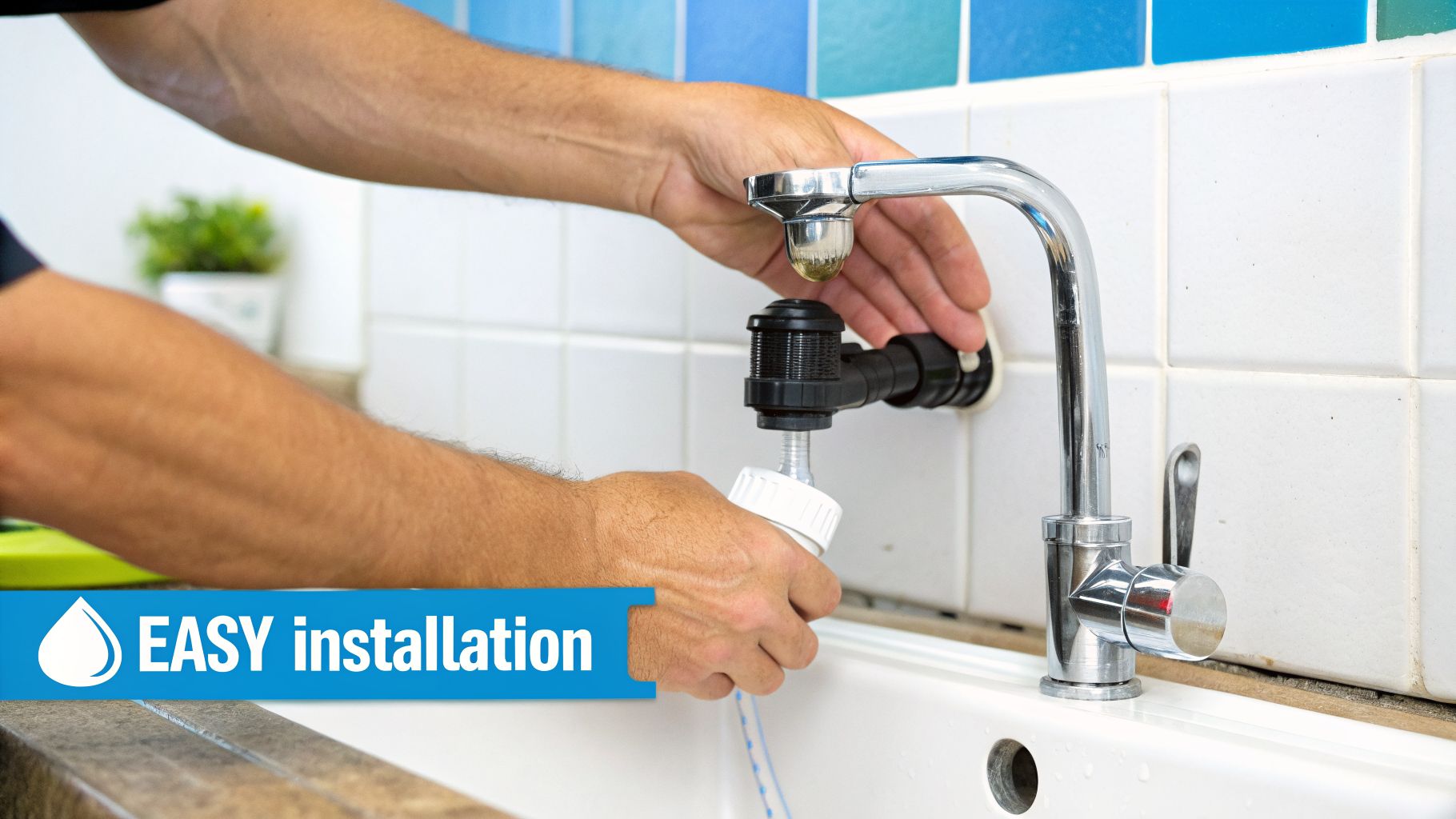
Close-up of hands installing a new water filter system onto a modern kitchen faucet over a white sink.

Let's be honest, a huge part of the appeal of faucet filters is how ridiculously simple they are. You shouldn't have to hire a plumber or break out a toolbox just to get clean water. In most cases, you can have one of these installed and running in just a few minutes.

The key is getting that installation right from the start. A good seal means no leaks and ensures every drop of water is forced through the filter media as intended.

Most faucet filters today use a simple twist-on design. Your kit will include a few different adapters to fit the threads on your kitchen faucet. Just find the one that matches, screw it on, and then attach the main filter unit. A firm hand-tight twist is usually all it takes.

If you notice any drips from your faucet's original hardware during this process, it might be a good time to learn how to fix a leaky faucet. A solid, leak-free fixture is the foundation for a properly working filter.

Your Long-Term Maintenance Checklist

Keeping your filter working at its best is incredibly straightforward. A little routine maintenance goes a long way.

  • When to Change the Cartridge: That little indicator light is just a timer. The real signal is your water flow. As the filter fills up with trapped gunk, the flow rate will drop. When you notice a real slowdown, it’s time for a new cartridge.

  • Clean the Housing: Every time you swap out the cartridge, take a minute to wipe the inside and outside of the plastic housing with a damp cloth. This prevents any grime or mineral scale from building up.

  • Maximize Filter Life: If you have hard water or a lot of sediment, your filter is working overtime. A simple trick is to run the tap on the unfiltered setting for a few seconds first. This can flush out larger particles before you switch over to the filtered stream, giving your cartridge a little more life.

A filter's performance and lifespan are directly tied to your local water quality. If your tap water has high levels of sediment or total dissolved solids (TDS), it can clog a cartridge in under two months, no matter what the box says.

Knowing how your local water affects your filter is crucial. We're seeing a shift towards smarter filters that help with this. In some areas, connected filters that send replacement reminders have helped people achieve 90% on-time cartridge changes. In those same homes, lead exposure has plummeted by an incredible 80%.

For more hands-on tips to keep your home's water systems running smoothly, head over to our complete guide on water filter advice.

Common Questions About Faucet Filters

Even after digging through reviews and comparing models, you probably still have a few practical questions. It's totally normal. Let's clear up the most common concerns so you can buy with total confidence.

Will This Thing Actually Fit My Faucet?

This is the number one worry we hear, but it's rarely a problem. Faucet filters are designed to work with the vast majority of standard kitchen faucets. The easiest way to check is to simply unscrew the little screen at the tip of your faucet (that’s the aerator) and look at the threads.

Your new filter will come with a small bag of multiple adapters. These are little threaded rings that bridge the gap between your faucet and the filter mount. Whether your faucet has threads on the outside (male) or inside (female), one of those adapters will almost certainly give you a tight, leak-free seal. Just know that these are not designed for pull-out, pull-down, or sprayer-style faucets.

Is My Water Pressure Going to Drop?

Yes, and that's actually a good thing. When you switch to the filtered stream, you'll see a slower flow. This is on purpose. A slower flow rate gives the water more "contact time" with the filter media inside, which is crucial for grabbing contaminants. Don't worry, it should be a steady, usable stream—not a frustrating drip.

Think of a slow flow rate as proof your filter is doing its job. When the water starts getting too slow, it's not broken. It means the filter has trapped so many impurities that it's full and ready to be replaced.

Are Faucet Filters Better Than a Pitcher?

"Better" really depends on your lifestyle and what you need. Each one has its own clear advantages.

  • Faucet Filters: The big win here is convenience. You get filtered water instantly, right from the tap. No waiting. They also last longer, typically filtering around 100 gallons before needing a change.
  • Water Filter Pitchers: These are great for their simplicity and portability. No installation needed, and you can keep one in the fridge for cold, filtered water. They're a solid choice for one person or if you don't use a ton of filtered water. Pitcher filters usually last for about 40 gallons.

For a busy family or anyone who does a lot of cooking with filtered water, a faucet filter is almost always the more practical and life-changing pick.


At Water Filter Advisor, we're here to give you the straight facts you need to choose the right water filter for your home. You can find more expert guides and reviews over at our main site, https://www.waterfilteradvisor.com.