You fill a glass at the kitchen sink, take a sip, and notice something slightly metallic. The water looks clear, but that doesn't answer the question that suddenly matters: what else is in the glass?
A drinking water contaminant can be a microbe, a dissolved metal, a chemical left behind after disinfection, or a compound that traveled from soil into groundwater. It can enter through a municipal supply, a private well, or the pipes inside your own home. The practical answer isn't to panic or buy the most complicated filter on the shelf. It's to identify the source, consider who needs protection, and match the treatment to the actual problem.
The Glass of Water You Never Think Twice About
Tap water is trusted until a small detail interrupts the routine. Maybe the water has a faint metallic flavor after sitting overnight. Maybe a glass smells like a swimming pool, leaves a cloudy film on the kettle, or tastes different after nearby plumbing work. Those clues don't prove that a drinking water contaminant is present, but they're reasonable reasons to investigate.
Water safety is also bigger than taste and odor. The World Health Organization explains that, in 2022, 6 billion people used safely managed drinking-water services, while 2.2 billion people still did not. Among those without safely managed services, 1.5 billion had basic services, 292 million relied on limited services, and 296 million collected water from unprotected wells and springs. The same source links contaminated drinking water to about 485,000 diarrhoeal deaths each year, showing that contamination is a public-health concern, not merely a question of whether water tastes pleasant.
For a household, “contaminant” doesn't mean one scary chemical. It includes microbial contamination, pollution at the water source, and problems created during distribution, storage, or contact with plumbing. A municipal treatment plant may make source water safe, yet water can still pick up lead from a service line or faucet fitting before it reaches your glass.
Treat your plumbing like a shared mailbox
Think of the water system as a neighborhood mailbox. The utility, the street pipes, your service line, the house plumbing, and the faucet all contribute to what arrives. You don't control every message placed in that box, but you can inspect your part of the delivery route and add treatment where it makes sense.
Three questions keep the process manageable:
- What is present? Start with a consumer confidence report for municipal water or a properly selected test for a private well.
- Who needs the most protection? Infants, pregnant people, immunocompromised adults, and people with kidney problems may require more careful decisions.
- Which technology solves that contaminant? A carbon filter behaves like a sponge for some chemicals, while reverse osmosis works more like a very fine barrier. Neither is automatically right for every problem.
You don't need to know chemistry before you begin. You only need to avoid treating every filter as a universal solution.
What Counts as a Drinking Water Contaminant
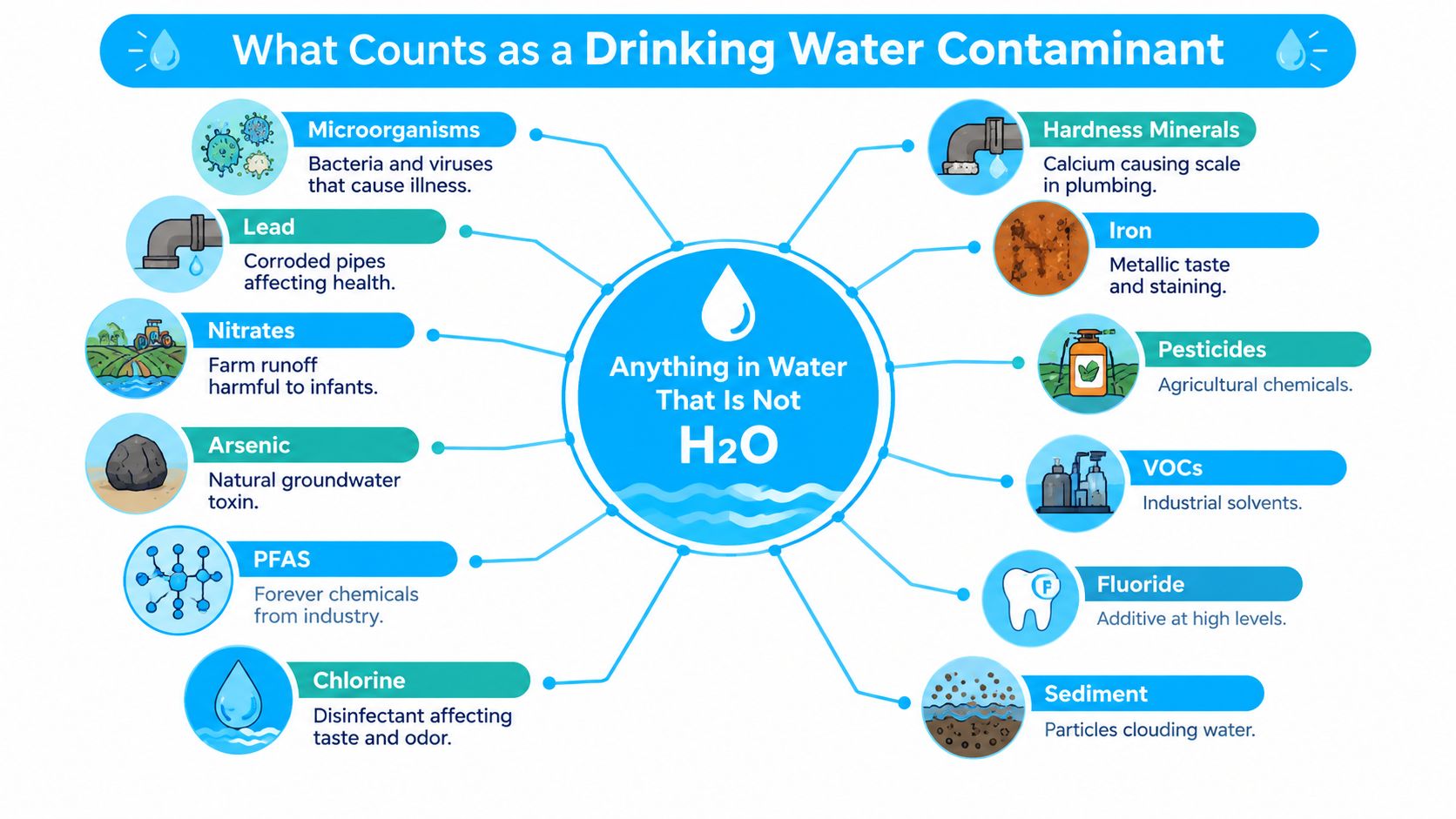
A drinking water contaminant is anything in water besides H2O that can affect health, taste, odor, or plumbing. The word doesn't automatically mean “dangerous.” Risk depends on the substance, its concentration, how long exposure continues, and the sensitivity of the person drinking it.
A useful way to sort the possibilities is to think of contaminants as different kinds of unwanted neighbors.
Heavy-metal neighbors
Lead can enter through aging service lines, solder, brass, and fixtures. The EPA says the maximum contaminant level goal for lead is zero, because there's no safe level of exposure. Children are especially vulnerable to developmental effects, while adults can experience kidney or blood-pressure impacts. Lead is mainly a plumbing concern in municipal systems, although well water can also contact lead-containing household components.
Arsenic often comes from natural rock and groundwater. Long-term exposure can harm health, making it especially important for private-well owners and communities whose water source has naturally higher levels. Iron is more commonly a taste, staining, and plumbing nuisance, though it can signal a water chemistry problem that deserves testing.
Chemical byproducts
Chlorine and chloramine protect municipal supplies from microbes, but they can affect taste and odor. Disinfection can also create TTHMs, a group of chemical byproducts that utilities monitor and manage. These substances generally concern municipal water more than untreated wells. Infants, pregnant people, and people with existing health concerns may reasonably prefer treatment that reduces exposure, but the correct response depends on test results and local reports.
Runoff and industrial compounds
Nitrates can enter groundwater from agricultural fertilizer and pose a particular concern for infants. Pesticides may follow agricultural or industrial runoff. PFAS, sometimes called “forever chemicals,” can come from industrial activity and firefighting materials and may travel through groundwater. These contaminants can affect both municipal and private-well users, depending on the source.
Microbial intruders
Bacteria, viruses, and protozoa such as Giardia and Cryptosporidium are biological contaminants. They can cause gastrointestinal illness and are especially concerning for infants, immunocompromised adults, and people with serious health conditions. Municipal water is disinfected, while private wells can be vulnerable after surface water enters the well area.
A final group includes aesthetic nuisances such as hydrogen sulfide, which creates a rotten-egg smell. It may make water unpleasant without proving that the water is unsafe, but persistent odor still deserves investigation because the treatment depends on the source and concentration.
How Contaminants Sneak Into Your Tap
Water doesn't travel directly from a source to your glass. It moves through a chain of places, and each place can change its chemistry. Think of the system as a long garden hose. Anything touching the inside wall, from a well screen to a faucet aerator, has an opportunity to affect the water.
For municipal supplies, the journey often begins in a river, lake, or reservoir. A treatment plant removes particles and disinfects the water, commonly with chlorine or chloramine. The treated water then travels through distribution mains, service lines, and household plumbing. Aging cast-iron or lead service lines can contribute metals, while solder, brass fittings, and fixtures can release lead when corrosion conditions allow it. Water that sits overnight may have more contact time with those materials.
Private wells follow a different route. Fertilizer can seep into groundwater as nitrate. Arsenic can dissolve naturally from certain rock formations. Heavy rain can carry surface contamination toward a poorly protected well, creating bacterial risk. PFAS from industrial sites or firefighting-foam use can migrate through aquifers and reach wells far from the original source.
The points you can control
You can't change the municipal treatment plant or the geology beneath a private well. You can investigate your service line, replace problematic fixtures, install point-of-entry treatment, or treat the kitchen tap with a certified point-of-use system. That distinction matters because a filter may reduce what reaches your glass without fixing the plumbing source.
| Contaminant | Typical Entry Point | Municipal vs. Well |
|---|---|---|
| Lead | Service lines, solder, brass, and fixtures | Both, especially where plumbing is old |
| Chlorine or chloramine | Added during municipal disinfection | Mostly municipal |
| TTHMs | Formed during disinfection when source-water chemistry allows | Mostly municipal |
| Nitrates | Fertilizer and agricultural runoff entering groundwater | Both, with strong well relevance |
| Arsenic | Natural dissolution from rock and aquifer materials | Especially private wells, also some municipal sources |
| PFAS | Industrial areas, firefighting materials, and contaminated groundwater | Both |
| Bacteria | Surface-water intrusion, poor well protection, or distribution problems | Both |
| Iron and hydrogen sulfide | Groundwater geology and reducing conditions | Commonly wells, sometimes buildings |
A faucet aerator can collect sediment and biofilm, but cleaning it won't solve a contaminated aquifer or lead service line. The filter location should follow the entry point. Treat the whole home when the contaminant affects bathing, laundry, plumbing, or every fixture. Treat one drinking tap when the concern is limited to consumption.
Matching Contaminants to the Right Filter
The cheapest effective fix is the one that matches the contaminant and the water's path. A coffee filter catches visible grounds, but it won't remove dissolved sugar. A window screen blocks insects, but it won't stop smoke. Home filtration works the same way. A filter's appearance tells you almost nothing about its certified performance.
| Contaminant | Best Filter Technology | Notes |
|---|---|---|
| Lead | Certified activated carbon or reverse osmosis | Choose a unit specifically certified for lead reduction. Also investigate corroding plumbing. |
| Chlorine | Activated carbon | Carbon improves taste and odor and reduces chlorine when properly sized and maintained. |
| Chloramine | Catalytic carbon | Standard carbon may not be sufficient. Confirm the performance claim. |
| TTHMs | Activated carbon or reverse osmosis | Carbon can adsorb many organic compounds. RO may help when dissolved contaminants are mixed. |
| Nitrates | Anion exchange or reverse osmosis | A basic carbon cartridge isn't the right tool for nitrate removal. |
| Arsenic | Reverse osmosis or specialized media | The correct method depends on arsenic form and water chemistry. Test first. |
| PFAS | Certified activated carbon or reverse osmosis | Check the exact claim and replacement schedule. A broad “purification” label isn't enough. |
| Bacteria | UV, chlorination, or microbiological treatment | UV needs clear water and reliable power. Disinfection doesn't remove dissolved chemicals. |
| Viruses | Chlorination, UV, or reverse osmosis in suitable systems | Verify the system's microbial claim rather than assuming a sediment filter works. |
| Giardia and Cryptosporidium | Certified fine filtration or reverse osmosis | Look for a cyst-reduction claim. UV can also address microbes when properly designed. |
| Iron | Oxidation and filtration, often whole-house | Treatment varies with dissolved iron, pH, and other water chemistry. |
| Hydrogen sulfide | Oxidation, aeration, or specialized carbon | Whole-house treatment is usually more practical when odor affects several fixtures. |
Activated carbon adsorbs chlorine and many organic compounds. Reverse osmosis pushes water through a membrane that reduces dissolved solids and a broad range of contaminants. Ion exchange swaps selected ions, such as nitrate or hardness minerals, for other ions held by the resin. UV light disrupts microbial DNA, while chlorination disinfects water and can help manage microbial growth in a system.
No single home cartridge solves every mixed-exposure scenario. PFAS, metals, nitrate, microbes, and taste compounds belong to different chemical or biological families. A combined system may be appropriate, but only after testing identifies the mixture. More stages can add maintenance without adding useful protection if none of those stages is certified for the actual contaminant.
EPA Rules, MCLs, and What NSF Certification Really Means
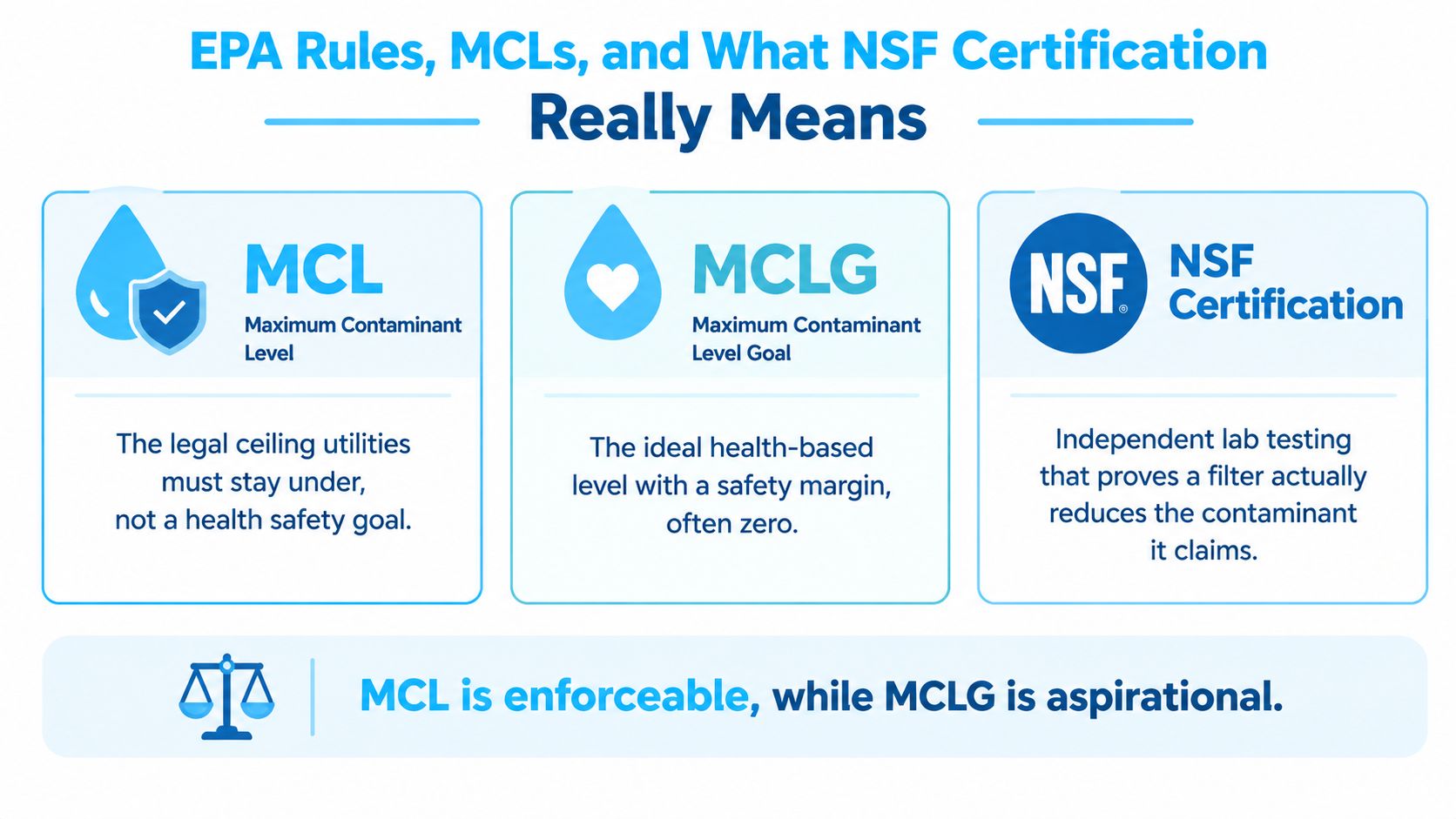
Regulatory language often sounds more reassuring than it is. A Maximum Contaminant Level, or MCL, is an enforceable limit that a public water system must meet. It isn't a guarantee that water contains nothing below that limit, and it isn't always the same as a zero-risk target.
An MCLG, or Maximum Contaminant Level Goal, is a health-based goal. The EPA sets the lead MCLG at zero, because lead is toxic even at low exposure levels. The EPA's drinking-water regulations explain that lead is managed through a treatment technique and an action level of 0.010 mg/L, formerly expressed by EPA as 15 parts per billion in its lead guidance. If more than 10% of tap samples exceed the action level, the water system must take additional steps, including corrosion-control measures.
State rules can also include variances under specific conditions. That doesn't mean a higher limit is automatically ideal for every household. It means the regulatory system may allow a different requirement while the utility addresses technical, economic, or source-water circumstances.
Read the filter claim, not the front of the box
The Lead and Copper Rule focuses heavily on corrosion control because lead often enters water from plumbing rather than the source itself. The Unregulated Contaminant Monitoring Rule helps utilities gather information about substances that don't yet have enforceable limits. PFAS regulation has also developed, including federal MCLs finalized in 2024, but local implementation and household exposure still require careful interpretation.
NSF/ANSI standards help translate a product claim into something testable:
- NSF/ANSI 42 generally covers aesthetic issues such as chlorine, taste, odor, and some particulates.
- NSF/ANSI 53 covers health-related reduction claims, including lead, cysts, VOCs, mercury, and asbestos.
- NSF/ANSI 58 applies to reverse osmosis systems.
- NSF/ANSI 55 relates to ultraviolet treatment.
- NSF/ANSI 401 addresses certain emerging contaminants.
The NSF certification guidance explains why a chlorine filter shouldn't be assumed to remove lead. Look for the contaminant name, the relevant standard, and the specific model listing. A compliant utility report also isn't the same as contaminant-free water at your tap, particularly when household plumbing contributes exposure.
Testing Your Water at Home Versus Sending It to a Lab
Home test strips are useful for quick checks. They can help you monitor free chlorine, pH, or total hardness and notice whether a treatment system is behaving differently. They're closer to a dashboard warning light than a complete mechanical inspection.
Color-change kits become less dependable when the question involves lead, arsenic, bacteria, or PFAS. Those contaminants may require laboratory methods such as ICP-MS for metals or EPA Method 533 for PFAS. A kit can suggest that something deserves attention, but a laboratory result is the stronger basis for choosing a treatment system.
| Testing Option | Useful For | Main Limitation |
|---|---|---|
| Home strips | Free chlorine, pH, and hardness | Fast estimates, not a full contaminant profile |
| Color-change kits | Screening and routine comparisons | Results can be affected by technique and water chemistry |
| Certified laboratory panel | Lead, arsenic, bacteria, nitrate, and PFAS | Costs more and requires careful sampling |
Basic home kits commonly cost $15 to $40, while state-certified lab panels commonly cost $100 to $400, according to the testing guidance specified for this comparison. Those figures are practical ranges, not guarantees. The panel you need depends on whether you use municipal water, a private well, or a treatment system.
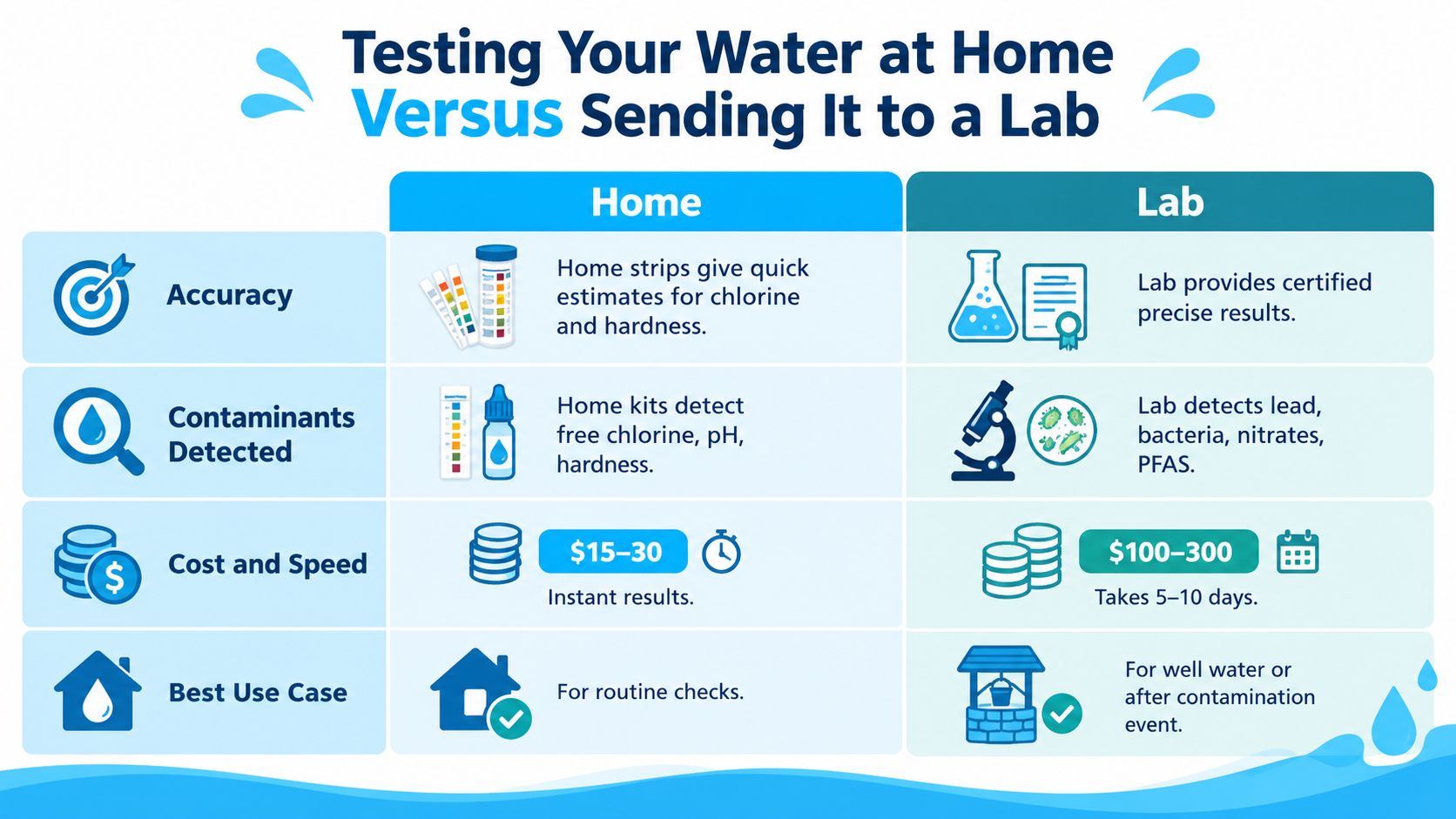
A municipal household should start with its annual water-quality report and test after plumbing work, a major odor change, or a local incident. A private-well household should establish a baseline with a certified laboratory and repeat testing when the well, land use, or household risk changes. Move-in day, nearby construction, a boil notice, or the arrival of a new baby or immunocompromised resident are sensible moments to choose laboratory testing rather than relying on strips.
This short video can help make the testing process less mysterious:
Choosing and Maintaining a Home Filtration System
Choose the treatment location before choosing the brand. A whole-house, or point-of-entry system, makes sense when iron, hydrogen sulfide, or chlorine affects multiple fixtures, damages plumbing, or creates an odor throughout the home. A point-of-use system is usually more efficient when the concern is drinking and cooking water, particularly for arsenic, lead, nitrates, or PFAS at the kitchen tap.
For practical buying guidance and maintenance advice, homeowners can compare system types through Water Filter Advisor's filtration advice. Treat that resource as one comparison point, then verify the certification and contaminant claim for the exact product you're considering.
| System Type | Price Range | Replacement Interval | Best For |
|---|---|---|---|
| Pitcher filter | $20 to $50 | 40 gallons or two months | Taste, odor, and selected certified reductions |
| Faucet-mount filter | $30 to $60 | Follow the model's rated capacity | A renter-friendly drinking-water upgrade |
| Countertop or under-sink RO | $150 to $600 installed | RO membrane every 2 to 3 years | Dissolved contaminants at one kitchen tap |
| Whole-house unit | $800 to $3,500 | Depends on media and water chemistry | Iron, hydrogen sulfide, chlorine, and whole-home treatment |
Don't buy based on the number of cartridges alone. A five-stage system with no certified claim for your contaminant is less useful than a simpler system with the right certification. Check for NSF/ANSI 42, 53, 58, 55, or 401 only when the standard matches the problem you identified.
Maintenance is part of filtration, not an optional chore. Replace pitcher cartridges at their rated capacity, change carbon blocks on schedule, replace RO membranes as specified, and replace UV lamps every 12 months. A forgotten sediment pre-filter can clog and starve an RO membrane, while an overdue carbon cartridge can become a source of poor flow and disappointing performance.
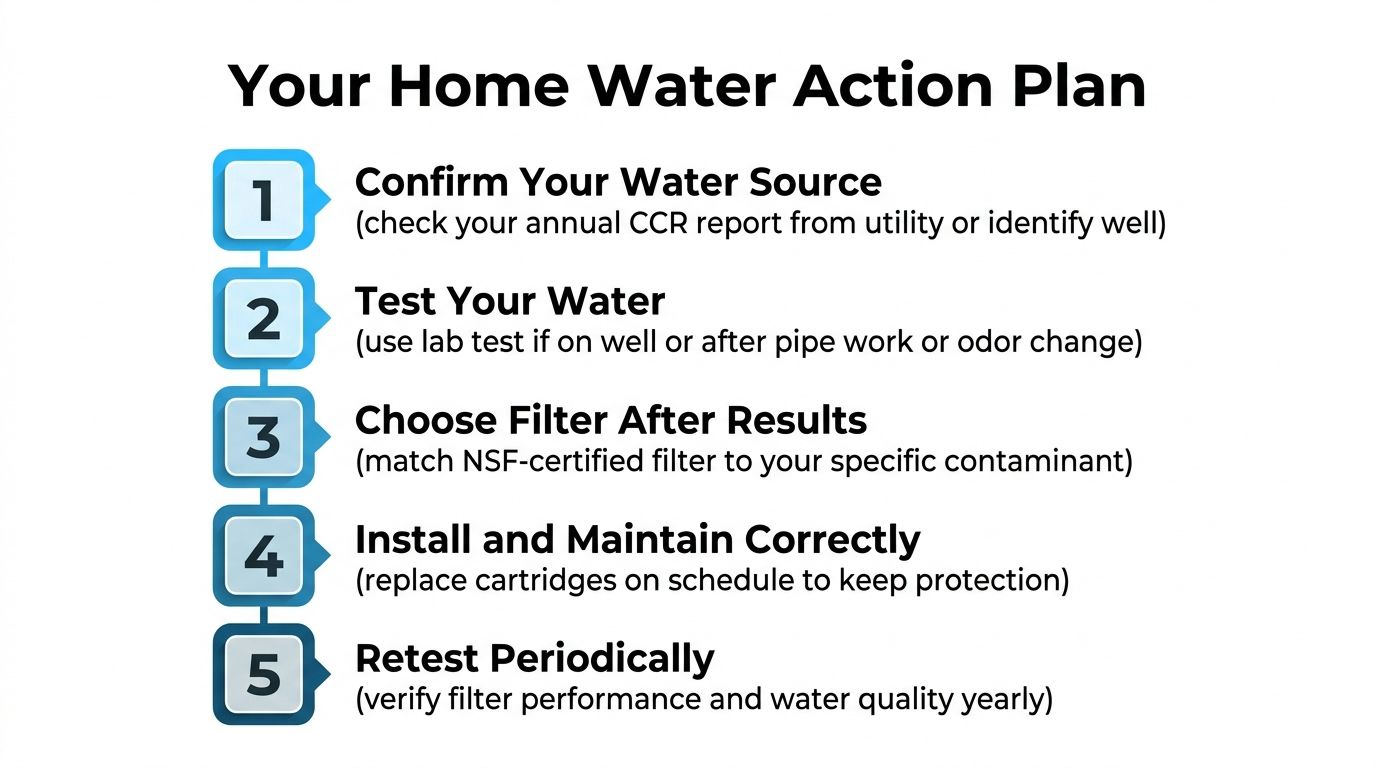
Your Home Water Action Plan and Common Questions
Use this order:
- Confirm your source. Read the municipal consumer confidence report or identify your private well.
- Test strategically. Use a certified lab after an incident, plumbing work, or when well conditions change.
- Choose after results. Match the contaminant to a certified technology.
- Install at the right point. Treat the whole home or only the drinking tap based on where the problem matters.
- Log maintenance. Record cartridge, membrane, media, and lamp replacement dates.
Is bottled water safer than filtered tap? Not automatically. Compare the source, testing information, packaging, and the performance claim of a certified home filter. Start with your local report and a targeted test.
Does an RO tank refill instantly? No. It refills gradually as the membrane produces treated water. Follow the manufacturer's flow and storage guidance, and don't treat a slow tank as proof that the system is broken until you check pressure, filters, and the shutoff valve.
Does boiling remove lead or PFAS? No. Boiling can address some microbial concerns, but it doesn't remove dissolved chemical contaminants such as lead or PFAS. Use a treatment certified for the contaminant.
Can a renter install under-sink RO? Ask the landlord before modifying plumbing, and choose a non-permanent connection if required. Get written approval, then use a certified installer or follow the lease-approved method.
Water Filter Advisor helps households compare contaminant-specific filtration options, certifications, replacement needs, and testing considerations. Visit Water Filter Advisor to turn your water report or lab result into a practical home filtration decision.
- September 6, 2026
- Uncategorized
