Tap water that meets municipal standards can still carry contaminants that affect taste, health, and plumbing, and water quality monitoring is the only way to know what's in your family's water. If you've ever tasted chlorine at the kitchen sink, seen orange staining in a tub, or worried about a private well after heavy rain, the answer isn't to guess. It's to test, interpret, and then choose the right treatment.
A homeowner can spend a lot of money on filtration and still miss the core problem. I've seen plenty of systems installed for odor when the issue was hardness, or installed for sediment when the primary concern was lead from older plumbing. Monitoring cuts through that confusion and gives you a clear path from water report to solution.
Introduction
The first time a homeowner calls with a water concern, it's usually not because they're thinking about standards or lab methods. It's because the coffee tastes off, the shower glass is filming over again, or a well owner got an alert about nearby runoff and suddenly doesn't trust the tap. That moment matters, because it's where panic usually tries to pick the treatment before the problem has even been identified.
The practical move is simple. Test the water, identify the contaminant profile, and then choose filtration that matches the result. That's true whether the supply comes from a city main or a private well, because both can leave you with water that looks fine and still causes real issues at home.
The history of modern monitoring shows why this approach exists. Water quality work moved from early local lab checks into a standardized public-health system, with milestones like the U.S. Geological Survey's early monitoring role, APHA's Standard Methods in 1906, ASTM D-19 in 1932, and the Clean Water Act framework that was strengthened in 1972, along with the global GEMS/Water program that followed. Those milestones matter because they turned monitoring into a repeatable practice instead of a one-off reaction, and homeowners benefit from that same discipline today. EPA history of the Clean Water Act
For household filtration, monitoring is the difference between buying a cartridge that changes taste and installing a system that solves the problem. It also keeps you honest about maintenance, because a filter that isn't matched to the water can give a false sense of security. If you want confidence in the water your family drinks, cooks with, and bathes in, monitoring is where that confidence starts.
Understanding Water Quality Monitoring
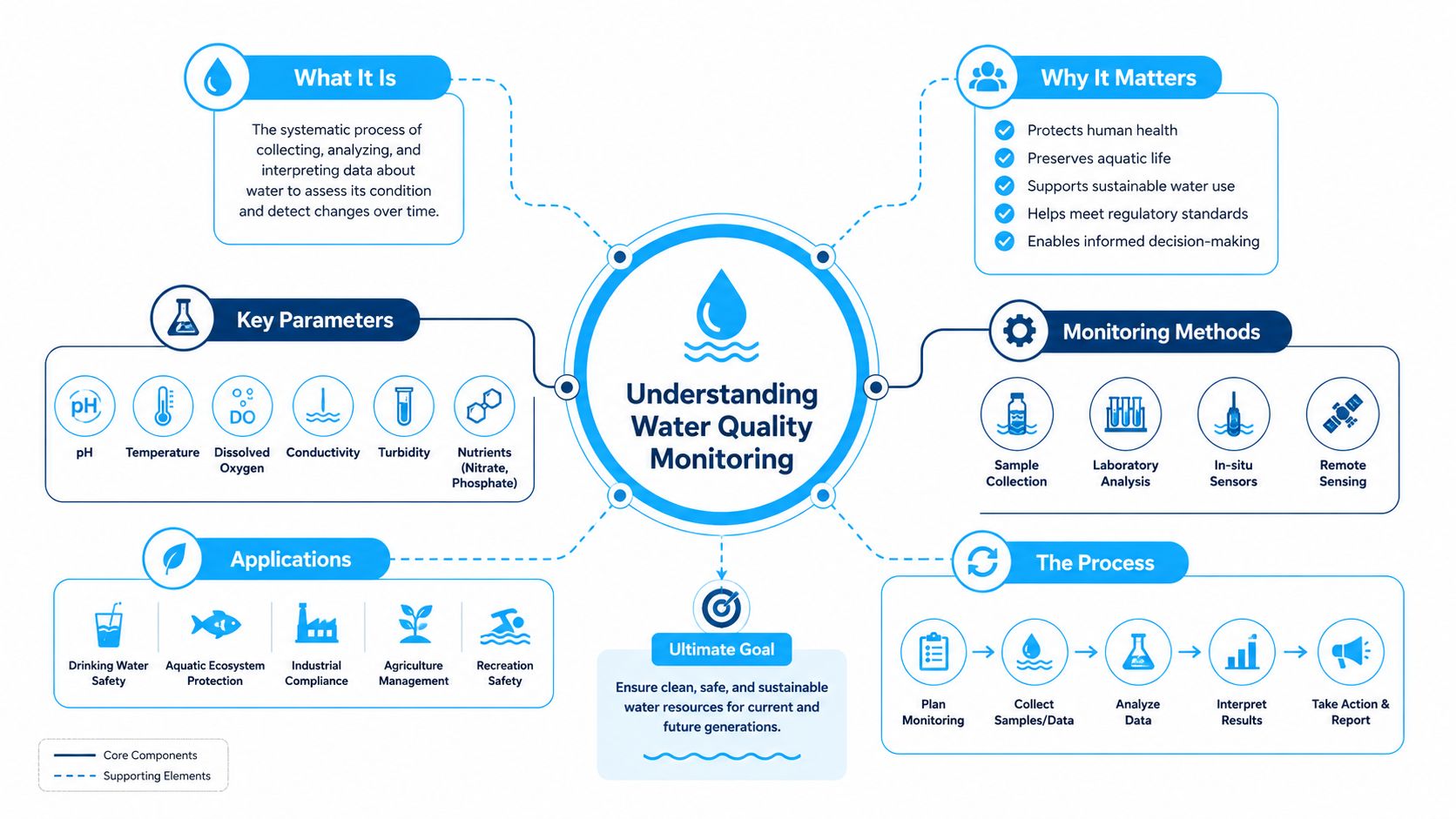
Water quality monitoring means measuring the physical, chemical, and biological condition of water on purpose, not by guesswork. It's a dashboard for your water. You wouldn't drive on a long trip with the speedometer, fuel gauge, and warning lights covered up, and you shouldn't choose a filter without knowing what the water is doing.
What it measures
A good monitoring plan looks at the things homeowners can feel and the things they can't. Taste, odor, staining, cloudiness, and scale are visible clues, but monitoring also checks the invisible side, like pH, dissolved oxygen, turbidity, chlorine residuals, and specific contaminants tied to health or plumbing damage. The point isn't to collect numbers for their own sake, it's to connect those numbers to action.
Practical rule: test before you treat. A filter chosen from a hunch may improve one problem and ignore the one that matters most.
Routine checks and event-driven checks
Routine monitoring follows the same water source over time, which is useful because many problems creep in slowly. Event-driven monitoring happens after a flood, a water main break, construction nearby, or a sudden change in taste or smell. That second kind matters because a system that looked fine last month can behave differently after a disturbance.
There's also a practical difference between point-of-entry and point-of-use monitoring. Point-of-entry checks the water before it enters the home's plumbing or whole-house treatment. Point-of-use checks the water after treatment, usually at a kitchen tap or another sink that people drink from. Homeowners who understand both can tell whether the raw water is the problem, the treatment system is the problem, or both need attention.
The best homeowners use monitoring like a thermostat. They don't wait until the house feels miserable, they watch the reading and adjust early. That habit saves money, prevents overbuying equipment, and keeps a small water issue from turning into a bigger one.
Key Contaminants and Parameters to Watch
The water problems homeowners run into most often are plain, not exotic. They show up in taste, appearance, plumbing, and trust at the tap. If you know which parameter points to which problem, a lab report becomes much easier to use.
The usual suspects in homes
Chlorine and chloramine are common in municipal water because utilities use them for disinfection. Homeowners usually notice them through taste or odor complaints, which is why NSF/ANSI Standard 42 is the certification most directly tied to improving taste and odor through chlorine reduction in pitchers, under-sink systems, and whole-house filters. NSF on Standard 42
Lead works differently. You do not see it, smell it, or taste it reliably, and it often comes from older plumbing rather than the source water itself. That is why a test result matters more than a guess, and why health-related certifications like NSF/ANSI Standard 53 and Standard 58 matter when you are choosing treatment for a home. CDC on choosing home water filters
Iron and manganese usually show up as staining, metallic taste, or laundry problems. Hardness shows up as scale, dry skin feel, and mineral buildup on fixtures. pH and turbidity matter too, because they often tell you whether water is likely to corrode plumbing, foul cartridges, or point to a broader issue in the source.
A homeowner who sees a brown stain on a fixture, cloudy water, or a sharp taste has already gotten a clue. The trick is matching that clue to the right test instead of guessing at a filter.
What to ask a test to tell you
For a homeowner, the smart checklist is simple.
- Lead: important for health decisions and filter selection, especially in older homes.
- Bacteria such as coliforms or E. coli: important for well owners and any home after a contamination event.
- Nitrates: especially relevant for wells near agriculture or septic systems.
- Turbidity: useful because cloudy water can interfere with treatment and disinfection.
- pH and hardness: important because they affect plumbing, fixture wear, and how well treatment systems behave.
Some problems are aesthetic, some are health-related, and some are both. The mistake is treating them all the same.
The value of a test result is in the next move it points to. If the problem is taste, a carbon filter may fit. If it is dissolved contaminants or lead, you are in a different category entirely. If it is bacteria, filtration alone may not be enough.
Testing Methods for Homeowners
Homeowners usually have three practical testing paths, and each one solves a different problem. The right choice depends on whether you want a quick screen, a reliable answer, or ongoing tracking after treatment.
| Method | Best use | Strength | Limitation |
|---|---|---|---|
| Home test kit | Quick screening and trend checks | Fast and easy | Less precise, narrower contaminant coverage |
| Laboratory analysis | Confirming specific contaminants | Most reliable and comprehensive | Takes more effort and planning |
| Continuous sensor | Watching changing water conditions | Real-time visibility | Needs calibration and maintenance |
Where each method fits
A home kit is useful when you need to know whether a problem is moving in the right direction. That's especially true for simple screening tasks like chlorine, hardness, or general pH tracking. It's not the tool I'd trust alone for lead, bacteria, or anything where a wrong call carries more risk.
A professional lab is the better choice when precise results are needed, especially for well owners. It gives you the clearest picture for contaminants that can't be judged by appearance, smell, or a strip chart. If you're deciding on a treatment system, lab data usually gives you the cleanest path.
Continuous sensors make sense when you need to watch a system over time, such as checking whether a filter or softener is still doing its job. They're useful for change detection, not just one-time diagnosis. The trade-off is simple, they only help if they're maintained and calibrated.
For homeowners who want practical guidance, Water Filter Advisor's advice section is one place to compare common test types and match them to a filtration goal.
A simple decision rule
- Need a fast screen: use a home kit.
- Need a defensible answer for a serious concern: use a lab.
- Need to watch performance over time: use a continuous sensor.
The wrong method can leave you with a false sense of confidence. The right one gives you enough certainty to spend money where it matters.
Building Your Water Monitoring Plan
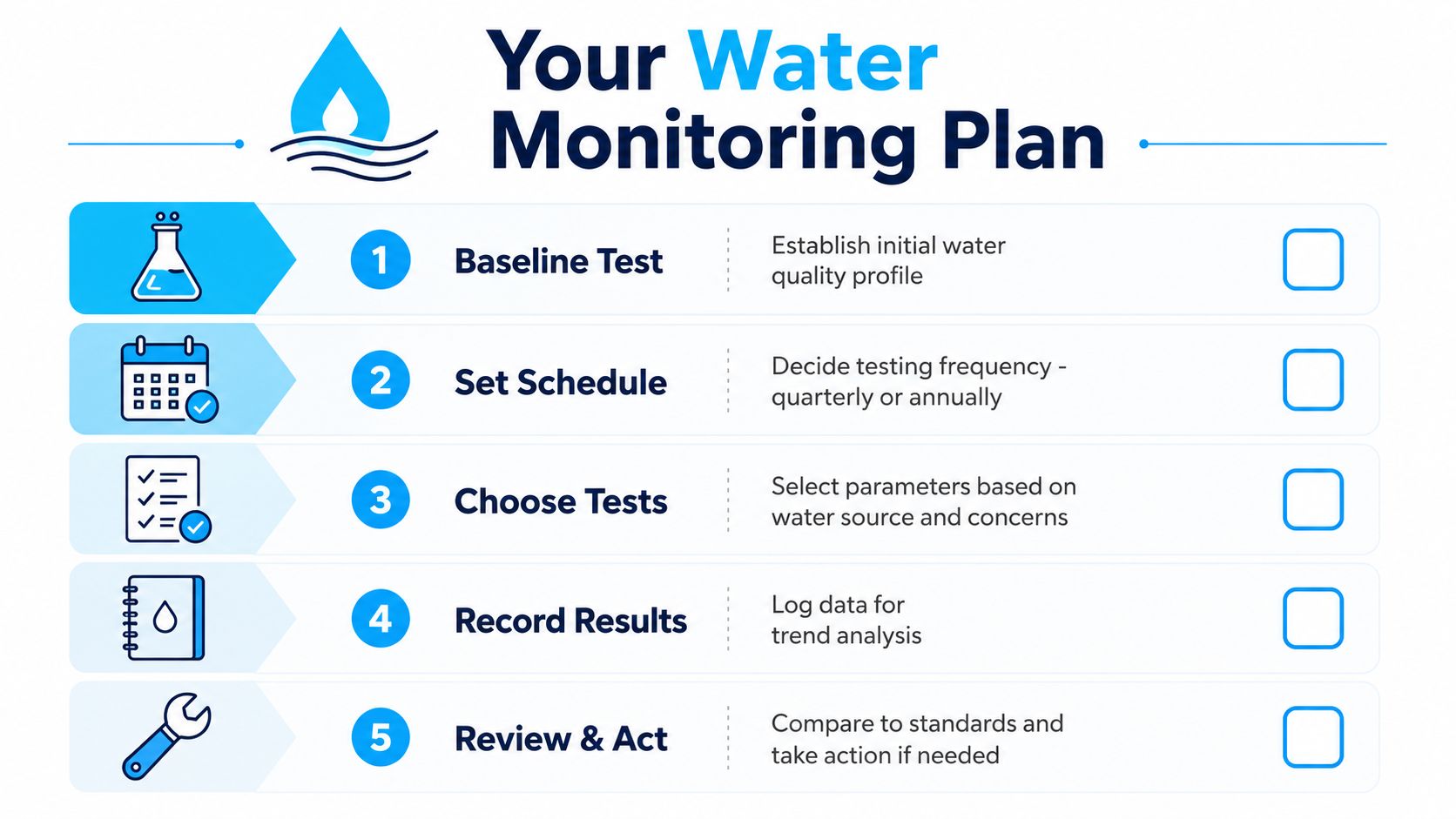
A practical home monitoring plan does not need to be elaborate. It needs to be consistent, because one test gives you a snapshot, but a repeated pattern shows whether the water is changing or holding steady.
Start with a baseline
Run an initial test before you install treatment equipment or move into a home with an unknown water history. That first reading becomes your reference point for everything that follows. If a later result changes, you can tell whether it reflects a real shift or ordinary variation.
City water still deserves attention. Lead and taste or odor changes often show up after local construction, service work, or a main break, so it helps to watch for changes at the tap. Private wells need even more care before move-in, because there may be no utility records to compare against. Annual bacteriological testing is a reasonable floor for wells, and a broader periodic panel helps catch nitrates, heavy metals, and pH problems before they turn into household trouble.
Make the log simple enough to keep
Record the date, sampling point, test used, result, and anything that changed in the house. That last detail matters more than people expect. A new softener, an old filter cartridge, a basement flood, or a plumbing repair can explain a reading better than the number by itself.
Keep the log where you'll use it, near the sink or on your phone. If logging takes too much effort, it usually stops after a few entries.
Use the result to set the next test
A workable monitoring calendar follows two things, the source and the treatment. If the raw water stays steady and the filter is performing as expected, retesting can stay simple. If results shift with the seasons or after storms, tighten the schedule until the pattern makes sense.
For homeowners who want practical guidance, Water Filter Advisor's advice section is one place to compare common test types and match them to a filtration goal. The key is consistency. The best plan is the one you will still follow next year.
Choosing Tests and Interpreting Results
Lab reports can look intimidating, but most of the confusion comes from not knowing what matters. A good report does more than list numbers. It shows whether a reading fits normal variation, points to a real change, or gives you a clear reason to act.
Reading results without overreacting
Start with the parameter name, the result, and the units. Then compare that result with the lab's reference context and the specific problem you are trying to solve. A number that matters in one home may be less important in another, especially when the source water and treatment goal are different.
Home test strips are looser tools, but they still have value. They work well for spotting direction, such as whether chlorine is dropping after a filter change or whether hardness is trending upward. They are not the right tool for a health decision that needs tight confidence.
Connect the result to the filter
Certifications matter. NSF/ANSI Standard 42 covers aesthetic treatment like taste and odor from chlorine. NSF/ANSI Standard 53 covers contaminant reduction claims. NSF/ANSI Standard 58 covers reverse osmosis systems, and CDC guidance notes reverse osmosis can remove chemicals such as lead, copper, chromium, chloride, and sodium. CDC on reverse osmosis filters
If lead is the concern, certification details matter more than marketing language. NSF reported in 2022 that the drinking water treatment unit lead limit was lowered to 5 parts per billion, a 50% drop from the previous 10 ppb requirement, and certification testing uses challenge water containing 150 ppb lead, which is 10 times the U.S. EPA action level of 15 ppb. NSF lead reduction certification update
A filter label is only useful if it matches the contaminant on your report.
That is the practical way to read a result. Do not chase every number. Match the contamination profile to the certification, then choose the system that solves the problem you have.
When to Call a Professional
Some water problems are still DIY-friendly. Others are not. Once lead shows up, bacteria tests come back positive, nitrates look abnormal, or the water changes after a flood, spill, or industrial event, it's time to stop treating the situation like a cartridge swap.
Red flags that deserve expert help
A professional should get involved when the issue is outside what a homeowner can confirm with a strip or a basic kit. That includes unexplained taste or odor problems that don't line up with a simple chlorine issue, because those can point to plumbing, source-water, or treatment failures that need deeper diagnosis. It also includes whole-house design problems, where a single point-of-use filter won't protect showers, appliances, and laundry.
Professionals can do more than sell equipment. They can identify the likely contaminant source, design a whole-house system, install it correctly, and keep complex treatment running over time. That matters when a home has multiple issues at once, like iron plus hardness plus a disinfection concern.
How to vet the right person
Ask what they've tested in homes like yours, what data they need before recommending equipment, and how they'll verify the system after installation. A good specialist should talk about test results first and product names second. If the conversation starts with a sale instead of a diagnosis, keep looking.
Good water work starts with the water, not with the catalog.
If you're dealing with a complex house, a private well, or contamination that could affect health, a licensed pro is a better investment than trial and error. The cost of a wrong system is usually higher than the cost of a proper assessment.
Taking Action and Protecting Your Water
Once you have results, the next step is practical. Match the test to the problem, choose the right treatment, maintain it on schedule, and retest to confirm it is still working. Activated carbon is often the first step for chlorine and taste issues, reverse osmosis fits heavier contaminant problems and dissolved solids, water softeners handle hardness, and UV disinfection is the tool to consider when bacteria are the concern.
Homeowners get better results when they treat water as part of the whole house, not as a stand-alone chore. If you are also trying to cut outdoor water use, pairing good monitoring habits with sustainable yard care practices can keep the bigger system, home and yard, working efficiently.
Monitoring is not a one-time project. It is a habit that protects your family, your plumbing, and your filter budget. If you want help sorting test results, comparing filter types, or deciding when a pro is worth it, visit Water Filter Advisor and use it as your starting point for smarter home water decisions.
- August 5, 2026
- Uncategorized
