Granular Activated Carbon Filter: A Complete Home Guide
You turn on the kitchen tap and notice it immediately. The water looks clear, but there's a faint chlorine smell, a metallic aftertaste, or an earthy note that wasn't there before. You may already have a tall tank in the basement, a cartridge under the sink, or a small filter on the counter, yet the important question remains: what is happening inside the carbon?
A granular activated carbon filter, usually shortened to GAC filter, can improve taste and reduce many dissolved organic chemicals. It can also disappoint when the bed is undersized, the water takes an easier path around the media, or nobody knows when the carbon has stopped working. Understanding the granules, the water path, and the warning signs at the tap makes the equipment much easier to choose and maintain.
What a Granular Activated Carbon Filter Actually Is
Open a whole-house carbon tank and you won't find a solid black wall. You'll find a bed of loose, irregular granules, often made from bituminous coal, coconut shell, or wood. The raw carbon has been activated with steam or chemicals, creating a network of internal pores where dissolved molecules can attach.
Activated carbon is unusually useful because its structure is amorphous, meaning its atoms don't form one neat crystal pattern. That irregularity creates a large internal surface area. Depending on the carbon and its manufacture, the surface area can be described qualitatively as very large, with pores measured at molecular scales rather than by the micron ratings used for particle filters. The attraction is mainly physical, through weak molecular forces often described as van der Waals interactions.
GAC differs from powdered activated carbon and carbon block media in the way it occupies the filter. Powdered carbon is fine enough to be dosed into a treatment process, while carbon block is compressed into a dense, shaped cartridge. GAC remains a free bed of particles, with channels between the granules that let water pass through the tank.
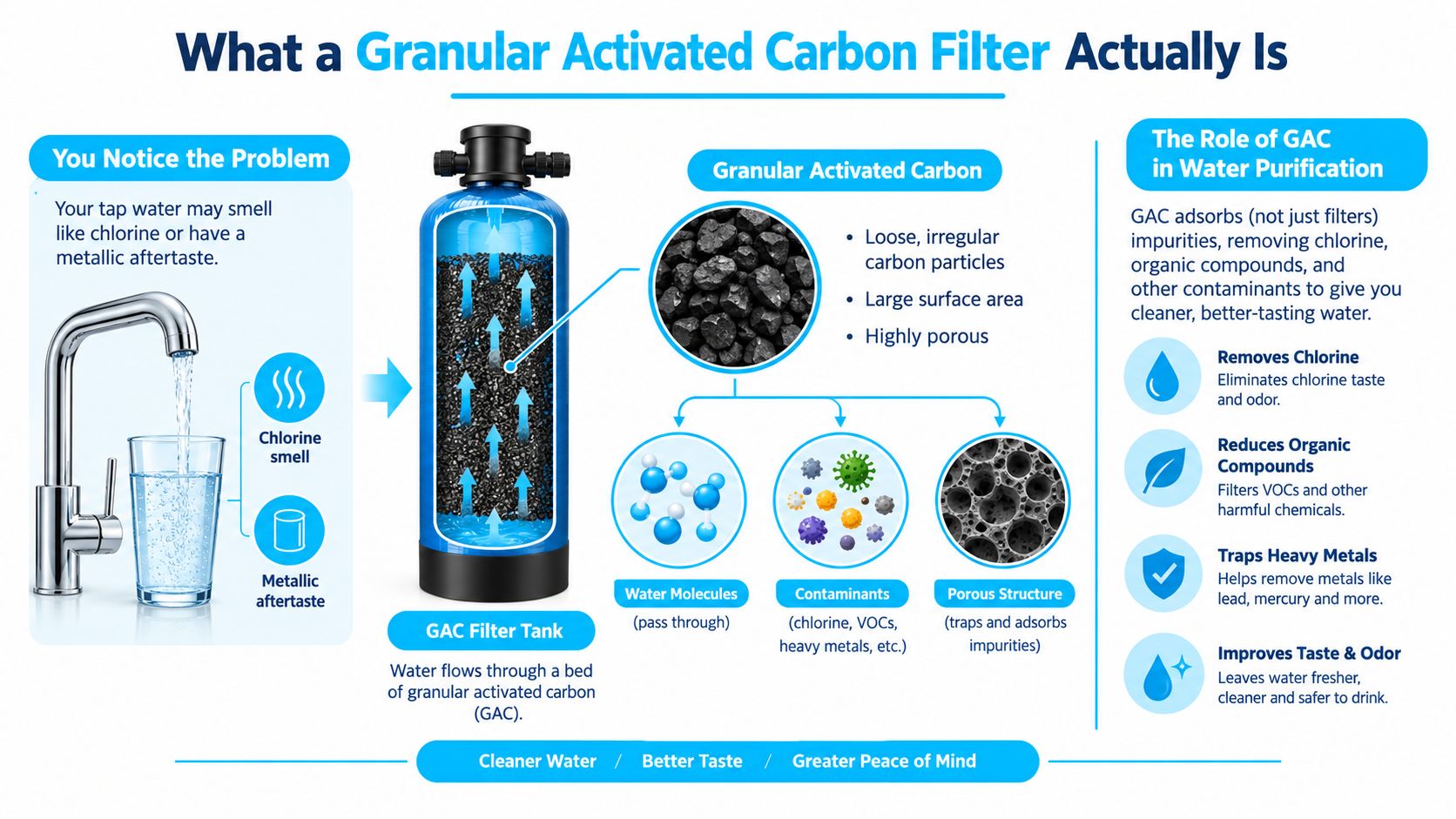
That loose arrangement explains the appeal. Water can move through a properly designed bed without the resistance created by a very dense cartridge, and the media can hold a substantial contaminant load. It also explains the risks. Water may form preferred channels, reducing contact with some granules, while the bed can collect sediment or develop biological activity if the incoming water isn't managed.
GAC has been used in water treatment for more than a century. Charcoal activation was applied in 1906, GAC use for dechlorinating chlorinated water was reported in 1910 in Reading, England, and the first granular activated carbon filters were installed in Germany in 1929 and the United States in 1930, according to this history of GAC in water treatment. Municipal adoption expanded substantially during the 1960s and 1970s.
The same loose granules give GAC its useful capacity and flow characteristics. They also create the possibility of channeling, stagnant pockets, sediment loading, and microbiological niches. To understand why, you need to look at adsorption itself.
How GAC Pulls Contaminants Out of Water
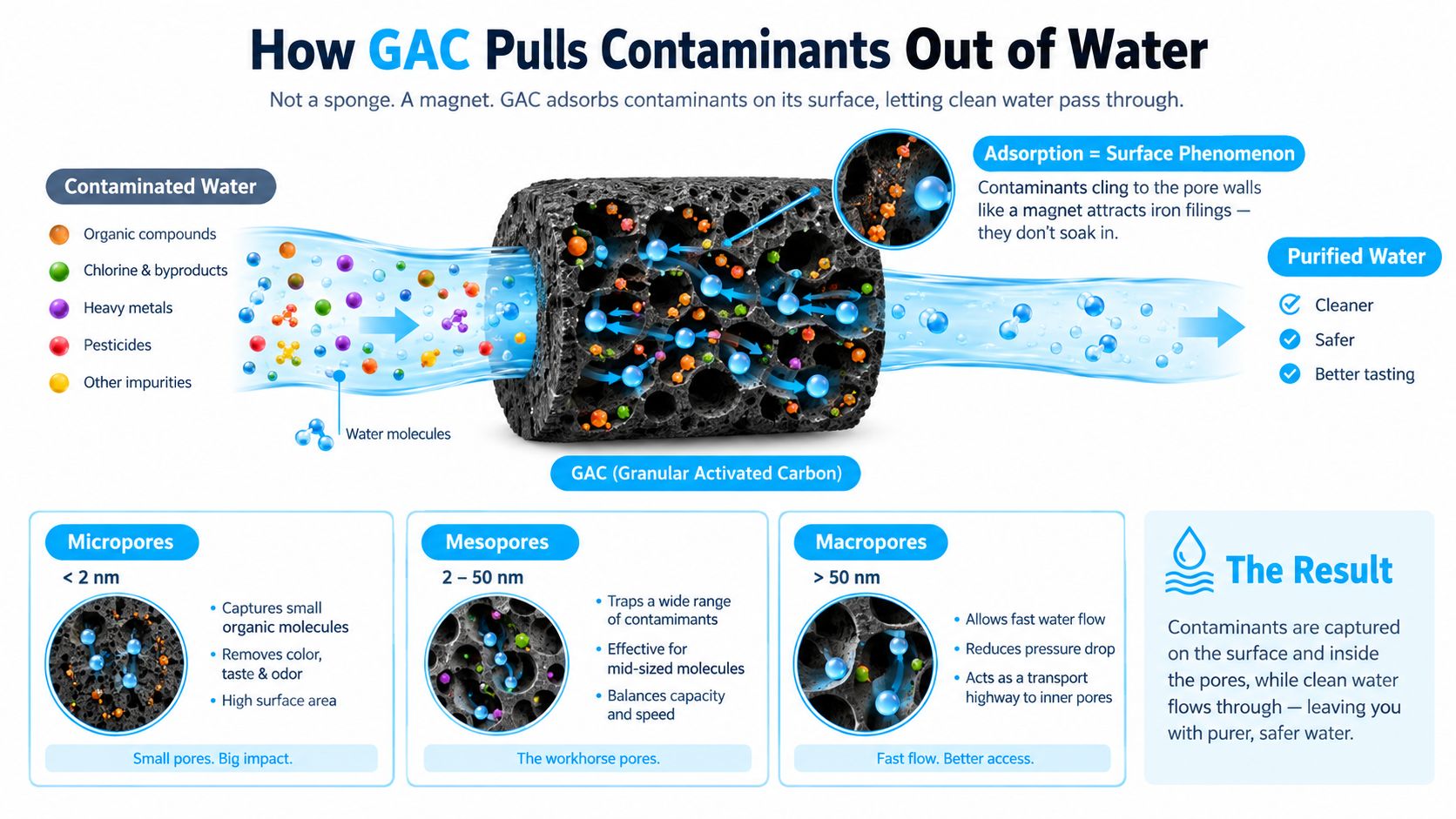
A glass of water can look clear while carbon is already removing invisible compounds. The process is adsorption, not absorption. A sponge takes water into its body. Activated carbon holds dissolved molecules on pore walls and internal surfaces, much like a building filled with tiny parking spaces designed for particular vehicles.
A molecule reaches a carbon grain only after moving through the bed, crossing the thin water layer around the grain, and entering a pore with an available site. Adsorption occurs when the attraction between that molecule and the carbon surface is stronger than the forces keeping it dissolved.
The pore network does different jobs
Activated carbon has several pore sizes, and each serves a different purpose:
- Micropores: Smaller than 2 nanometers, these provide much of the close-contact surface where many organic molecules attach.
- Mesopores: From 2 to 50 nanometers, these guide larger molecules toward smaller internal spaces.
- Macropores: Larger than 50 nanometers, these function as transport routes, helping water and contaminants travel through each granule.
That structure explains why two GAC products are not automatically interchangeable. Carbon with abundant small pores may suit certain dissolved organics, while a different pore distribution may give larger compounds better access.
A contaminant's trip through the bed
Water first moves through the open spaces between granules. A contaminant then crosses the surrounding water film and diffuses through the pore network until it finds an unoccupied adsorption site.
Empty-bed contact time, or EBCT, describes how long water theoretically remains in the carbon bed. Faster flow gives molecules fewer chances to reach adsorption sites. A channel through the bed can shorten that contact time even while much of the tank remains unused.
Carbon selection also involves practical test measures. The iodine number and molasses number indicate aspects of adsorption behavior. Drinking-water GAC specifications often target an iodine number around 900 to 1300 mg/g and an internal surface area near 900 m²/g. A drinking-water GAC technical specification also describes an effective particle size around 0.7 to 1.2 mm and a uniformity coefficient below 1.8. Those figures only make sense alongside the carbon's density, particle size, water chemistry, and target contaminant.
Designers use isotherms, including Freundlich and Langmuir models, to estimate how much contaminant carbon can hold at a given concentration. Homeowners do not need to calculate one. The practical lesson is that capacity depends on the contaminant, concentration, water chemistry, carbon type, and contact time.
For a broader explanation of flow through household treatment equipment, what does a whole house water filter offers useful background when comparing tank layouts.
Water treatment is easier to understand visually:
The following video provides another visual explanation of carbon adsorption and filter operation:
What GAC Removes and What It Doesn't
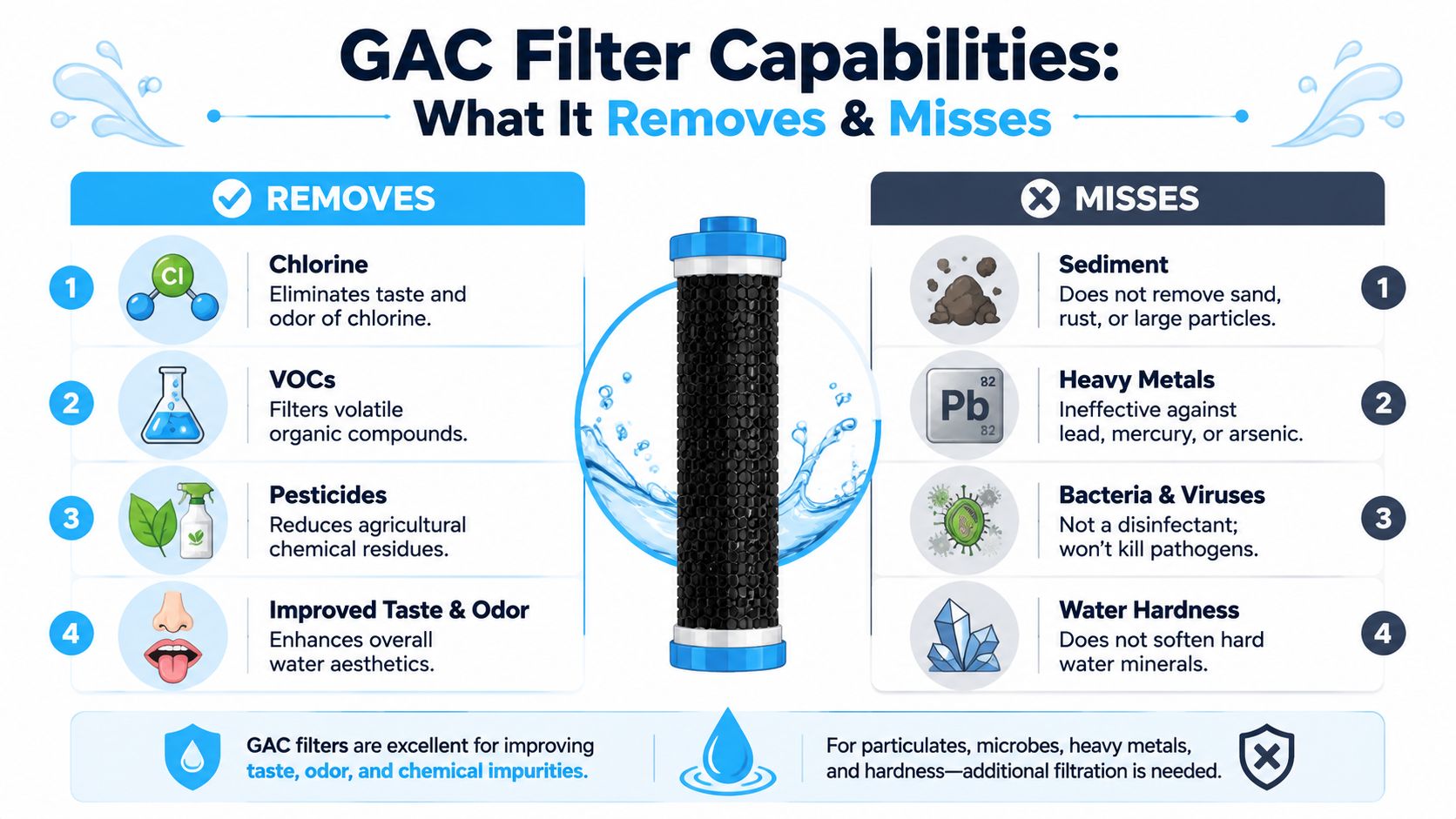
A glass of water can look clear while carrying chlorine taste, solvent vapors, or fuel-related compounds. GAC is built mainly for these dissolved organic chemicals. The U.S. Environmental Protection Agency describes activated carbon as a proven treatment technology, with removal efficiencies of up to 99.9% for many volatile organic compounds, including trichloroethylene and tetrachloroethylene, under appropriate conditions, as explained in EPA's activated carbon treatment guide.
At the tap, effective GAC may show up as less chlorine taste or odor. It can also treat fuel oils, solvents, polychlorinated biphenyls, dioxins, and some radon-related compounds. Carbon does not work like a universal net, however. Hardness minerals, sodium, fluoride, and nitrate remain dissolved as ions, so ordinary GAC usually does not remove them effectively.
| Contaminant Class | Typical Removal | NSF/ANSI Standard | Homeowner Note |
|---|---|---|---|
| Free chlorine and taste compounds | Often a strong application when the bed provides suitable contact time | NSF/ANSI 42 may apply to specific claims | Check taste and odor at the tap, not the carbon's color |
| VOCs such as TCE and PCE | Up to 99.9% for many listed compounds under appropriate conditions, per EPA guidance | NSF/ANSI 53 may apply to a tested contaminant claim | Capacity and breakthrough timing matter |
| Fuel oils, solvents, PCBs, and dioxins | GAC can treat these classes in groundwater applications | Claim-specific | Test the source water before choosing media |
| Chloramine | More difficult than free chlorine and usually needs longer contact time or catalytic carbon | Claim-specific | A standard chlorine cartridge may underperform |
| Hardness, sodium, fluoride, and nitrate | Generally not removed effectively by ordinary GAC | Usually not the relevant certification | Consider other treatment media |
| Bacteria and viruses | GAC is not an effective microbiological barrier | Not a substitute for disinfection | Sanitation and maintenance still matter |
| PFAS | Performance varies with carbon, bed depth, flow, and competing organics | Verify the exact certified claim | Clear water and normal taste do not prove removal |
GAC is not a reliable answer for every metal. Lead and mercury may require specialized media, while arsenic treatment generally needs a specifically designed or impregnated medium.
PFAS requires a different check than taste or odor. Carbon may adsorb a PFAS compound, but the bed can eventually break through as adsorption sites fill, especially when other organic matter competes for them. Test the source water and set a replacement schedule based on the actual household load.
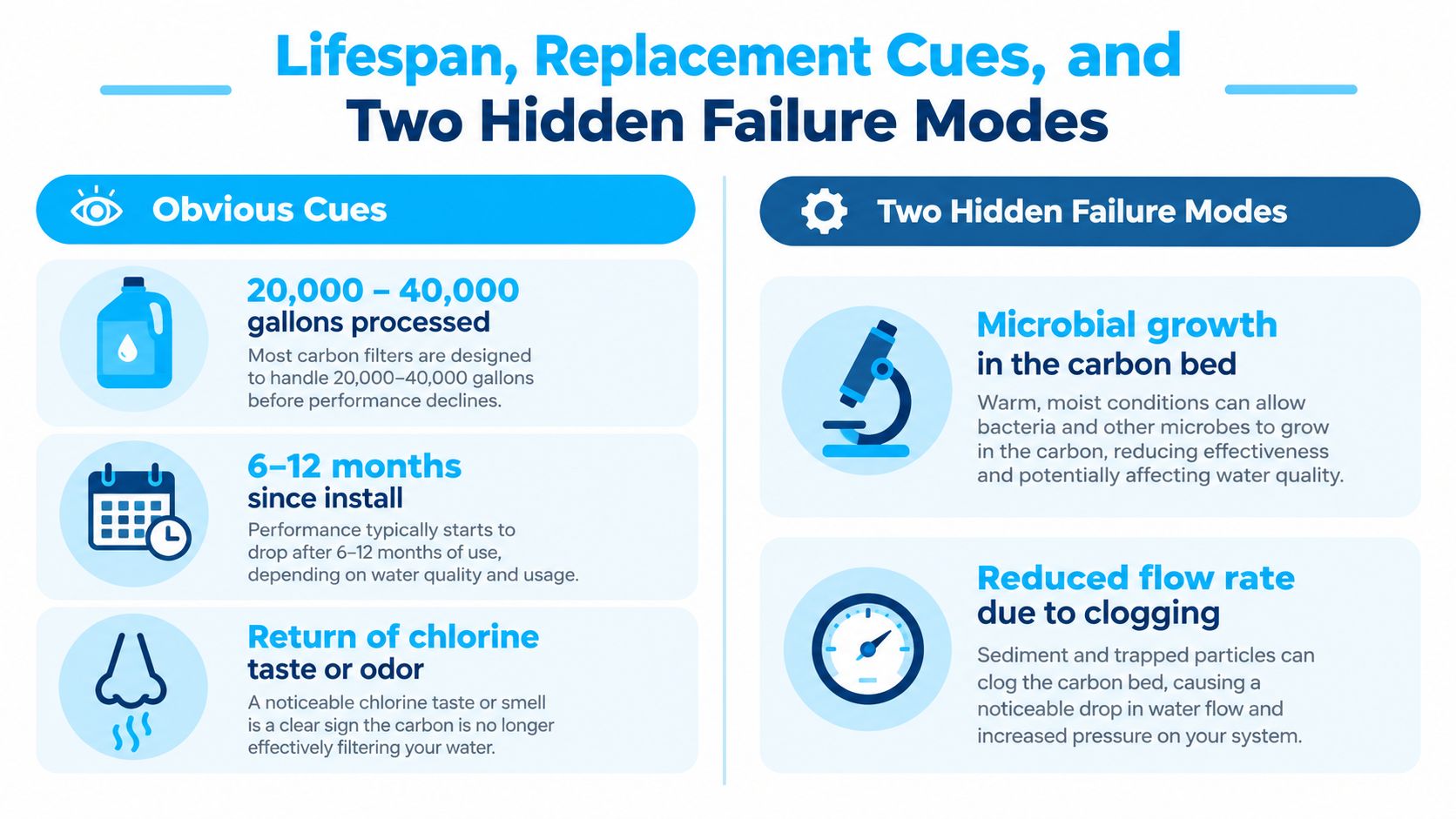
Biological growth can create another visible warning: falling pressure or slower flow. A damp carbon bed can support biofilm, which adds resistance even when the water still looks clear. Persistent pressure loss deserves investigation, sanitation, or media replacement rather than a visual inspection alone.
Practical rule: If the contaminant report lists nitrate, hardness, microbes, or a metal, match the treatment to that contaminant before buying a GAC tank. Test for PFAS separately and treat replacement timing as part of the filter's performance.
GAC vs Carbon Block vs Catalytic Carbon
At the kitchen tap, three carbon formats appear most often. They may all look black in a product photograph, but their internal structure changes the way water contacts the media.
GAC consists of loose particles. The spaces between particles support relatively open flow and can keep pressure loss modest, but water may find channels through the bed. That makes correct tank design and flow control important.
Carbon block compresses activated carbon into a dense cartridge. Water is forced through a more uniform body of media, which can improve consistency and allow the cartridge to provide fine particulate filtration as well as adsorption. The tradeoff is resistance. A dense block can reduce flow more quickly when it loads with sediment.
Catalytic carbon is a specialty carbon designed to promote reactions that ordinary GAC handles less effectively. Chloramine is the key example. Chloramine reactions on carbon are slower than free-chlorine reactions, so a catalytic product or substantially longer contact time may be necessary.
| Attribute | Granular GAC | Carbon Block | Catalytic Carbon |
|---|---|---|---|
| Physical form | Loose particles in a bed or cartridge | Compressed carbon cartridge | Specialty carbon, commonly used in a loose bed |
| Main advantage | Flow capacity and broad organic adsorption | More uniform contact and fine filtration | Better suited to difficult disinfectants such as chloramine |
| Main limitation | Channeling and uneven contact are possible | Higher pressure loss when undersized or loaded | Requires careful verification because sellers may misuse the term |
| Good fit | Chlorine, taste, odor, and whole-house flow | Point-of-use drinking water and specific tested claims | Municipal supplies using chloramine |
| Particle filtration | Limited by the bed design | Often available at fine ratings, such as 0.5 to 10 microns, when the cartridge is rated for them | Depends on the system design |
| Buying question | Is the bed deep enough for the flow? | What contaminant and micron claim was tested? | Is the media genuinely catalytic and certified for the target? |
The sales language deserves scrutiny. Not every loose carbon product labeled “catalytic” has the same treatment performance. Ask for the media type, the target contaminant, the required EBCT, and the certification or test documentation.
For a household with free chlorine and taste complaints, GAC or carbon block may be sensible. For chloramine, catalytic carbon deserves closer attention. For a sub-micron particle claim or a certified lead claim, a properly rated carbon block is usually the more relevant format.
Sizing a GAC Filter for Real Household Flow
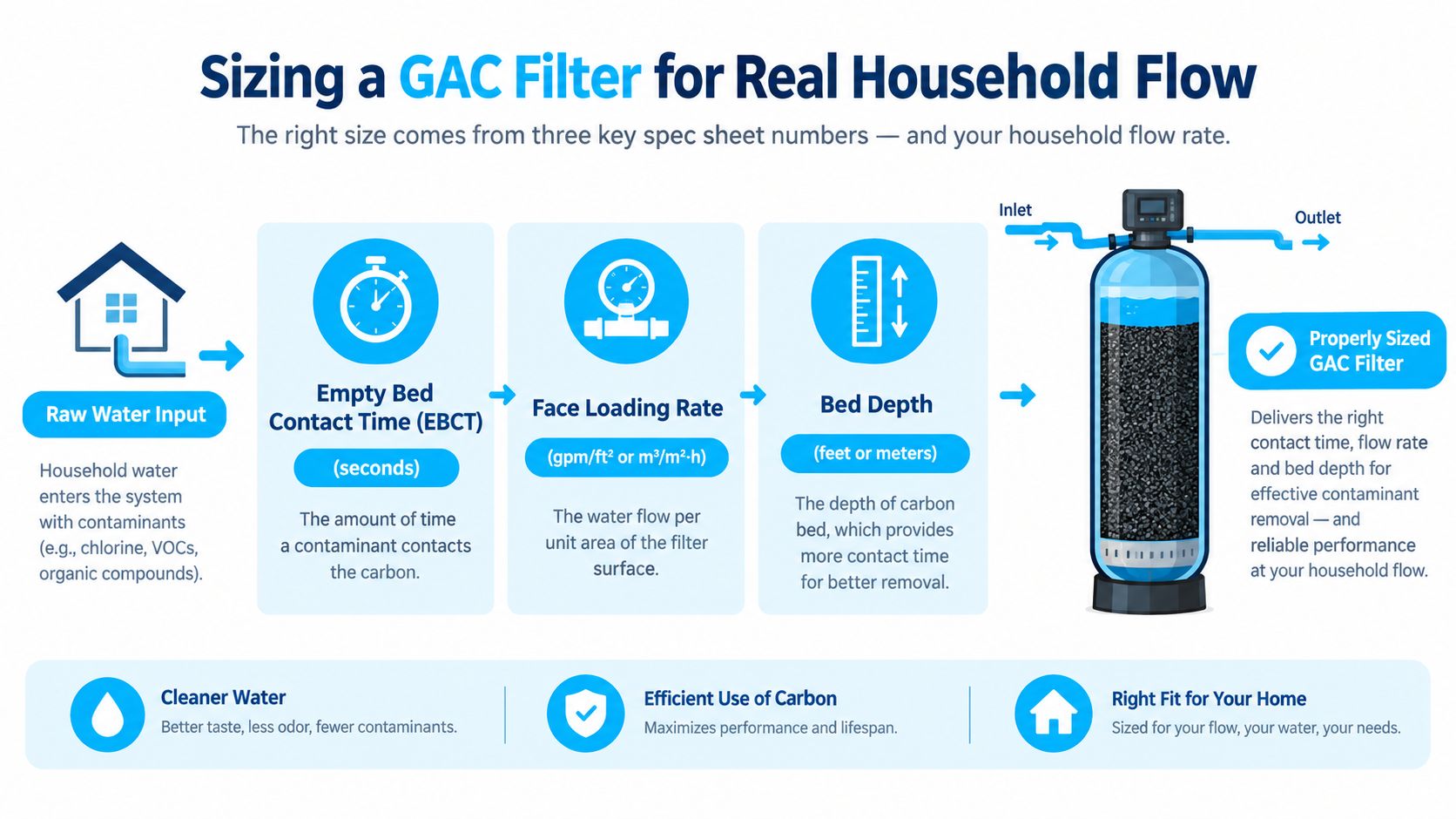
A tank can contain high-quality carbon and still disappoint at the tap. If water rushes through the bed, contaminants have less time to attach to the carbon surface. Three specification-sheet figures show whether the design can keep up: EBCT, face loading rate, and bed depth.
Start with contact time
EBCT, or empty bed contact time, estimates how long water would occupy the open volume of the carbon bed. It is not the time water spends in the whole tank. The calculation focuses on the bed and excludes the solid carbon particles.
For chlorine removal, one GAC chlorine treatment specification describes typical superficial loading around 4 to 10 gpm/ft², with temporary peaks up to 12 to 15 gpm/ft². It also emphasizes that EBCT has more influence on performance than face loading. Chloramine requires more contact time than free chlorine.
Start residential sizing with peak flow, not average daily use. A shower, washing machine, toilet refill, and kitchen tap may run together. A system that performs well during a quiet test can struggle when several fixtures open at once.
Check the bed and the tank
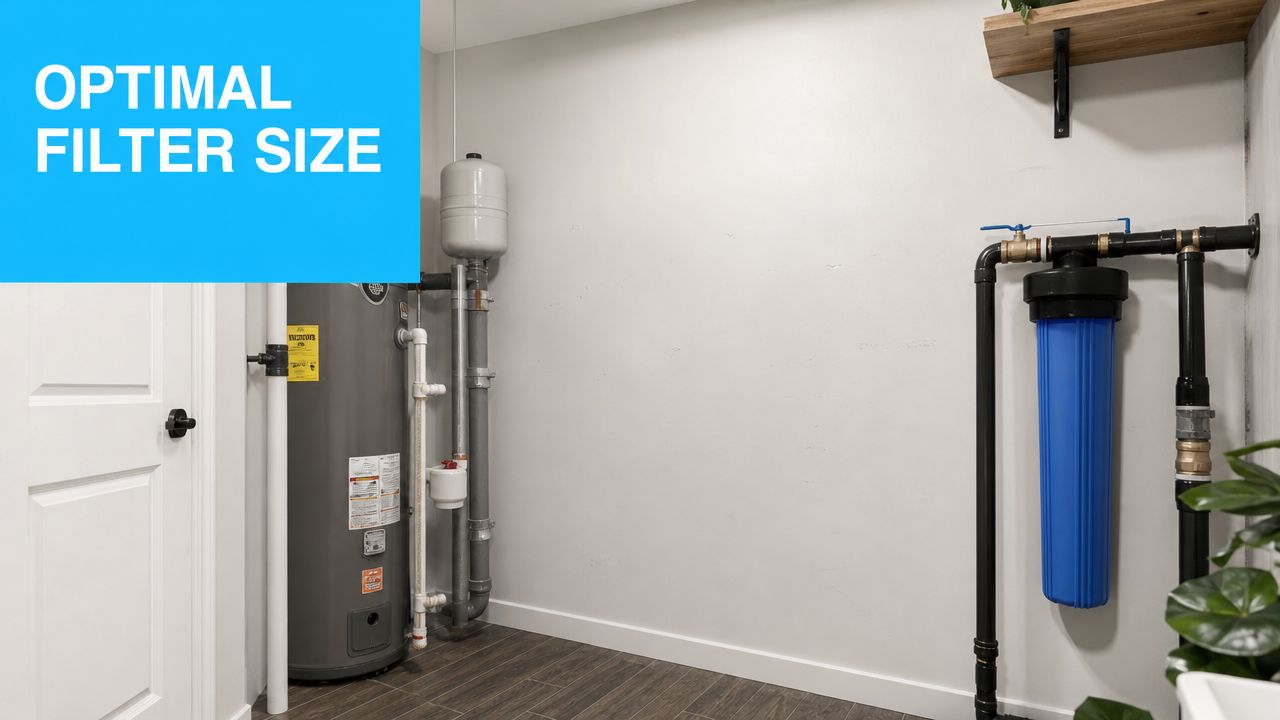
Consider a 10 by 54 inch tank with about 1.7 square feet of cross-sectional area and roughly two cubic feet of carbon. Depending on bulk density, bed depth, plumbing, and the target contaminant, this arrangement may support approximately 6 to 7 gpm at a suitable EBCT. Use it as a sizing example, not a universal rating.
Face loading equals flow divided by tank cross-sectional area. Keeping a residential design below 5 gpm/ft² can reduce channeling risk, although the carbon supplier's application data still determines whether the design fits.
Sizing rule: Choose the tank for real peak demand, verify that the carbon volume provides the required EBCT, then confirm that peak-flow headloss remains below 15 psi.
Typical GAC specifications describe bulk density around 250 to 600 kg/m³, abrasion resistance from 75% to 99%, and effective particle size around 0.7 to 1.2 mm, as detailed in the GAC sizing specification. These properties affect loading, durability, and backwashing.
An undersized bed gives water a shorter path through the media. That shortcut can cause early breakthrough, even while the carbon is still new. At the tap, the first warning may be returning chlorine taste or odor, although some contaminants can break through without any visible change.
Lifespan Replacement Cues and Two Hidden Failure Modes
Homeowners usually notice carbon exhaustion in familiar ways. Chlorine taste returns. The odor comes back. The filter has processed its rated volume, or the calendar says replacement is due. Those signs are useful, but they don't reveal every type of failure.
Manufacturers may express service life in gallons or months. One whole-house specification might list 20,000 to 40,000 gallons or 6 to 12 months, but these figures are only meaningful when tied to the source-water concentration, flow, carbon volume, and contaminant claim. Purdue's home water treatment guidance emphasizes that carbon quantity, prefiltration, water characteristics, flow rate, and bed depth all affect replacement needs.
PFAS can break through before taste changes
PFAS is a difficult maintenance problem because water can taste normal while adsorption performance has declined. Recent pilot-scale evidence found that five GAC materials began with very low breakthrough after fewer than 3,200 bed volumes, but one material reached up to 79% breakthrough after seven months and 69,000 treated bed volumes, as reported in the pilot-scale PFAS evidence.
That result doesn't produce a universal replacement interval. Media type, bed depth, flow, and competing organic matter all influence the curve. If PFAS is a concern, use laboratory testing or a verified monitoring plan rather than chlorine odor as the replacement trigger.
Biofilm and headloss change the bed
GAC can become biologically active. A recent study found that partially replacing sand with GAC produced biomass accumulation 25 times greater than sand while matching the performance of a full GAC filter for manganese removal, as described in the research on biologically active GAC media.
For a homeowner, the practical consequences are straightforward:
- Watch pressure: A noticeable pressure drop or sharply reduced flow can signal particulate loading, biofilm, iron, manganese, or other fouling.
- Inspect during service: Slimy media, unusual earthy or sulfur odors, or persistent discoloration deserve investigation.
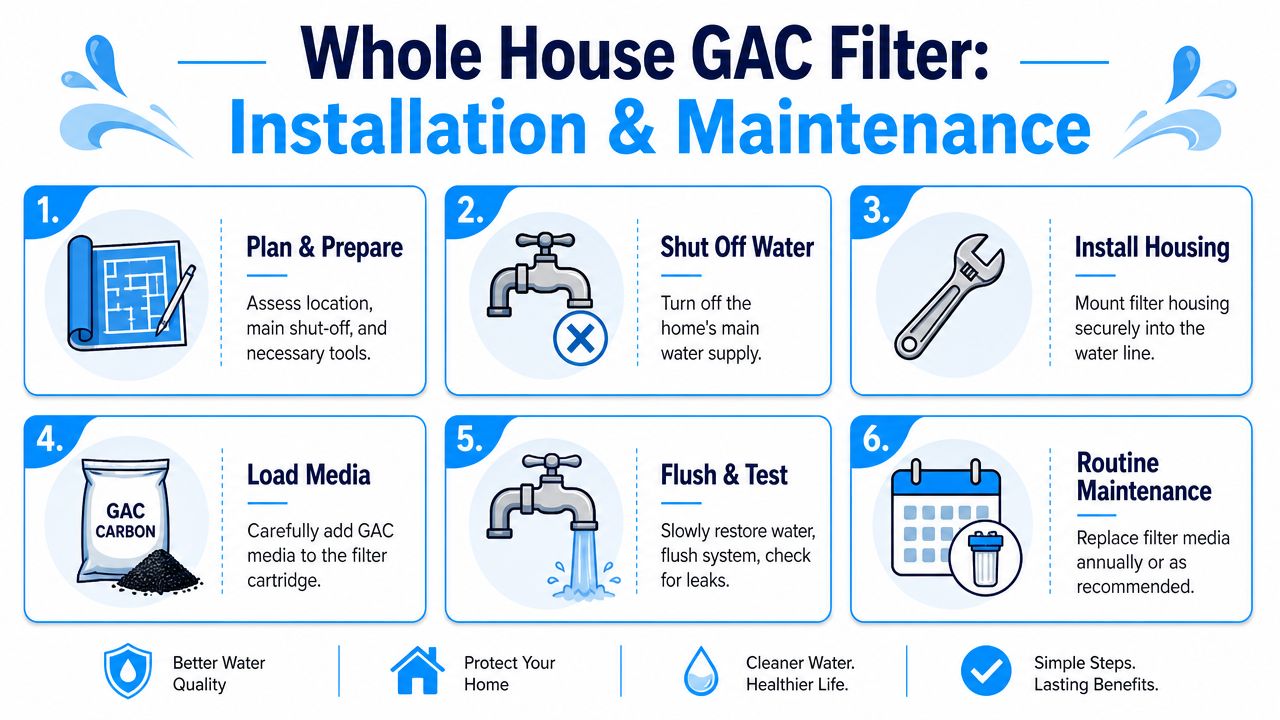
- Protect the bed: Use an upstream sediment prefilter where appropriate, backwash valve-equipped tanks according to the system's requirements, and schedule media replacement instead of waiting for a dramatic failure.
More carbon isn't automatically better. A larger bed can increase adsorption capacity, but dirty incoming water can turn that bed into a flow restriction and a maintenance burden.
Certifications and Quick Homeowner Water Tests
Certification names become useful when you connect them to a specific claim. NSF/ANSI 42 generally relates to aesthetic effects such as chlorine taste and odor. NSF/ANSI 53 addresses health-related contaminant claims, but the claim must identify the contaminant and the tested capacity. NSF/ANSI 401 covers certain emerging contaminants, again only when the product carries the relevant claim.
A general “carbon filter” label isn't enough. Look for the exact contaminant, rated capacity, flow condition, and replacement instruction. A product may reduce chlorine while having no tested claim for lead, mercury, PFAS, nitrate, or bacteria.
You can also create a simple household monitoring routine:
- Test chlorine: Use a free-chlorine DPD test or suitable strip at the kitchen tap before and after filtration.
- Check TDS: A TDS meter can show whether dissolved minerals remain, but it doesn't prove that the filter removes organic chemicals.
- Keep a short log: Record taste, odor, flow, pressure, and filter-change dates for a week or more.
- Test the source water: For well water or suspected PFAS, use a laboratory analysis that identifies the contaminants that matter.
A filter's certification and your water test answer different questions. Certification tells you what the product has demonstrated under a defined claim. Testing tells you whether that claim fits the water entering your home.
If a leak, flood, or plumbing incident has affected the treatment equipment, a broader water mitigation guide for Sarasota can help explain the remediation questions that sit outside ordinary filter maintenance.
Choosing the Right GAC Filter for Your Home
A sensible purchase starts with four questions:
- What's in the water? Chlorine and taste point toward carbon. Nitrate, hardness, microbes, and many metals require different treatment.
- How much water flows at once? Use peak demand, not a comfortable average.
- Where will the filter live? Under-sink, countertop, refrigerator, and whole-house systems solve different exposure and flow problems.
- Will you maintain it? A system you won't backwash, test, or replace won't deliver dependable treatment.
| Homeowner Scenario | Filter Class | Typical Size / Spec | Key Spec to Verify |
|---|---|---|---|
| Municipal water with chlorine taste at one tap | Countertop GAC pitcher or point-of-use cartridge | Small cartridge or pitcher | Chlorine claim and replacement guidance |
| Renter seeking filtered drinking water | Under-sink GAC system | 10-inch cartridge format may be suitable | Flow, cartridge certification, and installation space |
| Municipal water needing whole-house chlorine and odor reduction | Backwashing whole-house GAC tank | Around 1.0 to 1.5 cubic feet may be considered | EBCT, peak flow, backwash requirements, and headloss |
| Municipal water using chloramine | Catalytic carbon system | Size depends on flow and required contact time | Catalytic media documentation and chloramine claim |
| Well water with iron, manganese, turbidity, or microbes | Pretreatment plus contaminant-specific treatment | No universal GAC size | Laboratory water test, sediment control, and sanitation plan |
Two mistakes appear often. First, homeowners choose a tank that gives chlorine less than 5 minutes of contact or chloramine less than 10 minutes, which can leave too little reaction time. Second, they choose a tank too small to backwash the media properly, allowing sediment and biological growth to accumulate.
For additional buying and maintenance guidance, review the water filtration advice library. Water Filter Advisor is a consumer resource that compares filtration approaches, explains media and certifications, and helps households evaluate replacement and testing decisions.
Use this rule before you click “buy”: identify the contaminant, size for peak flow, verify the required contact time, and confirm that the maintenance schedule fits your household.
Water Filter Advisor can help you compare granular carbon, carbon block, catalytic carbon, whole-house tanks, and under-sink systems against your water concerns and flow requirements. Visit Water Filter Advisor to review practical buying guides, certification guidance, testing advice, and replacement checklists before choosing a filter.