
So, you're dreaming of crisp, clean water from every tap in your house. Fantastic idea! But before you dive in, that big question looms: "What's this going to cost me?" It's a smart question, and the answer isn't a simple one-size-fits-all number. Generally, most folks can expect to invest somewhere between $1,129 and $3,539 for the complete package—the filter system and professional installation.
Think of that range as your starting block. It gives you a solid financial ballpark before we get into the fun stuff, like different types of filtration magic, cool features, and what your home's unique plumbing situation looks like.
Your Quick Guide to Water Filter Costs
Trying to nail down the exact cost of a whole-house filter can feel a bit like playing darts in the dark. You see a price for a unit online, but that’s just one piece of the puzzle. What about the plumber's bill? Are there any sneaky hidden costs waiting to jump out? We’re going to illuminate the entire process for you, starting with the big-picture numbers.
Before you even start window shopping for filters, it’s a brilliant move to spend a little time understanding your home's plumbing system. A simple, straightforward setup will be much kinder to your wallet than a complex one that needs a bunch of modifications to welcome its new filtration buddy.
This chart lays out the typical cost spectrum beautifully. You've got your entry-level options for basic needs, the high-end systems for tackling serious water woes, and that sweet spot right in the middle where most homeowners find their perfect match.
As you can see, that average cost represents a fantastic balance: getting a powerful system that delivers amazing water without having to remortgage the house.
Breaking Down the Numbers
Your total bill is really two separate costs rolled into one: the hardware itself and the professional labor to get it installed. The latest numbers show that a typical whole-house filter installation in the U.S. runs from $1,129 to $3,539. The national average hovers right around $2,273 per household.
It’s crucial to know that this figure covers the unit and its initial installation. It doesn't include the ongoing costs, like swapping out filters or other maintenance down the road.
To give you a better feel for where your money goes, let's look at the costs for different kinds of systems. The technology inside the filter is the single biggest driver of its price tag.
Estimated Whole House Water Filter Costs At a Glance
This table gives you a quick snapshot of what you can expect to pay for the unit versus the installation for the most common system types. Think of it as a menu for your water purification journey.
| System Type | Average Unit Cost | Average Installation Cost | Total Estimated Cost |
|---|---|---|---|
| Sediment Filter | $100 – $400 | $300 – $600 | $400 – $1,000 |
| Carbon Filter | $400 – $1,500 | $400 – $800 | $800 – $2,300 |
| Water Softener | $800 – $3,000 | $500 – $1,000 | $1,300 – $4,000 |
| Multi-Stage System | $1,000 – $4,000+ | $600 – $1,500 | $1,600 – $5,500+ |
Just remember, these numbers are a starting line, not the finish line. Your final cost will definitely be influenced by what’s lurking in your water, the size of your house, and what plumbers charge in your neck of the woods.
The more you know, the more confident you'll feel about your choice. If you're thirsty for more tips and guidance on picking the right system, we've got a whole library of expert advice on water filtration you can check out.
Breaking Down Your Upfront Investment
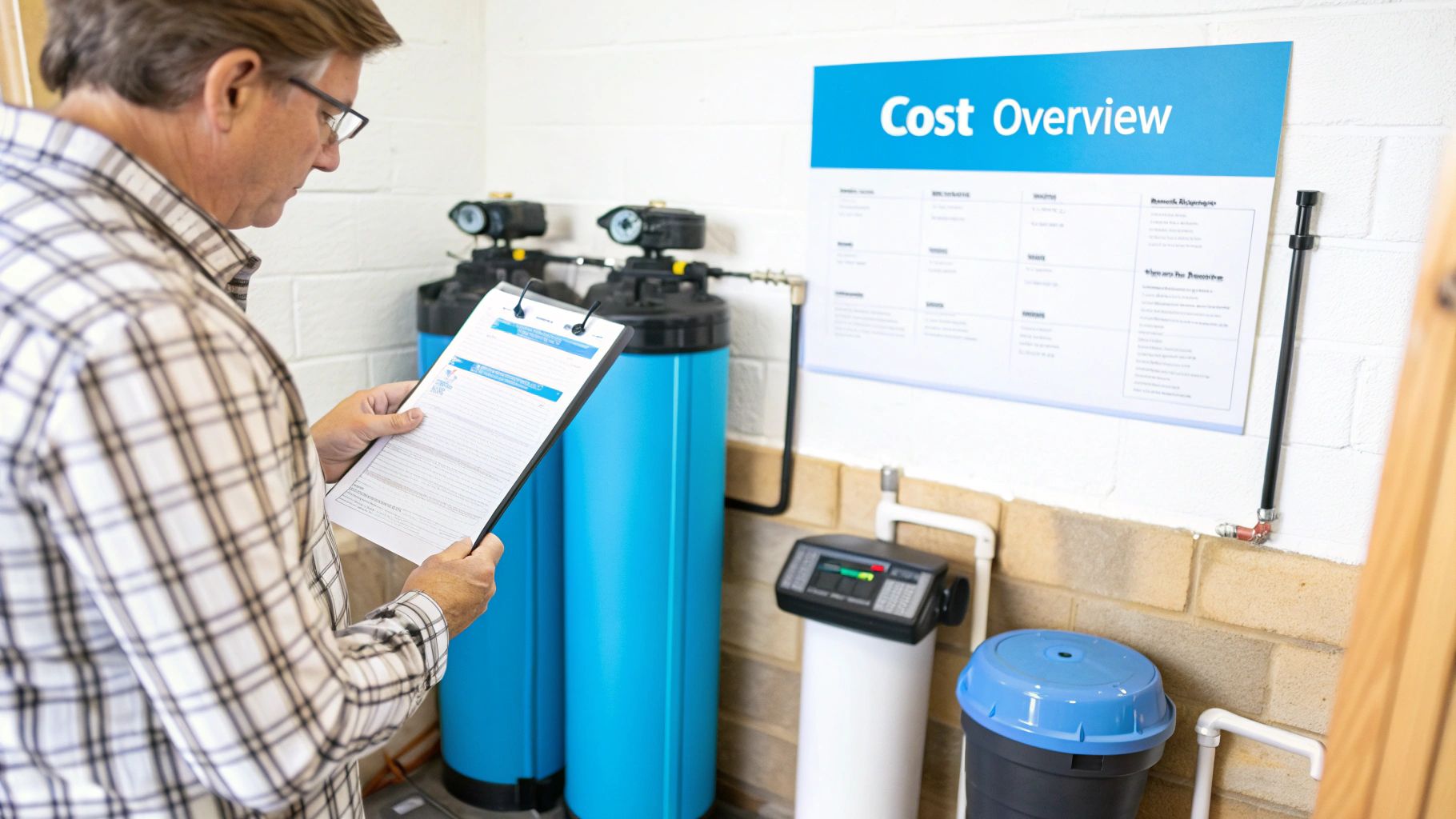
When a plumber hands you a quote for a whole house water filter, that initial number really covers two main things: the filter system itself and the cost to have a pro install it. It's a bit like buying a car. You can get a simple, reliable sedan that gets the job done perfectly, or you can spring for a high-performance luxury model packed with every bell and whistle. Both get you from A to B, but the experience—and the sticker price—are worlds apart.
That same idea applies here. The whole house water filter cost can vary wildly depending on your water goals. A basic sediment filter designed just to catch grit and rust will be on the lower end. On the flip side, you have sophisticated multi-stage systems that employ carbon filters, water softeners, and even UV purifiers to wage war on a whole host of water contaminants.
Sizing Up the System Cost
So, what determines the price of the actual hardware? A lot of it comes down to the size of your house and how much water your family uses. A bigger home with multiple bathrooms needs a system with a higher flow rate—measured in gallons per minute (GPM)—to keep the water pressure from plummeting when you’re running the shower, dishwasher, and washing machine all at once. Nobody wants a wimpy shower!
Systems with higher GPMs simply cost more. The brand and the quality of materials matter, too. You’ll often pay a premium for a well-known brand that has a solid warranty and the right certifications, but that extra cost buys you peace of mind and performance you can count on.
Let's look at what you can expect to pay for the equipment for common system types:
- Sediment & Carbon Filters: These are your go-to options for common problems. The equipment alone can run anywhere from $400 to $1,500. They're fantastic for tackling issues like chlorine taste and that swimming pool smell.
- Water Softener & Filter Combos: If you're fighting the good fight against hard water and other contaminants, these are a popular mid-range choice. The hardware for these systems usually falls between $800 and $3,000.
- Advanced Multi-Stage Systems: For tougher water challenges, like well water that’s full of iron or bacteria, you’ll need a more robust setup. These high-end units can cost anywhere from $1,000 to over $4,000 for the system alone.
The average cost to install a whole house water filtration system in major markets like the United States, Canada, and parts of Europe ranges from $1,200 to $5,800, with a typical homeowner spending around $2,500 for a mid-range system. This price range reflects the diversity of available systems, from basic single-stage filters to advanced multi-stage units with UV disinfection and water softening capabilities. You can explore more about these cost breakdowns and see what influences water filtration system prices.
Understanding Professional Installation Fees
After you've picked your champion filter system, the next piece of the puzzle is getting it installed. It can be tempting to save a few bucks with a DIY install, but for most people, this isn't a simple weekend project. Installing a whole house filter means cutting into your home's main water line, and that’s a job where you really can’t afford mistakes.
A professional plumber’s fee is for more than just connecting a couple of pipes. They'll assess your current plumbing, possibly reroute a few things, install a bypass valve so you can do maintenance later, and make absolutely sure every connection is watertight. A botched installation can lead to thousands in water damage, void your system’s warranty, and even render the filter useless.
Factors That Shape Installation Costs
The complexity of your home's plumbing is a huge factor. If your main water line is easy to get to in the basement or garage, the job is pretty straightforward and less expensive. But if the plumber has to start cutting into drywall or squeezing into a tight crawl space, you can expect the labor cost to go up. Sometimes, older homes need their plumbing updated just to handle the new system, which could add another $1,000 to $2,000 to the project.
On top of that, labor rates can be very different depending on where you live. A plumber in a big city is almost always going to charge a higher hourly rate than one in a small town. My advice? Always get quotes from a few different licensed and insured pros. That’s the best way to make sure you’re getting a fair price for quality work. Once you understand both the equipment and installation costs, you'll have the full picture of what you'll be paying upfront.
Planning for Long-Term Maintenance Costs
The sticker price on a whole house water filter is just the opening chapter of the story. To really get a handle on the whole house water filter cost, you have to look down the road at the ongoing expenses. This is what the pros call the total cost of ownership.
Think of it this way: are you making a one-time purchase or starting a subscription for amazing water? Some systems are more of a "set it and forget it" deal with big, infrequent expenses, while others need small, regular top-ups to keep things flowing beautifully.
The Two Paths of Maintenance Spending
When it comes to upkeep, whole house filters generally follow one of two paths. The first involves swapping out filter cartridges on a regular schedule—almost like a subscription service for clean water.
The other path involves large tanks filled with filtration media that basically clean themselves (a process called backwashing). These systems are low-maintenance for years until the day comes for a major, but very infrequent, media replacement. Each approach has its own rhythm and budget.
Breaking Down Cartridge Replacement Costs
Cartridge-based filters are incredibly popular, mostly because they don't hit the wallet as hard upfront and are pretty simple to understand. But their long-term cost is all about the replacement filters.
You'll have to factor in an annual maintenance cost, which can vary a lot but is never zero. The filters are the tireless workhorses here, grabbing all the gunk like sediment and chlorine. Once they're full, they have to be replaced. It's not optional if you want to keep your water pressure strong and your water quality high.
This is where that subscription idea really clicks. You might be changing filters every three months or maybe just once a year, depending on how much water you use and what's in it to begin with. These costs are predictable and need to be part of your long-term budget.
On average, you can expect to spend anywhere from $0 to $300 a year on maintenance. The higher end of that range is almost always for cartridge-based systems, which need regular filter changes every 6 to 12 months. Those replacement filters can run you $50–$200 a pop. For a deeper dive on these running costs, check out the analysis on WaterFilterGuru.com.
Understanding Media Lifespan in Tank Systems
Tank-style systems play a different game entirely. These big units are loaded with a bed of filtration media—think of it as a giant sponge of activated carbon or other specialized materials—that can go the distance. A good quality carbon media might last 5 to 10 years, sometimes even longer, before it's time for a refresh.
For most of the system's life, your maintenance costs are practically non-existent. The backwash cycle that cleans the media uses a bit of water and a negligible amount of electricity, but you're not buying anything regularly.
The catch? When the media finally gives up the ghost, you're looking at a pretty significant expense to replace it all. This can easily run several hundred dollars, depending on the tank size and media type. It’s a major one-time hit instead of a series of smaller payments.
Hidden Costs You Might Overlook
Beyond the obvious filters and media, a few other costs can pop up. It's smart to know about them so you're not caught off guard.
- UV Lamp Replacements: If your setup includes a UV purifier for zapping bacteria and viruses, that UV lamp needs to be replaced every single year. Plan on spending between $50 and $150 for a new one.
- Electricity Usage: Most simple filters are powerless, but if you have a UV lamp or an electronic head for a backwashing system, it will draw a small amount of electricity. It's not much—about the same as a small light bulb—but it's on 24/7.
- Professional Servicing: A lot of folks are comfortable changing their own filters, but some prefer to have a pro come out once a year to give the system a check-up. This can add $100 to $300 per visit but gives you peace of mind that everything's running just right.
5-Year Cost of Ownership Comparison
To really see how these two paths diverge, let's compare them side-by-side over a five-year period. This helps illustrate how the "cheaper" system upfront isn't always the most affordable in the long run.
| Cost Factor | Cartridge-Based System | Tank-Based (Backwashing) System |
|---|---|---|
| Initial Equipment | $300 – $800 | $800 – $1,500 |
| Annual Filter/Media Cost | $100 – $400 | $0 |
| Media Replacement (at Year 5) | N/A | $300 – $600 |
| Installation | $200 – $500 | $400 – $800 |
| 5-Year Est. Total Cost | $1,000 – $3,300 | $1,500 – $2,900 |
As you can see, while the tank-based system costs more to get started, its total cost can actually be lower over five years because you're not constantly buying replacement cartridges.
By looking past the initial price tag and planning for these real-world, long-term expenses, you can choose a system that not only gives you great water but also fits your family's budget for years to come.
Key Factors That Influence Your Final Price
Ever looked at two whole house water filters that seem almost identical and wondered why one costs double the other? That final number on the quote isn't just pulled out of a hat. It's a specific figure shaped by a handful of really important variables.
Getting a handle on these factors is your best bet for setting a realistic budget and avoiding any sticker shock. The final whole house water filter cost is much more than the price of the equipment; it’s a reflection of your home's unique setup, your local water chemistry, and the specific problems you're trying to fix. Let's pull back the curtain on what really drives the price.
Your Local Water Quality Is the Biggest Driver
If there's one thing that moves the needle on cost more than anything else, it's what's actually in your water. You can't pick the right tool for the job until you know what that job is. That's why getting a professional water test is always the best first step.
A good water test tells you exactly which contaminants you're up against, which in turn points you directly to the right type—and cost—of filtration system.
- Hard Water: Seeing spots on your dishes and dealing with scale buildup? You've likely got hard water, which is full of calcium and magnesium. You'll need a water softener or a hybrid filter-softener, which can add $800 to $3,000 to the equipment cost.
- Well Water Issues: Private wells can be a wild card. They often have unique challenges like bacteria, iron, or that rotten-egg sulfur smell. Tackling these means bringing in specialized gear, like a UV purifier for bacteria (another $300-$800) or a dedicated iron filter.
- Municipal Water Contaminants: Even city water, which is treated, often has chlorine or chloramine that can make it taste and smell off. A solid carbon filter is a must, but if your local water report shows other issues, you might need to step up to a more advanced system.
When considering filtration technologies, the choice of a whole house reverse osmosis systems can be a significant factor in your overall investment. These systems offer one of the highest levels of filtration but also come with a higher price tag and more complex installation requirements.
Home Size and System Capacity
Next up is the size of your home and how much water your family actually uses. This all comes down to a measurement called gallons per minute (GPM), which is simply how much filtered water the system can deliver at any given moment.
A smaller home with one or two bathrooms might get by just fine with a 10 GPM system. But think about a bigger house with four bathrooms—if someone's showering while the dishwasher and washing machine are both running, you'll need a much higher flow rate (maybe 15-20 GPM) to keep the water pressure from tanking. As a rule of thumb, higher GPM capacity equals a higher equipment cost.
Plumbing Complexity and Regional Labor Rates
The installation itself is the last big piece of the cost puzzle. Plain and simple, the easier it is for a plumber to get to your main water line, the less you'll pay in labor. If your main line is sitting out in an open basement or garage, the job is usually pretty straightforward.
But if the plumber has to start cutting into drywall, squeezing into a tight crawlspace, or re-routing pipes to make it fit, the clock starts ticking and the cost goes up. For older homes, in particular, these kinds of plumbing modifications can sometimes add another $1,000 to $2,000 to the bill.
And don't forget, where you live makes a huge difference. Labor rates for licensed plumbers can vary wildly from one city to the next. A plumber in a major metro area is almost guaranteed to have a higher hourly rate than one in a small town. The only way to know what's fair in your area is to get a few different quotes from local pros.
Thinking About Your Return on Investment
It's easy to look at the whole house water filter cost as just another household expense. But that's not really the right way to think about it. This is a true home investment, and it starts paying you back the moment it's up and running. When you shift your perspective, you stop focusing on the upfront cost and start seeing the real, long-term value it brings.
Forget about money going out the door. Let’s focus on the money that stops leaving your wallet. The most obvious payback? Saying goodbye to bottled water and those flimsy pitcher filters for good.
Ditching Disposable Water Costs
When you actually do the math on bottled water, the numbers are pretty shocking. A typical family can easily blow through $400 to $1,000 every single year on single-use plastic bottles. Pitcher filters might seem like a bargain at first, but those replacement cartridges add up fast, often costing a few hundred dollars annually.
A whole-house system changes the game completely. Suddenly, every faucet in your home delivers clean, fantastic-tasting water. Those repetitive costs? Gone. For many families, the system literally pays for itself in just a few years from these savings alone.
Protecting Your Major Appliances
The savings go way beyond your grocery bill. Some of the biggest returns are hidden inside your home's most expensive equipment. Hard water minerals and sediment are the silent killers of your plumbing and appliances.
Think of limescale buildup as cholesterol for your home's pipes. It slowly restricts water flow, forcing your dishwasher, washing machine, and water heater to work much harder, which drastically cuts down their lifespan.
A whole-house filter acts like a bodyguard for your most important appliances by filtering out all that damaging gunk. Preventing just one premature water heater replacement—a job that can easily cost $1,500 or more—gives you a massive return on your initial investment.
This kind of proactive protection means fewer frantic calls to the plumber, lower energy bills because your appliances run more efficiently, and getting the full, expected life out of the machines you depend on every day.
Unlocking Priceless Peace of Mind
Of course, not every return on investment shows up on a bank statement. Some of the most important benefits are the ones that simply make your life better. There’s a powerful sense of reassurance that comes from knowing your family is drinking, cooking, and bathing in safer, cleaner water.
This peace of mind also applies to your home itself. A whole-house filtration system is a very attractive feature for potential buyers, which can boost your property’s resale value and make it stand out in a competitive market.
When you look at the whole picture, a whole-house filter delivers value in three critical ways:
- Direct Financial Savings: You immediately cut out spending on bottled water and disposable filters.
- Asset Protection: You make your expensive appliances and plumbing last longer, saving you from huge repair and replacement bills down the line.
- Enhanced Quality of Life: You get the priceless benefit of clean, safe water from every tap and a more valuable home.
Add it all up, and that initial cost doesn't look like an expense anymore. It’s a smart, strategic investment in your family's health, your home's future, and your financial well-being.
Your Top Questions About Water Filter Costs, Answered
When you're looking into a big home upgrade like a whole house water filter, you're going to have questions. It's totally normal. Trying to nail down a budget, figure out the installation, and know what you actually need can feel like a lot to juggle.
To make it easier, we've pulled together the most common questions we hear from homeowners about the whole house water filter cost. Here are the clear, no-nonsense answers you're looking for.
Can I Save Money By Installing a Filter Myself?
This is the age-old DIY question, right? Can you save a good chunk of cash by installing the system yourself? The short answer: yes. You could potentially save several hundred to over a thousand dollars on professional labor. But—and this is a big one—this is a project where the risks can easily eclipse the savings if you don't know exactly what you're doing.
Installing a whole house filter isn't like changing a showerhead. You're cutting into your home's main water line, the absolute artery of your entire plumbing system. A proper install requires real plumbing skills—things like soldering copper pipes, using the right fittings for PEX or PVC, and making sure every single connection is rock-solid and leak-proof under pressure.
One tiny mistake here doesn't mean a small drip. It can lead to a catastrophic flood and thousands in water damage. On top of that, most manufacturers will void their warranty if the system isn’t put in by a licensed pro. Unless you have serious plumbing experience and all the right tools, hiring a professional is almost always the safer—and smarter—bet.
How Do I Know Which Filter System My Home Needs?
Figuring out the right system is all about matching the filter technology to your specific water problems. Dropping a ton of money on the most advanced, feature-packed system is a waste if it's designed to fix issues your water doesn't even have. The most critical first step? Get your water tested.
You've got two main routes for this:
- DIY Test Kits: You can grab these at any home improvement store. They’ll give you a basic read on things like chlorine, pH, and water hardness. They're a decent starting point for flagging common issues.
- Certified Lab Testing: This is the gold standard. Sending a water sample to a state-certified lab gives you the complete picture. You'll get a detailed report identifying a whole range of contaminants, from heavy metals and VOCs to bacteria and industrial chemicals.
Once you have that report, the right choice becomes obvious. High chlorine? A carbon filter is your answer. Hard water minerals? You need a water softener. Bacteria from a well? A UV purifier is non-negotiable. This data-first approach ensures your whole house water filter cost is a smart investment, not a shot in the dark.
Don’t guess what’s in your water. A water quality report is your roadmap to effective filtration. It takes the speculation out of the equation and empowers you to choose a system that solves your specific problems without wasting money on unnecessary features.
Are There Financing Options Available?
Absolutely. The upfront cost of a quality whole house system can feel steep, but you almost never have to pay for it all at once. Financing is a very common way homeowners make the investment fit comfortably into their budget.
Many water treatment companies and professional plumbers work with third-party lenders. Through these partnerships, they can offer some great financing plans, often with decent interest rates and flexible monthly payments. It's probably the most common way people handle the initial cost.
You can also check out a few other options:
- Home Improvement Loans: Your bank or credit union likely offers personal loans made specifically for home upgrades.
- HELOC (Home Equity Line of Credit): If you've got equity in your home, a HELOC can be a low-interest way to fund the project.
- Manufacturer Financing: Some of the big filter brands offer financing directly to customers. It’s always worth a look on their websites.
By checking out these routes, you can find a payment plan that works for you, letting you get the benefits of clean water right away without the financial stress.
Does a Filter Really Improve Water Taste and Smell?
Yes, without a doubt. In fact, this is usually the very first thing homeowners notice—sometimes just hours after the system is up and running. If you're on city water, the change can be night and day.
Municipal water is treated with chlorine or chloramine to keep it safe, but that often leaves it with that distinct "public pool" taste and smell. A whole house system with an activated carbon filter is a superstar at tackling this. Carbon basically acts like a magnet, grabbing onto the compounds that cause those funky tastes and odors. The result? Water from every single tap—the kitchen sink, the bathroom, the shower—is fresh, crisp, and clean.
It’s just as big of a deal for well water, too. Filters can completely eliminate that "rotten egg" smell from hydrogen sulfide or the metallic taste from high iron levels. This one change can honestly transform how you feel about your home's water.
Ready to stop wondering and start enjoying clean, great-tasting water from every faucet in your home? At Water Filter Advisor, we provide the expert reviews and straightforward guides you need to choose the perfect system. Explore our in-depth resources and find the right solution for your family and budget today at https://www.waterfilteradvisor.com.
- December 2, 2025
- 0
- Uncategorized
