You're standing at the sink with a water report in one hand and a filter shopping tab open in the other, trying to make sense of numbers that all seem to blur together. pH gets most of the attention, but alkalinity is the quiet line that often tells you whether your water will stay steady, swing around, or make your filter work harder than it should. For homeowners focused on filtration, that difference matters just as much as taste, because the wrong choice can leave you with scale, corrosion, or a cartridge that doesn't behave the way you expected.
The Water Report Puzzle Most Homeowners Miss
A lot of water reports look straightforward until you reach the line for alkalinity. It sits there beside pH, and it's easy to assume they're two ways of saying the same thing, but they aren't. pH tells you the water's current acidity or basicity, while alkalinity tells you how much the water can resist a change when acid shows up.
That's why two samples with the same pH can act very differently in your home. One might shrug off a bit of acidic water from plumbing or treatment changes, while the other shifts fast and starts creating trouble for copper pipes, a coffee maker, or a filter that depends on stable chemistry. The number is really about buffering capacity, not a snapshot of how “basic” the water looks at the moment (USGS water science on alkalinity and water).
What that means at the kitchen sink
Think of pH as the water's current mood and alkalinity as its patience. Water with higher alkalinity has more reserve, so it takes more acid to change that mood. Water with low alkalinity has less reserve, so even a small chemical shift can move it quickly.
That reserve matters to filtration because filters don't work in a vacuum. If your water has weak buffering, a treatment step that changes pH can be less predictable, and the same issue can affect corrosion control and taste. The key question isn't just “What is alkalinity in water?”, it's “How does this water behave once it's inside my plumbing and filtration system?”
Practical rule: don't read pH alone and call it the full story. If alkalinity is low, pH can move more easily after treatment or contact with acidic materials.
Alkalinity and pH Are Not the Same Thing
A water report can show a pH that looks fine and still leave you with water that reacts badly in plumbing or treatment. pH is the reading you have right now, while alkalinity is the reserve that keeps that reading from changing too easily (Thermo Fisher alkalinity basics).
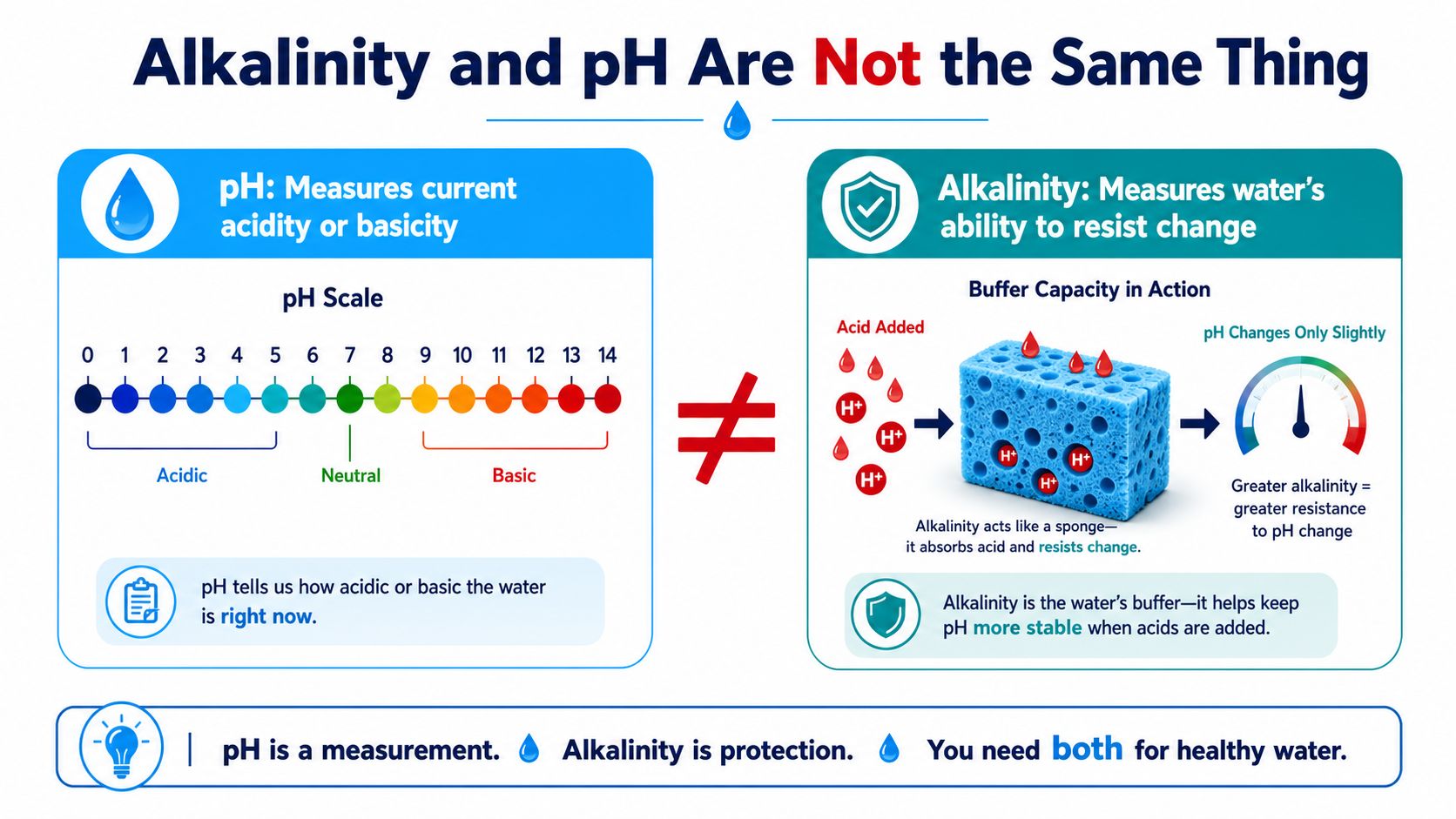
pH works like the water's current mood. Alkalinity is the cushion behind it, the part that absorbs an acid hit before the chemistry swings too far. Two samples can share the same pH and still behave very differently in a house, because one has more buffering reserve than the other.
Why the unit on the report looks odd
Most North American reports express alkalinity as mg/L as calcium carbonate, or CaCO3. That format gives labs and homeowners a common reference point, and it also helps connect the test result to everyday treatment decisions, including whether you need to protect your facility with water testing (Canadian guidance excerpt on ppm and mg/L as CaCO3).
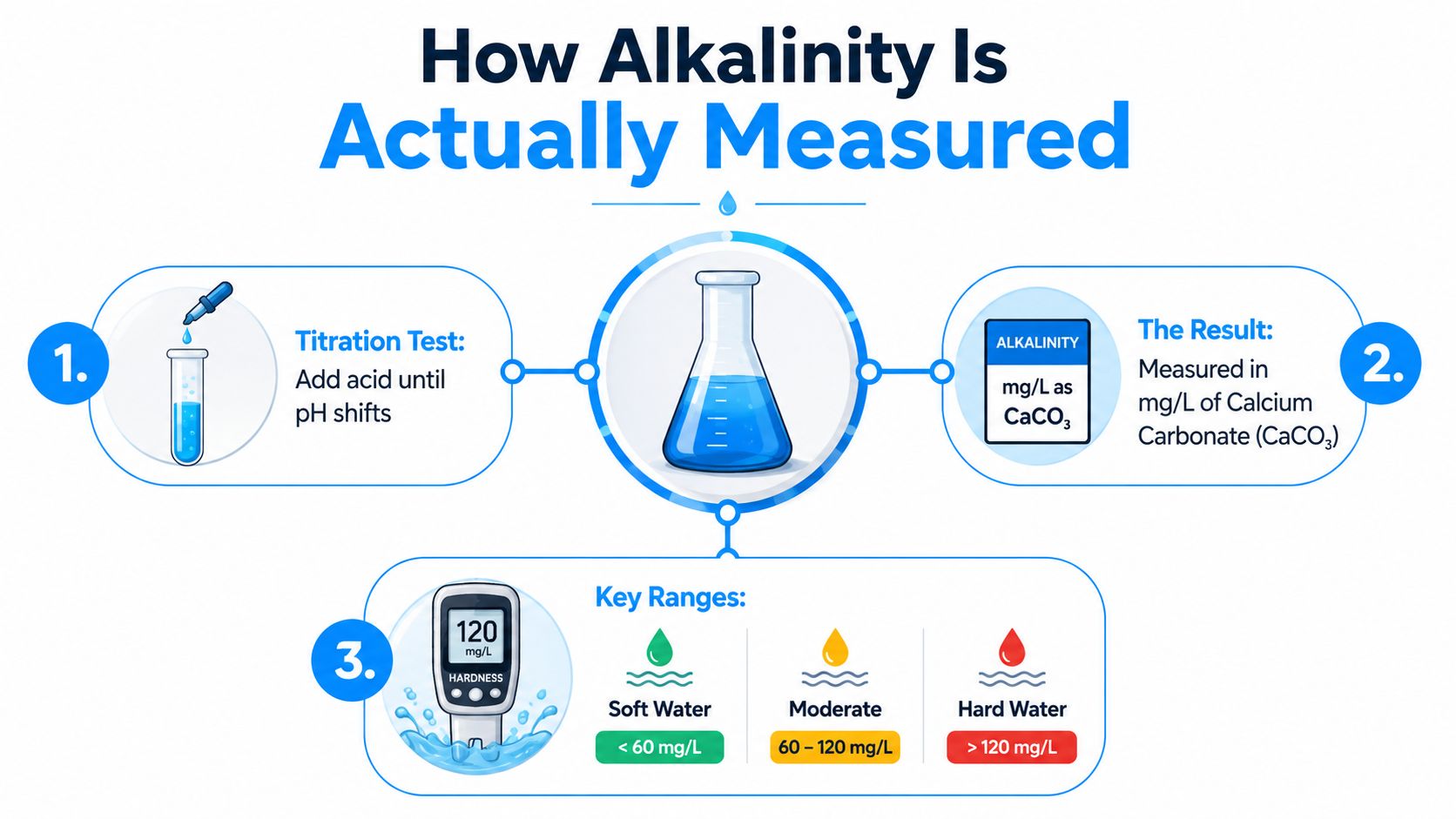
You may also see alkalinity described through acid titration to about pH 4.2, the endpoint used to measure how much acid the sample can absorb before its buffering reserve is used up (U.S. EPA archived method). That is what turns a chemistry idea into a usable number on a report.
The report is not judging whether your water is “good” or “bad.” It is showing how much resistance the water has before its chemistry starts to shift.
How Alkalinity Is Measured
A water test for alkalinity starts with a controlled acid challenge. A lab adds acid in a steady way and watches how much it takes to push the sample to the standard endpoint, around pH 4.2. The more acid the water can absorb before reaching that point, the more buffering reserve it has. That is why alkalinity results help explain why one source of water stays steady while another shifts more easily.
The result is then reported as mg/L CaCO3, which gives everyone the same reference point when reading a water report. In water-chemistry reporting, 1 ppm equals 1 mg/L for this format, so homeowners may see the same number written either way. That is one reason the label can look unfamiliar at first, even though the meaning is straightforward once you know what the lab is measuring.
The ranges homeowners need
Water reports often group alkalinity into practical bands: under 20 mg/L as CaCO3 is very low, roughly 20 to 160 mg/L is moderate, and above 160 mg/L is high. Those bands help you read the water in terms that matter at home, not just in a lab notebook. A sample can also be described in more general guidance as sitting in a middle zone that gives the water enough reserve without pushing too far toward scale.
For a homeowner, those ranges are less about chemistry labels and more about how the water behaves in the house. Very low alkalinity can leave water quick to change, which matters if plumbing or treatment nudges the water acidic. Higher alkalinity can make water more likely to leave scale behind. That becomes part of filter selection, because a filter that changes mineral balance or treatment response may make sense in one home and not in another.
If you are testing a home system and need to verify what the numbers mean before buying equipment, pairing alkalinity testing with broader water-quality screening gives a clearer picture. That is the point of protect your facility with water testing, you are not guessing at the chemistry behind the tap.
What Low, Moderate, and High Alkalinity Mean at Home
A water test result makes more sense once you connect it to what happens at the tap. Low alkalinity means the water has less buffering reserve, so it changes more easily when it meets acidic conditions in plumbing or treatment. Moderate alkalinity usually gives a steadier middle ground. High alkalinity can hold pH more firmly, but it can also leave mineral residue behind.
| Alkalinity Ranges and What They Mean at Home | ||
|---|---|---|
| Range (mg/L as CaCO3) | Typical Home Effects | What to Watch For |
| Under 20 | Water can change quickly, and plumbing chemistry may be less stable | Corrosion risk, pH swings, inconsistent treatment |
| 20 to 160 | More predictable buffering in everyday use | Usually easier to manage with standard filtration |
| Above 160 | Strong reserve, but more likely to leave mineral deposits | Scale on heaters, kettles, and membranes |
Low-alkalinity water is often the quiet troublemaker in a house. It may taste flat, and it may be less forgiving if your plumbing or treatment setup nudges the water acidic. In homes with copper piping, that matters because unstable water chemistry can encourage corrosive behavior.
Moderate alkalinity is the comfort zone for many homes. The water has enough reserve to resist quick swings, so filters and treatment changes tend to behave more predictably. That does not mean every system is identical, but it does mean the water usually gives you a more stable starting point.
High alkalinity works differently. The water can resist acid well, which sounds helpful until mineral deposits start showing up on hot surfaces and inside equipment. That is why the same alkalinity number can point two homes toward different filter choices, depending on whether the bigger concern is corrosion, scale, or how a treatment system will respond.
Homeowner takeaway: read alkalinity as the water's reaction habit. You are not just checking a number, you are checking whether the water tends to stay calm or leave a mess behind.
How Alkalinity Shapes Your Filtration Choices
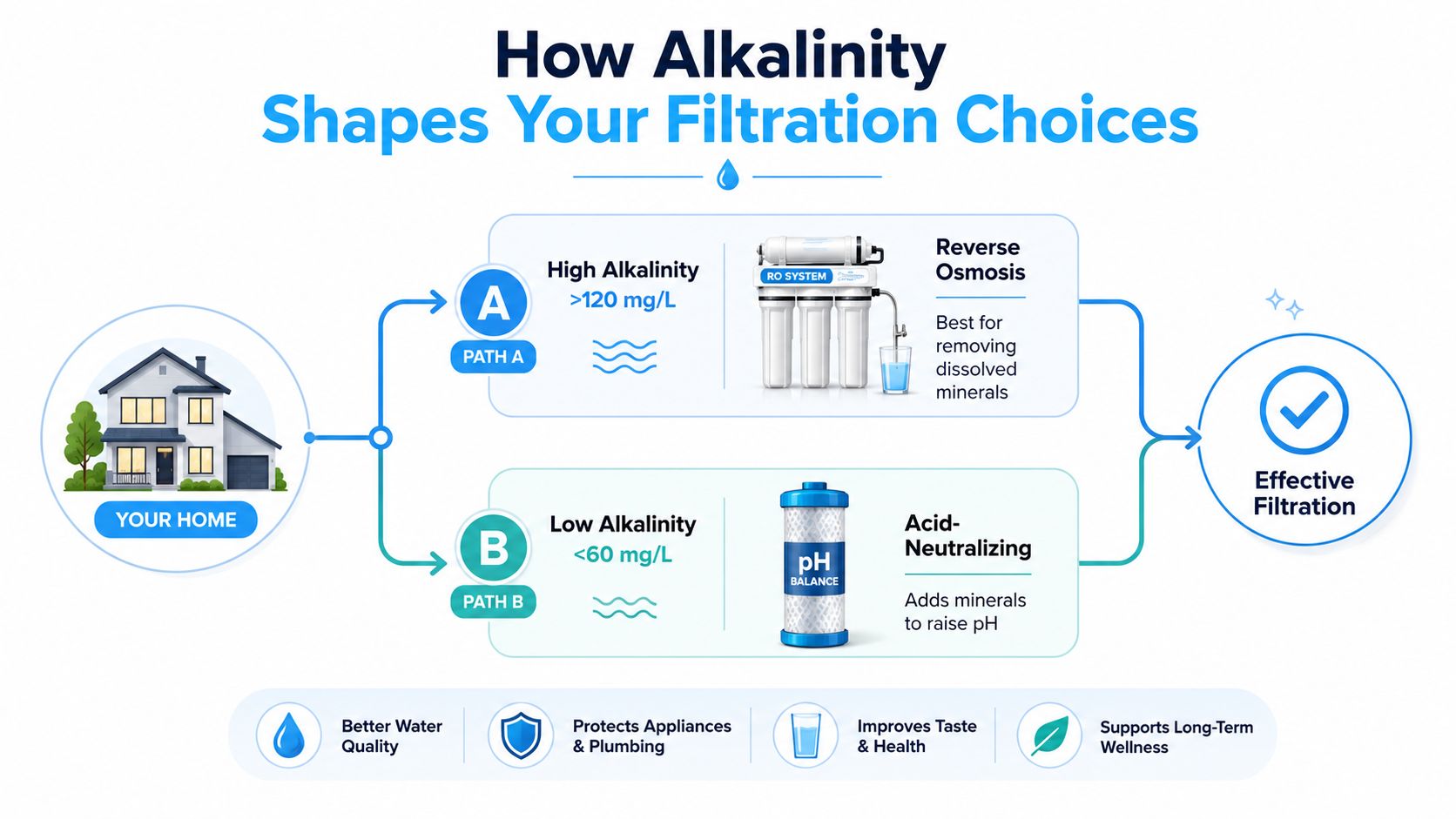
Alkalinity changes the filter decision because it changes what the water needs before and after treatment. A home with low alkalinity often needs help stabilizing chemistry, especially if the goal is to protect plumbing and keep pH from dropping around metals. A home with high alkalinity may need a system that reduces dissolved mineral load and helps slow scaling on sensitive equipment, especially in reverse osmosis setups.
Matching the system to the water
For low-alkalinity water, an acid-neutralizing or remineralizing approach can make sense because it adds buffering and helps the water act less aggressive toward plumbing. That's especially relevant when you're trying to keep a home system stable instead of reacting to repeated pH drift. For high-alkalinity water, reverse osmosis is often the more useful point-of-use option when the goal is to reduce mineral taste and manage the dissolved material that contributes to scale.
Cartridge life also depends on this chemistry. If the water has little buffering, a filter doing chemical balancing may have to work harder to keep performance stable. If the water carries high alkalinity, scale management becomes part of the maintenance picture, especially for membranes and heating equipment.
Water Filter Advisor publishes guidance on alkaline water filters that emphasizes testing both the source water and the filtered water, which is the right habit when you're trying to see whether a filter changed the chemistry in a meaningful way. It also explains that pH tells you whether water is more acidic or more alkaline, which is why the report needs to be read as a whole rather than by one number alone.
Common Myths About Alkaline Water and Alkalinity
The word “alkaline” gets used in marketing so often that it's easy to confuse chemistry with a health claim. Alkalinity in the water-quality sense is buffering capacity, not a promise that the water is healthier, better, or more nourishing. It tells you how the water behaves when acids enter the picture.
Another common mistake is assuming high pH always means high alkalinity. That isn't true. A sample can have a similar pH to another sample and still respond very differently to acid because its buffering reserve is lower or higher.
What to ignore and what to trust
Ignore the urge to chase a magic pH number. That number alone doesn't tell you whether your filtration setup will stay stable, whether your copper piping is happy, or whether your RO membrane is going to see more scale than you expected. Trust the actual report line for alkalinity, because that's the number that speaks to reserve and resistance.
The simple way to stay grounded is to look at the chemistry you already know. pH is current condition. Alkalinity is buffering capacity. Once you separate those two ideas, the marketing language loses a lot of its power.
Reading Your Own Water Report With Confidence
Start with the alkalinity line, sometimes labeled Total Alkalinity, and note whether it's reported as mg/L as CaCO3. Then place it into the low, moderate, or high range you saw earlier, because that gives you the quickest read on how the water will behave in the home.
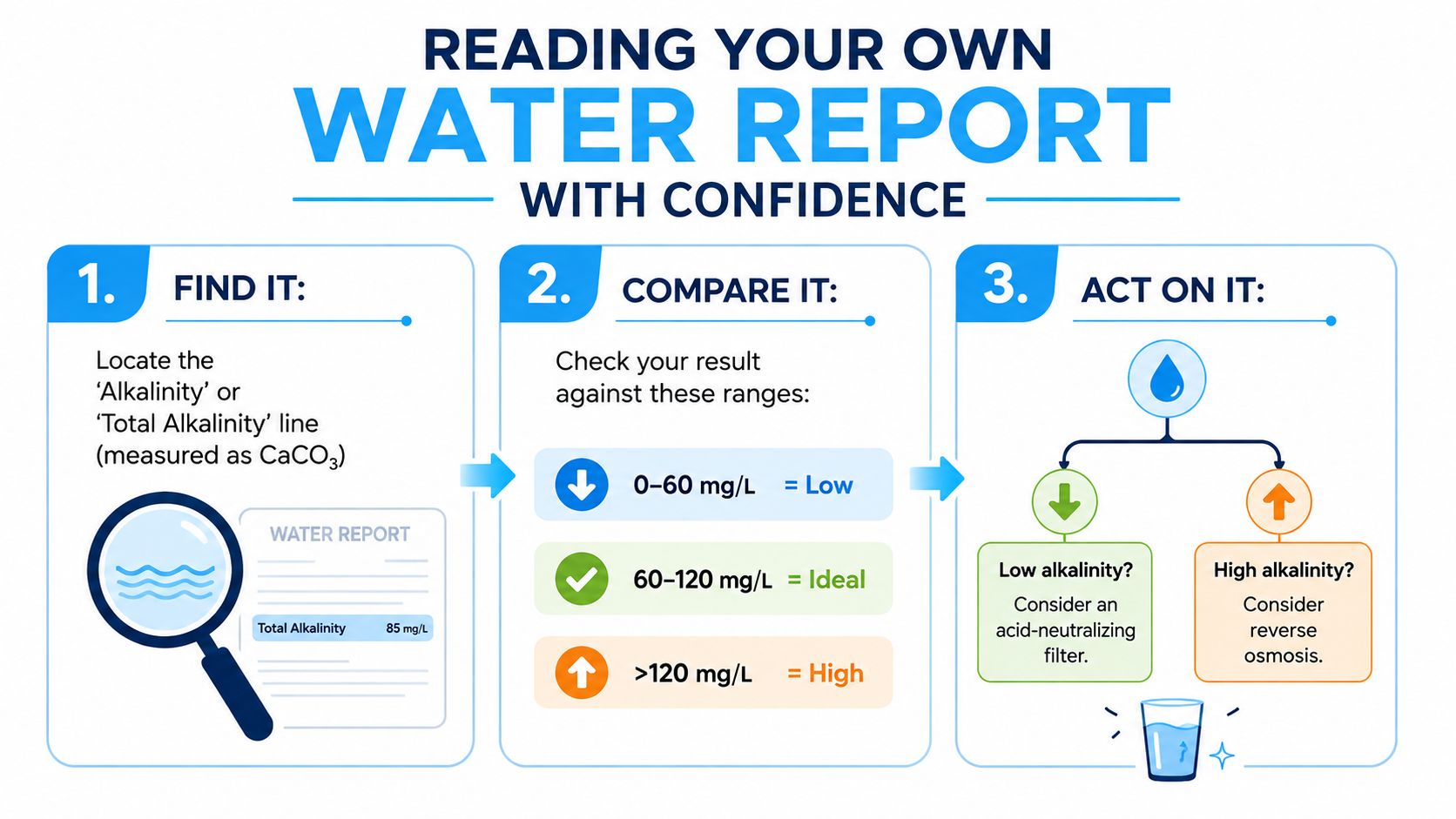
- Find it. Look for Alkalinity or Total Alkalinity, and confirm the unit.
- Compare it. Use the range as a guide, low, moderate, or high.
- Act on it. Low alkalinity can point you toward an acid-neutralizing filter, while high alkalinity may push you toward reverse osmosis.
If your home has known lead plumbing, don't stop at alkalinity. Pair it with a dedicated lead test, because buffering capacity alone can't tell you what metals are in the water. For more practical help with choosing and maintaining home systems, use the advice hub at Water Filter Advisor's guidance page.
If you want to turn your water report into an actual filtration decision, Water Filter Advisor can help you compare home systems, understand what the numbers mean, and match treatment to your source water. Visit Water Filter Advisor to explore practical buying guides, testing tips, and maintenance advice that fit real homes.
- August 9, 2026
- Uncategorized
