A water quality standard sets the legal or scientific limit for a contaminant, and two concrete U.S. benchmarks are 0.080 mg/L for total trihalomethanes and a 0.015 mg/L lead action level. Those numbers tell you whether a regulated system meets a public-health threshold, but they don't automatically describe the water coming from your own faucet.
You turn on the kitchen tap before work, fill the kettle, and notice a swimming-pool smell. The city says its water complies with applicable requirements, yet the taste bothers you, and you're still wondering whether old plumbing could add lead between the treatment plant and your glass. That situation captures the practical gap between public water compliance and household water quality.
Water quality standards are the legal and scientific guardrails that agencies such as the U.S. Environmental Protection Agency and the World Health Organization use to protect public health. They cover contaminants, treatment performance, sampling, and the way utilities manage risks from the source through distribution.
For a homeowner, the useful question is not just, “Is my water safe?” It's more specific: What does my utility report, what reaches my tap, and which filter certification matches the problem I'm trying to solve?
Understanding Your Water Quality Standards
A city water system can meet its regulatory obligations while your household still experiences chlorine taste, odor, sediment, or plumbing-related concerns. Compliance describes performance against defined rules and sampling requirements. It doesn't promise that every faucet in every building will have identical taste or the same exposure conditions.
Consider a home with an older service line or interior plumbing. The utility may deliver treated water that meets its requirements, but water sitting in household pipes can behave differently from water sampled at the treatment plant. A filter chosen for the actual issue, such as certified lead reduction or chlorine reduction, can address that point-of-use concern more directly than a broad “purification” claim.
Practical rule: Treat a compliance report as a starting point for a filtration decision, not as a substitute for understanding your own faucet.
The framework behind modern standards
The World Health Organization's drinking-water quality framework provides the scientific point of departure for national regulation and standard setting. Its model connects three elements:
- Health-based targets: Authorities define protective goals for hazards and contaminants.
- Water Safety Plans: Utilities manage risk from the catchment or source through treatment and distribution to the consumer.
- Independent surveillance: Oversight verifies that standards are being met over time.
That approach matters for filtration because water safety isn't just a single test at the tap. Source protection, treatment barriers, distribution integrity, sampling, and corrective action all contribute to the result you receive at home.
WHO guidance also says national standards should remain locally relevant while staying grounded in public-health protection. A rule designed for one region may not address the same source-water conditions as a rule in another region. That's one reason homeowners should match a filter to a documented contaminant rather than assume every certified system removes everything.
Why a compliant supply can still need filtration
Taste and odor complaints often point to aesthetic issues rather than a regulatory violation. Chlorine can remain in water because utilities use disinfection to control microbial hazards, while plumbing materials can influence what happens after treated water leaves the utility.
A point-of-use filter, such as an under-sink carbon system, targets drinking and cooking water. A whole-house system treats water entering the home and may make more sense when the concern affects showers, laundry, or multiple fixtures. The right choice depends on the contaminant, its location in the supply chain, and the filter's tested claim.
The History of Federal Drinking Water Regulations
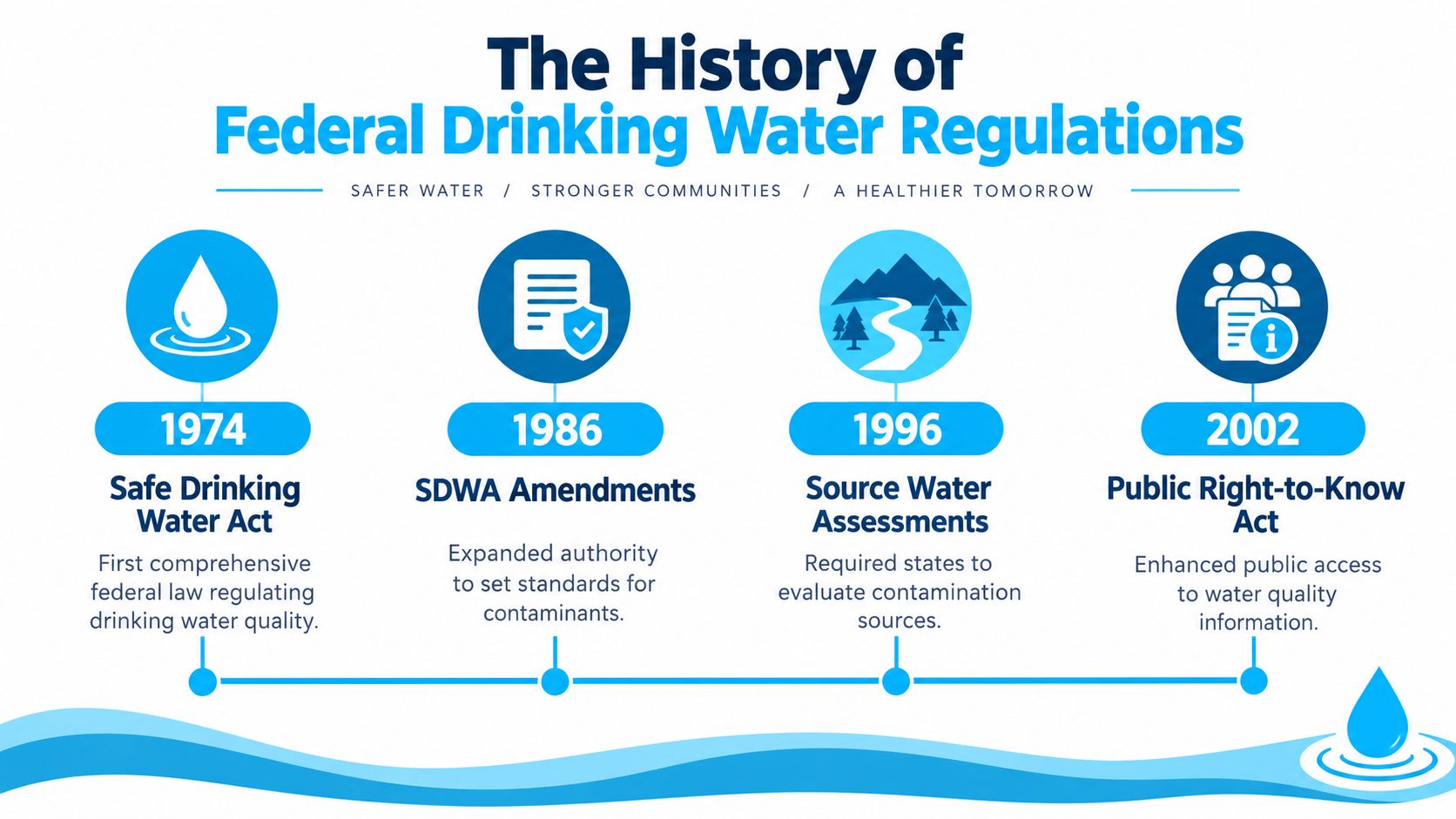
Modern U.S. drinking-water rules developed in layers. The Safe Drinking Water Act was enacted in 1974, creating the major federal structure that still shapes public drinking-water regulation. Before that framework expanded, federal oversight covered a much smaller group of standards.
The EPA and CDC history of drinking-water regulation explains how the system changed through later amendments. The 1986 amendments required the EPA to issue regulations for 83 specified contaminants by June 1989, a major acceleration compared with the earlier pace of federal standard setting. The EPA now says it has established protective drinking-water standards for more than 90 contaminants.
From contaminant limits to treatment controls
The important shift wasn't only the number of contaminants covered. Drinking-water regulation also developed requirements for treatment performance, including processes such as disinfection and filtration. That distinction matters because a utility may control risk through a treatment barrier rather than by measuring a contaminant only after it reaches the finished water.
The 1996 amendments strengthened the system by emphasizing periodic review and risk-based regulation. This helped move federal policy toward a broader public-health regime that considers microbes, chemicals, treatment processes, source water, and changing knowledge.
For homeowners, the history explains why an older home can present a different filtration question from a newer one. The public utility's treatment process may be effective, yet the final stretch through a service line, building plumbing, faucet, or storage tank can create household-level variation.
What the history means at the tap
A city report reflects the regulated system's monitoring and compliance record. It may not identify every condition inside a private building. A home test can therefore complement, rather than replace, the utility report.
The practical lesson is simple. Federal standards establish a baseline, but a homeowner still has to identify whether the concern is source water, distribution, or indoor plumbing. A filter certified for the relevant contaminant can then serve as a targeted barrier, provided the system is installed and maintained according to its instructions.
Differences Between Standards and Guidelines
The words standard and guideline sound interchangeable, but they carry different regulatory weight. A U.S. EPA drinking-water regulation can create an enforceable requirement for a public water system. WHO guidelines, by contrast, provide scientific recommendations that inform national or regional rules.
The WHO drinking-water guideline framework states that its guidelines aren't mandatory limits. They serve as the scientific point of departure for local standards and use health-based targets, Water Safety Plans, and surveillance to manage risk across the supply chain. WHO also defines a guideline value as a concentration that shouldn't create significant lifetime health risk under the assumptions used to establish it.
How an EPA benchmark works
An EPA regulation translates a health concern into an operational requirement. The EPA National Primary Drinking Water Regulations list a maximum contaminant level of 0.080 mg/L for total trihalomethanes, or TTHMs. These disinfection byproducts can form during chlorination, particularly when organic precursors and disinfectant contact conditions support their formation.
The same EPA table lists a lead action level of 0.015 mg/L. Lead usually enters drinking water through corrosion of plumbing and fixtures rather than from the source water itself. That difference changes the filtration decision: a utility-wide treatment adjustment and a point-of-use filter address different parts of the risk pathway.
| Term | Plain-language meaning | Home filtration implication |
|---|---|---|
| Guideline | Scientific advice that informs local rules | Use it to understand the health rationale, not as proof that a product removes a contaminant |
| Maximum contaminant level | A regulated concentration for a public water system | Compare the utility's reported result with the applicable limit |
| Action level | A trigger for additional system action based on tap sampling | Treat the sampling result and plumbing context as important signals |
| Filter claim | A product-specific reduction claim tested under a certification standard | Confirm the exact contaminant claim before buying |
Legal compliance isn't the same as zero exposure
A legal limit doesn't mean the water contains no contaminant. It means the system is evaluated against a defined regulatory benchmark, using the sampling and compliance approach established by the relevant authority.
Lead illustrates the distinction especially clearly. The EPA's lead information says EPA and CDC emphasize that lead has no safe level of exposure, while EPA sets the lead maximum contaminant level goal at zero. If more than 10% of tap samples exceed the 15 ppb lead action level, the water system must take additional actions.
For a household, that means a filter decision should consider both the public report and the actual tap. Look for a certification claim specifically covering lead reduction instead of relying on a general statement that a product improves water quality.
How to Read Your Consumer Confidence Report
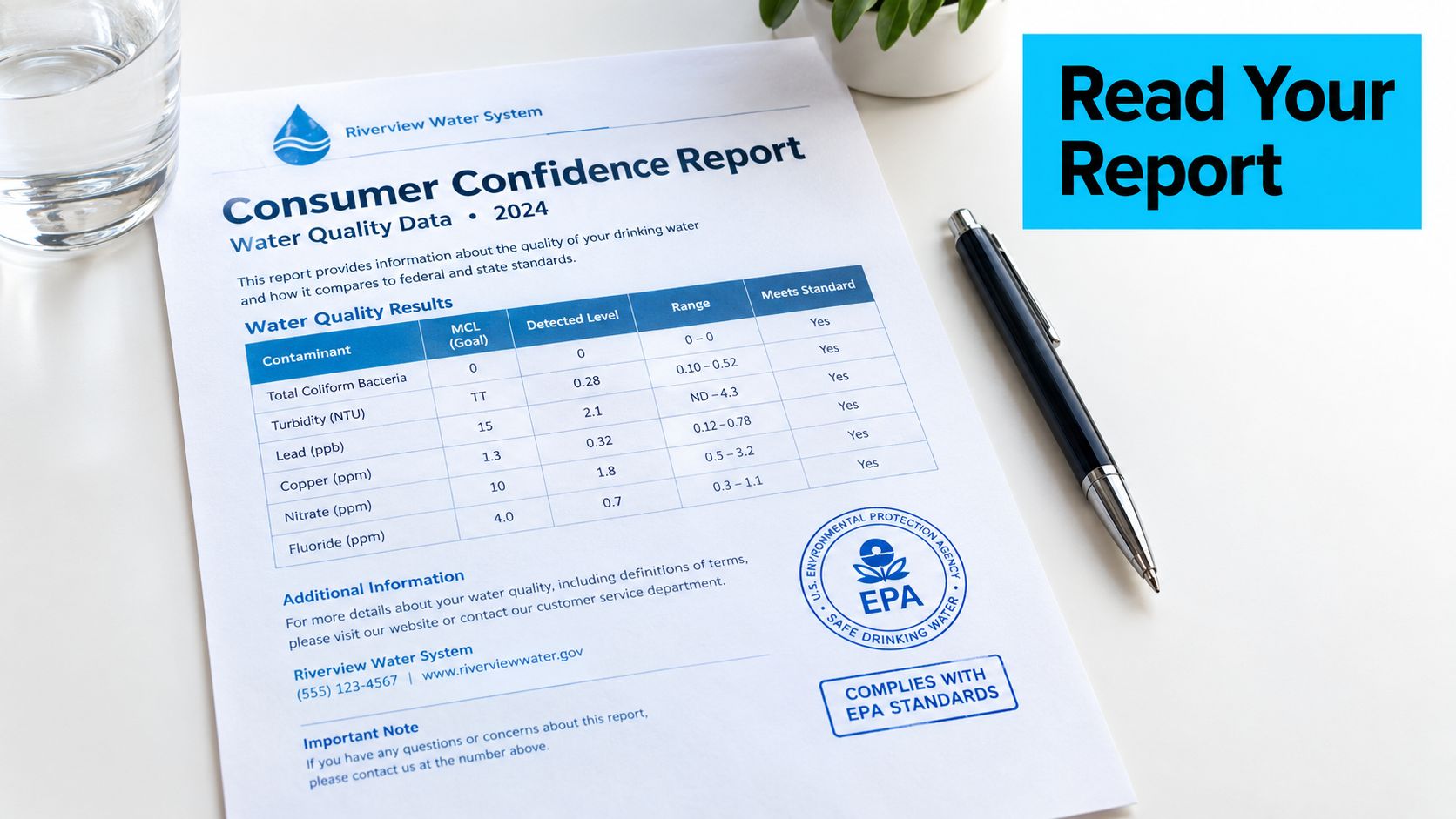
A Consumer Confidence Report, or CCR, gives you the utility's annual snapshot of regulated drinking-water quality. Don't read it as a product catalog for filters. Read it as a map that helps you decide what to investigate at home.
Start with the sampling table
Find the section listing contaminants that were detected or monitored. Identify the measurement unit, the reported range or result, the applicable limit, and any footnotes explaining sampling conditions.
Use this reading order:
- Find detected contaminants. Separate substances with a reported detection from substances listed only because the utility monitors them.
- Check the comparison value. Look for the applicable maximum contaminant level, action level, or other regulatory benchmark.
- Read the footnotes. A result may represent a particular sampling location, monitoring period, or calculation method.
- Look for violations. A violation is different from a contaminant being detected below its applicable limit.
- Check the source and treatment notes. These may explain whether the utility uses surface water, groundwater, disinfection, filtration, or other barriers.
A “detectable” result means the laboratory found the substance at or above its reporting capability. It doesn't automatically mean the water violates a standard. The relevant question is how the result compares with the applicable benchmark and whether the contaminant has a household-level pathway.
Use the report to choose what to test
Suppose the CCR shows a disinfection byproduct and your family notices a strong chlorine taste. A certified carbon filter may address the taste or odor, but you shouldn't assume that an aesthetic reduction claim covers every disinfection byproduct. Check the product's specific performance claims.
Lead requires a different reading strategy. The utility's distribution-wide information may not reveal what happens in your home's plumbing. Because EPA and CDC emphasize that lead has no safe level of exposure, a household test can help determine whether your faucet needs a targeted lead-reduction filter.
Read the CCR twice: First, identify regulated results. Then ask which results could change between the utility's sampling point and your glass.
Common Contaminants and Filtration Certifications
Filtration works best when you match one documented concern to one verified reduction claim. A filter that improves taste may not address lead, and a system that reduces lead may not be designed to remove every chemical, salt, or microbe.
The most useful comparison for many homes begins with NSF/ANSI standards. According to NSF's explanation of filtration standards, NSF/ANSI 42 is a voluntary standard for non-health-related issues such as chlorine, taste, odor, chloramine, particulate, iron, manganese, zinc, and TDS. NSF/ANSI 53 covers health-related contaminant reduction and includes more than 50 reduction claims.
Match the problem to the certification
| Household concern | What to verify | Typical filtration decision |
|---|---|---|
| Chlorine taste or odor | A certified chlorine-reduction claim | Point-of-use carbon for drinking water, or whole-house treatment when the concern affects many fixtures |
| Chloramine taste or odor | A specific chloramine claim, not merely a chlorine claim | Choose a system tested for chloramine reduction |
| Lead from plumbing | A specific NSF/ANSI 53 lead-reduction claim | Use point-of-use filtration at drinking and cooking taps, especially where testing identifies concern |
| Particulate or sediment | A particulate-reduction claim and suitable capacity | Use a sediment stage before finer treatment when the incoming water carries visible particles |
| TTHMs or another chemical | The exact contaminant claim and tested conditions | Select a filter whose certification covers that contaminant rather than relying on broad marketing language |
NSF/ANSI 42 and 53 don't mean every product removes every substance covered by those standards. Certification applies to specific claims. Read the performance data and confirm the contaminant name, installation position, replacement requirements, and rated capacity.
Why the filter format matters
An under-sink system concentrates treatment where your family drinks and cooks. It can be a sensible choice when the concern is a tap-specific plumbing issue or when you don't need to treat shower and laundry water.
A whole-house filter treats water at the entry point. That format may suit a home where chlorine odor, sediment, or another issue affects multiple fixtures, but it also treats a larger volume of water and requires attention to flow rate, pressure, bypass arrangements, and maintenance.
Carbon filtration can improve taste and reduce certain certified contaminants. Reverse osmosis can address a different group of dissolved substances, but homeowners shouldn't select it only because it sounds more advanced. The correct system is the one whose tested claim fits the result you're trying to change.
Purchase check: “NSF tested” isn't enough. Look for the exact contaminant reduction claim and verify that it applies to the model you're considering.
Taking Action and Installing Filters
Start with evidence from three places: your CCR, a faucet sample, and the product's certification documentation. A home test kit can provide an initial signal, while a qualified laboratory can offer more dependable contaminant-specific analysis when the result could affect a health decision.
Collect the sample exactly as instructed. For a plumbing-related concern such as lead, sampling conditions matter because water that has been sitting in a fixture can differ from water after the tap has run. If a result is surprising, repeat the test or ask the laboratory how to confirm it before choosing equipment.
Build a targeted filtration plan
Use this sequence:
- Name the contaminant or quality issue. “Bad water” isn't specific enough to guide a purchase.
- Identify where it enters. Source water, utility treatment, service lines, indoor plumbing, and fixtures require different responses.
- Choose the treatment location. Select point-of-use for drinking and cooking, or point-of-entry when the concern affects the whole home.
- Verify the exact certification claim. Check NSF/ANSI 42 for relevant aesthetic reductions and NSF/ANSI 53 for applicable health-related claims.
- Plan maintenance before installation. A filter only performs as intended when cartridges, membranes, seals, and prefilters receive the required attention.
If a remodel is already on your schedule, homeowners may find NoCo water filtration for remodels useful for coordinating plumbing access, cabinet space, drainage, and equipment placement before walls or counters close up. For broader guidance on testing, filter types, and maintenance, consult water filtration advice for homeowners.
Don't install equipment based on a single attractive label. Compare the lab finding with the CCR, confirm the certified claim, and make sure the system's flow and installation requirements suit your home. That process turns water quality standards into a practical decision at the faucet.
Water Filter Advisor helps households compare filtration systems, understand certifications, choose testing tools, and plan replacement and maintenance around real water-quality concerns. Visit Water Filter Advisor to connect your CCR or lab results with a focused home-filtration plan.
- September 25, 2026
- Uncategorized
