
You're probably here because your water is bothering you in a very normal homeowner way.
Maybe the drinking water tastes off. Maybe the shower leaves your skin feeling tight. Maybe the ice cubes smell faintly like a swimming pool. Or maybe you had your water tested and saw enough on the report to make you wonder whether you should stop thinking small and just filter everything.
That's where the idea of a reverse osmosis water filter whole house system gets attractive fast. It sounds like the ultimate answer. Clean water at every sink. Better water for showers, laundry, cooking, appliances, and drinking. No weak compromises.
I get the appeal. If you're already spending money and opening walls or reworking plumbing, why not go straight to the top shelf?
Because in real houses, the most powerful water treatment system isn't always the smartest one. Whole-house reverse osmosis can be the right move. It can also be a big, expensive machine solving a problem you don't have.
The Dream of Perfect Water from Every Tap
A lot of homeowners start in the same place. The kitchen faucet is the first thing that raises suspicion, but it rarely stays there. Once you start thinking about water quality, you notice everything else.
You notice the shower smell. You notice spots on dishes. You wonder what's running through the washing machine, the water heater, and every bathroom tap. Pretty soon, an under-sink filter starts to feel too small. You want one fix for the whole house.
Why whole-house RO sounds like the final answer
Whole-house reverse osmosis gets sold, and often discussed, as the closest thing to “perfect water” at home. That's not a crazy idea. RO is valued because it can target a broad range of dissolved contaminants that simpler filters often don't handle well.
If your concern is serious dissolved contamination, that matters. A basic carbon filter can help with chlorine, taste, and odor. Reverse osmosis lives in a different category. It's the system people look at when they want a much deeper level of treatment.
Whole-house RO is the kind of system people ask about when they're tired of partial fixes.
That said, homeowners often jump to it before answering the boring question that saves the most money: What problem are you trying to solve?
The real decision most people skip
If your home uses well water with difficult chemistry, whole-house RO may deserve a hard look. If you're on municipal water and your main complaints are chlorine smell, taste, or general “city water” annoyance, a full-house RO setup may be more machine than you need.
That distinction matters because public-health guidance still frames RO primarily as a point-of-use treatment method, not the standard whole-house default. The gap is practical. A lot of advice online jumps from “RO removes a lot” to “therefore every home should have whole-house RO,” and that's a leap.
For many families, the smartest water setup isn't “RO everywhere.” It's targeted filtration where it counts most, plus simpler treatment for the rest of the house.
How a Whole House RO System Actually Works
A whole-house RO system is a point-of-entry setup. That means it treats water as it enters the home, before that water heads out to sinks, showers, toilets, and appliances.
The heart of the system is the RO membrane. A whole-house reverse osmosis system uses a high-pressure pump to force water through a semi-permeable membrane, and the membrane pore size can be as small as 0.0001 microns according to Canney's explanation of whole-house RO operation. That's why RO can remove dissolved salts and many other contaminants instead of just catching visible particles.
Think of the membrane like a bouncer
The easiest way to picture it is a nightclub door with a very picky bouncer.
Water molecules get through. A lot of dissolved junk doesn't.
That's the big difference between RO and simpler filters. A sediment filter is more like a screen door. It catches grit and debris. An RO membrane is much more selective, which is why it needs pressure and a more complex system around it.
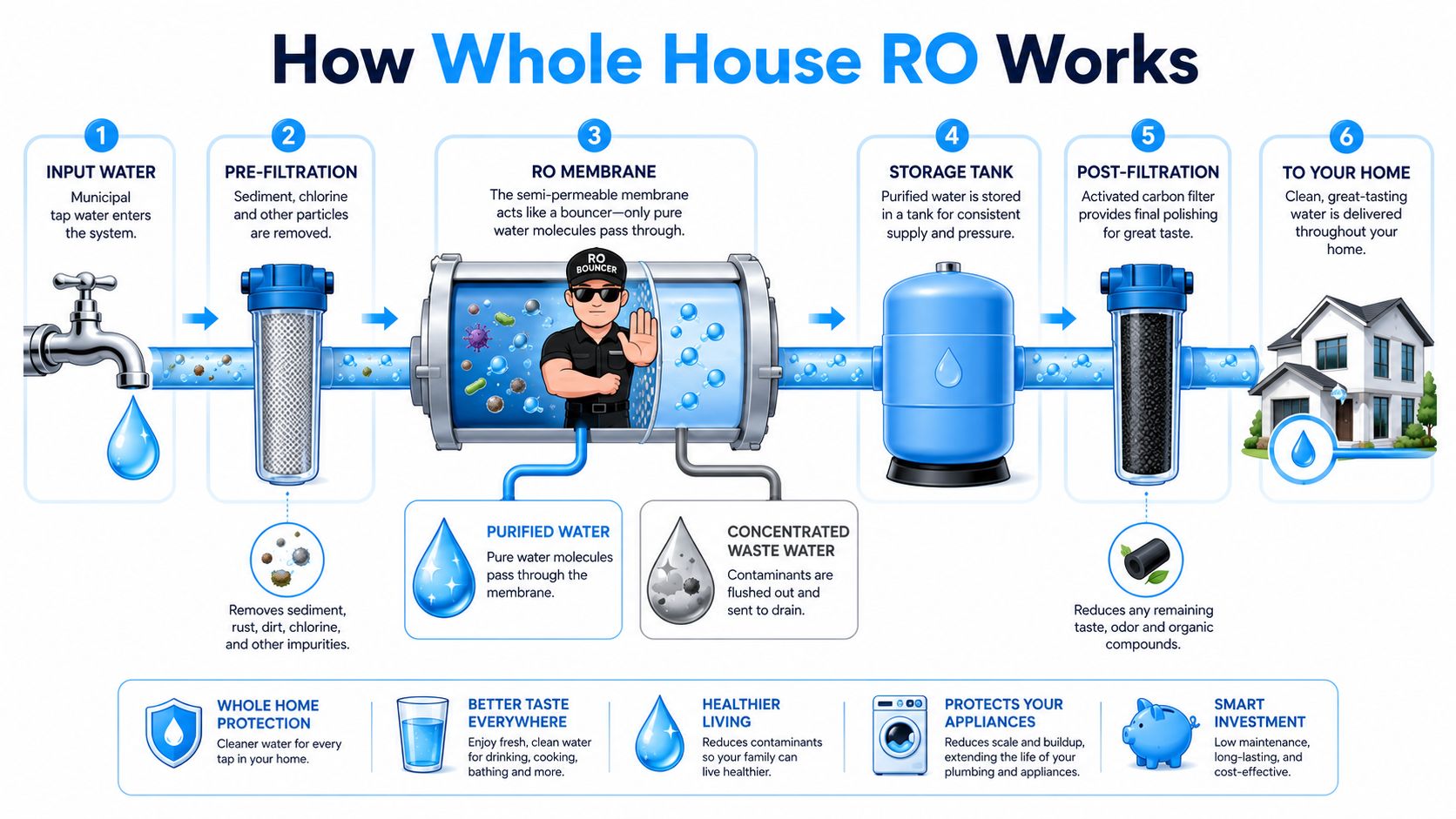
The parts that make the system work
A proper whole-house RO setup usually includes several working pieces, not just one filter canister.
- Pre-filters: These handle sediment and other material that could foul or damage the membrane.
- High-pressure pump: This is the muscle. Without pressure, RO doesn't do its job.
- RO membrane: Dissolved contaminants are separated from the cleaner water stream here.
- Storage tank: The system needs somewhere to hold treated water so the house can draw from it when demand spikes.
- Delivery pump: This pushes stored water back into the house at usable pressure.
- Post-filter: Often carbon, this gives the finished water a final polish.
Why the tank and pump confuse homeowners
Many individuals expect water treatment to work like a simple pass-through device. Water goes in, water comes out.
Whole-house RO isn't that kind of system.
RO treatment takes effort and time. It doesn't instantly make huge volumes of purified water on demand the way a plain pipe can deliver untreated municipal water. That's why storage matters. The system slowly builds a supply of treated water, then the delivery side sends it through the home when you open a faucet or start a shower.
Practical rule: If you're thinking about a reverse osmosis water filter whole house system, think “equipment room,” not “single filter.”
The other concept that trips people up is reject water. RO doesn't split all incoming water into usable product water. Some water carries concentrated contaminants away from the membrane. That's part of how the system protects itself and keeps the separation process working.
The Pros and Cons of Going All In on RO
A whole-house RO system can sound like the perfect answer. Cleaned water at every tap, every shower, every appliance.
That promise is real. So are the trade-offs.
Before you commit to treating every gallon that enters the house, it helps to ask a plumber's question instead of a marketing question. What problem are you trying to solve, and do you need this much treatment everywhere?
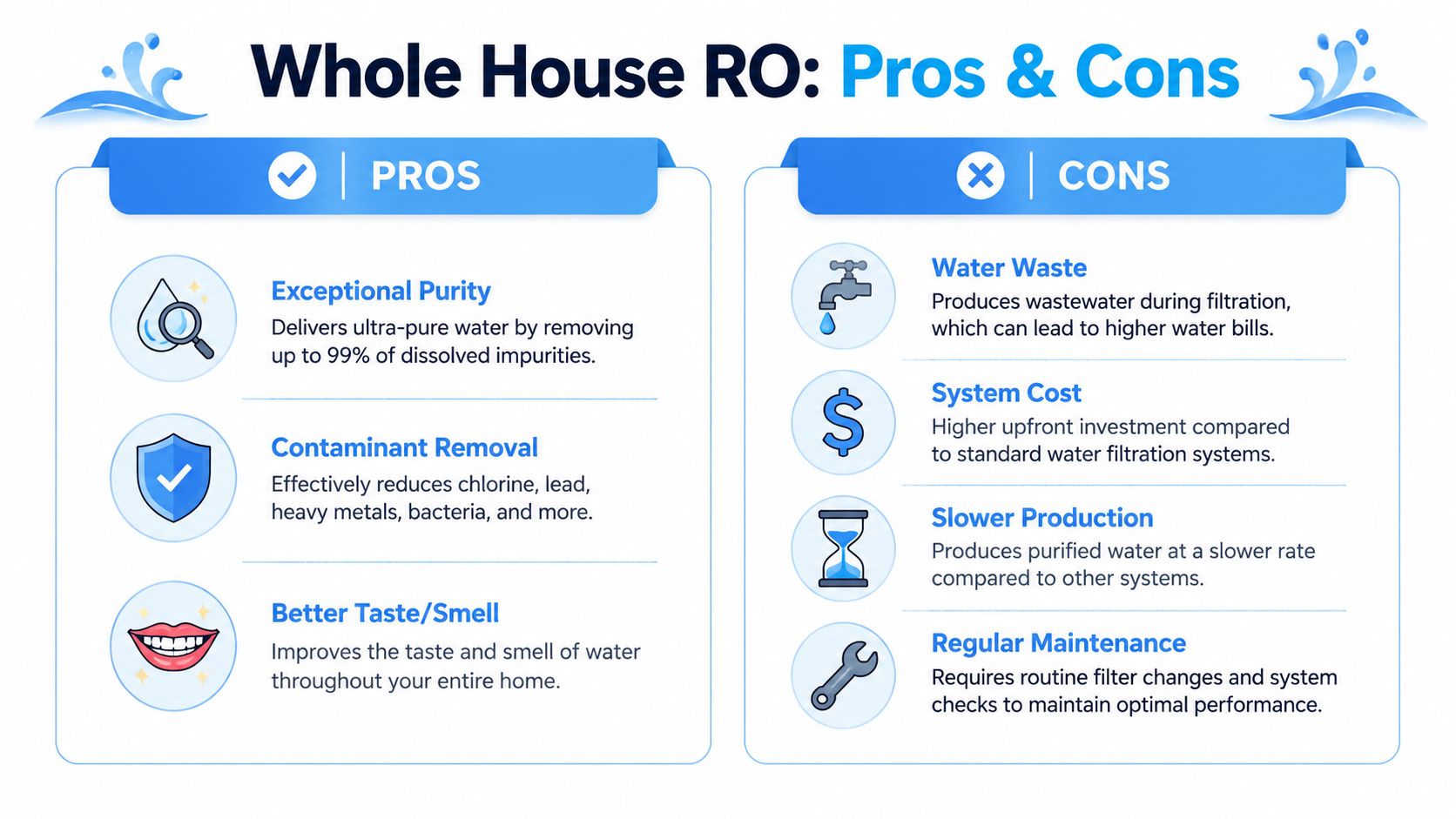
What makes whole-house RO so appealing
Reverse osmosis earns its reputation because it can reduce a wide range of dissolved contaminants that simpler filters may miss. Consumer Reports' water filter buying guide describes RO as one of the stronger options for reducing dissolved solids and contaminants such as lead, arsenic, nitrates, and some PFAS.
That matters if your water problem goes beyond chlorine taste or a musty smell. A carbon filter can improve taste and odor. RO goes after the dissolved material mixed into the water itself.
For some homes, that broader treatment brings real peace of mind. If you have troubling lab results, or you want better water feeding fixtures and water-using appliances throughout the house, whole-house RO can solve a bigger problem than an under-sink unit can.
Still, broad treatment is not always smart treatment. Cleaning every drop to a very high level can be a lot like buying hospital-grade air handling because one room gets dusty. It works, but the cost and complexity may not match the actual problem.
Here's a quick visual breakdown before the trade-offs get muddy.
The drawbacks that change the conversation
Whole-house RO asks more from your home than many buyers expect.
You are not only paying for filtration media and a membrane. You are paying for a system that needs space, drain connections, routine service, storage capacity, and enough support equipment to keep water moving through the house at usable pressure. If one part is undersized, the whole setup feels disappointing.
Water efficiency is the other big reality check.
The Water Quality Association explains that reverse osmosis creates a treated-water stream and a concentrate stream that carries rejected contaminants away from the membrane in its overview of reverse osmosis and water efficiency. In plain English, RO works more like sorting than straining. Some water becomes product water. Some water is used to flush the dissolved material away so the membrane can keep working.
That does not mean every whole-house system wastes the same amount of water. Design, recovery rate, controls, and pretreatment all affect performance. But it does mean reject water is built into how RO works, not a small footnote.
Pressure can also surprise homeowners. A whole-house RO setup is a bit like filling a large cooler slowly, then using a pump so the house can draw from it at a normal pace. If the system is poorly designed, showers, tubs, and simultaneous water use can expose its limits fast.
Pros and cons in plain language
| Side | What it means in real life |
|---|---|
| Pro | Reduces dissolved contaminants that basic sediment or carbon filters may leave behind |
| Pro | Improves drinking and cooking water when dissolved solids are part of the problem |
| Pro | Sends treated water to more than one fixture, not just the kitchen sink |
| Con | Takes more room and more installation planning than many homeowners expect |
| Con | Usually needs tanks, pumps, and controls to keep water available at a usable rate |
| Con | Maintenance is ongoing because several parts need service, not just one cartridge |
| Con | Produces reject water as part of normal operation, so efficiency matters |
| Con | Can solve a bigger problem than the house actually has, which raises cost fast |
A simple rule helps here. Whole-house RO makes sense when the water issue is serious, confirmed by testing, and affects the whole home.
If your main complaint is drinking-water taste, chlorine, or one or two contaminants at the kitchen tap, going all in on RO can be more system than you need.
Is Whole House RO Overkill for Your Home
For a lot of homes, yes, it is.
That doesn't mean whole-house RO is bad. It means the right filtration system should match the actual water problem, not the homeowner's anxiety after a late-night internet search.
A major missing piece in many buying guides is exactly this question. Practical coverage often skips whether whole-house RO is right for typical municipal-water homes, even though EPA guidance frames RO primarily as point-of-use technology. National Water Service makes that gap clear in its discussion of whole-house RO pros and cons.
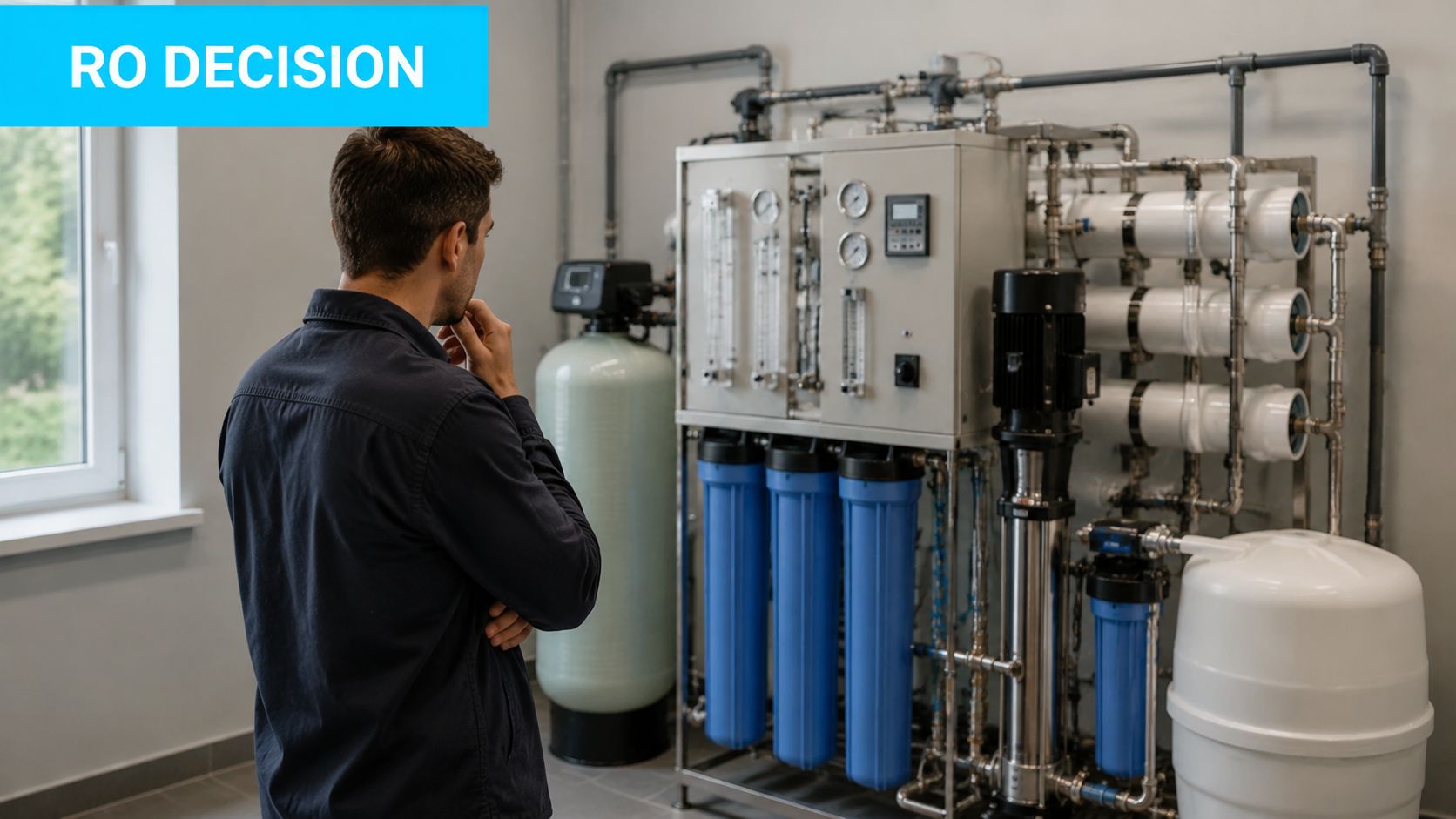
When whole-house RO makes more sense
If you're on well water and the test results show dissolved contaminants that need aggressive treatment, whole-house RO moves from “fancy option” to “serious candidate.”
That's because a private well can present issues across the whole home, not just at the kitchen sink. If the incoming water itself needs heavy treatment before anyone drinks it, showers in it, or runs it through equipment, a point-of-entry solution becomes easier to justify.
When it's often too much
If you're on municipal water and your main complaints are:
- Chlorine smell: A carbon-based whole-house system often addresses this more directly.
- Taste issues at the sink: A point-of-use RO unit may solve the part you drink.
- General improvement everywhere: A whole-house carbon filter can improve shower and tap experience without treating every gallon to RO level.
Municipal-water homes often need better-targeted filtration, not maximum filtration.
A simple homeowner checklist
Ask yourself these questions before you shop:
What did the water test show?
If you don't have a clear test result, you're guessing.Is the problem whole-house or point-of-use?
Drinking water and shower water don't always need the same treatment strategy.Am I trying to remove dissolved contaminants or improve taste and odor?
Those are different jobs.Do I want RO water from toilets, laundry lines, and outdoor fixtures?
Some homeowners do. Many realize they don't.
The biggest money-saving insight in this whole topic is simple. You do not need the most advanced system available. You need the system that matches your water.
Smarter Alternatives to Whole House Filtration
A lot of homeowners reach this point and realize they were aiming a very large solution at a much smaller problem.
If the complaint is, "I want better water to drink, better-smelling showers, and less chlorine taste," you usually do not need reverse osmosis at every fixture. Treating every gallon to RO level can be a bit like buying bottled water for the washing machine. It works, but it is often more treatment, cost, and maintenance than the house needs.
Option one. Under-sink RO where you drink it
If your biggest concern is drinking and cooking water, start at the kitchen sink.
An under-sink RO system treats the water you consume most. That keeps the purified water focused on coffee, ice, pasta pots, baby formula, and glasses at the table, instead of sending RO water to toilets, hose bibs, and the laundry line. For many municipal-water homes, that is the most sensible place to use RO.
The waste side matters too. Point-of-use RO still sends some water to drain as part of the process, but keeping RO at one sink usually makes that trade-off easier to live with than processing the entire house. If earlier numbers about RO efficiency caught your attention, that is exactly the reason to ask a simpler question first. Do you need purified water everywhere, or mainly where people drink it?
Option two. Whole-house carbon for comfort throughout the home
Whole-house carbon is often the better match when the water is safe to drink but unpleasant to live with.
This setup is commonly used to reduce chlorine taste and odor, improve shower experience, and make tap water feel less harsh around the house. It does not try to strip out dissolved solids the way RO does. That is the point. Carbon handles a different job, and for many city-water homes, it is the more direct tool.
Homeowners usually notice the difference in the places they use every day. Morning showers smell better. Bathroom sinks are more pleasant. Cooking water tastes cleaner before you ever get into specialty treatment.
Option three. A hybrid setup that matches how families actually use water
For a lot of homes, the practical sweet spot is a split approach.
Use a whole-house carbon system at the main line for everyday water quality and an under-sink RO unit at the kitchen for drinking and cooking. That gives you broad improvement across the house without asking an RO membrane to handle every flushed toilet and every load of towels.
It also keeps equipment sizing more reasonable. Smaller RO systems are usually easier to service, and they avoid some of the pressure and storage complications that show up when RO is asked to feed an entire house.
A smart middle ground: whole-house carbon for comfort, under-sink RO for the water you consume most.
Filtration system comparison
| Filtration Type | Best For | Average Cost (System + Install) | Water Waste | Key Benefit |
|---|---|---|---|---|
| Whole-house RO | Homes with serious dissolved contaminant concerns across the entire water supply | Higher than simpler systems | Part of RO design, varies by system and setup | Deep treatment at the point of entry |
| Under-sink RO | Drinking and cooking water | Lower than whole-house RO | Present, but limited to one use point | High-purity water where you use it most |
| Whole-house carbon | Chlorine, taste, odor, and overall comfort | Often simpler than whole-house RO | None in the RO sense | Improves water at every tap |
| Hybrid system | Families wanting better whole-house water plus purified drinking water | Mid-range compared with full-house RO | Limited to the point-of-use RO portion | Balanced, targeted treatment |
One more practical note. Some whole-house systems need added electrical support for pumps or controls, so installation planning can overlap with home power work such as electrical panel installation.
If you want a plain-English way to compare filter types, maintenance needs, and common use cases, Water Filter Advisor's water filtration advice library is a helpful reference.
Your Whole House RO Buyer and Installation Checklist
You are standing in the utility room with a contractor, looking at tanks, pipes, a drain line, and maybe a booster pump, and the project suddenly feels a lot bigger than "buy a filter." That moment is useful. It pushes you to ask the right question: do you indeed need whole-house RO, or are you about to pay for treatment your home does not need at every tap?
If you have already tested your water and still have a clear reason to treat the full supply, a careful checklist can save you from an expensive mismatch. Whole-house RO can work very well, but only when the equipment fits both the water and the house.
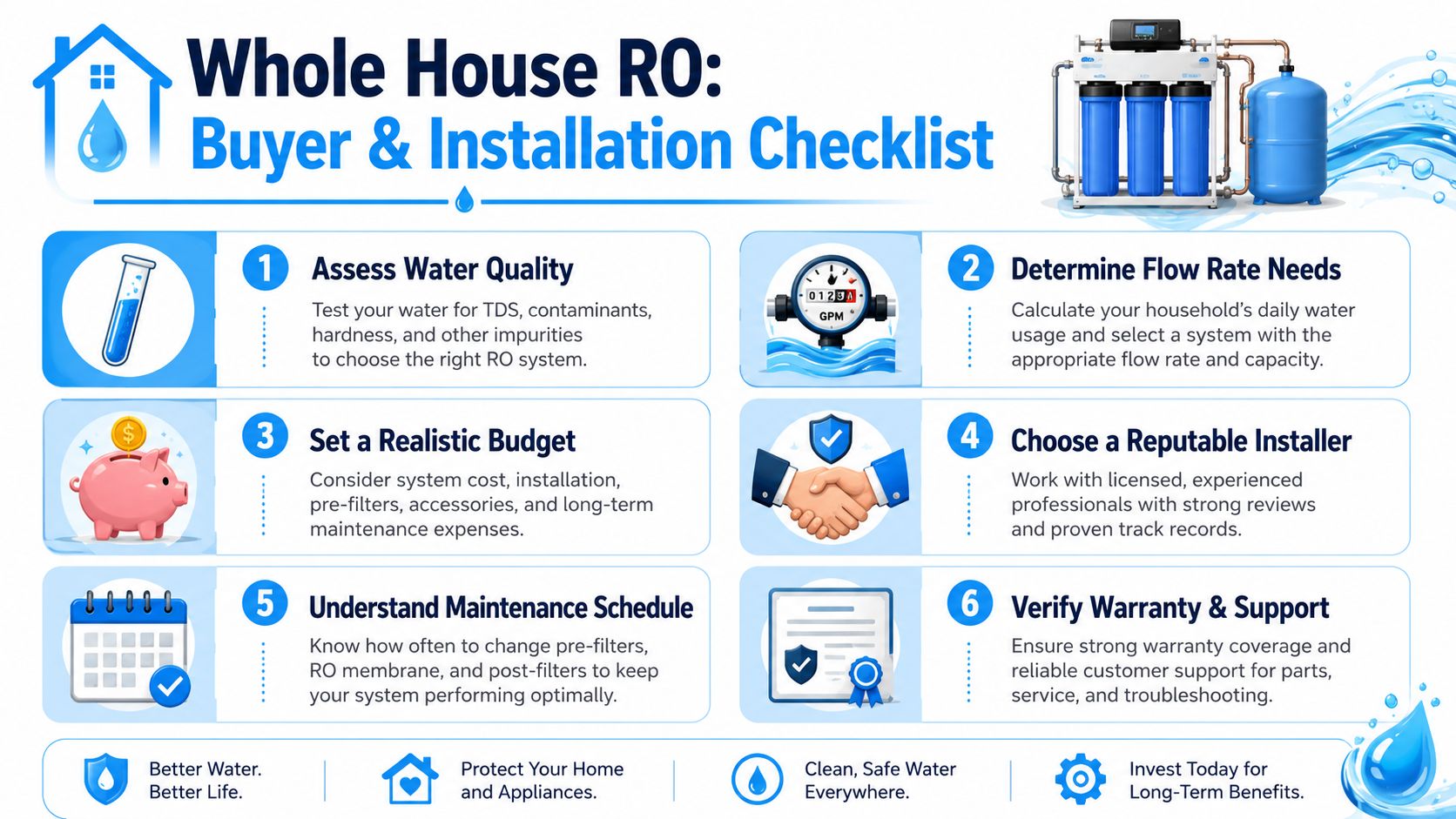
Start with the water test
A lab test comes first.
Without it, you are guessing about the one thing the system is supposed to fix. Smell, taste, and a neighbor's opinion can point to a problem, but they cannot tell you whether dissolved contaminants are serious enough to justify whole-house RO instead of a simpler setup.
The test also helps answer a question many homeowners skip. Is RO even the right tool here? If your main complaint is chlorine taste or odor, full-house RO may be more system than you need.
Match the system to your daily water use
Do not shop by bathroom count alone. Look at how your home uses water.
A family that runs two showers, a washing machine, and a dishwasher around the same time needs a different setup than a couple with lighter habits, even if both homes are the same size. Whole-house RO relies on storage and delivery equipment, so sizing is a little like planning a pantry. You do not shop only for the meal in front of you. You plan for the busy days too.
Ask the installer how they are sizing the system for your peak use, not just your average day.
Understand recovery and drain planning in plain English
RO does not turn every gallon coming in into a gallon going back out to the house. Some water carries the rejected contaminants away to drain.
That is normal. A better way to picture it is rinsing dirt off a screen. The rinse water is part of how the screen stays clear enough to keep working. For a whole-house system, that affects drain routing, storage capacity, and operating cost, so it should be explained clearly before you buy.
If a contractor gets vague here, slow down and ask more questions.
Check the house, not just the equipment sheet
A whole-house RO system needs room to live and room to be serviced. Tanks need floor space. Filters and membranes need access. Pumps and controls may need power nearby.
Some installations also involve home electrical planning, especially if the system uses pumps or added controls. In that case, related work such as electrical panel installation can become part of the project if the existing panel is already crowded or not well set up for new equipment.
A cramped corner can turn simple maintenance into an awkward, recurring mess.
Ask questions that reveal whether the design is sensible
Use this checklist during quotes and walkthroughs:
- Get the water test in writing: Do not approve a system based on a sales pitch alone.
- Ask why whole-house RO is being recommended: The installer should explain why a smaller point-of-use RO or a whole-house carbon system would not solve the problem.
- Review pretreatment needs: Membranes last longer when sediment, chlorine, hardness, or other upstream issues are handled properly first.
- Confirm peak flow planning: Ask what happens during back-to-back showers or heavy evening water use.
- Look at the drain route: The waste line needs a practical, code-compliant path.
- Check service space: A future filter change should not require dismantling half the mechanical room.
- Ask about replacement parts and local service: You want filters, membranes, and support that are easy to get.
- Get maintenance expectations in plain language: Know what gets changed, how often, and who will do it.
If you want a straightforward reference for comparing system types, upkeep, and common use cases, Water Filter Advisor's water filtration advice library is a useful place to keep researching before you sign anything.
The best whole-house RO install is usually the one that still makes sense after the sales meeting is over. If the design feels oversized, vague, or hard to maintain, that is often a sign to reconsider whether full-house RO is the smart choice for your home.
Frequently Asked Questions About Whole House RO
Does whole-house RO hurt water pressure
It can affect how the system feels if it isn't designed well.
RO treatment needs pressure to work, and whole-house systems rely on storage and pumping to deliver treated water back through the house in a usable way. If the equipment is undersized or poorly installed, homeowners notice it at the shower first. Good design is what keeps the system from feeling sluggish.
Does RO water taste too flat
Some people think it does.
That usually comes down to preference. RO strips out a lot of dissolved material, and that can change the taste profile. Some homeowners like the very clean taste right away. Others prefer adding a remineralization stage after treatment to give the water a different finish.
Can I install a whole-house RO system myself
Most homeowners shouldn't.
This isn't the same level of project as swapping an under-sink cartridge or hanging a shower filter. Whole-house RO involves plumbing layout, drain planning, pumps, storage, and enough system interaction that mistakes can get expensive fast. A skilled DIY homeowner may be comfortable with portions of the work, but most families are better off using a qualified water-treatment installer and plumber.
Is whole-house RO worth it for city water
Sometimes, but not automatically.
If municipal water testing shows a real dissolved-contaminant problem, the answer may be yes. If the main issue is chlorine taste, odor, or general water comfort, many homes are better served by a simpler setup such as whole-house carbon or a hybrid system.
What's the best mindset before buying
Treat whole-house RO like a medical prescription, not a luxury upgrade.
You want it because your water and your goals justify it, not because it sounds like the strongest option on the shelf. The best water filtration plan is rarely the most extreme one. It's the one that solves the actual problem without adding unnecessary complexity.
If you're comparing whole-house RO, under-sink RO, carbon systems, or hybrid setups, Water Filter Advisor is a practical place to keep researching. It focuses on helping homeowners choose filtration based on their water source, contaminants, and maintenance needs instead of defaulting to a one-size-fits-all answer.
- June 21, 2026
- Uncategorized
